SoFi Blog

Tips and news—
for your financial moves.

October 2025 Market Lookback

A Shutdown to Trump All Others

The federal government officially entered a shutdown at 12:01 a.m. ET on Oct. 1, the 11th such event involving furloughs in U.S. history. As usual, the lapse in federal funding stems from partisan politics. The shutdown is on track to become the longest government shutdown in U.S. history, surpassing the 35-day record set in 2018-19.

The human and economic costs are vast and grow more severe the longer they last.
The Bipartisan Policy Center estimates that 670,000 federal employees have been furloughed, while another 730,000 are required to work without pay. Exact figures are hard to pin down, but consensus suggests that shutdowns lower GDP by 0.1 to 0.2 percentage points for every week they go on.

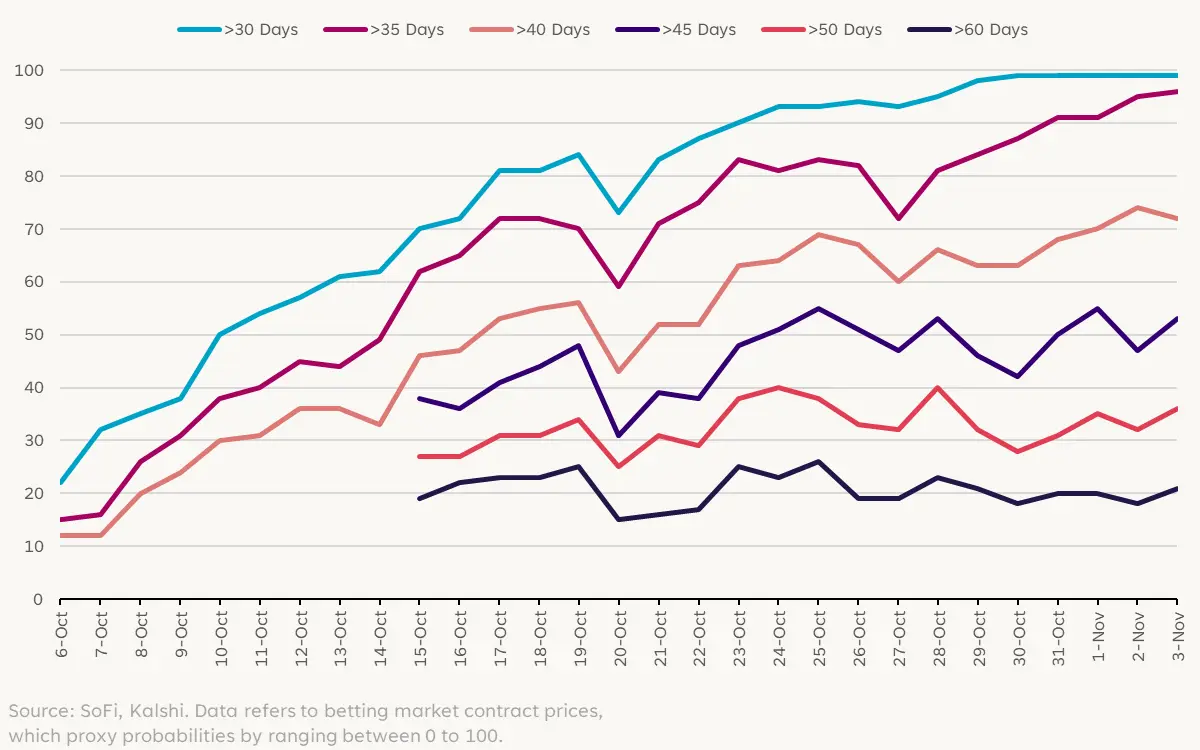
It’s already lasted over four weeks, and betting markets suggest roughly even odds that the shutdown lasts somewhere between 45 and 50 days, which would bring us to mid-November — a little over a week before Thanksgiving. Though shutdowns have historically had a limited and temporary impact on the stock market, the longer this one lasts, the harder it is to imagine it not being consequential.

How Many Days Will the Government Be Shut Down This Year?
Euphoria: Earned or Borrowed?

Last month, while Washington grappled with internal dysfunction (what’s new?), the market was focused on other things.

Trade tensions with China briefly ratcheted higher when President Trump threatened the country with an additional 100% tariff. Stocks initially fell sharply on the news, but two things may have led to a fairly quick reversal. First, Trump began to walk back the threat in a move reminiscent of TACO summer. Perhaps more importantly, however, earnings season began, and the results were mostly stellar. This helped offset macroeconomic uncertainty and reinforced the powerful narrative around artificial intelligence, which has driven investor optimism all year long.

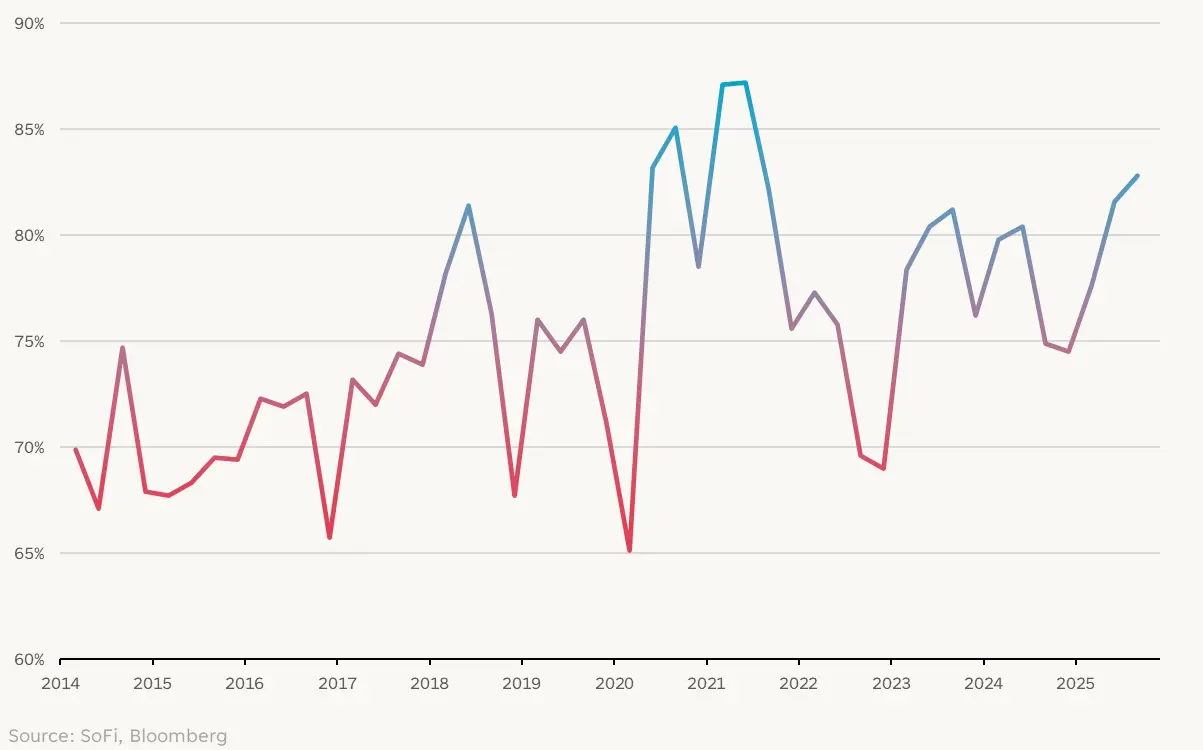
The strength of Q3 2025 earnings season was evident. With nearly half of S&P 500 companies reporting in October, 82.8% reported higher-than-expected earnings per share, substantially above the 5-year and 10-year averages of 78.6% and 76.3%, respectively. If sustained for the rest of the Q3 earnings season, that would mark the best performance since the second quarter of 2021.

Alongside this fundamental strength, the market turned notably speculative. Lower quality and higher beta stocks surged, with investors increasingly willing to chase momentum in a possible sign of fear of missing out (FOMO).

% of Companies With Positive EPS Surprises
Market Recap

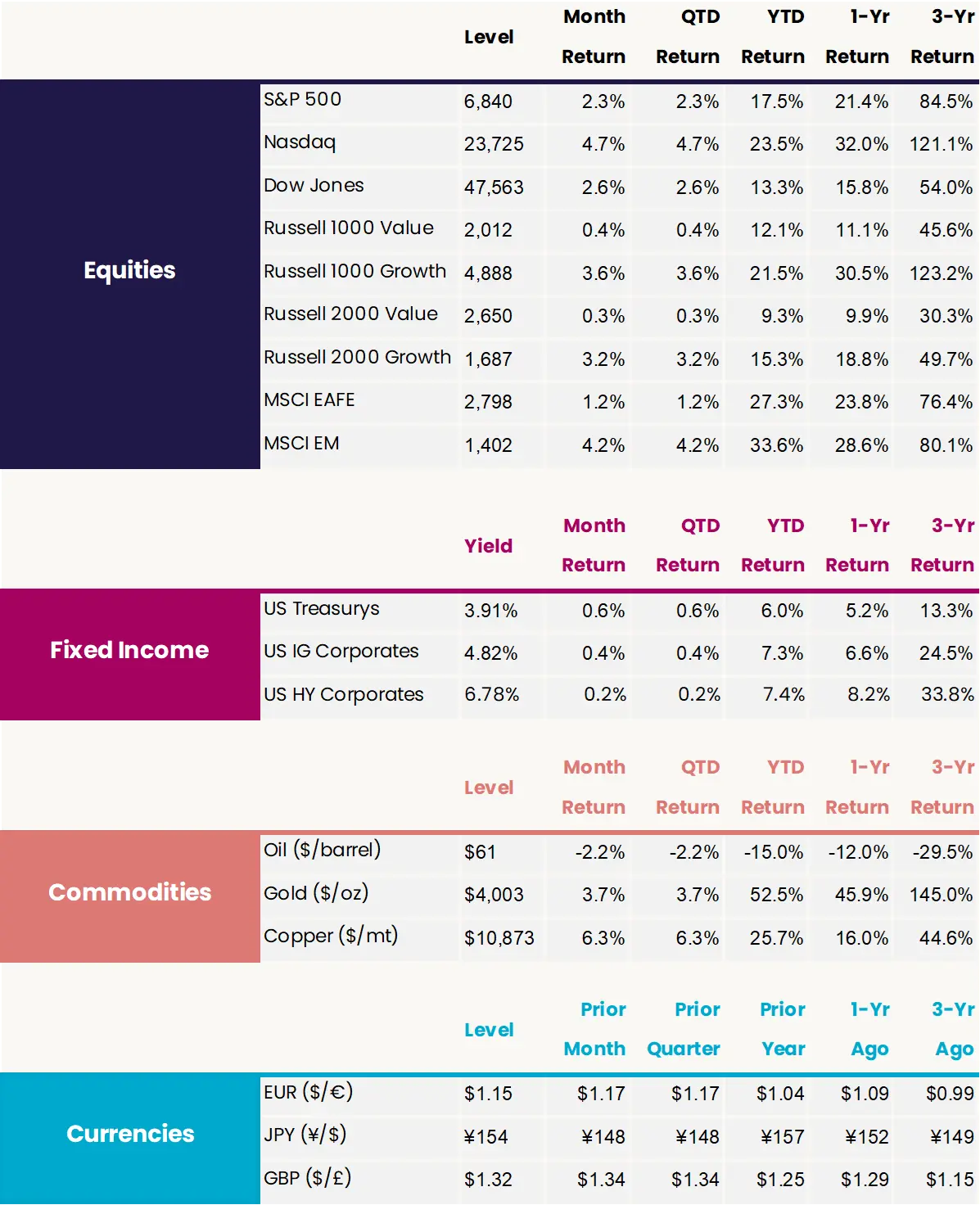
Asset Returns

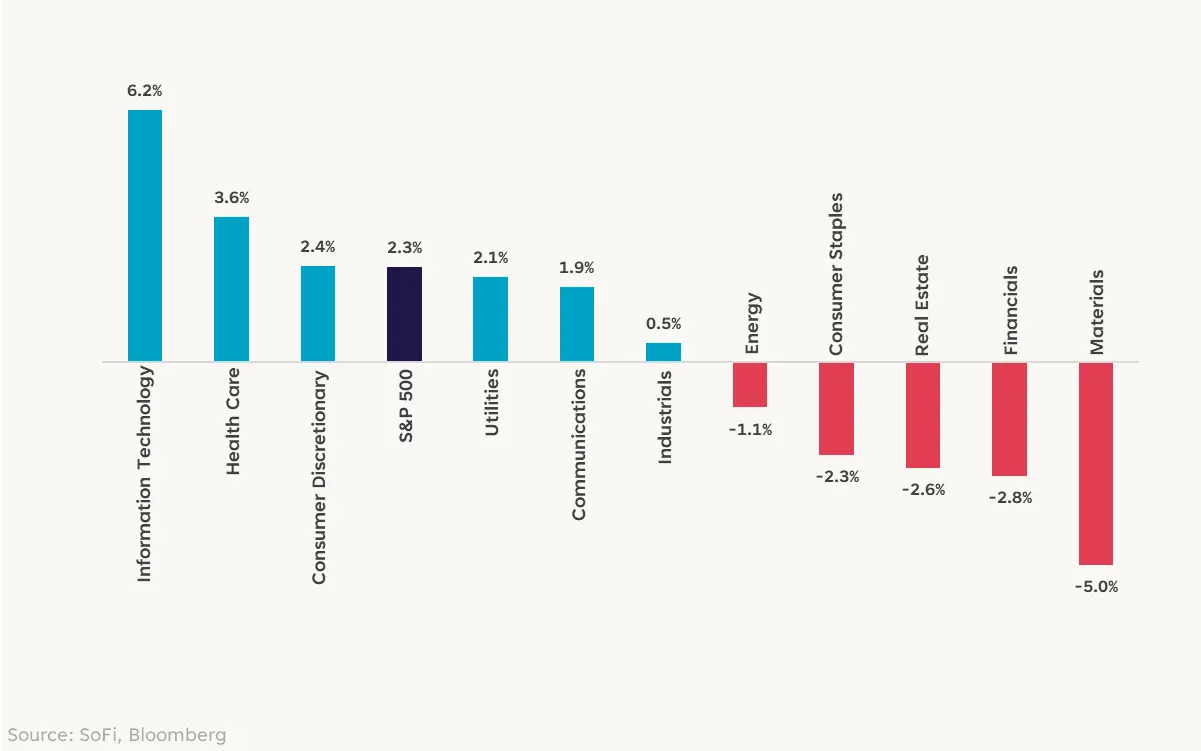
October 2025 Sector Total Returns
Macro

•  Federal funding lapsed on October 1, the start of the fiscal year, leading to the U.S. government shutting down.

•  The Federal Reserve lowered its benchmark interest rate by 25 basis points to a target range of 3.75%-4%. Two dissents to the decision were noted, with one official preferring a 50 basis point cut and the other preferring no cut.

•  The Fed also announced it would end balance sheet runoff on December 1, reinvesting any proceeds from maturing Treasurys and mortgage-backed securities into Treasury bills.

•  The September Employment Situation Report, in addition to most official economic data, was not released due to the ongoing government shutdown.

•  September CPI came in at 0.3% m/m and 3.0% y/y, the highest annual rate since January.

•  In one of its most volatile months ever, gold rose 14.3% to $4,381 on October 20 and then proceeded to decline 11.3% to $3,886 on October 28, before ending the month up 3.7%.

Equities

•  With over 65% of the S&P 500 having reported results, the earnings surprise rate stands at 8.6%, in-line with the five-year average.

•  The Information Technology sector beat the broader market by 3.9 percentage points, its sixth month of outperformance in the last seven.

•  Emerging market stocks rose 4.2% despite dollar appreciation, powered by strong tech sector gains from Taiwan and South Korea.

•  Cyclical stocks underperformed defensives by 2.1 percentage points through October 22, before then outperforming by 4.3 percentage points and finishing the month ahead, the sixth consecutive such month.

Fixed Income

•  Though High Yield corporate bond spreads ended the month at 267 basis points (exactly where they began the month), they briefly widened to 304 basis points on October 10 after President Trump’s 100% tariff threat on China.

View PDF


Performance data quoted represents past performance. Past performance does not guarantee future results. Market returns will fluctuate, and current performance may be lower or higher than the standardized performance data quoted.

Communication of SoFi Wealth LLC an SEC Registered Investment Adviser. Information about SoFi Wealth’s advisory operations, services, and fees is set forth in SoFi Wealth’s current Form ADV Part 2 (Brochure), a copy of which is available upon request and at www.adviserinfo.sec.gov. Mario Ismailanji is a Registered Representative of SoFi Securities and Investment Advisor Representative of SoFi Wealth. Form ADV 2A is available at www.sofi.com/legal/adv.

Read more

Week Ahead on Wall Street: More Unknown

If this were a normal week, we’d be talking about the Friday jobs report, the state of the economy, and the possibility that the Federal Reserve won’t lower interest rates again in December, especially in light of Chair Jerome Powell’s comments last week.

But it’s not a normal week. The government has officially been shut down for over a month now, leaving investors without much of the economic data they rely on.

Still, we’re not without any signposts.

First, the third-quarter earnings season continues. Though the peak of the mega-cap tech reports is behind us, 136 companies are still set to release their results this week, accounting for over 11% of the S&P 500’s market capitalization. These reports remain a crucial source of insights into corporate health and any burgeoning trends.

Second, with last week’s Fed meeting now in the rearview mirror, Fed officials are no longer in their blackout period. We can expect to hear from several policymakers this week, and any color they provide on what they are seeing in the economy will be a major focus for the market, especially in light of the two dissenting votes last week – one for a 50-basis-point cut and one for no cut at all.

In short, uncertainty is high, and until a resolution in Washington reopens the government, the market backdrop will likely continue to be defined more by what we don’t know than what we do know.

Economic and Earnings Calendar

Note: This list includes all regularly scheduled reports, but most that involve government data will not be released while the shutdown is ongoing.

Monday

•  October ISM Manufacturing PMI: This index from the Institute for Supply Management tracks how purchasing managers across the manufacturing sector feel about the business environment.

•  September Construction Spending: Construction data is a leading indicator of business activity.

•  October Wards Total Vehicle Sales: Cars are a big ticket item for consumers, so underlying vehicle sales trends can help shine a light on demand for durable goods.

•  Fedspeak: San Francisco Fed President Mary Daly will take part in a moderated conversation at Forum Club of the Palm Beaches, followed by Q&A. Fed Governor Lisa Cook will discuss the economic outlook and monetary policy at a Brookings Institution event.

•  Earnings: Clorox (CLX), Coterra Energy Inc (CTRA), Eastman Chemical (EMN), Diamondback Energy (FANG), Hologic (HOLX), IDEXX Laboratories (IDXX), Loews (L), Realty Income (O), ON Semiconductor (ON), Public Service Enterprise Group (PEG), Palantir Technologies (PLTR), Pinnacle West Capital (PNW), SBA Communications (SBAC), Simon Property Group (SPG), Vertex Pharmaceuticals (VRTX), Williams Companies (WMB)

Tuesday

•  September Trade Balance: Trade, made up of exports and imports, is an important driver of economic activity.

•  September Job Openings: A key measure of business demand for labor is the number of job openings, since reducing openings is easier and preferable to layoffs.

•  September Factory and Durable Goods Orders: These metrics give insight into underlying trends for leading cyclical indicators.

•  Earnings: Archer-Daniels-Midland (ADM), AES (AES), Aflac (AFL), American International Group (AIG), Assurant (AIZ), Advanced Micro Devices (AMD), Amgen (AMGN), Arista Networks (ANET), Apollo Global Management, Inc (APO), Axon Enterprise (AXON), Ball (BALL), Broadridge Financial Solutions (BR), CDW (CDW), Corteva (CTVA), Eversource Energy (ES), Eaton Corp (ETN), Exelon (EXC), Expeditors International of Washington (EXPD), Global Payments (GPN), Henry Schein (HSIC), International Flavors & Fragrances (IFF), Gartner (IT), Jack Henry & Associates (JKHY), Leidos Holdings (LDOS), Live Nation Entertainment (LYV), Marriott International (MAR), Martin Marietta Materials (MLM), Mosaic (MOS), Marathon Petroleum (MPC), Match Group (MTCH), Norwegian Cruise Line Holdings (NCLH), Pfizer (PFE), Super Micro Computer (SMCI), Stanley Black & Decker (SWK), Skyworks Solutions (SWKS), Molson Coors Brewing (TAP), Uber (UBER), Waters (WAT), YUM! Brands (YUM), Zoetis (ZTS)

Wednesday

•  October ADP Employment Report: This survey, usually released a day or two before the official government jobs report, offers insight into private sector employment trends.

•  October S&P Global US PMIs: These indexes track how purchasing managers across different industries feel about the business environment.

•  October ISM Services PMI: This index from the Institute for Supply Management tracks how purchasing managers across different services industries feel about the business environment.

•  Weekly Mortgage Applications: Mortgage activity gives insight on demand conditions in the housing market.

•  Earnings: Ameren (AEE), Albemarle (ALB), Allstate (ALL), Amcor PLC (AMCR), APA Corp (APA), AppLovin (APP), Atmos Energy (ATO), Bunge Global S.A. (BG), CF Industries Holdings (CF), AmerisourceBergen (COR), Corpay (CPAY), Charles River Laboratories International (CRL), DoorDash (DASH), Devon Energy (DVN), Emerson Electric Co (EMR), Fair Isaac (FICO), Fidelity National Information Services (FIS), Fortinet (FTNT), Robinhood (HOOD), Host Hotels & Resorts (HST), Humana (HUM), Iron Mountain (IRM), Johnson Controls International (JCI), McDonald’s (MCD), McKesson (MCK), MetLife (MET), Paycom Software (PAYC), PPL (PPL), PTC (PTC), Qualcomm (QCOM), Sempra Energy (SRE), STERIS (STE), Bio-Techne (TECH), TKO Group Holdings Inc (TKO), Texas Pacific Land Corp (TPL), Targa Resources (TRGP), Trimble (TRMB), Zimmer Biomet Holdings (ZBH)

Thursday

•  October Challenger Job Cuts: The firm Challenger, Gray & Christmas tracks the number of layoff announcements each month by sector.

•  3Q Productivity and Unit Labor Costs: These measures provide a breakdown of how productive workers were per hour of work and at what cost.

•  September Wholesale Inventories and Sales: Wholesalers often operate as an intermediary between manufacturers and retailers, serving as a key part of the goods supply chain.

•  Weekly Jobless Claims: This high frequency labor market data gives insight into filings for unemployment benefits.

•  Fedspeak: New York Fed President John Williams will give a lecture at the Goethe University Institute for Monetary and FInancial Stability in Germany, followed by Q&A. Cleveland Fed President Beth Hammack will speak at the Economic Club of New York. Philadelphia Fed President Anna Paulson will speak at the 2025 New Perspectives on Consumer Behavior in Credit and Payments Markets Conference. St. Louis Fed President Alberto Musalem will take part in a fireside chat on the economy and monetary policy.

•  Earnings: Airbnb (ABNB), Akamai Technologies (AKAM), Air Products and Chemicals (APD), Becton Dickinson and Company (BDX), Cummins (CMI), ConocoPhillips (COP), Camden Property Trust (CPT), DuPont de Nemours (DD), Datadog (DDOG), Consolidated Edison (ED), EOG Resources (EOG), EPAM Systems (EPAM), Evergy (EVRG), Expedia Group (EXPE), NortonLifeLock (GEN), Kenvue Inc. (KVUE), Alliant Energy (LNT), Microchip Technology (MCHP), Moderna (MRNA), Mettler-Toledo International (MTD), NRG Energy (NRG), News (NWS), News (NWSA), Parker-Hannifin (PH), Insulet (PODD), Ralph Lauren (RL), Rockwell Automation (ROK), Solventum (SOLV), Tapestry (TPR), Trade Desk (TTD), Take-Two Interactive Software (TTWO), Vistra Energy (VST), Viatris (VTRS), Warner Bros. Discovery, Inc (WBD), Wynn Resorts (WYNN), Block, Inc. (XYZ)

Friday

•  October Employment Situation Summary: This monthly blockbuster release from the Labor Department gives a comprehensive look at employment, wages, and hours worked in the previous month.

•  November University of Michigan Consumer Sentiment: How consumers feel about economic conditions affect their spending habits. This survey places a particular focus on inflation and its trajectory.

•  October New York Fed Survey of Consumer Expectations: This is a measure of peoples’ expectations for inflation, jobs prospects, earnings growth, and more.

•  September Consumer Credit: Borrowing activity gives insight into broader economic activity.

•  Fedspeak: Williams will deliver a keynote speech at the 2025 European Central Bank Conference on Money Markets.

•  Earnings: Franklin Resources (BEN), Constellation Energy Co (CEG), Duke Energy (DUK), KKR & Co (KKR), Monster Beverage (MNST), TransDigm Group (TDG)


Mario Ismailanji's Image


Want to see more stories like this?
On the Money is SoFi’s flagship newsletter
for all things personal finance.

Check it out


Please understand that this information provided is general in nature and shouldn’t be construed as a recommendation or solicitation of any products offered by SoFi’s affiliates and subsidiaries. In addition, this information is by no means meant to provide investment or financial advice, nor is it intended to serve as the basis for any investment decision or recommendation to buy or sell any asset. Keep in mind that investing involves risk, and past performance of an asset never guarantees future results or returns. It’s important for investors to consider their specific financial needs, goals, and risk profile before making an investment decision.

The information and analysis provided through hyperlinks to third party websites, while believed to be accurate, cannot be guaranteed by SoFi. These links are provided for informational purposes and should not be viewed as an endorsement. No brands or products mentioned are affiliated with SoFi, nor do they endorse or sponsor this content.

SoFi isn't recommending and is not affiliated with the brands or companies displayed. Brands displayed neither endorse or sponsor this article. Third party trademarks and service marks referenced are property of their respective owners.

Read more

Free Harris County, TX Mortgage Loan Calculator


Harris County, TX Mortgage Calculator

By SoFi Editors | Updated October 28, 2025

When you’re considering purchasing a home in Harris County, understanding your potential mortgage payments is a big first step. A Harris County mortgage calculator can provide clarity on what your monthly expenses might look like and assist you in making informed decisions about your down payment, loan term, and more. This article will guide you through using a mortgage calculator and help you get the most out of this tool.

Key Points

•  Using a mortgage calculator involves inputting your estimated purchase price, down payment, interest rate, loan term, and property tax rate.

•  A loan term is typically 10 to 30 years and helps govern overall costs.

•  First-time homebuyer programs can help buyers afford a down payment, closing costs, or both.

•  A mortgage calculator can help you determine what home price, down payment, and interest rate you can afford.

•  There are ways to lower your monthly mortgage costs even after you make your home purchase.

Harris County Mortgage Calculator


Calculator Definitions

•  Home price: The home price is the purchase price that you have agreed upon with the home seller. This is a key figure when it comes to determining your home loan amount.

•  Down payment: The down payment is the amount you pay upfront. Buyers typically put down between 3% and 20%. A down payment calculator can show you how much you would need to put down to reach 20%, which would likely eliminate the need to pay for private mortgage insurance (PMI).

•  Loan term: The loan term is the length of time you have to repay the loan. Common terms are 15 and 30 years. A shorter term can reduce total interest paid but increases monthly payments. A longer term offers lower monthly payments but results in more interest overall.

•  Interest rate: The interest rate is the cost of borrowing money, expressed as a percentage of the total loan amount. Interest rates vary based on factors such as your credit score and the type of mortgage loan you choose.

•  Annual property tax: The property tax in the municipality where a home is located plays a role in determining your total monthly housing payment.

•  Monthly payment: The monthly payment represents what you would pay toward the loan’s principal and interest each month, plus a sum that goes toward your property tax. This calculator does not include home insurance, private mortgage insurance, or homeowners association (HOA) fees.

•  Total interest paid: The total interest paid represents the amount of interest you will pay over the life of your home loan. A larger down payment, lower interest rate, or shorter loan term can reduce this amount.

•  Total loan cost: The total loan cost represents the entire amount you will pay for the loan, including both the principal borrowed and the accumulated interest.

How to Use the Harris County Mortgage Calculator

Step 1: Enter Your Home Price

Type the home price, which is the agreed-upon purchase price with the home seller.

Step 2: Select a Down Payment Amount

Choose the percent of the home price you will pay upfront. A larger down payment can reduce monthly payments and total interest paid.

Step 3: Choose a Loan Term

Select the length of time you would like to repay the mortgage, anywhere from 10 to 30 years. A longer term means lower monthly payments but more interest over time.

Step 4: Enter an Interest Rate

Input your estimated interest rate to the second or third decimal point. A lower rate reduces monthly payments and total interest paid.

Step 5: Add Your Annual Property Tax Rate

Enter the home’s property tax rate. The average effective property tax rate for Harris County is 1.77%.

Benefits of Using a Mortgage Payment Calculator

A Harris County mortgage calculator helps you estimate how much house you can afford by calculating monthly payments based on loan amount, interest rate, and repayment term. Use this tool to compare costs, like how the interest rate affects your monthly payments. Check out different loan terms to see their impact on expenses and total interest.

A mortgage calculator is particularly helpful if you’re a first-time homebuyer, as it allows you to play with different scenarios (raising and lowering the down payment amount, for example).

Deciding How Much House You Can Afford in Harris County

When you’re buying your first home, it’s good to research average home prices in the area you’re eyeing. In Harris County, the median home sale price in late 2025 was $315,000 — much more affordable than the national median of around $439,000, according to Redfin.

Lenders suggest housing costs shouldn’t exceed 28% of your gross monthly income. You’d need to earn an annual income of about $72,400 to afford the monthly payment on a $315,000 home, which comes to about $1,691. That payment amount assumes a 20% down payment ($63,000), an interest rate of 7.00% on a 30-year mortgage, and a property tax rate of 1.77%.

Lenders also recommend total debt payments stay under 36% of gross monthly income; other debts shouldn’t exceed $483 monthly in this case. If you want to factor in other debts, such as a car loan or student loan for example, you can use a home affordability calculator.

A more reliable method to help you determine affordability is to go through the mortgage preapproval process with a lender, where you provide detailed financial information. The lender will let you know whether you qualify for a loan and, if so, in what amount and under what terms.

Components of a Mortgage Payment

A mortgage payment mainly covers the principal (borrowed amount) and interest (borrowing cost). Your monthly payment might also include property tax, which is based on your home’s assessed value. If your down payment is less than 20%, you may be required to purchase PMI. Other potential costs that are often rolled into the payment are homeowners association (HOA) fees and homeowners insurance.

Homebuyers who are considering purchasing with the help of a Federal Housing Administration (FHA) loan will have an upfront and ongoing mortgage insurance premium to pay. These loans are still very affordable and are popular with first-time buyers. If you are considering an FHA loan, use an FHA mortgage calculator.

Similarly, if you are purchasing with a loan backed by the U.S. Department of Veterans Affairs, you’ll want a VA mortgage calculator.

Finally, if you are purchasing a pricey property, consider something called a jumbo loan. This type of loan is designed for when your loan amount is over the conforming loan limit set by the Federal Housing Finance Agency (FHFA). For 2026, the FHFA conforming loan limit for a single-unit property in Harris County is $832,750.

Recommended: Average Monthly Expenses for One Person

Cost of Living in Harris County

Harris County is relatively affordable compared to the national average, according to its cost of living. This metric gives you a sense of how far your dollar goes in terms of necessities like housing, utilities, groceries, health care, and transportation.

Harris County, home to Houston, has a cost of living score of 96.9, according to BestPlaces.net, — 3.1% lower than the U.S. average (100.0), and 2.9% lower than the average for Texas. Harris County is a little more affordable than Dallas County (100.2), home to Dallas, and much more economical than Travis County (129.1), home to Austin.

If you have your sights set on purchasing a home in Texas, Abilene, Amarillo, and Odessa are all considered best affordable places in the U.S.

For more help factoring in income, debts, and local property costs, try a home affordability calculator.

Recommended: The Cost of Living in the U.S.

Run the numbers on your home loan.

Using the free calculators is for informational purposes only, does not constitute an offer to receive a loan, and will not solicit a loan offer. Any payments shown depend on the accuracy of the information provided.

Tips for Reducing Your Mortgage Payment

As you explore your monthly bills, you may wonder how you can reduce your mortgage payment. Here are some ways borrowers can lower their payments:

•  Make additional payments toward the principal to decrease both the term of your loan and the total interest paid over its lifetime.

•  Once you’ve built 20% equity in your home, request that your lender cancel PMI payments to save on unnecessary costs.

•  If you think your property taxes are too high, the Harris Central Appraisal District can inform you about the appeals process.

•  See if your insurer offers a discount for bundling policies. Sometimes if you purchase more than one policy with them — both a homeowners and auto policy, for instance — they may offer a discount.

•  If mortgage rates have dropped since you made your purchase, consider a mortgage refinance.

Harris County First-Time Homebuyer Assistance Programs

If you’re considering buying your first home in Harris County, there are down payment assistance programs available to help you cover the initial costs associated with purchasing property. Anyone who hasn’t owned a primary residence in the past three years is considered a first-time homebuyer.

The Texas Department of Housing and Community Affairs (TDHCA) and the Texas State Affordable Housing Corporation offer first-time homebuyers financial aid for the down payment, closing costs, or both. You can also try the nonprofit Texas State Affordable Housing Corporation to see if you’re eligible for its first-time homebuyer programs.

Recommended: Do You Qualify as a First-Time Homebuyer?

The Takeaway

Using a Harris County mortgage calculator is a valuable step in the home-buying process. It helps you estimate monthly payments, understand the impact of different down payment amounts, and compare various loan terms and interest rates. This tool can help provide a clearer picture of your financial obligations and lead you to making informed decisions about your home loan, especially if you are a first-time homebuyer.

Looking for an affordable option for a home mortgage loan? SoFi can help: We offer low down payments (as little as 3% - 5%*) with our competitive and flexible home mortgage loans. Plus, applying is extra convenient: It's online, with access to one-on-one help.


SoFi Mortgages: simple, smart, and so affordable.


View your rate

FAQ

How can I get a lower mortgage interest rate?

For the lowest mortgage interest rate, work to cultivate a strong credit score (aim for 700 or more). Go through the online prequalification process with multiple lenders to see how low a rate you might be able to obtain. A higher down payment may help, too, if you can afford to make one. If you already own a home, you can explore a mortgage refinance and compare the costs of your old loan versus a new one (plus closing costs) at a new, lower rate.

How much is the payment on a $300,000 mortgage with a 30-year term?

The cost of a $300,000 mortgage with a 30-year term will depend on your interest rate and a down payment. For instance, at an interest rate of 6.00%, and a down payment of 20% ($60,000), your monthly payment would be $1,439. This estimate includes principal and interest but not property taxes, insurance, or other fees.

Should I choose a 30-year or 15-year mortgage term?

A 30-year mortgage offers lower monthly payments, but you will pay more interest over time. A 15-year mortgage has higher monthly payments but saves on interest. Consider your financial goals and budget, and choose the shortest term that you feel you can comfortably afford.

How much should I put down on a mortgage?

You should put as much money as you comfortably can toward a down payment on a home, while ensuring that you aren’t stretching your finances too much. A first-time homebuyer can sometimes put down as little as 3%, and repeat buyers may be able to contribute just 5%. If you put down less than 20%, you will likely have to add private mortgage insurance payments to your monthly bill.


SoFi Mortgages
Terms, conditions, and state restrictions apply. Not all products are available in all states. See SoFi.com/eligibility-criteria for more information.


SoFi Loan Products
SoFi loans are originated by SoFi Bank, N.A., NMLS #696891 (Member FDIC). For additional product-specific legal and licensing information, see SoFi.com/legal. Equal Housing Lender.


*SoFi requires Private Mortgage Insurance (PMI) for conforming home loans with a loan-to-value (LTV) ratio greater than 80%. As little as 3% down payments are for qualifying first-time homebuyers only. 5% minimum applies to other borrowers. Other loan types may require different fees or insurance (e.g., VA funding fee, FHA Mortgage Insurance Premiums, etc.). Loan requirements may vary depending on your down payment amount, and minimum down payment varies by loan type.


Financial Tips & Strategies: The tips provided on this website are of a general nature and do not take into account your specific objectives, financial situation, and needs. You should always consider their appropriateness given your own circumstances.


¹FHA loans are subject to unique terms and conditions established by FHA and SoFi. Ask your SoFi loan officer for details about eligibility, documentation, and other requirements. FHA loans require an Upfront Mortgage Insurance Premium (UFMIP), which may be financed or paid at closing, in addition to monthly Mortgage Insurance Premiums (MIP). Maximum loan amounts vary by county. The minimum FHA mortgage down payment is 3.5% for those who qualify financially for a primary purchase. SoFi is not affiliated with any government agency.


†Veterans, Service members, and members of the National Guard or Reserve may be eligible for a loan guaranteed by the U.S. Department of Veterans Affairs. VA loans are subject to unique terms and conditions established by VA and SoFi. Ask your SoFi loan officer for details about eligibility, documentation, and other requirements. VA loans typically require a one-time funding fee except as may be exempted by VA guidelines. The fee may be financed or paid at closing. The amount of the fee depends on the type of loan, the total amount of the loan, and, depending on loan type, prior use of VA eligibility and down payment amount. The VA funding fee is typically non-refundable. SoFi is not affiliated with any government agency.


Tax Information: This article provides general background information only and is not intended to serve as legal or tax advice or as a substitute for legal counsel. You should consult your own attorney and/or tax advisor if you have a question requiring legal or tax advice.


Checking Your Rates: To check the rates and terms you may qualify for, SoFi conducts a soft credit pull that will not affect your credit score. However, if you choose a product and continue your application, we will request your full credit report from one or more consumer reporting agencies, which is considered a hard credit pull and may affect your credit.

SOHL-Q425-004

Get prequalified in minutes for a SoFi Home Loan.

Read more

wes nav test

{/* ======================================= */}
{/* MOBILE NAVIGATION (Hidden on Desktop) */}
{/* ======================================= */}

{/* TRIGGER BUTTON */}

{/* DRAWER MENU */}

{/* BACKDROP */}

{/* ======================================= */}
{/* DESKTOP GLASS NAVIGATION */}
{/* ======================================= */}

{/* — MOBILE NAVIGATION WRAPPER — */}

{/* 1. THE TRIGGER BUTTON (Bottom Right) */}
{/* This toggles the ‘active’ class on the parent container via JS */}

{/* 2. THE DRAWER (Expands Up and Out) */}

{/* Logo at the top of the drawer */}

SoFi Logo

{/* Links Stack – Products */}

{/* CTA Buttons */}

{/* 3. BACKDROP (Darkens the screen behind the menu) */}

{/* Hero */}

{/* — 1. DESKTOP TEXT — */}
{/*
– This block is for desktop only (hide@mobile hide@tablet).
– It has NO auto-margins, so it aligns left by default.
*/}

INTRODUCING

The
first and only national chartered bank where individuals can buy, sell, and hold crypto.


Access cryptocurrencies like Bitcoin, Ethereum, and Solana—on a federally regulated platform with the safeguards of a bank. All in the same app as the rest of your finances.


{/* CTA */}


Explore crypto

Phased roll-out began on Nov 10th, 2025

{/* — 2. MOBILE/TABLET TEXT — */}
{/*
– This block is for mobile/tablet only (hide@desktop).
– It HAS auto-margins, so it will center.
*/}

INTRODUCING

The
first and only national chartered bank where individuals can buy, sell, and hold crypto.


Access cryptocurrencies like Bitcoin, Ethereum, and Solana—on a federally regulated platform…


{/* … CTA and disclaimer … */}


Explore crypto

Phased roll-out began on Nov 10th, 2025

{/* — RIGHT COLUMN (DESKTOP COIN) — */}


Crypto coin

{/* — Floating Ring Desktop — */}

{/* — MOBILE COIN (STACKED) — */}


Crypto coin

{/* — Floating Ring Mobile — */}

{/*
PART 1: The Outer Wrapper
– ‘text-animate-container’ is the trigger for the fade-in.
– ‘animate-fade-in’ is the 1.5s fade-in animation from your builder.css.
– All positioning styles are moved here.
*/}


{/*
PART 2: The Inner Image
– This element now gets the new ‘bobbing-element’ class
which will apply your ‘organicBob’ animation.
*/}
Floating ring

{/* The Star Container */}

{/* INLINE SVG STAR */}

{/* The Title Section */}


{/* The Counter Span:
– class ‘stat-counter’: triggers the JS
– data-target=”12.6″: tells JS where to stop
– data-decimals=”1″: tells JS to keep 1 decimal place (12.6 vs 12)
*/}

0

{/* Suffix stays outside the counter span */}
M+


{” “}SoFi members

$

0

{/* Suffix stays outside the counter span */}
B+


{” “}in debt paid off

$

0

{/* Suffix stays outside the counter span */}
B+


{” “}in funded loans


0

{/* Suffix stays outside the counter span */}
B+


{” “}in rewards earned

{/* How to start trading crypto with SoFi. DISPLAY THIS 12/1 */}

How to start trading crypto with SoFi.

You’ll need a SoFi Checking and Savings account to access crypto.

{/* ITEM 1 */}

Open a crypto account.

{/* ITEM 2 */}

Open a SoFi Checking and Savings account.

{/* ITEM 3 */}

Fund your checking
and savings account.

{/* ITEM 4 */}

Access crypto on SoFi.


Read more

Crypto

{/* Crypto LP $25 module add 1/20 */}
{/* Referral 25 module added*/}
{/* https://www.sofi.com/crypto/ */}

{/* Hero */}

INTRODUCING

The
first and only national chartered bank where retail customers can buy,
sell, and hold 25+ cryptocurrencies.


Access cryptocurrencies like Bitcoin, Ethereum, and Solana—on a federally
regulated platform with the safeguards of a bank. All in the same app as the rest of your finances.


Open an account

{/* Founding member mod – hidden 1/14/26 per A Lui – DP */}

{/* Grid Container */}

{/* Left Column: Spacer for Background Image */}

{/* Right Column: All Content aligned together */}

{/* Headline */}

Your chance to become a SoFi Crypto Founding Member—and win $1,000 in Bitcoin.*

    {/* Bullet 1 */}


  • Win Bitcoin.

    100 Founding Members will each win $1,000 in Bitcoin for their portfolios.

  • {/* Bullet 2 */}


  • Trade to win.

    Every $10 in crypto trades is another chance to win. So a $100 trade means 10 entries, a $1,000 trade means 100 entries, and so on. Enter by 1/15/26.

  • {/* Bullet 3 */}


  • Get awarded.

    Each of the 100 Founding Members wins a custom keepsake to show off their smart move—getting in on SoFi Crypto.

{/* CTA Button */}


Learn more

{/* Disclaimer / Footer */}

*NO PURCHASE OR QUALIFYING TRANSACTION NECESSARY. Open only to legal residents of the 50 US/DC, 18+. Void where prohibited by law. Sweepstakes starts 12/22/25 at 9 a.m. PT and ends at 11:59 p.m. PT on 1/15/26. See Official Rules for how to enter, free entry method by mail, prize details, limits, and odds: click here. Sponsor: SoFi Bank, National Association (“SoFi Bank”), 2750 E Cottonwood Pkwy #300, Cottonwood Heights, UT 84121.

{/* How to get your $10 bonus */}

How to get your $10 bonus
with a $10 purchase by 2/7/26. 1

Open a crypto account.

Make a qualifying crypto purchase of $10 or more by 2/7/26 with funds from SoFi Checking and Savings.

Get $10 in stablecoin for more SoFi Crypto trades.


Open an account

Qualifying crypto buy/purchase transactions exclude stablecoins (e.g. USDC).

{/* How to start trading crypto with SoFi. */}

How to start trading crypto with SoFi.

You’ll need a SoFi Checking and Savings account to access crypto.

Open a crypto account.

Open a SoFi Checking and Savings account.

Fund your checking
and savings account.

Access crypto on SoFi.


Open an account

{/* 1% Match Crypto – ADDED 1/14/26 DP*/}

You can start the new year strong with a 1% match on crypto buys through 3/30/262—only with SoFi Plus.


Learn more

Complimentary Plus Members with Eligible Direct Deposit or Qualifying Deposits or a $10/mo subscription are eligible for this promotion. Funds must be net-new and originate from the members’ SoFi Checking and Savings account to execute crypto buys by 3/30/26.

{/* Love SoFi Crypto? Tell your friends */}

Love SoFi Crypto? Tell your friends—and you could both get $25.

  • 1. Open a SoFi Crypto account (and a SoFi Checking and Savings account if you don’t already have one).

  • 2. Share your unique referral link.

  • 3. Get $25 for each friend who joins SoFi Crypto and makes a $50 or more crypto purchase. (They’ll get $25 in their SoFi Checking and Savings account, too!) Terms apply.*


Refer a friend

*Referral terms and conditions apply. See SoFi.com/referral-program for details.

{/* Why go crypto at sofi */}

Why go crypto at SoFi?

{/* Buy, Sell and hold crypto RTB1*/}

Buy, sell, and hold crypto on a platform with the safeguards of a bank.

This is where crypto meets modern banking.


Join the waitlist

{/* own crypto- and bank, borrow, invest RTB2*/}

Own crypto—and bank, borrow, invest—
all in one app.

No new apps to download or new passwords to juggle. You can keep all your money in one place where it’s simple
to manage.


Join the waitlist

{/* Make trades instantly RTB3*/}

Make trades instantly.

There’s no waiting around when you’re transferring funds through SoFi Checking and Savings—make trades the
moment you’re ready.


Join the waitlist

{/* Learn the basics RTB4 */}

Learn the basics with in-app guidance.

We’ll help you learn the ins and outs of how to buy, sell, and hold crypto

with SoFi.


Join the waitlist

{/* A wide selection of coins RTB5*/}

A wide selection of coins.

Get access to Bitcoin, Ethereum, and Solana, plus 25+ cryptocurrencies.


Join the waitlist

{/* Youtube video */}

Where crypto meets
modern banking.

Watch
to learn more.


Learn about crypto.

{/* desktop content mod */}

What Is Cryptocurrency?

What Is Cryptocurrency?

Cryptocurrency is a digital form of money that exists entirely online and generally operates independently of a central bank or government. Crypto is designed to be decentralized, allowing peer-to-peer transactions without relying on banks or payment processors. Transaction speed depends on the network – some are near-instant, while others take more time.

Unlike traditional currencies like the U.S. dollar, crypto transactions are secured through cryptography and recorded on the blockchain. This verification ensures security and integrity without relying on a single authority. Think of it like a shared digital record book that records and verifies crypto transactions on a distributed network of computers worldwide. Its shared nature makes the system transparent and difficult to tamper with.

Since the launch of Bitcoin in 2009, thousands of cryptocurrencies have emerged – some, such as Ethereum or Solana, have specific use cases (like payments, gaming, or decentralized finance), while many remain experimental or speculative. Crypto offers a new way to think about money and value transfers based on code rather than institutions.

Although crypto began as an alternative to traditional finance, it’s increasingly moving towards the mainstream. Some banks and licensed custodians now offer crypto services under evolving regulatory frameworks.

Cryptocurrency and digital assets are not insured by the Federal Deposit Insurance Corporation (FDIC), not bank-guaranteed, and may lose value.

How Blockchain Works

How Blockchain Works

Blockchain enables cryptocurrency to operate by verifying transactions collectively across a network rather than relying on a single intermediary. Think of the blockchain as a shared digital record book that anyone on the network can view but no single participant can unilaterally change. By automatically recording and verifying transactions, it removes the need for financial institutions or payment processors though many users still interact through exchanges or custodial services.

Every time someone sends or receives crypto, for example, the details are added to this record book and shared across thousands of computers around the world. These computers work together to confirm that the information is accurate, such as verifying that the sender actually has the funds. Once verified, the transaction is grouped with others into a new block. When the block is complete, it is locked and connected to the one before it, creating a continuous chain of verified records. That’s how the blockchain got its name.

The shared nature of this record book makes altering it extremely difficult, because it would require changing a majority of copies across the network. This design makes the system secure, transparent, and able to run automatically without a central authority.

Why People Use Cryptocurrency

Why People Use Cryptocurrency

People use crypto for a variety of reasons, but a major one is control – having more direct ownership over how their money moves. And there are a number of other potential benefits, too:

  • Fast and low-cost transfers: Many cryptocurrencies make it possible to send money quickly and cheaply – especially across borders – though timing and fees can vary by network and exchange rate.
  • Accessibility: Anyone with an internet connection can use crypto, even without a traditional bank account. This makes it especially useful where banking options are limited. When you hold crypto, your balance is publicly visible on the blockchain but accessible only with your private keys. (If you use a custodial wallet, a platform manages those keys for you.)
  • Independence and control: Crypto networks don’t rely on banks or governments to operate, though access and regulation may involve them.
  • Diversification: Digital assets may represent a new, distinct category within a financial portfolio alongside bank and investment accounts, retirement savings, and tangible assets like a home or car.

How To Evaluate Different Coins

How To Evaluate Different Coins

There are thousands of cryptocurrencies, so how do you decide which one to buy? Building a framework of how to think about a crypto’s value proposition can help you make this decision.

Here three key things to keep in mind:

  1. Purpose: Do your research on what a coin was designed to do. Some focus on speed or efficiency, while others are built for specific use cases, such as gaming or digital collectibles. Bitcoin was originally designed for digital payments, for example. Knowing a coin’s purpose can help you assess whether its market performance is driven by momentary hype or longer-term demand.
  2. Credibility and supply: Anyone can create a cryptocurrency, so not all have staying power. An experienced and transparent team behind a crypto project can be an important indicator. The supply of a coin is another part of this equation: Some supplies are limited, which can affect the coin’s value in the long-term.
  3. Market behavior: Crypto prices are driven by a mix of supply, demand, and confidence, which means that the market can be volatile and move quickly in response to headlines. Hype about a specific coin can move the market significantly, making it more important to know what you’re buying and why.

Protecting Your Crypto

Protecting Your Crypto

To own digital assets, which live online in blockchain, you need a crypto wallet. But unlike the wallet in your pocket, it doesn’t actually hold coins. Instead, it’s a tool to store the keys to your crypto, unique codes that prove ownership and let you send or receive funds.

Unlike your checking and savings accounts, your crypto wallet isn’t insured by the Federal Deposit Insurance Corporation. That’s why understanding how to keep it safe is key. Some custodial platforms may offer private insurance but not FDIC protection.

There are two main types of wallets:

  • Custodial wallets: Your private keys are managed and protected by a licensed custodian like SoFi. You still own your crypto, but storage and security are handled for you in a regulated environment.
  • Self-custody wallets: You manage your private keys directly. This offers full control but also full responsibility to protect your digital assets. If your keys or recovery phrases are lost, your crypto can’t be recovered.

Good digital habits are your best defense: Use strong, unique passwords, enable two-factor authentication, and keep your devices and apps up to date. So stay alert, stay informed, and stay safe.

{/* tablet content mod */}

What Is Crypto?

What Is Cryptocurrency?

Cryptocurrency is a digital form of money that exists entirely online and generally operates independently of a central bank or government. Crypto is designed to be decentralized, allowing peer-to-peer transactions without relying on banks or payment processors. Transaction speed depends on the network – some are near-instant, while others take more time.

Unlike traditional currencies like the U.S. dollar, crypto transactions are secured through cryptography and recorded on the blockchain. This verification ensures security and integrity without relying on a single authority. Think of it like a shared digital record book that records and verifies crypto transactions on a distributed network of computers worldwide. Its shared nature makes the system transparent and difficult to tamper with.

Since the launch of Bitcoin in 2009, thousands of cryptocurrencies have emerged – some, such as Ethereum or Solana, have specific use cases (like payments, gaming, or decentralized finance), while many remain experimental or speculative. Crypto offers a new way to think about money and value transfers based on code rather than institutions.

Although crypto began as an alternative to traditional finance, it’s increasingly moving towards the mainstream. Some banks and licensed custodians now offer crypto services under evolving regulatory frameworks.

Cryptocurrency and digital assets are not insured by the Federal Deposit Insurance Corporation (FDIC), not bank-guaranteed, and may lose value.

How Blockchain Works

How Blockchain Works

Blockchain enables cryptocurrency to operate by verifying transactions collectively across a network rather than relying on a single intermediary. Think of the blockchain as a shared digital record book that anyone on the network can view but no single participant can unilaterally change. By automatically recording and verifying transactions, it removes the need for financial institutions or payment processors though many users still interact through exchanges or custodial services.

Every time someone sends or receives crypto, for example, the details are added to this record book and shared across thousands of computers around the world. These computers work together to confirm that the information is accurate, such as verifying that the sender actually has the funds. Once verified, the transaction is grouped with others into a new block. When the block is complete, it is locked and connected to the one before it, creating a continuous chain of verified records. That’s how the blockchain got its name.

The shared nature of this record book makes altering it extremely difficult, because it would require changing a majority of copies across the network. This design makes the system secure, transparent, and able to run automatically without a central authority.

Why People Use Cryptocurrency

Why People Use Cryptocurrency

People use crypto for a variety of reasons, but a major one is control – having more direct ownership over how their money moves. And there are a number of other potential benefits, too:

  • Fast and low-cost transfers: Many cryptocurrencies make it possible to send money quickly and cheaply – especially across borders – though timing and fees can vary by network and exchange rate.
  • Accessibility: Anyone with an internet connection can use crypto, even without a traditional bank account. This makes it especially useful where banking options are limited. When you hold crypto, your balance is publicly visible on the blockchain but accessible only with your private keys. (If you use a custodial wallet, a platform manages those keys for you.)
  • Independence and control: Crypto networks don’t rely on banks or governments to operate, though access and regulation may involve them.
  • Diversification: Digital assets may represent a new, distinct category within a financial portfolio alongside bank and investment accounts, retirement savings, and tangible assets like a home or car.

How To Evaluate Different Coins

How To Evaluate Different Coins

There are thousands of cryptocurrencies, so how do you decide which one to buy? Building a framework of how to think about a crypto’s value proposition can help you make this decision.

Here three key things to keep in mind:

  1. Purpose: Do your research on what a coin was designed to do. Some focus on speed or efficiency, while others are built for specific use cases, such as gaming or digital collectibles. Bitcoin was originally designed for digital payments, for example. Knowing a coin’s purpose can help you assess whether its market performance is driven by momentary hype or longer-term demand.
  2. Credibility and supply: Anyone can create a cryptocurrency, so not all have staying power. An experienced and transparent team behind a crypto project can be an important indicator. The supply of a coin is another part of this equation: Some supplies are limited, which can affect the coin’s value in the long-term.
  3. Market behavior: Crypto prices are driven by a mix of supply, demand, and confidence, which means that the market can be volatile and move quickly in response to headlines. Hype about a specific coin can move the market significantly, making it more important to know what you’re buying and why.

Protecting Your Crypto

Protecting Your Crypto

To own digital assets, which live online in blockchain, you need a crypto wallet. But unlike the wallet in your pocket, it doesn’t actually hold coins. Instead, it’s a tool to store the keys to your crypto, unique codes that prove ownership and let you send or receive funds.

Unlike your checking and savings accounts, your crypto wallet isn’t insured by the Federal Deposit Insurance Corporation. That’s why understanding how to keep it safe is key. Some custodial platforms may offer private insurance but not FDIC protection.

There are two main types of wallets:

  • Custodial wallets: Your private keys are managed and protected by a licensed custodian like SoFi. You still own your crypto, but storage and security are handled for you in a regulated environment.
  • Self-custody wallets: You manage your private keys directly. This offers full control but also full responsibility to protect your digital assets. If your keys or recovery phrases are lost, your crypto can’t be recovered.

Good digital habits are your best defense: Use strong, unique passwords, enable two-factor authentication, and keep your devices and apps up to date. So stay alert, stay informed, and stay safe.

{/* mobile content mod */}

What Is Cryptocurrency?

What Is Cryptocurrency?

Cryptocurrency is a digital form of money that exists entirely online and generally operates independently of a central bank or government. Crypto is designed to be decentralized, allowing peer-to-peer transactions without relying on banks or payment processors. Transaction speed depends on the network – some are near-instant, while others take more time.

Unlike traditional currencies like the U.S. dollar, crypto transactions are secured through cryptography and recorded on the blockchain. This verification ensures security and integrity without relying on a single authority. Think of it like a shared digital record book that records and verifies crypto transactions on a distributed network of computers worldwide. Its shared nature makes the system transparent and difficult to tamper with.

Since the launch of Bitcoin in 2009, thousands of cryptocurrencies have emerged – some, such as Ethereum or Solana, have specific use cases (like payments, gaming, or decentralized finance), while many remain experimental or speculative. Crypto offers a new way to think about money and value transfers based on code rather than institutions.

Although crypto began as an alternative to traditional finance, it’s increasingly moving towards the mainstream. Some banks and licensed custodians now offer crypto services under evolving regulatory frameworks.

Cryptocurrency and digital assets are not insured by the Federal Deposit Insurance Corporation (FDIC), not bank-guaranteed, and may lose value.

How Blockchain Works

How Blockchain Works

Blockchain enables cryptocurrency to operate by verifying transactions collectively across a network rather than relying on a single intermediary. Think of the blockchain as a shared digital record book that anyone on the network can view but no single participant can unilaterally change. By automatically recording and verifying transactions, it removes the need for financial institutions or payment processors though many users still interact through exchanges or custodial services.

Every time someone sends or receives crypto, for example, the details are added to this record book and shared across thousands of computers around the world. These computers work together to confirm that the information is accurate, such as verifying that the sender actually has the funds. Once verified, the transaction is grouped with others into a new block. When the block is complete, it is locked and connected to the one before it, creating a continuous chain of verified records. That’s how the blockchain got its name.

The shared nature of this record book makes altering it extremely difficult, because it would require changing a majority of copies across the network. This design makes the system secure, transparent, and able to run automatically without a central authority.

Why People Use Cryptocurrency

Why People Use Cryptocurrency

People use crypto for a variety of reasons, but a major one is control – having more direct ownership over how their money moves. And there are a number of other potential benefits, too:

  • Fast and low-cost transfers: Many cryptocurrencies make it possible to send money quickly and cheaply – especially across borders – though timing and fees can vary by network and exchange rate.
  • Accessibility: Anyone with an internet connection can use crypto, even without a traditional bank account. This makes it especially useful where banking options are limited. When you hold crypto, your balance is publicly visible on the blockchain but accessible only with your private keys. (If you use a custodial wallet, a platform manages those keys for you.)
  • Independence and control: Crypto networks don’t rely on banks or governments to operate, though access and regulation may involve them.
  • Diversification: Digital assets may represent a new, distinct category within a financial portfolio alongside bank and investment accounts, retirement savings, and tangible assets like a home or car.

How To Evaluate Different Coins

How To Evaluate Different Coins

There are thousands of cryptocurrencies, so how do you decide which one to buy? Building a framework of how to think about a crypto’s value proposition can help you make this decision.

Here three key things to keep in mind:

  1. Purpose: Do your research on what a coin was designed to do. Some focus on speed or efficiency, while others are built for specific use cases, such as gaming or digital collectibles. Bitcoin was originally designed for digital payments, for example. Knowing a coin’s purpose can help you assess whether its market performance is driven by momentary hype or longer-term demand.
  2. Credibility and supply: Anyone can create a cryptocurrency, so not all have staying power. An experienced and transparent team behind a crypto project can be an important indicator. The supply of a coin is another part of this equation: Some supplies are limited, which can affect the coin’s value in the long-term.
  3. Market behavior: Crypto prices are driven by a mix of supply, demand, and confidence, which means that the market can be volatile and move quickly in response to headlines. Hype about a specific coin can move the market significantly, making it more important to know what you’re buying and why.

Protecting Your Crypto

Protecting Your Crypto

To own digital assets, which live online in blockchain, you need a crypto wallet. But unlike the wallet in your pocket, it doesn’t actually hold coins. Instead, it’s a tool to store the keys to your crypto, unique codes that prove ownership and let you send or receive funds.

Unlike your checking and savings accounts, your crypto wallet isn’t insured by the Federal Deposit Insurance Corporation. That’s why understanding how to keep it safe is key. Some custodial platforms may offer private insurance but not FDIC protection.

There are two main types of wallets:

  • Custodial wallets: Your private keys are managed and protected by a licensed custodian like SoFi. You still own your crypto, but storage and security are handled for you in a regulated environment.
  • Self-custody wallets: You manage your private keys directly. This offers full control but also full responsibility to protect your digital assets. If your keys or recovery phrases are lost, your crypto can’t be recovered.

Good digital habits are your best defense: Use strong, unique passwords, enable two-factor authentication, and keep your devices and apps up to date. So stay alert, stay informed, and stay safe.

{/* FAQs Desktop / Tablet */}

FAQs


What is a SoFi Crypto Account?


A SoFi Crypto Account enables you to use the Digital Asset Services, which include purchasing, selling, and holding Supported Digital Assets offered by SoFi Bank.


How easy is it to open a SoFi Crypto Account?

Opening a SoFi Crypto account is quick and easy. There are no fees to open a SoFi Crypto Account and there are no monthly maintenance fees. All we need are a few pieces of information such as name, home address, and Social Security number. In some cases, we may need additional documentation like a copy of your driver’s license, and/or a current photo ID to verify your identity.


Are my crypto assets insured ?


Your SoFi Crypto Account is not a deposit account or a bank account. Cryptocurrency and other digital assets are not deposits, not insured by the Federal Deposit Insurance Corporation (FDIC), or Securities Investor Protection Corporation (SIPC), not bank-guaranteed, and may lose value.


How do I purchase/trade crypto?


To start trading, you must fund your account by transferring cash from a Connected SoFi Account (SoFi Checking and Savings). We then convert this cash into a stablecoin (such as USDC) to execute the trade.
Please be aware that stablecoins are not issued or guaranteed by SoFi Bank or the FDIC and may lose value. Due to this structure, funding and withdrawals are restricted to your Connected SoFi Account.


Why do I need a SoFi Connected Account?


You need a SoFi Connected Account to unlock the full SoFi Crypto experience. Your Connected Account acts as your primary funding source to enable trading on the SoFi Crypto platform.


When will my funds from my SoFi Checking and Savings Accounts be available?


Transfers made from your SoFi Bank Checking and Savings Account are available instantly to begin trading!


When can I trade? What time is the market closed?


With SoFi Crypto, you can trade 24/7, 365. There are no market hours for the crypto market.


What are SoFi Crypto Trading Fees?


Trading crypto with SoFi is straightforward. We charge a flat 1% fee on all buy and sell transactions. You may notice the price you receive includes a “spread.” This is simply the difference between the live market rate and the rate at which your order is executed. This spread protects you by locking in your price at the moment you order, ensuring valid transaction settlement.


When will my crypto transfer to my SoFi Crypto account be available?


Crypto transfer times from external wallets vary by cryptocurrency. Many are near-instant, while others may take a few hours. Factors that can impact this: the specific blockchain network utilized, network congestion, transaction fees, and more.


{/* FAQs Mobile */}

FAQs


What is a SoFi Crypto Account?


A SoFi Crypto Account enables you to use the Digital Asset Services, which include purchasing, selling, and holding Supported Digital Assets offered by SoFi Bank.


How easy is it to open a SoFi Crypto Account?

Opening a SoFi Crypto account is quick and easy. There are no fees to open a SoFi Crypto Account and there are no monthly maintenance fees. All we need are a few pieces of information such as name, home address, and Social Security number. In some cases, we may need additional documentation like a copy of your driver’s license, and/or a current photo ID to verify your identity.


Are my crypto assets insured ?


Your SoFi Crypto Account is not a deposit account or a bank account. Cryptocurrency and other digital assets are not deposits, not insured by the Federal Deposit Insurance Corporation (FDIC), or Securities Investor Protection Corporation (SIPC), not bank-guaranteed, and may lose value.


How do I purchase/trade crypto?


To start trading, you must fund your account by transferring cash from a Connected SoFi Account (SoFi Checking and Savings). We then convert this cash into a stablecoin (such as USDC) to execute the trade.
Please be aware that stablecoins are not issued or guaranteed by SoFi Bank or the FDIC and may lose value. Due to this structure, funding and withdrawals are restricted to your Connected SoFi Account.


Why do I need a SoFi Connected Account?


You need a SoFi Connected Account to unlock the full SoFi Crypto experience. Your Connected Account acts as your primary funding source to enable trading on the SoFi Crypto platform.


When will my funds from my SoFi Checking and Savings Accounts be available?


Transfers made from your SoFi Bank Checking and Savings Account are available instantly to begin trading!


When can I trade? What time is the market closed?


With SoFi Crypto, you can trade 24/7, 365. There are no market hours for the crypto market.


What are SoFi Crypto Trading Fees?


Trading crypto with SoFi is straightforward. We charge a flat 1% fee on all buy and sell transactions. You may notice the price you receive includes a “spread.” This is simply the difference between the live market rate and the rate at which your order is executed. This spread protects you by locking in your price at the moment you order, ensuring valid transaction settlement.


When will my crypto transfer to my SoFi Crypto account be available?


Crypto transfer times from external wallets vary by cryptocurrency. Many are near-instant, while others may take a few hours. Factors that can impact this: the specific blockchain network utilized, network congestion, transaction fees, and more.


{/* Jump start your crypto journey */}


Jump-start your crypto journey.

You’ve got a platform with the safeguards of a bank when you access crypto on SoFi.


Open an account


Read more
TLS 1.2 Encrypted
Equal Housing Lender