If so, you are in the right place! Get started by entering your personal confirmation number below.
Received an offer from us?
If so, you are in the right place! Get started by entering your personal confirmation number below.
Leaving SoFi Website
You are now leaving the SoFi website and entering a third-party website. SoFi has no control over the content, products or services offered nor the security or privacy of information transmitted to others via their website. We recommend that you review the privacy policy of the site you are entering. SoFi does not guarantee or endorse the products, information or recommendations provided in any third party website.
Friday, Feb. 13
• The Ruffles NBA All-Star Celebrity Game at Kia Forum and Castrol Rising Stars match at Intuit Dome
Saturday, Feb. 14
• NBA All-Star Saturday at Intuit Dome and a special SoFi Plus invite-only event for you and a plus-one.
Sunday, Feb. 15
• U.S. vs. World Competition at Intuit Dome
Enter by January 18, 2026 for a chance to win.
Note: Flights, transportation, and hotels are not included. Tickets are nontransferable and not resalable.
*NO PURCHASE OR SOFI PLUS MEMBERSHIP NECESSARY. A PURCHASE WILL NOT INCREASE YOUR CHANCES OF WINNING. Open only to legal residents of the 50 US/DC, 18+. Void where prohibited by law. Promotion ends at 11:59 p.m. ET on 1/18/26. Subject to Official Rules, including alternate method of entry, prize pools, prizes, limits, odds, and judging criteria: click here. Prize does not include travel. Sponsor: Social Finance LLC (“SoFi”) 234 First Street, San Francisco, CA 94105.
The
first and only national chartered bank where retail customers can buy,
sell, and hold 25+ cryptocurrencies.
Access cryptocurrencies like Bitcoin, Ethereum, and Solana—on a federally
regulated platform with the safeguards of a bank. All in the same app as the rest of your finances.
Open an account
{/* Founding member mod - hidden 1/14/26 per A Lui - DP */}
{/* Grid Container */}
{/* Left Column: Spacer for Background Image */}
{/* Right Column: All Content aligned together */}
{/* Headline */}
Your chance to become a SoFi Crypto Founding Member—and win $1,000 in Bitcoin.*
{/* Bullet 1 */}
Win Bitcoin.
100 Founding Members will each win $1,000 in Bitcoin for their portfolios.
{/* Bullet 2 */}
Trade to win.
Every $10 in crypto trades is another chance to win. So a $100 trade means 10 entries, a $1,000 trade means 100 entries, and so on. Enter by 1/15/26.
{/* Bullet 3 */}
Get awarded.
Each of the 100 Founding Members wins a custom keepsake to show off their smart move—getting in on SoFi Crypto.
{/* CTA Button */}
Learn more
{/* Disclaimer / Footer */}
*NO PURCHASE OR QUALIFYING TRANSACTION NECESSARY. Open only to legal residents of the 50 US/DC, 18+. Void where prohibited by law. Sweepstakes starts 12/22/25 at 9 a.m. PT and ends at 11:59 p.m. PT on 1/15/26. See Official Rules for how to enter, free entry method by mail, prize details, limits, and odds: click here. Sponsor: SoFi Bank, National Association ("SoFi Bank"), 2750 E Cottonwood Pkwy #300, Cottonwood Heights, UT 84121.
{/* How to get your $10 bonus */}
How to get your $10 bonus with a $10 purchase by 2/7/26. 1
Open a crypto account.
Make a qualifying crypto purchase of $10 or more by 2/7/26 with funds from SoFi Checking and Savings.
Get $10 in stablecoin for more SoFi Crypto trades.
Open an account
Qualifying crypto buy/purchase transactions exclude stablecoins (e.g. USDC).
{/* How to start trading crypto with SoFi. */}
How to start trading crypto with SoFi.
You’ll need a SoFi Checking and Savings account to access crypto.
Open a crypto account.
Open a SoFi Checking and Savings account.
Fund your checking
and savings account.
Access crypto on SoFi.
Open an account
{/* 1% Match Crypto - ADDED 1/14/26 DP*/}
You can start the new year strong witha 1% match on crypto buys through 3/30/262—only with SoFi Plus.
Learn more
Complimentary Plus Members with Eligible Direct Deposit or Qualifying Deposits or a $10/mo subscription are eligible for this promotion. Funds must be net-new and originate from the members' SoFi Checking and Savings account to execute crypto buys by 3/30/26.
{/* Why go crypto at sofi */}
Why go crypto at SoFi?
{/* Buy, Sell and hold crypto RTB1*/}
Buy, sell, and hold crypto on a platform with the safeguards of a bank.
This is where crypto meets modern banking.
Join the waitlist
{/* own crypto- and bank, borrow, invest RTB2*/}
Own crypto—and bank, borrow, invest— all in one app.
No new apps to download or new passwords to juggle. You can keep all your money in one place where it’s simple
to manage.
Join the waitlist
{/* Make trades instantly RTB3*/}
Make trades instantly.
There’s no waiting around when you’re transferring funds through SoFi Checking and Savings—make trades the
moment you’re ready.
Join the waitlist
{/* Learn the basics RTB4 */}
Learn the basics with in-app guidance.
We’ll help you learn the ins and outs of how to buy, sell, and hold crypto
with SoFi.
Join the waitlist
{/* A wide selection of coins RTB5*/}
A wide selection of coins.
Get access to Bitcoin, Ethereum, and Solana, plus 25+ cryptocurrencies.
Join the waitlist
{/* Youtube video */}
Where crypto meets modern banking. Watch
to learn more.
Learn about crypto.
{/* desktop content mod */}
What Is Cryptocurrency?
What Is Cryptocurrency?
Cryptocurrency is a digital form of money that exists entirely online and generally operates independently of a central bank or government. Crypto is designed to be decentralized, allowing peer-to-peer transactions without relying on banks or payment processors. Transaction speed depends on the network – some are near-instant, while others take more time.
Unlike traditional currencies like the U.S. dollar, crypto transactions are secured through cryptography and recorded on the blockchain. This verification ensures security and integrity without relying on a single authority. Think of it like a shared digital record book that records and verifies crypto transactions on a distributed network of computers worldwide. Its shared nature makes the system transparent and difficult to tamper with.
Since the launch of Bitcoin in 2009, thousands of cryptocurrencies have emerged – some, such as Ethereum or Solana, have specific use cases (like payments, gaming, or decentralized finance), while many remain experimental or speculative. Crypto offers a new way to think about money and value transfers based on code rather than institutions.
Although crypto began as an alternative to traditional finance, it’s increasingly moving towards the mainstream. Some banks and licensed custodians now offer crypto services under evolving regulatory frameworks.
Cryptocurrency and digital assets are not insured by the Federal Deposit Insurance Corporation (FDIC), not bank-guaranteed, and may lose value.
How Blockchain Works
How Blockchain Works
Blockchain enables cryptocurrency to operate by verifying transactions collectively across a network rather than relying on a single intermediary. Think of the blockchain as a shared digital record book that anyone on the network can view but no single participant can unilaterally change. By automatically recording and verifying transactions, it removes the need for financial institutions or payment processors though many users still interact through exchanges or custodial services.
Every time someone sends or receives crypto, for example, the details are added to this record book and shared across thousands of computers around the world. These computers work together to confirm that the information is accurate, such as verifying that the sender actually has the funds. Once verified, the transaction is grouped with others into a new block. When the block is complete, it is locked and connected to the one before it, creating a continuous chain of verified records. That’s how the blockchain got its name.
The shared nature of this record book makes altering it extremely difficult, because it would require changing a majority of copies across the network. This design makes the system secure, transparent, and able to run automatically without a central authority.
Why People Use Cryptocurrency
Why People Use Cryptocurrency
People use crypto for a variety of reasons, but a major one is control – having more direct ownership over how their money moves. And there are a number of other potential benefits, too:
Fast and low-cost transfers: Many cryptocurrencies make it possible to send money quickly and cheaply – especially across borders – though timing and fees can vary by network and exchange rate.
Accessibility: Anyone with an internet connection can use crypto, even without a traditional bank account. This makes it especially useful where banking options are limited. When you hold crypto, your balance is publicly visible on the blockchain but accessible only with your private keys. (If you use a custodial wallet, a platform manages those keys for you.)
Independence and control: Crypto networks don’t rely on banks or governments to operate, though access and regulation may involve them.
Diversification: Digital assets may represent a new, distinct category within a financial portfolio alongside bank and investment accounts, retirement savings, and tangible assets like a home or car.
How To Evaluate Different Coins
How To Evaluate Different Coins
There are thousands of cryptocurrencies, so how do you decide which one to buy? Building a framework of how to think about a crypto’s value proposition can help you make this decision.
Here three key things to keep in mind:
Purpose: Do your research on what a coin was designed to do. Some focus on speed or efficiency, while others are built for specific use cases, such as gaming or digital collectibles. Bitcoin was originally designed for digital payments, for example. Knowing a coin’s purpose can help you assess whether its market performance is driven by momentary hype or longer-term demand.
Credibility and supply: Anyone can create a cryptocurrency, so not all have staying power. An experienced and transparent team behind a crypto project can be an important indicator. The supply of a coin is another part of this equation: Some supplies are limited, which can affect the coin’s value in the long-term.
Market behavior: Crypto prices are driven by a mix of supply, demand, and confidence, which means that the market can be volatile and move quickly in response to headlines. Hype about a specific coin can move the market significantly, making it more important to know what you’re buying and why.
Protecting Your Crypto
Protecting Your Crypto
To own digital assets, which live online in blockchain, you need a crypto wallet. But unlike the wallet in your pocket, it doesn’t actually hold coins. Instead, it’s a tool to store the keys to your crypto, unique codes that prove ownership and let you send or receive funds.
Unlike your checking and savings accounts, your crypto wallet isn’t insured by the Federal Deposit Insurance Corporation. That’s why understanding how to keep it safe is key. Some custodial platforms may offer private insurance but not FDIC protection.
There are two main types of wallets:
Custodial wallets: Your private keys are managed and protected by a licensed custodian like SoFi. You still own your crypto, but storage and security are handled for you in a regulated environment.
Self-custody wallets: You manage your private keys directly. This offers full control but also full responsibility to protect your digital assets. If your keys or recovery phrases are lost, your crypto can’t be recovered.
Good digital habits are your best defense: Use strong, unique passwords, enable two-factor authentication, and keep your devices and apps up to date. So stay alert, stay informed, and stay safe.
{/* tablet content mod */}
What Is Crypto?
What Is Cryptocurrency?
Cryptocurrency is a digital form of money that exists entirely online and generally operates independently of a central bank or government. Crypto is designed to be decentralized, allowing peer-to-peer transactions without relying on banks or payment processors. Transaction speed depends on the network – some are near-instant, while others take more time.
Unlike traditional currencies like the U.S. dollar, crypto transactions are secured through cryptography and recorded on the blockchain. This verification ensures security and integrity without relying on a single authority. Think of it like a shared digital record book that records and verifies crypto transactions on a distributed network of computers worldwide. Its shared nature makes the system transparent and difficult to tamper with.
Since the launch of Bitcoin in 2009, thousands of cryptocurrencies have emerged – some, such as Ethereum or Solana, have specific use cases (like payments, gaming, or decentralized finance), while many remain experimental or speculative. Crypto offers a new way to think about money and value transfers based on code rather than institutions.
Although crypto began as an alternative to traditional finance, it’s increasingly moving towards the mainstream. Some banks and licensed custodians now offer crypto services under evolving regulatory frameworks.
Cryptocurrency and digital assets are not insured by the Federal Deposit Insurance Corporation (FDIC), not bank-guaranteed, and may lose value.
How Blockchain Works
How Blockchain Works
Blockchain enables cryptocurrency to operate by verifying transactions collectively across a network rather than relying on a single intermediary. Think of the blockchain as a shared digital record book that anyone on the network can view but no single participant can unilaterally change. By automatically recording and verifying transactions, it removes the need for financial institutions or payment processors though many users still interact through exchanges or custodial services.
Every time someone sends or receives crypto, for example, the details are added to this record book and shared across thousands of computers around the world. These computers work together to confirm that the information is accurate, such as verifying that the sender actually has the funds. Once verified, the transaction is grouped with others into a new block. When the block is complete, it is locked and connected to the one before it, creating a continuous chain of verified records. That’s how the blockchain got its name.
The shared nature of this record book makes altering it extremely difficult, because it would require changing a majority of copies across the network. This design makes the system secure, transparent, and able to run automatically without a central authority.
Why People Use Cryptocurrency
Why People Use Cryptocurrency
People use crypto for a variety of reasons, but a major one is control – having more direct ownership over how their money moves. And there are a number of other potential benefits, too:
Fast and low-cost transfers: Many cryptocurrencies make it possible to send money quickly and cheaply – especially across borders – though timing and fees can vary by network and exchange rate.
Accessibility: Anyone with an internet connection can use crypto, even without a traditional bank account. This makes it especially useful where banking options are limited. When you hold crypto, your balance is publicly visible on the blockchain but accessible only with your private keys. (If you use a custodial wallet, a platform manages those keys for you.)
Independence and control: Crypto networks don’t rely on banks or governments to operate, though access and regulation may involve them.
Diversification: Digital assets may represent a new, distinct category within a financial portfolio alongside bank and investment accounts, retirement savings, and tangible assets like a home or car.
How To Evaluate Different Coins
How To Evaluate Different Coins
There are thousands of cryptocurrencies, so how do you decide which one to buy? Building a framework of how to think about a crypto’s value proposition can help you make this decision.
Here three key things to keep in mind:
Purpose: Do your research on what a coin was designed to do. Some focus on speed or efficiency, while others are built for specific use cases, such as gaming or digital collectibles. Bitcoin was originally designed for digital payments, for example. Knowing a coin’s purpose can help you assess whether its market performance is driven by momentary hype or longer-term demand.
Credibility and supply: Anyone can create a cryptocurrency, so not all have staying power. An experienced and transparent team behind a crypto project can be an important indicator. The supply of a coin is another part of this equation: Some supplies are limited, which can affect the coin’s value in the long-term.
Market behavior: Crypto prices are driven by a mix of supply, demand, and confidence, which means that the market can be volatile and move quickly in response to headlines. Hype about a specific coin can move the market significantly, making it more important to know what you’re buying and why.
Protecting Your Crypto
Protecting Your Crypto
To own digital assets, which live online in blockchain, you need a crypto wallet. But unlike the wallet in your pocket, it doesn’t actually hold coins. Instead, it’s a tool to store the keys to your crypto, unique codes that prove ownership and let you send or receive funds.
Unlike your checking and savings accounts, your crypto wallet isn’t insured by the Federal Deposit Insurance Corporation. That’s why understanding how to keep it safe is key. Some custodial platforms may offer private insurance but not FDIC protection.
There are two main types of wallets:
Custodial wallets: Your private keys are managed and protected by a licensed custodian like SoFi. You still own your crypto, but storage and security are handled for you in a regulated environment.
Self-custody wallets: You manage your private keys directly. This offers full control but also full responsibility to protect your digital assets. If your keys or recovery phrases are lost, your crypto can’t be recovered.
Good digital habits are your best defense: Use strong, unique passwords, enable two-factor authentication, and keep your devices and apps up to date. So stay alert, stay informed, and stay safe.
{/* mobile content mod */}
What Is Cryptocurrency?
What Is Cryptocurrency?
Cryptocurrency is a digital form of money that exists entirely online and generally operates independently of a central bank or government. Crypto is designed to be decentralized, allowing peer-to-peer transactions without relying on banks or payment processors. Transaction speed depends on the network – some are near-instant, while others take more time.
Unlike traditional currencies like the U.S. dollar, crypto transactions are secured through cryptography and recorded on the blockchain. This verification ensures security and integrity without relying on a single authority. Think of it like a shared digital record book that records and verifies crypto transactions on a distributed network of computers worldwide. Its shared nature makes the system transparent and difficult to tamper with.
Since the launch of Bitcoin in 2009, thousands of cryptocurrencies have emerged – some, such as Ethereum or Solana, have specific use cases (like payments, gaming, or decentralized finance), while many remain experimental or speculative. Crypto offers a new way to think about money and value transfers based on code rather than institutions.
Although crypto began as an alternative to traditional finance, it’s increasingly moving towards the mainstream. Some banks and licensed custodians now offer crypto services under evolving regulatory frameworks.
Cryptocurrency and digital assets are not insured by the Federal Deposit Insurance Corporation (FDIC), not bank-guaranteed, and may lose value.
How Blockchain Works
How Blockchain Works
Blockchain enables cryptocurrency to operate by verifying transactions collectively across a network rather than relying on a single intermediary. Think of the blockchain as a shared digital record book that anyone on the network can view but no single participant can unilaterally change. By automatically recording and verifying transactions, it removes the need for financial institutions or payment processors though many users still interact through exchanges or custodial services.
Every time someone sends or receives crypto, for example, the details are added to this record book and shared across thousands of computers around the world. These computers work together to confirm that the information is accurate, such as verifying that the sender actually has the funds. Once verified, the transaction is grouped with others into a new block. When the block is complete, it is locked and connected to the one before it, creating a continuous chain of verified records. That’s how the blockchain got its name.
The shared nature of this record book makes altering it extremely difficult, because it would require changing a majority of copies across the network. This design makes the system secure, transparent, and able to run automatically without a central authority.
Why People Use Cryptocurrency
Why People Use Cryptocurrency
People use crypto for a variety of reasons, but a major one is control – having more direct ownership over how their money moves. And there are a number of other potential benefits, too:
Fast and low-cost transfers: Many cryptocurrencies make it possible to send money quickly and cheaply – especially across borders – though timing and fees can vary by network and exchange rate.
Accessibility: Anyone with an internet connection can use crypto, even without a traditional bank account. This makes it especially useful where banking options are limited. When you hold crypto, your balance is publicly visible on the blockchain but accessible only with your private keys. (If you use a custodial wallet, a platform manages those keys for you.)
Independence and control: Crypto networks don’t rely on banks or governments to operate, though access and regulation may involve them.
Diversification: Digital assets may represent a new, distinct category within a financial portfolio alongside bank and investment accounts, retirement savings, and tangible assets like a home or car.
How To Evaluate Different Coins
How To Evaluate Different Coins
There are thousands of cryptocurrencies, so how do you decide which one to buy? Building a framework of how to think about a crypto’s value proposition can help you make this decision.
Here three key things to keep in mind:
Purpose: Do your research on what a coin was designed to do. Some focus on speed or efficiency, while others are built for specific use cases, such as gaming or digital collectibles. Bitcoin was originally designed for digital payments, for example. Knowing a coin’s purpose can help you assess whether its market performance is driven by momentary hype or longer-term demand.
Credibility and supply: Anyone can create a cryptocurrency, so not all have staying power. An experienced and transparent team behind a crypto project can be an important indicator. The supply of a coin is another part of this equation: Some supplies are limited, which can affect the coin’s value in the long-term.
Market behavior: Crypto prices are driven by a mix of supply, demand, and confidence, which means that the market can be volatile and move quickly in response to headlines. Hype about a specific coin can move the market significantly, making it more important to know what you’re buying and why.
Protecting Your Crypto
Protecting Your Crypto
To own digital assets, which live online in blockchain, you need a crypto wallet. But unlike the wallet in your pocket, it doesn’t actually hold coins. Instead, it’s a tool to store the keys to your crypto, unique codes that prove ownership and let you send or receive funds.
Unlike your checking and savings accounts, your crypto wallet isn’t insured by the Federal Deposit Insurance Corporation. That’s why understanding how to keep it safe is key. Some custodial platforms may offer private insurance but not FDIC protection.
There are two main types of wallets:
Custodial wallets: Your private keys are managed and protected by a licensed custodian like SoFi. You still own your crypto, but storage and security are handled for you in a regulated environment.
Self-custody wallets: You manage your private keys directly. This offers full control but also full responsibility to protect your digital assets. If your keys or recovery phrases are lost, your crypto can’t be recovered.
Good digital habits are your best defense: Use strong, unique passwords, enable two-factor authentication, and keep your devices and apps up to date. So stay alert, stay informed, and stay safe.
{/* FAQs Desktop / Tablet */}
FAQs
What is a SoFi Crypto Account?
A SoFi Crypto Account enables you to use the Digital Asset Services, which include purchasing, selling, and holding Supported Digital Assets offered by SoFi Bank.
How easy is it to open a SoFi Crypto Account?
Opening a SoFi Crypto account is quick and easy. There are no fees to open a SoFi Crypto Account and there are no monthly maintenance fees. All we need are a few pieces of information such as name, home address, and Social Security number. In some cases, we may need additional documentation like a copy of your driver’s license, and/or a current photo ID to verify your identity.
Are my crypto assets insured ?
Your SoFi Crypto Account is not a deposit account or a bank account. Cryptocurrency and other digital assets are not deposits, not insured by the Federal Deposit Insurance Corporation (FDIC), or Securities Investor Protection Corporation (SIPC), not bank-guaranteed, and may lose value.
How do I purchase/trade crypto?
To start trading, you must fund your account by transferring cash from a Connected SoFi Account (SoFi Checking and Savings). We then convert this cash into a stablecoin (such as USDC) to execute the trade.
Please be aware that stablecoins are not issued or guaranteed by SoFi Bank or the FDIC and may lose value. Due to this structure, funding and withdrawals are restricted to your Connected SoFi Account.
Why do I need a SoFi Connected Account?
You need a SoFi Connected Account to unlock the full SoFi Crypto experience. Your Connected Account acts as your primary funding source to enable trading on the SoFi Crypto platform.
When will my funds from my SoFi Checking and Savings Accounts be available?
Transfers made from your SoFi Bank Checking and Savings Account are available instantly to begin trading!
When can I trade? What time is the market closed?
With SoFi Crypto, you can trade 24/7, 365. There are no market hours for the crypto market.
What are SoFi Crypto Trading Fees?
Trading crypto with SoFi is straightforward. We charge a flat 1% fee on all buy and sell transactions. You may notice the price you receive includes a "spread." This is simply the difference between the live market rate and the rate at which your order is executed. This spread protects you by locking in your price at the moment you order, ensuring valid transaction settlement.
When will my crypto transfer to my SoFi Crypto account be available?
Crypto transfer times from external wallets vary by cryptocurrency. Many are near-instant, while others may take a few hours. Factors that can impact this: the specific blockchain network utilized, network congestion, transaction fees, and more.
{/* FAQs Mobile */}
FAQs
What is a SoFi Crypto Account?
A SoFi Crypto Account enables you to use the Digital Asset Services, which include purchasing, selling, and holding Supported Digital Assets offered by SoFi Bank.
How easy is it to open a SoFi Crypto Account?
Opening a SoFi Crypto account is quick and easy. There are no fees to open a SoFi Crypto Account and there are no monthly maintenance fees. All we need are a few pieces of information such as name, home address, and Social Security number. In some cases, we may need additional documentation like a copy of your driver’s license, and/or a current photo ID to verify your identity.
Are my crypto assets insured ?
Your SoFi Crypto Account is not a deposit account or a bank account. Cryptocurrency and other digital assets are not deposits, not insured by the Federal Deposit Insurance Corporation (FDIC), or Securities Investor Protection Corporation (SIPC), not bank-guaranteed, and may lose value.
How do I purchase/trade crypto?
To start trading, you must fund your account by transferring cash from a Connected SoFi Account (SoFi Checking and Savings). We then convert this cash into a stablecoin (such as USDC) to execute the trade.
Please be aware that stablecoins are not issued or guaranteed by SoFi Bank or the FDIC and may lose value. Due to this structure, funding and withdrawals are restricted to your Connected SoFi Account.
Why do I need a SoFi Connected Account?
You need a SoFi Connected Account to unlock the full SoFi Crypto experience. Your Connected Account acts as your primary funding source to enable trading on the SoFi Crypto platform.
When will my funds from my SoFi Checking and Savings Accounts be available?
Transfers made from your SoFi Bank Checking and Savings Account are available instantly to begin trading!
When can I trade? What time is the market closed?
With SoFi Crypto, you can trade 24/7, 365. There are no market hours for the crypto market.
What are SoFi Crypto Trading Fees?
Trading crypto with SoFi is straightforward. We charge a flat 1% fee on all buy and sell transactions. You may notice the price you receive includes a "spread." This is simply the difference between the live market rate and the rate at which your order is executed. This spread protects you by locking in your price at the moment you order, ensuring valid transaction settlement.
When will my crypto transfer to my SoFi Crypto account be available?
Crypto transfer times from external wallets vary by cryptocurrency. Many are near-instant, while others may take a few hours. Factors that can impact this: the specific blockchain network utilized, network congestion, transaction fees, and more.
{/* Jump start your crypto journey */}
Jump-start your crypto journey.
You’ve got a platform with the safeguards of a bank when you access crypto on SoFi.
Open an account
{/* Hero */}
SOFI CRYPTO
Now’s your chance to win $1,000 in Bitcoin—and be a Founding Member.*
We’re celebrating the launch of SoFi Crypto. And the more you trade, the better your chance to win.
Start trading
*NO PURCHASE OR QUALIFYING TRANSACTION NECESSARY. Open only to legal residents of the 50 US/DC, 18+. Void where prohibited by law. Sweepstakes starts 12/22/25 at 9 a.m. PT and ends at 11:59 p.m. PT on 1/15/26. See Official Rules for how to enter, free entry method by mail, prize details, limits, and odds: click here. Sponsor: SoFi Bank, National Association ("SoFi Bank"), 2750 E Cottonwood Pkwy #300, Cottonwood Heights, UT 84121.
{/* 100 winners will get 1000 Module */}
100 winners will get $1,000 in Bitcoin.
Enter for a chance to become one of 100 Founding Members who will each win $1,000 in Bitcoin for their portfolio.
Every $10 in crypto trades is another chance to win.
That means a $100 trade would give you 10 entries, a $1,000 trade would give you 100 entries, and so on. Enter by 1/15/26.
{/* Desktop CTA */}
Start trading
{/* Mobile CTA */}
Start trading
*NO PURCHASE OR QUALIFYING TRANSACTION NECESSARY. Open only to legal residents of the 50 US/DC, 18+. Void where prohibited by law. Sweepstakes starts 12/22/25 at 9 a.m. PT and ends at 11:59 p.m. PT on 1/15/26. See Official Rules for how to enter, free entry method by mail, prize details, limits, and odds: click here. Sponsor: SoFi Bank, National Association ("SoFi Bank"), 2750 E Cottonwood Pkwy #300, Cottonwood Heights, UT 84121.
{/* Show off Founding Member Status */}
Show off your Founding Member status.
We’ll commemorate each of the 100 Founding Members with a custom award you can put on a shelf or share on your socials. And give you bragging rights that you were in on SoFi Crypto from the start.
{/* Desktop CTA */}
Start trading
{/* Mobile CTA */}
Start trading
*NO PURCHASE OR QUALIFYING TRANSACTION NECESSARY. Open only to legal residents of the 50 US/DC, 18+. Void where prohibited by law. Sweepstakes starts 12/22/25 at 9 a.m. PT and ends at 11:59 p.m. PT on 1/15/26. See Official Rules for how to enter, free entry method by mail, prize details, limits, and odds: click here. Sponsor: SoFi Bank, National Association ("SoFi Bank"), 2750 E Cottonwood Pkwy #300, Cottonwood Heights, UT 84121.
{/* Turn to SoFi */}
Turn to SoFi to trade crypto on a platform with the safeguards of a bank.
Our bank grade regulation and custody standards now apply to crypto.
Trade over 25 coins including Bitcoin, Ethereum, and Solana.
Helpful education and in-app guidance answer questions and raise your confidence.
Bank, borrow, invest, and now trade crypto—all in one app.
Qualifying crypto buy/purchase transactions exclude stablecoins (e.g. USDC).
{/* FAQs Desktop / Tablet */}
FAQs
What is a SoFi Crypto Account?
A SoFi Crypto Account enables you to use the Digital Asset Services, which include purchasing, selling, and holding Supported Digital Assets offered by SoFi Bank.
How easy is it to open a SoFi Crypto Account?
Opening a SoFi Crypto account is quick and easy. There are no fees to open a SoFi Crypto Account and there are no monthly maintenance fees. All we need are a few pieces of information such as name, home address, and Social Security number. In some cases, we may need additional documentation like a copy of your driver’s license, and/or a current photo ID to verify your identity.
Are my crypto assets insured ?
Your SoFi Crypto Account is not a deposit account or a bank account. Cryptocurrency and other digital assets are not deposits, not insured by the Federal Deposit Insurance Corporation (FDIC), or Securities Investor Protection Corporation (SIPC), not bank-guaranteed, and may lose value.
How do I purchase/trade crypto?
To start trading, you must fund your account by transferring cash from a Connected SoFi Account (SoFi Checking and Savings). We then convert this cash into a stablecoin (such as USDC) to execute the trade.
Please be aware that stablecoins are not issued or guaranteed by SoFi Bank or the FDIC and may lose value. Due to this structure, funding and withdrawals are restricted to your Connected SoFi Account.
Am I eligible for this new SoFi Crypto account promotion?
New SoFi Crypto accounts opened during the promotion period are eligible for the $10 New Account Promo bonus.
When will my funds from my SoFi Checking and Savings Accounts be available?
Transfers made from your SoFi Bank Checking and Savings Account are available instantly to begin trading!
When can I trade? What time is the market closed?
With SoFi Crypto, you can trade 24/7, 365. There are no market hours for the crypto market.
What are SoFi Crypto Trading Fees?
Trading crypto with SoFi is straightforward. We charge a flat 1% fee on all buy and sell transactions. You may notice the price you receive includes a "spread." This is simply the difference between the live market rate and the rate at which your order is executed. This spread protects you by locking in your price at the moment you order, ensuring valid transaction settlement.
What is a qualifying crypto buy transaction?
A qualifying crypto buy transaction is a successful transaction to buy Supported Digital Assets on platform. Qualifying crypto buy transactions exclude stablecoins.
When will I receive my $10 promo bonus payout?
The $10 bonus payment, in stablecoin, will be credited to your SoFi Crypto Account within 2 weeks following the conclusion of the promotion.
{/* FAQs Mobile */}
FAQs
What is a SoFi Crypto Account?
A SoFi Crypto Account enables you to use the Digital Asset Services, which include purchasing, selling, and holding Supported Digital Assets offered by SoFi Bank.
How easy is it to open a SoFi Crypto Account?
Opening a SoFi Crypto account is quick and easy. There are no fees to open a SoFi Crypto Account and there are no monthly maintenance fees. All we need are a few pieces of information such as name, home address, and Social Security number. In some cases, we may need additional documentation like a copy of your driver’s license, and/or a current photo ID to verify your identity.
Are my crypto assets insured ?
Your SoFi Crypto Account is not a deposit account or a bank account. Cryptocurrency and other digital assets are not deposits, not insured by the Federal Deposit Insurance Corporation (FDIC), or Securities Investor Protection Corporation (SIPC), not bank-guaranteed, and may lose value.
How do I purchase/trade crypto?
To start trading, you must fund your account by transferring cash from a Connected SoFi Account (SoFi Checking and Savings). We then convert this cash into a stablecoin (such as USDC) to execute the trade.
Please be aware that stablecoins are not issued or guaranteed by SoFi Bank or the FDIC and may lose value. Due to this structure, funding and withdrawals are restricted to your Connected SoFi Account.
Why do I need a SoFi Connected Account?
You need a SoFi Connected Account to unlock the full SoFi Crypto experience. Your Connected Account acts as your primary funding source to enable trading on the SoFi Crypto platform.
When will my funds from my SoFi Checking and Savings Accounts be available?
Transfers made from your SoFi Bank Checking and Savings Account are available instantly to begin trading!
When can I trade? What time is the market closed?
With SoFi Crypto, you can trade 24/7, 365. There are no market hours for the crypto market.
What are SoFi Crypto Trading Fees?
Trading crypto with SoFi is straightforward. We charge a flat 1% fee on all buy and sell transactions. You may notice the price you receive includes a "spread." This is simply the difference between the live market rate and the rate at which your order is executed. This spread protects you by locking in your price at the moment you order, ensuring valid transaction settlement.
When will my crypto transfer to my SoFi Crypto account be available?
Crypto transfer times from external wallets vary by cryptocurrency. Many are near-instant, while others may take a few hours. Factors that can impact this: the specific blockchain network utilized, network congestion, transaction fees, and more.
Understanding the equity in your home is a critical component of modern financial strategy. The California HELOC payment calculator is a valuable first step, translating abstract financial concepts into tangible figures for personal planning. This free HELOC calculator helps you estimate your monthly payments and total interest costs, before you formally apply for a line of credit with a lender.
By demystifying these figures, the calculator helps you grasp the key concepts you need to know before deciding if a HELOC is the right choice for your financial goals.
Key Points
• HELOCs and other home equity financing options allow you to use your home as collateral to secure funds.
• A HELOC is a revolving line of credit that operates in two phases: a draw period (often 10 years) when you can borrow funds, and a subsequent repayment period (typically 10 to 20 years) when you repay the principal and interest.
• You pay interest only on the amount you have borrowed from your credit line, not on the entire credit limit available to you.
• HELOCs usually come with a variable interest rate, which can change over time. This contrasts with the fixed interest rate commonly associated with a traditional home loan.
• To qualify, lenders generally require that homeowners have a minimum of 15% equity in their home. Qualified borrowers may be able to access up to 90% of their home equity.
Calculator Definitions
• HELOC Balance: The HELOC balance is the total amount of principal that a borrower currently owes on their line of credit.
• Current Interest Rate: This is the rate at which interest accrues on your outstanding balance. For most HELOCs, this is a variable rate that can change over time in response to market shifts.
• Draw Period: The draw period is the specific time frame, often lasting between 5 and 10 years, during which you can access funds from your HELOC up to your approved credit limit.
• Repayment Period: The repayment period is the phase that begins after the draw period ends, typically lasting 10 to 20 years. During this time, you can no longer borrow funds and must make regular payments on both the principal and interest.
• Monthly Interest Payment: This refers to the minimum payment required during the draw period. Some HELOCs allow for interest-only payments during this phase, which cover the interest accrued on the borrowed amount but do not reduce the principal balance.
• Monthly Principal and Interest Payment: This is the standard payment made during the repayment period. It includes a portion of the principal balance and the accrued interest, and is designed to pay off the line of credit over the specified term.
• Total Interest: This figure represents the cumulative amount of interest you will pay over the life of the HELOC. It includes all interest payments from the beginning of the draw period through the end of the repayment period.
How to Use the California HELOC Calculator
A HELOC payment calculator is a straightforward tool designed to demystify how a HELOC works. By inputting a few key pieces of financial information, you can get a clear estimate of what your payments could look like, providing a solid foundation for financial planning.
Step 1: Enter Your Planned or Actual HELOC Balance
Enter the outstanding principal balance on your current HELOC. If you are exploring a new line of credit, input the potential amount you are thinking about borrowing to see how it might affect your budget.
Step 2: Estimate Your Interest Rate
Input the annual interest rate for your line of credit. Since most HELOCs feature variable rates that can fluctuate, this figure will be used as an estimate to model potential payments and interest costs.
Step 3: Choose the Length of the Draw Period
Enter the duration of the draw period for your HELOC, which is typically between 5 and 10 years. This is the period during which you can access funds, and its length affects the overall timeline of your line of credit.
Step 4: Select Your Repayment Period
Enter the length of the repayment period, which often ranges from 10 to 20 years. This phase follows the draw period and determines the schedule over which you will pay back the principal and accumulated interest.
Step 5: Review Your Results
The HELOC payment calculator will provide you with estimated figures, including your potential monthly payments during both the draw and repayment periods, as well as the total interest you might pay over the life of the line of credit. Remember that these numbers are estimates intended for planning and informational purposes.
These estimated results provide a financial snapshot. To fully understand the mechanics behind these numbers, let’s explore in detail what is a home equity line of credit?
What Is a Home Equity Line of Credit?
A home equity line of credit, or HELOC, is a flexible financial tool available to homeowners who have built up equity in their property. Understanding its mechanics is the first step toward determining if it aligns with your financial strategy for how to get equity out of your home.
A HELOC is a revolving line of credit that functions much like a credit card but is secured by the equity in your home. Your home equity is the difference between the property’s current market value and the amount you still owe on your mortgage. Because the line of credit is secured by your home, lenders typically offer more competitive interest rates compared to unsecured options like credit cards or personal loans.
HELOCs are structured in two distinct phases. The first is the draw period, which typically lasts 5 to 10 years. During this time, you can withdraw funds as needed, up to your approved credit limit, and you are often only required to make payments on the interest that accrues on your outstanding balance. A HELOC interest-only calculator can give you the payment info for that first phase only.
Once the draw period ends, the repayment period begins, usually lasting 10 to 20 years. During this phase, you can no longer withdraw funds, and your required monthly payments will increase significantly to cover both the principal balance and the interest. Homeowners should use a HELOC repayment calculator to prepare for this transition, to ensure the new, larger payment fits their long-term budget.
Most HELOCs have variable interest rates, meaning the rate can fluctuate over time. This is a key distinction from a standard home equity loan, which usually offers a fixed interest rate and a predictable monthly payment schedule.
Accessing the funds from your HELOC is designed for convenience. Common methods include using special checks provided by the lender, a dedicated debit or access card, or transferring money directly to your checking account through online banking.
With these mechanics in mind, a specialized free HELOC calculator becomes the essential tool for translating these concepts—like draw periods and variable rates—into personalized, actionable figures.
The ability to secure and utilize different types of home equity loans is directly tied to the amount of equity a homeowner possesses, a figure that is heavily influenced by the dynamics of the housing market.
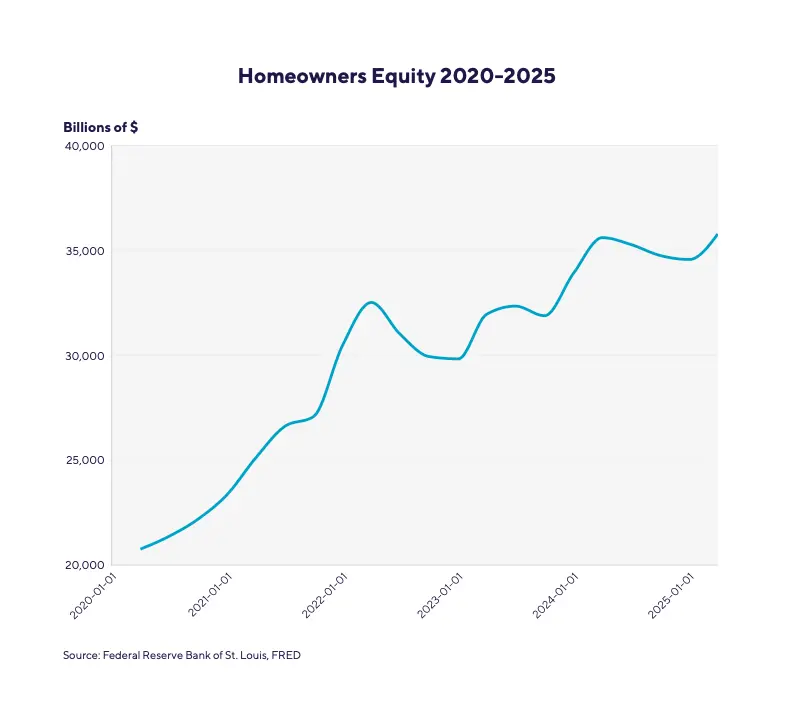
In recent years, rising home prices have impacted homeowners and prospective buyers in different ways. While appreciating home values can make it more challenging for first-time buyers to enter the market, this same trend has led to a significant “spike in home equity” for existing homeowners. As property values increase, the gap between a home’s market worth and the owner’s outstanding mortgage balance widens, creating more accessible equity.
Many homeowners, particularly in high-value states like California, may have more equity than they realize. Even those who have owned their homes for just a few years may find they have built enough equity to meet the minimum 15% lender requirement sooner than they might have expected, especially if they purchased in a rapidly appreciating market.
In California, home equity has increased 79% over the last five years. As a result, homeowners are sitting on a huge amount of equity: $348,200 on average. That’s more than enough to fund a home renovation or other large purchase and still maintain a comfortable equity cushion.
Current HELOC rates by state.
Compare current home interest rates by state and find a HELOC rate that suits your financial goals.
Select a state to view current rates:
How to Use the HELOC Calculator Data to Your Advantage
The data generated by a HELOC payment calculator is more than just a set of numbers; it provides actionable insights that can be used to make sound financial decisions. By translating your home equity into concrete borrowing potential and estimated costs, the calculator empowers you to plan strategically for your financial future.
• Budgeting for major projects: The estimated monthly payments for both the draw and repayment periods can be directly integrated into your household budget. This allows you to realistically assess the affordability of a large-scale project, such as a kitchen remodel or adding a new pool. By understanding the potential impact on your monthly cash flow, you can plan renovations without overextending your finances.
• Evaluating debt consolidation: If you are considering using a HELOC to consolidate high-interest debt, the calculator’s output is essential. You can compare the estimated monthly payment and total interest paid on the HELOC against the combined payments and interest costs of your current credit cards or personal loans. This direct comparison will reveal whether consolidation would result in genuine savings and a more manageable single payment.
• Informed lender conversations: Approaching a lender with a clear understanding of your borrowing capacity and estimated payments puts you in a position of strength. Instead of starting from scratch, you can have a more productive and confident discussion about your financial options, armed with realistic expectations and a solid baseline for negotiating terms.
• Understanding long-term impact: The calculator’s estimate of the total interest paid over the entire life of the HELOC provides a crucial long-term perspective. This figure helps you appreciate the full cost of borrowing and encourages a responsible approach to using the funds, ensuring that the benefits of the project or expense outweigh the long-term interest costs.
Armed with these insights, it becomes easier to follow best practices for managing this powerful financial tool.
Tips on HELOCs
While a HELOC can be a powerful and flexible financial tool, it requires careful and responsible management to avoid pitfalls. The following tips are designed to help you use your line of credit wisely, ensuring it serves as a benefit rather than a burden.
• Shop and compare lenders: Do not settle for the first offer you receive. Take the time to compare options from multiple lenders, including banks, credit unions, and online providers. Look beyond the advertised interest rate and scrutinize the full terms. Pay close attention to potential fees, such as annual fees, inactivity fees, and early termination or prepayment penalties, as these can significantly impact the overall cost of borrowing.
• Develop a clear repayment plan: Treat your home equity with the respect it deserves as a significant asset. Avoid the temptation to use HELOC funds for depreciating assets or discretionary lifestyle spending without an ironclad repayment strategy. Every draw should be an investment—in your property’s value or your family’s financial health—not a liability that puts your home at risk.
• Prepare for the repayment period: One of the most common surprises for HELOC borrowers is the significant increase in monthly payments when the line of credit transitions from the interest-only draw period to the principal-and-interest repayment period. Use a HELOC calculator to estimate what these future payments will be and ensure they fit comfortably within your long-term budget to avoid “payment shock.”
• Understand the risks of variable rates: Most HELOCs come with a variable interest rate, which means your monthly payment can increase if market rates rise. You must be financially prepared for potential fluctuations in your payment obligations. Budgeting for a rate that is higher than the current one can provide a valuable financial cushion.
• Maintain your financial health: Lenders look for strong financial credentials when approving a HELOC. This typically includes a credit score of 640 or higher and a debt-to-income (DTI) ratio below 45%. (To learn your DTI, add up all your monthly debt payments and divide by your gross monthly income.) Before applying, review your credit report for any errors, and work on managing your overall debt to position yourself for the best possible interest rate and terms.
While a HELOC is a strong option for many, it’s also wise to consider other financial products that might better suit your needs.
Alternatives to HELOCs
A HELOC is just one of several ways to access home equity or secure financing for a major expense. The best choice depends entirely on your individual financial circumstances, your goals, and your comfort with different repayment structures. It is always wise to evaluate all available options before making a decision.
Home Equity Loan
A home equity loan, often called a second mortgage, provides a one-time lump sum of cash that you borrow against your home’s equity. It is known for its fixed interest rate and predictable, regular monthly payments over a set term, making it a good option for those who know the exact amount they need for a specific project. A home equity loan calculator can help you compare the cost of this product to that of a HELOC.
A home improvement loan is a type of personal loan specifically intended for financing home renovations and repairs. It is typically an installment loan, which means it comes with a fixed interest rate and predictable monthly payments. Because it’s not secured by your home, the interest rate is usually higher than that of a home equity loan.
Personal Line of Credit
A personal line of credit (PLOC) is an unsecured revolving line of credit that functions similarly to a HELOC (and a credit card) but does not use your home as collateral. Because it is unsecured, a PLOC may have a higher interest rate and a lower credit limit compared to a HELOC.
Cash-Out Refinance
A cash-out mortgage refinance replaces your current mortgage with a new, larger one. The difference between the new mortgage amount and your old mortgage balance is paid to you in cash. This consolidates your debt into a single mortgage payment but resets your mortgage term.
When comparing a cash-out refinance vs. home equity line of credit, you should understand that the former leaves you with one payment. The latter gives you a second payment on top of your original mortgage payment.
Understanding these alternatives provides a broader context for making the best financial choice for your future.
The Takeaway
A California HELOC calculator is a smart first step for any homeowner considering tapping into their home equity. It provides a clear, no-commitment estimate of borrowing power and potential costs, transforming a complex financial product into a manageable set of figures for planning. This preliminary step of calculation is not just about numbers; it’s about empowerment. It enables homeowners to make strategic, well-informed financial decisions regarding their most significant asset.
SoFi now partners with Spring EQ to offer flexible HELOCs. Our HELOC options allow you to access up to 90% of your home’s value, or $500,000, at competitively lower rates. And the application process is quick and convenient.
Unlock your home’s value with a home equity line of credit from SoFi, brokered through Spring EQ.
What is the difference between a HELOC and a home equity loan?
A HELOC is a revolving line of credit with a typically variable interest rate, allowing you to borrow and repay funds as needed during a draw period. A home equity loan provides a one-time lump sum of cash with a fixed interest rate and predictable monthly payments from the start.
How much can I borrow with a HELOC?
Lenders typically allow you to borrow up to 90% of your equity. The exact amount depends on your creditworthiness, your income, your other debts, and the lender’s policies.
What can I use the money for from a HELOC?
You can use HELOC funds for almost anything, including home improvements, debt consolidation, educational expenses, medical bills, or other major purchases. However, borrowing against your home should be done with a clear purpose and a repayment plan.
Is a HELOC interest rate fixed or variable?
Most HELOCs have a variable interest rate that is tied to the U.S. Prime Rate. This means the rate, and your monthly payments, can change over time. Some lenders may offer a fixed-rate option.
What happens when the draw period ends?
When the draw period ends, the repayment period begins. You can no longer borrow from the line of credit, and your required monthly payments will increase to include both principal and interest.
What is the benefit of having a variable interest rate?
A variable interest rate can fluctuate with market conditions. While this means your rate could increase, it also means it could decrease if benchmark rates fall, which would lower your monthly interest payments.
Are there closing costs or fees for a HELOC?
Yes, HELOCs can have closing costs, typically ranging from 2% to 5% of the credit limit, though some lenders may waive them. Other potential fees include annual maintenance fees, inactivity fees, and early termination penalties.
What is the minimum credit score I need to qualify for a HELOC?
Requirements vary by lender, but a credit score of at least 640 is usually necessary to qualify, and many lenders like to see 680 or above. And a score of 700+ will help borrowers secure the most competitive interest rates.
Is the interest on a HELOC tax-deductible?
Interest paid on HELOCs and home equity loans may be tax-deductible. There are limits on the total amount of mortgage debt on which interest can be deducted, and in order to capture this deduction a homeowner would need to itemize deductions on their tax return. Your best move is to consult a tax advisor.
SoFi Mortgages
Terms, conditions, and state restrictions apply. Not all products are available in all states. See SoFi.com/eligibility-criteria for more information.
SoFi Loan Products
SoFi loans are originated by SoFi Bank, N.A., NMLS #696891 (Member FDIC). For additional product-specific legal and licensing information, see SoFi.com/legal. Equal Housing Lender.
Financial Tips & Strategies: The tips provided on this website are of a general nature and do not take into account your specific objectives, financial situation, and needs. You should always consider their appropriateness given your own circumstances.
Checking Your Rates: To check the rates and terms you may qualify for, SoFi conducts a soft credit pull that will not affect your credit score. However, if you choose a product and continue your application, we will request your full credit report from one or more consumer reporting agencies, which is considered a hard credit pull and may affect your credit.
²SoFi Bank, N.A. NMLS #696891 (Member FDIC), offers loans directly or we may assist you in obtaining a loan from SpringEQ, a state licensed lender, NMLS #1464945. All loan terms, fees, and rates may vary based upon your individual financial and personal circumstances and state.You should consider and discuss with your loan officer whether a Cash Out Refinance, Home Equity Loan or a Home Equity Line of Credit is appropriate. Please note that the SoFi member discount does not apply to Home Equity Loans or Lines of Credit not originated by SoFi Bank. Terms and conditions will apply. Before you apply, please note that not all products are offered in all states, and all loans are subject to eligibility restrictions and limitations, including requirements related to loan applicant’s credit, income, property, and a minimum loan amount. Lowest rates are reserved for the most creditworthy borrowers. Products, rates, benefits, terms, and conditions are subject to change without notice. Learn more at SoFi.com/eligibility-criteria. Information current as of 06/27/24.In the event SoFi serves as broker to Spring EQ for your loan, SoFi will be paid a fee.
Tax Information: This article provides general background information only and is not intended to serve as legal or tax advice or as a substitute for legal counsel. You should consult your own attorney and/or tax advisor if you have a question requiring legal or tax advice.
By Erik Carlson |
Uncategorized |
Comments Off on Medical Student and Veterinary School Graduate Loans | SoFi
MEDICAL AND VETERINARY STUDENT LOANS
Get the funding you need to pay for medical school, STAT.
View your rate
Checking your rate will not affect your credit score.✝︎
Don’t let changes to federal graduate loans stop you from achieving excellence. SoFi is here to help with simple, flexible private student loan options to pay for your med or vet school education—covering MD, DO, DPM, DVM, and VMD degrees.
View your rate
Checking your rate will not affect your credit score.✝︎
Received a mailer from us? (window.sofiUtils.triggerModalById(‘dm-confirmation-offer-landing’, this))} > Enter confirmation #
Your medical school loan comes with benefits—whether caring for humans or animals.
Our graduate student loans are designed to give you peace of mind so you can focus on your studies.
All online. All easy.
Finish our online application in minutes—and adding a cosigner is just as easy.
Competitive rates.
A lower interest rate could now translate to a smaller debt burden after graduation.
No fees required.
That means no origination fees, no late fees, and no insufficient funds fees. Period.
Exclusive SoFi member benefits.
Including exclusive rate discounts1, access to financial planning resources2, and more.
View your rate
Checking your rate will not affect your credit score.†
Grad school loan rates for medical and veterinary students.
Choose from a fixed or variable graduate student loan.
SoFi’s medical and veterinary school graduate loans are tailored to fit your needs.
Get up to 100% of your school-certified costs covered.
SoFi gives you 36 months of a grace period to account for your residency programs.
Defer up to 48 months during your residency, fellowship, or other surgical disciplines.
Repayment options include our newest offering, a 20-year term.
View your rate
Checking your rate will not affect your credit score.†
It’s not brain surgery. We made applying for a medical or veterinary student loan fast and simple.
Screen images simulated.
Apply online in just minutes.
Get your rate fast and find out if you’re pre-qualified before you even finish your application. Easily add a cosigner in just a few clicks.
Select your rate and repayment option.
Choose from fixed or variable rates. Then, pick from four repayment options.
Sign and accept your loan.
Upload screenshots of your info, sign your paperwork electronically, and boom—it’s done. We’ll handle it from here.
View your rate
Checking your rate will not affect your credit score.†
Make repayment fit into your life.
Our repayment options allow you to choose what will work with your budget and lifestyle.
Deferred
Start paying principal and interest payments six months after you leave school.
No payments while in school
Highest overall cost option
Interest only
Pay only interest payments while you’re in school.
Moderate payment while in school
Reduces overall cost
Partial
Pay a $25 fixed monthly payment while you’re in school.
Lowest payment option while in school
Reduces some of the overall cost
Immediate
Start paying principal and interest payments right away.
Highest payment option while in school
Lowest overall cost option
View repayment examples
Medical and veterinary graduate student loan FAQs
What degree types are eligible for SoFi’s medical and veterinary school loan? SoFi is here to help with simple, flexible private student loan options to help pay for your medical or veterinary school education. Eligible degree types include MD, DO, DPM, DVM, and VMD degrees.
What expenses can a SoFi medical and veterinary school loan cover?
SoFi’s medical and veterinary loans can be used for up to 100% coverage of school-certified expenses. This includes tuition, fees, technology, housing, and more.
Can I defer loan payments while in medical school or residency?
Yes. SoFi’s medical and veterinary loans allow you to defer up to 48 months during your residency, fellowship, or other surgical disciplines.
What is a grace period? What is the grace period for SoFi’s medical loan?
SoFi’s medical and veterinary loans offer a 36 month grace period to account for your residency programs. Please keep in mind that interest continues to accrue during this time. If your residency is less than 36 months, you may request to start full principal and interest payment sooner to reduce the cost of your loan. SoFi has no penalties for prepayment or beginning full principal and interest payments prior to the end of school or the grace period which may reduce the overall cost of the loan.
How do SoFi medical and veterinary school loans compare to Federal Grad PLUS loans?
The Federal Direct Grad PLUS loan program is being eliminated for new borrowers of all types starting July 1, 2026. SoFi’s medical and veterinary school loans are an option to consider for students who can no longer use Federal Grad PLUS loans.
Key differences between Federal Grad PLUS and SoFi’s medical and veterinary school loans include: interest rate options, origination fees (which SoFi does not have), term and repayment options. Federal Grad PLUS loans have fixed interest rates for the life of the loan with limited term and repayment options. SoFi’s medical and veterinary loans offer both fixed and variable rate types to select from, as well as five repayment term options. Additionally, Federal Grad PLUS loans have origination fees.
Federal loans allow you to be eligible for certain types of forgiveness and unique income-based repayment plans. Please carefully consider all of your borrowing options at both a federal and private level.
Do I need a cosigner to qualify for a SoFi medical and veterinary school loan?
No, you do not need a cosigner to qualify for a SoFi medical and veterinary school loan. However, cosigners could help you get a lower rate and/or increase your chances of approval. With SoFi’s online application process, you and your cosigner can see what rates and terms you pre-qualify for before submitting your full loan application—and it won’t impact your credit score.
What are the borrowing limits for SoFi medical and veterinary school loans?
SoFi’s medical and veterinary loans can be used for up to 100% coverage of school-certified expenses.
When do repayment and interest begin on SoFi medical or veterinary school loans?
This will depend on the loan terms that are selected. If you choose the deferred repayment option, full principal and interest payments can be deferred as long as you remain enrolled at an eligible school at least half-time. Full principal and interest payments would begin 36 months after the student graduates or drops below half-time enrollment. Borrowers who have selected immediate repayment will begin full principal and interest payments upon first full disbursement of the loan. You would only begin payments on the amount disbursed. Medical and veterinary school loans are also eligible for a 20-year repayment term.
By Annie Luc |
Uncategorized |
Comments Off on Is 675 a Good Credit Score?
Is 675 a Good Credit Score?
On this page:
On this page:
By Laurel Tincher
(Last Updated – 12/2025)
A 675 credit score is considered a good score, but it’s at the very low end of that range. This score can definitely be high enough to open some doors for you financially speaking, but it may not be high enough to get the most favorable terms for, say, a mortgage or car loan.
Read on to learn more about the answer to “Is 675 a good credit score?” and learn how to build that important three-digit number.
Key Points
• A 675 credit score is considered good but is at the lower end of this range.
• With this score, you can qualify for loans and credit cards, but with less favorable terms.
• Potential drawbacks include higher interest rates and fewer rewards on credit cards.
• To improve your credit score, pay bills on time and keep credit card balances low.
• Regularly check credit reports for errors and avoid multiple new credit applications.
What Does a 675 Credit Score Mean?
A FICO® Score of 675 falls into the low end of the good credit range, which typically runs from 670 to 739. Despite not fitting into the excellent or upper reaches of the good categories, a score of 675 indicates a responsible credit history. Here’s how FICO categorizes its scores:
• Excellent: 800 to 850
• Very Good: 740 to 799
• Good: 670 to 739
• Fair: 580 to 669
• Poor: 300 to 579
Credit score ranges are used by lenders to evaluate the risk involved in giving credit to someone. A score of 675 indicates that the applicant has exhibited a moderate degree of creditworthiness. This may indicate a track record of:
• On-time debt payments
• A manageable debt-to-income ratio
• Overall healthy financial standing
It’s important to remember that a credit score of 675 can be built. When applying for loans or credit cards, those in the 675 range can pay a little bit more in interest than people with higher scores. If you had a higher credit score, you might be offered a lower annual percentage rate, or APR.
Gaining a better understanding of the factors that impact credit scores (and making a concerted effort to build yours) can lead to better terms and financial prospects.
💡 Quick Tip: Before choosing a personal loan, ask about the lender’s fees: origination, prepayment, late fees, etc. One question can save you many dollars.
What Else Can You Get with a 675 Credit Score?
People with a credit score of 675 can qualify for a range of financial products, though there might be some restrictions. Even if they are eligible for credit cards, their interest rates and benefits might not be as good as those offered to those with better credit scores. For large expenditures like a home or car, lenders may grant loans, but the interest rates may be on the higher end.
Reducing outstanding debt, avoiding late payments or defaults, and making consistent, on-time payments are all critical steps that can build one’s score. People who work to keep or build their credit score put themselves in a better position to access a wider variety of financial products with better terms and conditions.
Can I Get a Credit Card with a 675 Credit Score?
It is possible to get a credit card with a 675 credit score, and you may have several solid options from which to choose. However, there are rewards if you build your score even higher, including possibly a lower APR and/or fees or access to enhanced rewards.
By using a credit card responsibly, you can work to build your score. It’s worth noting that the single biggest contributing factor to your score is your credit history, meaning on-time payments. Set up payment alerts or opt into automatic payments to help ensure that you pay your bill on time, every time.
💡 Quick Tip: Generally, the larger the personal loan, the bigger the risk for the lender — and the higher the interest rate. So one way to lower your interest rate is to try downsizing your loan amount.
Can I Get an Auto Loan with a 675 Credit Score?
You can get an auto loan with a credit score of 675, but the terms and interest rates might not be as good as what is available to people with higher credit scores. You will find that offers may well vary from lender to lender.
Worth noting: 690 was found to be the average score among those who get a used car loan. Those buying a new car typically have a score of 757 or above.
That said, those with a credit score of 675 should shop around. You may find that if you can make a higher down payment, you could be rewarded with terms you find more affordable.
With a credit score of 675, you will likely be approved by a mortgage lender with what’s considered a good interest rate. But you may not receive the best rate — that’s often reserved for those with high scores, such as 740 and above.
In order to improve your chances of getting approved for a mortgage with more favorable terms, you may want to think about other aspects that lenders take into account, like:
• A steady job history with a reliable income
• A larger down payment.
Also, know that if your credit score is below 675, there are still options to be found:
• You may be able to find a conventional loan with a score of 620 or higher.
• You may qualify for a FHA loan with a credit score of 500 or higher.
• You may qualify for a VA or USDA loan with a credit score of 640 or higher.
Can I Get a Personal Loan with a 675 Credit Score?
With a credit score of 675, you can usually qualify for a personal loan. This can be good news, since personal loans can be used in a variety of ways, such as debt consolidation, home renovations, or medical bills.
However, you may find that not all lenders approve you; some prefer prospective borrowers to have credit scores in the 700s. And those that do offer you a loan may not have the best terms, such as the lower APRs.
In other words, it’s in your best interests to shop around and see what offers are available. It can also help to follow the steps mentioned above to build your score, such as always paying bills on time, keeping your amounts owed low (under 30% of your credit limit), and not applying for too much new credit at the same time.
Is a 675 credit score good? Yes. A FICO Score of 675, which is at the lower end of the good range, is typically high enough to qualify for loans and mortgages. However, you may have to pay a little bit more in interest and have less favorable terms than people with better scores. You also may benefit from building your score a bit higher before applying for a loan. You might qualify with more lenders and for better terms.
Think twice before turning to high-interest credit cards. Consider a SoFi personal loan instead. SoFi offers competitive fixed rates and same-day funding. See your rate in minutes.
SoFi’s Personal Loan was named NerdWallet’s 2024 winner for Best Personal Loan overall.
SoFi Loan Products
SoFi loans are originated by SoFi Bank, N.A., NMLS #696891 (Member FDIC). For additional product-specific legal and licensing information, see SoFi.com/legal. Equal Housing Lender.
Disclaimer: Many factors affect your credit scores and the interest rates you may receive. SoFi is not a Credit Repair Organization as defined under federal or state law, including the Credit Repair Organizations Act. SoFi does not provide “credit repair” services or advice or assistance regarding “rebuilding” or “improving” your credit record, credit history, or credit rating. For details, see the FTC’s website .
Non affiliation: SoFi isn’t affiliated with any of the companies highlighted in this article.
Third-Party Brand Mentions: No brands, products, or companies mentioned are affiliated with SoFi, nor do they endorse or sponsor this article. Third-party trademarks referenced herein are property of their respective owners.
Third Party Trademarks: Certified Financial Planner Board of Standards Center for Financial Planning, Inc. owns and licenses the certification marks CFP®, CERTIFIED FINANCIAL PLANNER®
Financial Tips & Strategies: The tips provided on this website are of a general nature and do not take into account your specific objectives, financial situation, and needs. You should always consider their appropriateness given your own circumstances.