Table of Contents
ATM stands for automated teller machine. These electronic banking terminals allow you to perform certain transactions without visiting a bank teller, such as withdrawing cash, checking your balance, transferring money, and, at some machines, making deposits.
Understanding how ATMs work, what they can do, and how to use them safely can help you manage your money more conveniently while avoiding unnecessary fees.
Key Points
• ATM stands for automated teller machine, which is an electronic device allowing you to perform basic banking transactions without a teller.
• Common ATM functions include withdrawing cash, checking account balances, transferring money between accounts, and (sometimes) making deposits.
• ATMs are generally categorized by their location, with on-premise machines at bank branches and off-premise machines in retail or public spaces.
• Practicing good security habits like inspecting the machine for tampering and covering your PIN can help protect your account information.
• You can often avoid unnecessary costs by staying within your financial institution’s network or selecting an account that reimburses out-of-network ATM fees.
What Is an Automated Teller Machine (ATM)?
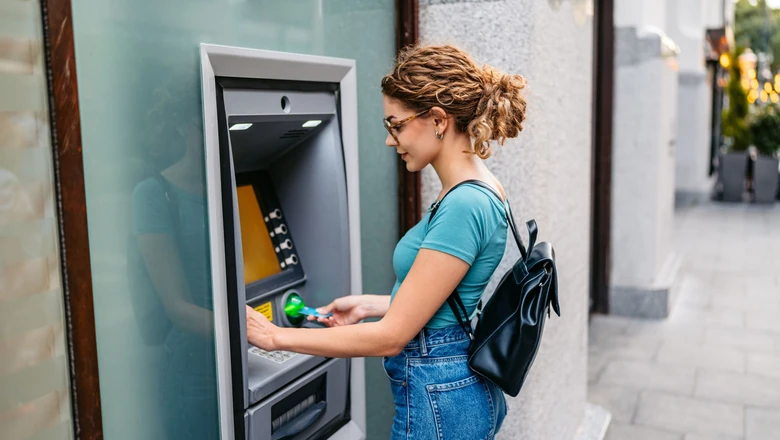
An automated teller machine, or ATM, is an electronic banking device that allows you to conduct some bank transactions without interacting with a bank teller. Depending on the machine and your financial institution, you may be able to withdraw cash, check your balance, transfer money between accounts, and make deposits.
However, ATM capabilities vary. For example, some machines accept cash and check deposits with others are designed primarily for withdrawals. Your bank may also limit how much you can withdraw or deposit through an ATM during a particular period.
You typically access an ATM using a debit or ATM card and a personal identification number (PIN). Some financial institutions also offer cardless access, which allows customers to use a smartphone or mobile banking app at compatible ATMs.
A Brief History of the ATM
The modern ATM grew out of efforts in the 1960s to make cash available outside normal bank hours. The world’s first bank ATM is generally considered the cash machine installed at a Barclays branch in Enfield, London, on June 27, 1967. The first U.S. ATM debuted at Chemical Bank in Rockville Center, New York, in September 1969.
Here’s a look at a few milestones in the development of ATMs:
• 1967: Barclays introduces the world’s first bank ATM in London.
• 1969: Chemical bank introduces the first ATM in the U.S. allowing customers to withdraw cash outside normal banking hours.
• 1980s: ATMs become increasingly common in the U.S. and begin offering more services beyond dispensing cash.
• 1990s: ATMs become more widely available at off-site locations, including retail establishments and other locations away from bank branches.
• 1999: A talking ATM is introduced in Canada, helping make ATM services more accessible to people with visual impairments.
• 2010s: Cardless ATM technology becomes increasingly available, allowing customers at participating institutions to access cash using a smartphone instead of a physical card.
These developments helped transform ATMs from simple cash-dispensing machines into self-service banking terminals that can perform a range of transactions.
Core Functions of an ATM
ATMs can perform several types of transactions, although the services available vary by machine and financial institution. Common functions include: cash withdrawals, deposits and transfers, and balance inquiries.
Cash Withdrawals
One of the primary functions of an ATM is dispensing cash. This allows bank customers to access money outside of regular branch hours and at locations that may be more convenient than a bank branch.
You can typically access an ATM by inserting or tapping a debit card or an ATM card and entering your PIN. At participating financial institutions, you may also be able to use a smartphone for cardless access.
Using an ATM within your bank’s network may be free, while using an out-of-network ATM can result in fees.
Deposits and Transfers
Some ATMs allow you to deposit checks or cash. However, not every ATM accepts deposits, and the rules for deposits can vary by financial institution. You may need to use an ATM owned by your bank or one specifically designated for deposits. Cash deposits may also be limited to certain machines or locations.
Some ATMs also allow you to transfer money between accounts at the same financial institution, such as moving money from checking to savings. You may also be able to make these transfers through online or mobile banking.
If you use an online bank, check its policies before attempting to deposit cash. Online banks often provide access to large networks of ATMs for withdrawals but may have limited or no options for depositing cash through an ATM.
Balance Inquiries
ATMs can also allow you to check your account balance. Depending on your financial institution, you may be able to view the available balance for your checking or savings account after entering your card and PIN.
Some ATMs may also offer a printed receipt showing recent transactions. This can provide a quick snapshot of account activity without requiring you to log in to online or mobile banking. Keep in mind, though, that an ATM receipt may not show all transactions that have recently occurred, particularly transactions that have not yet posted to your account.
Recommended: What Happens if You Overdraft Your Bank Account?
Increase your savings
with a limited-time APY boost.*
Types of ATMs
ATMs can generally be divided into two broad categories based on where they are located: on-premise and off-premise.
On-Premise vs Off-Premise
An on-premise ATM is located at or near a financial institution, such as a bank or credit union. Some are accessible from inside a branch during business hours, while others are available from an exterior location or through a drive-up area outside regular banking hours.
An off-premise ATM is located somewhere other than a financial institution, such as a gas station, retailer, restaurant, hotel, airport, or shopping center. These machines can provide convenient access to cash, particularly when there isn’t a bank branch nearby.
Off-premise ATMs are often operated by third-party companies rather than banks or credit unions. They may offer fewer services than an ATM at a financial institution and may charge a fee for using the machine.
How to Use an ATM Safely
ATMs are generally designed with security features, but you can take additional precautions to protect your account.
• Choose a safe location. When possible, use an ATM in a well-lit, populated location. Be especially cautious when using machines in isolated areas.
• Inspect the machine. Before inserting or tapping your card, look for anything unusual, such as a loose or damaged card reader, an unfamiliar attachment, or a keypad that looks different from the surrounding machine. These can be signs of tampering or skimming.
• Protect your PIN. Cover the keypad with your hand when entering your PIN. This can help prevent someone nearby or a hidden camera from seeing the numbers you enter.
• Take your card and cash. Before leaving, make sure you have your card, cash, and receipt if you requested one.
• Monitor your account. Check your bank account regularly for transactions you don’t recognize. Contact your financial institution promptly if you notice suspicious activity.
Understanding ATM Fees and Limits
Before using an ATM, it’s important to understand the fees and withdrawal limits that may apply. These can vary by financial institution, account, ATM network, and location.
ATM Fees
Using an ATM within your financial institution’s network may be free, although the specific rules depend on your account. Some financial institutions also participate in large ATM networks that allow customers to use participating machines without paying an out-of-network fee.
Using an out-of-network ATM may result in two separate charges: a fee from your financial institution and a surcharge from the ATM operator. According to Bankrate’s 2025 Checking Account and ATM Fee Study, the average total cost of an out-of-network ATM withdrawal was $4.86. That consisted of an average $1.64 fee from the customer’s financial institution and a $3.22 surcharge from the ATM operator.
If you frequently use out-of-network ATMs, these charges can add up. To reduce or avoid them, you can look for an ATM within your financial institution’s network, use an ATM locator in your bank’s mobile app, or choose an account that reimburses some out-of-network ATM fees.
ATM Limits
Financial institutions may impose limits on how much you can withdraw from an ATM during a single transaction or within a day. Daily withdrawal limits can vary significantly by institution and account type, with some accounts allowing several hundred dollars per day and others allowing $1,000 or more.
If you need to withdraw more cash than your usual daily limit, such as before a trip or to make a large cash payment, you can contact your financial institution to ask whether it can temporarily increase the limit. The bank may approve the request, although it isn’t required to do so.
ATM withdrawal limits can help reduce potential losses if you lose your debit card or your PIN is compromised. They also help financial institutions manage the amount of cash available at individual machines.
The Takeaway
ATM stands for automated teller machine, and these machines have evolved from simple cash dispensers into self-service banking terminals. Depending on the machine and your financial institution, you may be able to withdraw cash, check your balance, make deposits, transfer money, and perform other basic transactions.
Knowing your financial institution’s ATM network, fees, and withdrawal limits can help you avoid unnecessary charges. Taking basic security precautions, such as protecting your PIN and checking the machine for signs of tampering, can also help you use ATMs more safely.
Interested in opening an online bank account? When you sign up for a SoFi Checking and Savings account with eligible direct deposit, you’ll get a competitive annual percentage yield (APY), pay zero account fees, and enjoy an array of rewards, such as access to the Allpoint Network of 55,000+ fee-free ATMs globally. Qualifying accounts can even access their paycheck up to two days early.
FAQ
What is the standard daily withdrawal limit on an ATM?
There is no standard ATM withdrawal limit. Your financial institution typically sets a daily limit based on your account type and other factors. Limits can range from a few hundred dollars to $1,000 or more. The ATM itself may also have a per-transaction limit. If you need to withdraw more than your daily limit allows, contact your financial institution to ask whether it can temporarily increase the limit.
Can I use an ATM without my physical debit card?
Yes. Some financial institutions offer cardless ATM access, which allows you to withdraw cash using a smartphone or mobile banking app instead of a physical debit card. You may need to use a contactless-enabled ATM and authenticate the transaction through your bank’s app or another method. Not all ATMs or financial institutions support cardless withdrawals, so check with your bank to see whether the feature is available.
How long does it take for an ATM check deposit to clear?
The time it takes for an ATM check deposit to clear depends on your financial institution, the type of check, and other factors. Funds may be available as soon as the next business day, while some deposits may be subject to longer holds. Your bank should provide information about when deposited funds will be available. Check your receipt or account terms for the specific availability policy that applies to your deposit.
Are there ATMs that dispense cryptocurrency like Bitcoin?
Yes. Bitcoin ATMs, sometimes called Bitcoin kiosks or cryptocurrency ATMs, allow users to conduct certain cryptocurrency transactions using cash or a debit card. Depending on the machine, you may be able to purchase or sell Bitcoin or other cryptocurrencies. They differ from traditional ATMs because they generally aren’t connected directly to a bank account for standard banking transactions. Fees and identity-verification requirements can also vary by operator and location.
What should I do if an ATM eats my debit card?
If an ATM keeps your debit card, don’t try to retrieve it yourself. If the machine is located at a bank branch, notify the bank immediately. If it’s an independently operated ATM, contact the operator using the customer service number displayed on the machine. You should also contact your financial institution to report the problem and ask whether your card should be locked or replaced. It’s also a good idea to monitor your account for unauthorized transactions while the issue is being resolved.
Photo credit: iStock/urbazon
SoFi® Checking and Savings is offered through SoFi Bank, N.A. ©2026 SoFi Bank, N.A. All rights reserved. Member FDIC. Equal Housing Lender.^Early access to direct deposit funds is based on the timing in which we receive notice of impending payment from the Federal Reserve, which is typically up to two days before the scheduled payment date, but may vary.
Annual percentage yield (APY) is variable and subject to change at any time. Rates are current as of 10/20/26. There is no minimum balance requirement. Fees may reduce earnings. Additional rates and information can be found at https://www.sofi.com/legal/banking-rate-sheet
Eligible Direct Deposit means a recurring deposit of regular income to an account holder’s SoFi Checking or Savings account, including payroll, pension, or government benefit payments (e.g., Social Security), made by the account holder’s employer, payroll or benefits provider or government agency (“Eligible Direct Deposit”) via the Automated Clearing House (“ACH”) Network every 31 calendar days.
Although we do our best to recognize all Eligible Direct Deposits, a small number of employers, payroll providers, benefits providers, or government agencies do not designate payments as direct deposit. To ensure you're earning the APY for account holders with Eligible Direct Deposit, we encourage you to check your APY Details page the day after your Eligible Direct Deposit posts to your SoFi account. If your APY is not showing as the APY for account holders with Eligible Direct Deposit, contact us at 855-456-7634 with the details of your Eligible Direct Deposit. As long as SoFi Bank can validate those details, you will start earning the APY for account holders with Eligible Direct Deposit from the date you contact SoFi for the next 31 calendar days. You will also be eligible for the APY for account holders with Eligible Direct Deposit on future Eligible Direct Deposits, as long as SoFi Bank can validate them.
Deposits that are not from an employer, payroll, or benefits provider or government agency, including but not limited to check deposits, peer-to-peer transfers (e.g., transfers from PayPal, Venmo, Wise, etc.), merchant transactions (e.g., transactions from PayPal, Stripe, Square, etc.), and bank ACH funds transfers and wire transfers from external accounts, or are non-recurring in nature (e.g., IRS tax refunds), do not constitute Eligible Direct Deposit activity. There is no minimum Eligible Direct Deposit amount required to qualify for the stated interest rate. SoFi Bank shall, in its sole discretion, assess each account holder's Eligible Direct Deposit activity to determine the applicability of rates and may request additional documentation for verification of eligibility.
See additional details at https://www.sofi.com/legal/banking-rate-sheet. We do not charge any account, service, or maintenance fees for SoFi Checking and Savings. We do charge transaction fees for outgoing wire transfers, Instant Transfers, and global remittance transfers. Our fee policy is subject to change at any time. See the SoFi Bank Fee Sheet for details at sofi.com/legal/banking-fees/. *Awards or rankings from Forbes are not indicative of future success or results. This award and its ratings are independently determined and awarded by their respective publications.
Third-Party Brand Mentions: No brands, products, or companies mentioned are affiliated with SoFi, nor do they endorse or sponsor this article. Third-party trademarks referenced herein are property of their respective owners.
Third Party Trademarks: Certified Financial Planner Board of Standards Center for Financial Planning, Inc. owns and licenses the certification marks CFP®, CERTIFIED FINANCIAL PLANNER®
SOBNK-Q326-064