SoFi Blog

Tips and news—
for your financial moves.

Dallas Housing Market: Trends & Prices


Dallas Housing Market: Trends & Prices (2025)

On this page:

    Dallas Real Estate Market Overview

    By Robin Rothstein

    (Last Updated – 4/2025)

    Texas may be the Lone Star State, but it sure isn’t lonely. Over 31 million people live in Texas, and about 1.3 million of them reside in the city of Dallas. What’s the attraction?

    First, if you like warmth, let’s talk about that. Dallas averages 232 sunny days a year. When it comes to snow, Dallas sees an average of 2.6 inches. (Snow skiers and boarders can get their fix not far away.)

    But does the weather really matter if you have good grub? Dallas is known as one of the best cities in the country to find good barbecue.

    Dallas is also fairly affordable, as big cities go. The cost of living is 1.8% higher than the national average, according to the Council for Community and Economic Research’s 2024 Cost of Living Index.

    Recommended: Cost of Living in Texas

    Dallas housing prices have gone down since last year. In April 2023, the average home sale price went down roughly 5.1% since last year, according to Redfin.

    It can be informative to also look at price-to-rent ratios.

    If you’re considering buying property in Dallas, saddle up and keep reading.


    Get matched with a local
    real estate agent and earn up to
    $9,500 cash back when you close.

    Connect with an agent


    Recommended: Home Ownership

    $419,000

    Median Sale Price

    $239

    Median Price Per Square Foot

    55 days

    Median Time on Market

    Dallas Housing Market Forecast

    If you’re looking to buy, you’ll want to know that experts predict that the Dallas metro area will be a hot housing market this year, as in recent years past.
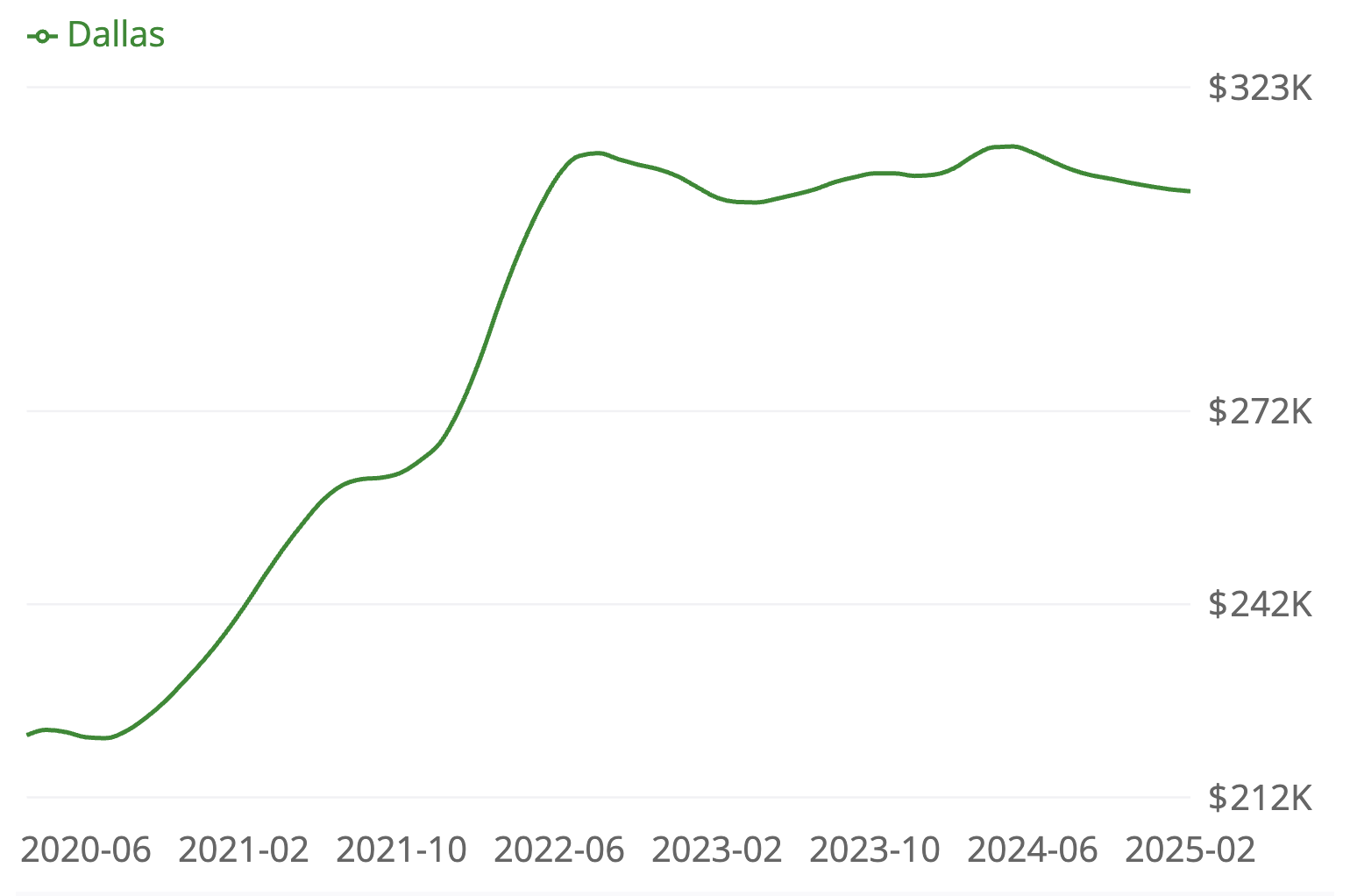

    Housing market forecast chart

    *Graph taken from Zillow as of 4/2025

    Demographics of the Dallas Market

    Why move to Dallas, besides the barbecue and a world of other cuisines? Let’s take a look at some of the top reasons you might want to consider a move to Dallas-Fort Worth.

    Job-hunters will find that Dallas has one of the largest concentrations of big companies in the U.S., with AT&T, Energy Transfer, CBRE (a real estate company), and Southwest Airlines all employing a large workforce here. The top employment sectors here are Information Technology, Finance and Insurance, Manufacturing, Real Estate, and Professional and Technical Services.

    Median Household Income: $70,121

    Median Age: 33.5

    College Educated: 38.7%

    Homeowners: 42.4%

    Married: 49%

    Oak Lawn

    Oak Lawn is known for its support of the LGBT community and every September hosts a large Pride event.

    The neighborhood, just north of downtown Dallas, features tons of modern restaurants and shops, but nature lovers will probably prefer taking a stroll by Turtle Creek, which connects a number of parks.


    Quick Facts

    Population:

    24,797

    Median Age:

    33.8

    Housing Units:

    19,273

    Bike Score:

    76/100

    Walk Score:

    85/100

    Transit Score:

    60/100

    Median Household Income:

    $127,896

    Oak Lawn Market

    The median home price in Oak Lawn is a bit above that of Dallas more generally, although it has dropped 1.7% in the last year.


    Median Sale Price

    $460,000

    Median Price Per Sq. Foot

    $347


    Lake Highlands

    The public schools in Lake Highlands may be one of the worst-kept secrets in all of Texas. Families flock to this neighborhood, consisting of dozens of subdivisions, because of the highly rated schools and easy access to big-city amenities. Getting preapproved for a home loan can help you compete if you’re looking to buy in this busy market.

    Parkland and trails lead to White Rock Lake for those looking for an active lifestyle.


    Quick Facts

    Population:

    48,148

    Median Age:

    35

    Housing Units:

    22,842

    Bike Score:

    46/100

    Walk Score:

    44/100

    Transit Score:

    41/100

    Median Household Income:

    $88,468

    Lake Highlands Housing Market

    The median home price is higher than what’s typical in Dallas, and prices rose 12.3% in February 2025 compared to the previous year.


    Median Sale Price

    $564,000

    Median Price Per Sq. Foot

    $242


    Cedar Crest

    Cedar Crest residents have access to the Trinity River greenbelt and, farther south, the Balcones Canyonlands National Wildlife Refuge.

    But there are restaurants and shops to enjoy as well, and downtown Dallas is only 20 minutes away.


    Quick Facts

    Population:

    3,330

    Median Age:

    33

    Housing Units:

    1,323

    Bike Score:

    45/100

    Walk Score:

    42/100

    Transit Score:

    45/100

    Median Household Income:

    $52,830

    Cedar Crest Housing Market

    This is an affordable, if somewhat competitive housing market. In February 2025, home prices were up 2.1% year over year, but the median sale price is still far below Dallas as a whole.


    Median Sale Price

    $245,000

    Median Price Per Sq. Foot

    $164


    Wolf Creek

    Only 21 minutes from downtown, Wolf Creek offers an easy commute. This family-friendly neighborhood has 22 schools and is known for its community spirit.

    80% of locales reported the yards are well-kept in this area, and 66% feel there is plenty of holiday spirit.


    Quick Facts

    Population:

    15,218

    Median Age:

    34

    Housing Units:

    5,657

    Bike Score:

    39/100

    Walk Score:

    29/100

    Transit Score:

    38/100

    Median Household Income:

    $62,806

    Wolf Creek Housing Market

    Current home prices in this neighborhood have risen more than 2% since last year, although the median home price is still well below that of the Dallas area.

    Houses are spending more time on the market recently, with an average time of 76 days, according to Redfin.


    Median Sale Price

    $258,000

    Median Price Per Sq. Foot

    $161


    Winnetka Heights

    This small community peppered with historic homes is a dreamy place to raise a family or enjoy the single life. Food and art lovers can take advantage of the local restaurant scene and close proximity to the trendy Bishop Arts District.

    The neighborhood is popular with visitors but is also the perfect place for locals to call home.


    Quick Facts

    Population:

    29,992

    Median Age:

    35.5

    Housing Units:

    13,207

    Bike Score:

    54/100

    Walk Score:

    55/100

    Transit Score:

    47/100

    Median Household Income:

    $120,126

    Winnetka Heights Housing Market

    Home values in Winnetka Heights remain solid and well above the median home price for the Dallas area.

    Listings are few but are lingering on the market for about 76 days.


    Median Sale Price

    $744,000

    Median Price Per Sq. Foot

    $314


    SoFi Home Loans

    It’s easy to see why the Dallas real estate market has been active. There are some amazing neighborhoods to choose from, whether you’re single or have a family to look after.

    If you think Dallas could be your home sweet home, then you may need to consider your home loan options.

    Looking for an affordable option for a home mortgage loan? SoFi can help: We offer low down payments (as little as 3% - 5%*) with our competitive and flexible home mortgage loans. Plus, applying is extra convenient: It's online, with access to one-on-one help.

    SoFi Mortgages: simple, smart, and so affordable.


    View your rate

    FAQ

    Is the Dallas housing market cooling?

    Recent data from Redfin paints an interesting picture of the Dallas housing market. It seems the feverish pace of skyrocketing prices is starting to mellow. With a few more homes on the market and a slight deceleration in price hikes, the tide may be turning in favor of buyers. It’s a good time to keep your eyes on the market and be ready to make a move when you find the right place.

    What’s the forecast for the Texas housing market?

    The forecast for the Texas housing market remains one of steady growth. Recent real estate reports suggest that the Lone Star State is poised for a positive trajectory, thanks to a solid job market and population increases. While home prices are expected to climb, the pace may be more moderate than in previous years.

    What’s the next hot neighborhood in Dallas?

    The Cedars offers a vibrant, eclectic atmosphere with a growing arts scene, all convenient to downtown Dallas. Yet it still has a neighborhoody feel. Median home sale prices here are still well below the Dallas market generally, and community events and a strong sense of neighborhood pride make it an attractive place to call home.


    SoFi Mortgages
    Terms, conditions, and state restrictions apply. Not all products are available in all states. See SoFi.com/eligibility-criteria for more information.


    SoFi Loan Products
    SoFi loans are originated by SoFi Bank, N.A., NMLS #696891 (Member FDIC). For additional product-specific legal and licensing information, see SoFi.com/legal. Equal Housing Lender.


    *SoFi requires Private Mortgage Insurance (PMI) for conforming home loans with a loan-to-value (LTV) ratio greater than 80%. As little as 3% down payments are for qualifying first-time homebuyers only. 5% minimum applies to other borrowers. Other loan types may require different fees or insurance (e.g., VA funding fee, FHA Mortgage Insurance Premiums, etc.). Loan requirements may vary depending on your down payment amount, and minimum down payment varies by loan type.


    Third-Party Brand Mentions: No brands, products, or companies mentioned are affiliated with SoFi, nor do they endorse or sponsor this article. Third-party trademarks referenced herein are property of their respective owners.


    External Websites: The information and analysis provided through hyperlinks to third-party websites, while believed to be accurate, cannot be guaranteed by SoFi. Links are provided for informational purposes and should not be viewed as an endorsement.


    ‡Up to $9,500 cash back: HomeStory Rewards is offered by HomeStory Real Estate Services, a licensed real estate broker. HomeStory Real Estate Services is not affiliated with SoFi Bank, N.A. (SoFi). SoFi is not responsible for the program provided by HomeStory Real Estate Services. Obtaining a mortgage from SoFi is optional and not required to participate in the program offered by HomeStory Real Estate Services. The borrower may arrange for financing with any lender. Rebate amount based on home sale price, see table for details.

    Qualifying for the reward requires using a real estate agent that participates in HomeStory’s broker to broker agreement to complete the real estate buy and/or sell transaction. You retain the right to negotiate buyer and or seller representation agreements. Upon successful close of the transaction, the Real Estate Agent pays a fee to HomeStory Real Estate Services. All Agents have been independently vetted by HomeStory to meet performance expectations required to participate in the program. If you are currently working with a REALTOR®, please disregard this notice. It is not our intention to solicit the offerings of other REALTORS®. A reward is not available where prohibited by state law, including Alaska, Iowa, Louisiana and Missouri. A reduced agent commission may be available for sellers in lieu of the reward in Mississippi, New Jersey, Oklahoma, and Oregon and should be discussed with the agent upon enrollment. No reward will be available for buyers in Mississippi, Oklahoma, and Oregon. A commission credit may be available for buyers in lieu of the reward in New Jersey and must be discussed with the agent upon enrollment and included in a Buyer Agency Agreement with Rebate Provision. Rewards in Kansas and Tennessee are required to be delivered by gift card.

    HomeStory will issue the reward using the payment option you select and will be sent to the client enrolled in the program within 45 days of HomeStory Real Estate Services receipt of settlement statements and any other documentation reasonably required to calculate the applicable reward amount. Real estate agent fees and commissions still apply. Short sale transactions do not qualify for the reward. Depending on state regulations highlighted above, reward amount is based on sale price of the home purchased and/or sold and cannot exceed $9,500 per buy or sell transaction. Employer-sponsored relocations may preclude participation in the reward program offering. SoFi is not responsible for the reward.

    SoFi Bank, N.A. (NMLS #696891) does not perform any activity that is or could be construed as unlicensed real estate activity, and SoFi is not licensed as a real estate broker. Agents of SoFi are not authorized to perform real estate activity.

    If your property is currently listed with a REALTOR®, please disregard this notice. It is not our intention to solicit the offerings of other REALTORS®.

    Reward is valid for 18 months from date of enrollment. After 18 months, you must re-enroll to be eligible for a reward.

    SoFi loans subject to credit approval. Offer subject to change or cancellation without notice.

    The trademarks, logos and names of other companies, products and services are the property of their respective owners.


    SOHL-Q125-233

    Read more

    Tariffs Could Cost US Households $4,700 a Year to Start

    This article appeared in SoFi's On the Money newsletter. Not getting it? Sign up here.

    Tariffs. Whether you approve of them or not, they may be a tough pill to swallow.

    The stock market has reacted severely, economists are raising the odds of a U.S. recession, and the Federal Reserve says both inflation and unemployment could get worse.

    President Trump warned it won’t be easy, even though the end result will be worth it, he’s said. Some businesses have already started introducing tariff surcharges.

    So leaving the politics out of it, what should households expect in terms of impact?

    An additional $4,689 in costs a year, according to new estimates from Yale University’s Budget Lab, a non-partisan policy research center.

    That’s the average loss in purchasing power — in 2024 dollars. The burden will range from nearly $2,100 a year for the lowest-income households to more than $10,000 for the highest.

    Where will we feel it the most? When we go clothes shopping, for one. In the short run, leather and apparel costs are expected to go up the most, followed by electrical equipment, textiles and mineral products, the lab’s estimates show.

    The lab ranked commodities by the biggest estimated increases and included the potential impact on prices both short-term and longer-term, when consumers would presumably start buying alternative products that are cheaper. Longer-term, the average annual cost could drop to $2,700.

    Of course, added costs are only part of the economic equation. The president has identified multiple reasons for the new tariffs, including bringing manufacturing investment and jobs back to U.S. shores, which would have a ripple effect on many fronts.

    And things are changing quickly, as is evidenced by the president’s recent 90-day pause on some tariffs. Plus, the tariffs are levers in ongoing global trade talks, meaning some nations could come to the table with proposals to lessen their burden.

    For now, however, an escalating rift with China — one of the nation’s biggest trading partners — suggests we could be in a protracted trade war.

    So what? It’s unclear how long the president’s unprecedented experiment in global trade will last or how it will all play out.

    But you don’t want to get caught unprepared, even if an increase in household expenses is temporary. Shoring up your emergency savings, cutting back on non-essential spending, and taking a fresh look at your financial goals can help you weather whatever comes next.

    Related Reading

    •   Why Do Domestic Prices Rise With Tariffs? (Marginal Revolution)

    •   The Economic Effects of President Trump’s Tariffs (Wharton Business School)

    •   Making Sense of Recent Market Volatility (SoFi)


    Please understand that this information provided is general in nature and shouldn’t be construed as a recommendation or solicitation of any products offered by SoFi’s affiliates and subsidiaries. In addition, this information is by no means meant to provide investment or financial advice, nor is it intended to serve as the basis for any investment decision or recommendation to buy or sell any asset. Keep in mind that investing involves risk, and past performance of an asset never guarantees future results or returns. It’s important for investors to consider their specific financial needs, goals, and risk profile before making an investment decision.

    The information and analysis provided through hyperlinks to third party websites, while believed to be accurate, cannot be guaranteed by SoFi. These links are provided for informational purposes and should not be viewed as an endorsement. No brands or products mentioned are affiliated with SoFi, nor do they endorse or sponsor this content.

    SoFi isn't recommending and is not affiliated with the brands or companies displayed. Brands displayed neither endorse or sponsor this article. Third party trademarks and service marks referenced are property of their respective owners.

    Read more

    What to Do as the Cost of Home Insurance Climbs

    This article appeared in SoFi's On the Money newsletter. Not getting it? Sign up here.


    Editor’s Note: This is part one of a three-part series exploring the rising cost of home insurance. Coming over the next two weeks: What to consider if you’re shopping around and how to avoid leaving yourself underinsured.

    One of the advantages of buying a house with a fixed-rate mortgage is being able to budget for the same payment amount every month.

    But if you bundle your insurance premium in with your monthly principal and interest, chances are what felt like a relatively fixed monthly housing payment has started to feel anything but fixed.

    Since 2018, the average annual homeowners’ premium nationally has increased 62% to $1,761, or about $147 a month, according to Freddie Mac’s latest 2024 calculations. And costs vary widely, so premiums in some states are four or five times as high as others.

    In fact, insurance has become a primary contributor to the country’s housing affordability crisis, in addition to the pandemic surge in real estate prices and a steep increase in mortgage rates.

    The average premium climbed 24% between 2020 and 2024 after inching up just 1% over the previous four years, data from Harvard University’s Joint Center for Housing Studies show. And that’s after adjusting for the rapid inflation of recent years.

    So is this trajectory the new norm? And if you own a home, do you have any recourse? Here’s what we know and how you may be able to reduce your costs.

    The Impact of Climate Change

    At a very basic level, insurers set their premiums according to their anticipated risks. When the likelihood they’ll have to pay a claim rises, so do their premiums.

    As climate change has made the weather more volatile, the severity and frequency of extreme events like hurricanes and wildfires has increased, increasing the scope of insured damage. Disasters in 2022 and 2024 caused over $180 billion in total damage each year, making them two of the four costliest years on record, according to the National Oceanic and Atmospheric Administration.

    This is one reason why insurance premiums vary so much by state. Between 2017 and 2023, Texas, Colorado, Arizona and other states west of the Mississippi — areas prone to tornadoes, hail, and wildfires — saw the fastest premium increases, according to the Federal Reserve Bank of Minneapolis, citing S&P Global data.

    In fact, homeowners in tornado- and hurricane-prone states like Nebraska, Louisiana, and Oklahoma pay over $500 a month, more than five times as much as residents of Hawaii, Oregon and Delaware, according to a November analysis by Marketwatch Guides that put the national average at $227.

    And a major study released by the U.S. Treasury Department’s Federal Insurance Office in January showed residents in the riskiest 20% of U.S. ZIP codes (those with the highest expected losses) pay 82% more in premiums than those in the least risky ZIP codes.

    Plus, these pricier policies may provide less coverage than they used to. Many homeowners in hail-prone areas of the Upper Midwest, for example, are now responsible for a bigger share of roof repair costs, according to the Minneapolis Fed.

    And then there are states like California and Florida, where insurers are abandoning disaster-prone markets altogether, forcing many homeowners to get more limited but often more expensive policies from their state’s “insurer of last resort.”

    Other Drivers of Price Increases

    But climate change is by no means the only factor in the sharp premium increases. In fact, some insurance industry groups have suggested that the link to climate change is sometimes overstated.

    Other macroeconomic forces include:

    •   The pandemic spike in inflation, which increased the cost of materials and labor needed to repair and rebuild homes

    •   An increase in litigation and insurance fraud

    •   More people moving into disaster-prone areas

    •   A surge in the cost of reinsurance (insurance purchased by insurers) that’s at least partly related to the damage from extreme weather

    And there are more typical reasons prices go up, like a change in your circumstances. Maybe you recently added on to your house, filed a claim, or installed what insurers deem an “attractive nuisance” such as a trampoline or swimming pool.

    An Uncertain Outlook

    While premiums may continue to go up, overall increases are expected to be less dramatic this year, some forecasts suggest. As an industry, insurers are adjusting to the new norms and profits have stabilized, according to the reinsurance giant Swiss Re.

    Still, there is a lot of uncertainty. The impact of extreme weather is hard to predict. And new tariffs on U.S. imports could drive up rebuilding costs, Swiss Re said.

    What You Can Do

    Ok, that’s probably not what you wanted to hear. But as a homeowner, you do have options. Here are some things you can do to potentially lower your costs:

    •   Shop around. Premiums can vary significantly by insurer, so it pays to explore all your options. You can do this by calling around on your own, going to an independent broker, or accessing an online marketplace like SoFi’s. (We let you compare quotes from up to 30 top insurers through our partner Experian Insurance Services.) Just make sure you’re comparing apples-and-apples coverage. Lower quotes aren’t necessarily less expensive if they come with reduced protection.

    •   Ask your current insurer about discounts. These could be discounts you missed initially or ones you’re newly eligible for (because you’ve gotten married, for instance). Your insurer may reward you for your loyalty, for bundling your coverage with an auto or umbrella policy, or being claim-free for a certain number of years.

    •   Increase your deductible. Your deductible is the portion of a claim you pay. Agreeing to shoulder more of it can help reduce your premium, but make sure you could actually afford the additional cost if you needed to make a claim. It’s important to weigh any potential coverage changes like this very carefully. You don’t want to leave yourself underinsured and in a financial bind.

    •   Make your home safer. Upgrades cost money, so this is not a money-saver in the short run. But if you’re considering a new roof or installing a security system anyway, you may find that lower insurance premiums are an added benefit.


    Next week in our series:
    What to consider if you’re shopping around for better rates.


    Please understand that this information provided is general in nature and shouldn’t be construed as a recommendation or solicitation of any products offered by SoFi’s affiliates and subsidiaries. In addition, this information is by no means meant to provide investment or financial advice, nor is it intended to serve as the basis for any investment decision or recommendation to buy or sell any asset. Keep in mind that investing involves risk, and past performance of an asset never guarantees future results or returns. It’s important for investors to consider their specific financial needs, goals, and risk profile before making an investment decision.

    The information and analysis provided through hyperlinks to third party websites, while believed to be accurate, cannot be guaranteed by SoFi. These links are provided for informational purposes and should not be viewed as an endorsement. No brands or products mentioned are affiliated with SoFi, nor do they endorse or sponsor this content.

    SoFi isn't recommending and is not affiliated with the brands or companies displayed. Brands displayed neither endorse or sponsor this article. Third party trademarks and service marks referenced are property of their respective owners.

    OTM2025041601

    Read more

    Online Life Insurance Reg


    Powered by
    Ladder

    Life insurance
    made easy.

    SoFi has teamed up with Ladder to

    bring you term

    life insurance that’s

    competitive, quick to set up, and

    easy to understand.


    Get my quote


    Calculate my needs

    We are directing you to Ladder to complete your application. SoFi will not be your host and is not responsible for content provided. You will be subject to Ladder’s Privacy Policy and Terms & Conditions. SoFi is compensated by Ladder for each issued term life policy.

    Why Ladder?

    Apply for life insurance coverage in minutes and get a decision instantly. As your life changes, you can always decrease or cancel your coverage with a couple of clicks. No fees, no hassle.

    Flexible coverage

    Get coverage that ranges from $100K to $8M and 10 to 30 years. Adjust at any time.

    Great rates

    Ladder offers competitive insurance rates for the coverage that’s right for you.

    Quick application

    Get your quote and apply in minutes. Medical tests are not required for eligible applicants.1

    Trustworthy

    Rated 4.8 out of 5 stars on Trustpilot on over 2,500 reviews.

    How it works:

    1

    Get started

    Select your coverage
    amount and term.

    2

    Apply online

    Complete your application in
    minutes—eligible cases don’t require a medical test.1

    3

    Instant Decision

    We value your time.
    Check it off your list.


    Get my quote

    Easily create and manage your estate plan.

    For a limited time get 20% off a trust, will, or guardianship through our partner, Trust & Will.*


    Learn more


    The service provides forms for your use, not legal advice. Using these documents is not a substitute for obtaining legal advice.

    Ladder FAQs


    What is term life insurance?

    Term life insurance is life insurance that provides coverage at a fixed price for a specific period of time. As such, it is often less expensive than permanent life insurance products that typically cover you for the entirety of your life. To find out more about term life insurance and other helpful articles, visit Ladder’s Knowledge Center. You can also reach out to their helpful experts with any questions at 1-855-622-0299.


    Who is Ladder, and why has SoFi teamed up with them as a life insurance provider?

    Ladder is our trusted partner for term life insurance. Ladder is for people who value a streamlined process and who want to be able to easily adjust their coverage as their needs change over time. We’re excited to be combining innovative technology with industry expertise to provide top quality products for our members.


    How much life insurance do I need?

    Life insurance needs vary from person to person. Calculate your needs by using this calculator.


    Is there someone I can call to learn more?

    You can speak with Ladder’s helpful experts by calling 1-855-622-0299. They are licensed, but not commissioned agents that can answer any questions you might have.


    See All FAQs

    Ready to get started?

    Apply for a policy in minutes.


    Get my quote


    Read more

    The State of U.S. Retirement Savings: 2024 Survey Insights

    Retirement is an important financial milestone that typically takes decades of planning and saving to reach. And there are many decisions to be made along the way: When should you start saving? How much will you need? How much should you set aside each month? When should you retire? Uncertainty about the market and a rising cost of living can turn up the pressure and further complicate the process.

    So how are we doing?

    SoFi surveyed 500 U.S. adults aged 18 or older in April 2024 to find out how Americans are grappling with these and other tricky retirement issues. We asked them when they started saving, how much progress they’ve made toward their goals, and how confident they feel in their ability to retire comfortably. Here’s what we learned.

    Key Findings

    Some of the highlights of SoFi’s 2024 Retirement Survey include:

    •   Just 7% have $500,000 or more saved for retirement.

    •   Around 1 in 2 contribute less than 10% of their income to their retirement savings.

    •   The majority of savers plan to retire at age 60 or older.

    •   12% expect to retire by age 49.

    •   31% are relying on Social Security to be their primary source of income in retirement.

    •   35% are very confident they will be able to retire on time, while 33% are somewhat confident.

    Retirement Readiness

    Retirement readiness can be interpreted as having enough saved to cover expenses for the rest of your life once you stop working. So, how prepared are Americans? Here’s what our survey results tell us.

    51% of Americans Start Saving Before Age 35

    About 1 in 3 respondents said they started saving for their golden years between the ages of 25 to 35, while 17% began before age 25. That’s a positive sign, as getting an early start means more time to capitalize on the power of compounding returns. However, roughly 1 in 3 adults said they didn’t start saving until after the age of 36, and 13% said they had yet to put a retirement plan into action.

    2 Out of 3 Are Somewhat or Very confident They Will Be Able to Retire on Time

    Nearly 40% of respondents hope to retire at age 65 or older, while 31% are looking to exit the workforce between ages 60 and 64. Roughly 30% are setting their sights on retiring before the age of 60, and close to 12% are aiming to retire by age 50.

    Recommended: What Is Full Retirement Age for Social Security?

    How confident are they in meeting these goals? A full 68% are very or somewhat confident in their ability to retire at their target age. Only 15% were somewhat or very doubtful they’ll be able to retire on time; 17% said they feel neither confident nor doubtful.

    54% Say Financial Readiness Is a Key Reason to Retire

    How do people decide when to retire? Financial readiness — in other words, being able to afford to retire — is the top consideration, according to our survey. However, it’s not the only one.

    Other major reasons why people want to retire by a certain time include (in order of importance): being able to spend more time with friends and family and engage in hobbies; health considerations; a desire for leisure and travel; and eligibility for Social Security benefits. Last but not least: 1 in 3 adults say job satisfaction (or lack thereof) is influencing their decision on when to retire.

    75% of Adults Don’t Know How Much They’ll Need to Retire

    Americans want to retire and they have a good idea when they want to do it, but most haven’t figured out exactly how much money they’ll need to make it happen. In SoFi’s Retirement Survey, just 1 in 4 respondents said they have calculated exactly how much they’ll need to exit the workforce for good and have a detailed plan in place. The remainder either have a general idea of how much they’ll need to retire comfortably (41%) or don’t know and haven’t done any calculations (25%).

    Of the 25% who don’t know how much money they’ll need to retire, roughly 40% are aged 45 or older, which could spell trouble if they’re underfunding their retirement accounts.

    Recommended: Retirement Calculator: Estimate Your Future Balance

    4 in 10 Americans Learn About Retirement Planning Online

    Retirement is a complex topic and it helps to have resources to guide you through the planning process. According to our study, the internet is America’s top choice for retirement research and information, relied on by nearly 40% of respondents. Following close behind (in order of preference): professional financial planners/advisors (38%), friends and family (37%), and employer-provided resources (42%).

    A smaller number (17%) turn to books and other publications or seminars and workshops to get guidance on retirement planning.

    Retirement Saving Habits and Strategies

    Money habits can make a difference when attempting to move the needle on retirement. Unfortunately, many American workers aren’t doing enough to reach their retirement goals. Here’s a look at how much our respondents are putting aside and how much they have amassed so far.

    Just 17% Are Putting at Least 15% of Their Income Toward Retirement.

    Financial advisors generally recommend saving at least 15% of your pre-tax income each year for retirement. Unfortunately, only 17% of respondents in SoFi’s Retirement Survey are following that advice. More concerning: Nearly half of respondents are contributing less than 10% of their income to retirement.

    Those that are contributing 15% or more are more likely to be high-income earners in the earlier stages of their careers. Fifty percent of those who contribute 15% or more have a household income of $100,000+ and 60% are aged 25 to 44.

    17% Have No Retirement Savings

    A common guideline is to save at least 1x your salary by 30, 3x by 40, 6x by 50, 8x by 60, and 10 x by 67.

    However, our survey suggests that many Americans may not be making those milestones. Around 40% have less than $50,000 saved for retirement. Only 22% have put aside between $100,000 and $500,000, and a scant 7% have more than $500,000 in retirement savings.

    Those that have at least $100,000 saved for retirement are more likely to be men, have a college or higher degree, and be married or living with a partner. Those with less then 100k stashed away for their retirement years tend to be women, those who have a high school level education level or lower, and to be single, divorced, or widowed.

    53% Save for Retirement at Work

    Workplace plans, like 401(k) or 403(b) plans, offer a tax-advantaged way to save for retirement, and the majority of the Americans we surveyed are using them. A smaller number, 19%, said they have a pension plan, while 33% have an Individual Retirement Account (IRA), such as a Roth IRA.

    Twenty-four percent of respondents include high-yield savings accounts in their retirement plan, while 27% are using traditional savings accounts. Only 17% put retirement funds in alternative investments like real estate or gold.

    28% Step Up Retirement Saving During Uncertain Time

    Market volatility and economic instability deter some savers (about 1 in 5) from making retirement contributions. However, a fair number of Americans (28%) actually increase contributions to retirement accounts in response to economic uncertainty. Others simply adjust their investment strategy: 22% shift toward more conservative investments, while 19% focus on diversifying.

    Early Retirement and Financial Independence

    Many Americans dream of early retirement, which generally means before the standard age of 65 to 70. It’s a lofty goal and typically requires getting an early start on saving, while minimizing expenses and debt.

    12% Aim to Retire Before Age 50

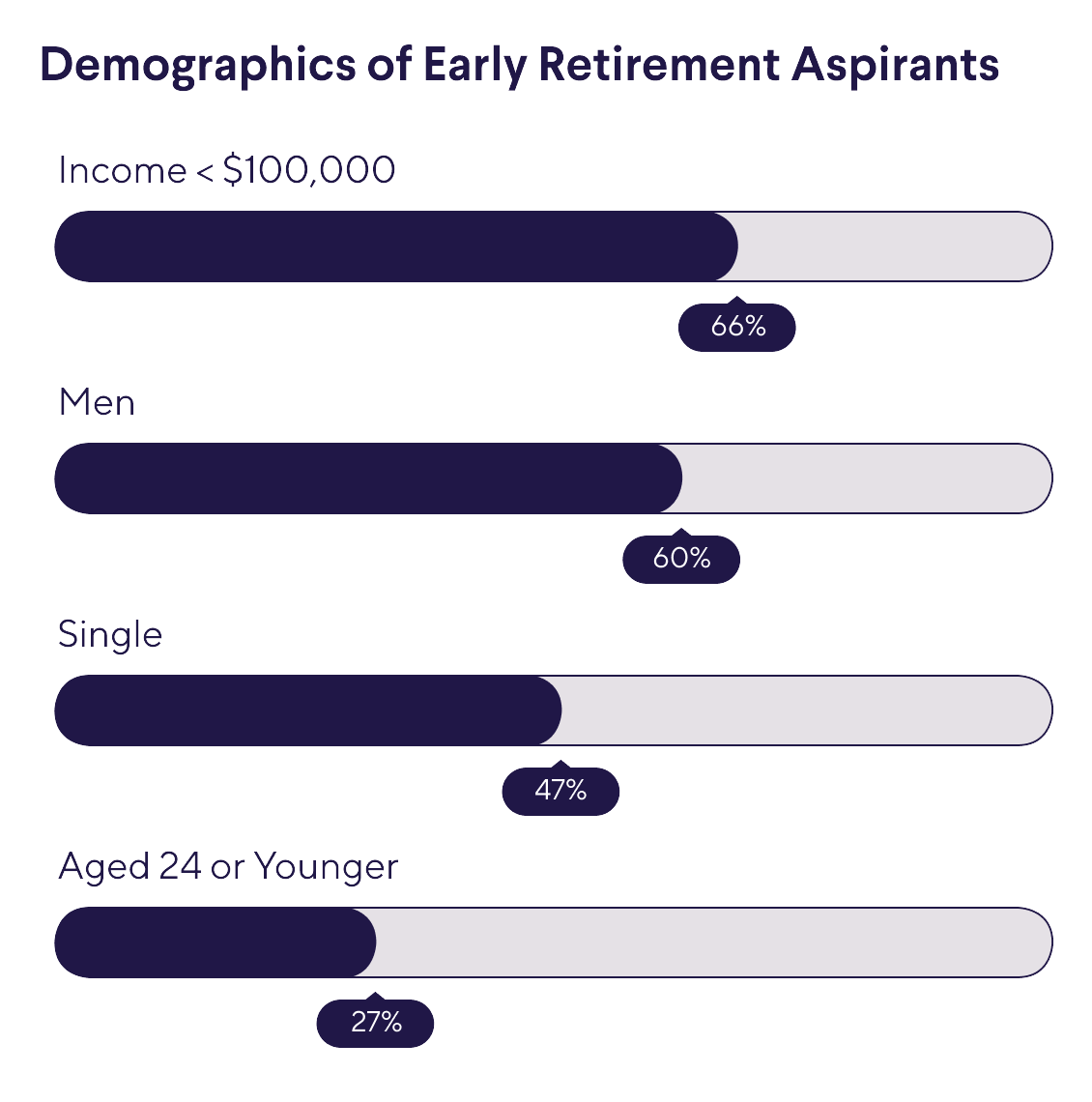
    As mentioned above, a modest 12% of Americans want to retire at age 49 or younger. Of that group:

    demographics of early retirement aspirants

    Roughly 1 in 3 Are Using FIRE strategies

    Of those who said they want to retire before they turn 50, about a third (36%) are using the Financial Independence, Retire Early (FIRE) approach, a financial movement that embraces frugal living, aggressive saving, and investment. Others are working to get there by maxing out their retirement plans, using brokerage accounts, aggressively paying down debt, and/or generating extra income through a second job or passive income strategies.

    Retirement Income and Social Security

    Retirees generally rely on multiple resources, including investments, part-time work, and Social Security, to ensure a sustainable income stream in their retirement years. Most of our survey respondents are planning for that. However, some are counting solely on Social Security for their retirement years.

    60% Plan to Use Their Savings to Fund their Retirement

    According to our survey, today’s workers are mostly counting on their investments (like their 401(k)s and IRAs) to fund their retirement. Nearly half are also relying on Social Security benefits, and 32% expect some income from pensions or annuities. Roughly 1 in 3 also plan to supplement their savings with part-time work or freelancing. A full 13% aren’t yet sure how they’ll fund their retirement yet.

    Nearly 1 in 3 Expect Social Security to Be Their Main Income Source

    Social Security is a federal program that was designed to help people pay their expenses during retirement, but it is generally not meant to be your only source of income in retirement. On average, Social Security will replace about 40% of your annual pre-retirement earnings, according to the Social Security Administration.

    While many people we polled (41%) are aware of this, a sizable percentage (31%) are counting on Social Security as their main source of income in retirement. On the flip side, a full 16% aren’t counting on Social Security at all.

    Recommended: When to Take Social Security: Age 62 vs. 67 vs. 70

    Challenges and Concerns

    Getting to the finish line with retirement isn’t always a straight course. Our survey reveals what Americans are most concerned about when mapping out their financial future.

    1 in 2 Are Worried About Health Care Eating Up Retirement Savings

    Rising health care costs can test the strength of your retirement plan, and roughly half of people we polled cite it as their number one concern. Forty-nine percent plan to use Medicare and supplemental insurance to manage health care expenses in retirement, while 27% are putting funds into a Health Savings Account (HSA) to help cover future health care expenses.

    After health care, respondents said their chief worries were (in order of importance): economic downturns, inflation, and outliving their retirement savings. Just 10% say they have no concerns about their retirement savings.

    1 in 2 Review Their Savings Strategies at Least Annually

    Financial advisors generally recommend reviewing your retirement savings accounts and overall plan at least once each year to monitor your progress and address any concerns.

    The good news is that more than half of our survey participants (55%) do that or more: 23% check in once a year; 13% do quarterly reviews, and 19% check in once a month or more. But there is some room for improvement: 15% of our survey respondents admit to taking a head-in-the-sand approach and never review or adjust their retirement plan.

    The Takeaway

    The results of SoFi’s 2024 Retirement Survey suggest that most Americans are getting a relatively early start on saving for retirement and feel fairly confident about reaching their goals. However, our data also highlights some weak spots: Many workers aren’t putting away enough of each paycheck into savings, don’t have a clear idea of how much they will need to retire, and may not have enough stashed away to retire when they’d like.

    Taking an inventory of your investments, and using some basic rules of thumb to calculate how much you need to save can help you figure out where you are on the path to retirement. And if you have yet to start investing, it’s easy to get the ball rolling.

    Ready to invest for your retirement? It’s easy to get started when you open a traditional or Roth IRA with SoFi. SoFi doesn’t charge commissions, but other fees apply (full fee disclosure here).

    Easily manage your retirement savings with a SoFi IRA.

    Invest now

    About the Survey

    SoFi’s 2024 Retirement Survey was conducted on April 1, 2024 and included 500 U.S. adults aged 18+ who were either currently saving for retirement, not currently saving for retirement but have in the past, or not currently saving but would like to start.

    Percentages were rounded to the nearest whole number so some percentages may not add up to 100%.

    SOIN-Q125-088

    Read more
    TLS 1.2 Encrypted
    Equal Housing Lender