SoFi Blog

Tips and news—
for your financial moves.

Auto Loans Refinance

{/* Auto Loan Refinance LP 5/28 */}
{/* https://www.sofi.com/auto-loans/auto-loan-refinance/ */}


{/* Hero */}

Auto Loan Refinance

You could
save big by
refinancing
your auto loan.


When you refinance your
auto loan, you could lower
your monthly payment or
save big on interest.
Explore
your options in minutes with
SoFi’s marketplace.


Search for financing

(without impacting your credit score)

SoFi’s marketplace is owned and operated by SoFi Lending Corp.
Expand for Advertising Disclosures
.


} />}
expand={} />}
/>

Advertising Disclosures: The
preliminary
options presented on this
site are from lenders
and providers
that pay SoFi compensation for

marketing their products and services.
This affects
whether a product or service is featured on this site
and could affect the order of presentation. SoFi does
not include all products and services in the market.
All rates, terms, and conditions vary by provider. See
SoFi Lending Corp. licensing information below.


{/* Refinance your auto loans with */}

Refinance your auto loan with
SoFi’s marketplace in three steps.


  • Search for quotes.

    Browse our marketplace for
    competitive auto loan refinance
    quotes from top providers.


  • Compare your options.

    Evaluate and compare quotes to
    see if you could lower your monthly
    payment or save big on interest.


  • Get your approval status.

    Choose a quote and receive a
    credit decision from the provider in
    minutes. If you’re approved and
    decide to refinance, you will have a
    new car loan with the terms
    selected.


Search for quotes

(without impacting your credit score)

{/* Auto loan refinancing might be right for you*/}

Auto loan refinancing might be right for you, if…

reduction in debt could
allow you to qualify for a
lower interest rate. By
refinancing to a lower rate,
you could save on the total
interest paid over time and
possibly bring your
monthly payment down.’,
title: ‘Your credit score has improved.’
},
{
ctaIsButton: false,
ctaLink: ”,
ctaText: ”,
hasCta: false,
imgSrc: ‘https://d32ijn7u0aqfv4.cloudfront.net/wp/wp-content/uploads/raw/LNT25-2477050_Auto-Loan-Refinancing-Landing-Page_Mod3_2_Mobile%402x.png’,
text: ‘If you’re having trouble
making your car payment,
refinancing to a lower
interest rate could help
lower your payment. Just
know, if you extend the
length of your loan, you
may pay more in interest
over time.’,
title: ‘You need to lower your monthly payment.’
},
{
ctaIsButton: false,
ctaLink: ”,
ctaText: ”,
hasCta: false,
imgSrc: ‘https://d32ijn7u0aqfv4.cloudfront.net/wp/wp-content/uploads/raw/LNT25-2477050_Auto-Loan-Refinancing-Landing-Page_Mod3_3_Mobile%402x.png’,
text: ‘When you make changes
to a loan, many lenders will
let you add or remove a
co-borrower. This means
you can remove or add
someone to the vehicle’s
title after refinancing your
auto loan.’,
title: ‘You want to make changes to the car’s title.’
},
{
ctaIsButton: false,
ctaLink: ”,
ctaText: ”,
hasCta: false,
imgSrc: ‘https://d32ijn7u0aqfv4.cloudfront.net/wp/wp-content/uploads/raw/LNT25-2477050_Auto-Loan-Refinancing-Landing-Page_Mod3_4_Mobile%402x.png’,
text: ‘If interest rates have
dropped since you
purchased your car, it
could be a smart money
move to explore your
options. A lower rate could
mean big savings. Just
consider whether
potential savings offset
lender fees.’,
title: ‘Auto loan interest rates have dropped.’
}
]}
/>


Search for quotes

(without impacting your credit score)

{/* What is SoFi’s marketplace? */}

What is
SoFi’s
marketplace?

Our marketplace is a one-stop shop for
comparing auto loan refinance rates
from multiple lenders. You can explore
your options with one easy search
and shop refinancing solutions in
minutes.
We keep it simple.


Search for quotes

(without impacting your credit score)


{/* horizon */}

{/* Compare auto loan refinance rates in minutes */}

Compare auto loan
refinance rates
in minutes.

You could save big with one simple search on SoFi’s marketplace.


Search for quotes

(without impacting your credit score)


{/*FAQs*/}

FAQs


Can I refinance a car with bad credit?

Yes, refinancing an auto loan with bad credit is possible, but it may be difficult. Lenders typically handle auto refinancing on a case-by-case basis. You may be able to refinance a car loan with bad credit if you have a positive track record of making payments on your current loan or have a creditworthy cosigner. If you’re considering refinancing and are coming up empty-handed, talk to your current lender. They may be open to discussing options. 


How do I know which lender is the best for my auto loan refinance?

Comparing multiple options will provide more context that can help you find the right loan for you. Shopping around allows you to compare rates from different lenders, which is important if you’re looking for the lowest car refinance rates for you. The best company to refinance auto loan debt is the lender that offers the right terms for you.


Does checking my rate hurt my credit score?

No, checking your rate with SoFi’s marketplace results in a soft credit inquiry. This means you can find and compare auto refinance options without impacting your credit score. If you choose to proceed with a loan refinancing option, a hard credit pull will follow, which will be recorded by credit bureaus and may cause your credit score to drop several points.


What information do you need about my vehicle?


You’ll need to provide either the VIN, license plate number, or the make and model of your vehicle. By providing some basic information about your car, SoFi’s marketplace can help you shop and compare refinance rates for your vehicle.


Can I refinance my car with a cosigner?

Yes, some companies allow refinancing with a cosigner. Some lenders may also allow qualified individuals to co-borrow. A creditworthy cosigner or co-borrower can help you get approved for better refinance car loan rates.


Who has the best auto refinance rates?

There is no one place with the “best” rates, as every situation is different. For instance, when searching for the “best” auto refinance rates, remember that just because a place says “rates as low as…” you aren’t guaranteed a rate that low. Rates, terms, and other conditions are generally determined by many factors, including:

•   Your credit score, current financial situation, and creditworthiness

•   Your location (different states may have different rates and restrictions)

•   The mileage on the vehicle

•   Whether the car was new or used when purchased

•   The length of your refinanced loan


Can I qualify for auto loan refinancing at a lower interest rate?

Auto refinance applicants may need higher income, better credit scores, or a much lower debt-to-income ratio than they had when taking out their initial loan to potentially qualify for lower rates. That said, qualifying for a lower car loan refinancing rate is never guaranteed, no matter how much those factors may have changed in your favor.


What happens if I extend my car loan term?

While extending the life of your loan may result in lower monthly payments, it can also mean paying more overall. This is because the longer it takes to pay off a loan, the more months you are paying interest. Additionally, your car’s value will likely depreciate over time. So the loan amount you were approved for could end up being higher than what your car is worth when you’re done paying off the loan.


See all FAQs


Read more

Decoding Markets: Recovery Road

Round Trip

It was February 19. Stocks were sitting at record highs, with the S&P 500 surpassing 6144. A rapidly shifting policy landscape was largely written off by investors as the typical early days of a new administration.

Then came April 2. On what President Trump called Liberation Day, he unveiled a baseline universal tariff on imports in addition to higher reciprocal tariffs. The market reaction was swift. Over the next week, stocks — already down 7.7% from their all-time highs — fell an additional 12% as investors grappled with what were likely to be the meaningfully negative effects of higher import costs.

The market carnage ended suddenly on April 9, when the administration announced a 90-day pause on tariffs to allow time for negotiations. The S&P 500 rose 9.5% that day, the 10th best day for stocks since 1927. Looking past major tit-for-tat retaliation with China and an eventual detente, stocks have nearly round-tripped all the way back, now sitting just 5% away from all-time highs.

If the pivot on trade policy was what ignited this rally, washed-out positioning and bearish sentiment, which reached its most extreme levels since 2022, served as fuel. Factors like this can affect price only for so long before fading, however. That looks to be happening now with the recent strong momentum losing some steam.

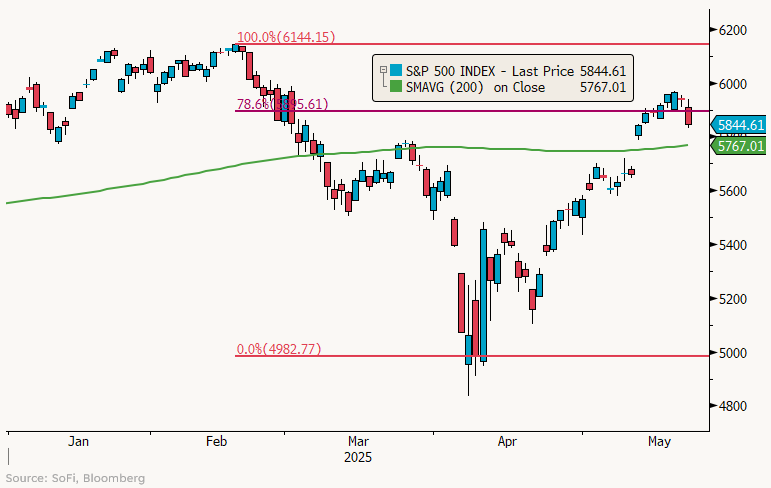
From a technical perspective, the S&P 500 might have encountered some resistance near 6000, a psychologically important round number. (For all its complexity, investing can sometimes be that simple – investors are humans after all). That this consolidation is happening after stocks have punched through several important retracement levels isn’t shocking or unhealthy. Digestion phases are normal.

S&P 500 Levels

Just as certain price levels can serve as resistance, they can also serve as support. Given that market momentum has faded in recent days, investors could look to these levels for a “verdict” on the rally’s durability. Two such levels to keep in mind are the 200-day moving average currently at 5767 and the 78.6% retracement level at 5896. The S&P 500 has hovered around the latter in recent days and even fell below it yesterday.

How this clash of investor buying and selling shakes out is key. If support fails, it could be the beginning of a meaningful move lower for stocks.

Fundamentals Are King

Technical factors may affect markets in the short-term, but what matters over the long-term is fundamentals. And for now, things look rosy on that end.

With 94% of S&P 500 companies having reported first quarter results, earnings per share are tracking toward year-over-year growth of 11.2%, surpassing consensus expectations by 8.0%. This marked the second consecutive quarter of double-digit growth and the seventh straight quarter of positive growth.

Of course, all the recent upheaval has made these results a bit stale. Companies have been cautious about providing guidance with the outlook heavily dependent on what happens on the macroeconomic and trade policy front. Tariffs, in particular, have emerged as a major concern, with nearly all companies mentioning them this earnings season.

That’s not surprising. Tariffs can increase input costs, disrupt supply chains, and dampen consumer demand, thereby squeezing profit margins. This caution is further reflected in company guidance, which Bloomberg data suggests is at its most negative since 2015. Despite the negative direction, investor expectations for forward earnings have been pretty resilient: Forward 12m EPS consensus is $273, only 1.2% below the March 31 peak of $277.

S&P 500 Forward Earnings

This is different from prior periods of non-recessionary market upheaval, which saw more deterioration in earnings expectations.

•   The 2018-19 trade war (which, like now, had a Federal Reserve talking tough on interest rates) saw forward earnings estimates fall 3.1%.

•   The period of negative guidance momentum a decade ago saw forward earnings estimates fall 5.7%.

•   The inflation shock of 2022-23 saw forward earnings estimates fall 6.1%.

That’s not to mention recessionary drawdowns, which often see earnings revised lower by double-digit percentage points.

All in all, resilient earnings expectations have enabled stocks to recover recent losses, but that could be reversed if the macro backdrop changes. It might take some time to get that clarity though, which suggests the risk of the fundamentals breaking down in the immediate future is somewhat muted. Later in the summer, once trade deals are signed (or not) and tariffs are finally set in stone (or not), these concerns could pick up. But for now it’s spring and out of sight, out of mind.

The Bigger Picture

It would be remiss not to acknowledge that financial markets are more than just stocks. Gold, for instance, has been a standout performer in 2025, with the precious metal up nearly 27% this year alone. Aggressive purchasing globally by central banks seeking to diversify their reserves has provided strong underlying support. Gold is also typically seen as a hedge against inflation fears and U.S. dollar weakness, which have been market themes year-to-date.

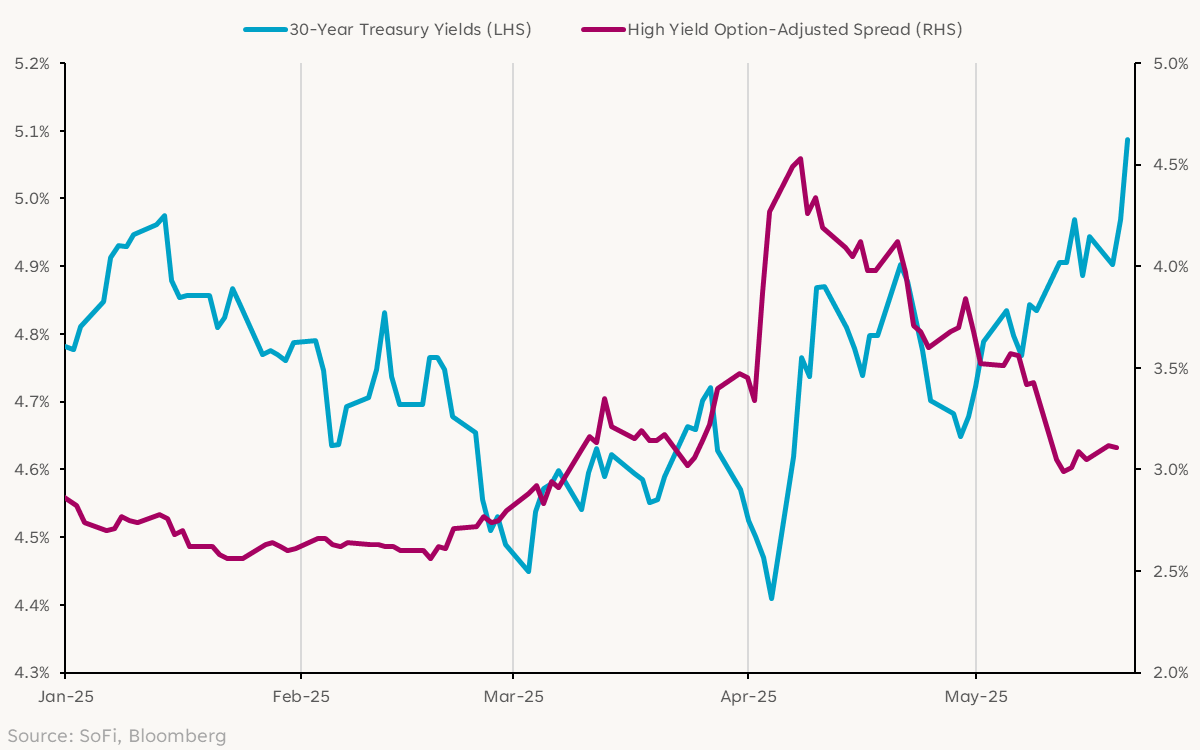
Bonds have been another asset class with a lot of action — especially U.S. Treasurys. The big shifts in inflation, economic growth, and Fed policy expectations has led to major whipsaw in what is typically seen as one of the safer investment options. Long-term Treasury yields fell 9-13 basis points in the first two days post-Liberation Day, before surging 45-50 basis points over the next week.

Bond Market Volatility

Corporate bonds give us a more nuanced way of being able to view markets. While affected by trends in Treasury markets, they often have higher yields due to the risk associated with their exposure to businesses’ financial health. After High Yield credit spreads had already risen 72 basis points from February 19 to April 2, they rose an additional 119 basis points through April 8, reflecting increased recession fears. In the month and a half since then, they’re down 142 basis points. Now they’re below where they were on Liberation Day and quite low historically.

So let’s summarize: Gold is pushing toward all-time highs, as we might expect it to do in a period of elevated uncertainty and dollar weakness. Credit spreads suggest a benign backdrop, and stocks are near all-time highs (albeit with weakening momentum). It’s an unlikely combination, and how it will resolve is anyone’s guess. If the economy holds up and trade policy uncertainty evaporates, stocks should be able to set new records. If there’s more volatility ahead, it’ll be tougher for stocks to climb the mountain, with defensive areas likely to outperform.


Want more insights from SoFi’s Investment Strategy team? The Important Part: Investing With Liz Thomas, a podcast from SoFi, takes listeners through today’s top-of-mind themes in investing and breaks them down into digestible and actionable pieces.

Listen & Subscribe


SoFi can’t guarantee future financial performance, and past performance is no indication of future success. This information isn’t financial advice. Investment decisions should be based on specific financial needs, goals and risk appetite.

Communication of SoFi Wealth LLC an SEC Registered Investment Adviser. Information about SoFi Wealth’s advisory operations, services, and fees is set forth in SoFi Wealth’s current Form ADV Part 2 (Brochure), a copy of which is available upon request and at www.adviserinfo.sec.gov. Mario Ismailanji is a Registered Representative of SoFi Securities and Investment Advisor Representative of SoFi Wealth. Form ADV 2A is available at www.sofi.com/legal/adv.

Read more

Is 733 a Good Credit Score?


Is 733 a Good Credit Score?

733 credit score

On this page:

    By Marcy Lovitch

    A 733 credit score fits into the “good” category and could make it easier to qualify for different types of loans and credit cards at lower interest rates. It’s also higher than the national average credit score of 715 and only seven points away from the “very good” category.

    Here’s how a credit score of 733 can impact borrowing.

    Key Points

    •   A 733 credit score is considered good and is higher than the national average of 715.

    •   A 733 credit score can make it easier to qualify for credit cards with favorable terms and rewards.

    •   This score enhances chances of renting an apartment and securing loans with better terms.

    •   Lenders also consider other financial factors, like employment status and debt-to-income ratio.

    •   A 733 credit score is advantageous for financial opportunities and can save you money on interest over the long term.

    What Does a 733 Credit Score Mean?

    Credit score ranges generally span from 300 to 850. FICO®, the credit scoring model used by 90% of lenders, calculates your score based on five categories:

    •   Payment history (35%)

    •   Amounts owed (30%)

    •   Length of credit history (15%)

    •   Diversity of credit mix (10%)

    •   How many new credit accounts you’ve opened in a short period of time (10%)

    Using the above information, here’s how FICO categorizes its credit scores:

    •   Poor: 300-579

    •   Fair: 580-669

    •   Good: 670-739

    •   Very Good: 740-799

    •   Excellent (or Exceptional): 800-850

    As you can see, a 733 credit score is a good credit score.

    Recommended: 8 Reasons Why Good Credit Is So Important

    What Else Can You Get With a 733 Credit Score?

    Having a 733 credit score can unlock certain benefits and opportunities that a person with a poor or fair credit score may not qualify for.

    For instance, having a good credit score can make it easier to rent an apartment, since landlords often run a tenant credit and background check when considering an applicant. A 733 credit score can bolster your chances of getting the apartment because it shows you’re more likely to make on-time rent payments than someone with a lower score.

    The score could also improve your odds of getting approved for a mortgage, credit card, car loan, or personal loan. Let’s take a closer look.

    Can I Get a Credit Card With a 733 Credit Score?

    There’s no minimum credit score needed to obtain a credit card. That said, with a credit score of 733, you should be able to qualify for a popular kind of card: an unsecured credit card. This line of credit lets you use credit up to its limit and then pay it off continuously — with no end date. In addition to helping you build credit, an unsecured card often carries extras like cash-back rewards or free travel insurance.

    Can I Get an Auto Loan With a 733 Credit Score?

    Most auto loan lenders are looking for people with a FICO Score of 661 or higher, according to Experian®. If your score falls in that range, you may be more likely to get approved for an auto loan with favorable terms, which can lower borrowing costs.

    Consider this: In the fourth quarter of 2024, Experian reports the average APR for a borrower with a prime credit score (661-780) was 6.40% for a new car loan and 9.95% for a used car. Those numbers jump for car shoppers with a deep subprime credit score (300-500). The average APR for a new car loan was 15.75% and 21.81% for a used car.

    While a 733 credit score can help you secure better deals, it’s important to know your score isn’t the only thing a lender considers. Other factors include the amount you’re borrowing, the length of the loan, the kind of car you’re purchasing, and the amount of your down payment.

    Recommended: Should I Buy a New or Used Car in 2025?

    Can I Get a Mortgage With a 733 Credit Score?

    Similar to auto loans, credit score requirements for a mortgage depend on your lender. Here’s a look at different types of mortgage loans.

    Conventional mortgages

    Conventional mortgages are loans that a government agency does not insure, and they usually require a minimum credit score of 620. Provided your other credentials are strong, you should be able to qualify for a conventional mortgage with a 733 credit score.

    FHA loans

    FHA loans are backed by the government and may be of particular interest to borrowers with a lower credit score. These types of loans require a minimum 3.5% down payment with a credit score of 580 — or a 10% down payment with a score between 500 and 579.

    VA loans

    Also backed by the government, VA loans are available to service members, veterans, and qualifying surviving spouses with a Certificate of Eligibility (COE). Lenders usually want to see a score of 620 or higher, though some will consider scores as low as 580.

    USDA loans

    USDA loans are backed by the U.S. Department of Agriculture, and borrowers usually need a credit score of at least 640. While a 733 credit score more than satisfies that requirement, you’ll also need to meet certain criteria, including income eligibility, debt-to-income ratio, and property eligibility.

    Can I Get a Personal Loan With a 733 Credit Score?

    A personal loan can be used for virtually any reason — from taking a dream vacation or taking care of hefty medical bills to financing home improvements or consolidating credit card debt.

    You usually need a 580 credit score to qualify for a personal loan, so a 733 score is beyond the necessary threshold to acquire this type of loan.

    Not surprisingly, the better your financial circumstances are, the more of a leg up you have when it comes securing a personal loan — and landing better terms and interest rates. Credit scores matter, but lenders want an overall view of your financial situation to ensure you’ll be able to pay back what you borrow. Besides your actual credit score, they’ll carefully consider other key factors such as your employment status, cash flow, and debt-to-income ratio.

    Thinking of applying for a personal loan? Use SoFi’s personal loan calculator to determine how much your monthly loan payments might amount to so you can keep debt manageable.

    The Takeaway

    Having a 733 credit score falls into the “good” category and is higher than the national average FICO® Score of 715. If this is your score, you’re also close to advancing to the “very good” tier. Most lenders consider someone with a credit score of 733 to be relatively low risk. So, if you’re looking to apply for a new credit card, mortgage, personal or auto loan, you should have plenty of available options with competitive interest rates and terms.

    Think twice before turning to high-interest credit cards. Consider a SoFi personal loan instead. SoFi offers competitive fixed rates and same-day funding. See your rate in minutes.


    SoFi’s Personal Loan was named NerdWallet’s 2024 winner for Best Personal Loan overall.

    View your rate


    SoFi Loan Products
    SoFi loans are originated by SoFi Bank, N.A., NMLS #696891 (Member FDIC). For additional product-specific legal and licensing information, see SoFi.com/legal. Equal Housing Lender.


    Third-Party Brand Mentions: No brands, products, or companies mentioned are affiliated with SoFi, nor do they endorse or sponsor this article. Third-party trademarks referenced herein are property of their respective owners.


    Non affiliation: SoFi isn’t affiliated with any of the companies highlighted in this article.

    Financial Tips & Strategies: The tips provided on this website are of a general nature and do not take into account your specific objectives, financial situation, and needs. You should always consider their appropriateness given your own circumstances.


    Third Party Trademarks: Certified Financial Planner Board of Standards Center for Financial Planning, Inc. owns and licenses the certification marks CFP®, CERTIFIED FINANCIAL PLANNER®


    SOPL-Q225-004

    Read more

    Is 445 a Good Credit Score?


    Is 445 a Good Credit Score?

    445 credit score

    On this page:

      By Marcy Lovitch

      A 445 credit score is considered poor and falls within the lowest category of credit scores. With this score, you may find it challenging to get approved for most loans and credit cards. If you do get the green light from a lender, you can likely expect higher interest rates, fees, and less-flexible terms compared to someone with a much higher score.

      Here’s an in-depth look into what might be available to you with a credit score of 445.

      Key Points

      •   A 445 credit score is poor, making it difficult to get loans and credit cards.

      •   With a 445 credit score, auto loans may have higher interest rates, larger down payments, and increased fees.

      •   Mortgage approval can be tough with a 445 credit score; consider FHA, VA, or USDA loans for better options.

      •   Personal loans are harder to get with a 445 credit score; if approved, expect higher interest rates and fees.

      •   Improving a 445 credit score involves paying bills on time, reducing debt, and keeping older accounts open.

      What Does a 445 Credit Score Mean?

      To understand what a 445 credit score represents, it helps to know about credit scores and how they’re calculated.

      A credit score is a three-digit number between 300 and 850 that signifies to lenders your creditworthiness. There are a handful of credit score factors that make up the particular score found in your credit report. These include:

      •   Payment history

      •   Amounts owed

      •   Length of credit history

      •   Diversity of your credit

      •   Any new credit accounts you may have

      FICO® is the scoring model used by the majority of lenders. Here’s a breakdown of its credit score ranges:

      •   Poor: 300-579

      •   Fair: 580-669

      •   Good: 670-739

      •   Very Good: 740-799

      •   Excellent: 800-850

      Is 445 a good or a bad credit score? As you can see, a credit score of 445 falls into the lowest-ranking category. It’s also 270 points below the national average FICO® score of 715.

      But take heart: There are ways to build up your credit over time and position yourself for more lending options and better terms. Strategies include consistently paying bills on time; paying down debts; keeping open older accounts that are in good standing; and responsibly managing a diverse mix of credit.

      What Else Can You Get with a 445 Credit Score?

      Having a 445 credit score can be an obstacle when it comes to getting approved for certain types of loans or credit cards. If you do get approved, as previously noted, you’ll most likely be saddled with higher interest rates, fees, and less-favorable terms. Let’s take a closer look at what you can get if your credit score is 445.

      Can I Get a Credit Card with a 445 Credit Score?

      There’s no definitive minimum credit score required for a credit card. But if your score is in the poor range, it’s going to be harder to get approved for an unsecured credit card that doesn’t require any form of collateral or a deposit.

      Instead, a secured credit card may be worth exploring. This type of card can be a great way to build credit if you’re having trouble getting approved for a traditional card. You’ll need to put down a security deposit, usually equal to your spending limit on that card. That deposit is refunded once you switch to an unsecured card.

      Another way to get a credit card with a 445 credit score — and help build your credit — is to become an authorized user on someone else’s credit card. The primary cardholder adds you to their account, and you can reap the benefits of their positive financial habits.

      Can I Get an Auto Loan with a 445 Credit Score?

      Similar to credit cards, there’s no minimum credit score needed for a car loan, though some lenders have their own thresholds. You can find car loan offers through banks, credit unions, online lenders, and in some cases, the car dealer.

      Though you can get an auto loan with a credit score of 445, chances are you’re going to shell out more money if you do. For example, for the fourth quarter of 2024, Experian® reports the average annual percentage rate, or APR, was 15.75% for a new car loan and 21.81% for a used car.

      With poor credit, you may have to also put down a larger down payment and pay higher lender fees. You may consider adding a cosigner to the loan to increase your chances of qualifying and getting an auto loan. Though you’ll both apply and appear on the loan together, the cosigner won’t be the car’s owner. However, the two of you are on the hook for the payments.

      Recommended: Smarter Ways to Get a Car Loan

      Can I Get a Mortgage with a 445 Credit Score?

      It can be tough getting a mortgage with a poor credit score, since most conventional loans (ones that aren’t insured by the federal government) typically require applicants to have a 620 credit score or higher.

      If you’re considering buying a home and with a less-than-stellar credit score, you may want to take some time to repair your credit. This can put you in a better position for other government-backed loans such as a Federal Housing Administration (FHA) loan, which typically requires a minimum score of 580 and a down payment of 3.5%. You may also be able to get a FHA loan with a 500 credit score and a 10% down payment.

      There are other government-insured loans you may also want to consider. A Veterans Affairs (VA) loan — available to veterans, active military members and some surviving spouses — doesn’t require a minimum credit score. However, some lenders may require that borrowers have a score in the 620-640 range.

      Similarly, a USDA loan, which is sponsored by the U.S. Department of Agriculture, doesn’t have a firm credit score requirement, but your chances for approval may increase if you have a score of at least 640.

      Can I Get a Personal Loan with a 445 Credit Score?

      A personal loan can be used to fund a variety of things, including home renovations, a wedding, medical bills, or consolidate credit card debt.

      The question is, can you get a personal loan if your credit score is 445? The answer is maybe, though you’ll likely be presented with higher rates and less-flexible terms. You also may not be able to get approved for the full amount you need.

      Credit score requirements for personal loans vary depending on the lender. Generally, you need a score of 580 or higher to qualify, though it’s still possible to find loan issuers who are willing to approve smaller personal loans to those with a lower credit score.

      You may have a better chance if you look for a secured personal loan, which will require you to put up some sort of collateral, such as your car or home in order to get approved. Another idea is to get a cosigner with a healthier credit score to come on board to help get the loan rubber-stamped.

      If you’re thinking about applying for a personal loan, try using SoFi’s personal loan calculator to determine how much your monthly loan payments might amount to so you can keep debt manageable.

      Recommended: Where to Get a Personal Loan?

      The Takeaway

      Is a 445 credit score good or bad? It’s in the lowest category of credit score rankings and considerably lower than the national average credit score of 715. But don’t despair, because even if your score is 445, it doesn’t have to stay there.

      It may take time, but you can take solid steps to repair your credit and put yourself in a better position to qualify for a variety of loans and lines of credit. Examples include paying your bills on time, avoiding accumulating any extra debt, keeping a diverse credit mix, and not applying for many new accounts in a short period of time.

      Think twice before turning to high-interest credit cards. Consider a SoFi personal loan instead. SoFi offers competitive fixed rates and same-day funding. See your rate in minutes.


      SoFi’s Personal Loan was named NerdWallet’s 2024 winner for Best Personal Loan overall.

      View your rate

      SoFi Loan Products
      SoFi loans are originated by SoFi Bank, N.A., NMLS #696891 (Member FDIC). For additional product-specific legal and licensing information, see SoFi.com/legal. Equal Housing Lender.


      Disclaimer: Many factors affect your credit scores and the interest rates you may receive. SoFi is not a Credit Repair Organization as defined under federal or state law, including the Credit Repair Organizations Act. SoFi does not provide “credit repair” services or advice or assistance regarding “rebuilding” or “improving” your credit record, credit history, or credit rating. For details, see the FTC’s website .


      Third-Party Brand Mentions: No brands, products, or companies mentioned are affiliated with SoFi, nor do they endorse or sponsor this article. Third-party trademarks referenced herein are property of their respective owners.


      Non affiliation: SoFi isn’t affiliated with any of the companies highlighted in this article.

      Financial Tips & Strategies: The tips provided on this website are of a general nature and do not take into account your specific objectives, financial situation, and needs. You should always consider their appropriateness given your own circumstances.


      SOPL-Q225-105

      Read more

      Create an Emergency Financial Plan To Ease Recession Stress

      This article appeared in SoFi's On the Money newsletter. Not getting it? Sign up here.

      What’s your runway?

      That is, how long could you cover your expenses if you lost your job or faced some other hardship?

      Sobering questions like these are on all of our minds as uncertainty about the economy consumes much of the country. Last month concerns about tariff policies and a potential recession turned Americans’ expectations about future income prospects negative for the first time in five years, according to The Conference Board’s Consumer Confidence survey.

      If you have enough saved to cover three to six months worth of living expenses — as experts recommend — you’re already ahead of the game, since many people don’t.

      But figuring out how to stretch those limited dollars over an unemployment gap of unknown length can still be stressful. You can take control of your finances — and be better prepared — by planning out exactly what steps you would take if you’re laid off. Create an emergency financial plan, as it were.

      There are no set rules for these kinds of plans, and for some, it might be enough to make a quick mental list of backup options.

      But you can get as detailed as you want, writing up a step-by-step plan for what you would cut from your monthly budget when and how you would pivot if your reserves are dwindling. The key is the timing: determining what you would do right away and which extra steps you would take if your unemployment was extended.

      Here are a few questions an uber planner will want to answer as they create their emergency financial plan:

      1.    Would you be eligible for unemployment benefits, and if so, how much could you expect to collect each week? This roundup of rules for each state can help.

      2.    How much monthly income will your household have without yours? This would include unemployment benefits, SNAP or other government assistance you may be eligible for, a spouse or partner’s income, investment income, and alimony or child support.

      3.    What are your baseline monthly expenses — your rent or mortgage payment, utilities, food, gas, debt payments, etc. — and how much do you spend on optional things? Can you rank those optional or discretionary items from most to least cuttable? (For instance, maybe you cancel streaming services and stop getting takeout right away, but only stop your gym membership or kid’s piano lessons if your savings fall to a certain level.)

      4.    Could you take on any temporary or part-time work while you look for your next permanent role? If so, how much could you earn?

      5.    At what point will you consider taking more drastic measures and what will those be? Could you borrow on your credit cards or take out a loan? Apply for forbearance with one or more lenders? Dip into your 401(k) or IRA?

      So what? Unemployment most typically lasts about 10 weeks, but 23% of the people unemployed in April had been out of work for at least 27 weeks, according to government data. Having a healthy emergency savings and a plan for using it can help you prepare you for whatever happens. Plus, confronting the worst-case scenario often reduces stress and anxiety — and gives you back control of the uncontrollable.

      Related Reading

      •   5 Things to Do to Come Back From a Layoff (SoFi)

      •   Reducing the Harms of Unemployment (University of North Dakota)

      •   In Case of Emergency, Break Glass: Managing Household Liquidity (Vanguard)


      Please understand that this information provided is general in nature and shouldn’t be construed as a recommendation or solicitation of any products offered by SoFi’s affiliates and subsidiaries. In addition, this information is by no means meant to provide investment or financial advice, nor is it intended to serve as the basis for any investment decision or recommendation to buy or sell any asset. Keep in mind that investing involves risk, and past performance of an asset never guarantees future results or returns. It’s important for investors to consider their specific financial needs, goals, and risk profile before making an investment decision.

      The information and analysis provided through hyperlinks to third party websites, while believed to be accurate, cannot be guaranteed by SoFi. These links are provided for informational purposes and should not be viewed as an endorsement. No brands or products mentioned are affiliated with SoFi, nor do they endorse or sponsor this content.

      SoFi isn't recommending and is not affiliated with the brands or companies displayed. Brands displayed neither endorse or sponsor this article. Third party trademarks and service marks referenced are property of their respective owners.

      OTM20250521SW

      Read more
      TLS 1.2 Encrypted
      Equal Housing Lender