SoFi Blog

Tips and news—
for your financial moves.

A Primer for Parents on the Trump Accounts: Yay or Nay?

By now, you’ve probably heard about the Trump Accounts. And the headline-maker seems to be the $1,000 in seed money available to all babies born between 2025 and 2028.

But how will these new investment vehicles actually work? And how should they fit into your kid’s financial future, if at all?

Here’s what we know: Trump Accounts are a new type of tax-deferred investment account for kids. They’re part of the newly approved budget bill (aka One Big Beautiful Bill,) and the idea is to kick-start each kid’s financial security as soon as they leave the womb.

While newborns are the only ones eligible for the one-time $1,000 from the government, anyone under 18 with a Social Security number can have a Trump Account.

Parents, relatives, and even employers will be able to contribute up to $5,000 combined per year, with employer contributions capped at $2,500. Earnings will grow tax-free until they’re withdrawn, and there will be incentives for the accountholder to use the money for retirement, college tuition or buying a house for the first time.

Many of the details and logistics are still unclear (the accounts reportedly won’t be available until next July) but in the meantime, here are some of the pluses and minuses — and how they compare to other options you have for saving and investing, including IRAs, 529 college savings plans, and custodial brokerage accounts.

Yay: You get $1,000. If you’ve got a qualifying newborn, the free money is what makes the Trump Accounts different from any other investment account.

Nay: Earnings get taxed upon withdrawal. While the money in a Trump Account can grow tax-deferred, your child will have to pay taxes on any earnings when they withdraw the money.

It would be taxed at a potentially lower rate (the rate for long-term capital gains rather than ordinary income) if they use it for a qualified expense such as college tuition, business loans or a first-time home purchase, but with a 529 plan, your child wouldn’t pay any federal taxes (and generally no state taxes) on earnings as long as the money is used for education.

In fact, among the current slate of tax-advantaged investment accounts available to Americans, the Trump Accounts are pretty restrictive, according to the Tax Foundation. Here’s a side-by-side comparison.

Yay: Employers can kick in. Employers will be allowed to contribute cash for your kid, and it won’t count as part of your income. If this catches on as a trendy retention tool, with companies like Dell already pledging their support, parent-employees might be motivated to open Trump Accounts for their kids just to get the free company cash.

Nay: Parents don’t get tax breaks for contributing. You may be wondering what’s in it for you if you contribute to your kids’ Trump Accounts. Unlike with many retirement accounts, parents won’t get a tax deduction on their contributions. FYI: 529 plan contributions aren’t deductible on your federal income tax either, but can sometimes be claimed at the state-level.

Yay: Families could catch the investment bug. A $1,000 headstart could motivate families who aren’t already investors to become investors. And that could help grow generational wealth.

Nay: Investment choices are more limited. With Trump Accounts, you can only invest in U.S.-based mutual funds and ETFs. Custodial brokerage accounts, on the other hand, offer more investment choices (for example, bonds and individual stocks.) And although there aren’t any tax benefits with custodial accounts, they don’t face the same early-withdrawal penalties or restrictions that Trump Accounts will.

So what? For newborns, a Trump Account is a no-brainer. Just the initial $1,000 could theoretically turn into enough for a down payment on a house by the time your child is 40, depending on how the investments do. (If that initial $1,000 earned 7% a year, they’d have nearly $15,000 after 40 years.)

Otherwise, though, take some time to investigate Trump Accounts further as more details are announced. Capitalizing on more than one investment vehicle for your kids is great if you can swing it. But if you have limited dollars to invest, you may want to put this one lower on your priority list.

Related Reading

Trump Accounts: A New Way to Save for Your Child’s Future (SavingforCollege.com)

Read This Before Putting Any of Your Own Money Into One of Those Trump Accounts for Babies (MarketWatch via MSN)

Creating an Investment Plan for Your Child (SoFi)


Please understand that this information provided is general in nature and shouldn’t be construed as a recommendation or solicitation of any products offered by SoFi’s affiliates and subsidiaries. In addition, this information is by no means meant to provide investment or financial advice, nor is it intended to serve as the basis for any investment decision or recommendation to buy or sell any asset. Keep in mind that investing involves risk, and past performance of an asset never guarantees future results or returns. It’s important for investors to consider their specific financial needs, goals, and risk profile before making an investment decision.

The information and analysis provided through hyperlinks to third party websites, while believed to be accurate, cannot be guaranteed by SoFi. These links are provided for informational purposes and should not be viewed as an endorsement. No brands or products mentioned are affiliated with SoFi, nor do they endorse or sponsor this content.

SoFi isn't recommending and is not affiliated with the brands or companies displayed. Brands displayed neither endorse or sponsor this article. Third party trademarks and service marks referenced are property of their respective owners.

OTM20250725SW

Read more


DM – Home Equity Rapid 1

Pay off debt with a
SoFi Home Equity Loan.

✓ Pre-filled, fast-tracked application
✓ No in-person appraisal
✓ No closing costs, origination fees or prepayment penalties*

Where is my confirmation code?


Checking your rate won’t impact your credit score.


Why SoFi

Finance debt consolidation or home improvements with SoFi as your Home Equity broker.

No change to your mortgage rate

No need to refinance your first mortgage. And for qualified borrowers, there are options to access a large portion of your home’s equity.

Lower monthly payment

You could save compared to a high-interest credit card or unsecured installment loan.

Finance almost anything up to $350K

Access up to $350,000 of your home’s equity (up to 85%) to finance home improvements or consolidate debt.

Dedicated one-on-one support

You’ll have a dedicated SoFi Mortgage Loan Officer to help you find the right loan option.

Read more

Renters Insurance Guide

Renters Insurance Guide

Renters Insurance Resources:
A Comprehensive Guide to Renters Insurance

Understanding your renters insurance needs can be challenging. This resource hub brings together helpful articles on topics like coverage types, common insurance terms, and costs. Whether you’re looking for ways to lower your premium or just want to learn the basics, these resources can help.

Terms to know:


Premium

The regular payment (monthly or yearly) you make to keep your insurance policy active.

Deductible

The amount you must pay out-of-pocket on a claim before your insurance company pays the rest.

Personal Property Coverage

Covers the cost to repair or replace your belongings if they are damaged or stolen by a covered event.

Liability Coverage

Protects you financially if you’re found responsible for injuring someone or damaging their property.

Loss of Use Coverage (ALE)

A specific cause of damage that your policy covers, such as fire or theft.

Peril

This is the official, legal document that includes the terms of the policy owner’s insurance. The policy will name the insured, the policy owner, the death benefit, and the beneficiary.

Endorsement (or Rider)

An optional add-on that provides extra coverage to your policy, often for high-value items like jewelry.

Renters Insurance Basics

Renters insurance can be confusing, but understanding the basics can help. These articles cover key topics like choosing a renters insurance deductible, why landlords require it, and how it works to give you a solid foundation.

Ready to Explore Renters Insurance?

With SoFi, compare renters insurance coverage options from a network of top insurance providers.


Get started

Read more

Decoding Markets: Behavioral Biases

The Threat From Within

2025 has been filled with twists and turns. From trade policy uncertainty to major tax reforms to the ongoing dominance of artificial intelligence, there has been a lot to digest. But complex and sometimes confusing backdrops create a fertile ground for investment mistakes.

When investing over the long-term, the most significant threat often comes from within. Most investors aren’t robots (though even that has been changing these days), which means that behavioral biases inevitably come into the fray. This can contribute to investors making the wrong decisions at precisely the wrong moments.

In a market increasingly dominated by animal spirits, it’s a good time to check ourselves before we wreck ourselves.

Recency Bias

Recency bias causes individuals to weigh recent events more heavily than historical data when making judgments and decisions. In investing, this manifests as the tendency to believe that recent market trends, whether positive or negative, will continue indefinitely into the future. This bias can be particularly potent — our freshest memories are usually the most vivid — and so they seem the most relevant.

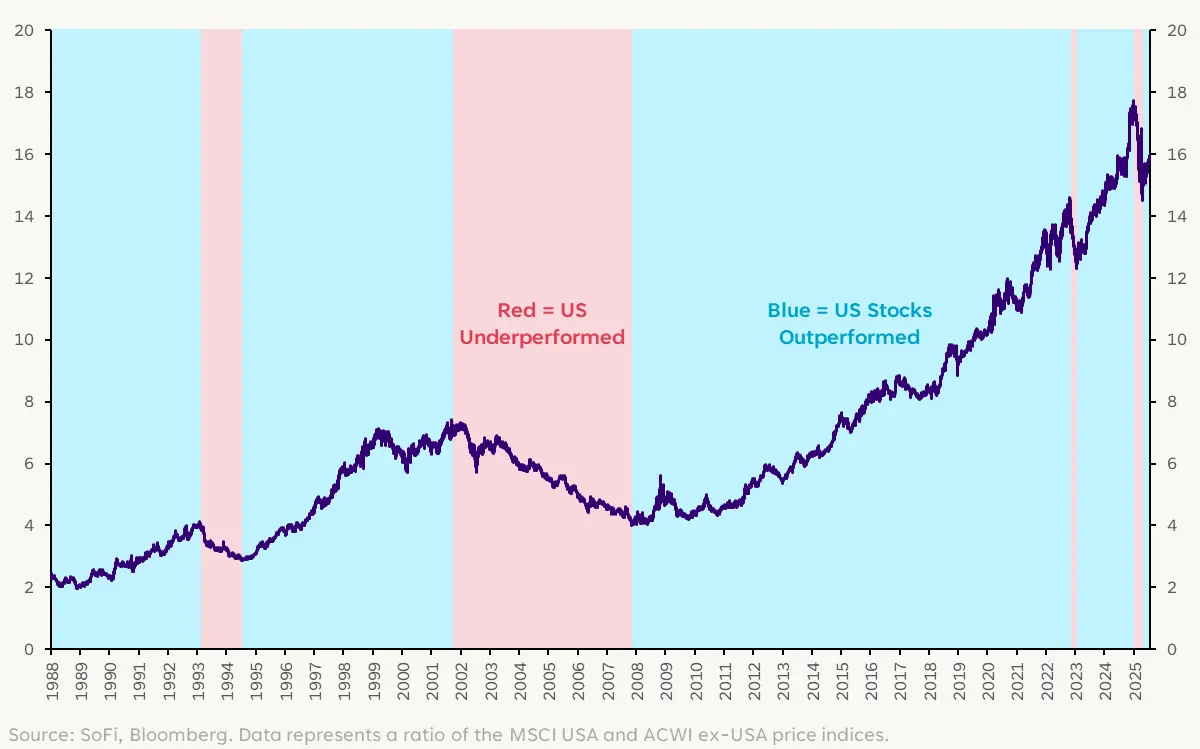
However, this can lead investors to abandon longer-term strategies in favor of chasing hot trends or abandoning underperforming stocks. This year has provided a textbook example of the conditions that foster recency bias. As we discussed last week, the first half of 2025 disrupted the nearly two decades of “U.S. exceptionalism” in stocks, as a dramatic reversal saw the dollar depreciate significantly and international markets surge.


US vs. International Stocks

Here’s where the behavioral trap of recency bias snaps shut. After more than a decade of the U.S. market (particularly tech stocks) being rewarded for being overweight, investors are now confronting the possibility of a new market regime. In response, the psychological pull can be to over-rotate, chasing returns in international markets by selling U.S. assets.

Implicit in that decision is the assumption that what we saw in the first half of 2025 is a sign of things to come. Yet as July has shown, that’s not guaranteed. Relative performance has been mixed between regions.

Of course, the pitfalls of recency bias don’t mean that international is not going to outperform. It just means that things are more complicated than that and a decision to invest (or not) in international stocks should be based on more than a glance at year-to-date returns.

Speculative Fervor

Market pessimism from earlier this year has given way to optimism, and in some pockets, outright euphoria. With the transition has come a resurgence of speculative fervor reminiscent of the meme stock mania of 2021. It’s a classic example of the Fear of Missing Out (FOMO), which in investing usually means missing out on a rapidly appreciating stock. It sometimes leads to impulsive decisions to buy after a significant price run-up.

That doesn’t mean every decision to buy a stock after major gains is driven by FOMO. A company’s stock price surging because of a gangbusters quarter and an announcement of promising innovations would be different (and likely more sustainable) than a sudden surge due to a short squeeze. The former is generally driven by rational analysis, while the latter by the promise of immediate gains or the pain of regret.

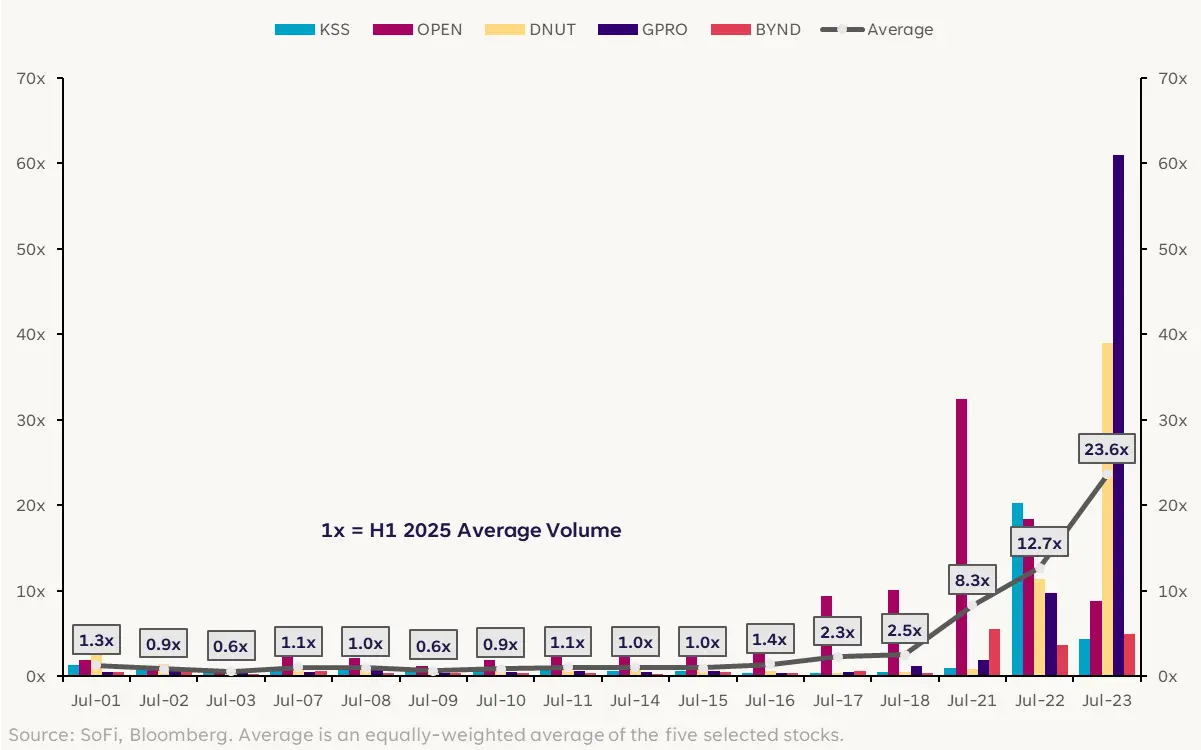
Some telltale signs of these dynamics have been on display over the last week or so, with a new batch of meme stocks emerging. For example, Kohl’s (KSS), Opendoor Technologies (OPEN), Krispy Kreme (DNUT), GoPro (GPRO), and Beyond Meat (BYND) have seen major volatility this week, with the stocks experiencing 20-30 percent intraday price swings and trading volumes surging to over 22 times the norm.


Daily Trading Volumes Relative to H1 2025

Always Lurking

Perhaps the most common behavioral tendency investors deal with is loss aversion. This deep-seated psychological bias is particularly salient during periods of high volatility and uncertainty.

Loss aversion is a cornerstone concept of behavioral finance. It refers to the tendency people have to feel the pain of a loss more intensely than the pleasure derived from an equivalent gain (e.g. if your net worth is a million dollars, losing a million dollars would likely be far worse than winning a million dollars). This asymmetry means that investors are often more motivated by the desire to avoid a loss than they are by the prospect of making a gain.

There are many different facets to loss aversion, but the current environment of scary headlines, reemerging inflation fears, and market volatility can trigger its destructive aspects. One such example is panic selling, when investors get scared and indiscriminately sell their holdings during a drawdown or emergence of negative news. The sell-off following the April 2025 tariff announcements serves as a recent example of this. The S&P 500 fell sharply as investors reacted to the new uncertainty, with many selling first and asking questions later.

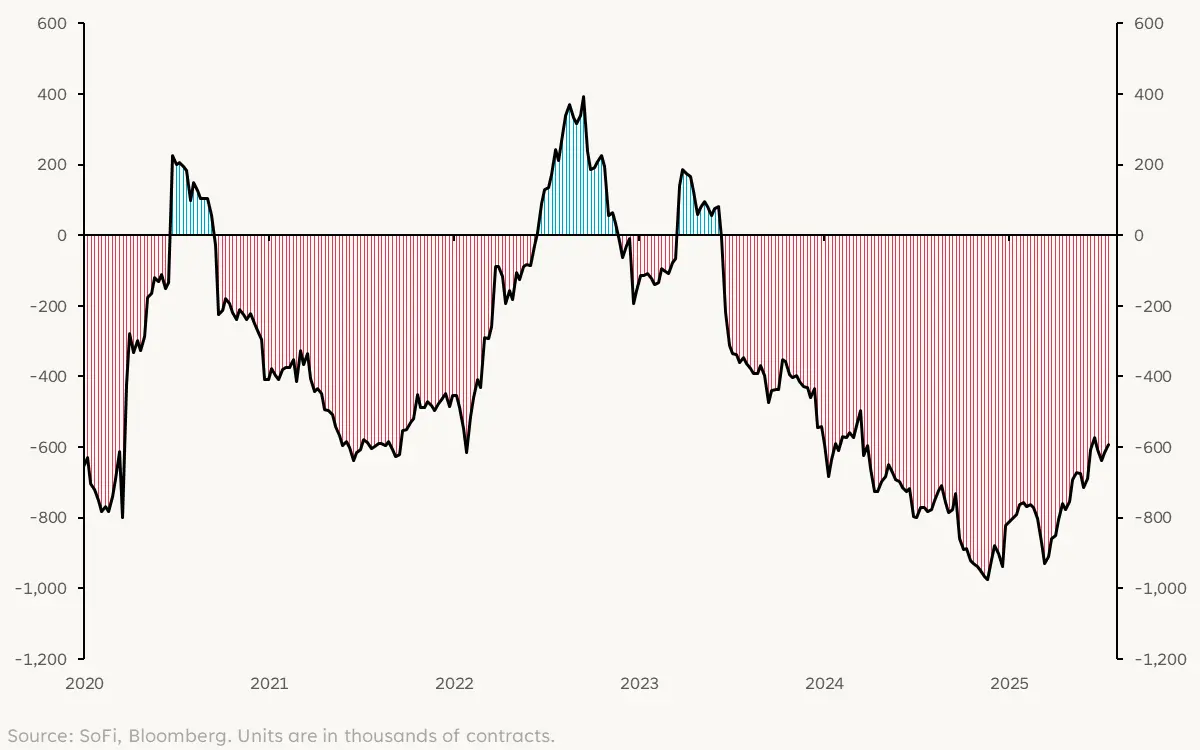
With the S&P 500 now near a record high, one would think that investor bullishness would be back to where it was early in the year. We can proxy for this by looking at dealer positioning in S&P 500 futures, which is updated weekly. Basically, because dealers generally position themselves on the opposite side of investors (in order to maintain overall neutral exposure), we can get an idea of how investors feel. The latest data shows that dealer positioning has gotten less negative since March and is the least negative since early 2024, which means that investors have gotten more negative.


Dealer Positioning in S&P 500 Futures

While panic selling is one way loss aversion can manifest, another is through a phenomenon called the disposition effect. As we discussed last year, this is the tendency for investors to sell their winning investments too early while holding on to their losing investments for too long. The reluctance to sell a losing asset is a direct consequence of loss aversion; selling would mean “realizing” a loss, which is psychologically painful and forces the investor to admit they made a mistake.

In today’s market, with its stark divergence between a few high-flying stocks and many laggards, the temptation to lock in gains on winners prematurely or hold on to losers in the hope they will “get back to even” is particularly strong. This behavior can trap capital in underperforming assets and prevent investors from letting their successful investments compound over the long term.

Think, Then React

The market will always present new narratives, new uncertainties, and new temptations. Succeeding as an investor over the long term isn’t about being able to predict the future, though that would definitely help. We can’t fully rid ourselves of the emotions that seep into the investment process — we’re human after all — but by understanding our biases and having a plan, we can manage them more effectively.


Want more insights from SoFi’s Investment Strategy team? The Important Part: Investing With Liz Thomas, a podcast from SoFi, takes listeners through today’s top-of-mind themes in investing and breaks them down into digestible and actionable pieces.

Listen & Subscribe


SoFi can’t guarantee future financial performance, and past performance is no indication of future success. This information isn’t financial advice. Investment decisions should be based on specific financial needs, goals and risk appetite.

Communication of SoFi Wealth LLC an SEC Registered Investment Adviser. Information about SoFi Wealth’s advisory operations, services, and fees is set forth in SoFi Wealth’s current Form ADV Part 2 (Brochure), a copy of which is available upon request and at www.adviserinfo.sec.gov. Mario Ismailanji is a Registered Representative of SoFi Securities and Investment Advisor Representative of SoFi Wealth. Form ADV 2A is available at www.sofi.com/legal/adv.

Read more

Playground


{/* Hero */}

5% cash back rewards on all dining.
3% groceries, gas and drugstores.
1% everything else.

And the only card from SoFi that allows you to invest your points and watch them grow over time.
Unlock access to the NEW SoFi+ Premium Card by joining SoFi+.

{/* Bitgo / Blockchain module*/}

{/*

bitgo logo

BitGo

*/}

Step 1: Join SoFi+

$1,000+ in annual reward value

• 10% Boost on credit card spend
• 3.8% SoFi Savings Bank APY
• 1% on recurring Invest Deposits
• Entertainment access
• Financial planning
• 2x rewards points on qualifying activity

$10 monthly fee

$0 monthly fee for customers who maintain direct deposit with SoFi


Join SoFi+

Step 2: Apply in minutes
for the SoFi+ Premium Card

5% all dining.
3% groceries, gas, and drugstores.
1% everything else.

• Boost your earnings: 10% Boost on cashback rewards earned through the premium card with your current SoFi+ Membership
• Choose the investment index for your points and watch them grow over time

$95 annual card fee

{/* Get a portfolio recommendation in 5 minutes */}

Link your points for growth

Why settle for idle points? With us, your rewards stay active—and can grow with the market.

Money Market

Generally stable, with small value changes over time.

S&P 500

Tracks the S&P 500 index and can rise or fall as the market changes.

Bitcoin ETF

Very volatile; frequent and significant value changes are possible.


Read more
TLS 1.2 Encrypted
Equal Housing Lender