LIMITED-TIME OFFER! New SoFi members get $10 in rewards points for activating credit score monitoring.1

SoFi Blog

Tips and news—
for your financial moves.

Free Credit Score Checks & Credit Score Tracking


{/* Hero banner */}

Free credit score check

Check your free
credit score
online
in minutes.

Meeting your financial goals starts
with knowing your
credit score. Sign
up for a free credit score check
to
gain insights into your score and
how to improve it.


Get started

Must click on the link to be eligible. Other terms and conditions apply.


Based on SoFi Members. This claim may not be representative of the experience of all other customers.

{/* RTBs with Icons */}

Start building your
credit
with insights
from SoFi.


Get started

Do a free credit score
check in minutes.

Check your credit score at no cost in minutes to help you hit your goals.

Simulate credit scenarios.

Determine how certain financial decisions might impact your score.

Get credit insights.

Understand the factors that drive your credit score and what you can do to influence them.

Protect your data.

Multifactor authentication helps keep your personal data safe and secure.


Get started

{/* what is */}

What is a
credit score?

Here’s the gist: A credit score is a three-digit number ranging from 300 to 850 that lenders use to assess the risk involved in lending you money. It’s calculated using information from your credit report, like your payment history, amounts owed, length of credit history, new credit applications, and the types of credit you use. A higher score indicates lower risk and can help you qualify for loans and credit cards with better interest rates and terms.


Learn more

{/* benefits */}

The benefits of
checking
your credit score.

Keep an eye on your credit score.

By monitoring your credit with SoFi,
you’ll get
alerts to potential
unauthorized activity or
identity theft
—at
no cost.

Prepare for major financial decisions.

Your credit score is important when
you’re applying for an auto loan, buying
a home, or signing up for a new
credit card.

Identify areas for improvement.

See how your payment history and
other factors impact your credit
score and simulate changes to
craft a plan for improvement.

{/* how to */}

How to sign up for
free credit score
monitoring with SoFi.

Sign up in under a minute—with
easy setup and
no impact to your
credit score:

Enter your information.

This part is essential to unlock your
personal credit score.

Agree to terms and conditions.

Almost done! We just need you to
look over the legal terms.

Start tracking!

View your credit score immediately
in the dashboard.


  • Enter your information.

    This part is essential to unlock your
    personal credit score.

  • Agree to terms and conditions.

    Almost done! We just need you to
    look over the legal terms.


  • Start tracking!

    View your credit score immediately
    in the dashboard.


Get started

{/* Credit Score Bar */}

The power of a
good credit score.

A good credit score falls in the range of 670–739 on a scale of 300-850. Scores above 740 are considered good while scores of 781 or higher are excellent. High scores are more likely to secure favorable loan terms.


Track your credit growth

See how your credit score has changed over time

Powered by TransUnion®

Get your VantageScore 3.0 credit score updated weekly

Won’t impact
our score

We only do a “soft” pull on your credit and which won’t affect your score


Get started

{/* FAQs */}

FAQs


What accounts can I link on SoFi?


You can link a variety of accounts to view your full financial picture. This includes checking and savings accounts, investment and retirement accounts, credit cards, student loans, mortgages, and other liabilities. Linking accounts allows you to see your net worth and track your financial progress all in one place.


Will checking my credit hurt my credit score?


No, checking your own credit, often called a “soft inquiry” or “soft pull,” will not hurt your credit score. You can check your own credit report and score as often as you like to monitor your financial health.

Learn more: Does Checking Your Credit Score Lower Your Rating?


Why does my credit score matter?


Your credit score is a numerical representation of your creditworthiness. Lenders use it to determine the likelihood of you repaying borrowed money. A higher credit score can help you get approved for loans, credit cards, and mortgages, and often leads to lower interest rates and better terms. It can also be used by landlords, employers, and insurance companies.


What is a good credit score?


While the definition of a “good” credit score can vary depending on the score model used by each credit bureau, a VantageScore® 3.0 Score of 661 to 780 is generally considered good. Scores of 781 to 850 are considered “excellent.” A good score increases your chances of getting approved for credit and securing favorable terms.

Learn more: Guide to Credit Score Ranges


What is the difference between a credit report and a credit score?


A credit report is a detailed history of your credit activity, including accounts, payment history, and public records. A credit score is a three-digit number calculated based on the information in your credit report. The report is the data, while the score is the summary of that data that lenders use to assess your risk.


What factors are used to calculate my credit score?


The primary factors used to calculate your credit score include your payment history, the amount of debt you owe (credit utilization), the length of your credit history, the types of credit you use (credit mix), and new credit inquiries. Payment history is the most important factor, as it shows whether you’ve paid past credit accounts on time.

Learn more: What Factors Affect Your Credit Score?


How can a free credit check help me with identity theft?


Regularly checking your free credit report is a key way to spot signs of identity theft. You can review the report for any accounts or inquiries you don’t recognize, which could indicate that someone has opened a fraudulent account in your name. If you find suspicious activity, you can take steps to report it and protect your credit.


What’s the difference between a soft inquiry and a hard inquiry?


A soft inquiry (or “soft pull”) occurs when you check your own credit or when a lender pre-approves you for an offer. It does not affect your credit score. A hard inquiry (or “hard pull”) happens when a lender checks your credit after you formally apply for a new loan or credit card. Hard inquiries can cause a small, temporary drop in your score.

Learn more: What’s the Difference Between a Hard and Soft Credit Check?


Which credit bureau do free credit score services like SoFi use?


SoFi uses TransUnion to provide your credit score and related information. Specifically, it uses the VantageScore 3.0 model. While your free score is an excellent educational tool for monitoring your credit health, it may not perfectly match the score a lender pulls, as different models weigh factors differently.


See more FAQs

{/* Learn More resources articles */}

Learn more about credit scores and
why they’re important.


Learn more

{/* footer */}

See your credit score at no cost.

Checking your credit score with SoFi is quick, easy, and free. Sign up now to see your

credit score in minutes. Just like that.


Get started

Read more

Week Ahead on Wall Street: The Fed’s Meeting Minutes

The government shutdown continues this week and there’s little sign of a near-term resolution. With betting markets expecting it to drag on for weeks, investors will need to continue navigating through an economic data fog. Two important sources of clarity will help pierce through the cloud, however.

First and foremost: Though most government data is on hold during the shutdown, the Consumer Price Index (CPI) is a critical exception. Due to its importance in calculating annual cost-of-living adjustments for Social Security benefits, the Bureau of Labor Statistics (BLS) announced it’ll be releasing the report on Friday. Already the most tracked by market participants, this report is even more important while investors are making due without other economic data.

And we can’t forget about corporate America. The pace of third-quarter earnings reports picks up significantly this week, with a host of companies from various sectors set to share their results. These reports will provide a real-time, bottom-up perspective on the health of the economy, straight from those who are on the business front lines.

Economic and Earnings Calendar

Most releases involving government data will not be released while the shutdown is ongoing.

Monday

•  September Leading Economic Index: This is an index composed of various economic indicators that have historically led changes in the broader economy.

•  Earnings: Steel Dynamics (STLD), W R Berkley (WRB)

Tuesday

•  October Philadelphia Fed Non-Manufacturing Activity: The Philadelphia Fed’s survey of services executives in the region on business conditions and their outlook.

•  Earnings: Chubb (CB), Capital One Financial (COF), Quest Diagnostics (DGX), Danaher (DHR), Equifax (EFX), Elevance Health (ELV), EQT (EQT), General Electric (GE), General Motors (GM), Genuine Parts (GPC), Halliburton (HAL), Intuitive Surgical (ISRG), Coca-Cola (KO), Lockheed Martin (LMT), 3M (MMM), Nasdaq (NDAQ), Netflix (NFLX), Northrop Grumman (NOC), Omnicom Group (OMC), PACCAR (PCAR), PulteGroup (PHM), Philip Morris International (PM), Pentair (PNR), Raytheon Technologies (RTX), Texas Instruments (TXN)

Wednesday

•  Weekly Mortgage Applications: Mortgage activity gives insight on demand conditions in the housing market.

•  Earnings: Amphenol (APH), Avery Dennison (AVY), Boston Scientific (BSX), Crown Castle International (CCI), CME Group (CME), FirstEnergy (FE), Globe Life (GL), Hilton Worldwide Holdings (HLT), International Business Machines (IBM), Interpublic Group of Companies (IPG), Kinder Morgan (KMI), Lennox International (LII), Lam Research (LRCX), Southwest Airlines (LUV), Las Vegas Sands (LVS), Moody’s (MCO), Molina Healthcare (MOH), Northern Trust (NTRS), NVR (NVR), O’Reilly Automotive (ORLY), Packaging of America (PKG), Raymond James Financial (RJF), AT&T (T), Teledyne Technologies (TDY), Thermo Fisher Scientific (TMO), Tesla (TSLA), United Rentals (URI), Westinghouse Air Brake Technologies (WAB)

Thursday

•  August Wholesale Inventories and Sales: Wholesalers often operate as an intermediary between manufacturers and retailers, serving as a key part of the goods supply chain.

•  Weekly Jobless Claims: This high frequency labor market data gives insight into filings for unemployment benefits.

•  Fedspeak: Kashkari will moderate a conversation with Barr at the Economic Club of Minnesota. San Francisco Fed President Mary Daly will take part in a moderated conversation on technology and the economy.

•  Earnings: Delta Air Lines (DAL), PepsiCo (PEP)

Friday

•  October University of Michigan Consumer Sentiment: How consumers feel about economic conditions affect their spending habits. This survey places a particular focus on inflation and its trajectory.

•  September Treasury Statement: This summarizes the U.S. federal government budget by tracking government revenues and expenditures.

•  Fedspeak: Chicago Fed President Austan Goolsbee will give welcome remarks at the regional bank’s Community Bankers Symposium. Musalem will take part in a fireside chat on the economy and monetary policy.


Mario Ismailanji's Image


Want to see more stories like this?
On the Money is SoFi’s flagship newsletter
for all things personal finance.

Check it out


Please understand that this information provided is general in nature and shouldn’t be construed as a recommendation or solicitation of any products offered by SoFi’s affiliates and subsidiaries. In addition, this information is by no means meant to provide investment or financial advice, nor is it intended to serve as the basis for any investment decision or recommendation to buy or sell any asset. Keep in mind that investing involves risk, and past performance of an asset never guarantees future results or returns. It’s important for investors to consider their specific financial needs, goals, and risk profile before making an investment decision.

The information and analysis provided through hyperlinks to third party websites, while believed to be accurate, cannot be guaranteed by SoFi. These links are provided for informational purposes and should not be viewed as an endorsement. No brands or products mentioned are affiliated with SoFi, nor do they endorse or sponsor this content.

SoFi isn't recommending and is not affiliated with the brands or companies displayed. Brands displayed neither endorse or sponsor this article. Third party trademarks and service marks referenced are property of their respective owners.

Read more

September 2025 Market Lookback

Political Pressure

It took a while, but the moment many investors were waiting for finally arrived. The Federal Reserve lowered interest rates for the first time since December, aiming to guard against the risk of further deterioration in the labor market.

The Fed cut its benchmark 25 basis points as political pressure to lower borrowing costs posed the biggest test of the Fed’s independence since the 1970s: First, President Trump attempted to remove Fed Governor Lisa Cook, triggering a legal battle that’s still going on. Then Stephen Miran, who had advised the president as chair of the Council of Economic Advisors, was confirmed to the Board of Governors and pushed for a more aggressive 50 basis point rate cut. (He also indicated he preferred to lower the rate by an additional 125 basis points through the end of the year — 50 basis points more than any other Fed official.)

While Fed Chair Jerome Powell’s focus on maximum employment and price stability has kept the central bank grounded throughout the turmoil, investors have taken note of the political clouds.

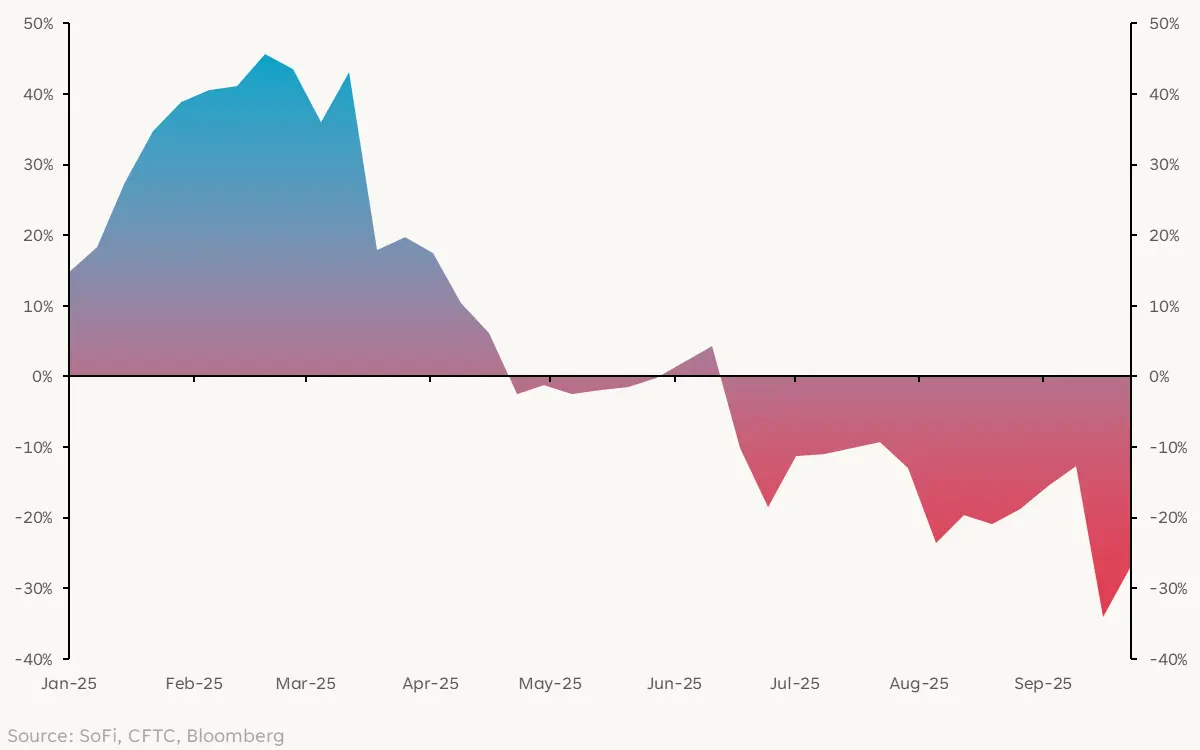
Of course, there isn’t any one definitive way to measure the impact of political risk on asset prices, but there are hints. For instance, though speculative positioning in dollar futures (DXY) has gotten more bearish throughout the year, there was a decisive increase in bearishness over the summer and in the lead up to the meeting.


Speculative US Dollar Future Positioning


A New Goldilocks?

Political concerns notwithstanding, the first rate cut in nearly a year was a powerful catalyst for financial markets, igniting a broad-based rally across multiple asset classes. Investors have embraced a “bad news is good news” dynamic, where weakening labor data was viewed as a positive for asset prices because it solidifies the case for further rate cuts. At least for now, other drivers of further rate cuts could include declining consumer demand or shrinking profit margins.

One of the most significant developments was the breakout in small-capitalization stocks. The Russell 2000 index surged to a new all-time high for the first time since November 2021 amid renewed investor confidence in the more cyclical parts of the U.S. economy. (Smaller companies tend to be seen as more sensitive to borrowing costs.)


Russell 2000


Sectors levered to the AI trade also had another strong month, and gold prices climbed to new record highs, surpassing $3,800/oz. While both are thought to benefit from lower interest rates, the month’s political turmoil also likely boosted the precious metal’s appeal as a safe-haven hedge against institutional instability and inflation.

Market Recap


Asset Returns


September 2025 Sector Total Returns


Macro

•  The Federal Reserve lowered its benchmark interest rate by 25 basis points to a target range of 4%-4.25%.

•  In their Summary of Economic Projections, Fed officials expected higher GDP growth, lower unemployment, and higher inflation.

•  Against expectations for an increase of 75k jobs in August, only 22k were added. Additionally, the prior two months were revised down by 12k.

•  After the prior month’s surge, August PPI came in below expectations at -0.1% m/m. On the other hand, CPI came in a touch above estimates at 0.4% m/m.

•  Second quarter GDP growth was revised up from 3.3% to 3.8%, driven by higher than initially reported consumer spending.

•  The University of Michigan’s consumer sentiment index fell to 55.1 in September, below consensus of 62.0, amid worsening perceptions of the job market and their personal financial situation.

•  New home sales surged to an annualized 800k, significantly above consensus for 650k and the most since January 2022.

•  Buoyed by lower interest rates, ETF flows, and ongoing central bank purchases, gold rose 11.9% to finish the month at an all-time high of $3,859. That was its best month since August 2011.

Equities

•  Emerging market stocks rose 7.2%, powered by strong tech sector gains from Taiwan, South Korea, and China.

•  The Magnificent Seven and a basket of AI-sensitive stocks also had a strong month, with gaining 9.3% and 10.2%, respectively.

•  Cyclical stocks beat defensives by 1.1 percentage points, their fifth straight month of outperformance.

Fixed Income

•  Treasurys and Investment Grade corporate bonds have had three straight quarters of positive returns, the first such streak since 2020.

•  Treasury volatility (i.e. the MOVE Index) continued its multi-month declines, now at its lowest level since early January 2022.

View PDF


Performance data quoted represents past performance. Past performance does not guarantee future results. Market returns will fluctuate, and current performance may be lower or higher than the standardized performance data quoted.

Read more

Everyday Cash Rewards Credit Card | SoFi


YOU’RE PREAPPROVED1

Earn up to 3% cash back rewards.2

You can choose to stop receiving “prescreened” offers of credit from this and other companies by calling toll-free 1-888-5-OPTOUT (1-888-567-8688). See PRESCREEN AND OPT-OUT NOTICE BELOW for more information about prescreened offers.


YOU’RE PREAPPROVED1

Earn up to 3% cash back rewards.2

You can choose to stop receiving “prescreened” offers of credit from this and other companies by calling toll-free 1-888-5-OPTOUT (1-888-567-8688). See PRESCREEN AND OPT-OUT NOTICE BELOW for more information about prescreened offers.

Read more

Email Confirmation – SoFi Bank


student loans illustration
invest illustration

hero mobile decorator home 1
hero mobile decorator home 2
hero mobile decorator home 3

Get Your Money Right®

All in one app.

SECURE MOBILE APP
AND ONLINE BANKING

24/7 ACCOUNT MONITORING

NO CHECKING AND
SAVINGS ACCOUNT FEES


Get started

mobile illustration
vault illustration


Invest

Grab up to $3,000 in stock* with
SoFi Active Invest.

Get Started

*Offer valid from 9/15/25 through 10/7/25. Customer must fund their Active Invest account with at least $50 within 45 days of opening the account. Receive a minimum of $15. Probability of member receiving $3,000 is a probability of 0.026%. If you don’t make a selection in 45 days, you’ll no longer qualify for the promo. Percentages for the $3,000 are subject to decrease. See full terms and conditions.

)}
layout=”columns”
topRightPillText=”1 / 2″
/>

Banking

Increase your savings
with a limited-time APY boost.*

Learn more

*Earn up to 4.50% Annual Percentage Yield (APY) on SoFi Savings with a 0.70% APY Boost (added to the 3.80% APY as of 8/5/25) for up to 6 months.
Open a new SoFi Checking & Savings account and enroll in SoFi Plus by 1/31/26. Rates variable, subject to change. Terms apply here. SoFi Bank, N.A. Member FDIC.

)}
layout=”columns”
topRightPillText=”2 / 2″
/>


As natural disasters impact the United States, SoFi wishes for the safety of everyone in the affected areas. We
are here to help borrowers who are in a disaster zone designated by FEMA. To find out more click here.

Why do 13.7M members love SoFi?

  • Smart money moves
    earn you points.

    Rewards points are
    redeemable for cash, SoFi loan payments, and more.

  • Help when you
    need it.

    Need help? Get in
    touch with our support team via phone or chat.

  • Complimentary
    member benefits.

    SoFi members get
    benefits
    like financial planning and exclusive access to SoFi Stadium.

  • No-cost spending and
    budgeting tools.

    Get complimentary credit score monitoring, spending breakdowns, financial insights, and more.

  • 1-on-1 financial and
    career planning.

    Members get unlimited access to personalized financial advice at no additional
    cost—plus free career tools and
    coaching.

  • Exclusive member rate
    discounts.

    Once you’re in, you’re able to get a rate reduction or discount on your next
    eligible loan.

Your money will thank you.


Personalized mortgage solutions to achieve your goals.

Select from a variety of home loan options with mortgage rates, loan terms, and
monthly payments that suit your budget.

All APRs are updated daily


View your rate

Need help finding the best option for your unique needs? Get in touch with a Mortgage Loan Officer at (844)-763-4466.


All your money.

All in one app.


We’ve helped

our members


in a big way.

  • 13.7M
    SoFi members
  • 12.5B+
    in rewards earned
  • $33B+
    in debt paid off
  • $117B+
    in funded loans

As featured in


We’re serious

about security.


  • 24/7 account monitoring


  • Investments SIPC protected up to $500K
    ††


  • FDIC insurance on checking & savings balances up to $250K^^


Ready to go?
Join SoFi today!


Get started

Mortgage Loan Terms

5 30-YEAR Payment Example: The payment for a 30-year term, loan amount $362000.00, Rate 5.875%, LTV 80% is $2141.00 for
full Principal and Interest Payments with $6030.92 due at closing. The Annual Percentage Rate is
6.117%. No
prepayment penalty. Payment shown does not include taxes and insurance. The actual payment amount will be greater.
Interest rates and annual percentage rates (APRs) are for informational purposes only and are subject to change
without notice.

6 20-YEAR Payment Example: The payment for a 20-year term, loan amount $362000.00, Rate 5.750%, LTV 80% is $2542.00 for
full Principal and Interest Payments with $6041.78 due at closing. The Annual Percentage Rate is
6.072%. No
prepayment penalty. Payment shown does not include taxes and insurance. The actual payment amount will be greater.
Interest rates and annual percentage rates (APRs) are for informational purposes only and are subject to change
without notice.

7 15-YEAR Payment Example: The payment for a 15-year term, loan amount $362000.00, Rate 5.125%, LTV 80% is $2886.00 for
full Principal and Interest Payments with $4901.48 due at closing. The Annual Percentage Rate is
5.474%. No
prepayment penalty. Payment shown does not include taxes and insurance. The actual payment amount will be greater.
Interest rates and annual percentage rates (APRs) are for informational purposes only and are subject to change
without notice.

8 10-YEAR Payment Example: The payment for a 10-year term, loan amount $362000.00, Rate 5.250%, LTV 80% is $3884.00 for
full Principal and Interest Payments with $5194.70 due at closing. The Annual Percentage Rate is
5.767%. No
prepayment penalty. Payment shown does not include taxes and insurance. The actual payment amount will be greater.
Interest rates and annual percentage rates (APRs) are for informational purposes only and are subject to change
without notice.

Personal Loan Terms

Fixed rates from 7.74% APR
to 35.49% APR reflect the
0.25% autopay interest rate discount and a 0.25% direct
deposit interest rate discount. SoFi rate ranges are current as of 2/7/26 and are subject to change
without notice. The average of SoFi Personal Loans funded in 2022 was around $30K. Not all applicants qualify for
the lowest rate. Lowest rates reserved for the most creditworthy borrowers. Your actual rate will be within the
range of rates listed and will depend on the term you select, evaluation of your creditworthiness, income, and a
variety of other factors.

Loan amounts range from $5,000– $100,000. The APR is the cost of credit as a yearly rate and reflects both your
interest rate and an origination fee of 0%-7%, which will be deducted from any loan proceeds you receive.

PERSONAL LOAN INTEREST RATES AND FEES | ELIGIBILITY AND IMPORTANT DETAILS. Annual percentage rates (APRs) shown
include the 0.25% autopay discount. If approved for a loan, the rates and terms offered will
depend on things like creditworthiness, the length of the loan, and other factors, and will fall within the range
of rates available by applicable loan term; check out our full APR examples and terms. Remember, not all
applicants will qualify for the lowest rate. Want to learn more? See our eligibility criteria at
SoFi.com/eligibility-criteria. SoFi reserves the right to change interest rates at any time without notice,
changes would only apply to applications begun after the effective date of the change. Fixed Rates: Fixed rates
range from 7.74% APR to
35.49% APR (with autopay).
The SoFi 0.25% autopay interest rate reduction requires you to agree to make your scheduled
monthly payments by an automatic monthly deduction (ACH) from a savings or checking account. Enrolling in autopay
is not required to receive a loan from SoFi. Loan Terms: SoFi Personal Loans offer loans with a period of
repayment between 2 and 7-year terms. Loan Fees: SoFi personal loans have no fees required; specifically, no
origination fees required, no late fees, no prepayment penalties.

PERSONAL LOAN | REPAYMENT EXAMPLE. The following example depicts the APR, monthly payment and total payments
during the life of a $30,000 personal loan with a 2-year repayment term, a 0.25% autopay
discount, and a fixed rate between 7.74% APR to 35.49% APR. It works out to 24 monthly payments ranging from $1,356.68–$1,529.07 for a total amount of
payments ranging from $32,560.37–$36,697.76. This repayment example assumes that the borrower is signed up for
autopay and that all payments are made on time, with no pre-payments. Actual rates may vary based on repayment
term, loan amount, creditworthiness, and other terms and conditions. SoFi does not offer variable rate personal
loans. State restrictions may apply.


Read more
TLS 1.2 Encrypted
Equal Housing Lender