Score $0 origination fees when you apply for a home equity loan. Final whistle blows 2/9.*

SoFi Blog

Tips and news—
for your financial moves.

Home Equity Loans – Apply for a Home Equity Loan Online

HOME EQUITY LOANS

Borrow at a lower rate with a home equity loan

Rate Drop Alert: Fixed rates start at 6.99% APR*

Checking your rate will not affect your credit score.

Received a mailer from us?
Enter confirmation #

✓ Access up to 85% or $750K of your home’s equity.
✓ Keep your current home loan interest rate.
✓ $0 origination fee options.1
✓ Fixed rates and flexible terms.

See APR disclosure

{/*Hero APR*/}

HOME EQUITY LOANS

New, lower home equity rates with $0 origination fees.*


View your rate

Checking your rate will not affect your credit score.

✓ Access up to 85% or $750K of your home’s equity.
✓ Enjoy lower rates for consolidating debt or
home upgrades.
✓ Get flexible terms that work for you.


View your rate

Checking your rate will not affect your credit score.

Received a mailer from us?
Enter confirmation #

{/*trust pilot*/}


Received a mailer from us?
Enter confirmation #

{/*how it works*/}

How to apply for a
home equity loan online.

Help us understand your needs.

Answer a few questions online to help us
assist you better.

Get paired with a dedicated Mortgage
Loan Officer.

You’ll be connected with an experienced SoFi
Mortgage Loan Officer who’s ready to help you get
the best home equity loan for you.

Submit your application.

Your SoFi Mortgage Loan Officer will help you submit your home equity application so you can get access to your cash.


Get started

{/*what is a he loan*/}

What is a home
equity loan?

Home equity loans let you borrow
money by leveraging the equity in your
home. They’re one of the most
affordable financing options since
home equity rates are lower than
interest rates for most other types of
loans. These lower interest rates can
help fund big purchases, home
renovations, or consolidate high-interest debt.


Learn more

You could save thousands
with a SoFi home equity loan.
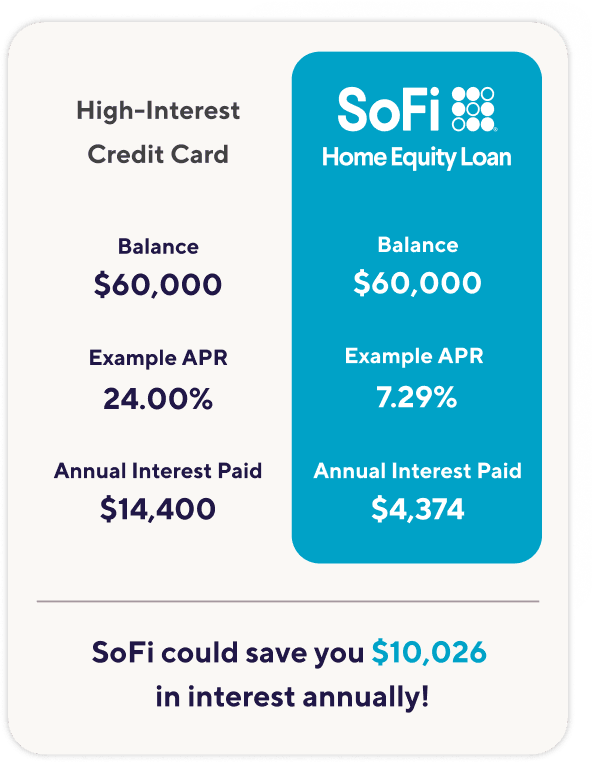
The savings claim above is based upon using a SoFi Home Equity Loan to pay-off credit card balance of $60,000. We assume a credit card APR of 24%. The savings shown assumed payments of only the interest due. We compare that against an assumed SoFi Home Equity Loan of $60,000 (to pay off the credit card) with an APR of 7.29%. Annual interest savings assumes you pay both loans on time. You might not be eligible for the home equity loan and, if you are eligible, your APR rate could be higher. Eligibility and the lowest APR rate depend on credit worthiness, income, and other factors. The 24% APR is the average credit card APR reported by Wallethub for Q1 March 2025 under their Good Credit category.

{/*requirements*/}

Home equity loan requirements:


View your rate

Checking won’t affect your credit score.

{/*horizon*/}

{/*popular uses*/}

A home equity loan could
help with that.


  • Pay down high-interest debt.

    You could save on your monthly payments
    when you consolidate credit cards or
    other unsecured loans into one lower rate.


  • Fund home improvements.

    Make your dream kitchen a reality without
    having to take on high-interest debt.


  • Make big purchases.

    Tuition, weddings, and vacations can get
    expensive. Instead of putting them on a
    high-interest credit card, a home equity
    loan could help you save on monthly payments.

{/*calculators*/}

Crunch the
numbers on your
home equity loan.

Home equity
loan calculator

Use this to determine your
home’s equity.


Learn more

HELOC monthly
payment
calculator

Get help
understanding your
monthly payments
with a home
equity
line of credit.

Learn more

HELOC
interest-only
calculator

Shine some light on potential
interest payments.


Learn more

HELOC repayment
calculator

Estimate how much you might be
paying with a home equity line of
credit.


Learn more

{/*why SoFi*/}

Why choose SoFi
for your home
equity loan?

No change to your existing mortgage rate.

Keep your current mortgage as is, no
need to refinance. And for qualified
borrowers, there are options to access
your home’s equity.

Finance almost anything
with up to $750K.

Access up to $750,000 of your home’s
equity (up to 85%) to finance home
improvements or consolidate debt.

Lower your monthly payment.

You could save compared to a high-
interest credit card or unsecured personal loan.

Get dedicated one-on-one support.

You’ll have a dedicated SoFi Mortgage
Loan Officer to help you find the right
loan option for you.


“Austin and his team were awesome and easy to work with! Great communication and follow up. Kept us in the loop every step of the way! I would go back to Austin without question.”

“Spencer and his team totally went to bat for us and got our loan processed. Very happy with him and his teams efforts and follow up. Communication was excellent right up to the loan funding.”

“Mark and his team worked very closely with us to make sure that we were comfortable with the process, understood the expectations, timeline and overall schedule.”

300+ Reviews

Current home equity loan rates by state.

Compare current home equity loan rates by state and find a home equity loan rate that suits your financial goals.

Select a state to view current rates:

{/*learn more*/}

Learn more about home equity loans.

More resources on
home equity

Get answers to questions like “What’s the difference between a home equity loan
and a HELOC (home equity line of credit)?”


FAQs


How does a home equity loan work?


To start, you’ll need to have sufficient home equity, which is the difference between the market value and what you owe. You may have built home equity by paying down your mortgage and by seeing your home appreciate. You’ll go through an application process, and the lender will likely order a home appraisal to ensure that there’s enough value there to lend against. You’ll have a lot more paperwork than some other loans and will sign mortgage lien documents that give the lender the right to start proceedings should you fail to make payments. After closing on the loan, you’ll receive all funds upfront. Repayment starts shortly after.

Learn more: What Is a Home Equity Loan?


How to apply for a home equity loan?

First, assess your financial situation – consider your income, how much equity you have available, if you have at least a “good” FICO® score, and your debt-to-income ratio. Exploring different loan options is encouraged!

Once you’ve found a fitting loan and are ready to apply, you’ll go through the application process, where you’ll submit information about your income, current mortgage, insurance, and other details the lender requests. If everything checks out, you’ll be able to close on your loan! Funds are disbursed around three business days after closing on the loan.

On a home equity loan where the funds are disbursed upfront and your interest rate is locked, the first payment will be due around 30 days after you close the loan.


How do I qualify for a home equity loan?


Home equity loans are contingent on income, credit history, and debt-to-income ratio. LTV is also considered. LTV compares the amount you owe against your home with its current value. Lenders usually want to see an LTV no higher than 85%. (LTV = Loan Value ÷ Property Value.) On a $400,000 home, for example, that means that you should owe no more than $340,000.


How long does it take to get a home equity loan?


It can take an estimated 30 days to close your loan. Funds are disbursed around three business days after closing on the loan. On a home equity loan where the funds are disbursed upfront and your interest rate is locked, the first payment will be due around 30 days after you close the loan.


What is the interest rate on a home equity loan?


A home equity loan offers a low interest rate because it uses your home’s equity to secure the loan. Because of the way it works, you may have access to a larger sum of money at a lower interest rate than you would if you used another source, such as a credit card. View your home equity rate here.


How much can I get with a home equity loan?

When it comes to how much home equity you can tap, many lenders allow a maximum of 90%, although some allow less, and some, more. In other words, your loan-to-value ratio shouldn’t exceed 90% in many cases.

If you’re taking out a second mortgage like a home equity loan or HELOC, your first mortgage and the equity loan compared with your home value is what is called the combined loan-to-value (CLTV) ratio. Most lenders will require a CLTV of 90% or less to obtain a home equity loan, although some will allow you to borrow 100% of your home’s value. For a better idea of exactly how much you can borrow, use SoFi’s Home Equity Loan Calculator.

Learn more: Ways to Pull Equity Out of Your Home


What is a home equity line of credit (HELOC)?


A home equity line of credit (HELOC) is a credit line secured by the value of your home, minus any existing mortgage owed. You can borrow against it, spend, repay, and borrow again using your home as collateral.

Learn more: What Is a Home Equity Line of Credit (HELOC)?


What is the difference between a HELOC vs home equity loan?


A HELOC is a revolving line of credit. You can take out money as you need it, up to your approved limit, during the draw period. You may be able to make interest-only payments on the amount you withdraw during that time, typically 10 years. A home equity loan is another type of second mortgage that uses your home as collateral, but in this case, the funds are disbursed all at once and repayment starts immediately. It is usually a fixed-rate loan of five to 30 years, and monthly payments remain the same until the loan is paid off.

Learn more: HELOC vs. Home Equity Loan


Can you have both a HELOC and home equity loan?


It is rare to have both a HELOC and a home equity loan. One would be a second mortgage and the other would be a third mortgage. Few banks are willing to lend money on a third mortgage, and for any that do, the interest rate would be high.


See more FAQs

Read more

Home Improvement Loans


HOME IMPROVEMENT LOANS

This home improvement loan is ready to roll up its sleeves.


✓ No fees required
✓ Same-day funding*
✓ No collateral required


View your rate


Checking your rate will not affect your credit score.✝︎

Why do over 13.7M members love SoFi?


The savings and experiences of members herein may not be representative of the experiences of all members.
Savings are not guaranteed and will vary based on your unique situation and other factors.

Received a mailer from
us? 

Enter confirmation #

What exactly is a home
improvement loan?

A home improvement loan is a personal loan used to pay for home repairs or renovation projects. SoFi’s home improvement loans range from $5K-$100K and they’re unsecured, which means that your house is not used as collateral to secure the loan.

Compared to a home equity loan (HELOC), which may only cover a handful of projects, a SoFi Home Improvement Loan allows you to use the money for whatever your dream home demands. And while a HELOC can require an appraisal before you can get approved, a SoFi Home Improvement Loan could get approved—and even funded—on the same day*, with no appraisal required.


View your rate


(without impacting your credit score)✝︎

Why SoFi for your home improvement loan?


View your rate


(without impacting your credit score)✝︎

  • Same-Day Funding*

    Get your funds as quickly as the same day your loan is approved so you can get moving on your project ASAP.

  • Fixed Payments

    With fixed monthly payments over a set term, you’ll know when and how to pay off the debt up front, so you can keep your project at or under budget.

  • No Collateral

    Our home improvement loan is an unsecured loan—meaning your home equity, or anything else, is not on the line.

  • Absolutely No Fees required

    Surprises are almost inevitable with any home renovation. But not with your SoFi Home Improvement Loan—you’ll find no fees required, and no surprises.


View your rate

See how our Home Improvement Loans compare.

Bringing out the greatness in your home calls for a great way to fund it—and you have options. But choosing to finance your next home improvement project with a SoFi Personal Loan can help keep your budget fixed without giving up your home’s equity or putting up collateral.

57‘,
‘No fees required’,
‘Fixed’,
‘$5,000–$100,000’,
‘No’,
‘No’,
]}
competitorCards={[
[
‘HELOC’,
‘Varies’,
‘Varies’,
‘Variable’,
‘Up to your home’s equity’,
‘Yes’,
‘Yes’,
],
[
‘Credit Card 6‘,
‘12.00%—22.86% 6‘,
‘Up to $500’,
‘Compounding’,
‘Varies’,
‘No’,
‘No’,
],
]}
/>

Feeling good in your home matters—now more than ever.


As we’ve all been spending a lot more time at home, it’s easy to understand why we want to realize our homes’ greatest potential—because investing in our homes directly improves our quality of life. So whether you envision a small cosmetic refresh or taking it down to the studs, SoFi’s got you covered. Here are just a few home improvement projects you might be considering.

Kitchen remodeling

The kitchen has long been called the heart of the home, and over the past year or so, your kitchen’s heartbeat has been rigorously tested. Did it pass? If your kitchen could use a few modifications—or the works—consider that an industry standard for kitchen remodeling projects is 10% of your home’s value. Source: Forbes Advisor.


View your rate

Landscaping

Enhance your home’s curb appeal in your front yard or expand your living space with a deck or patio in the backyard. Landscaping can cost anywhere from $4 per square foot for basic or intermediate services, all the way to $40 per square foot for a full makeover landscape design (excluding labor). No matter what your project, landscaping can add to your home’s value while allowing your family to enjoy some fresh air. Source: Forbes Advisor.


View your rate

Home gym

Make any space work just as hard as you do by converting to a home gym. The need for this functionality came into focus at the beginning of the pandemic and the cost depends on a lot of factors like square footage and equipment. But the return on this type of investment on a day-to-day basis can prove to be invaluable.


View your rate

Energy efficiency updates

With more time spent at home, you may have noticed your utility bills going up. It might be time to invest in eco-friendly upgrades that could save you money—and help save the planet. Think solar panels, energy-efficient windows and appliances, programmable thermostats, and geothermal energy. Even small modifications could have a positive effect, and not just on your bills.


View your rate


Here’s the process of getting a SoFi Home Improvement Loan:

View your rate.

Get pre-qualified online with no fees required, and no obligation.

Select your loan & apply.

Choose the loan that works for you and complete your application.

Receive your funds.

Sign your documents and funds will be wired to your account—as soon as the same day.*

View your rate


(without impacting your credit score)✝︎

Home improvement loan tools,
tips, resources, and more.

Our online resource center provides you with over 500 articles, budgeting tools, and guides—all with the goal of helping you Get Your Money Right®.


Get started in 60 seconds.

Speed matters. Which is why you can view your rate on a SoFi Home Improvement Loan in one minute—literally.


View my rate


(without impacting your credit score)✝︎


FAQs


What is a home improvement loan?


A home improvement loan is a personal loan used to pay for home repairs or renovation projects. Unsecured home improvement loans means that your house is not used as collateral to secure the loan.


How do home improvement loans work?


Loans for home improvement can cover a range of projects from small installations to major renovations. These loans are investments to potentially increase the value of a home. If a homeowner doesn’t have cash to fund these home repairs or renovations, then using loans for home improvements could be a viable option to improve their property.

Learn more: How Do Home Improvement Loans Work?


What qualifies for a home improvement loan?


A home improvement loan isn’t a specific type of loan, but a personal loan used to maintain, repair, or improve a home. These unsecured loans are approved based on creditworthiness and other personal financial factors.


How is a home improvement loan different from refinancing or a home equity loan?


Personal loans for home improvements are separate unsecured loans, meaning they are not tied to the value of your home and your home is not put up as collateral. A HELOC, or home equity line of credit, is a loan which allows you to draw from the existing equity of your home as cash to finance things like large home renovations. A cash-out refinance involves refinancing your mortgage for more than the principal and converting the extra amount to cash, typically to finance home improvements or renovations. Each loan for home improvements has advantages and disadvantages, depending on your needs and financial situation.

Learn more: Home Equity Loans vs. Personal Loans for Home Improvement


Is a home improvement loan better than using a credit card?


Credit cards typically have high interest rates. Home improvement loan rates tend to be lower, making monthly payments more manageable or saving money from interest accrual over the lifetime of the debt. If you’re considering applying for a home improvement loan, it’s worth researching the terms, rates, and criteria.


How long can you finance a home improvement loan?


Home improvement loan terms vary depending on the lender. SoFi Personal Loans have term options ranging from 2-7 years.


What credit score do I need to be approved for a home improvement loan?


Applying for a home improvement loan will require meeting your lender’s criteria. Since most home improvement loans are unsecured (meaning they don’t require collateral) this criteria assures the lender that you can repay the loan. Lenders will typically evaluate your credit score, income, and debt-to-income ratio, among other factors. There is no minimum credit score required to secure a personal loan, but lower scores could affect your eligibility, terms, or rate—depending on your lender.


How quickly can I get a home improvement loan?


The approval process for home renovation personal loans varies, depending on your lender. Here’s how it works with SoFi: Once your application is complete and verified, if you are approved for a home improvement loan, you will receive a Loan Agreement for electronic signature. Once you’ve signed the document electronically, we will give you a call to confirm your address and welcome you to the SoFi Community, and then your funds should generally be available within a few days.


Are home improvement loans secured or unsecured?


The SoFi Personal Loan is an unsecured loan. This means that it is not tied to your home and you do not need to provide collateral for the loan.


What is the minimum and maximum I can borrow with a SoFi Personal Loan?


With the SoFi Personal Loan, the minimum amount you can borrow is $5,000 in most states and the maximum is $100,000.


See all FAQs


† To check the rates and terms you may qualify for, SoFi conducts a soft credit pull that will not affect your credit score. However, if you choose a product and continue your application, we will request your full credit report from one or more consumer reporting agencies, which is considered a hard credit pull and may affect your credit.

Terms and conditions apply. SOFI RESERVES THE RIGHT TO MODIFY OR DISCONTINUE PRODUCTS AND BENEFITS AT ANY TIME WITHOUT NOTICE. To qualify, a borrower must be a U.S. citizen or other eligible status, be residing in the U.S., and meet SoFi’s underwriting requirements. Not all borrowers receive the lowest rate. Lowest rates reserved for the most creditworthy borrowers. If approved, your actual rate will be within the range of rates at the time of application and will depend on a variety of factors, including term of loan, evaluation of your creditworthiness, income, and other factors. If SoFi is unable to offer you a loan but matches you for a loan with a participating bank, then your rate may be outside the range of rates listed above. Rates and Terms are subject to change at any time without notice. SoFi Personal Loans can be used for any lawful personal, family, or household purposes and may not be used for post-secondary education expenses. Minimum loan amount is $5,000. The average of SoFi Personal Loans funded in 2022 was around $30K. Information current as of 6/2/23. SoFi Personal Loans originated by SoFi Bank, N.A. Member FDIC. NMLS #696891 (www.nmlsconsumeraccess.org). See SoFi.com/legal for state-specific license details. See SoFi.com/eligibility for details and state restrictions.

Fixed rates from 7.74% APR to 35.49% APR reflect the 0.25% autopay interest rate discount and a 0.25% direct deposit interest rate discount. SoFi rate ranges are current as of 2/8/26 and are subject to change without notice. The average of SoFi Personal Loans funded in 2023 was around $33K. Not all applicants qualify for the lowest rate. Lowest rates reserved for the most creditworthy borrowers. Your actual rate will be within the range of rates listed and will depend on the term you select, evaluation of your creditworthiness, income, and a variety of other factors.

Loan amounts range from $5,000– $100,000. The APR is the cost of credit as a yearly rate and reflects both your interest rate and an origination fee of 0%-7%, which will be deducted from any loan proceeds you receive.

5 Autopay: The SoFi 0.25%autopay interest rate reduction requires you to agree to make monthly principal and interest payments by an automatic monthly deduction from a savings or checking account. The benefit will discontinue and be lost for periods in which you do not pay by automatic deduction from a savings or checking account. Autopay is not required to receive a loan from SoFi.

7 Direct Deposit Discount: To be eligible to potentially receive an additional (0.25%) interest rate reduction on your Personal Loan (your “Loan”), you must set up Direct Deposit with a SoFi Checking and Savings account offered by SoFi Bank, N.A., or enroll in SoFi Plus by paying the SoFi Plus Subscription Fee, all within 30 days of the funding of your Loan. Once eligible, you will receive this discount during periods in which you have enabled Direct Deposit to an eligible Direct Deposit Account in accordance with SoFi’s reasonable procedures and requirements to be determined at SoFi’s sole discretion, or during periods in which SoFi successfully receives payment of the SoFi Plus Subscription Fee. This discount will be lost during periods in which SoFi determines you have turned off Direct Deposit to your Checking and Savings account or in which you have not paid the SoFi Plus Subscription Fee. You are not required to enroll in Direct Deposit or to pay the SoFi Plus Subscription Fee to receive a Loan.

§ Awards or rankings are not indicative of future success or results. Neither SoFi Bank, N.A. nor its employees paid a fee in exchange for ratings. Awards and ratings are independently determined and awarded by their respective publications.

‡ Same-Day Personal Loan Funding: 83% of typical SoFi personal loan applications, excluding Direct Pay personal loans and personal loan refinance, from January 1, 2023–January 1, 2024 that were signed before 6pm ET on a business day were funded the same day.

^ Direct Pay: Terms and conditions apply. Offer good for personal loan customers with credit cards and personal loans in their name only and subject to lender approval. To receive the offer, you must: (1) register and/or apply through this landing page; (2) complete a loan application with SoFi within 90 days of your application submit date; (3) meet SoFi’s underwriting criteria; (4) apply 50% or more of your loan proceeds directly to your lenders/creditors. Once conditions are met and the loan has been disbursed, the interest rate shown in the Final Disclosure Statement will include an additional 0.25% rate discount. SoFi reserves the right to change or terminate the Direct Pay Rate Discount Program to unenrolled participants at any time with or without notice. It takes about 3 business days for your creditor/lender to receive payment after your loan is signed. You will be responsible for making all required payments to avoid credit card and other loan fees.

Excellent/4.4/5 star rating based on 9,067 reviews as of January 1, 2025. © 2025 Trustpilot, Inc. All rights reserved.

How long do I need to wait to reapply after my Personal Loan application has been declined?
You will need to wait at least 30 days before re-applying for a Personal Loan with the same borrower(s). You are welcome to retry at any time with a co-borrower, if the previous application was as a single borrower. If you initially applied with a co-borrower, you can retry as a single borrower or with a different co-borrower.


Read more

DM – Home Equity 2

Turn your home
equity into cash.

SoFi HELOC: Unlock a revolving line of credit you can use as needed.
SoFi Home Equity Loan: Receive a one-time lump sum,
paid directly to you.


Checking your rate won’t impact your credit score.


Why SoFi

Finance debt consolidation or home improvements with SoFi as your Home Equity broker.

No change to your mortgage rate

No need to refinance your first mortgage. And for qualified borrowers, there are options to access a large portion of your home’s equity.

Lower monthly payment

You could save compared to a high-interest credit card or unsecured installment loan.

Finance almost anything with up to $500k

Access up to $500,000 of your home’s equity (up to 90%) to finance home improvements or consolidate debt.

Dedicated one-on-one support

You’ll have a dedicated SoFi Mortgage Loan Officer to help you find the right loan option.

Read more

Current Home Equity Loan Rates in Wisconsin Today

WISCONSIN HOME EQUITY LOAN RATES TODAY

Current home equity loan rates in

Wisconsin.


Disclaimer: The prime rate directly influences the rates on HELOCs and home equity loans.


View your rate

Turn your home equity into cash. Call us for a complimentary consultation or get prequalified online.

Compare home equity loan rates in Wisconsin.

Key Points

•   Home equity loans allow homeowners to borrow against their home’s equity for high-cost projects, such as home renovations, education, and debt consolidation.

•   Home equity loan interest rates are influenced by the prime rate, the borrower’s creditworthiness, and overall market conditions.

•   To qualify for the lowest rates, it’s important to build a strong credit score, manage debt-to-income ratio, obtain adequate property insurance, and maintain sufficient home equity.

•   Home equity loans typically have fixed interest rates, ensuring consistent monthly payments throughout the loan tenure.

•   Alternatives to home equity loans include HELOCs, HECMs, and cash-out refinances, each with its own features and eligibility criteria.

Introduction to Home Equity Loan Rates

Welcome to our guide on Wisconsin home equity loan rates. We’re here to help you understand how to leverage the equity in your home, the interest rates you can expect, and tips on how to get the best deal. We’ll also discuss some alternatives to home equity loans that might be a good fit for your needs.

To begin, let’s look at what is a home equity loan.

How Do Home Equity Loans Work?

Home equity loans can be a smart financial move: By using your home as collateral, homeowners secure lower interest rates than on personal loans. If you’re still paying off your first home loan, a home equity loan is considered a second mortgage. These loans come with fixed interest rates and flexible repayment terms, typically ranging from 5 to 30 years.

To qualify, homeowners need at least 20% equity in their property. If you’re approved, the funds can cover an array of expenses, from renovations to education, medical bills, and debt consolidation.

Recommended: Cash-Out Refinance vs Home Equity Line of Credit

Where Do Home Equity Loan Rates Originate?

Home equity loan interest rates are a product of multiple economic factors, with the prime rate playing a significant role. The prime rate is what banks charge their most creditworthy clients. Federal Reserve policy decisions on interest rates can also sway home equity loan rates. By understanding these influences, homeowners can better anticipate rate shifts and make well-informed decisions about the timing of your home equity options.

How Interest Rates Impact Home Equity Loan Affordability

The interest rate you secure can have a significant impact on your ability to afford a loan over its full term. Over a standard 20-year home equity loan, for example, a 1% difference in the interest rate can mean a higher monthly payment. Even more significant, that seemingly small difference can add up to an extra $11,000 in interest paid over the life of the loan, as illustrated in the chart below.

Interest Rate Monthly Payment Total Interest Paid
8.00% $627 $75,559
7.50% $604 $70,007
7.00% $581 $64,554


Home Equity Loan Rate Trends

The prime interest rate is a moving target, and its fluctuations are a crystal ball of sorts for predicting the future of home equity loan rates. By keeping a close eye on the prime rate, you can gain valuable insights into what the future holds for your borrowing options. This knowledge can empower you to make more informed financial decisions.

Historical Prime Interest Rates

Since 2018, the prime rate has dipped to a low of 3.25% in 2020 and peaked at 8.50% in 2023. This fluctuation is a reflection of the ever-changing economic climate and the Federal Reserve’s continuous efforts to keep things steady. These tweaks have a ripple effect, influencing the rates of adjustable-rate mortgages, credit cards, corporate loans, and various home equity options.

Date Prime Rate
9/19/2024 8.00%
7/27/2023 8.50%
5/4/2023 8.25%
3/23/2023 8.00%
2/2/2023 7.75%
12/15/2022 7.50%
11/3/2022 7.00%
9/22/2022 6.25%
7/28/2022 5.50%
6/16/2022 4.75%
5/5/2022 4.00%
3/17/2022 3.50%
3/16/2020 3.25%
3/4/2020 4.25%
10/31/2019 4.75%
9/19/2019 5.00%
8/1/2019 5.25%
12/20/2018 5.50%
9/27/2018 5.25%

Source: St. Louis Fed


The graphic below shows that the prime rate has not been above 10% since the 1980s.

Source: TradingView.com

Factors Influencing Home Equity Loan Rates

Besides the prime rate, a variety of other factors help determine your home equity loan rate, such as your credit score, loan-to-value ratio, home value, home value stability, property location, and lender policies. Lenders carefully consider these elements when setting the interest rate and terms of a home equity loan, as they provide a comprehensive view of your financial standing, the value of your property as collateral, and the overall risk of the loan.

These same factors also influence the rates and terms of a HELOC (home equity line of credit), which is another way to get equity out of your home.

Credit Score

The better your credit score, the more favorable your interest rates. Lenders often look for a minimum of 680, but many prefer 700 or higher. Why? Because a higher score means you’re less likely to default, which makes you a more attractive candidate for a loan.

Home Value

Lenders often use independent appraisals to help determine the value of a home and the amount of equity a homeowner has. This helps them set appropriate loan limits. The more equity you have, the more you may be able to borrow.

Loan-to-Value (LTV) Ratio

The LTV ratio is a critical factor in determining the maximum loan lenders will permit. In Wisconsin, most lenders cap your combined LTV (your mortgage balance plus loan amount divided by your home value) at around 85%.

Let’s say you currently owe $300,000 on your mortgage and you want to borrow $75,000 for a renovation project. Your home is appraised at $450,000:

$300,000 + $75,000 = $350,000

$375,000 / $450,000 = 83%

At 83% combined LTV, there is a good chance a lender will approve a home equity loan.

Home Value Stability

The ups and downs of home values impact the equity you’ve built in your home. When the housing market is on the upswing, lenders are often more willing to approve larger loans, as the increasing value of your property can act as a safety net. But when home values dip, lenders might tighten their belts, leading to more stringent criteria and potentially smaller loan amounts.

Property Location

Living in an area with a high risk of natural disasters or other hazards can lead to higher interest rates. Lenders may charge more in interest to offset the risk of lending in these areas. High-risk areas can include places that are prone to natural disasters, such as hurricanes, floods, and wildfires.

Lender Policies

When you’re looking at home equity options in Wisconsin, it’s important to consider lender policies. They can have a big impact on the interest rate you’re offered. To make sure you’re getting the best deal, compare interest rates, fees, and closing costs from several lenders. Do your homework, and you can get the most favorable terms for your home equity options in Wisconsin.

How to Qualify for the Lowest Rates

To qualify for the best home equity loan rates in Wisconsin, you’ll need to have a strong credit score, a low debt-to-income ratio, adequate property insurance, and a good amount of equity in your home. By making sure you meet these qualifications, you’ll be able to get the best loan terms for your needs and enjoy the financial flexibility and peace of mind that come with homeownership.

Build a Strong Credit Score

A robust credit score is your ticket to more attractive interest rates on home equity loans. On the flip side, a lower credit score might mean higher rates or even a rejection. That’s why it’s key to keep your credit score in tip-top shape by paying your bills on time, checking your credit report regularly, and not maxing out your credit cards.

Manage Debt-to-Income (DTI) Ratio

Your DTI ratio is a crucial factor in determining your eligibility for a home equity loan. This ratio, which compares your gross monthly income to your monthly debt payments (auto loan, student loan, personal loan, etc), gives lenders a clear picture of your financial health. Most lenders require a DTI of 36% or less to approve a home equity loan. However, some lenders may offer home equity loans to borrowers with a DTI between 36% and 50%, but charge higher rates and fees.

Obtain Adequate Property Insurance

It’s standard practice for home equity lenders in Wisconsin to require property insurance, especially in areas prone to flooding. These policies are designed to protect you and your lender from potential financial losses due to damage or destruction of your property. It’s a good idea to review your coverage before applying for a home equity loan or HELOC.

Maintain Sufficient Home Equity

To qualify for a home equity loan in Wisconsin, you’ll need to have at least 20% equity in your home. The 20% equity requirement is in place to protect borrowers from taking on more debt than they can handle and to protect lenders from the risk of default. A home equity loan calculator can help you determine your equity level.

Fixed vs. Variable Interest Rates

Home equity loans typically come with fixed interest rates, which means you can count on steady, predictable monthly payments for the life of the loan. While fixed rates offer peace of mind, they often start out higher than variable rates, which can be more affordable at the outset. This is something to consider if you’re looking for a home equity loan in Wisconsin and want to know exactly what your payments will be.

Tools & Calculators

Use the helpful tools and calculators to find out how much you can borrow and what your payments will be, and to compare different loan options. Here, in addition to the home equity loan calculator, you’ll find a HELOC repayment calculator and a HELOC interest only calculator.

Run the numbers on your home equity loan.

Using the free calculators is for informational purposes only, does not constitute an offer to receive a loan, and will not solicit a loan offer. Any payments shown depend on the accuracy of the information provided.

Closing Costs and Fees

Home equity loan closing costs typically range from 2% to 5% of the loan amount. These include a variety of fees such as the appraisal, credit report, document preparation, origination, notary, title search, and insurance.

Loan origination fees may be around 0.5% to 1% of the loan amount, or a flat fee. Title insurance is another cost, typically 0.5% to 1% of the loan balance, with title search fees ranging from $100 to $250. Appraisal fees can be between $300 and $500, and credit report fees are usually $50 to $100. Make sure to factor these into your calculations when determining the cost of your home equity loan.

Tax Deductibility of Home Equity Loan Interest

Good news: The interest you pay on a home equity loan can be tax-deductible if it’s used for home improvements. If you’re married and filing jointly, you can deduct interest on loans up to $750,000. Single filers can deduct interest on loans up to $375,000. Just remember, you’ll need to itemize your deductions to claim this benefit.

Alternatives to Home Equity Loans

There are a few different types of home equity loans and lines of credit. Home equity lines of credit (HELOCs), home equity conversion mortgages (HECMs), and cash-out refinances all have unique features and requirements. Each option has its own pros and cons, so it’s important to consider your specific financial situation and needs.

Home Equity Line of Credit (HELOC)

A home equity line of credit (HELOC) can be another smart financial move. You can borrow up to a certain limit and pay interest only on the amount you use. During the draw period, you can pay down the principal balance, making more money available to borrow. One drawback: Variable interest rates can change, so your monthly payments may go up. Here’s a HELOC vs home equity loan comparison at a glance:

HELOC Home Equity Loan
Type Revolving line of credit Installment loan
Interest Rate Usually variable-rate Usually fixed-rate
Repayment Repay only what you borrow; you may have the option to make interest-only payments during the draw period. Starts immediately at a set monthly payment.
Disbursement Charge only the amount you need. Lump sum


Recommended: What Is a Home Equity Line of Credit?

Home Equity Conversion Mortgage (HECM)

An HECM, a government-insured reverse mortgage, is an option for those 62 and older to receive payments from the lender based on their home’s value. The funds can be received in various ways: a lump sum, regular payments, or a line of credit. Unlike Wisconsin home equity options and HELOCs, HECMs don’t require monthly payments, only becoming due when you leave the home. (While SoFi does not offer HECMs at this time, we do offer home equity loans and HELOCs.)

Cash-Out Refinance

A type of mortgage refinance, cash-out refinance is a new mortgage that pays off your old one and lets you pocket the difference. Most lenders will let you borrow up to 80-85% of your home’s equity. Wisconsin home equity options and HELOCs require at least 20% equity, while reverse mortgages have no equity requirement but do have an age stipulation.


The Takeaway

In Wisconsin, home equity loans are a great way to leverage the equity in your home for a variety of financial needs. Understanding how home equity loans work and how to get the best interest rates are key to making a smart decision that’s right for your financial situation. Shopping around to compare rates, fees, and closing costs can also be enlightening and ensure you get the best available deal.

Unlock your home’s value with a home equity loan from SoFi.


View your rate

FAQ

What would my monthly payment be on a $50,000 loan?

With a $50,000 home equity loan, you have to consider the interest rate and loan term, as these will greatly affect how much you’ll pay each month. An 8.00% interest rate and a 10-year term would mean a monthly payment of $607. Score a 6.00% rate and choose a 20-year term and you’d pay $358 per month.

What is the monthly payment for a $100,000 HELOC?

The monthly payment on a $100,000 HELOC will depend on the current market interest rate and how much of the line you have used. If you used the entire $100,000 and repaid it over 20 years at 7.00% interest, you would need to come up with $775 per month. To get a rough estimate of your monthly payment, you can use the calculator shown above.

What is the payment for a $25,000 home equity loan?

When considering a home equity loan, it’s important to consider the current interest rate and the term of the loan, as they will affect your monthly payment. To give you an idea, an 8.50% interest rate repaid over 10 years would give you a $310 monthly payment.

What would the payment be on a $30,000 home equity loan?

When you’re thinking about a $30,000 home equity loan, it’s important to consider how the interest rate and loan term will affect your monthly payment. But if you had a 7.00% interest rate and repaid the loan over 10 years, you’d pay about $348 per month.

What might disqualify you from securing a home equity loan?

There are a few things that can prevent you from getting a home equity loan, including having a poor credit history, not having enough equity in your home, having a high debt-to-income ratio, and not having enough insurance on your home. These factors can make it harder for you to get a home equity loan, so it’s important to consider them before you apply.

What are the benefits of a HELOC?

Home equity lines of credit, or HELOCs, are a great way to access the equity in your home. They offer flexibility in borrowing, lower interest rates than most credit cards, and the option to pay interest only on the money you actually borrow. These features make HELOCs a popular choice for homeowners looking for a cost-effective way to borrow.


SoFi Mortgages
Terms, conditions, and state restrictions apply. Not all products are available in all states. See SoFi.com/eligibility-criteria for more information.


SoFi Loan Products
SoFi loans are originated by SoFi Bank, N.A., NMLS #696891 (Member FDIC). For additional product-specific legal and licensing information, see SoFi.com/legal. Equal Housing Lender.


*SoFi requires Private Mortgage Insurance (PMI) for conforming home loans with a loan-to-value (LTV) ratio greater than 80%. As little as 3% down payments are for qualifying first-time homebuyers only. 5% minimum applies to other borrowers. Other loan types may require different fees or insurance (e.g., VA funding fee, FHA Mortgage Insurance Premiums, etc.). Loan requirements may vary depending on your down payment amount, and minimum down payment varies by loan type.


²SoFi Bank, N.A. NMLS #696891 (Member FDIC), offers loans directly or we may assist you in obtaining a loan from SpringEQ, a state licensed lender, NMLS #1464945.
All loan terms, fees, and rates may vary based upon your individual financial and personal circumstances and state.
You should consider and discuss with your loan officer whether a Cash Out Refinance, Home Equity Loan or a Home Equity Line of Credit is appropriate. Please note that the SoFi member discount does not apply to Home Equity Loans or Lines of Credit not originated by SoFi Bank. Terms and conditions will apply. Before you apply, please note that not all products are offered in all states, and all loans are subject to eligibility restrictions and limitations, including requirements related to loan applicant’s credit, income, property, and a minimum loan amount. Lowest rates are reserved for the most creditworthy borrowers. Products, rates, benefits, terms, and conditions are subject to change without notice. Learn more at SoFi.com/eligibility-criteria. Information current as of 06/27/24.
In the event SoFi serves as broker to Spring EQ for your loan, SoFi will be paid a fee.


Tax Information: This article provides general background information only and is not intended to serve as legal or tax advice or as a substitute for legal counsel. You should consult your own attorney and/or tax advisor if you have a question requiring legal or tax advice.


Checking Your Rates: To check the rates and terms you may qualify for, SoFi conducts a soft credit pull that will not affect your credit score. However, if you choose a product and continue your application, we will request your full credit report from one or more consumer reporting agencies, which is considered a hard credit pull and may affect your credit.

Disclaimer: Many factors affect your credit scores and the interest rates you may receive. SoFi is not a Credit Repair Organization as defined under federal or state law, including the Credit Repair Organizations Act. SoFi does not provide “credit repair” services or advice or assistance regarding “rebuilding” or “improving” your credit record, credit history, or credit rating. For details, see the FTC’s website .


Non affiliation: SoFi isn’t affiliated with any of the companies highlighted in this article.

Financial Tips & Strategies: The tips provided on this website are of a general nature and do not take into account your specific objectives, financial situation, and needs. You should always consider their appropriateness given your own circumstances.


This content is provided for informational and educational purposes only and should not be construed as financial advice.


SOHL-Q424-109


More home equity resources.

Turn your home equity into cash. Call us for a complimentary consultation or get prequalified online.

Read more

Current Home Equity Loan Rates in Oklahoma Today

Oklahoma HOME EQUITY LOAN RATES TODAY

Current home equity loan rates in

Oklahoma.


Disclaimer: The prime rate directly influences the rates on HELOCs and home equity loans.


View your rate

Turn your home equity into cash. Call us for a complimentary consultation or get prequalified online.

Compare home equity loan rates in Oklahoma.

Key Points

•   Home equity loans allow homeowners to borrow against the equity in their homes.

•   Home equity loan rates are influenced by the prime rate and economic conditions, including the local real estate market.

•   To qualify for the lowest rates, it’s important to have a strong credit score, manage debt-to-income ratio, obtain adequate property insurance, and maintain sufficient home equity.

•   Home equity loans offer fixed interest rates, providing stability and predictability in monthly payments, while HELOCs have variable rates that can fluctuate.

•   Alternatives to home equity loans include HELOCs, HECMs, and cash-out refinances, each with its own features and eligibility criteria.

Introduction to Home Equity Loan Rates

Ready to learn how to get equity out of your home in Oklahoma? This guide is your introduction to home equity loan rates in the Sooner State — how they are determined, what factors influence them, and (especially key) how you can qualify for the best home equity loan rate possible. We’ll also show you the tools that are available to help you determine how much you can borrow and whether you qualify.

First, let’s make sure you understand the basics: What is a home equiy loan?

How Do Home Equity Loans Work?

A home equity loan is a loan that uses your home as collateral, which is why home equity loans typically offer lower interest rates than most unsecured personal loans. With a fixed rate, home equity loans offer a consistent, predictable repayment schedule. In order to take advantage of a home equity loan, you’ll need at least 20% equity in your primary residence to qualify — so it helps to pay off your home loan for a while before you apply. Many Oklahomans use these loans for renovations, education, medical bills, or debt consolidation.

You might be wondering, is a home equity loan the same thing as a home equity line of credit? The short answer is no. But we’ll get to what is a home equity line of credit in more detail below.

Where Do Home Equity Loan Interest Rates Originate?

The all-important home equity loan interest rate that drives the cost of your loan is not an arbitrary number; the interest rate a borrower is offered is influenced by a variety of economic factors. The cascade starts with the Federal Reserve. Fed policy on its rates helps drive the prime rate, which is the interest rate that banks charge their most creditworthy customers. Lenders have their prime rate, and then adjust it based on an individual borrower’s qualifications.

How Interest Rates Impact Home Equity Loan Affordability

The interest rate you secure can have a big impact on your ability to pay down your loan. For example, a 20-year home equity loan of $100,000 with an interest rate of 7.50% would mean a monthly payment of $806. The table below shows you how that monthly payment will change if you alter the loan amount, interest rate, or loan term.

Interest Rate Monthly Payment Total Interest Paid
8.50% $620 $24,391
8.00% $607 $22,797
7.50% $594 $21,221


Home Equity Loan Rate Trends

The prime interest rate is a key player when it comes to Oklahoma home equity loan rates. By keeping an eye on changes to the prime rate and understanding its historic ups and downs, you can make an informed decision about the right time to apply for an Oklahoma home equity loan.

The chart below shows the prime rate in recent years. It bottomed out at 3.25% in 2020 and peaked at 8.50% in 2023. The graphic below shows a much longer period of time: 50-plus years. As you can see, rates as low as 3.25% haven’t come around very often.

Historical Prime Interest Rates

Date Prime Rate
9/19/2024 8.00%
7/27/2023 8.50%
5/4/2023 8.25%
3/23/2023 8.00%
2/2/2023 7.75%
12/15/2022 7.50%
11/3/2022 7.00%
9/22/2022 6.25%
7/28/2022 5.50%
6/16/2022 4.75%
5/5/2022 4.00%
3/17/2022 3.50%
3/16/2020 3.25%
3/4/2020 4.25%
10/31/2019 4.75%
9/19/2019 5.00%
8/1/2019 5.25%
12/20/2018 5.50%
9/27/2018 5.25%

Source: St. Louis Fed


Source: TradingView.com

Factors Influencing Home Equity Loan Rates

As noted above, several factors, such as credit score, loan-to-value ratio, home value, home value stability, property location, and lender policies, influence home equity loan rates. Many of these are within your control (unlike the prime rate), so it’s worth looking at them closely:

Credit Score

If you’re the kind of person who’s diligent about making timely payments, you’re in luck. Lenders are more inclined to offer you a better interest rate. They generally look for a credit score of 680 or higher, but many will be more impressed if you’re at 700 or above.

Home Value

To figure out how much you can borrow, lenders will request an appraisal to determine your home’s value. This will help them establish your equity and the maximum loan amount they’re willing to approve.

Loan-to-Value (LTV) Ratio

Once you know your home value, the LTV ratio can be calculated by taking the loan amount (the amount you owe on your first mortgage plus the amount you want to borrow with a home equity loan) and dividing it by your home’s appraised value. For a home equity loan, you generally want the answer to be less than 85%.

Home Value Stability

The stability of home values can significantly impact the amount of equity homeowners can access and utilize. When home values are on the rise in your part of Oklahoma, lenders may be more inclined to approve larger loan amounts, as the increased value of the property reduces the perceived risk. Conversely, if home values have been declining, lenders may be more conservative.

Property Location

Living in a place with a history of natural disasters or extreme weather can mean higher interest rates. Lenders may see these areas as risky, which can mean you’ll pay more over the life of your loan. If you live in an area with a high risk of flooding, tornadoes, or wildfires, you may have a more challenging time finding the lowest rates in Oklahoma.

Lender Policies

When you’re looking for a home equity loan, it’s important to consider how a lender’s policies will impact the interest rate you are offered. To make a smart decision, you should shop around and compare interest rates, fees, and closing costs from different lenders. By doing your homework and comparing your options, including home equity rates in Oklahoma, you can find the loan that’s right for you and may save money in the long run.

How to Qualify for the Lowest Rates

To qualify for the best Oklahoma home equity loans rates, there are a few things you should keep in mind. Tick off everything on this to-do list and you should be in good shape:

Build a Strong Credit Score

A higher credit score can lead to more favorable interest rates on home equity loans. Check your credit report and correct any inaccuracies before applying for a home equity loan. Avoid using the maximum on all your credit cards at once. And above all, pay your bills on time.

Manage Debt-to-Income Ratio

Your debt-to-income (DTI) ratio is a key player in loan approval. It’s a simple calculation: Add up your monthly debts (car loan, student loan, etc.) and divide by your gross monthly income. You’re looking for a number under 50% — and under 36% is even better for a home equity loan.

Obtain Adequate Property Insurance

Lenders want to know their investment is protected, especially in high-risk areas, so make sure your homeowner’s insurance is up to date.

Maintain Sufficient Home Equity

You’ll need at least 20% equity in your residence to qualify for a home equity loan, as we’ve seen. When you’re computing your equity to make sure you hit this number, remember to use the current estimated value of your home.

Fixed vs. Variable Interest Rates

Home equity loans typically feature fixed interest rates, so monthly payments remain constant throughout the loan’s life. While fixed interest rates offer stability, they may result in higher initial rates compared to variable rates, which can start lower but fluctuate over time. A home equity line of credit (HELOC) usually offers variable interest rates. Depending on your comfort level with changing monthly payment amounts and the direction you think interest rates are headed, one or the other of these options will be more suitable for you.

Tools & Calculators

By using our online tools and calculators, you can get a better idea of your eligibility for a home equity loan or HELOC, the amount you may be able to borrow, and your monthly payments. Play around with these helpful tools before you submit a loan application.

Run the numbers on your home equity loan.

Using the free calculators is for informational purposes only, does not constitute an offer to receive a loan, and will not solicit a loan offer. Any payments shown depend on the accuracy of the information provided.

Closing Costs and Fees

Home equity loans typically come with closing costs that range from 2% to 5% of the loan amount. These may include fees for services such as appraisals, credit reports, document preparation, origination, notary, title search, and title insurance. Every lender’s fee schedule is different, so it’s important to consider not only what interest rate you are being offered but also the lender’s fee schedule when you are weighing one loan option against another.

Tax Deductibility of Home Equity Loan Interest

Here’s the scoop: The interest you pay on a home equity loan could be tax-deductible if you’re using the funds to buy, build, or improve your home. If you’re married and filing jointly, you can deduct interest on loans up to $750,000; for single filers, the number is $375,000. To benefit from this deduction, you’ll need to itemize your deductions on your tax return.

Alternatives to Home Equity Loans

Beyond the conventional home equity loan, there are different types of home equity loans at your disposal. Each comes with its own set of features and eligibility requirements.

Home Equity Line of Credit (HELOC)

A home equity line of credit (HELOC) is like a credit card. The lender will approve you for a certain amount of credit, and you can borrow up to that limit. You are not required to take the full amount of the HELOC. You will only pay interest on the amount you have borrowed. A HELOC has a variable interest rate that changes with the prime rate. If the prime rate goes up, your interest rate goes up and your payment will increase. Here’s a quick look at HELOCs vs. home equity loans:

HELOC Home Equity Loan
Type Revolving line of credit Installment loan
Interest Rate Usually variable-rate Usually fixed-rate
Repayment Repay only what you borrow; you may have the option to make interest-only payments during the draw period. Starts immediately at a set monthly payment.
Disbursement Charge only the amount you need. Lump sum

Home Equity Conversion Mortgage (HECM)

An HECM is a government-backed reverse mortgage option for those 62 and older. With an HECM, you can receive payments from the lender based on your home’s value. The beauty of it is that you don’t have to repay the loan until you leave your home. This sets it apart from Oklahoma home equity loans and HELOCs, which require regular payments. While HECMs may have higher closing costs and longer processing times, the benefits are worth considering. (While SoFi does not offer HECMs at this time, we do offer home equity loans and HELOCs.)

Cash-Out Refinance

This special type of mortgage refinance gives you a new mortgage that pays off your old one and an additional lump sum that you can use however you wish. Lenders usually permit borrowing up to 85% of your home’s value. If you’re considering a cash-out refinance vs. a home equity line of credit, the rate you have on your current mortgage is an important


The Takeaway

If you’re a homeowner in Oklahoma, you can make the most of your home equity by learning about home equity loan rates in Oklahoma and the factors that influence them. By comparing lenders, using online tools, and considering all financing options, you can make an informed decision about your home equity loan.

Unlock your home’s value with a home equity loan from SoFi.


View your rate

FAQ

What will you be paying each month on a $50,000 home equity loan?

The interest rate and loan term will determine what the monthly payment is on a $50,000 home equity loan. An 8.00% interest rate and a 10-year term would mean a monthly payment of $607. If the interest rate was 7.00%, the monthly payment would change to $581.

What is the monthly payment on a $100,000 HELOC?

Your monthly payment on a $100,000 HELOC will fluctuate based on the current interest rate and how much of your credit line you’ve used. Consider using a HELOC Monthly Payment Calculator, which can take these variables into account and provide an accurate projection.

What is the payment on a $25,000 home equity loan?

If you’re thinking about a $25,000 home equity loan, it’s a smart move to shop around and compare interest rates and loan terms to find the right loan for your financial needs. If you paid back the loan over a decade, at an interest rate of 6.50%, you would pay $284 per month. But changing either the term or rate would change the payment amount, as well as how much interest you pay over the life of the loan.

What would the payment be on a $30,000 home equity loan?

A 10-year term and 8.00% interest rate would equal a monthly payment of $364. A 7.00% interest rate would cost you $348 per month over the same time period.

What might disqualify you from getting a home equity loan?

Generally speaking, lenders want to see that you have a history of making on-time payments and being financially responsible. Having a bad credit score, lacking adequate equity in your home, being burdened by a high level of debt, or not having insurance on your property could all be disqualifying factors.

What are the benefits of a HELOC?

A home equity line of credit (HELOC) has a lot of benefits, including a lower interest rate than a credit card and the ability to only pay interest on the money you borrow. If you know you need cash on hand for an upcoming project or expense but you aren’t sure exactly how much, a HELOC can be an especially flexible option.


SoFi Mortgages
Terms, conditions, and state restrictions apply. Not all products are available in all states. See SoFi.com/eligibility-criteria for more information.


SoFi Loan Products
SoFi loans are originated by SoFi Bank, N.A., NMLS #696891 (Member FDIC). For additional product-specific legal and licensing information, see SoFi.com/legal. Equal Housing Lender.


*SoFi requires Private Mortgage Insurance (PMI) for conforming home loans with a loan-to-value (LTV) ratio greater than 80%. As little as 3% down payments are for qualifying first-time homebuyers only. 5% minimum applies to other borrowers. Other loan types may require different fees or insurance (e.g., VA funding fee, FHA Mortgage Insurance Premiums, etc.). Loan requirements may vary depending on your down payment amount, and minimum down payment varies by loan type.


²SoFi Bank, N.A. NMLS #696891 (Member FDIC), offers loans directly or we may assist you in obtaining a loan from SpringEQ, a state licensed lender, NMLS #1464945.
All loan terms, fees, and rates may vary based upon your individual financial and personal circumstances and state.
You should consider and discuss with your loan officer whether a Cash Out Refinance, Home Equity Loan or a Home Equity Line of Credit is appropriate. Please note that the SoFi member discount does not apply to Home Equity Loans or Lines of Credit not originated by SoFi Bank. Terms and conditions will apply. Before you apply, please note that not all products are offered in all states, and all loans are subject to eligibility restrictions and limitations, including requirements related to loan applicant’s credit, income, property, and a minimum loan amount. Lowest rates are reserved for the most creditworthy borrowers. Products, rates, benefits, terms, and conditions are subject to change without notice. Learn more at SoFi.com/eligibility-criteria. Information current as of 06/27/24.
In the event SoFi serves as broker to Spring EQ for your loan, SoFi will be paid a fee.


Tax Information: This article provides general background information only and is not intended to serve as legal or tax advice or as a substitute for legal counsel. You should consult your own attorney and/or tax advisor if you have a question requiring legal or tax advice.


Checking Your Rates: To check the rates and terms you may qualify for, SoFi conducts a soft credit pull that will not affect your credit score. However, if you choose a product and continue your application, we will request your full credit report from one or more consumer reporting agencies, which is considered a hard credit pull and may affect your credit.

Disclaimer: Many factors affect your credit scores and the interest rates you may receive. SoFi is not a Credit Repair Organization as defined under federal or state law, including the Credit Repair Organizations Act. SoFi does not provide “credit repair” services or advice or assistance regarding “rebuilding” or “improving” your credit record, credit history, or credit rating. For details, see the FTC’s website .


Non affiliation: SoFi isn’t affiliated with any of the companies highlighted in this article.

Financial Tips & Strategies: The tips provided on this website are of a general nature and do not take into account your specific objectives, financial situation, and needs. You should always consider their appropriateness given your own circumstances.


This content is provided for informational and educational purposes only and should not be construed as financial advice.


SOHL-Q424-096


More home equity resources.

Turn your home equity into cash. Call us for a complimentary consultation or get prequalified online.

Read more
TLS 1.2 Encrypted
Equal Housing Lender