SoFi Blog

Tips and news—
for your financial moves.

July 2025 Market Lookback

How Big, How Beautiful?

July was defined by two major public policy initiatives. The first was the enactment of the One Big Beautiful Bill Act (OBBBA), fiscal legislation that promises to reshape the U.S. economy.

The bill made many of the expiring provisions from the 2017 Tax Cuts and Jobs Act permanent, while introducing some new tax breaks. Additionally, favorable tax treatment of business expenses like domestic R&D spending was all fully restored.

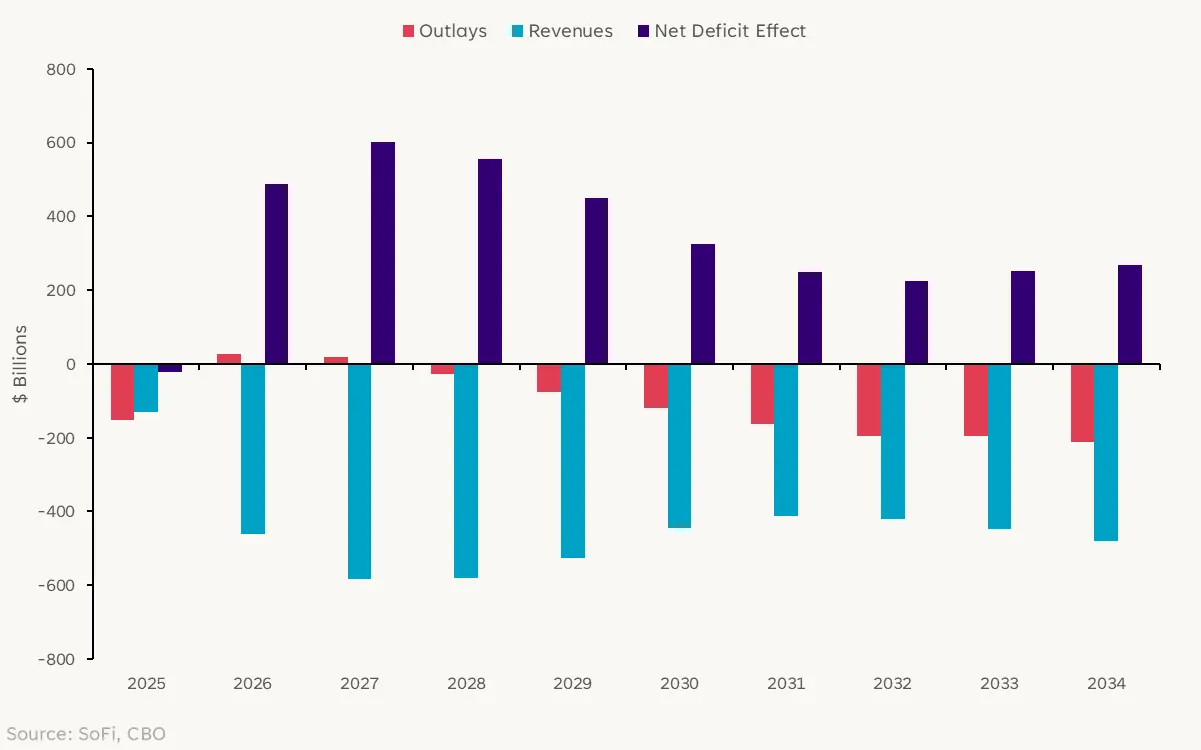
These tax reductions will be partially offset by over $1.4 trillion in spending cuts, primarily targeting healthcare programs like Medicaid and the Affordable Care Act. The net effect is a short-term economic stimulus, but a long-term debt increase: Congressional Budget Office scoring indicates the bill will add $3.4 trillion to the deficit over the next 10 years.


CBO Scoring of OBBBA

All else being equal, higher deficits entail more government borrowing and higher borrowing costs. The Budget Lab estimates that the 10-year Treasury yield will go up about half a percentage point by 2034, pushing mortgage rates higher and potentially weighing on stock valuation multiples.

Tariff-ic Consequences

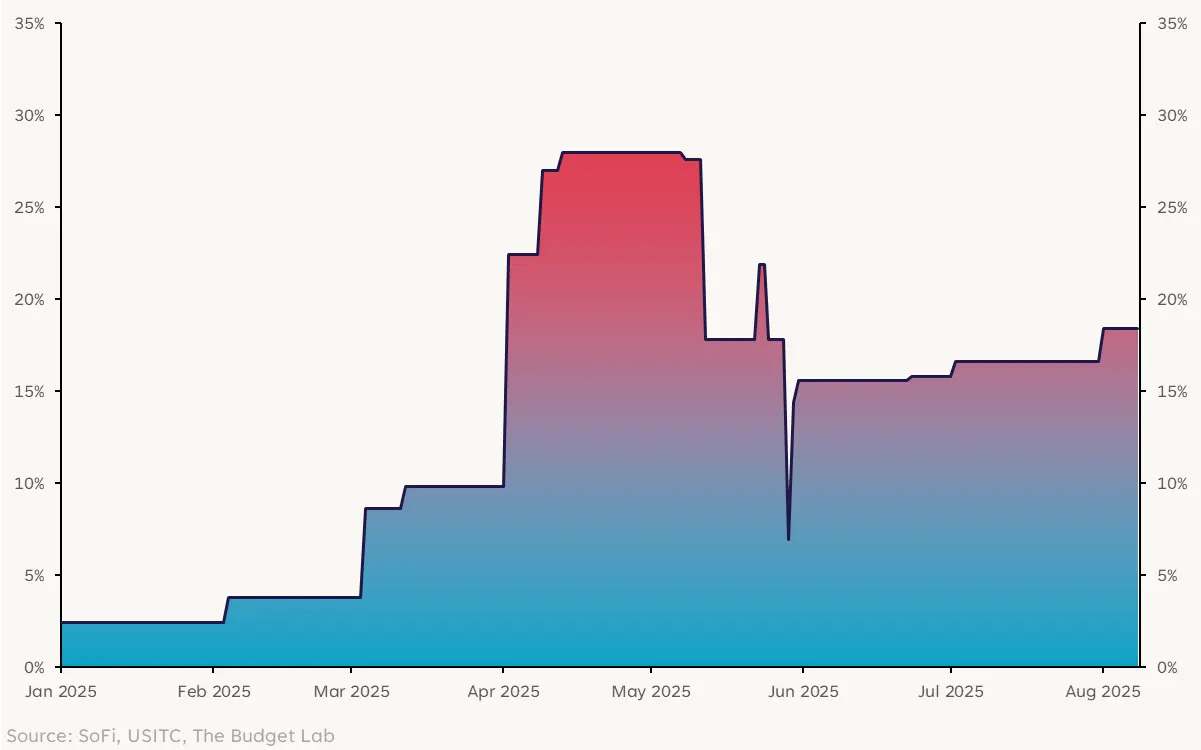
The other big policy initiative centered on trade policy. The Trump administration solidified the country’s protectionist trade framework, ending a 90-day pause on new tariffs and imposing wide-ranging tariffs on trading partners as of August 1.

Several major trading partners — including the European Union, Japan, and South Korea — ended up negotiating lower tariff rates, though these deals are asymmetric on their face: Foreign nations have made non-binding commitments to purchase hundreds of billions of dollars of U.S. goods and invest in U.S. projects, while U.S. exports face lower or no tariffs.

While consumers and businesses may shift spending from higher to lower tariff goods, eventually lowering the effective tariff rate on imports, the agreed upon pre-substitution rates are significantly above where they were at the start of the year.


Pre-Substitution Tariff Rate

So far this year tariffs have added over $300 billion in annualized revenue to government coffers. While their contribution is expected to decline in future years, tariff revenue could offset a large chunk of the deficit impact of OBBBA if they remain in force over the next decade. The economic consequences of these two countervailing forces are, while unclear, sure to be significant.

Market Recap


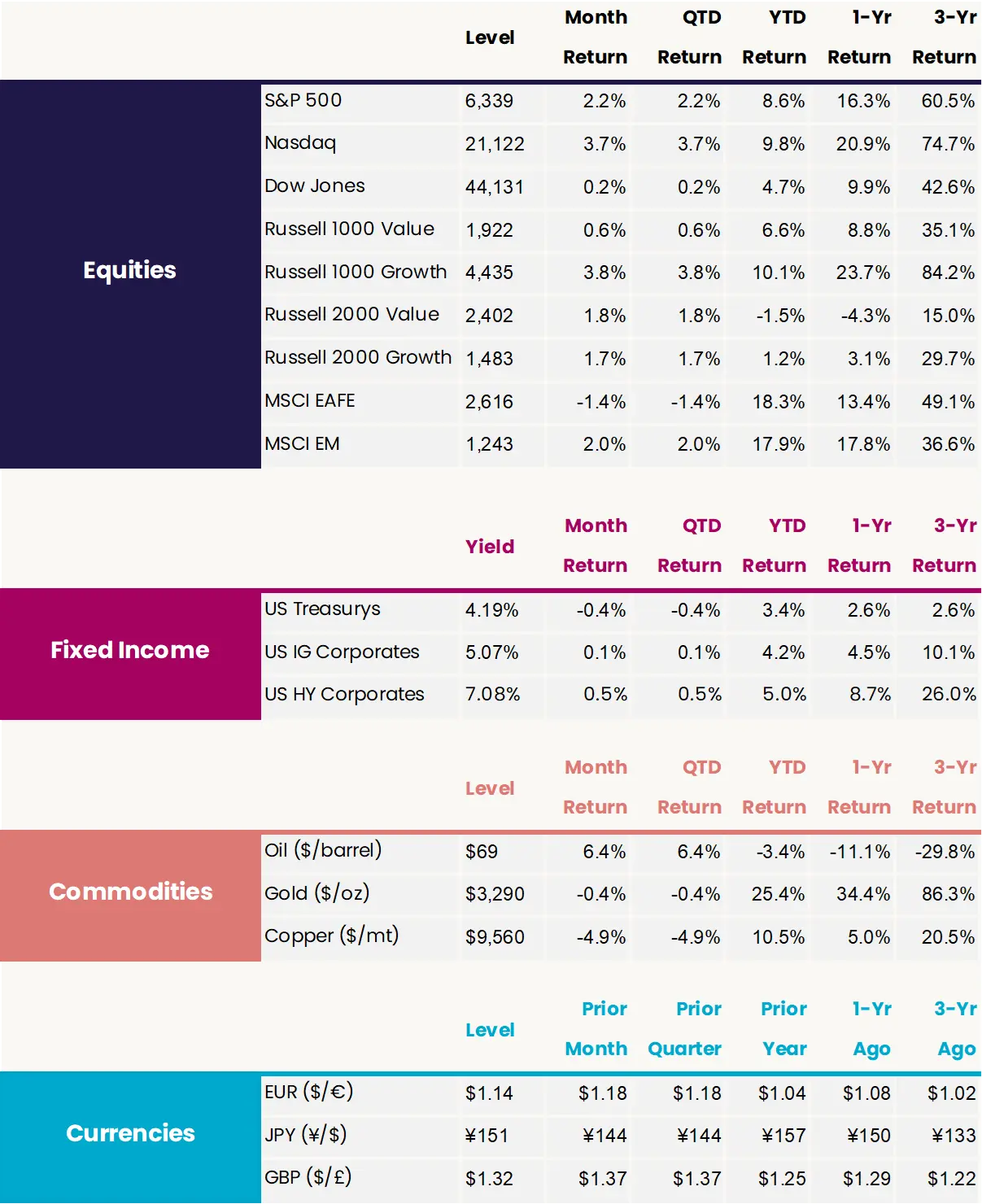
Asset Returns


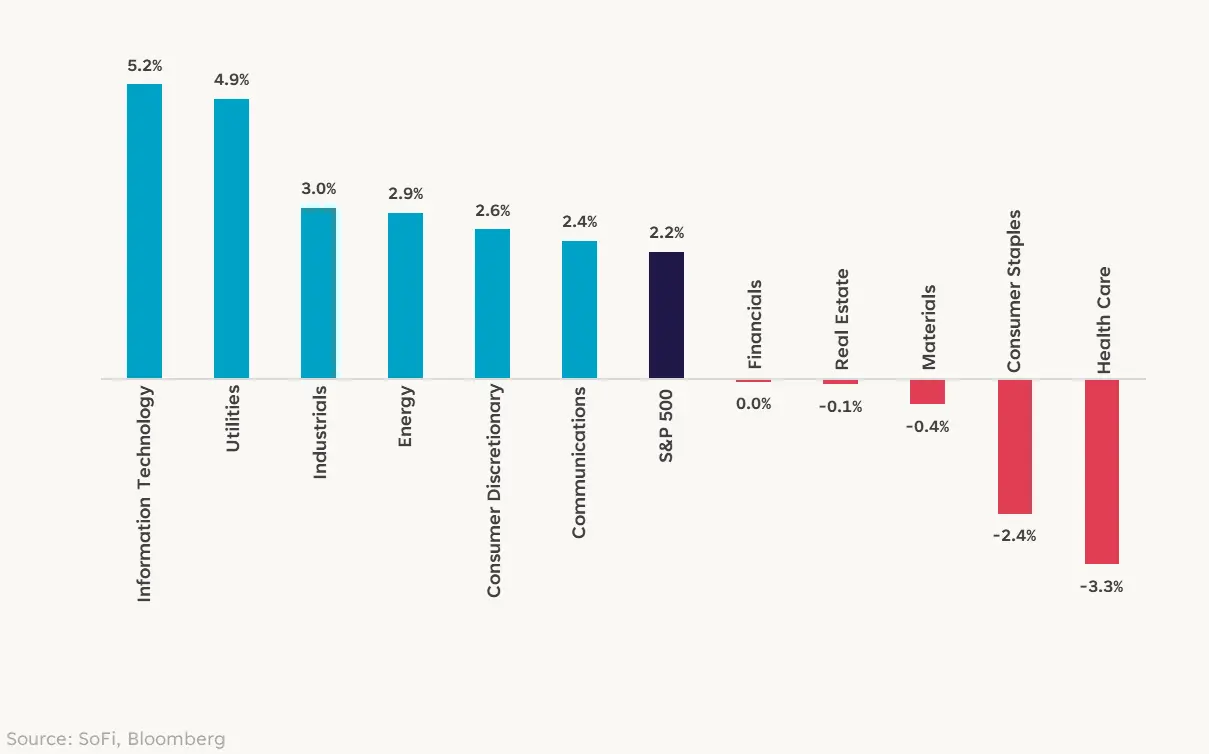
July 2025 Sector Total Returns

Macro

•  The Federal Reserve left its benchmark interest rate unchanged at a target range of 4.25%-4.50%, though two FOMC governors dissented in the decision, preferring to cut by 25 basis points.

•  Q2 GDP rose an annualized 3.0%, above expectations for 2.6% growth, as a 30.3% decline in imports contributed 5.7 percentage points.

•  While core CPI came in below consensus at 0.2% m/m in June, core goods ex-cars rose 0.6% m/m, the most since November 2021 in a sign that tariff inflation is starting to materialize.

•  Months’ supply of new homes rose to 9.8 in June, the highest since September 2022 in a sign that supply is outstripping demand.

•  $29 billion in customs and excise tax revenue was generated in July, owed in large part to tariffs, and is now running at an annualized rate of over $300 billion.

•  After being mostly stable for the first three weeks of the month, oil prices took a leg higher on news of potential secondary sanctions on countries that purchase Russian oil.

Equities

•  The Information Technology sector beat the broad market for the fourth straight month, the longest such streak since it outperformed for 11 months in 2019-20.

•  With approximately 60% of S&P 500 companies having reported second quarter results, earnings growth is tracking toward 9.1% y/y, above the 2.8% expected at the start of earnings season.

•  82.4% of companies have reported positive earnings surprises, the most since Q2 2021.

•  Large-cap growth stocks were the best performing size & style blend for the fourth straight month, while large-cap value stocks were the worst performing blend for the third straight month.

Fixed Income

•  2- and 10-year Treasury yields rose 24 and 15 basis points, respectively, as traders reacted to signs of tariff inflation and Fed hesitance to lower interest rates.

•  Treasury volatility (i.e. the MOVE Index) fell to its lowest level since February 2022.

View PDF


Performance data quoted represents past performance. Past performance does not guarantee future results. Market returns will fluctuate, and current performance may be lower or higher than the standardized performance data quoted.

Read more

SoFi Protect Content Hub

INSURANCE RESOURCES

A Guide to All Things Insurance

Learning about insurance won’t dazzle and inspire you — but it is time well spent. After all, insurance helps protect you, your family, your assets, and your finances in the event of the unexpected.

If you have questions about insurance planning, coverage, concepts, and terminology, start here. Below, we’ve collected our best insurance resources to help you evaluate your options and navigate the process. Understanding the basics of insurance will help you find the right plans for you.


For more information about our insurance offerings, visit the
SoFi Protect page.


Life Insurance

A life insurance policy can be tailored to fit your specific needs. Learn more about the importance of life insurance, different kinds of policies,
and how to make the right choice.


Homeowners and Renters

Your home will probably be the biggest expense of your life. Here’s what you should know to make sure you’re protected as an owner or renter.


Auto Insurance

If you own a car, liability car insurance is a legal requirement nationwide. But many drivers find that comprehensive coverage can come in very handy. Find out how much you need, what’s covered, and more.


Estate Planning

Like life insurance, estate planning makes things easier for your loved ones after you’re gone. Find out about wills, trusts, health care power of attorney, and how to “get your affairs in order.”


Other Important Insurance Coverage


SoFi Resources

SoFi offers the following resources to help you get the insurance coverage you need:


Protect What Matters

Check out all of SoFi Protect’s reliable insurance options to help you make a plan today.


Read more

How ‘No Tax on Tips’ Could Change Tipping Culture

It’s a tricky time to introduce tax-free tips.

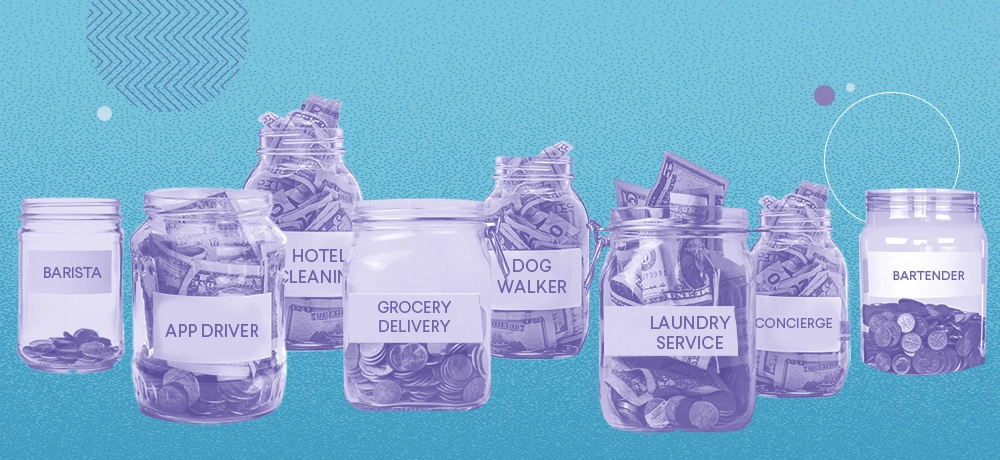
Although a new tax deduction should be welcome news for many waiters, bartenders, and other workers who typically rely on income from tips, there could be unintended negative consequences for both the tippee and the tipper.

For one, it could turbocharge a tipping culture many Americans already feel is out of control. Over the last few years, touchscreen tipping prompts have become ubiquitous when checking out at takeout joints, delis, and coffee houses. Even some pet and thrift stores have them.

The new tax policy “could ignite a whole new level of tipping resentment,” Michelle Singletary, the personal finance columnist at The Washington Post, wrote in a recent column.

Consumers are likely to feel even more pressure and could become more judgmental of the work provided by tipped workers, according to Singletary. At the same time, there will be less incentive for employers to pay a living wage, she wrote.

A quick recap of the new provision, which was approved as part of the One Big Beautiful Bill Act: Between 2025 and 2028, federal taxpayers with occupations that “customarily and regularly” receive tips can deduct up to $25,000 a year in qualifying tips. (The IRS will post a list of eligible occupations by October.) The tax break phases out for workers who earn over $150,000 in adjusted gross income, and the income is still subject to Social Security and Medicare taxes.

To be sure, it’s hard to say how much the new rules will actually affect tipping behavior. According to a report last year from The Budget Lab at Yale, only 4% of families report tips to the IRS, and many of those who do may not earn enough to pay income tax in the first place.

So what? Tipping is an emotionally charged issue. Few, if any, want to stiff a hardworking low-wage waiter or barista, but the number of tipping requests can be overwhelming. If tips are taking a toll on you — financially or otherwise — consider these options:

•  Pay in cash. Those automatic 15%, 20%, 25% tipping prompts pop up when you use a credit card or payment app. There’s a lot less pressure when you pull out cash.

•  Create a tipping budget/plan. It’s exhausting thinking about tips, especially if you have to ask yourself what’s fair every time you make a purchase. Consider creating your own tipping rules ahead of time. Have a standard percentage for each type of business you frequent. (You can always raise it when you get great service.)

•  When you can, DIY. There’s no need to tip when you’re eating at home, trimming your own kid’s hair, or washing your own car. Doing it yourself can help you limit how often you’re presented with a tipping option.

•  Look for other ways to save. Depending on where you live, businesses may pay tipped workers less than the standard minimum wage. If that motivates you to tip, find other places in your budget to cut back instead.

Related Reading

‘No Tax on Tips’ Will Harm More Workers Than It Helps (Economic Policy Institute)

The Craziest Places I’ve Been Asked To Tip (Bankrate)

Small Businesses Leverage Tipping to Control Labor Costs Amid Tipping Fatigue (Gusto)


Please understand that this information provided is general in nature and shouldn’t be construed as a recommendation or solicitation of any products offered by SoFi’s affiliates and subsidiaries. In addition, this information is by no means meant to provide investment or financial advice, nor is it intended to serve as the basis for any investment decision or recommendation to buy or sell any asset. Keep in mind that investing involves risk, and past performance of an asset never guarantees future results or returns. It’s important for investors to consider their specific financial needs, goals, and risk profile before making an investment decision.

The information and analysis provided through hyperlinks to third party websites, while believed to be accurate, cannot be guaranteed by SoFi. These links are provided for informational purposes and should not be viewed as an endorsement. No brands or products mentioned are affiliated with SoFi, nor do they endorse or sponsor this content.

SoFi isn't recommending and is not affiliated with the brands or companies displayed. Brands displayed neither endorse or sponsor this article. Third party trademarks and service marks referenced are property of their respective owners.

OTM20250730SW

Read more

5 Ways to Avoid a Financial Storm This Hurricane Season

This article appeared in SoFi's On the Money newsletter. Not getting it? Sign up here.

With peak hurricane season in the Atlantic beginning in mid-August, preparing yourself financially can be just as important as stocking supplies or boarding up windows.

In fact, with the National Oceanic and Atmospheric Administration (NOAA) predicting above-normal hurricane activity for the season, taking care of a few simple things now could help you avoid a financial storm later. (And it’s not just a coastal concern: Hurricanes can cause damage hundreds of miles inland too.)

Here are five things to do to batten the financial hatches:

1. Ensure you’re insured. Standard homeowners and renters insurance policies don’t cover flood damage, and experts say that many properties that should have flood coverage don’t. Depending on where you live, it could be worthwhile to purchase a separate flood policy, especially since damage from storm surge counts as flooding damage. (An online tool like this one can help you assess your risk.) Flood policies are available through FEMA’s National Flood Insurance Program or a private insurer, and may take 30 days to take effect.

In some areas of the country, a standard homeowner policy can exclude wind-related damage, too, so make sure you fully understand what’s covered in the event you have a hurricane. Contact your insurance agent or check your policy.

Also, documenting your belongings and valuables, including with photos or videos, can speed up the claims process if the time comes. Inventory your furniture and closet, write down any necessary make and model numbers, and if you have expensive rugs, jewelry, or artwork, consider getting them appraised.

2. Prep a financial survival kit. When natural disasters hit, bank branches and ATMs may be inaccessible. FEMA recommends keeping cash on hand and having an emergency-only credit card to cover essential expenses for at least a week. (Dedicating one card to emergency purchases can also make it easier to track reimbursable or tax-deductible disaster expenses.)

3. Plan to be away. Be prepared if a storm forces you to evacuate your home. Automate any checks you still get in the mail (like paper checks or government benefit checks) and photograph or scan items including:

•  Passports, driver’s licenses, and Social Security cards

•  Rental agreements, house deeds, car titles, and vehicle registration papers

•  Insurance cards and prescriptions

Store the copies on password-protected cloud storage services — you may need them for post-hurricane aid and claim reimbursements.

Check out FEMA’s Emergency Financial First Aid Kit for a full list of how to prepare.

4. Stock up now. If you’re getting a physical survival kit ready (think: food, water, meds), try spreading out your purchases to avoid a single budget-busting expense. (You could even go in on a bulk buy with neighbors, then divide the supplies.) Also, if you’ve got a generator, make sure there’s enough fuel in it to last several days and if there isn’t, order it now.

5. Make a cheat-sheet ahead of time. It’s easy to panic during emergencies. To stay grounded, create a to-do list now that you can reference in the heat of the moment. To determine what you would need, imagine a worst-case situation where you can’t use your phone and don’t have power or internet.

•  Compile essential phone numbers, addresses, maps, websites, and apps. Include your insurance agent’s direct line and nearby shelters.

•  Take a moment to read up on post-disaster scams. The last thing you need is to be taken advantage of during a stressful time.


Please understand that this information provided is general in nature and shouldn’t be construed as a recommendation or solicitation of any products offered by SoFi’s affiliates and subsidiaries. In addition, this information is by no means meant to provide investment or financial advice, nor is it intended to serve as the basis for any investment decision or recommendation to buy or sell any asset. Keep in mind that investing involves risk, and past performance of an asset never guarantees future results or returns. It’s important for investors to consider their specific financial needs, goals, and risk profile before making an investment decision.

The information and analysis provided through hyperlinks to third party websites, while believed to be accurate, cannot be guaranteed by SoFi. These links are provided for informational purposes and should not be viewed as an endorsement. No brands or products mentioned are affiliated with SoFi, nor do they endorse or sponsor this content.

SoFi isn't recommending and is not affiliated with the brands or companies displayed. Brands displayed neither endorse or sponsor this article. Third party trademarks and service marks referenced are property of their respective owners.

OTM2025072801

Read more

Week Ahead on Wall Street: A Lot to Digest

Get ready for a pivotal week for financial markets. The calendar is full of important events, with the Federal Reserve’s interest rate decision sandwiched between a bunch of big corporate earnings reports and the release of monthly unemployment data.

This week is the busiest week of the second-quarter earnings season, with nearly a third of S&P 500 companies set to report results. Most closely watched and potentially market-moving are likely to be technology giants Meta Platforms (META), Microsoft (MSFT), Amazon (AMZN), and Apple (AAPL).

But not to be outshined, the Fed’s rate-setting committee will hold its July meeting, and no doubt tariffs and inflation will be a hot topic. Market pricing currently indicates just a 3% chance the Fed will cut its benchmark interest rate, so the main focus will likely be on the outlook for prices and economic growth. Investors will parse every word of the Fed statement and press conference on Wednesday, looking for clues on when the central bank might lower rates.

The week will be topped off with the release of second-quarter Gross Domestic Product (GDP) and July employment data, helping to shed light on the strength of the labor market, including how companies are responding to economic uncertainty. A strong or weak report could either complement or contrast with the Fed’s message from Wednesday.

However it goes, investors will have a lot to digest.

Economic and Earnings Calendar

Monday

•  July Dallas Fed Manufacturing Activity: This is the Dallas Fed’s survey of manufacturing executives in the region on business conditions and their outlook.

•  Earnings: Brown & Brown (BRO), Cadence Design Systems (CDNS), Cincinnati Financial (CINF), Hartford Financial Services Group (HIG), Nucor (NUE), Principal Financial Group (PFG), PerkinElmer (RVTY), Universal Health Services (UHS), Veralto Corporation (VLTO), Welltower (WELL), Waste Management (WM)

Tuesday

•  June Wholesale Inventories and Sales: Wholesalers often operate as an intermediary between manufacturers and retailers, serving as a key part of the goods supply chain.

•  June Wholesale and Retail Inventories: Wholesalers and retailers often operate as intermediaries for the sale of manufactured products, serving as a key part of the goods supply chain.

•  May FHFA House Price Index: This is a broad measure of single-family house prices released by the Federal Housing Finance Agency.

•  May S&P CoreLogic Case-Shiller Home Price Index: This is a private sector measure of national home prices.

•  June Job Openings: A key measure of business demand for labor is the number of job openings, since reducing openings is easier and preferable to layoffs.

•  July Conference Board Consumer Confidence: How consumers feel about economic conditions affect their spending habits. This survey places a particular focus on job availability and the state of the labor market.

•  July Dallas Fed Non-Manufacturing Activity: This is the Dallas Fed’s survey of services executives in the region on business conditions and their outlook.

•  Earnings: Arch Capital Group (ACGL), American Tower (AMT), Boeing (BA), Booking Holdings (BKNG), Boston Properties (BXP), Carrier Global Corp (CARR), CBRE Group (CBRE), Caesars Entertainment (CZR), DTE Energy (DTE), Electronic Arts (EA), Ecolab (ECL), Essex Property Trust (ESS), Expand Energy Corporation (EXE), Corning (GLW), Hubbell (HUBB), Incyte (INCY), Johnson Controls International (JCI), Mondelez International (MDLZ), Merck & Co (MRK), Norfolk Southern (NSC), Procter & Gamble (PG), PPG Industries (PPG), PayPal (PYPL), Royal Caribbean Cruises (RCL), Regency Centers (REG), Republic Services (RSG), Starbucks (SBUX), Seagate Technologies (STX), Stanley Black & Decker (SWK), Sysco (SYY), Teradyne (TER), UnitedHealth Group (UNH), United Parcel Service (UPS), Visa (V)

Wednesday

•  July ADP Employment Report: This survey, usually released a day or two before the official government jobs report, offers insight into private sector employment trends.

•  2Q GDP First Estimate: The primary measure of economic activity in the United States, which is measured as total expenditure on a country’s goods and services.

•  FOMC Interest Rate Decision: The Federal Reserve will announce any changes to monetary policy after the conclusion of its two-day FOMC meeting, in addition to providing commentary on the economy. It’s one of eight regularly scheduled meetings per year.

•  Weekly Mortgage Applications: Mortgage activity gives insight on demand conditions in the housing market.

•  Earnings: Automatic Data Processing (ADP), American Electric Power (AEP), Albemarle (ALB), Align Technology (ALGN), Allstate (ALL), AvalonBay Communities (AVB), American Water Works (AWK), Bunge Global S.A. (BG), CH Robinson Worldwide (CHRW), Cognizant Technology Solutions (CTSH), DexCom (DXCM), eBay (EBAY), Everest RE Group (EG), Equinix (EQIX), Entergy (ETR), Extra Space Storage (EXR), Ford (F), FirstEnergy (FE), F5 Networks (FFIV), Fair Isaac (FICO), Fortive (FTV), GE HealthCare Technologies Inc (GEHC), Generac Holdings (GNRC), Garmin (GRMN), Hologic (HOLX), Host Hotels & Resorts (HST), Hershey (HSY), Humana (HUM), IDEX (IEX), Invitation Homes (INVH), Illinois Tool Works (ITW), Kraft Heinz (KHC), Lam Research (LRCX), Live Nation Entertainment (LYV), Mid-America Apartment Communities (MAA), Meta Platforms, Inc. (META), MGM Resorts International (MGM), Altria Group (MO), Microsoft (MSFT), Old Dominion Freight Line (ODFL), Prudential Financial (PRU), Public Storage (PSA), PTC (PTC), Qualcomm (QCOM), Smurfit WestRock (SW), Trane Technologies (TT), Tyler Technologies (TYL), UDR (UDR), Vici Properties (VICI), Verisk Analytics (VRSK), Ventas (VTR), Western Digital (WDC), WEC Energy Group (WEC)

Thursday

•  July Challenger Job Cuts: The firm Challenger, Gray & Christmas tracks the number of layoff announcements each month by sector.

•  June Personal Income and Spending: These numbers give insight into how Americans are doing, which is important since consumer spending accounts for about two-thirds of economic growth in the United States.

•  June Personal Consumption Expenditures Price Index: The Fed targets this inflation measure for its price stability mandate and believes PCE to be the best measure of consumers’ spending habits.

•  2Q Employment Cost Index: This is the most comprehensive measure of worker compensation, including wages, bonuses, benefits and more.

•  July Chicago Business Barometer: The barometer provides information on U.S. economic activity and business conditions, consisting of seven activity

•  Weekly Jobless Claims: This high frequency labor market data gives insight into filings for unemployment benefits. Initial jobless claims have remained mostly steady, while continuing claims have increased of late.

•  Earnings Apple (AAPL), AbbVie (ABBV), Ameren (AEE), AES (AES), Arthur J Gallagher & Co (AJG), Ametek (AME), Amazon (AMZN), Air Products and Chemicals (APD), Aptiv (APTV), Baxter International (BAX), Biogen (BIIB), Builders FirstSource (BLDR), Bristol-Myers Squibb (BMY), Cigna (CI), Clorox (CLX), Comcast (CMCSA), CMS Energy (CMS), Coinbase (COIN), Camden Property Trust (CPT), CVS Health (CVS), Edison International (EIX), Eastman Chemical (EMN), Eversource Energy (ES), Exelon (EXC), First Solar (FSLR), Huntington Ingalls Industries (HII), Howmet Aerospace (HWM), Intercontinental Exchange (ICE), International Paper (IP), Ingersoll Rand (IR), Kellogg (K), Kimco Realty (KIM), KKR & Co (KKR), KLA-Tencor (KLAC), Mastercard (MA), Masco (MAS), Monolithic Power Systems (MPWR), Mettler-Toledo International (MTD), Norwegian Cruise Line Holdings (NCLH), PG&E (PCG), PPL (PPL), Quanta Services (PWR), ResMed (RMD), Southern Company (SO), S&P Global (SPGI), Stryker (SYK), Vulcan Materials (VMC), Willis Towers Watson Public (WTW), Xcel Energy (XEL), Xylem (XYL)

Friday

•  July Employment Situation Summary: This monthly blockbuster release from the Labor Department gives a comprehensive look at employment, wages, and hours worked in the previous month.

•  July ISM Manufacturing PMI: This index from the Institute for Supply Management tracks how purchasing managers across the manufacturing sector feel about the business environment.

•  June Construction Spending: Construction data is a leading indicator of business activity.

•  July University of Michigan Consumer Sentiment: How consumers feel about economic conditions affect their spending habits. This survey places a particular focus on inflation and its trajectory.

•  July Wards Total Vehicle Sales: Cars are a big ticket item for consumers, so underlying vehicle sales trends can help shine a light on demand for durable goods.

•  Earnings: Franklin Resources (BEN), Cboe Global Markets (CBOE), Church & Dwight (CHD), Colgate-Palmolive (CL), Chevron (CVX), Dominion Energy (D), WW Grainger (GWW), Kimberly-Clark (KMB), Linde PLC (LIN), LyondellBasell Industries (LYB), Moderna (MRNA), Motorola Solutions (MSI), Regeneron Pharmaceuticals (REGN), T Rowe Price Group (TROW), Exxon Mobil (XOM)


Want to see more stories like this?
On the Money is SoFi’s flagship newsletter
for all things personal finance.

Check it out


Please understand that this information provided is general in nature and shouldn’t be construed as a recommendation or solicitation of any products offered by SoFi’s affiliates and subsidiaries. In addition, this information is by no means meant to provide investment or financial advice, nor is it intended to serve as the basis for any investment decision or recommendation to buy or sell any asset. Keep in mind that investing involves risk, and past performance of an asset never guarantees future results or returns. It’s important for investors to consider their specific financial needs, goals, and risk profile before making an investment decision.

The information and analysis provided through hyperlinks to third party websites, while believed to be accurate, cannot be guaranteed by SoFi. These links are provided for informational purposes and should not be viewed as an endorsement. No brands or products mentioned are affiliated with SoFi, nor do they endorse or sponsor this content.

SoFi isn't recommending and is not affiliated with the brands or companies displayed. Brands displayed neither endorse or sponsor this article. Third party trademarks and service marks referenced are property of their respective owners.

Read more
TLS 1.2 Encrypted
Equal Housing Lender