SoFi Blog

Tips and news—
for your financial moves.

Crypto

{/* Crypto LP $25 module add 1/20 */}
{/* Referral 25 module added*/}
{/* https://www.sofi.com/crypto/ */}

{/* Hero */}

INTRODUCING

The
first and only national chartered bank where retail customers can buy,
sell, and hold 25+ cryptocurrencies.


Access cryptocurrencies like Bitcoin, Ethereum, and Solana—on a federally
regulated platform with the safeguards of a bank. All in the same app as the rest of your finances.


Open an account

{/* Founding member mod – hidden 1/14/26 per A Lui – DP */}

{/* Grid Container */}

{/* Left Column: Spacer for Background Image */}

{/* Right Column: All Content aligned together */}

{/* Headline */}

Your chance to become a SoFi Crypto Founding Member—and win $1,000 in Bitcoin.*

    {/* Bullet 1 */}


  • Win Bitcoin.

    100 Founding Members will each win $1,000 in Bitcoin for their portfolios.

  • {/* Bullet 2 */}


  • Trade to win.

    Every $10 in crypto trades is another chance to win. So a $100 trade means 10 entries, a $1,000 trade means 100 entries, and so on. Enter by 1/15/26.

  • {/* Bullet 3 */}


  • Get awarded.

    Each of the 100 Founding Members wins a custom keepsake to show off their smart move—getting in on SoFi Crypto.

{/* CTA Button */}


Learn more

{/* Disclaimer / Footer */}

*NO PURCHASE OR QUALIFYING TRANSACTION NECESSARY. Open only to legal residents of the 50 US/DC, 18+. Void where prohibited by law. Sweepstakes starts 12/22/25 at 9 a.m. PT and ends at 11:59 p.m. PT on 1/15/26. See Official Rules for how to enter, free entry method by mail, prize details, limits, and odds: click here. Sponsor: SoFi Bank, National Association (“SoFi Bank”), 2750 E Cottonwood Pkwy #300, Cottonwood Heights, UT 84121.

{/* How to get your $10 bonus */}

How to get your $10 bonus
with a $10 purchase by 2/7/26. 1

Open a crypto account.

Make a qualifying crypto purchase of $10 or more by 2/7/26 with funds from SoFi Checking and Savings.

Get $10 in stablecoin for more SoFi Crypto trades.


Open an account

Qualifying crypto buy/purchase transactions exclude stablecoins (e.g. USDC).

{/* How to start trading crypto with SoFi. */}

How to start trading crypto with SoFi.

You’ll need a SoFi Checking and Savings account to access crypto.

Open a crypto account.

Open a SoFi Checking and Savings account.

Fund your checking
and savings account.

Access crypto on SoFi.


Open an account

{/* 1% Match Crypto – ADDED 1/14/26 DP*/}

You can start the new year strong with a 1% match on crypto buys through 3/30/262—only with SoFi Plus.


Learn more

Complimentary Plus Members with Eligible Direct Deposit or Qualifying Deposits or a $10/mo subscription are eligible for this promotion. Funds must be net-new and originate from the members’ SoFi Checking and Savings account to execute crypto buys by 3/30/26.

{/* Love SoFi Crypto? Tell your friends */}

Love SoFi Crypto? Tell your friends—and you could both get $25.

  • 1. Open a SoFi Crypto account (and a SoFi Checking and Savings account if you don’t already have one).

  • 2. Share your unique referral link.

  • 3. Get $25 for each friend who joins SoFi Crypto and makes a $50 or more crypto purchase. (They’ll get $25 in their SoFi Checking and Savings account, too!) Terms apply.*


Refer a friend

*Referral terms and conditions apply. See SoFi.com/referral-program for details.

{/* Why go crypto at sofi */}

Why go crypto at SoFi?

{/* Buy, Sell and hold crypto RTB1*/}

Buy, sell, and hold crypto on a platform with the safeguards of a bank.

This is where crypto meets modern banking.


Join the waitlist

{/* own crypto- and bank, borrow, invest RTB2*/}

Own crypto—and bank, borrow, invest—
all in one app.

No new apps to download or new passwords to juggle. You can keep all your money in one place where it’s simple
to manage.


Join the waitlist

{/* Make trades instantly RTB3*/}

Make trades instantly.

There’s no waiting around when you’re transferring funds through SoFi Checking and Savings—make trades the
moment you’re ready.


Join the waitlist

{/* Learn the basics RTB4 */}

Learn the basics with in-app guidance.

We’ll help you learn the ins and outs of how to buy, sell, and hold crypto

with SoFi.


Join the waitlist

{/* A wide selection of coins RTB5*/}

A wide selection of coins.

Get access to Bitcoin, Ethereum, and Solana, plus 25+ cryptocurrencies.


Join the waitlist

{/* Youtube video */}

Where crypto meets
modern banking.

Watch
to learn more.


Learn about crypto.

{/* desktop content mod */}

What Is Cryptocurrency?

What Is Cryptocurrency?

Cryptocurrency is a digital form of money that exists entirely online and generally operates independently of a central bank or government. Crypto is designed to be decentralized, allowing peer-to-peer transactions without relying on banks or payment processors. Transaction speed depends on the network – some are near-instant, while others take more time.

Unlike traditional currencies like the U.S. dollar, crypto transactions are secured through cryptography and recorded on the blockchain. This verification ensures security and integrity without relying on a single authority. Think of it like a shared digital record book that records and verifies crypto transactions on a distributed network of computers worldwide. Its shared nature makes the system transparent and difficult to tamper with.

Since the launch of Bitcoin in 2009, thousands of cryptocurrencies have emerged – some, such as Ethereum or Solana, have specific use cases (like payments, gaming, or decentralized finance), while many remain experimental or speculative. Crypto offers a new way to think about money and value transfers based on code rather than institutions.

Although crypto began as an alternative to traditional finance, it’s increasingly moving towards the mainstream. Some banks and licensed custodians now offer crypto services under evolving regulatory frameworks.

Cryptocurrency and digital assets are not insured by the Federal Deposit Insurance Corporation (FDIC), not bank-guaranteed, and may lose value.

How Blockchain Works

How Blockchain Works

Blockchain enables cryptocurrency to operate by verifying transactions collectively across a network rather than relying on a single intermediary. Think of the blockchain as a shared digital record book that anyone on the network can view but no single participant can unilaterally change. By automatically recording and verifying transactions, it removes the need for financial institutions or payment processors though many users still interact through exchanges or custodial services.

Every time someone sends or receives crypto, for example, the details are added to this record book and shared across thousands of computers around the world. These computers work together to confirm that the information is accurate, such as verifying that the sender actually has the funds. Once verified, the transaction is grouped with others into a new block. When the block is complete, it is locked and connected to the one before it, creating a continuous chain of verified records. That’s how the blockchain got its name.

The shared nature of this record book makes altering it extremely difficult, because it would require changing a majority of copies across the network. This design makes the system secure, transparent, and able to run automatically without a central authority.

Why People Use Cryptocurrency

Why People Use Cryptocurrency

People use crypto for a variety of reasons, but a major one is control – having more direct ownership over how their money moves. And there are a number of other potential benefits, too:

  • Fast and low-cost transfers: Many cryptocurrencies make it possible to send money quickly and cheaply – especially across borders – though timing and fees can vary by network and exchange rate.
  • Accessibility: Anyone with an internet connection can use crypto, even without a traditional bank account. This makes it especially useful where banking options are limited. When you hold crypto, your balance is publicly visible on the blockchain but accessible only with your private keys. (If you use a custodial wallet, a platform manages those keys for you.)
  • Independence and control: Crypto networks don’t rely on banks or governments to operate, though access and regulation may involve them.
  • Diversification: Digital assets may represent a new, distinct category within a financial portfolio alongside bank and investment accounts, retirement savings, and tangible assets like a home or car.

How To Evaluate Different Coins

How To Evaluate Different Coins

There are thousands of cryptocurrencies, so how do you decide which one to buy? Building a framework of how to think about a crypto’s value proposition can help you make this decision.

Here three key things to keep in mind:

  1. Purpose: Do your research on what a coin was designed to do. Some focus on speed or efficiency, while others are built for specific use cases, such as gaming or digital collectibles. Bitcoin was originally designed for digital payments, for example. Knowing a coin’s purpose can help you assess whether its market performance is driven by momentary hype or longer-term demand.
  2. Credibility and supply: Anyone can create a cryptocurrency, so not all have staying power. An experienced and transparent team behind a crypto project can be an important indicator. The supply of a coin is another part of this equation: Some supplies are limited, which can affect the coin’s value in the long-term.
  3. Market behavior: Crypto prices are driven by a mix of supply, demand, and confidence, which means that the market can be volatile and move quickly in response to headlines. Hype about a specific coin can move the market significantly, making it more important to know what you’re buying and why.

Protecting Your Crypto

Protecting Your Crypto

To own digital assets, which live online in blockchain, you need a crypto wallet. But unlike the wallet in your pocket, it doesn’t actually hold coins. Instead, it’s a tool to store the keys to your crypto, unique codes that prove ownership and let you send or receive funds.

Unlike your checking and savings accounts, your crypto wallet isn’t insured by the Federal Deposit Insurance Corporation. That’s why understanding how to keep it safe is key. Some custodial platforms may offer private insurance but not FDIC protection.

There are two main types of wallets:

  • Custodial wallets: Your private keys are managed and protected by a licensed custodian like SoFi. You still own your crypto, but storage and security are handled for you in a regulated environment.
  • Self-custody wallets: You manage your private keys directly. This offers full control but also full responsibility to protect your digital assets. If your keys or recovery phrases are lost, your crypto can’t be recovered.

Good digital habits are your best defense: Use strong, unique passwords, enable two-factor authentication, and keep your devices and apps up to date. So stay alert, stay informed, and stay safe.

{/* tablet content mod */}

What Is Crypto?

What Is Cryptocurrency?

Cryptocurrency is a digital form of money that exists entirely online and generally operates independently of a central bank or government. Crypto is designed to be decentralized, allowing peer-to-peer transactions without relying on banks or payment processors. Transaction speed depends on the network – some are near-instant, while others take more time.

Unlike traditional currencies like the U.S. dollar, crypto transactions are secured through cryptography and recorded on the blockchain. This verification ensures security and integrity without relying on a single authority. Think of it like a shared digital record book that records and verifies crypto transactions on a distributed network of computers worldwide. Its shared nature makes the system transparent and difficult to tamper with.

Since the launch of Bitcoin in 2009, thousands of cryptocurrencies have emerged – some, such as Ethereum or Solana, have specific use cases (like payments, gaming, or decentralized finance), while many remain experimental or speculative. Crypto offers a new way to think about money and value transfers based on code rather than institutions.

Although crypto began as an alternative to traditional finance, it’s increasingly moving towards the mainstream. Some banks and licensed custodians now offer crypto services under evolving regulatory frameworks.

Cryptocurrency and digital assets are not insured by the Federal Deposit Insurance Corporation (FDIC), not bank-guaranteed, and may lose value.

How Blockchain Works

How Blockchain Works

Blockchain enables cryptocurrency to operate by verifying transactions collectively across a network rather than relying on a single intermediary. Think of the blockchain as a shared digital record book that anyone on the network can view but no single participant can unilaterally change. By automatically recording and verifying transactions, it removes the need for financial institutions or payment processors though many users still interact through exchanges or custodial services.

Every time someone sends or receives crypto, for example, the details are added to this record book and shared across thousands of computers around the world. These computers work together to confirm that the information is accurate, such as verifying that the sender actually has the funds. Once verified, the transaction is grouped with others into a new block. When the block is complete, it is locked and connected to the one before it, creating a continuous chain of verified records. That’s how the blockchain got its name.

The shared nature of this record book makes altering it extremely difficult, because it would require changing a majority of copies across the network. This design makes the system secure, transparent, and able to run automatically without a central authority.

Why People Use Cryptocurrency

Why People Use Cryptocurrency

People use crypto for a variety of reasons, but a major one is control – having more direct ownership over how their money moves. And there are a number of other potential benefits, too:

  • Fast and low-cost transfers: Many cryptocurrencies make it possible to send money quickly and cheaply – especially across borders – though timing and fees can vary by network and exchange rate.
  • Accessibility: Anyone with an internet connection can use crypto, even without a traditional bank account. This makes it especially useful where banking options are limited. When you hold crypto, your balance is publicly visible on the blockchain but accessible only with your private keys. (If you use a custodial wallet, a platform manages those keys for you.)
  • Independence and control: Crypto networks don’t rely on banks or governments to operate, though access and regulation may involve them.
  • Diversification: Digital assets may represent a new, distinct category within a financial portfolio alongside bank and investment accounts, retirement savings, and tangible assets like a home or car.

How To Evaluate Different Coins

How To Evaluate Different Coins

There are thousands of cryptocurrencies, so how do you decide which one to buy? Building a framework of how to think about a crypto’s value proposition can help you make this decision.

Here three key things to keep in mind:

  1. Purpose: Do your research on what a coin was designed to do. Some focus on speed or efficiency, while others are built for specific use cases, such as gaming or digital collectibles. Bitcoin was originally designed for digital payments, for example. Knowing a coin’s purpose can help you assess whether its market performance is driven by momentary hype or longer-term demand.
  2. Credibility and supply: Anyone can create a cryptocurrency, so not all have staying power. An experienced and transparent team behind a crypto project can be an important indicator. The supply of a coin is another part of this equation: Some supplies are limited, which can affect the coin’s value in the long-term.
  3. Market behavior: Crypto prices are driven by a mix of supply, demand, and confidence, which means that the market can be volatile and move quickly in response to headlines. Hype about a specific coin can move the market significantly, making it more important to know what you’re buying and why.

Protecting Your Crypto

Protecting Your Crypto

To own digital assets, which live online in blockchain, you need a crypto wallet. But unlike the wallet in your pocket, it doesn’t actually hold coins. Instead, it’s a tool to store the keys to your crypto, unique codes that prove ownership and let you send or receive funds.

Unlike your checking and savings accounts, your crypto wallet isn’t insured by the Federal Deposit Insurance Corporation. That’s why understanding how to keep it safe is key. Some custodial platforms may offer private insurance but not FDIC protection.

There are two main types of wallets:

  • Custodial wallets: Your private keys are managed and protected by a licensed custodian like SoFi. You still own your crypto, but storage and security are handled for you in a regulated environment.
  • Self-custody wallets: You manage your private keys directly. This offers full control but also full responsibility to protect your digital assets. If your keys or recovery phrases are lost, your crypto can’t be recovered.

Good digital habits are your best defense: Use strong, unique passwords, enable two-factor authentication, and keep your devices and apps up to date. So stay alert, stay informed, and stay safe.

{/* mobile content mod */}

What Is Cryptocurrency?

What Is Cryptocurrency?

Cryptocurrency is a digital form of money that exists entirely online and generally operates independently of a central bank or government. Crypto is designed to be decentralized, allowing peer-to-peer transactions without relying on banks or payment processors. Transaction speed depends on the network – some are near-instant, while others take more time.

Unlike traditional currencies like the U.S. dollar, crypto transactions are secured through cryptography and recorded on the blockchain. This verification ensures security and integrity without relying on a single authority. Think of it like a shared digital record book that records and verifies crypto transactions on a distributed network of computers worldwide. Its shared nature makes the system transparent and difficult to tamper with.

Since the launch of Bitcoin in 2009, thousands of cryptocurrencies have emerged – some, such as Ethereum or Solana, have specific use cases (like payments, gaming, or decentralized finance), while many remain experimental or speculative. Crypto offers a new way to think about money and value transfers based on code rather than institutions.

Although crypto began as an alternative to traditional finance, it’s increasingly moving towards the mainstream. Some banks and licensed custodians now offer crypto services under evolving regulatory frameworks.

Cryptocurrency and digital assets are not insured by the Federal Deposit Insurance Corporation (FDIC), not bank-guaranteed, and may lose value.

How Blockchain Works

How Blockchain Works

Blockchain enables cryptocurrency to operate by verifying transactions collectively across a network rather than relying on a single intermediary. Think of the blockchain as a shared digital record book that anyone on the network can view but no single participant can unilaterally change. By automatically recording and verifying transactions, it removes the need for financial institutions or payment processors though many users still interact through exchanges or custodial services.

Every time someone sends or receives crypto, for example, the details are added to this record book and shared across thousands of computers around the world. These computers work together to confirm that the information is accurate, such as verifying that the sender actually has the funds. Once verified, the transaction is grouped with others into a new block. When the block is complete, it is locked and connected to the one before it, creating a continuous chain of verified records. That’s how the blockchain got its name.

The shared nature of this record book makes altering it extremely difficult, because it would require changing a majority of copies across the network. This design makes the system secure, transparent, and able to run automatically without a central authority.

Why People Use Cryptocurrency

Why People Use Cryptocurrency

People use crypto for a variety of reasons, but a major one is control – having more direct ownership over how their money moves. And there are a number of other potential benefits, too:

  • Fast and low-cost transfers: Many cryptocurrencies make it possible to send money quickly and cheaply – especially across borders – though timing and fees can vary by network and exchange rate.
  • Accessibility: Anyone with an internet connection can use crypto, even without a traditional bank account. This makes it especially useful where banking options are limited. When you hold crypto, your balance is publicly visible on the blockchain but accessible only with your private keys. (If you use a custodial wallet, a platform manages those keys for you.)
  • Independence and control: Crypto networks don’t rely on banks or governments to operate, though access and regulation may involve them.
  • Diversification: Digital assets may represent a new, distinct category within a financial portfolio alongside bank and investment accounts, retirement savings, and tangible assets like a home or car.

How To Evaluate Different Coins

How To Evaluate Different Coins

There are thousands of cryptocurrencies, so how do you decide which one to buy? Building a framework of how to think about a crypto’s value proposition can help you make this decision.

Here three key things to keep in mind:

  1. Purpose: Do your research on what a coin was designed to do. Some focus on speed or efficiency, while others are built for specific use cases, such as gaming or digital collectibles. Bitcoin was originally designed for digital payments, for example. Knowing a coin’s purpose can help you assess whether its market performance is driven by momentary hype or longer-term demand.
  2. Credibility and supply: Anyone can create a cryptocurrency, so not all have staying power. An experienced and transparent team behind a crypto project can be an important indicator. The supply of a coin is another part of this equation: Some supplies are limited, which can affect the coin’s value in the long-term.
  3. Market behavior: Crypto prices are driven by a mix of supply, demand, and confidence, which means that the market can be volatile and move quickly in response to headlines. Hype about a specific coin can move the market significantly, making it more important to know what you’re buying and why.

Protecting Your Crypto

Protecting Your Crypto

To own digital assets, which live online in blockchain, you need a crypto wallet. But unlike the wallet in your pocket, it doesn’t actually hold coins. Instead, it’s a tool to store the keys to your crypto, unique codes that prove ownership and let you send or receive funds.

Unlike your checking and savings accounts, your crypto wallet isn’t insured by the Federal Deposit Insurance Corporation. That’s why understanding how to keep it safe is key. Some custodial platforms may offer private insurance but not FDIC protection.

There are two main types of wallets:

  • Custodial wallets: Your private keys are managed and protected by a licensed custodian like SoFi. You still own your crypto, but storage and security are handled for you in a regulated environment.
  • Self-custody wallets: You manage your private keys directly. This offers full control but also full responsibility to protect your digital assets. If your keys or recovery phrases are lost, your crypto can’t be recovered.

Good digital habits are your best defense: Use strong, unique passwords, enable two-factor authentication, and keep your devices and apps up to date. So stay alert, stay informed, and stay safe.

{/* FAQs Desktop / Tablet */}

FAQs


What is a SoFi Crypto Account?


A SoFi Crypto Account enables you to use the Digital Asset Services, which include purchasing, selling, and holding Supported Digital Assets offered by SoFi Bank.


How easy is it to open a SoFi Crypto Account?

Opening a SoFi Crypto account is quick and easy. There are no fees to open a SoFi Crypto Account and there are no monthly maintenance fees. All we need are a few pieces of information such as name, home address, and Social Security number. In some cases, we may need additional documentation like a copy of your driver’s license, and/or a current photo ID to verify your identity.


Are my crypto assets insured ?


Your SoFi Crypto Account is not a deposit account or a bank account. Cryptocurrency and other digital assets are not deposits, not insured by the Federal Deposit Insurance Corporation (FDIC), or Securities Investor Protection Corporation (SIPC), not bank-guaranteed, and may lose value.


How do I purchase/trade crypto?


To start trading, you must fund your account by transferring cash from a Connected SoFi Account (SoFi Checking and Savings). We then convert this cash into a stablecoin (such as USDC) to execute the trade.
Please be aware that stablecoins are not issued or guaranteed by SoFi Bank or the FDIC and may lose value. Due to this structure, funding and withdrawals are restricted to your Connected SoFi Account.


Why do I need a SoFi Connected Account?


You need a SoFi Connected Account to unlock the full SoFi Crypto experience. Your Connected Account acts as your primary funding source to enable trading on the SoFi Crypto platform.


When will my funds from my SoFi Checking and Savings Accounts be available?


Transfers made from your SoFi Bank Checking and Savings Account are available instantly to begin trading!


When can I trade? What time is the market closed?


With SoFi Crypto, you can trade 24/7, 365. There are no market hours for the crypto market.


What are SoFi Crypto Trading Fees?


Trading crypto with SoFi is straightforward. We charge a flat 1% fee on all buy and sell transactions. You may notice the price you receive includes a “spread.” This is simply the difference between the live market rate and the rate at which your order is executed. This spread protects you by locking in your price at the moment you order, ensuring valid transaction settlement.


When will my crypto transfer to my SoFi Crypto account be available?


Crypto transfer times from external wallets vary by cryptocurrency. Many are near-instant, while others may take a few hours. Factors that can impact this: the specific blockchain network utilized, network congestion, transaction fees, and more.


{/* FAQs Mobile */}

FAQs


What is a SoFi Crypto Account?


A SoFi Crypto Account enables you to use the Digital Asset Services, which include purchasing, selling, and holding Supported Digital Assets offered by SoFi Bank.


How easy is it to open a SoFi Crypto Account?

Opening a SoFi Crypto account is quick and easy. There are no fees to open a SoFi Crypto Account and there are no monthly maintenance fees. All we need are a few pieces of information such as name, home address, and Social Security number. In some cases, we may need additional documentation like a copy of your driver’s license, and/or a current photo ID to verify your identity.


Are my crypto assets insured ?


Your SoFi Crypto Account is not a deposit account or a bank account. Cryptocurrency and other digital assets are not deposits, not insured by the Federal Deposit Insurance Corporation (FDIC), or Securities Investor Protection Corporation (SIPC), not bank-guaranteed, and may lose value.


How do I purchase/trade crypto?


To start trading, you must fund your account by transferring cash from a Connected SoFi Account (SoFi Checking and Savings). We then convert this cash into a stablecoin (such as USDC) to execute the trade.
Please be aware that stablecoins are not issued or guaranteed by SoFi Bank or the FDIC and may lose value. Due to this structure, funding and withdrawals are restricted to your Connected SoFi Account.


Why do I need a SoFi Connected Account?


You need a SoFi Connected Account to unlock the full SoFi Crypto experience. Your Connected Account acts as your primary funding source to enable trading on the SoFi Crypto platform.


When will my funds from my SoFi Checking and Savings Accounts be available?


Transfers made from your SoFi Bank Checking and Savings Account are available instantly to begin trading!


When can I trade? What time is the market closed?


With SoFi Crypto, you can trade 24/7, 365. There are no market hours for the crypto market.


What are SoFi Crypto Trading Fees?


Trading crypto with SoFi is straightforward. We charge a flat 1% fee on all buy and sell transactions. You may notice the price you receive includes a “spread.” This is simply the difference between the live market rate and the rate at which your order is executed. This spread protects you by locking in your price at the moment you order, ensuring valid transaction settlement.


When will my crypto transfer to my SoFi Crypto account be available?


Crypto transfer times from external wallets vary by cryptocurrency. Many are near-instant, while others may take a few hours. Factors that can impact this: the specific blockchain network utilized, network congestion, transaction fees, and more.


{/* Jump start your crypto journey */}


Jump-start your crypto journey.

You’ve got a platform with the safeguards of a bank when you access crypto on SoFi.


Open an account



Read more

Breaking Barriers: New SoFi Data Reveals the Truth About Today’s Female Entrepreneurs

A new SoFi survey reveals groundbreaking news that turns many assumptions about female entrepreneurs on their heads. Women business owners are no longer content to just “stay in their lane.” Instead, they are branching out into fields previously dominated by men, such as construction, transportation and warehouse, and tech/software and AI, according to our research.

In the Summer 2025 SoFi survey of over 1,000 women business owners across the U.S., the majority of respondents reported that they had no financial help or support network when they launched their businesses. Instead, they used their own savings to get their venture off the ground and relied on their experience and know-how.

And forget investors — many female founders are getting the job done with their own money, hard work, ingenuity, and determination.

Key Points

•   68% funded their businesses with their own personal savings. Only 18% had a business or Small Business Administration (SBA) loan; just 3% had venture capital.

•   62% of women business owners taught themselves how to manage their business finances; 42% are very confident in their financial management skills.

•   44% say their industry’s gender makeup has motivated them to prove themselves and stand out.

•   63% of respondents say personal fulfillment comes from flexibility and control, with 42% say satisfaction derives from expanding client bases and 36% from revenue growth.

Why Business Growth Equals Personal Growth

There are over 14 million female-owned businesses in the U.S., and they generate $3.3 trillion of revenue.

Most women business owners say they are very confident in their financial management skills — and those abilities are clearly paying off. However, they do worry about the broader financial situation in the U.S. The majority of SoFi survey respondents cite “current economic uncertainty” as the biggest challenge they face right now in terms of managing their business finances.

The bottom line is that despite the unpredictability of today’s economy, women have discovered that owning a business can be deeply rewarding—and that there can be unexpected opportunities in fields that may have once seemed off-limits. In fact, 30% say that entering a new industry has been the biggest professional reward they’ve gained.

Source: Based on a SoFi survey conducted on June 12-18 of 1,000 women business owners in the U.S. ages 18 and up.

Percentages have been rounded to the nearest whole number, and some questions allowed for multiple answers, so some data may not add up to 100%.

Bridging the Gender Gap

As noted above, women are discovering opportunities in business spaces that were once men-only. Sixteen percent of SoFi respondents say their business is in an industry that’s male dominated, and 39% percent report that the industry they’re in is evenly divided between men and women. By comparison 38% say they’re in an industry that’s female dominated, and 7% don’t know the make-up of their industry.

For many women entrepreneurs, venturing into new territory has had a positive effect:

•   44% say the gender makeup of their industry has motivated them to prove themselves and stand out.

•   29% report that it allows them to distinguish themselves from the competition.

•   20% say they’ve been able to build stronger networks because of it.

•   26% of respondents say gender hasn’t had any impact at all.

Easier Than Expected

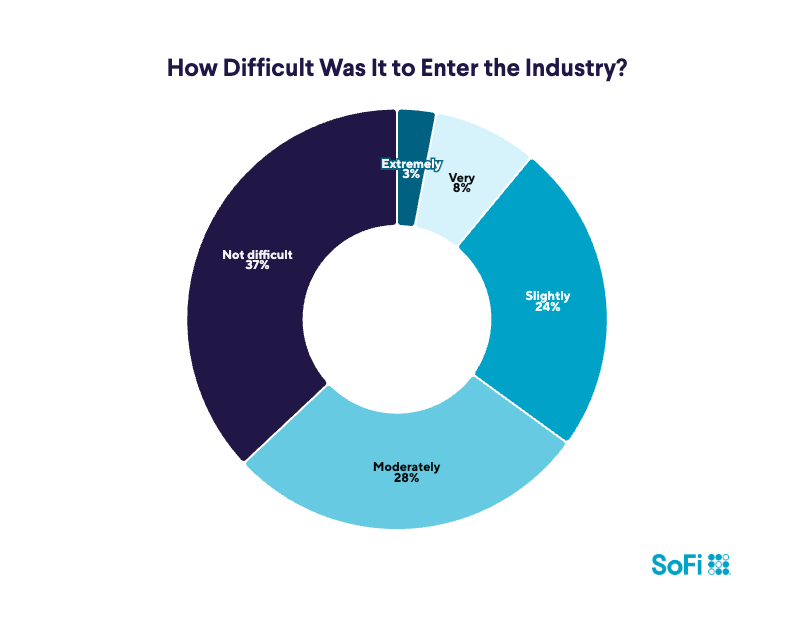
While breaking into a male-dominated field might sound intimidating, it was actually fairly simple, SoFi’s survey found: 61% of women business owners say it was not at all difficult — or just slightly difficult — to enter their industry.

Four gauge charts showing How Difficult Was It to Enter the Industry? Not Difficult 37%, Slightly 24%, Moderately 28%, Very 11%.

•   Not at all difficult: 37%

•   Slightly difficult: 24%

•   Moderately difficult: 28%

•   Very difficult: 8%

•   Extremely difficult: 3%

The Challenges Women Entrepreneurs Faced When Entering Their Industry

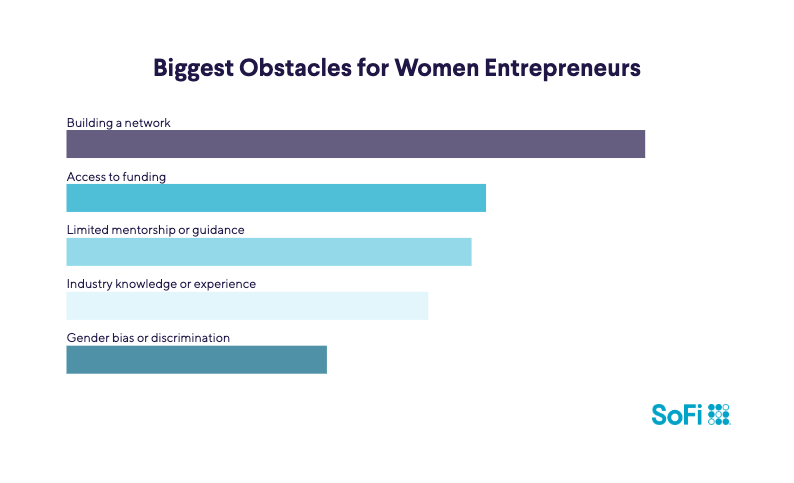
The main obstacles women business owners face had less to do with discrimination and more about building a support system, according to SoFi’s survey. Networking and finding a mentor were top challenges for 68% of respondents. Surprisingly, this was more than twice as challenging as securing funding.

Horizontal bar chart showing Biggest Obstacles for Women Entrepreneurs. Difficulty building a network 40%. Lack of access to funding 29%. Limited mentorship or guidance 28%. Lack of industry knowledge or experience 25%. Gender bias or discrimination 18%.

•   Difficulty building a network: 40%

•   Lack of access to funding: 29%

•   Limited mentorship or guidance: 28%

•   Lack of industry knowledge or experience: 25%

•   Gender bias or discrimination: 18%

How Women Overcame the Biggest Challenges to Launching Their Business

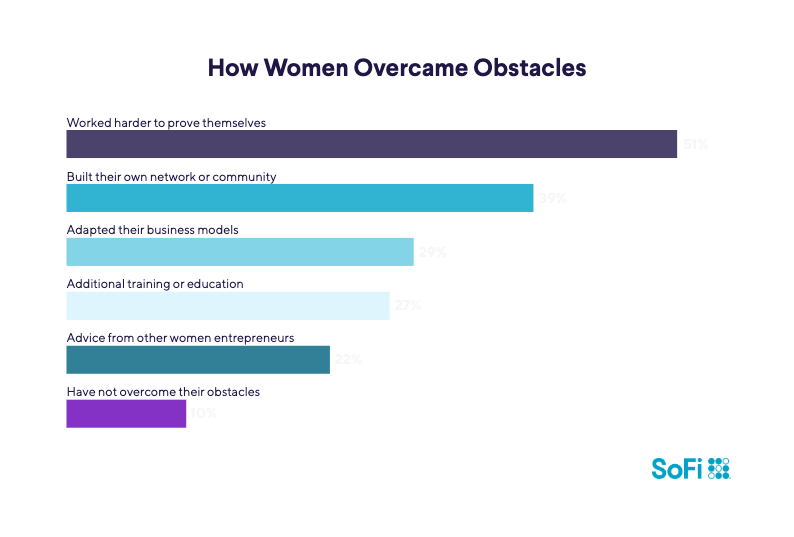
A few roadblocks didn’t slow down these female entrepreneurs, however. In fact, many women business owners found the hurdles motivating.

Infographic: How Women Overcame Obstacles. Worked harder to prove themselves 51%, Built their own network 39%.

•   I worked harder to prove myself: 51%

•   I built my own network or support community: 39%

•   I adapted my business model to overcome obstacles: 29%

•   I pursued additional training or education: 27%

•   I sought advice or mentorship from other women entrepreneurs: 22%

•   I haven’t overcome them yet: 10%

Where the Money Comes From

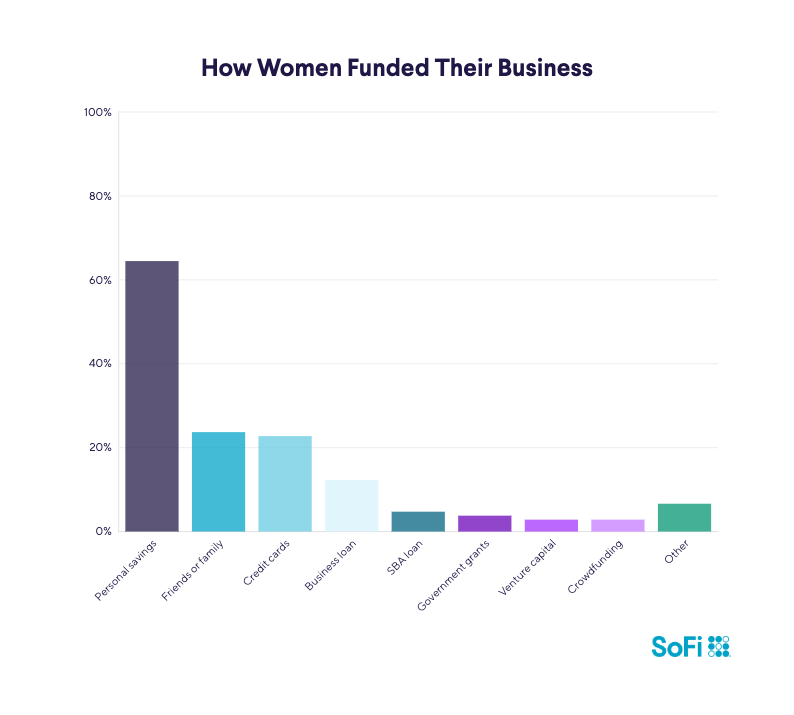
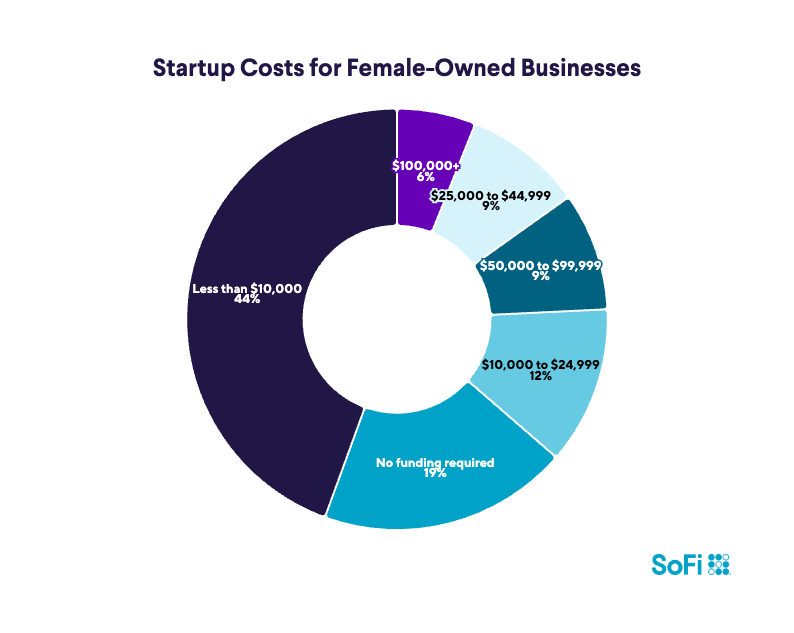
Most women business owners in the SoFi survey dug into their own savings to launch. Only 18% secured a business loan or Small Business Administration (SBA) loan. Perhaps it’s a good thing then that many of them required less than $10,000 to set up shop.

How Women Funded the Launch of Their Business

Bar chart: How Women Fund Their Businesses. Personal Savings 68%, Family/Friends 25%, Credit Cards 24%, Business Loan 13%.

•   Personal savings: 68%

•   Friends or family: 25%

•   Credit cards: 24%

•   Business loan (bank or private): 13%

•   SBA loan or assistance: 5%

•   Government grants: 4%

•   Venture capital or angel investors: 3%

•   Crowdfunding platforms: 3%

•   Other: 7%

The Initial Funding Their Business Required

Pie chart: Startup Costs for Female-Owned Businesses. Less than $10,000 (44%), $10,000-$24,999 (12%).

•   Less than $10,000: 44%

•   $10,000–$24,999: 12%

•   $25,000–$49,999: 9%

•   $50,000–$99,999: 9%

•   $100,000 or more: 6%

•   My business didn’t require any initial funding: 19%

Even though they primarily had to use their own savings or credit cards to launch, 47% of women business owners say they haven’t had any funding obstacles.

Recommended: Small Business Grants: Where to Find Funding

Financially Fluent

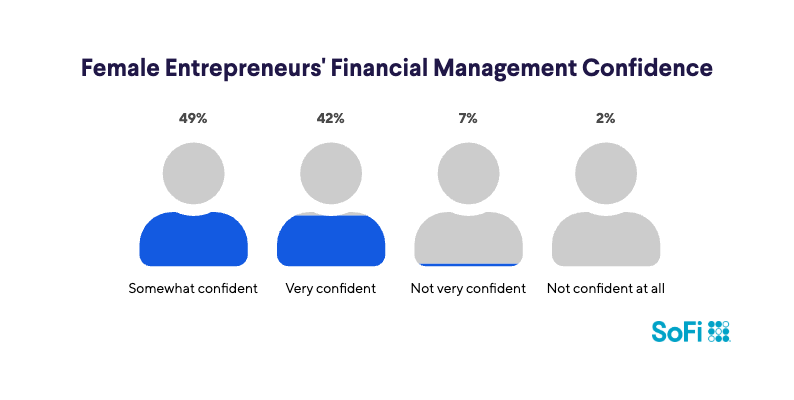
The overwhelming majority of women business owners report that they have good money management skills — and they’re proud to use them. Only 3% outsource this task to a professional.

Four circular charts showing Female Entrepreneurs' Financial Management Confidence: Very 42%, Somewhat 49%, Not Very 7%, Not at All 2%.

When asked how confident they are in managing business finances, respondents answered:

•   Very confident: 42%

•   Somewhat confident: 49%

•   Not very confident: 7%

•   Not confident at all: 2%

Most women business owners learned financial management skills on their own: 62% say they are self-taught through experience. Others had a little help, including 15% who learned from an advisor or mentor, and 12% who took classes or workshops. Eight percent of women entrepreneurs say they are still learning.

What Keeps Them Up At Night

Just like any business owner, female founders have concerns about specific financial issues. A substantial number of them are worried about the state of the U.S. economy.

Here’s what they said when asked: What are the biggest challenges related to managing your business finances?

•   Current economic uncertainty: 38%

•   Setting prices or fees: 32%

•   Understanding taxes or compliance: 27%

•   Budgeting and expense tracking: 21%

•   Forecasting revenue: 20%

•   Managing cash flow: 20%

•   I haven’t had major financial challenges: 19%

•   Access to capital or credit: 15%

Recommended: Mompreneurs: Generational Wealth and Real-Time Struggles

Reaping the Rewards

In the SoFi survey, women business owners revealed that money was less of a motivation to start their company than personal fulfillment. Thirty percent say they were inspired by the desire for flexibility and autonomy, and 27% launched to pursue a strong vision or passion. Just 23% say they started a business to generate income after a job loss or life change.

But for most respondents, the rewards have been well worth it.

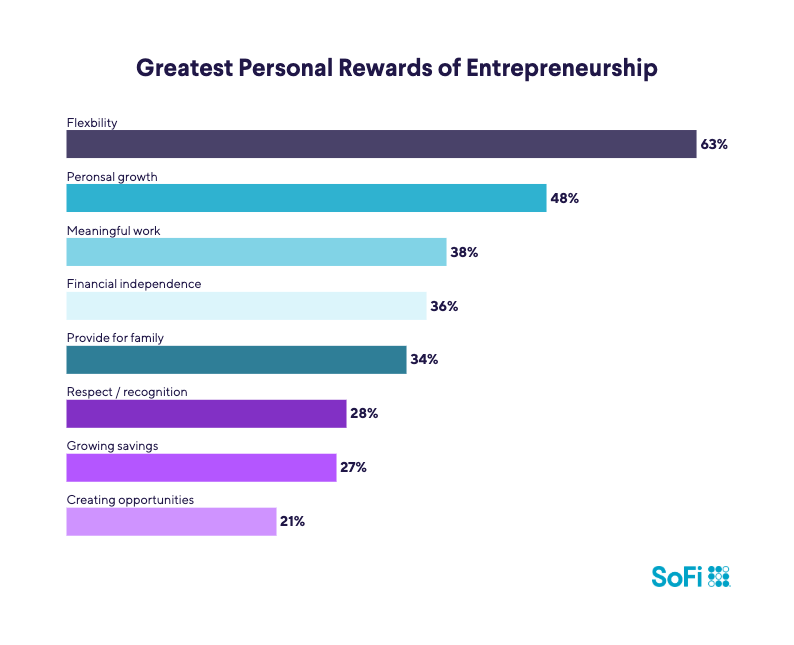
Greatest Personal Rewards of Owning a Business

Infographic: Greatest Rewards of Entrepreneurship. Personal: Flexibility 63%, Personal growth 48%, Meaningful work 38%. Professional: Expanding client base 42%, Revenue growth 36%, Enter industry successfully 30%.

•   Flexibility and control over my time: 63%

•   Personal growth or self-confidence: 48%

•   Doing meaningful or impactful work: 38%

•   Financial independence or growth: 36%

•   Being able to provide for my family: 34%

•   Gaining respect or recognition: 28%

•   Growing savings for my family: 27%

•   Creating opportunities for others: 21%

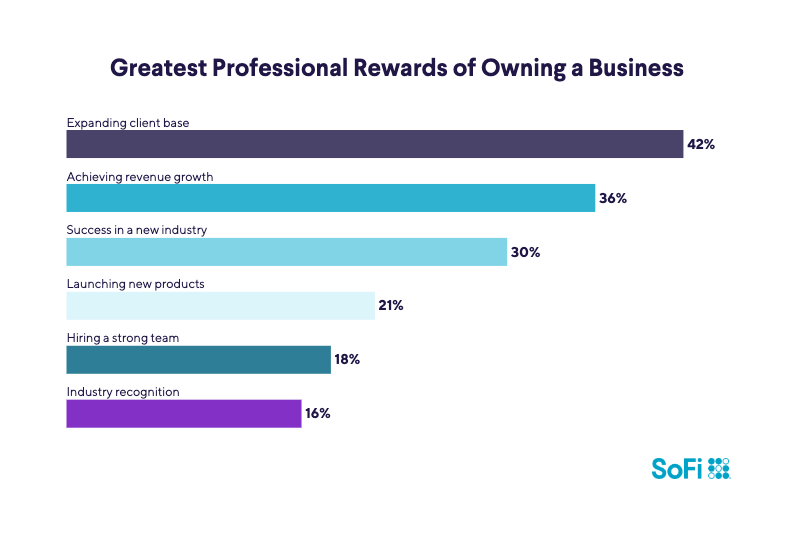
Greatest Professional Rewards of Owning a Business

Infographic: Greatest Professional Rewards of Entrepreneurship.

•   Expanding my client base or market: 42%

•   Achieving revenue growth: 36%

•   Successfully entering a new industry: 30%

•   Launching new services or products: 21%

•   Hiring a strong team: 18%

•   Receiving industry recognition or awards: 16%

Best Advice for Other Aspiring Women Business Owners

When asked what they would tell other women who are starting a business, the female entrepreneurs SoFi surveyed had a lot to say. Here are some of their best tips and words of wisdom:

“Try going out on a limb to achieve your dreams. You never know what you are capable of.”

“Don’t treat your business like a hobby. Keep trying and put all your efforts into it.”

“Be strong, classy, and in control. There’s nothing you can’t do if you put your mind to it.”

“Find support from other women.”

“Know the field well. I had twenty years of experience before I started my own business.”

“Learn as much as you can from someone who is in the same field or a similar one. Shadow them if you can.”

“It’s not always a direct path. Be open to changes.”

“Don’t be afraid to ask for help.”

“Save up your own money, start small and grow, and don’t give up if you have a good concept.”

“Do your homework, make sure you have good business and financial skills, evaluate risk, and don’t depend on one major customer.”

“Be tenacious, do your research, and have a two-year plan, a five-year plan, and a 10-year plan.”

“Keep learning and asking questions as you go.”

“Do your research, stay the course, and make connections everywhere you go. You never know where you will find an opportunity.”

The Takeaway

Women business owners are entering traditionally male-dominated industries in growing numbers. On the whole, they are finding the challenge motivating, according to SoFi’s 2025 survey of female entrepreneurs. Female founders have learned how to stand out from the competition, built stronger networks, and pivoted to adapt their business model to better compete.

These women business owners are confident in their financial management skills, the survey found. That may be because they’ve been doing it since the start — for many of them, funding their business was a DIY operation. They mainly relied on personal savings and credit cards to get the money they needed to launch.

Funding methods other aspiring women business owners may want to pursue include grants and loans. It can be helpful to explore all financial options when putting a business plan into action. If you’re seeking financing for your business, SoFi is here to support you. On SoFi’s marketplace, you can shop and compare financing options for your business in minutes.

If you’re seeking financing for your business, SoFi is here to support you. On SoFi’s marketplace, you can shop and compare financing options for your business in minutes.


Large or small, grow your business with financing that’s a fit for you. Search business financing quotes today.

Explore funding options


SoFi's marketplace is owned and operated by SoFi Lending Corp.


Advertising Disclosures: The preliminary options presented on this site are from lenders and providers that pay SoFi compensation for marketing their products and services. This affects whether a product or service is presented on this site. SoFi does not include all products and services in the market. All rates, terms, and conditions vary by provider. See SoFi Lending Corp. licensing information below.


This content is provided for informational and educational purposes only and should not be construed as financial advice.


Financial Tips & Strategies: The tips provided on this website are of a general nature and do not take into account your specific objectives, financial situation, and needs. You should always consider their appropriateness given your own circumstances.


Third-Party Brand Mentions: No brands, products, or companies mentioned are affiliated with SoFi, nor do they endorse or sponsor this article. Third-party trademarks referenced herein are property of their respective owners.


SOSMB-Q325-012

Read more

Would Your Finances Pass a Stress Test?

This article appeared in SoFi's On the Money newsletter. Not getting it? Sign up here.

If life throws you a layoff, a big medical bill, or a major house repair, you want to know you can handle it. But what does financial resilience actually entail?

It’s not about being rich. It’s about being ready.

While a recent survey by NerdWallet found Americans are more likely to feel financially resilient when they earn over $100,000 and own a home, it also showed that there’s more to it than financial resources. Just as important is how well you manage your money and can adapt to setbacks, surprises, or even opportunities.

Here are some telltale signs your finances would pass a stress test:

1. You’ve got a cushion to fall back on

An emergency savings stash is the backbone of financial resilience — a safety net to help you get back on your feet when times are tough.

Financial advisors often recommend having enough saved to cover three to six months’ worth of living expenses. But it’s better to start small than not start at all. For example, you could set up automatic transfers to a high-yield savings account, even if it’s just $20 a week. Thanks to the power of compound interest, that could make a big difference over time. And even a smaller buffer can reduce stress and prevent small problems, like an unexpected vet bill, from snowballing into bigger ones.

2. You keep debt under control

Debt isn’t necessarily a bad thing, but the type and size of it matters. Financially resilient households tend to have low or manageable debt, especially when it comes to high-interest debt from credit card spending. Credit card debt can get out of hand when you make only the minimum required payment, and ideally you’re able to pay your bill in full each month.

One rule of thumb is to keep your total monthly debt payments under 36% of your pre-tax income. If you’re over that threshold, focus on paying down the highest-interest balances. Momentum matters. Each bill you eliminate frees up cash flow and delivers more peace of mind.

3. You have a strong credit score

A good credit score doesn’t just signal responsibility, it provides options. If an unexpected bill pops up, access to affordable credit can be a lifeline. A strong credit score could also save you thousands in interest per year on loans like mortgages and car loans. Even insurance premiums may be lower.

Paying bills on time and keeping your credit utilization under 30% can help you maintain a strong credit score.

4. You have stable income sources

You don’t have to have a six-figure salary, but predictability helps you plan, save, and avoid expensive debt. People with either steady or multiple income streams tend to weather shocks better than those with unsteady pay, but that doesn’t mean that freelancers, gig workers, or business owners can’t feel financially resilient.

If you don’t have steady income, building resilience might mean creating your own version of stability, like budgeting around your lowest-earning month and saving the difference when times are good.

Whatever your income is, the important thing is that you live within your means.

5. You know where your money is going

Budgeting doesn’t have to mean spreadsheets and stress, but you want to be aware.

It’s important to have a handle on what’s coming in, what’s going out, and where you can pivot if something changes. Nerdwallet’s survey showed people who track spending on a regular basis are more likely to feel financially resilient. And studies suggest that people who track spending report higher financial confidence and less anxiety.

6. You can afford your housing, whether you own or rent

Homeownership usually correlates with stability, but it’s not the only path. What matters more is having housing costs that fit your budget. Whether it’s a mortgage or rent, experts recommend keeping total housing costs below 30% of gross income.

7. You understand how money works

Financial literacy might be the ultimate resilience tool. People who understand how risk, inflation, and compound returns work tend to make better decisions, recover faster from setbacks, and enjoy better financial health.

And you don’t need a finance degree, just curiosity. Read credible personal finance resources, listen to a podcast, or follow a budgeting community online. A little knowledge goes a long way.

8. You’re thinking about tomorrow

Retirement may feel far off, but saving for it is part of future resilience.

The ability to handle future financial needs without panic starts with habits you build earlier in life. Contributing even a small percentage of your paycheck to a 401(k) or IRA helps create a financial buffer that future-you will thank you for.

If your employer offers a match, grab it. It’s free money for your future, and something you can bank on in hard times.

9. You’re not going it alone

Don’t overlook one of the most underrated resilience factors: Connection.

Research has shown that people with strong social support from friends, family, and their community bounce back faster from financial stress. The more you reach out, the more support you can get.

Asking for help isn’t weakness. It’s resourcefulness.


Please understand that this information provided is general in nature and shouldn’t be construed as a recommendation or solicitation of any products offered by SoFi’s affiliates and subsidiaries. In addition, this information is by no means meant to provide investment or financial advice, nor is it intended to serve as the basis for any investment decision or recommendation to buy or sell any asset. Keep in mind that investing involves risk, and past performance of an asset never guarantees future results or returns. It’s important for investors to consider their specific financial needs, goals, and risk profile before making an investment decision.

The information and analysis provided through hyperlinks to third party websites, while believed to be accurate, cannot be guaranteed by SoFi. These links are provided for informational purposes and should not be viewed as an endorsement. No brands or products mentioned are affiliated with SoFi, nor do they endorse or sponsor this content.

SoFi isn't recommending and is not affiliated with the brands or companies displayed. Brands displayed neither endorse or sponsor this article. Third party trademarks and service marks referenced are property of their respective owners.

OTM2025102901

Read more

Learn All About Florida Small Business Loans

Florida has become an economic magnet, with more than 3 million small businesses calling the Sunshine State home. There’s no personal income tax in Florida, and the state’s economy is the fourteenth largest in the world, both of which contribute to its reputation as a business-friendly location.

Whether you’re starting a business or expanding one, finding small business loans in Florida can help you thrive. Here’s what you need to know about getting financing for your company.

Key Points

•   The primary small business loans in Florida include term loans, business lines of credit, equipment financing, and SBA loans.

•   Application process involves defining loan purpose, checking credit scores, and gathering financial documents.

•   Tips for loan approval: improve credit scores, request strategic funding, and create a detailed business plan.

•   Additional funding options: state programs, credit unions, and SBA loans for diverse business needs.

•   State-specific programs support rural, minority, and Hispanic-owned businesses with various loan funds.

Popular Types of Small Business Loans in Florida

Securing the right financing is a critical step in growing your venture. Whether your goal is a major expansion, managing day-to-day operational costs, or purchasing vital equipment, there are various small business loans in Florida designed to meet those needs. Understanding the structure of each option is the first step in choosing the best path for your company. Below is an overview of the most widely used business loans Florida entrepreneurs can access.

Florida Small Business Loan Programs

The Florida Department of Commerce operates a Small Business Innovation program that includes a number of loans for both new and established businesses. Available loans include:

•   Rebuild Florida Business Loan Fund

•   Florida Small Business Emergency Bridge Loan

•   Rural Community Development Revolving Loan Program

•   State Small Business Credit Initiative

•   Microfinance Guarantee Program

•   Black Business Loan Program

•   Prospera (for Hispanic-owned businesses and entrepreneurs)

•   Urban League of Broward County

Term Loans

In addition to state financing opportunities, Florida business owners can also explore term loans from banks, credit unions, and online loan marketplaces.

A term loan is structured like a personal loan. The business receives a lump sum and the principal plus interest is repaid to the lender as a fixed payment. A business loan calculator can help you estimate monthly payments based on loan amount, interest rate, and term.

Some lenders require that eligible businesses have a minimum time in business, while others offer startup business loans.

Business Lines of Credit

An alternative to a Florida small business loan is a business line of credit. Instead of receiving one infusion of cash, your business can continually draw on a line of credit to borrow funds as needed. It’s similar to having a business credit card, but you can write checks and deposit cash directly into your business account.

Having access to a line of credit can help smooth out cash flow issues or cover financial emergencies. Depending on your lender, you may have to secure your line of credit with assets like real estate, cash, equipment, or inventory.

Equipment Financing

If you need cash specifically to purchase equipment for your business, consider equipment financing. The loan is secured by the asset you purchase, which can make your payments more affordable. Plus, you could qualify to finance up to 100% of the purchase price in order to preserve your business’s cash.

Another advantage of equipment financing is that your Florida business doesn’t need to use heavy machinery in order to qualify. Other eligible purchases include office furniture, vehicles, and computers.

SBA Loans

Small Business Administration loans are guaranteed by the federal government but executed by private lenders. There are three primary types of SBA loans:

  • 7(a) loans: Florida business owners can use this type of financing to pay for real estate, working capital, debt refinancing, machinery and equipment, furniture, ownership changes, and more. An SBA loan calculator gives you a sense of total costs and monthly payments.

  • 504 loans: 504 loans finance projects that foster business growth and job creation. The funds can be used for major fixed assets.

  • Microloans: An SBA microloan provides up to $50,000 in funding for small businesses.

How to Apply for a Small Business Loan in Florida

Learning how to apply for a small business loan in Florida could improve your approval odds.

Define Your Loan Purpose and Amount

It’s helpful to know how you’re going to use the funds so you can estimate your ideal loan amount. Many business owners apply for financing to be used towards upfront costs, expansion, cash flow, or large purchases like property, equipment, and inventory.

Recommended: Small Business Financing Guide

Know Your Credit Score

Lenders typically look at your personal credit score for your business loan application, as well as your business credit score. Banks usually require a minimum personal score of 680 or above, while online lenders may have more flexible requirements.

Business credit scores range from 1 to 100, with 70 considered the threshold for a “good” score. Having a below-average score doesn’t necessarily mean you can’t get approved for a Florida business loan, but you may have to pay a higher interest rate and secure the loan with collateral.

Gather Your Key Documents

In addition to filling out the lender’s application, you’ll also need to submit supporting documentation. Here are common documents that may be requested when you apply for any type of business loan:

•   Credit report

•   Income statement

•   Bank statements

•   Budget

•   Income tax returns (both business and personal)

•   Business plan

•   Collateral valuation and supporting documents (such as titles, deeds, or invoices)

Compare Lenders and Loan Offers

Lenders evaluate business loan applications differently, so it’s worth checking with a few different options to compare your offers. You might qualify for different financing structures and even different loan terms (including interest rates) with various lenders.

Submit Your Application and Await Approval

Once your application is complete and you’ve gathered the required documentation, you’re ready to submit your package to the lender. From there, you’ll need to wait to find out whether you’ve been approved. Online lenders tend to offer quick decisions, while banks and other SBA lenders have a longer wait time.

Grow Your Business the Right Way.
Explore small business funding options in one place with no impact to your credit score.*

Grow Your Business the Right Way.
Explore small business funding options in one place with no impact to your credit score.*

Grow Your Business the Right Way.
Explore small business funding options in one place with no impact to your credit score.*

Tips for Improving Your Loan Approval Chances

Maximize your approval odds for a small business loan in Florida with the following best practices:

•   Improve your business and personal credit scores

•   Request a strategic amount of funding, not more than you need

•   Create an in-depth business plan

Other Funding Options for Florida Small Business

FloridaCommerce recommends a number of additional resources for Florida small business owners, including:

•   Miami Bayside Foundation’s loan programs

•   Florida A&M University Federal Credit Union

•   Florida First Capital Finance Corporate

•   Minority Business Development Agency (U.S. Department of Commerce)

•   The National Minority Supplier Development Center

Explore these organizations for additional Florida business loans and help in growing your company.

Additional Business Resources in Florida

Florida’s Small Business Development Center network helps businesses at all stages. Search to find one of nine regional offices closest to you. All locations offer three core service areas:

    •   Training: Access hundreds of live trainings each year, covering topics from business basics to management skills.

    •   Consulting: You can work with a no-cost business consultant to help you grow your business in areas like strategic planning, financial analysis, marketing, capital access, government contracting, and more.

    •   Research: Get research your business may not otherwise be able to afford. Then you can make better informed decisions with customized reports related to your industry and geography.

    Recommended: Small Business Grants: Where to Find Funding

    Run the numbers on your business loan.

    Using the free calculators is for informational purposes only, does not constitute an offer to receive a loan, and will not solicit a loan offer. Any payments shown depend on the accuracy of the information provided.

    The Takeaway

    Fueling your company with a Florida business loan can help you launch and expand more quickly than simply bootstrapping each step of the way. Explore SoFi’s small business loans to compare loan offers from multiple lenders.

    If you’re seeking financing for your business, SoFi is here to support you. On SoFi’s marketplace, you can shop and compare financing options for your business in minutes.


    With one simple search, see if you qualify and explore quotes for your business.


    Search for financing

    (without impacting your credit score)

    FAQ

    How do I get a small business loan in Florida?

    You can get a small business loan in Florida by applying with local financial institutions and online lenders, or by searching opportunities from the Florida Department of Commerce’s Small Business Innovation program.

    Can I get a startup business loan in Florida with no money?

    Getting a startup business loan can be tricky because many lenders like to see a minimum time in business and revenue. Applying through a small business loan marketplace can save you time by narrowing down lenders that are comfortable working with startups.

    How hard is it to get a small business loan in Florida?

    Florida has a business-friendly environment, but just as in any other state, you’ll need to submit a strong business loan application to get approved. Expect to have lenders evaluate your credit scores and financial documentation for both your personal and business backgrounds.

    What is the easiest type of business loan to get approved for?

    It’s usually easier to get approved with secured business financing than unsecured. That’s because the lender can repossess the collateral if the loan goes into default.

    What credit score do I need for a small business loan?

    The typical minimum for a small business loan is a 680 for personal credit and a 70 for business credit.

    What can I use a small business loan for?

    Small business loans can be used for working capital, debt consolidation, inventory purchases, real estate, equipment, and more.

    Are there any small business grants available in Florida?

    Yes, you can research several online grant aggregators to search for online small business grants by locations, including those available in Florida.


    SoFi's marketplace is owned and operated by SoFi Lending Corp.


    Advertising Disclosures: The preliminary options presented on this site are from lenders and providers that pay SoFi compensation for marketing their products and services. This affects whether a product or service is presented on this site. SoFi does not include all products and services in the market. All rates, terms, and conditions vary by provider. See SoFi Lending Corp. licensing information below.


    This content is provided for informational and educational purposes only and should not be construed as financial advice.


    Financial Tips & Strategies: The tips provided on this website are of a general nature and do not take into account your specific objectives, financial situation, and needs. You should always consider their appropriateness given your own circumstances.


    Third-Party Brand Mentions: No brands, products, or companies mentioned are affiliated with SoFi, nor do they endorse or sponsor this article. Third-party trademarks referenced herein are property of their respective owners.


    SoFi receives compensation in the event you obtain a loan, financial product, or service through SoFi’s marketplace. This webpage is owned and operated by SoFi Lending Corp., licensed by the Department of Financial Protection and Innovation under the California Financing Law, license number 6054612; NMLS number 1121636. ((www.nmlsconsumeraccess.org)). This page is NOT operated by SoFi Bank. Loans, financial products, and services may not be available in all states. All loan terms, including interest rate, and Annual Percentage Rate (APR), and monthly payments shown through SoFi’s marketplace are from providers and are estimates based upon the limited information you provided and are for informational purposes only. All rates, fees, and terms are presented without guarantee and are subject to change pursuant to each provider’s discretion. The actual loan terms you receive, including APR, will depend on the provider you select, their underwriting criteria, and your personal financial factors. The loan terms and rates presented are provided by the providers and not by SoFi Lending Corp. Please review each provider’s Terms and Conditions for additional details.

    *Small Business Loans: Reference to “same day funding” or “funding within 24 hours” describes a general capability of many lenders you can reach through SoFi’s marketplace. Funding or funding timing is not guaranteed. Your experience with any lender will vary based on requirements of the lender and the loan you apply for. To determine the timing of funds availability, you must inquire directly with any lender. In addition, your access to any funds from a loan may be dependent on your bank’s ability to clear a transfer and make funds available.

    †Credit score impact: To check the options, terms, and/or rates you may qualify for, SoFi and/or its network providers will conduct a soft credit pull that will not affect your credit score. However, if you choose a product and continue your application, the provider(s) you choose will request your full credit report from one or more consumer reporting agencies, which is considered a hard credit pull and may affect your credit. Rates may not be available from all providers.

    ©2025 SoFi Lending Corp. All rights reserved.

    SOSMB-Q425-004


    More Small Business Financing Resources

    Business loans don’t have to be complicated. Get clear answers on applications, learn what providers really look for, and understand popular loan options.

    Search for small business funding in minutes.

    Your time matters. So we’re making business loans as easy as possible by helping you find small business funding fast.


    Search for financing

    (without impacting your credit score)

    Read more

wes sofi travel test

{/* Evergreen 8/30 */}

{/* Hero */}

SOFI TRAVEL

Give yourself a (spring) break

with 20% off select hotels.1

Give yourself a (spring) break

with 20% off select hotels.1

Find some sun and save this spring with 20% or more off select hotels worldwide1—and earn 5% cash back rewards points on all bookings (excluding air) as a SoFi Plus member.2 Book by 3/16/26 for travel through 9/30/26.


Book now

Expedia

Expedia

{/* Travel Booking just got a members-only upgrade */}

Travel booking just got a
members-only upgrade.


  • Premium member savings

    Save 10% (or more) on select hotels with SoFi member prices.*


  • All-in-one app

    Search, book, and manage your flights, hotels, and rental cars all in the SoFi app.


  • Earn rewards

    Earn unlimited 3% cash back rewards when you book with your SoFi Credit Card through SoFi Travel.*

{/* horizon */}

{/* So how does SoFi Travel Work? / autoplay true*/}

So how does SoFi Travel work?


{/* slide 1 */}

Step 1

Opt in to SoFi Travel.

SoFi members can opt in to start receiving special offers on trips and travel packages.


Book now

{/* slide 2 */}

Step 2

Start booking your trip.

Book your flights, hotels, and rental cars right in the SoFi app—and you’ll save 10% on select hotels with SoFi member prices.*


Book now

{/* slide 3 */}

Step 3

Confirm and manage your travel plans.

Got a change of plans? Need to add something after you’ve already booked? The SoFi app has you covered.


Book now

{/* slide 4 */}

Step 4

Earn travel rewards.

Spend on SoFi Travel with your SoFi Credit Card to earn unlimited 3% cash back rewards to put toward your financial goals in the SoFi app.*


Book now


{/* FAQs*/}

FAQs


How does SoFi Travel work?
We teamed up with Expedia to offer you access to their catalog of stays, flights, cars, packages, and things to do. You will save 10% or more on select hotels (clearly labeled “SoFi Member Price”) in the SoFi Travel portal.


Who is eligible to book through SoFi Travel?
All SoFi users may book through SoFi Travel. SoFi Travel works the same regardless of whether you are a SoFi Plus member.


What if I already have an Expedia account?
You can still use SoFi Travel. Your Expedia account and your SoFi Travel account are entirely separate and independent, with their own login credentials, rewards, etc. Please note that you will only earn unlimited 3% cash back rewards when you book with the SoFi Credit Card in SoFi Travel, but not in your separate Expedia account.


Do I need to book travel with a SoFi credit or debit card?
No, you can book with any credit or debit card. If you book with a SoFi Credit Card, you’ll earn unlimited 3% cash back rewards. These cash back rewards do not stack on top of other rewards associated with SoFi Credit Card or SoFi Plus. In other words, you’ll earn 3% cash back rewards back on SoFi Travel, and your standard SoFi Credit Card cash back rewards everywhere else.


When and how will I receive my cash back rewards when I book with the SoFi Credit Card?

Your cash back rewards will be deposited as SoFi Points in your Rewards home, found by clicking the jewel under your name on the home screen of the SoFi mobile app. Your SoFi Points will be added to your balance, and clearly marked “SoFi Travel cash back rewards” under “Recent Activity,” when the transaction status changes from “pending” to “posted” (up to 7 days after the transaction). Learn more about SoFi Rewards.


Can I pay for a SoFi Travel booking using SoFi Points?

Yes, you can book travel through SoFi Travel using SoFi rewards points.


How do I manage my reservation?

You will receive a confirmation email from Expedia. Save that email—it will include important information about your booking as well as Expedia’s customer service phone number. You can also manage your reservation by signing in to SoFi and tapping your profile > Our products > SoFi Travel and selecting “My Trips.”


Who do I call if I have questions?

Please call SoFi at +1 (855) 456-SOFI (7634) and select SoFi Travel. SoFi Travel support is available 24/7.


See more FAQs

{/* Get inspired to travel. */}

Get inspired to travel.


More Travel Tips


Read more
TLS 1.2 Encrypted
Equal Housing Lender