man on phone with bicycle

Smart Strategies to Lower Your Student Loan Payments

Staying on top of student loan payments is an important part of your overall financial health. If you’re concerned about making payments on time, or if you’re reevaluating your budget, you may be wondering how to lower student loan payments.

Many borrowers may be eligible for options that can reduce their student loan payments. Read on to learn about some strategies that could help.

Key Points

•   Borrowers struggling to pay student loans have several options for reducing their monthly payments.

•   Enrolling in autopay can reduce the student loan interest rate by 0.25%, helping to make monthly payments more manageable.

•   Federal student loan repayment plans like the Graduated Repayment Plan and the Extended Repayment Plan can lower monthly payments but increase total interest paid.

•   Loan assistance and forgiveness programs might help reduce or eliminate student loan debt for some borrowers.

•   Refinancing private student loans can potentially lower interest rates and result in more favorable loan terms for those who qualify.

Can You Reduce Your Student Loan Payments?

There are several ways you may be able to lower your monthly payments. For example, if you have federal student loans, the Graduated Repayment Plan, in which your payments start small and gradually go up over time, is an option you can explore.

Borrowers might also want to consider refinancing student loans at a lower interest rate or with a longer loan term, both which may lower monthly payments. (Note: You may pay more interest over the life of the loan if you refinance with an extended term.) It’s possible to refinance private and federal student loans, although there are many factors to consider.

Assessing Your Student Loan Repayment Situation

Before you can determine if you can lower your student loan payments, however, it’s important to know the type of loans you have, since this can affect your student loan repayment options.

You can find all of your federal student loans and the individual loan servicers, by logging into your account on Federal Student Aid.

Unless you choose another plan, federal loans are automatically placed in the Standard Repayment Plan, which sets your monthly payments at a fixed amount so your loans will be paid off within 10 years. Some private loans also follow the 10-year repayment timeline, but it varies depending on the lender.

The next step is to assess how much debt you have in total. By calculating what you owe, you can get a better understanding of how your current repayment plan is working and whether you want to consider changing it.

Once you have all of your loan information, you can use a student loan payoff calculator or contact your loan servicer to find your current payoff dates for your student loans. The calculator can also help you determine which repayment plans you qualify for. Keep in mind that if you change to a longer term to lower your monthly student loan payments, you may end up paying more over the life of the loan since interest will continue to accumulate over the longer term.

If you only need temporary relief, consider contacting your loan servicer to see if you are eligible for student loan deferment or forbearance. Both options let borrowers temporarily pause or lower loan payments for reasons such as unemployment or going back to school. Depending on the type of loan you have, interest may still accrue during this time.

Recommended: When Do You Have to Start Paying Back Student Loans?

Ways to Lower Your Monthly Student Loan Payments

There are different ways to reduce your student loan payments. One or more of these methods might be right for your situation.

1. Enroll in Autopay for Interest Rate Reductions

Federal loan servicers and some private lenders offer incentives if you elect to make automatic payments, such as a 0.25% interest rate reduction. With auto payments, you won’t have to worry about missing student loan due dates. Autopay can also help you incorporate your student loan payments into your budget as an expense that must be accounted for every month.

2. Talk to Your Loan Servicer About Alternative Repayment Plan Options

If you’re interested in changing federal repayment plans to help lower student loan payments, contact your loan servicer to learn more.

One option is the Graduated Repayment Plan, as mentioned, which has a payment timeline of 10 years (or up to 30 years for Direct Consolidation loans), and starts out with lower monthly payments. The payment amount gradually increases, usually every two years. Note that you will likely pay more in interest with this plan.

If you have more than $30,000 in eligible outstanding student debt on most loans, you can also ask about the Extended Repayment Plan, which lengthens your loan repayment timeline to 25 years and can make your monthly payments smaller. However, you may end up paying more in interest over the life of the loan on the extended plan.

3. Consider Income-Driven Repayment for Federal Loans When Available

As of March 2025, access to income-driven (IDR) plans for new borrowers is currently on hold while the Trump administration reevaluates these plans. You can find out more about this and any new developments on the Federal Student Aid website. In the meantime, here is a quick rundown of how these plans typically work.

On an IDR plan, how much you owe each month is based on your monthly discretionary income and family size. IDR options typically offer loan forgiveness after borrowers make consistent payments for a certain number of years. However, forgiveness on all but one of the IDR plans is currently paused.

These are the types of IDR plans.

•   Income-Based: Payments are generally about 10% of a borrower’s discretionary income, and any outstanding balance is forgiven after 20 or 25 years.

   Note that on the IBR plan, forgiveness after the repayment term has been met is still proceeding as of March 2025, since this plan was separately enacted by Congress.

•   Saving on a Valuable Education (SAVE): As of March 2025, the SAVE plan is no longer available after being blocked by a federal court. Forgiveness has been paused for borrowers who were already enrolled in the plan and they have been placed in interest-free forbearance.

•   Pay As You Earn (PAYE): A borrower’s monthly payment on PAYE is roughly 10% of their discretionary income, and they’ll make 20 years of payments. As of March 2025, forgiveness has been paused for borrowers who were already enrolled in the plan, and they have been placed in interest-free forbearance.

•   Income-Contingent Repayment (ICR): The monthly payment amount on this plan is either 20% of a borrower’s discretionary income divided by 12, or the amount they would pay on a repayment plan with a fixed payment over 12 years, whichever is less. The repayment term is 25 years. As of March 2025, forgiveness has been paused for borrowers who were already enrolled in the plan and they have been placed in interest-free forbearance.

4. Explore Loan Assistance and Forgiveness Programs

If you’re eligible, a Loan Repayment Assistance Program (LRAP) can provide funds to help you lower your student loan payments. Since private loans are not eligible for the federal income-based repayment plans mentioned above, an LRAP could be helpful for those with both private and federal student loans.

Some states, organizations, and companies may offer LRAPs, especially if you work in certain fields like health care or education. LRAPs often include a requirement that you work in your eligible job for a certain number of years, typically in public service.

There are also federal and state forgiveness programs you may be eligible for. For example, if you have federal student loans and you’re employed by government entities or nonprofits, you might qualify for Public Service Loan Forgiveness (PSLF). Borrowers pursuing this program agree to work in underserved areas and must meet specific requirements to have their loan forgiven after 120 qualifying payments on an income-driven repayment plan.

A number of states also have student loan forgiveness programs, especially for individuals working in health care and education. Check with your state’s department of education to see what’s available.

5. Refinance to Potentially Lower Interest Rates

Student loan refinancing is an option that may be helpful if you have student loans with high interest rates or private student loans.

When you refinance student loans, a lender pays off your existing loans and gives you a new loan with new terms. Refinancing may save you money in the long run if you get a lower interest rate, or you could change your term to get more time to pay off your loan and lower the cost of your monthly student loan payments, though you may pay more in interest in the long run.

Keep in mind, however, that if you refinance a federal student loan, you’ll lose access to federal benefits and protections.

What to Do if You Can’t Afford Your Student Loan Payments

With most federal student loans, if you don’t make a payment in more than 270 days, you’ll default on the loan. Private loans are often placed in default as soon as after 90 days.

Defaulting can impact your credit score, and have other negative consequences, including losing eligibility for deferment, forbearance, and other valuable repayment options. The best path forward is to avoid default. If you are having trouble making payments, contact your loan servicer right away.

Planning for Life After Student Loan Repayment

Along with managing your student loan payments, it’s also important to save for your future. That might include a down payment on a house, putting money away for your child’s education, and investing for retirement.

To plan for life after student loan repayment, work to build an emergency fund to handle sudden expenses, such as medical bills or job loss. Aim to have at least three to six months’ worth of expenses in your emergency fund, and keep it in a separate bank account so you won’t be tempted to spend it.

Also, open a savings account, if you don’t already have one, to put away money each week or month for your financial goals. Participate in your 401(k) at work, if that’s an option. And you might also want to consider opening an IRA to help maximize your retirement savings and secure your financial future.

Refinancing Student Loans With SoFi

There are several strategies to make your student loan payments more manageable, including choosing a new repayment plan, signing up for autopay, and student loan refinancing. Explore the options to determine what makes sense for your situation.

Looking to lower your monthly student loan payment? Refinancing may be one way to do it — by extending your loan term, getting a lower interest rate than what you currently have, or both. (Please note that refinancing federal loans makes them ineligible for federal forgiveness and protections. Also, lengthening your loan term may mean paying more in interest over the life of the loan.) SoFi student loan refinancing offers flexible terms that fit your budget.


With SoFi, refinancing is fast, easy, and all online. We offer competitive fixed and variable rates.

FAQ

Can you negotiate student loans down?

You generally can’t negotiate student loans unless you’ve stopped making payments and your loans are delinquent or in default, a situation that has serious financial consequences, such as potentially damaging your credit score.

There are other options to lower student loan payments, however. If you need temporary relief, you can contact your loan servicer to see if you’re eligible for deferment or forbearance. If you have federal loans, you may be able to change your loan term or enroll in a different repayment plan. Borrowers with private loans can explore refinancing their student loans to see if they qualify for a lower interest rate or more favorable loan terms.

How do I negotiate student loan payoff?

If your student loans are delinquent or in default, you may be able to negotiate a settlement for a lower payment amount, but this is generally seen as a last resort because of the negative financial consequences. If you are struggling to make your payments, contact your lender to see what other options may be available to you.

What is average student loan debt?

The average student borrower has $38,375 in student loans to pay off, according to the Education Data Initiative.

What are the pros and cons of refinancing student loans?

The pros of student loan refinancing include potentially getting a lower interest rate on your loan or better loan terms if you qualify. Your loans may also be easier to manage because you can streamline them into one new loan with one monthly payment.

The disadvantages of student loan refinancing include potentially paying more in interest if you lengthen your repayment term to lower your monthly payments and losing access to federal benefits if you refinance federal loans. Weigh the pros and cons to decide if refinancing makes sense for you.

Does deferment or forbearance affect my credit score?

Neither deferment nor forbearance affect your credit score. Both options allow you to temporarily stop payments on your student loans if you are struggling to afford them. The main difference between them is that with deferment, some federal student borrowers may not be required to pay the interest that accrues on certain types of loans during the deferment period. With forbearance, a borrower is generally required to cover accruing interest while the loan is in forbearance.


SoFi Student Loan Refinance
Terms and conditions apply. SoFi Refinance Student Loans are private loans. When you refinance federal loans with a SoFi loan, YOU FORFEIT YOUR ELIGIBILITY FOR ALL FEDERAL LOAN BENEFITS, including all flexible federal repayment and forgiveness options that are or may become available to federal student loan borrowers including, but not limited to: Public Service Loan Forgiveness (PSLF), Income-Based Repayment, Income-Contingent Repayment, extended repayment plans, PAYE or SAVE. Lowest rates reserved for the most creditworthy borrowers.
Learn more at SoFi.com/eligibility. SoFi Refinance Student Loans are originated by SoFi Bank, N.A. Member FDIC. NMLS #696891 (www.nmlsconsumeraccess.org).

SoFi Loan Products
SoFi loans are originated by SoFi Bank, N.A., NMLS #696891 (Member FDIC). For additional product-specific legal and licensing information, see SoFi.com/legal. Equal Housing Lender.


Third-Party Brand Mentions: No brands, products, or companies mentioned are affiliated with SoFi, nor do they endorse or sponsor this article. Third-party trademarks referenced herein are property of their respective owners.

Non affiliation: SoFi isn’t affiliated with any of the companies highlighted in this article.

Disclaimer: Many factors affect your credit scores and the interest rates you may receive. SoFi is not a Credit Repair Organization as defined under federal or state law, including the Credit Repair Organizations Act. SoFi does not provide “credit repair” services or advice or assistance regarding “rebuilding” or “improving” your credit record, credit history, or credit rating. For details, see the FTC’s website .

Financial Tips & Strategies: The tips provided on this website are of a general nature and do not take into account your specific objectives, financial situation, and needs. You should always consider their appropriateness given your own circumstances.

External Websites: The information and analysis provided through hyperlinks to third-party websites, while believed to be accurate, cannot be guaranteed by SoFi. Links are provided for informational purposes and should not be viewed as an endorsement.

SOSLR-Q125-022

Read more
Books with sticky note markers

What’s the Average Student Loan Interest Rate?

Student loans, like any loans, have an interest rate. While interest rate accrual on existing federal student loans was paused for more than three years due to the Covid-19 forbearance, interest accrual resumed on September 1, 2023, and payments resumed in October 2023. And of course, any new student loans — federal or private — will have an interest rate that impacts the total cost of the loan.

So what is the average student loan interest rate? In this guide, we’ll look at the interest rates of new federal student loans, as well as the range of rates for private student loans.

Key Points

•   Federal student loan interest rates for 2024-25 are 6.53% for undergraduates, 8.08% for graduate students, and 9.08% for PLUS loans.

•   Private student loan interest rates range from 3.50% to 17.00% as of March 2025.

•   Federal interest rates are fixed rates that are set annually using formulas tied to the 10-year Treasury note and a statutory add-on percentage.

•   Lenders set their own rates for private student loans. The interest rate on these loans may be fixed or variable.

•   Interest rates for federal loans have increased from the previous year, while private loans have a wide range of rates influenced by market conditions.

What Is The Average Student Loan Interest Rate?

The interest rate on a student loan varies based on the type of student loan. Federal student loans issued after July 1, 2006, have a fixed interest rate. The rates on newly disbursed federal student loans are determined annually by formulas specified in the Higher Education Act of 1965 (HEA).

These are the federal student loan interest rates for the 2024–25 school year:

•   6.53% for Direct Subsidized or Unsubsidized loans for undergraduates

•   8.08% for Direct Unsubsidized loans for graduate and professional students

•   9.08% for Direct PLUS loans for graduate students, professional students, and parents

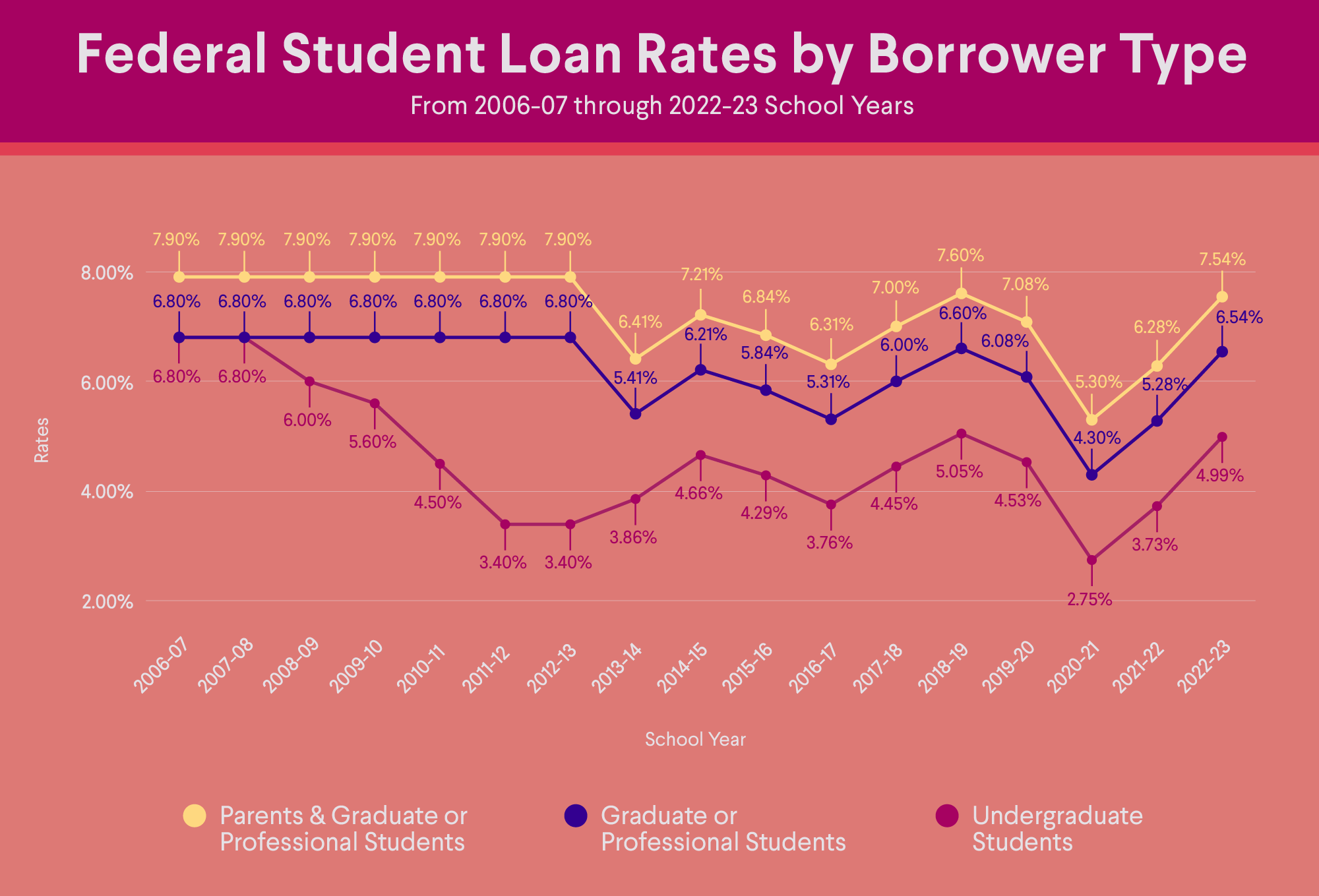
All three of those rates have risen from the 2023-2024 school year, and the undergraduate rate has more than doubled since the 2020-2021 school year.

Federal Student Loan Rates by Borrower Type
Source: Studentaid.gov

This means that the average student loan interest rate for the three main types of federal student loans is 7.89%.

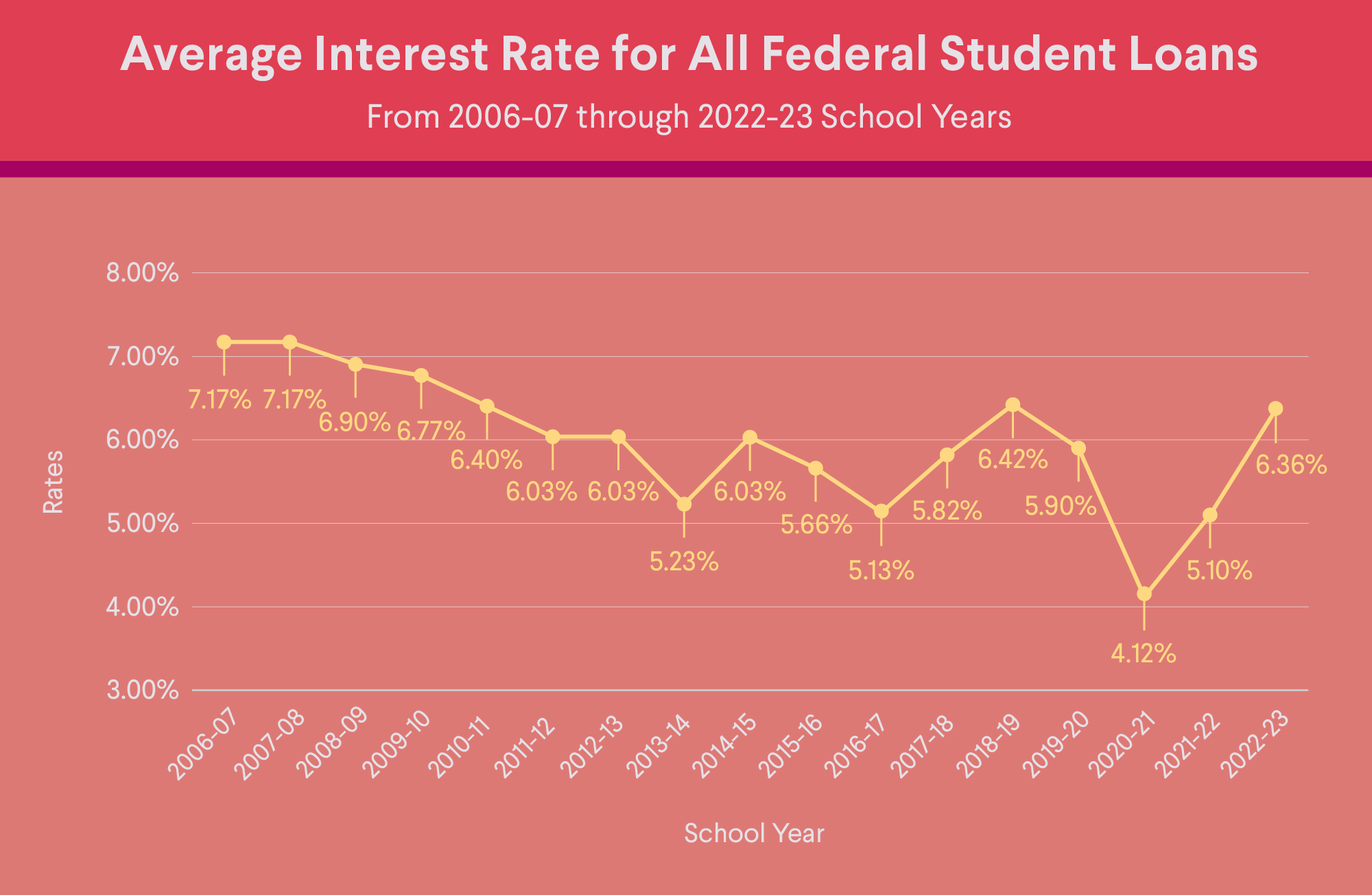
Average Interest Rate for All Federal Student Loans
Source: Studentaid.gov

Private student loan interest rates vary by lender and each has its own criteria for which rates borrowers qualify for. Private student loans can have either fixed interest rates that remain the same over the life of the loan, or variable rates that may start lower than a fixed interest rate but then go up over time, based on market changes.

Private loans require a credit check, and lenders may offer different interest rates if you have strong credit or a cosigner on your student loan. The interest rates on private student loans can vary anywhere from 3.50% to 17.00% (as of March 2025), depending on the lender, the type of loan, and on individual financial factors including the borrower’s credit history.

Recommended: Do Student Loans Have Simple or Compound Interest?

How Are Interest Rates Determined?

As mentioned, the interest rates on federal student loans are set annually by formulas specified in the HEA. The rates are tied to the financial markets — federal law sets them based on the 10-year Treasury note and a statutory add-on percentage with a maximum rate cap.

Since July 2006, all federal student loans have fixed interest rates. Although federal student loans are serviced by private companies or nonprofits selected by the federal government, these loan servicers have no say in the federal interest rate offered.

For private student loans, the lenders set their own rates, though they often take cues from federal rates. The rates quoted for student loans vary based on each applicant’s individual situation — though generally the better a potential borrower’s credit history is, the better rate they may be able to qualify for.

To learn more about private and federal student loans, check out our student loan help center.

How Student Loan Interest is Calculated and Applied

Interest on federal student loans typically accrues daily. To calculate the interest as it accrues, the following formula can be used:

Interest amount = (outstanding student loan principal balance × interest rate factor) × days since last payment

In other words, you will multiply your outstanding loan balance by the interest rate factor, which is used to calculate the amount of interest that accrues on a student loan. Then, multiply that result by the days since you last made a payment.

To calculate the interest rate factor you can divide the interest rate by the number of days of the year (365). For example, let’s say you have an outstanding student loan balance of $10,000, an interest rate of 4.75%, and it’s been 30 days since your last payment. Here’s how to calculate your interest:

$10,000 x (4.75%/365) = $1.30 daily interest charge
$1.30 x 30 days = $39
Interest amount $39

Many private student loans will also accrue interest on a daily basis; however, the terms will ultimately be determined by the lender. Review the lending agreement to confirm.

Recommended: Do Student Loans Count as Income?

How to Evaluate Student Loan Interest Rates

When you take out a federal student loan, you’ll receive a fixed interest rate. This means that you’ll pay a set amount for the term of the student loan. In addition, all of the terms, conditions, and benefits are determined by the government. Federal student loans also provide some additional perks that you may not find with private lenders, like deferment.

Private student loans can have higher interest rates and potentially fewer perks than federal student loans. You may want to take advantage of all federal student loans you qualify for before comparing private loan options.

One thing to keep in mind is that interest you pay on student loans may allow you to take the student loan interest deduction on your taxes.

What Is a Good Fixed Interest Rate for Student Loans?

The lower the interest rate, the less a borrower will owe over the life of the loan, which could help individuals as they work on other financial goals. If you’re taking out federal loans, the student loan interest rate is set by federal law, so you don’t have a choice for what is and isn’t a reasonable interest rate.

When it comes to private student loans, it’s wise to shop around and compare your options to find the most suitable financing solution. Since every lender offers different terms, rates, and fees, getting quotes from multiple lenders may help you select the best option for your personal needs. Keep in mind that the rate you receive on a private student loan is largely dependent on your credit score and other factors, whereas federal student loan interest rates are based on HEA formulas.

Also keep in mind that private student loans do not have the same borrower protections as federal student loans, including deferment options, and should be considered only after all federal aid options have been exhausted.

Ways to Lower Your Student Loan Interest Rate

The interest rate on federal student loans, while fixed for the life of the loan, does fluctuate over time. For example, the rates for Direct Subsidized and Unsubsidized loans for undergraduates more than doubled from 2.75% in 2020–21 to 6.53% in 2024–25.

To adjust the rate on an existing student loan, borrowers generally have two options. They can refinance student loans or consolidate them with hopes of qualifying for a lower interest rate.

Refinancing a federal loan with a private lender eliminates them from federal borrower protections such as federal deferment or Public Service Loan Forgiveness. The federal government does offer a Direct Consolidation Loan, which allows borrowers to consolidate their federal loans into a single loan. This will maintain the federal borrower protections but won’t necessarily lower the interest rate. When federal loans are consolidated into a Direct Consolidation Loan, the new interest rate is a weighted average of your original federal student loans’ rates.

Refinancing student loans with a private lender may allow qualifying borrowers to secure a lower interest rate or preferable loan terms. Note that extending the repayment term will generally result in an increased cost over the life of the loan.

To see how refinancing could work for your student loans, try this student loan refinance calculator.

💡 Quick Tip: Refinancing comes with a lot of specific terms. If you want a quick refresher, the Student Loan Refinancing Glossary can help you understand the essentials.

Fixed vs. Variable Interest Rates: Which Is Better?

Whether fixed or variable interest rates are better depends on a borrower’s specific situation. For many borrowers, fixed rates are often a better option because they are stable and predictable. Your payments won’t change, and you won’t have to worry about rate hikes. Borrowers may want to consider a student loan with a fixed interest rate if interest rates are rising overall and they anticipate needing a number of years to repay their loan.

Because variable interest rates fluctuate with the market, they can be unpredictable. That means your payments can potentially change from one month to the next.

The Takeaway

The average student loan interest rate varies depending on the loan type. The interest rate for federal Direct Unsubsidized and Subsidized loans is set annually by federal law and fixed for the life of the loan.

The interest rate on private student loans is determined by a variety of factors including the borrower’s credit history and may range anywhere from 3.50% to to 17%.

Looking to lower your monthly student loan payment? Refinancing may be one way to do it — by extending your loan term, getting a lower interest rate than what you currently have, or both. (Please note that refinancing federal loans makes them ineligible for federal forgiveness and protections. Also, lengthening your loan term may mean paying more in interest over the life of the loan.) SoFi student loan refinancing offers flexible terms that fit your budget.


With SoFi, refinancing is fast, easy, and all online. We offer competitive fixed and variable rates.

FAQ

How often do student loan interest rates change?

The rates on federal student loans are determined and set annually by formulas specified in the Higher Education Act of 1965. Private student loan rates vary by lender, and they may be fixed or variable. Private loans with variable rates can change based on market changes.

How do federal student loan interest rates compare to private loans?

The interest rate on federal student loans is often lower than the rates for private student loans. The rate you may qualify for with a private loan depends on your circumstances. If you have strong credit or a loan cosigner who has strong credit, you may be able to get a loan with a lower interest rate.

Keep in mind that federal student loans have fixed interest rates, which means the interest and your monthly payment won’t change. Private student loans may have fixed or variable rates, and variable rates can go up or down with market changes.

Can I negotiate my student loan interest rate?

Federal student loans have fixed rates that are non-negotiable. With a private student loan, it’s possible that you may be able to negotiate the interest rate, especially if you are struggling to make payments or dealing with financial hardship. Call your private lender and explain the situation.

What factors determine my student loan interest rate?

Federal student loans have a fixed interest rate that is determined and set each year based on formulas specified in the Higher Education Act of 1965. With private student loans, each lender sets their own rates. Private loans require a credit check, and the interest rates vary based on an applicant’s credit and other factors. Generally speaking, the stronger a borrower’s credit is (or if they have a loan cosigner with strong credit), the lower the rate they may be able to qualify for.

Is it better to choose a fixed or variable interest rate for student loans?

For many borrowers, fixed rates may be a better option because they are stable and predictable, which means the monthly payments won’t change over the life of the loan. If you are planning to repay your loan over a period of years, you may want to consider a student loan with a fixed interest rate.

Variable interest rates fluctuate with the market, which makes them unpredictable. As a result, your payments can go up (or down), and may be harder to budget for.


About the author

Ashley Kilroy

Ashley Kilroy

Ashley Kilroy is a seasoned personal finance writer with 15 years of experience simplifying complex concepts for individuals seeking financial security. Her expertise has shined through in well-known publications like Rolling Stone, Forbes, SmartAsset, and Money Talks News. Read full bio.


SoFi Student Loan Refinance
Terms and conditions apply. SoFi Refinance Student Loans are private loans. When you refinance federal loans with a SoFi loan, YOU FORFEIT YOUR ELIGIBILITY FOR ALL FEDERAL LOAN BENEFITS, including all flexible federal repayment and forgiveness options that are or may become available to federal student loan borrowers including, but not limited to: Public Service Loan Forgiveness (PSLF), Income-Based Repayment, Income-Contingent Repayment, extended repayment plans, PAYE or SAVE. Lowest rates reserved for the most creditworthy borrowers.
Learn more at SoFi.com/eligibility. SoFi Refinance Student Loans are originated by SoFi Bank, N.A. Member FDIC. NMLS #696891 (www.nmlsconsumeraccess.org).

SoFi Loan Products
SoFi loans are originated by SoFi Bank, N.A., NMLS #696891 (Member FDIC). For additional product-specific legal and licensing information, see SoFi.com/legal. Equal Housing Lender.


Third-Party Brand Mentions: No brands, products, or companies mentioned are affiliated with SoFi, nor do they endorse or sponsor this article. Third-party trademarks referenced herein are property of their respective owners.

Non affiliation: SoFi isn’t affiliated with any of the companies highlighted in this article.

Tax Information: This article provides general background information only and is not intended to serve as legal or tax advice or as a substitute for legal counsel. You should consult your own attorney and/or tax advisor if you have a question requiring legal or tax advice.

Disclaimer: Many factors affect your credit scores and the interest rates you may receive. SoFi is not a Credit Repair Organization as defined under federal or state law, including the Credit Repair Organizations Act. SoFi does not provide “credit repair” services or advice or assistance regarding “rebuilding” or “improving” your credit record, credit history, or credit rating. For details, see the FTC’s website .

Financial Tips & Strategies: The tips provided on this website are of a general nature and do not take into account your specific objectives, financial situation, and needs. You should always consider their appropriateness given your own circumstances.

External Websites: The information and analysis provided through hyperlinks to third-party websites, while believed to be accurate, cannot be guaranteed by SoFi. Links are provided for informational purposes and should not be viewed as an endorsement.

SOSLR-Q125-025

Read more
laptop with person with credit card

Is It Possible to Delay Credit Card Payments?

Credit card debt can pile up quickly when a person can’t make their payments on time. If you find yourself in that situation, you may wonder if it’s possible to delay credit card payments. In some cases, you may be able to do so. Read on to learn your options.

Key Points

•   Credit card companies may offer relief options like forbearance, reduced payments, and waived late fees for those facing financial hardship.

•   Missing payments can lead to late fees, increased interest rates, and potential damage to credit scores.

•   Accounts 180 days overdue may be charged off, resulting in debt collection.

•   Alternatives include balance transfer cards, home equity loans, and personal loans for debt consolidation.

Credit Card Relief Options

Some credit card companies may provide financial relief programs to their customers who are facing financial hardships and having difficulty paying their bills on time. Below, you’ll learn about some of your options.

Although programs may vary by company, here are some of the relief programs that credit card companies may offer.

💡 Quick Tip: A low-interest personal loan can consolidate your debts, lower your monthly payments, and help you get out of debt sooner.

Decreasing or Deferring Payments

Many credit card companies allow cardholders to reduce or delay credit card payments for a specific amount of time by offering emergency forbearance. Once the forbearance period ends, cardholders will need to make up any skipped or postponed payments.

While the credit card company may not require cardholders to make up payments right away, they will need to begin to make at least the minimum monthly payment. Depending on the new credit card balance, the minimum payment required may have changed.

One other possibility: Many credit card issuers may agree to shifting your due date slightly to, say, better sync with when you get paid. This can be another option to inquire about.

Refunding or Waiving Late Payment Fees

Usually, when a cardholder misses a credit card payment, they are charged a late fee. Some card companies may refund or waive late fees if the customer requests so due to financial hardship.

Lowering the Interest Rate

Some credit card companies may reduce the credit card interest rate on an account if a customer is facing financial hardship. However, this rate may increase after the specified term ends.

Establishing Payment Plans

Some credit card companies help cardholders repay their credit card balance by offering payment plan options. Cardholders may be able to secure a better repayment plan that works for their current financial situation.

Keep in mind that all of these options may vary by creditor.

Consequences of Missing a Credit Card Payment

If you miss a credit card payment vs. entering into a forbearance program with your card issuer, here is what you might expect.

Increase to the Credit Card Balance

Making a late payment may increase a credit card holder’s balance in several ways. First, credit card companies can charge a late fee that can be in the range of $30 or $32, even for the first occurrence. If a cardholder misses a payment after that, the late fee could increase to $41. It’s important to note that this fee may not exceed the minimum balance due.

Another way the credit card company may increase the balance is to increase the account’s interest rate. For example, if the cardholder hasn’t made a payment for 60 days, the credit card company may increase the APR, or annual percentage rate, to a penalty APR.

Increasing the interest rate can also increase the revolving balance on the credit card. However, not all creditors may charge penalty interest.

Credit Scores May Be Impacted

Since payment history and account standing are some of the factors used to determine a cardholder’s credit score, making late payments may negatively impact it. But the amount of time a cardholder’s credit is affected can vary depending on the situation.

In general, creditors send the payment information to credit bureaus. They use codes to identify the standing of the accounts. Typically, once a payment is 30 days late, it is considered a delinquent payment to the credit bureaus.

While missing a payment may not impact a score immediately, it may appear on a cardholder’s score and stay there for several years if it happens regularly. Of course, this depends on the situation and the other factors credit bureaus use to figure the credit score.

The Balance Could Be Charged Off

Another consequence of making a late payment is that the creditor may not allow the cardholder to use it for other purchases until the card is in good standing.

Additionally, if the payment is 180 days late, the creditor may close the account and charge off the balance. If a creditor charges off the balance, it means that the creditor permanently closes the account and writes it off as a loss. However, the cardholder will still owe the outstanding balance remaining on the account.

In some cases, creditors will attempt to recover this debt by using their collections department. In other cases, they may sell the debt to a third-party collection agency that will try to get payments from the cardholder.

Creditors have some flexibility when it comes to working with their customers. For customers who have had financial setbacks such as losing a job, creditors may help them get back on track under FDIC regulations. Usually, this type of flexibility is available for consumers who show a willingness and ability to repay their debt.

Alternative Options

For consumers who find themselves struggling to make their credit card payments and don’t have creditor relief programs available, there are a few other options to consider that may reduce the financial burden of making credit card payments on time.

Balance Transfer Credit Cards

A balance transfer credit card is a credit card that offers a lower interest rate or even a 0% introductory interest rate. This could allow a consumer to transfer a high-interest credit card debt to a card with lower interest — and potentially pay off the debt faster. Usually, balance transfer credit cards have introductory periods that last anywhere between six and 21 months.

Using this method can potentially be a money-saver if the consumer no longer uses the high-interest rate credit card and continues to pay down the transferred debt at the lower interest rate.

In general, consumers need a solid credit history to qualify for a balance transfer credit card. If approved, consumers can use the new credit card to pay down high-interest debt. Therefore, this can be a solution for credit card debt repayment, as long as the cardholder can pay off the debt before the introductory period ends.

However, if the balance isn’t repaid before the introductory period ends, the interest rate typically jumps up. At this point, the balance will begin to accrue interest charges, and the balance will grow.

Home Equity Loans

With fixed-rate home equity loans, some homeowners may qualify for a lower interest rate using their home as collateral rather than using an unsecured loan (a loan that’s not backed by collateral). As with home equity lines of credit, the terms and interest rate a borrower might qualify for is based on a variety of financial factors.

It’s important to note that borrowing against a home doesn’t come without risks, such as leaving the homeowners vulnerable to foreclosure if they don’t pay back the loan.

Credit Card Consolidation

For borrowers who may not want to use their home as collateral but are struggling to pay down debt, debt consolidation with a personal loan may be a better fit for their situation. Essentially, borrowers may be able to use a personal loan with better terms and a lower interest rate to pay off credit card debt.

Using a personal loan to consolidate credit card debt can make monthly payments more manageable and potentially lower payments. Although a credit card debt consolidation loan won’t magically make debt disappear, paying off the balance might make a difference in a person’s overall financial outlook.

However, note that some lenders may charge origination fees, which can add to the total balance you’ll have to repay. You may also have to pay other charges, such as late fees or prepayment penalties, so make sure you understand any fees or penalties before signing the loan agreement.

Recommended: A Guide to Unsecured Personal Loans

The Takeaway

Staying on top of credit card payments can be difficult during times of financial hardship. Fortunately, you might have options when it comes to delaying credit card payments, including forbearance programs with your card issuer. Or, you could explore alternative options for getting out of debt for good. A credit card consolidation loan, which is a kind of personal loan, might be worth exploring.

Think twice before turning to high-interest credit cards. Consider a SoFi personal loan instead. SoFi offers competitive fixed rates and same-day funding. See your rate in minutes.


SoFi’s Personal Loan was named a NerdWallet 2026 winner for Best Personal Loan for Large Loan Amounts.

FAQ

Can I delay my credit card payments?

If you are having difficulty making credit card payments on time, it’s wise to contact your credit card issuer as soon as possible to see if they can work with you and possibly allow you to delay a payment. They might be able to waive late fees and change your payment due date going forward to help ease the financial stress.

Does delaying credit card payments affect credit scores?

Delaying credit card payments (or skipping them) can negatively impact your credit score and lead to additional fees and potentially a higher interest rate. Your payment history is the single biggest contributing factor to your credit score, and late or skipped payments can bring your score down.

Can you ask credit card companies to defer payments?

You can ask your credit card if they can defer payments for a period of time or otherwise work with you if it’s challenging to pay what you owe. They are not, however, obligated to agree to do so. You might have to find other ways to manage your debt.


About the author

Ashley Kilroy

Ashley Kilroy

Ashley Kilroy is a seasoned personal finance writer with 15 years of experience simplifying complex concepts for individuals seeking financial security. Her expertise has shined through in well-known publications like Rolling Stone, Forbes, SmartAsset, and Money Talks News. Read full bio.


SoFi Loan Products
SoFi loans are originated by SoFi Bank, N.A., NMLS #696891 (Member FDIC). For additional product-specific legal and licensing information, see SoFi.com/legal. Equal Housing Lender.


*Awards or rankings from NerdWallet are not indicative of future success or results. This award and its ratings are independently determined and awarded by their respective publications.

Disclaimer: Many factors affect your credit scores and the interest rates you may receive. SoFi is not a Credit Repair Organization as defined under federal or state law, including the Credit Repair Organizations Act. SoFi does not provide “credit repair” services or advice or assistance regarding “rebuilding” or “improving” your credit record, credit history, or credit rating. For details, see the FTC’s website .

Financial Tips & Strategies: The tips provided on this website are of a general nature and do not take into account your specific objectives, financial situation, and needs. You should always consider their appropriateness given your own circumstances.

Third Party Trademarks: Certified Financial Planner Board of Standards Center for Financial Planning, Inc. owns and licenses the certification marks CFP®, CERTIFIED FINANCIAL PLANNER®

SOPL-Q225-051

Read more

A Complete Guide to Private Student Loans

The average cost of college in the U.S. is $38,270 per year, including books, supplies, and daily living expenses, according to the Education Data Initiative. While grants and scholarships can significantly lower your out-of-pocket expenses, they typically don’t cover the full cost of your college education.

Student loans, both federal and private, can help bridge this gap in financial aid to allow you to attend the college of your choice. Federal student loans are funded by the government. They tend to offer the best rates and terms, but come with borrowing limits. If you still have gaps in funding, you can turn to private student loans.

Private student loans are funded by banks, credit unions, and online lenders. Private lenders set their own eligibility criteria, and interest rates generally depend on a borrower’s creditworthiness. While private student loans don’t offer all the same borrower protections as federal loans, they can still be a smart choice to help you pay for educational expenses, as long as you do your research.

This guide offers private student loan basics, including what they are, how they work, their pros and cons, and how to apply for one.

Key Points

•   Private student loans are offered by banks, credit unions, and online lenders. They are a funding option for students after federal student loans have been exhausted.

•   Approval for private student loans typically depends on the borrower’s creditworthiness; students may need a cosigner due to limited credit history.

•   Private loans may lack flexible repayment plans and protections that federal loans offer.

•   Funds are usually sent directly to the educational institution to cover tuition and fees; any remaining amount is disbursed to the student.

•   It’s essential to thoroughly research and compare private loan options, considering factors like interest rates, repayment terms, and borrower protections, before making a decision.

What are Private Student Loans?

Often when people talk about student loans, they’re referring to federal student loans, which are provided by the federal government. Private student loans, by contrast, are funded by banks, credit unions, and online lenders. Students typically turn to private student loans when federal loans won’t cover all of their costs.

You can use the money from a private school loan to pay for expenses like tuition, fees, housing, books, and supplies. Interest rates for private student loans may be variable or fixed and are set by the lender. Repayment terms can be anywhere from five to 20 years.

Unlike federal student loans, borrowers must pass a credit check to qualify for private student loans. Since most college students don’t have enough credit history to take out a large loan, a cosigner is often required.

💡 Quick Tip: New to private student loans? Visit the Private Student Loans Glossary to get familiar with key terms you will see during the process.

How Do Private Student Loans Work?

How Private Student Loans Work

Loan amounts, interest rates, repayment terms, and eligibility requirements for undergraduate private student loans vary by individual lender. If you’re in the market for a private student loan, it’s key to shop around and compare your options to find the best fit.

To get a private student loan, you need to file an application directly with your lender of choice. Based on the information you submit, the lender will determine whether or not you are approved and, if so, what rates and terms you qualify for.

If you’re approved, the loan proceeds will typically be disbursed directly to your university. Your school will apply that money to tuition, fees, room and board, and any other necessary expenses. If there are funds left over, the money will be given to you to use toward other education-related expenses, such as textbooks and supplies.

Repayment policies vary by lender, but typically you aren’t required to make payments while you’re attending school. Some lenders will allow you to defer payments until six months after you graduate. However, interest typically begins accruing as soon as the loan is dispersed. Similar to unsubsidized federal student loans, the interest that accrues while you’re in school is added to your loan balance.

The Pros and Cons of Private Student Loans

Pros of Private Student Loans

Cons of Private Student Loans

Apply any time of the year May require a cosigner
Higher loan amounts Less flexible repayment options
Choice of fixed or variable rates No loan forgiveness programs
Quick application process Can lead to over-borrowing
Options for international students No federal subsidy

If federal financial aid — including grants, work-study, and federal student loans — isn’t enough to cover the full cost of college, private student loans can fill in any gaps. Just keep in mind that private student loans don’t offer the same borrower protections that come with federal student loans. Before taking out a private student loan, it’s a good idea to fully understand their pros and cons.

The Benefits of Private Student Loans

Here’s a look at some of the advantages that come with private student loans.

Apply Any Time of the Year

Unlike federal student loans, which have application deadlines, you can apply for private student loans any time of the year. As a result, they can be helpful if you’re facing a mid-year funding shortfall or if your college expenses go up unexpectedly.

Higher Loan Amounts

Federal loans have annual maximums. For example, a first-year, dependent undergraduate can borrow up to $5,500 for that year. The aggregate max a dependent student can borrow from the government for their entire undergraduate education is $31,000. Private student loan limits vary with each lender, but you can typically borrow up to the full cost of attendance, minus any financial aid received.

Choice of Fixed or Variable Interest Rates

Federal loans only offer fixed-rate loans, while private lenders usually give you a choice between fixed or variable interest rates. Fixed rates remain the same over the life of the loans, whereas variable rates can change throughout the loan term, depending on benchmark rates.

Variable-rate loans usually have lower starting interest rates than fixed-rate loans. If you can afford to pay off your student loans quickly, you might pay less interest with a variable-rate loan from a private lender than a fixed-rate federal loan.

Quick Application Process

While federal student loans require borrowers to fill out the Free Application for Federal Student Aid, or FAFSA, private student loans do not. You can apply for most private student loans online in just a few minutes without providing nearly as much information.
In some cases, you can get a lending decision within 72 hours. By comparison, it typically takes one to three days for the government to process the FAFSA if you submit electronically, and seven to 10 days if you mail in the form.

Options for International Students

While you never want to default on your student loans (since it can cause significant damage to your credit), it can be nice to know that private student loans come with a statute of limitations. This is a set period of time that lenders have to take you to court to recoup the debt after you default. The time frame varies by state, but it can range anywhere from three to 10 years. After that period ends, lenders have limited options to collect from you.

However, that’s not the case with federal student loans. You must eventually repay your loans, and the government can even garnish your wages and tax refunds until you do.

Options for International Students

International students typically don’t qualify for federal financial aid, including federal student loans. Some private lenders, however, will provide student loans to non-U.S. citizens who meet specific criteria, such as attending an eligible college on at least a half-time basis, having a valid student visa, and/or adding a U.S. citizen as a cosigner.

When we say no fees required we mean it.
No late fees
when you take out a student loan with SoFi.


The Disadvantages of Private Student Loans

Private student loans also have some downsides. Here are some to keep in mind.

May Require a Cosigner

Most high school and college students don’t make enough income or have a strong credit history to qualify for private student loans on their own. Though some lenders will take grades and income potential into consideration, most students need a cosigner to qualify for a private student loan. Your cosigner is legally responsible for your student debt, and any missed payments can negatively affect their credit. If you can’t repay your loans, your cosigner is responsible for the entire amount.

The good news is that some private student loans allow for a cosigner release.That means that after you make a certain number of on-time payments, you can apply to have the cosigner removed from the loan.

Less Flexible Repayment Options

Federal student loans offer several different types of repayment plans, including income-driven repayment (IDR) plans, which calculate your monthly payment as a percentage of your income.

With private student loans, on the other hand, usually the only way to reduce your monthly payment is to refinance the loan to a lower interest rate, a longer repayment term, or both. Keep in mind that by lowering your monthly payment via a longer repayment period, you’ll typically end up paying more in interest over the life of the loan.

No Loan Forgiveness Programs

Federal student loans come with a few different forgiveness programs, including Public Service Loan Forgiveness (PSLF) and Teacher Loan Forgiveness. While these programs have strict eligibility requirements, they can help many low-income borrowers. Private lenders, on the other hand, generally don’t offer programs that forgive your debt after meeting certain requirements.

If you’re experiencing financial hardship, however, the lender may agree to temporarily lower your payments, waive a payment, or shift to interest-only payments.

Can Lead to Over-Borrowing

Private loans typically allow you to borrow up to 100% of your cost of attendance, minus other aid you’ve already received. Just because you can borrow that much, however, doesn’t necessarily mean you should. Borrowing the maximum incurs more interest over the duration of your loans and increases your payments, which can make repayment more difficult.

Recommended: How to Save Money in College

No Federal Subsidy

Subsidized federal student loans, awarded based on financial need, come with an interest subsidy, meaning the government pays your interest while you’re in school and for six months after you graduate. This can add up to a significant savings.

Subsidies don’t exist with private student loans. Interest accrues from Day One, and in some cases, you might need to make interest payments while still in school. If you don’t pay the interest as you go, it’s added to your debt as capitalized interest when you finish school. (This is also the case with federal unsubsidized loans.)

Federal vs Private Student Loans

Here’s a look at the key differences between federal vs. private student loans.

Federal Student Loans vs. Private Student Loans

The Application Process

Federal student loans are awarded as a part of a student’s financial aid package. In order to apply for federal student loans, students must fill out the FAFSA each year. No credit check is needed to qualify.

To apply for private student loans, students need to fill out an application directly with their preferred lender. Application requirements vary depending on the lender. A credit check is typically required.

Recommended: Financial Aid vs Student Loans

Interest Rates

The interest rates on federal student loans are fixed and are set annually by Congress. Once you’ve taken out a federal loan, your interest rate is locked for the life of the loan.

For the 2025-2026 school year, the federal student loan interest rate is 6.39% for Direct Subsidized and Unsubsidized Loans for undergraduates, 7.94% for Direct Unsubsidized Loans for graduate and professional students, and 8.94% for Direct PLUS loans for parents and graduate or professional students.

Private lenders, on the other hand, are free to set interest rates. Rates may be fixed or variable and depend on several factors, including your (or your cosigner’s) credit score, loan amount, and chosen repayment term. Private student loan rates may start as low as 3.47%, according to the Education Data Initiative.

Repayment Plans

Borrowers with federal student loans can select from several different federal repayment plans , including income-driven repayment plans. You can defer payments while enrolled at least half-time and immediately after graduation.

Repayment plans for private loans are set by the individual lender. Many private student loan lenders allow you to defer payments during school and for six months after graduation. They also have a variety of repayment terms, often ranging from five to 20 years.

Keep in mind that for federal student loans, access to all income-based plans is currently cut off for new borrowers while the Trump administration reevaluates.

Options for Deferment or Forbearance

Federal student loan borrowers can apply for deferment or forbearance if they encounter financial difficulties while they are repaying their loans. These options allow borrowers to pause their loan payments (interest, however, will typically continue to accrue).

Some private lenders may offer options for borrowers who are facing financial difficulties, including short periods of deferment or forbearance. Some also offer unemployment protection, which allows qualifying borrowers who have lost their job through no fault of their own to modify payments on their student loans.

Loan Forgiveness

Borrowers with federal student loans might be able to pursue loan forgiveness through federal programs such as PSLF or Teacher Loan Forgiveness, or after paying down their balances on an IDR plan for a certain period of time.

Since private student loans aren’t controlled by the government, they are not eligible for federal loan forgiveness programs. Though private lenders will often work with borrowers to avoid default, private student loans are rarely forgiven. Generally, it only happens if the borrower becomes permanently disabled or dies, but even then it is up to the specific lender.

Should You Consider Private Student Loans?

There are many different types of student loans. It’s generally a good idea to maximize federal student loans before turning to private student loans. That way, you’ll have access to income-driven repayment plans, loan forgiveness programs, and extended deferment and forbearance periods.

If you still need money to cover tuition or other expenses, and you (or your cosigner) have strong credit, a private student loan can make sense.

Private student loans can also be useful if your expenses suddenly go up and you’ve already maxed out federal student loans, since they allow you to access additional funding relatively quickly. You might also consider a private student loan if you don’t qualify for federal loans. If you’re an international student, for example, a private loan may be your only college funding option.

Another scenario where private student loans can make sense is if you only plan to take out the loan short-term. If you’ll be able to repay the loan over a few years, private student loans could end up costing less overall.

Recommended: When to Apply for Student Loans

How to Get a Private Student Loan

Here’s a look at the steps involved in getting a private student loan.

1.    Shop around. Your school may have a list of preferred lenders, but you’re not restricted to this list. You can also do your own research to find top lenders. As you evaluate lenders, consider factors like interest rates, how much you can borrow, the loan term, when you must start repayment, any fees, and if the lender offers any hardship programs.

2.    See if you can prequalify. Some lenders allow borrowers to get a quote by filling out a prequalification application. This generally involves a soft credit inquiry (which won’t impact your credit score) and tells you what interest rates and terms you may qualify for. Completing this step can help you decide if you need a cosigner.

3.    Gather your information. To officially apply for a private student loan, you typically need to provide your Social Security number, birthdate, and home address, as well as proof of employment and income. You may also need to provide other financial information, such as your assets, rent or mortgage, and tax returns. If you have a cosigner, you’ll have to provide their personal and financial details as well.

4.    Submit your application. Once you’ve completed your application, the lender will typically contact your school to verify your information and eligibility. They will then process the student loan and notify you about your approval and disbursement of your money.


💡 Quick Tip: Parents and sponsors with strong credit and income may find much lower rates on no-fee private parent student loans than federal parent PLUS loans. Federal PLUS loans also come with an origination fee.

Does Everyone Get Approved for Private Student Loans?

No, not everyone gets approved for private student loans. Lenders assess various factors to determine eligibility, such as credit history and income. Students with limited credit history may need a cosigner to qualify. Here are the key factors lenders consider:

•   Credit score

•   Income and employment status

•   Debt-to-income ratio

•   Cosigner’s creditworthiness

•   Enrollment status at an eligible school

If you don’t meet these qualifications, you can apply with a cosigner who does.

Apply for a Private Student Loan with SoFi

Private student loans are offered by banks, credit unions, and online lenders to help college students cover their educational expenses. They are not part of the federal student loan program, and generally do not feature the flexible repayment terms or borrower protections offered by federal student loans.
However, private student loans come with higher loan limits, and the borrowing costs are sometimes lower compared to their federal counterparts.

If you’ve exhausted all federal student aid options, no-fee private student loans from SoFi can help you pay for school. The online application process is easy, and you can see rates and terms in just minutes. Repayment plans are flexible, so you can find an option that works for your financial plan and budget.


Cover up to 100% of school-certified costs including tuition, books, supplies, room and board, and transportation with a private student loan from SoFi.

FAQ

Why would someone get a private student loan?

Students typically turn to private student loans when federal loans won’t cover all of their costs. Private student loans come with higher borrowing limits than their federal counterparts. The aggregate max dependent students can borrow from the government for their entire undergraduate education is $31,000, which is sometimes not nearly enough to cover the cost of attendance.

With private loans, on the other hand, you can typically borrow up to the total cost of attendance, minus any financial aid received, every year. This gives you more flexibility to get the financing you need. Keep in mind, though, that private student loans do not come with the same federal protections and benefits offered by federal student loans.

Will private student loans be forgiven?

Private student loans aren’t funded by the government, so they don’t offer the same forgiveness programs. In fact, private student loan forgiveness is rare.

If you experience financial hardship, however, many lenders will work with you to stay out of default. They may agree to temporarily lower your payments, waive a payment, or switch to interest-only payments. Or, you might qualify for deferment or forbearance, which temporarily postpones your payments (though interest continues to accrue).

Are private student loans paid to you or the school?

Private student loans are typically disbursed directly to the school to cover tuition, fees, and other educational expenses. Any remaining funds after those costs are covered are then refunded to the student, which can be used for additional expenses like housing, textbooks, and personal living costs.


SoFi Private Student Loans
Please borrow responsibly. SoFi Private Student loans are not a substitute for federal loans, grants, and work-study programs. We encourage you to evaluate all your federal student aid options before you consider any private loans, including ours. Read our FAQs.

Terms and conditions apply. SOFI RESERVES THE RIGHT TO MODIFY OR DISCONTINUE PRODUCTS AND BENEFITS AT ANY TIME WITHOUT NOTICE. SoFi Private Student loans are subject to program terms and restrictions, such as completion of a loan application and self-certification form, verification of application information, the student's at least half-time enrollment in a degree program at a SoFi-participating school, and, if applicable, a co-signer. In addition, borrowers must be U.S. citizens or other eligible status, be residing in the U.S., Puerto Rico, U.S. Virgin Islands, or American Samoa, and must meet SoFi’s underwriting requirements, including verification of sufficient income to support your ability to repay. Minimum loan amount is $1,000. See SoFi.com/eligibility for more information. Lowest rates reserved for the most creditworthy borrowers. SoFi reserves the right to modify eligibility criteria at any time. This information is subject to change. This information is current as of 4/22/2025 and is subject to change. SoFi Private Student loans are originated by SoFi Bank, N.A. Member FDIC. NMLS #696891 (www.nmlsconsumeraccess.org).

SoFi Student Loan Refinance
Terms and conditions apply. SoFi Refinance Student Loans are private loans. When you refinance federal loans with a SoFi loan, YOU FORFEIT YOUR ELIGIBILITY FOR ALL FEDERAL LOAN BENEFITS, including all flexible federal repayment and forgiveness options that are or may become available to federal student loan borrowers including, but not limited to: Public Service Loan Forgiveness (PSLF), Income-Based Repayment, Income-Contingent Repayment, extended repayment plans, PAYE or SAVE. Lowest rates reserved for the most creditworthy borrowers.
Learn more at SoFi.com/eligibility. SoFi Refinance Student Loans are originated by SoFi Bank, N.A. Member FDIC. NMLS #696891 (www.nmlsconsumeraccess.org).

SoFi Loan Products
SoFi loans are originated by SoFi Bank, N.A., NMLS #696891 (Member FDIC). For additional product-specific legal and licensing information, see SoFi.com/legal. Equal Housing Lender.


Financial Tips & Strategies: The tips provided on this website are of a general nature and do not take into account your specific objectives, financial situation, and needs. You should always consider their appropriateness given your own circumstances.

Third-Party Brand Mentions: No brands, products, or companies mentioned are affiliated with SoFi, nor do they endorse or sponsor this article. Third-party trademarks referenced herein are property of their respective owners.

External Websites: The information and analysis provided through hyperlinks to third-party websites, while believed to be accurate, cannot be guaranteed by SoFi. Links are provided for informational purposes and should not be viewed as an endorsement.

SOISL-Q125-021

Read more

How Are Employee Stock Options and RSUs Different?

Employee stock options (ESOs) are different from restricted stock units (RSUs). They are both types of deferred compensation, and can be used as incentives, but employee stock options are similar to a call option. They give employees the option to buy company stock at a certain price, by a certain date. RSUs simply give an employee shares of stock on a given date.

Generally speaking there are specific terms the employee must meet in order to get either kind of stock. For example, an employee must work for the company for a year, and then obtain shares on a vesting schedule (i.e., shares become available over time, not all at once).

Sometimes, employees get a choice between ESOs and RSUs. Understanding how each stock plan works, how they differ — particularly when it comes to vesting schedules and taxes — can help you make a decision that best aligns with your financial goals.

Key Points

•   Employee stock options (ESOs) and restricted stock units (RSUs) are types of deferred compensation.

•   ESOs allow an employee to buy company stock at a set price, by a certain date, usually according to a vesting schedule.

•   If the employee chooses not to exercise their options to buy the shares, they expire.

•   RSUs give employees a certain number of shares of stock by a certain date.

•   Like ESOs, RSUs can vest gradually or all at once. Employees don’t have to buy RSUs; they own them on the date they’re given.

•   Depending on the type of stock options you get, you may owe income tax and/or capital gains tax if you sell your shares at a profit.

What Are Employee Stock Options (ESOs)?

Employee stock options (ESOs) give an employee the right to purchase their company’s stock at a set price — called the exercise, grant, or strike price — by a certain date, assuming certain terms are met, usually according to a vesting schedule. In this way, they are similar to call options (a type of derivative contract).

If the employee doesn’t exercise their options within that period, they expire.

Companies may offer stock options to employees as part of a compensation plan, in addition to salary, 401(k) matching funds, and other benefits. ESOs are considered an incentive to help the company succeed, so that (ideally) the stock options are worth more when the employee chooses to exercise them.

In an ideal scenario, exercising stock options allows an employee to purchase shares of their company’s stock at a price that’s lower than the current market price — and realize a profit.

Note that while some of the features of employee stock options are similar to trading stock options, these contracts aren’t exactly the same, and you can’t trade ESOs. Also, options are derivatives based on the value of underlying securities, e.g. stocks, bonds, ETFs — they aren’t a type of employee compensation.

How Do ESOs Work?

Generally, ESOs operate in four stages — starting with the grant date and ending with the exercise date, i.e. actually buying the stock.

1. The Grant Date

This is the official start date of an ESO contract. You receive information about how many shares you’ll be issued, the strike price (or exercise price) for those shares, the vesting schedule, and any requirements that must be met along the way.

2. The Cliff

If a compensation package includes ESOs, they’re generally not available on day one. Contracts often include requirements that must be met first, such as working full time for at least a year.

Those 12 months when you are not yet eligible to exercise your employee stock options is called the cliff. If you remain an employee past the cliff date, you get to level up to the vesting period.

Some companies include a 12-month cliff to incentivize employees to stay at least a year. Other companies may have a vesting schedule.

3. The Vest

The vesting period is when you start to take ownership of your options and the right to exercise them. Vesting can either happen all at once or take place after a cliff (as noted above), or gradually over several years, depending on your company’s plan.

One common vesting schedule is a one-year cliff followed by a four-year vest. On this timeline, you’re 0% vested the first year (meaning you aren’t eligible for any options), 25% vested at the two-year mark (you can exercise up to 25% of the total options granted), and so on until you own 100% of your options. At that point, you’re considered fully vested.

4. The Exercise

This is when you pull the financial trigger and actually purchase some or all of your vested shares.

ESO’s Expiration Date

While the expiration date of stock options isn’t always front and center, it’s important to bear in mind. The strike price you’re given as part of your options package expires on a certain date if you don’t exercise your shares.

One common timeline is 10 years from grant date to expiration date, but specific terms will be in the contract, and it’s important to vet the timing of your ESOs — as part of your career as well as your tax and your long-term financial plan. Again, if you let your stock options expire, you lose the right to buy shares at that price.

Pros and Cons of Employee Stock Options (ESOs)

If you land a job with the right company and stay until you’re fully vested, exercising your employee stock options could potentially lead to gains.

For example, if your strike price is $30 per share, and at the time of vesting the stock is trading at $100 or more per share, you’re getting a great deal on shares.

On the other hand, if your strike price is $30 per share and the company is trading at $10 per share, you might be better off not exercising your employee stock options until the price goes up (when and if it does; there are no guarantees).

That’s why ESOs are considered a form of employee incentive: You may work harder to help the company grow, if you know your efforts could translate to a higher stock price.

Recommended: Stock Market Basics

Tax Implications of Employee Stock Options

Given that stock options can generate gains, it’s important to know how they are taxed so you can plan accordingly.

Generally speaking, employers offer two types of stock options: nonqualified stock options (NSOs or NQSOs) and incentive stock options (ISOs).

Nonqualified Stock Options

NSOs are the most common and often the type offered to the general workforce. NSOs have a less favorable tax treatment, because they’re subject to ordinary income tax on the difference between the exercise price and the market price at the time you exercise your options and purchase the stock, assuming the market price is higher.

NSOs are then taxed again at the capital gains rate when you sell the shares at a profit.

Your individual circumstances, tax filing status, and the terms of your stock options may also play into how you’re taxed, so you may want to consult a professional.

Incentive Stock Options

ISOs are “qualified,” meaning you don’t pay any taxes when you exercise the options — unless you’re subject to the alternative minimum tax (AMT).

You will owe taxes, however, if you sell them at a profit later on. (If you don’t sell, and if the stocks gain or lose value, those are considered unrealized gains and losses.) Any money you make when you sell your shares later would be subject to capital gains tax. If you hold your shares less than a year, the short-term capital gains tax rate equals your ordinary income tax rate, which could be up to 37% for the highest tax bracket.

If you hold your shares less than a year, the short-term capital gains tax rate equals your ordinary income tax rate, which could be up to 37% for the highest tax bracket.
For assets held longer than a year, the long-term rate is lower: 0%, 15%, or 20%, depending on your taxable income and filing status.

What Are Restricted Stock Units (RSUs)?

Restricted stock units, or RSUs, simply grant employees a certain number of shares stock by a certain date. When employees are granted RSUs, the company holds onto the shares until they’re fully vested.

The company determines the vesting criteria — it can be a time period of several years, a key revenue milestone, and/or personal performance goals. Like ESOs, RSUs can vest gradually or all at once. When the employee gets their shares, they own them outright; employees don’t have to buy RSUs.

How Do Restricted Stock Units (RSUs) Work?

RSUs are priced based on the fair market value of the stock on the day they vest, or the settlement date. The company stocks you receive from your company will be worth just as much as they would be if you purchased them on your own that same day.

If the stock is worth $40 per share, and you have 100 shares, you would get $4,000 worth of shares (assuming you’re fully vested and have met other terms).

Again, the main difference between employee stock options and restricted stock units is that you don’t have to purchase RSUs.

As long as the company’s common stock holds value, so do your RSUs. Upon vesting, you can either keep your RSUs in the form of actual shares, or sell them immediately to take the cash equivalent. Either way, the RSUs you receive will be taxed as income.

And, of course, if you later sell your shares you may realize a gain or a loss and there will be tax implications accordingly.

Pros and Cons of Restricted Stock Units (RSUs)

One good thing about RSUs, similar to ESOs, is the incentive to stay with the company for a longer period of time. If your company grows during your vesting period, you could see a substantial windfall when your settlement date rolls around.

But even if the stock falls to a penny per share, the shares are still awarded to you on your settlement date. Since you don’t have to pay for them, it’s still money in your pocket.

In fact, you may only lose out on money with RSUs if you leave the company and have to forfeit any units that aren’t already vested, or if the company goes out of business.

Tax Implications of RSUs

When your RSU shares or cash equivalent are automatically delivered to you on your settlement date(s), they’re considered ordinary income and are taxed accordingly. In fact, your RSU distributions are actually added to your W-2 form.

For some people, the additional RSU income may bump them up a tax bracket (or two). In those cases, if you’ve been withholding at a lower tax bracket before your vesting period, you could owe the IRS more money.

As with ESOs, if you sell your shares at a later date and make a profit, you’ll be subject to capital gains taxes.

ESOs RSUs
Definition An employee can buy company stock at a set price at a certain date in the future. An employee receives stock at a date in the future and does not have to purchase them
Pricing The strike price is set when ESOs are offered to an employee, and they pay that price when they exercise their shares. The share price is based on the fair market value of the stock on the day the shares vest, and employees get the full-value shares.
Tax implications The difference between the strike price and the stock’s market value on exercise is considered earned income and added to your W-2, where it’s taxed as income. If you sell your shares later at a profit, you may also be subject to capital gains tax. RSU shares (or cash equivalent) are considered ordinary income as soon as they are vested, and are taxed accordingly.

If you sell the shares later, capital gains tax rules would apply.

The Takeaway

Employee stock options (ESOs) and restricted stock units (RSUs) are two different types of equity or share-based compensation.

An employee stock option gives an employee the option to buy company stock at a certain price, by a certain date. An RSU is the promise that on a future date the employee will receive actual company stock (without having to purchase the shares).

Because these types of compensation are often considered incentives, they’re designed to encourage employees to stay with the company for a certain amount of time. As such, employees often don’t get their options (in the case of ESOs) or the actual shares (in the case of RSUs) until certain terms are met. There may be a vesting schedule or company benchmarks or other terms.

Invest in what matters most to you with SoFi Active Invest. In a self-directed account provided by SoFi Securities, you can trade stocks, exchange-traded funds (ETFs), mutual funds, alternative funds, options, and more — all while paying $0 commission on every trade. Other fees may apply. Whether you want to trade after-hours or manage your portfolio using real-time stock insights and analyst ratings, you can invest your way in SoFi's easy-to-use mobile app.


Invest with as little as $5 with a SoFi Active Investing account.


INVESTMENTS ARE NOT FDIC INSURED • ARE NOT BANK GUARANTEED • MAY LOSE VALUE

SoFi Invest is a trade name used by SoFi Wealth LLC and SoFi Securities LLC offering investment products and services. Robo investing and advisory services are provided by SoFi Wealth LLC, an SEC-registered investment adviser. Brokerage and self-directed investing products offered through SoFi Securities LLC, Member FINRA/SIPC.

For disclosures on SoFi Invest platforms visit SoFi.com/legal. For a full listing of the fees associated with Sofi Invest please view our fee schedule.

Options involve risks, including substantial risk of loss and the possibility an investor may lose the entire amount invested in a short period of time. Before an investor begins trading options they should familiarize themselves with the Characteristics and Risks of Standardized Options . Tax considerations with options transactions are unique, investors should consult with their tax advisor to understand the impact to their taxes.

Tax Information: This article provides general background information only and is not intended to serve as legal or tax advice or as a substitute for legal counsel. You should consult your own attorney and/or tax advisor if you have a question requiring legal or tax advice.

Disclaimer: The projections or other information regarding the likelihood of various investment outcomes are hypothetical in nature, do not reflect actual investment results, and are not guarantees of future results.

Financial Tips & Strategies: The tips provided on this website are of a general nature and do not take into account your specific objectives, financial situation, and needs. You should always consider their appropriateness given your own circumstances.

SOIN-Q125-051

Read more
TLS 1.2 Encrypted
Equal Housing Lender