SoFi Blog

Tips and news—
for your financial moves.

5 Things to Do If You Don’t Want to Wait to Buy a House

This article appeared in SoFi's On the Money newsletter. Not getting it? Sign up here.

Let’s face it: Between high mortgage rates and steep property prices, buying a house can be prohibitively expensive these days.

But waiting for conditions to improve could take a while. Economists at the Mortgage Bankers Association predict rates will stay in the mid-6% range through at least 2027, and real estate values remain inflated by the pandemic buying boom.

So what can you do? Some people who are tired of putting off a move are stomaching the high mortgage costs with the goal of refinancing their loan if and when rates drop in the future. But if you can’t afford to do that, it’s not hopeless.

Here are five things to do if you want to buy a house this year.

1.    Try negotiating the price. Although most people have been paying top dollar since the pandemic, the tide is turning, according to economists. Unlike back then, today’s high borrowing costs are sidelining many would-be buyers just as the number of homes for sale is growing.

   In many cases, this combination is giving buyers the upper hand and forcing the first reality check on sellers in nearly five years. In fact, the median U.S. sale price in March was almost $39,000 less than the median U.S. list price, according to data from the brokerage Redfin. This gap — the biggest since May 2020 — shows sellers are increasingly overestimating what buyers are willing to pay.

   Caveat: Real estate is very location-specific, so it’s important not to assume national trends apply everywhere. Meet with an agent and research your local market to level-set your expectations for price and other competitive factors. If you live in Chicago, you may still need to prep for a bidding war, while in Houston, you might have success offering under asking price.

2.    Ask the seller to make other compromises. If you can’t get anywhere on price, don’t give up. Once a seller has received an offer, they may be willing to make other concessions in order to close the deal. Consider asking them to cover closing costs, pay for repairs, or even pay for you to have a lower mortgage rate. (Yes, that’s a thing.) It worked with 44% of U.S. home sales — nearly a record high percentage — in the first quarter, according to Redfin.

3.    Think outside the box. The affordability equation isn’t as straightforward as price and rate. Explore all your options, even less conventional ones. Can you rent out a room to a boarder or ask a relative to live with you to help defray your costs? Could you look for a smaller house than you might have otherwise in order to stay within your budget? Would you consider buying a fixer upper and living in it as-is until you can save up enough to renovate?

4.    Consider buying new. When mortgage rates are a deterrent to buying houses, builders aren’t able to wait for conditions to improve like other sellers might be able to. That’s why 61% of builders surveyed by the National Association of Home Builders in April offered some kind of sales incentive. Builders may be willing to cut their price, throw in free or reduced-cost upgrades, cover closing costs, or temporarily pay down your mortgage rate.

5.    Build in wiggle room. Unlike a fixed loan payment, insurance and property tax bills change every year, and could go up by a lot, depending on where you live. When you’re determining how much you can afford to pay for housing each month (mortgage + insurance + taxes,) make sure you could handle potential increases in the latter two. You don’t want to be able to cover today’s costs and nothing more. (Using SoFi’s Home Affordability Calculator in Advanced mode can help.)


Please understand that this information provided is general in nature and shouldn’t be construed as a recommendation or solicitation of any products offered by SoFi’s affiliates and subsidiaries. In addition, this information is by no means meant to provide investment or financial advice, nor is it intended to serve as the basis for any investment decision or recommendation to buy or sell any asset. Keep in mind that investing involves risk, and past performance of an asset never guarantees future results or returns. It’s important for investors to consider their specific financial needs, goals, and risk profile before making an investment decision.

The information and analysis provided through hyperlinks to third party websites, while believed to be accurate, cannot be guaranteed by SoFi. These links are provided for informational purposes and should not be viewed as an endorsement. No brands or products mentioned are affiliated with SoFi, nor do they endorse or sponsor this content.

SoFi isn't recommending and is not affiliated with the brands or companies displayed. Brands displayed neither endorse or sponsor this article. Third party trademarks and service marks referenced are property of their respective owners.

OTM2025051901

Read more

Week Ahead on Wall Street: Beware the Unknown

For financial markets, this week is the kind of week that, on the surface, might seem like a good time to catch your breath. There aren’t any real headline-grabbing economic releases or major earnings announcements on the calendar.

Things aren’t always as they seem, however. Relatively few scheduled events don’t necessarily indicate a period of calm. It’s precisely in these moments that it’s crucial for investors to acknowledge, and even embrace, the unknown.

Times like these can sometimes lead to thinner trading volumes. Fewer catalysts often mean less urgency for traders to take big positions. But there’s a catch: Lower liquidity can be a double-edged sword. While it might mean a more subdued market if all remains quiet, it can also amplify the impact of any unexpected developments.

That’s a major risk considering the current market backdrop, given persistent uncertainty on inflation, interest rates, and broader economic growth. Add in a complex and dynamic geopolitical landscape marked by trade upheaval and military conflicts, and you have a recipe for potential, if unscheduled, volatility.

Economic and Earnings Calendar

Monday

•   April Leading Economic Index: This is an index composed of various economic indicators that have historically led changes in the broader economy.

•   Fedspeak: Atlanta Fed President Raphael Bostic will give opening remarks at the regional Fed’s annual Financial Markets Conference. Fed Vice Chair Phillip Jefferson will give a keynote speech at the Atlanta Fed conference, followed by a discussion moderated by Bostic. New York Fed President John Williams will participate in a moderated discussion at a Mortgage Bankers Association event. Dallas Fed President Lorie Logan will deliver remarks and moderate a panel titled The Increasing Role of Nonbank Institutions in the Treasury and Money Markets at the Atlanta Fed conference.

Tuesday

•   May Philadelphia Fed Non-Manufacturing Activity: The Philadelphia Fed’s survey of services executives in the region on business conditions and their outlook.

•   Fedspeak: Bostic will deliver welcome remarks at the Atlanta Fed conference. Richmond Fed President Tom Barkin will deliver a speech at the regional Fed’s Investing in Rural America Conference. Boston Fed President Susan Collins will host a Fed Listens event and give remarks. St. Louis Fed President Alberto Musalem will discuss the economy and monetary policy at the Economic Club of Minnesota. San Francisco Fed President Mary Daly and Cleveland Fed President Beth Hammack will participate in a panel discussion at the Atlanta Fed conference, moderated by Bostic.

•   Earnings: Home Depot (HD), Keysight Technologies (KEYS), Palo Alto Networks (PANW)

Wednesday

•   Weekly Mortgage Applications: Mortgage activity gives insight on demand conditions in the housing market.

•   Fedspeak: Barkin and Fed Governor Michelle Bowman will participate in a Fed Listens event.

•   Earnings: Lowe’s Companies (LOW), Medtronic (MDT), Target (TGT), TJX Companies (TJX)

Thursday

•   April Chicago Fed National Activity Index: This is a monthly index put together that incorporates 85 indicators from four categories: production and income; employment, unemployment, and hours; personal consumption and housing; and sales, orders, and inventories.

•   May S&P Global US PMIs: These indexes track how purchasing managers across different industries feel about the business environment.

•   April Existing Home Sales: Most home transactions in any given month tend to come from the existing market, and as a result set the tone for the broader housing market.

•   May Kansas City Fed Manufacturing Activity: The Kansas City Fed’s survey of manufacturing executives in the region on business conditions and their outlook.

•   Weekly Jobless Claims: This high frequency labor market data gives insight into filings for unemployment benefits. Jobless claims have continued to show a labor market that remains strong despite having cooled.

•   Fedspeak: Williams will deliver keynote remarks at a NY Fed event.

•   Earnings: Analog Devices (ADI), Autodesk (ADSK), Copart (CPRT), Deckers Outdoor (DECK), Intuit (INTU), Ralph Lauren (RL), Ross Stores (ROST), Workday (WDAY), Williams-Sonoma (WSM)

Friday

•   April New Home Sales: While only a minority of home transactions in any given month come from new constructions, these home prices tend to be more cyclical and give insight into developing trends.

•   May Kansas City Fed Non-Manufacturing Activity: The Kansas City Fed’s survey of services executives in the region on business conditions and their outlook.

•   Fedspeak: San Francisco and Richmond Fed Presidents Mary Daly and Thomas Barkin will deliver commencement speeches.


Want to see more stories like this?
On the Money is SoFi’s flagship newsletter
for all things personal finance.

Check it out


Please understand that this information provided is general in nature and shouldn’t be construed as a recommendation or solicitation of any products offered by SoFi’s affiliates and subsidiaries. In addition, this information is by no means meant to provide investment or financial advice, nor is it intended to serve as the basis for any investment decision or recommendation to buy or sell any asset. Keep in mind that investing involves risk, and past performance of an asset never guarantees future results or returns. It’s important for investors to consider their specific financial needs, goals, and risk profile before making an investment decision.

The information and analysis provided through hyperlinks to third party websites, while believed to be accurate, cannot be guaranteed by SoFi. These links are provided for informational purposes and should not be viewed as an endorsement. No brands or products mentioned are affiliated with SoFi, nor do they endorse or sponsor this content.

SoFi isn't recommending and is not affiliated with the brands or companies displayed. Brands displayed neither endorse or sponsor this article. Third party trademarks and service marks referenced are property of their respective owners.

Read more

SoFi Partners With Kelsea Ballerini and tnAchieves to Invest $2 Million for Tennessee’s Next Generation to Achieve Their Ambitions

SoFi’s Rising Stars Program Provides Post-Secondary Students with Financial Skills and Resources They Need to Succeed: Financial Education, 1:1 Coaching, Grants, and Resources to Start Investing Early

SoFi Technologies, Inc. (NASDAQ: SOFI) has teamed up with five-time GRAMMY® Award nominated, multiple ACM and CMA Award winning, multiplatinum songwriter, producer, and author Kelsea Ballerini and tnAchieves, a nationally recognized nonprofit dedicated to college access and success, to launch the Rising Stars Program. This $2 million initiative is aimed at helping the next generation of Tennessee students achieve financial independence. SoFi will provide tnAchieves with over $500,000 in grants to expand its COMPLETE program. SoFi’s contributions will fund students’ 1:1 coaching and financial support as they prepare for a high-skill, high-wage career, as well as a specialized financial readiness curriculum for the 60,000 students across their programs. In addition, to help people start investing early, SoFi is offering every Tennessee resident between 18-24 the opportunity to receive a minimum of $5 in stock of their choosing, at no cost, with a chance to receive up to $1,000 in stock – all with no minimum deposit or fees required.

“It has taken me years of hard work to reach my ambitions, and I’ve been lucky to have the support of so many people along the way,” said Kelsea Ballerini. “I’m incredibly proud to be working with SoFi to give students in Tennessee the financial tools and education they need to succeed. Investing even small amounts of money in your 20s will go further than larger amounts invested later in life. Building true financial independence starts by investing in your future early…in all the ways!”

The Rising Stars Program will enable tnAchieves’s COMPLETE to expand its support for students across Tennessee to help them meet college enrollment requirements and successfully earn a college credential, from 1:1 coaching to financial assistance for food, housing, laptops, textbooks, and emergency funds. SoFi will also equip all tnAchieves students with a financial planning curriculum covering topics like budgeting, investing, and saving for future life milestones. The organization’s impact is significant: students who participate in the COMPLETE program are six times more likely to graduate than their peers.

“tnAchieves could not be more excited to partner with SoFi to bring financial literacy resources to our students and families, helping more Tennesseans achieve their ambitions of going to college and earning a high-quality degree,” said Krissy DeAlejandro, President/CEO of tnAchieves. “The Rising Stars Program will provide our students with the critical support and mentorship they need to get into college, pursue meaningful careers, and build generational wealth. We are grateful for their support as tnAchieves executes programs designed to build Tennessee’s future workforce by meeting each student where they are—at scale.”

“At SoFi, we’re committed to helping people achieve financial independence to realize their ambitions. And we know access to financial education, coaching, and investment tools can drive generational wealth and long-term success,” said Lauren Stafford Webb, CMO at SoFi. “This partnership is about creating real opportunity for young people to get their money right and build the foundation for their financial future. As a mother and a Tennessean, I care deeply about investing in the state’s next generation, and SoFi is honored to work alongside Kelsea Ballerini and tnAchieves to make an impact.”

SoFi is also making it easier for people to get started with investing and on the path to financial independence. To participate, students can register for an Active SoFi Invest brokerage account, with no minimum deposit required. Once their account is set up, they will be directed to a promotion where they can select stock values ranging from $5, $10, $50, $100, or $1,000. This offer is available to Tennessee residents between the ages of 18-24 who do not have an Active Investing brokerage account with SoFi. Registration is open from June 6 until July 31, 2025. Visit sofi.com/RisingStars to learn more.

The Rising Stars Program is part of the SoFi Generational Wealth Fund, which has contributed millions of dollars across multiple initiatives to help underserved communities build wealth for the next generation. These programs have made a meaningful impact by helping low-income families purchase their first home, funding high school athletic programs, providing financial aid for family planning, and empowering women’s financial independence. Kelsea Ballerini joins SoFi’s inspiring roster of Generational Wealth Fund partners, which includes NBA All-Star and Celtics forward Jayson Tatum, tennis champion and best-selling author Venus Williams, Los Angeles Chargers quarterback Justin Herbert, and Los Angeles Sparks forward and WNBA star Cameron Brink.

About SoFi

SoFi Technologies (NASDAQ: SOFI) is a one-stop shop for digital financial services on a mission to help people achieve financial independence to realize their ambitions. Over 10.9 million members trust SoFi to borrow, save, spend, invest, and protect their money – all in one app – and get access to financial planners, exclusive experiences, and a thriving community. Fintechs, financial institutions, and brands use SoFi’s technology platform Galileo to build and manage innovative financial solutions across 158.4 million global accounts. For more information, visit www.sofi.com or download our iOS and Android apps.

SoFi innovates across three business segments: Lending, Financial Services – which includes SoFi Checking and Savings, SoFi Invest, SoFi Credit Card, SoFi Protect, and SoFi Insights – and Technology Platform, which offers the only end-to-end vertically integrated financial technology stack. SoFi Bank, N.A., an affiliate of SoFi, is a nationally chartered bank, regulated by the OCC and FDIC and SoFi is a bank holding company regulated by the Federal Reserve. The company is also the naming rights partner of SoFi Stadium, home of the Los Angeles Chargers and the Los Angeles Rams. For more information, visit SoFi.com or download our iOS and Android apps.

Disclosures:

INVESTMENTS ARE NOT FDIC INSURED • ARE NOT BANK GUARANTEED • MAY LOSE VALUE

Probability of Member receiving $1,000 is a probability of 0.028%. If you don’t make a selection in 30 days, you’ll no longer qualify for the promo.

Brokerage and Active investing products offered through SoFi Securities LLC, member FINRA/SIPC. For a full listing of the fees associated with Sofi Invest, please view our fee schedule.

©2025 SoFi Technologies, Inc. All rights reserved.

SOFI-F

Read more

SoFi Plus Welcome Offer 2

{/* SoFi Plus LP 3/6 4.60% apy $300 Bonus Banner Hero*/}

{/* Hero */}

New! Premium Membership

SoFi Plus. 12+ perks. $1,000+ in annual value with qualifying activities.1

The new SoFi Plus is America’s most rewarding financial membership—all in one app.2 Now, get $50 in rewards points when you click below and try out SoFi Plus for 90 days.^

The new SoFi Plus is America’s most rewarding financial membership—all in one app.2Now, get $50 in rewards points when you click below and try out SoFi Plus for 90 days.^


Get SoFi Plus


Get SoFi Plus

1$1,000 value: See assumptions and details below, value is not guaranteed and varies depending on benefits used. Terms apply.

2Based on a series of blinded surveys of financial memberships across banking, borrowing, investing, and credit cards. A nationally representative sample of 900 consumers were asked to rank offerings based on the question “Which financial membership brand is most rewarding?” Results as of January 2025. See SoFi.com/plus-survey for details.

All the reasons you’re gonna love SoFi Plus.

More savings

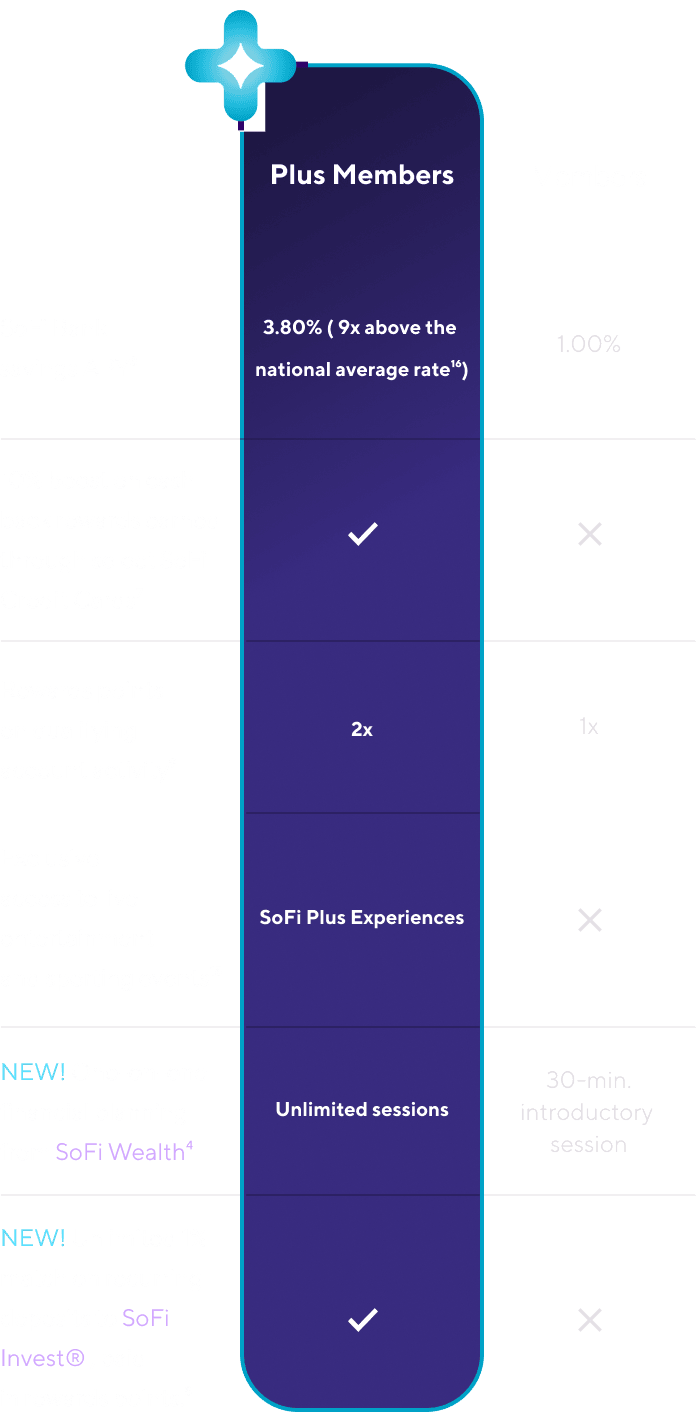
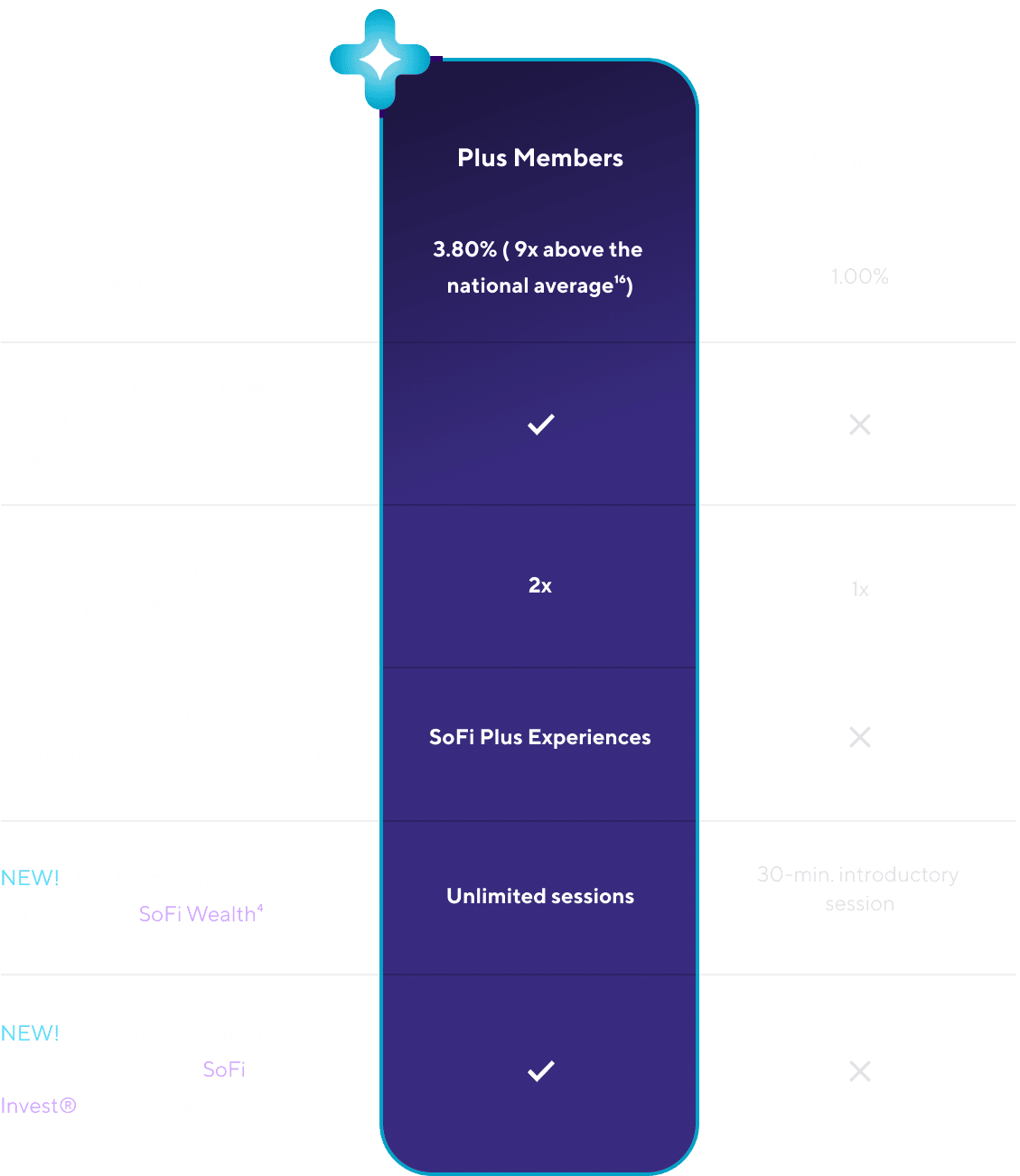
3.30% APY on SoFi Bank savings3

More advice

NEW! Unlimited access to financial planners4

SoFi Wealth

More for investors

NEW! 1% match on recurring invest deposits, paid in rewards points5

SoFi Invest®

Preferred IPO access6

SoFi Securities

More rewards

10% boost on cash back rewards earned through select SoFi Credit Cards7

NEW! 3% cash back rewards on SoFi Travel hotels booked with any card8

2x rewards points on qualifying account activity9

More for borrowers

NEW! $1,000 home mortgage discount. Must be a SoFi Plus member when approved.10

Rate discount on new personal loans11

NEW! Rate discount on student loan refinancing12

More protection

NEW! 50% discount on Hello Privacy13

NEW! $200 off trusts with Trust & Will14

More fun

NEW! SoFi Plus Experiences15

See below for specific offer terms

Compare top SoFi Plus benefits.

These easy-to-earn benefits are just the start of the $1,000+ in value that SoFi Plus subscribers unlock.

So many ways to unlock $1,0001 from SoFi Plus…

Example 1

Mix and match to add up $1,000.

$220 in interest + $600 in cash back rewards + $250 in value


Save $6,000 and earn $220 in interest with our highest APY on SoFi Bank savings.


Spend $2,300 on your SoFi Credit Card each month and earn $600 in cash back rewards.


Meet with a financial planner, a $250 value.

Example 2

Get unlimited access to financial planners


$250 value each time.


Schedule as many one-on-one sessions as you need.


4 sessions x $250 = $1,000.

Example 3

Buy a home. Unlock a $1,000 discount.10


We’ll celebrate you closing a dream home with a dream discount.


Your $1,000 discount is also available on a mortgage refinance.


Must be a SoFi Plus member when approved.

Or find your own path! There are so many ways to save and earn with SoFi Plus, we can’t wait to see what you’ll do.


Get SoFi Plus

1$1,000 value: See assumptions and details below, value is not guaranteed and varies depending on benefits used. Terms apply.

The estimated value of a meeting with our financial planners is based on SoFi’s competitive assessment of similar offerings. See full terms below.

SoFi Plus members are eligible for a one-time discount on loans originated by SoFi Bank of $1,000 off the standard origination fee for home purchase or refinance mortgages. See full terms below.

Live sports, music, and more: SoFi Plus Experiences.7

SoFi Plus members get exclusive chances to enjoy top, live entertainment with SoFi Plus Experiences.


Get SoFi Plus

How will you join SoFi Plus?


Subscribe for just $10/month.
17

• Includes all benefits in one monthly payment.

• No direct deposit or SoFi products needed.

Subscribe with eligible direct deposit.

• Includes all benefits at no extra cost.

• Eligible direct deposit to a SoFi Checking and Savings account required.


Get SoFi Plus

Read more

Is 495 a Good Credit Score?


Is 495 a Good Credit Score?

495 credit score

On this page:

    By Rebecca Lake

    Credit scores measure your financial health and tell lenders how you manage credit and debt. These scores are calculated based on information in your credit reports. If you plan to apply for a loan or line of credit, this three-digit number can make a difference in whether you’re approved and the rates you pay.

    Is 495 a good credit score? The short answer is no, not at all. Read on to learn what a credit score below 500 means and how it can affect you financially.

    Key Points

    •   A credit score of 495 is considered poor, indicating that you pose a high risk to lenders.

    •   Poor credit scores typically lead to higher interest rates and less-favorable lending terms, making financial products more expensive.

    •   Challenges include difficulty in loan and credit card approval, with limited options and higher interest rates.

    •   A mortgage, including FHA, VA and USDA loans, can be particularly hard to obtain with a poor credit score.

    •   Steps to improve the score include timely payments, reducing debt, using secured credit cards, and checking your credit report for errors.

    What Does a 495 Credit Score Mean?

    Credit scores operate on a range. FICO® credit scores, which are used by 90% of top lenders for loan decisions, range from 300 to 850. Where you fall in that range determines what kind of credit rating you have.

    A credit score of 495 is poor on the FICO scale. A poor credit score means that:

    •   Your credit score is well below the average borrower’s credit score.

    •   You present a greater risk to lenders.

    For perspective, the average credit score in the U.S. is 715, according to Experian. That’s well above the minimum threshold for “good” credit.

    Is 495 a bad credit score? Yes. Is it the end of the world? No, but it could make life harder if you need to borrow money.

    You may not be approved at all for credit, or you may only qualify for bad credit loans. Some bad credit loans, like payday loans or title loans, are predatory in nature. Payday loans, for example, can have interest rates approaching 400%. Lenders can charge rates that high if you have a 495 credit score because they bank on you not being able to get approved elsewhere.

    What Else Can You Get with a 495 Credit Score?

    Lenders may be reluctant to offer you loans when your credit score is below 500, regardless of the reasons why your score is that low.

    For example, maybe you’re recently divorced and your ex-spouse ran up debt in both your names. Those debts can affect your credit score, regardless of whether you or your ex is the one who’s paying them off. Or maybe you fell behind on your credit card payments because of an extended illness, which hurt your score.

    Both situations may have been beyond your control, but they still impact your credit negatively and make you seem like a bigger risk. Let’s look at how a 495 credit score affects your ability to get different types of credit.

    Can I Get a Credit Card with a 495 Credit Score?

    Credit cards let you buy things now and pay for them later. You may be able to get a credit card with a 495 credit score, though you might be limited to a secured credit card. Secured credit cards usually require a cash deposit to open; the deposit may double as your credit limit.

    Secured cards can help you build credit if your account history is reported to the credit bureaus. Another plus is that a low credit limit can keep you from piling up a lot of debt. Some secured cards offer added perks, like earning cash back when you make eligible purchases.

    Over time, you may be able to graduate to an unsecured card and get your cash deposit back. One drawback of secured cards is that they sometimes have higher interest rates. So the best way to use them to build credit is to pay off the balance in full each month.

    If you have credit cards you’re trying to pay off, you could use a balance transfer or a credit card consolidation loan to lower your rate. On-time payments can get your credit health back on track, and you could save money on interest as well.

    Can I Get an Auto Loan with a 495 Credit Score?

    A 495 credit score car loan is possible, though it’s likely to be expensive. Rather than getting a car loan through a bank or an online lender, you might be limited to on-the-lot or in-house financing.

    There’s no minimum credit score required for a car loan, but lenders typically look for borrowers with good credit. That means a score of 670 or better on the FICO scale, though you could qualify with fair credit, which ranges from 580 to 669. The higher your score is, the lower your rates are likely to be.

    If you’re interested in a car loan and have bad credit, shop around. Compare loan terms, rates, and fees from multiple lenders or dealerships to estimate how much you’ll pay. If you can hold off on buying a car for now, you could work on improving your credit score, which could help you get a more favorable loan.

    Can I Get a Mortgage with a 495 Credit Score?

    Mortgage loans are secured by the home you’re buying. That means if you don’t make your payments as agreed, the lender can foreclose on the home and take the property in place of repayment.

    That reduces some of the risk to the lender, but it’s still very difficult to qualify for a mortgage with a 495 credit score. Even FHA loans, which are government-backed and designed for people with less-than-perfect credit, require a minimum credit score of 500 to qualify. If you’re just below that threshold, you may need to wait a little for your credit to improve.

    Conventional loans, meanwhile, typically require a 620 credit score. If you’re interested in a VA loan, there’s no minimum credit score required by the government, but lenders may look for a 620 score or better. The USDA loan program doesn’t have a minimum either, but lenders generally require a minimum score of 640.

    Can I Get a Personal Loan with a 495 Credit Score?

    Personal loans let you borrow a lump sum of money for a wide variety of reasons. Usually, these loans are unsecured, which means you don’t need a cash deposit or any other collateral to qualify.

    You may be able to get an unsecured personal loan with a 495 credit score, though the terms may not be the best. If you’re interested in a personal loan for bad credit, check online lenders, banks, and credit unions to see how the options compare. Use a personal loan calculator to estimate your costs.

    Peer-to-peer (P2P) lending is another option if you’re looking for alternatives to personal loans. These loans are funded through multiple investors who pool their money to lend to borrowers. They make money off the interest they charge.

    It may be easier to qualify for a P2P loan if you have poor credit. The trade-off is that the interest rates may be higher. However, these loans are typically not in the same predatory category as payday loans or title loans, which are best avoided whenever possible.

    The Takeaway

    Is a 495 credit score good or bad? It’s not good, but it’s not the end of the world either. If your score is in this range, ask yourself how you can improve it. Some of the best ways to boost a poor credit score include paying bills on time and reducing your debt.

    Think twice before turning to high-interest credit cards. Consider a SoFi personal loan instead. SoFi offers competitive fixed rates and same-day funding. See your rate in minutes.


    SoFi’s Personal Loan was named NerdWallet’s 2024 winner for Best Personal Loan overall.

    View your rate

    SoFi Loan Products
    SoFi loans are originated by SoFi Bank, N.A., NMLS #696891 (Member FDIC). For additional product-specific legal and licensing information, see SoFi.com/legal. Equal Housing Lender.


    Disclaimer: Many factors affect your credit scores and the interest rates you may receive. SoFi is not a Credit Repair Organization as defined under federal or state law, including the Credit Repair Organizations Act. SoFi does not provide “credit repair” services or advice or assistance regarding “rebuilding” or “improving” your credit record, credit history, or credit rating. For details, see the FTC’s website .


    Third-Party Brand Mentions: No brands, products, or companies mentioned are affiliated with SoFi, nor do they endorse or sponsor this article. Third-party trademarks referenced herein are property of their respective owners.


    Non affiliation: SoFi isn’t affiliated with any of the companies highlighted in this article.

    Financial Tips & Strategies: The tips provided on this website are of a general nature and do not take into account your specific objectives, financial situation, and needs. You should always consider their appropriateness given your own circumstances.


    SOPL-Q225-002

    Read more
    TLS 1.2 Encrypted
    Equal Housing Lender