Woman behind laptop

Why Your Student Loan Balance Never Seems to Decrease

If you’ve been making your student loan payments, yet your balance isn’t budging — or even worse, it’s gone up — you may be asking yourself, why did my student loan balance increase? The likely reason is that your monthly payments are not covering all the interest that has accrued, which may be a result of the payment plan you’re on.

Understanding how and when student loans accrue interest, and the role your repayment plan may play, can help you make smart choices about paying off your balance.

Key Points

•   Accrued interest can cause student loan balances to remain stagnant or grow. Federal student loans accrue interest daily.

•   At the beginning of the loan repayment term, larger portions of payments primarily cover interest rather than the principal. Over time, the portion reducing the principal increases as the interest portion decreases.

•   Income-driven repayment plans can lower monthly student loan payments, but they may be too low to fully cover the interest, which can potentially cause the loan balance to grow.

•   During a period of forbearance or deferment, interest continues to accrue on student loans, and on certain types of loans, the interest may capitalize.

•   Potential methods to reduce student loan balance include changing repayment plans, making extra payments toward the loan principal, and student loan refinancing.

What Makes Up a Student Loan Balance?

To understand what increases your total loan balance, it’s important to know how student loans work. Your student loan balance is made up of two parts: the amount you borrowed plus any origination fees (the principal) and what the lender charges you to borrow it (interest).

Once you receive your loan, interest begins to accrue. If it’s a Direct Subsidized loan, the federal government typically pays the interest while you’re in school and for the first six months after you graduate. After that, you are responsible for paying the interest along with the principal.

If the loan is a Direct Unsubsidized loan or a private student loan, the borrower is solely responsible for accrued interest, even while they’re in school.

The Impact of Interest Accrual

The interest rate on your student loan is calculated as a percentage of your unpaid principal amount. Most federal student loans accrue interest daily. To determine the amount of interest that accrues each day, multiply your loan balance by the number of days since your last payment and then multiply that number by your interest rate.

In some cases, unpaid interest on federal student loans can capitalize — such as after a deferment for a Direct Unsubsidized loan. That means the interest is added to your principal balance. Interest then accrues on the new, larger balance moving forward, which increases how much you owe.

How Do Payments Affect My Student Loan Principal?

Many student loan borrowers pay a fixed monthly payment to their lender. That payment includes the principal and the interest. At the beginning of a loan term, a larger portion of your payment goes toward paying interest, and a smaller portion goes to the principal. But the ratio of interest to principal gradually changes so that by the end of the loan term, your payment is mostly going toward the principal.

💡 Recommended: Defaulting on Student Loans

How Does an Income-Based Repayment Plan Affect My Student Loan Balance?

The payment process is different if you’re making payments under an income-driven repayment (IDR) plan. Under these plans, your payments are tied to your family size and discretionary income. The interest, however, doesn’t change based on your income.

While an IDR plan can lower your monthly payments, the payment amount might be too low to fully cover the interest that accrues for that month, much less contribute to your principal. In fact, your student loan balance may actually grow over time, despite the payments you’re making, and you could end up repaying significantly more than you borrowed originally.

Refi now to pay off loans &
reach your goals faster with a shorter term.


Forbearance and Deferment Periods

Borrowers can temporarily pause their federal student loans payments with a forbearance or deferment.

A student loan forbearance allows you to pause your payments for up to 12 months at a time. However, interest continues to accrue on your federal loans while you’re in forbearance. To qualify for a forbearance, you need to apply for it and demonstrate that you meet specific requirements, such as experiencing financial difficulties or facing medical bills. Your loan servicer will determine if you are eligible.

With a student loan deferment, you can temporarily pause the payments on your federal loans, but you must apply for a specific type of deferment and meet certain requirements to be eligible. The types of deferment include cancer treatment deferment, economic hardship deferment, and unemployment deferment, among others.

Interest accrues on your loans during deferment, and you may be responsible for paying it, depending on the type of loan you hold. For example, borrowers with Direct Unsubsidized loans, Direct PLUS loans, and Federal Family Education Loans (FFEL) typically need to pay the interest that accrues on these loans while in deferment. You can pay the interest as it accrues or not. However, if you don’t pay it, the interest will capitalize at the end of the deferment period, which means the total amount you pay over the life of the loan might be higher.

Private student loans may or may not allow forbearance or deferment, and the rules typically differ from lender to lender.

How to Pay Down Your Loan Quicker

When it comes to repaying student loans, the key is to find an approach you’ll stick with. One way to tackle the debt is by making extra payments toward the principal. Even a little bit can help bring down the loan balance.

Another approach is to consider a student loan refinance to a lower interest rate, if you qualify, or you could refinance to a shorter loan term. You could also potentially do both. Your payments may be higher, particularly if you switch to a shorter loan term, but you will be finished paying off the debt sooner.

Note that if you refinance a federal student loan, you will lose access to federal protections and programs such as the Public Service Loan Forgiveness program, and income-driven repayment plans.

Other Strategies to Reduce Your Student Loan Balance

There are additional methods you can use to help pay off your student loans. They may take longer than the approaches listed above, but they can help shrink your balance.

•   Switch to a different repayment plan. If you’re on an income-driven plan, you could change to the standard repayment plan instead. Your monthly payments will likely be higher on this plan, but that will typically reduce the total amount of interest you’ll pay. Plus, you’ll repay your loan in up to 10 years, rather than the 20 or 25 years on an IDR plan.

•   Enroll in autopay. When you sign up for automatic payment, your loan servicer will deduct the amount you owe from your bank account each month. You won’t have to remember to make your payments, and even better, if you have federal Direct loans you’ll get a 0.25% interest rate deduction for participating. Some private student loan lenders also offer a similar interest rate deduction for autopay.

•   Search for student loan repayment assistance or forgiveness options. The federal government, many states, and various organizations offer programs that help qualifying individuals in certain professions pay off their loans. This includes teachers, health-care professionals, members of the military, and those who work in public service. Do some research to see what programs you might be eligible for.

The Takeaway

The way loan payment schedules are set up is likely one reason why your regular payments don’t seem to be making much of a dent to your balance or loan principal. Initially, more of your payment goes toward paying interest and less goes toward the principal. But gradually that changes so that by the end of the loan term, most of your payment is going toward the principal.

In addition, the type of student loan repayment plan you’re on can increase the amount you owe. With an income-driven plan, your monthly payment may be low enough that it doesn’t cover the interest you owe, which could cause your loan balance to grow.

Fortunately, you have options to help pay off your loan faster or pay less interest over the life of the loan. For instance, you could switch to a different repayment plan, make extra payments toward your loan principal, or refinance your student loans.

Looking to lower your monthly student loan payment? Refinancing may be one way to do it — by extending your loan term, getting a lower interest rate than what you currently have, or both. (Please note that refinancing federal loans makes them ineligible for federal forgiveness and protections. Also, lengthening your loan term may mean paying more in interest over the life of the loan.) SoFi student loan refinancing offers flexible terms that fit your budget.

With SoFi, refinancing is fast, easy, and all online. We offer competitive fixed and variable rates.


SoFi Student Loan Refinance
Terms and conditions apply. SoFi Refinance Student Loans are private loans. When you refinance federal loans with a SoFi loan, YOU FORFEIT YOUR ELIGIBILITY FOR ALL FEDERAL LOAN BENEFITS, including all flexible federal repayment and forgiveness options that are or may become available to federal student loan borrowers including, but not limited to: Public Service Loan Forgiveness (PSLF), Income-Based Repayment, Income-Contingent Repayment, extended repayment plans, PAYE or SAVE. Lowest rates reserved for the most creditworthy borrowers.
Learn more at SoFi.com/eligibility. SoFi Refinance Student Loans are originated by SoFi Bank, N.A. Member FDIC. NMLS #696891 (www.nmlsconsumeraccess.org).

SoFi Private Student Loans
Please borrow responsibly. SoFi Private Student loans are not a substitute for federal loans, grants, and work-study programs. We encourage you to evaluate all your federal student aid options before you consider any private loans, including ours. Read our FAQs.

Terms and conditions apply. SOFI RESERVES THE RIGHT TO MODIFY OR DISCONTINUE PRODUCTS AND BENEFITS AT ANY TIME WITHOUT NOTICE. SoFi Private Student loans are subject to program terms and restrictions, such as completion of a loan application and self-certification form, verification of application information, the student's at least half-time enrollment in a degree program at a SoFi-participating school, and, if applicable, a co-signer. In addition, borrowers must be U.S. citizens or other eligible status, be residing in the U.S., Puerto Rico, U.S. Virgin Islands, or American Samoa, and must meet SoFi’s underwriting requirements, including verification of sufficient income to support your ability to repay. Minimum loan amount is $1,000. See SoFi.com/eligibility for more information. Lowest rates reserved for the most creditworthy borrowers. SoFi reserves the right to modify eligibility criteria at any time. This information is subject to change. This information is current as of 4/22/2025 and is subject to change. SoFi Private Student loans are originated by SoFi Bank, N.A. Member FDIC. NMLS #696891 (www.nmlsconsumeraccess.org).

SoFi Loan Products
SoFi loans are originated by SoFi Bank, N.A., NMLS #696891 (Member FDIC). For additional product-specific legal and licensing information, see SoFi.com/legal. Equal Housing Lender.


Third-Party Brand Mentions: No brands, products, or companies mentioned are affiliated with SoFi, nor do they endorse or sponsor this article. Third-party trademarks referenced herein are property of their respective owners.

Non affiliation: SoFi isn’t affiliated with any of the companies highlighted in this article.

Financial Tips & Strategies: The tips provided on this website are of a general nature and do not take into account your specific objectives, financial situation, and needs. You should always consider their appropriateness given your own circumstances.

SOSLR-Q125-002

Read more
house next to a condo

House or Condo: Which is Right For You? Take The Quiz

If you’re thinking about buying a home in the not-too-distant future, you may be wondering what kind of property to purchase. Would a single-family house be better, or perhaps a condo unit?

Some important factors: Do you prefer being in a city, perhaps in an apartment or townhome, or are you all about a house with a picket fence? Do you like handling your own gardening and picking your own front-door paint colors, or would you like to delegate that? Do you like neighbors close by or prefer privacy? Does your household include furbabies?

These are some of the considerations that may impact whether a house or a condo is right for you. Each option has its pros and cons, and of course, finances will play a role too.

Key Points

•   Houses typically cost more but are considered better long-term investments.

•   Condos reduce maintenance and utility costs, but fees apply.

•   Houses offer more privacy and living space.

•   Condos often include shared amenities, and many offer urban perks.

•   Condo values appreciate more slowly than those of houses.

To decide which might suit you best, take this house vs. condo quiz, and then learn more about some key factors.

House or Condo Quiz

Next, you might want to take these pros and cons into consideration as well.

Pros and Cons of Buying a House

A top-of-mind question for many people is, “Isn’t a house more expensive than a condo?” Cost is a factor, especially when buying in a hot market, and there can typically be a significant difference between a house and a condo when you are home shopping.

The median sales price of existing single-family homes was $404,400 in the fourth quarter of 2024, according to St. Louis Fed data, compared with a median existing condo price of $359,000 in December 2024, according to the National Association of Realtors®.

Now that you know that price info, look at these pros and cons when buying a house vs. a condo.

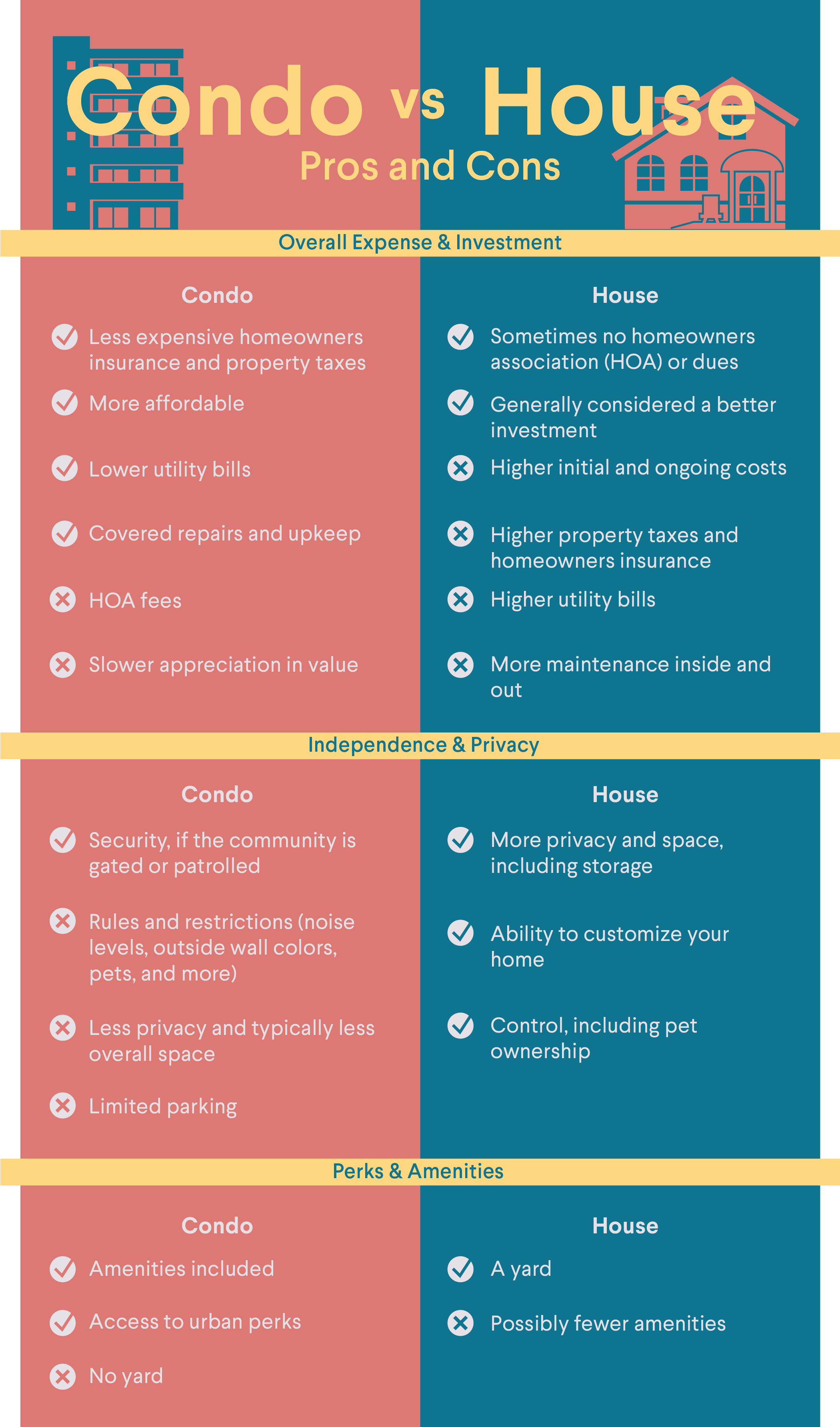
Pros of Buying a House

Among the benefits of buying a house are the following:

•   More privacy and space, including storage

•   A yard

•   Ability to customize your home as you see fit

•   Room to garden and create an outdoor space, just as you want it to be

•   Control of your property

•   Pet ownership unlikely to be an issue

•   Sometimes no homeowners association (HOA) or dues

•   Generally considered a better investment

Cons of Buying a House

However, you may have to contend with these downsides:

•   Potentially higher initial and ongoing costs

•   More maintenance inside and out

•   Typically higher utility bills

•   Potentially higher property taxes and homeowners insurance

•   Possibly fewer amenities (such as common areas, a gym, etc.)

If, after taking the quiz and weighing the pros and cons, buying a house feels like the right choice, you can start brainstorming about size, style, location, and price; attending open houses; and looking online.

Learning how to win a bidding war might also come in handy, depending on the temperature of the market.

First-time homebuyers can
prequalify for a SoFi mortgage loan,
with as little as 3% down.

Questions? Call (888)-541-0398.


Pros and Cons of Buying a Condo

A quick look at how condos work before diving in: Condominium owners share an interest in common areas, like the grounds and parking structures, and hold title to their individual units. They are members of an HOA that enforces community rules. Being a member of a community in this way is a key difference between a condo and a house.

Pros of Buying a Condo

Here are some of the upsides of purchasing a condo:

•   More affordable

•   Amenities included (this might include common rooms, a fitness center, and other features)

•   Potentially less expensive homeowners insurance and property taxes

•   Repairs and upkeep of the property typically taken care of

•   Typically lower utility bills

•   Security, if the community is gated or patrolled

•   Access to urban perks

Cons of Buying a Condo

Next, consider the drawbacks of condo living:

•   Less privacy

•   Typically no private yard

•   Rules and restrictions (about noise levels, outside wall colors, pets, and more)

•   Typically less overall space

•   HOA fees

•   Limited parking

•   Slower appreciation in value

Plus, the mortgage interest rate and down payment are often higher on a condo vs. a house of the same value, though that isn’t always the case, especially for a first-time buyer of an owner-occupied condo.

Conventional home loan mortgage lenders sometimes charge more for loans on condo units; they take into consideration the strength of the condo association financials and vacancy rate when weighing risk.

Mortgages backed by the Federal Housing Administration (FHA) are available for condos, even if they are not part of an FHA-approved condominium project, with a process called the Single Unit Approval Program.

An FHA loan is easier to qualify for and requires as little as 3.5% down, but you’ll pay upfront and ongoing mortgage insurance premiums.

Condo vs House Pros and Cons

What Are the Costs of a House or Condo?

As mentioned above, houses tend to cost more than condos. But here are a few other ways to look at the financials when comparing a condo vs. a house:

•   Condos tend to have lower list prices than houses which may mean a smaller mortgage. However, you also need to factor in monthly maintenance fees and HOAs so you get the full picture.

•   Condos may have assessments from time to time. These are additional charges to fund projects for the unexpected expenses, such as a capital improvement to the entire dwelling.

•   Homeowner fees are growing along with inflation, so when you make your purchase, understand that these charges are not static.

•   Before buying into an HOA community, it’s imperative to vet the board’s finances, including its reserve fund, how often it has raised rates in recent years, whether it has collected any special assessments or plans, and whether it’s facing any lawsuits.

•   If you are buying a house, keep in mind that maintenance and upkeep are your responsibility. This can mean everything from replacing a hot-water heater that’s reaching the end of its lifespan to dealing with roof repairs.

•   Down payments will vary due to several factors. For a condo, a down payment is typically around 10% but can vary considerably from, say, 3% to 20%.

•   With a house, a down payment could be from 3.5% with an FHA loan to the conventional 20% needed to avoid private mortgage insurance, or PMI. Those who qualify for VA loans may be able to buy a house without a down payment.

•   If you are buying a house, make sure to scrutinize property taxes and factor those into your budget. Those are not fixed and can rise over time.

Another smart move: Check out this home affordability calculator to get a better feel for the bottom line.

When Is a Good Time to Buy?

You may know what you’d like to buy (condo vs. a house) and where (in what neighborhood), but do you feel as though now is the right time? If so, fantastic.

You might decide, though, that you want to rent for a while longer under certain circumstances, which can include:

•   Hoping to wait out an overheated market and looking at price-to-rent ratios

•   Wanting to save more money for the down payment and closing costs (the bigger your down payment, the lower your monthlies will likely be)

•   Needing to boost your credit score first

•   Wanting to pay down credit card debt or other debt, which improves your debt-to-income ratio or DTI

•   Needing more time to look at houses and condos before deciding which path to take


Get matched with a local
real estate agent and earn up to
$9,500 cash back when you close.

The Takeaway

The condo vs. house decision depends on a multitude of factors. Reviewing the pros and cons of buying a condo vs. a house can at least give you a direction to start your search. And so can such givens as knowing that you want to be in a certain location (downtown in a condo instead of in a house on a couple of acres), or that you have lots of dogs and therefore want your own yard, and so forth.

Looking for an affordable option for a home mortgage loan? SoFi can help: We offer low down payments (as little as 3% - 5%*) with our competitive and flexible home mortgage loans. Plus, applying is extra convenient: It's online, with access to one-on-one help.

SoFi Mortgages: simple, smart, and so affordable.


Financial Tips & Strategies: The tips provided on this website are of a general nature and do not take into account your specific objectives, financial situation, and needs. You should always consider their appropriateness given your own circumstances.

SoFi Mortgages
Terms, conditions, and state restrictions apply. Not all products are available in all states. See SoFi.com/eligibility-criteria for more information.


SoFi Loan Products
SoFi loans are originated by SoFi Bank, N.A., NMLS #696891 (Member FDIC). For additional product-specific legal and licensing information, see SoFi.com/legal. Equal Housing Lender.


External Websites: The information and analysis provided through hyperlinks to third-party websites, while believed to be accurate, cannot be guaranteed by SoFi. Links are provided for informational purposes and should not be viewed as an endorsement.

‡Up to $9,500 cash back: HomeStory Rewards is offered by HomeStory Real Estate Services, a licensed real estate broker. HomeStory Real Estate Services is not affiliated with SoFi Bank, N.A. (SoFi). SoFi is not responsible for the program provided by HomeStory Real Estate Services. Obtaining a mortgage from SoFi is optional and not required to participate in the program offered by HomeStory Real Estate Services. The borrower may arrange for financing with any lender. Rebate amount based on home sale price, see table for details.

Qualifying for the reward requires using a real estate agent that participates in HomeStory’s broker to broker agreement to complete the real estate buy and/or sell transaction. You retain the right to negotiate buyer and or seller representation agreements. Upon successful close of the transaction, the Real Estate Agent pays a fee to HomeStory Real Estate Services. All Agents have been independently vetted by HomeStory to meet performance expectations required to participate in the program. If you are currently working with a REALTOR®, please disregard this notice. It is not our intention to solicit the offerings of other REALTORS®. A reward is not available where prohibited by state law, including Alaska, Iowa, Louisiana and Missouri. A reduced agent commission may be available for sellers in lieu of the reward in Mississippi, New Jersey, Oklahoma, and Oregon and should be discussed with the agent upon enrollment. No reward will be available for buyers in Mississippi, Oklahoma, and Oregon. A commission credit may be available for buyers in lieu of the reward in New Jersey and must be discussed with the agent upon enrollment and included in a Buyer Agency Agreement with Rebate Provision. Rewards in Kansas and Tennessee are required to be delivered by gift card.

HomeStory will issue the reward using the payment option you select and will be sent to the client enrolled in the program within 45 days of HomeStory Real Estate Services receipt of settlement statements and any other documentation reasonably required to calculate the applicable reward amount. Real estate agent fees and commissions still apply. Short sale transactions do not qualify for the reward. Depending on state regulations highlighted above, reward amount is based on sale price of the home purchased and/or sold and cannot exceed $9,500 per buy or sell transaction. Employer-sponsored relocations may preclude participation in the reward program offering. SoFi is not responsible for the reward.

SoFi Bank, N.A. (NMLS #696891) does not perform any activity that is or could be construed as unlicensed real estate activity, and SoFi is not licensed as a real estate broker. Agents of SoFi are not authorized to perform real estate activity.

If your property is currently listed with a REALTOR®, please disregard this notice. It is not our intention to solicit the offerings of other REALTORS®.

Reward is valid for 18 months from date of enrollment. After 18 months, you must re-enroll to be eligible for a reward.

SoFi loans subject to credit approval. Offer subject to change or cancellation without notice.

The trademarks, logos and names of other companies, products and services are the property of their respective owners.


SOHL-Q125-045

Read more

How Much Do Doctors Make a Year in California?

The average salary for a doctor in California is $239,200 according to the latest data from the Bureau of Labor Statistics. Understanding the average salary of a profession can help you make a variety of important decisions, from what field you want to enter to where you want to live and work.

Here’s a closer look at how much medical doctors make a year in California, regional differences in salary, and the top-paying medical specialities in the state.

Key Points

•   In California, the average annual salary for a physician is $239,200.

•   Salaries for doctors in California are mid-range compared to other states like Arizona and Florida.

•   Factors such as Medicaid and Medicare reimbursements can influence doctors’ incomes.

•   Specialties like psychiatry and surgery can offer higher wages, with some salaries exceeding $300,000.

•   The path to becoming a doctor involves extensive education and licensing, impacting potential earnings.

What Is the Average Salary for a Medical Doctor in California?

The average salary of a physician in the state of California is $239,200 per year, according to data from the U.S. Bureau of Labor Statistics (BLS). This figure doesn’t account for a physician sign-on bonus, which some doctors receive. Interestingly, California is squarely in the middle when it comes to average physicians’ salaries. The average salary in California lags behind a dozen states, including New Mexico, Wyoming, Colorado, and Connecticut.

Though many consider anything more than $100,000 a good salary, the fact that California’s pay is not top tier may come as a surprise to some. However, there are some possible explanations. For one, California spends the most on Medicaid among U.S. states. Medicaid — and Medicare, for that matter — both reimburse physicians at rates lower than their usual fees. Doctors who are seeing a lot of elderly or low-income individuals may see their incomes reduced.

Note that early in your career as a doctor, while you’re in your residency or fellowship, you’ll likely make considerably less than you will later in your career. You may need to budget wisely to get by on a medical resident’s salary.

You may also want to consider using a spending app, which can help you set financial goals and a budget and track where your money goes.

Track your credit score with SoFi

Check your credit score for free. Sign up and get $10.*


How to Become a Doctor in California

Doctors are health care professionals who are charged with meeting with patients, diagnosing their conditions, and managing their care plans. They perform tests and prescribe medications. And they must coordinate with a range of other health care professionals, including other doctors, nurses, and emergency medical technicians.
That’s a lot of responsibility, and as a result, it takes a lot of training to become a doctor.

First, you’ll need to complete a bachelor’s degree in a field that relates to medicine, such as premedicine, biology, or biochemistry.

Next, you’ll need to go to medical school, where you will receive classroom and practical training to advance your knowledge in the medical field. Medical school is typically a four-year program. While in school, you’ll complete the first and second parts of the U.S. Medical Licensing Examination (USMLE). The average cost of medical school can be high, typically running more than $60,000 a year at private institutions.

When you graduate from medical school, you’ll enter a residency program that helps you choose a medical specialty. These programs usually last three years (but may be as long as seven), and under the supervision of an experienced physician, you’ll work full time as a resident doctor. You’ll complete your residency by passing the third and final part of the USMLE.

After your residency, you can choose to complete a fellowship that gives you further training in the specialty you’ve chosen. Though fellows tend to make more than residents, their salary isn’t as high as new doctors. The good news is, there are ways to budget on a medical fellowship salary.

Finally, you’ll need to obtain a California medical license from the Medical Board of California. You can renew your license every two years, which requires 50 hours of continuing medical education.

Recommended: What Is the Average Medical School Debt?

Reasons to Become a Doctor

Becoming a doctor can involve a lot of challenges, but it can also be immensely rewarding work. Here are a few reasons you might become a doctor:

•   To help others: Doctors diagnose and treat medical conditions, helping to save and improve patients’ lives. They are often involved in ongoing treatment, ushering patients down the path to recovery. Being a physician is a people-centric profession that involves working closely with patients and their families to explain medical conditions and treatment options.

•   To work in the sciences: If you’re interested in a variety of scientific fields, from biology to chemistry to anatomy to pharmacology, being a doctor is a way to explore these subjects while also helping others.

•   To find purpose: The responsibility toward patients and coworkers and the ability to better people’s health and well-being often provide doctors with a sense of satisfaction and meaning in their work.

•   To become a teacher: Becoming a doctor requires a lot of schooling and ongoing training. Doctors may pass on this knowledge by educating patients on how to lead healthier lives, educating medical students in teaching hospitals, and supervising residents.

•   To have job security: The job outlook for physicians is relatively low, with the field expected to grow 3% through 2031. That said, there are still 23,800 openings for physicians projected each year, according to BLS data.

•   To make a good salary: The annual average wage for all workers in the United States is $59,228, according to the BLS — quite a bit lower than the $239,200 average annual pay for physicians in California. That means a new doctor’s budget could be easier to wrangle than other workers starting their careers, but then again, a M.D. may have considerable educational debt.

Recommended: What Is The Average Salary in the U.S.?

Best-Paying Medical Doctor Jobs in California

The medical speciality you pursue in California will have a big impact on your salary. According to BLS data, here are some of the highest-paid physicians in California:

Psychiatrist

Psychiatrists help diagnose and treat mental disorders. Unlike psychologists, they are allowed to prescribe drugs for medical treatment.

Mean salary: $256,930

Obstetricians and Gynecologists

OBGYNs provide medical care related to childbirth and diagnose and treat diseases of the female reproductive organs. They also specialize in women’s health issues like hormone problems, infertility, and menopause.

Mean salary: $278,660

Anesthesiologist

Before, during, or after surgery, anesthesiologists administer anesthetics (which reduce sensitivity to pain) and analgesics (which act as pain relievers).

Mean salary: $339,470

Cardiologists

Cardiologists diagnose and treat conditions of the cardiovascular system.

Mean salary: $423,450

Radiologists

Radiologists use medical imaging techniques, such as x-rays, MRIs, and ultrasounds to diagnose and treat diseases and injuries.

Mean salary: $353,960

Pathologists

A pathologist helps diagnose diseases by running tests on organs, tissue, and bodily fluids, such as blood.

Mean salary: $270,560

Surgeons

Surgeons are medical doctors that may have to perform surgery, a procedure that physically changes a patient’s body.

Mean salary: $409,665

Recommended: Starting (and Keeping) an Emergency Fund

The Takeaway

Being a doctor can be fulfilling, as it allows you to help people through work in the medical sciences. It can also be monetarily rewarding, and understanding average salaries can help you make decisions about where you want to live and what you want to specialize in. Though income varies by speciality, the average salary for physicians in California is $239,200 per year. Whatever you may earn, tracking your money and budgeting wisely can be important steps to financial wellness.

Take control of your finances with SoFi. With our financial insights and credit score monitoring tools, you can view all of your accounts in one convenient dashboard. From there, you can see your various balances, spending breakdowns, and credit score. Plus you can easily set up budgets and discover valuable financial insights — all at no cost.

Stay up to date on your finances by seeing exactly how your money comes and goes.

FAQ

What is a doctor’s yearly salary in California?

In California, a doctor can expect to make $239,200 per year on average, according to data from the U.S. Bureau of Labor Statistics.

What is the highest-paying medical specialty?

Among the highest-paid doctors in California are surgeons and cardiologists.

Who earns more: a dentist or a doctor?

In California, doctors tend to make more than dentists, who earn $170,910 per year on average.


Photo credit: iStock/Drazen Zigic

SoFi Relay offers users the ability to connect both SoFi accounts and external accounts using Plaid, Inc.’s service. When you use the service to connect an account, you authorize SoFi to obtain account information from any external accounts as set forth in SoFi’s Terms of Use. Based on your consent SoFi will also automatically provide some financial data received from the credit bureau for your visibility, without the need of you connecting additional accounts. SoFi assumes no responsibility for the timeliness, accuracy, deletion, non-delivery or failure to store any user data, loss of user data, communications, or personalization settings. You shall confirm the accuracy of Plaid data through sources independent of SoFi. The credit score is a VantageScore® based on TransUnion® (the “Processing Agent”) data.

*Terms and conditions apply. This offer is only available to new SoFi users without existing SoFi accounts. It is non-transferable. One offer per person. To receive the rewards points offer, you must successfully complete setting up Credit Score Monitoring. Rewards points may only be redeemed towards active SoFi accounts, such as your SoFi Checking or Savings account, subject to program terms that may be found here: SoFi Member Rewards Terms and Conditions. SoFi reserves the right to modify or discontinue this offer at any time without notice.

Financial Tips & Strategies: The tips provided on this website are of a general nature and do not take into account your specific objectives, financial situation, and needs. You should always consider their appropriateness given your own circumstances.

This content is provided for informational and educational purposes only and should not be construed as financial advice.

Third-Party Brand Mentions: No brands, products, or companies mentioned are affiliated with SoFi, nor do they endorse or sponsor this article. Third-party trademarks referenced herein are property of their respective owners.

SORL-Q125-048

Read more

I Make $200,000 a Year, How Much House Can I Afford?

An income of $200,000 a year puts you in a good position to afford a home priced at $600,000. But whether you should aim higher or lower than this in your house hunt will depend on your debt, how much you’ve saved for a down payment, and current interest rates, among other factors. Read on for a breakdown of the variables that could affect how much of a mortgage you can manage.

What Kind of House Can I Afford with $200,000 a Year?

Not so very long ago, if you’d asked someone: “If I make $200,000 a year, how much house can I afford?” they probably would have said, “A mansion!” Of course, that isn’t necessarily true anymore. But that income still can get you a pretty sweet home in most places.

You can get an idea of how much house you can afford on a $200,000 income by using an online mortgage calculator or by prequalifying with one or more lenders for a home mortgage loan. Or you can run the numbers yourself using a calculation like the 28/36 rule, which says your mortgage payment shouldn’t be more than 28% of your monthly gross income, and your total monthly debt — including your mortgage payment — shouldn’t be more than 36% of your income. Let’s take a closer look at what could affect how much you can borrow and what your payments might be.


💡 Quick Tip: Not to be confused with prequalification, preapproval involves a longer application, documentation, and hard credit pulls. Ideally, you want to keep your applications for preapproval to within the same 14- to 45-day period, since many hard credit pulls outside the given time period can adversely affect your credit score, which in turn affects the mortgage terms you’ll be offered.

First-time homebuyers can
prequalify for a SoFi mortgage loan,
with as little as 3% down.

Questions? Call (888)-541-0398.


Understanding Debt-to-Income Ratio

You can expect lenders to look carefully at your debt-to-income ratio (DTI) — the second number in the 28/36 rule — when they’re deciding how much mortgage you can afford. It tells them how you’re handling the debt you already have and if you can manage more.

Your DTI ratio is calculated by dividing your total monthly debt payments by your monthly gross income. Mortgage lenders generally look for a DTI ratio of 36% or less; but depending on the lender and the type of home loan you’re hoping to get, you may be able to qualify with a DTI up to 43% or even 50%.

Typically, the lower your risk, the better your borrowing options. So if you want the best loan amount, rate, and terms, you’ll want to keep an eye on this number.

Your Down Payment Also Can Affect Costs

You may not need a hefty down payment to qualify for some home loans. But the more you can comfortably put down on a house, the less you’ll have to borrow, which can help lower your monthly payments. And if you put down at least 20%, you can avoid paying private mortgage insurance (PMI), which will further reduce your payments.

Other Factors that Can Affect Home Affordability

Your income, debt, and down payment are all primary factors in determining how much house you can afford. But there are other things that also can affect your ability to qualify for a mortgage that’s manageable, including:

Interest Rates

A lower mortgage interest rate can significantly lower your monthly payment — and the amount you’ll pay for your home over time. While interest rates are relatively consistent across the market, lenders do compete for customers, so you may benefit from shopping around. You also can help your chances of qualifying for a better rate by making sure your finances are in good shape and you have a solid credit score.

Loan Term

The most common mortgage term is 30 years, but different loan lengths are available depending on the type of mortgage you choose — and each has pros and cons. If you’re deciding between a 15-year vs. a 30-year mortgage, for example, the shorter term may offer a less expensive interest rate, which could save you money over the life of your loan. But the 30-year term will likely have lower monthly payments, which may be a better fit for your budget.

Homeowners Insurance

Understanding how to buy homeowners insurance and comparing the policies available may help you minimize this expense. Lenders require borrowers to have an adequate amount of homeowners insurance, and if you live in a state that’s considered “high risk,” the cost of coverage could be significant.

HOA Fees

If you’re buying in a community with lots of amenities, homeowners association (HOA) dues could add a substantial amount to your monthly home costs. (The monthly average is about $250, but fees can go as high as $2,500 or more.)

Property Taxes

Property taxes, which are generally based on the assessed value of a home, are often included in a borrower’s monthly mortgage payment, so it’s important to include this amount when you calculate home affordability. (Check your county’s website for the correct number.)

Location

If you’re a fan of real estate shows like House Hunters, you already know the city or even the particular neighborhood you want to live in can be a big factor in determining how much house you can afford. The overall cost of living can vary by state, and costs are also typically higher in cities vs. rural areas. If you aren’t willing to compromise on location, you may have to increase your housing budget to buy in the area you want.

Recommended: Best Affordable Places to Live in the U.S.

How to Afford More House with Down Payment Assistance

If you have the means to manage a higher monthly payment but you need some help with your down payment, there are state and federal down payment assistance programs that can help.

Many programs set limits on how much an eligible home can cost, or on the homebuyer’s income. But it’s worth checking out what’s available to you — especially if you live in a state with higher home values. In California, for example, where homes can be expensive, a first-time homebuyer with a $200,000 income still can qualify for assistance in some counties.


Get matched with a local
real estate agent and earn up to
$9,500 cash back when you close.

Home Affordability Examples

With a home affordability calculator, you can get a basic idea of how much house you can afford by plugging in some basic information about your income, savings, debt, and the home you hope to buy. Here are some hypothetical examples:

Example #1: Saver with a Little Debt

Annual income: $200,000

Amount available for down payment: $80,000

Monthly debt: $650

Mortgage rate: 6.5%

Property tax rate: 1.125%

House budget: $700,000


Example #2: Less Debt, But Also Less Savings

Gross annual income: $200,000

Amount available for down payment: $20,000

Monthly debt: $200

Mortgage rate: 6.5

Property tax rate: 1.125%

House budget: $605,000

How You Can Calculate How Much House You Can Afford

Along with using an online calculator to figure out how much house you might be able to afford on a $200,000 income, you also can run the numbers on your own. Some different calculations include:

The 28/36 Rule

We already covered the 28/36 rule, which combines two factors that lenders typically look at to determine home affordability: income and debt. The first number sets a limit of 28% of gross income as a homebuyer’s maximum total mortgage payment, including principal, interest, taxes, and insurance. The second number limits the mortgage payment plus any other debts to no more than 36% of gross income.

Here’s an example: If your gross annual income is $200,000, that’s $16,666 per month. So with the 28/36 rule, you could aim for a monthly mortgage payment of about $4,666—as long as your total debt (including car payments, credit cards, etc.) isn’t more than $6,000.

The 35/45 Model

Another DIY calculation is the 35/45 method, which recommends spending no more than 35% of your gross income on your mortgage and debt, and no more than 45% of your after-tax income on your mortgage and debt.

Here’s an example: Let’s say your gross monthly income is $16,666 and your after-tax income is about $13,000. In this scenario, you might spend between $5,833 and $5,850 per month on your debt payments and mortgage combined. This calculation gives you a bit more breathing room with your mortgage payment, as long as you aren’t carrying too much debt.

The 25% After-Tax Rule

If you’re worried about overspending, or you have other goals you’re working toward, this method will give you a more conservative result. With this calculation, your target is to spend no more than 25% of your after-tax income on your mortgage. Let’s say you make $13,000 a month after taxes. With this method, you would plan to spend $3,250 on your mortgage payments.

Keep in mind that these equations can only give you a rough idea of how much you can spend. When you want to be more certain about the overall price tag and monthly payments you can afford, it helps to go through the mortgage preapproval process.

Recommended: 2024 Home Loan Help Center

How Your Monthly Payment Affects Affordability

Some eager homebuyers can tend to put most of their focus on a home’s listing price or the interest rate. But it’s how those factors and others combine to raise or lower the monthly payment that can ultimately determine whether a buyer can afford the home or not.

Before signing on the dotted line, it’s a good idea to run the numbers on an online mortgage calculator to be confident you can stay on track.

If you do find yourself struggling a bit — perhaps because your income changes or an unexpected life event occurs — refinancing to a new loan with a lower payment may be an option. (Especially if interest rates drop.) But how soon you can refinance may depend on the type of loan you have.

Types of Home Loans Available to $200,000 Households

A $200,000 income can go a long way toward helping a buyer qualify for certain mortgage options, such as a conventional or jumbo loan. But a higher salary also could make you ineligible for a government-backed loan that has income limits. There also may be limits on the purchase price and type of property, depending on the mortgage you get.

Here are a few of the options that may be available to $200,000-income households:

Conventional Loans This loan is issued by a private lender, such as a bank, credit union, or other financial institution.

FHA loans Insured by the Federal Housing Administration, FHA loans are a good resource for borrowers with a lower credit score or little money available for a down payment. There are no limits on how much you can earn and get an FHA loan, but there may be a limit on how much you can borrow depending on where you plan to reside.

VA loans A loan guaranteed by the U.S. Department of Veterans Affairs is an excellent option for eligible members of the U.S. military and surviving spouses. There are no income limits on VA loans, and there are no longer standard loan limits on VA direct or VA-backed home loans.

USDA loans These loans are guaranteed by the U.S. Department of Agriculture and are meant to help moderate- to low-income borrowers buy homes in eligible (typically rural) areas. Loan limits and income limits are based on the home’s location.


💡 Quick Tip: Keep in mind that FHA home loans are available for your primary residence only. Investment properties and vacation homes are not eligible.

The Takeaway

There are several variables that factor into how much home you can afford. Besides your income, lenders will look at your credit, your debt, and your down payment to determine how much you can borrow. To find a loan and monthly payment that’s a good fit for you, it’s a good idea to research and compare different loan types and amounts. And, if you have questions, you can seek advice from a qualified mortgage professional.

Looking for an affordable option for a home mortgage loan? SoFi can help: We offer low down payments (as little as 3% - 5%*) with our competitive and flexible home mortgage loans. Plus, applying is extra convenient: It's online, with access to one-on-one help.

SoFi Mortgages: simple, smart, and so affordable.

FAQ

Is $200,000 a good salary for a single person?

According to the Census Bureau, only 11.5% of U.S. households earned $200,000 or more in 2022. So, if you’re earning $200,000 all on your own, you could say you’re doing pretty well.

What is a comfortable income for a single person?

“Comfortable” is a subjective term and can vary from one person to the next. For some people comfortable means being able to buy what they want. For others it means crafting and following a careful budget so that they know where their money is going each month.

What is a livable wage in 2024?

The Massachusetts Institute of Technology’s Living Wage Calculator lists living costs across the U.S., and its “livable wage” varies widely based on family size and location. For a single person with no children in Napa County, California, for instance, the living wage is $21.62 per hour. In Boone County, Nebraska, it’s $14.93 per hour.

What salary is considered rich for a single person?

The top 5% of earners made, on average, $335,891 in 2021, the most recent year for which data is available, according to the Economic Policy Institute. (If you feel as though you have to be in the top 1% to be “rich,” you’d have to earn $819,324 or more.)


Photo credit: iStock/YvanDube

SoFi Loan Products
SoFi loans are originated by SoFi Bank, N.A., NMLS #696891 (Member FDIC). For additional product-specific legal and licensing information, see SoFi.com/legal. Equal Housing Lender.


SoFi Mortgages
Terms, conditions, and state restrictions apply. Not all products are available in all states. See SoFi.com/eligibility-criteria for more information.


*SoFi requires Private Mortgage Insurance (PMI) for conforming home loans with a loan-to-value (LTV) ratio greater than 80%. As little as 3% down payments are for qualifying first-time homebuyers only. 5% minimum applies to other borrowers. Other loan types may require different fees or insurance (e.g., VA funding fee, FHA Mortgage Insurance Premiums, etc.). Loan requirements may vary depending on your down payment amount, and minimum down payment varies by loan type.

Financial Tips & Strategies: The tips provided on this website are of a general nature and do not take into account your specific objectives, financial situation, and needs. You should always consider their appropriateness given your own circumstances.

Third-Party Brand Mentions: No brands, products, or companies mentioned are affiliated with SoFi, nor do they endorse or sponsor this article. Third-party trademarks referenced herein are property of their respective owners.

Tax Information: This article provides general background information only and is not intended to serve as legal or tax advice or as a substitute for legal counsel. You should consult your own attorney and/or tax advisor if you have a question requiring legal or tax advice.

¹FHA loans are subject to unique terms and conditions established by FHA and SoFi. Ask your SoFi loan officer for details about eligibility, documentation, and other requirements. FHA loans require an Upfront Mortgage Insurance Premium (UFMIP), which may be financed or paid at closing, in addition to monthly Mortgage Insurance Premiums (MIP). Maximum loan amounts vary by county. The minimum FHA mortgage down payment is 3.5% for those who qualify financially for a primary purchase. SoFi is not affiliated with any government agency.
Veterans, Service members, and members of the National Guard or Reserve may be eligible for a loan guaranteed by the U.S. Department of Veterans Affairs. VA loans are subject to unique terms and conditions established by VA and SoFi. Ask your SoFi loan officer for details about eligibility, documentation, and other requirements. VA loans typically require a one-time funding fee except as may be exempted by VA guidelines. The fee may be financed or paid at closing. The amount of the fee depends on the type of loan, the total amount of the loan, and, depending on loan type, prior use of VA eligibility and down payment amount. The VA funding fee is typically non-refundable. SoFi is not affiliated with any government agency.
‡Up to $9,500 cash back: HomeStory Rewards is offered by HomeStory Real Estate Services, a licensed real estate broker. HomeStory Real Estate Services is not affiliated with SoFi Bank, N.A. (SoFi). SoFi is not responsible for the program provided by HomeStory Real Estate Services. Obtaining a mortgage from SoFi is optional and not required to participate in the program offered by HomeStory Real Estate Services. The borrower may arrange for financing with any lender. Rebate amount based on home sale price, see table for details.

Qualifying for the reward requires using a real estate agent that participates in HomeStory’s broker to broker agreement to complete the real estate buy and/or sell transaction. You retain the right to negotiate buyer and or seller representation agreements. Upon successful close of the transaction, the Real Estate Agent pays a fee to HomeStory Real Estate Services. All Agents have been independently vetted by HomeStory to meet performance expectations required to participate in the program. If you are currently working with a REALTOR®, please disregard this notice. It is not our intention to solicit the offerings of other REALTORS®. A reward is not available where prohibited by state law, including Alaska, Iowa, Louisiana and Missouri. A reduced agent commission may be available for sellers in lieu of the reward in Mississippi, New Jersey, Oklahoma, and Oregon and should be discussed with the agent upon enrollment. No reward will be available for buyers in Mississippi, Oklahoma, and Oregon. A commission credit may be available for buyers in lieu of the reward in New Jersey and must be discussed with the agent upon enrollment and included in a Buyer Agency Agreement with Rebate Provision. Rewards in Kansas and Tennessee are required to be delivered by gift card.

HomeStory will issue the reward using the payment option you select and will be sent to the client enrolled in the program within 45 days of HomeStory Real Estate Services receipt of settlement statements and any other documentation reasonably required to calculate the applicable reward amount. Real estate agent fees and commissions still apply. Short sale transactions do not qualify for the reward. Depending on state regulations highlighted above, reward amount is based on sale price of the home purchased and/or sold and cannot exceed $9,500 per buy or sell transaction. Employer-sponsored relocations may preclude participation in the reward program offering. SoFi is not responsible for the reward.

SoFi Bank, N.A. (NMLS #696891) does not perform any activity that is or could be construed as unlicensed real estate activity, and SoFi is not licensed as a real estate broker. Agents of SoFi are not authorized to perform real estate activity.

If your property is currently listed with a REALTOR®, please disregard this notice. It is not our intention to solicit the offerings of other REALTORS®.

Reward is valid for 18 months from date of enrollment. After 18 months, you must re-enroll to be eligible for a reward.

SoFi loans subject to credit approval. Offer subject to change or cancellation without notice.

The trademarks, logos and names of other companies, products and services are the property of their respective owners.


SOHL0124061

Read more
toothbrush and floss

How to Pay for Dental School

The demand for dentists, like other health care professionals, is on the rise, partly due to an aging U.S. population and partly due to more attention on dental health with each generation. The aging population is likely to need additional oral care, some of which can include complicated procedures.

By learning about the average tuition costs and ways to pay for dental school, prospective students can figure out if a dental career is the right choice for their future.

Keep reading to learn more on the employment outlook for dentists, ways to pay for dental school, how to pay for dental school without loans, and more.

Key Points

•   To pay for dental school, seek scholarships and grants from professional organizations, universities, and private institutions. These awards often require strong academic performance, community service, or specific career goals, and they don’t need to be repaid.

•   Programs like the National Health Service Corps (NHSC), Indian Health Service (IHS), and military scholarships cover tuition and provide living stipends in exchange for a service commitment after graduation.

•   You can also apply for federal loans through FAFSA, such as Direct Unsubsidized Loans and Grad PLUS Loans, which offer competitive interest rates and flexible repayment plans tailored to students.

•   Many dental schools offer work-study opportunities, allowing students to earn money to offset education costs. Additionally, part-time jobs or teaching assistant positions can provide supplemental income while in school.

•   Private lenders can help cover gaps in funding, but they often have higher interest rates and stricter terms. Compare options and ensure you understand repayment terms before committing.

Employment Outlook for Dentists

The U.S. Bureau of Labor Statistics (BLS) projects there to be a 5% increase in available dentist jobs from 2023 to 2033. Dentists can work in a variety of settings, such as private practice — either on their own or with a partner — or in an outpatient care center, among others.

The median annual salary of a general dentist was $170,910 in 2023. For perspective, the median annual U.S. income in the same year was $65,470.

While dentistry pays well, it also costs a lot to become a dentist. Dental school programs typically take four years to complete after students have already completed a bachelor’s degree. A degree from an accredited dental school will be either a D.D.S. (Doctor of Dental Surgery) or a D.M.D. (Doctor of Dental Medicine).

Individual universities determine which degree is awarded, but they are both approved by the Commission on Dental Accreditation (CODA), a part of the American Dental Association (ADA). Whichever degree a dental graduate is awarded, chances are they may also have hundreds of thousands of dollars worth of student loan debt to contend with after graduation.

How Much Does Dental School Cost?

The range of dental school costs depends on whether a student is in-state (resident) or out-of-state (non-resident), and whether attending a public or private school. In-state public school tuition is typically going to be the least expensive option for most students.

According to the ADA, the average first-year cost of dental school (public or private), including tuition and mandatory fees, in 2023-2024 was $44,608 for residents and $75,163 for non-residents.

The cost difference between public schools and private schools can be substantial. The average resident cost for the first year of a public dental school program was $41,711, while the first-year cost for private dental school was $84,842 in 2023-24. After four years in school, students are looking at an average of $293,900 in debt.

Prospective students can compare the cost of dental schools and then determine how much they are willing to pay for their education. According to the ADA, there are 81 accredited dental schools throughout the United States and 10 in Canada.

Ways to Pay for Dental School

Even though dental school tuition can be expensive, students have options when figuring out how to pay for dental school. Students can explore scholarships, grants, fellowships, and service programs to help pay for dental school.

Federal and private student loans are also an option. After graduating from dental school, some borrowers may consider refinancing their student loans as they pay off dental school debt. Continue reading for more details on paying for dental school.

1. Scholarships and Grants

Scholarships and grants are awards that, in most cases, don’t have to be repaid. For students without the means to pay for tuition and other costs from personal savings, exploring these options may be a good place to start.

Dental schools may offer scholarships and grants to students who meet certain academic standards or who are working towards a certain type of degree, for example. When researching dental schools, prospective students may consider asking financial aid offices about available scholarships and grants.

Along with reaching out to schools, students may want to research scholarships and grants through organizations like the American Dental Association, the American Association of Public Health Dentistry, or the American Dental Education Association. There are also a variety of online scholarship search tools that students can use to find scholarships.

Recommended: What Is a Scholarship & How to Get One?

2. Service Programs

Several service programs can help pay for dental school, including:

•   National Health Service Corps (NHSC): This federal program offers scholarships and loan repayment options to dental students who commit to working in designated Health Professional Shortage Areas (HPSAs) after graduation. Scholarships cover tuition, fees, and living stipends, while loan repayment programs reduce educational debt in exchange for a minimum service obligation of two years.

•   Armed Forces Health Professions Scholarship Program (HPSP): Provided by branches of the U.S. military, HPSP covers full tuition for dental school, offers a monthly living stipend, and may include bonuses. Participants serve as military dentists for a designated number of years after completing their education, gaining valuable clinical experience and leadership training.

•   Indian Health Service (IHS) Loan Repayment Program: This program is aimed at improving dental care access in Native American and Alaska Native communities. Dentists receive up to $40,000 in loan repayment for a two-year service commitment at an IHS or Tribal site. Participants can extend their service for additional loan repayment benefits.

•   Public Health Service Commissioned Corps: This program allows dentists to serve as officers in the U.S. Public Health Service, providing care in federal agencies like the Centers for Disease Control and Prevention (CDC), Bureau of Prisons, or the Food and Drug Administration (FDA). Participants may receive loan repayment assistance and competitive salaries.

•   State-based programs: Many states offer incentives such as scholarships, grants, or loan repayment programs to dental professionals willing to practice in rural or underserved areas. These programs vary by state and may require service commitments ranging from two to five years.

Each program offers financial relief but requires a contractual commitment to serve specific populations or organizations.

Repay your way. Find the monthly student loan
payment and rate that fits your budget.


3. Federal Student Loans

Completing the FAFSA® (Free Application for Federal Student Aid) form is the first step students should take to determine eligibility for federal financial aid. To fill out the form, they will need to provide personal identification and financial records.

Federal student loans for graduate and professional school students are either Direct Unsubsidized Loans or Direct PLUS Loans. Students may borrow up to $20,500 each year in Direct Unsubsidized Loans, and eligibility is not based on financial need.

If a student has costs in excess of that borrowing limit, they may want to consider a Direct PLUS Loan. Like a Direct Unsubsidized Loan, eligibility for a Direct PLUS Loan is not based on financial need, although a credit check is required.

Students are encouraged to ask the financial aid office at their school about school-based loans that might be available. Some federal funds are offered to schools instead of directly to students and are tied to certain eligibility requirements.

4. Private Student Loans

It’s always recommended that students exhaust all federal student loan options before considering a private student loan. But if there is still a financial need, a private student loan may be the right choice for some students. Private student loans are available from private lenders and are awarded based on factors including your income, credit history, and credit score, among other factors.

Considering Student Loan Refinancing

After graduating, dentists may consider refinancing their student loans to secure a more competitive interest rate or more favorable terms. Refinancing also allows borrowers to combine all their loans into a single loan. This won’t be the right choice for all borrowers because when you refinance federal loans you’ll lose access to any federal benefits — like any loan forgiveness options.

Should you refinance your student loans? The answer is personal and will depend on factors including the amount of student debt you currently have, your credit score, income, and whether you are your income, and whether you are refinancing with or without a cosigner.

Recommended: Student Loan Refinance Guide

5. Employment

Dental school is rigorous, but if students have the time and energy, they may want to consider working to supplement their educational costs. The federal work-study program is available to graduate and professional students with financial need, and has the same eligibility requirements and position availability as it does for undergraduate students. Financial aid offices at individual schools will have information pertaining to this program.

Training grants and fellowships, an option some dental students might find appealing, are sources of funding that often include a stipend and sometimes cover part of a student’s tuition.

These programs are designed to further a student’s education in a specific research area that interests them. They differ from simple grants in that there is a work component to them.

The Takeaway

Dental school can be expensive but can lead to a fulfilling and lucrative career. When determining how to pay for dental school, students can explore dental school scholarships, grants, federal student loans, and private student loans.

If you’ve exhausted all federal student aid options, no-fee private student loans from SoFi can help you pay for school. The online application process is easy, and you can see rates and terms in just minutes. Repayment plans are flexible, so you can find an option that works for your financial plan and budget.


Cover up to 100% of school-certified costs including tuition, books, supplies, room and board, and transportation with a private student loan from SoFi.

FAQ

How do students afford dental school?

Students afford dental school through a combination of federal and private student loans, scholarships, grants, and work-study programs. Some seek financial aid through military service or dental school repayment programs. Budgeting, saving, and seeking loan forgiveness options also help manage the significant costs associated with dental education.

Does FAFSA cover dental school?

Yes, FAFSA can cover dental school by determining eligibility for federal financial aid, including Direct Unsubsidized Loans and Grad PLUS Loans. While FAFSA doesn’t directly pay for dental school, it provides access to federal loans and grants, helping students finance their education and manage costs effectively.

Is it possible to go to dental school for free?

It is possible to attend dental school for free through scholarships, grants, and service-based programs. Options include military scholarships, school-specific awards, and programs like the National Health Service Corps, which cover tuition in exchange for service commitments in underserved areas after graduation. Financial aid opportunities vary by eligibility.


About the author

Kylie Ora Lobell

Kylie Ora Lobell

Kylie Ora Lobell is a personal finance writer who covers topics such as credit cards, loans, investing, and budgeting. She has worked for major brands such as Mastercard and Visa, and her work has been featured by MoneyGeek, Slickdeals, TaxAct, and LegalZoom. Read full bio.


SoFi Private Student Loans
Please borrow responsibly. SoFi Private Student loans are not a substitute for federal loans, grants, and work-study programs. We encourage you to evaluate all your federal student aid options before you consider any private loans, including ours. Read our FAQs.

Terms and conditions apply. SOFI RESERVES THE RIGHT TO MODIFY OR DISCONTINUE PRODUCTS AND BENEFITS AT ANY TIME WITHOUT NOTICE. SoFi Private Student loans are subject to program terms and restrictions, such as completion of a loan application and self-certification form, verification of application information, the student's at least half-time enrollment in a degree program at a SoFi-participating school, and, if applicable, a co-signer. In addition, borrowers must be U.S. citizens or other eligible status, be residing in the U.S., Puerto Rico, U.S. Virgin Islands, or American Samoa, and must meet SoFi’s underwriting requirements, including verification of sufficient income to support your ability to repay. Minimum loan amount is $1,000. See SoFi.com/eligibility for more information. Lowest rates reserved for the most creditworthy borrowers. SoFi reserves the right to modify eligibility criteria at any time. This information is subject to change. This information is current as of 4/22/2025 and is subject to change. SoFi Private Student loans are originated by SoFi Bank, N.A. Member FDIC. NMLS #696891 (www.nmlsconsumeraccess.org).

SoFi Loan Products
SoFi loans are originated by SoFi Bank, N.A., NMLS #696891 (Member FDIC). For additional product-specific legal and licensing information, see SoFi.com/legal. Equal Housing Lender.


Financial Tips & Strategies: The tips provided on this website are of a general nature and do not take into account your specific objectives, financial situation, and needs. You should always consider their appropriateness given your own circumstances.

Third-Party Brand Mentions: No brands, products, or companies mentioned are affiliated with SoFi, nor do they endorse or sponsor this article. Third-party trademarks referenced herein are property of their respective owners.

SOISL-Q424-040

Read more
TLS 1.2 Encrypted
Equal Housing Lender