
How and When to Combine Federal Student Loans & Private Loans

One of the biggest student loan myths is that borrowers can’t combine federal student loans and private student loans into one refinanced loan.

It’s understandable why people may think that, since this wasn’t always an option. And consolidation through the Department of Education is only available for federal student loans.

But now you can choose to combine federal and private loans. So it’s important to learn whether combining them is right for you, and if it is, how to consolidate private and federal student loans.

Key Points

•   Borrowers can now combine federal and private student loans through refinancing, which simplifies payments and may result in lower interest rates.

•   Refinancing federal loans with a private lender results in the loss of federal benefits, such as forgiveness programs and income-driven repayment plans.

•   Interest rates for federal student loans are fixed and determined annually, while private loans may offer lower rates based on creditworthiness and income.

•   Federal student loans offer various benefits, including deferment and forbearance options, which are not available once loans are refinanced as private loans.

•   Evaluating financial goals and loan details is essential before deciding to refinance, as it can impact payment terms and overall debt costs.

Can I Consolidate Federal and Private Student Loans?

If you’ve ever wondered, can I consolidate federal and private student loans?, the answer is yes. You can combine private and federal student loans by refinancing them with a private lender.

Through this process, you apply for a new loan (which is used to pay off your original loans) and obtain one with a new — ideally lower — interest rate.

Although you are combining your loans, refinancing isn’t the same thing as federal student loan consolidation.

Key Differences Between Consolidation and Refinancing

Some people use the words “refinance” and “consolidate” interchangeably, but consolidating student loans is a different process than refinancing student loans.

Federal student loans can be consolidated into one loan by taking out a Direct Consolidation Loan from the government. To be eligible for a Direct Consolidation Loan you must have at least one Direct Loan or one Federal Family Education Loan (FFEL). Federal loan consolidation does not typically lower your interest rate. The new student loan consolidation rate is the weighted average of the interest rates of your prior loans, rounded up to the nearest ⅛ of a percent.

You can only consolidate federal student loans in this way. Private student loans are not eligible for federal loan consolidation.

When you refinance student loans, you exchange your old student loans for a new private loan. You can refinance private student loans, federal student loans, or a combination of both types. When you refinance, you may be able to get a lower interest rate, which could help you save money on interest over the life of the loan, or more favorable loan terms, if you qualify.

However, refinancing federal loans makes them ineligible for federal benefits such as deferment and income-driven-repayment plans.

Pros and Cons of Combining Federal and Private Loans

Before you combine federal and private student loans, there are a number of things to think about. Consider the following advantages and drawbacks.

Pros:

•   Combining federal and private loans may result in a lower interest rate if you qualify, which could help you save on interest over the life of the loan.

•   You may be able to lower your monthly payments through refinancing by extending the term of your loan.

•   Combining your loans can help you manage and streamline your payments since you’ll have just one loan rather than several.

Cons:

•   Combining federal and private loans through refinancing means you’ll lose federal protections like forgiveness and deferment.

•   In order to get lower interest rates, you’ll need a good credit score, a stable job, and a steady income.

•   If you extend the term of the loan to lower your monthly payments, you’ll pay more interest over the life of the loan.

If you’re still debating what to do, here’s an easy decision tree to help you understand whether refinancing federal and private loans is the right option for you:
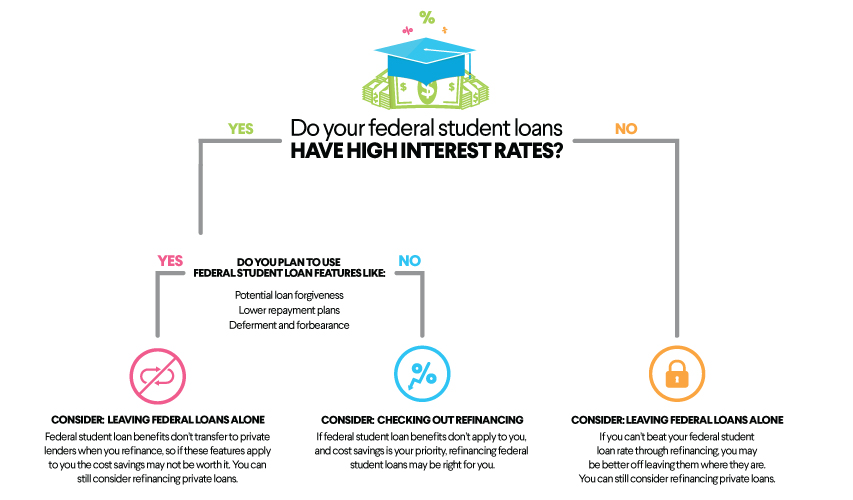
Federal-Loans-Decisions--Tree-853x500

Steps to Consolidating Private and Federal Loans

If you decide that loan consolidation makes sense, here’s how to consolidate private and federal student loans through refinancing:

1.    Decide which loans you want to consolidate. For instance, maybe you’d like to combine some of your federal loans with your private loans, but not all of them.

2.    Look into lenders. Private lenders that provide refinancing include banks, credit unions, and online lenders. Each one offers different rates and terms. Find out about any fees they might charge, what kind of customer service they have, and what their eligibility requirements are.

3.    Shop around. Each lender uses different criteria to determine if you’re eligible for a loan and the rates and terms you may get. To help find the best deal, you can prequalify with several lenders. Prequalifying involves a soft credit check, not a hard credit inquiry, so your credit score won’t be affected.

4.    Apply for refinancing. Once you’ve selected a lender, you can fill out a loan application. You can typically do this online. You’ll need to provide your personal, employment, and salary information, as well as details about your private and federal student loans. Be sure to have backup like pay stubs and loan paperwork readily available since you may need to provide it. The lender will do a hard credit check, which could temporarily cause your credit score to drop a few points.

5.    Find out if you’re approved. In general, you’ll learn whether you’re approved within several days. Keep an eye out for information from your new lender about the payments and due dates on the new loan.

Federal Student Loan Interest Rates

Depending on loan type and disbursement date, federal student loan interest rates are reassessed annually, every July. For the 2025-2026 school year, interest rates on new federal student loans range from 6.39% to 8.94%. Interest rates on federal student loans are determined by Congress and fixed for the life of the loan.

How Interest Rates Affect Consolidation and Refinancing Decisions

As noted earlier, when you apply to refinance, private lenders evaluate things like your credit history and credit score, as well as other personal financial factors, to determine the interest rate and terms you may qualify for.

If you’ve been able to build credit during your time as a student, or your income has significantly improved, you may be able to qualify for a more competitive interest rate than the rate on your current federal student loans — and perhaps any private student loans you have — when you consolidate your loans by refinancing with a private lender.

To get an idea of how much refinancing could potentially reduce the cost of interest on your loans, crunch the numbers with SoFi’s student loan refinancing calculator.

Federal Student Loan Benefits

Federal student loans come with a number of federal benefits and protections. If you refinance your federal loans — whether you’re consolidating them with private loans or not — the loans will no longer be eligible for federal benefits and protections.

Protections You May Lose When Combining Loans

Before you move ahead with refinancing, take a look at your loans to see if any of the following federal loan benefits and programs apply to you — and whether you might want to take advantage of them in the future. If you think you might need any of these protections, combining loans by refinancing them likely isn’t a good idea for you.

Student Loan Forgiveness

There are a few forgiveness programs available for borrowers with federal student loans. For example, under the Public Service Loan Forgiveness Program (PSLF), your Direct Loan balance may be eligible for forgiveness after 120 qualifying, on-time payments if you’ve worked in public service for an eligible nonprofit or government organization that entire time.

Pursuing PSLF can require close attention to detail to ensure your loan payments and employer qualify for the program. The qualification requirements are clearly stated on the PSLF section of the Federal Student Aid website.

Similarly, the Teacher Loan Forgiveness Program is available for teachers who work in eligible schools that serve low-income families full-time for five consecutive years. The total amount forgiven depends on factors like the eligible borrower’s role and the subject they teach.

Income-Driven Repayment Plans

Income-driven repayment plans can ease the burden for eligible borrowers who feel their loan payments are higher than they can afford. With income-driven repayment, monthly payments are calculated based on borrowers’ discretionary income and family size, which can lower how much you owe each month. That can make your student debt more manageable. The repayment period on these plans is 20 to 25 years.

Just be aware that when you lower your payments or extend your repayment term, you’ll pay more interest over time.

Deferment or Forbearance

Borrowers who are having difficulty making payments on their student loans may qualify for deferment or forbearance, two programs that allow borrowers to temporarily pause payments on their federal student loans.

The biggest difference between them is that with forbearance, the borrower is responsible for paying the interest that accrues on the loan. Forbearance can have a major financial impact on a borrower, as any unpaid interest will be added to the original loan balance. With deferment, the borrower may or may not be responsible for paying the interest that accrues. For instance, those with Direct Subsidized Loans are not responsible for paying the accruing interest.

Refinancing Your Student Loans

Looking to lower your monthly student loan payment? Refinancing may be one way to do it — by extending your loan term, getting a lower interest rate than what you currently have, or both. (Please note that refinancing federal loans makes them ineligible for federal forgiveness and protections. Also, lengthening your loan term may mean paying more in interest over the life of the loan.) SoFi student loan refinancing offers flexible terms that fit your budget.


With SoFi, refinancing is fast, easy, and all online. We offer competitive fixed and variable rates.

FAQ

How does refinancing affect my credit score?

Refinancing affects your credit score because when you submit a formal loan application, the lender will check your credit score and credit history, which is known as a hard credit inquiry. That may cause your credit score to drop a few points temporarily.

Can I keep federal loan protections if I refinance?

No. Refinancing federal student loans with a private lender means that you lose access to federal programs and protections like income-driven repayment and forgiveness.

What are the risks of refinancing student loans?

The risks of refinancing federal student loans is losing access to federal programs and protections. In addition, if you extend the term of the loan through refinancing to lower your monthly payments, you’ll end up paying more interest over the life of the loan.

Is it better to consolidate or refinance student loans?

Whether it’s better to consolidate or refinance your student loans depends on your situation. If you have federal loans and want to combine them all into one loan to streamline your payments and make them more manageable, consolidation may be the right option for you.

On the other hand, if you have private loans and your credit and financial background is strong, refinancing may help you get a lower interest rate, which could help you save money. Refinancing may also be worth considering if you have federal loans and won’t need to use any of the federal benefits they provide, and you can qualify for a lower interest rate.

What should I consider before combining federal and private student loans?

Before combining federal and private student loans through refinancing, make sure you won’t need to use any of the federal benefits that federal student loans provide, such as income-driven repayment and deferment. Remember, refinancing makes federal loans ineligible for these programs.

Also, consider whether your credit and financial history is strong enough to qualify for a lower interest rate than you have on your current loans before refinancing.


SoFi Student Loan Refinance
Terms and conditions apply. SoFi Refinance Student Loans are private loans. When you refinance federal loans with a SoFi loan, YOU FORFEIT YOUR ELIGIBILITY FOR ALL FEDERAL LOAN BENEFITS, including all flexible federal repayment and forgiveness options that are or may become available to federal student loan borrowers including, but not limited to: Public Service Loan Forgiveness (PSLF), Income-Based Repayment, Income-Contingent Repayment, extended repayment plans, PAYE or SAVE. Lowest rates reserved for the most creditworthy borrowers.
Learn more at SoFi.com/eligibility. SoFi Refinance Student Loans are originated by SoFi Bank, N.A. Member FDIC. NMLS #696891 (www.nmlsconsumeraccess.org).

SoFi Private Student Loans
Please borrow responsibly. SoFi Private Student loans are not a substitute for federal loans, grants, and work-study programs. We encourage you to evaluate all your federal student aid options before you consider any private loans, including ours. Read our FAQs.

Terms and conditions apply. SOFI RESERVES THE RIGHT TO MODIFY OR DISCONTINUE PRODUCTS AND BENEFITS AT ANY TIME WITHOUT NOTICE. SoFi Private Student loans are subject to program terms and restrictions, such as completion of a loan application and self-certification form, verification of application information, the student's at least half-time enrollment in a degree program at a SoFi-participating school, and, if applicable, a co-signer. In addition, borrowers must be U.S. citizens or other eligible status, be residing in the U.S., Puerto Rico, U.S. Virgin Islands, or American Samoa, and must meet SoFi’s underwriting requirements, including verification of sufficient income to support your ability to repay. Minimum loan amount is $1,000. See SoFi.com/eligibility for more information. Lowest rates reserved for the most creditworthy borrowers. SoFi reserves the right to modify eligibility criteria at any time. This information is subject to change. This information is current as of 4/22/2025 and is subject to change. SoFi Private Student loans are originated by SoFi Bank, N.A. Member FDIC. NMLS #696891 (www.nmlsconsumeraccess.org).

SoFi Loan Products
SoFi loans are originated by SoFi Bank, N.A., NMLS #696891 (Member FDIC). For additional product-specific legal and licensing information, see SoFi.com/legal. Equal Housing Lender.


Disclaimer: Many factors affect your credit scores and the interest rates you may receive. SoFi is not a Credit Repair Organization as defined under federal or state law, including the Credit Repair Organizations Act. SoFi does not provide “credit repair” services or advice or assistance regarding “rebuilding” or “improving” your credit record, credit history, or credit rating. For details, see the FTC’s website .

Third-Party Brand Mentions: No brands, products, or companies mentioned are affiliated with SoFi, nor do they endorse or sponsor this article. Third-party trademarks referenced herein are property of their respective owners.

Non affiliation: SoFi isn’t affiliated with any of the companies highlighted in this article.

Financial Tips & Strategies: The tips provided on this website are of a general nature and do not take into account your specific objectives, financial situation, and needs. You should always consider their appropriateness given your own circumstances.

External Websites: The information and analysis provided through hyperlinks to third-party websites, while believed to be accurate, cannot be guaranteed by SoFi. Links are provided for informational purposes and should not be viewed as an endorsement.
Third Party Trademarks: Certified Financial Planner Board of Standards Center for Financial Planning, Inc. owns and licenses the certification marks CFP®, CERTIFIED FINANCIAL PLANNER®

SOSLR-Q225-033

Read more
woman writing in notebook at cafe

What We Like About the Snowball Method of Paying Down Debt

Dealing with debt can be a very stressful experience and make you feel as if you’ll never be able to pay off what you owe. If you find yourself struggling to manage multiple debts, the snowball method can provide a practical and effective strategy to regain control of your financial situation. This method, popularized by personal finance expert Dave Ramsey, focuses on paying off debts in a specific order to build momentum and motivation.

Read on to learn how the snowball debt payoff method works, including its benefits, plus alternative payoff strategies you may want to consider.

Key Points

•   The snowball method lists debts from smallest to largest, focusing on the smallest first.

•   Quick wins and a sense of accomplishment are key psychological benefits.

•   The avalanche method targets high-interest debts to save on interest.

•   The snowball strategy builds momentum, though the avalanche technique can be more cost-effective.

•   The best approach for debt payoff depends on individual circumstances and goals, with personal loans being another popular option.

Building the Snowball

With the snowball method you list your debts from smallest to largest based on balance and regardless of interest rates. The goal is to pay off the smallest debt first while making minimum payments on other debts. Once the smallest debt is paid off, you roll the amount you were paying towards it into the next smallest debt, creating a “snowball effect” as you tackle larger debts.

Getting rid of the smallest debt first can give you a psychological boost. If, by contrast, you were to try to pay down the largest debt first, it might feel like throwing a pebble into an ocean, and you might simply give up before you got very far.

A Word About Paying Off High-interest Debt First

From a purely financial perspective, it might make more sense to first tackle the debt that comes with the highest interest rate first, since it means paying less interest over the life of the loans (more on this avalanche approach below).

However, the snowball method focuses on the psychological aspect of debt repayment. By starting with the smallest debt, you experience quick wins and a sense of accomplishment right away. This early success can then motivate you to continue the debt repayment journey. In addition, paying off smaller debts frees up cash flow, allowing you to put more money towards larger debts later.

Recommended: How to Get Out of $10,000 in Credit Card Debt

Making Minimum Payments Doesn’t Equal Minimum Payoff Time

While you may feel like you’re making progress by paying the minimum balance on your debts, this approach can lead to a prolonged payoff timeline. The snowball method encourages you to pay more than the minimum on your smallest debt, accelerating the repayment process. Over time, as you pay off each debt, the amount you can allocate towards the next debt grows, increasing your progress.

The Snowball Plan, Step By Step

Here’s a step-by-step guide to implementing the snowball method.

1. List all debts from smallest to largest. You want to list them by the total amount owed, not the interest rates. If two debts have similar totals, place the debt with the higher interest rate first.

2. Make minimum payments. Continue making at least minimum payments on all debts except the smallest one.

3. Attack the smallest debt. Put any extra money you can towards paying off the smallest debt while still making your payments on others.

4. Roll the snowball. Once the smallest debt is paid off, take the amount you were paying towards it and add it to the minimum payment of the next smallest debt.

5. Repeat and accelerate. Repeat this process, attacking one debt at a time, until all debts are paid off.

A Word About Principal Reduction

It’s a good idea to reach out to your creditors and lenders and find out how they apply extra payments to a debt (they don’t all do it the same way). You’ll want to make sure that any additional payments you make beyond the minimum are applied to the principal balance of the debt. This will help reduce the overall interest you pay and expedite the debt payoff process.

Recommended: Personal Loan Calculator

Perks of the Snowball Method

The snowball method offers several advantages:

•   Motivation and momentum The quick wins and sense of progress provide motivation to continue the debt repayment journey.

•   Simplification Focusing on one debt at a time simplifies the process, making it easier to track and manage.

•   Increased cash flow As each debt is paid off, the money previously allocated to it becomes available to put towards the next debt, accelerating the payoff timeline.

Alternatives to the Snowball Method

While the snowball method has proven effective for many, it’s not the only debt repayment strategy available. Here are three alternative methods you may want to consider.

The Avalanche Method

The avalanche method involves making a list of all your debts in order of interest rate. The first debt on your list should be the one with the highest interest rate. You then pay extra on that first debt, while continuing to pay at least the minimum on all the others. When you fully pay off that first debt, you apply your extra payment to the debt with the next highest interest rate, and so on.

This method can potentially save more on interest payments in the long run. However, it requires discipline and may take longer to see significant progress compared to the snowball method.

The Debt Snowflake Method

The debt snowflake method is a debt repayment method you can use on its own or in conjunction with other approaches (like the snowball or avalanche method). The snowflake approach involves finding extra income through a part-time job or side gig, selling items, and/or cutting expenses and then putting that extra money directly toward debt repayment. While each “snowflake” may not have a significant impact on your debt, they can accumulate over time and help you become free of high-interest debt.

Debt Consolidation

If the snowball, avalanche, or snowflake methods seem overwhelming, you might want to consider combining your debts into one simple monthly payment that doesn’t require any strategizing. Known as debt consolidation, you may be able to do this by taking out a personal loan and using it to pay off your debts. You then only have one balance and one payment and, ideally, a lower interest rate, which can help you save money.

Often called debt consolidation loans, these loans provide a lump sum of cash, usually at a fixed interest rate and are repayable in one to seven years.

Recommended: How Refinancing Credit Card Debt Works

The Takeaway

The snowball method offers a practical and motivational approach to paying down debt. By starting with small debts and building momentum, you can gain control of your finances and work towards becoming debt-free. It can be a good way to take action and commit to a debt repayment strategy. If it doesn’t suit you, you might consider the avalanche or snowflake method or a personal loan to consolidate debt.

Think twice before turning to high-interest credit cards. Consider a SoFi personal loan instead. SoFi offers competitive fixed rates and same-day funding. See your rate in minutes.


SoFi’s Personal Loan was named a NerdWallet 2026 winner for Best Personal Loan for Large Loan Amounts.

FAQ

What is the snowball method of paying down debt?

With the snowball method of paying down debt, you prioritize paying off the smallest balance first, no matter what its interest rate is. Once that debt is paid off, you prioritize the next smallest debt.

What is the disadvantage of using the debt snowball method?

The disadvantage of the debt snowball method is that, by prioritizing the lowest amount of debt, you may not be paying off the debt with the highest interest rate first. This means your most expensive debt could continue to grow as you pay off smaller debts.

What is the advantage of the debt snowball method?

By tackling the smallest debt first, regardless of interest rate, you can get a psychological boost from successfully paying that off and then build momentum for getting rid of your other debt.


SoFi Loan Products
SoFi loans are originated by SoFi Bank, N.A., NMLS #696891 (Member FDIC). For additional product-specific legal and licensing information, see SoFi.com/legal. Equal Housing Lender.


*Awards or rankings from NerdWallet are not indicative of future success or results. This award and its ratings are independently determined and awarded by their respective publications.

Disclaimer: Many factors affect your credit scores and the interest rates you may receive. SoFi is not a Credit Repair Organization as defined under federal or state law, including the Credit Repair Organizations Act. SoFi does not provide “credit repair” services or advice or assistance regarding “rebuilding” or “improving” your credit record, credit history, or credit rating. For details, see the FTC’s website .

Financial Tips & Strategies: The tips provided on this website are of a general nature and do not take into account your specific objectives, financial situation, and needs. You should always consider their appropriateness given your own circumstances.

Third-Party Brand Mentions: No brands, products, or companies mentioned are affiliated with SoFi, nor do they endorse or sponsor this article. Third-party trademarks referenced herein are property of their respective owners.

Third Party Trademarks: Certified Financial Planner Board of Standards Center for Financial Planning, Inc. owns and licenses the certification marks CFP®, CERTIFIED FINANCIAL PLANNER®

SOPL-Q225-103

Read more

Long Put Option Guide


Editor's Note: Options are not suitable for all investors. Options involve risks, including substantial risk of loss and the possibility an investor may lose the entire amount invested in a short period of time. Please see the Characteristics and Risks of Standardized Options.

The simplest options strategies include purchasing calls or puts — typically called “going long.” For the bearish investor who believes an asset will see price declines over a well-defined period of time, the simplest strategy may be to purchase puts on those assets, also known as a long put strategy.

This strategy allows buyers to benefit from downward price moves while limiting losses to the premium paid upfront. Take a closer look at how long puts work, including their profit and loss potential, breakeven pricing, and how they differ from short puts or other bearish positions.

Key Points

•   A long put is a bearish options strategy where the buyer gains the right to sell the underlying asset at a set price within a specific timeframe.

•   The maximum loss for a long put is limited to the premium paid for the contract.

•   Maximum profit is realized if the underlying asset’s price falls to zero, minus the premium paid.

•   The breakeven point is calculated by subtracting the put option’s premium from its strike price.

•   Long puts can be used for speculation, hedging existing positions, or as part of multi-leg options strategies.

What Is a Long Put?

The term “long put” describes the strategy of buying put options. The investor who purchases a put has purchased the right to sell an underlying security at a specific price over a specific time period. Being the buyer and holder of any options makes you “long” that option contract.

Because the contract in question is a put, the investor is long the put and expects the put option’s value to increase as the underlying asset declines. The put option holder is bearish vs. bullish on the underlying asset as they expect its price to go down.

Conversely, an investor who sells a put option would hold a short position, which they might do if they expect the price of the underlying asset to rise or remain neutral, instead of fall.

Maximum Loss

In comparison to other options trading strategies, long puts are low risk due to their limited and well-defined downside. The maximum amount an investor can lose is the premium paid at the initiation of the transaction.

Maximum Loss = Premium Paid

Because different options trading platforms have different commission structures (some of which may be commission-free), commissions are typically omitted from profit and loss calculations.

Maximum Profit

The maximum gain for a long put strategy occurs when the underlying asset drops to zero. While this potential gain is also limited and defined, it may exceed the potential downside and could be significant. The maximum gain on a long put strategy is defined as the strike price of the put less the premium paid.

Maximum Profit = Strike Price – Premium Paid

Breakeven Price

The breakeven price on a long put strategy occurs at the strike price less the premium. Note that the formula for the maximum gain and the breakeven price is the same but the metrics represent different outcomes.

The breakeven price is the point at which the investor begins to make a profit. As the price drops past breakeven toward zero, hopefully, the investor can realize the maximum gain possible.

Breakeven Price = Strike Price – Premium Paid


💡 Quick Tip: How do you decide if a certain online trading platform or app is right for you? Ideally, the online investment platform you choose offers the features that you need for your investment goals or strategy, e.g., an easy-to-use interface, data analysis, educational tools.

Why Investors Use Long Puts

Investors utilize a long put strategy for three main reasons:

•   Speculation: The investor identifies an asset they believe will decrease in price over a defined time period. Buying a long put allows the investor to profit from this forecasted price decrease if it happens.

•   Hedging: Sometimes an investor already holds an asset like a stock or exchange-traded fund (ETF), and could be concerned that the price of the asset may drop in the short term, but still wants to hold the asset for the long term.

By purchasing a long put, the investor can offset any short-term losses through gains on the put and keep control of the underlying asset. For most assets, this strategy may serve as relatively low-cost downside protection.

•   Combination strategies: For experienced investors, long puts can be part of complicated multi-leg strategies involving the sale or purchase of other options, both calls and puts, to pursue different investment objectives.

Long Put vs Short Put

In contrast to a long put, a short put options strategy occurs when the investor sells a put. The seller of a put options contract is obligated to buy shares in the underlying security from the option holder at the strike price if the option is exercised.

Short put strategies differ from long puts in structure, obligation, and market outlook:

Long Puts

Short Puts

Investor role Buyer Seller
Investor responsibility Right/Discretion Obligation
Investor outlook — Asset Bearish Neutral to Bullish
Risk Premium (Strike Price – Premium)
Reward (Strike Price – Premium) Premium

Long Put Option Example

An investor has been watching XYZ stock, which is trading at $100 per share. The investor believes the $100 share price for XYZ is excessive and believes the share price will fall over the next 30 days.

The investor purchases a long put with a strike price of $95 per share for a premium of $5 and an expiration date of 60 days from today. Because options contracts are sold based on 100 share lots, the price for this contract will be $5 x 100 = $500.

The options contract gives the investor the right to sell 100 shares of XYZ at $95 for the next 60 days.

The breakeven price on this investment is:

Breakeven Price = Strike Price – Premium Paid

Breakeven Price = $95 – $5 = $90

Should XYZ be trading below $90 at expiration, the option trade will be profitable.

If XYZ stock falls to $0 at expiration, the investor could realize their maximum possible profit:

Maximum Profit = Strike Price – Premium Paid

Maximum Profit = $95 – $5 = $90 profit per share or $9,000 per put option

However, if XYZ stock stays above $90 at expiration, the investor would incur their maximum possible loss, and the option will expire worthless:

Maximum Loss = Premium Paid

Maximum Loss = $5 per share or $500 per put option

Even if XYZ rose above the $100 price at purchase, the investor’s loss remains limited to the premium paid, or $500 in this example.

The Takeaway

Long put options provide a potentially accessible starting point for those exploring bearish strategies. The trading strategy may provide limited downside risk and potential profit if the underlying asset declines.

SoFi’s options trading platform offers qualified investors the flexibility to pursue income generation, manage risk, and use advanced trading strategies. Investors may buy put and call options or sell covered calls and cash-secured puts to speculate on the price movements of stocks, all through a simple, intuitive interface.

With SoFi Invest® online options trading, there are no contract fees and no commissions. Plus, SoFi offers educational support — including in-app coaching resources, real-time pricing, and other tools to help you make informed decisions, based on your tolerance for risk.

Explore SoFi’s user-friendly options trading platform.

FAQ

What is the long put option strategy?

A long put strategy involves buying a put option in anticipation that the underlying asset will decline in value. The buyer gains the right — but not the obligation — to sell the asset at a predetermined strike price before the option expires. This strategy can be used to profit from a downward move or to hedge an existing long position. The risk is limited to the premium paid, while potential profit increases as the asset’s price drops.

What is the most successful options trading strategy?

There is no single “most successful” options strategy — success depends on the trader’s goals, risk tolerance, and market outlook. For bearish views, long puts or bear spreads may be appropriate. For bullish views, strategies like covered calls or long calls are commonly used. More advanced traders may use iron condors or straddles for neutral markets. Each strategy carries trade-offs in terms of cost, complexity, and risk-reward profile. No strategy guarantees returns.

How can traders make money on long puts?

To profit from a long put, the price of the underlying asset must fall below the breakeven point, which is the strike price minus the premium paid. As the asset’s price drops, the value of the put typically increases, which may allow the trader to sell the option at a profit or exercise the option to sell the asset at a higher strike price. The lower the asset falls, the greater the potential profit — up to the maximum if the asset drops to zero.

When should an investor consider a long put?

An investor might consider a long put when they expect the price of an asset to decline within a defined time period. This strategy allows them to potentially profit from the downside move while limiting their maximum loss to the premium paid. Long puts can also serve as a form of short-term insurance for a long position in the stock, especially in volatile or uncertain markets. However, because options lose value over time, long puts are generally best suited for situations where a significant price move is expected before expiration.


Photo credit: iStock/Paul Bradbury

INVESTMENTS ARE NOT FDIC INSURED • ARE NOT BANK GUARANTEED • MAY LOSE VALUE

SoFi Invest is a trade name used by SoFi Wealth LLC and SoFi Securities LLC offering investment products and services. Robo investing and advisory services are provided by SoFi Wealth LLC, an SEC-registered investment adviser. Brokerage and self-directed investing products offered through SoFi Securities LLC, Member FINRA/SIPC.

For disclosures on SoFi Invest platforms visit SoFi.com/legal. For a full listing of the fees associated with Sofi Invest please view our fee schedule.

Options involve risks, including substantial risk of loss and the possibility an investor may lose the entire amount invested in a short period of time. Before an investor begins trading options they should familiarize themselves with the Characteristics and Risks of Standardized Options . Tax considerations with options transactions are unique, investors should consult with their tax advisor to understand the impact to their taxes.

Disclaimer: The projections or other information regarding the likelihood of various investment outcomes are hypothetical in nature, do not reflect actual investment results, and are not guarantees of future results.

Financial Tips & Strategies: The tips provided on this website are of a general nature and do not take into account your specific objectives, financial situation, and needs. You should always consider their appropriateness given your own circumstances.

Exchange Traded Funds (ETFs): Investors should carefully consider the information contained in the prospectus, which contains the Fund’s investment objectives, risks, charges, expenses, and other relevant information. You may obtain a prospectus from the Fund company’s website or by emailing customer service at [email protected]. Please read the prospectus carefully prior to investing.

SOIN-Q225-071

Read more
percentage sign

What Is Interest Rate Risk?

Interest rate risk refers to the possibility that a fixed-income asset, such as a bond, could rise or fall in value owing to changing interest rates. Interest rate risk also has implications for businesses.

When interest rates rise, bond values on the secondary market tend to fall, and vice versa: When interest rates decline, bond values tend to rise. A bond’s duration, or maturity, comes into play as well. Bonds with longer durations (i.e., more time to maturity) are more susceptible to interest rate risk.

Interest rate risk also applies to securities such as CDs (which may have floating rates), as well as loans with variable rates. These instruments can have an impact on consumers, as well as companies, who might see their debt payments increase on variable-rate loans, for example.

Key Points

•   Interest rate risk usually refers to the impact of interest rate changes on bond values.

•   When interest rates rise, bond values tend to fall, and when interest rates drop, bond values rise.

•   Longer duration bonds — those with more time to maturity — are more vulnerable to interest rates changes.

•   Interest rate risk can also impact stocks indirectly, when a company’s cash flow or performance is impacted by changes in borrowing costs and investment returns.

•   Investors with fixed-income investments may seek ways to mitigate interest rate risk.

How Does a Bond Work?

Bonds are a type of loan, with the bond issuer effectively borrowing money from the investor. The issuer could be the federal government, a state or local government, or a company.

In return for the loan, the investor is promised that they will be repaid the full amount of the bond (the principal) — plus a predetermined amount of interest (the coupon rate) — on a specific date.

Traditionally, most bonds have paid a fixed rate, although there are some with a variable or “floating” interest rate.
Bonds come with an expiration or “maturity” date, when the value of the bond must be paid back in full to the investor, plus interest.

While there’s no such thing as a safe investment, investors typically consider bonds to be lower-risk than stocks and some other investments.

Buying and Selling Bonds

An investor can sell a bond before it reaches its full maturity. If the bond issuer is doing well and the bond is in high demand, the investor could sell it on the secondary market and see a capital gain. If not, the sale might be made at a loss.

Because interest rates impact a bond’s value, the risk here is that rising rates could make a bond’s current rate less attractive. By the same token, if interest rates drop, and an investor is holding bonds with a higher rate, the value of those bonds will rise.

Interest Rate Risk and Timing

In other words, when investors buy fixed-rate bonds, they’re taking the risk that the interest rate may go up after they’ve already made their purchase.

If interest rates do increase, then new bonds are issued with higher rates, which means that existing bonds with lower returns are in lower demand, lowering the bonds’ value.

In general, longer-term bonds are more sensitive to interest rate risk than those with shorter terms. The higher interest rates rise after the bond was purchased, the more of an impact that can have on the investor’s return on investment.

Examples of Interest Rate Risk

The Office of Investor Education and Advocacy of the U.S. Securities and Exchange Commission (SEC) offers two contrasting examples to illustrate this concept.

In the first example, they assume that a Treasury bond has a 3% interest rate. A year later, interest rates drop to 2%. But investors who bought their bonds at 3% continue to receive that interest rate, making it a more valuable investment than new bonds paying just 2%.

If that bond is sold before it reaches its maturity date, the price would likely be higher than it was in the previous year. The bond’s yield to maturity, though, will be down for investors purchasing it at the higher price.

In the second example, instead of rates going down from the original 3%, rates go up to 4%. In that scenario, investors looking to sell their bonds would be competing with new bonds that offer a 4% rate. So the price of the bond that pays 3% may well fall, with the yield going up.

How Interest Rates Can Impact Stocks

Stocks can also be subject to interest rate risk, in that rate changes can impact a company’s bottom line via potentially higher borrowing costs, and expected return on investments (including CDs, which can have a variable rate).

While the impact of interest rates on stocks is indirect, interest rate risk is nonetheless a concern for equity investors as well.

Interest Rate Risk Management

One way to handle investment risk is with diversification. This means building a diversified portfolio that includes a variety of different asset classes, such as stocks, mutual funds, real estate or other asset classes.

Diversified investment portfolios may offer some risk insulation so that if one area takes a financial hit, possible growth in another area could balance out that risk.

Get up to $1,000 in stock when you fund a new Active Invest account.*

Access stock trading, options, alternative investments, IRAs, and more. Get started in just a few minutes.


*Customer must fund their Active Invest account with at least $50 within 45 days of opening the account. Probability of customer receiving $1,000 is 0.026%. See full terms and conditions.

Interest Rate Risk and High-Yield Bonds

There are pros and cons to high-yield bonds. These types of bonds — corporate bonds that were issued by companies looking to raise capital, or by “fallen angel” companies whose credit rating has dropped—might sound attractive to investors because the notion of receiving a relatively high rate of interest is appealing. But along with the high yield is the potential for a higher degree of risk.

Bonds receive ratings on their creditworthiness, with S&P Global Ratings and Moody’s serving as two of the main credit-rating agencies. Bonds with quality ratings are less likely to go into default. When a bond goes into default, interest is less likely to be paid on time, if at all, and investors may also lose their initial investment.

Bonds with high ratings include U.S. Treasury bonds and notes issued by the federal government, and those issued by large companies considered to be stable.

Bonds with lower ratings tend to need to offer higher coupon rates to entice investors. In other words, they often need to offer high-yield bonds.

When deciding whether to include high-yield bonds in their portfolio, investors may want to consider the pros and cons of doing so.

Pros of High-Yield Bonds

•  Consistent yields. Bonds typically come with an agreed-upon and consistent yield, which makes the amount owed to the investor predictable as long as the company doesn’t go into default (and many don’t).

•  Priority payment if the company fails. If assets of a failed company are liquidated, bondholders would be first in line for payouts, ahead of stockholders.

•  Possible price appreciation. If the credit rating of the company issuing the bond improves, it’s possible that the bond’s price will go up.

•  Potentially less sensitive to interest rate changes. When this is the case, it may be because high-yield bonds tend to have shorter terms than investment-grade bonds, which may be why they often have less sensitivity to fluctuations in interest rates.

Cons of High-Yield Bonds

•  Higher default rates. Because of the higher risk involved, more of these bonds default. When this happens, the investor can lose all funds, including the original principal they invested.

•  Harder to sell. There can be lower demand for this type of bonds, which can make it harder to sell them at a desired price (or at all).

•  Possible price depreciation. If a company’s credit rating drops further, then the price can further depreciate.

•  Sensitivity to interest rate changes. All bonds, including high-yield ones, are subject to interest rate risk.

The Takeaway

Bonds are a popular investment choice because they are less volatile than stocks, but they are not without risks. Interest rate risk is the potential for a bond value to drop as market interest rate rises (the opposite is also true). High-yield bonds are just as susceptible to interest rate risk as corporate or municipal bonds.

Investors can work to mitigate that risk through portfolio diversification and careful selection of bonds.

Invest in what matters most to you with SoFi Active Invest. In a self-directed account provided by SoFi Securities, you can trade stocks, exchange-traded funds (ETFs), mutual funds, alternative funds, options, and more — all while paying $0 commission on every trade. Other fees may apply. Whether you want to trade after-hours or manage your portfolio using real-time stock insights and analyst ratings, you can invest your way in SoFi's easy-to-use mobile app.

Invest with as little as $5 with a SoFi Active Investing account.

FAQ

Why do bond prices fall when interest rates are rising?

Bond prices typically fall on secondary markets when interest rates rise because newer-issued bonds are more attractive and see higher demand.

Why are longer-maturity bonds more sensitive to interest rate risk?

When a bond has a longer maturity, i.e., five years or more, interest rates are likely to fluctuate more over that extended period. This can impact a bond’s value over time.

Is there interest rate risk if you hold onto a bond until maturity?

Yes. If an investor purchases a bond at a certain rate, and they only redeem the bond at maturity, they are locked into the interest rate of the bond. If interest rates rise, for example, the investor is losing out on potentially higher rates. If interest rates decline, however, that could spell good news for the investor.


INVESTMENTS ARE NOT FDIC INSURED • ARE NOT BANK GUARANTEED • MAY LOSE VALUE

SoFi Invest is a trade name used by SoFi Wealth LLC and SoFi Securities LLC offering investment products and services. Robo investing and advisory services are provided by SoFi Wealth LLC, an SEC-registered investment adviser. Brokerage and self-directed investing products offered through SoFi Securities LLC, Member FINRA/SIPC.

For disclosures on SoFi Invest platforms visit SoFi.com/legal. For a full listing of the fees associated with Sofi Invest please view our fee schedule.

Tax Information: This article provides general background information only and is not intended to serve as legal or tax advice or as a substitute for legal counsel. You should consult your own attorney and/or tax advisor if you have a question requiring legal or tax advice.

Investment Risk: Diversification can help reduce some investment risk. It cannot guarantee profit, or fully protect in a down market.

Third Party Trademarks: Certified Financial Planner Board of Standards Center for Financial Planning, Inc. owns and licenses the certification marks CFP®, CERTIFIED FINANCIAL PLANNER®

Disclaimer: The projections or other information regarding the likelihood of various investment outcomes are hypothetical in nature, do not reflect actual investment results, and are not guarantees of future results.

Financial Tips & Strategies: The tips provided on this website are of a general nature and do not take into account your specific objectives, financial situation, and needs. You should always consider their appropriateness given your own circumstances.

SOIN-Q225-087

Read more
Average Personal Loan Interest Rates and What Affects Them

Average Personal Loan Interest Rates & What Affects Them

You may have seen personal loans advertised as starting at a certain interest rate or annual percentage rate (APR). But when you check your personal loan interest rate, you may find that what is offered to you is significantly higher. Why is that?

The average personal loan interest rate is dependent on several factors, including the amount borrowed, credit history, and income, among others. Average interest rates for personal loans may also differ depending on the type of the loan. Here are some factors that may affect the personal loan interest rate you’re approved for.

Key Points

•   Personal loan interest rates are influenced by factors such as credit score, income, and loan amount.

•   Higher credit scores generally secure lower interest rates on personal loans.

•   Secured personal loans require collateral, whereas unsecured loans do not.

•   Employment stability and income levels can significantly affect personal loan rates offered.

•   Personal loans can be beneficial for consolidating high-interest debt or financing large purchases.

Average Personal Loan Interest Rates By Credit Score

The APR for a personal loan is calculated by looking at several factors, including the requested amount, the applicant’s income history, and the reasons for borrowing. One of the biggest factors, however, is an applicant’s credit score. In general, the higher a borrower’s credit score, the lower the loan interest rate they will be offered.

Here’s a look at average personal loan interest rates for different credit scores as of May 2025.

Credit Score

Average estimated APR

Excellent credit (720 to 850)

13.88%

Good (690-719) 15.38%
Fair (630-689) 19.77%
Bad (300-629) 19.83%

Factors That Can Lower Personal Loan Interest Rates

One thing to know about how personal loans work is that your unique credit profile will likely affect the interest rate offered to you. Here’s a look at some ways you may be able to qualify for a lower personal loan interest rate.

Building Your Credit Score

Building your credit score can potentially be a way to qualify for a personal loan with better rates and terms. Some strategies that can help you positively impact your credit profile include:

•  Checking your credit report It’s a good idea to get copies of your credit reports (you have three; one each from Equifax®, TransUnion®, and Experian®) and make sure that your personal information — e.g., name, address, phone number, Social Security number — is correct in each one. Also look for any erroneous public record information, such as lawsuits or bankruptcies filed that you were not a part of and any errors or inaccuracies in the credit accounts section. You can dispute any errors with the credit reporting agency.

•  Lowering your credit utilization ratio Your credit utilization ratio — the amount of debt you have compared to the amount of credit available to you — plays a large part in credit score calculation. Paying down your debt will lower this ratio. Financial experts suggest keeping the ratio at 30% or lower (10% or lower is ideal).

•  Avoiding late payments Late payments can have a large and lasting impact on your credit score. If there are any late payments in your history, you may be able to minimize their impact by creating a record of on-time payments moving forward. Setting up autopay for debt payments is one way to make sure those payments are made regularly and on time.

Secured vs Unsecured Personal Loans

How a personal loan works depends on the type of personal loan you choose. As you research loan options, you may come across options for secured and unsecured personal loans.

What’s the difference between a secured and unsecured personal loan?

•  A secured personal loan requires the borrower to pledge collateral to guarantee the loan. This collateral is something of value that the borrower owns, such as a car, investments, or a savings account. If the borrower cannot or does not make the loan payments, then the lender can seize that collateral to recoup its losses.

•  An unsecured personal loan, also called a signature loan, is backed by the borrower’s estimated creditworthiness. If the borrower can’t pay back the loan, the lender can’t take any of their property or valuables to recoup its loss. The lender can, however, take other steps to recoup its loss, such as suing the borrower, which may affect the borrower’s credit score and future financial options.

Personal loans are commonly unsecured loans. However, some lenders offer secured personal loans, which can allow borrowers with fair credit to qualify for a loan or get a better rate than they otherwise would with an unsecured loan.

Income and Employment Status

Your income and employment status may affect the rate you’re offered on a personal loan. Lenders generally see borrowers with solid, steady income as lower risk and, therefore, offer them lower rates. If you’re a freelancer, independent contractor, or business owner, you might need additional paperwork to prove your income than you would if you work a W-2 job.

If your income is irregular, having a creditworthy co-applicant may help you get approved for more favorable interest rates. Asking someone to be a co-applicant is a big commitment, though, and having a conversation about all that it entails can help alleviate any concerns of both parties.

Factors That May Increase Personal Loan Interest Rates

Lenders must assess how risky an unsecured loan might be and the likelihood of the loan being paid back. To do that, they look at the applicant’s credit history, employment status, and loan amount requested, among other factors. Here are some things that may lead a lender to think a loan is more risky — and potentially offer a higher rate to the borrower.

Credit Score

An applicant’s credit score is one factor that affects the personal loan interest rate they might be approved for. In general, the lower the applicant’s credit score (which indicates poor management of credit in the past), the higher the rate of interest they will be offered. Improving your credit over time may make it possible to qualify for a loan with a lower interest rate.

Debt-to-Income Ratio

Debt-to-income (DTI) ratio refers to how much debt someone has in relation to how much income they have. To calculate your DTI, you add up your monthly debts (including mortgage payments, car payments, and credit card payments) then divide that number by your gross monthly income and multiply by 100. DTI ratio is expressed as a percentage. In general, the higher your DTI ratio, the riskier you may seem to lenders. Each lender sets its own DTI ratio requirement.

Unemployment

A personal loan application will ask for proof of income, usually in the form of W2s or tax returns from prior years. The lender wants to know that a borrower has a steady source of income. If a loan applicant is unemployed, it may be harder — but not impossible — to have a loan approved.

Recent Bankruptcy

Bankruptcy will appear on an applicant’s credit report and stay there for seven to 10 years, typically making it challenging to be approved for a personal loan. Applying with a cosigner can make it easier to be approved for a personal loan after recent bankruptcy. But keep in mind that if you are unable to repay the loan, your cosigner would be responsible for the debt.

Awarded Best Personal Loan by NerdWallet.
Apply Online, Same Day Funding


Is a Personal Loan the Right Choice for You?

Individual circumstances really determine whether a personal loan is the right choice for any one person.

•  A personal loan can be a good option for people who want to consolidate high-interest debt, like that of credit cards, to save money. For a debt consolidation loan to be successful, it’s important to discontinue using the credit cards to accumulate more debt.

•  Having a fixed interest rate and steady payment amount can be helpful when using a personal loan to cover a big purchase. A personal loan is installment debt with a payment end date, in contrast to the revolving debt of a credit card.

•  A personal loan is still debt and increases a person’s overall debt load, so it can be a good idea to have a sense of how you’ll repay it. Making late payments or failing to repay the loan can negatively affect your credit score.

A personal loan rate calculator can be a helpful tool to estimate your personal loan rate and will not affect your credit score. Your offered rate may vary slightly when you officially apply for a loan, but an estimate can give you a good benchmark for comparison.

Recommended: How to Apply for a Personal Loan

The Takeaway

Personal loan interest rates vary depending on an applicant’s financial circumstances but can also vary by lender, so it can make sense to shop around for rates. If your credit profile is not as strong as it could be, you may want to work on building your credit before applying for a personal loan. This can help increase your chances of loan approval, as well as your odds of getting approved for a loan with a favorable interest rate.

Think twice before turning to high-interest credit cards. Consider a SoFi personal loan instead. SoFi offers competitive fixed rates and same-day funding. See your rate in minutes.


SoFi’s Personal Loan was named a NerdWallet 2026 winner for Best Personal Loan for Large Loan Amounts.

FAQ

What is a good interest rate on a personal loan?

A good interest rate on a personal loan could be under the almost 14.00% average for those with superior credit as of May 2025. At that time, some of the lowest rates for personal loans began at around 7.99%.

Is 10.00% a good personal loan rate?

Yes. If you have good to very strong credit (720-plus), you could qualify for a 10.00% APR, which is considered a good personal loan interest rate. It is lower than the average personal loan rate for borrowers with excellent credit, which is 13.88% as of May 2025.

Is 12.00% a good personal loan rate?

Yes, a 12.00% APR is considered a good personal loan rate as of May 2025. You would probably need a very strong credit score (possibly 720 or higher) to qualify for this rate. It beats the average personal loan interest rate for excellent credit, which is 13.88%.

Which bank has the lowest interest rate on personal loans?

According to Forbes Advisor, the best low-interest personal loans are currently available from SoFi, Upgrade, LendingClub, PenFed, Happy Money, and U.S. Bank.

What is a personal loan interest rate?

A personal loan’s interest rate is the cost you pay each year to borrow money expressed as a percentage. The interest rate does not include fees charged for the loan. The annual percentage rate (APR) of a personal loan is the cost you pay each year to borrow money, including fees, expressed as a percentage. The higher the APR, the more you’ll pay over the life of the loan.

What is the interest rate on a $40,000 loan?

The interest rate on a $40,000 personal loan will depend on the lender, the loan’s term, and the creditworthiness of the borrower. The APR can range anywhere from the single digits to 35.99% or possibly higher.

What is a good interest rate for an unsecured personal loan?

A good interest rate for an unsecured personal loan can range anywhere from 7.99% to 13.88% as of May 2025. However, you will likely need to have excellent credit to qualify.


Photo credit: iStock/alexsl

SoFi Loan Products
SoFi loans are originated by SoFi Bank, N.A., NMLS #696891 (Member FDIC). For additional product-specific legal and licensing information, see SoFi.com/legal. Equal Housing Lender.


*Awards or rankings from NerdWallet are not indicative of future success or results. This award and its ratings are independently determined and awarded by their respective publications.

Disclaimer: Many factors affect your credit scores and the interest rates you may receive. SoFi is not a Credit Repair Organization as defined under federal or state law, including the Credit Repair Organizations Act. SoFi does not provide “credit repair” services or advice or assistance regarding “rebuilding” or “improving” your credit record, credit history, or credit rating. For details, see the FTC’s website .

Financial Tips & Strategies: The tips provided on this website are of a general nature and do not take into account your specific objectives, financial situation, and needs. You should always consider their appropriateness given your own circumstances.

Third-Party Brand Mentions: No brands, products, or companies mentioned are affiliated with SoFi, nor do they endorse or sponsor this article. Third-party trademarks referenced herein are property of their respective owners.

Third Party Trademarks: Certified Financial Planner Board of Standards Center for Financial Planning, Inc. owns and licenses the certification marks CFP®, CERTIFIED FINANCIAL PLANNER®

SOPL-Q225-088

Read more
TLS 1.2 Encrypted
Equal Housing Lender