Value vs Growth Stocks

Generally speaking, value stocks are shares of companies that have fallen out of favor and are valued less than their actual worth. Growth stocks are shares of companies that demonstrate a strong potential to increase earnings, thereby ramping up their stock price.

The terms value and growth refer to two categories of stocks, as well as two contrasting investment “styles”: value can be lower risk with a focus on longer-term returns; growth can be higher risk, with a focus on higher, short-term returns.

Each style has pros and cons. When value investing, investors can buy shares (or fractional shares) of a company that has strong fundamentals at bargain prices. However, investors must be careful not to fall into a “value trap”: i.e., buying stocks that appear to be a bargain, but are actually trading at a discount due to poor fundamentals.

Key Points

•   Value stocks represent undervalued assets, while growth stocks indicate potential for significant price increases.

•   Established companies may offer value stocks, whereas growth stocks usually stem from emerging, rapidly expanding businesses.

•   Dividends are more common with value stocks, as growth stocks frequently retain earnings for reinvestment.

•   Long-term gains are the focus of value investing, contrasting with the short-term appreciation sought in growth investing.

•   Volatility tends to be lower in value stocks and higher in growth stocks, reflecting different risk profiles.

What Are Value Stocks?

Value stocks are stocks that tend to be relatively cheap, or that investors believe aren’t receiving a fair market valuation. In other words, investors think that a stock may be undervalued by the market. Value investors try to identify value stocks by examining quarterly and annual financial statements and comparing what they see to the price the stock is getting on the market.

Investors will also look at a number of valuation metrics to determine whether the stock is lower cost relative to its own trading history, its industry, and other benchmarks, such as the S&P 500 index.

Key Characteristics of Value Stocks

Value stocks tend to have a few underlying characteristics that may lead investors to believe that they’re undervalued.

For example, investors often look at price-to-earnings (P/E) ratio, which is the ratio of price per share over earnings per share. Some experts say that a value stock’s P/E should be 40% less than the stock’s highest P/E in the previous five years.

Investors may also look at price-to-book, which is the price per share over book value per share. A stock’s book value is a company’s total assets minus its liability and provides an estimate of a company’s value if it were liquidated.

Value investors are hoping to buy a quality stock when its price is in a temporary lull, holding it until the stock market corrects and the stock price goes up to a point that better reflects the underlying value of the company.

What Could Make a Stock Undervalued?

There are a number of reasons that a stock could be undervalued.

•   A stock could be cyclical, meaning it’s tied to the movements of the market. While the company itself might be strong, market fluctuations may temporarily cause its price to dip.

•   An entire sector of the market could be out of favor, causing the price of a specific stock to dip. For example, a pharmaceutical company with an effective new drug might be priced low if the health care sector is generally on the outs with investors.

•   Bad press or a negative news cycle could cause share prices to drop.

•   Companies can simply be overlooked by investors looking in a different direction.

Examples of Well-Known Value Stocks

As of early 2025, here are five examples of top-performing value stocks, according to Morningstar. But remember, there’s no guarantee that any of these stocks, or any stock for that matter, will appreciate.

•   JPMorgan Chase

•   Walmart

•   UnitedHealth Group

•   International Business Machines (IBM)

•   Wells Fargo

What Are Growth Stocks?

Growth stocks are shares of companies that demonstrate the potential for high earnings or sales. These companies tend to reinvest their earnings back into their business to spur their company’s growth, as opposed to paying out dividends to shareholders.

Growth investors are betting that a company which is growing fast now, will continue to grow quickly in the future. But the risk is that investors jumping into growth stocks may be buying a stock that is already valued relatively high. In doing so, they could lose a potentially significant amount of money if prices to tumble in the future.

Key Characteristics of Growth Stocks

To spot growth stocks, investors can look for companies that are not only expanding rapidly but may be leaders in their industry. For example, a company may have developed a new technology that gives it a competitive edge over similar companies.

There are also a number of metrics growth investors could examine to help them identify growth stocks. First, investors may look at price-to-sales (P/S), or price per share over sales per share. Not all growth companies are profitable, and P/S allows investors to see how quickly a company is expanding without factoring in its costs.

Investors may also look at price-to-earnings growth (PEG), which is P/E over projected earnings growth. A PEG of 1 or more typically suggests that investors are overvaluing a stock, while PEG of less than one may mean the stock is relatively cheap. PEG is a useful metric for investors who want to consider both value and growth investing.

Key Differences Between Value and Growth Stocks

The main difference between value and growth stocks mostly concerns their current valuation. As discussed, investors believe that value stocks are undervalued at a certain point in time, and believe the stock could appreciate over time.

Growth stocks, on the other hand, may not be undervalued, but are expected to appreciate relatively quickly over the short or medium term.

With that in mind, some other differences between the two could include relative risk; value stocks may be less risky than growth stocks, which can be more volatile. Further, value stocks may be shares of older more established companies, which could also offer dividends (but have lower earnings growth). The opposite might be true for growth stocks.

Performance in Bull vs. Bear Markets

Given relative risk factors and volatility in relation to growth and value stocks, investors might expect that value stocks would perform better than growth stocks during bear markets. The inverse could be true for bull markets. But again, nothing is guaranteed.

Investment Horizon for Value vs Growth

Investors may also want to consider their strategy and time horizon when deciding whether a value or a growth strategy makes more sense for them.

Specifically, value stocks may be better suited for investors with long-term strategies, while growth may be better for those with shorter time horizons. Naturally, a mix of the two, to some degree, is likely an ideal route for most investors, but it may be worth speaking with a financial professional for guidance.

How Are Growth and Value Strategies Similar?

While growth and value investing are two different investment strategies, distinctions between the two are not hard and fast; there can be quite a bit of overlap. Investors may see that stocks listed in a growth fund are also listed in a value fund depending on the criteria used to choose the stock.

What’s more, growth stocks may evolve into value stocks, and value stocks can become growth stocks. For example, say a small technology company develops a new product that attracts a lot of investor attention. It might start to use that capital to grow its business more quickly, shifting from value to growth.

Investors practicing growth and value strategies also have the same end goal in mind: They want to buy stocks when they are relatively cheap and sell them again when prices have gone up. Value investors are simply looking to do this with companies that are already on solid financial footing, and hopefully, see stock price appreciation should rise as a result.

Growth investors are looking for companies with a lot of growth potential, whose stock price will hopefully rise quickly.

Using Growth and Value Strategies Together

The stock market goes through natural cycles during which either growth or value stocks will be up. Investors who want to capture the potential benefits of each may choose to employ both strategies over the long term. Doing so may add diversity to an investor’s portfolio and head off the temptation to chase trends if one style pulls ahead of the other.

Investors who don’t want to analyze individual stocks for growth or value potential can access these strategies through growth or value mutual funds. Because of the cyclical nature of growth and value investing, investors may want to keep a close eye on their portfolios to ensure they stay balanced — and consider rebalancing their portfolio if market cycles shift their asset allocation.

Balancing Risk With Growth and Value Investments

As noted, it may be a good strategy to find some sort of balance between value and growth assets in your portfolio. This adds a degree of diversification, naturally, but given your personal risk tolerance and time horizon, there may be advantages to balancing your portfolio more toward growth or value — it’ll depend on your specific situation.

Again, this may be worth a conversation with a financial professional, who can help with some additional guidance. But given prevailing, changing market conditions and more variables, it can also be a good idea to regularly check in and rebalance your portfolio.

The Takeaway

Growth and value are different strategies for investing in stocks. Investing in growth stocks is considered a bit riskier, though it also may provide potentially higher returns than value investing. That said, growth stocks have not always outperformed value stocks. Value stocks may be purchased for less than they’re worth, tend to be lower risk, and may offer investors some appreciation over time.

As a result, some investors may choose to build a diversified portfolio that includes each style so they have a better chance of reaping benefits when one is outperforming the other.

Invest in what matters most to you with SoFi Active Invest. In a self-directed account provided by SoFi Securities, you can trade stocks, exchange-traded funds (ETFs), mutual funds, alternative funds, options, and more — all while paying $0 commission on every trade. Other fees may apply. Whether you want to trade after-hours or manage your portfolio using real-time stock insights and analyst ratings, you can invest your way in SoFi's easy-to-use mobile app.

Opening and funding an Active Invest account gives you the opportunity to get up to $1,000 in the stock of your choice.¹

FAQ

What is the main difference between value and growth stocks?

Value stocks are considered to be undervalued by investors, whereas growth stocks have an expectation of short-term growth or appreciation.

Can growth stocks turn into value stocks over time?

Yes, growth stocks may turn into value stocks over time, and value stocks may turn into growth stocks. They are fluid, in that sense.

How can beginners balance growth and value investments?

Perhaps the easiest way for beginners to balance growth and value investments is to diversify their portfolios through index or mutual funds, which may include a mix of both types of investments.

Which strategy works better in a recession?

While nothing is guaranteed or for certain, it may be a better bet to stick to a value strategy during a recession or economic downturn, as value stocks tend to have less volatility and risk than growth stocks.

How do dividends impact value and growth stocks?

Many growth stocks may not offer dividends, as those companies may instead be focused on growth and reinvesting their profits. Value stocks, on the other hand, tend to offer dividends, as they’re not necessarily in “growth mode,” and are in the practice of returning value to shareholders.


INVESTMENTS ARE NOT FDIC INSURED • ARE NOT BANK GUARANTEED • MAY LOSE VALUE

SoFi Invest is a trade name used by SoFi Wealth LLC and SoFi Securities LLC offering investment products and services. Robo investing and advisory services are provided by SoFi Wealth LLC, an SEC-registered investment adviser. Brokerage and self-directed investing products offered through SoFi Securities LLC, Member FINRA/SIPC.

For disclosures on SoFi Invest platforms visit SoFi.com/legal. For a full listing of the fees associated with Sofi Invest please view our fee schedule.

Mutual Funds (MFs): Investors should carefully consider the information contained in the prospectus, which contains the Fund’s investment objectives, risks, charges, expenses, and other relevant information. You may obtain a prospectus from the Fund company’s website or clicking the prospectus link on the fund's respective page at sofi.com. You may also contact customer service at: 1.855.456.7634. Please read the prospectus carefully prior to investing.Mutual Funds must be bought and sold at NAV (Net Asset Value); unless otherwise noted in the prospectus, trades are only done once per day after the markets close. Investment returns are subject to risk, include the risk of loss. Shares may be worth more or less their original value when redeemed. The diversification of a mutual fund will not protect against loss. A mutual fund may not achieve its stated investment objective. Rebalancing and other activities within the fund may be subject to tax consequences.

Disclaimer: The projections or other information regarding the likelihood of various investment outcomes are hypothetical in nature, do not reflect actual investment results, and are not guarantees of future results.

Third-Party Brand Mentions: No brands, products, or companies mentioned are affiliated with SoFi, nor do they endorse or sponsor this article. Third-party trademarks referenced herein are property of their respective owners.

Financial Tips & Strategies: The tips provided on this website are of a general nature and do not take into account your specific objectives, financial situation, and needs. You should always consider their appropriateness given your own circumstances.


¹Probability of Member receiving $1,000 is a probability of 0.026%; If you don’t make a selection in 45 days, you’ll no longer qualify for the promo. Customer must fund their account with a minimum of $50.00 to qualify. Probability percentage is subject to decrease. See full terms and conditions.

SOIN-Q125-078

Read more

FDIC Insurance: What It Is And How It Works

When you deposit money into a bank, you expect it to be safe and accessible whenever you need it. But what happens if the bank itself runs into trouble or even goes out of business? That’s where the Federal Deposit Insurance Corporation (FDIC) comes in.

FDIC insurance is a crucial safety net that protects depositors’ funds in the rare event of a bank failure. This ensures that you don’t lose your money (up to certain limits) if a financial institution goes belly up.

But there are rules and limits surrounding FDIC insurance that are important for banking customers to understand. Read on for a closer look at what the FDIC is, what “FDIC insured” means, and how to make the most of the FDIC’s coverage.

Key Points

•   The FDIC protects depositors’ funds and ensures bank stability by offering insurance, monitoring banks, and managing failures.

•   The agency insures checking accounts, savings accounts, money market accounts, CDs, and certain retirement accounts and prepaid cards.

•   Coverage limits for FDIC insurance are $250,000 per depositor, per insured bank, and per account ownership category.

•   When a bank fails, the FDIC ensures quick access to insured funds, typically by transferring them to another bank or issuing a check.

•   Uninsured financial products like stocks, bonds, and crypto assets carry risks.

What Is the FDIC?

The FDIC is shorthand for the Federal Deposit Insurance Corporation. It’s an independent agency of the U.S. government that provides insurance to protect depositors’ money in case of a bank failure. You don’t need to apply for this insurance when you open a bank account — your deposits are automatically insured up to at least $250,000 at each FDIC-insured bank.

The National Credit Union Administration (NCUA) offers similar protection at credit unions.

History and Mission of the FDIC

The FDIC was created under the Banking Act of 1933 in response to the many bank failures during the Great Depression. In the early 1930s, the U.S. experienced one of the most severe banking crises in history. Thousands of banks failed, wiping out savings and triggering widespread financial panic. To prevent future economic disasters and protect the savings of ordinary Americans, Congress established the FDIC.

The FDIC officially began operations on January 1, 1934. Its initial insurance limit was $2,500 per depositor, which has been increased multiple times over the decades to reflect inflation and changing economic conditions. Today, the standard insurance coverage limit is $250,000 per depositor, per insured bank, for each account ownership category (more on exactly how this works below).

What Does the FDIC Do?

The FDIC plays a crucial role in the U.S. financial system by acting as both an insurer and a regulator.

Role of the FDIC in Maintaining Financial Stability

The FDIC’s primary responsibility is to safeguard depositors’ funds and ensure that banks operate in a sound and secure manner. It does this by:

•   Providing deposit insurance: By insuring deposits, the FDIC protects individual and business accounts from losses due to bank failures. Customers do not pay for this insurance; banks cover the cost of insurance premiums.

•   Conducting bank examinations: The FDIC regularly audits banks to ensure they are following sound financial practices and complying with federal regulations.

•   Managing risk: The FDIC monitors financial institutions for signs of instability and typically steps in to address problems before they lead to failure.

•   Handling bank failures: If a bank does fail, the FDIC ensures that depositors’ insured funds are quickly accessible. They often do this by transferring the funds to another bank or directly reimbursing depositors.

Recommended: What Are National Banks?

How the FDIC Protects Consumers

Thanks to FDIC insurance, the money you deposit in a checking account or savings account remains safe (up to certain limits), even if your bank goes out of business. In fact, no depositor has lost any insured money as a result of bank failure since the creation of FDIC insurance.

The FDIC’s protection extends beyond just insuring deposits, though. The agency also enforces consumer protection laws to prevent unfair practices by banks. These protections include:

•   The Truth in Lending Act, which requires banks to disclose the terms and costs of loans and credit products.

•   The Electronic Fund Transfer Act, which protects consumers when they use ATMs, debit cards, and electronic payment systems.

•   The Fair Credit Reporting Act, which regulates how banks use and share consumer credit information.

Through these regulations, the FDIC ensures that banks treat consumers fairly and transparently, and help foster trust in the financial system.

Increase your savings
with a limited-time APY boost.*


*Earn up to 4.00% Annual Percentage Yield (APY) on SoFi Savings with a 0.70% APY Boost (added to the 3.30% APY as of 12/23/25) for up to 6 months. Open a new SoFi Checking and Savings account and pay the $10 SoFi Plus subscription every 30 days OR receive eligible direct deposits OR qualifying deposits of $5,000 every 31 days by 3/30/26. Rates variable, subject to change. Terms apply here. SoFi Bank, N.A. Member FDIC.

Types of Accounts Insured by the FDIC

The FDIC covers common banking products, including checking accounts, savings accounts, and money market accounts. However, not all financial products qualify for FDIC coverage.

How to Tell if Your Money Is FDIC-Insured

To determine if a bank is FDIC-insured, you can ask a bank representative or look for the FDIC sign when visiting a branch. If you use an online bank, the company’s website should contain information about its coverage.

Another option is to use the FDIC’s BankFind tool. BankFind provides access to detailed information about all FDIC-insured institutions, including branch locations, the bank’s official website, and the current operating status of the bank.

Commonly Covered Accounts Under FDIC Insurance

The FDIC insures all deposit accounts at insured banks and savings associations up to the FDIC’s limits, including:
Checking accounts

•   Checking accounts

•   Savings accounts, including high-yield savings accounts

•   Money market accounts

•   Certificates of deposit (CDs)

•   Prepaid cards (if certain FDIC requirements are met; also note that funds are only insured in the event of bank failure, not loss or theft of card)

•   Certain retirement savings accounts (in which plan participants have the right to direct how the money is invested)

Types of Accounts Not Insured by the FDIC

While the FDIC protects many types of deposit accounts, not all financial products are covered. For example, investments in the stock market and other securities carry inherent risks, and the FDIC does not cover losses in these markets.

Examples of Uninsured Financial Products

Products that are not insured by the FDIC include:

•   Stocks

•   Bonds

•   Annuities

•   Crypto assets

•   Mutual funds

•   Municipal securities

•   Life insurance policies

•   The contents of a safety deposit box

How FDIC Insurance Works

Understanding how FDIC insurance works is essential to maximizing your coverage and protecting your assets.

Coverage Limits and How They Apply

FDIC insurance covers up to $250,000 per depositor, per institution, and per ownership category. But what exactly does that mean? Let’s break it down.

•   “Per deposit, per institution” refers to one person (the depositor) at one insured bank. If you own multiple deposit accounts at the same bank those deposits count towards the $250,000 limit. If you own accounts at two different banks, each account would have separate and full coverage.

•   “Per ownership category” generally refers to whether the account is owned by one person (single) or owned by two or more individuals (joint). (Other types of ownership categories include certain retirement accounts, employee benefit plan accounts, and business accounts.)

For example:

•   An individual with a checking account and a savings account at the same bank is insured for up to $250,000 across both accounts.

•   A couple with a joint account is insured for up to $500,000 ($250,000 per depositor).

•   A person with a checking account at one insured bank and a savings account at another insured bank is insured for up to $250,000 at each bank.

If you’re married and want to maximize your FDIC insurance, you and your spouse could each open individual accounts at one bank (resulting in each of you having up to $250,000 FDIC-insured), then also open a joint account (where each of you has $250,000 insured). Across all three accounts, you could have up to $1 million FDIC-insured at one bank.

If you’re not sure if all your cash on deposit at a bank is insured, the FDIC’s Electronic Deposit Insurance Estimator can show your specific deposit insurance coverage once you put in your account details.

What FDIC Insurance Does Not Cover

FDIC insurance does not cover:

•   Investment losses (stocks, bonds, mutual funds)

•   Losses due to bank fraud or theft

•   Funds held at non-FDIC-insured banks

•   Failure or bankruptcy of a non-bank

•   Business losses related to bank failure

What Happens if a Bank Fails?

When a bank fails, the FDIC steps in to protect depositors and minimize disruption to the financial system.

Steps the FDIC Takes to Protect Depositors

If a bank were to collapse, the FDIC would intervene in two ways:

Giving Customers Access to Their Funds

The FDIC would pay depositors up to the insurance limit to cover their losses. So, if you had $10,500 in an insured account and the bank failed, you would be reimbursed for that amount. Typically, this happens within a few days after a bank closes.

The FDIC may pay depositors by providing a new account at another insured bank for the insured amount they had at the failed bank, or by issuing a check for that amount.

In some cases, you may be able to receive amounts higher than the coverage limit, but there is no guarantee. If the failed bank is acquired by another institution, your uninsured funds may also be transferred. If the failed bank is dissolved, you typically need to file a claim with the FDIC to recoup uninsured funds.

Becoming the “Receiver” of the Failed Bank

The FDIC also takes responsibility for collecting the assets of the failed bank and settling its debts. As assets are sold, depositors who had more than the $250,000 limit in an insured account may receive payments on their claim, though this can take several years.

How to Recover Your Money if a Bank Fails

Recovering your funds after a bank failure is usually straightforward. Here’s how it works.

FDIC Claims Process Explained

Because of the FDIC safety net, you won’t likely see fearful customers lining up to get their money the way they did before deposit insurance was established.

Still, when a bank closes, it can cause depositors to worry and wonder how to get their money. Typically, there are one of two scenarios when a bank fails:

•   Most commonly, you would become a depositor at a healthy, FDIC-insured bank. You would have access to your insured funds at this new bank and could likely choose to keep your accounts there if you like.

•   If there is not a healthy, FDIC-insured bank that can step in quickly, the FDIC will likely pay the insured depositor by check within as little as a few days after the bank closes.

As for immediate next steps if you learn your bank is closing, the FDIC aims to post information as promptly as possible, or you can contact the agency at 877-ASK-FDIC or visit the FDIC Support Center website.

The Takeaway

Though it’s a rare occurrence, a bank can fail when it takes on too much risk. This means the bank can’t meet its financial obligations to its depositors and borrowers. If your bank is covered by FDIC insurance, you can receive reimbursement up to certain limits, meaning your funds aren’t lost for good. FDIC insurance covers checking accounts, savings accounts, money market accounts, CDs, and other deposit accounts.

The FDIC does not cover some of the other financial products or services offered by banks, including stocks, bonds, mutual funds, annuities, and securities.

Putting your money in a brick-and-mortar financial institution isn’t the only way to make sure it’s protected. Many online banks, including SoFi, are FDIC-insured.

Interested in opening an online bank account? When you sign up for a SoFi Checking and Savings account with eligible direct deposit, you’ll get a competitive annual percentage yield (APY), pay zero account fees, and enjoy an array of rewards, such as access to the Allpoint Network of 55,000+ fee-free ATMs globally. Qualifying accounts can even access their paycheck up to two days early.


Better banking is here with SoFi, NerdWallet’s 2024 winner for Best Checking Account Overall.* Enjoy 3.30% APY on SoFi Checking and Savings with eligible direct deposit.

FAQ

How often does a bank fail?

Currently, bank failure is relatively uncommon. Since January 2020, there have been 12 bank failures in the U.S., but only three of these were major banks.

In stable economic periods, bank failures tend to be rare due to strict regulations and oversight. If an insured bank does go under, the FDIC steps in to protect depositors by covering funds up to the standard limit. This ensures customers can access their money with little to no disruption.

How does the FDIC differ from the NCUA?

The FDIC (Federal Deposit Insurance Corporation) insures deposits at banks, while the NCUA (National Credit Union Administration) insures deposits at credit unions. Both provide up to $250,000 in coverage per depositor, per institution, and per account ownership category.

The FDIC is an independent government agency, while the NCUA is a federal agency overseeing credit unions. Although they serve similar functions, they apply to different types of financial institutions — banks (FDIC) and credit unions (NCUA).

How many banks are FDIC insured?

As of the third quarter of 2024, the FDIC (Federal Deposit Insurance Corporation) insured 4,517 banks and savings institutions in the U.S. The FDIC protects deposits up to $250,000 per depositor, per insured bank, per account category. The number of FDIC-insured banks has declined over time due to mergers and acquisitions, but the FDIC continues to monitor and regulate the banking system.

Are credit unions FDIC insured?

No, credit unions are not insured by the FDIC (Federal Deposit Insurance Corporation). Instead, they are insured by the NCUA (National Credit Union Administration), which provides similar protection for deposits up to $250,000 per depositor, per credit union, and per account type.

The NCUA operates the National Credit Union Share Insurance Fund (NCUSIF) and ensures that credit union members’ deposits are safe even if the institution fails, similar to how FDIC insurance protects bank customers.

Does FDIC insurance cover online banks?

Yes, FDIC insurance typically covers online banks just as it does traditional brick-and-mortar banks. This protects your deposits up to $250,000 per depositor, per insured bank, per ownership category, even if the online bank fails. You can confirm an online bank’s FDIC status by checking the FDIC website, the bank’s website, or contacting the bank directly.


SoFi Checking and Savings is offered through SoFi Bank, N.A. Member FDIC. The SoFi® Bank Debit Mastercard® is issued by SoFi Bank, N.A., pursuant to license by Mastercard International Incorporated and can be used everywhere Mastercard is accepted. Mastercard is a registered trademark, and the circles design is a trademark of Mastercard International Incorporated.

Annual percentage yield (APY) is variable and subject to change at any time. Rates are current as of 12/23/25. There is no minimum balance requirement. Fees may reduce earnings. Additional rates and information can be found at https://www.sofi.com/legal/banking-rate-sheet

Eligible Direct Deposit means a recurring deposit of regular income to an account holder’s SoFi Checking or Savings account, including payroll, pension, or government benefit payments (e.g., Social Security), made by the account holder’s employer, payroll or benefits provider or government agency (“Eligible Direct Deposit”) via the Automated Clearing House (“ACH”) Network every 31 calendar days.

Although we do our best to recognize all Eligible Direct Deposits, a small number of employers, payroll providers, benefits providers, or government agencies do not designate payments as direct deposit. To ensure you're earning the APY for account holders with Eligible Direct Deposit, we encourage you to check your APY Details page the day after your Eligible Direct Deposit posts to your SoFi account. If your APY is not showing as the APY for account holders with Eligible Direct Deposit, contact us at 855-456-7634 with the details of your Eligible Direct Deposit. As long as SoFi Bank can validate those details, you will start earning the APY for account holders with Eligible Direct Deposit from the date you contact SoFi for the next 31 calendar days. You will also be eligible for the APY for account holders with Eligible Direct Deposit on future Eligible Direct Deposits, as long as SoFi Bank can validate them.

Deposits that are not from an employer, payroll, or benefits provider or government agency, including but not limited to check deposits, peer-to-peer transfers (e.g., transfers from PayPal, Venmo, Wise, etc.), merchant transactions (e.g., transactions from PayPal, Stripe, Square, etc.), and bank ACH funds transfers and wire transfers from external accounts, or are non-recurring in nature (e.g., IRS tax refunds), do not constitute Eligible Direct Deposit activity. There is no minimum Eligible Direct Deposit amount required to qualify for the stated interest rate. SoFi Bank shall, in its sole discretion, assess each account holder's Eligible Direct Deposit activity to determine the applicability of rates and may request additional documentation for verification of eligibility.

See additional details at https://www.sofi.com/legal/banking-rate-sheet.

*Awards or rankings from NerdWallet are not indicative of future success or results. This award and its ratings are independently determined and awarded by their respective publications.

Financial Tips & Strategies: The tips provided on this website are of a general nature and do not take into account your specific objectives, financial situation, and needs. You should always consider their appropriateness given your own circumstances.

We do not charge any account, service or maintenance fees for SoFi Checking and Savings. We do charge a transaction fee to process each outgoing wire transfer. SoFi does not charge a fee for incoming wire transfers, however the sending bank may charge a fee. Our fee policy is subject to change at any time. See the SoFi Bank Fee Sheet for details at sofi.com/legal/banking-fees/.
External Websites: The information and analysis provided through hyperlinks to third-party websites, while believed to be accurate, cannot be guaranteed by SoFi. Links are provided for informational purposes and should not be viewed as an endorsement.

SOBNK-Q125-063

Read more
man on phone with bicycle

Smart Strategies to Lower Your Student Loan Payments

Staying on top of student loan payments is an important part of your overall financial health. If you’re concerned about making payments on time, or if you’re reevaluating your budget, you may be wondering how to lower student loan payments.

Many borrowers may be eligible for options that can reduce their student loan payments. Read on to learn about some strategies that could help.

Key Points

•   Borrowers struggling to pay student loans have several options for reducing their monthly payments.

•   Enrolling in autopay can reduce the student loan interest rate by 0.25%, helping to make monthly payments more manageable.

•   Federal student loan repayment plans like the Graduated Repayment Plan and the Extended Repayment Plan can lower monthly payments but increase total interest paid.

•   Loan assistance and forgiveness programs might help reduce or eliminate student loan debt for some borrowers.

•   Refinancing private student loans can potentially lower interest rates and result in more favorable loan terms for those who qualify.

Can You Reduce Your Student Loan Payments?

There are several ways you may be able to lower your monthly payments. For example, if you have federal student loans, the Graduated Repayment Plan, in which your payments start small and gradually go up over time, is an option you can explore.

Borrowers might also want to consider refinancing student loans at a lower interest rate or with a longer loan term, both which may lower monthly payments. (Note: You may pay more interest over the life of the loan if you refinance with an extended term.) It’s possible to refinance private and federal student loans, although there are many factors to consider.

Assessing Your Student Loan Repayment Situation

Before you can determine if you can lower your student loan payments, however, it’s important to know the type of loans you have, since this can affect your student loan repayment options.

You can find all of your federal student loans and the individual loan servicers, by logging into your account on Federal Student Aid.

Unless you choose another plan, federal loans are automatically placed in the Standard Repayment Plan, which sets your monthly payments at a fixed amount so your loans will be paid off within 10 years. Some private loans also follow the 10-year repayment timeline, but it varies depending on the lender.

The next step is to assess how much debt you have in total. By calculating what you owe, you can get a better understanding of how your current repayment plan is working and whether you want to consider changing it.

Once you have all of your loan information, you can use a student loan payoff calculator or contact your loan servicer to find your current payoff dates for your student loans. The calculator can also help you determine which repayment plans you qualify for. Keep in mind that if you change to a longer term to lower your monthly student loan payments, you may end up paying more over the life of the loan since interest will continue to accumulate over the longer term.

If you only need temporary relief, consider contacting your loan servicer to see if you are eligible for student loan deferment or forbearance. Both options let borrowers temporarily pause or lower loan payments for reasons such as unemployment or going back to school. Depending on the type of loan you have, interest may still accrue during this time.

Recommended: When Do You Have to Start Paying Back Student Loans?

Ways to Lower Your Monthly Student Loan Payments

There are different ways to reduce your student loan payments. One or more of these methods might be right for your situation.

1. Enroll in Autopay for Interest Rate Reductions

Federal loan servicers and some private lenders offer incentives if you elect to make automatic payments, such as a 0.25% interest rate reduction. With auto payments, you won’t have to worry about missing student loan due dates. Autopay can also help you incorporate your student loan payments into your budget as an expense that must be accounted for every month.

2. Talk to Your Loan Servicer About Alternative Repayment Plan Options

If you’re interested in changing federal repayment plans to help lower student loan payments, contact your loan servicer to learn more.

One option is the Graduated Repayment Plan, as mentioned, which has a payment timeline of 10 years (or up to 30 years for Direct Consolidation loans), and starts out with lower monthly payments. The payment amount gradually increases, usually every two years. Note that you will likely pay more in interest with this plan.

If you have more than $30,000 in eligible outstanding student debt on most loans, you can also ask about the Extended Repayment Plan, which lengthens your loan repayment timeline to 25 years and can make your monthly payments smaller. However, you may end up paying more in interest over the life of the loan on the extended plan.

3. Consider Income-Driven Repayment for Federal Loans When Available

As of March 2025, access to income-driven (IDR) plans for new borrowers is currently on hold while the Trump administration reevaluates these plans. You can find out more about this and any new developments on the Federal Student Aid website. In the meantime, here is a quick rundown of how these plans typically work.

On an IDR plan, how much you owe each month is based on your monthly discretionary income and family size. IDR options typically offer loan forgiveness after borrowers make consistent payments for a certain number of years. However, forgiveness on all but one of the IDR plans is currently paused.

These are the types of IDR plans.

•   Income-Based: Payments are generally about 10% of a borrower’s discretionary income, and any outstanding balance is forgiven after 20 or 25 years.

   Note that on the IBR plan, forgiveness after the repayment term has been met is still proceeding as of March 2025, since this plan was separately enacted by Congress.

•   Saving on a Valuable Education (SAVE): As of March 2025, the SAVE plan is no longer available after being blocked by a federal court. Forgiveness has been paused for borrowers who were already enrolled in the plan and they have been placed in interest-free forbearance.

•   Pay As You Earn (PAYE): A borrower’s monthly payment on PAYE is roughly 10% of their discretionary income, and they’ll make 20 years of payments. As of March 2025, forgiveness has been paused for borrowers who were already enrolled in the plan, and they have been placed in interest-free forbearance.

•   Income-Contingent Repayment (ICR): The monthly payment amount on this plan is either 20% of a borrower’s discretionary income divided by 12, or the amount they would pay on a repayment plan with a fixed payment over 12 years, whichever is less. The repayment term is 25 years. As of March 2025, forgiveness has been paused for borrowers who were already enrolled in the plan and they have been placed in interest-free forbearance.

4. Explore Loan Assistance and Forgiveness Programs

If you’re eligible, a Loan Repayment Assistance Program (LRAP) can provide funds to help you lower your student loan payments. Since private loans are not eligible for the federal income-based repayment plans mentioned above, an LRAP could be helpful for those with both private and federal student loans.

Some states, organizations, and companies may offer LRAPs, especially if you work in certain fields like health care or education. LRAPs often include a requirement that you work in your eligible job for a certain number of years, typically in public service.

There are also federal and state forgiveness programs you may be eligible for. For example, if you have federal student loans and you’re employed by government entities or nonprofits, you might qualify for Public Service Loan Forgiveness (PSLF). Borrowers pursuing this program agree to work in underserved areas and must meet specific requirements to have their loan forgiven after 120 qualifying payments on an income-driven repayment plan.

A number of states also have student loan forgiveness programs, especially for individuals working in health care and education. Check with your state’s department of education to see what’s available.

5. Refinance to Potentially Lower Interest Rates

Student loan refinancing is an option that may be helpful if you have student loans with high interest rates or private student loans.

When you refinance student loans, a lender pays off your existing loans and gives you a new loan with new terms. Refinancing may save you money in the long run if you get a lower interest rate, or you could change your term to get more time to pay off your loan and lower the cost of your monthly student loan payments, though you may pay more in interest in the long run.

Keep in mind, however, that if you refinance a federal student loan, you’ll lose access to federal benefits and protections.

What to Do if You Can’t Afford Your Student Loan Payments

With most federal student loans, if you don’t make a payment in more than 270 days, you’ll default on the loan. Private loans are often placed in default as soon as after 90 days.

Defaulting can impact your credit score, and have other negative consequences, including losing eligibility for deferment, forbearance, and other valuable repayment options. The best path forward is to avoid default. If you are having trouble making payments, contact your loan servicer right away.

Planning for Life After Student Loan Repayment

Along with managing your student loan payments, it’s also important to save for your future. That might include a down payment on a house, putting money away for your child’s education, and investing for retirement.

To plan for life after student loan repayment, work to build an emergency fund to handle sudden expenses, such as medical bills or job loss. Aim to have at least three to six months’ worth of expenses in your emergency fund, and keep it in a separate bank account so you won’t be tempted to spend it.

Also, open a savings account, if you don’t already have one, to put away money each week or month for your financial goals. Participate in your 401(k) at work, if that’s an option. And you might also want to consider opening an IRA to help maximize your retirement savings and secure your financial future.

Refinancing Student Loans With SoFi

There are several strategies to make your student loan payments more manageable, including choosing a new repayment plan, signing up for autopay, and student loan refinancing. Explore the options to determine what makes sense for your situation.

Looking to lower your monthly student loan payment? Refinancing may be one way to do it — by extending your loan term, getting a lower interest rate than what you currently have, or both. (Please note that refinancing federal loans makes them ineligible for federal forgiveness and protections. Also, lengthening your loan term may mean paying more in interest over the life of the loan.) SoFi student loan refinancing offers flexible terms that fit your budget.


With SoFi, refinancing is fast, easy, and all online. We offer competitive fixed and variable rates.

FAQ

Can you negotiate student loans down?

You generally can’t negotiate student loans unless you’ve stopped making payments and your loans are delinquent or in default, a situation that has serious financial consequences, such as potentially damaging your credit score.

There are other options to lower student loan payments, however. If you need temporary relief, you can contact your loan servicer to see if you’re eligible for deferment or forbearance. If you have federal loans, you may be able to change your loan term or enroll in a different repayment plan. Borrowers with private loans can explore refinancing their student loans to see if they qualify for a lower interest rate or more favorable loan terms.

How do I negotiate student loan payoff?

If your student loans are delinquent or in default, you may be able to negotiate a settlement for a lower payment amount, but this is generally seen as a last resort because of the negative financial consequences. If you are struggling to make your payments, contact your lender to see what other options may be available to you.

What is average student loan debt?

The average student borrower has $38,375 in student loans to pay off, according to the Education Data Initiative.

What are the pros and cons of refinancing student loans?

The pros of student loan refinancing include potentially getting a lower interest rate on your loan or better loan terms if you qualify. Your loans may also be easier to manage because you can streamline them into one new loan with one monthly payment.

The disadvantages of student loan refinancing include potentially paying more in interest if you lengthen your repayment term to lower your monthly payments and losing access to federal benefits if you refinance federal loans. Weigh the pros and cons to decide if refinancing makes sense for you.

Does deferment or forbearance affect my credit score?

Neither deferment nor forbearance affect your credit score. Both options allow you to temporarily stop payments on your student loans if you are struggling to afford them. The main difference between them is that with deferment, some federal student borrowers may not be required to pay the interest that accrues on certain types of loans during the deferment period. With forbearance, a borrower is generally required to cover accruing interest while the loan is in forbearance.


SoFi Student Loan Refinance
Terms and conditions apply. SoFi Refinance Student Loans are private loans. When you refinance federal loans with a SoFi loan, YOU FORFEIT YOUR ELIGIBILITY FOR ALL FEDERAL LOAN BENEFITS, including all flexible federal repayment and forgiveness options that are or may become available to federal student loan borrowers including, but not limited to: Public Service Loan Forgiveness (PSLF), Income-Based Repayment, Income-Contingent Repayment, extended repayment plans, PAYE or SAVE. Lowest rates reserved for the most creditworthy borrowers.
Learn more at SoFi.com/eligibility. SoFi Refinance Student Loans are originated by SoFi Bank, N.A. Member FDIC. NMLS #696891 (www.nmlsconsumeraccess.org).

SoFi Loan Products
SoFi loans are originated by SoFi Bank, N.A., NMLS #696891 (Member FDIC). For additional product-specific legal and licensing information, see SoFi.com/legal. Equal Housing Lender.


Third-Party Brand Mentions: No brands, products, or companies mentioned are affiliated with SoFi, nor do they endorse or sponsor this article. Third-party trademarks referenced herein are property of their respective owners.

Non affiliation: SoFi isn’t affiliated with any of the companies highlighted in this article.

Disclaimer: Many factors affect your credit scores and the interest rates you may receive. SoFi is not a Credit Repair Organization as defined under federal or state law, including the Credit Repair Organizations Act. SoFi does not provide “credit repair” services or advice or assistance regarding “rebuilding” or “improving” your credit record, credit history, or credit rating. For details, see the FTC’s website .

Financial Tips & Strategies: The tips provided on this website are of a general nature and do not take into account your specific objectives, financial situation, and needs. You should always consider their appropriateness given your own circumstances.

External Websites: The information and analysis provided through hyperlinks to third-party websites, while believed to be accurate, cannot be guaranteed by SoFi. Links are provided for informational purposes and should not be viewed as an endorsement.

SOSLR-Q125-022

Read more

Guide to Financial Security and Achieving It

Achieving financial security is a key goal for many people, yet it often seems out of reach due to daily expenses, debt, and the unpredictability of life. Financial security is not about being wealthy — it’s about having enough resources and financial stability to cover your expenses, handle emergencies, and plan for the future without constantly worrying about money.

The question is, how do you get there?

Whatever your future goals or current financial situation, these seven strategies can help you build a strong foundation and put you on the path to financial security.

Key Points

•   Financial security is defined as living without debt, being able to cover your expenses, and feeling confident about the future.

•   Setting specific, measurable goals can help you achieve financial security.

•   Setting up a budget that aligns with your goals, automating saving, and paying down debt are also key to achieving financial security.

•   Building an emergency fund reduces financial stress and allows you to handle unexpected expenses without strain.

•   Investing early maximizes retirement savings and financial growth.

What Is Financial Security?

Financial security is typically defined as reaching a point where you’re living without debt, can cover your monthly financial obligations, and feel secure about your financial future. It means you’re confident that you could manage the unexpected, even a job loss, since you have a solid cushion of cash in the bank.

Financial security can look somewhat different for everyone because it’s based on individual circumstances and goals. For one person, it may mean being debt-free and having a solid emergency fund; for another, it may involve building wealth through investments and passive income streams. At its core, financial security means having the freedom and peace of mind to live the life you want without being burdened by money worries.

Why Financial Security Matters

Financial security provides peace of mind and reduces the stress associated with living paycheck to paycheck. When you know you have money set aside for emergencies and future expenses, you generally feel more in control and less anxious about your finances.

Financial security gives you the freedom to make decisions based on your goals and values, rather than financial limitations. You might have the flexibility to switch careers, take time off, or pursue opportunities without worrying about income. It also allows you to plan for the future. When your present financial needs are covered, you can focus on long-term goals like retirement, home ownership, and building wealth.

Benefits of Achieving Financial Security

When you achieve financial security, you gain more than just financial stability — you gain the freedom to live on your terms. Here’s a look at some of the key benefits of financial security.

•   Less financial stress: Knowing you can cover your expenses and handle emergencies can significantly lower anxiety and stress related to money.

•   More flexibility: Financial security allows you to explore new opportunities, such as starting a business, investing, or traveling, rather than being limited by financial constraints.

•   Improved relationships: Financial stress can strain personal relationships. Becoming financially secure can reduce conflict and help you build stronger connections.

•   Confidence in decision-making: When you have financial security, you can make decisions from a place of strength rather than desperation or fear.

•   Generational wealth: Financial security allows you to build wealth that can be passed down to future generations, improving your family’s financial stability.

7 Ways to Achieve Financial Security

No matter your age or stage of life, achieving financial security typically requires a strategic and disciplined approach. Here are seven steps that can help you get there.

1. Setting Goals

Financial goal-setting is like jumping ahead to the last chapter of a book. It starts with the endgame, such as traveling, upgrading your home, or paying for kids’ college. From there, your work backwards by breaking those goals into bite-size steps until the arrival at Chapter 1 — the first step.

Short-term financial goals could include things like paying off high-interest debt, eliminating student loans, optimizing your credit score, or building an emergency fund. Longer-term objectives might include retirement, paying off a mortgage, and/or investing.

When setting goals it’s important to make them specific and measurable (e.g., “Save $5,000 for an emergency fund in 12 months”) and to regularly review and adjust your goals as you go along.

Increase your savings
with a limited-time APY boost.*


*Earn up to 4.00% Annual Percentage Yield (APY) on SoFi Savings with a 0.70% APY Boost (added to the 3.30% APY as of 12/23/25) for up to 6 months. Open a new SoFi Checking and Savings account and pay the $10 SoFi Plus subscription every 30 days OR receive eligible direct deposits OR qualifying deposits of $5,000 every 31 days by 3/30/26. Rates variable, subject to change. Terms apply here. SoFi Bank, N.A. Member FDIC.

2. Creating a Goals-Based Budget

A budget is a crucial tool for financial security because it helps you understand where your money is going and how to align your spending with your goals.

To start building a budget, look at the last several months’ worth of financial statements to determine your average monthly income (after taxes) and average monthly spending. It’s also a good idea to make a list of your typical monthly expenses, dividing them into essential and nonessential spending.

From there, you can come with a plan for how you want to allocate your income. For example, one popular framework is the 50/30/20 rule. This approach recommends putting 50% of your take-home income for needs (housing, utilities, groceries, minimum debt payments); 30% for wants (entertainment, dining out); and 20% for goals (saving and debt repayment beyond the minimum).

Recommended: 50/30/20 Budget Calculator

3. Getting Out of Debt

If those monthly high-interest credit-card payments didn’t exist, where would that money go instead? Paying off debt could free up a potentially big chunk of money to put toward those big dreams.
Two popular debt-payoff methods include:

•   The debt snowball, which calls for paying off the lowest balance first and then focusing on the next-lowest balance, and so on. This approach provides early wins which can help keep you motivated.

•   The debt avalanche, which requires paying off the debt with the highest interest rate first, then working your way down to the debt with the lowest interest rate. This approach can help you save money on interest.

Other solutions for dealing with debt include looking into zero- or low-interest balance transfer offers for credit cards, which can give your breathing room (often 18 months) to pay off what you owe without those steep interest charges. Or you might look into debt consolidation with a personal loan, which could give you a lower monthly payment, or you might meet with a low- or no-cost debt counselor for guidance.

4. Managing Your Expenses

Overspending is one of the most common barriers to financial security. Here are some ways to control your cash flow and stay on track toward your financial goals:

•   Reduce fixed expenses: You might be able to get a better deal on some of your so-called “fixed” bills, like your cell phone, insurance, and utilities, by negotiating or switching providers.

•   Limit impulse purchases: Try to avoid shopping when you’re emotional or bored, and consider implementing a 30-day rule before making big purchases.

•   Use cash or debit for everyday expenses: Credit cards can encourage overspending. Paying with cash or debit helps you stick to your budget.

•   Review subscriptions and memberships: Cancel unused or unnecessary services. Even small monthly charges can add up over time.

•   Meal plan and cook at home: Eating out is a major expense for many people. Preparing meals at home is generally healthier and more affordable.

5. Saving

Having money in the bank for near-term goals and emergencies is an important part of financial security. Here are some ways to build your savings:

•   Open a high-interest account. To earn a competitive rate on your savings, it’s wise to shop around and compare annual percentage yields (APYs). A high-yield savings account can pay 9x the national average interest rate for savings accounts.

•   Build an emergency fund. It’s important to have a cushion of cash in the bank that you can tap should you get hit with any unexpected expenses or lose your job (more on this below).

•   Pay yourself first. To make sure some money goes into saving each month, it’s a good idea to set up a recurring transfer from checking to one or more savings accounts for a set amount on the same day each money (ideally the day after you get paid). This keeps the money out of sight and (hopefully) out of mind so you don’t inadvertently spend it on something else.

💡 Quick Tip: Don’t think too hard about your money. Automate your budgeting, saving, and spending with SoFi’s seamless and secure mobile banking app.

6. Investing

A major part of financial security is knowing you’ll be able to comfortably retire one day. The earlier you start investing for retirement, the less you need to set aside each year to reach your retirement goal. This is thanks to the magic of compounding returns — when your returns start earning returns of their own, accelerating your account’s growth.

Financial advisors often recommend investing around 15% of your pre-tax income each year into a 401(K) or individual retirement account (IRA). If that feels too high right now, try to contribute at least up to any employer match, since this is essentially free money. You can gradually increase your contributions over time.

7. Keeping Your Money Safe

Achieving financial security also involves keeping your money safe. Here are some steps that can help:

•   Choose reputable financial institutions When opening a checking or savings account, look for a financial institution that’s insured by either the Federal Deposit Insurance Corporation (FDIC) or the National Credit Union Administration (NCUA).

•   Guard against fraud. Keeping your money safe also involves choosing strong passwords, enabling mutli-factor identification, and monitoring your accounts regularly for unauthorized transactions.

•   Safeguard your income. Long-term disability insurance helps protect your income should you become unable to work due to illness or injury. You may have protection from your employer, but it’s a good idea to check your coverage and make sure it’s sufficient.

Building an Emergency Fund for Financial Security

An emergency fund acts as a financial safety net and is crucial for building and maintaining financial security. Having cash set aside for emergencies allows you to cover those surprise expenses — like a car repair or a broken appliance — without stress or running up expensive debt.

Financial advisors generally recommend having at least six months’ worth of living expenses set aside in a savings account earmarked for the unexpected. But you don’t have to build your emergency fund overnight. It’s fine to start with a smaller goal (say, $500 to $1,000), then gradually build your back-up fund over time.

Recommended: Emergency Fund Calculator

Tracking Your Progress Toward Financial Security

As you work towards achieving financial security, it’s important to monitor your progress every month or quarter, and make adjustments when needed.

For example, if you’re not meeting your goal of putting 10% of your income into your savings account each month, you might track your spending for a month or two to see exactly where your money is going. This can help you identify patterns and areas where you can cut back.

Monitoring your progress can also help keep you motivated. Watching your vacation savings fund and/or retirement account grow, for example, can motivate you to keep up the good work and potentially put even more aside each month towards your goals.

Opening a SoFi Savings Account

Whatever your starting point, there are certain strategies that can help you achieve long-term financial security. These include setting goals, establishing a budget, managing expenses, knocking down debt, saving, and investing for long-term growth.

Once you achieve financial security, you’ll have the freedom and confidence to make decisions that align with your values and live a more fulfilled life. Start today — your future self will thank you.

Interested in opening an online bank account? When you sign up for a SoFi Checking and Savings account with eligible direct deposit, you’ll get a competitive annual percentage yield (APY), pay zero account fees, and enjoy an array of rewards, such as access to the Allpoint Network of 55,000+ fee-free ATMs globally. Qualifying accounts can even access their paycheck up to two days early.


Better banking is here with SoFi, NerdWallet’s 2024 winner for Best Checking Account Overall.* Enjoy 3.30% APY on SoFi Checking and Savings with eligible direct deposit.

FAQ

What is an example of financial security?

Financial security means having enough savings, investments, and income to cover your living expenses and handle emergencies without stress. For example, someone with a stable job, a solid emergency fund, and investments generating passive income is financially secure. They can cover monthly bills, handle unexpected medical expenses, and still save for future goals like retirement or buying a home.

How do you start financial security?

To build financial security, you might start by creating a budget to ensure you’re not overspending and that you’re putting some money into savings each month. It’s also important to build an emergency fund, pay down high-interest debt, and contribute to retirement accounts, such as a 401(k) or individual retirement account (IRA). Financial advisors often recommend putting15% of your pre-tax income towards retirement each year to build long-term financial security.

What are financial security issues?

Issues that can hinder financial security include insufficient savings and high-interest debt. If you’re living paycheck to paycheck and don’t have an emergency fund, an unexpected expense or loss of income can threaten your financial stability. Inadequate retirement planning and poor investment choices can also weaken long-term security, making it difficult to maintain a comfortable lifestyle in the future.

How can I protect my financial assets?

Steps that can help protect your financial assets include using only trusted financial institutions, setting up strong passwords and multi-factor identification, diversifying your investments, and monitoring your accounts regularly for any signs of fraud. It’s also important to purchase health, disability, and property insurance to cover unexpected losses.

Does financial security include having insurance?

Yes, insurance is a key part of financial security. Health, life, disability, and property insurance can help protect you from unexpected expenses and loss of income. Having insurance provides a financial safety net, ensuring you don’t have to drain your savings or go into debt when faced with costly emergencies.

How can an emergency fund contribute to financial security?

An emergency fund provides a financial cushion for unexpected expenses (like medical bills or car repairs) or a loss of income. If you don’t bother to build a back-up fund and experience a financial set-back, you might be forced to run up expensive debt that could take months, even years, to get out from under. Ideally, an emergency fund should cover at least six months’ worth of living expenses. Having this safety net can reduce stress and help you stay on track with long-term financial goals.


SoFi Checking and Savings is offered through SoFi Bank, N.A. Member FDIC. The SoFi® Bank Debit Mastercard® is issued by SoFi Bank, N.A., pursuant to license by Mastercard International Incorporated and can be used everywhere Mastercard is accepted. Mastercard is a registered trademark, and the circles design is a trademark of Mastercard International Incorporated.

Annual percentage yield (APY) is variable and subject to change at any time. Rates are current as of 12/23/25. There is no minimum balance requirement. Fees may reduce earnings. Additional rates and information can be found at https://www.sofi.com/legal/banking-rate-sheet

Eligible Direct Deposit means a recurring deposit of regular income to an account holder’s SoFi Checking or Savings account, including payroll, pension, or government benefit payments (e.g., Social Security), made by the account holder’s employer, payroll or benefits provider or government agency (“Eligible Direct Deposit”) via the Automated Clearing House (“ACH”) Network every 31 calendar days.

Although we do our best to recognize all Eligible Direct Deposits, a small number of employers, payroll providers, benefits providers, or government agencies do not designate payments as direct deposit. To ensure you're earning the APY for account holders with Eligible Direct Deposit, we encourage you to check your APY Details page the day after your Eligible Direct Deposit posts to your SoFi account. If your APY is not showing as the APY for account holders with Eligible Direct Deposit, contact us at 855-456-7634 with the details of your Eligible Direct Deposit. As long as SoFi Bank can validate those details, you will start earning the APY for account holders with Eligible Direct Deposit from the date you contact SoFi for the next 31 calendar days. You will also be eligible for the APY for account holders with Eligible Direct Deposit on future Eligible Direct Deposits, as long as SoFi Bank can validate them.

Deposits that are not from an employer, payroll, or benefits provider or government agency, including but not limited to check deposits, peer-to-peer transfers (e.g., transfers from PayPal, Venmo, Wise, etc.), merchant transactions (e.g., transactions from PayPal, Stripe, Square, etc.), and bank ACH funds transfers and wire transfers from external accounts, or are non-recurring in nature (e.g., IRS tax refunds), do not constitute Eligible Direct Deposit activity. There is no minimum Eligible Direct Deposit amount required to qualify for the stated interest rate. SoFi Bank shall, in its sole discretion, assess each account holder's Eligible Direct Deposit activity to determine the applicability of rates and may request additional documentation for verification of eligibility.

See additional details at https://www.sofi.com/legal/banking-rate-sheet.

*Awards or rankings from NerdWallet are not indicative of future success or results. This award and its ratings are independently determined and awarded by their respective publications.

Financial Tips & Strategies: The tips provided on this website are of a general nature and do not take into account your specific objectives, financial situation, and needs. You should always consider their appropriateness given your own circumstances.

We do not charge any account, service or maintenance fees for SoFi Checking and Savings. We do charge a transaction fee to process each outgoing wire transfer. SoFi does not charge a fee for incoming wire transfers, however the sending bank may charge a fee. Our fee policy is subject to change at any time. See the SoFi Bank Fee Sheet for details at sofi.com/legal/banking-fees/.
Third Party Trademarks: Certified Financial Planner Board of Standards Center for Financial Planning, Inc. owns and licenses the certification marks CFP®, CERTIFIED FINANCIAL PLANNER®

SOBNK-Q125-083

Read more
Books with sticky note markers

What’s the Average Student Loan Interest Rate?

Student loans, like any loans, have an interest rate. While interest rate accrual on existing federal student loans was paused for more than three years due to the Covid-19 forbearance, interest accrual resumed on September 1, 2023, and payments resumed in October 2023. And of course, any new student loans — federal or private — will have an interest rate that impacts the total cost of the loan.

So what is the average student loan interest rate? In this guide, we’ll look at the interest rates of new federal student loans, as well as the range of rates for private student loans.

Key Points

•   Federal student loan interest rates for 2024-25 are 6.53% for undergraduates, 8.08% for graduate students, and 9.08% for PLUS loans.

•   Private student loan interest rates range from 3.50% to 17.00% as of March 2025.

•   Federal interest rates are fixed rates that are set annually using formulas tied to the 10-year Treasury note and a statutory add-on percentage.

•   Lenders set their own rates for private student loans. The interest rate on these loans may be fixed or variable.

•   Interest rates for federal loans have increased from the previous year, while private loans have a wide range of rates influenced by market conditions.

What Is The Average Student Loan Interest Rate?

The interest rate on a student loan varies based on the type of student loan. Federal student loans issued after July 1, 2006, have a fixed interest rate. The rates on newly disbursed federal student loans are determined annually by formulas specified in the Higher Education Act of 1965 (HEA).

These are the federal student loan interest rates for the 2024–25 school year:

•   6.53% for Direct Subsidized or Unsubsidized loans for undergraduates

•   8.08% for Direct Unsubsidized loans for graduate and professional students

•   9.08% for Direct PLUS loans for graduate students, professional students, and parents

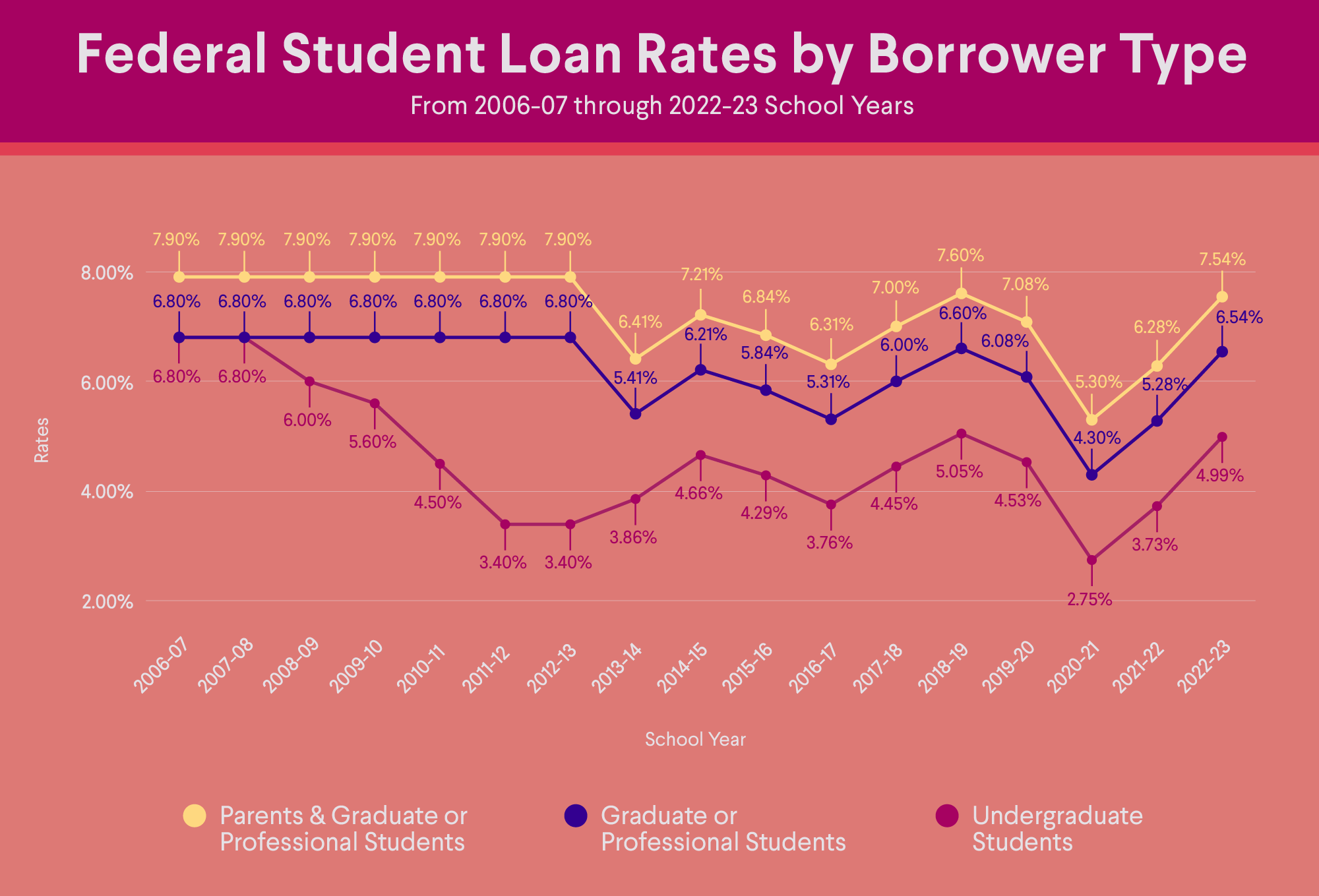
All three of those rates have risen from the 2023-2024 school year, and the undergraduate rate has more than doubled since the 2020-2021 school year.

Federal Student Loan Rates by Borrower Type
Source: Studentaid.gov

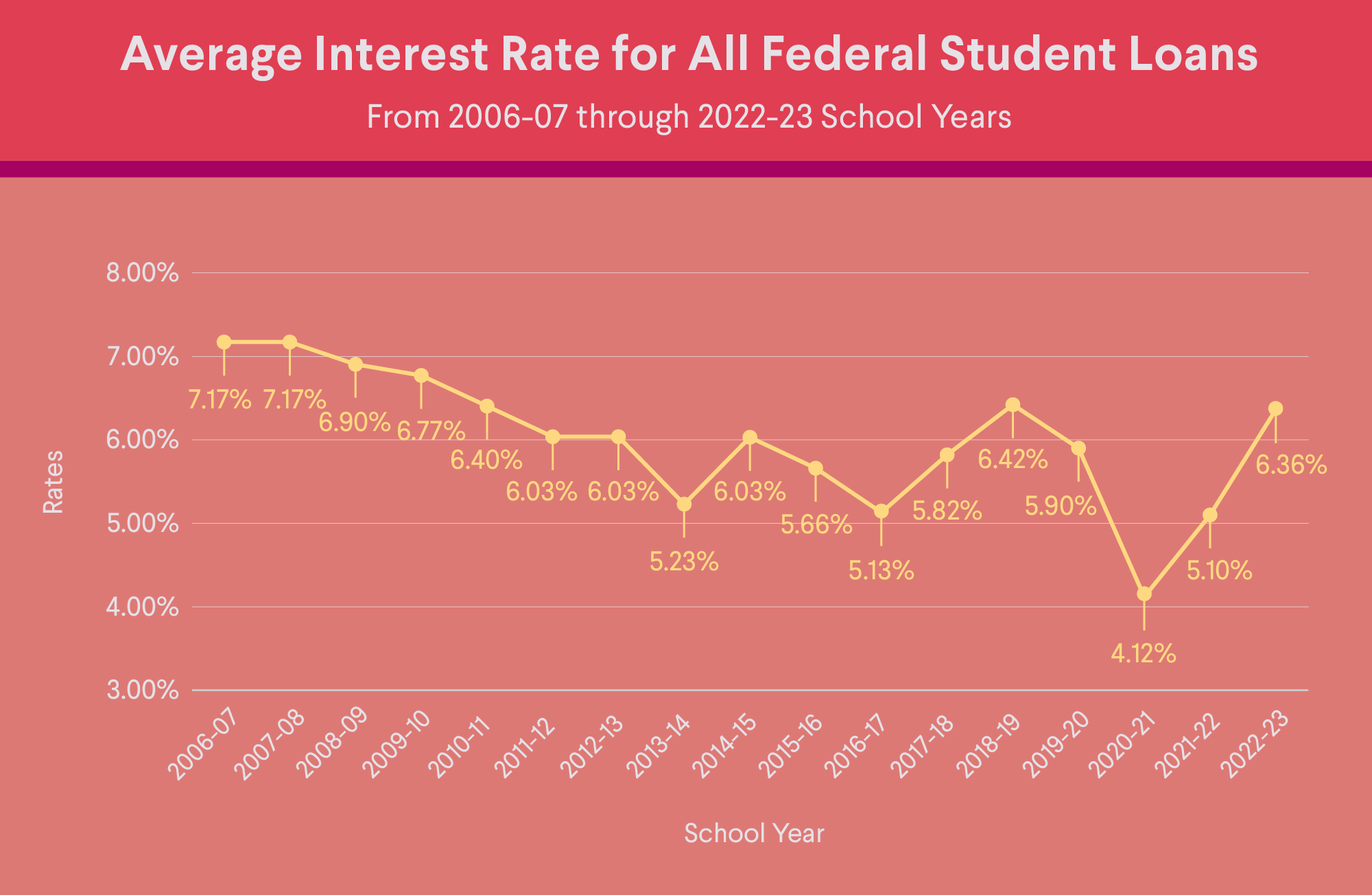
This means that the average student loan interest rate for the three main types of federal student loans is 7.89%.

Average Interest Rate for All Federal Student Loans
Source: Studentaid.gov

Private student loan interest rates vary by lender and each has its own criteria for which rates borrowers qualify for. Private student loans can have either fixed interest rates that remain the same over the life of the loan, or variable rates that may start lower than a fixed interest rate but then go up over time, based on market changes.

Private loans require a credit check, and lenders may offer different interest rates if you have strong credit or a cosigner on your student loan. The interest rates on private student loans can vary anywhere from 3.50% to 17.00% (as of March 2025), depending on the lender, the type of loan, and on individual financial factors including the borrower’s credit history.

Recommended: Do Student Loans Have Simple or Compound Interest?

How Are Interest Rates Determined?

As mentioned, the interest rates on federal student loans are set annually by formulas specified in the HEA. The rates are tied to the financial markets — federal law sets them based on the 10-year Treasury note and a statutory add-on percentage with a maximum rate cap.

Since July 2006, all federal student loans have fixed interest rates. Although federal student loans are serviced by private companies or nonprofits selected by the federal government, these loan servicers have no say in the federal interest rate offered.

For private student loans, the lenders set their own rates, though they often take cues from federal rates. The rates quoted for student loans vary based on each applicant’s individual situation — though generally the better a potential borrower’s credit history is, the better rate they may be able to qualify for.

To learn more about private and federal student loans, check out our student loan help center.

How Student Loan Interest is Calculated and Applied

Interest on federal student loans typically accrues daily. To calculate the interest as it accrues, the following formula can be used:

Interest amount = (outstanding student loan principal balance × interest rate factor) × days since last payment

In other words, you will multiply your outstanding loan balance by the interest rate factor, which is used to calculate the amount of interest that accrues on a student loan. Then, multiply that result by the days since you last made a payment.

To calculate the interest rate factor you can divide the interest rate by the number of days of the year (365). For example, let’s say you have an outstanding student loan balance of $10,000, an interest rate of 4.75%, and it’s been 30 days since your last payment. Here’s how to calculate your interest:

$10,000 x (4.75%/365) = $1.30 daily interest charge
$1.30 x 30 days = $39
Interest amount $39

Many private student loans will also accrue interest on a daily basis; however, the terms will ultimately be determined by the lender. Review the lending agreement to confirm.

Recommended: Do Student Loans Count as Income?

How to Evaluate Student Loan Interest Rates

When you take out a federal student loan, you’ll receive a fixed interest rate. This means that you’ll pay a set amount for the term of the student loan. In addition, all of the terms, conditions, and benefits are determined by the government. Federal student loans also provide some additional perks that you may not find with private lenders, like deferment.

Private student loans can have higher interest rates and potentially fewer perks than federal student loans. You may want to take advantage of all federal student loans you qualify for before comparing private loan options.

One thing to keep in mind is that interest you pay on student loans may allow you to take the student loan interest deduction on your taxes.

What Is a Good Fixed Interest Rate for Student Loans?

The lower the interest rate, the less a borrower will owe over the life of the loan, which could help individuals as they work on other financial goals. If you’re taking out federal loans, the student loan interest rate is set by federal law, so you don’t have a choice for what is and isn’t a reasonable interest rate.

When it comes to private student loans, it’s wise to shop around and compare your options to find the most suitable financing solution. Since every lender offers different terms, rates, and fees, getting quotes from multiple lenders may help you select the best option for your personal needs. Keep in mind that the rate you receive on a private student loan is largely dependent on your credit score and other factors, whereas federal student loan interest rates are based on HEA formulas.

Also keep in mind that private student loans do not have the same borrower protections as federal student loans, including deferment options, and should be considered only after all federal aid options have been exhausted.

Ways to Lower Your Student Loan Interest Rate

The interest rate on federal student loans, while fixed for the life of the loan, does fluctuate over time. For example, the rates for Direct Subsidized and Unsubsidized loans for undergraduates more than doubled from 2.75% in 2020–21 to 6.53% in 2024–25.

To adjust the rate on an existing student loan, borrowers generally have two options. They can refinance student loans or consolidate them with hopes of qualifying for a lower interest rate.

Refinancing a federal loan with a private lender eliminates them from federal borrower protections such as federal deferment or Public Service Loan Forgiveness. The federal government does offer a Direct Consolidation Loan, which allows borrowers to consolidate their federal loans into a single loan. This will maintain the federal borrower protections but won’t necessarily lower the interest rate. When federal loans are consolidated into a Direct Consolidation Loan, the new interest rate is a weighted average of your original federal student loans’ rates.

Refinancing student loans with a private lender may allow qualifying borrowers to secure a lower interest rate or preferable loan terms. Note that extending the repayment term will generally result in an increased cost over the life of the loan.

To see how refinancing could work for your student loans, try this student loan refinance calculator.

💡 Quick Tip: Refinancing comes with a lot of specific terms. If you want a quick refresher, the Student Loan Refinancing Glossary can help you understand the essentials.

Fixed vs. Variable Interest Rates: Which Is Better?

Whether fixed or variable interest rates are better depends on a borrower’s specific situation. For many borrowers, fixed rates are often a better option because they are stable and predictable. Your payments won’t change, and you won’t have to worry about rate hikes. Borrowers may want to consider a student loan with a fixed interest rate if interest rates are rising overall and they anticipate needing a number of years to repay their loan.

Because variable interest rates fluctuate with the market, they can be unpredictable. That means your payments can potentially change from one month to the next.

The Takeaway

The average student loan interest rate varies depending on the loan type. The interest rate for federal Direct Unsubsidized and Subsidized loans is set annually by federal law and fixed for the life of the loan.

The interest rate on private student loans is determined by a variety of factors including the borrower’s credit history and may range anywhere from 3.50% to to 17%.

Looking to lower your monthly student loan payment? Refinancing may be one way to do it — by extending your loan term, getting a lower interest rate than what you currently have, or both. (Please note that refinancing federal loans makes them ineligible for federal forgiveness and protections. Also, lengthening your loan term may mean paying more in interest over the life of the loan.) SoFi student loan refinancing offers flexible terms that fit your budget.


With SoFi, refinancing is fast, easy, and all online. We offer competitive fixed and variable rates.

FAQ

How often do student loan interest rates change?

The rates on federal student loans are determined and set annually by formulas specified in the Higher Education Act of 1965. Private student loan rates vary by lender, and they may be fixed or variable. Private loans with variable rates can change based on market changes.

How do federal student loan interest rates compare to private loans?

The interest rate on federal student loans is often lower than the rates for private student loans. The rate you may qualify for with a private loan depends on your circumstances. If you have strong credit or a loan cosigner who has strong credit, you may be able to get a loan with a lower interest rate.

Keep in mind that federal student loans have fixed interest rates, which means the interest and your monthly payment won’t change. Private student loans may have fixed or variable rates, and variable rates can go up or down with market changes.

Can I negotiate my student loan interest rate?

Federal student loans have fixed rates that are non-negotiable. With a private student loan, it’s possible that you may be able to negotiate the interest rate, especially if you are struggling to make payments or dealing with financial hardship. Call your private lender and explain the situation.

What factors determine my student loan interest rate?

Federal student loans have a fixed interest rate that is determined and set each year based on formulas specified in the Higher Education Act of 1965. With private student loans, each lender sets their own rates. Private loans require a credit check, and the interest rates vary based on an applicant’s credit and other factors. Generally speaking, the stronger a borrower’s credit is (or if they have a loan cosigner with strong credit), the lower the rate they may be able to qualify for.

Is it better to choose a fixed or variable interest rate for student loans?

For many borrowers, fixed rates may be a better option because they are stable and predictable, which means the monthly payments won’t change over the life of the loan. If you are planning to repay your loan over a period of years, you may want to consider a student loan with a fixed interest rate.

Variable interest rates fluctuate with the market, which makes them unpredictable. As a result, your payments can go up (or down), and may be harder to budget for.


About the author

Ashley Kilroy

Ashley Kilroy

Ashley Kilroy is a seasoned personal finance writer with 15 years of experience simplifying complex concepts for individuals seeking financial security. Her expertise has shined through in well-known publications like Rolling Stone, Forbes, SmartAsset, and Money Talks News. Read full bio.


SoFi Student Loan Refinance
Terms and conditions apply. SoFi Refinance Student Loans are private loans. When you refinance federal loans with a SoFi loan, YOU FORFEIT YOUR ELIGIBILITY FOR ALL FEDERAL LOAN BENEFITS, including all flexible federal repayment and forgiveness options that are or may become available to federal student loan borrowers including, but not limited to: Public Service Loan Forgiveness (PSLF), Income-Based Repayment, Income-Contingent Repayment, extended repayment plans, PAYE or SAVE. Lowest rates reserved for the most creditworthy borrowers.
Learn more at SoFi.com/eligibility. SoFi Refinance Student Loans are originated by SoFi Bank, N.A. Member FDIC. NMLS #696891 (www.nmlsconsumeraccess.org).

SoFi Loan Products
SoFi loans are originated by SoFi Bank, N.A., NMLS #696891 (Member FDIC). For additional product-specific legal and licensing information, see SoFi.com/legal. Equal Housing Lender.


Third-Party Brand Mentions: No brands, products, or companies mentioned are affiliated with SoFi, nor do they endorse or sponsor this article. Third-party trademarks referenced herein are property of their respective owners.

Non affiliation: SoFi isn’t affiliated with any of the companies highlighted in this article.

Tax Information: This article provides general background information only and is not intended to serve as legal or tax advice or as a substitute for legal counsel. You should consult your own attorney and/or tax advisor if you have a question requiring legal or tax advice.

Disclaimer: Many factors affect your credit scores and the interest rates you may receive. SoFi is not a Credit Repair Organization as defined under federal or state law, including the Credit Repair Organizations Act. SoFi does not provide “credit repair” services or advice or assistance regarding “rebuilding” or “improving” your credit record, credit history, or credit rating. For details, see the FTC’s website .

Financial Tips & Strategies: The tips provided on this website are of a general nature and do not take into account your specific objectives, financial situation, and needs. You should always consider their appropriateness given your own circumstances.

External Websites: The information and analysis provided through hyperlinks to third-party websites, while believed to be accurate, cannot be guaranteed by SoFi. Links are provided for informational purposes and should not be viewed as an endorsement.

SOSLR-Q125-025

Read more
TLS 1.2 Encrypted
Equal Housing Lender