Two people sit at an office desk looking at a tablet computer held by two outstretched hands.

Guide to Mortgage Relief Programs

Whether a layoff, inflation, or other bugaboo is causing you to struggle with your mortgage payments, life rafts are available. Options for people who need mortgage relief include forbearance, loan modification, and refinancing. Here’s a closer look at each option.

Key Points

•   Mortgage relief programs can pause or lower your monthly payments if you’re facing financial hardship.

•   Options include forbearance (temporary pause/reduction), loan modification (permanent change to loan terms), and refinancing (getting a new loan with better terms).

•   Contact your mortgage servicer immediately if you anticipate trouble making a payment to avoid damaging your credit score.

•   During forbearance, interest still accrues, and all suspended or reduced payments will need to be repaid.

•   Repayment options after forbearance vary but can include a lump sum, a repayment plan, or adding the amount to the end of the loan.

What Are Mortgage Relief Programs?

Relief programs don’t magically make monthly mortgage payments disappear, but they can pause or lower those payments.

Through a perennial form of mortgage relief, mortgage forbearance, borrowers facing financial troubles may be able to defer or trim payments short term.

It’s important to know that if you even anticipate a problem making a payment, it would be smart to contact your mortgage servicer (the company you send your mortgage payments to) immediately to talk about your options.

Tardy payments damage credit scores, and late payments stay on a credit report for seven years.

Catching a Break Through Mortgage Relief

The remedies for mortgage payment anguish come in several forms.

Forbearance at Any Time

While pandemic-related laws that required lenders to provide mortgage forbearance relief to struggling homeowners expired in April 2023, many lenders offer forbearance programs to borrowers on a case-by-case basis. If you’re dealing with a short-term crisis, you can reach out to your lender and ask for mortgage forbearance, to temporarily pause or lower your mortgage payments.

Many lenders will ask for documentation to prove the hardship. They also will want to know whether the hardship is expected to last for six months or less or 12 months.

During forbearance, interest accrues and is added to the loan balance. All suspended or reduced payments will need to be paid back.

Refinancing

Homeowners coming out of forbearance may find that it’s a good time for a mortgage refinance, aiming for a lower rate and possibly different repayment term.

When choosing a mortgage term, know that the longer the term, the lower the payments, in general.

It’s generally thought that you should have at least 20% equity in your home to refinance. Your debt-to-income ratio and credit will be assessed if you apply.

There are two refi options for low- to moderate-income homeowners whose current mortgage is owned by Fannie Mae or Freddie Mac. Fannie Mae’s RefiNow and Freddie Mac’s Refi Possible are designed to help those homeowners get better mortgage rates and reduce upfront costs.

Someone with a VA loan can look into an interest rate reduction refinance loan, and an FHA loan borrower may look into an FHA Streamline Refinance or standard conventional refi.

💡 Quick Tip: Lowering your monthly payments with a mortgage refinance from SoFi can help you find money to pay down other debt, build your rainy-day fund, or put more into your 401(k).

Loan Modification

Homeowners who expect a permanent change in finances, or who are exiting forbearance but don’t qualify for refinancing, can ask for a loan modification.

Loan modification may result in a lower interest rate, a lower principal balance, an extension of the repayment term, or a combination.

You might have to prove the hardship to be approved.

Recommended: Loan Modification vs. Refinancing

Applying for Mortgage Relief

Again, when homeowners realize that they might have trouble making their monthly mortgage payment, they would be doing themselves a favor by contacting their loan servicer.

This applies to primary homes, multifamily properties, and vacation homes.

Suffering in silence does no good. Working with your mortgage servicer could lead to one of the mortgage relief options described above or an agreement to try a short sale to avoid foreclosure.

A deed in lieu (an arrangement where you give your mortgage lender the deed to your home) is also sometimes used to avoid foreclosure.

Recommended: 6 Ways to Lower Your Mortgage Payment

What to Do During Forbearance

A homeowner in mortgage forbearance might want to keep track of the following:

•   Automatic payments. Any automatic payments or transfers to mortgage accounts should be paused by the borrower during the forbearance period. It’s unlikely the payments will be paused automatically, so it might be best to double-check.

•   Credit scores. On any loan, deferring payments shouldn’t affect credit scores, but homeowners might want to keep an eye on their scores in the event of an error.

•   Savings account. Now might be a good time to set aside any extra income to pay for the mortgage once forbearance ends.

•   Any changes to income. If a borrower’s income is restored during forbearance, they might need to contact their lender.

•   Property taxes and insurance payments. If homeowners insurance and taxes are paid through an escrow account, it should go into forbearance along with the mortgage. Homeowners who do not have an escrow account may be on the hook for those payments.

Homeowners interested in an extension of a forbearance period need to ask their mortgage servicer.

💡 Quick Tip: Generally, the lower your debt-to-income ratio, the better loan terms you’ll be offered. One way to improve your ratio is to increase your income (hello, side hustle!). Another way is to consolidate your debt and lower your monthly debt payments.

How to Repay Forbearance

Homeowners who received Covid hardship forbearance are not required to repay their paused payments in a lump sum when the forbearance period ends.

For those with Fannie Mae and Freddie Mac loans, options include a repayment plan with higher mortgage payments, putting the missed payments at the end of the loan, and a loan modification.

Borrowers with FHA loans can put the money owed into a no-interest lien that comes payable if they sell the home or refinance the mortgage. Or they can negotiate to lower their mortgage payments with a loan modification.

Options for USDA and VA loan repayment include adding the missed payments to the end of the loan, and loan modification.

In general, a homeowner can expect one of the following scenarios:

•   Repaying the forbearance amount in a lump sum.

•   An amount is added to the borrower’s monthly payment until the forbearance amount is repaid in full.

•   The forbearance amount is added to the end of the loan.

Recommended: Guide to Buying, Selling, and Updating Your Home

The Takeaway

Federal mortgage relief programs help homeowners who are experiencing hardship. General mortgage forbearance is possible during most any household setback. Refinancing could be an answer for some borrowers who are coming out of forbearance.

SoFi can help you save money when you refinance your mortgage. Plus, we make sure the process is as stress-free and transparent as possible. SoFi offers competitive fixed rates on a traditional mortgage refinance or cash-out refinance.

A new mortgage refinance could be a game changer for your finances.


SoFi Loan Products
SoFi loans are originated by SoFi Bank, N.A., NMLS #696891 (Member FDIC). For additional product-specific legal and licensing information, see SoFi.com/legal. Equal Housing Lender.


SoFi Mortgages
Terms, conditions, and state restrictions apply. Not all products are available in all states. See SoFi.com/eligibility-criteria for more information.


*SoFi requires Private Mortgage Insurance (PMI) for conforming home loans with a loan-to-value (LTV) ratio greater than 80%. As little as 3% down payments are for qualifying first-time homebuyers only. 5% minimum applies to other borrowers. Other loan types may require different fees or insurance (e.g., VA funding fee, FHA Mortgage Insurance Premiums, etc.). Loan requirements may vary depending on your down payment amount, and minimum down payment varies by loan type.

Financial Tips & Strategies: The tips provided on this website are of a general nature and do not take into account your specific objectives, financial situation, and needs. You should always consider their appropriateness given your own circumstances.

Tax Information: This article provides general background information only and is not intended to serve as legal or tax advice or as a substitute for legal counsel. You should consult your own attorney and/or tax advisor if you have a question requiring legal or tax advice.

This article is not intended to be legal advice. Please consult an attorney for advice.

Third Party Trademarks: Certified Financial Planner Board of Standards Center for Financial Planning, Inc. owns and licenses the certification marks CFP®, CERTIFIED FINANCIAL PLANNER®

SOHL-Q425-182

Read more

How to Open a Brokerage Account

When you open a brokerage account with a brokerage firm, you transfer money into the account that you can use to start investing. While some brokerage accounts may set an account minimum, there is typically no limit to how much you can deposit or when you can withdraw your money.

With a brokerage account, investors can invest in a variety of securities, including stocks, bonds, ETFs, and more. There are many brokerages, but the steps to open a brokerage account are similar among most of them.

Key Points

  • Select a brokerage provider that aligns with your investment goals, considering services and fees.
  • Complete the online account setup by submitting personal and financial information.
  • Fund the account by transferring money, similar to a bank deposit.
  • Start trading stocks, bonds, and ETFs once the account is funded.
  • SIPC insurance protects up to $500,000 in cash and securities if the brokerage fails.[1] However, if the brokerage firm fails, the account fails, too.

How to Open a Brokerage Account

How to Open a Brokerage Account Step-by-Step

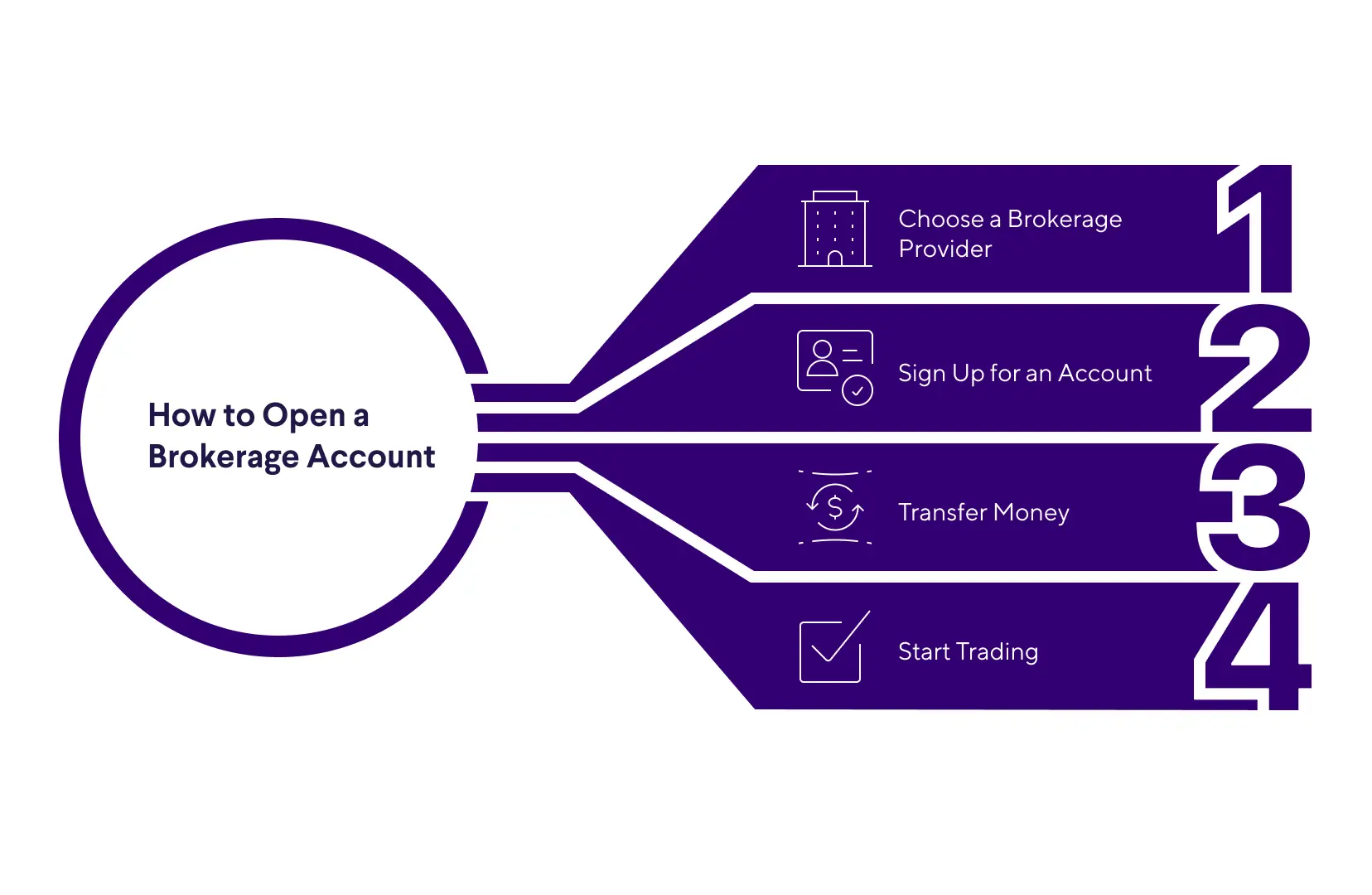
There are a few simple steps to opening your first brokerage account. We’ll dive deep into each one below.

  1. Choose a brokerage provider.
  2. Sign up for an account.
  3. Transfer money.
  4. Start trading.

Step 1: Choose a Brokerage Provider

There are several types of brokerage accounts[2], and the type you choose will depend on what you’re trying to accomplish.

  • Full-service brokerage firms not only allow clients to trade securities, they may also offer financial consulting and other services — though the price may be steep, compared to the other options here.
  • Discount brokerage firms typically charge lower fees than full-service, but as a result clients don’t have access to additional financial consulting or planning services.
  • Online brokerage firms are typically online-only, allowing clients to sign up, transfer money, and make trades through their website. These firms typically offer the lowest fees.

The accounts above are known as cash accounts: You must buy securities with funds you put in your account ahead of time.

You may also encounter other more complicated types of brokerage accounts known as margin accounts, which allow you to borrow money from your brokerage to make investments, using your case account as collateral. These accounts tend to be for sophisticated investors willing to shoulder the risk that investments bought with borrowed funds will lose value.

Before working with an individual investment advisor or a firm and opening a cash or margin account, it can be a good idea to run a check on their background. The Financial Industry Regulatory Authority (FINRA) offers online broker checks where you can enter a broker’s name, or the name of a firm, to learn whether a broker is registered to sell securities, offer investment advice, or both.[3]

And you can learn about a broker’s employment history, regulatory actions, and whether there are past or current arbitrations and complaints.

Step 2: Sign Up for a Brokerage Account

Most brokers of all kinds allow you to open and access your brokerage account online. When you open the account, you will likely be asked to provide your Social Security number or taxpayer identification number, your address, date of birth, driver’s license or passport information, employment status, annual income and net worth. You may also be asked about your investment goals and risk tolerance.

For the most part, they should not charge you a fee for opening an account. While some may require account minimums, others allow you to open an account with no minimum deposit. There is no limit on the number of brokerage accounts you can open, and you may be able to hold multiple accounts with multiple brokerage firms.

Step 3: Transfer Money

You will need to fund your new brokerage account before you can purchase any types of securities. You can deposit money in a brokerage account like you would in a traditional bank account.

Step 4: Start Trading

Many brokerage firms will offer a way for you to earn interest on uninvested funds so that your money continues to work for you even when not invested in the market.

How Do Brokerage Accounts Work?

The brokerage firm with which you hold your account maintains the account and acts as the custodian for the assets you hold. In other words, the custodian provides a space for investors to use their account in the way that it was intended.

However, you own the investments in the account and can buy and sell them as you wish. The brokerage firm acts as a middleman between you and the markets, matching you with buyers and sellers, and executing trades based on your instructions.

For example, if you place an order with your brokerage to buy a certain number of shares of stock, the brokerage will match you with a seller looking to sell those shares and make the trade for you.

What’s the Difference Between Brokerage Accounts and Retirement Accounts?

Brokerage accounts are also known as taxable accounts, because profits on sales of securities inside the account are potentially subject to capital gains taxes. Generally speaking, these accounts offer no tax advantages for investors.

Retirement accounts, on the other hand, offer a number of tax advantages that may make them preferable to taxable accounts if you’re planning to save for retirement. Retirement accounts place limits on how much money you can contribute and when you can withdraw funds.

If retirement planning is your main concern, you may consider saving as much as you can in both a 401(k) if your employer offers one, and a traditional or Roth IRA. If you have funds left over, you may choose to invest those in your taxable brokerage account.

Is My Money Safe in a Brokerage Account?

The money and securities held in a brokerage account are insured by the Securities Investor Protection Corporation (SIPC). The SIPC protects against the loss of cash and securities held at failing brokerage firms. If your brokerage firm goes bankrupt, the SIPC covers $500,000 worth of losses, including $250,000 in cash losses.

The SIPC only provides protection for the custody function of a brokerage firm. In other words, they work to restore the cash and securities that were in a customer’s account when the brokerage started its liquidation proceedings. The organization does not protect against declines in value of the securities you hold, nor does it protect against receiving and acting upon bad investment advice.

It is important that any investor realizes and accepts that investment comes with a certain amount of risk. While security prices may gain in value, it is also possible that you could lose some or all of your investment.

The Takeaway

Opening a brokerage account is a simple process that allows you to invest in securities. Effectively, you’re depositing money at a brokerage, which will allow you to buy investments such as stocks, bonds, or ETFs. There are numerous brokerages out there, and different types of brokerage accounts.

Invest in what matters most to you with SoFi Active Invest. In a self-directed account provided by SoFi Securities, you can trade stocks, exchange-traded funds (ETFs), mutual funds, alternative funds, options, and more — all while paying $0 commission on every trade. Other fees may apply. Whether you want to trade after-hours or manage your portfolio using real-time stock insights and analyst ratings, you can invest your way in SoFi's easy-to-use mobile app.

Opening and funding an Active Invest account gives you the opportunity to get up to $1,000 in the stock of your choice.¹

FAQ

How do I open a brokerage account?

Broadly speaking, you can open a brokerage account by choosing a broker or brokerage account provider, signing up, transferring money into the account, and then starting to trade or invest.

What are the different types of brokers?

There are several different types of brokerages, and those include full-service brokerage firms, discount brokerage firms, and online brokerage firms. Each type may offer different products and services, or levels of service.

Is money in a brokerage account safe?

While nothing is ever truly safe, money and securities that are held in brokerage accounts are insured by the Securities Investor Protection Corporation, or SIPC, for up to $500,000 in losses.

Article Sources

INVESTMENTS ARE NOT FDIC INSURED • ARE NOT BANK GUARANTEED • MAY LOSE VALUE

SoFi Invest is a trade name used by SoFi Wealth LLC and SoFi Securities LLC offering investment products and services. Robo investing and advisory services are provided by SoFi Wealth LLC, an SEC-registered investment adviser. Brokerage and self-directed investing products offered through SoFi Securities LLC, Member FINRA/SIPC.

For disclosures on SoFi Invest platforms visit SoFi.com/legal. For a full listing of the fees associated with Sofi Invest please view our fee schedule.

Financial Tips & Strategies: The tips provided on this website are of a general nature and do not take into account your specific objectives, financial situation, and needs. You should always consider their appropriateness given your own circumstances.

Disclaimer: The projections or other information regarding the likelihood of various investment outcomes are hypothetical in nature, do not reflect actual investment results, and are not guarantees of future results.

Exchange Traded Funds (ETFs): Investors should carefully consider the information contained in the prospectus, which contains the Fund’s investment objectives, risks, charges, expenses, and other relevant information. You may obtain a prospectus from the Fund company’s website or by emailing customer service at [email protected]. Please read the prospectus carefully prior to investing.

Fund Fees
If you invest in Exchange Traded Funds (ETFs) through SoFi Invest (either by buying them yourself or via investing in SoFi Invest’s automated investments, formerly SoFi Wealth), these funds will have their own management fees. These fees are not paid directly by you, but rather by the fund itself. these fees do reduce the fund’s returns. Check out each fund’s prospectus for details. SoFi Invest does not receive sales commissions, 12b-1 fees, or other fees from ETFs for investing such funds on behalf of advisory clients, though if SoFi Invest creates its own funds, it could earn management fees there.
SoFi Invest may waive all, or part of any of these fees, permanently or for a period of time, at its sole discretion for any reason. Fees are subject to change at any time. The current fee schedule will always be available in your Account Documents section of SoFi Invest.


Utilizing a margin loan is generally considered more appropriate for experienced investors as there are additional costs and risks associated. It is possible to lose more than your initial investment when using margin. Please see SoFi.com/wealth/assets/documents/brokerage-margin-disclosure-statement.pdf for detailed disclosure information.

Tax Information: This article provides general background information only and is not intended to serve as legal or tax advice or as a substitute for legal counsel. You should consult your own attorney and/or tax advisor if you have a question requiring legal or tax advice.


¹Probability of Member receiving $1,000 is a probability of 0.026%; If you don’t make a selection in 45 days, you’ll no longer qualify for the promo. Customer must fund their account with a minimum of $50.00 to qualify. Probability percentage is subject to decrease. See full terms and conditions.

Third Party Trademarks: Certified Financial Planner Board of Standards Center for Financial Planning, Inc. owns and licenses the certification marks CFP®, CERTIFIED FINANCIAL PLANNER®

SOIN-Q225-132

Read more
A mother and daughter sit on a sofa conversing, with a black dog lying on the floor in the foreground.

7 Tips to Prepare for College Decision Day

After four years of hard work in high school, the moment of truth arrives as college acceptance letters begin to roll in. If you’re lucky enough to receive multiple offers, you’ve got a big decision to make.

Most final enrollment choices must be made by May 1st, widely known as College Decision Day. This is the deadline for prospective students who apply “regular decision” to confirm their enrollment and submit a nonrefundable deposit.

Making this choice can be difficult, with a number of factors to consider. Below are seven tips to help you and your family confidently navigate the decision-making process ahead of College Decision Day.

Key Points

•   Stay organized by tracking key deadlines and keeping all acceptance/award letters in one place.

•   Compare financial aid offers carefully, focusing on the net cost after grants and scholarships are applied.

•   To accept a college offer, you must typically submit a nonrefundable enrollment deposit by the deadline.

•   If you are waitlisted, you may need to put down a deposit at a different school by May 1st as a backup plan.

•   Understand your financing options, including the differences between federal student loans (which are undergoing changes for 2026) and private student loans.

1. Getting Organized

While the hard work of submitting college applications is done, high school seniors still have several important tasks and deadlines to manage to ensure a smooth transition to college.

Here are some deadlines to keep in mind and documents you’ll want to organize leading up to (and just after) Decision Day.

Key Deadlines (for 2026 Entry)

•   FAFSA® submission: The federal deadline to submit the Free Application for Federal Student Aid (FAFSA) for the 2026-2027 academic year is June 30, 2027. However, individual states and colleges have their own FAFSA deadlines, which are often much earlier than the federal deadline. It’s a good idea to submit the FAFSA as early as possible because many grants and scholarships are awarded on a first-come, first-served basis until the funds run out.

•   CSS Profile (if required): The deadline for submission varies by school but typically falls between January 1 and March 31 for regular decision students.

•   College Decision Day: May 1, 2026 is the typical deadline to accept an admission offer and submit a deposit for fall 2026 enrollment.

•   Housing applications: For incoming freshmen, housing applications are often due within a week after the May 1 decision deadline, or around May 8.

•   Scholarship deadlines: Deadlines for scholarship applications occur all year round, but many fall between October and March.

•   Federal aid offer appeals: If your family’s financial situation has changed since you submitted the FAFSA or if you believe your initial application did not accurately reflect your ability to pay, you can appeal your financial aid award. Deadlines vary by school but, ideally, you want to submit it shortly after receiving your aid package.

Staying organized with a calendar or a checklist will help you avoid missing any important deadlines.

Important Paperwork to Keep Track Of

Consider setting up a folder (physical or digital) for all of the following:

•   Acceptance letters for each college you’re considering

•   Financial aid award letters

•   FAFSA submission confirmation

•   CSS Profile submission confirmation (if applicable)

•   Scholarship award letters

•   Communications with admissions/financial aid offices (e.g., emails, notes from calls)

•   Enrollment deposit receipts (once you’ve chosen a school)

•   Housing application confirmations (once you’ve chosen a school)

💡 Quick Tip: Make no payments on SoFi private student loans for six months after graduation.

2. Comparing Financial Aid Offers

College can be expensive. Before you commit to a school, you’ll want to compare any financial aid offers you’ve received.

When you receive a financial aid award letter, it will outline how much aid is in grants and scholarships (which you don’t have to repay) versus federal student loans (which you do have to repay). The letter will also typically include the school’s cost of attendance. By subtracting the grant and scholarship amounts on your aid offer from the cost of attendance amount, you can come up with the school’s net cost. This is the amount you will have to pay out of your pocket using savings, earnings from work, and/or student loans.

Looking at the net costs for the colleges you are considering allows you to compare costs apples to apples and see which school best fits your budget.

3. Reserving Your Spot

Once you receive an offer letter, you can respond at any point — you don’t need to wait until College Decision Day. To secure your spot, you’ll usually need to pay an enrollment deposit.

What You Need to Know About Enrollment Deposits

•   This fee is typically nonrefundable.

•   Paying the deposit holds your spot in the incoming class.

•   Deposit amounts typically range from $100 to $1,000, depending on the school.

•   Try to avoid paying deposits to multiple schools (known as “double-depositing ”) just to buy extra time — this is generally frowned upon and can harm other students on waitlists.

4. Mulling Over the Waitlist

Being waitlisted by a college means you are not accepted or rejected, but are on a hold list for potential admission if spots open up after other accepted students decline their offers. You generally won’t hear back about a waitlist decision until after the national May 1 deadline. In some cases, students don’t find out until soon before the fall semester.

If you’re waitlisted, you typically need to accept or reject the waitlist offer. You generally only want to accept a waitlist offer if the school is truly your top choice. Otherwise, it’s a good idea to remove yourself from the list so other students can be considered.

If you accept a waitlist offer, consider how long you’re willing to wait and come up with a backup plan. That typically means putting down an enrollment deposit at another college you have been accepted to by College Decision Day. This ensures you have a place to go if you don’t get off the waitlist, even if you lose the deposit later.

5. When Decision Day Arrives

Ideally, you’ll make your final decision before May 1. Waiting until the last minute offers very little wiggle room if something goes wrong, like a technical glitch.

To accept a college admission offer, you’ll need to use the method specified by the school, which often involves logging into your student portal and paying a nonrefundable enrollment deposit.

You’re not required to formally decline a college acceptance — not accepting by May 1 is considered a rejection. However, it’s more respectful to decline. You can typically do this by logging in to the school’s online system and rejecting the admission offer. The sooner you reject an offer, the sooner the college can offer the spot to another student on the school’s acceptance waitlist.

6. If You Miss the Deadline

If you miss the May 1 deadline, you risk losing your spot because the college may fill it with someone else. You may also lose your financial aid package. However, you aren’t necessarily out of luck. Your best move is to contact the college admissions department as soon as possible. If you have a valid excuse, they may allow you to still accept their offer. Be sure to explain any emergency, problem, or other issue that kept you from submitting your decision and deposit in time.

7. Financing a College Education

Once you’ve accepted a college offer, you’ll have a clear idea of how much it will cost. As you and your family figure out how you’ll pay for college, student loans may come into play.There are two types available:

Federal Student Loans

Federal student loans are made by the U.S. government and have terms and conditions that are set by law. Federal loans can be subsidized (meaning the government pays the interest while you are in school and during certain other periods) or unsubsidized (you must pay all of the interest that accrues). Subsidized loans are offered to eligible students who demonstrate financial need; unsubsidized loans are available to eligible students regardless of financial need.

Federal student loans generally do not require a credit check and come with relatively low, fixed interest rates.

Federal Student Loans: What’s Changed for 2026

Major changes to federal student loans were enacted by the “One Big Beautiful Bill” Act (OBBBA) in July 2025, primarily affecting new borrowers starting in July 2026. Here’s are some changes that will impact undergraduates:

•  Fewer payment plans: OBBBA will reduce repayment options from the current seven plans down to two new plans. These include:

◦  The standard plan: Borrowers will be assigned a repayment window of between 10 and 25 years, depending on the size of their debt, and will need to make equal monthly payments. This is generally the best choice for those who want to pay off their loans quickly and minimize interest costs.

◦  The Repayment Assistance Plan (RAP): Borrowers who worry they won’t be able to make the fixed monthly payments on the standard plan, can choose the Repayment Assistance Plan (RAP). On RAP, payments range from 1% to 10% of a borrower’s Adjusted Gross Income (AGI), with forgiveness after 30 years of consistent payments.

•  Lower borrowing limits for parents: Parents and caregivers who use parent PLUS loans to help students pay for college will see new loan limits. These loans will be capped at $20,000 a year and, in aggregate, at $65,000 per child.

💡 Quick Tip: Parents and sponsors with strong credit and income may find more-competitive rates on no-fees-required private parent student loans than federal parent PLUS loans. Federal PLUS loans also come with an origination fee.

Private Student Loans

Private student loans are offered by private lenders like banks and credit unions to help cover educational and living expenses. They are typically used to bridge the funding gap when federal student aid (including federal student loans) and scholarships do not cover the total cost of attendance.

Unlike federal loans, private student loans are credit-based, meaning a borrower’s credit history is a key factor in approval and interest rates. Many students need a creditworthy cosigner to qualify.

Private lenders often allow borrowing up to the total cost of attendance (minus any financial aid), which can be higher than federal loan limits. However, private loans may have higher interest rates and generally lack the borrower protections available with federal loans, such as income-driven repayment and forgiveness programs.

The Takeaway

Choosing which college to attend is a major decision, and College Decision Day is the critical deadline. By staying organized, diligently comparing financial aid packages, and planning for how you will ultimately finance your education, you can navigate this stressful but exciting time successfully. Taking these preparation steps can help ensure you make the best choice for your academic future and financial well-being.

If you’ve exhausted all federal student aid options, no-fee private student loans from SoFi can help you pay for school. The online application process is easy, and you can see rates and terms in just minutes. Repayment plans are flexible, so you can find an option that works for your financial plan and budget.


Cover up to 100% of school-certified costs including tuition, books, supplies, room and board, and transportation with a private student loan from SoFi.

FAQ

What should I consider when comparing financial aid offers in 2026?

When comparing financial aid offers for 2026, the key is to look past the sticker price and focus on the net cost. This is the total cost of attendance (tuition, fees, room, board, and estimated personal expenses) minus any grant and scholarship money you receive. Grants and scholarships are essentially free money that does not need to be repaid, making them the most valuable part of your package. You’ll also want to closely examine the federal student loans offered, noting whether they are subsidized (the government pays the interest while you’re in school) or unsubsidized (you are responsible for all interest). If you’re eligible for work-study, that can also help you cover some of your costs.

What happens if I miss the College Decision Day deadline?

If you miss the College Decision Day deadline, you may lose your spot at your chosen school. Colleges often reallocate unclaimed offers to waitlisted students. Contact the admissions office immediately, as some may offer a short grace period. Missing the deadline can also impact your eligibility for financial aid and housing preferences.

Can I apply for more financial aid after receiving my college acceptance?

Yes, you can generally apply for more financial aid even after you’ve received your college acceptance and initial aid offer. The process is typically called a financial aid appeal. You’ll need to contact the college’s financial aid office to request this review. Generally, your odds of success are better if you can demonstrate a significant change in your family’s financial situation since submitting the FAFSA®, such as a job loss, unexpected medical expenses, or a parent’s divorce. You will need to provide documentation to support your appeal.

How can I appeal my financial aid offer?

To appeal your financial aid offer, contact your college’s financial aid office and ask about their appeal process. Typically, you need to submit a formal letter explaining your financial changes or special circumstances, such as job loss or medical expenses, and include documentation to support your case. Appeals are reviewed individually and may or may not increase your aid.

Are there any new student loan options for 2026?

Federal student loan options are undergoing significant changes for new borrowers starting in July 2026 due to the “One Big Beautiful Bill” Act (OBBBA) enacted in July 2025. For undergraduates, changes include a reduction in repayment plans from seven to two: the Standard Plan (fixed payments over 10-25 years) and the Repayment Assistance Plan, or RAP (payments based on 1%-10% of adjusted gross income, with forgiveness after 30 years). Additionally, new annual and aggregate borrowing limits for Parent PLUS loans have been set at $20,000 and $65,000 per child. Private student loans remain an option, typically used to cover costs beyond what federal aid provides.

How do recent federal policy changes affect my student loans?

The federal policy changes enacted by the “One Big Beautiful Bill” Act (OBBBA) in July 2025 will significantly affect new federal student loan borrowers starting in July 2026. For undergraduates, the most impactful change is the consolidation of the seven existing repayment plans into just two: the Standard Plan, which assigns fixed monthly payments over a 10- to 25-year period based on debt size, and the Repayment Assistance Plan (RAP), a new income-driven option where payments are set at 1% to 10% of the borrower’s adjusted gross income, leading to forgiveness after 30 years of consistent payments. In addition, parents using Parent PLUS loans to help finance their children’s education will face new limits, with annual borrowing capped at $20,000 and an aggregate limit of $65,000 per child.


SoFi Private Student Loans
Please borrow responsibly. SoFi Private Student loans are not a substitute for federal loans, grants, and work-study programs. We encourage you to evaluate all your federal student aid options before you consider any private loans, including ours. Read our FAQs.

Terms and conditions apply. SOFI RESERVES THE RIGHT TO MODIFY OR DISCONTINUE PRODUCTS AND BENEFITS AT ANY TIME WITHOUT NOTICE. SoFi Private Student loans are subject to program terms and restrictions, such as completion of a loan application and self-certification form, verification of application information, the student's at least half-time enrollment in a degree program at a SoFi-participating school, and, if applicable, a co-signer. In addition, borrowers must be U.S. citizens or other eligible status, be residing in the U.S., Puerto Rico, U.S. Virgin Islands, or American Samoa, and must meet SoFi’s underwriting requirements, including verification of sufficient income to support your ability to repay. Minimum loan amount is $1,000. See SoFi.com/eligibility for more information. Lowest rates reserved for the most creditworthy borrowers. SoFi reserves the right to modify eligibility criteria at any time. This information is subject to change. This information is current as of 4/22/2025 and is subject to change. SoFi Private Student loans are originated by SoFi Bank, N.A. Member FDIC. NMLS #696891 (www.nmlsconsumeraccess.org).

SoFi Bank, N.A. and its lending products are not endorsed by or directly affiliated with any college or university unless otherwise disclosed.

SoFi Loan Products
SoFi loans are originated by SoFi Bank, N.A., NMLS #696891 (Member FDIC). For additional product-specific legal and licensing information, see SoFi.com/legal. Equal Housing Lender.


Non affiliation: SoFi isn’t affiliated with any of the companies highlighted in this article.

SOISL-Q425-040

Read more

Tips For Navigating Life After College

Graduating college is a big deal. The time you spent in school has likely taught you a lot about the subjects you studied, being organized and meeting deadlines, and life in general. Once you have your degree, you’ll put those skills to good use as you embark on your career and independent life. No more dining hall, no more dorms. It’s time to launch adult life and figure out how to make your own way.

To help you deal with some of the basics, like a job and banking, read on. You’ll find valuable tips to help you through the first steps of post-grad life.

Key Points

•   For college grads, extensive networking and using school resources can help in job searching.

•   Regular health check-ups and understanding health care plan resources are crucial as new grads begin to navigate life on their own.

•   Continuing education through certifications or online classes could assist college grads in learning new skills and boosting their career.

•   Creating a monthly budget could help manage student loan debt.

•   Maintaining a balanced lifestyle with activities for physical and mental well-being is important.

Life After College

Congrats on your degree! Now, on to the next challenge. It’s time to tackle adulting, which can include such things as getting set up in your new living situation, finding your favorite brunch spot, and making new friends if your college pals have scattered to different places.

In addition, there are some major daily-life tasks to wrangle:

•   Finding and holding a job

•   Taking control of your health and your health insurance

•   Keeping your brain active, which may lead to more schooling

•   Managing your money.

Below, get some helpful advice on these last four topics (you can probably find the best brunch spot in your new neighborhood without too much help).


💡 Quick Tip: Enjoy no hidden fees and special member benefits when you refinance student loans with SoFi.

Getting to Work

Hopefully you enjoyed a few weeks off post-grad to travel or kick back and relax after four years of hard work. But for many people, what to do after college is find work.

When you’re ready to begin your job search, it can feel overwhelming. Chances are, it’s time to focus on taking steps towards building your career.

First off, don’t let job searching totally stress you out. While entry-level hiring has slowed in 2025, and there is higher unemployment for new grads, it is still possible to find a job.

It could just require more time and patience. Some good advice? Research, network, and network some more.

•   Your school’s career services office may provide job leads, and its alumni office may be able to network you with people in your field who can share insights.

•   Search for jobs online. There are many job boards, such as Indeed and ZipRecruiter, to access.

•   Put out the word among friends, families, past internship supervisors, and others.

•   To gain intel on starting salaries, try an online salary calculator. You provide some basic info like your location and experience, and their tool tells you what the average salary for your desired role is. While this tool can only provide an estimate, it may help you determine if you should try to negotiate for a higher salary when you receive a job offer.

Taking Your Health into Your Own Hands

As part of learning how to navigate life on your own, make sure you take the reins of your healthcare. Mom and Dad likely aren’t scheduling those biannual dental checkups for you anymore.

Whether you’re still on your parent’s policy or buying your own health insurance, getting more familiar with the resources your healthcare plan provides is never a bad idea.

It can help you stay on top of scheduling check ups, dental cleanings, and eye exams. You may also need to learn the ropes of finding in-network doctors as you move to a new place or get your own policy.

And you might want to start saving for any unexpected medical or dental bills that may arise. Having an emergency fund at the ready can be an important step to financial wellness in this new chapter of your life.

Speaking of wellness: You may feel swamped by post-grad life, but it’s such an important time to prioritize your well-being. It might be helpful to make time to go to the gym each week, meditate, cook healthy meals, and get a good night’s sleep. Getting into good health habits is an excellent adulting accomplishment.


💡 Quick Tip: Refinancing could be a great choice for working graduates who have higher-interest graduate PLUS loans, Direct Unsubsidized Loans, and/or private loans.

Continuing Your Learning

It’s normal after college to need a little break from learning. For the first time in your life, there is no one telling you what to read or what classes you have to take. But once the dust has settled and you’ve had a rest from hitting the books, you might try to prioritize learning. Not only does it keep your brain sharp, it can also help boost your career by enhancing or expanding your skills.

For example, you could consider obtaining a professional license related to your career or industry. According to the most recent intel from the Bureau of Labor Statistics, 24% of employed workers had some sort of professional license or certification in 2024. Having one may give you a competitive boost at work or while job searching. You can go the extra mile to develop more skills needed in your career through an online class or professional conference.

What’s more, additional learning and training could lead to a profitable side hustle or gig work. For instance, you might be able to pick up extra cash during tax season supporting professional tax preparers.

Learning-wise, not all of what you do after graduation has to go towards career advancement, of course. Take that cool history of film class at your local community college. Join a book club or just load up your bookshelf with books you’re dying to read. Exploring your passions can help you feel motivated, fulfilled, and inspired. Now is the time in your life to open doors, not close them.

Recommended: What Should I Do After My Master’s Degree?

Getting Your Finances Organized

Once you graduate from college and join the working world, it’s likely time to look at whether your current banking partner suits your needs.

It can be a wise move to look for a bank that offers a good interest rate on your deposits, convenient access, and tools that help you track your money in a quick and convenient way.

As you organize your money (and don’t forget to start that emergency fund mentioned above), you may realize that one expense that may really be bringing you down is your student loan debt payments.

The average federal student loan debt is currently $39,075, according to the Education Data Initiative. Is student loan debt weighing you down? There are a few strategies you can use to help pay off your student loan debt quicker. You might start your journey to a student loan-free life by creating a monthly budget that can help you get out of debt.

•   To create a budget that can assist with paying off debt, you could begin by gathering all of your bills and recent receipts. Review exactly what you need to spend on necessary living expenses (rent, food, health insurance, minimum debt payments), how much you are spending on the wants in life (travel, entertainment, clothing), and how much you can save or put toward additional debt payment.

•   There are different budgeting methods, and it’s a good idea to spend a bit of time finding the one that works for you. For instance, you might like the 50/30/20 budget rule, which says to allocate 50% of your take-home pay to necessities, 30% to wants, and 20% to savings and extra debt payoff.

Whichever technique you choose, do compare the cost of your living expenses to your paystubs to see how much you can afford to pay towards debt each month. Creating a budget can help you not only pay off your debt, but avoid accumulating more debt in the future.

Recommended: 6 Strategies to Pay Off Student Loans Quickly

The Takeaway

Life after college is exciting, but it can also be challenging. You’ll need to find a job, take control of your health, keep sharpening your skills, and learn to manage your finances, including setting up a budget.

Once you have your monthly budget under control, you might consider refinancing your student loans as part of how you navigate life post-college. You may be able to lower your interest rate, lower your monthly payments by extending your repayment term, or release a cosigner from a previous loan.

Do note that lengthening your repayment term can increase the interest you’ll pay throughout the life of your loan.

Refinancing comes with many benefits, but keep in mind that you lose federal benefits and protections when you refinance federal loans with a private lender. But if you are not planning on taking advantage of these benefits, refinancing might be for you.

Looking to lower your monthly student loan payment? Refinancing may be one way to do it — by extending your loan term, getting a lower interest rate than what you currently have, or both. (Please note that refinancing federal loans makes them ineligible for federal forgiveness and protections. Also, lengthening your loan term may mean paying more in interest over the life of the loan.) SoFi student loan refinancing offers flexible terms that fit your budget.

With SoFi, refinancing is fast, easy, and all online. We offer competitive fixed and variable rates.

FAQ

What’s the biggest challenge grads face after college?

One of the biggest challenges grads face after college is finding a job that utilizes their skills and talents and pays well. In addition, new grads are facing other challenges, such as getting settled in their new life — possibly in a new home in a new city — working on managing their finances, perhaps for the first time, and starting to pay off student loan debt.

Why is it so hard for recent college graduates to get a job now?

College grads are currently facing a slowing job market for entry-level jobs, economic uncertainty, and higher unemployment. Networking, brushing up on or learning skills that employers are seeking, and putting the word out to family, friends, and former employers that you are job searching are some ways to potentially help boost your job search.

How important is your first job out of college?

A first job doesn’t define your career, and in this challenging job market it’s important to be flexible. Grads might end up with an entry-level job that is different from one they might have envisioned. That said, a first job can help a new grad develop skills and build a professional network. If possible, look for a position that aligns with your career goals as much as possible and that also allows you to use the skills you have while developing new ones.


SoFi Student Loan Refinance
Terms and conditions apply. SoFi Refinance Student Loans are private loans. When you refinance federal loans with a SoFi loan, YOU FORFEIT YOUR ELIGIBILITY FOR ALL FEDERAL LOAN BENEFITS, including all flexible federal repayment and forgiveness options that are or may become available to federal student loan borrowers including, but not limited to: Public Service Loan Forgiveness (PSLF), Income-Based Repayment, Income-Contingent Repayment, extended repayment plans, PAYE or SAVE. Lowest rates reserved for the most creditworthy borrowers.
Learn more at SoFi.com/eligibility. SoFi Refinance Student Loans are originated by SoFi Bank, N.A. Member FDIC. NMLS #696891 (www.nmlsconsumeraccess.org).

SoFi Loan Products
SoFi loans are originated by SoFi Bank, N.A., NMLS #696891 (Member FDIC). For additional product-specific legal and licensing information, see SoFi.com/legal. Equal Housing Lender.


Non affiliation: SoFi isn’t affiliated with any of the companies highlighted in this article.

Financial Tips & Strategies: The tips provided on this website are of a general nature and do not take into account your specific objectives, financial situation, and needs. You should always consider their appropriateness given your own circumstances.

External Websites: The information and analysis provided through hyperlinks to third-party websites, while believed to be accurate, cannot be guaranteed by SoFi. Links are provided for informational purposes and should not be viewed as an endorsement.

SOSLR-Q425-011

Read more
A traditional wood-handled magnifying glass magnifies an "A+" on a vibrant yellow background, symbolizing a top grade

Do Grades Affect Financial Aid? All You Need to Know

The office of Federal Student Aid provides over 9.9 million college students with more than $120 billion in grant, work-study, and student loan funds each year to help pay for college or career school. However, there are situations where students can lose their financial aid.

Students will want to consider how their grades affect financial aid to avoid having federal college aid taken away. Generally, you’ll need to make satisfactory academic progress (SAP) each term to continue receiving federal financial aid, but you may be able to regain lost aid by filing a financial aid appeal.

If you’ve received aid through private scholarships or grants, you may need to meet their minimum requirements to remain eligible for gift aid. Private lenders may also have minimum GPA requirements, but these vary by lender.

Key Points

•   Federal financial aid requires students to maintain Satisfactory Academic Progress (SAP) — typically a 2.0 GPA, 67% course completion rate, and program completion within 150% of normal timeframe.

•   Dropping below SAP standards can cause loss of grants, loans, or work-study eligibility, though aid can sometimes be regained through an appeal.

•   Private scholarships and grants often have their own GPA or credit hour requirements, and failure to meet them may result in lost funding.

•   Private student loans usually don’t depend on grades, but lenders may have credit or GPA requirements depending on the institution.

•   Students who lose aid due to grades may file a SAP appeal if poor performance was linked to extenuating circumstances like illness or family hardship.

Types of Financial Aid

There are many types of financial aid available to college students from the federal government, states, schools, and private sources. This funding can be used to cover most higher education costs, such as tuition and fees, room and board, and books.

Sallie Mae’s 2025 “How America Pays for College” survey found that while parent income and savings covered nearly 50% of college costs during the 2024–25 academic year, families still heavily relied on financial aid and federal loans to cover the other half.

Grants & Scholarships

College grants and scholarships are a form of financial aid that can help make college more affordable because they don’t usually need to be repaid. The U.S. Department of Education, colleges, and universities award an estimated $256.7 billion in grant and scholarship money to students each year. The Sallie Mae survey found that scholarships and grants covered approximately 27% of school costs for families in 2024-25.

The biggest differences between college grants and scholarships are where the funds come from, eligibility requirements, and the application process. Grants are typically given based on financial need while most scholarships are merit-based. Scholarships may be awarded to students based on their academic or athletic achievements, extracurricular activities, fields of study, and more.


💡 Quick Tip: You can fund your education with a competitive-rate, no-fees-required private student loan that covers up to 100% of school-certified costs.

Federal Work-Study

Federal Work-Study is a form of financial aid that offers students funds via part-time employment on campus. Several factors determine whether a student is eligible to participate in the Federal Work-Study program, including their family’s income and the student’s enrollment status at the school.

As with other forms of federal financial aid, a student’s grades affect their eligibility. Students are expected to make SAP, which is a school’s standard for satisfactory academic progress toward a degree or certificate.

Student Loans

Student loans can either come from the federal government or private lenders. To qualify for a federal student loan, students must demonstrate financial need, fill out the Free Application for Federal Student Aid (FAFSA®), be enrolled in an eligible degree or certificate program at least half-time, and maintain SAP.

Another option is to take out a private student loan; however, this is generally only considered after all other options have been exhausted. Private student loans may be more expensive than federal student loans and don’t offer the same borrower protections, such as access to income-driven repayment and forgiveness programs. Private lenders can set their own terms and repayment plans so you should read the loan terms closely before making any borrowing decisions.

Recommended: How to Pay for College

How Grades May Affect Financial Aid

If you find yourself struggling in school, you may be wondering how grades affect financial aid.

State and federal financial aid, such as grants, loans, and work-study, require students to maintain satisfactory academic progress while working toward a degree. Academic performance is evaluated based on each school’s individual policy.

Your school’s policy will tell you what grade point average (GPA) or equivalent you must maintain, the minimum number of credit hours you need, the required pace of course completion, maximum time frame allowed, and more.

As far as how grades affect financial aid, federal regulations state that students must maintain a 2.0 cumulative GPA, or a grade of “C”, on a 4.0 scale. Additionally, students must complete at least 67% of cumulative credits attempted, and progress through their undergraduate program no longer than 150% of the published length of the educational program.

Private scholarships and grants may have their own academic requirements. Dropping below the minimum requirements could result in termination of the scholarship or grant money for the following term but typically does not require repayment. If you receive a scholarship or grant, make sure you read the fine print to see if your grades affect your financial aid.


💡 Quick Tip: Parents and sponsors with strong credit and income may find more-competitive rates on no-fees-required private parent student loans than federal parent PLUS loans. Federal PLUS loans also come with an origination fee.

Do Grades Affect Private Student Loans?

Typically, no. However, each lender has different eligibility criteria for student borrowers. Similar to other types of loans, private student loans are given based on factors including your (or you cosigner’s) finances and credit history and, depending on the lender, there may or may not be a GPA requirement. Private lenders usually care more about your ability to repay the loan than your grades, but again, each lender is different.

If you’re interested in a private student loan, check with the lender to see if there are any student loan GPA requirements before making your decision.

Recommended: I Didn’t Get Enough Financial Aid: Now What?

Regaining Lost Financial Aid Due to Low Grades

Have you lost financial aid due to low grades? You may still be able to get it back. Losing financial aid due to low grades means you aren’t satisfying your school’s SAP requirements.

Visit a Financial Aid Office

One of the first things to do after losing financial aid due to low grades is to visit your school’s financial aid office to discuss your options. Your financial aid office can help you formulate a plan to improve your grades so that your financial aid can be reinstated.

Make sure to ask about the requirements for the financial aid that you are or were receiving and find out if you’re able to file a financial aid appeal.

File a Financial Aid Appeal

You can file a financial aid appeal, or an SAP appeal, if your school allows it and if the poor performance was due to circumstances outside of your control. There must be a link between poor performance and the special circumstance. Some acceptable situations include:

•   Death of a relative

•   Severe personal injury or illness

•   Other special circumstances determined by the school

If you can prove your lower grade directly correlates to one of these situations, then it may be possible for you to regain your financial aid. Check your college’s website for directions and for more information on filing a SAP appeal.

The Takeaway

Your grades do affect your financial aid and federal student loans. Generally, if your cumulative GPA dips below a 2.0, you will no longer be considered to be in good academic standing. However, if your low grades are due to extenuating circumstances, you can try to appeal. Other forms of financial aid, like private grants and scholarships, may also have their own set of academic requirements.

If you’ve exhausted all federal student aid options, no-fee private student loans from SoFi can help you pay for school. The online application process is easy, and you can see rates and terms in just minutes. Repayment plans are flexible, so you can find an option that works for your financial plan and budget.


Cover up to 100% of school-certified costs including tuition, books, supplies, room and board, and transportation with a private student loan from SoFi.

FAQ

Can financial aid be taken away for bad grades?

It’s possible. You must remain in good academic standing to keep any type of state or federal financial aid, such as grants, loans, and work-study. Private scholarships and grants may also have their own set of requirements to keep any gift aid.

While private lenders typically don’t have any student loan GPA requirements, each lender is different.

Do you get more financial aid if you get good grades?

Most federal financial aid programs do not take your grades into consideration when determining how much financial aid to give. However, bad grades can hurt your federal financial aid availability.

Good grades are even more important to recipients of merit scholarships and some grants but there are scholarships that do not take grades or GPA into consideration.

Will my FAFSA be affected if I fail a class?

As long as you meet your school’s definition of Satisfactory Academic Progress (SAP), one failed class won’t affect your financial aid package.


Photo credit: iStock/harunhalici

SoFi Private Student Loans
Please borrow responsibly. SoFi Private Student loans are not a substitute for federal loans, grants, and work-study programs. We encourage you to evaluate all your federal student aid options before you consider any private loans, including ours. Read our FAQs.

Terms and conditions apply. SOFI RESERVES THE RIGHT TO MODIFY OR DISCONTINUE PRODUCTS AND BENEFITS AT ANY TIME WITHOUT NOTICE. SoFi Private Student loans are subject to program terms and restrictions, such as completion of a loan application and self-certification form, verification of application information, the student's at least half-time enrollment in a degree program at a SoFi-participating school, and, if applicable, a co-signer. In addition, borrowers must be U.S. citizens or other eligible status, be residing in the U.S., Puerto Rico, U.S. Virgin Islands, or American Samoa, and must meet SoFi’s underwriting requirements, including verification of sufficient income to support your ability to repay. Minimum loan amount is $1,000. See SoFi.com/eligibility for more information. Lowest rates reserved for the most creditworthy borrowers. SoFi reserves the right to modify eligibility criteria at any time. This information is subject to change. This information is current as of 4/22/2025 and is subject to change. SoFi Private Student loans are originated by SoFi Bank, N.A. Member FDIC. NMLS #696891 (www.nmlsconsumeraccess.org).

SoFi Bank, N.A. and its lending products are not endorsed by or directly affiliated with any college or university unless otherwise disclosed.

SoFi Loan Products
SoFi loans are originated by SoFi Bank, N.A., NMLS #696891 (Member FDIC). For additional product-specific legal and licensing information, see SoFi.com/legal. Equal Housing Lender.


Non affiliation: SoFi isn’t affiliated with any of the companies highlighted in this article.

Third-Party Brand Mentions: No brands, products, or companies mentioned are affiliated with SoFi, nor do they endorse or sponsor this article. Third-party trademarks referenced herein are property of their respective owners.

SOISL-Q425-033

Read more
TLS 1.2 Encrypted
Equal Housing Lender