Smiling woman using a laptop at a table.

Comparing the Pros and Cons of Going to College

Deciding whether to go to college is a major life choice with long-lasting consequences — financially, socially, and personally. For decades, a college degree has been seen as a clear pathway to better jobs and higher earnings. But rising costs, record levels of student debt, and changing workforce demands have made this choice more complex.

Below we break down the advantages and disadvantages of going to college, examine how earning potential varies by major, and explore alternative options. Understanding both sides of the equation can help you and your family make a more informed and intentional decision.

Key Points

•   A college degree historically leads to higher lifetime earnings and increased access to professional jobs, but the ROI is increasingly being scrutinized due to rising costs.

•   The major advantages of college include higher earning potential, lower unemployment rates, and the development of valuable transferable skills like critical thinking.

•   Major drawbacks of college are the significant cost, potential for high student loan debt, the opportunity cost of time spent not working, and the risk of underemployment.

•   The financial value of a degree varies widely, with STEM majors often yielding the highest median salaries and fastest return on investment.

•   Popular alternatives to a traditional four-year degree include trade schools, community colleges, apprenticeships, and industry-specific training programs.

On the Fence About Going to College?

If you’re unsure whether college is worth it, you’re not alone. Surveys of college graduates show growing skepticism about the return on investment (ROI) of a four-year degree, particularly among younger workers.

In a March 2025 Harris/Indeed poll of graduates who were working or looking for work, roughly half of Gen Z respondents said they were skeptical about the value of their degree. Similarly, an August 2025 Gallup poll found that just 35% of American adults viewed college as very important, down from 70% in 2013.

Many students today weigh concerns about debt, job prospects, and the time commitment against potential long-term benefits such as higher income, career flexibility, and personal growth.

💡 Quick Tip: SoFi offers competitive fixed- or variable-interest rates. So you can get a private student loan that fits your budget.

Pros of Going to College

Going to college offers numerous benefits, from personal development to expanded career opportunities. Here’s a look at some key advantages.

Higher Earning Potential

Higher education does not guarantee wealth, but statistically, it increases access to higher-paying roles and long-term earning growth, particularly in professional and technical fields.

Data from the Bureau of Labor Statistics (BLS) show that, on average, workers with bachelor’s degrees earn 66% more per week than those with only a high school diploma. Additional education can widen this gap further: Individuals with professional degrees make, on average, 53% more than those with bachelor’s degrees.

Access to More Jobs

Many occupations list a bachelor’s degree as a minimum requirement, even when the daily tasks may not strictly require one. Holding a degree allows you to qualify for a broader range of roles and provides greater flexibility when choosing where you want to work.

According to a Georgetown University report, by 2031, 72% of all U.S. jobs are expected to require some form of postsecondary education or training. Roughly 42% of jobs will require at least a bachelor’s degree, while about 28% will be available to workers with a high school diploma or less.

Value of Learning

College provides more than job-specific training. Students develop transferable skills such as critical thinking, analytical reasoning, written and verbal communication, collaboration, and adaptability. These skills are valuable across industries and remain relevant even for those entering technical fields.

In an economy shaped by automation and rapid technological change, the ability to learn, analyze, and adapt may be just as important as specialized knowledge.

Networking

Going to college offers built-in networking environments that are difficult to replicate elsewhere. Students interact with professors, advisors, classmates, alumni, and visiting professionals. Internships, research projects, student organizations, and career fairs provide early exposure to industries and employers.

The connections you form in college can play a significant role in securing your first job after graduation and advancing throughout your career, especially in competitive fields where referrals and recommendations matter.

Lower Unemployment

BLS data consistently show that unemployment rates decline as education levels rise. For workers aged 25 and over, those with less than a high school diploma typically face the highest unemployment rates, while those with advanced degrees experience the lowest.

While no credential guarantees job security, higher education can provide insulation during economic downturns and improve reemployment prospects.

Lower Poverty

Educational attainment is strongly correlated with lower poverty levels. According to the U.S. Census, roughly 4% of Americans with a bachelor’s degree or higher were living below the poverty line in 2025, compared with approximately 23% of those without a high school diploma.

Higher earnings, steadier employment, and access to employer-provided benefits all contribute to this outcome.

Recommended: Colleges With Free Tuition

Healthier

Numerous studies show that people with higher education levels report better overall health. College graduates are more likely to have employer-sponsored health insurance, engage in preventative care, and maintain healthier lifestyles.

Education is also associated with improved mental health outcomes, partially due to increased financial stability and access to resources.

Better Educated Children

Parents with college degrees are generally more likely to emphasize academic achievement and educational attainment for their children. This can create long-term benefits across generations, including higher graduation rates and greater economic mobility.

More Likely to Save for Retirement

College graduates are more likely to work in jobs that offer retirement plans such as 401(k)s. Higher earnings also make it easier to contribute consistently to long-term savings, which can help improve financial security later in life. An April 2025 Gallup poll found that 81% of college graduates had retirement savings, compared with 39% of adults without any college education

Increased Job Stability and Benefits

Beyond wages, college degree holders are more likely to receive benefits such as paid leave, health insurance, disability coverage, and employer retirement contributions. These benefits can significantly influence quality of life and long-term financial security, even when base salaries appear similar.

Cons of Going to College

Despite its advantages, college also involves real costs and risks. Here’s a look at some of the drawbacks of going to college.

Cost of College

The rising price of higher education is one of the most substantial barriers for students today.

Cost of Tuition

According to the College Board’s 2025-26 “Trends in College Pricing” report, the average published tuition and fees for full-time students are $11,950 at public four-year in-state institutions and $45,000 at private nonprofit four-year universities. When housing, food, books, and other expenses are included, the total annual cost of attendance averages $30,990 for in-state students at public schools and $65,470 for private colleges.

Opportunity Cost of Time Spent Not Working

College requires a substantial time commitment. Full-time students typically delay full-time employment for four years or more. During that period, noncollege peers may be earning income, gaining work experience, and advancing in their careers.

For individuals confident in alternative career paths, this opportunity cost can be substantial.

High-Paying No-Degree Jobs

Not all high-paying careers require a bachelor’s degree. Skilled trades, certain technology roles, and some health care positions often rely on certifications, apprenticeships, or associate degrees instead.

Examples of relatively high-paying jobs that may not require a college degree include:

•   Wind turbine technician

•   Electrician

•   Flight attendant

•   Hearing aid specialist

•   Plumber

•   Licensed practical nurse

•   Medical records technician

•   Construction worker

These paths often involve lower training costs and faster entry into the workforce.

Underemployed College Graduates

Some graduates struggle to find work that fully utilizes their degree, leading to underemployment. Underemployment refers to recent graduates working in roles that don’t typically require a bachelor’s degree.

Research suggests that as many as 52% of college graduates are underemployed when they first enter the labor market. This can reduce the financial return on a college investment and contribute to dissatisfaction, particularly among those carrying student debt.

Recommended: Student Loan Payment Calculator

Dropping Out

Not all students complete their degrees. National data shows that a substantial share of students who start college do not finish within eight years. For these individuals, the financial and time investment may not deliver the expected return, while student debt often remains.

Student Loan Debt and Long-Term Financial Impact

Student loan debt remains a major concern for many borrowers. According to the Education Data Initiative, the average student borrows more than $30,000 to earn a bachelor’s degree. Professional degrees can raise debt levels considerably: Average law school debt is around $140,000, while average medical school debt approaches $200,000.

While debt is manageable for some graduates, for others, it can become a long-term financial burden that affects major life decisions.

💡 Quick Tip: Would-be borrowers will want to understand the different types of student loans that are available: private student loans, federal Direct Subsidized and Unsubsidized loans, Direct PLUS loans, and more.

Earning Potential of Different Majors for College Graduates

The financial value of a degree is not uniform — outcomes vary widely depending on the chosen field of study.

STEM vs Humanities and Liberal Arts

An October 2025 Georgetown University report found that while a bachelor’s degree generally increases income, your major plays a critical role in determining earning potential. STEM graduates earned the highest median salaries at approximately $98,000, while graduates in arts and humanities majors earned a median salary of about $69,000.

ROI by Field of Study

Return on investment depends on both post-graduate earnings and the cost of education. A September 2024 Bankrate analysis of U.S. Census data found that degrees in engineering, nursing, and technology tend to deliver the strongest financial returns, while bachelor’s degrees in the arts and humanities often take longer to break even due to lower average pay and high tuition costs.

Understanding expected earnings by major is important when evaluating whether college makes financial sense.

Is College Right for You?

If you’re debating whether college is worth it, the following considerations can help guide your decision.

Factors to Consider Based on Career Goals and Finances

Key questions to ask include:

•   Does your intended career require a degree?

•   What is the total cost of attendance, not just tuition?

•   How much debt would you need to take on?

•   What is the expected salary in your chosen field?

Aligning your education decisions with realistic financial projections can help prevent a costly mismatch.

The Role of Passion and Personal Interests

For some students, college is closely tied to intellectual curiosity and personal fulfillment. For others, hands-on work, entrepreneurship, or technical training may be more motivating. While passion alone shouldn’t dictate the decision, it can play a key role in persistence and long-term satisfaction.

Alternatives to College

College is not the only path to success. Several alternatives can offer practical, lower-cost routes into stable careers.

Trade School

Trade schools focus on specific skills such as electrical work, welding, HVAC, and automotive repair. Programs are typically shorter and more affordable than four-year degrees and often lead directly to in-demand jobs.

Community College

Community colleges offer associate degrees and certificates at significantly lower cost than four-year institutions. Many students use them as stepping stones to bachelor’s programs or as direct pathways into technical and health care roles.

They tend to offer flexible schedules, making it easier for students to work or care for family members. About 40% of all undergraduate students in the U.S. are enrolled in community colleges, according to a December 2025 report from Columbia University’s Community College Research Center.

Industry-Specific Education Programs

Bootcamps and short-term training programs in fields like IT, cybersecurity, data analytics, and digital marketing can provide job-ready skills in three to six months rather than years.

Learning on the Job

Some careers prioritize experience over formal credentials. Entry-level roles, internships, and freelance work allow individuals to build skills while earning income, particularly in creative and technical fields. This approach can provide a debt-free alternative to college.

Apprenticeships and Certifications

Apprenticeships combine paid work with structured on-the-job training and classroom instruction. These programs often lead to industry-recognized certifications that validate specific skills and expertise.

Apprenticeships are available in a variety of fields, including manufacturing, construction, IT, health care, energy, transportation, and logistics.

The Takeaway

Going to college can be a powerful investment — but only when it aligns with clear goals, realistic finances, and thoughtful planning. For many careers, higher education opens doors to stability, higher earnings, and long-term benefits. For others, alternative paths may offer faster and more affordable routes to success.

Ultimately, the most important question is not whether college is worth it in general, but whether it’s worth it for you.

When it comes to paying for college, students may rely on a combination of cash savings, scholarships, grants, and federal and private student loans.

If you’ve exhausted all federal student aid options, no-fee private student loans from SoFi can help you pay for school. The online application process is easy, and you can see rates and terms in just minutes. Repayment plans are flexible, so you can find an option that works for your financial plan and budget.


Cover up to 100% of school-certified costs including tuition, books, supplies, room and board, and transportation with a private student loan from SoFi.

FAQ

What are the biggest reasons for not going to college?

The biggest reasons for not going to college often center on the high cost, which can lead to significant student loan debt and long-term financial burden. Other factors include the opportunity cost of time spent not working, the risk of dropping out without a degree, and the possibility of underemployment (working in a job that doesn’t require a degree). Some individuals find that career-focused alternatives, like trade schools or apprenticeships, offer a faster, more affordable path to a stable, well-paying job.

What are the most important reasons to attend college?

The most important reasons to go to college include:

•   Higher earning potential: College graduates statistically earn significantly more than those with only a high school diploma.

•   Access to more jobs: A degree is often a minimum requirement for professional and technical occupations, offering greater career flexibility.

•   Skill development: College helps develop valuable transferable skills like critical thinking, communication, and adaptability.

•   Lower unemployment: Degree holders consistently have lower rates of unemployment and poverty.

•   Networking: College provides connections with alumni, professors, and professionals that can be important for career advancement.

How does college compare to trade school as far as cost and benefit go?

College typically involves significantly higher costs and takes longer (four years or more), often leading to more student debt. However, a bachelor’s degree statistically offers the highest lifetime earning potential and the greatest flexibility in career path.

Trade schools are generally less expensive, require less time (often six months to two years), and provide faster entry into high-demand, skilled trades. While trade school pay may be lower than a top college degree, the lower cost and time commitment may result in a faster return on investment.

Can you succeed financially without going to college?

Yes, absolutely. Financial success does not strictly require a four-year college degree. Many paths lead to high earnings and stability without traditional college, including trade schools, apprenticeships, industry-specific certifications (like those in IT or tech), and entrepreneurial ventures. These alternatives often involve lower debt and faster entry into the workforce.

What are good alternatives to a traditional four-year degree?

Top alternatives to a traditional four-year degree include:

•   Trade school: Focuses on specific skills and offers faster, more affordable training for in-demand jobs like plumbing, electrical work, and automotive technology.

•   Community college: Provides lower-cost associate degrees and certificates, often serving as a stepping stone to a bachelor’s or a direct path to technical roles.

•   Apprenticeships/certifications: Combines paid work with structured training, leading to industry-recognized credentials in fields like IT, health care, and construction.

•   Industry-specific education programs: Short-term bootcamps in tech fields (such as coding or data analytics) for rapid skill acquisition.

•   Learning on the job: Building experience and skills through entry-level roles or internships.


About the author

Julia Califano

Julia Califano

Julia Califano is an award-winning journalist who covers banking, small business, personal loans, student loans, and other money issues for SoFi. She has over 20 years of experience writing about personal finance and lifestyle topics. Read full bio.


Photo credit: iStock/FG Trade

SoFi Private Student Loans
Please borrow responsibly. SoFi Private Student loans are not a substitute for federal loans, grants, and work-study programs. We encourage you to evaluate all your federal student aid options before you consider any private loans, including ours. Read our FAQs.

Terms and conditions apply. SOFI RESERVES THE RIGHT TO MODIFY OR DISCONTINUE PRODUCTS AND BENEFITS AT ANY TIME WITHOUT NOTICE. SoFi Private Student loans are subject to program terms and restrictions, such as completion of a loan application and self-certification form, verification of application information, the student's at least half-time enrollment in a degree program at a SoFi-participating school, and, if applicable, a co-signer. In addition, borrowers must be U.S. citizens or other eligible status, be residing in the U.S., Puerto Rico, U.S. Virgin Islands, or American Samoa, and must meet SoFi’s underwriting requirements, including verification of sufficient income to support your ability to repay. Minimum loan amount is $1,000. See SoFi.com/eligibility for more information. Lowest rates reserved for the most creditworthy borrowers. SoFi reserves the right to modify eligibility criteria at any time. This information is subject to change. This information is current as of 4/22/2025 and is subject to change. SoFi Private Student loans are originated by SoFi Bank, N.A. Member FDIC. NMLS #696891 (www.nmlsconsumeraccess.org).

SoFi Bank, N.A. and its lending products are not endorsed by or directly affiliated with any college or university unless otherwise disclosed.

SoFi Loan Products
SoFi loans are originated by SoFi Bank, N.A., NMLS #696891 (Member FDIC). For additional product-specific legal and licensing information, see SoFi.com/legal. Equal Housing Lender.


Third-Party Brand Mentions: No brands, products, or companies mentioned are affiliated with SoFi, nor do they endorse or sponsor this article. Third-party trademarks referenced herein are property of their respective owners.

Non affiliation: SoFi isn’t affiliated with any of the companies highlighted in this article.

SOISL-Q126-003

Read more
How to Max Out Your 401(k) and Should You Do It?

Maxing out your 401(k) involves contributing the maximum allowable amount to your workplace retirement account to increase the benefit of compounding and appreciating assets over time.

All retirement plans come with contribution caps, and when you hit that limit it means you’ve maxed out that particular account.

There are a lot of things to consider when figuring out how to max out your 401(k) account, including whether maxing out your account is a good idea in the first place. Read on to learn about the pros and cons of maxing out your 401(k).

Key Points

•   Maxing out your 401(k) contributions can help you save more for retirement and take advantage of tax benefits.

•   If you want to max out your 401(k), strategies include contributing enough to get the full employer match, increasing contributions over time, utilizing catch-up contributions if eligible, automating contributions, and adjusting your budget to help free up funds for additional 401(k) contributions.

•   Diversifying your investments within your 401(k) and regularly reviewing and rebalancing your portfolio can optimize your returns.

•   Seeking professional advice and staying informed about changes in contribution limits and regulations can help you make the most of your 401(k).

What Exactly Does It Mean to ‘Max Out Your 401(k)?’

Maxing out your 401(k) means that you contribute the maximum amount allowed in a given year, as specified by the established 401(k) contribution limits. But it can also mean that you’re maxing out your contributions up to an employer’s percentage match.

If you want to max out your 401(k) in 2025, you’ll need to contribute $23,500. If you’re 50 or older, you can contribute an additional $7,500, for an annual total of $31,000. In addition, in 2025, those aged 60 to 63 may contribute up to an additional $11,250 instead of $7,500, thanks to SECURE 2.0, for an annual total of $34,750.

To max out your 401(k) in 2026, you would need to contribute $24,500. If you’re 50 or older, you can contribute an additional catch-up contribution of $8,000, for a total for the year of $32,500. Also in 2026, those aged 60 to 63 may contribute up to an additional $11,250 SECURE 2.0 catch-up instead of $8,000, for an annual total of $35,750.

Should You Max Out Your 401(k)?

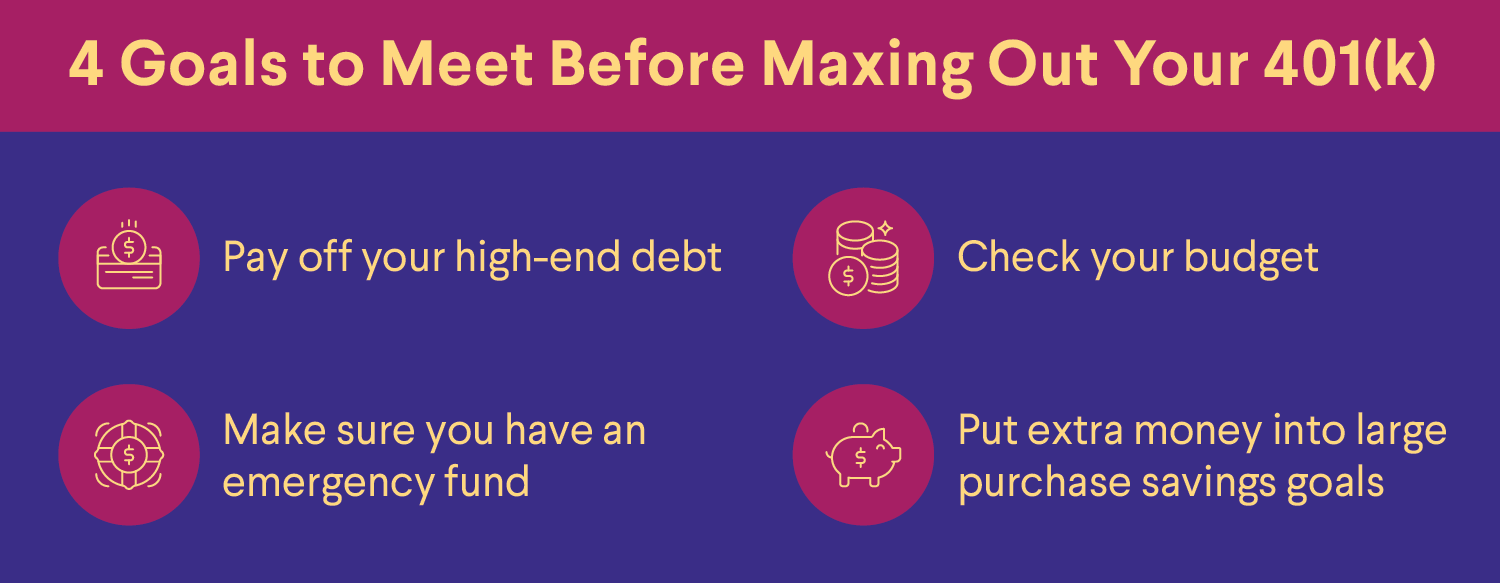
4 Goals to Meet Before Maxing Out Your 401(k)

Generally speaking, yes, it’s a good thing to max out your 401(k) so long as you’re not sacrificing your overall financial stability to do it. Saving for retirement is important, which is why many financial experts would likely suggest maxing out any employer match contributions first.

But while you may want to take full advantage of any tax and employer benefits that come with your 401(k), you also want to consider any other financial goals and obligations you have before maxing out your 401(k).

That doesn’t mean you should put other goals first, and not contribute to your retirement plan at all. That’s not wise. Maintaining a baseline contribution rate for your future is crucial, even as you continue to save for shorter-term aims or put money toward debt repayment.

Other goals might include:

•   Is all high-interest debt paid off? High-interest debt like credit card debt should be paid off first, so it doesn’t accrue additional interest and fees.

•   Do you have an emergency fund? Life can throw curveballs — it’s smart to be prepared for job loss or other emergency expenses.

•   Is there enough money in your budget for other expenses? You should have plenty of funds to ensure you can pay for additional bills, like student loans, health insurance, and rent.

•   Are there other big-ticket expenses to save for? If you’re saving for a large purchase, such as a home or going back to school, you may want to put extra money toward this saving goal rather than completely maxing out your 401(k), at least for the time being.

Once you can comfortably say that you’re meeting your spending and savings goals, it might be time to explore maxing out your 401(k). There are many reasons to do so — it’s a way to take advantage of tax-deferred savings, employer matching (often referred to as “free money”), and it’s a relatively easy and automatic way to invest and save, since the money gets deducted from your paycheck once you’ve set up your contribution amount.

How to Max Out Your 401(k)

Only a relatively small percentage of people max out their 401(k)s, but that doesn’t mean you can’t be one of them. Here are some strategies for how to max out your 401(k).

1. Max Out 401(k) Employer Contributions

Your employer may offer matching contributions, and if so, there are typically rules you will need to follow to take advantage of their match.

An employer may require a minimum contribution from you before they’ll match it, or they might match only up to a certain amount. They might even stipulate a combination of those two requirements. Each company will have its own rules for matching contributions, so review your company’s policy for specifics.

For example, suppose your employer will match your contribution up to 3%. So, if you contribute 3% to your 401(k), your employer will contribute 3% as well. Therefore, instead of only saving 3% of your salary, you’re now saving 6%. With the employer match, your contribution just doubled. Note that employer contributions can range from nothing at all up to a certain limit. It depends on the employer and the plan.

Since saving for retirement is one of the best investments you can make, it’s wise to take advantage of your employer’s match. Every penny helps when saving for retirement, and you don’t want to miss out on this “free money” from your employer.

If you’re not already maxing out the matching contribution and wish to, you can speak with your employer (or HR department, or plan administrator) to increase your contribution amount, you may be able to do it yourself online.

2. Max Out Salary-Deferred Contributions

While it’s smart to make sure you’re not leaving free money on the table, maxing out your employer match on a 401(k) is only part of the equation.

In order to make sure you’re setting aside an adequate amount for retirement, consider contributing as much as your budget will allow. As noted earlier, individuals younger than age 50 can contribute up to $23,500 in 2025, and up to $24,500 in 2026.

Those contributions aren’t just an investment in your future lifestyle in retirement. Because they are made with pre-tax dollars, they lower your taxable income for the year in which you contribute. For some, the immediate tax benefit is as appealing as the future savings benefit.

3. Take Advantage of Catch-Up Contributions

As mentioned, 401(k) catch-up contributions allow investors aged 50 and over to increase their retirement savings — which is especially helpful if they’re behind in reaching their retirement goals.

Individuals 50 and over can contribute an additional $7,500 for a total of $31,000 in 2025. And in 2026, those 50 and older can contribute an extra $8,000 for a total of $32,500. And in both 2025 and 2026, those aged 60 to 63 can contribute up to an additional $11,250, instead of $7,500 in 2025 and $8,000 in 2026, for a total of $34,750 and $35,750 respectively. Putting all of that money toward retirement savings can help you truly max out your 401(k).

As you draw closer to retirement, catch-up contributions can make a difference, especially as you start to calculate when you can retire. Whether you have been saving your entire career or just started, this benefit is available to everyone who qualifies.

And of course, in many cases, this extra contribution will lower taxable income even more than regular contributions. Although using catch-up contributions may not push everyone to a lower tax bracket, it will certainly minimize the tax burden during the next filing season for many filers — with an important exception.

Under a new law regarding catch-up contributions that went into effect on January 1, 2026 (as part of SECURE 2.0), individuals aged 50 and older whose FICA wages exceeded $150,000 in 2025 are required to put their 401(k) catch-up contributions into a Roth 401(k) account. Because of the way Roth accounts work, these individuals will pay taxes on their catch-up contributions upfront, and make eligible withdrawals tax-free in retirement. This means their taxable income will not be lowered; they could even potentially move into higher tax bracket. Those impacted by the new law should check with their employer or plan administrator to find out how to proceed.

4. Reset Your Automatic 401(k) Contributions

When was the last time you reviewed your 401(k)? It may be time to check in and make sure your retirement savings goals are still on track. Is the amount you originally set to contribute each paycheck still the correct amount to help you reach those goals?

With the increase in contribution limits most years, it may be worth reviewing your budget to see if you can up your contribution amount to max out your 401(k). If you don’t have automatic payroll contributions set up, you could set them up.

It’s generally easier to save money when it’s automatically deducted; a person is less likely to spend the cash (or miss it) when it never hits their checking account in the first place.

If you’re able to max out the full 401(k) limit, but fear the sting of a large decrease in take-home pay, consider a gradual, annual increase such as 1% — how often you increase it will depend on your plan rules as well as your budget.

5. Put Bonus Money Toward Retirement

Unless your employer allows you to make a change, your 401(k) contribution may be deducted from any bonus you might receive at work. Some employers allow you to determine a certain percentage of your bonus to contribute to your 401(k).

Consider possibly redirecting a large portion of a bonus to 401k contributions, or into another retirement account, such as an individual retirement account (IRA). Because this money might not have been expected, you won’t miss it if you contribute most of it toward your retirement.

You could also do the same thing with a raise. If your employer gives you a raise, consider putting it directly toward your 401(k). Putting this money directly toward your retirement can help you inch closer to maxing out your 401(k) contributions.

6. Maximize Your 401(k) Returns and Fees

Many people may not know what they’re paying in investment fees or management fees for their 401(k) plans. By some estimates, the average fees for 401(k) plans are between 0.5% and 2%, but some plans may have higher fees.

Fees add up — even if your employer is paying the fees now, you’ll have to pay them if you leave the job and keep the 401(k).

Essentially, if an investor has $100,000 in a 401(k) and pays $1,000 or 1% (or more) in fees per year, the fees could add up to thousands of dollars over time. Any fees you have to pay can chip away at your retirement savings and reduce your returns.

It’s important to ensure you’re getting the most for your money in order to maximize your retirement savings. If you are currently working for the company, you could discuss high fees with your HR team.

One way to potentially lower your costs is to find more affordable investment options. Generally speaking, index funds often charge lower fees than other investments. If an employer’s plan offers an assortment of low-cost index funds, may consider investing in these funds to save some money and help build a diversified portfolio.

What Happens If You Contribute Too Much to Your 401(k)?

After an individual maxes out their 401(k) for the year — meaning they’ve hit the contribution limit corresponding to their age range — if they don’t stop making contributions they will risk paying additional taxes on their overcontributions.

In the event that an individual makes an overcontribution, they might let their plan manager or administrator know, and withdraw the excess amount. If they leave the excess in the account, it’ll be taxed twice — once when it was contributed initially, and again when they take it out.

What to Do After Maxing Out a 401(k)?

If you max out your 401(k) this year, pat yourself on the back. Maxing out your 401(k) is a financial accomplishment. But now you might be wondering, what’s next? Here are some additional retirement savings options to consider if you have already maxed out your 401(k).

Open an IRA

An individual retirement account (IRA) can be an option to complement an employer’s retirement plans. With a traditional IRA, you can contribute pre-tax dollars up to the annual limit, which is $7,000 in 2025. If you’re 50 or older, you can contribute an extra $1,000, for an annual total of $8,000 in 2025. In 2026, you can contribute up to $7,500, while those 50 and older can contribute an additional $1,100, for a total of $8,600 for 2026.

You may also choose to consider a Roth IRA. As with a traditional IRA, the annual contribution limit for a Roth IRA in 2025 is $7,000, and $8,000 for those 50 or older. And in 2026, the annual Roth IRA contribution limit is $7,500, and $8,600 for those age 50 and up.

Roth IRA accounts have income limits, but if you’re eligible, you can contribute with after-tax dollars, which means you won’t have to pay taxes on earnings withdrawals in retirement as you do with traditional IRAs.

It’s possible to open an IRA at a brokerage, mutual fund company, or other financial institution. If you ever leave your job, you can typically roll your employer’s 401(k) into your IRA without facing tax consequences as long as both accounts are similarly taxed, such as rolling funds from a traditional 401(k) to a traditional IRA, and funds are transferred directly from one plan to the other. Doing a 401(k) to IRA rollover may allow you to invest in a broader range of investments with lower fees.

Boost an Emergency Fund

Experts often advise establishing an emergency fund with at least three to six months of living expenses before contributing to a retirement savings plan. Perhaps you’ve already done that — but haven’t updated that account in a while. As your living expenses increase, it’s a good idea to make sure your emergency fund grows, too. This will cover you financially in case of life’s little curveballs: new brake pads, a new roof, or unforeseen medical expenses.

Save for Health Care Costs

Contributing to a health savings account (HSA) can reduce out-of-pocket costs for expected and unexpected health care expenses, though you can only open and contribute to an HSA if you are enrolled in a high-deductible health plan (HDHP).

For tax year 2025, those eligible can contribute up to $4,300 pre-tax dollars for an individual plan or up to $8,550 for a family plan. Those 55 or older who are not enrolled in Medicare can make an additional catch-up contribution of $1,000 per year.

For tax year 2026, those who are eligible can contribute up to $4,400 for an individual plan or up to $8,750 for a family plan. Those 55 or older who are not enrolled in Medicare can again make an additional catch-up of $1,000.

The money in this account can be used for qualified out-of-pocket medical expenses such as copays for doctor visits and prescriptions. Another option is to leave the money in the account and let it grow for retirement. Once you reach age 65, you can take out money from your HSA without a penalty for any purpose. However, to be exempt from taxes, the money must be used for a qualified medical expense. Any other reasons for withdrawing the funds will be subject to regular income taxes.

Increase College Savings

If you’re feeling good about maxing out your 401(k), consider increasing contributions to your child’s 529 college savings plan (a tax-advantaged account meant specifically for education costs, sponsored by states and educational institutions).

College costs continue to creep up every year. Helping your children pay for college helps minimize the burden of college expenses, so they hopefully don’t have to take on many student loans.

Open a Brokerage Account

After maxing out a 401(k), individuals might also consider opening a brokerage account. Brokerage firms offer various types of investment accounts, each with different services and fees. A full-service brokerage firm may provide different financial services, which include allowing investors to trade securities.

Many brokerage firms require individuals to have a certain amount of cash to open accounts and have enough funds for trading fees and commissions. While there are no limits on how much can be contributed to the account, earned dividends are taxable in the year they are received. Therefore, if you earn a profit or sell an asset, you must pay a capital gains tax. On the other hand, if you sell a stock at a loss, that becomes a capital loss. This means that the transaction may yield a tax break by lowering your taxable income.

Pros and Cons of Maxing Out Your 401(k)

thumb_up

Pros:

•   Increased Savings: More contributions added to a retirement savings plan could lead to more growth over time.

•   Simplified Saving and Investing: Maxing out your 401(k) can also make your saving and investing relatively easy, as long as you’re taking a no-lift approach to setting your money aside thanks to automatic contributions.

thumb_down

Cons:

•   Affordability: Maxing out a 401(k) may not be financially feasible for everyone. It may be challenging due to existing debt or other savings goals.

•   Risk: Like all investments, there is the risk of loss.

•   Opportunity Costs: Money invested in retirement plans could be used for other purposes. During strong stock market years, non-retirement investments may offer more immediate access to funds.


Test your understanding of what you just read.


The Takeaway

Maxing out your 401(k) involves matching your employer’s maximum contribution match, and also, contributing as much as legally allowed to your retirement plan in a given year. If you have the flexibility in your budget to do so, maxing out a 401(k) can be an effective way to build retirement savings.

And once a 401(k) is maxed out? There are other ways an individual might direct their money, including opening an IRA, or contributing more to an HSA or to a child’s 529 plan.

Prepare for your retirement with an individual retirement account (IRA). It’s easy to get started when you open a traditional or Roth IRA with SoFi. Whether you prefer a hands-on self-directed IRA through SoFi Securities or an automated robo IRA with SoFi Wealth, you can build a portfolio to help support your long-term goals while gaining access to tax-advantaged savings strategies.

Help build your nest egg with a SoFi IRA.

🛈 While SoFi does not offer 401(k) plans at this time, we do offer a range of Individual Retirement Accounts (IRAs).

FAQ

What happens if I max out my 401(k) every year?

Assuming you don’t overcontribute, you may see your retirement savings increase if you max out your 401(k) every year, and hopefully, be able to reach your retirement and savings goals sooner.

Will you have enough to retire after maxing out a 401(k)?

There are many factors that need to be considered to determine if you’ll have enough money to retire if you max out your 401(k). Start by getting a sense of how much you’ll need to retire by using a retirement expense calculator. Then you can decide whether maxing out your 401(k) for many years will be enough to get you there, assuming an average stock market return and compounding built in.

First and foremost, you’ll need to consider your lifestyle and where you plan on living after retirement. If you want to spend a lot in your later years, you’ll need more money. As such, a 401(k) may not be enough to get you through retirement all on its own, and you may need additional savings and investments to make sure you’ll have enough.

What is the best way to max out a 401(k)?

Some effective ways to max out a 401(k) include contributing up to the allowable amount for the year (for 2025, that’s $23,500 for those under age 50, and for 2026, it’s $24,500); using catch-up contributions if you’re aged 50 or older ($7,500 in 2025, and $8,000 in 2026, or $11,250 if you’re ages 60 to 63 in 2025 and 2026); contributing enough to get your employer’s matching contributions if offered; automating your contributions and increasing them yearly, if possible; and directing a percentage of any bonus you receive into your 401(k).


INVESTMENTS ARE NOT FDIC INSURED • ARE NOT BANK GUARANTEED • MAY LOSE VALUE

SoFi Invest is a trade name used by SoFi Wealth LLC and SoFi Securities LLC offering investment products and services. Robo investing and advisory services are provided by SoFi Wealth LLC, an SEC-registered investment adviser. Brokerage and self-directed investing products offered through SoFi Securities LLC, Member FINRA/SIPC.

For disclosures on SoFi Invest platforms visit SoFi.com/legal. For a full listing of the fees associated with Sofi Invest please view our fee schedule.

Financial Tips & Strategies: The tips provided on this website are of a general nature and do not take into account your specific objectives, financial situation, and needs. You should always consider their appropriateness given your own circumstances.

Mutual Funds (MFs): Investors should carefully consider the information contained in the prospectus, which contains the Fund’s investment objectives, risks, charges, expenses, and other relevant information. You may obtain a prospectus from the Fund company’s website or clicking the prospectus link on the fund's respective page at sofi.com. You may also contact customer service at: 1.855.456.7634. Please read the prospectus carefully prior to investing.Mutual Funds must be bought and sold at NAV (Net Asset Value); unless otherwise noted in the prospectus, trades are only done once per day after the markets close. Investment returns are subject to risk, include the risk of loss. Shares may be worth more or less their original value when redeemed. The diversification of a mutual fund will not protect against loss. A mutual fund may not achieve its stated investment objective. Rebalancing and other activities within the fund may be subject to tax consequences.

Investment Risk: Diversification can help reduce some investment risk. It cannot guarantee profit, or fully protect in a down market.

Tax Information: This article provides general background information only and is not intended to serve as legal or tax advice or as a substitute for legal counsel. You should consult your own attorney and/or tax advisor if you have a question requiring legal or tax advice.

Third Party Trademarks: Certified Financial Planner Board of Standards Center for Financial Planning, Inc. owns and licenses the certification marks CFP®, CERTIFIED FINANCIAL PLANNER®

This article is not intended to be legal advice. Please consult an attorney for advice.

SOIN-Q425-085
Q126-3525874-013

Read more
IRA vs 401(k): What Is the Difference?

IRA vs 401(k): What Is the Difference?

The biggest difference between an IRA vs. a 401(k) is the amount you can save. You can save over three times as much in a 401(k) vs. an IRA — $23,500 versus $7,000 for tax year 2025, and $24,500 versus $7,500 for tax year 2026. But not everyone has access to a 401(k), because these are sponsored by an employer, typically for full-time employees.

“A 401(k) is probably one of the most common retirement vehicles,” says Brian Walsh, a CFP® at SoFi. “A 401(k) will be available through work. Your employer is going to choose whether or not to make a 401(k) available to all the employees. Generally speaking, 401(k)s are the most popular retirement plan employers provide.”

Other than that, a traditional IRA and a 401(k) are similar in terms of their basic provisions and tax implications. Both accounts are considered tax deferred, which means you can deduct the amount you contribute each year — unless you have a Roth account, which has a different tax benefit.

Before you decide whether one or all three types of retirement accounts might make sense for you, it helps to know all the similarities and differences between a 401(k) and a traditional IRA and Roth IRA.

Key Points

•   An IRA (Individual Retirement Account) and a 401(k) are both retirement savings accounts, but they have different features and eligibility requirements.

•   IRAs are typically opened by individuals, while 401(k)s are offered by employers to their employees.

•   IRAs offer more investment options and flexibility, while 401(k)s may have employer matching contributions and higher contribution limits.

•   Both accounts offer tax advantages, but the timing of tax benefits differs: IRAs provide tax benefits during retirement, while 401(k)s offer tax benefits upfront.

•   Choosing between an IRA and a 401(k) depends on factors like employment status, employer contributions, investment options, and personal financial goals.

How Are IRAs and 401(k)s Different?

The government wants you to prioritize saving for retirement. As a result, they provide tax incentives for IRAs vs. 401(k)s.

In that respect, a traditional IRA and a 401(k) are somewhat similar; both offer tax-deferred contributions, which may lower your taxable income, and tax-deferred investment growth. Also, you owe taxes on the money you withdraw from these accounts in retirement (or beforehand, if you take an early withdrawal).

There is a bigger difference between a Roth IRA and a 401(k). Roth accounts are funded with after-tax contributions — so they aren’t tax deductible. But they provide tax-free withdrawals in retirement.

And while you can’t withdraw the contributions you make to a traditional IRA until age 59 ½ (or incur a penalty), you can withdraw Roth contributions at any time (just not the earning or growth on your principal).

These days, you may be able to fund a Roth 401(k), if your company offers it.

Other Key Differences Between IRAs and 401(k)s

As with anything that involves finance and the tax code, these accounts can be complicated. Because there can be stiff penalties when you don’t follow the rules, it’s wise to know what you’re doing.

Who Can Set Up a 401(k)?

As noted above, a key difference between an IRA and a 401(k) is that 401(k)s are qualified employer-sponsored retirement plans. You typically only have access to these plans through an employer who offers them as part of a full-time compensation package.

In addition, your employer may choose to provide matching 401(k) funds as part of your compensation, which is typically a percentage of the amount you contribute (e.g. an employer might match 3%, dollar for dollar).

Not everyone is a full-time employee. You may be self-employed or work part-time, leaving you without access to a traditional 401(k). Fortunately, there are other options available to you, including solo 401(k) plans and opening an IRA online (individual retirement accounts).

Who Can Set Up an IRA?

Anyone can set up an individual retirement account (IRA) as long as they’re earning income. (And if you’re a non-working spouse of someone with earned income, they can set up a spousal IRA on your behalf.)

If you already have a 401(k), you can still open an IRA and contribute to both accounts. But if you or your spouse (if you’re married) are covered by a retirement plan at work, you may not be able to deduct the full amount of your IRA contributions.

Understanding RMDs

Starting at age 73 (for those who turn 72 after December 31, 2022), you must take required minimum distributions (RMDs) from your tax-deferred accounts, including: traditional IRAs, SEP and SIMPLE IRAs, and 401(k)s. Be sure to determine your minimum distribution amount, and the proper timing, so that you’re not hit with a penalty for skipping it.

It’s worth noting, though, that RMD rules don’t apply to Roth IRAs. If you have a Roth IRA, or inherit one from your spouse, the money is yours to withdraw whenever you choose. The rules change if you inherit a Roth from someone who isn’t your spouse, so consult with a professional as needed.

However, RMD rules do apply when it comes to a Roth 401(k), similar to a traditional 401(k). The main difference here, of course, is that the Roth structure still applies and withdrawals are tax free.

A Closer Look at IRAs

An IRA is an individual retirement account that has a much lower contribution limit than a 401(k) (see chart below). Anyone with earned income can open an IRA, and there are two main types of IRAs to choose from: traditional and Roth accounts.

Self-employed people can also consider opening a SEP-IRA or a SIMPLE IRA, which are tax-deferred accounts that have higher contribution limits.

Traditional IRA

Like a 401(k), contributions to a traditional IRA are tax deductible and may help lower your tax bill. In 2025, IRA contribution limits are $7,000, or $8,000 for those ages 50 or older. In 2026, IRA contribution limits are $7,500, or $8,600 for those 50 or older.

With a traditional IRA, investments inside the account grow tax-deferred. And unlike 401(k)s where an employer might offer limited options, IRAs are more flexible because they are classified as self-directed and you typically set up an IRA through a brokerage firm of your choice.

Thus it’s possible to invest in a wider range of investments in your IRA, including stocks, bonds, mutual funds, exchange-traded funds, and even real estate.

When making withdrawals at age 59 ½, you will owe income tax. As with 401(k)s, any withdrawals before then may be subject to both income tax and the 10% early withdrawal penalty.

What Are Roth Accounts?

So far, we’ve discussed traditional 401(k) and IRA accounts. But each type of retirement account also comes in a different flavor — known as a Roth.

The main difference between traditional and Roth IRAs lies in when your contributions are taxed.

•   Traditional accounts are funded with pre-tax dollars. The contributions are tax deductible and may provide an immediate tax benefit by lowering your taxable income and, as a result, your tax bill.

•   Money inside these accounts grows tax-deferred, and you owe income tax when you make withdrawals, typically when you’ve reached the age of 59 ½.

Roth accounts, on the other hand, are funded with after-tax dollars, so your deposits aren’t tax deductible. However, investments inside Roth accounts also grow tax-free, and they are not subject to income tax when withdrawals are made at or after age 59 ½.

As noted above, Roths have an additional advantage in that you can withdraw your principal at any time (but you cannot withdraw principal + earnings until you’ve had the account for at least five years, and/or you’re 59 ½ or older — often called the five-year rule).

Roth accounts may be beneficial if you anticipate being in a higher tax bracket when you retire versus the one you’re in currently. Then tax-free withdrawals may be even more valuable.

It’s possible to hold both traditional and Roth IRAs at the same time, though combined contribution limits are the same as those for traditional accounts. And those limits can’t be exceeded.

Additionally, the ability to fund a Roth IRA is subject to certain income limits: above a certain limit you can’t contribute to a Roth. There are no income limits for a designated Roth 401(k), however.

A Closer Look at a 401(k)

Contributions to your 401(k) are made with pre-tax dollars. This makes them tax-deductible, meaning the amount you save each year can lower your taxable income in the year you contribute, possibly resulting in a smaller tax bill.

In 2025, you can contribute up to $23,500 to your 401(k). If you’re 50 or older, you can also make catch-up contributions of an extra $7,500, for a total of $31,000. For 2025, those aged 60 to 63 may contribute an additional $11,250 instead of $7,500, thanks to SECURE 2.0, for a total of $34,750.

In 2026, you can contribute up to $24,500 to your 401(k), or up to $32,500 (including $8,000 extra in catch-up contributions). And again in 2026, individuals aged 60 to 63 can contribute an additional $11,250 instead of $8,000, for a total of $35,750.

Also, under a new law that went into effect on January 1, 2026 (as part of SECURE 2.0), individuals aged 50 and older who earned more than $150,000 in FICA wages in 2025 are required to put their 401(k) catch-up contributions into a Roth 401(k) account. With Roth accounts, you pay taxes on contributions upfront, but can make eligible withdrawals tax-free in retirement. Those impacted by the new law should check with their employer or plan administrator to find out how to proceed.

401(k) catch-up contributions allow people nearing retirement to boost their savings. In addition to the contributions made, an employer can also match their employee’s contribution, up to a combined employer and employee limit of $70,000 in 2025 and $72,000 in 2026.

An employer may offer a handful of investment options to choose from, such as exchange-traded funds (ETFs), mutual funds, and target date mutual funds. Money invested in these options grows tax-deferred, which can help retirement investments grow faster.

When someone begins taking withdrawals from their 401(k) account at age 59 ½ (the earliest age at which you can start taking penalty-free withdrawals), those funds are subject to income tax. Any withdrawals made before 59 ½ may be subject to a 10% early withdrawal penalty, on top of the tax you owe.

When Should You Use a 401(k)?

If your employer offers a 401(k), it may be worth taking advantage of the opportunity to start contributing to your retirement savings. After all, 401(k)s have some of the highest contribution limits of any retirement plans, which means you might end up saving a lot. Here are some other instances when it may be a good idea:

1. If your employer matches your contributions

If your company matches any part of your contribution, you may want to consider at least contributing enough to get the maximum employer match. After all, this match is tantamount to free money, and it can add up over time.

2. You can afford to contribute more than you can to an IRA

For tax year 2025, you can put up to $7,000 in an IRA, but up to $23,500 in a 401(k) — if you’re 50 or over, those amounts increase to $8,000 for an IRA and $31,000 for a 401(k). And those aged 60 to 63 can contribute up to $34,750 to a 401(k), thanks to SECURE 2.0.

For tax year 2026, you can put up to $7,500 in an IRA, but up to $24,500 in a 401(k) — if you’re 50 or older, those amounts increase to $8,600 for an IRA and $32,500 for a 401(k). And again, if you’re aged 60 to 63, you can contribute up to $35,750 to a 401(k). If you’re in a position to save more than the IRA limit, that’s a good reason to take advantage of the higher limits offered by a 401(k).

3. When your income is too high

Above certain income levels, you can’t contribute to a Roth IRA. How much income is that? That’s a complicated question that is best answered by our Roth IRA calculator.

And if you or your spouse are covered by a workplace retirement plan, you may not be able to deduct IRA contributions.

If you can no longer fund a Roth, and can’t get tax deductions from a traditional IRA, it might be worth throwing your full savings power behind your 401(k).

When Should You Use an IRA?

If you can swing it, it may not hurt to fund an IRA. This is especially true if you don’t have access to a 401(k). But even if you do, IRAs can be important tools. For example:

1. When you leave your company

When you leave a job, you can rollover an old 401(k) into an IRA — and it’s generally wise to do so. It’s easy to lose track of old plans, and companies can merge or even go out of business. Then it can become a real hassle to find your money and get it out.

You can also roll the funds into your new company’s retirement plan (or stick with an IRA rollover, which may give you more control over your investment choices).

Recommended: How to Roll Over Your 401(k)

2. If your 401(k) investment choices are limited

If you have a good mix of mutual funds in your 401(k), or even some target date funds and low-fee index funds, your plan is probably fine. But, some plans have very limited investment options, or are so confusing that people can’t make a decision and end up in the default investment — a low interest money market fund.

If this is the case, you might want to limit your contributions to the amount needed to get your full employer match and put the rest in an IRA.

3. When you’re between jobs

Not every company has a 401(k), and people are not always employed. There may be times in your life when your IRA is the only option. If you have self-employment income, you can make higher contributions to a SEP IRA or a Solo 401(k) you set up for yourself.

4. If you can “double dip.”

If you have a 401(k), are eligible for a Roth IRA, or can deduct contributions to a traditional IRA, and you can afford it — it may be worth investing in both. After all, saving more now means more money — and financial security — down the line. Once again, you can check our IRA calculator to see if you can double dip. Just remember that the IRA contribution limit is for the total contributed to both a Roth and traditional IRA.

The real question is not: IRA vs. 401(k), but rather — which of these is the best place to put each year’s contributions? Both are powerful tools to help you save, and many people will use different types of accounts over their working lives.

When Should You Use Both an IRA and 401(k)?

Using an IRA and a 401(k) at the same time may be a good way to save for your retirement goals. Funding a traditional or Roth IRA and 401(k) at once can allow you to save more than you would otherwise be able to in just one account.

Bear in mind that if you or your spouse participate in a workplace retirement plan, you may not be able to deduct all of your traditional IRA contributions, depending on how high your income is.

Having both types of accounts can also provide you some flexibility in terms of drawing income when you retire. For example, you might find a 401(k) as a source of pre-tax retirement income. At the same time you might fund a Roth IRA to provide a source of after-tax income when you retire.

That way, depending on your financial and tax situation each year, you may be able to strategically make withdrawals from each account to help minimize your tax liability.

The Takeaway

Roth accounts — whether a Roth IRA or a Roth 401(k) — have a different tax treatment. You deposit after-tax funds in these types of accounts. And then you don’t pay any tax on your withdrawals in retirement.

Another difference is that a 401(k) is generally sponsored by your employer, so you’re beholden to the investment choices of the firm managing the company’s plan, and the fees they charge. By contrast, you set up an IRA yourself, so the investment options are greater — and the fees can be lower.

Generally, you can have an IRA as well as a 401(k). The rules around contribution limits, and how much you can deduct may come into play, however.

If you’re ready to open an IRA, it’s easy when you set up an Active Invest account with SoFi Invest.

Not sure what the right strategy is for you? SoFi Invest® offers educational content as well as access to financial planners. The Active Investing platform lets investors choose from an array of stocks, ETFs or fractional shares. For a limited time, funding an account gives you the opportunity to win up to $1,000 in the stock of your choice. All you have to do is open and fund a SoFi Invest account.

Opening and funding an Active Invest account gives you the opportunity to get up to $1,000 in the stock of your choice.¹

FAQ

Is a 401(k) considered an IRA for tax purposes?

No. A 401(k) is a completely separate account than an IRA because it’s sponsored by your employer.

Is it better to have a 401(k) or an IRA?

You can save more in a 401(k), and your employer may also offer matching contributions. But an IRA often has a much wider range of investment options. It’s wise to weigh the differences, and decide which suits your situation best.

Can you roll a 401(k) Into an IRA penalty-free?

Yes. If you leave your job and want to roll over your 401(k) account into an IRA, you can do so penalty free within 60 days. If you transfer the funds and hold onto them for longer than 60 days, you will owe taxes and a penalty if you’re under 59 ½.

Can you lose money in an IRA?

Yes. You invest all the money you deposit in an IRA in different securities (i.e. stocks, bonds, mutual funds, ETFs). Ideally you’ll see some growth, but you could also see losses. There are no guarantees.


External Websites: The information and analysis provided through hyperlinks to third-party websites, while believed to be accurate, cannot be guaranteed by SoFi. Links are provided for informational purposes and should not be viewed as an endorsement.

INVESTMENTS ARE NOT FDIC INSURED • ARE NOT BANK GUARANTEED • MAY LOSE VALUE

SoFi Invest is a trade name used by SoFi Wealth LLC and SoFi Securities LLC offering investment products and services. Robo investing and advisory services are provided by SoFi Wealth LLC, an SEC-registered investment adviser. Brokerage and self-directed investing products offered through SoFi Securities LLC, Member FINRA/SIPC.

For disclosures on SoFi Invest platforms visit SoFi.com/legal. For a full listing of the fees associated with Sofi Invest please view our fee schedule.

Exchange Traded Funds (ETFs): Investors should carefully consider the information contained in the prospectus, which contains the Fund’s investment objectives, risks, charges, expenses, and other relevant information. You may obtain a prospectus from the Fund company’s website or by emailing customer service at [email protected]. Please read the prospectus carefully prior to investing.


¹Probability of Member receiving $1,000 is a probability of 0.026%; If you don’t make a selection in 45 days, you’ll no longer qualify for the promo. Customer must fund their account with a minimum of $50.00 to qualify. Probability percentage is subject to decrease. See full terms and conditions.

SOIN0922043
CN-Q425-3236452-06
Q126-3525874-003

Read more
Man at desk on tablet

What Is 401(k) Matching and How Does It Work?

Matching in 401(k) retirement accounts involves an employee making a contribution to the account, and their employer mirroring that contribution — or matching it. A 401(k) is a mechanism for saving retirement funds by making pre-tax contributions through deductions from payroll.

Some plans offer a 401(k) employer match, which can be the equivalent of getting “free money” from an employer. That can help increase an investor’s retirement savings over time.

Key Points

•   401(k) matching involves employers contributing to an employee’s retirement plan, matching the employee’s contributions up to a certain limit.

•   Benefits include tax-deferred growth on investments and immediate ownership of contributions.

•   Matching rates vary, with some employers offering dollar-for-dollar matches and others a percentage.

•   Contribution limits are set annually, with additional catch-up contributions allowed for those over 50.

•   Vesting schedules determine when employees gain full ownership of employer contributions.

What Is 401(k) Matching?

Matching a 401(k) contribution means that an employer matches or mirrors an employee’s contribution to their retirement account, typically up to a certain percentage. In effect, if an employee contributes $1 to their 401(k), an employer would also contribute $1, thereby “matching” the contribution. But again, there are limits to how much employers are generally willing to match.

There are certain advantages to 401(k) matching.

For one, investment gains and elective deferrals to 401(k) plans are not subject to federal income tax until they’re distributed, which is typically when:

•   The participant reaches the age of 59 ½

•   The participant becomes disabled, deceased, or otherwise has a severance from employment

•   The plan terminates and no subsequent plan is established by the employer

•   The participant incurs a financial hardship

Second, elective deferrals are 100% vested. The participant owns 100% of the money in their account, and the employer cannot take it back or forfeit it for any reason.

And third, participants choose how to invest their 401(k). The plans are mainly self-directed, meaning participants decide how they’d like to invest the money in their account. This could mean mutual funds or exchange-traded funds (ETFs) which invest in a wide array of sectors and companies, but typically doesn’t include investing in individual companies and stocks.

Investment tactics might vary from person to person, but by understanding their goals, investors can decide whether their portfolio will have time to withstand market ups and downs with some high-risk, high-reward investments, or if they should shift to a more conservative allocation as they come closer to retirement.

💡 Quick Tip: The advantage of opening a Roth IRA and a tax-deferred account like a 401(k) or traditional IRA is that by the time you retire, you’ll have tax-free income from your Roth, and taxable income from the tax-deferred account. This can help with tax planning.

How Does 401(k) Matching Work?

A 401(k) match is an employee benefit that allows an employer to contribute a certain amount to their employee’s 401(k) plan. The match can be based on a percentage of the employee’s contribution, up to a certain portion of their total salary or a set dollar amount, depending on the terms of the plan.

So, some employers might offer a dollar-for-dollar match, while others might offer matching based on a percentage, or a partial-match. Others may not offer any type of match.

That’s important to keep in mind: Not all employers offer this benefit, and some have prerequisites for participating in the match, such as a minimum required contribution or a cap up to a certain amount.

Meeting with an HR representative or a benefits administrator is a one way to get a better idea of what’s possible. Learning the maximum percent of salary the company will contribute is a start, then the employee can set or increase their contribution accordingly to maximize the employer match benefit.

401(k) Matching Example

Many employers use a match formula to determine their 401(k) matches (assuming they offer it at all). Some formulas are more common than others, too, which can help us with an example.

Consider this: Many 401(k) plans use a single-tier match formula, with $0.50 on the dollar on the first 6% of pay being common. But others use multi-tier match formulas, e.g., dollar-on-dollar on the first 3% of pay and $0.50 on the dollar on the next 2% of pay.

For the sake of breaking a few things down, here’s a retirement saving scenario that can illuminate how 401(k) matching works in real life:

Let’s say a person is 30 years old, with a salary of $50,000, contributing 3% of their salary (or $1,500) to a 401(k). Let’s also say they keep making $50,000 and contributing 3% every year until they’re 65. They will have put $52,500 into their 401(k) in those 35 years.

Now let’s say they opt into an employer match with a dollar-for-dollar up to 3% formula. Putting aside the likelihood of an increase in the value of the investments, they’ll have saved $105,000 — with $52,500 in free contributions from their employer.

That, effectively, is a no-cost way to increase retirement savings by 100%.

Average 401(k) Match

Average 401(k) matches is generally around 4% or 5%, and can vary from year to year. With that in mind, workers who are getting an employer match in that range, or within a broader range — perhaps 3% to 6% — are likely getting a “good” match.

But again, considering that some employers don’t offer any match at all, the chance to secure almost any type of match could be considered good for some investors.

Contribution Limits When 401(k) Matching

When deciding how much to contribute to a 401(k) plan, many factors might be considered to take advantage of a unique savings approach:

•   If a company offers a 401(k) employer match, the participant might consider contributing enough to meet whatever the minimum match requirements are.

•   If a participant is closer to retirement age, they’ll probably have a pretty good idea of what they already have saved and what they need to reach their retirement goals. An increase in contributions can make a difference, and maxing out their 401(k) might be a solid strategy.

A retirement calculator can also be helpful in determining what the right contribution amount is for a specific financial situation.

In addition to the uncertainty that can come with choosing how much to contribute to a 401(k), there’s the added pressure of potential penalties for going over the maximum 401(k) contribution limit.

Three common limits to 401(k) contributions:

1.    Elective deferral limits: Contribution amounts chosen by an employee and contributed to a 401(k) plan by the employer. In 2025, participants can contribute up to $23,500. In 2026, participants can contribute up to $24,500.

2.    Catch-up contribution limits: After the age of 50, participants can contribute more to their 401(k) with catch-up contributions. In 2025, participants can make up to $7,500 in catch-up contributions per year, and in 2026, they can make up to $8,000 in catch-up contributions annually. In both 2025 and 2026, those aged 60 to 63 may contribute up to an additional $11,250, instead of $7,500 and 8,000 respectively, thanks to SECURE 2.0.

However, under a new law that went into effect on January 1, 2026 as part of SECURE 2.0, individuals aged 50 and older who earned more than $150,000 in FICA wages in 2025 are required to put their 401(k) catch-up contributions into a Roth 401(k) account. With Roths, individuals pay taxes on contributions upfront, but can make qualified withdrawals tax-free in retirement.

3.    Employer contribution limits: An employer can also make contributions and matches to a 401(k). The combined limit (not including catch-up contributions) on employer and employee contributions in 2025 is $70,000 and in 2026 is $72,000.

If participants think their total deferrals will exceed the limit for that particular year, the IRS recommends notifying the plan to request the difference (an “excess deferral”) “be paid out of any of the plans that permit these distributions. The plan must then pay the employee that amount by April 15 of the following year (or an earlier date specified in the plan).”

401(k) Vesting Schedules

Vesting ” means “ownership” in a retirement plan. The employee will vest, or own, some percent of their account balance. In the case of a 401(k), being 100% vested means they’ve met their employer’s vesting schedule requirements to ensure complete ownership of their funds.

Vesting schedules, determined by 401(k) plan documents, can lay out certain employer vesting restrictions that range from immediate vesting to 100% vesting after three years to a schedule that increases the vested percentage based on years of service. Either way, all employees must be 100% vested if a plan is terminated by the employer or upon reaching the plan’s standard retirement age.

Tips on Making the Most of 401(k) Matching

Here are some things to keep in mind when trying to make the most of 401(k) matching.

Remember: It’s “Free” Money

An employer match is one part of the overall compensation package and another way to maximize the amount of money an employer pays their employees. Those employees could be turning their backs on free money by not contributing to an employer-matched 401(k) plan.

You Can Reduce Taxable Income

According to FINRA, “with pre-tax contributions, every dollar you save will reduce your current taxable income by an equal amount, which means you will owe less in income taxes for the year. But your take-home pay will go down by less than a dollar.”

If a participant contributed $1,500 a year to a 401(k), they’d only owe taxes on their current salary minus that amount, which could save some serious money as that salary grows.

Every Dollar Counts

It can be tempting to avoid contributing to your retirement plan, and instead, use the money for something you want or need now. But remember: The more time your money has to potentially grow while it’s invested, the more likely you are to reach your financial goals sooner. While that’s not guaranteed, every dollar you can save or invest now for future use is a dollar you don’t need to save or invest later.

The Takeaway

A 401(k) match is an employee benefit that allows an employer to contribute a certain amount to their employee’s 401(k) plan. Matches can be based on a percentage of the employee’s contribution, up to a certain portion of their total salary or a set dollar amount, depending on the terms of the plan.

Taking advantage of employer matches in a 401(k) plan can help workers reach their financial goals sooner, as a match is, in effect, “free money.” If you’re considering how matches can help bolster your investment strategy, it may be worth discussing with a financial professional.

Prepare for your retirement with an individual retirement account (IRA). It’s easy to get started when you open a traditional or Roth IRA with SoFi. Whether you prefer a hands-on self-directed IRA through SoFi Securities or an automated robo IRA with SoFi Wealth, you can build a portfolio to help support your long-term goals while gaining access to tax-advantaged savings strategies.

Help grow your nest egg with a SoFi IRA.

FAQ

How much should I match 401(k)?

It’ll be up to the individual investor, but to make the most of a 401(k) match, workers should likely try to contribute as much as possible up to their employer’s match — it may be worth discussing with a financial professional for additional guidance.

What does 6% 401(k) match mean?

A 6% 401(k) match means that an employer is willing to match up to 6% of an employee’s total salary or compensation in their 401(k) account through matching contributions.

What is a good 401(k) match?

A good 401(k) match could be in the 3% to 6% range, as average employer matches tend to be between 4% and 5%.

Is a 3% match good? Is a 4% match good?

Generally speaking, a 3% match could be considered “good,” as could a 4% match. On average, employers match somewhere between 4% and 5%, and when you get down to it, almost any employer match is “good.”

How do I maximize my 401(k) match?

Maximizing your 401(k) match involves contributing enough to get at least your employer’s full match, whatever that match may be. You should be able to change your contribution levels through your provider, or by speaking with your employer.


INVESTMENTS ARE NOT FDIC INSURED • ARE NOT BANK GUARANTEED • MAY LOSE VALUE

SoFi Invest is a trade name used by SoFi Wealth LLC and SoFi Securities LLC offering investment products and services. Robo investing and advisory services are provided by SoFi Wealth LLC, an SEC-registered investment adviser. Brokerage and self-directed investing products offered through SoFi Securities LLC, Member FINRA/SIPC.

For disclosures on SoFi Invest platforms visit SoFi.com/legal. For a full listing of the fees associated with Sofi Invest please view our fee schedule.

Financial Tips & Strategies: The tips provided on this website are of a general nature and do not take into account your specific objectives, financial situation, and needs. You should always consider their appropriateness given your own circumstances.


¹Probability of Member receiving $1,000 is a probability of 0.026%; If you don’t make a selection in 45 days, you’ll no longer qualify for the promo. Customer must fund their account with a minimum of $50.00 to qualify. Probability percentage is subject to decrease. See full terms and conditions.

SOIN0124014
CN-Q425-3236452-134
Q126-3525874-059

Read more
A focused woman in a blue top works on a laptop, holding a pen and taking notes while resting her other hand on her forehead.

Types of Retirement Plans and Which to Consider

Retirement will likely be the most significant expense of your lifetime, which means saving for retirement is a big job. This is especially true if you envision a retirement that is rich with experiences such as traveling through Europe or spending time with your grown children and grandkids. A retirement savings plan may help you achieve these financial goals and stay on track.

There are all types of retirement plans you may consider to help you build your wealth, from 401(k)s to Individual Retirement Accounts (IRAs) to annuities. Understanding the nuances of these different retirement plans, like their tax benefits and various drawbacks, may help you choose the right mix of plans to achieve your financial goals.

Key Points

•   There are various types of retirement plans, including traditional and non-traditional options, such as 401(k), IRA, Roth IRA, SEP IRA, and Cash-Balance Plan.

•   Employers offer defined contribution plans (e.g., 401(k)) where employees contribute and have access to the funds, and defined benefit plans (e.g., Pension Plans) where employers invest for employees’ retirement.

•   Different retirement plans have varying tax benefits, contribution limits, and employer matches, which should be considered when choosing a plan.

•   Individual retirement plans like Traditional IRA and Roth IRA provide tax advantages but have contribution restrictions and penalties for early withdrawals.

•   It’s possible to have multiple retirement plans, including different types and accounts of the same type, but there are limitations on tax benefits based on the IRS regulations.

🛈 SoFi does not offer employer-sponsored plans, such as 401(k) or 403(b) plans, but we do offer a range of individual retirement accounts (IRAs).

Types of Retirement Accounts

There are several different types of retirement plans, including some traditional plan types you may be familiar with as well as non-traditional options.

Traditional retirement plans can be IRA accounts or 401(k). These tax-deferred retirement plans allow you to contribute pre-tax dollars to an account. With a traditional IRA or 401(k), you only pay taxes on your investments when you withdraw from the account.

Non-traditional retirement accounts can include Roth 401(k)s and IRAs, for which you pay taxes on funds before contributing them to the account and withdraw money tax-free in retirement.

Here’s information about some of the most common retirement plan types:

•   401(k)

•   403(b)

•   Solo 401(k)

•   SIMPLE IRA (Savings Incentive Match Plan for Employees)

•   SEP Plan (Simplified Employee Pension)

•   Profit-Sharing Plan (PSP)

•   Defined Benefit Plan (Pension Plan)

•   Employee Stock Ownership Plan (ESOP)

•   457(b) Plan

•   Federal Employees Retirement System (FERS)

•   Cash-Balance Plan

•   Nonqualified Deferred Compensation Plan (NQDC)

•   Multiple Employer Plans

•   Traditional Individual Retirement Accounts (IRAs)

•   Roth IRAs

•   Payroll Deduction IRAs

•   Guaranteed Income Annuities (GIAs)

•   Cash-Value Life Insurance Plan

types of retirement plans

Retirement Plans Offered by Employers

There are typically two types of retirement plans offered by employers:

•   Defined contribution plans (more common): The employee invests a portion of their paycheck into a retirement account. Sometimes, the employer will match up to a certain amount (e.g. up to 5%). In retirement, the employee has access to the funds they’ve invested. 401(k)s and Roth 401(k)s are examples of defined contribution plans.

•   Defined benefit plans (less common): The employer invests money for retirement on behalf of the employee. Upon retirement, the employee receives a regular payment, which is typically calculated based on factors like the employee’s final or average salary, age, and length of service. As long as they meet the plan’s eligibility requirements, they will receive this fixed benefit (e.g. $100 per month). Pension plans and cash balance accounts are common examples of defined benefit plans.

Let’s get into the specific types of plans employers usually offer.

401(k) Plans

A 401(k) plan is a type of work retirement plan offered to the employees of a company. Traditional 401(k)s allow employees to contribute pre-tax dollars, where Roth 401(k)s allow after-tax contributions.

•   Income Taxes: If you choose to make a pre-tax contribution, your contributions may reduce your taxable income. Additionally, the money will grow tax-deferred and you will pay taxes on the withdrawals in retirement. Some employers allow you to make after-tax or Roth contributions to a 401(k). You should check with your employer to see if those are options.

•   Contribution Limit: $23,500 in 2025 and $24,500 in 2026 for the employee; people 50 and older can contribute an additional $7,500 in 2025 and $8,000 in 2026. However, in 2025 and 2026, under the SECURE 2.0 Act, a higher catch-up limit of $11,250 applies to individuals ages 60 to 63.

And under a new law that went into effect on January 1, 2026 (as part of SECURE 2.0), individuals aged 50 and older who earned more than $150,000 in FICA wages in 2025 are required to put their 401(k) catch-up contributions into a Roth 401(k) account. Because of the way Roth accounts work, these individuals will pay taxes on their catch-up contributions upfront, but can make eligible withdrawals tax-free in retirement.

•   Pros: Money is deducted from your paycheck, automating the process of saving. Some companies offer a company match. There is a significantly higher limit than with Traditional IRA and Roth IRA accounts.

•   Cons: With a 401(k) plan, you are largely at the mercy of your employer — there’s no guarantee they will pick plans that you feel are right for you or are cost effective for what they offer. Also, the value of a 401(k) comes from two things: the pre-tax contributions and the employer match, if your employer doesn’t match, a 401(k) may not be as valuable to an investor. There are also penalties for early withdrawals before age 59 ½, although there are some exceptions, including for certain public employees.

•   Usually best for: Someone who works for a company that offers one, especially if the employer provides a matching contribution. A 401(k) retirement plan can also be especially useful for people who want to put retirement savings on autopilot.

•   To consider: Sometimes 401(k) plans have account maintenance or other fees. Because a 401(k) plan is set up by your employer, investors only get to choose from the investment options they provide.

403(b) Plans

A 403(b) retirement plan is like a 401(k) for certain individuals employed by public schools, churches, and other tax-exempt organizations. Like a 401(k), there are both traditional and Roth 403(b) plans. However, not all employees may be able to access a Roth 403(b).

•   Income Taxes: With a traditional 403(b) plan, you contribute pre-tax money into the account; the money will grow tax-deferred and you will pay taxes on the withdrawals in retirement. Additionally, some employers allow you to make after-tax or Roth contributions to a 403(b); the money will grow tax-deferred and you will not have to pay taxes on withdrawals in retirement. You should check with your employer to see if those are options.

•   Contribution Limit: $23,500 in 2025 and $24,500 in 2026 for the employee; people 50 and older can contribute an additional $7,500 in 2025 and $8,000 in 2026. In 2025 and 2026, under the SECURE 2.0 Act, those ages 60 to 63 can contribute a higher catch-up amount of $11,250. As noted above with 401(k) plans, as of January 1, 2026, individuals aged 50 and older with FICA wages exceeding $150,000 in 2025 are required to put their catch-up contributions into a Roth account.

The maximum combined amount both the employer and the employee can contribute annually to the plan (not including the catch-up amounts) is generally the lesser of $70,000 in 2025 and $72,000 in 2026 or the employee’s most recent annual salary.

•   Pros: Money is deducted from your paycheck, automating the process of saving. Some companies offer a company match. Also, these plans often come with lower administrative costs because they aren’t subject to Employee Retirement Income Security Act (ERISA) oversight.

•   Cons: A 403(b) account generally lacks the same protection from creditors as plans with ERISA compliance.

•   To consider: 403(b) plans offer a narrow choice of investments compared to other retirement savings plans. The IRS states these plans can only offer annuities provided through an insurance company and a custodial account invested in mutual funds.

Solo 401(k) Plans

A Solo 401(k) plan is essentially a one-person 401(k) plan for self-employed individuals or business owners with no employees, in which you are the employer and the employee. Solo 401(k) plans may also be called a Solo-k, Uni-k, or One-participant k.

•   Income Taxes: The contributions made to the plan are tax-deductible.

•   Contribution Limit: $23,500 in 2025 and $24,500 in 2026, or 100% of your earned income, whichever is lower, plus “employer” contributions of up to 25% of your compensation from the business. The 2025 total cannot exceed $70,000, and the 2026 total cannot exceed $72,000. (On top of that, people 50 and older are allowed to contribute an additional $7,500 in 2025 and $8,000 in 2026. In 2025 and 2026, those ages 60 to 63 can contribute a higher catch-up amount of $11,250 under the SECURE 2.0 Act .)

•   Pros: A solo 401(k) retirement plan allows for large amounts of money to be invested with pre-tax dollars. It provides some of the benefits of a traditional 401(k) for those who don’t have access to a traditional employer-sponsored 401(k) retirement account.

•   Cons: You can’t open a solo 401(k) if you have any employees (though you can hire your spouse so they can also contribute to the plan as an employee — and you can match their contributions as the employer).

•   Usually best for: Self-employed people with enough income and a large enough business to fully use the plan.

SIMPLE IRA Plans (Savings Incentive Match Plans for Employees)

A SIMPLE IRA plan is set up by an employer, who is required to contribute on employees’ behalf, although employees are not required to contribute.

•   Income Taxes: Employee contributions are made with pre-tax dollars. Additionally, the money will grow tax-deferred and employees will pay taxes on the withdrawals in retirement.

•   Contribution Limit: $16,500 in 2025 and $17,000 in 2026. Employees aged 50 and over can contribute an extra $3,500 in 2025 and $4,000 in 2026, bringing their total to $20,000 in 2025 and $21,000 in 2026. In 2025 and 2026, under the SECURE 2.0 Act, people ages 60 to 63 can contribute a higher catch-up amount of $5,250.

•   Pros: Employers contribute to eligible employees’ retirement accounts at 2% their salaries, whether or not the employees contribute themselves. For employees who do contribute, the company will match up to 3%.

•   Cons: The contribution limits for employees are lower than in a 401(k) and the penalties for early withdrawals — up to 25% for withdrawals within two years of your first contribution to the plan — before age 59 ½ may be higher.

•   To consider: Only employers with less than 100 employees are allowed to participate.

Recommended: Comparing the SIMPLE IRA vs. Traditional IRA

SEP Plans (Simplified Employee Pension)

This is a retirement account established by a small business owner or self-employed person for themselves (and if applicable, any employees).

•   Income Taxes: Your contributions will reduce your taxable income. Additionally, the money will grow tax-deferred and you will pay taxes on withdrawals in retirement.

•   Contribution Limit: For 2025, $70,000 or 25% of earned income, whichever is lower; for 2026, $72,000 or 25% of earned income, whichever is lower.

•   Pros: Higher contribution limit than IRA and Roth IRAs, and contributions are tax deductible for the business owner.

•   Cons: These plans are employer contribution only and greatly rely on the financial wherewithal and available cash of the business itself.

•   Usually best for: Self-employed people and small business owners who wish to contribute to an IRA for themselves and/or their employees.

•   To consider: Because you’re setting up a retirement plan for a business, there’s more paperwork and unique rules. When opening an employer-sponsored retirement plan, it generally helps to consult a tax advisor.

Profit-Sharing Plans (PSPs)

A Profit-Sharing Plan is a retirement plan funded by discretionary employer contributions that gives employees a share in the profits of a company.

•   Income taxes: Deferred; assessed on distributions from the account in retirement.

•   Contribution Limit: The lesser of 25% of the employee’s compensation or $70,000 in 2025 (On top of that, people 50 and older are allowed to contribute an additional $7,500 in 2025. And people ages 60 to 63 can make a higher contribution of $11,250 in 2025 under SECURE 2.0.) In 2026, the contribution limit is $72,000 or 25% of the employee’s compensation, whichever is less. Those 50 and up can contribute an extra $7,500 in 2025 and $8,000 in 2026. And people ages 60 to 63 can once again make a higher contribution of $11,250 in 2026 under SECURE 2.0.

•   Pros: An employee receives a percentage of a company’s profits based on its earnings. Companies can set these up in addition to other qualified retirement plans, and make contributions on a completely voluntary basis.

•   Cons: These plans put employees at the mercy of their employers’ profits, unlike retirement plans that allow employees to invest in securities issued by other companies.

•   Usually best for: Companies who want the flexibility to contribute to a PSP on an ad hoc basis.

•   To consider: Early withdrawal from the plan is subject to penalty.

Defined Benefit Plans (Pension Plans)

These plans, more commonly known as pension plans, are retirement plans provided by the employer where an employee’s retirement benefits are calculated using a formula that factors in age, salary, and length of employment.

•   Income taxes: Deferred; assessed on distributions from the plan in retirement.

•   Contribution limit: Determined by an enrolled actuary and the employer.

•   Pros: Provides tax benefits to both the employer and employee and provides a fixed payout upon retirement that many retirees find desirable.

•   Cons: These plans are increasingly rare, but for those who do have them, issues can include difficulty realizing or accessing benefits if you don’t work at a company for long enough.

•   Usually best for: Companies that want to provide their employees with a “defined” or pre-determined benefit in their retirement years.

•   To consider: These plans are becoming less popular because they cost an employer significantly more in upkeep than a defined contribution plan such as a 401(k) program.

Employee Stock Ownership Plans (ESOPs)

An Employee Stock Ownership Plan is a qualified defined contribution plan that invests in the stock of the sponsoring employer.

•   Income taxes: Deferred. When an employee leaves a company or retires, they receive the fair market value for the stock they own. They can either take a taxable distribution or roll the money into an IRA.

•   Contribution limits: Allocations are made by the employer, usually on the basis of relative pay. There is typically a vesting schedule where employees gain access to shares in one to six years.

•   Pros: Could provide tax advantages to the employee. ESOP plans also align the interests of a company and its employees.

•   Cons: These plans concentrate risk for employees: An employee already risks losing their job if an employer is doing poorly financially, by making some of their compensation employee stock, that risk is magnified. In contrast, other retirement plans allow an employee to invest in stocks in other securities that are not tied to the financial performance of their employer.

457(b) Plans

A 457(b) retirement plan is an employer-sponsored deferred compensation plan for employees of state and local government agencies and some tax-exempt organizations.

•   Income taxes: If you choose to make a pre-tax contribution, your contributions will reduce your taxable income. Additionally, the money will grow tax-deferred and you will pay taxes on the withdrawals in retirement. Some employers also allow you to make after-tax or Roth contributions to a 401(k).

•   Contribution limits: The lesser of 100% of employee’s compensation or $23,500 in 2025 and $24,500 in 2026; some plans allow for “catch-up” contributions. For those plans that do allow catch-ups, under the new law that went into effect on January 1, 2026, individuals aged 50 and older with FICA wages above $150,000 in 2025 are required to put their catch-up contributions into a Roth account.

•   Pros: Plan participants can withdraw as soon as they are retired at any age, they do not have to wait until age 59 ½ as with 401(k) and 403(b) plans.

•   Cons: 457 plans do not have the same kind of employer match as a 401(k) plan. While employers can contribute to the plan, it’s only up to the combined limit for individual contributions.

•   Usually best for: Employees of governmental agencies.

Federal Employees Retirement System (FERS)

The Federal Employees Retirement System (FERS) consists of three government-sponsored retirement plans: Social Security, the Basic Benefit Plan, and the Thrift Savings Plan.

The Basic Benefit Plan is an employer-provided pension plan, while the Thrift Savings Plan is most comparable to what private-sector employees can receive.

•   Income Taxes: Contributions to the Thrift Savings Plan are made before taxes and grow tax-free until withdrawal in retirement.

•   Contribution Limit: The contribution limit for employees is $23,500 in 2025, and the combined limit for all contributions, including from the employer, is $70,000. In 2026, the employee contribution limit is $24,500, and the combined limit for contributions, including those from the employer, is $72,000. Also, those 50 and over are eligible to make an additional $7,500 in “catch-up” contributions in 2025 and an additional $8,000 in 2026. And in both 2025 and 2026, those ages 60 to 63 can make a higher catch-up contribution of $11,250 under the SECURE 2.0 Act.

•   Pros: These government-sponsored plans are renowned for their low administrative fees and employer matches.

•   Cons: Only available for federal government employees.

•   Usually best for: Federal government employees who will work at their agencies for a long period; it is comparable to 401(k) plans in the private sector.

Cash-Balance Plans

This is another type of pension plan that combines features of defined benefit and defined contribution plans. They are sometimes offered by employers that previously had defined benefit plans. The plans provide an employee an “employer contribution equal to a percent of each year’s earnings and a rate of return on that contribution.”

•   Income Taxes: Contributions come out of pre-tax income, similar to 401(k).

•   Contribution Limit: The plans combine a “pay credit” based on an employee’s salary and an “interest credit” that’s a certain percentage rate; the employee then gets an account balance worth of benefits upon retirement that can be paid out as an annuity (payments for life) or a lump sum. Limits depend on age, but for those over 60, they can be more than $250,000.

•   Pros: Can reduce taxable income.

•   Cons: Cash-balance plans have high administrative costs.

•   Usually best for: High earners, business owners with consistent income.

Nonqualified Deferred Compensation Plans (NQDC)

These are plans typically designed for executives at companies who have maxed out other retirement plans. The plans defer payments — and the taxes — you would otherwise receive as salary to a later date.

•   Income Taxes: Income taxes are deferred until you receive the payments at the agreed-upon date.

•   Contribution Limit: None

•   Pros: The plans don’t have to be entirely geared around retirement. While you can set dates with some flexibility, they are fixed.

•   Cons: Employees are not usually able to take early withdrawals.

•   Usually best for: Highly-paid employees for whom typical retirement plans would not provide enough savings compared to their income.

Multiple Employer Plans

A multiple employer plan (MEP) is a retirement savings plan offered to employees by two or more unrelated employers. It is designed to encourage smaller businesses to share the administrative burden of offering a tax-advantaged retirement savings plan to their employees. These employers pool their resources together to offer a defined benefit or defined contribution plan for their employees.

Administrative and fiduciary responsibilities of the MEP are performed by a third party (known as the MEP Sponsor), which may be a trade group or an organization that specializes in human resources management.

This article is part of SoFi’s Retirement Planning Guide, our coverage of all the steps you need to create a successful retirement plan.


money management guide for beginners

Compare Types of Retirement Accounts Offered by Employers

To recap retirement plans offered by employers:

Retirement Plans Offered by Employers

Type of Retirement Plan

May be Funded By

Pro

Con

401(k) Employee and Employer Contributions are deducted from paycheck Limited investment options
Solo 401(k) Employee and Employer Good for self-employed people Not available for business owners that have employees
403(b) Employee and Employer Contributions are deducted from paycheck Usually offer a narrow choice of investment options
SIMPLE IRA Employer and Employee Employer contributes to account High penalties for early withdrawals
SEP Plan Employer High contribution limits Employer decides whether and how much to contribute each year
Profit-Sharing Plan Employer Can be paired with other qualified retirement plans Plan depends on an employer’s profits
Defined Benefit Plan Employer Fixed payout upon retirement May be difficult to access benefits
Employee Stock Ownership Plan Employer Aligns interest of a company and its employees May be risky for employees
457 Employee You don’t have to wait until age 59 ½ to withdraw Does not have same employer match possibility like a 401(k)
Federal Employees Retirement System Employee and Employer Low administrative fees Only available for federal government employees
Cash-Balance Plan Employer Can reduce taxable income High administrative costs
Nonqualified Deferred Compensation Plan Employer Don’t have to be retirement focused Employees are not usually able to take early withdrawals

Retirement Plans Not Offered by Employers

Traditional Individual Retirement Accounts (IRAs)

Traditional individual retirement accounts (IRAs) are managed by the individual policyholder.

With an IRA, you open and fund the IRA yourself. As the name suggestions, it is a retirement plan for individuals. This is not a plan you join through an employer.

•   Income Taxes: You may receive an income tax deduction on contributions (depending on your income and access to another retirement plan through work). The balance in the IRA is tax-deferred, and withdrawals will be taxed (the amount will vary depending on whether contributions were deductible or non-deductible).

•   Contribution Limit: In 2025, the contribution limit is $7,000, or $8,000 for people 50 and older. In 2026, the contribution limit is $7,500, or $8,600 for people 50 and older.

•   Pros: You might be able to lower your tax bill if you’re eligible to make deductible contributions. Additionally, the money in the account is tax-deferred, which can make a difference over a long period of time. Finally, there are no income limits for contributing to a traditional IRA..

•   Cons: Traditional IRAs come with a number of restrictions, including how much can be contributed and when you can start withdrawals without penalty. Traditional IRAs are also essentially a guess on the tax rate you will be paying when you begin withdrawals after age 59 ½, as the money in these accounts are tax-deferred but are taxed upon withdrawal. Also, traditional IRAs generally mandate withdrawals starting at age 73.

•   Usually best for: People who can make deductible contributions and want to lower their tax bill, or individuals who earn too much money to contribute directly to a Roth IRA. Higher-income earners might not get to deduct contributions from their taxes now, but they can take advantage of tax-deferred growth between now and retirement. An IRA can also be used for consolidating and rolling over 401(k) accounts from previous jobs.

•   To consider: You may be subject to a 10% penalty for withdrawing funds before age 59 ½. As a single filer, you cannot deduct IRA contributions if you’re already covered by a retirement account through your work and earn more (according to your modified gross adjusted income) than $89,000 or more in 2025, with a phase-out starting at more than $79,000, and $91,000 or more in 2026, with a phase-out starting at more than $81,000.

Roth IRAs

A Roth IRA is another retirement plan for individuals that is managed by the account holder, not an employer.

•   Income Taxes: Roth IRA contributions are made with after-tax money, which means you won’t receive an income tax deduction for contributions. But your balance will grow tax-free and you’ll be able to withdraw the money tax-free in retirement.

•   Contribution Limit: In 2025, the contribution limit is $7,000, or $8,000 for those 50 and up. In 2026, the contribution limit is $7,500, or $8,600 for those 50 and up.

•   Pros: While contributing to a Roth IRA won’t lower your tax bill now, having the money grow tax-free and being able to withdraw the money tax-free down the road could provide value in the future.

•   Cons: Like a traditional IRA, a Roth IRA has tight contribution restrictions. Unlike a traditional IRA, it does not offer tax deductions for contributions. As with a traditional IRA, there’s a penalty for taking some kinds of distributions before age 59 ½.

•   Usually best for: Someone who wants to take advantage of the flexibility to withdraw from an account during retirement without paying taxes. Additionally, it can be especially beneficial for people who are currently in a low income-tax bracket and expect to be in a higher income tax bracket in the future.

•   To consider: To contribute to a Roth IRA, you must have an earned income. Your ability to contribute begins to phase out when your income as a single filer (specifically, your modified adjusted gross income) reaches $150,000 in 2025, and $153,000 in 2026. As a married joint filer, your ability to contribute to a Roth IRA begins to phase out at $236,000 in 2025, and $242,000 in 2026.

Payroll Deduction IRAs

This is either a traditional or Roth IRA that is funded through payroll deductions.

•   Income Taxes: For a Traditional IRA, you may receive an income tax deduction on contributions (depending on income and access to a retirement plan through work); the balance in the IRA will always grow tax-deferred, and withdrawals will be taxed (how much is taxed depends on if you made deductible or non-deductible contributions). For a Roth IRA, contributions are made with after-tax money, your balance will grow tax-free and you’ll be able to withdraw the money tax-free in retirement.

•   Contribution Limit: In 2025, the limit is $7,000, or $8,000 for those 50 and older. In 2026, the limit is $7,500, or $8,600 for those 50 and older.

•   Pros: Automatically deposits money from your paycheck into a retirement account.

•   Cons: The employee must do the work of setting up a plan, and employers can not contribute to it as with a 401(k). Participants cannot borrow against the retirement plan or use it as collateral for loans.

•   Usually best for: People who do not have access to another retirement plan through their employer.

•   To consider: These have the same rules as a Traditional IRA, such as a 10% penalty for withdrawing funds before age 59 ½. Only employees can contribute to a Payroll Deduction IRA.

Guaranteed Income Annuities (GIAs)

Guaranteed Income Annuities are products sold by insurance companies. They are similar to the increasingly rare defined benefit pensions in that they have a fixed payout that will last until the end of life. These products are generally available to people who are already eligible to receive payouts from their retirement plans.

•   Income Taxes: If the annuity is funded by 401(k) benefits, then it is taxed like income. Annuities purchased with Roth IRAs, however, have a different tax structure. For “non-qualified annuities,” i.e. annuities purchased with after-tax income, a formula is used to determine the taxes so that the earnings and principal can be separated out.

•   Contribution Limit: Annuities typically do not have contribution limits.

•   Pros: These are designed to allow for payouts until the end of life and are fixed, meaning they’re not dependent on market performance.

•   Cons: Annuities can be expensive, often involving significant fees or commissions.

•   Usually best for: People who have high levels of savings and can afford to make expensive initial payments on annuities.

Cash-Value Life Insurance Plan

Cash-value life insurance typically covers the policyholder’s entire life and has tax-deferred savings, making it comparable to other retirement plans. Some of the premium paid every month goes to this investment product, which grows over time.

•   Income Taxes: Taxes are deferred until the policy is withdrawn from, at which point withdrawals are taxed at the policyholder’s current income tax rate.

•   Contribution Limit: The plan is drawn up with an insurance company with set premiums.

•   Pros: These plans have a tax-deferring feature and can be borrowed from.

•   Cons: While you may be able to withdraw money from the plan, this will reduce your death benefit.

•   Usually best for: High earners who have maxed out other retirement plans.

Compare Types of Retirement Accounts Not Offered by Employers

To recap retirement plans not offered by employers:

Retirement Plans Not Offered by Employers

Type of Retirement Plan

Pro

Con

IRA Contributions may be tax deductible Penalty for withdrawing funds before age 59 ½
Roth IRA Distributions are not taxed Not available for individuals with high incomes
Payroll Deduction IRA Automatically deposits money from your paycheck into the account Participants can’t borrow against the plan
Guaranteed Income Annuity Not dependent on market performance Expensive fees and commissions
Cash-Value Life Insurance Plan Tax-deferred savings May be able to withdraw money from the plan, but this will reduce death benefit

Specific Benefits to Consider

As you’re considering the different types of retirement plans, it’s important to look at some key benefits of each plan. These include:

•   the tax advantage

•   contribution limits

•   whether an employer will add funds to the account

•   any fees associated with the account

💡 Quick Tip: Before opening any investment account, consider what level of risk you are comfortable with. If you’re not sure, start with more conservative investments, and then adjust your portfolio as you learn more.

Determining Which Type of Retirement Plan Is Best for You

Depending on your employment circumstances, there are many possible retirement plans in which you can invest money for retirement. Some are offered by employers, while other retirement plans can be set up by an individual. Brian Walsh, a CFP® at SoFi, says “a mixture of different types of accounts help you best plan your retirement income strategy down the road.”

Likewise, the benefits for each of the available retirement plans differ. Here are some specific benefits and disadvantages of a few different plans to consider.

With employer-offered plans like a 401(k) and 403(b), you have the ability to:

Take them with you. If you leave your job, you can roll these plans over into a plan with a new employer or an IRA.

Possibly get an employer match. With some of these plans, an employer may match a certain percentage or amount of your contributions.

With retirement plans not offered by employers, like a SEP IRA, you may get:

A wider variety of investment options. You might have more options to choose from with these plans.

You may be able to contribute more. The contribution limits for some of these plans may be higher.

Despite their differences, the many different types of retirement accounts all share one positive attribute: utilizing and investing in them is an important step in saving for retirement.

Because there are so many retirement plans to choose from, it may be wise to talk to a financial professional to help you decide your financial plan.

Can You Have Multiple Types of Retirement Plans?

You can have multiple retirement savings plans, whether employer-provided plans like a 401(k), IRAs, or annuities. Having various plans can let you take advantage of the specific benefits that different retirement savings plans offer, thus potentially increasing your total retirement savings.

Additionally, you can have multiple retirement accounts of the same type; you may have a 401(k) at your current job while also maintaining a 401(k) from your previous employer.

Nonetheless, there are limitations on the tax benefits you may be allowed to receive from these multiple retirement plans. For example, the IRS does not allow individuals to take a tax deduction for traditional IRA contributions if they also have an employer-sponsored 401(k).

Opening a Retirement Investment Account With SoFi

Prepare for your retirement with an individual retirement account (IRA). It’s easy to get started when you open a traditional or Roth IRA with SoFi. Whether you prefer a hands-on self-directed IRA through SoFi Securities or an automated robo IRA with SoFi Wealth, you can build a portfolio to help support your long-term goals while gaining access to tax-advantaged savings strategies.

Easily manage your retirement savings with a SoFi IRA.

FAQ

Why is it important to understand the different types of retirement plans?

Understanding the different types of retirement plans is important because of the nuances of taxation in these accounts. The various rules imposed by the Internal Revenue Service (IRS) can affect your contributions, earnings, and withdrawals. And not only does the IRS have rules around taxation, but also about contribution limits and when you can withdraw money without penalties.

Additionally, the various types of retirement plans differ regarding who establishes and uses each account and the other plan rules. Ultimately, understanding these differences will help you determine which combination of retirement plans is best for you.

How can you determine which type of retirement plan is best for you?

The best type of retirement plan for you is the one that best meets your needs. Many types of retirement plans are available, and each has its own benefits and drawbacks. When choosing a retirement plan, some factors to consider include your age, investing time horizon, financial goals, risk tolerance, and the fees associated with a retirement plan.


Photo credit: iStock/damircudic

INVESTMENTS ARE NOT FDIC INSURED • ARE NOT BANK GUARANTEED • MAY LOSE VALUE

SoFi Invest is a trade name used by SoFi Wealth LLC and SoFi Securities LLC offering investment products and services. Robo investing and advisory services are provided by SoFi Wealth LLC, an SEC-registered investment adviser. Brokerage and self-directed investing products offered through SoFi Securities LLC, Member FINRA/SIPC.

For disclosures on SoFi Invest platforms visit SoFi.com/legal. For a full listing of the fees associated with Sofi Invest please view our fee schedule.

Financial Tips & Strategies: The tips provided on this website are of a general nature and do not take into account your specific objectives, financial situation, and needs. You should always consider their appropriateness given your own circumstances.

Tax Information: This article provides general background information only and is not intended to serve as legal or tax advice or as a substitute for legal counsel. You should consult your own attorney and/or tax advisor if you have a question requiring legal or tax advice.

Third Party Trademarks: Certified Financial Planner Board of Standards Center for Financial Planning, Inc. owns and licenses the certification marks CFP®, CERTIFIED FINANCIAL PLANNER®

Mutual Funds (MFs): Investors should carefully consider the information contained in the prospectus, which contains the Fund’s investment objectives, risks, charges, expenses, and other relevant information. You may obtain a prospectus from the Fund company’s website or clicking the prospectus link on the fund's respective page at sofi.com. You may also contact customer service at: 1.855.456.7634. Please read the prospectus carefully prior to investing.Mutual Funds must be bought and sold at NAV (Net Asset Value); unless otherwise noted in the prospectus, trades are only done once per day after the markets close. Investment returns are subject to risk, include the risk of loss. Shares may be worth more or less their original value when redeemed. The diversification of a mutual fund will not protect against loss. A mutual fund may not achieve its stated investment objective. Rebalancing and other activities within the fund may be subject to tax consequences.

SOIN-Q425-072
Q126-3525874-002

Read more
TLS 1.2 Encrypted
Equal Housing Lender