
Monday,
August 30, 2021
Market recap
Dow Jones
35,454.81
+241.69 (+0.69%)
S&P 500
4,509.39
+39.39 (+0.88%)
Nasdaq
15,129.50
+183.69 (+1.23%)
Amid evolving news surrounding COVID-19 and the economic reopening, your financial needs are our top priority. For more information,click here.

Top Story
The Week Ahead on Wall Street
Economic News
Today, pending home sales for July are released. In June pending home sales declined 1.9% amid inventory shortages and rising home prices. Investors will be paying close attention to the reading for July to gauge the health and trajectory of the real estate market.
Tomorrow, the Consumer Confidence Index for July is published. This data point tracks how consumers are feeling about the economy and their finances. Consumer confidence remained high in July but with the Delta variant spreading, it is not clear if that remains the case.
On Wednesday, motor vehicle sales for August are due. The sales pace for vehicles slowed in July as dealers dealt with inventory shortages. The situation may have gotten worse in August with chip shortages forcing car markers to curb production and rising cases of COVID-19 slowing down the supply chain. Construction spending for July and the ISM Manufacturing Index for August are also released Wednesday.
Be on the lookout for initial and existing unemployment claims on Thursday. The unemployment rate has steadily declined even as the number of COVID-19 cases increases. Last week, initial jobless claims jumped slightly to 353,000. Investors will be paying close attention to see if this trend continues.
Finally, on Friday nonfarm payrolls for August are released along with related metrics including the unemployment rate and average hourly earnings. Nonfarm payrolls jumped by 943,00 in July despite increasing infections across the country. It marked the largest payroll jump since August of last year.
Earnings Reports
Today, be on the lookout for Zoom Video Communications (ZM) which reports quarterly earnings. The video-conferencing software provider became a lifeline during the pandemic. To remain relevant as companies return to their offices, it's branching into new areas. Last month it acquired Five9, a cloud-based call center software company, for $14.7 billion. Investors will want to hear more about the deal and how usage is holding up as cases of COVID-19 rise again.
Tomorrow, NetEase (NTES) reports quarterly results. Earlier this month the Chinese internet technology company delayed its Hong Kong IPO of Cloud Village, its music streaming service, which was valued at $1 billion. The delay was due to the current regulatory environment in China. With the Chinese government clamping down on tech companies, investors are feeling slightly more hesitant at the moment. NetEase is expected to shed light on the impact the current regulatory environment is having on its business.
On Wednesday, Campbell Soup (CPB) hands in its report card. Late last month the soup maker overhauled its labels for the first time in 50 years. To commemorate the new design Campbell launched a non-fungible token and donated proceeds to Feeding America. Investors will want to know how the new branding is resonating with consumers and what impact COVID-19 is having on sales.
On Thursday, be on the lookout for earnings from Broadcom (AVGO), a mobile chip maker. With semiconductor shortages still persisting and COVID-19 cases rising, it's causing more supply-chain headaches across the globe. The chip shortages have gotten so bad some car markers have had to reduce their production of new vehicles. Investors will be paying close attention to what Broadcom has to say about the demand-supply imbalance when it reports quarterly earnings.
Also Thursday, American Eagle (AEO) reports quarterly results. Leading up to the back-to-school selling season, the retailer rolled out a new campaign aimed at getting customers in stores. But with the Delta variant rapidly spreading across the country, signs are emerging consumers are beginning to spend less. With American Eagle a popular destination for teens and college-bound consumers, it will be interesting to hear what it has to say about back-to-school demand.
The Week Ahead at SoFi
Learn all about finding and responding to recruiters, plus building strong relationships with them. Plus, tune in for Your Next Dollar with SoFi’s Brian Walsh.
RSVP in the SoFi app!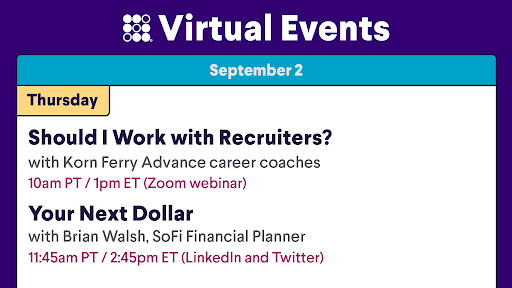
What the Fed Said
Scaling Back Low-Rate Policies
On Friday, Federal Reserve Chairman Jerome Powell spoke about the central bank’s monetary policy plans in the upcoming months. This was part of the Fed’s annual Jackson Hole conference, which was held virtually. The Fed has implemented a historic response to pandemic-related economic downturn. Now, the bank is making plans to scale back these measures and help the economy regain normalcy.
Powell said that the Federal Reserve will begin reining in its low-rate policies later this year if the labor market continues to strengthen. This will likely translate to higher borrowing costs for business loans, mortgages, and credit cards. During the pandemic, the central bank has been purchasing $120 billion per month in mortgage and Treasury bonds in order to keep loan rates low and encourage borrowing and spending. Powell said that the Fed will begin tapering these purchases sometime in the fourth quarter of the year.
Getting the Economy Back on Track
Powell emphasized that the Fed’s decision to taper its bond buying does not mean it will start raising its benchmark short-term rate, which has been near zero since the pandemic began hammering the economy in March 2020. It is expected that rate hikes will not occur until the central bank has finished tapering its bond buying.
Powell said that inflation has climbed enough to meet the bank’s goals. Additionally, employment levels are getting back on track. Powell noted that the Fed’s leadership is monitoring the impact of the Delta variant of COVID-19 on the economy, but it believes that in the long term, economic conditions are headed in the right direction.
Wall Street’s Response
On Wall Street, many investors were bullish regarding the Federal Reserve’s plans to gradually reduce economic support. They also cheered Powell’s comments saying that inflation pressures are likely to be temporary.
In July, inflation increased 3.6% compared to a year ago, according to the Federal Reserve’s preferred gauge. This marked the most significant jump seen in three decades. Higher prices have squeezed American households and have created challenges for businesses across industries. As the Fed makes moves to normalize the economy, it is likely that inflation will begin to abate.
China Makes Plans to Ban Some Foreign IPOs
Chinese Companies With Sensitive Data Will Be Prevented From Listing in the US
Tensions between Washington and Beijing surrounding technology and data privacy have been running high for some time. The conflicts have impacted Chinese and American companies as well as investors around the world.
In recent weeks, Chinese stock market regulators have said they plan to propose a new set of rules which would prohibit certain Chinese companies from listing in the US. The ban would apply to Chinese companies with significant amounts of sensitive consumer data. Companies with less private data, like those in the pharmaceutical industry, would likely still be allowed to pursue foreign listings. The move is motivated by concerns about Chinese national security.
New Regulations for Chinese Tech Giants
For years, Chinese tech companies have used a complex corporate structure to get around foreign investment restrictions. Chinese technology companies including Alibaba (BABA), DiDi (DIDI), and Tencent Holdings (TCEHY), have had success trading in the US through a corporate structure called a Variable Interest Entity.
The new rules would allow Beijing to exert more control over companies using this structure. The regulations would also require Chinese companies to apply for formal approval from a cross-ministry committee for overseas IPOs. At the moment, private companies in China are not required to get approval for foreign listings.
Unanswered Questions
The new rules proposed by the Chinese regulators still need to be finalized. It is likely that they will be implemented in the fourth quarter of the year. China has asked some companies to put off their foreign IPOs until then.
There are still a number of questions surrounding how the regulations will impact the way that Chinese companies gain access to foreign capital. It is also not yet clear how the rules will affect companies which already trade on foreign markets.
Not-So-Breaking News
-
Southwest Airlines (LUV) is scaling back the number of flights it offers through the end of the year. The airline hopes this will reduce cancelations and delays as it deals with labor shortages and uncertainty about the Delta variant of COVID-19.
-
Tesla (TSLA) has filed an application with the Texas Public Utility Commission to sell electricity to consumers in Texas. The electric-car maker has already built a number of large-scale energy storage systems around the world, but this would be the company’s first time acting as a retail electricity provider.
-
Hibbett (HIBB) reported second-quarter profits which were double expectations. The athletic apparel company also raised its full-year outlook. Its stock price was in record territory following the news.
-
Big Lots (BIG) shares fell after the discount retailer missed expectations with its recent report. The company has continued to struggle with supply-chain complications and high freight costs. This news caused Big Lots’ share price to drop.
-
The core personal expenditures price index, an inflation measure which the Federal Reserve uses to set policy, increased 3.6% in July compared to a year ago. This was in line with Wall Street expectations, though it tied the highest level in about 30 years.
-
How much wealth do you really have? Explore ways to calculate net worth and why you should.
Financial Planner Tip of the Day
"People who are reluctant to take on extra risk right now but are looking for ways to maintain exposure to certain securities might want to consider an investment strategy called dollar-cost averaging, which just means regularly putting a set amount of money into an investment."
Brian Walsh, CFP® at SoFi