
Thursday,
August 12, 2021
Market recap
Dow Jones
35,484.97
+220.30 (+0.62%)
S&P 500
4,447.70
+10.95 (+0.25%)
Nasdaq
14,765.14
-22.95 (-0.16%)
Amid evolving news surrounding COVID-19 and the economic reopening, your financial needs are our top priority. For more information,click here.

Top Story
The Senate Passed a $3.5 Trillion Budget Blueprint. What’s Next?
Beyond the Infrastructure Bill
President Joe Biden’s bipartisan infrastructure bill got closer to becoming a reality this week after the Senate passed the $1 trillion package. The bill still needs to pass in the House, which could be more complicated given Democrats want to tie a more ambitious $3.5 trillion bill to it.
Senate Passes Budget Blueprint for $3.5 Trillion Bill
In addition to passing President Biden’s infrastructure bill, the Senate also took the first step to push through a bigger $3.5 trillion package. On Wednesday, the Senate passed the budget blueprint for the proposal via a party line vote.
The legislation includes paid family and medical leave, an extension of the expanded child-tax credit, universal pre-k, and tuition-free college. It would also expand Affordable Care Act subsidies put in place during the pandemic and broaden Medicare benefits. There are also tax incentives for clean energy companies and a pollution tax.
The Bills Face a Tough Battle in the House
The Senate passed the infrastructure bill, but this may not happen in the House. That is because many House Democrats have said the infrastructure package has to be attached to the broader $3.5 trillion bill to be passed.
The budget blueprint for the $3.5 trillion bill has been passed in the Senate, and now Senate lawmakers are working to turn their new budget framework into a comprehensive bill. The Democrats have set September 15 as the target date for a bill to be submitted. Until then, expect a lot of wrangling and negotiations on both sides as Democrats try to push through this ambitious legislation.
Your Home Is an Asset. Do You Know What It’s Worth?
Your house is much more than a home—it’s likely one of the biggest purchases you’ll ever make, with a value that makes up a significant proportion of most people’s net worth. As such, you’ve probably wondered from time to time what your home is worth.
Determining the answer is not as simple as referring back to your sales agreement or mortgage papers. What you paid for your house when you purchased it merely reflects what your house was worth to you—and the real estate market—at a specific point in time.
In reality, housing values are dynamic and they fluctuate based on a number of factors. Some things, such as keeping your house in good repair, are within your control. Other external influences, such as the market, mortgage rates, and other considerations, can also affect the value of your home.
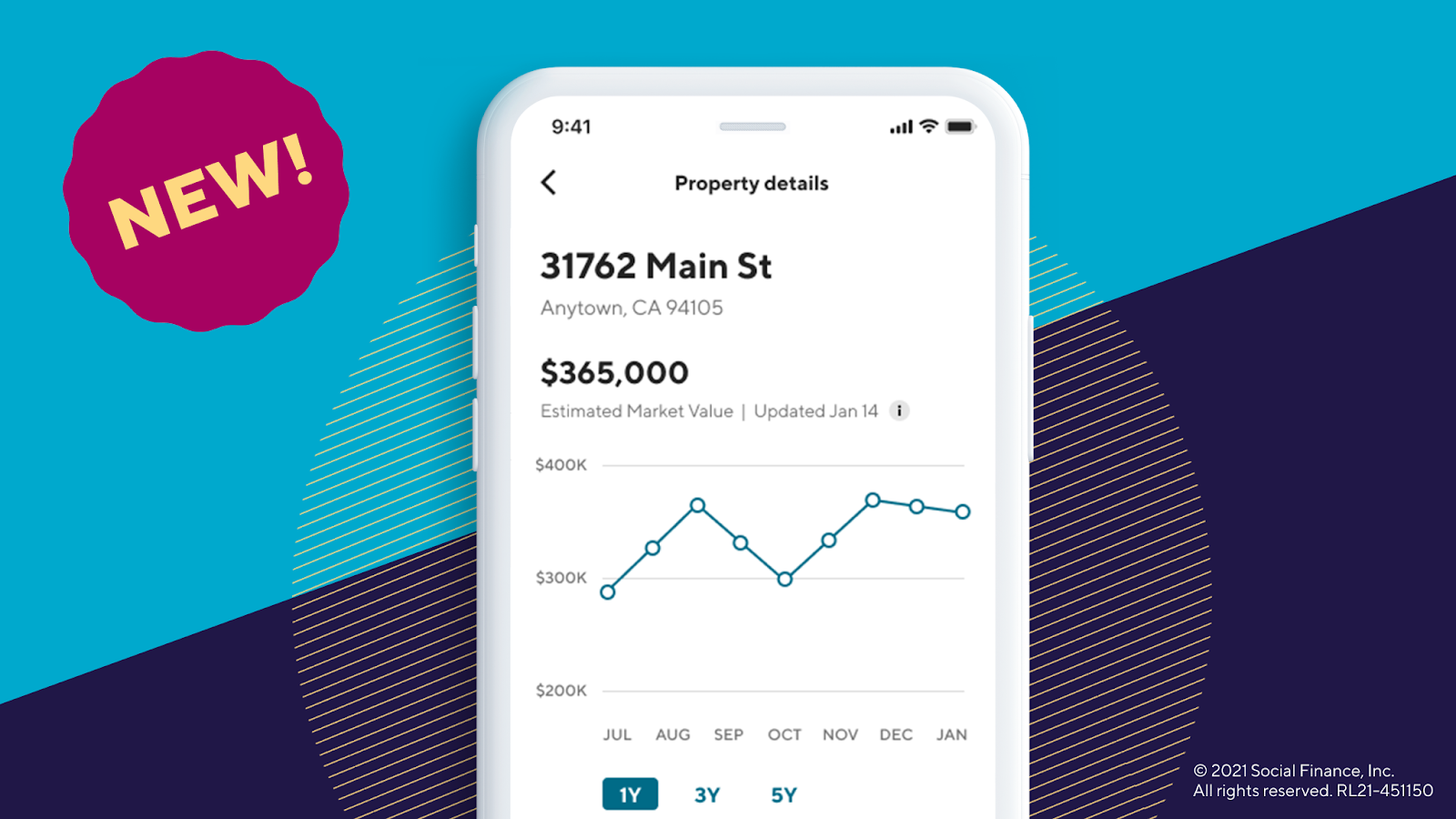
We’ve made it easy to connect and track your real estate assets right alongside the rest of your money. Connect a property and get 250 SoFi points!

Infrastructure Spending
The Infrastructure Influence
On Tuesday, the Senate passed a $1 trillion bipartisan infrastructure bill that both reauthorizes existing federal public-works spending and includes additional spending on roads, bridges, rail, transit, access to broadband, and improving the electrical grid, among other projects.
In the wee hours of Wednesday morning, the Senate also laid out its 2022 budget amounting to $3.5 trillion of spending that includes additional initiatives around education, health care, and climate change.
What’s the Timeline?
Let’s first acknowledge that the bill and the budget are far from done deals, they both must still pass through the House of Representatives and may change as a result of debates in that process, which could last into October. Meaning I’ll probably have to write about this again before it’s over.
What Will the Market Think?
Broad indexes have had a somewhat positive response since both announcements, but it’s hard to say if that’s due to the fiscal news or to inflation not being as terrifyingly high as feared. Either way, the reaction so far has been muted, which is historically typical—the market will care when it’s time to care.
Given that the debt ceiling will approach around the same time that the budget is trying to make its way through Congress, there could be a whopper of a debate that ensues in the fall. Depending on the length and severity of that debate, markets may see some volatility until a resolution is reached. After all, certainty, even if unpopular, is usually better digested than uncertainty.
That said, since the spending will be spread out over a number of years, the infrastructure bill may not have a huge impact on the overall market in 2022, but there are sectors and industry groups that could see a direct benefit. Namely, those levered to roads and highways, rail and transit, and water—most of which fall into the industrials or materials sectors.
The larger reconciliation bill expands spending into areas including clean energy, affordable housing, health care, education, and income transfer. The sectors and industry groups that could benefit are consumer staples, consumer discretionary, clean and renewable energy companies (e.g., charging stations, solar, energy efficiency), real estate, and various health care names, particularly those levered to Medicare and Medicaid coverage expansion.
What About Corporate Taxes?
These spending measures will be coupled with tax increase proposals in order to “pay for” a portion of the cost. Since we are focusing on markets here, I am only going to focus on the possible corporate tax increases and their projected impact on corporate earnings. In my view, the market has not yet fully priced in the prospect of tax hikes, and we may see more reaction to them in fall/early winter.
The proposal will likely include a corporate tax hike from 21% to either 25% or 28%, which could shave roughly 2% or 3.5% off projected 2022 S&P earnings. There may also be other increases beyond the scope of this piece that, combined with these tax increases, could further reduce earnings projections broadly for next year.
What’s the Bottom Line?
Clearly, while some of the proposed spending is intended to stimulate economic growth and improve our nation’s infrastructure, some of it could pose a headwind to corporations. The end goal is for the stimulative effects to outweigh the headwinds and it’s possible the final agreement can achieve that goal. In the meantime, it’s also realistic to expect the debate to bring some short-term wobbles in markets, but none that I think can derail our recovery.

Investors Bet on eVTOLs
Joby Aviation Shares Climb on First Day of Trading
Joby Aviation (JOBY), an electric air-taxi startup which debuted on the New York Stock Exchange Wednesday via a SPAC deal, has seen shares surge. Investors are betting on growth for the green travel industry.
Joby Aviation was acquired by blank-check company Reinvent Technology Partners in February. It was valued at $4.5 billion. The deal gave Joby over $1 billion which it is using to build electric aircraft, bring its air-taxi service to the US, and gain certifications with the Federal Aviation Administration.
Joby to Launch Air-Taxi Service
Joby Aviation launched 12 years ago, aiming to make air travel greener by developing electric aircraft which could replace helicopters. Known as eVTOLs, Joby is aiming to offer its service by 2024. Joby’s eVTOL will be able to carry four passengers plus a pilot and go 150 miles on one charge, reaching speeds of 200 miles per hour. Joby’s main source of revenue will be air taxis but it also wants to sell green credits to other aviation companies looking to offset their carbon emissions.
Joby is different from other eVTOL manufacturers in the marketplace. In addition to building aircraft it also wants to operate an air-taxi service including charging stations in the US and elsewhere.
Airline Operators Eye the Market
Joby is not the only eVTOL startup to get interest from investors. With the major airlines looking for ways to lower their emissions, they are increasingly eyeing eVTOLs. In February, United Airlines (UAL) took part in a fundraising round in Archer Aviation, an eVTOL startup going public via a SPAC deal with Atlas Crest Investment (ACIC). Meanwhile American Airlines (AAL) made an investment in rival Vertical Aerospace in June. The latter already has pre-orders for as many as 1,000 eVTOLs. American plans to be one of the initial customers.
With the world committing to lower emissions, demand for eVTOLs is expected to increase. It will be interesting to watch which startups emerge as the leaders and which airline operators will be first to add eVTOLs to their fleets.
Not-So-Breaking News
-
Amazon (AMZN) is accelerating its push to control deliveries, opening a $1.5 billion air hub in Kentucky. The new terminal will serve as the central hub for its cargo network.
-
NortonLifeLock (NLOK) and Avast (AVASF) announced a $8 billion merger, creating a new cybersecurity firm. Combined, the company will have more than 500 million users.
-
Southwest Airlines (LUV) joined the list of airline operators to warn the Delta variant is weighing on bookings. As a result Southwest cut its revenue and profit targets.
-
Samsung unveiled two new smartphones, both sporting folding screens. One of the models will sell for under $1,000. The consumer electronics giant is known for releasing new phones in August ahead of Apple’s (AAPL) fall announcements.
-
The White House asked OPEC and its oil-producing allies to boost production in a bid to help the global pandemic recovery. The call sent oil prices lower.
-
If you’re buying a home or refinancing a mortgage, the lender will likely do a property valuation. Here’s a guide to appraisals, broker price opinions, and more.
Financial Planner Tip of the Day
“It’s certainly not easy to prioritize investing for retirement. If you’re in your 20s or 30s, you might have student loans or other goals that seem more ‘immediate,’ such as saving for a down payment on a house or kid’s college. But setting aside a little every year starting in your 20s could make the difference between hundreds of thousands of dollars of accumulated investment earnings by retirement age. That’s one reason it’s important to begin planning for retirement early.”
Brian Walsh, CFP® at SoFi