A Guide to Choosing the Right College Major

If you’re applying to college or are a freshman and haven’t settled on a field of study, you’re not alone. Answering the question, “What should I major in?” can feel like a nerve-racking decision, but it doesn’t have to.

There are steps you can take to make an informed decision you’ll be happy with. Read on to learn more about choosing a major, take our college majors quiz, and then discover the strategies that will help you pick the right major.

Key Points

•   To pick a college major, explore interests and strengths, branching out from high school subjects.

•   Engage with students, professors, and guest lecturers for career insights.

•   Investigate financial aspects like starting salaries and student loans.

•   Create a detailed list of strengths, weaknesses, and preferences.

•   Consider post-graduate plans and further education needs.

When Is It Necessary to Declare a Major?

Schools usually require that you declare a major by the end of your sophomore year. Generally, there’s not a particular rush to declare. What’s more important is that you take a variety of classes if you’re still trying to figure out what to major in. Doing so can help you find the subjects that interest you most.

Just be aware that if your chosen field requires sequential classes, you may not be able to take quite as long to shop around for a major. For instance, it’s easier to switch out of being a science or engineering major than it is to switch into that field.

Why Choosing the Right Major Is Important

Your college major is the first stepping stone to your career. It won’t decide your entire career path, just as your first job won’t determine your entire career, but it will launch you on a particular trajectory and help you develop certain skills you’ll need to be successful.

Practically, you’ll want to choose a major with college program costs you can afford, that will pay you the kind of income you’re looking for, and has good employment prospects for the future.

On a more personal level, some of the most important considerations are: Is it something that truly engages you? Does it set you up for a career that you’ll enjoy? And does it suit your personality?

It seems obvious to say that you should choose a degree based on your interests, but it’s a consideration that you should respect. True engagement in a topic can have numerous ripple benefits. For instance, you’ll probably be more motivated and committed to lifelong learning and less likely to feel burnt out in school or later in your career.

College Major Quiz

Now that you understand why the right major is important, take this college major quiz to help uncover which college major you should choose, and find the right area of study for you.

Satisfaction Survey Results

How do college graduates feel about the majors they chose? One landmark survey conducted by BestColleges.com gauged how happy college graduates were with their choice of major. The survey asked numerous questions, with results tabulated for each question from each of the following generations: Millennials, Gen X, Baby Boomers, and the Silent Generation.

Here are three key findings:

•  61% of respondents would change their major if that were possible.

•  About 26% of participants would change their major to reflect their passions.

•  About 30% of the Millennials who participated said they should have chosen a major with better job opportunities.

It’s important to remember that this survey focused on people who graduated and were looking back at decisions they’d already made about their majors. As a current college student, you still have the ability to make the right decision.

6 Steps to Choosing Your College Major

Here are some key steps you can take to find the best college major for you.

1. Exploring

What’s tough about making a decision about which major to choose when you’re a teenager is that you haven’t tried a lot of things yet. The first year or two of college is a fine opportunity to explore, even if you think you know what major you’ll choose.

To begin, think about what you enjoy and what you’re good at. In addition to subjects, include skills such as leadership or organization. Next, consider the majors that match up with those interests. Branch out beyond the same subjects you took in high school.

Sign up for academic or pre-professional clubs—they’re a great way to learn more about career possibilities, create a support network as you’re enrolling in classes, seek out job-related opportunities, and meet people who share your interests. If you plan on working while you’re in college, find a job in a field you’re interested in.

2. Talking to People

As you’re thinking about, what major should I choose?, speak with other students, professors, and guest lecturers about their career experience. You’re likely to learn more about what a career is like by talking to someone with real-life experience.

Find a career counselor at your school who is willing to discuss with you options for majors and career opportunities.

It’s also no secret that we can have very skewed opinions of ourselves. Often, we’re too hard on ourselves or don’t recognize our own talents. It can help to have conversations with the people in your life (family, friends, teachers, coaches, and so on) whom you know will provide constructive observations and advice. It’s entirely possible that you’ll learn something about your strengths you never knew before.

3. Thinking About the Money

While no one expects that you have money figured out, you should have a general idea about how the decisions you make in college will affect you later in life.

First, investigate the starting salaries for different majors and entry-level jobs. This is an especially important exercise if you have student loans. As you’re choosing a major, it’s helpful to understand the basics of student loans and what they cover.

For instance, you’ll need to be aware of when you need to start putting money toward student loans, and how much your payments might be. Your loans can affect your financial future for many years, so make sure your major and career of choice will allow you to cover what you owe.

Even if you don’t have student loans, having a realistic idea about salaries, job availability, and cost of living in the area where you expect to live is important. Find a major that works within your budget and schedule.

It’s also important to look ahead. Is a career of choice expected to be in demand in the future? Is the demand expected to actually increase?

Recommended: Private Student Loans Guide

4. Getting Granular

At this point, it may be obvious to you which major is best. If not, and you’re still asking, “what major should I choose?”, a good strategy can be to create an in-depth list that includes:

•  Your strengths

•  Your weaknesses

•  Activities you enjoy

•  Tasks you dread

Also ask a college counselor if you can do aptitude testing. Are career fairs that you can attend coming to your school? Do some volunteer work or see if you can secure an internship in an area of special interest. Spread your net wide and take all you’ve listed and learned to make a choice that’s right for you.

5. Post-Graduate Plans

Is a bachelor’s degree what’s needed for the career you’re considering? Or will more schooling be required? Before finalizing your major, it makes sense to be clear about how much education you’ll need for a particular job.

If a master’s degree or more is required, is this something you’re interested in pursuing? And can you afford it?

And again, it makes sense to think about your student loans and the repayment terms they have. One thing to know is that you don’t necessarily have to stick to those terms if they won’t work for you. Refinancing student loans could help you get a more favorable rate and term, and possibly make your payments more affordable.

When you refinance, you replace your current loans with a brand-new private loan. It’s important to explore the advantages of refinancing student loans as well as the disadvantages.

One thing to know is that refinancing federal student loans makes them ineligible for federal programs and protections, like income-driven repayment, deferment and forbearance, and Public Service Loan Forgiveness. If you think you’ll need access to these benefits, refinancing may not be the best choice for you.

6. Filling in the Gaps

Once you choose a major, you might also want to select a minor. Having a minor opens up another academic discipline and can provide you with additional skills that can help you pursue your ideal career.

If, for example, you want to become a psychiatrist, it can make sense to have a business minor if you want to open a solo practice.

Whenever possible, it makes sense to choose a minor at the same time you declare your major. This allows you to strategically schedule classes so you can graduate within the planned time frame.

In the end, no matter what major and minor you decide on, know that your flexibility, creativity, and passion for life-long learning will have much to do with your success.

Shopping for Student Loans

As you’re determining your major and also thinking about paying for college, student loans can help you cover some of the cost of college. If you’re exploring student loan options, it’s wise to start with looking at federal student loans, since their rates are usually the most favorable and they come with the benefits and protections mentioned above.

An alternative or a way to fill any financing gaps could be private student loans, which can have fixed or variable interest rates. They are available from a variety of sources, such as banks, credit unions, and online lenders, and fees and repayment options will vary. Shopping around and comparing offers is an important part of the process.

If you have student loans and you’d like to lower your monthly payments, refinancing might be one way to do it. Note: You could achieve lower monthly payments via qualifying for a lower interest rate and/or by extending your term. You may pay more interest over the life of the loan if you refinance with an extended term.

The Takeaway

Choosing a college major can be a hard decision, but also a satisfying experience. Explore different topics, talk to a variety of people, take a quiz, and think about your post-graduate plans and finances when making your choice.

When it comes to financing your education, federal and/or private student loans can help you achieve your dreams.

Looking to lower your monthly student loan payment? Refinancing may be one way to do it — by extending your loan term, getting a lower interest rate than what you currently have, or both. (Please note that refinancing federal loans makes them ineligible for federal forgiveness and protections. Also, lengthening your loan term may mean paying more in interest over the life of the loan.) SoFi student loan refinancing offers flexible terms that fit your budget.


With SoFi, refinancing is fast, easy, and all online. We offer competitive fixed and variable rates.

FAQ

Can you pick a major you know nothing about?

Yes, many students pick majors they know nothing about. It can be very interesting to pursue a major you are unfamiliar with if it captures your attention. For example, many high school students have not been exposed to such fields as anthropology or electrical engineering, but these are popular fields of study.

How to determine which college major is right for you?

When choosing a college major, first think about your interests, strengths, and aspirations while exploring different fields of study that are available. You might talk to friends, relatives, and professors about this as well. It can also be wise to consider your hopes after graduation: Do you plan to further your education? What kind of work would you like to do and how much would you want to earn? These considerations can count, too.

What’s considered the easiest college major?

There’s no one single easiest college major. Much depends on a school’s specific program and how demanding it is and a student’s effort and abilities. That said, many people feel that liberal arts degrees (such as English and History) can be easier than STEM topics.


SoFi Student Loan Refinance
Terms and conditions apply. SoFi Refinance Student Loans are private loans. When you refinance federal loans with a SoFi loan, YOU FORFEIT YOUR ELIGIBILITY FOR ALL FEDERAL LOAN BENEFITS, including all flexible federal repayment and forgiveness options that are or may become available to federal student loan borrowers including, but not limited to: Public Service Loan Forgiveness (PSLF), Income-Based Repayment, Income-Contingent Repayment, extended repayment plans, PAYE or SAVE. Lowest rates reserved for the most creditworthy borrowers.
Learn more at SoFi.com/eligibility. SoFi Refinance Student Loans are originated by SoFi Bank, N.A. Member FDIC. NMLS #696891 (www.nmlsconsumeraccess.org).

SoFi Loan Products
SoFi loans are originated by SoFi Bank, N.A., NMLS #696891 (Member FDIC). For additional product-specific legal and licensing information, see SoFi.com/legal. Equal Housing Lender.


Financial Tips & Strategies: The tips provided on this website are of a general nature and do not take into account your specific objectives, financial situation, and needs. You should always consider their appropriateness given your own circumstances.

External Websites: The information and analysis provided through hyperlinks to third-party websites, while believed to be accurate, cannot be guaranteed by SoFi. Links are provided for informational purposes and should not be viewed as an endorsement.

SOSLR-Q325-056

Read more
What Are Stock Delistings and Why Do They Occur?

What Are Stock Delistings and Why Do They Occur?

When a stock is delisted, that means it’s been removed from a public stock exchange. All publicly traded stocks are listed on an exchange. In the U.S., that typically means the New York Stock Exchange (NYSE) or the Nasdaq.

There are different reasons for delisting stock, it can occur voluntarily, such as when a company chooses to go private, or involuntarily, if it fails to meet the requirements of the stock exchange.

Owning a delisted stock doesn’t mean you can no longer trade it, but it does change how trades take place. If you own a delisted stock, it’s important to understand what it may mean for your portfolio.

Key Points

•   Stocks can be removed from major exchanges through delisting, either voluntarily or involuntarily.

•   Common reasons for delisting include failing to meet listing requirements, going private, or financial distress.

•   Delisting impacts investors by making shares harder to trade and potentially losing value.

•   After delisting, stocks move to over-the-counter (OTC) markets, reducing transparency and accessibility.

•   Investors should assess the reason for delisting and may choose to sell shares if it signals financial issues.

How Stock Listings Work

Before diving into stock delisting, it’s helpful to know more about how stocks get listed in the first place. Stock exchanges can either be physical or digital locations in which investors buy and sell stocks and other securities. The NYSE is an example of a physical exchange, while the Nasdaq is an electronic stock exchange.

To get listed on any stock exchange, companies must meet certain requirements. For example, Nasdaq-listed companies must meet specific listing guidelines relating to:

•   Pre-tax earnings

•   Cash flows

•   Market capitalization

•   Revenue

•   Total assets

•   Stockholder equity

•   Minimum bid price

Companies must also pay a fee to be listed on the exchange. The NYSE has its own requirements that companies must meet to be listed.

Once a stock is listed, it can be traded by investors. But being listed on an exchange doesn’t guarantee the stock will remain there permanently. Stocks get added to and removed from exchanges fairly regularly.

What Does Delisting a Stock Mean?

When a stock is delisted, either the company itself or the exchange decides to remove the stock from the exchange.

Exchange-Initiated Stock Delisting

When an exchange delists a stock, it’s typically because it no longer meets the minimum requirements for listing or the stock has failed to meet some regulatory requirement. Using Nasdaq-listed stocks as an example, a delisting can happen if a company’s pre-tax earnings, market capitalization, or minimum share price fall below the thresholds required by the exchange.

Exchanges set listing requirements to try and ensure that only high-quality companies are available to trade. Without stock listing requirements, it would be easier for financially unstable companies to find their way into the market. This could pose an investment risk to individual investors and the market as a whole.

In delisting stocks that don’t meet the basic requirements, exchanges can minimize that risk. When and if a company addresses the areas where it falls short, it can apply for relisting. Assuming it meets all the necessary requirements, it can once again trade on the exchange.

Exchanges typically give companies opportunities to rectify the situation before delisting stocks. For example, if a company is trading under the minimum bid price requirement, the exchange can send notice that this requirement isn’t being met and specify a deadline for improvement. That can help companies that experience temporary price dips only to have share prices rebound relatively quickly.

Company-Initiated Stock Delistings

A delisted stock can also reflect a decision on the part of the listed company. There are different reasons a company voluntarily delists itself. Scenarios include:

•   A move from public to private ownership

•   Merger with or acquisition by another company

•   Bankruptcy filing

•   Ceased operations

In some cases, a company may ask to be delisted as a preemptive measure if it’s aware that it’s in danger of being delisted by the exchange. For example, if the latest quarterly earnings report shows a steep decline in market capitalization below the minimum threshold, the company may move ahead with voluntary delisting.

What Happens If a Stock Is Delisted?

Once a stock has been delisted from its exchange, either voluntarily or involuntarily, it can still be traded. But trading activity now happens over-the-counter (OTC) versus through an exchange.

An over-the-counter trade is any trade that doesn’t take place on a stock exchange. Investors can trade both listed or delisted stock shares over-the-counter through alternative trading networks of market makers. The OTC Markets Group and the Financial Industry Regulation Authority (FINRA) are two groups that manage OTC trading activity.

Unless the company that issued a now-delisted stock cancels its shares for any reason, your investment doesn’t disappear. If you owned 500 shares of ABC company before it was delisted, for example, you’d still own 500 shares afterward. You could continue trading those shares, though you’d do so through an over-the-counter network.

What can change, however, is the value of those shares after the delisting. Again, this can depend on whether the exchange or the company initiated a delisting, and the reasoning behind the decision.

For example, if a stock is being delisted because the company is filing for bankruptcy its share price could plummet. That means when it’s time to sell them, you may end up doing so at a loss.

Even if a stock’s value doesn’t take a nosedive after delisting, it can still be a sign of financial trouble at the company. If you own delisted dividend-paying stocks, for instance, dividend payments may shrink or dry up altogether if the company begins making cutbacks to preserve capital or reduce expenses.

What to Do If a Stock You Own Is Delisted

If you own shares in a company that delists its stock, it’s important to consider how to manage that in your portfolio. Specifically, that means thinking about whether you want to hold on to your shares or sell them.

It helps to look at the bigger picture of why the reason for the delisting and what it might say about the company. If the company pulled its stock because a bankruptcy filing is in the works, then selling sooner rather than later might make sense to avoid a sharp drop in value.

Also, consider the ease with which you can later sell delisted stock if you decide to keep them. Some online brokerages allow you to trade over-the-counter but not all of them do. If you prefer to keep things as simple as possible when making trades, you may prefer to unload delisted stocks so you no longer have to deal with them.

Recommended: How to Open a New Brokerage Account

The Takeaway

When a stock becomes delisted, it’s removed from a stock exchange, either because it no longer met the requirements of the exchange, or because the company chose to delist for financial reasons. You can still trade a company after it’s delisted, but transactions occur over-the counter, rather than on an exchange.

Knowing about delisted stocks and companies can be helpful for investors of all types. Broadening your knowledge about the markets is almost never a bad idea.

Invest in what matters most to you with SoFi Active Invest. In a self-directed account provided by SoFi Securities, you can trade stocks, exchange-traded funds (ETFs), mutual funds, alternative funds, options, and more — all while paying $0 commission on every trade. Other fees may apply. Whether you want to trade after-hours or manage your portfolio using real-time stock insights and analyst ratings, you can invest your way in SoFi's easy-to-use mobile app.


Opening and funding an Active Invest account gives you the opportunity to get up to $1,000 in the stock of your choice.¹

FAQ

Why would a stock get delisted?

A stock can be delisted and removed from a stock exchange for a number of reasons. The delisting may be voluntary, meaning the company chooses to be delisted because it’s going private or being bought or merged with another company, or it is planning to declare bankruptcy or cease operations.

An involuntary listing, on the other hand, is when a stock exchange delists a stock because it no longer meets certain requirements by the exchange. For example, a stock could be delisted by an exchange if it no longer fulfills requirements for its share price, pre-tax earnings, or market capitalization.

Is delisting a stock good or bad?

In general, holding delisted stock is less than desirable. Once a stock is delisted from a major exchange, it becomes harder to buy and sell. In addition, the price of the shares may fall, or the delisting could be a signal that the company is in financial trouble.

What happens to my stock if a company delists?

Once a company is delisted, you still own your shares of the stock, but it becomes more difficult to buy and sell them. That’s because the stock is no longer on a major stock exchange but instead it’s on an over-the-counter (OTC) market, which is less accessible to investors and has less regulation and transparency. The value of your shares may also drop.

However, if the company delisted voluntarily because it is going private or being merged with another company, you might receive cash for your shares or shares in the purchasing company. Understanding the reason for the delisting and how it may affect your shares can be helpful.


About the author

Rebecca Lake

Rebecca Lake

Rebecca Lake has been a finance writer for nearly a decade, specializing in personal finance, investing, and small business. She is a contributor at Forbes Advisor, SmartAsset, Investopedia, The Balance, MyBankTracker, MoneyRates and CreditCards.com. Read full bio.


Photo credit: iStock/wacomka

INVESTMENTS ARE NOT FDIC INSURED • ARE NOT BANK GUARANTEED • MAY LOSE VALUE

SoFi Invest is a trade name used by SoFi Wealth LLC and SoFi Securities LLC offering investment products and services. Robo investing and advisory services are provided by SoFi Wealth LLC, an SEC-registered investment adviser. Brokerage and self-directed investing products offered through SoFi Securities LLC, Member FINRA/SIPC.

For disclosures on SoFi Invest platforms visit SoFi.com/legal. For a full listing of the fees associated with Sofi Invest please view our fee schedule.


¹Probability of Member receiving $1,000 is a probability of 0.026%; If you don’t make a selection in 45 days, you’ll no longer qualify for the promo. Customer must fund their account with a minimum of $50.00 to qualify. Probability percentage is subject to decrease. See full terms and conditions.

Financial Tips & Strategies: The tips provided on this website are of a general nature and do not take into account your specific objectives, financial situation, and needs. You should always consider their appropriateness given your own circumstances.

Third-Party Brand Mentions: No brands, products, or companies mentioned are affiliated with SoFi, nor do they endorse or sponsor this article. Third-party trademarks referenced herein are property of their respective owners.

Tax Information: This article provides general background information only and is not intended to serve as legal or tax advice or as a substitute for legal counsel. You should consult your own attorney and/or tax advisor if you have a question requiring legal or tax advice.

SOIN-Q325-074

Read more
What Is an IPO Roadshow?

What Is an IPO Roadshow?

Before a company can sell its shares on an exchange, it first needs to go through the Initial Public Offering (IPO) process. One of the most critical steps in this process is the IPO roadshow, in which the company pitches itself to potential investors.

A roadshow presentation can take place in-person, with meetings in cities across the country, or the company can offer an online event instead. Either way, the goal is the same: to generate interest in the company that will encourage investors to buy in.

Key Points

•   An IPO roadshow is a series of meetings or presentations in which key members of a private company pitch the initial public offering to prospective institutional investors.

•   Digital roadshows have become increasingly popular and offer an advantage of increased efficiency compared to traditional in-person roadshows.

•   The purpose of an IPO roadshow is to generate interest in a company among prospective investors in order to raise capital.

•   Virtual IPO roadshow presentations have the potential to reach a broader audience, rather than being limited to a handful of cities.

•   Buying IPO stock can help diversify an investment portfolio, but is typically high risk and requires due diligence.

What Is a Roadshow?

In general, a roadshow is a series of meetings or presentations in which key members of a private company, usually executives, pitch the initial public offering, or IPO, to prospective investors. Essentially, the company is taking its branding message on the road to meet with investors in different cities, hence the name.

The IPO roadshow presentation is an important part of the IPO process in which a company sells new shares to the public for the first time. Whether a company’s IPO succeeds or not can hinge on interest generated among investors before the stock makes its debut on an exchange.

There are also some cases where company executives will embark on a roadshow to meet with investors to talk about their company, even if they’re not planning an IPO.


💡 Quick Tip: IPO stocks can get a lot of media hype. But savvy investors know that where there’s buzz there can also be higher-than-warranted valuations. IPO shares might spike or plunge (or both), so investing in IPOs may not be suitable for investors with short time horizons.

How Roadshows Work

Typically, the roadshow is the third step in the IPO process, following the selection of an underwriter to oversee the process and the completion of due diligence. At this point, the Securities and Exchange Commission (SEC) reviews all of the documents submitted in connection with the IPO, while the company and the underwriting team get ready for the roadshow.

The underwriters and executives taking part in the IPO roadshow work together to decide which cities to visit, which investors to target, and which information to include in the roadshow presentation.

A typical IPO roadshow presentation highlights the most important information the company wants investors to know, including:

•   The company’s history and its plans regarding the IPO

•   Details about the top executives

•   The current vision and mission statement

•   Financial performance and earnings history

•   Future sales projections and anticipated growth

•   IPO goals

A roadshow IPO presentation may include digital media, such as videos or a slideshow. Investors have a chance to ask questions during a Q&A session following the presentation.

The roadshow tour for an IPO can last anywhere from days to weeks, depending on how many stops the company makes along the way.

New Digital Roadshows

Virtual roadshows have become an increasingly popular alternative to the traditional IPO roadshow. The Covid-19 pandemic forced companies to rethink the way they meet with investors, resulting in a growing number of roadshows taking place online only.

Digital roadshows mean companies forgo a chance to meet with prospective investors face-to-face, but they offer an advantage in terms of increased efficiency. Company executives and underwriters save money and time, since they’re not traveling. Virtual IPO roadshow presentations also have the potential to reach a broader audience about the investment opportunity, rather than being limited to just a handful of cities.

If a company schedules multiple presentations in a single day, using a virtual format, they can complete the roadshow and move through the IPO process more quickly. This could make it easier to determine the price of an IPO if there’s less opportunity for pricing to be affected by volatility. Pricing the IPO typically happens at the conclusion of the roadshow.

Importance of Roadshows

The IPO roadshow presentation is an opportunity for a company to convince investors that buying stock in their company is a good investment opportunity. The main purpose of an IPO is generally to raise capital and companies can’t do that without interest from investors.

IPO stocks are considered high-risk investments, and while some companies may present an opportunity for growth, there are no guarantees. Like investing in any other type of stock, it’s essential for investors to do their due diligence. While individual investors aren’t included in the IPO roadshow process, they can follow the coverage, to understand new details that might emerge about the company.

Pros and Cons of a Roadshow

If the company goes public and no one buys its shares, then the IPO ends up being a flop, which can affect the company’s success in the near and long term. If the company experiences an IPO pop, in which its price goes much higher than its initial offering price, it could be a sign that underwriters mispriced the stock.

A roadshow is also important for helping determine how to price the company’s stock when the IPO launches. If the roadshow ends up being a smashing success, for example, that can cause the underwriters to adjust their expectations for the stock’s IPO price.

On the other hand, if the roadshow doesn’t seem to be generating much buzz around the company at all, that could cause the price to be adjusted downward.

In a worst-case scenario, the company may decide to pull the plug on the IPO altogether or to go a different route, such as a private IPO placement.

The Takeaway

The IPO roadshow presents an opportunity for a new company to convince investors to invest in their organization. The main purpose of an IPO is to raise capital and companies can’t do that without interest from investors.

The underwriters and executives taking part in the IPO roadshow work together to decide which cities to visit, which investors to target, and which information to include in the roadshow presentation.

While individual investors typically don’t have access to roadshows, eligible investors may still participate in IPO trading. Participating in IPO investing may provide an option for diversifying an investment portfolio, and may present growth opportunities — but IPO shares are typically high risk. It’s vital to do thorough research about any IPO opportunity.

Whether you’re curious about exploring IPOs, or interested in traditional stocks and exchange-traded funds (ETFs), you can get started by opening an account on the SoFi Invest® brokerage platform. On SoFi Invest, eligible SoFi members have the opportunity to trade IPO shares, and there are no account minimums for those with an Active Investing account. As with any investment, it's wise to consider your overall portfolio goals in order to assess whether IPO investing is right for you, given the risks of volatility and loss.


Invest with as little as $5 with a SoFi Active Investing account.

FAQ

What is the purpose of a roadshow?

The purpose of an IPO roadshow is to generate interest in a company among prospective investors. The company executives and underwriters can meet with investors in-person or virtually to share details about the IPO, the company’s financials, and its goals.

How long after the roadshow is the IPO?

The IPO can take place as little as two weeks after the roadshow is completed. The actual timing depends on a number of factors, including whether the underwriters determine that a price adjustment is needed or if any snags come up involving the filing of key documents.

Are IPO roadshows public?

The IPO roadshow process typically focuses on institutional investors, rather than retail investors. So the roadshow presentations have traditionally been private affairs. But with more companies opting to host virtual roadshows, there may be potential at some point for the general public to be able to view some IPO presentations online.


About the author

Rebecca Lake

Rebecca Lake

Rebecca Lake has been a finance writer for nearly a decade, specializing in personal finance, investing, and small business. She is a contributor at Forbes Advisor, SmartAsset, Investopedia, The Balance, MyBankTracker, MoneyRates and CreditCards.com. Read full bio.


Photo credit: iStock/FreshSplash

INVESTMENTS ARE NOT FDIC INSURED • ARE NOT BANK GUARANTEED • MAY LOSE VALUE

SoFi Invest is a trade name used by SoFi Wealth LLC and SoFi Securities LLC offering investment products and services. Robo investing and advisory services are provided by SoFi Wealth LLC, an SEC-registered investment adviser. Brokerage and self-directed investing products offered through SoFi Securities LLC, Member FINRA/SIPC.

For disclosures on SoFi Invest platforms visit SoFi.com/legal. For a full listing of the fees associated with Sofi Invest please view our fee schedule.

Investing in an Initial Public Offering (IPO) involves substantial risk, including the risk of loss. Further, there are a variety of risk factors to consider when investing in an IPO, including but not limited to, unproven management, significant debt, and lack of operating history. For a comprehensive discussion of these risks please refer to SoFi Securities’ IPO Risk Disclosure Statement. This should not be considered a recommendation to participate in IPOs and investors should carefully read the offering prospectus to determine whether an offering is consistent with their investment objectives, risk tolerance, and financial situation. New offerings generally have high demand and there are a limited number of shares available for distribution to participants. Many customers may not be allocated shares and share allocations may be significantly smaller than the shares requested in the customer’s initial offer (Indication of Interest). For more information on the allocation process please visit IPO Allocation Procedures.

An investor should consider the investment objectives, risks, charges, and expenses of the Fund carefully before investing. This and other important information are contained in the Fund’s prospectus. For a current prospectus, please click the Prospectus link on the Fund’s respective page. The prospectus should be read carefully prior to investing.
Alternative investments, including funds that invest in alternative investments, are risky and may not be suitable for all investors. Alternative investments often employ leveraging and other speculative practices that increase an investor's risk of loss to include complete loss of investment, often charge high fees, and can be highly illiquid and volatile. Alternative investments may lack diversification, involve complex tax structures and have delays in reporting important tax information. Registered and unregistered alternative investments are not subject to the same regulatory requirements as mutual funds.
Please note that Interval Funds are illiquid instruments, hence the ability to trade on your timeline may be restricted. Investors should review the fee schedule for Interval Funds via the prospectus.


Investment Risk: Diversification can help reduce some investment risk. It cannot guarantee profit, or fully protect in a down market.

Financial Tips & Strategies: The tips provided on this website are of a general nature and do not take into account your specific objectives, financial situation, and needs. You should always consider their appropriateness given your own circumstances.

SOIN-Q325-078

Read more

Free Monthly Budget Template: Your Tool for Financial Success

Budgets can help you take control of your money and make it work harder for you. A monthly budget template can help you stay organized as you track your income, expenses, savings, and debt repayment. There are different ways to make a budget template, but if you don’t have time to do it yourself, it’s easy to find one online.

If you’re specifically looking for an Excel budget template then you’re in the right place. You’ll find a free budget Excel template you can download to help you better manage your money.

Key Points

•   A monthly budget template helps track income, expenses, savings, and debt, providing a comprehensive financial overview.

•   The budget template is customizable, allowing users to add, remove, and rename lines to fit personal financial needs.

•   The template includes sections for essential and discretionary expenses, savings, and debt repayment, which automatically total calculations.

•   Users can track variable expenses like groceries and gas to identify spending patterns and adjust budgets accordingly.

•   The template can be used in Excel or Google Sheets, offering flexibility in managing finances.

Options trading online by SoFi Invest.

Monthly Budget Template


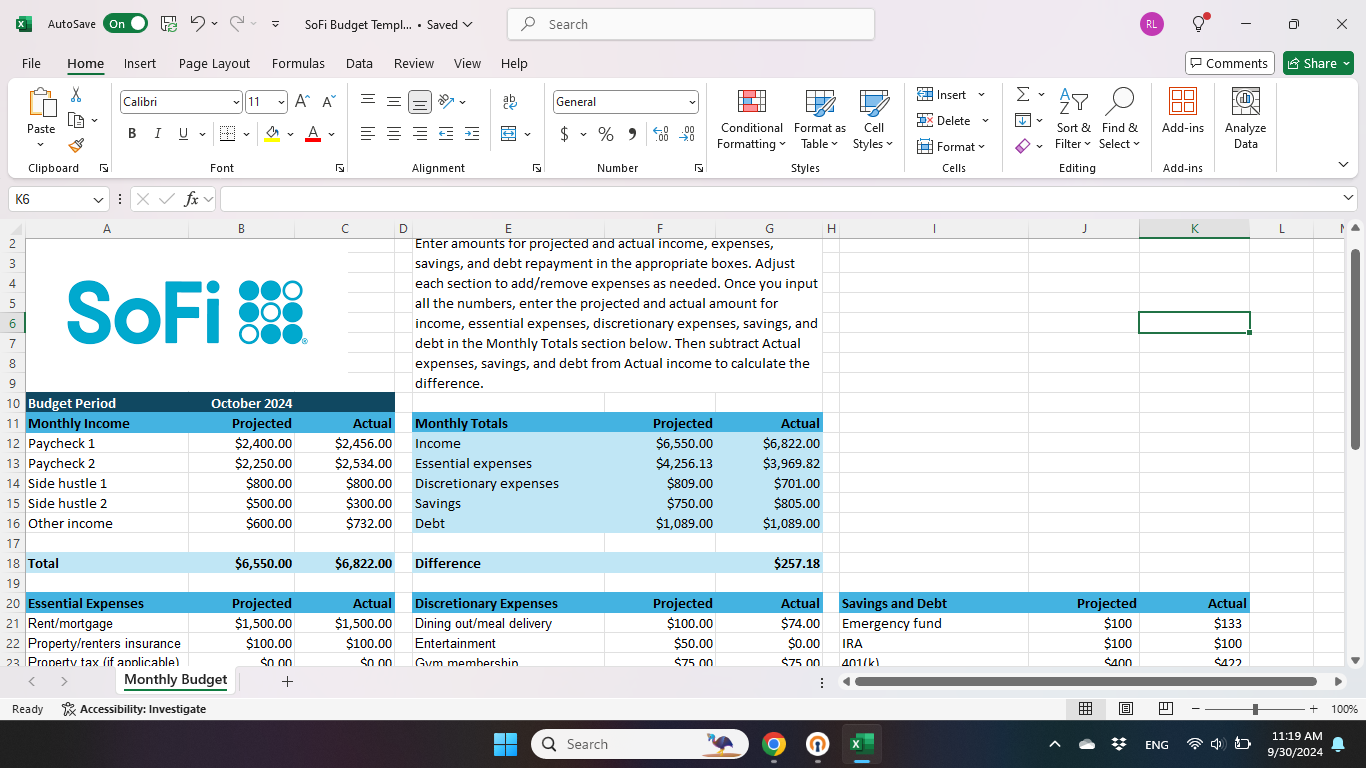
There are different types of budgeting methods to choose from, such as the envelope system or the 50/30/20 budget rule. This free budget template can likely work well with many of them. The template allows you to enter your income, expenses, savings, and debt payments to create a comprehensive snapshot of your finances from month to month.

Here’s what you can expect when using this monthly budget template.

Key Components of the Template


When making a financial plan, it’s important to include the most important components of a budget. This simple budget template is divided into five sections:

•   Income

•   Essential expenses (the “needs” in life)

•   Discretionary expenses (the “wants” in life)

•   Savings and debt repayment

•   Monthly totals

You’ll be able to enter projected and actual amounts for each section. You can add or remove lines as needed or edit the descriptions for expenses, savings, and debt payments. Totals are calculated for you automatically.

Screenshot of SoFi Free Budget Template

How to Download and Access the Template


Here are steps for downloading the free monthly budget template:

•   You can download the Excel budget template here.

•   Once you download the file, you’ll open it and then click “Enable editing.”

•   You can then save the file to your preferred location on your device, and start using it to make a budget.

If you don’t have Excel, you can open the file in Google Sheets. You’ll need to:

•   Download the Excel file

•   Open Google Sheets

•   Click “File,” then “Import”

•   Click “Upload” and “Browse,” then find the Excel file

•   Select the file and click “Open”

•   In Google Sheets, select “Create new spreadsheet” from the dropdown menu (or this may automatically populate on a pop-up screen), and click “Import data”

•   Click the blue “Open now” link to start using the spreadsheet

If you’re opening the file in Google Sheets, you may need to make adjustments to the font or spacing if you have a default font that you use.

Recommended: 50/30/20 Budget Calculator

Increase your savings
with a limited-time APY boost.*


*Earn up to 4.00% Annual Percentage Yield (APY) on SoFi Savings with a 0.70% APY Boost (added to the 3.30% APY as of 12/23/25) for up to 6 months. Open a new SoFi Checking and Savings account and pay the $10 SoFi Plus subscription every 30 days OR receive eligible direct deposits OR qualifying deposits of $5,000 every 31 days by 3/30/26. Rates variable, subject to change. Terms apply here. SoFi Bank, N.A. Member FDIC.

Using the Monthly Budget Template Effectively


Every monthly budget template is different, and you may need to do some customizing to make it your own. Here are some tips for living on a budget and tracking all of the numbers.

•   Review each section one by one to determine whether you’ll need to add or remove lines or make changes to descriptions.

•   Start by reviewing your monthly income and adding the projected amount for each income stream that you have.

•   Enter “Essential expenses” next, using the projected amount for each budget category. Again, you may need to add or remove expenses or adjust the descriptions to match your needs.

•   Enter “Discretionary expenses,” using the projected amount for each budget category. There’s plenty of room in the budget template to add additional expense categories if you have them.

•   Enter projected amounts for each of your monthly savings goals and debt repayment goals.

•   As you pay your essential expenses, add the actual amount spent for each one to your budget template.

•   Use the “Expense tracker” tab included in the budget template to record expenses for things like groceries and gas throughout the month. You can then add up the amounts for each category and enter them in the relevant box on the “Monthly budget” tab.

•   Enter savings contributions and debt payments in the “Actual” column as you make them.

Once you’ve added your income, expenses, savings, and debt payments and calculated the projected and actual amounts for each category, you can enter those numbers into the “Monthly totals” section. You can then subtract your actual expenses, savings, and debt payments from your actual income to calculate the difference. Managing your budget in this way adds an extra level of insight onto and control of what’s going on in your bank account.

Personalizing Your Budget


The monthly budget template is customizable so you can add or remove items as needed.

For example in the “Income section,” you’ll see room to enter amounts for two paychecks, two side hustles, and an ‘Other’ category. If you only get paid monthly, you can delete one of the paycheck lines. Or if you get paid biweekly and have a three-paycheck month coming up, you can add a line to account for that.

You can do the same with all of the other sections so that your budget template reflects your monthly expenses and savings goals. For example, say that you use sinking funds — money set aside for specific goals — to save money for one-time expenses. You could add individual lines for each one in the “Savings” and “Debt” section.

So your savings goals might include:

•   Emergency fund

•   Holiday fund

•   Vacation fund

•   New car fund

Likewise, you might have multiple student loans you’re repaying that you’d like to list separately. Having a projected column and an actual column can be a huge asset. This can help you see how well you’re doing with your spending, savings, and debt repayment goals month to month. That, in turn, can help you manage your money better.

Tracking and Analyzing Your Spending


Failing to track variable or discretionary expenses is one of the most common budgeting mistakes. It’s easy to go over budget if you don’t know what you’re spending.

This budget template includes an “Expense Tracker” sheet that you can use to record spending, outside of what you pay toward the bills. Tracking expenses monthly is a great way to see how your expenses are trending, where your money goes, and what you might want or need to cut back on.

Some of the most helpful expenses to track may include:

•   Groceries

•   Gas

•   Anything that’s in your “Discretionary expenses” category on the template, such as entertainment and dining out

These are the areas of your budget where spending may not be the same month to month. You can look at each expense category and ask yourself what you could do to reduce spending or even eliminate it altogether if you’re trying to free up funds to save or pay down debt.

It’s also helpful to look back each month to see how your essential expenses have changed. Some costs, like your mortgage or rent payments, may always be the same but you might spend more on utilities during certain times of the year than others. Getting to know these patterns can help you adjust your budget accordingly so you’re not surprised by a higher-than-usual electric bill.

Budget Template vs App


Using a budget template is a hands-on way to track your income and spending because you have to enter amounts in the sheet manually. If you don’t have time to do that or you’re worried about getting the numbers wrong, you might use a free budget app instead.

These can let you link your bank account, including checking and savings accounts, in one place so you can see what you’re spending. You can also add investment accounts, retirement accounts, credit cards, student loans, and other loans to track your net worth. Many financial institutions offer these tools, so it can be worthwhile to check with yours, or many third-party apps are available as well, some for free and others with associated costs.

You might also find that a budgeting app can help you move towards your short- and longer-term money goals, as you see where your cash goes and how you can lower debt and build savings over time.

In addition, credit score monitoring may be included so you can see how paying down debt or taking out a new loan affects your credit rating.

Recommended: Ways to Earn Money From Home

The Takeaway


If you’re ready to make budgeting part of your money routine or looking to fine-tune how you track your finances, a monthly budget template can help you do it. This Excel budget template is designed to be user-friendly.

As you work on tracking your money, it’s wise to have a banking partner that helps you manage and grow your wealth.

Interested in opening an online bank account? When you sign up for a SoFi Checking and Savings account with eligible direct deposit, you’ll get a competitive annual percentage yield (APY), pay zero account fees, and enjoy an array of rewards, such as access to the Allpoint Network of 55,000+ fee-free ATMs globally. Qualifying accounts can even access their paycheck up to two days early.


Better banking is here with SoFi, NerdWallet’s 2024 winner for Best Checking Account Overall.* Enjoy 3.30% APY on SoFi Checking and Savings with eligible direct deposit.


Photo credit: iStock/cagkansayin

SoFi Checking and Savings is offered through SoFi Bank, N.A. Member FDIC. The SoFi® Bank Debit Mastercard® is issued by SoFi Bank, N.A., pursuant to license by Mastercard International Incorporated and can be used everywhere Mastercard is accepted. Mastercard is a registered trademark, and the circles design is a trademark of Mastercard International Incorporated.

Annual percentage yield (APY) is variable and subject to change at any time. Rates are current as of 12/23/25. There is no minimum balance requirement. Fees may reduce earnings. Additional rates and information can be found at https://www.sofi.com/legal/banking-rate-sheet

Eligible Direct Deposit means a recurring deposit of regular income to an account holder’s SoFi Checking or Savings account, including payroll, pension, or government benefit payments (e.g., Social Security), made by the account holder’s employer, payroll or benefits provider or government agency (“Eligible Direct Deposit”) via the Automated Clearing House (“ACH”) Network every 31 calendar days.

Although we do our best to recognize all Eligible Direct Deposits, a small number of employers, payroll providers, benefits providers, or government agencies do not designate payments as direct deposit. To ensure you're earning the APY for account holders with Eligible Direct Deposit, we encourage you to check your APY Details page the day after your Eligible Direct Deposit posts to your SoFi account. If your APY is not showing as the APY for account holders with Eligible Direct Deposit, contact us at 855-456-7634 with the details of your Eligible Direct Deposit. As long as SoFi Bank can validate those details, you will start earning the APY for account holders with Eligible Direct Deposit from the date you contact SoFi for the next 31 calendar days. You will also be eligible for the APY for account holders with Eligible Direct Deposit on future Eligible Direct Deposits, as long as SoFi Bank can validate them.

Deposits that are not from an employer, payroll, or benefits provider or government agency, including but not limited to check deposits, peer-to-peer transfers (e.g., transfers from PayPal, Venmo, Wise, etc.), merchant transactions (e.g., transactions from PayPal, Stripe, Square, etc.), and bank ACH funds transfers and wire transfers from external accounts, or are non-recurring in nature (e.g., IRS tax refunds), do not constitute Eligible Direct Deposit activity. There is no minimum Eligible Direct Deposit amount required to qualify for the stated interest rate. SoFi Bank shall, in its sole discretion, assess each account holder's Eligible Direct Deposit activity to determine the applicability of rates and may request additional documentation for verification of eligibility.

See additional details at https://www.sofi.com/legal/banking-rate-sheet.

*Awards or rankings from NerdWallet are not indicative of future success or results. This award and its ratings are independently determined and awarded by their respective publications.

SoFi Relay offers users the ability to connect both SoFi accounts and external accounts using Plaid, Inc.’s service. When you use the service to connect an account, you authorize SoFi to obtain account information from any external accounts as set forth in SoFi’s Terms of Use. Based on your consent SoFi will also automatically provide some financial data received from the credit bureau for your visibility, without the need of you connecting additional accounts. SoFi assumes no responsibility for the timeliness, accuracy, deletion, non-delivery or failure to store any user data, loss of user data, communications, or personalization settings. You shall confirm the accuracy of Plaid data through sources independent of SoFi. The credit score is a VantageScore® based on TransUnion® (the “Processing Agent”) data.

*Terms and conditions apply. This offer is only available to new SoFi users without existing SoFi accounts. It is non-transferable. One offer per person. To receive the rewards points offer, you must successfully complete setting up Credit Score Monitoring. Rewards points may only be redeemed towards active SoFi accounts, such as your SoFi Checking or Savings account, subject to program terms that may be found here: SoFi Member Rewards Terms and Conditions. SoFi reserves the right to modify or discontinue this offer at any time without notice.

Disclaimer: Many factors affect your credit scores and the interest rates you may receive. SoFi is not a Credit Repair Organization as defined under federal or state law, including the Credit Repair Organizations Act. SoFi does not provide “credit repair” services or advice or assistance regarding “rebuilding” or “improving” your credit record, credit history, or credit rating. For details, see the FTC’s website .

Financial Tips & Strategies: The tips provided on this website are of a general nature and do not take into account your specific objectives, financial situation, and needs. You should always consider their appropriateness given your own circumstances.

Third-Party Brand Mentions: No brands, products, or companies mentioned are affiliated with SoFi, nor do they endorse or sponsor this article. Third-party trademarks referenced herein are property of their respective owners.

SOBNK-Q324-110

Read more
Understanding Low Float Stocks

Understanding Low-Float Stocks

A company’s float, or floating shares, are those available for public trading after subtracting closely held stock and restricted shares from all outstanding shares. Low-float stocks are companies with a relatively small number of shares available for public trading. It doesn’t mean the company has very few shares in total.

The percentage of floating stock can help investors assess a stock’s liquidity. Float can also be an indicator of volatility.

Low-float stocks are considered more volatile, and typically have higher bid/ask spreads (a reason some day traders look to trade low-float stocks). But a company’s float can change owing to various conditions.

Key Points

•   Low-float stocks are companies with a smaller percentage of outstanding share available for public trading.

•   The float of a stock is calculated by subtracting closely held and restricted shares from the total number of outstanding shares, to get the percentage available for public trading.

•   Various factors contribute to a company’s float, including control by insiders, family ownership, stock buybacks, and stock-based compensation.

•   Day traders often favor low-float stocks due to their potential for significant short-term gains, but the high volatility also presents substantial risks that require careful evaluation.

•   Monitoring news events and technical indicators is essential for trading low-float stocks, as these factors can lead to dramatic price movements and influence trading strategies.

Stock Float: Quick Recap

The float of a stock indicates the number of shares of company stock available for public trading. The measure doesn’t include closely held shares, those owned by controlling investors, employees, institutions, or company owners.

A company’s float changes frequently. Calculating floating stock requires looking at a company’s balance sheet and taking the total number of shares of a company and subtracting any restricted and closely held shares.

Some stock indexes, such as the S&P 500, use the percentage of floating stock as the basis for figuring out the free-floating market cap of a company. This is different from standard market capitalization, which simply refers to the number of outstanding shares multiplied by the share price.

Recommended: Investing 101 Guide

What Are Low-Float Stocks?

Some larger corporations have very high floats, in the billions, and investors typically consider a float of 10 to 20 million shares as a low-float. But there are companies with floats of less than one million, and you can find even lower-float stocks trading on over-the-counter exchanges (OTC).

Companies with a low-float frequently have a large portion of their equity held by controlling investors such as directors and employees, which leaves only a small percentage of the stock available for public trading. That limited supply can cause dramatic price swings if demand changes quickly.

Because low-float stocks have fewer shares available, investors interested in trading stocks like these may have difficulty finding a buyer or seller for them. This may make the stocks more volatile, which appeals to day traders. The bid-ask spread of low-float stocks tends to be higher as well.

Recommended: Stock Market Basics

Understanding Shares Outstanding

Another stock market term that helps explain low-float stocks is shares outstanding. Shares outstanding refers to the total number of shares issued by a company, including those that can’t be traded (e.g., closely held and restricted shares).

Insider shares are considered closely held, because they’re owned by company employees, officers, and managers, as well as institutional investors (and others who have a controlling stake in the company).

When those shares are subtracted from the total outstanding, that’s the amount available for public trade. This is known as the float percentage. Companies might have numerous shares outstanding, but only a certain percentage of floating stock that can be publicly traded.

The amount of floating stock typically changes over time, as companies might sell more stock to raise money, or company stakeholders might sell their holdings. If a stock goes through a stock split or reverse split, this will also increase or decrease floating shares.

Floating Stock, Example Calculation

If a trader thinking of buying stock online looks at a company’s balance sheet, they can see how many outstanding shares the company has under the heading “Capital Stock.”

Looking at fictional Company A, the company’s balance sheet shows outstanding shares and floating stock shares:

•   50 million shares outstanding

•   45 million float shares

This is a high-float stock, with 90% of the stock available for trade. By contrast, Company B has:

•   2 million shares outstanding

•   475,000 float shares

This is a 23.75% float, and could serve as a signal for day traders to look at other factors to determine whether they want to invest in the stock.

Importance of Low-Float Stocks

If you’re interested in investing in a particular company, it’s important to understand its stock float, in order to gauge potential risk factors (like volatility, liquidity, and the size of the bid-ask spread).

The size of a stock float can change over time, which would affect the stock’s liquidity and volatility. Stock buybacks, secondary share offerings, insider buying or selling shares, and stock splits (or reverse splits) can cause the number of shares outstanding to change, and thus the float.

Get up to $1,000 in stock when you fund a new Active Invest account.*

Access stock trading, options, alternative investments, IRAs, and more. Get started in just a few minutes.


*Customer must fund their Active Invest account with at least $50 within 45 days of opening the account. Probability of customer receiving $1,000 is 0.026%. See full terms and conditions.

Benefits of Trading Low-Float Stocks

Essentially, low-float stocks primarily benefit day traders who are willing to take the risk of making short-term trades with the hope of a quick profit.

By their nature, low-float stocks are volatile. There are relatively few low-float stocks in the marketplace, and their prices tend to go up and down easily and quickly, due to the smaller number of tradable shares. Moreover, every trade of a low-float stock issue can have a larger impact on the value of the stock than it would on a security with a higher float.

For example, when good news hits a security with a limited supply, it doesn’t take much for it to have a huge impact on the share price. A low-float stock can see big gains when demand skyrockets. Conversely, if bad news comes to the same security, its price can drop rapidly. Nonetheless, day traders willing to assume the risk may want to trade low-float stocks

6 Reasons for Low-Floating Shares

Low-float stocks tend to have higher spreads and more volatility than a comparable higher-float stock, where many shares are available to trade. By contrast, investors may find it hard to enter or exit positions in stocks that have a low float. What are some specific instances that could account for low-floating shares?

1. Special Purpose Acquisition Companies (SPACs)

Certain shares may be trading at a low float because the company that’s issuing the stock is part of a special purpose acquisition company (SPAC). A SPAC is a corporation formed for the sole purpose of raising investment capital through an initial public offering (IPO).

Typically, experienced business executives in the same industry as the SPAC’s target acquisition become the founders of a SPAC. A SPAC could take as long as a number of years to complete. And, even when the new company does go public, there may be fewer shares available for public purchase because they’re held by founders of the SPAC or other officers and insiders close to the deal.

2. The Company Is Family Operated

Another reason for low-float shares could be that the company is family owned. In these cases, a family likely would own a significant share of the company’s shares and would influence important decisions, like electing a chairman and CEO. In particular, if a family-operated company is small to midsize, there may be few shares left for the public to buy.

In fact, family-owned or operated businesses abound in the market — including well-known names like BMW, Samsung, and Wal-Mart Stores. About 35% of Fortune 500 companies are family controlled.

3. Stock Buybacks

If a company buys back some of its shares, that may affect its float by reducing the number of shares available for trading; there’s even a name for it: float shrink.

Regular share buybacks, along with dividend payments, are two ways that a company may reward shareholders. Another reason for a share buyback could be for a company to gain better control of its strategic initiatives without needing to consult its shareholders.

4. Company Has Donated Shares to Its Charitable Foundation

If a company founder has donated a large percentage of its shares to an associated charitable foundation, this could result in a lower float, if the foundation has held onto the shares which are then excluded from the overall float count.

5. Initial Public Offerings (IPOs)

In another scenario, a company might be involved in an initial public offering (IPO), in which its shares are considered privately held until the IPO is complete. Once the new shares are made publicly available for trade, a stock could be considered low float because a high percentage of shares are still restricted for a period of time.

6. Stock-Based Compensation

Some companies have initiatives that reward their employees with company stock; either as part of an incentive program or combined with their regular compensation.

A company also could have an equity compensation program in place as a way of rewarding employees, executives, and directors of a company with equity in the business. Depending on the company, these restricted shares could impact float if employees were to redeem a large number of stock options or restricted stock units.

Evaluating Low-Float Stocks

Not every low-float stock represents a good buy, but it is a popular strategy for day traders. To evaluate a low-float stock, day traders often look at several other factors.

High Relative Volume

The relative volume shows a stock’s current volume in comparison to earlier periods in a company’s history. This is important to investors because it can affect a stock’s liquidity. If a stock has low liquidity, traders can potentially get stuck with shares they can’t sell.

They may also find themselves unable to take advantage of news events that impact trading. If a stock’s price changes, but there isn’t a lot of trading volume, it may not be a good pick.

News Events

Positive or negative news about a company frequently makes a low-float stock increase or decrease in a short amount of time.

Day traders keep a close eye on the stock market and corporate news to see which stocks likely would make moves. A news event can cause a low-float stock to move anywhere from 50% to 200% in a single day, as they are in low supply.

Float Percentage

This is the percentage of the total shares of stock available for trading. Each trader has their preferences, but most look for a percentage between 10% and 25%.

How to Trade Low-Float Stocks

When trading a low-float stock, a trader might buy and sell the same stock multiple times in a single day. Then, move on to a different low-float stock the next day in an extreme form of market timing.

Many traders will plan out their profit targets and support and resistance ahead of time, and use stop loss orders to reduce risk. As with any trade, traders can look at technical indicators like candlestick charts and moving averages to see whether a stock looks bullish or bearish.

A good strategy pays attention to technical analysis and rather than simply buying or selling based on rumors or news.

Finding Low-Float Stocks

Finding and evaluating stocks to trade requires some knowledge and experience. Several platforms offer the ability to trade low-float stocks. Some of these platforms allow traders to filter by criteria such as volume and float to find the best opportunities. Traders can look for stocks with a float of less than 50 million and a relatively high volume.

Penny stocks less than $5 are very popular with day traders. Traders can also look to watchlists for ideas about which low-float stocks to trade. There are a number of stock-screening tools investors can use to find low-float stocks.

Some Risks to Know

Every investment comes with risks, but low-float stocks present some particular challenges. Day trading is inherently very risky and can result in significant losses (as well as gains). So, other types of investments are often a better fit for those with a low appetite for risk.

Low-float stocks can have high volatility; their price can change within seconds or minutes. If an investor isn’t careful, knowledgeable, or always on top of it, this volatility could wipe out a large portion of their portfolio. Low-float stocks could also present substantial profit opportunities; traders might see gains of 50% to 200% in a single day.

Looking at both the news and technical indicators is crucial for trading success. Trading low-float stocks requires a daily look at market news, as the stocks that look like a promising trade one day may not be ideal the next.


Test your understanding of what you just read.


The Takeaway

The term “low-float,” as it pertains to stocks, refers to the relatively smaller number of shares available to trade in the public market after the appropriate number of shares are allocated to founders, officers of the company, and other inside investors.

It’s important for investors to be aware of the amount of a company’s low-floating stock, as it can reflect the stock’s liquidity. If a stock has relatively few available issues, it might be harder for traders to sell it.

Invest in what matters most to you with SoFi Active Invest. In a self-directed account provided by SoFi Securities, you can trade stocks, exchange-traded funds (ETFs), mutual funds, alternative funds, options, and more — all while paying $0 commission on every trade. Other fees may apply. Whether you want to trade after-hours or manage your portfolio using real-time stock insights and analyst ratings, you can invest your way in SoFi's easy-to-use mobile app.

Invest with as little as $5 with a SoFi Active Investing account.

FAQ

Is a low-float stock good?

When a company’s stock is considered low float, there are fewer shares available for public trading. That can increase volatility for some investors, while others (like day traders) may be able to leverage changes in the share price.

How important is a stock’s float?

Understanding why a company may have a higher or lower float is an important factor for investors to take into consideration, because it can reveal (or be tied to) other aspects of the company’s management or status.

Are low-float stocks good for day trading?

Low-float stocks can garner huge profits for day traders when a particular industry, sector, or company is in high demand. But when demand shifts, low-float stocks can be risky.

What’s the difference between high- and low-float stocks?

You can find a company’s float by taking the total number of shares outstanding and subtracting the number of shares that are closely held or restricted. If the remainder is a high percentage of the outstanding shares, that’s considered a high-float stock — which can indicate the stock has a certain amount of liquidity.

If the remainder is a small percentage of the outstanding shares, that indicates a low-float stock, which generally has a higher spread, lower liquidity, and may be more volatile.


About the author

Ashley Kilroy

Ashley Kilroy

Ashley Kilroy is a seasoned personal finance writer with 15 years of experience simplifying complex concepts for individuals seeking financial security. Her expertise has shined through in well-known publications like Rolling Stone, Forbes, SmartAsset, and Money Talks News. Read full bio.


Photo credit: iStock/damircudic

INVESTMENTS ARE NOT FDIC INSURED • ARE NOT BANK GUARANTEED • MAY LOSE VALUE

SoFi Invest is a trade name used by SoFi Wealth LLC and SoFi Securities LLC offering investment products and services. Robo investing and advisory services are provided by SoFi Wealth LLC, an SEC-registered investment adviser. Brokerage and self-directed investing products offered through SoFi Securities LLC, Member FINRA/SIPC.

For disclosures on SoFi Invest platforms visit SoFi.com/legal. For a full listing of the fees associated with Sofi Invest please view our fee schedule.

Investing in an Initial Public Offering (IPO) involves substantial risk, including the risk of loss. Further, there are a variety of risk factors to consider when investing in an IPO, including but not limited to, unproven management, significant debt, and lack of operating history. For a comprehensive discussion of these risks please refer to SoFi Securities’ IPO Risk Disclosure Statement. This should not be considered a recommendation to participate in IPOs and investors should carefully read the offering prospectus to determine whether an offering is consistent with their investment objectives, risk tolerance, and financial situation. New offerings generally have high demand and there are a limited number of shares available for distribution to participants. Many customers may not be allocated shares and share allocations may be significantly smaller than the shares requested in the customer’s initial offer (Indication of Interest). For more information on the allocation process please visit IPO Allocation Procedures.

Financial Tips & Strategies: The tips provided on this website are of a general nature and do not take into account your specific objectives, financial situation, and needs. You should always consider their appropriateness given your own circumstances.

S&P 500 Index: The S&P 500 Index is a market-capitalization-weighted index of 500 leading publicly traded companies in the U.S. It is not an investment product, but a measure of U.S. equity performance. Historical performance of the S&P 500 Index does not guarantee similar results in the future. The historical return of the S&P 500 Index shown does not include the reinvestment of dividends or account for investment fees, expenses, or taxes, which would reduce actual returns.

SOIN-Q325-072

Read more
TLS 1.2 Encrypted
Equal Housing Lender