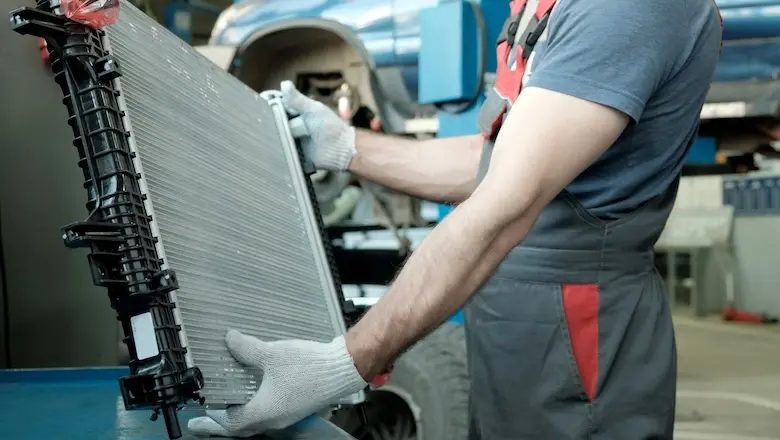
Your car’s radiator helps keep your engine cool and functioning. Overheating can damage an engine, which can eventually lead to engine failure. If you notice your radiator is failing, it’s critical to the health of your vehicle that you repair or replace it as soon as possible.
The average cost to replace a car radiator can range from $750 to $1,850, depending on car make and model. Radiator repair is often far cheaper, costing $250 to $750, on average.
Here’s a closer look at what a car radiator does, the factors that affect the cost of repairing or replacing a radiator, and how to pay for the fix.
Key Points
• Repairing a radiator is considerably less expensive, typically costing $250 to $750. If a full replacement is needed, the cost rises significantly — ranging from $750 to $1,850.
• The cost of replacement parts depends on your car’s model — common vehicles have lower parts prices, while high-performance or luxury cars are more expensive.
• The radiator circulates coolant to dissipate heat from your engine’s cooling system, preventing overheating — and potential engine failure.
• To estimate the cost, start with national averages, then use tools like KBB’s Repair Pricing tool by entering your vehicle’s year, make, and model. Finally, compare multiple quotes from reputable mechanics.
• To pay for a radiator, you can pay cash, use a credit card, take out a personal loan, or refinance your vehicle.
Car Radiator Repair and Replacement Cost Breakdown
The cost of radiator repair or replacement will depend on the cost of parts and the cost of labor.
On average, auto mechanics in the U.S. charge $75 to $130 per hour, though rates will vary depending on where you live. A mechanic in a big city will likely charge more than one on the outskirts of town to help cover the increased cost of things like real estate, utilities, and labor.
An experienced mechanic should be able to replace a radiator in two to three hours. On the high end, you could expect labor to replace a radiator to cost nearly $400. It may take much less time to have a repair done, such as replacing a radiator hose.
The rest of the cost of repair or replacement comes from the cost of parts. Replacing an entire radiator is more expensive than replacing worn out parts.
The cost of parts is determined by the make and model of your car. For example, the price of parts for work on a relatively common vehicle, like a Toyota Corolla, will likely be much less than on high-performance luxury vehicles.
The type of part that’s required by your vehicle will also have an impact on price. Single core radiators are the most common radiators used in vehicles, but double- and triple-core radiators are more expensive if your vehicle calls for them.
Recommended: Luxury Cars With the Lowest and Highest Maintenance Costs
Getting an Estimate
When getting an estimate for a replacement or a repair, start by looking up average cost in the U.S. This will serve as a baseline that you can compare with estimates you receive.
Next, consider online resources, such as Kelley Blue Book’s Repair Pricing tool, that allow you to input the year, make, and model of your car and the repair you need. It will then tell you the price range you can expect in your area.
Finally, contact a handful of local mechanics, let them know the make and model of your vehicle, and ask them for a quote. Look for reputable mechanics by seeking recommendations from friends and family, and look up local shops with the Better Business Bureau to see if there are any complaints or shops you should avoid.
Recommended: Suspension Repair and Replacement Guide
What Does a Radiator Do?
When your engine is running, the temperature inside the cylinder can reach more than 260 degrees Fahrenheit. With temperatures so high, the engine must be cooled so that it doesn’t overheat.
This is where the radiator comes in. The engine in your car has what’s known as a cooling jacket. Radiator fluid circulates through the cooling jacket and is pumped to the radiator where it is cooled down before circulating again.
Recommended: The Costs of a Replacement Engine
Why Do Radiators Fail?
Radiators fail for a variety of reasons. For example, there could be corrosion or buildup that blocks the cooling system and eventually causes the radiator to malfunction. Drivers can work to avoid this by flushing their radiator system and coolant every year.
In addition, radiator seals can become brittle over time and crack, which can cause coolant to leak. Or, faulty temperature sensors can cause the radiator itself to overheat, which can potentially cause failure.
Signs of a Bad Radiator
Look out for the following signs that your radiator is in need of repair or replacement:
• An overheating engine. This may be caused by low coolant or a blockage in the radiator system.
• Coolant leaking on the ground. This may be a sign of a cracked or punctured component of the radiator system.
• A sweet smell. A sickly sweet smell coming from the front of your car may be coming from leaking radiator fluid.
• Dashboard warning. There may be a light on your dashboard that warns of low coolant.
• Sludgy buildup. The coolant in your radiator should be bright in color. If it’s rust-colored or thick like a milkshake, it may be a sign that your radiator is failing.
Recommended: Guide to Transmission Replacements
Can I Drive With a Bad Radiator?
Your radiator is what cools your engine. If your engine overheats, other important parts of your engine, such as the cylinder, can get damaged and eventually there could be catastrophic engine failure. As a result, it’s not safe to drive your car with a failing radiator and you should have the problem taken care of immediately.
Recommended: Car Make and Model Explained
How to Cover the Costs of a Radiator Replacement
With car radiator replacement costing nearly $2,000 in some cases, it can take some strategizing to figure out how to cover costs. You may consider the following options:
Pay With Cash
Cash is the least expensive way to cover the cost of an auto repair. On average, radiators need to be replaced once every 80,000 miles. While there’s no guarantee that your radiator won’t fail before then, as the 80,000-mile marker approaches, you may want to set money aside in a savings account to cover future radiator repairs.
If you don’t have cash on hand, you may turn instead to credit.
Use a Credit Card
Credit cards can be used to finance the cost of a new radiator. However, if you carry a balance from month to month, you’ll owe interest, and interest rates can be very high — up to 20% or more. What’s more, if you continue to carry a balance, you’ll start to owe interest on your interest, which can send you deeper into debt.
As a result, it’s best to only rely on credit cards when you know you’ll be able to pay them off at the end of each billing cycle.
Take Out a Loan
If you know you won’t be able to pay your credit card bill off right away, a personal loan for car repairs may be a cheaper alternative, offering lower interest rates. Personal loans allow you to borrow a lump sum of money that can be used for most purposes, including auto repair. You agree to repay that loan in monthly installments with interest.
Refinance Your Auto Loan
You may also consider refinancing your auto loan. When you refinance your loan, you pay off your old loan with a new loan, preferably one with a lower interest rate, which can save you money over the life of the loan. You can use these savings to help fund auto repair.
A car loan refinancing calculator can help you determine how much you might save.
The Takeaway
If you think something may be wrong with your radiator, it’s best to get it handled as soon as possible. Signs of a faulty radiator include your car overheating, a sweet smell coming from the hood, leaking coolant, and the warning light on your dashboard turning on.
With the cost of radiator replacements being close to $2,000, this is not an expense to be taken lightly. If you can pay cash, that will be the best option. If not, you can consider using a credit card, taking out a personal loan, or refinancing your current car loan to a lower interest rate or opting for a cash-out refinance, where you get cash out of the loan and can use that money to pay for car repairs.
If you’re seeking auto loan refinancing, SoFi is here to support you. On SoFi’s marketplace, you can shop and compare financing options for your car in minutes.
FAQ
Can I continue driving my car with a damaged radiator?
Driving with a damaged radiator should be avoided as it can cause your car to overheat. Have it fixed as soon as possible to avoid further damage to your engine.
Are there different types of radiators for different car models?
Yes, there are different types of radiators for different car models. For example, single-core radiators are most common, but some cars will use double- or triple-core radiators.
Can a car radiator be repaired, or does it need to be replaced entirely?
In some cases, damaged parts of a car radiator, such as radiator hose, may be replaced without the need to replace the whole component.
How long does it take to replace a car radiator?
Replacing a car radiator may be completed by a skilled mechanic in two to three hours.
Photo credit: iStock/Evgenii Palitsyn
SoFi's marketplace is owned and operated by SoFi Lending Corp.
Advertising Disclosures: The preliminary options presented on this site are from lenders and providers that pay SoFi compensation for marketing their products and services. This affects whether a product or service is presented on this site. SoFi does not include all products and services in the market. All rates, terms, and conditions vary by provider. See SoFi Lending Corp. licensing information below.
Financial Tips & Strategies: The tips provided on this website are of a general nature and do not take into account your specific objectives, financial situation, and needs. You should always consider their appropriateness given your own circumstances.
Third-Party Brand Mentions: No brands, products, or companies mentioned are affiliated with SoFi, nor do they endorse or sponsor this article. Third-party trademarks referenced herein are property of their respective owners.
SOALR-Q325-096