
Tuesday,
April 26, 2022
Market recap
Dow Jones
34,049.46
+238.06 (+0.70%)
S&P 500
4,296.12
+24.34 (+0.57%)
Nasdaq
13,004.85
+165.56 (+1.29%)

Top Story
Afternoon Rally Sends Stocks Higher, But China’s Latest COVID-19 Lockdowns Worry Economists
• US stocks rose Monday as the market rallied in the afternoon, helping the Dow erase a nearly 500-point loss. Earlier it seemed investors were concerned regarding the latest COVID-19 lockdowns in China, but a series of favorable earnings reports may have boosted sentiment.
• Economists say the supply chain could be further disrupted by new lockdowns, as Beijing continues to pursue its “zero-COVID” strategy. This has also led to fears of a global slowdown. Oil prices fell, potentially on the prospect of lower demand.
• The Chicago Fed says the nation’s economic growth slowed further in March. Its National Activity Index decreased to 0.44 last month, down from 0.54 in February.
What to Be on the Lookout for Today
• March’s new home sales will be released. February’s number came in 2% lower, falling short of earlier estimates. Analysts say elevated home values and rising mortgage rates have forced a significant number of would-be buyers to continue renting. March’s durable goods orders are also due, as well as this month’s consumer confidence index.
• JetBlue (JBLU) will publish earnings, during what’s been a busy earnings season for the airline industry as a whole. While the consensus is that this summer will be positive for the sector, Deutsche Bank (DB) recently downgraded JetBlue saying the stock could lag behind its competitors.
The Cost Of Waiting To Refi Your Student Loans
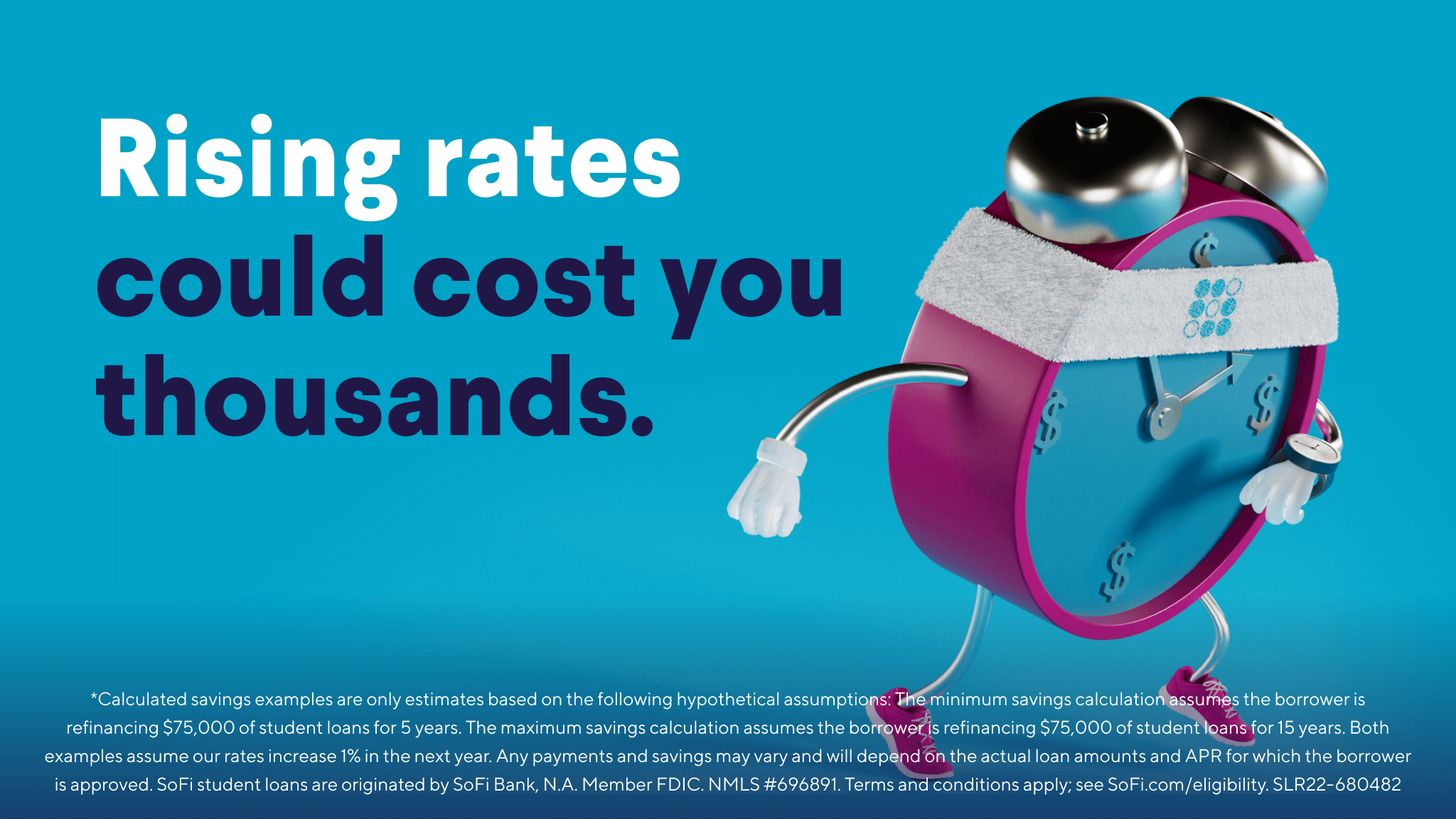
If rates rise 1% in the next year, with an average balance of $75,000, waiting to refinance could cost you $2,000-$6,000 over the life of your student loan.* That could be the beginning of an investment portfolio, the start to a down payment, your early retirement fund — or a whole bunch of crypto.
Our calculator shows how much you can save on your student loans by refinancing with SoFi. Just add in your current student loan information, and we’ll calculate your estimated savings — both monthly and over the lifetime of your loan. If you have multiple student loans, simply combine the loans and average their principal.
A Few Headlines That Should Be on Your Radar
Elon Musk has criticized Twitter’s (TWTR) advertising model, and now has a chance to do something about it, as reports say the social media giant has agreed to be acquired. Still, 90% of Twitter’s revenue comes from ad sales, so what’s next for the company other than an “edit button”? The world’s richest man has also suggested he will relax content moderation standards, allow for longer tweets, and make the platform’s algorithm open source. Musk also plans to take Twitter private. Read more >> If you’re planning on attending a concert this summer, it could cost you more — especially if you’re going for backstage passes or VIP seating. Plus, there’s a COVID-19 backlog of pent up demand, meaning both the music and money will be flowing in the coming months. Big names like Elton John, Billie Eilish, and the Eagles are hitting the road, and their ticket prices are up compared to before the pandemic. What’s more, demand is even higher year-to-date than it was in 2019. But while the priciest seats are getting even more expensive, Live Nation (LYV) says back-of-the house areas remain moderately priced. Read more >> Pickleball is all the rage. The easy-to-learn sport can provide ways for different generations to connect while getting some exercise. Grandpa and granddaughter can get competitive on the court. As the sport grows in popularity, tennis courts are being converted and clubs are investing in the construction of pickleball courts. Even former tennis pro Andre Agassi has caught pickleball fever and is a player. Read more >> With a little planning and some smart shopping hacks, you may be able to significantly cut the amount of money you spend on food but still eat well. Here are 15 simple strategies to try. Outside of housing and transportation, Americans spend more on food than any other category. According to the Bureau of Labor Statistics, the average U.S. household shells out $7,719 on food each year, including groceries and eating out. Read more >>Not-So-Breaking News
- SpaceX has landed its first deal with a major airline. The satellite company owned by Elon Musk will be providing free wi-fi on some Hawaiian Airlines (HA) Flights via its Starlink internet service. The arrangement, which is pending certification, is expected to be offered to passengers as early as 2023.
- Blackstone (BX) announced that it will buy real estate investment trust PS Business Parks (PSB) in a deal valued at $7.6 billion. Public Storage (PSA), which owns 41% common equity interest in the REIT, said it will vote in favor of the deal that is expected to close in Q3 2022. Public Storage expects the deal to bring in $2.7 billion, $2.3 billion of which the company says will be distributed to shareholders.
- General Motors (GM) plans to release an “electrified” version of its corvette sports car in 2022. Details of the specifications were not disclosed, although company president Mark Reuss noted that plans are also in the works for an all-electric version of the car.
- Coca Cola (KO) beat analyst expectations on the top and bottom lines. Earnings per share of 64 cents in the first quarter were up from 53 cents last year. Revenue for soft drinks, plant-and dairy-based beverages as well as sports, coffee and tea all posted increases. Net revenue was negatively impacted by 1%-2% following the company’s suspension of business with Russia.
- Activision Blizzard (ATVI) reported first-quarter profit and revenue that were below analyst expectations. Revenue was down 22.3%, reflecting declining proceeds from online channels, “Call of Duty: Vanguard” and its “Warcraft” franchise.
Financial Planner Tip of the Day
“Mutual funds combine a variety of different assets. Buying into a mutual fund means purchasing a small share of the combination. It can be a very economic way to invest, because it pulls a bunch of people together to buy a large collection of investments. Most mutual funds are actively managed by a professional, who decides when to buy, sell, and hold the portfolio of assets. However, they can be passively managed as well.”
Brian Walsh, CFP® at SoFi