
Table of Contents
Simply defined, disposable income is the amount of money you have available to spend or save after your income taxes have been deducted. You may also hear this sum of money called disposable earnings or disposable personal income (or DPI).
Disposable income is carefully watched by economists because it is a valuable indicator of the economy’s health. It’s also the basis of your own personal budget, since it represents the money you can use for spending, saving, or investing as you see fit.
Key Points
• Disposable income refers to the money available for spending or saving after income taxes have been deducted.
• It is an important indicator of an individual’s financial status and is used to determine how to allocate funds.
• Disposable income is different from discretionary income, which takes into account essential expenses.
• Calculating disposable income involves subtracting taxes and other mandatory deductions from gross earnings.
• Budgeting disposable income involves tracking spending, setting goals, and allocating funds for basic living expenses, discretionary spending, and saving/investing.
What Is Disposable Income?
Disposable income is money you have left over from your earnings after taxes and any other mandatory charges are deducted.
This money (which may also be referred to as expendable income) can then be spent or saved as you wish. You will likely use it for your basic living expenses, or the needs in your daily life, such as housing, utilities, food, transportation, healthcare, and minimum debt payments.
You may also spend that money on the wants in life, such as dining out, entertainment, travel, and non-vital purchases, such as a cool new watch or mountain bike.
Your disposable income can also be allocated towards your goals, such as saving for your child’s college education, the down payment on a house, and/or retirement.
💡 Quick Tip: Typically, checking accounts don’t earn interest. However, some accounts do, and online banks are more likely than brick-and-mortar banks to offer you the best rates.
Why Disposable Income Is Important
There are different types of income, and disposable income is usually defined as the amount of money you keep after federal, state, and local taxes and other mandatory deductions are subtracted from gross earnings. Consider these details:
• Mandatory deductions include Social Security, state income tax, federal income tax, and state disability insurance.
• Voluntary deductions, such as health benefit deductions, 401(k) contributions, deductions for other employer-sponsored benefits, as well as any assignments of support (such as child support) are excluded from the calculation. These costs are considered part of your disposable earnings.
• Disposable income is an important number not just for consumers, but also the nation as a whole. The average disposable income of the country is used by analysts to measure consumer spending, payment ability, probable future savings, and the overall health of a nation’s economy.
• International economists use national measures of disposable income to compare economies of different countries.
On an individual level, your disposable income is also a key economic indicator because this is the actual amount of money you have to spend or save.
For example, if your salary is $60,000, you don’t actually have $60,000 to spend over the course of the year. Federal, state, and possibly other local taxes will be deducted, as will Social Security and Medicare taxes.
What is left over is what you would have to spend on everything else in your life, such as housing, transportation, food, health insurance, other necessities, as well as nonessentials.
Recommended: Money Management Guide
Disposable Income vs. Discretionary Income
Although they’re often confused with one another, disposable income is completely different from discretionary income.
While disposable income is your income minus only taxes, discretionary income takes into account the costs of both taxes and other essential expenses. Essential expenses include rent or mortgage payments, utilities, groceries, insurance, clothing, and other “musts.”
Discretionary income is what you can have leftover after the essentials are subtracted. This is what you can spend on nonessential, or discretionary, items.
Some costs that fall under the discretionary category are dining out, vacations, recreation, and luxury items like jewelry. Although internet service and your cell phone may seem like necessities, these expenses are considered discretionary expenses.
Similarities
Both disposable and discretionary income are a way of looking at income after taxes.
However, discretionary income goes a step further and deducts essential expenses, such as housing and healthcare.
Differences
As you might expect, discretionary income is always less than disposable income. When you subtract your basic living expenses from disposable income, the amount that remains is your discretionary income — what you have left to spend on wants or save for the future.
Increase your savings
with a limited-time APY boost.*
Calculating Disposable Income
Disposable income refers to the amount of earnings left over after mandatory federal, state, and local deductions. But disposable income is not necessarily the same as your take-home pay.
Deductions from your paycheck may include additional items such as health insurance, retirement plan contributions, and health savings accounts. These deductions are voluntary, not mandatory.
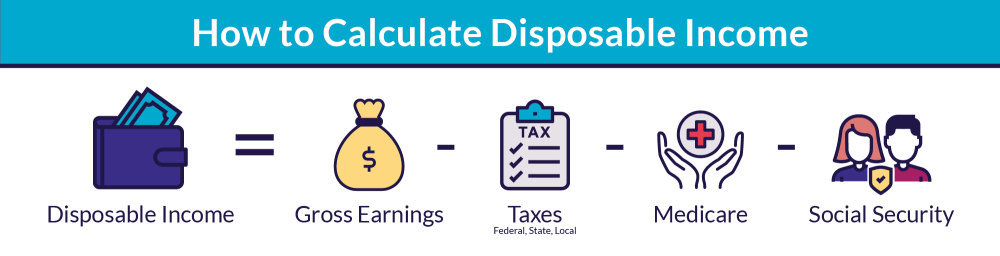
To calculate your disposable earnings, you can simply subtract federal, state and local taxes; Medicare; and Social Security from your gross earnings. Be sure to include any passive income streams, such as rental income, or side hustle earnings (more on that in a moment), when doing the math for your gross income. The resulting amount is your disposable income.
Some of the finer points to note:
• Keep in mind that taxes deducted from your paycheck are an estimate. If you have a history of getting a large refund or having a large amount of taxes due, it may be worth reviewing your withholdings through your employer.
This could help you adjust the withholdings so it is closer to the actual expected tax that will be calculated when you file. You can then plan accordingly.
• Even if you’re a contractor or freelancer, or if you made additional income from side gigs along with your salary, you can still calculate your disposable income.
This requires subtracting your quarterly tax payments and any additional taxes you will owe from your overall income. You can then determine your monthly after-tax income.
Setting aside money to pay taxes can also help you budget with your disposable income.
💡 Quick Tip: Most savings accounts only earn a fraction of a percentage in interest. Not at SoFi. Our high-yield savings account can help you make meaningful progress towards your financial goals.
Disposable Income Budgeting
Calculating your disposable income is a key first step in preparing a budget. You need to know how much you have to spend in order to plan your monthly spending and saving.
A personal budget puts you in control of your disposable income and helps you make financial decisions. It forces you to take a closer look at how you’re spending your money.
Here are a few ideas that could be helpful when developing a budget based on disposable income.
Tracking Spending
Disposable income is what’s coming into your account every month. It’s a good idea to also determine what is going out each month.
To do this, you can gather up bank and credit card statements, as well as receipts, from the past three months or so, and then list all of your monthly spending (both essential and discretionary/nonessential).
To make this list more accurate, you may want to actually track your spending for a month. You can do this with a phone app (your bank’s app may include this function), by carrying a small notebook and jotting down everything you buy, or by saving all of your receipts and logging it later.
This can be an eye-opening exercise. Many of us have no idea how much we’re spending on the little things, like morning coffees, and how much they can add up to at the end of the month.
Once you see your spending laid out in black and white, you may find some easy ways to cut back, such as getting rid of subscriptions and streaming services that you rarely use, brewing coffee at home, cooking more and getting less take-out, or getting rid of a pricey gym membership and working out at home.
Setting Goals And Spending Targets
Tracking income and spending can provide a great starting point for setting financial goals and spending targets.
• Goals are things that a person aims for in the short- or long-term — like paying off student loans or buying a new car.
• Spending targets are how much you want to spend each month in general categories in order to have money left over to put towards your savings goals.
Since essential spending often can’t be adjusted, spending targets are typically for discretionary income.
One option for budgeting disposable income is the 50/30/20 plan. This suggests spending about 50% on necessities, 30% on discretionary items, and then putting aside 20% for savings and other long-term goals.
Use the 50/30/20 budget calculator below to see how your budget would fall into those three categories.
These percentages are general guidelines, however, and can be adjusted as needed based on individual circumstances. For example, if you live in a competitive housing area, rent may take up a large portion of your expenses, and you may have to bump up necessity spending to 60% and decrease fun money to 20% instead.
Or, if you are saving for something in the near term, like a car or a wedding, you may want to temporarily bump up the savings category, and pull back unnecessary spending for a few months.
3 Uses for Your Disposable Income
Once you have calculated your disposable income, you can consider the ways you might divide it up:
Basic Living Expenses
Some of your disposable income will go towards necessities, such as:
• Housing
• Utilities
• Food
• Healthcare
• Transportation
• Insurance
• Minimum debt payments
Discretionary Spending
Next, there are the wants in life. These are things that are not vital for survival but can certainly make things more enjoyable:
• Eating out
• Entertainment, such as streaming platforms, movies, concerts, and books
• Clothing that isn’t essential
• Electronics, like the latest mobile phone
• Travel
• Gifts
Saving and Investing
In addition to the spending outlined above, you will likely want to save money or invest it for your short-term and/or long-term goals. These may include:
• Your emergency fund
• The down payment for a house
• A college fund for children
• Money to start your own business
• A new car
• Retirement
Recommended: Emergency Fund Calculator
Meet the new SoFi Plus!
Get access to higher APY, credit card cash back rewards, discounts, and more.

Test your understanding of what you just read.
The Takeaway
Disposable income is a key concept in budgeting, as it refers to the income that’s left over after you pay taxes. Knowing how much disposable income you have is the foundation for putting together a simple budget that allows for necessary expenses, having fun, while also saving for the future. Finding the right banking partner is another important element of planning for tomorrow.
Interested in opening an online bank account? When you sign up for a SoFi Checking and Savings account with eligible direct deposit, you’ll get a competitive annual percentage yield (APY), pay zero account fees, and enjoy an array of rewards, such as access to the Allpoint Network of 55,000+ fee-free ATMs globally. Qualifying accounts can even access their paycheck up to two days early.
FAQ
What does disposable income mean?
Disposable income (also known as disposable earnings) is the money you have left after taxes and other mandatory deductions are taken out of your income. Essentially, it’s the money you have at your disposal to spend, save, or invest.
What is an example of disposable income?
Disposable income is the amount of money you have left after taxes and other mandatory deductions are taken out. As an example, let’s say Sarah earns $4,000 a month in gross income. After $1,000 is deducted in federal, state, and payroll taxes (including Social Security and Medicare), Sarah is left with $3,000.
This $3,000 is Sarah’s disposable income — the amount she has available to spend on essential and discretionary expenses, as well as put towards savings.
What is the difference between disposable income and discretionary income?
Disposable income refers to earnings minus taxes and mandatory deductions, such as Social Security and Medicare. Discretionary income is a subset of disposable income. It is the money left once you have paid for essentials, such as housing, utilities, food, and healthcare. The money that is left can be used for nonessential spending and for saving.
SoFi Checking and Savings is offered through SoFi Bank, N.A. Member FDIC. The SoFi® Bank Debit Mastercard® is issued by SoFi Bank, N.A., pursuant to license by Mastercard International Incorporated and can be used everywhere Mastercard is accepted. Mastercard is a registered trademark, and the circles design is a trademark of Mastercard International Incorporated.
Annual percentage yield (APY) is variable and subject to change at any time. Rates are current as of 12/23/25. There is no minimum balance requirement. Fees may reduce earnings. Additional rates and information can be found at https://www.sofi.com/legal/banking-rate-sheet
Eligible Direct Deposit means a recurring deposit of regular income to an account holder’s SoFi Checking or Savings account, including payroll, pension, or government benefit payments (e.g., Social Security), made by the account holder’s employer, payroll or benefits provider or government agency (“Eligible Direct Deposit”) via the Automated Clearing House (“ACH”) Network every 31 calendar days.
Although we do our best to recognize all Eligible Direct Deposits, a small number of employers, payroll providers, benefits providers, or government agencies do not designate payments as direct deposit. To ensure you're earning the APY for account holders with Eligible Direct Deposit, we encourage you to check your APY Details page the day after your Eligible Direct Deposit posts to your SoFi account. If your APY is not showing as the APY for account holders with Eligible Direct Deposit, contact us at 855-456-7634 with the details of your Eligible Direct Deposit. As long as SoFi Bank can validate those details, you will start earning the APY for account holders with Eligible Direct Deposit from the date you contact SoFi for the next 31 calendar days. You will also be eligible for the APY for account holders with Eligible Direct Deposit on future Eligible Direct Deposits, as long as SoFi Bank can validate them.
Deposits that are not from an employer, payroll, or benefits provider or government agency, including but not limited to check deposits, peer-to-peer transfers (e.g., transfers from PayPal, Venmo, Wise, etc.), merchant transactions (e.g., transactions from PayPal, Stripe, Square, etc.), and bank ACH funds transfers and wire transfers from external accounts, or are non-recurring in nature (e.g., IRS tax refunds), do not constitute Eligible Direct Deposit activity. There is no minimum Eligible Direct Deposit amount required to qualify for the stated interest rate. SoFi Bank shall, in its sole discretion, assess each account holder's Eligible Direct Deposit activity to determine the applicability of rates and may request additional documentation for verification of eligibility.
See additional details at https://www.sofi.com/legal/banking-rate-sheet.
*Awards or rankings from NerdWallet are not indicative of future success or results. This award and its ratings are independently determined and awarded by their respective publications.
Financial Tips & Strategies: The tips provided on this website are of a general nature and do not take into account your specific objectives, financial situation, and needs. You should always consider their appropriateness given your own circumstances.
We do not charge any account, service or maintenance fees for SoFi Checking and Savings. We do charge a transaction fee to process each outgoing wire transfer. SoFi does not charge a fee for incoming wire transfers, however the sending bank may charge a fee. Our fee policy is subject to change at any time. See the SoFi Bank Fee Sheet for details at sofi.com/legal/banking-fees/.
Tax Information: This article provides general background information only and is not intended to serve as legal or tax advice or as a substitute for legal counsel. You should consult your own attorney and/or tax advisor if you have a question requiring legal or tax advice.
Third Party Trademarks: Certified Financial Planner Board of Standards Center for Financial Planning, Inc. owns and licenses the certification marks CFP®, CERTIFIED FINANCIAL PLANNER®
SOBNK-Q325-060