stop watch

7 Signs It’s Time for a Mortgage Refinance

Maybe you’ve considered refinancing your mortgage, but haven’t quite decided. Is now the right time? Will rates go lower?

It can be hard to know when to take the plunge.

Whether you purchased a home recently or bought a home years ago, you probably know the average mortgage rates now are high compared to the near-historic lows in early 2021.

But as with any financial rate or data point, it is hard – if not impossible – to time the market or predict the future.

Homeowners often look to refinance when it could benefit them in some way, like with a lower monthly payment. Refinancing is the process of paying off a mortgage with new financing, ideally at a lower rate or with some other, more favorable, set of terms.

Here are seven signs that locking in a new mortgage could be the right move.

Key Points

•   It can make sense to refinance if you can break even quickly, meaning you can reach the point where your savings exceed your costs.

•   If you can reduce your rate by at least 0.50%, that can be a strong indicator to refinance.

•   Switching to a 15-year mortgage can lead to higher monthly payments but lower total interest.

•   You might consider a refinance to secure a fixed-rate mortgage, which protects you against potential interest rate increases.

•   Refinancing from a fixed-rate mortgage to an ARM for lower initial rates could make sense if you’re planning to move before the initial period ends.

7 Signs It May Be Smart to Refinance Your Mortgage

You Can Break Even in Two Years or Less

Refinancing a mortgage costs money — generally 2% to 5% of the principal amount. So if you are refinancing to save money, you’ll likely want to run numbers to be sure the math checks out.

To calculate the break-even point on a mortgage refinance — when savings exceed costs — do this:

1.    Determine your monthly savings by subtracting your projected new monthly mortgage payment from your current monthly payment.

2.   Find your tax rate (e.g., 22%) and subtract it from 1 to get the after-tax percentage of the savings.

3.   Multiply monthly savings by the after-tax percentage. This is your after-tax savings.

4.   Take the total fees and closing costs of the new mortgage loan and divide that number by your monthly after-tax savings. This yields the number of months it will take to recover the costs of refinancing — or the break-even point.

For example, if you’re refinancing a $300,000, 30-year mortgage that has a fixed 7.50% rate to a 6.50% rate, refinancing will reduce your original monthly payment from $2,098 to $1,896 – a monthly savings of $202. Assuming a tax rate of 22%, the after-tax percentage would be 0.78, which results in an after-tax savings of $157.56. If you have $12,000 in refinancing costs, it will take about 76 months to recoup the costs of refinancing ($12,000 / $157.56 = 76.2).

The length of time you intend to own the home can affect whether refinancing is worth the expense. You’ll want to run the calculations to make sure that you can break even on a timeline that works for you. But two years is a general rule of thumb.

The rate and fees usually work in tandem. The lower the rate, the higher the cost. (“Buying down the rate” means paying an extra fee in the form of discount points. One point costs 1% of the mortgage amount and lowers your interest rate by 0.25%.)

If you’re shopping, each mortgage lender you apply with is required to give you a loan estimate within three days of your application, so you can compare terms and annual percentage rates. The APR, which includes the interest rate, points, and lender fees, reflects the true cost of borrowing.

2. You Can Reduce the Rate by at Least 0.50%

You may have heard conflicting ideas about when you should consider refinancing. The reason is that there is no one-size-fits-all answer; individual loan scenarios and goals differ.

One commonly cited rule of thumb is that the home refinance rate should be a minimum of two percentage points lower than an existing mortgage’s rate. What may work for each individual depends on things like loan amount, interest rate, fees, and more.

However, the combination of larger mortgages and lenders offering lower closing cost options has changed that. For a large mortgage, even a change of 0.50% could result in significant savings, especially if the homeowner can avoid or minimize lender fees.

If rates drop low enough, you might even choose to take a higher rate with a no closing cost refi.

Recommended: Guide to Buying, Selling, and Updating Your Home

3. You Can Afford to Refinance to a 15-Year Mortgage

When you refinance a loan, you are getting an entirely new loan with new terms. Depending on your eligibility, it is possible to adjust aspects of your loan beyond the interest rate, such as the loan’s term or the type of loan (fixed vs. adjustable).

If you’re looking to save major money over the duration of your mortgage loan, you may want to consider a shorter term, such as 15 years. Shortening the term of your mortgage from 30 years to 15 years will likely cost you more monthly, but it could save thousands in interest over the life of the loan.

For example, a 30-year $1 million loan at a 7.50% interest rate would carry a monthly payment of approximately $6,992 and a total cost of around $1,517,172 in interest over the life of the loan.

Refinancing to a 15-year mortgage with a 5.50% rate would result in a higher monthly payment, about $8,171, but the shorter maturity would result in total loan interest of around $470,750 -– an interest savings over the life of the loan of about $1,046,422 vs. the 30-year term.

One more perk: Lenders often charge a lower interest rate for a 15-year mortgage than for a 30-year home loan.

4. You’re Interested in Securing a Fixed Rate

Borrowers may take out an adjustable-rate mortgage because they may get a lower rate (at least initially) than on a fixed-rate mortgage for the same property. But just as the name states, the rate will adjust with market fluctuations.

Typically, ARMs for second mortgages such as home equity lines of credit are “pegged” to the prime rate, which generally moves in lockstep with the federal funds rate. First mortgage ARM rates are tied more closely to mortgage-backed securities or the 10-year Treasury note.

Even though ARM loans come with yearly and lifetime interest rate caps, if you believe that interest rates will move higher in the future and you plan to keep your loan for a while, you may want to consider a more stable fixed rate.

Refinancing to a fixed mortgage can protect your loan against rate increases in the future and provide the security of knowing how much you’ll be paying on your mortgage each month, no matter what the markets do.

5. You’re Considering an ARM

You may also be considering a move in the other direction—switching from a fixed-rate mortgage to an adjustable-rate mortgage. This could potentially make sense for someone with a 30-year fixed loan but who plans to leave their home much sooner.

For example, you could get a 7/1 ARM with a potential lower interest rate for the first seven years, after which the rate may change once a year, when up for review, as the market changes. If you plan to move on before higher rate changes, you could potentially save money.

It’s best to know exactly when the rate and payment will adjust, and how high. And it’s important to understand the loan’s margin, index, yearly and lifetime rate caps, and payments. For further details, try using an online mortgage calculator

6. You’re Considering a Strategic Cash-Out Refi

In addition to updating the rate and terms of a mortgage loan, it may be possible to do a cash-out refinance, when you take out a new loan at a higher loan amount by tapping into available equity.

The lender will provide you with cash and in exchange will increase your loan amount, which will likely result in a higher monthly payment.

If you go this route, realize that you’re taking on more debt and using the equity you have built up in your home. Market value changes may result in a loss of home value and equity. Also, a mortgage loan is secured by your home, which means that the lender can seize the property if you are unable to make mortgage payments.

A cash-out refi may make sense if you use it as a tool to pay less interest on your overall debt load. Using the cash from the refinance to pay off debts carrying higher rates, like credit cards, could be a good move.

Depending on loan terms and other factors, a lower rate may allow for overall faster repayment of your other debts.

Recommended: How Does Cash-Out Refinancing Work?

7. Your Financial Situation Has Improved

When putting together an offer for a mortgage, a lender will often take multiple factors into consideration. One of those is prevailing interest rates. Another is your financial situation, including things like your credit history, credit score, income, and debt-to-income ratio.

The better your personal financial situation in the eyes of the lender, the more creditworthy you are – and the better the terms of your loan offer could be.

Therefore, it may be possible to refinance your mortgage loan into better terms if your financial situation has improved since you took out the original loan, especially when paired with relatively low market rates.

The Takeaway

Is it time to refinance? It might be if you could get a lower interest rate or better loan term. For instance, locking in a lower rate now may help you achieve your long-term goals by freeing up cash for other stuff, like retirement or a big vacation.

SoFi can help you save money when you refinance your mortgage. Plus, we make sure the process is as stress-free and transparent as possible. SoFi offers competitive fixed rates on a traditional mortgage refinance or cash-out refinance.


A new mortgage refinance could be a game changer for your finances.

FAQ

How do you know if it’s the right time to refinance?

To see if now is a good time for you to refinance, you can calculate your break-even point – when your savings exceed your costs. You can do this by dividing the total closing cost amount by the net monthly savings you’d get from the refinance. This will give you the number of months it will take to pay off the closing costs and let you know where the break-even point is.

What is the timeline for refinancing?

Refinancing typically takes between 30 and 45 days, though it can vary. Being prepared with relevant documents and responsive to requests can expedite the process.

How long after signing a mortgage can you refinance?

The length of time required after you sign a mortgage to when you can refinance can vary based on the type of loan. For conventional loans backed by Fannie Mae or Freddie Mac, you may be able to refinance immediately. However, there may be a “seasoning period” of six months required by your lender before you can refinance with that lender. FHA loans have a waiting period of 210 days to 12 months; VA loans require 210 days or six on-time payments, whichever comes later; and USDA loans can be refinanced after 12 months of on-time payments. Jumbo loan terms are set by the lender.


SoFi Loan Products
SoFi loans are originated by SoFi Bank, N.A., NMLS #696891 (Member FDIC). For additional product-specific legal and licensing information, see SoFi.com/legal. Equal Housing Lender.


SoFi Mortgages
Terms, conditions, and state restrictions apply. Not all products are available in all states. See SoFi.com/eligibility-criteria for more information.


*SoFi requires Private Mortgage Insurance (PMI) for conforming home loans with a loan-to-value (LTV) ratio greater than 80%. As little as 3% down payments are for qualifying first-time homebuyers only. 5% minimum applies to other borrowers. Other loan types may require different fees or insurance (e.g., VA funding fee, FHA Mortgage Insurance Premiums, etc.). Loan requirements may vary depending on your down payment amount, and minimum down payment varies by loan type.

¹FHA loans are subject to unique terms and conditions established by FHA and SoFi. Ask your SoFi loan officer for details about eligibility, documentation, and other requirements. FHA loans require an Upfront Mortgage Insurance Premium (UFMIP), which may be financed or paid at closing, in addition to monthly Mortgage Insurance Premiums (MIP). Maximum loan amounts vary by county. The minimum FHA mortgage down payment is 3.5% for those who qualify financially for a primary purchase. SoFi is not affiliated with any government agency.
Veterans, Service members, and members of the National Guard or Reserve may be eligible for a loan guaranteed by the U.S. Department of Veterans Affairs. VA loans are subject to unique terms and conditions established by VA and SoFi. Ask your SoFi loan officer for details about eligibility, documentation, and other requirements. VA loans typically require a one-time funding fee except as may be exempted by VA guidelines. The fee may be financed or paid at closing. The amount of the fee depends on the type of loan, the total amount of the loan, and, depending on loan type, prior use of VA eligibility and down payment amount. The VA funding fee is typically non-refundable. SoFi is not affiliated with any government agency.
Financial Tips & Strategies: The tips provided on this website are of a general nature and do not take into account your specific objectives, financial situation, and needs. You should always consider their appropriateness given your own circumstances.

SOHL-Q225-209

Read more
mother and child on stairs

7 Ways to Build Equity in Your Home

Homeownership comes with plenty of perks, But one important financial benefit is the opportunity to build home equity, which is how much of a property you actually own. Home equity is considered a common way to generate wealth over time.

Read on to learn how homeowners can help build equity and increase the value of their home.

Key Points

•   Home equity is the amount of your home that you own, and it’s considered a way to build wealth over time.

•   Ways to build home equity include making a large down payment, adding additional principal payments, and shortening your mortgage term, among others.

•   Another way to build home equity is to apply a money windfall, such as a work bonus or tax refund, to your home loan’s principal.

•   Home equity loans and home equity lines of credit can tap your home equity and make cash available for use.

•   Home equity loans and lines of credit use your home as collateral, while a personal loan involves no collateral.

What Is Home Equity?

In order to understand how building home equity works, it’s important to understand exactly what it is.

Equity is the amount of your home you actually own. More specifically, it’s the difference between how much you owe your lender and how much your home is worth.

To calculate home equity, simply subtract the amount of the outstanding mortgage loan from the price paid for the home. So if a home is worth $350,000, and the homeowner owes $250,000 on their mortgage, they have $100,000 of equity built up in their house. Their mortgage lender still has an interest in the home to the tune of $250,000 and will continue to have an interest in the home until the mortgage is paid off.

7 Smart Ways to Build Your Home Equity

Here, learn some techniques for growing home equity.

1. Making a Big Down Payment

Homeowners can get a jump on building home equity when they’re buying a home by making a large down payment.

Typically, homebuyers using a conventional loan will put down at least 20% as a down payment to avoid having to pay mortgage insurance. That means that right off the bat, the homeowner has a 20% interest in their home. They can increase this amount by putting even more down. A down payment of 30%, for instance, will increase equity and potentially give the homebuyer more favorable mortgage payments and terms. (It can also help you avoid paying mortgage insurance.)

If making a large down payment means having less in emergency savings, however, the home buyer may want to use other methods to build equity.

2. Prioritizing Mortgage Payments

Each mortgage payment a homeowner makes increases the amount of equity they have in their home. Making mortgage payments on time will avoid potential late fees.

Keep in mind that a portion of each mortgage payment goes toward interest and sometimes escrow. You’ll want to take these amounts into account when calculating how much equity is accruing.

3. Making Extra Payments

Extra payments chip away at a loan’s principal, help build equity faster, and potentially save thousands of dollars in interest payments. Even if it’s only a little bit each month, paying more than your regular mortgage payment amount can help you increase how much home equity you build.

If adding some extra cash each month isn’t feasible, perhaps making one-time payments whenever possible — when you get a bonus at work, for instance — would be an option. Using a money windfall this way can help you build equity more quickly.

To ensure those payments are applied correctly, be sure to notify the lender that any extra or lump-sum payments should be put toward the loan’s principal.

Beware that some lenders may charge a prepayment penalty to borrowers who make significantly large payments or completely pay off their mortgage before the end of the term. Before making extra payments, consider asking the lender about a prepayment clause.

4. Refinancing to a Shorter Term

You may also consider refinancing with a loan that offers a shorter term. For example, a homeowner could refinance their 30-year mortgage to a 20-year mortgage, shaving off up to a decade of mortgage payments. However, doing so means they will also be increasing the amount they pay each month.

Still, shorter-terms loans may have the added benefit of lower interest rates, which could soften the blow of higher monthly payments.

Mortgage refinancing is not necessarily a simple process, nor is it guaranteed that a lender will offer a new loan. Homeowners can increase their chances of securing a refinanced mortgage by maintaining healthy credit and a low debt-to-income ratio. It may also help to have equity built up in the home already.

5. Renovating Your Home

Making home improvements typically increases the value of a home, which will likely increase equity. Renovating a home’s interior can be a good place to start.

Minor renovations like updating light fixtures and repainting can add some value to a home. Larger projects such as updating the kitchen, adding bathrooms or finishing the basement may yield good returns on the investment.

Weighing present cost against potential future gain may be a good thing to do before tackling a big project. The idea is that making these improvements now, and then being able to sell at a premium will mean recouping your expenses and then some. An online home improvement project calculator can help you estimate the cost of projects and how much value they could potentially add.

6. Sprucing Up the Outside

Similarly, adding to a home’s curb appeal may also increase its value. A fresh coat of paint, a well-maintained lawn, and tasteful landscaping could help increase a home’s desirability and the amount that buyers are willing to pay.

Mature trees, for example, can potentially add thousands of dollars to a home’s resale value. If you’re thinking of selling in a decade or more, planting a tree now could have a big effect on sale price later.

Increasing usable outdoor space by adding a deck or patio and installing good outdoor lighting may increase the value of your home.

7. Waiting for Home Values to Rise

The real estate market is always evolving, and sometimes, playing the waiting game could help you build equity. For instance, if your neighborhood becomes more popular, home prices could start to rise. If that happens, it may be worth keeping a home there longer to take advantage of the trend. Of course, the flip side is that housing prices may drop over time, which could mean a loss in equity.

Why Build Home Equity?

Building home equity is important because it gives the homeowner the opportunity to convert that equity into cash when the need arises. This is commonly done when a home is sold. But the equity in a home can also be important when taking out a home equity loan, which could allow the homeowner to use the value of their home while still living there.

For a home equity loan, a lender provides a lump-sum payment to the borrower. The amount must be repaid over a fixed time period with a set interest rate. As with a personal loan, home equity loans can be used for a variety of purposes. The loan is backed by the value of the home and typically must be repaid in full if the home is sold.

A home equity line of credit, or HELOC, is a revolving line of credit that uses the value of the home as collateral. Unlike lump-sum loans, a HELOC allows the homeowner to borrow money as needed up to an approved credit limit. That amount is paid back and can be drawn on again throughout the course of the loan’s draw period. While a person’s home is likely to be their most valuable asset, it’s also valuable purely because of its provision of shelter.

Researching and understanding all of the risks involved with loans that use a home as collateral, including that it could be lost if the loan is not paid back, is important before considering this option.

Of course, there may be times in your life when you want to access cash but you prefer not to tap into your home equity loan. For those times, a personal loan may be a good option, allowing you to access a lump sum of cash (typically, from a couple of thousand dollars to $50,000 or $100,000) to use for almost any purpose, such as a home renovation, a big medical bill, or a vacation.

In this case, you would repay the principal and interest over a term that’s usually two to seven years. Interest rates for an unsecured personal loan tend to be somewhat higher than those for secured loans in which collateral is involved.

The Takeaway

There are many ways to build equity in a home. Different strategies include making a large down payment or extra monthly mortgage payments, refinancing to a shorter term, renovating your home, or waiting for home values in your area to rise. Whatever your strategy, home equity can provide you with a valuable resource that can be used when a financial need arises. Often this resource is tapped into by means of a loan that is secured by the home. However, this means if the loan is not repaid, a homeowner could lose their home. If you want to avoid using a home as collateral for a loan, consider a personal loan.

Think twice before turning to high-interest credit cards. Consider a SoFi personal loan instead. SoFi offers competitive fixed rates and same-day funding. See your rate in minutes.


SoFi’s Personal Loan was named a NerdWallet 2026 winner for Best Personal Loan for Large Loan Amounts.

FAQ

What is the fastest way to build home equity?

Among the faster ways to build home equity are to make a larger down payment and to apply money windfalls to the principal of your home loan.

What is the three-day rule for home equity?

The 3-day rule for home equity says that you can cancel a home equity loan or a HELOC within three days without any penalties, provided you are using your main residence as collateral.

What credit score do you need for a home equity loan?

Many lenders want to see a credit score of at least 620 to approve a home equity loan. Usually, the higher your score, the more favorable your rate and loan terms will be.


SoFi Loan Products
SoFi loans are originated by SoFi Bank, N.A., NMLS #696891 (Member FDIC). For additional product-specific legal and licensing information, see SoFi.com/legal. Equal Housing Lender.


*Awards or rankings from NerdWallet are not indicative of future success or results. This award and its ratings are independently determined and awarded by their respective publications.

Disclaimer: Many factors affect your credit scores and the interest rates you may receive. SoFi is not a Credit Repair Organization as defined under federal or state law, including the Credit Repair Organizations Act. SoFi does not provide “credit repair” services or advice or assistance regarding “rebuilding” or “improving” your credit record, credit history, or credit rating. For details, see the FTC’s website .

²SoFi Bank, N.A. NMLS #696891 (Member FDIC), offers loans directly or we may assist you in obtaining a loan from SpringEQ, a state licensed lender, NMLS #1464945.
All loan terms, fees, and rates may vary based upon your individual financial and personal circumstances and state.
You should consider and discuss with your loan officer whether a Cash Out Refinance, Home Equity Loan or a Home Equity Line of Credit is appropriate. Please note that the SoFi member discount does not apply to Home Equity Loans or Lines of Credit not originated by SoFi Bank. Terms and conditions will apply. Before you apply, please note that not all products are offered in all states, and all loans are subject to eligibility restrictions and limitations, including requirements related to loan applicant’s credit, income, property, and a minimum loan amount. Lowest rates are reserved for the most creditworthy borrowers. Products, rates, benefits, terms, and conditions are subject to change without notice. Learn more at SoFi.com/eligibility-criteria. Information current as of 06/27/24.
In the event SoFi serves as broker to Spring EQ for your loan, SoFi will be paid a fee.


Financial Tips & Strategies: The tips provided on this website are of a general nature and do not take into account your specific objectives, financial situation, and needs. You should always consider their appropriateness given your own circumstances.

Third Party Trademarks: Certified Financial Planner Board of Standards Center for Financial Planning, Inc. owns and licenses the certification marks CFP®, CERTIFIED FINANCIAL PLANNER®

SOPL-Q225-048

Read more
What Is an ACH Routing Number? And Where Can I Find It?

Guide to ACH Routing Numbers

An ACH routing number is a nine-digit code that identifies a financial institution during an electronic financial transaction. It ensures that money transferred using the ACH (Automated Clearing House) network is taken from and sent to the right place. ACH transfers are usually faster than paper checks and are used for various transactions like autopay and direct deposits.

Since ACH routing numbers play a vital role in everyday banking, let’s take a closer look.

Key Points

•   An ACH routing number is a nine-digit code essential for identifying financial institutions during electronic transactions, facilitating faster money transfers compared to traditional checks.

•   This number is crucial for various financial activities, including setting up direct deposits, authorizing online payments, and managing automatic bill payments.

•   To locate an ACH routing number, individuals can check their checks, access their online banking account, search the bank’s website, or contact customer service.

•   ACH routing numbers differ from ABA routing numbers, which are used for paper checks and wire transfers, although many banks now use the same number for both.

•   Understanding and knowing the ACH routing number is vital for conducting secure and efficient electronic transactions in today’s banking environment.

🛈 If you’re looking for the SoFi routing number, you can find it here: SoFi routing number.

What Is an ACH Routing Number?

An ACH routing number is essentially a digital address for your bank. It’s used specifically for transfers made using the Automated Clearing House (ACH) network, a system that facilitates electronic payments and direct deposits between financial institutions in the U.S.

Smaller banks and credit unions may have only one ACH routing number, while big banks may use several different ACH routing numbers based on region.

You’ll need your bank’s ACH routing number for a number of financial transactions. This includes setting up direct deposit at work, getting a tax refund directly deposited into your bank account, authorizing a one-time online payment, setting up autopay, and using a P2P payment app.

To set up an ACH transaction, you also need to provide your account number, which (unlike an ACH number) is unique to you. Your account number identifies the specific account, such as a traditional or online checking account, within the bank you want to use for the ACH credit or debit.

Increase your savings
with a limited-time APY boost.*


*Earn up to 4.00% Annual Percentage Yield (APY) on SoFi Savings with a 0.70% APY Boost (added to the 3.30% APY as of 12/23/25) for up to 6 months. Open a new SoFi Checking and Savings account and pay the $10 SoFi Plus subscription every 30 days OR receive eligible direct deposits OR qualifying deposits of $5,000 every 31 days by 3/30/26. Rates variable, subject to change. Terms apply here. SoFi Bank, N.A. Member FDIC.

How Do I Find My ACH Routing Number?

Let’s say you want to sign up to pay your homeowner’s insurance automatically every month or you need to enroll in a P2P app to send someone money. To find your bank’s ACH routing number, you have a few options.

Using Your Checkbook

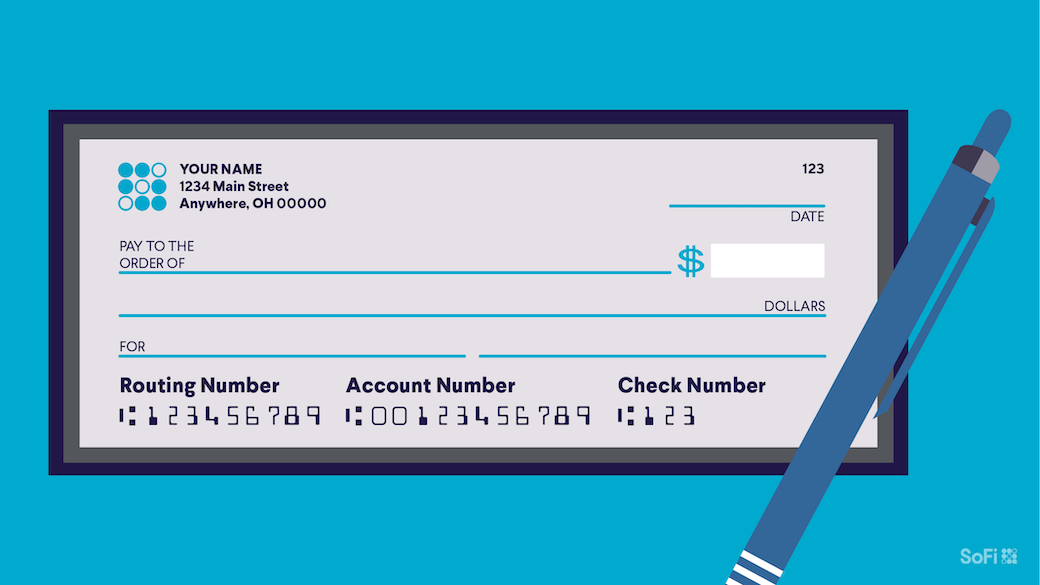
If you have paper checks, you can find your routing number by looking at the string of numbers printed along the bottom of a check. Your bank’s routing number is the first set of nine digits on the bottom left. It is usually followed by your account number and then the check number.

blank check with ach routing number

Using Your Online or Mobile Bank Account

Another way to get your ACH routing number is to go to your bank’s website and sign into your account. Methods vary by bank but, typically, here’s how you do it: Click on the last four digits of your account number (which appears above your account information) and choose “see full account number” next to your account name. A box will then open to display your bank account number and routing number.

You can also find your ACH routing number by signing into your bank’s mobile app. Typically, you just need to choose your account title and then tap “show details,” and your bank account and routing number will appear.

Using the Internet

If you don’t have access to online banking, you can also find your ACH routing number by going to your bank’s official website. You can then use the search function to look for “ACH routing number” or check the “Help” or “FAQ” sections.

Another option is to do a simple internet search. Put “ACH number” and the name of your bank into a search engine and you should be able to find it. Keep in mind that some large banks may have multiple regional ACH numbers. You want to make sure you are getting the one associated with your location.

Contacting Customer Service

If you can’t get online, you can always contact your bank’s customer service department by phone. They can provide you with the correct ACH routing number.

What Are ACH Routing Numbers Used For?

ACH routing numbers serve several essential functions in the banking system. Here are some of the main uses for ACH routing numbers:

•   Direct deposit Employers use ACH routing numbers to deposit salaries directly into employees’ bank accounts. This method is fast, secure, and convenient for both employers and employees.

•   Bill payments Many people use ACH routing numbers to pay bills electronically. This includes payments for utilities, mortgages, and other recurring expenses.

•   Tax refunds The IRS and state tax agencies use ACH routing numbers to deposit tax refunds directly into taxpayers’ bank accounts.

•   Transfers between accounts ACH routing numbers are used to transfer money between different bank accounts, whether within the same bank or between different banks. This is common for personal transactions, such as moving funds from a checking account to a savings account.

ACH vs ABA Routing Numbers: The Differences

An ABA (American Bankers Association) routing number is similar to an ACH routing number in that it identifies your bank. However, these numbers are used in different contexts.

ACH routing numbers are specifically used for electronic transactions processed through the Automated Clearing House network. This includes direct deposits, bill payments, and other electronic funds transfers. ABA routing numbers (also known as check routing numbers) are used for processing paper checks and for wire transfers. ABA and ACH simply refer to the method in which the money is moved.

These days, the same nine-digit number can serve as both an ACH routing number and an ABA routing number, which means that the ABA and ACH routing number for your bank is likely the same. If that’s the case, your bank will simply refer to its ABA/ACH routing number simply as its “routing number.”

Some banks, however, may provide separate ACH numbers (for electronic transfers) and ABA numbers (for checks and wire transfers).

ACH vs ABA Routing Numbers: History

ABA numbers were created in 1910 by the American Bankers Association (ABA) to help facilitate the sorting, bundling, and shipping of paper checks. They are still used for the processing of paper checks (and also for wire transfers).

More than a half century later, in the late 1960s, a group of California banks banded together to find a speedier alternative to check payments. They launched the first ACH in the U.S. in 1972; that was a key milestone in the evolution of electronic banking.

ACH vs ABA Routing Number: Numerical Differences

In the past, ABA and ACH numbers were slightly different, specifically the first two digits. Today, though, they are typically identical. Your bank’s ABA routing number and ACH routing number are likely to be one and the same. The reason is that both ABA and ACH numbers are used for the same purpose — transferring funds to the correct destination.


Test your understanding of what you just read.


The Takeaway

An ACH routing number is a nine-digit code that identifies a bank during an electronic financial transaction. The ACH system has been used for decades and makes life easier by keeping transactions quick and secure. While ACH numbers used to be different from ABA routing codes, today these two numbers are typically the same.

Whether you are setting up direct deposits, paying bills, or transferring money between accounts, it’s essential to know your bank’s ACH routing number. You can find it by looking at your checks, logging into your account, or doing a simple online search. It’s that easy.

Interested in opening an online bank account? When you sign up for a SoFi Checking and Savings account with eligible direct deposit, you’ll get a competitive annual percentage yield (APY), pay zero account fees, and enjoy an array of rewards, such as access to the Allpoint Network of 55,000+ fee-free ATMs globally. Qualifying accounts can even access their paycheck up to two days early.


Better banking is here with SoFi, NerdWallet’s 2024 winner for Best Checking Account Overall.* Enjoy 3.30% APY on SoFi Checking and Savings with eligible direct deposit.

FAQ

Is the routing number different for ACH and wire transfers?

In some cases, the routing number for ACH transactions may be different from the routing number used for wire transfers. ACH routing numbers are used for electronic transactions processed through the Automated Clearing House network, such as direct deposits and bill payments.

Wire transfers, which are often faster and more direct, require an ABA or wire transfer routing number. It’s a good idea to confirm with your bank to ensure you use the correct routing number for the type of transaction you are making.

For SoFi wire transfers, the routing number is the same for ACH and wire transfers: 031101334.

Do all banks have an ACH routing number?

All banks and credit unions that process ACH transactions have an ACH routing number. This nine-digit number is your bank’s digital address, and is essential for facilitating electronic transactions such as direct deposits and bill payments. Each financial institution has its own specific ACH routing number to ensure that transactions are routed correctly.

Is your ACH number your account number?

No, your ACH routing number is not the same as your account number. The ACH routing number is a nine-digit code that identifies your bank or financial institution. Your account number, on the other hand, is a unique identifier for your specific bank account within that institution.

Both numbers are required for electronic transactions, but they serve different purposes. The routing number directs the transaction to the correct bank, while the account number specifies the particular account to be credited or debited within that bank.


Photo credit: iStock/fizkes

Annual percentage yield (APY) is variable and subject to change at any time. Rates are current as of 12/23/25. There is no minimum balance requirement. Fees may reduce earnings. Additional rates and information can be found at https://www.sofi.com/legal/banking-rate-sheet

Eligible Direct Deposit means a recurring deposit of regular income to an account holder’s SoFi Checking or Savings account, including payroll, pension, or government benefit payments (e.g., Social Security), made by the account holder’s employer, payroll or benefits provider or government agency (“Eligible Direct Deposit”) via the Automated Clearing House (“ACH”) Network every 31 calendar days.

Although we do our best to recognize all Eligible Direct Deposits, a small number of employers, payroll providers, benefits providers, or government agencies do not designate payments as direct deposit. To ensure you're earning the APY for account holders with Eligible Direct Deposit, we encourage you to check your APY Details page the day after your Eligible Direct Deposit posts to your SoFi account. If your APY is not showing as the APY for account holders with Eligible Direct Deposit, contact us at 855-456-7634 with the details of your Eligible Direct Deposit. As long as SoFi Bank can validate those details, you will start earning the APY for account holders with Eligible Direct Deposit from the date you contact SoFi for the next 31 calendar days. You will also be eligible for the APY for account holders with Eligible Direct Deposit on future Eligible Direct Deposits, as long as SoFi Bank can validate them.

Deposits that are not from an employer, payroll, or benefits provider or government agency, including but not limited to check deposits, peer-to-peer transfers (e.g., transfers from PayPal, Venmo, Wise, etc.), merchant transactions (e.g., transactions from PayPal, Stripe, Square, etc.), and bank ACH funds transfers and wire transfers from external accounts, or are non-recurring in nature (e.g., IRS tax refunds), do not constitute Eligible Direct Deposit activity. There is no minimum Eligible Direct Deposit amount required to qualify for the stated interest rate. SoFi Bank shall, in its sole discretion, assess each account holder's Eligible Direct Deposit activity to determine the applicability of rates and may request additional documentation for verification of eligibility.

See additional details at https://www.sofi.com/legal/banking-rate-sheet.

SoFi Checking and Savings is offered through SoFi Bank, N.A. Member FDIC. The SoFi® Bank Debit Mastercard® is issued by SoFi Bank, N.A., pursuant to license by Mastercard International Incorporated and can be used everywhere Mastercard is accepted. Mastercard is a registered trademark, and the circles design is a trademark of Mastercard International Incorporated.

Financial Tips & Strategies: The tips provided on this website are of a general nature and do not take into account your specific objectives, financial situation, and needs. You should always consider their appropriateness given your own circumstances.

Tax Information: This article provides general background information only and is not intended to serve as legal or tax advice or as a substitute for legal counsel. You should consult your own attorney and/or tax advisor if you have a question requiring legal or tax advice.

SOBK-Q224-1885644-V1

Read more

How to Write a Check: A Step-by-Step Guide

The basic steps of check-writing sound pretty straightforward: Fill out the date, amount, payee name, and add your signature.

There are, however, right and wrong ways to complete this process. And, despite the current age of online banking, there may still be times when you need to write checks and want to do so correctly. Make an error, and your check may not be cashed, which can lead to hassles and fees.

By learning the simple step-by-step process, you can fill out a check properly when you need to.

Key Points

•   Writing a check involves filling out the date, amount, payee name, and your signature.

•   Errors in check writing can lead to uncashed checks and potential fees.

•   Postdating a check allows it to be deposited at a future date.

•   Writing the dollar amount in words and numbers helps prevent fraud.

•   Signing the check is crucial as an unsigned check is invalid.

1. Date the Check

First things first: Write today’s date on the space provided in the upper right-hand corner of the check. Putting the date on your check will provide evidence of when you wrote the check.

You can also postdate a check and request for the recipient not to deposit the amount until on or after that future date.

filling out date on a check


2. Add the Recipient’s Name

In the line, “Pay to the order of,” write the name of the individual or company you are paying. Be sure to double check the spelling of the person’s name and the official vendor name to avoid any payment mishaps.

You can also make a check out to “cash,” but this poses a security risk. If you or the payee loses the check, anyone who finds it will be able to cash it. You can also write a check to yourself if you need to transfer funds from your checking account to another personal account.

adding recipients name to check

3. Write the Payment Amount in Numbers

Write the dollar and cents amount in the rectangular box, located to the right of the payee line. (Example: $156.99.) It’s essential to write the payment amount clearly for the ATM or bank worker.

filling in payment amount on check

4. Write the Payment Amount in Words

To help prevent error or fraud, write the check amount out in words on the line provided.

How to Write a Check with Cents

To write a check with cents, you’ll express the cents amount as a fraction. For example, $156.99 would read as “One hundred and fifty-six and 99/100.”

How to Write a Check with No Cents

If the dollar amount is whole ($156.00), it should read “one hundred and fifty-six and 00/100.” A banker or ATM will check that your numerical amount matches the spelled-out amount.

Recommended: What Is an Outstanding Check?

writing payment amount on check

5. Sign the Check

One of the biggest mistakes check writers make is forgetting to sign the check. Neglecting to do so makes the check invalid and uncashable. Be sure and write your signature on the bottom right-hand line of the check.

adding signature to a check

6. Add a Memo

Adding a note in the memo line on a check is optional, but it’s a good idea. Doing so will help you remember why you wrote the check in the first place: “July 1st rent” or “Beyoncé tix reimbursement.”

Some payees may require additional information which you can put on the memo line on the bottom-left corner. The IRS, for example, will ask you to write your Social Security number on your check.

adding a memo to a check

Example of Writing a Check

Now that you’ve read about writing a check, here’s what a properly filled out one looks like:

example of a filled out check

Tips for Filling Out Checks

The steps on how to write a check are pretty clear. But there are additional tips that can help protect your account and ensure a successful transaction.

Use a Pen

Protect your money. Always fill out a check in ink — preferably blue or black ink for easier readability. Using a pencil is a recipe for theft. You don’t want your payee and dollar amounts being erased and rewritten (aka an altered check).

Don’t Sign a Blank Check

Don’t sign your name on the bottom of the check until it is completely filled out. If a check has your signature, but no payee name or dollar amount, you are leaving yourself wide open for any thief with a pen to fill in the blanks.

Keep Your Signature Consistent

Maintaining a consistent signature can help a bank teller or ATM detect signs of identity fraud. You’ll be better able to prove someone other than you signed your check if you have clear signature samples.

Save a Copy of Your Check

Having a copy of your check can act as proof of payment. You can take a picture of it with your cell phone. Some banks will issue checkbooks with carbon copies—a duplicate check attached to the back of a paper one. If you press down hard enough, your writing will transfer onto the duplicate check.

Recommended: Overdraft vs Non-Sufficient Funds Fees: What’s the Difference?

Increase your savings
with a limited-time APY boost.*


*Earn up to 4.00% Annual Percentage Yield (APY) on SoFi Savings with a 0.70% APY Boost (added to the 3.30% APY as of 12/23/25) for up to 6 months. Open a new SoFi Checking and Savings account and pay the $10 SoFi Plus subscription every 30 days OR receive eligible direct deposits OR qualifying deposits of $5,000 every 31 days by 3/30/26. Rates variable, subject to change. Terms apply here. SoFi Bank, N.A. Member FDIC.

How to Protect Your Accounts When Writing Paper Checks

After mailing or handing over a check, it’s wise to keep tabs on its path and your bank account. Here are some smart moves that can help keep your records straight.

Record the Payment

Most checkbooks come with a check register — a place to record your check usage and current bank balance. It’s important to dot down:

•   The check number

•   The date you wrote the check

•   The payee information

•   The dollar amount

Doing so will help you balance your checkbook and avoid ending up with a negative balance.

Monitor for Fraud or Lost Checks

Having a record of your checks will help you avoid overdraft fees and keep track of any outstanding checks that payees have yet to cash. When you receive your monthly statement, compare it against your check register to catch any suspicious activity.

This can reveal a check that might have been cashed for a different amount than what you filled it out for. This could indicate a kind of fraud called “check washing,” in which a criminal gets a hold of your check, erases information, and fills it out to themselves.

Or you might spot that a check hasn’t been cashed in a timely manner, indicating that it’s a lost check, worth following up on.

Check Your Available Balance

You don’t want to write a check for more money than you currently have, so keep an eye on your bank balance to avoid bouncing a check. Whether you have a traditional or online checking account, you should be able to easily monitor this on your financial institution’s website or app.

Consider Automated Payments

While checks can still have their time and place in your financial life, online and mobile banking can make it easy to pay bills and otherwise send funds to other accounts. This can be accomplished quickly, easily, and securely by automating your finances.

For example, instead of writing paper checks, you could set up recurring transfers to pay bills online every month or make one-off payments as needed. These actions can be done safely and simply, and they eliminate the need for envelopes and postage stamps, too.

Recommended: ACH vs Checks: Key Differences


Test your understanding of what you just read.


The Takeaway

It’s possible that check payments could eventually become a thing of the past. Until then, it’s important to know how to write a check and avoid making little errors that could result in big headaches.

Most bank accounts come with checks, but that’s not the only feature to consider when shopping for a new account.

Interested in opening an online bank account? When you sign up for a SoFi Checking and Savings account with eligible direct deposit, you’ll get a competitive annual percentage yield (APY), pay zero account fees, and enjoy an array of rewards, such as access to the Allpoint Network of 55,000+ fee-free ATMs globally. Qualifying accounts can even access their paycheck up to two days early.

Better banking is here with SoFi, NerdWallet’s 2024 winner for Best Checking Account Overall.* Enjoy 3.30% APY on SoFi Checking and Savings with eligible direct deposit.

FAQ

What makes a check invalid?

Banks can refuse to cash a check due to a missing signature, insufficient account funds, invalid or illegible account numbers, or if too much time has passed since the check was dated (typically six months).

Can someone steal your identity with a check?

It is possible for criminals to use the information on your check — your name, your address, your routing number — to steal your identity. They might be able to apply for loans in your name or open bank accounts.

Where is the bank routing number on a check?

The bank routing number is at the bottom of the check, to the left. Just to the right of it is your account number, and then at the far right, the check number.

Who signs the back of a check?

The payee endorses the back of the check in order to make a deposit or cash it.


Photo credit: iStock/payphoto

SoFi Checking and Savings is offered through SoFi Bank, N.A. Member FDIC. The SoFi® Bank Debit Mastercard® is issued by SoFi Bank, N.A., pursuant to license by Mastercard International Incorporated and can be used everywhere Mastercard is accepted. Mastercard is a registered trademark, and the circles design is a trademark of Mastercard International Incorporated.

Annual percentage yield (APY) is variable and subject to change at any time. Rates are current as of 12/23/25. There is no minimum balance requirement. Fees may reduce earnings. Additional rates and information can be found at https://www.sofi.com/legal/banking-rate-sheet

Eligible Direct Deposit means a recurring deposit of regular income to an account holder’s SoFi Checking or Savings account, including payroll, pension, or government benefit payments (e.g., Social Security), made by the account holder’s employer, payroll or benefits provider or government agency (“Eligible Direct Deposit”) via the Automated Clearing House (“ACH”) Network every 31 calendar days.

Although we do our best to recognize all Eligible Direct Deposits, a small number of employers, payroll providers, benefits providers, or government agencies do not designate payments as direct deposit. To ensure you're earning the APY for account holders with Eligible Direct Deposit, we encourage you to check your APY Details page the day after your Eligible Direct Deposit posts to your SoFi account. If your APY is not showing as the APY for account holders with Eligible Direct Deposit, contact us at 855-456-7634 with the details of your Eligible Direct Deposit. As long as SoFi Bank can validate those details, you will start earning the APY for account holders with Eligible Direct Deposit from the date you contact SoFi for the next 31 calendar days. You will also be eligible for the APY for account holders with Eligible Direct Deposit on future Eligible Direct Deposits, as long as SoFi Bank can validate them.

Deposits that are not from an employer, payroll, or benefits provider or government agency, including but not limited to check deposits, peer-to-peer transfers (e.g., transfers from PayPal, Venmo, Wise, etc.), merchant transactions (e.g., transactions from PayPal, Stripe, Square, etc.), and bank ACH funds transfers and wire transfers from external accounts, or are non-recurring in nature (e.g., IRS tax refunds), do not constitute Eligible Direct Deposit activity. There is no minimum Eligible Direct Deposit amount required to qualify for the stated interest rate. SoFi Bank shall, in its sole discretion, assess each account holder's Eligible Direct Deposit activity to determine the applicability of rates and may request additional documentation for verification of eligibility.

See additional details at https://www.sofi.com/legal/banking-rate-sheet.

Financial Tips & Strategies: The tips provided on this website are of a general nature and do not take into account your specific objectives, financial situation, and needs. You should always consider their appropriateness given your own circumstances.

Non affiliation: SoFi isn’t affiliated with any of the companies highlighted in this article.

SOBK-Q224-1878350-V1

Read more
notebook with pencil

How to Apply for Student Loans

College students often use a combination of funding including grants, scholarships, student loans, and savings to pay for their college education. Scholarships and grants are helpful because they typically don’t have to be repaid. In many cases, though, students rely on borrowed funds to help pay for some college costs.

Student borrowers have two major options available to them — private and federal student loans. While both types can be used by students to help pay for college, there are big differences in how a student will apply for them.

Continue reading for more details on the differences between private and federal student loans and their application process.

Key Points

•   Both federal and private student loans can help students pay for college.

•   Federal student loans often offer lower interest rates and more flexible repayment options compared to private loans

•   To apply for federal student loans, students must complete the Free Application for Federal Student Aid (FAFSA®) each academic year.

•   After maximizing federal aid, students can consider private student loans to cover remaining expenses.

•   Students can apply for private student loans directly through the lender’s website, keeping in mind that private loans may require a credit check and possibly a cosigner.

Federal Student Loans vs Private Student Loans

Federal student loans are provided by the federal government. Private student loans are issued by institutions such as banks, some schools, and other private lenders. In order to make an educated borrowing decision, it’s important to understand the major differences between federal vs private student loans. These differences include:

Repayment Terms

Federal student loans have a standardized set of repayment options. Borrowers can choose any of the federal plans and can adjust their repayment plan at any time without incurring any costs by contacting their loan servicer.

These repayments include income-driven repayment options, which aim to make repaying student loans more affordable by linking monthly payments to your income.

The repayment terms on private student loans are set by the lender at the time the loan is borrowed. Some lenders may offer flexible repayment terms, but they are not required to do so. Thoroughly review the loan terms before borrowing.

Interest Rates

All federal student loans have fixed interest rates, which are determined annually by Congress.

Private student loans may have either fixed or variable interest rates. With variable rates, the starting rate depends on factors such as your credit score, income, and employment history, and it can change as the economy fluctuates. Lenders determine the interest rate on a loan based on reviewing borrower information such as income, credit history, and score, among other factors.

In-School Deferment Options

Your choice between federal and private student loans may also determine when you start paying back your loans.

If you have a federal student loan, you generally aren’t required to start making payments until you graduate, leave college altogether, or reduce your course load below half-time. Many federal loans offer a six-month grace period after you leave school or cut back to below half-time, meaning you don’t have to make student loan payments during this time.

Certain private lenders allow you to wait to make payments on your private student loans just as you would with federal loans, but others require you to start paying them while you’re still in school full-time. This varies depending on the lender, so it’s important to check the specifics before taking out a loan.

Recommended: Using In-School Deferment as a Student

Which Type of Student Loan Should You Apply for First?

Federal student loans tend to be more flexible in regards to repayment options and loan forgiveness, and sometimes offer lower interest rates than private student loans. Because private loans are awarded based on borrower criteria, including credit history, undergraduate students with limited credit history may need to add a cosigner to strengthen their chances of being approved for a private student loan.

Generally speaking, federal loans are prioritized over private student loans. But, in situations where borrowers have exhausted their federal borrowing options, private student loans can help fill financing gaps.

Application Process of Federal and Private Student Loans

Navigating the application process for student loans is an important step in financing your college education. Whether you’re considering federal or private student loans, understanding how each process works can help you make informed decisions and avoid unnecessary delays.

But first, we’re looking at student loan deadlines for both federal and private loans.

How Does the Application Process Differ Between Federal and Private Student Loans?

We’ll dive into an overview of how to apply for student loans, broken down by federal and private loans. But you should know that there are two main differences in the processes: where to apply and when to apply.

Federal Student Loan Deadlines

For federal student loans, you’ll fill out the Free Application for Federal Student Aid, better known as the FAFSA®. You will need to fill out the FAFSA each year you are in school.

When it comes to timing, there are important FAFSA deadlines set by the state and sometimes your individual college. Some states offer aid on a first-come, first-served basis, so procrastinating may not be in your best interest. Jumping on the FAFSA early could make a difference in how much aid you receive.

Private Student Loan Deadlines

To apply for a private student loan, you’ll fill out an application directly with an individual lender. While private student loans are known for being more stringent with their terms and requirements, they can actually be more flexible when it comes to application timing. There’s no universal private student loan deadline. That’s one reason you may prefer to apply for federal student loans before private ones — to see how much federal financial aid you receive first, then, if needed, you can fill in the gaps with private loans.

Recommended: When to Apply for Student Loans: Student Loan Deadlines

Applying for Federal Student Loans

To apply for federal student loans, the first step is to fill out the FAFSA.

Filling out the FAFSA

You can fill out the FAFSA online at the Student Aid website. You can list up to 10 colleges on your FAFSA form. If you want to list more than 10, you just have to follow a couple of extra steps.

The FAFSA form will ask for personal and financial information about the student and their parents (if the student is a dependent). These questions cover your age, marital status, level of degree you’re acquiring, military status, and your own dependents.

You’ll provide the necessary financial information. This includes your federal income tax returns and tax documents (and/or your parents’ returns and documents, if you’re considered a dependent). The website includes an IRS Data Retrieval Tool, and once you enter the relevant information, it should be able to pull up you and/or your parent’s tax return(s).

Just a heads up — you won’t submit the most recent tax return. For example, if you’re applying for aid for the 2024-25 school year, you’ll attach your 2022 tax returns.

Last but not least, you and/or your parents will provide bank statements. These statements should be current at the time you fill out the application, not from the year of the tax documents you submitted.

Recommended: SoFi’s FAFSA Guide

Completing FAFSA Follow-up Steps

After receiving your Student Aid Report, you may want to double-check with the schools you listed on the FAFSA® to make sure they received your information and to ask if they need you to fill out any more documents. Some schools require different documents, so it may be beneficial to contact each one.

Once a school has processed your information, you’ll receive an award letter from the institution that officially reports how much aid you’ll be receiving. Colleges differ in how long they wait to send out award letters, so if you’re feeling antsy, you can call to inquire about their reward deadline.

Now for a huge follow-up step: applying for private student loans if scholarships, grants, and federal loans don’t cover everything.

Types of Federal Student Loans

There are four types of federal student loans: Direct Subsidized Loans, Direct Unsubsidized Loans, Direct PLUS Loans for graduate and professional students, and Direct PLUS Loans for parents.

Direct Subsidized vs Unsubsidized Loans

Direct Subsidized Loans are available for undergraduate students. These loans are for students in financial need, and you don’t have to pay the interest until six months after you’ve graduated, left school, or dropped below half-time enrollment. These six months are referred to as the “grace period.” Interest will still accrue while you’re in school, but the government covers interest while you’re enrolled and during the grace period.

Direct Unsubsidized Loans for graduate and undergraduate students, but they aren’t disbursed based on your financial situation. The government doesn’t cover the cost of interest while you’re in school, so interest will accumulate throughout your time in college.

Direct PLUS Loans

The third type of federal student loan is a Direct PLUS Loan for graduate or professional students. The student takes out the loan, which is unsubsidized.

The fourth type is the Direct PLUS Loan for parents. This loan is for the parents of undergraduate students, so the parents would apply for and are held responsible for paying back the loan. Parent PLUS Loans are also unsubsidized.

Direct PLUS Loans require a credit check, unlike Direct Subsidized and Unsubsidized Loans.

Applying for Private Student Loans

As mentioned above, you can typically apply for private student loans directly on the lenders’ websites. If you’re having trouble deciding where to apply for private loans, but have already narrowed down your top schools, you can contact those institutions. Some colleges have “preferred lender” lists.

However, you aren’t necessarily bound by those lender lists. You may still want to research private student loans to find the right interest rates, interest rate types (fixed or variable), payment schedules, and included fees for your specific needs. Remember, private student loans tend to vary in their terms, so a little research can’t hurt.

Lender Requirements

Make sure you meet the requirements to receive a private student loan. For example, will you be enrolled in school at least half-time?

You should also make sure you’re attending a school that’s eligible for private student loans. If you’re attending a community college or trade school, you may or may not be able to receive a private loan.

Keep in mind that private student loan lenders tend to check things like your credit, income, and job history when you apply. This step will affect everyone differently, but if you’re fresh out of high school, this step could throw you for a loop. What if you’ve never had a job? What if you didn’t even know credit scores were a thing before this moment?

Considering a Cosigner

One thing that may help in this predicament is finding a student loan cosigner. Your options for a cosigner are fairly flexible, but many borrowers choose someone they trust, such as a parent, close relative, or trusted friend.

A cosigner agrees to take equal responsibility for the loan. If the student borrower cannot make payments, the cosigner is legally obligated to repay the debt, which can help the student qualify for better loan terms.

Still, it may be possible to get a private loan without a cosigner if you have low credit and/or income. Just be prepared to possibly pay more in interest!

Other Ways to Finance Your Education

While federal and private student loans are tools for receiving money to pay for college, there are other options. These include scholarships, grants, and Federal Work-Study.

Scholarships and Grants

Scholarships are gift aid, which means they don’t usually need to be repaid, and are typically merit-based. You can search for scholarships based on skill, such as academic, athletic, or music scholarships.

There are also scholarships available for people of certain demographics, such as ones for minorities or for women. You could even find scholarships for people of a certain religion/denomination or for those who’ve engaged in community service.

Grants are gift aid awarded based on your financial need. Some grants are provided by the government (state or federal), while others may be offered by your school or a private company.

Recommended: SoFi’s Scholarships Search Tool

Work-Study Program

The Federal Work-Study Program awards students with financial need the option to work part-time jobs to help pay for college. If you are interested in participating in the work-study program, you can indicate your interest when you fill out the FAFSA.

If you do not qualify for work-study, you may consider getting a part-time job.

The Takeaway

To apply for a federal student loan and other forms of federal financial aid, students will fill out the FAFSA annually. Students interested in private student loans will fill out applications directly with private lenders.

Other ways to pay for college include cash savings, scholarships, grants, and Federal Work-Study.

If you’ve exhausted all federal student aid options, no-fee private student loans from SoFi can help you pay for school. The online application process is easy, and you can see rates and terms in just minutes. Repayment plans are flexible, so you can find an option that works for your financial plan and budget.


Cover up to 100% of school-certified costs including tuition, books, supplies, room and board, and transportation with a private student loan from SoFi.

FAQ

What is the first step in applying for federal student loans?

The initial step is completing the Free Application for Federal Student Aid (FAFSA), which determines eligibility for federal student loans and other financial aid.

How does the application process differ between federal and private student loans?

Federal student loans require completing the FAFSA annually, with specific deadlines set by the federal government, states, and individual colleges. Private student loans are applied for directly through individual lenders and typically have more flexible application timelines.

When should I apply for private student loans?

While private student loans don’t have strict deadlines, it’s advisable to apply after determining your federal aid eligibility and once you’ve decided on a school. Applying early ensures funds are available when tuition payments are due.


SoFi Private Student Loans
Please borrow responsibly. SoFi Private Student loans are not a substitute for federal loans, grants, and work-study programs. We encourage you to evaluate all your federal student aid options before you consider any private loans, including ours. Read our FAQs.

Terms and conditions apply. SOFI RESERVES THE RIGHT TO MODIFY OR DISCONTINUE PRODUCTS AND BENEFITS AT ANY TIME WITHOUT NOTICE. SoFi Private Student loans are subject to program terms and restrictions, such as completion of a loan application and self-certification form, verification of application information, the student's at least half-time enrollment in a degree program at a SoFi-participating school, and, if applicable, a co-signer. In addition, borrowers must be U.S. citizens or other eligible status, be residing in the U.S., Puerto Rico, U.S. Virgin Islands, or American Samoa, and must meet SoFi’s underwriting requirements, including verification of sufficient income to support your ability to repay. Minimum loan amount is $1,000. See SoFi.com/eligibility for more information. Lowest rates reserved for the most creditworthy borrowers. SoFi reserves the right to modify eligibility criteria at any time. This information is subject to change. This information is current as of 4/22/2025 and is subject to change. SoFi Private Student loans are originated by SoFi Bank, N.A. Member FDIC. NMLS #696891 (www.nmlsconsumeraccess.org).

SoFi Loan Products
SoFi loans are originated by SoFi Bank, N.A., NMLS #696891 (Member FDIC). For additional product-specific legal and licensing information, see SoFi.com/legal. Equal Housing Lender.


Financial Tips & Strategies: The tips provided on this website are of a general nature and do not take into account your specific objectives, financial situation, and needs. You should always consider their appropriateness given your own circumstances.

Third-Party Brand Mentions: No brands, products, or companies mentioned are affiliated with SoFi, nor do they endorse or sponsor this article. Third-party trademarks referenced herein are property of their respective owners.

Third Party Trademarks: Certified Financial Planner Board of Standards Center for Financial Planning, Inc. owns and licenses the certification marks CFP®, CERTIFIED FINANCIAL PLANNER®

SOISL-Q225-040

Read more
TLS 1.2 Encrypted
Equal Housing Lender