woman in cafe on laptop

How Much Money Should I Have Saved by 40?

By the time you reach 40, your retirement savings should ideally be on track to support a comfortable lifestyle once you stop working. But how do you know if you’re saving enough? Exactly how much should you have for retirement by age 40?

The answer depends on various factors, including your income, current expenses, and long-term financial goals. Below, we’ll walk you through key retirement savings benchmarks, simple ways to calculate your retirement savings target, and how to play catch-up if you’re behind.

Key Points

•   Aim to have three times your annual income saved for retirement by age 40.

•   Prioritize paying off high-interest debt over saving for retirement in your 40s.

•   Maximize contributions to 401(k) and IRA accounts to boost savings.

•   Consider Roth accounts for tax-free withdrawals in retirement.

•   Protect your retirement savings by building an emergency fund with at least six months’ worth of living expenses.

Understanding Your Retirement Savings at 40

Whether you have a full-time job or you’re self-employed, a smart way to save for retirement is in a retirement savings account, such as 401(k) or an individual retirement account (IRA). Unlike regular investment accounts, these accounts give you a tax break on your savings, either upfront or down the line when you withdraw the funds.

In the meantime, your money grows without being taxed.

A general rule of thumb is to save at least 15% to 20% of your income into your retirement fund. However, you may need to adjust this percentage based on your income and current monthly expenses.

💡 Quick Tip: Want to save more, spend smarter? Let your bank manage the basics. It’s surprisingly easy, and secure, when you open an online bank account.

Retirement Savings Benchmarks for 40-Year-Olds

Financial experts provide benchmarks to help gauge whether you’re on track with retirement saving. A common guideline suggests having two to three times your annual salary saved in a 401(l) or IRA by 40. For example, if you earn $80,000 per year, you should aim for $160,000 to $240,000 in retirement savings.

If you haven’t reached this benchmark, however, don’t get discouraged. There are ways to boost retirement savings in your 40s, plus ways to play catch-up later (more on that below).

Analyzing Personal Financial Circumstances

As you enter your 40s, it’s likely that your income is increasing. However, your expenses and financial obligations may also be on the rise. You may be managing mortgage payments, still paying off student loans, and also trying to save for a child’s future college education. Here’s a look at how to balance it all.

Income and Earning Potential

Your income level directly affects how much you can save for retirement. If your income is modest and your expenses are high, it may be difficult to put 10%, let alone 15%, of each paycheck into retirement. The key is to save a consistent percentage of each paycheck, even if it’s small. As your income grows, so will your contributions. As you earn more, you can also gradually bump up the percent you put into retirement savings.

Current Debt and Financial Obligations

In your 40s, you may have debts, which can hinder your ability to save for retirement. Which is wiser — saving for retirement or paying off your debts?

A general rule of thumb is to prioritize paying off high-interest debts, like credit cards, over saving for retirement. This is because your investment returns likely won’t exceed the interest you’re paying on your balances. With other debts, like student loans and a mortgage, however, it’s generally a good idea to balance paying them off while consistently contributing to retirement savings.

Recommended: Money Management Guide

Calculating Your Retirement Savings Target

So how much 401(k) should you have at 40? There are two guidelines financial planners often use to help people determine how much they should have in retirement savings. Here’s a closer look at each.

Salary Multiplier Method

This approach recommends saving a multiple of your salary at different life stages. While this method doesn’t account for any unique lifestyle choices or financial needs, it provides a quick and easy way to assess your savings progress at various ages.

Retirement Savings By:

•  Age 30: 1x your annual income

•  Age 40: 3x your annual income

•  Age 50: 6x your annual income

•  Age 60: 8x your annual income

•  Age 67: 10x your annual income

Income Replacement Ratio Approach

This method focuses on saving enough to replace 75% of your pre-retirement income annually once you stop working. So if you think you’ll be making $100,000 in the last few years before retirement, you would plan on needing $75,000 a year to live on once you stop working.

There are a few reasons you’ll likely need less than your full income after retirement:

•   Your everyday expenses will likely be lower.

•   You’re no longer a portion of your earnings into retirement savings.

•   Your taxes may be lower.

How to Maximize Your Retirement Savings in Your 40s

Maximizing contributions to tax-advantaged accounts such as 401(k)s and IRAs can accelerate your retirement savings in your 40s.

Contribute to Retirement Accounts

If you have access to a 401(k) at work, you ideally want to contribute up to the max allowed by the Internal Revenue Service (IRS). For tax year 2025, the most you can contribute to a 401(k) is $23,500 if you’re under age 50. For 2026, the maximum rises to $24,500.

If you don’t have access to an employer-sponsored retirement plan, you can open an IRA and set-up automatic transfers from your checking account into the IRA each month — ideally up to max allowed for an IRA. For tax year 2025, you can contribute up to $7,000 if you’re under age 50, and for tax year 2026, you can contribute up to $7,500 if you’re under age 50.

You can make 2025 IRA contributions until the unextended federal tax deadline.

Take Advantage of 401(k) Matching

Employer-sponsored 401(k) plans often come with matching contributions. If your employer offers this benefit, consider adjusting your contributions to get the full match, since this is essentially free money. Over time, compound returns (which are the returns you earn on your returns) on these extra contributions can lead to substantial growth.

Leverage Catch-Up Contributions

Once you reach age 50, you can make catch-up contributions to your 401(k), which could help you save even more for retirement.

For tax year 2025, the 401(k) catch-up contribution is an extra $7,500 on top of the regular $23,500 limit (for a total limit of $31,000), and for tax year 2026, the catch-up contribution is an extra $8,000 on top of the regular $24,500 limit (for a total limit of $32,500). In both 2025 and 2026, those aged 60 to 63 can contribute up to an additional $11,250 (in place of the $7,500 in 2025 and the $8,000 in 2026), if their plan allows it.

Under a new law regarding catch-up contributions that went into effect on January 1, 2026 (as part of SECURE 2.0), individuals aged 50 and older who earned more than $150,000 in FICA wages in 2025 are required to put their 401(k) catch-up contributions into a Roth 401(k) account. Because of the way Roth accounts work, these individuals will pay taxes on their catch-up contributions upfront, but can make eligible withdrawals tax-free in retirement.

The IRA catch-up contribution is $1,000 for 2025, for a total contribution limit of $8,000 for those age 50 or older. In 2026, the IRA catch-up contribution is $1,100 for a total contribution limit of $8,600 for those age 50 or older.

Expert Strategies to Increase Retirement Savings

There are a number of smart ways to maximize your savings and stay on track for retirement. Here are a few strategies experts advise.

Salary Negotiations and Their Long-Term Impact on Savings

If it’s been a while since you’ve received a raise, this may be a good time to ask for one. By age 40, you’ve probably developed skills that make you valuable to your employer. To increase your chances of success, it can be helpful to research industry standards, highlight your achievements, and demonstrate your value to the company.

Even small salary increases can have a compounding effect on long-term savings. If you need some incentive for negotiating for a higher salary, consider this: Increasing your retirement contributions by just $25 a month for the next 20 years can add an extra $13,023.17 to your retirement fund, assuming a growth rate of 7.00% and monthly compounding.

Building a Solid Financial Foundation With a Six-Month Emergency Fund

Having an emergency fund that contains at least six months’ worth of living expenses is also critical to your retirement plan.

Why? While retirement is still a long way off if you’re 40, an emergency could happen at any time. For instance, you may get hit with an unexpected medical bill or your heating system might break in the middle of winter and need to be replaced. If you don’t have the emergency funds to cover these things, you might be forced to dip into your retirement fund early (and pay penalties) or run up debt that could limit your ability to save for retirement.

You might open a high-yield savings account for your emergency fund to help it grow. Consider automating your savings to make sure you’re contributing to your emergency fund regularly. Once it’s fully funded, you can allocate the money you had been contributing to the emergency fund to your retirement savings.

Recommended: Emergency Fund Calculator

Why Prioritizing Roth Retirement Accounts Can Pay Off

A Roth IRA or Roth 401(k) is a retirement account that taxes your contributions up front, but your withdrawals in retirement are tax-free, including all your growth. This differs from a traditional IRA, which involves tax-deferred contributions, meaning you’ll pay taxes every time you withdraw money, including on your growth. A Roth IRA or 401 (k) can be especially beneficial if you anticipate being in a higher tax bracket later in life.

Even if you have a 401(k) at work, you can add a Roth IRA to boost your retirement earnings. However, there are contribution and income limits with Roth IRAs that you’ll need to keep in mind.

The Role of Expenses in Retirement Planning

Figuring out how much your retirement living expenses will be is important for calculating how money you’ll need to save. These are some of the things you may want to consider and budget for when figuring out how much to save for retirement.

Planning for Health Care Expenses in Retirement

As people grow older, their health care needs and costs typically increase. For many, health care can be one of the biggest retirement expenses. Fidelity estimates that the average person may need $165,000 to cover health care costs in retirement.

If you have a high-deductible health insurance plan, you might want to set up a health savings account (HSA). An HSA is a tax-advantaged account that can be used to pay for medical expenses. You can invest the money in an HSA, and if you leave it untouched, it will grow and earn interest. When you make withdrawals in retirement, you won’t pay any taxes if you spend the money on qualified health care expenses.

Long-term care insurance is another option to consider for covering health care costs later in life. Researching Medicare options and potential out-of-pocket expenses ahead of time can help you prepare for future medical needs.

Incorporating Home Costs Into Retirement Savings

Housing costs are another major retirement expense. You may have mortgage payments, homeowner’s insurance, and home maintenance and repairs to pay for. If you rent, you’ll have to cover your monthly rental fee plus renters’ insurance.

If you’re planning on a move after you retire, where you choose to live can have a major impact on how much you pay for housing. In general, living on the coasts can be more expensive. You may want to take the cost of living into consideration when you’re thinking about where you want to live in retirement.

Family and Retirement: Balancing the Present and Future

Along with planning for retirement, you may be saving for important family milestones, such as college and a child’s wedding. Fortunately, with proper budgeting and planning, it is possible to help cover these expenses and save for retirement at the same time.

Budgeting for College Savings While Prioritizing Retirement

To help your children with the cost of college, consider opening a 529 plan. You fund this account with after-tax dollars, but your money grows tax-free and withdrawals for qualified education expenses are also tax-free.

Just keep in mind: Financial experts generally recommend that people in their 40s prioritize retirement savings over college savings. The reason? Financial aid can help fill a college funding gap, but there’s no financial aid for retirement, so you’ll want to ensure your retirement contributions remain consistent.

You might funnel extra funds toward college saving. You can also let family members know they can contribute to a child’s 529. For instance, instead of birthday gifts, you might ask loved ones to contribute to your child’s 529 instead.

Weddings and Other Major Family Expenses

If you’d like to help pay for your child’s wedding or first home purchase it’s a good idea to save for those goals separately, so they don’t disrupt your retirement savings progress.

If the wedding or home purchase is coming up in the next few years, you might open a high-yield savings account earmarked for that goal. If these family expenses are well off in the future, you might want to invest in mutual funds or a stock index fund, which could deliver more growth (though returns are not guaranteed).

The Takeaway

While there are several rules of thumb as to how much money you should have saved by 40, the truth is everyone’s path to a comfortable retirement looks different. One piece of advice is universal, however: The sooner you start saving for retirement, the better your chances of being in a financially desirable position later in life.

Interested in opening an online bank account? When you sign up for a SoFi Checking and Savings account with eligible direct deposit, you’ll get a competitive annual percentage yield (APY), pay zero account fees, and enjoy an array of rewards, such as access to the Allpoint Network of 55,000+ fee-free ATMs globally. Qualifying accounts can even access their paycheck up to two days early.


Better banking is here with SoFi, NerdWallet’s 2024 winner for Best Checking Account Overall.* Enjoy 3.30% APY on SoFi Checking and Savings with eligible direct deposit.


SoFi Checking and Savings is offered through SoFi Bank, N.A. Member FDIC. The SoFi® Bank Debit Mastercard® is issued by SoFi Bank, N.A., pursuant to license by Mastercard International Incorporated and can be used everywhere Mastercard is accepted. Mastercard is a registered trademark, and the circles design is a trademark of Mastercard International Incorporated.

Annual percentage yield (APY) is variable and subject to change at any time. Rates are current as of 12/23/25. There is no minimum balance requirement. Fees may reduce earnings. Additional rates and information can be found at https://www.sofi.com/legal/banking-rate-sheet

Eligible Direct Deposit means a recurring deposit of regular income to an account holder’s SoFi Checking or Savings account, including payroll, pension, or government benefit payments (e.g., Social Security), made by the account holder’s employer, payroll or benefits provider or government agency (“Eligible Direct Deposit”) via the Automated Clearing House (“ACH”) Network every 31 calendar days.

Although we do our best to recognize all Eligible Direct Deposits, a small number of employers, payroll providers, benefits providers, or government agencies do not designate payments as direct deposit. To ensure you're earning the APY for account holders with Eligible Direct Deposit, we encourage you to check your APY Details page the day after your Eligible Direct Deposit posts to your SoFi account. If your APY is not showing as the APY for account holders with Eligible Direct Deposit, contact us at 855-456-7634 with the details of your Eligible Direct Deposit. As long as SoFi Bank can validate those details, you will start earning the APY for account holders with Eligible Direct Deposit from the date you contact SoFi for the next 31 calendar days. You will also be eligible for the APY for account holders with Eligible Direct Deposit on future Eligible Direct Deposits, as long as SoFi Bank can validate them.

Deposits that are not from an employer, payroll, or benefits provider or government agency, including but not limited to check deposits, peer-to-peer transfers (e.g., transfers from PayPal, Venmo, Wise, etc.), merchant transactions (e.g., transactions from PayPal, Stripe, Square, etc.), and bank ACH funds transfers and wire transfers from external accounts, or are non-recurring in nature (e.g., IRS tax refunds), do not constitute Eligible Direct Deposit activity. There is no minimum Eligible Direct Deposit amount required to qualify for the stated interest rate. SoFi Bank shall, in its sole discretion, assess each account holder's Eligible Direct Deposit activity to determine the applicability of rates and may request additional documentation for verification of eligibility.

See additional details at https://www.sofi.com/legal/banking-rate-sheet.

*Awards or rankings from NerdWallet are not indicative of future success or results. This award and its ratings are independently determined and awarded by their respective publications.

Financial Tips & Strategies: The tips provided on this website are of a general nature and do not take into account your specific objectives, financial situation, and needs. You should always consider their appropriateness given your own circumstances.

We do not charge any account, service or maintenance fees for SoFi Checking and Savings. We do charge a transaction fee to process each outgoing wire transfer. SoFi does not charge a fee for incoming wire transfers, however the sending bank may charge a fee. Our fee policy is subject to change at any time. See the SoFi Bank Fee Sheet for details at sofi.com/legal/banking-fees/.
Tax Information: This article provides general background information only and is not intended to serve as legal or tax advice or as a substitute for legal counsel. You should consult your own attorney and/or tax advisor if you have a question requiring legal or tax advice.

Third Party Trademarks: Certified Financial Planner Board of Standards Center for Financial Planning, Inc. owns and licenses the certification marks CFP®, CERTIFIED FINANCIAL PLANNER®

SOBNK-Q125-061
CN-Q425-3236452-38
Q126-3525874-015

Read more
Wire cutters cutting through exposed electrical cable, symbolizing home electrical repair or rewiring work.

What Is the Cost to Rewire a House?

Updating the wiring in a house could cost between $6 and $10 per square foot, but keeping old wiring could have disastrous consequences. Electrical issues are the third most common cause of house fires in the United States. Modern technology also may demand rewiring a house. Powering multiple electronic devices, having adequate interior and exterior lighting, and heating and cooling a home to today’s standards are difficult if a home’s electrical system is not up to the task. Given all this, rewiring is a common way to upgrade your home. Let’s explore what’s involved and how much is it to rewire a house.

Key Points

•   Rewiring costs for a house typically range from $6 to $10 per square foot.

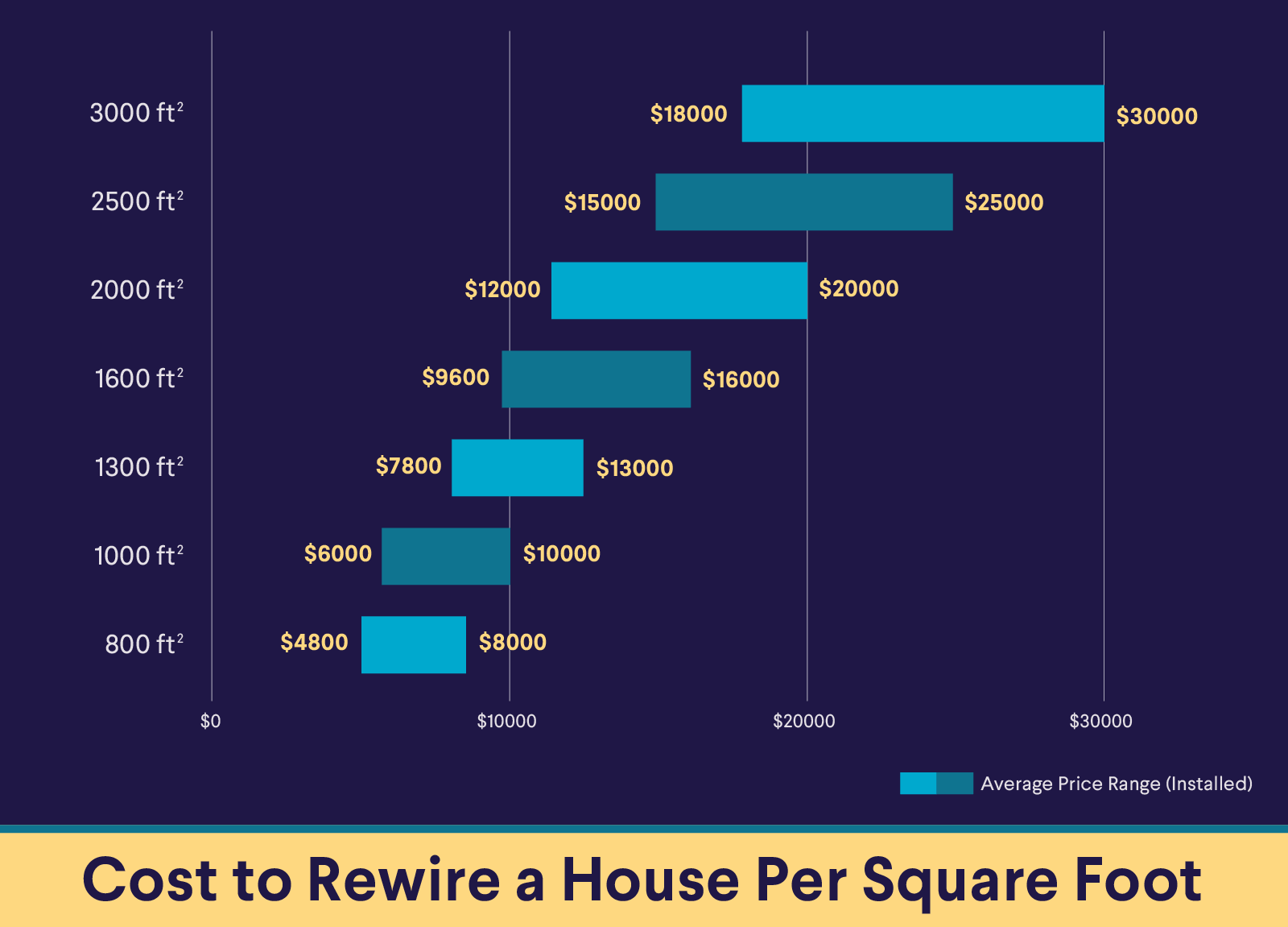
•   A 1,300-square-foot house may cost between $7,800 and $13,000 to rewire.

•   Rewiring a 2,500-square-foot home could range from $15,000 to $25,000.

•   Factors influencing rewiring costs include house size, age, work extent, materials used, and wiring access.

•   Older and larger homes often require more extensive rewiring, increasing the overall cost.

Factors That Affect the Cost to Rewire a House

Rewiring a home involves removing the outdated wiring inside a home’s walls and installing new, modern wiring that can safely meet today’s electrical needs.

Rewiring is typically done by a licensed electrician who strips out the old wiring and runs new wiring throughout the entire house, installs a new circuit breaker panel to handle the load of the new wiring system, and ensures that building codes are met.

It can be a big job — and an expensive one, too. Let’s look at some common factors that can impact the total cost.

Size of the House

The bigger the home, the more materials and labor the job will likely require. And that can drive up the price. Rewiring a 1,300-square-foot house, for instance, runs around $7,800 to $13,000. For a 2,500-square-foot home, you can expect to pay between $15,000 to $25,000.

House’s Age

Older homes weren’t constructed with 21st century living in mind, so a rewiring project will likely cost more. Common necessities like opening a wall to reach out-of-the-way wiring ($4-$8 per square foot), upgrading outdated wiring ($200-$2,300), and replacing an electrical outlet ($125-$200) can all add to the price tag.

Extent of Work Needed

Small-scale projects are typically cheaper than larger, more complex ones. If you’re planning to set up a new alarm system, run wiring to a backyard shed, or upgrade the electric panel, you’ll likely need to adjust your budget accordingly.

Type of Wiring and Materials Used

The average cost to rewire a house is just that: average. And your own house rewire costs will vary based on the materials used in the job. Below we’ll get into the details of how different materials can affect your job costs.

Local Labor Rates and Permit Requirements

If you’re in a high cost of living area, you can expect hourly rates for electricians, drywall repair, and painting to be above national averages. This, too, will affect the cost of your job.

Recommended: How to Find a Contractor for Home Remodeling

Signs You Need to Rewire a Home

Flickering lights, outlets making a popping sound, or tripped breakers indicate that a home might need to be rewired. When buying an older home, a home inspection typically reveals if rewiring is recommended or necessary.

Even before a professional inspection, prospective homebuyers may be able to get a good idea of how the home is wired by peeking into the attic, basement, or crawl space.

Vintage charm does not extend to knob and tube wiring, which was common through the mid-1900s. The lack of a ground wire is seen as a significant fire hazard, and most carriers will deny homeowners insurance for a home that has knob and tube electrical wiring.

Another way to check for outdated wiring is to find the electrical panel and see if it has modern breaker switches or round fuses. The fuses indicate that the system is outdated, and rewiring the house might be recommended.

In almost every state, home sellers must disclose defects, but cautious buyers may still want to include the inspection contingency in the purchase contract.

If you’re living in a home with older wiring and notice that your circuit breakers trip often, lights flicker, the light switches feel warm to the touch, or there is a burning smell coming from an outlet, it’s time to schedule an appointment with an electrician and explore house rewire costs. Get ready to encounter one of the more common home repair costs

Cost to Rewire a House Per Square Foot

What’s Involved in the Rewiring Process?

Rewiring a house can be a costly endeavor in part because it is a complex process. After all, most of those wires are inside your walls. Depending on the extent of the job, rewiring could involve any or all of the following: Replacing or adding circuits; running new wire through walls, ceiling, and floors; replacing (and potentially adding) outlets and switches; installing ground fault circuit interrupters, which are often required by building codes in areas with potential exposure to moisture such as kitchens and bathrooms. After the work is done, the electrical contractor will test the system.

Filing for building permits before the work and managing an inspection once it is done will also likely be necessary. And in some jobs, an electrical service upgrade will be needed to bring more power to the home. This adds to cost and complexity.

Now let’s look more closely at how much does it cost to rewire a home based on the type of materials being used.

Cost to Rewire a House Per Material

The cost of rewiring a house depends on square footage and how easy or difficult it is to access the space. But the wiring and cable materials can also have an impact. Let’s take a look:

•   Used in most homes, nonmetallic (NM) cables are easy to install, flexible, and cost-effective. If you’re rewiring these cables, expect to pay between $0.40 and $0.80 per linear foot, according to Angi.

•   Underground feeder (UF) cables are similar to NM cables, except that they’re designed to go underground or in damp areas. Rewiring UF cables costs around $0.50 to $0.75 per linear foot.

•   Durable and able to handle high temperatures, THHN and THWN wires are often used in an unfinished space, like a basement, or for hot water heaters and garbage disposals. They cost $0.80 to $1.60 per linear foot to rewire.

•   Coaxial cables have high bandwidth support and are easy to install, which once made them a go-to choice for televisions and video equipment. Today, they’re more commonly used to connect cable or satellite TV signals or for internet connectivity. These cables cost around $0.25 to $0.35 per linear foot to rewire.

Updating a doorbell or thermostat? You’ll likely be working with low-voltage wires, which are used for circuits less than 50 volts. Rewiring typically costs between $0.25 and $0.35.

Copper vs. Aluminum Wiring

As you explore rewiring the house, you may find references to both aluminum and copper wire. If your home dates to the 1970s, it may have aluminum wiring, which was used often in that era because it was light and cheap. Unfortunately, it was also more prone than copper to oxidizing and expanding, which created hazards. Copper is the preferred material and what you will likely be upgrading to. Copper’s conductivity makes it highly efficient and a lower fire risk than aluminum.

Cost of Upgrading the Electrical Panel

If the wiring in your home is outdated, it is possible that your electrical panel will also need an update to provide the level of service necessary for the needs of a modern home. A basic panel upgrade can cost $2,000 to $4,000, with additional costs for a service upgrade requiring underground wiring, for example.

Additional Costs for Smart Home or Energy-Efficient Upgrades

These days, there are abundant add-ons for any wiring project. The universe of smart-home devices seems to be expanding exponentially. A basic smart-home upgrade for your home, often done alongside a rewiring job, might run you between $2,000 and $7,000. This would include installing a hub with a smart speaker and automated door locks, thermostat, and smart lighting in several rooms. If you go all in on a smart refrigerator and other gadgets, the price could climb as high as $16,000.

Recommended: How Much Is My House Worth?

Awarded Best Online Personal Loan by NerdWallet.
Apply Online, Same Day Funding


How to Cover Your House Rewiring Costs

Rewiring a home is not a small expense. Fortunately, there are several ways to pay for it. Here’s a look at some options.

Home Equity Loans

If you’ve built up equity in your home and are facing a major rewiring project, one possible solution is a home equity loan. There are three main types of home equity borrowing to consider: a fixed-rate home equity loan, a home equity line of credit (HELOC), and cash-out refinancing. All of these use your home as collateral, meaning that if you miss payments you could face foreclosure.

Each has its pros and cons. For instance, with a fixed-rate home equity loan, you receive a lump sum payment, which you’ll pay back over a period of time with a set interest rate.

A HELOC, on the other hand, is revolving debt. As the balance borrowed is paid down, it can be borrowed again during the draw period, which typically lasts 10 years. HELOCs tend to have a variable interest rate, so payments are less predictable.

With a cash-out refinance, you can refinance your mortgage for more than what you currently owe, and then take the difference in cash that you can use to cover your renovation.

Home Improvement Loans

A home improvement loan is a type of personal loan used to fund renovations and upgrades, including rewiring a house. Once your loan application is approved, you’ll receive a lump sum of cash, which you can use to pay for home improvements. You’ll repay the loan, with interest, in regular installments over the life of the loan — typically five to seven years.

These loans are unsecured, which means your home isn’t used as collateral. As a result, they often come with a higher interest rate than a home equity loan or HELOC.

💡 Quick Tip: Check out SoFi’s home improvement loan rates to explore competitive terms and find the right financing for your renovation needs.

Credit Cards

A credit card is a fast, easy way to fund a rewiring project, and it can be a good option if you’re able to pay off the balance on the card that month. Or look for a card with an introductory 0% annual percentage rate (APR), as this allows you anywhere from six to 18 months to pay back the balance with zero interest. But keep in mind that any balance left after the promotional period ends will start accruing the card’s regular APR.

Also watch for surcharges on credit card transactions. Many tradespeople charge fees for clients using credit cards, and these can quickly add a considerable sum to a larger project.

Government Assistance or Energy Efficiency Incentives

The U.S. Department of Energy provides tax credits and rebates for certain home energy projects, so it’s a good idea to check the DOE site to see what might be available when planning your project. Local governments and utility companies may also offer incentives if your project is considered energy efficient. The U.S. Department of Agriculture also provides grants and loans to qualified low-income households looking to make home improvements. And if you are purchasing a home that needs rewiring, you may be able to finance the purchase and renovation with an FHA 203(k) loan.

Cash

Depending on the scope of the project and your budget, you may decide to dip into your savings account or withdraw money from your emergency fund, if you have one, to cover the cost of rewiring a home.

As you create a budget and weigh your financing options, look for opportunities to save money. Research how much rewiring a house costs in your area, and include a cushion in your budget for unexpected expenses. If you’re not planning to tackle the job yourself, gather quotes from reputable licensed electricians in your area and see which one can offer you the best deal.

Finally, factor in the long-term costs and benefits. Although rewiring might seem cost-prohibitive when buying a single-family home, owners may find that the cost of rewiring a house — and the peace of mind the upgrade provides — can be money well spent.

Regardless of how you choose to pay for your rewiring job, it’s a good idea to track your home improvement costs, as these records may come in handy for tax purposes if you tackle home improvement projects to increase your home’s value before selling the property.

The Takeaway

At $6 to $10 per square foot, the cost of rewiring a house may seem high. But adequate electrical panels and modern wiring can amp up your home value and prevent fires. Wondering how you’re going to pay for it all? Home equity loans, savings, credit cards, and home improvement loans are all ways to pay for the average cost to rewire a house.

Think twice before turning to high-interest credit cards. Consider a SoFi personal loan instead. SoFi offers competitive fixed rates and same-day funding. See your rate in minutes.

SoFi’s Personal Loan was named a NerdWallet 2026 winner for Best Personal Loan for Large Loan Amounts.

FAQ

Is it worth rewiring an old house?

It’s not only worth rewiring an old house, it’s an important safety measure and a way of protecting your investment. Replacing outdated wiring can help prevent a house fire and add value to the property. Plus, updated, energy-efficient fixtures are sometimes included in a remodeling job of this scope, which can potentially lower utility costs.

How much does it cost to replace all the electrical wiring in a house?

According to the home services website Angi, home owners can expect to pay anywhere from $601 to $2,590 to rewire a house. However, if you have an older, larger home, you’ll likely pay closer to $6,000.

Can a house be rewired without removing drywall?

In many cases, at least some drywall or plaster will need to be removed during a rewiring project. But talk to your electrician to see if the work can be done without disrupting your walls.

What permits or inspections are needed to rewire a house?

All but the most minor electrical work typically requires a permit, although regulations are set locally so you’ll want to explore exactly what is required in your area. Rewiring a house is quite a big job and so any costs associated with permitting should be part of the electrician’s bid.

How long does it typically take to rewire a house?

Rewiring a house can take anywhere from a few days to a few weeks, depending on the size of the job. Angi reports an average time of three to 10 days, with longer times for older and larger houses. If rewiring is happening in the context of other renovations, such as an HVAC installation or plumbing work, you can expect it to take longer. Add additional time for replacing sheetrock or plaster that has been removed and repainting the affected area.


Photo credit: iStock/Dmitriev

SoFi Loan Products
SoFi loans are originated by SoFi Bank, N.A., NMLS #696891 (Member FDIC). For additional product-specific legal and licensing information, see SoFi.com/legal. Equal Housing Lender.


¹FHA loans are subject to unique terms and conditions established by FHA and SoFi. Ask your SoFi loan officer for details about eligibility, documentation, and other requirements. FHA loans require an Upfront Mortgage Insurance Premium (UFMIP), which may be financed or paid at closing, in addition to monthly Mortgage Insurance Premiums (MIP). Maximum loan amounts vary by county. The minimum FHA mortgage down payment is 3.5% for those who qualify financially for a primary purchase. SoFi is not affiliated with any government agency.
²SoFi Bank, N.A. NMLS #696891 (Member FDIC), offers loans directly or we may assist you in obtaining a loan from SpringEQ, a state licensed lender, NMLS #1464945.
All loan terms, fees, and rates may vary based upon your individual financial and personal circumstances and state.
You should consider and discuss with your loan officer whether a Cash Out Refinance, Home Equity Loan or a Home Equity Line of Credit is appropriate. Please note that the SoFi member discount does not apply to Home Equity Loans or Lines of Credit not originated by SoFi Bank. Terms and conditions will apply. Before you apply, please note that not all products are offered in all states, and all loans are subject to eligibility restrictions and limitations, including requirements related to loan applicant’s credit, income, property, and a minimum loan amount. Lowest rates are reserved for the most creditworthy borrowers. Products, rates, benefits, terms, and conditions are subject to change without notice. Learn more at SoFi.com/eligibility-criteria. Information current as of 06/27/24.
In the event SoFi serves as broker to Spring EQ for your loan, SoFi will be paid a fee.


Tax Information: This article provides general background information only and is not intended to serve as legal or tax advice or as a substitute for legal counsel. You should consult your own attorney and/or tax advisor if you have a question requiring legal or tax advice.

Disclaimer: Many factors affect your credit scores and the interest rates you may receive. SoFi is not a Credit Repair Organization as defined under federal or state law, including the Credit Repair Organizations Act. SoFi does not provide “credit repair” services or advice or assistance regarding “rebuilding” or “improving” your credit record, credit history, or credit rating. For details, see the FTC’s website .

Third Party Trademarks: Certified Financial Planner Board of Standards Center for Financial Planning, Inc. owns and licenses the certification marks CFP®, CERTIFIED FINANCIAL PLANNER®

This article is not intended to be legal advice. Please consult an attorney for advice.

External Websites: The information and analysis provided through hyperlinks to third-party websites, while believed to be accurate, cannot be guaranteed by SoFi. Links are provided for informational purposes and should not be viewed as an endorsement.
Third-Party Brand Mentions: No brands, products, or companies mentioned are affiliated with SoFi, nor do they endorse or sponsor this article. Third-party trademarks referenced herein are property of their respective owners.

SOPL-Q126-001

Read more
A woman writes on a pad with a pen while working on a laptop computer.

What is Paper Trading Stocks and How To Get Started

Paper trading is simulated trading, done for practice without real money. It’s a way to test different trading strategies without the risk of losing money, before an investor starts trading with real capital.

The practice gets its name from how investors would once mark down their hypothetical stock purchases and sales and track their returns and losses, on paper. But these days, investors typically use digital platforms to virtually test out hypothetical investment portfolios, day-trading tactics, and broader investing strategies.

Key Points

•   Paper trading is simulated trading done for practice without using real money, allowing investors to test strategies without financial risk.

•   Paper trading helps new traders build skills and make mistakes without risking real money, in both bear and bull markets.

•   To start paper trading, choose a virtual trading platform, develop a practice plan, and analyze results to refine strategies.

•   Paper trading allows investors to learn about investing, track trades, and examine stock performance in a low-stress environment.

•   Paper trading has limitations, including not perfectly replicating market conditions and potentially encouraging bad habits due to lack of real financial consequences.

How Does Paper Trading Work?

In its most basic form, paper trading involves selecting a stock, group of stocks, or a sector, then writing down the ticker or tickers and choosing a time to buy the stock. The paper trader then writes down the purchase price or prices.

When they sell the stock or stocks, they write down that price as well, and tally up their return. Most modern paper traders can use a simulation platform to keep track of their trades, rather than a pen and paper.

What Are the Pros of Paper Trading

Paper trading has both benefits and drawbacks. Here are some of the pros of paper trading.

Practice Trading Without Risking Real Money

Paper trading is a way to learn and build trading skills in either a bear or a bull market. For new traders, a virtual trading platform offers a way to make rookie mistakes without risking real money.

In other words, paper trading is a method to get comfortable with the process of buying and selling stocks, and making sure you don’t enter a limit order when you mean to place a market order.

Learn the Mechanics of an Investing Platform

Similarly, investors can learn the mechanics, or ins-and-outs, of particular investing platforms. That can be helpful when you want to take certain actions, perhaps within a set time frame, and know exactly what to do.

Test and Refine Your Trading Strategies

Perhaps most importantly: paper stock trading allows for experimentation. For example, an investor might hear about shorting a stock. But they may not know how the process works, and what it actually pays out. Paper trading permits investors to learn how these trades work in practical terms. Or, they might want to try out other strategies, such as swing trading.

Further, you can test your own mettle. Paper trading can serve as a way for investors to learn about their own strengths and weaknesses. Traders lose money in the markets for a number of personal reasons. Some stick to their guns too long, while others give up too soon when the market is down. Some lose money because they panic, while others lose money because they ignore clear warning signs.

What Are the Cons of Paper Trading?

There are also some drawbacks to paper trading.

It Doesn’t Simulate Real Trading Emotions

The biggest drawback of paper trading is that it’s not real. An investor can’t keep the returns they earn paper trading. And those paper returns can lead the investor to have an unrealistic sense of confidence, and a false sense of security. Paper trading also doesn’t account for real-life situations that might require an investor to withdraw money from the market for personal reasons or the impact of an unexpected recession.

As such, hypotheticals don’t necessarily spur genuine emotions. You’d likely react differently with real money on the line, in other words, than you would knowing that you’re simulating market conditions. So, paper trading may not be helpful for some investors when trying to emotionally prepare for market volatility.

It Can’t Perfectly Replicate Market Conditions

While paper trading offers important lessons, it can also mislead investors in other ways. If a paper trading strategy focuses on just a few stocks, or using one trading strategy, they can easily lose sight of how broader market conditions actually drive the performance of those stocks, including stock volatility, or their strategy, or have an inflated confidence in their ability to time the markets.

They need to realize their holdings or strategy may offer very different results in a real-world scenario.

Another danger with paper-trading is that traders may overlook the cost of slippage and commissions. These two factors are a reality of actual trading, and they erode an investor’s returns. Slippage is the difference between the price of a trade at the time the trader decides to execute it and the price they actually pay or receive for a given stock.

Especially during periods of high volatility, slippage can make a significant impact on the profitability of a trade. Any difference, up or down, counts as slippage, so slippage can be good news at times. Since brokerage commissions and other fees always come out of a trader’s bottom line, paper traders should include them in their model.

It Can Encourage Bad Habits

To a certain extent, investing with hypothetical dollars can help investors practice keeping their emotions in check while the markets are going up and down. However, once an investor’s real money is in play, it can be much more difficult to remain calm and keep perspective when stressful situations arise, such as when the market plunges over the course of a trading day.

To prepare emotionally, as well as practically, for the volatility of markets, investors can also practice risk management techniques appropriate for the strategies they’re exploringÄ. It can also be wise for novice investors to trade in smaller amounts, at first, as they learn more about the markets and become more comfortable with the interface and tools of the brokerage they’re using.

How to Start Paper Trading in 3 Simple Steps

If you’d like to try paper trading, be sure to research your investments, just like you would if you were investing for real, and use the same amount of paper money you would use in real life. This will help mimic the actual experience.

With that in mind, here are a few steps to get started.

Step 1: Choose a Paper Trading Platform or App

If you choose to paper trade with a pencil and paper, you can simply choose a stock or group of stocks, write down the ticker, and pick a time to buy the stock. You then write down the purchase price, or prices. When you sell the stock you record that price and then figure out your return.

If you decide to use an online investing platform, you’ll need to choose a platform. There are many free platforms available. You may want to look for one that has live market feeds so that you can practice trading without delays.

Once you’ve selected a virtual trading platform, you’ll set up an account. Simply log onto the platform and follow the prompts to set up an account. Once you’ve done that, there should be a “paper trading” option you can click on.You’ll need to select a balance and then you should be able to start simulating trading.

Step 2: Develop a Practice Plan or Strategy

The entire point of paper trading is to practice and test out your strategies. So, have some in mind before you start. Find an investing calculator. Think about buy-and-hold tactics, or swing trading and daytrading techniques. Give it all some thought.

You don’t even need to worry about Securities Investor Protection Corporation protection, or SIPC protection, at first, since its paper trading is all a form of practice. That protection helps protect investors up to certain amounts if they are victims of fraud or firm failure, similar to FDIC protections. SIPC does not protect against market losses, however. Try enacting your strategies over a set period of time, and see what happens. Again, this is the time and place to make mistakes, so don’t worry too much about the outcomes.

Experiment with different types of market orders, after hours trading, the whole shebang.

Step 3: Analyze Your Results and Learn

After you’ve gotten the hang of the platform and done some practicing, take a look at what your strategy has yielded, and analyze the results. Did your trend trading technique work out as you had hoped? Did you let your emotions get the best of you during a bout of volatility?

Think about the decisions you made, and how you can use what you’ve learned to sharpen your strategy when you move to trading with actual money.

The Takeaway

Paper trading can be a way to learn about investing. By keeping track of all trades, and the losses or gains they generate, it creates a low-stress practice for examining why certain stocks, and certain trades, perform the way they do. That can be invaluable later, when there’s real money on the line.

However, remember that paper trading isn’t real. In real-life trading with an investment account, you’ll have the potential for gains, but also for losses. Make sure you are comfortable taking that risk.

Invest in what matters most to you with SoFi Active Invest. In a self-directed account provided by SoFi Securities, you can trade stocks, exchange-traded funds (ETFs), mutual funds, alternative funds, options, and more — all while paying $0 commission on every trade. Other fees may apply. Whether you want to trade after-hours or manage your portfolio using real-time stock insights and analyst ratings, you can invest your way in SoFi's easy-to-use mobile app.


Opening and funding an Active Invest account gives you the opportunity to get up to $1,000 in the stock of your choice.¹

FAQ

How realistic is paper trading?

Paper trading is very realistic as paper traders are working in and with actual market conditions. The only difference should be that they’re not trading or investing real money.

Is paper trading good for beginners?

Yes, paper trading can be good for beginners as it gives them a chance to refine their strategy, learn about their risk tolerances or tendencies, and learn how to use a given platform without fear of making a costly mistake.

How long should I paper trade before using real money?

The duration you should paper trade before using real money is completely dependent upon you and your specific comfort level. Some investors may not want to paper trade at all and jump right into the mix with real money, while others will want to practice for a prolonged period of time — so, there’s no single answer.

Can you make real money with paper trading?

No, paper trading is done with virtual or fake money. As such, there isn’t really a way to generate an actual return.

What is the 90% rule in trading?

In trading, the 90% rule refers to the belief that 90% of traders will lose 90% of their capital within the first 90 days of trading. This is largely due to inexperience, unproven strategies, and their inability to handle risk.


Photo credit: iStock/fizkes

INVESTMENTS ARE NOT FDIC INSURED • ARE NOT BANK GUARANTEED • MAY LOSE VALUE

SoFi Invest is a trade name used by SoFi Wealth LLC and SoFi Securities LLC offering investment products and services. Robo investing and advisory services are provided by SoFi Wealth LLC, an SEC-registered investment adviser. Brokerage and self-directed investing products offered through SoFi Securities LLC, Member FINRA/SIPC.

For disclosures on SoFi Invest platforms visit SoFi.com/legal. For a full listing of the fees associated with Sofi Invest please view our fee schedule.


¹Probability of Member receiving $1,000 is a probability of 0.026%; If you don’t make a selection in 45 days, you’ll no longer qualify for the promo. Customer must fund their account with a minimum of $50.00 to qualify. Probability percentage is subject to decrease. See full terms and conditions.

SOIN-Q425-050

Read more
man on smartphone

Safe Harbor 401(k) Plan: What Is It? Is It for You?

Safe harbor 401(k) plans enable companies to avoid the annual IRS testing that comes with traditional 401(k) plans. With a safe harbor 401(k), an employer makes mandatory contributions to all employees’ retirement accounts, and those funds vest immediately.

Often a perk used to attract top talent, safe harbor 401(k) plans are a way for highly compensated employees, like company executives and owners, to save more than a traditional 401(k) plan would normally allow.

Keep reading to learn more about safe harbor rules, why companies use these plans, along with the benefits, drawbacks, and relevant deadlines.

Key Points

•   Like a traditional 401(k), a safe harbor 401(k) lets employees deposit tax-deferred funds from their paychecks into a retirement savings account.

•   Employers are required to contribute to employees’ safe harbor 401(k) accounts.

•   Employer contributions in a safe harbor 401(k) vest immediately. There is no waiting period.

•   Highly-paid employees can contribute more to a safe harbor 401(k) than a traditional 40(k).

•   Safe harbor 401(k) plans allow companies to skip the annual nondiscrimination regulatory testing required by the IRS for traditional 401(k)s.

What Is a Safe Harbor 401(k) Plan?

A 401(k) safe harbor plan is similar to a traditional 401(k) plan — but with a twist. In both cases, eligible employees can use the plan to contribute pre-tax funds to a retirement account and employers may contribute matching funds.

But with a traditional 401(k) retirement plan, companies must submit to annual nondiscrimination regulatory testing by the IRS to ensure that the company plan doesn’t treat highly compensated employees (HCEs) more favorably than others. HCEs are generally defined as earning at least $160,000 in the 2025 and 2026 tax years, and being in the company’s top 20% in pay, or owning more than 5% of the business. The testing process is complex and can be a burden for some companies.

An alternative is to set up a safe harbor 401(k) plan with a safe harbor match. This allows a company to skip the annual IRS testing — and avoid imposing restrictions on employee saving — by providing the same 401(k) contributions to all employees, regardless of title, salary, or even years spent at the company. And those funds must vest immediately.

This is an important benefit, because in many cases, employer contributions to traditional 401(k) plans vest over time, requiring employees to stay with the company for some years in order to get the full value of the employer match. Often, if you leave before the employer contributions or match have vested, you may forfeit them.

For smaller companies, it may be worth making the extra safe harbor match contributions in order to avoid the time and expense of the IRS’s annual nondiscrimination testing. For larger companies, giving all employees the same percentage contribution could be expensive. But the upside is that highly paid employees can then make much larger 401(k) contributions without running afoul of IRS rules, a real perk for company leaders. In addition, 401(k) safe harbor plans are typically less expensive to set up than traditional plans.

💡 Quick Tip: Look for an online brokerage with low trading commissions as well as no account minimum. Higher fees can cut into investment returns over time.

Traditional 401(k) vs Safe Harbor 401(k) Plans

While safe harbor 401(k)s and traditional 401(k) plans are similar in many ways, there are some important differences that employers should be aware of.

For instance, with traditional 401(k) plans, contributions from highly compensated employees can’t comprise more than 2% of the average of all other employee contributions, in addition to other restrictions. However, with safe harbor 401(k) plans, those limits don’t apply.

Comparing Plan Features and Benefits

Here is a side-by-side comparison of a safe harbor 401(k) vs. a traditional 401(k)

Safe Harbor 401(k) Traditional 401(k)
Employer contributions are required. Employer contributions are optional.
Employer contributions are vested immediately. Employer contributions may vest over time.
Highly-paid employees can contribute up to the $23,500 maximum in tax year 2025 and up to $24,500 in 2026. Highly-paid employees can be limited in how much they can contribute.
Companies do not have to do annual nondiscrimination testing. Companies must do annual nondiscrimination testing.

Choosing the Right Plan for Your Business

A safe harbor plan may be beneficial for some smaller companies that can’t afford the expense of nondiscrimination testing. In addition, the plan is simpler with less administrative tasks.

A company might also choose a safe harbor 401(k) if it has some key high-earning employees that make up a large share of the workforce.

However, if your company is able to easily manage the nondiscrimination testing process, you may want to opt for a traditional 401(k). A traditional 401(k) could also be a good option for business owners who want to try to retain employees over the long-term. They could set up a vesting schedule for employer contributions that requires employees to be with the company for three years before becoming fully vested, for instance.

Setting Up a Safe Harbor 401(k) Plan

For employers interested in using a safe harbor 401(k), there are some general rules and guidelines they will need to follow.

Requirements, Contribution Formulas, and Deadlines

To fulfill the safe harbor 401(k) requirements, the employer must make qualifying 401(k) contributions (a.k.a. the safe harbor match) that vest immediately. The company contributes to employees’ retirement accounts in one of three ways:

•   Non-elective: The company contributes the equivalent of 3% of each employee’s annual salary to a company 401(k) plan, regardless of whether the employee contributes.

•   Basic: The company offers 100% matching for the first 3% of an employee’s 401(k) plan contributions, plus a 50% match for up to 5% of an employee’s contributions.

•   Enhanced: The company offers a 100% company match for all employee 401(k) contributions, up to 4% of a staffer’s annual salary.

Companies that opt for a safe harbor 401(k) plan have to adhere to strict compliance filing deadlines. These are the dates worth knowing.

October 1: That’s the deadline for filing for a safe harbor 401(k) for the current calendar year. This deadline meets the government criteria of a company needing to have a safe harbor 401(k) in operation for at least three months in a 12 month period, for the first year operating a safe harbor plan.

December 1: By this date, all companies — whether they’re rolling out a brand new safe harbor plan or are administering an existing one — must issue a formal notice to employees that a safe harbor 401(k) will be offered to company staffers.

January 1: The date that all safe harbor 401(k) plans are activated. For companies that currently have no 401(k) plan at all, they can roll out either a traditional 401(k) plan or a safe harbor 401(k) plan at any point in the year, for that calendar year.

Advantages of Implementing a Safe Harbor 401(k) Plan

Safe harbor 401(k)s offer some distinct upsides for business owners and employees alike.

Benefits for Employers and Employees

By creating a safe harbor 401(k) plan, a business owner can potentially attract and maintain highly skilled employees. Employees are attracted to higher retirement plan contributions and the ability to optimize retirement plan contribution amounts, ensuring more money for long-term retirement savings.

Plus, a safe harbor 401(k) plan can also help business owners save money on the compliance end of the spectrum. For example, companies save on regulatory costs by avoiding the costs of preparing for a nondiscrimination test (and the staff hours and training that goes with it).

There are some additional upsides to offering a safe harbor 401(k) retirement plan, for higher paid employees and regular staff too.

•   Playing catch up. If a company owner, or high-level managers, historically haven’t stowed enough money away in a company retirement plan, a safe harbor 401(k) plan can help them catch up. The same may be true, although to a lesser degree, for regular employees.

•   The spread of profit. Suppose a company has a steady and robust revenue stream and is managed efficiently. In that case, company owners may feel comfortable “spreading the wealth” with not only high-profile talent but rank-and-file employees, too.

•   Encourage retirement savings. If a company is seeing weak contribution activity from its rank-and-file employees, it may feel more comfortable going the safe harbor route and at least guaranteeing minimum 401(k) contributions to employees while rewarding higher-value employees with more lucrative 401(k) plan contributions.

Disadvantages of Safe Harbor Plans

Safe harbor 401(k) plans have their downsides, too. Here are some drawbacks to consider.

Financial Implications for Employers

The matching contribution requirements for safe harbor 401(k)s can add up to a hefty expense, depending on employee salaries. And because employees are vested immediately, there’s no incentive to stay with the company for a certain period.

In addition, if a company introduces a safe harbor 401(k) plan, it must commit to it for one calendar year, no matter how the plan is performing internally. Even after a year, 401(k) plan providers (which administer and manage the retirement plans) may charge a termination fee if a company decides to pull the plug on its safe harbor plan after one year.

💡 Quick Tip: The advantage of opening a Roth IRA and a tax-deferred account like a 401(k) or traditional IRA is that by the time you retire, you’ll have tax-free income from your Roth, and taxable income from the tax-deferred account. This can help with tax planning.

Safe Harbor 401(k) Contribution Limits and Match Types

There are some different rules for employer contribution limits and matching with a safe harbor 401(k) vs. a traditional 401(k).

Understanding Contribution Limits

Just like traditional 401(k) plans, the maximum employee contribution limit for a safe harbor plan is $23,500 in 2025 and $24,500 in 2026. If you are over 50, you would be eligible for an additional $7,500 catch-up contribution in 2025 and $8,000 in 2026, if your plan allows it.

For both 2025 and 2026, those aged 60 to 63 may contribute an additional $11,250 (instead of $7,500 and $8,000) to their 401(k) plan.

But in a safe harbor plan, a company owner can reserve the maximum $23,500 in 2025 for their annual plan contribution, $24,500 for 2026, and also boost contribution payments to valued team members up to an individual profit-sharing maximum amount of 100% of their compensation, or $70,000 (77,500 for those over age 50 with the standard catch-up and $81,250 with the SECURE 2.0 catch-up for those 60 to 63) — whichever is less — for 2025.

For 2026, the total allowed is 100% of compensation or $72,000, whichever is less. (For those 50 and up the cap is $80,000 with the standard catch-up, and $83,250 with the SECURE 2.0 catch-up for those ages 60 to 63 only.) Employer rules about catch-up provisions may vary, so be sure to ask.

Regular employees are allowed the standard maximum contribution limit of $23,500 in 2025, $24,500 in 2026; plus anyone over age 50 can contribute an extra “catch-up” amount of $7,500 in 2025 and $8,000 in 2026. Those are the same maximum contribution ceilings as regular 401(k) plans. For 2025 and 2026, those aged 60 to 63 may contribute an additional $11,250 instead of $7,500 and $8,000 respectively, thanks to SECURE 2.0.

Different Types of Employer Matching Contributions

As mentioned earlier, with a safe harbor 401(k), an employer must make qualifying 401(k) contributions that vest immediately in one of these ways:

•   Non-elective: The company contributes the equivalent of 3% of each employee’s annual salary to a company 401(k) plan.

•   Basic: The company matches 100% for the first 3% of an employee’s 401(k) plan contributions, plus a 50% match for the following 2% of their contributions.

•   Enhanced: The company provides a 100% company match for all employee 401(k) contributions, up to 4% of a staffer’s annual salary.

IRS Compliance Testing and Safe Harbor Provisions

To help understand the benefit of safe harbor plans, it helps to see what employers with traditional 401(k) plans face in terms of following IRS rules and submitting to the annual nondiscrimination tests.

Navigating Non-Discrimination Testing

Each year, a company must conduct Actual Deferral Percentage (ADP), Actual Contribution Percentage (ACP), and Top Heavy tests to confirm there is no compensation discrimination.

If the company fails one of the tests, it could mean considerable administrative hassle, plus the expense of making corrections, and potentially even refunding 401(k) contributions.

Before explaining the details of each test, here’s a refresher on how the IRS defines highly compensated employees (HCEs) and non-highly compensated employees (NHCEs).

To be an HCE:

•   The employee must own more than 5% of the company at any time during the current or preceding year (directly or through family attribution).

•   The employee is paid over $160,000 in compensation from the employer for both 2025 and 2026. The plan can limit these employees to the top 20% of employees who make the most money.

Employees who don’t fit these criteria are considered non-highly compensated. The nondiscrimination tests are designed to assess whether top employees are saving substantially more than the rank-and-file staffers.

•   The Actual Deferral Percentage (ADP) test measures how much income highly paid employees contribute to their 401(k), versus staff employees.

•   The Actual Contribution Percentage (ACP) test compares employer retirement contributions to HCEs versus the contributions to everyone else.

According to the IRS, the terms of the ADP test — which compares the amounts different employees are saving in their 401(k)s — are met if the ADP for highly compensated employees (HCE) doesn’t exceed the greater of:

•   125% of the deferral percentage for ordinary, i.e., non-highly compensated employees (NHCEs)

Or the lesser of:

•   200% of the deferral percentage for the NHCEs

•   or the deferral percentage for the NHCEs plus 2%.

The ACP test is met if the deferral percentage for highly compensated employees doesn’t exceed the greater of:

•   125% of the deferral percentage for the NHCEs,

Or the lesser of:

•   200% of the deferral percentage for the group of NHCEs

•   or the deferral percentage for the NHCEs plus 2%.

Last, the top-heavy test measures the value of the assets in all company 401(k) accounts, total. If the 401(k) balances of “key employees” account for more than 60% of total plan assets, the 401(k) would fail the top heavy test. The IRS defines key employees somewhat differently than highly compensated employees, although both groups are similar in that they earn more than ordinary staff.

As you can see, maintaining a traditional 401(k) plan, and meeting these requirements each year, can be a burden for some companies. Fortunately, by setting up a safe harbor 401(k) plan, a company can avoid the annual nondiscrimination tests and still provide a 401(k) savings plan for employees.

The Takeaway

Companies that don’t want the regulatory obligations of a traditional 401(k) plan, and would like to prioritize talent acquisition and employee retention may want to consider safe harbor 401(k) plans.

However, a business owner needs to weigh the pros and cons of a safe harbor 401(k) plan because, in some cases, it can be expensive for a company to maintain.

But no matter what type of 401(k) an employer decides to go with, having a retirement plan in place, with different savings and investment options, can help employees — and business owners themselves — save for the future.

Prepare for your retirement with an individual retirement account (IRA). It’s easy to get started when you open a traditional or Roth IRA with SoFi. Whether you prefer a hands-on self-directed IRA through SoFi Securities or an automated robo IRA with SoFi Wealth, you can build a portfolio to help support your long-term goals while gaining access to tax-advantaged savings strategies.

Help grow your nest egg with a SoFi IRA.

FAQ

Is a safe harbor 401(k) worth it?

Whether a safe harbor 401(k) is worth it depends on the goals of the business owner. A safe harbor 401(k) allows a company to skip the expense of nondiscrimination testing. And by creating a safe harbor 401(k) plan, a business owner may be able to attract and maintain highly skilled employees because of the higher contributions. However, the matching employer contribution requirements can add up to a high expense. A business owner needs to weigh the pros and cons of these plans.

Can I cash out my safe harbor 401(k)?

You can withdraw safe harbor 401(k) funds without penalty at age 59 ½ or if you leave your job. However, hardship withdrawals for immediate and heavy financial need may be allowed in certain circumstances. You can learn more at irs.gov.

Why would a company use a safe harbor 401(k)?

A company might use a safe harbor 401(k) to avoid the expense of nondiscrimination testing and to simplify the administration of a 401(k) plan. They might also use a safe harbor 401(k) to help attract and keep highly skilled employees.

What is an example of a safe harbor 401(k) match?

If an employer with a safe harbor 401(k) chooses to offer non-elective matching contributions, that means they contribute at least 3% of each employee’s annual salary. So if an employee makes $70,000 a year, for example, the employer would contribute $2,100 to their safe harbor 401(k) account.


About the author

Ashley Kilroy

Ashley Kilroy

Ashley Kilroy is a seasoned personal finance writer with 15 years of experience simplifying complex concepts for individuals seeking financial security. Her expertise has shined through in well-known publications like Rolling Stone, Forbes, SmartAsset, and Money Talks News. Read full bio.


INVESTMENTS ARE NOT FDIC INSURED • ARE NOT BANK GUARANTEED • MAY LOSE VALUE

SoFi Invest is a trade name used by SoFi Wealth LLC and SoFi Securities LLC offering investment products and services. Robo investing and advisory services are provided by SoFi Wealth LLC, an SEC-registered investment adviser. Brokerage and self-directed investing products offered through SoFi Securities LLC, Member FINRA/SIPC.

For disclosures on SoFi Invest platforms visit SoFi.com/legal. For a full listing of the fees associated with Sofi Invest please view our fee schedule.

Financial Tips & Strategies: The tips provided on this website are of a general nature and do not take into account your specific objectives, financial situation, and needs. You should always consider their appropriateness given your own circumstances.

Tax Information: This article provides general background information only and is not intended to serve as legal or tax advice or as a substitute for legal counsel. You should consult your own attorney and/or tax advisor if you have a question requiring legal or tax advice.

Third-Party Brand Mentions: No brands, products, or companies mentioned are affiliated with SoFi, nor do they endorse or sponsor this article. Third-party trademarks referenced herein are property of their respective owners.

External Websites: The information and analysis provided through hyperlinks to third-party websites, while believed to be accurate, cannot be guaranteed by SoFi. Links are provided for informational purposes and should not be viewed as an endorsement.
SOIN0224032
CN-Q425-3236452-139

Read more

How Much a $1 Million Mortgage Will Cost You

What is the monthly payment on a $1 million mortgage at recent interest rates? If we remove property taxes, property insurance, and mortgage insurance from the equation, you can expect to spend between $6,653 and $8,988 a month on principal and interest alone, depending on which loan term you choose. But that’s not the whole story. There’s more you’ll need to know about a $1 million mortgage payment.

Key Points

•   A $1,000,000 mortgage typically falls under the jumbo loan category, meaning it exceeds conventional loan limits in most areas.

•   Monthly payments for a $1 million mortgage (principal and interest only) are roughly $6,653 for a 30-year term and $8,988 for a 15-year term, based on a 7.00% interest rate.

•   Choosing a 15-year term over a 30-year term on a $1 million mortgage at 7.00% interest can save you over $777,000 in total interest paid over the life of the loan.

•   Lenders typically require you to have a debt-to-income (DTI) ratio of 43% or less to qualify for a mortgage.

•   To afford a $1 million 30-year mortgage, you would need an annual income of approximately $265,000, or about $360,000 for a 15-year term.

Cost of a $1 Million Mortgage

The cost of a $1 million mortgage varies depending on which home mortgage loan you choose and a few other factors, such as interest rate and property taxes. As you may know, different types of mortgage loans have different expenses, such as mortgage insurance, which can change your monthly payment.

Monthly Payments for a $1 Million Mortgage

The monthly payment on a $1 million mortgage is influenced by a variety of factors, which include:

•   Interest rate

•   Fixed vs. variable interest rate

•   Mortgage insurance

•   Property insurance

•   Loan term

•   Type of loan

•   Property taxes

Removing all variables except a 7.00% interest rate, a $1 million mortgage payment would be between $6,653 and $8,988 per month. If you’re a first time homebuyer considering a $1 million mortgage, make sure you understand the true cost of buying and owning a home. Remember that your property taxes and some insurance costs may be dictated by your home’s location. (You may want to analyze the cost of living by state. Some of the best affordable places to live in the U.S. may surprise you.)

If these variables are new to you, a home loan help center may smooth out any confusion you may have.

Where to Get a $1 Million Mortgage

You can get a $1 million mortgage with mortgage lenders such as banks, credit unions, and online lenders. However, they’ll need to offer jumbo home loans since $1 million exceeds the conventional loan limit of $832,750 in most areas. When comparing lenders, look at both interest rates and fees. Loan origination fees, in particular, can vary greatly between lenders.

💡 Quick Tip: A major home purchase may mean a jumbo loan, but it doesn’t have to mean a jumbo down payment. Apply for a jumbo mortgage with SoFi, and you could put down as little as 10%.

What to Consider Before Applying for a $1 Million Mortgage

The monthly payment for a $1 million mortgage isn’t the only thing you should consider. Also keep in mind the total amount you’ll spend on interest for each loan term. For a 30-year loan with a 7.00% interest rate, you’ll spend $1,395,086 on interest. If you opt for a 15-year loan, you’ll spend just $617,890. This means if you can afford a 15-year loan, you’ll save $777,196.

While you’re home shopping, use a mortgage calculator to see the amount of money you’ll spend monthly and over the life of the loan. You may also want to use a home affordability calculator to incorporate your monthly debts and spending habits into the equation. While you may be able to technically afford a large monthly payment, would the expense leave room for dining out, vacations, and retirement contributions?

During the early years of your mortgage loan, more of your monthly payment typically goes toward paying off the interest on the loan, with a smaller proportion paying down the principal you owe. An amortization schedule shows how the proportions shift, and you build equity more quickly in the second half of the loan term. Here are sample schedules for 30-year and 15-year loan terms:

Amortization Schedule, 30-year, 7.00%

Year Beginning Balance Monthly Payment Total Interest Paid Total Principal Paid Remaining Balance
1 $1,000,000 $6,653.02 $69,678.20 $10,158.10 $989,841.90
2 $989,841.90 $6,653.02 $68,943.87 $10,892.43 $978,949.47
3 $978,949.47 $6,653.02 $68,156.46 $11,679.84 $967,269.63
4 $967,269.63 $6,653.02 $67,312.12 $12,524.18 $954,745.45
5 $954,745.45 $6,653.02 $66,406.75 $13,429.55 $941,315.90
6 $941,315.90 $6,653.02 $65,435.92 $14,400.38 $926,915.52
7 $926,915.52 $6,653.02 $64,394.92 $15,441.38 $911,474.14
8 $911,474.14 $6,653.02 $63,278.66 $16,557.64 $894,916.50
9 $894,916.50 $6,653.02 $62,081.71 $17,754.59 $877,161.91
10 $877,161.91 $6,653.02 $60,798.23 $19,038.07 $858,123.83
11 $858,123.83 $6,653.02 $59,421.96 $20,414.34 $837,709.50
12 $837,709.50 $6,653.02 $57,946.21 $21,890.09 $815,819.40
13 $815,819.40 $6,653.02 $56,363.77 $23,472.53 $792,346.88
14 $792,346.88 $6,653.02 $54,666.94 $25,169.36 $767,177.52
15 $767,177.52 $6,653.02 $52,847.44 $26,988.85 $740,188.66
16 $740,188.66 $6,653.02 $50,896.42 $28,939.88 $711,248.78
17 $711,248.78 $6,653.02 $48,804.35 $31,031.95 $680,216.83
18 $680,216.83 $6,653.02 $46,561.05 $33,275.25 $646,941.58
19 $646,941.58 $6,653.02 $44,155.58 $35,680.72 $611,260.86
20 $611,260.86 $6,653.02 $41,576.22 $38,260.08 $573,000.78
21 $573,000.78 $6,653.02 $38,810.39 $41,025.91 $531,974.88
22 $531,974.88 $6,653.02 $35,844.63 $43,991.67 $487,983.20
23 $487,983.20 $6,653.02 $32,664.47 $47,171.83 $440,811.37
24 $440,811.37 $6,653.02 $29,254.41 $50,581.89 $390,229.48
25 $390,229.48 $6,653.02 $25,597.84 $54,238.46 $335,991.02
26 $335,991.02 $6,653.02 $21,676.94 $58,159.36 $277,831.66
27 $277,831.66 $6,653.02 $17,472.59 $62,363.71 $215,467.96
28 $215,467.96 $6,653.02 $12,964.32 $66,871.98 $148,595.97
29 $148,595.97 $6,653.02 $8,130.14 $71,706.16 $76,889.81
30 $76,889.81 $6,653.02 $2,946.49 $76,889.81 $0

Amortization Schedule, 15-year, 7.00%

Year Beginning Balance Monthly Payment Total Interest Paid Total Principal Paid Remaining Balance
1 $1,000,000 $8,988.28 $68,761.41 $39,097.98 $960,902.02
2 $960,902.02 $8,988.28 $65,935.02 $41,924.38 $918,977.65
3 $918,977.65 $8,988.28 $62,904.30 $44,955.09 $874,022.55
4 $874,022.55 $8,988.28 $59,654.49 $48,204.90 $825,817.65
5 $825,817.65 $8,988.28 $56,169.76 $51,689.64 $774,128.02
6 $774,128.02 $8,988.28 $52,433.11 $55,426.28 $718,701.74
7 $718,701.74 $8,988.28 $48,426.34 $59,433.05 $659,268.68
8 $659,268.68 $8,988.28 $44,129.92 $63,729.47 $595,539.21
9 $595,539.21 $8,988.28 $39,522.91 $68,336.48 $527,202.73
10 $527,202.73 $8,988.28 $34,582.86 $73,276.53 $453,926.19
11 $453,926.19 $8,988.28 $29,285.69 $78,573.70 $375,352.50
12 $375,352.50 $8,988.28 $23,605.59 $84,253.80 $291,098.70
13 $291,098.70 $8,988.28 $17,514.88 $90,344.51 $200,754.19
14 $200,754.19 $8,988.28 $10,938.87 $96,875.52 $103,878.66
15 $103,878.66 $8,988.28 $3,980.73 $103,878.66 $0

How to Get a $1 Million Mortgage

Anyone who has ever bought a home will tell you there are tips to qualify for a mortgage. The biggest ones include saving up for a large down payment, paying down your debts, and working on your credit score before applying for a mortgage. Paying off balances lowers your debt to income (DTI) ratio and helps you qualify for better mortgage terms. The maximum DTI is usually around 43%, but it can vary with each lender and borrower.

💡 Quick Tip: Lowering your monthly payments with a mortgage refinance from SoFi can help you find money to pay down other debt, build your rainy-day fund, or put more into your 401(k).

The Takeaway

If you need to borrow $1 million to buy a home, a 15-year mortgage will require around a $9,000 a month mortgage payment, whereas a 30-year mortgage requires around $6,650. Assuming a 7.00% interest rate, homebuyers can expect to spend between $617,890 and $1,395,086 on interest alone.

Keep in mind that property taxes, home insurance, and mortgage insurance may increase your monthly payment. If you’re in the market to buy a $1 million house, principal and interest will comprise a majority of your monthly costs.

When you’re ready to take the next step, consider what SoFi Home Loans have to offer. Jumbo loans are offered with competitive interest rates, no private mortgage insurance, and down payments as low as 10%.

SoFi Mortgage Loans: We make the home loan process smart and simple.

FAQ

How much is a $1,000,000 mortgage a month?

You can expect to spend around $6,653 a month with a 30-year mortgage term and $8,988 a month with a 15-year term. This assumes you have a 7.00% interest rate (and doesn’t take into account property taxes, mortgage insurance, and property insurance).

How much income is required for a $1,000,000 mortgage?

Housing costs should be at or below 30% of your income. If you were to choose a 30-year mortgage, this suggests that your income should be around $265,000 a year. Choose a 15-year mortgage, and your income should be around $360,000.

How much is a down payment on a $1,000,000 mortgage?

Because a $1,000,000 mortgage typically means a jumbo loan, you may need to make a down payment of at least 10%. That means your minimum down payment would be $111,112 on a home priced around $1,112,000.

Can I afford a $1,000,000 house with a $70K salary?

No, a $70,000 annual salary would not be enough to cover the cost of a mortgage on a $1,000,000 house. This salary assumes about $5,833 gross a month (before taxes and deductions), which is not enough to cover the minimum payment required of either loan term.


Photo credit: iStock/Paul Bradbury

SoFi Loan Products
SoFi loans are originated by SoFi Bank, N.A., NMLS #696891 (Member FDIC). For additional product-specific legal and licensing information, see SoFi.com/legal. Equal Housing Lender.

SoFi Mortgages
Terms, conditions, and state restrictions apply. Not all products are available in all states. See SoFi.com/eligibility-criteria for more information.


*SoFi requires Private Mortgage Insurance (PMI) for conforming home loans with a loan-to-value (LTV) ratio greater than 80%. As little as 3% down payments are for qualifying first-time homebuyers only. 5% minimum applies to other borrowers. Other loan types may require different fees or insurance (e.g., VA funding fee, FHA Mortgage Insurance Premiums, etc.). Loan requirements may vary depending on your down payment amount, and minimum down payment varies by loan type.
Financial Tips & Strategies: The tips provided on this website are of a general nature and do not take into account your specific objectives, financial situation, and needs. You should always consider their appropriateness given your own circumstances.
Tax Information: This article provides general background information only and is not intended to serve as legal or tax advice or as a substitute for legal counsel. You should consult your own attorney and/or tax advisor if you have a question requiring legal or tax advice.

SOHL-Q425-184

Read more
TLS 1.2 Encrypted
Equal Housing Lender