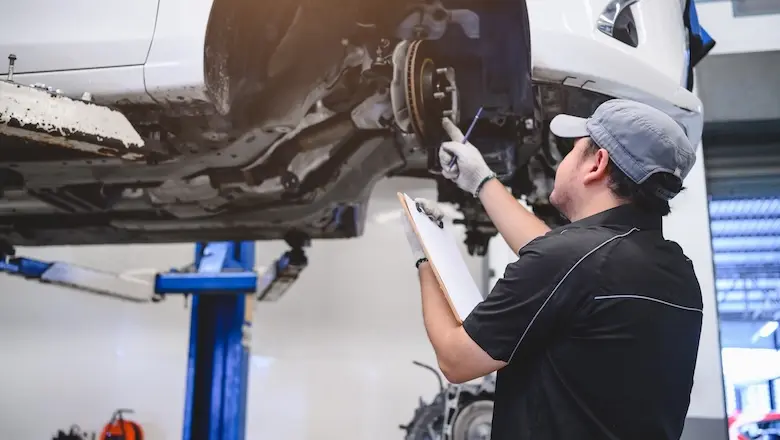
Shock absorbers and strut assemblies, called shocks and struts, are essential to a car’s suspension. Because shocks and struts are in constant use whenever you drive, they may wear out quickly. Replacing your shocks and struts can be expensive, but it’s important for the safety and handling of your car.
Read on to learn more about the cost of replacing shocks and struts.
Key Points
• Replacing shocks and struts is essential for maintaining car safety and handling, with costs ranging from $500 to $2,500 for a pair.
• Labor expenses for replacement can vary from $100 to $300 per assembly.
• Optimal performance is achieved by replacing all four shocks and struts simultaneously.
• Indicators of failing shocks and struts include thumping noises, a bumpier ride, and the car dipping.
• A wheel alignment, typically costing around $150, is often required post-replacement to avoid uneven tire wear.
Shocks and Struts Replacement Costs: What’s Included
Part of responsible car ownership is keeping your car well maintained, including key components such as the struts and shocks. When you replace shocks and struts, you’ll pay for labor, parts, and getting the wheels aligned. A typical shock and strut replacement can cost between $500 and $2,500 or more, with prices rising for luxury car maintenance. The price will vary depending on the type of vehicle suspension you have, the parts needed, and where you live.
But that’s the cost for just one pair of wheels. It’s recommended to replace your shocks and struts in pairs, and to replace all four at the same time, if possible. The total shocks and struts replacement cost would be about $1,000 to $5,000 for all four.
Here’s how the cost to replace shocks and struts breaks down:
Cost of Labor
The cost of labor for replacing a shock and strut assembly can range from $100 and $300 per assembly. The labor cost may vary depending where the work is done. For instance, car dealerships might charge more for labor than auto repair shops.
Cost of Parts
Purchasing the parts is one of the major expenses involved in the struts and shocks replacement cost. A replacement can cost between $80-$250 per pair of shocks and $300-$760 per pair of struts. You’ll need to multiply this number by two, depending how many shocks and struts you’re replacing.
You might be able to save some money by purchasing an aftermarket shocks and struts replacement online. These parts are usually the same as the factory-issued parts, but they’re less expensive. You could also get replacement parts from an auto repair shop. This will be more expensive than buying the parts online, but cheaper than getting them from a dealership.
If you don’t have the cash on hand to pay for the replacement parts, a car repair personal loan could be an option to help cover the shocks and struts replacement cost. Or you might look into a car loan refinance that helps you get some cash out of your equity.
Recommended: Which Credit Bureau Is Used Most for Car Loans?
Wheel Alignment Cost
When you install new shocks and struts, it can alter your vehicle’s alignment. If the alignment is off, that can create uneven wear and tear on the tires. That’s why mechanics usually recommend a wheel alignment after a strut or shock replacement. Supplies for a wheel alignment are around $20, and labor costs are about $130 to $180.
Recommended: Suspension Repair and Replacement Guide
Are Shocks and Struts the Same?
Although shocks and struts are similar, they aren’t the same. Struts are a major structural part of a vehicle’s suspension, and they perform more functions that shocks do. Here are some of the similarities and differences between shocks and struts.
| Shocks | Struts |
|---|---|
| Control spring and suspension movement | Control suspension movement |
| Stabilize the car | Stabilize the car |
| Decrease bounce and roll | Decrease bounce and roll |
| Velocity-sensitive damping to provide a better driving experience | Velocity-sensitive damping to provide a better driving experience |
| Absorb road inconsistencies like uneven surfaces and potholes | Absorb road inconsistencies like uneven surfaces and potholes |
| Support side load on the vehicle’s suspension | |
| Support the spring and keeps the tires aligned correctly |
Recommended: How Much Does a Timing Chain Replacement Cost?
Can I Replace Just the Shocks or Struts?
It’s possible to replace just the shocks or struts if your car has struts in the front and shocks in the rear. However, your car won’t perform as well or ride as smoothly if you’re driving with a mix of old and new shocks and struts. Replacing struts and shocks as needed can keep your vehicle in good working order, which might help increase the car’s value.
As mentioned, it’s best to replace shocks and struts in pairs. Ideally, you should replace all four struts and shocks at the same time, if possible.
Recommended: How Much Does it Cost to Replace Airbags?
When Should I Replace the Struts on My Car?
Struts usually last between 50,000 and 100,000 miles. But driving conditions can affect their lifespan. If you have an extended warranty for your car, check to see if the shocks and struts replacement cost is covered.
Signs of Failing Shocks and Struts
You can do a road test to determine whether your struts and shocks need to be replaced. As you’re driving, stay alert for any of the following conditions, which could be a sign of failing shocks and struts. If your car has any of these issues, see a mechanic right away.
Thumping, Rattling or Knocking Sounds
A thumping, rattling, knocking, or vibration of the steering wheel, even when the road you’re driving on is smooth, could be a sign of failing struts or shocks.
A Bumpier Ride Than Usual
A rough ride is another red flag. The car may even rock from side to side when the wind is blowing.
The Car Dips When Braking or Accelerating Hard
If the front of your car dips down or swerves when you brake, your shocks or struts may be going.
You Notice Your Car Rolls During Turns
The car feels like it’s tilting when you drive. Or it may pull or roll to one side when you turn the steering wheel.
Your Tires Have a “Cupped” Wear Pattern
Uneven wear on tires is another sign of faulty struts or shocks. For instance, you may notice a “cupped” or scalloped treadwear pattern on the tires.
Hydraulic Fluid Is Leaking
If you see leaking hydraulic fluid, have your car checked by a mechanic as soon as possible. This could indicate a problem with your shocks or struts, or another issue that needs to be repaired.
Recommended: Alternator Repair and Replacement Costs
The Takeaway
Shocks and struts are vital to the performance and safety of your car. Worn shocks and struts can reduce the vehicle’s handling and braking and create wear and tear on your tires. If you notice signs that your shocks and struts are failing, see a mechanic about getting them replaced as soon as possible.
And if you need help covering the struts and shocks replacement costs, you might want to explore auto loan refinancing to see if it’s an option for you.
If you’re seeking auto loan refinancing, SoFi is here to support you. On SoFi’s marketplace, you can shop and compare financing options for your car in minutes.
FAQ
Is it worth replacing shocks and struts?
It’s important to replace shocks and struts if they start to fail. Shocks and struts are vital to the proper handling, braking, and safety of your car.
What happens if you don’t replace faulty struts?
Worn shocks and struts can reduce a car’s handling and braking performance, and can compromise the life of the tires and the vehicle’s safety.
Should you replace all four struts at once?
Yes, it’s recommended to replace all four struts and shocks at the same time to keep your car handling smoothly.
How long do shocks and struts last?
Struts usually last between 50,000 and 100,000 miles. But the conditions you drive in may affect their lifespan. If you see any signs the shocks and struts may be failing, it’s wise to make an appointment with a mechanic.
Can I drive with bad shocks or struts?
It’s not advisable to drive with bad shocks or struts. The vehicle’s handling may be compromised, and continuing to drive with bad shocks or struts can be dangerous.
Photo credit: iStock/Shutter2U
SoFi's marketplace is owned and operated by SoFi Lending Corp.
Advertising Disclosures: The preliminary options presented on this site are from lenders and providers that pay SoFi compensation for marketing their products and services. This affects whether a product or service is presented on this site. SoFi does not include all products and services in the market. All rates, terms, and conditions vary by provider. See SoFi Lending Corp. licensing information below.
Disclaimer: Many factors affect your credit scores and the interest rates you may receive. SoFi is not a Credit Repair Organization as defined under federal or state law, including the Credit Repair Organizations Act. SoFi does not provide “credit repair” services or advice or assistance regarding “rebuilding” or “improving” your credit record, credit history, or credit rating. For details, see the FTC’s website .
Financial Tips & Strategies: The tips provided on this website are of a general nature and do not take into account your specific objectives, financial situation, and needs. You should always consider their appropriateness given your own circumstances.
SOALR-Q325-101