3 Factors That Affect Student Loan Interest Rates

Student loan interest rates change on a regular basis and are determined by different factors. You may have student loans taken out in different years and/or from various lenders — each with a different interest rate. But why? Who makes these decisions and when were they made? Here’s an in-depth look at what goes into the determination of student loan interest rates.

Key Points

•   Federal student loan interest rates are set by Congress, tying rates to the 10-year Treasury bill plus a fixed margin, with new rates established each July 1 for the following year.

•   Direct Subsidized and Unsubsidized Loans, as well as PLUS Loans for parents and graduate students, each carry different fixed rates by law.

•   Qualifying for federal rates doesn’t require a credit check (aside from PLUS eligibility).

•   Private lenders set rates based on individual factors — credit score, income, debt-to-income ratio — and may require a cosigner.

•   Private loans often offer both fixed and variable rate options: variable rates may change over time, while fixed rates provide payment stability.

How Did We Get Here?

Federal student aid programs are enacted and authorized by Congress. There have been a few different programs over the years, aimed at students with various financial needs and educational goals:

•   GI Bill: The first such program was the GI Bill, implemented in 1944 to assist veterans who had served during wartime. The idea behind the GI Bill was that the veterans needed a chance to catch up to their peers who did not have their lives interrupted by military service and had been able to go to college.

•   National Defense Education Act: In 1958, spurred on by the Soviet launch of Sputnik, Congress enacted the National Defense Education Act (NDEA), which provided financial aid to students in certain fields of study. The NDEA provided low-cost loans for undergraduate students, with the opportunity for debt cancellation for students who became teachers after graduation. It also established graduate fellowships for students studying in fields with national security relevance, such as science, mathematics, and engineering. Scholarships or grants that were outright need-based were not included in the NDEA, however.

•   Higher Education Act: The first sweeping legislation to offer educational financial aid came in the form of the Higher Education Act (HEA) of 1965. Title IV of the HEA focused on the needs of students who did not have the financial means to afford a college education, with the introduction of Educational Opportunity Grants. This section of the act also introduced College Work-Study and the Guaranteed Student Loan (GSL) program.

Congress has enacted comprehensive reauthorization of the HEA eight times during successive presidential administrations. The HEA and student financial aid programs that today’s system is centered around came about with the 1972 reauthorization of the act. Changes included:

•   Financial support to students in programs other than four-year baccalaureate programs: career and vocational programs, community colleges, and trade schools, as well as to students in part-time programs.

•   Educational Opportunity Grants, College Work-Study, and the GSL program were replaced by Basic Grants (renamed Pell Grants in 1978).

•   State Student Incentive Grants, which provided federal matching funds to states that enacted or expanded their own need-based programs, were introduced.

•   Sallie Mae (“Student Loan Marketing Association”) was established to administer funds in the GSL program.

Later reauthorizations of the HEA saw further changes to student financial aid programs. Some of these changes included:

•   Expansion of student financial aid to the middle class.

•   Widening eligibility for Pell Grants.

•   Availability of subsidized guaranteed loans to students regardless of income or financial need.

•   Introduction of an unsubsidized federal student loan option that doesn’t take financial need into account at all.

•   Increasing the borrowing limits for federal student loans.

All of those various pieces of legislation introduced the concept of financial aid and programs that administered them. Some components of student financial aid, such as scholarships and grants, typically don’t have to be repaid, but student loans do have to be repaid — with interest.

3 Factors Affecting Your Student Loan Interest Rates

There are many moving pieces in the puzzle that is higher education funding, and affording a college education can be quite puzzling to students and parents. If you’re considering applying for a federal or private student loan, there are a few main factors to learn about that might help you make a decision:

1. How Legislation Affects Student Loan Interest Rates

One of the main factors affecting federal student loans and their interest rates is legislation. Rates set by private lenders are not governed by legislation.

Until 1979, banks’ rate of return for GSLs was capped by the rate set by a group of government officials. But that year, Congress passed an amendment to the HEA that assured banks a favorable rate of return on GSLs by tying their subsidies directly to changes in Treasury bill rates. Before this amendment, federal grants and work-study made up about 50% of student financial aid, and federal student loans made up about 25%.

During the 1980s and 1990s, student loan volume skyrocketed and those percentages essentially flip-flopped — loans made up about 60% of student aid, and grants and work-study made up only about 35%. But the low Treasury rates of the 1960s and early 1970s, which the banks’ subsidies had been based on, rose dramatically from the late 1970s though the mid-1980s, and didn’t return to the early-1970s rates until 1992, and they didn’t stay there for long.

The Student Loan Reform Act of 1993 was introduced to address the problems student loan borrowers were having repaying those debts. The Act implemented flexible repayment plans and began phasing in the Federal Direct Student Loan program, which still exists today, to replace previous loan programs.

Prior to 2006, federal student loan interest rates were variable, based on the 91-day Treasury bill rate plus varying percentage rates depending on the type of loan, and were capped at 8.25% for Stafford Subsidized and Unsubsidized Loans, and 9% for PLUS Loans.

From 2006 to 2012, rates were fixed at 6.8% for Stafford Subsidized and Unsubsidized Loans, and 7.9% for Direct PLUS Loans for graduate students and parents. During this time range, subsidized Stafford Loan interest rates were reduced incrementally based on the distribution date.

The 2013 passage of the Student Loan Certainty Act changed the way interest rates on federal student loans were calculated. This Act established the interest rate calculation as based on the 10-year Treasury bill rate. New rates are set every year on July 1, and are applied to loans disbursed from July 1 through June 30 of the following year. In other words, as prevailing interest rates change from year to year, rates on newly disbursed Direct Loans do, too.

How Does This Affect Your Rates?

If you are a federal student loan borrower, your loan’s interest rate was set according to the calculation used when it was disbursed. Student loan consolidation can be an option for some borrowers with multiple loans that have different interest rates. Any loans that have variable rates can be switched to a fixed interest rate through consolidation. There are pros and cons to consolidating loans, though, so it’s important to consider your financial situation before deciding if it’s the right option for you.

2. How the Type of Loan Affects Student Loan Interest Rates

The type of student loan you have dictates the interest rate you’ll be charged.

•   For current undergraduate borrowers, there are two types of federal student loans available:

◦   Direct Subsidized Loans for student borrowers with financial need.

◦   Direct Unsubsidized Loans, which don’t have a financial need requirement.

◦   The applicant’s credit history is not a consideration for either of these types of loans.

•   Current graduate and professional borrowers also have two federal student loan options:

◦   Direct Unsubsidized Loans, which don’t have a financial need requirement.

◦   Direct PLUS Loans, which are commonly referred to as Grad PLUS Loans when taken out by graduate students.

▪   Federal Direct PLUS Loans do require a credit check to determine eligibility, but this does not affect the interest rate, as it is fixed by federal law.

•   Parents of dependent, undergraduate students have the option of borrowing under the federal Direct PLUS Loan Program.

◦   Commonly referred to as Parent PLUS Loans when taken out by parents, a credit check is required for qualification, but since the interest rate is fixed by federal law, the applicant’s credit history does not affect the interest rate.

For the 2025-26 school year, the interest rate on Direct Subsidized or Unsubsidized loans for undergraduates is 6.39%, the rate on Direct Unsubsidized loans for graduate and professional students is 7.94%, and the rate on Direct PLUS Loans for graduate students, professional students, and parents is 8.94%. The interest rates on federal student loans are fixed and are set annually by Congress.

Private student loans may be another option for some borrowers. After exhausting all federal student loan options, seeking out scholarships and grants, and using as much accumulated savings as you feel comfortable using, a private student loan can help fill in any gaps in educational funding that might be left. Here are some details about private student loans that might help you as you consider financial options:

•   Private student loans are administered by the lender, not the federal government.

•   The borrower’s credit score and credit history will be used to determine the interest rate they might qualify for.

•   Recent high school graduates may not be able to qualify on their own, so might need a cosigner.

•   Interest rates can be higher with private student loans than federal student loans.

A borrower might end up with a combination of several types of loans to repay and want to make that repayment as simple and financially feasible as possible. Federal student loans come with consolidation options and repayment plans that aren’t generally offered by private lenders. If there is a need to reduce your monthly student loan payment on federal student loans, it’s best to try all federal options — forbearance, deferment, or income-driven repayment (IDR) — before looking at student loan refinancing options with a private lender.

How Does This Affect Your Rates?

Federal student loan interest rates are fixed by federal law, so your rate will only be affected by the date of disbursement. If you have more than one federal student loan, you will likely have different interest rates on each of them.

Private student loan interest rates are set by the lender. Some private lenders will offer the choice of a variable- or fixed-rate loan. With a variable-rate loan, the rate can fluctuate over time. This may make it a greater risk for the borrower. If interest rates go up, so do your interest payments. A fixed rate loan’s interest will be the same amount each month, which can make it easier to budget.

Recommended: Why Are Student Loan Interest Rates So High?

3. How You Can Affect Your Student Loan Interest Rates

The choices and decisions you feel comfortable making will affect how much you pay for a student loan.

Opting for a federal student loan means your interest rate will be fixed for the term of the loan. Your personal credit history does not have an effect on the interest rate.

Opting for a private loan means your credit history will be taken into account when determining eligibility and the interest rate offered. This means that financial decisions you’ve made in the past may determine how much you pay for your student loan in the future.

Auto-pay is an option that may reduce your student loan interest rate by a certain percentage. Federal loans offer this option, and some private lenders do, too. Check with your loan servicer to ask about auto-pay options.

If college graduation is but a fond memory, and your credit history is better established and more positive than it may have been in the past, you might consider negotiating your private student loan interest rate. There is no guarantee that the lender will agree to a lower rate, but it’s worth asking.

How Does This Impact Your Rates?

The bottom line with this factor is that you can choose the option that you think works best for your financial situation and personal comfort level. If you want the fixed-rate steadiness and other benefits that a federal student loan comes with, then choosing that may be right for you. If you’re comfortable with the potential of an interest rate increase with a variable-rate private student loan, then this is another option you may choose.

The Takeaway

For first-time borrowers, federal student loans can be the way to go — after all, most undergrads haven’t had time to build up a history of responsibly (or irresponsibly) using credit.

However, graduate and professional school borrowers, or nontraditional student borrowers with clear financial pictures, may have more options than the one-size-fits-all approach. Remember, private student loans may not have the same protections and benefits that come with federal student loans and usually are not considered until all other financial aid options have been exhausted.

Looking to lower your monthly student loan payment? Refinancing may be one way to do it — by extending your loan term, getting a lower interest rate than what you currently have, or both. (Please note that refinancing federal loans makes them ineligible for federal forgiveness and protections. Also, lengthening your loan term may mean paying more in interest over the life of the loan.) SoFi student loan refinancing offers flexible terms that fit your budget.


With SoFi, refinancing is fast, easy, and all online. We offer competitive fixed and variable rates.


We’ve Got You Covered

Need to pay
for school?

Learn more →

Already have
student loans?

Learn more →


FAQ

What is the student loan interest rate based on?

Student loan interest rates are based on factors such as the type of loan, the borrower’s credit score (for private loans), and the current federal benchmark rates (for federal loans). Federal rates are set annually and can vary depending on the loan program and the borrower’s level of education.

What can I do if my interest rate is high on my student loan?

If your student loan interest rate is high, consider refinancing with a private lender to secure a lower rate. Additionally, explore income-driven repayment plans for federal loans, make extra payments when possible, and check for any available loan forgiveness programs.

Why do private student loan rates vary by borrower?

Private student loan rates vary by borrower due to factors like credit score, credit history, income, and sometimes the borrower’s educational institution. Lenders assess these factors to determine the risk level, which influences the interest rate offered. Better credit generally leads to lower rates.


SoFi Student Loan Refinance
Terms and conditions apply. SoFi Refinance Student Loans are private loans. When you refinance federal loans with a SoFi loan, YOU FORFEIT YOUR ELIGIBILITY FOR ALL FEDERAL LOAN BENEFITS, including all flexible federal repayment and forgiveness options that are or may become available to federal student loan borrowers including, but not limited to: Public Service Loan Forgiveness (PSLF), Income-Based Repayment, Income-Contingent Repayment, extended repayment plans, PAYE or SAVE. Lowest rates reserved for the most creditworthy borrowers.
Learn more at SoFi.com/eligibility. SoFi Refinance Student Loans are originated by SoFi Bank, N.A. Member FDIC. NMLS #696891 (www.nmlsconsumeraccess.org).

SoFi Loan Products
SoFi loans are originated by SoFi Bank, N.A., NMLS #696891 (Member FDIC). For additional product-specific legal and licensing information, see SoFi.com/legal. Equal Housing Lender.


Financial Tips & Strategies: The tips provided on this website are of a general nature and do not take into account your specific objectives, financial situation, and needs. You should always consider their appropriateness given your own circumstances.

Third-Party Brand Mentions: No brands, products, or companies mentioned are affiliated with SoFi, nor do they endorse or sponsor this article. Third-party trademarks referenced herein are property of their respective owners.

Third Party Trademarks: Certified Financial Planner Board of Standards Center for Financial Planning, Inc. owns and licenses the certification marks CFP®, CERTIFIED FINANCIAL PLANNER®

External Websites: The information and analysis provided through hyperlinks to third-party websites, while believed to be accurate, cannot be guaranteed by SoFi. Links are provided for informational purposes and should not be viewed as an endorsement.

SOSLR-Q225-046

Read more

Are Student Loans Tax Deductible? What You Should Know About the Student Loan Interest Deduction

How the Student Loan Interest Deduction Works & Who Qualifies

If you paid interest on your qualified student loans in the previous tax year, you might be eligible for the student loan tax deduction, which allows borrowers to deduct up to $2,500 in interest paid.

Here are some important things to know about the student loan interest deduction and whether you qualify.

Key Points

•   Borrowers can deduct up to $2,500 in student loan interest annually.

•   Eligibility requires being legally obligated to pay interest on a qualified student loan and not filing as married separately.

•   Income limits for full deduction are based on a borrower’s modified adjusted gross income (MAGI), and MAGI limits are typically changed annually.

•   Form 1098-E reports student loan interest a borrower paid over the year and is required for claiming the student loan interest deduction.

•   Other education-related tax benefits include 529 Plans, the American Opportunity Tax Credit, and the Lifetime Learning Credit.

How the Student Loan Tax Deduction Works

With the student loan tax deduction, a borrower can deduct a certain amount of interest they paid on their student loans during the prior tax year.

The interest applies to qualified student loans that were used for tuition and fees; room and board; coursework-related fees like books, supplies, and equipment, and other necessary expenses such as transportation.

So how much student loan interest can you deduct? If you qualify for the full deduction, you can deduct student loan interest up to $2,500 or the total amount of interest you paid on your student loans, whichever is lower. (You don’t need to itemize in order to get the deduction.)

Who Qualifies for the Student Loan Interest Deduction?

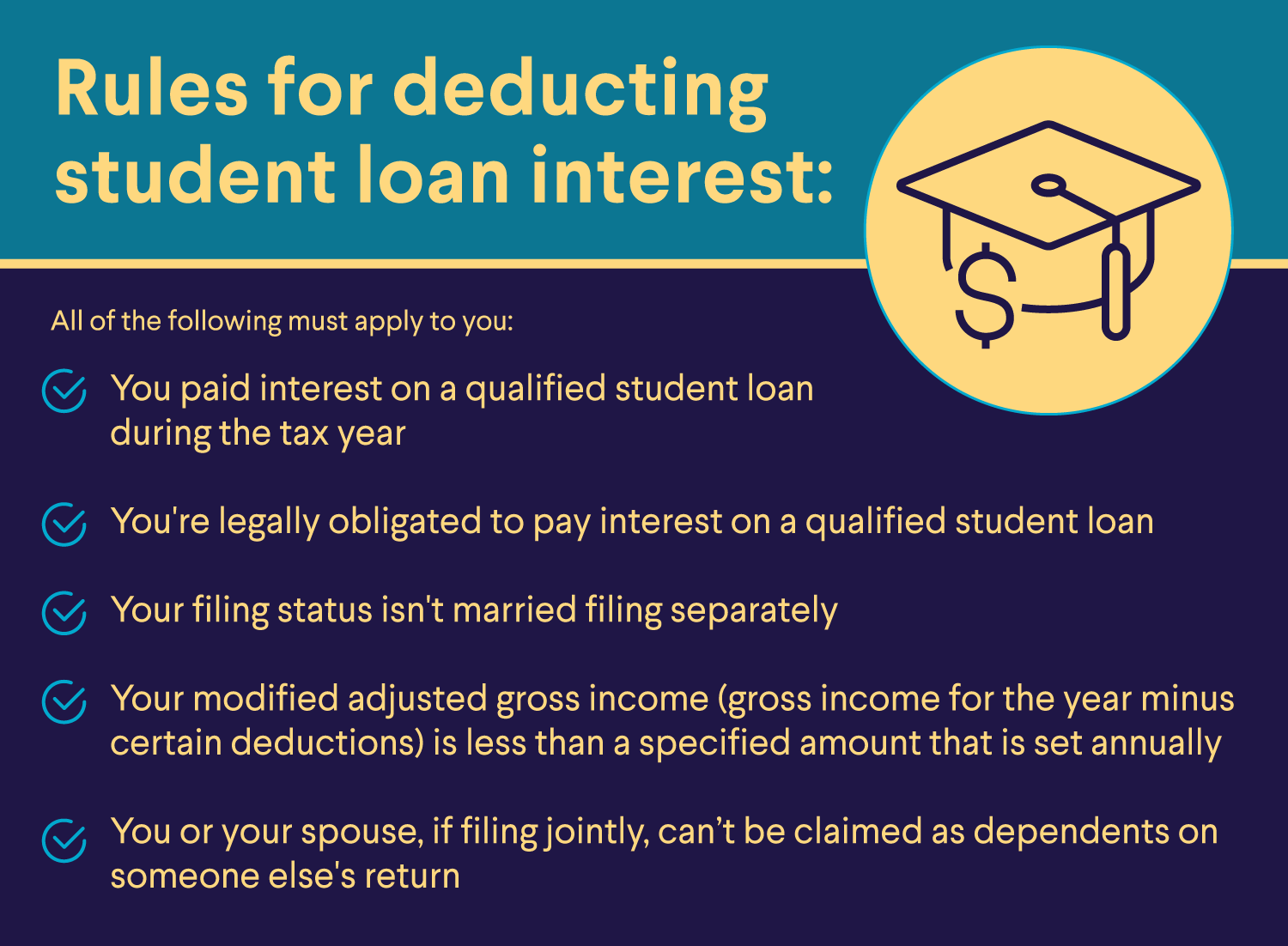
To be eligible to deduct student loan interest, individuals must meet the following requirements:

•   You paid interest on a qualified student loan (a loan for you, your spouse, or a dependent) during the tax year.

•   Your modified adjusted gross income (MAGI) is less than a specified amount that is set annually.

•   Your filing status is anything except married filing separately.

•   Neither you nor your spouse can be claimed as a dependent on someone else’s return.

•   You are legally required to pay the interest on a student loan.

The student loans in question can be federal or private student loans, as well as refinanced student loans.

What Are the Income Requirements for the Student Loan Tax Deduction?

The income requirements for the student loan tax deduction depend on your MAGI and your tax-filing status. The eligible MAGI ranges are typically recalculated annually.

For tax year 2024 (filing in 2025), the student loan interest deduction is worth up to $2,500 for a single filer, head of household, or qualifying widow/widower with a MAGI of $80,000 or less.

For those who exceed a MAGI of $80,000, the deduction begins to phase out. Once their MAGI reaches $95,000 or more, they are no longer able to claim the deduction.

For married couples filing jointly, the phaseout begins with a MAGI of more than $165,000, and eligibility ends at $195,000.

If you have questions about your eligibility, consider consulting a tax professional to make sure you can take advantage of the deduction.

When we say no required fees we mean it.
No late fees, & insufficient fund
fees when you take out a student loan with SoFi.


Other Tax Deductions for Students

In addition to the student loan interest rate deduction, there are other tax breaks that may be available to you if you’re a student, saving for college or paying for certain education expenses for yourself, a spouse, or a dependent. Here are three other tax benefits to consider:

529 Plans

A 529 college savings plan is a tax-advantaged plan that allows you to save for qualified education expenses — like tuition, lab fees, and textbooks — for yourself or your children. In 2025, you can contribute up to $19,000 per year without triggering gift taxes, and other family members can contribute to the fund, as well.

Savings can be invested and grow tax free inside the account. And while the federal government doesn’t offer any tax deductions, some states provide tax benefits like deductions from state income tax. Withdrawals must be used to cover qualified expenses; otherwise you will face income taxes and a 10% penalty.

American Opportunity Tax Credit

The American Opportunity Tax Credit (AOTC) helps offset $2,500 in qualified education expenses per student per year for the first four years of higher education. Unlike a tax deduction, tax credits reduce your tax bill on a dollar-for-dollar basis. And if the credit brings your taxes to zero, 40% of whatever remains of the credit amount can be refunded to you, up to $1,000.

To be eligible for the AOTC, you must be getting a degree or another form of recognized education credential. And at the beginning of the tax year, you must be enrolled in school at least half time for one academic period, and you cannot have finished your first four years of higher education at the beginning of the tax year.

Lifetime Learning Credit

The Lifetime Learning Credit (LLC) helps pick up where the AOTC leaves off. While the AOTC only lasts for four years, the LLC helps offset the expense of graduate school and other continuing educational opportunities. The credit can help pay for undergraduate and graduate programs, as well as professional degree courses that help you improve your job skills. The credit is worth $2,000 per tax return, and there is no limit to the number of years you can claim it. Unlike the AOTC, it is not a refundable tax credit.

To be eligible, you, a dependent, or someone else must pay qualified education expenses for higher education or pay for the expenses of an eligible student and an eligible educational institution. The eligible student must be yourself, your spouse or a dependent that you have listed on your tax return.

Look for Form 1098-E

If you’re wondering how to get the student loan interest deduction, keep an eye out for Form 1098-E, which you will need to file with your tax return. It will be sent out by your loan servicer or lender if you paid at least $600 in interest on your student loans for the tax year in question.

On Form 1098-E, your loan provider reports information on the interest you paid on your student loans throughout the year. The form goes out to student loan borrowers when the tax year ends, typically by mid-February. You can also check for the form on your loan servicer’s website and download a copy.

Note that you won’t receive this student loan tax form if you paid less than $600 in interest on your loan during the tax year.

Calculating Your Student Loan Interest Deduction

To figure out how much of a student loan interest deduction you can claim, start with your MAGI. If your MAGI is in the range to qualify for the full deduction, you’ll be eligible for $2,500 or the amount you paid in interest on your student loans during the tax year, whichever amount is less. (As you are calculating your MAGI, if you’re wondering, do student loans count as income, no, they do not.)

However, if your MAGI falls into the range where student interest deduction is reduced (which is more than $80,000 for single filers and $165,000 for joint filers in 2024), you can generally follow the instructions on the student loan interest deduction worksheet in Schedule 1 of Form 1040 to figure out the amount of your deduction when filing your federal income taxes. Then you can enter the calculated interest amount on Schedule 1 of the 1040 under “Adjustments to Income.”

One thing to note: For loans made before September 1, 2004, loan origination fees and/or capitalized interest may not be included in the amount of interest Form 1098-E says you paid. In this case, Box 2 on the form will be checked. If that applies to you, to calculate the full value of the interest deduction, start with the amount of interest the form says you paid, and then add any interest you paid on qualified origination fees and capitalized interest. Just make sure these amounts don’t add up to more than the total you paid on your student loan principal.

You can consult IRS Publication 970 for more information about how to do this, or consult a tax professional.

Common Mistakes to Avoid

Taking the student loan interest deduction can be somewhat complicated because there are a number of requirements involved. These are some common mistakes to watch out for.

•   Misreporting your income. Be sure to calculate your modified adjusted gross income (MAGI) correctly. It’s critical to use the right MAGI when determining if you are eligible for the student loan interest deduction and how much you can claim.

•   Deducting too much. The deduction is capped at $2,500 a year, no matter how much you paid in interest.

•   Deducting interest paid by someone else. If another person made some of your student loan payments for you — your parents, say — you cannot deduct the interest they paid. You can only deduct the interest you paid.

•   Failing to take the deduction. If you are eligible for the student loan interest deduction, be sure to take it. It can sometimes be easy to overlook this deduction in the hustle to get your tax information together.

Strategies to Reduce Student Loan Payments and Interest

Tax credits and deductions are one way to help cover some of the cost of school. Finding ways to lower your student loan payments is another cost-saving measure. Here are a few potential ways to do that.

•   Put money toward student loans by making additional payments to pay down your principal. Doing this may help reduce the amount of interest you owe over the life of the loan. Just make sure your loan does not have any prepayment penalties.

•   Make interest-only payments while you’re still in school on loans for which interest accrues, such as unsubsidized federal loans.

•   Find out if your loan provider offers discounts if you set up automatic payment. Federal Direct Loan holders may be eligible for a 0.25% discount when they sign up for automatic payments, for example.

•   Consider refinancing student loans. When you refinance, you replace your current student loan with a new loan that ideally has a lower interest rate or more favorable terms.

While there are advantages of refinancing student loans, such as possibly lowering your monthly payments, there are disadvantages as well. One major caveat: If you refinance federal loans, they are no longer eligible for federal benefits or protections. Also, you may pay more interest over the life of the loan if you refinance with an extended term. Weigh the options to decide if refinancing is right for you.

The Takeaway

Qualified student loan borrowers can take a student loan interest deduction of up to $2,500 annually. This applies to federal and private student loans as well as refinanced student loans.

You should get a form 1098-E from your loan servicer if you paid at least $600 in interest on your qualified student loans. Before you file for the deduction, make sure you qualify for it, and then figure out whether you are eligible for a full or partial deduction, based on your MAGI.

Whether you qualify for the student loan interest deduction or not, there are a number of ways to lower your monthly student loan payments, including putting additional payments toward your loan principal, signing up for automatic payments, and refinancing your student loans.

Looking to lower your monthly student loan payment? Refinancing may be one way to do it — by extending your loan term, getting a lower interest rate than what you currently have, or both. (Please note that refinancing federal loans makes them ineligible for federal forgiveness and protections. Also, lengthening your loan term may mean paying more in interest over the life of the loan.) SoFi student loan refinancing offers flexible terms that fit your budget.

With SoFi, refinancing is fast, easy, and all online. We offer competitive fixed and variable rates.

FAQ

How much student loan interest can I deduct?

The amount of student loan interest you can deduct is the lesser of up to $2,500 annually or the amount of interest you paid on your student loans. However, to qualify for the full deduction in 2024, you must have a MAGI of $80,000 or less if you are a single filer, or $165,000 or less if you are filing jointly. You will be eligible for a partial deduction if your MAGI is less than $95,000 for single filers and less than $195,000 for joint filers. Keep in mind that the MAGI limits typically change yearly.

Do I need to itemize my deductions to claim the student loan interest deduction?

No, you do not need to itemize your deduction to claim the student loan interest deduction. The deduction is considered an adjustment to your income, according to the IRS, so there is no need to itemize. You can simply report the amount on Form 1040 when you file your taxes, and include a copy of your Form 1098-E, which shows the student loan interest you paid for the tax year.

Can parents deduct student loan interest if they pay for their child’s loans?

Parents who pay for their child’s student loans can deduct student loan interest only if they are legally obligated to repay the loan — meaning that the loan is in their name or they are a cosigner of the loan. However, if the loan is in the child’s name only, parents cannot take the deduction, even if they paid for their child’s loans. The rules can be confusing, so parents may want to consult a tax professional.

What happens if I refinance my student loans?

Refinanced student loans are eligible for the student loan tax deduction as long as the refinanced loan was used for qualified education expenses and your MAGI falls within the set limits.

Are private student loans eligible for the student loan interest deduction?

Yes, private student loans are eligible for the student loan tax deduction, as are federal loans and refinanced loans. As long as you paid interest on a qualified student loan, your MAGI is less than the specified limit for the year, your filing status is anything except married and filing separately, and you (or your spouse if applicable) can’t be claimed as a dependent on someone else’s return, you are eligible for the deduction as a private student loan borrower.


SoFi Student Loan Refinance
Terms and conditions apply. SoFi Refinance Student Loans are private loans. When you refinance federal loans with a SoFi loan, YOU FORFEIT YOUR ELIGIBILITY FOR ALL FEDERAL LOAN BENEFITS, including all flexible federal repayment and forgiveness options that are or may become available to federal student loan borrowers including, but not limited to: Public Service Loan Forgiveness (PSLF), Income-Based Repayment, Income-Contingent Repayment, extended repayment plans, PAYE or SAVE. Lowest rates reserved for the most creditworthy borrowers.
Learn more at SoFi.com/eligibility. SoFi Refinance Student Loans are originated by SoFi Bank, N.A. Member FDIC. NMLS #696891 (www.nmlsconsumeraccess.org).

SoFi Loan Products
SoFi loans are originated by SoFi Bank, N.A., NMLS #696891 (Member FDIC). For additional product-specific legal and licensing information, see SoFi.com/legal. Equal Housing Lender.


Third-Party Brand Mentions: No brands, products, or companies mentioned are affiliated with SoFi, nor do they endorse or sponsor this article. Third-party trademarks referenced herein are property of their respective owners.

Non affiliation: SoFi isn’t affiliated with any of the companies highlighted in this article.

Tax Information: This article provides general background information only and is not intended to serve as legal or tax advice or as a substitute for legal counsel. You should consult your own attorney and/or tax advisor if you have a question requiring legal or tax advice.

Financial Tips & Strategies: The tips provided on this website are of a general nature and do not take into account your specific objectives, financial situation, and needs. You should always consider their appropriateness given your own circumstances.

Third Party Trademarks: Certified Financial Planner Board of Standards Center for Financial Planning, Inc. owns and licenses the certification marks CFP®, CERTIFIED FINANCIAL PLANNER®

External Websites: The information and analysis provided through hyperlinks to third-party websites, while believed to be accurate, cannot be guaranteed by SoFi. Links are provided for informational purposes and should not be viewed as an endorsement.

SOSLR-Q225-053

Read more
blue piggy bank with graduation cap

Paying for College: A Parent’s Guide

Many parents want to do whatever they can to help pay for their child’s higher education, which can be quite expensive. In-state education can add up to $108,584 for four years, and a private education can total $234,512 on average, according to figures from the Education Data Initiative.

Starting to plan and save early and consistently can be vital. But knowing how much to save and where to stash those funds, plus pay for any balance due, is equally important.

Need guidance? Here, what parents need to know about paying for their child’s college education.

Key Points

•   Many parents help their children pay for college and use methods such as automating savings and redirecting funds from no longer needed expenses to boost college savings.

•   Parents can open 529 plans for tax-free growth and withdrawals for qualified education expenses.

•   Coverdell ESAs have a $2,000 annual limit, grow tax-free, and are suitable for lower-income families.

•   UTMA/UGMA custodial accounts can be used for any expense benefiting a minor, with no contribution limits, though there are potential tax implications.

•   Federal and private student loans are options to help cover remaining costs, along with scholarships and grants.

How Much Will I Need to Save?

The answer to this question is subjective. Do you plan to try to cover 100% of your child’s college costs, or will you use student loans, if needed? Will your child likely qualify for need-based or merit-based aid? Might your high achiever be eligible for a college that meets some or all of their demonstrated need?

Also, think about your own financial picture. Have you carved out your retirement savings plan, created an emergency fund, and focused on paying down your own debt? It’s smart financial planning to get your house in order first, so you can save for your offspring’s college.

The cost of attendance, or “sticker price,” on every college website that estimates the total cost of a year of school can cause, well, sticker shock. But most students do not pay sticker price. They pay the net price, which is the sticker price minus scholarships, grants, and financial aid.

The College Board reports that the average published tuition and fees for full-time students for 2024-25 were:

•   Public four-year college, in-state student: $11,610

•   Public four-year college, out-of-state student: $30,780

•   Private nonprofit four-year college, any student: $43,350

Remember that the above numbers cite tuition and fees, not the total cost of attendance, which also includes the estimated annual cost of room and board, books, supplies, transportation, loan fees, miscellaneous expenses (including for a personal computer), and eligible study-abroad programs.

The upshot: Anticipating the cost of attendance of various colleges, your family’s eligibility for a merit scholarship, need-based aid, and borrowing tolerance can help you prepare.

If you put a number on a savings target, another key question is: How can I start saving for college?

What Are Some Strategies for Saving?

Here are a few options to consider:

Automating savings. You could set up automatic transfers to a designated college savings account, so you won’t even have to think about it. You can transfer from your checking account or, if it’s an option, opt to direct deposit a portion of your paycheck directly to your savings account.

Putting windfalls to work. Another way to boost savings comes from the planned and unplanned windfalls in life. Getting a tax refund or receiving an inheritance? Keeping an eye out for unexpected money can help you achieve your savings goals.

Pruning expenses. If you haven’t already trimmed your expenses, you can use the natural course of time to turn expenses into savings. For example, once your child no longer needs diapers, you can put that cost toward college savings. When they no longer need daycare, you could funnel what you were paying into your account. If piano lessons end, it’s yet another chance to increase how much you can save.

Finding scholarship matches. Once children get closer to high school graduation, you can help them find scholarships. FastWeb and Scholarships.com are two popular sites among many that will help you search for opportunities. Many allow you to set up a profile for your child that may include interests, intended majors, and even preferred schools — data points that will be used to help match your child with scholarships.

It’s usually more cost-effective to save than borrow, of course. Every dollar you borrow can cost you more than that dollar once you add interest.

Many parents use a mix of sources to fund their children’s education. For example, you could save a third of your target, pay a third during your child’s time in college, and borrow the last third with federal student loans and private student loans.

Which Savings Plan Is Right for Me?

If you have your target goal and a plan to make regular contributions, you’re ready to weigh which investment vehicles will fit your needs. Here are some common savings tools.

529 Plans

The 529 college savings plan is a tax-advantaged account to save for higher education costs, and it has become popular with parents saving for college. Anyone, even non-family members, can set one up and make contributions on behalf of a beneficiary. Some details:

•   Contributions to 529s are made with after-tax dollars, but they grow tax-free, and capital gains are tax-free as long as withdrawals are used to pay for qualified education expenses.

•   Any withdrawals that are not used for higher education expenses may be subject to penalties and taxes.

•   If your child doesn’t go to college, the funds still need to be spent on education to avoid taxes and penalties. But you have the ability to change the beneficiary of a 529 account to another family member.

This means that if your oldest child does not use the funds for college, you can change the beneficiary on the 529 to a sibling or even a family member in the next generation.

•   If your child receives a scholarship for college, you can withdraw the amount of the scholarship from the 529 plan penalty-free. If you decide to withdraw it for another purpose, you’ll pay a 10% penalty, plus regular income taxes.

•   Annual contributions to a 529 plan are not limited, but any amount you give the beneficiary will be part of your annual $19,000 gift tax exclusion for 2025. The IRS will let you (and your spouse, if you elect to split gifts) make five years of contributions at once without paying gift taxes.

•   Many states offer these plans, so you’ll want to start by finding out if your state offers any tax incentives to participate in your own state’s sponsored plan. If you discover that your state does not offer additional tax benefits for contributions, you can shop around for the lowest fees.

Then there are 529 prepaid tuition plans, offered by a dwindling number of states, that allow parents, grandparents, and others to prepay tuition and mandatory fees at today’s rates at eligible colleges and universities.

•   Currently, eight states offer them: Florida, Massachusetts, Michigan, Mississippi, Nevada, Pennsylvania, Texas, and Washington.

•   Most state prepaid tuition plans require you or your child to be a resident of the state offering the plan when you apply. Most allow the funding to be transferred to a sibling.

•   Qualified distributions from prepaid 529 plans are exempt from federal income taxes and might also be exempt from state and local taxes.

•   The Private College 529, not run by a state, offers guaranteed prepaid tuition at many participating colleges and universities, with no residency requirements.

Coverdell Education Savings Account

A Coverdell education savings account can also be used to pay for qualified education expenses.

The annual contribution limit is $2,000. Contributions are made with after-tax dollars, but they grow tax-free, and withdrawals for qualified expenses are tax-free.

The account is limited to certain incomes. The current limit is a modified adjusted gross income (MAGI) over $110,000 per person or $220,000 if filing jointly.

UTMA and UGMA Accounts

A Uniform Transfers to Minors Act (UTMA) or Uniform Gift to Minors Act (UGMA) custodial account can be set up to pay any expense that benefits a minor. Here’s more intel on how these work:

•   When your child reaches the age of majority, 18 or 21, depending on the state, they will be able to use the money for whatever they want, so many parents are wary of using these to plan for college. (However, the funds could become an investment plan for your child if they didn’t go to college.)

•   The flip side is your child won’t be limited to just paying for education expenses and can use the money for living arrangements, a car, or other necessary purchases.

•   There are no contribution limits for UTMA and UGMA accounts, and they can be funded with any combination of cash and investments. Annual gift tax exclusions apply.

•   Because contributions are made with after-tax dollars, there are no taxes on withdrawals, but there may be taxes on capital gains.

What About Student Loans?

Students can have access to scholarships and grants, which can help make college more affordable. In addition, your student may have to take out federal student loans to make it to graduation day. You can also shoulder some of the load.

Parent PLUS loans can be one way to help your child afford college. They are student loans offered by the U.S. Department of Education, and parents become the borrower. Currently, you can borrow up to the amount of education expenses not covered by other financial aid. For loans disbursed on or after July 1, 2026, you can borrow up to $20K per year, or $65K total per student. You may be able to qualify even if you don’t have a good credit history.

Parent PLUS loans have a fixed interest rate, currently 9.08%, with a typical term of 10 years that may be extended to 25 years with another repayment plan or up to 30 years if you consolidate. For loans disbursed on or after July 1, 2026, repayment terms will range from 10 to 25 years, depending on the loan balance. However, unlike federal student loans, Parent PLUS Loans come with a fairly high origination fee — it’s currently 4.228%.

Even with savings, federal student loans, grants, and scholarships, your child may still have unmet needs. Private student loans, offered by private lenders, are often used to fill those gaps.

•   Depending on your situation, student loan refinancing can also lower your monthly payment, especially if you qualify for a lower interest rate. Many online lenders consider a variety of factors when determining your eligibility and loan terms, including your educational background, earning potential, credit score, and other factors. However, if you’re lowering your monthly payment by extending your loan term, you may pay more interest over the life of the loan.

•   With private parent student loans, you take responsibility for the loan. Another option can be undergrad private student loans that allow a cosigner. If you cosign, you and the student are both responsible for the loan.

•   It’s important to know that federal student loans come with benefits, including income-driven repayment options and student loan forgiveness, that private lenders do not offer.

Recommended: Student Loans Guide

The Takeaway

Paying for a child’s college education involves two key things: saving early and consistently. Even so, most students will still end up borrowing student loans in order to pay for the many expenses of higher education.

Looking to lower your monthly student loan payment? Refinancing may be one way to do it — by extending your loan term, getting a lower interest rate than what you currently have, or both. (Please note that refinancing federal loans makes them ineligible for federal forgiveness and protections. Also, lengthening your loan term may mean paying more in interest over the life of the loan.) SoFi student loan refinancing offers flexible terms that fit your budget.

With SoFi, refinancing is fast, easy, and all online. We offer competitive fixed and variable rates.

FAQ

Is it a parent’s responsibility to pay for college?

Generally speaking, a parent does not have to pay for college — parents are not legally obligated to cover tuition, fees, and other college costs. (One exception: Some divorce and custody agreements may include college payment requirements that parents must abide by).
However, the Free Application for Federal Student Aid (FAFSA) calculates financial aid eligibility based on parental income. If parents are not paying for college, a student needs to meet stringent criteria to be considered an independent student to qualify for need-based financial aid. Students whose parents are not chipping in can also turn to scholarships, grants, work-study programs or student loans to help pay for school.

What is the best way to pay for college as a parent?

One of the best ways to help pay for college as a parent is to open a 529 savings plan, which is a tax-advantaged account. Contributions to the account are made with after-tax dollars and grow tax-free in the account. Capital gains are also tax-free as long as withdrawals are used for qualified education expenses.

What parent income disqualifies you for FAFSA?

There are no income limits to qualify for federal financial aid through the FAFSA. Anyone, no matter how much their parents make, can — and should — submit the FAFSA. The amount of money you are eligible to receive will vary based on your income, but you may still qualify for grants and loans.


SoFi Student Loan Refinance
Terms and conditions apply. SoFi Refinance Student Loans are private loans. When you refinance federal loans with a SoFi loan, YOU FORFEIT YOUR ELIGIBILITY FOR ALL FEDERAL LOAN BENEFITS, including all flexible federal repayment and forgiveness options that are or may become available to federal student loan borrowers including, but not limited to: Public Service Loan Forgiveness (PSLF), Income-Based Repayment, Income-Contingent Repayment, extended repayment plans, PAYE or SAVE. Lowest rates reserved for the most creditworthy borrowers.
Learn more at SoFi.com/eligibility. SoFi Refinance Student Loans are originated by SoFi Bank, N.A. Member FDIC. NMLS #696891 (www.nmlsconsumeraccess.org).

SoFi Private Student Loans
Please borrow responsibly. SoFi Private Student loans are not a substitute for federal loans, grants, and work-study programs. We encourage you to evaluate all your federal student aid options before you consider any private loans, including ours. Read our FAQs.

Terms and conditions apply. SOFI RESERVES THE RIGHT TO MODIFY OR DISCONTINUE PRODUCTS AND BENEFITS AT ANY TIME WITHOUT NOTICE. SoFi Private Student loans are subject to program terms and restrictions, such as completion of a loan application and self-certification form, verification of application information, the student's at least half-time enrollment in a degree program at a SoFi-participating school, and, if applicable, a co-signer. In addition, borrowers must be U.S. citizens or other eligible status, be residing in the U.S., Puerto Rico, U.S. Virgin Islands, or American Samoa, and must meet SoFi’s underwriting requirements, including verification of sufficient income to support your ability to repay. Minimum loan amount is $1,000. See SoFi.com/eligibility for more information. Lowest rates reserved for the most creditworthy borrowers. SoFi reserves the right to modify eligibility criteria at any time. This information is subject to change. This information is current as of 4/22/2025 and is subject to change. SoFi Private Student loans are originated by SoFi Bank, N.A. Member FDIC. NMLS #696891 (www.nmlsconsumeraccess.org).

SoFi Loan Products
SoFi loans are originated by SoFi Bank, N.A., NMLS #696891 (Member FDIC). For additional product-specific legal and licensing information, see SoFi.com/legal. Equal Housing Lender.


Third-Party Brand Mentions: No brands, products, or companies mentioned are affiliated with SoFi, nor do they endorse or sponsor this article. Third-party trademarks referenced herein are property of their respective owners.

Non affiliation: SoFi isn’t affiliated with any of the companies highlighted in this article.

Financial Tips & Strategies: The tips provided on this website are of a general nature and do not take into account your specific objectives, financial situation, and needs. You should always consider their appropriateness given your own circumstances.

Tax Information: This article provides general background information only and is not intended to serve as legal or tax advice or as a substitute for legal counsel. You should consult your own attorney and/or tax advisor if you have a question requiring legal or tax advice.

Third Party Trademarks: Certified Financial Planner Board of Standards Center for Financial Planning, Inc. owns and licenses the certification marks CFP®, CERTIFIED FINANCIAL PLANNER®

External Websites: The information and analysis provided through hyperlinks to third-party websites, while believed to be accurate, cannot be guaranteed by SoFi. Links are provided for informational purposes and should not be viewed as an endorsement.

SOSLR-Q225-048

Read more

Can Medical Bills Affect Your Credit Report?

A hospitalization or medical treatment can carry a price tag that packs a serious punch, with Americans owing an estimated $220 billion in healthcare debt.

If you’re among those unable to pay medical bills, insult can get added to injury in the form of damage to your credit score. That’s because once a medical bill becomes delinquent, many hospitals and individual medical providers will send it to collections.

Even though unpaid medical bills might affect your credit report, there are steps to take to potentially lessen the impact.

Key Points

•   Unpaid medical bills can negatively impact your credit if sent to collections.

•   Bills typically become delinquent after 60-120 days of non-payment.

•   Paid medical collections are removed from credit reports, positively impacting scores.

•   Medical debt under $500 is not reported to credit bureaus.

•   Manage medical debt by setting up payment plans, reviewing and correcting insurance claims, and considering a personal loan.

Do Medical Bills Hurt Your Credit?

Unpaid doctor or hospital bills typically don’t automatically hurt your credit score. Because most health care providers do not report to the credit bureaus, medical debt would have to get sent to collections in order to eventually appear on your credit report and have a potential effect on your credit score. The point at which medical providers will sell the debt to a collection agency is after it’s 60 to 120 days past due, depending on the provider.

The Consumer Financial Protection Bureau (CFPB) has been working to lessen the impact of medical debt on credit. As things currently stand, the three credit bureaus — Experian®, Equifax®, and TransUnion® — have set a one-year waiting period from the date of service until the medical debt is included on a consumer’s credit report. This is intended to make sure there’s enough time to solve any disputes with insurers and allow for delays in payment.

The three major credit bureaus also no longer include unpaid medical bills in collections on a person’s credit report if the amount owed is less than $500. And in even better news, medical debt that was in collections but is now paid off isn’t included on credit report (usually, collections accounts take seven years to drop off a report).

On top of all that, some scoring models don’t weigh medical debt as heavily as they do other types of debt when calculating credit scores. In fact, some models may exclude unpaid medical debt entirely. So while medical bills can affect your credit, the effect might not be as drastic as other types of unpaid debt.

As of mid-2025, the courts were weighing whether other guidelines about medical debt and credit would be enacted. It can be wise to research whether new rules have gone into effect if you are dealing with this kind of debt.

Can Medical Bills Be Removed From My Credit Report?

Unlike other types of debt, medical collections debt will no longer appear on your credit report once it is paid. Unpaid medical debt, however, can appear on your credit report for up to seven years if it remains unpaid. Fortunately, as time goes by, the account in collections counts less toward your credit scores.

If your bill was sent to collections by mistake, you may be able to have it removed by proving the error. Collect as much evidence as you can to make your case, such as credit card or checking account statements. You also might ask for payment records from your medical provider’s billing office.

You can file a dispute with the credit bureau that’s reporting the error. The credit bureau will then investigate and respond to you within 30 days. You may also receive email updates from the credit bureau regarding the status of your dispute.

Does Paying Off Medical Collections Improve Credit?

If you pay off medical collections debt, it will get removed from your credit report, which will have a positive impact on your credit score, and potentially a significant one. This is a recent change — previously, paid medical collections debt remained on credit reports for up to seven years.

One option to explore if you’re seeking to pay off your medical collections debt and thus get it removed from your credit report is to get your health insurance company to pay the debt. If you have reason to believe your insurance company should have paid a medical bill, ask your insurer to reconsider your insurance claims.

What to Do if You Can’t Pay Your Medical Bills

If the balance on your medical bill is your financial responsibility, but you’re unable to pay it, there may be ways to relieve your medical debt. Here are some options to consider:

•   Ask the medical provider to set up a payment plan. Discuss this option with your medical provider to find a plan that is manageable with your monthly budget.

•   Review your explanation of benefits the insurance company provides. Look out for billing errors or consider negotiating some of the medical charges, both of which could lower the total amount due.

•   Consider getting a temporary part-time job. This may help bring in extra income that you can put toward the medical debt.

•   Get assistance from a patient advocate. This might be an option worth considering if you can’t get the provider to budge on the payment.

•   Apply for a personal loan. Medical debt is one of the common uses for personal loans. If you can secure a personal loan that has a lower interest rate than credit cards, this may offer another option for payment.

   You may see these loans called medical loans. And note that your personal loan approval and the interest rate you’re offered on the loan will depend on your credit record and other factors.

Recommended: How to Get Approved for a Personal Loan

Being Proactive About Medical Bills

Just because you made your copay at the doctor’s office doesn’t necessarily mean the bill is settled. Additionally, the fact that the provider has billed your health insurance company doesn’t automatically mean the amount will be accurate or even paid.

•   If you haven’t received a statement from your medical provider’s billing office within a few weeks of your appointment or hospital stay, it might be a good idea to call for a billing update. Catching errors early in the billing process can help keep medical bills off your credit report and in turn, prevent medical bills from affecting your credit score.

•   If you know ahead of time that you won’t be able to pay the entire amount owed, contacting the provider’s billing office and trying to negotiate a payment plan may be a good first step. If you can come to an agreement, it’s a good idea to get it in writing. If you can’t reach an agreement, start exploring other options, making sure to weigh the pros and cons and crunch the numbers, such as with a personal loan calculator.

•   Should a collection agency employee contact you about a bill that you think has been paid or should have been paid by insurance, stay calm. Ask if you can call back with information that shows there’s no open balance.

The Takeaway

If you have unpaid medical bills on your credit report, focusing on getting them paid has the potential to make a real difference in your financial future. Staying on top of medical bills can mean extra vigilance, but the effort is worth it to keep medical debt from affecting your credit. You might work out a payment plan or take out a personal loan when medical debt is too high to pay out of pocket.

Think twice before turning to high-interest credit cards. Consider a SoFi personal loan instead. SoFi offers competitive fixed rates and same-day funding. See your rate in minutes.


SoFi’s Personal Loan was named a NerdWallet 2026 winner for Best Personal Loan for Large Loan Amounts.

FAQ

Can medical debt ruin your credit?

Yes, medical bills can negatively impact your credit if they are turned over to collections, but there are recent changes to how they’re reported. While unpaid medical bills can be sent to collections and potentially affect your credit score, once paid, they come off your report. Also, the three major credit bureaus no longer include medical debt under $500 on credit reports.

Do medical bills fall off after 7 years?

Unpaid debts that are in collection typically stay on your credit report for seven years. However, if you pay medical debt that’s gone to collection, it is treated differently. It comes off your credit report.

Can you ignore medical debt?

It’s not wise to ignore medical debt or any debt, for that matter. Unpaid debt can accrue interest and penalties and can be put into collection, which can harm your credit score. It can be a good idea to talk to your medical provider about negotiating your bill or setting up a payment plan if you cannot pay your debt. Or you might consider a personal loan.


SoFi Loan Products
SoFi loans are originated by SoFi Bank, N.A., NMLS #696891 (Member FDIC). For additional product-specific legal and licensing information, see SoFi.com/legal. Equal Housing Lender.


*Awards or rankings from NerdWallet are not indicative of future success or results. This award and its ratings are independently determined and awarded by their respective publications.

Disclaimer: Many factors affect your credit scores and the interest rates you may receive. SoFi is not a Credit Repair Organization as defined under federal or state law, including the Credit Repair Organizations Act. SoFi does not provide “credit repair” services or advice or assistance regarding “rebuilding” or “improving” your credit record, credit history, or credit rating. For details, see the FTC’s website .

Financial Tips & Strategies: The tips provided on this website are of a general nature and do not take into account your specific objectives, financial situation, and needs. You should always consider their appropriateness given your own circumstances.

Third-Party Brand Mentions: No brands, products, or companies mentioned are affiliated with SoFi, nor do they endorse or sponsor this article. Third-party trademarks referenced herein are property of their respective owners.

SOPL-Q225-106

Read more
mother and daughter

Guide to Parent Student Loans

Weighing your child’s college education against keeping your own debt manageable is a tough balancing act. Parent student loans could help you fill gaps when other student aid falls short.

There are a variety of student loans available to parents who are interested in helping their child pay for college. Parents can consider either federal or private student loans. Parent PLUS Loans are federal student loans available to parents. Private lenders will likely have their own loans and terms available for parent borrowers.

Figuring out how to fund your child’s education is a personal decision. Read on for an overview of the different loan types available to parents and some important considerations to make before borrowing money to pay for your child’s education.

Key Points

•   Parents can choose between federal Parent PLUS Loans and private student loans to finance education.

•   Federal Parent PLUS Loans have a fixed interest rate and cover the full cost of attendance.

•   Private loans may offer better rates for good credit but lack federal protections.

•   Assess the impact of parent student loans on retirement savings and credit scores before borrowing.

•   PLUS Loans offer deferment and consolidation options, while private loans vary by lender.

Types of Parent Student Loans

Parent borrowers can consider borrowing a federal student loan or private student loan. Here are a few of the different types of loans to consider.

Parent PLUS Loans

Parent PLUS Loans are federal student loans that are available to parents of dependent undergraduate students through the Department of Education. They offer fixed interest rates — 8.94% for the 2025-2026 academic year. On the plus side, eligible parents can borrow up to the attendance costs of their child’s school of choice, minus other financial aid.

The amount eligible parents can borrow is not limited otherwise, so this can be a useful loan to fill in whatever tuition gaps aren’t covered by other sources of funding. These loans also provide flexible repayment options, such as graduated and extended repayment plans, as well as deferment and forbearance.

As far as federal loans go, interest rates on Parent PLUS Loans are relatively high. So, it may be worth considering having your child take out other federal loans that carry lower interest rates. Parent PLUS Loans also come with a relatively high origination fee of 4.228% for the 2025-2026 academic year.

Applying for Parent PLUS Loans

To apply for a Parent PLUS Loan, parents will have to fill out the Free Application for Federal Student Aid, or FAFSA®. In addition to the FAFSA, there is a separate application form for Parent PLUS Loans . Most schools accept an online application. For any questions, contact the school’s financial aid office.

Unlike other federal student loans, there is a credit check during the application process for Parent PLUS loans. One of the eligibility requirements is that borrowers not have an adverse credit history. However, parents who do not qualify for a Parent PLUS Loan due to their credit history, may be able to add an endorser in order to qualify. An endorser is someone who signs onto the loan with the borrower and agrees to make payments on the loan if the borrower is unable to do so.

Repaying a Parent PLUS Loan

​​PLUS Loan terms are limited to 10 to 25 years, depending on the chosen repayment plan, and do not offer income-driven repayment plans like other federal loans do (although they become eligible for the Income-Contingent Repayment Plan if they are consolidated through a Direct Consolidation Loan).

Parents have the option of requesting a deferment if they do not want to make payments on their PLUS loan while their child is actively enrolled in school. If a parent does not request deferment, payments will begin as soon as the loan is disbursed.

Keep in mind that interest will continue to accrue during periods of deferment, so deferring payments while your child is in school may increase the overall cost of borrowing the loan.

Private Parent Student Loans

In some cases, it might make sense to turn to private lenders for student loans. If you have a solid credit history (among other factors), you may be able to secure a reasonable interest rate.

Recommended: Private vs. Federal Student Loans

Before taking on a private student loan, here are some things to be aware of:

•   Always read the fine print.

•   Origination fees will vary from lender to lender.

•   There may not be flexible repayment options, and private loans typically don’t offer deferment or forbearance options the way federal loans do.

•   The amount you may qualify to borrow will likely vary.

The application process for private parent student loans will likely differ based on the individual lenders. Repayment terms and options will also generally vary by lender.

Keep in mind that private student loans don’t offer the same borrower protections, like deferment options, as federal student loans. For this reason, they are typically borrowed after other options, like savings, federal student loans, and scholarships, have been exhausted.

💡 Quick Tip: New to private student loans? Visit the Private Student Loans Glossary to get familiar with key terms you will see during the process.

Named a Best Private Student Loans
Company by U.S. News & World Report.


Cosigning Private Student Loan for Your Child

Cosigning a private student loan with your child means that you both have skin in the game. Cosigning a loan typically means each party is equally responsible for the debt. So if your child stops paying, you’re still on the hook for all of the debt.

Most college-age students have had little chance to build their own credit, so having parents — with better, or at least longer, financial histories — as cosigners might mean a better rate than if they applied on their own.

Parents can work out a plan in which both parents and children make payments, or it may even make sense to have a cosigned loan on which only the child makes payments.

Considerations Before Borrowing a Parent Student Loan

As a parent, of course you want the best for your child and to help them in any way you can. Whether or not you decide to take out a student loan to put your child through school is a decision to weigh carefully.

Your choice will likely have a lot to do with your own financial situation. Consider how taking out student loans may affect your own financial goals, especially retirement.

Staying on track for retirement requires a concerted effort during your earning years. That is in part because it can be more difficult to borrow money to cover your retirement expenses when you’re retired, because you will no longer be earning an income to help you pay back borrowed money.

So, before taking on student debt for your children, you’ll probably want to make sure you’re saving enough for your own future. After all, your children likely have decades of potential earnings after they graduate, during which time they can work to pay off their student loans. You, on the other hand, may not have as much time to pay off new debts and save for other goals.

It may also be worth considering how taking on new debt could affect things like your credit score and your debt-to-income ratio. Lenders consider these factors, among others, when deciding whether to loan you money.

That said, if you feel you are financially strong enough to take on student loans for your child, there are a number of loan options available to you. You may even want to consider refinancing student loans you have if you can qualify for a lower interest rate or more favorable terms.

When you refinance student loans, you replace your existing loans with a new loan from a private lender. If you get a lower interest rate, you may save money on interest over the life of the loan. While it’s possible to refinance both federal and student loans, it’s important to be aware that refinancing federal loans makes them ineligible for federal benefits like income-driven repayment plans and deferment.

The Takeaway

Parent student loans can be borrowed by a student’s parents and used to help pay for educational expenses like tuition. Before borrowing a federal or private parent student loan, parents should evaluate their own financial situation and goals, such as retirement savings.

Looking to lower your monthly student loan payment? Refinancing may be one way to do it — by extending your loan term, getting a lower interest rate than what you currently have, or both. (Please note that refinancing federal loans makes them ineligible for federal forgiveness and protections. Also, lengthening your loan term may mean paying more in interest over the life of the loan.) SoFi student loan refinancing offers flexible terms that fit your budget.

With SoFi, refinancing is fast, easy, and all online. We offer competitive fixed and variable rates.

FAQ

Do parents who make $120,000 still qualify for the FAFSA?

There are no income limits to qualify for federal financial aid through the FAFSA. Students, regardless of how much their parents make, should submit the FAFSA. The amount of money the student is eligible to receive will vary based on income, but you may still qualify for certain types of federal aid, including grants and loans.

What are the disadvantages of Parent PLUS loans?

Disadvantages of Parent PLUS loans include the fact that they have relatively high interest rates — 8.94% for the 2025-26 school year (compared to 6.39% for federal Direct loans for undergraduate students). Also, unlike other federal student loans, Parent PLUS loans involve a credit check in order to qualify. Finally, these loans are not eligible for income-driven repayment plans.

What disqualifies you from a Parent PLUS loan?

One thing that could disqualify you for a Parent PLUS loan is if you have an adverse credit history. These loans stipulate that you must not have an adverse credit history in order to be eligible.

However, if your application is denied because of this, you still have options. For example, you could get an endorser who agrees to pay back the loan if you can’t. You can also file an appeal to ask for another review of your application. With either of these options, you will also have to complete PLUS Credit Counseling, which takes about 20 to 30 minutes and can be done online at the Federal Student Aid website.


SoFi Student Loan Refinance
Terms and conditions apply. SoFi Refinance Student Loans are private loans. When you refinance federal loans with a SoFi loan, YOU FORFEIT YOUR ELIGIBILITY FOR ALL FEDERAL LOAN BENEFITS, including all flexible federal repayment and forgiveness options that are or may become available to federal student loan borrowers including, but not limited to: Public Service Loan Forgiveness (PSLF), Income-Based Repayment, Income-Contingent Repayment, extended repayment plans, PAYE or SAVE. Lowest rates reserved for the most creditworthy borrowers.
Learn more at SoFi.com/eligibility. SoFi Refinance Student Loans are originated by SoFi Bank, N.A. Member FDIC. NMLS #696891 (www.nmlsconsumeraccess.org).

SoFi Private Student Loans
Please borrow responsibly. SoFi Private Student loans are not a substitute for federal loans, grants, and work-study programs. We encourage you to evaluate all your federal student aid options before you consider any private loans, including ours. Read our FAQs.

Terms and conditions apply. SOFI RESERVES THE RIGHT TO MODIFY OR DISCONTINUE PRODUCTS AND BENEFITS AT ANY TIME WITHOUT NOTICE. SoFi Private Student loans are subject to program terms and restrictions, such as completion of a loan application and self-certification form, verification of application information, the student's at least half-time enrollment in a degree program at a SoFi-participating school, and, if applicable, a co-signer. In addition, borrowers must be U.S. citizens or other eligible status, be residing in the U.S., Puerto Rico, U.S. Virgin Islands, or American Samoa, and must meet SoFi’s underwriting requirements, including verification of sufficient income to support your ability to repay. Minimum loan amount is $1,000. See SoFi.com/eligibility for more information. Lowest rates reserved for the most creditworthy borrowers. SoFi reserves the right to modify eligibility criteria at any time. This information is subject to change. This information is current as of 4/22/2025 and is subject to change. SoFi Private Student loans are originated by SoFi Bank, N.A. Member FDIC. NMLS #696891 (www.nmlsconsumeraccess.org).

SoFi Loan Products
SoFi loans are originated by SoFi Bank, N.A., NMLS #696891 (Member FDIC). For additional product-specific legal and licensing information, see SoFi.com/legal. Equal Housing Lender.


Third-Party Brand Mentions: No brands, products, or companies mentioned are affiliated with SoFi, nor do they endorse or sponsor this article. Third-party trademarks referenced herein are property of their respective owners.

Non affiliation: SoFi isn’t affiliated with any of the companies highlighted in this article.

Financial Tips & Strategies: The tips provided on this website are of a general nature and do not take into account your specific objectives, financial situation, and needs. You should always consider their appropriateness given your own circumstances.

Third Party Trademarks: Certified Financial Planner Board of Standards Center for Financial Planning, Inc. owns and licenses the certification marks CFP®, CERTIFIED FINANCIAL PLANNER®

External Websites: The information and analysis provided through hyperlinks to third-party websites, while believed to be accurate, cannot be guaranteed by SoFi. Links are provided for informational purposes and should not be viewed as an endorsement.

SOSLR-Q225-050

Read more
TLS 1.2 Encrypted
Equal Housing Lender