Businesswoman Using Her Phone Standing At Office

How Do You Cash Out Stocks? Guide to Selling Stocks

Cashing out stocks essentially means selling them, and most investors should be able to sell their stocks without too much trouble. Buying stocks can be fairly straightforward, whether online or through a financial advisor. But, when it’s time to sell shares, some beginning investors struggle with how to turn their stocks back into cash. After all, money invested in stocks is not immediately cash.

Investors may want to sell stocks for a wide variety of reasons. They might wish to reinvest the cash into another asset with an eye toward long-term gains. Or they could choose to withdraw funds from the stock market to cover short-term, daily expenses with cash earned from the sale. So, how might investors go about cashing out stocks? And, what factors might individuals curious about how to cash out stocks bear in mind? Here’s an overview of the how and when of selling stocks.

Key Points

  • Stocks can be cashed out by selling them through a broker on a stock exchange.
  • Selling stocks can provide cash for major expenses or to reinvest in other assets.
  • Steps to cash out stocks include determining investment goals, accessing a brokerage account, placing a sell order, waiting for the sale to be completed, and receiving the proceeds.
  • Motivations for selling stocks include accessing cash for expenses, cashing out profits, preventing significant losses, day trading, and offloading low-performing stocks.
  • Types of sell orders include market orders, limit orders, stop orders, and trailing sell stop orders.

Can You Cash Out Stocks?

Investors can cash out stocks by selling them on a stock exchange through a broker. Stocks are relatively liquid assets, meaning they can be converted into cash quickly, especially compared to investments like real estate or jewelry. However, until an investor sells a stock, their money stays tied up in the market.

What Happens When You Sell a Stock?

When you sell a stock for a higher price than you paid, the proceeds from the sale will include your original investment plus your gains and minus any fees. If you sold your stock at a lower price than you paid, your total return will be less than your original investment (depending on how much of an overall loss you’re taking), minus any fees. So, you can have either a positive or negative return.

How to Sell Stocks: 5 Steps

There are several steps involved in selling stocks, including the following:

1. Determine Your Investment Goals

Consider why you want to sell your stocks and whether it aligns with your overall investment goals.

2. Access Your Brokerage Account

You need to access or log in to your brokerage account to sell your stocks.

3. Place an Order to Sell your Stocks

Once you’re logged into your brokerage account, you can place a sell order (like the orders outlined below) to sell your stocks. You can choose to sell at a specific price or through a market order, which will sell the stocks at the current market price.

4. Wait for the Sale to be Completed

After placing an order to sell your stocks, you will need to wait for the sale to be completed. This can take anywhere from a few seconds to several days, depending on market conditions and the type of order you have placed.

5. Receive the Proceeds From the Sale

After the sale is completed, the proceeds from the sale will be deposited into your brokerage account or sent to you in the form of a check.

Motivations for Selling Stocks

Some investors watch their portfolios closely, selling stocks regularly to cash out profits or avoid significant losses.

However, one common reason investors decide to sell stocks is that they need the cash from the investments to pay for living expenses. While different investors might sell for various reasons, it can be helpful to understand the motivation that drives the desire to sell.

So, why might investors want to cash out stocks? Some common reasons could include the following:
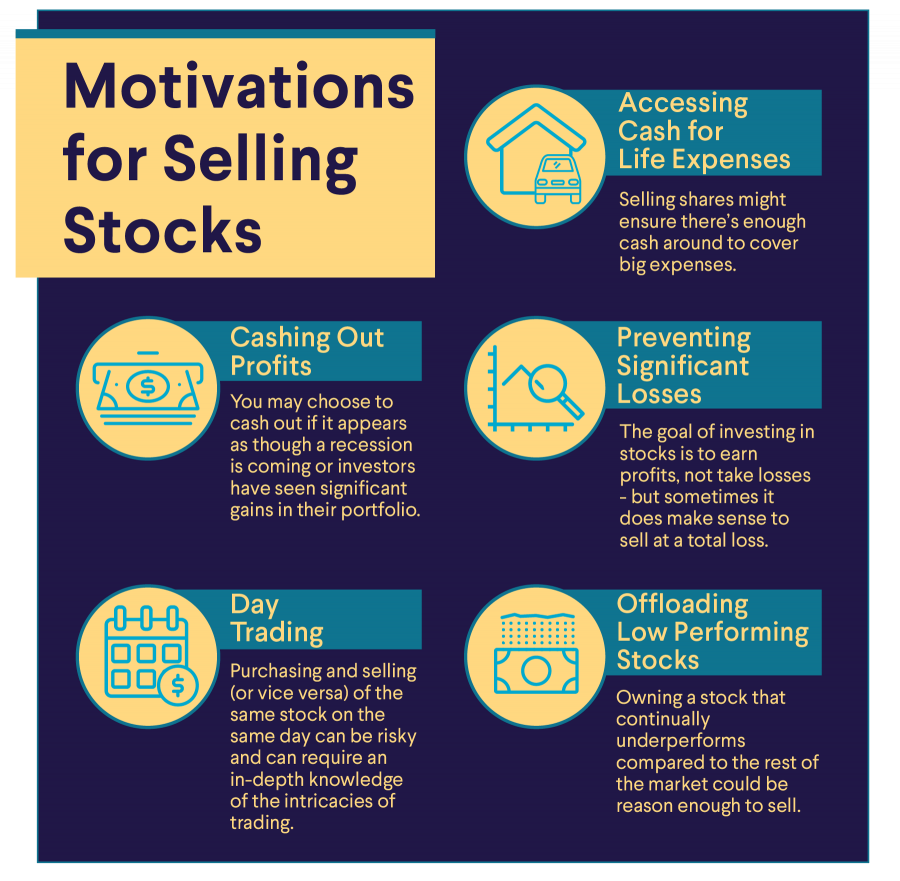
Motivation for Selling Stocks

Accessing Cash for Life Expenses

If investors know they’ll need cash for a major life expense, such as buying a car or home, they may choose to cash out some stocks. Selling shares might ensure there’s enough cash around to cover big expenses.

One benefit to having cash on hand instead of having money invested in stocks is that cash is not subject to the ups and downs of the stock market. However, the value of cash is impacted over time by inflation.

Some investors might also opt to move money out of stocks into potentially more secure investments, such as bonds or a money market account, until they’re ready to pay for that large expense.

Cashing Out Profits

If it appears as though a recession is coming or investors have seen significant gains in their portfolio, they might choose to cash out to lock in the profits. It’s important to understand, however, that attempting to time the stock market to avoid losses during unstable economic conditions is risky. What seems to be a trend in the market one day may or may not indicate how the markets may perform in the future.

Investors may want to ask themselves whether they’re interested in cashing out based on an emotional reaction (fear of recent market ups and downs, for instance) or a need for profits.

Preventing Significant Losses

The goal of investing in stocks is to earn profits or generate a positive return – online investing, or otherwise – is to not take losses. Still, there are some instances in which it could make sense to sell at a loss.

For example, an investor may sell specific stock holdings to prevent the likelihood of deeper losses in the future. Another scenario that might drive an investor to want to sell stocks is an industry-wide hardship, where numerous companies in one sector of the economy experience financial calamity at the same time. Industry-wide hardships may negatively impact the value of specific stock holdings.

In other instances, a company might reduce or eliminate shareholder dividends. Earning dividends may be a prime reason an investor bought the stock in the first place, so they decide to sell the stock because it’s no longer part of their investment strategy.

Day Trading

Day trading is one way of selling stocks, but it can involve significant risks. Day trades are the purchasing and selling (or vice versa) of the same stock on the same day. Here, traders are attempting to gain profit through short-term trades — typically through the use of technical or market analyses, which can require an in-depth knowledge of the intricacies of trading.

If it were possible to clearly predict future stock movements, everyone might want in on the stock market. But, stocks are volatile. Rather than guessing based on company news and technical indicators, traders who wish to make shorter term trades might choose to set a price goal. For instance, if they buy shares at $10 each, they could set a goal to sell them when they reach $18 per share.

Offloading Low Performing Stocks

Even if investors conduct thorough research on a company before buying a stock, they may later realize it wasn’t a boon for their portfolio. If a purchased stock continues to decline in value over time, investors may opt to offload the low-performing stock.

Also, some investors sell low-performing stocks at the end of the year for tax-loss harvesting, where investors sell investments at a loss to reduce their overall tax burden.

What Are the Different Types of Sell Orders?

Once an investor has decided to cash out a stock, there are several options for how to sell. Each comes with different amounts of control over the sale. Here’s an overview of the most common types of sell orders:

Types of Sell Orders

Market Orders

When placing a market order, an investor agrees to sell their shares at the current market price per share. The sell order will be placed immediately or when the market reopens if the order is placed after hours.

One upside of market orders is that the trade can usually be executed quickly. A downside is that the investor has no control over the selling price.

Limit Orders

With a limit order, however, an investor can set the minimum price they are willing to sell their shares for. The sell order only gets executed if and when the stock reaches that price or higher.

For example, if you want to sell a stock currently trading at $50 per share and place a sell limit order at $55, the order will only be filled if the stock price rises to $55 or above.

The upside of limit orders is that investors can control the selling price (and potentially get a higher price than the current market rate). But, one possible downside is that their order won’t go through instantly and, potentially, might never go through (if the stock doesn’t reach the selected price).

Stop Orders or Stop-Loss Orders

A stop-loss order is placed with a brokerage to automatically sell a security when it reaches a specific price, known as the stop price. The reason investors set stop orders is to prevent incurring significant losses if a stock plummets in value.

For example, if you own a stock currently trading at $50 per share and place a stop-loss order at $40, the order will be triggered, and the stock will be sold if the price falls to $40 or below.

The upside of stop orders is that they can help protect against significant losses if the stock price drops unexpectedly (but not guarantee that you’ll avoid them). However, stop-loss orders do not guarantee a specific price, and the actual sale price may differ from the stop price due to market fluctuations.

Trailing Sell Stop Orders

Investors may also choose to place a trailing sell stop order, which allows you to set a stop price for a security that adjusts automatically as the price of the security moves in your favor.

With a trailing sell stop order, you can set the initial stop price at a certain percentage or dollar amount below the market price. The stop price will then adjust automatically as the market price of the security increases so that the stop price remains a fixed percentage or dollar amount below the market price. If the market price of the security then falls and reaches the stop price, the order will be triggered, and the security will be sold.

Trailing sell stop orders may allow traders to benefit from gains when a stock’s price rises while still protecting themselves from potential losses.

Factors to Assess When Selling and Cashing Out Stocks

There are several factors that you should consider when cashing out stocks:

  • Capital gains taxes: Cashing out stocks may result in capital gains, which are subject to taxes. It is important to consider the tax implications of cashing out stocks. Not all stock holdings are taxed similarly, which could impact an investor’s decision to sell or not to sell.
  • Investment goals: Consider why you are cashing out stocks and whether it aligns with your overall investment goals. If you are cashing out stocks to meet a short-term financial need, selling may be necessary even if the stock price is not optimal. However, if you are cashing out stocks as part of a long-term investment strategy, it may be worth holding onto the stocks, even if they’ve declined in price, because they may still appreciate over time.
  • Fees and commissions: Brokerage firms generally charge investment fees and commissions for executing trades, which can impact the overall profit or loss on the sale of your stocks. Considering these fees and commissions is important when deciding whether to cash out stocks.

Pros and Cons of Reinvesting Profits

Investors may choose to sell stocks to gain or spend cash. But, individuals may want to reinvest earnings from the stocks sold into other assets. If investors decide to reinvest their profits, they need to consider the advantages and disadvantages of doing so.

Pros

  • Compound growth: Reinvesting stock profits allows you to compound your returns on your investments, which may significantly increase your overall returns over time.
  • Diversification: Reinvesting stock profits can help you diversify your portfolio and reduce risk by investing in various stocks rather than holding a lot of cash.
  • Hedge against inflation: Cash is subject to inflation, which makes cash savings lose value over time. Over a long-term period, cash tends to lose value, whereas the stock market tends to grow. By reinvesting rather than holding on to cash, investors may be less likely to lose money due to inflation.

Recommended: 5 Tips to Hedge Against Inflation

Cons

  • Opportunity cost: Reinvesting stock profits means that you are not using the proceeds from the sale of your stocks to meet other financial goals or needs, such as paying off debt or saving for a down payment on a house.
  • Taxes: Reinvesting stock profits may result in capital gains tax, which can reduce the overall returns on your investments.
  • Market risk: The value of your investments can fluctuate due to market conditions, and reinvesting stock profits means you are exposed to the risks of the stock market.

Platforms for Buying and Selling Stocks

People just getting started with building a portfolio of stocks have several options. Options might include online platforms or traditional phone-in and in-person traders, including:

Online Brokerage Accounts

There are numerous online brokerage accounts and digital apps where investors can buy and sell stocks to build a portfolio. Online brokerage accounts and apps can be a convenient investment method, allowing users to sell from anywhere. Unlike many traditional brokerage firms, many trading apps don’t charge a commission on trades.

Opening a brokerage account will require identity verification and connection with a bank account for deposits and withdrawals.

Financial Advisors

Investors can also make stock trades over the phone or in person by working with a financial advisor. Sell orders placed through these individuals generally get executed within 24 hours, so it can be a slower method to cash out stocks. Before the arrival of web-driven trading, most stocks were bought and sold through traditional investment brokers or financial advisors.


Test your understanding of what you just read.


The Takeaway

Before selling any stocks, investors might opt to evaluate their short- and long-term financial goals. Then, they could devise a plan to pursue those objectives, which may lead to cashing out stock holdings. However, knowing when to sell a stock can take time and effort. Rather than trying to time the market and sell stocks to lock in immediate profits and avoid future losses, individuals may want to invest for the long term.

Invest in what matters most to you with SoFi Active Invest. In a self-directed account provided by SoFi Securities, you can trade stocks, exchange-traded funds (ETFs), mutual funds, alternative funds, options, and more — all while paying $0 commission on every trade. Other fees may apply. Whether you want to trade after-hours or manage your portfolio using real-time stock insights and analyst ratings, you can invest your way in SoFi's easy-to-use mobile app.

Opening and funding an Active Invest account gives you the opportunity to get up to $1,000 in the stock of your choice.¹

FAQ

How long does it take to cash out stocks?

The time it takes to cash out stocks can vary depending on the type of order you place and market conditions. Generally, it can take anywhere from a few seconds to several days for a sale of stocks to be completed.

Do you get money when you sell stock?

Yes, you will receive money when you sell stock, as long as its value is more than $0. The proceeds from the stock sale will be deposited into your brokerage account or sent to you in the form of a check. The amount of money you receive will depend on the price you sell the stock and any fees or commissions charged by the brokerage firm.

Can I withdraw money from stocks?

To access cash from stocks, you need to sell your holdings and use the proceeds from the sale to withdraw cash from your brokerage account.


INVESTMENTS ARE NOT FDIC INSURED • ARE NOT BANK GUARANTEED • MAY LOSE VALUE

SoFi Invest is a trade name used by SoFi Wealth LLC and SoFi Securities LLC offering investment products and services. Robo investing and advisory services are provided by SoFi Wealth LLC, an SEC-registered investment adviser. Brokerage and self-directed investing products offered through SoFi Securities LLC, Member FINRA/SIPC.

For disclosures on SoFi Invest platforms visit SoFi.com/legal. For a full listing of the fees associated with Sofi Invest please view our fee schedule.

Financial Tips & Strategies: The tips provided on this website are of a general nature and do not take into account your specific objectives, financial situation, and needs. You should always consider their appropriateness given your own circumstances.

Tax Information: This article provides general background information only and is not intended to serve as legal or tax advice or as a substitute for legal counsel. You should consult your own attorney and/or tax advisor if you have a question requiring legal or tax advice.


¹Probability of Member receiving $1,000 is a probability of 0.026%; If you don’t make a selection in 45 days, you’ll no longer qualify for the promo. Customer must fund their account with a minimum of $50.00 to qualify. Probability percentage is subject to decrease. See full terms and conditions.

SOIN-Q424-031

Read more
What Is the MOASS and When Will It Happen?

What Is the MOASS?

“MOASS,” or, the “Mother of All Short Squeezes,” was largely unknown to investors prior to 2021. But a saga involving so-called “meme stocks,” most notably GameStop stock, changed that, and MOASS entered the investing lexicon. In short, that specific scenario, bringing the Mother of All Short Squeezes, as a strategy, to investors’ attention, involved a rag-tag band of day traders taking on the hedge fund giants, with a short-sale “squeeze” that greatly impacted some of those giants.

Meme stocks, including GameStop and AMC Theatres, saw further short squeeze action in mid-May 2024, too. But the episode in 2021 shined a light on investors, short-sales, trading squeeze strategies, and digital trading on a massive scale, all of which fell under the MOASS umbrella.

Key Points

•   MOASS stands for “Mother of All Short Squeezes,” a phenomenon where stock prices skyrocket due to mass buying.

•   It gained prominence with the GameStop stock saga, where day traders challenged large hedge funds.

•   The strategy involves a high volume of purchases to drive up stock prices, countering short sellers.

•   Effective execution of MOASS can lead to significant profits for traders who initiate the squeeze.

•   The approach carries high risks, especially for those who join late or cannot sell off at peak prices.

Short Squeeze Basics

A short squeeze is an orchestrated effort to drive up shares of a stock that’s being heavily shorted. MOASS, meaning the Mother of All Short Squeezes, as noted, is a trading strategy in which a high volume of buyers drive up shares of stocks that were being “shorted” by other investors.

A short squeeze trading strategy needs two components to work — a short seller or, more preferably, several short sellers on one side and a group of disciplined contrarian investors who unroll a short squeeze and buy shares of the stock being shorted.

How the MOASS Works

In order to understand how a short squeeze — or a massive short squeeze — works, you first need to understand short selling.

Short sellers aim to profit from the fall in a stock’s price. They do so by borrowing and selling shares of a stock that they believe will decline in value. Then, when the stock price falls, a short seller buys the stock at the reduced price, returns the shares, and pockets the profit.

If the short seller makes the right call, meaning the price does fall, they earn the difference between the price when they entered the short position and the lower stock price at which they bought to cover.

If the short seller makes the wrong call, and the price goes up, the investor must buy the stock at a price higher than when they entered the short position, thereby losing money — and negating any potential for a profit.

As short sellers wind up leaving their short positions when they execute a buy order on the stock, those “short-squeeze” buy positions get noticed by other day traders, who also jump in to purchase the stock. That, in turn, drives the stock’s price even higher, since there are fewer shares of the stocks available to purchase.

Short-sellers, highly alarmed by the rising share price, also issue buy orders on the stock to exit the short sale strategy and reduce their investment risk, which completes the cycle and puts the short squeeze in full effect. This can result in the short sales losing money and the MOASS day traders making a profit on the rising stock price.

Recommended: Understanding Low Float Stocks

Get up to $1,000 in stock when you fund a new Active Invest account.*

Access stock trading, options, alternative investments, IRAs, and more. Get started in just a few minutes.


*Customer must fund their Active Invest account with at least $50 within 45 days of opening the account. Probability of customer receiving $1,000 is 0.026%. See full terms and conditions.

GameStop: The Prime Example of MOASS

Perhaps the best example of MOASS in action is the GameStop saga in early 2021. At the time, several hedge fund firms had “shorted” GameStop stock, which essentially meant betting the share price of the stock would decline. That didn’t happen with GameStop shares. Some context is important to understand, too, as many retail stocks, like GameStop, had been heavily affected by the pandemic at the time.

But GameStop shares bucked the trend.

A group of day traders hanging out on a Reddit investing forum called “Wallstreetbets” banded together and started buying up shares of GameStop stock. The gambit worked, with GameStop shares skyrocketing from $19 per share to around $350 per share. The retail investors had successfully “squeezed” the short sellers, causing several hedge funds to lose hundreds of millions of dollars on their short positions on GameStop.

If the short squeeze works, the share price will continue to rise and the short investors, many of whom have fixed deadlines built into their short sales positions, will have to sell their shares and cut their losses, thereby driving the stock price even higher. That rewards the short squeeze investor, who profits from the rising share price, especially as other buyers enter the fray and drive the share price up even higher.

Once victory was declared with the GameStop short squeeze, the Reddit traders turned their attention to other so-called meme stocks where short selling activity was particularly high. That group included AMC Entertainment Holdings, Koss Corporation, and Blackberry, which all saw share volumes rise after the MOASS traders entered the fray.

Thus, a series of short squeezes that target more and more short sellers is really what MOASS is all about: squeezing enough short-sellers to achieve critical mass in the trading markets, and making huge profits in the process.

Also, as mentioned, a similar situation played out in May 2024, when certain stocks (including GameStop and AMC Theatres) were at the center of another short squeeze, though smaller in scale than the 2021 events.

Recommended: Pros and Cons of Momentum Trading

MOASS Trading Tips

Investors who want to participate in the next short squeeze effort should be careful. So-called “meme” stock trading can be fraught with risk, especially if you’re left holding the bag after other short-squeezers sell out of their positions before you do.

Take these risk considerations with you before participating in a mass short squeeze play.

Consider Minimal Purchases to Limit Losses

While the adrenaline level can be high when participating in a short squeeze trading event, tamp down emotions by limiting the amount of money you invest in a GameStop-type situation. As the old gambling adage says, never risk money you can’t afford to lose. That goes double when chasing the thrill of a MOASS scenario.

Should You Expect to Lose Money?

There’s a significant chance that you’ll lose money at some point with a short squeeze play.

Nothing is guaranteed in the stock market and that’s especially the case as short-sellers have learned their lesson after meme-stock related events in recent years, and grow more cautious about their investing habits. MOASS trading patterns can be something of a roller coaster ride for investors, and the odds that your ride will dip along the way are high. That can translate into days or even weeks of your short-squeeze buying strategy where your investment returns are written in red ink.

💡 Quick Tip: Are self-directed brokerage accounts cost efficient? They can be, because they offer the convenience of being able to buy stocks online without using a traditional full-service broker (and the typical broker fees).

MOASS Tip: Have a Plan to Sell Quickly

Short squeeze investing isn’t exactly an orderly process and you need to put your interest first ahead of other MOASS investors. Why? Because volatility can be high and prices can swing at a moment’s notice when trading MOASS-themed stocks. Additionally, nobody really has any idea how high a price can go with a short squeeze in play, and nobody really knows if a stock will rise higher at all.

That’s why it’s a good idea to have a fixed “sell price” in mind when engaging in a short squeeze situation — a stop loss order to automatically sell the stock at a specific price can be a good idea in this scenario.

If you buy a targeted MOASS stock at $50 and it goes to $70, there’s no way of knowing if the stock will go any higher — it might and it might not. Worse, the price could slide back to $30 when buyers lose interest in the stock.

Having a good investment exit strategy in a short squeeze scenario, can help minimize investment losses and capitalize on a stock increase when and if it happens.


Test your understanding of what you just read.


The Takeaway

“MOASS” means the “Mother of All Short Squeezes,” and perhaps the best example of it in action involved so-called “meme stocks” in 2021. Short squeeze trading strategies can bring a great deal of portfolio-shaking volatility to the investment table, and there are plenty of heavily shorted stocks that could be the next MOASS, but it’s impossible to know which one could trigger a squeeze.

That means MOASS may not be the best strategy for long-term investors or those with an aversion to risk. A short squeeze takes a significant amount of discipline, patience, and attention on the part of the investors, with continual risk in play until the squeeze is played out.

Invest in what matters most to you with SoFi Active Invest. In a self-directed account provided by SoFi Securities, you can trade stocks, exchange-traded funds (ETFs), mutual funds, alternative funds, options, and more — all while paying $0 commission on every trade. Other fees may apply. Whether you want to trade after-hours or manage your portfolio using real-time stock insights and analyst ratings, you can invest your way in SoFi's easy-to-use mobile app.

Opening and funding an Active Invest account gives you the opportunity to get up to $1,000 in the stock of your choice.¹


Photo credit: iStock/PeopleImages

INVESTMENTS ARE NOT FDIC INSURED • ARE NOT BANK GUARANTEED • MAY LOSE VALUE

SoFi Invest is a trade name used by SoFi Wealth LLC and SoFi Securities LLC offering investment products and services. Robo investing and advisory services are provided by SoFi Wealth LLC, an SEC-registered investment adviser. Brokerage and self-directed investing products offered through SoFi Securities LLC, Member FINRA/SIPC.

For disclosures on SoFi Invest platforms visit SoFi.com/legal. For a full listing of the fees associated with Sofi Invest please view our fee schedule.

Third-Party Brand Mentions: No brands, products, or companies mentioned are affiliated with SoFi, nor do they endorse or sponsor this article. Third-party trademarks referenced herein are property of their respective owners.

Investment Risk: Diversification can help reduce some investment risk. It cannot guarantee profit, or fully protect in a down market.

Financial Tips & Strategies: The tips provided on this website are of a general nature and do not take into account your specific objectives, financial situation, and needs. You should always consider their appropriateness given your own circumstances.


¹Probability of Member receiving $1,000 is a probability of 0.026%; If you don’t make a selection in 45 days, you’ll no longer qualify for the promo. Customer must fund their account with a minimum of $50.00 to qualify. Probability percentage is subject to decrease. See full terms and conditions.

SOIN-Q224-1885888-V1

Read more

How to Calculate Stock Profit

To calculate stock profit, it’s a relatively simple calculation that involves taking the original price you paid for the stock and subtracting it from the price at which you sold it. So, if you paid $50 per share and the stock is now worth $55, your profit would be $5 per share, minus applicable fees or commissions. If the stock price has dropped since you bought it, you would subtract the current price from the original price, to arrive at the amount of your loss.

Understanding the implications of those gains (or losses) in terms of dollar amounts as well as percentages — and what to do next — is another matter. In most cases you’ll owe taxes on your gains, and/or you can use losses to offset gains. But when and how is where investors need to pay attention.

Key Points

•   Calculating stock profit involves subtracting the purchase price from the selling price, resulting in either a gain or a loss based on market fluctuations.

•   Differentiating between realized and unrealized gains is crucial; only gains from sold stocks are considered realized and subject to taxes.

•   Investors can calculate percentage changes in stock value to compare performance, using the formula: ((Selling Price – Purchase Price) / Purchase Price) x 100.

•   Capital gains tax may apply to profits from sold stocks, with differing rates for short-term and long-term holdings based on the holding period.

•   Tax-loss harvesting allows investors to offset capital gains with losses, potentially reducing overall tax liability while adhering to specific rules like the wash-sale rule.

How Do You Calculate Stock Profit?

As noted, calculating stock profit involves a simple calculation to find the difference between the current share price and the price you initially purchased it – often called the “cost basis.”

Given the history of the stock market, and the constant price fluctuations of almost every stock, most investors should expect the price of the shares they buy to change over time. The question for investors, however, is whether the change is positive (a profit) or negative (a loss).

Realized Gains vs Unrealized Gains

Another question that’s critical for investors: Are those gains or losses realized or unrealized?

When a stock in your portfolio gains or loses value, but you hold onto it, that is considered an unrealized gain or loss. Your asset has appreciated in value, but you haven’t sold it to reap the benefits, or “realized” the gain. As such, you wouldn’t pay additional trading fees and you wouldn’t (yet) face any tax implications because you haven’t actually sold the shares.

If you sell the shares through an online brokerage account or other means, that’s when you realize (or take) the actual cash profit or loss in your account. At that point, trading fees and taxes would likely come into play.

▶️
Video: What Are Unrealized Gains?
Learn the basics in under 2 minutes.
Watch Now

Formula to Calculate Percentage Gain or Loss of Stocks

Calculating stock profit can be done as a dollar amount or as a percentage change. The same is true of losses. While knowing the dollar amount that you’ve gained or lost is relevant for long-term planning and tax purposes, calculating the percentage change will help investors gauge whether one stock had good return when compared with another.

Percentage change = (Price sold – Purchase price) / (Purchase price) x 100

The important thing to remember about this formula is to always keep the purchase price (cost basis) in the denominator. That way the percentage change in the shares is always divided by what an investor paid for them.

Calculating Stock Profit Example

Here’s a hypothetical example using the formula above, but incorporating the number of shares an investor may hold. This will give the total dollar profit as well as the percentage move.

1.    Let’s say an investor owns 100 shares of Stock A, which they bought at $20 a share for a total of $2,000.

2.    The investor sells all of their shares when the stock is trading at $23, for $2,300.

3.    Ignoring any potential investment fees, commissions, or taxes in this hypothetical example, the investor would see a gain of $3 per share or $300 in profit.

4.    What’s the percentage gain? ($23 – $20) / $20 = 0.15 x 100 = 15 or a 15% gain.

Calculating Stock Loss Example

Now let’s look at an example where Stock A declines.

1.    Here, an investor owns 100 shares of Stock B, which they bought at $20.

2.    This time, the investor sells all 100 shares at $18.

3.    This means, the investor has to subtract $18 from $20 to get a $2 loss per share.

4.    What’s the percentage loss? ($20 – $18) / $20 = 0.10 x 100 = 10, or a 10% loss.

As an investor, you can also compare your stock profit with the average historical stock return, that number has historically hovered around 9%.

And if you’re wondering about how to calculate stock profit when shorting stocks, note that that is a more complex investing strategy that requires a more careful and detailed understanding and calculation.

Calculating Percentage Change in Index Funds and Indices

Index funds are mutual funds that track a specific market index, which means they include the companies or securities in that index. An S&P 500 index fund mirrors the performance of the companies in the S&P 500 Index.

To calculate the percentage change of your shares in an index fund, you can approach it the same way you would when you calculate profit or loss from a stock.

You can also calculate the difference between the percentage change of the index itself, between the date you purchased shares of the related index fund and sold them. Here’s an example, using the S&P 500 Index.

Let’s say the index was at 4,500 when you bought shares of a related index fund, and at 4,650 when you sold your shares. The same formula applies:

4,650 – 4,500 / 4,650 = 0.032 x 100 equals a 3.2% gain in the index, and therefore the gain in your share price would be similar. But because you cannot invest in an index, only in funds that track the index, it’s important to calculate index fund returns separately.

Get up to $1,000 in stock when you fund a new Active Invest account.*

Access stock trading, options, alternative investments, IRAs, and more. Get started in just a few minutes.


*Customer must fund their Active Invest account with at least $50 within 45 days of opening the account. Probability of customer receiving $1,000 is 0.026%. See full terms and conditions.

Importance of Calculating Stock Profit

Calculating stock profits (and losses) is important because it can help inform you of how successful your overall strategy has been. That can have a downstream effect in numerous areas:

•   Taxes owed

•   Your overall tax strategy (more on that below)

•   Your asset allocation

•   Your long-term financial picture

How Are You Taxed on Profit From a Stock?

To determine any tax liability resulting from a stock-trade profit, you would start by subtracting the cost basis from the total proceeds to calculate what you’ve earned from a sale. If the proceeds are greater than the cost basis, you’ve made a profit, also known as a capital gain. At this point, the government will take a slice of the pie — you’ll owe taxes on any capital gains you make.

Capital gains tax rates are the rates at which you’re taxed on the profit from selling your stock (in addition to other investments you may hold such as bonds and real estate). You are only taxed on a stock when you sell and realize a gain, and then you are taxed on net gain, which is the difference between your gains and losses.

You can deduct capital losses from your gains every year. So if some stocks sell for a profit, while others sell for an equal loss, your net gain could be zero, and you’ll owe no taxes on these stocks.

Short-Term vs Long-Term Capital Gains Tax

There are two types of capital gains tax that might apply to you: short-term and long-term investment capital gains tax. If you sell a stock you’ve held for less than a year for a profit, you realize a short-term capital gain.

If you sell a stock you’ve held for more than a year and profit on the sale, you realize a long-term capital gain. Short-term capital gain tax rates can be significantly higher than long-term rates. These rates are pegged to your tax bracket, and they are taxed as regular income.

So, if your income lands you in the highest tax bracket, you will likely pay a short-term capital gains rate equal to the highest income tax rate — which is higher than the highest long-term capital gains rate.

Long-term capital gains, on the other hand, are given preferential tax treatment. Depending on your income and your filing status, you could pay 0%, 15%, or a maximum of 20% on gains from investments you’ve held for more than a year.

Investors may choose to hold onto stocks for a year or more to take advantage of these preferential rates and avoid the higher taxes that may result from the buying and selling of stocks inside a year.

When Capital Gains Tax Doesn’t Apply

There are a few instances when you don’t have to pay capital gains tax on the profits you make from selling stock, namely inside of retirement accounts.

The government wants to incentivize people to save for retirement, so it encourages people to set up tax-advantaged retirement accounts, including 401(k)s and/or an individual retirement account, or IRA.

You fund tax-deferred accounts such as 401(k)s and traditional IRAs with pre-tax dollars, which may help lower your taxable income in the year you make a contribution. You can then buy and sell stocks inside the accounts without incurring any capital gains tax.

Tax-deferred accounts don’t allow you to avoid taxes entirely, however, when you make qualified withdrawals after age 59 ½, you are taxed at your regular income tax rate. Roth accounts, such as Roth IRAs function slightly differently. You don’t avoid taxes with these types of accounts, either, since you fund these accounts with after-tax dollars.

Then you can also buy and sell stocks inside a Roth account where any gains grow tax free. Once again, you won’t owe capital gains on profit you make inside the account. And in the case of a Roth, when you make withdrawals at age 59 ½ you won’t owe any income tax either.

Recommended: How to Open an IRA: A 5-Step Guide

Understanding Capital Losses

Though it seems counterintuitive, capital losses may help investors manage their tax liabilities, thanks to a strategy called tax-loss harvesting.

Capital losses can be used to offset gains from the sale of other stocks. Say you sold Stock A for a profit of $15 and Stock C from another company for a loss of $10. The resulting taxable amount is now $5, or $15 minus $10.

In some cases, total losses will be greater than total gains (i.e. a net capital loss). When this happens, you may be able to deduct excess capital losses against other income. If an investor has an overall net capital loss for the year, they can deduct up to $3,000 against other kinds of income — including ordinary and interest income.

The amount of losses you can deduct in a given year is limited to $3,000. However, additional losses can be rolled over and deducted on the following year’s taxes.

There are other limitations with claiming capital losses. The wash-sale rule, for example, prohibits claiming a full capital loss after selling securities at a loss and then buying “substantially identical” stocks within a 30-day period.

The rule essentially closes a loophole, preventing investors from selling a stock at a loss only to immediately buy the same security again, leaving their portfolio essentially unchanged while claiming a tax benefit.

Another way investors try to defer taxes is through automated tax-loss harvesting, or strategically taking some losses in order to offset taxable profits from another investment.

Other Income From Stocks

You may receive income from some stock holdings in the form of dividends, which are unrelated to the sale of the stock. A dividend is a distribution of a portion of a company’s profits to a certain class of its shareholders. Dividends may be issued in the form of cash or additional shares of stock.

While dividends represent profit from a stock, they are not capital gains and therefore fall into a different tax category. (Different types of investment income are taxed in different ways.) Dividends can be classified as either qualified or ordinary dividends, which are taxed at different rates. Ordinary dividends are taxed at regular income tax rates.

Qualified dividends that meet certain requirements are subject to the preferential capital gains tax rates. Taxpayers are responsible for identifying the type of dividends they receive and reporting that income on Form 1099-DIV.

Brokerage Fees or Commissions

Investors need to remember that there are brokerage account fees or commissions that you might have paid when you bought the stock. You may have overlooked these costs, but they do have an effect on your investment’s profitability and, depending on the amounts involved, these fees could make a profitable trade unprofitable.

Tally all the fees you paid and subtract that sum from your profit to find out what your net gain was. Note that your brokerage account may do these calculations for you, but you might want to know how to do them yourself to have a better understanding of how the process works.

Some brokerage firms offer zero commission trading, but they may be engaging in a practice called payment for order flow, where your orders are sent to third parties in order to be executed.

When to Consider Selling a Stock

There are a number of reasons investors may choose to sell their stocks, especially when they may generate a positive return. First, they may need the money to meet a personal goal, like making a down payment on a home or buying a new car. Investors with retirement accounts may start to liquidate assets in their accounts once they retire and need to make withdrawals.

Investors may also choose to sell stocks that have appreciated considerably. Stocks that have made significant gains can shift the asset allocation inside an investor’s portfolio. The investor may want to sell stocks and buy other investments to rebalance the portfolio, bringing it back in line with their goals, risk tolerance, and time horizon.

This strategy may give investors the opportunity to sell high and buy low, using appreciated stock to buy new, potentially cheaper, investments. That said, investors might want to avoid trying to time the market, buying and selling based on an attempt to predict future price movements. It’s hard to know what the market or any given stock will do in the future.

Sometimes investors may decide that buying a certain stock was a mistake. It may not be the right match for their goals or risk tolerance, for example. In this case, they may decide to sell it, even if it means incurring a loss.


Test your understanding of what you just read.


The Takeaway

Assuming a stock’s price is higher when you sell it versus when you bought it, learning how to calculate stock profit is pretty easy. You simply subtract the original purchase price from the price at which you sold it. (If the selling price is lower than the purchase price, of course, you’d see a loss.)

It’s important to calculate stock profits and losses because it can impact your taxes. If you realize a gain, you may owe capital gains tax; if you realize a loss, you may be able to use the loss to offset your gains. Of course, if you’re trading stocks within an IRA, Roth IRA, or 401(k), you avoid any tax consequences.

Invest in what matters most to you with SoFi Active Invest. In a self-directed account provided by SoFi Securities, you can trade stocks, exchange-traded funds (ETFs), mutual funds, alternative funds, options, and more — all while paying $0 commission on every trade. Other fees may apply. Whether you want to trade after-hours or manage your portfolio using real-time stock insights and analyst ratings, you can invest your way in SoFi's easy-to-use mobile app.

Opening and funding an Active Invest account gives you the opportunity to get up to $1,000 in the stock of your choice.¹

FAQ

Why is it important to calculate stock profit?

investing in stocks comes with a certain amount of risk. It may help you to know what your gains and losses are so that you can gauge the winners and losers in your portfolio. Calculating stock profit also helps with tax planning and portfolio rebalancing.

How can you calculate stock profit?

Calculating the dollar amount is relatively simple (you subtract the final selling price from the original purchase price, or vice versa). The formula for determining the percentage change is also straightforward:

(Price sold – Purchase price) / (Purchase price) x 100 = Percentage change

What is an example of calculating stock profit?

An investor owns 100 shares of Stock X, which they bought at $50 a share for a total of $5,000. The price rises to $55, a gain of $5, and the investor sells all their shares for a $500 profit ($5,500 total), excluding commissions, taxes, fees.

What’s the percentage gain? ($55 – $50) / $50 = 0.10 x 100 = 10 or a 10% gain.


INVESTMENTS ARE NOT FDIC INSURED • ARE NOT BANK GUARANTEED • MAY LOSE VALUE

SoFi Invest is a trade name used by SoFi Wealth LLC and SoFi Securities LLC offering investment products and services. Robo investing and advisory services are provided by SoFi Wealth LLC, an SEC-registered investment adviser. Brokerage and self-directed investing products offered through SoFi Securities LLC, Member FINRA/SIPC.

For disclosures on SoFi Invest platforms visit SoFi.com/legal. For a full listing of the fees associated with Sofi Invest please view our fee schedule.

Financial Tips & Strategies: The tips provided on this website are of a general nature and do not take into account your specific objectives, financial situation, and needs. You should always consider their appropriateness given your own circumstances.


¹Probability of Member receiving $1,000 is a probability of 0.026%; If you don’t make a selection in 45 days, you’ll no longer qualify for the promo. Customer must fund their account with a minimum of $50.00 to qualify. Probability percentage is subject to decrease. See full terms and conditions.

SOIN-Q324-002

Read more
overhead view of businessman working, looking at business charts and graphs

Guide to Share Lending

Share lending is when investment firms loan shares to borrowers as a way to collect additional revenue on stocks they already hold. This produces another revenue stream on equities that would otherwise sit untraded in their portfolios.

The borrowers of the shares are often short sellers, who give collateral in the form of cash or other securities to the lenders.

Key Points

•   Share lending involves institutional investors temporarily transferring shares to borrowers for a fee, enhancing revenue.

•   Short selling, a key use of borrowed shares, is a high-risk strategy that allows investors to seek potentially high returns from price declines and increased market liquidity.

•   Benefits of share lending include additional income and turning inactive investments into potential profit generators.

•   Risks include counterparty default, loss of SIPC protection, negative tax implications, and loss of voting rights.

•   Concerns exist over the transfer of voting rights and lack of transparency in the securities lending market.

What Is Share Lending?

Share lending involves institutions lending out investors’ shares of stock to other investors in order to generate more revenue. The lenders are often pension funds, mutual funds, sovereign wealth funds, and exchange-traded fund (ETF) providers, since these types of firms tend to be long-term holders of equities.

Brokerages can also practice securities lending with shares in retail investors’ brokerage accounts, so long as investors agree to it. Share lending can help such firms keep management fees down for their clients.

Share lending is also known as securities lending, as the practice can extend beyond equities to bonds and commodities. Securities lending has become more popular in recent years as increased competition in the brokerage space drove down management fees to near-zero, and investment firms sought other sources of revenue. Worldwide revenue from securities lending totaled $9.64 billion during 2024.

Share lending is also useful to investors who are shorting stock, because those investors need to borrow shares in order to open their positions.

Critics argue that the practice comes at the expense of fund investors, since investment firms forgo their voting rights when they loan out shares. They might also try to own stocks that are easier to rent out.

Other concerns about share lending include a lack of transparency, and an increase in counterparty risk. That said, because short-sellers often use margin trading as a way to increase their potential returns, they’re likely used to assuming risk.

How Securities Lending Works

Here’s a deeper breakdown of how share lending works:

1.    Institutional investors use in-house or third-party agents to match their shares with borrowers. Such agents receive a cut of the fee generated by the loan. Sometimes, retail investors may loan or borrower shares through their broker as well.

2.    The fee is agreed upon in advance and typically tied to how much demand there is for the lent-out security on the market.

3.    The institutional investor or lender often reinvests the collateral in order to collect additional interest or income while their shares are out on loan.

4.    Borrowers tend to be other banks, hedge funds, or broker-dealers, and sometimes include other lending agents, retail investors, or short sellers. When the borrower is done using the shares, they return them back to the lender.

5.    If the collateral posted was in the form of cash, a percentage of the revenue earned from reinvesting is sometimes given back to the borrower.

Retail investors should learn whether their brokerage offers securities lending or share-lending programs. If you have a margin account at a brokerage or with a specific investing platform, there’s a good chance that you may be eligible or given access to a share-lending program. But you’ll need to ask your specific brokerage for details.

For some dividend stocks, investors could get some form of payment from the borrower, rather than the dividend itself. This payment may be taxed at a higher rate than a dividend payout.

Share Lending and Short Selling

In order to short a stock, investors usually first borrow shares. They then sell these shares to another investor or trader, with the hope that when or if the stock’s price falls, the short seller can buy them back and pocket the difference, before returning the loaned shares.

In share lending, a share can only be loaned out once — but when the borrower is a short seller, they can sell it, and the new buyer can lend it again. This is why the short stock float – the percentage of the share float that is shorted — can rise above 100% in a stock.

The fee generated by lending out shares depends on their availability. A small number of stocks tend to account for a large proportion of revenue in securities lending.

Criticism of Securities Lending

The lack of transparency in securities lending is a concern for many investors — both retail, and institutional.

The Dark Side of Share Lending

In December 2019, Japan’s Government Pension Investment Fund, among the world’s largest, announced that it would halt stock lending, saying the practice is not in line with its goals as a long-term investor. They further cited a lack of transparency regarding the identity of the individuals or entities borrowing the loaned securities, as well as their motivations for borrowing.

This became a bigger concern for investors after the “cum-ex” scandal in Germany, where borrowed shares were allegedly used in a tax evasion scheme.

Voting Rights Transferred

Another one of the biggest criticisms of share lending is that shareholder voting rights attached to the actual stock are transferred to the borrower.

This practice challenges the traditional model, in which institutional investors vote and push for change in companies in order to maximize shareholder value for their investors. Money managers can recall shares in order to cast a vote in an upcoming shareholder meeting. But there are concerns that they don’t, and it’s unclear how often they do.

A Hidden Problem

Another concern is that share lending programs incentivize money managers to own stocks that are popular to borrow, but may underperform. A 2017 paper entitled “Distortions Caused By Lending Fee Retention,” updated in June 2023, found that mutual funds that practice securities lending tend to overweight high-fee stocks which then underperform versus funds that do not rent out shares.

Pros and Cons of Share Lending

There are numerous pros and cons to share lending.

Pros

The most obvious upside for investors is that they may be able to open up an additional revenue stream to increase their returns by lending their shares. Along the same lines, share lending can also help investors turn otherwise dormant investments into return-boosters, under the right circumstances.

Also, lending shares allows for investors to lend their shares to short-sellers – thereby greasing the wheels of the market and allowing short-sellers to do their work. It adds liquidity to the market, in other words.

Cons

One downside to share lending is that retail investors should take note that securities that have been loaned are not protected by the Securities Investor Protection Corporation (SIPC). The SIPC, however, does protect the cash collateral received for the loaned securities for up to $250,000.

There can also be negative tax consequences when lending out shares of stock. You don’t receive dividends for the stocks you’ve loaned out, but you do get Payment in Lieu that’s equal to the value of the dividends paid on loan shares. Unfortunately, though, these payments are taxed at your marginal tax rate, not the more favorable dividend rate.

Another concern is the increase in counterparty risk (similar to credit risk). Let’s say a short seller’s wager goes sour. If the shorted stock rallies enough, the short seller could default and there’s a risk that the collateral posted to the lender isn’t enough to cover the cost of the shares on loan.

Finally, there may be additional and special criteria that investors need to meet in order to qualify for share-lending programs. This will depend on individual brokerages or platforms, however. And a final note: If you use a platform that allows you to buy or trade fractional shares, those fractional shares may not be eligible for share lending, either.

thumb_up

Pros:

•   Potential to earn more revenue

•   Allows investors to boost returns from dormant investments

•   Adds liquidity to short-seller market

thumb_down

Cons:

•   Lack of SIPC protection

•   Increased counterparty risk (the borrower may default)

•   You’re taxed at the marginal rate on payments in lieu of dividends

•   Investors may need to qualify


Test your understanding of what you just read.


The Takeaway

Share lending or securities lending is a potential source of revenue for institutional investors and brokerage firms, who rent out shares that otherwise would have sat idly in portfolios. The practice has ramped up in recent years as management and brokerage fees have shrunk dramatically due to competition and the popularity of index investing.

There are pros and cons, however, as there’s always a risk that a borrower could default. That’s offset, naturally, by the chance to earn additional revenue and boost your ultimate returns. But there are no guarantees.

Invest in what matters most to you with SoFi Active Invest. In a self-directed account provided by SoFi Securities, you can trade stocks, exchange-traded funds (ETFs), mutual funds, alternative funds, options, and more — all while paying $0 commission on every trade. Other fees may apply. Whether you want to trade after-hours or manage your portfolio using real-time stock insights and analyst ratings, you can invest your way in SoFi's easy-to-use mobile app.

Opening and funding an Active Invest account gives you the opportunity to get up to $1,000 in the stock of your choice.¹

FAQ

What are the risks of share lending?

Some of the biggest risks of share lending are counterparty risk (or, the risk that a borrower will default and not be able to return your shares); the fact that you may lose SIPC protection on your shares; and that you may need to qualify in order to actually lend shares.

What exactly happens when you lend shares?

When you lend shares, ownership is temporarily transferred to a borrower, who transfers other shares or investments to the lender as collateral. The borrower also pays the lender a fee for the privilege of borrowing their shares.

Does share lending save money?

It doesn’t necessarily save money, but it can be a way to earn more money or drive more revenue from your owned investments. By lending out shares, you can garner fees from borrowers, amounting to a boost to your overall return.


INVESTMENTS ARE NOT FDIC INSURED • ARE NOT BANK GUARANTEED • MAY LOSE VALUE

SoFi Invest is a trade name used by SoFi Wealth LLC and SoFi Securities LLC offering investment products and services. Robo investing and advisory services are provided by SoFi Wealth LLC, an SEC-registered investment adviser. Brokerage and self-directed investing products offered through SoFi Securities LLC, Member FINRA/SIPC.

For disclosures on SoFi Invest platforms visit SoFi.com/legal. For a full listing of the fees associated with Sofi Invest please view our fee schedule.

Financial Tips & Strategies: The tips provided on this website are of a general nature and do not take into account your specific objectives, financial situation, and needs. You should always consider their appropriateness given your own circumstances.


¹Probability of Member receiving $1,000 is a probability of 0.026%; If you don’t make a selection in 45 days, you’ll no longer qualify for the promo. Customer must fund their account with a minimum of $50.00 to qualify. Probability percentage is subject to decrease. See full terms and conditions.

SOIN-Q125-027

Read more
What Is Margin Level and How Do You Calculate It?

What Is Margin Level and How Do You Calculate It?

Margin level is a risk-management indicator that helps you understand what influence the currently opened positions have on your account.

The margin level in your options trading account is a formula that tells you how much of your funds are available to open new trades. The higher your margin level percentage, the more funds are available to trade. If the margin level drops too low, you could receive a margin call.

Key Points

•   Margin level serves as a risk-management indicator, reflecting the relationship between equity in a trading account and the utilized margin, expressed as a percentage.

•   A margin level of 100% indicates that the total equity is equal to the used margin; falling below this threshold may trigger a margin call from brokers.

•   Calculating margin level involves dividing equity by used margin and multiplying by 100, with a 0% margin level signifying no open positions.

•   Understanding margin level is crucial for traders, as it determines the ability to open new positions and manage potential risks associated with margin trading.

•   Trading on margin offers buying power but introduces greater risks; thus, it is essential for traders to manage their positions and leverage carefully.

What Is Margin Level?

Your margin level percentage is a measure of the relationship between the equity in your trading or brokerage account and how much margin is in use. The margin level calculation is expressed as a percentage: (equity / margin) x 100.

It’s helpful to think of margin level as a reading of your trading account’s health. A margin level percentage of 0% means you have no open positions. A margin level of 100% means that the amount of a portfolio’s equity and used margin are equal. Equity is the cash available to trade, plus any unrealized profits and losses on open positions. Many brokers will not allow investors to make new opening trades when the margin level on their options trading account is 100% or less.

When margin level falls below 100%, the broker might issue a margin call. Unless the market moves back in your favor, you must deposit more funds (or assets) into your account when you are hit with a margin call. You can also satisfy a margin call by exiting your current holdings.

The margin level percentage depends on various factors. The volume of your positions and their potential effect on the market can affect your margin level calculation; as can the amount of leverage you use.

Increase your buying power with a margin loan from SoFi.

Borrow against your current investments at just 4.75% to 9.50%* and start margin trading.

*For full margin details, see terms.


💡 Quick Tip: One of the advantages of using a margin account, if you qualify, is that a margin loan gives you the ability to buy more securities. Be sure to understand the terms of the margin account, though, as buying on margin includes the risk of bigger losses.

What Does Margin Level Really Do?

To understand what margin level means, it’s important first to grasp the concept of margin in options trading.

Margin is the amount of cash or securities a trader must deposit in their account before being able to write (or sell) options. You can think of it as a good faith deposit or a form of collateral. The Federal Reserve Board’s Reg T sets margin requirements.

Margin works differently in options and futures accounts than in stock trading
accounts. Margin debt in stock trading refers to the amount of borrowed funds used to buy new shares. This is also referred to as using leverage.

The margin level calculation tells you how much of your funds are available to use for new opening trades. The higher your margin level, the more “free margin” you have. Free margin is the amount of money available to place new trades. Margin is composed of “used” and “free” amounts. Used margin is the aggregate of all the required margin on your existing positions. Free margin, on the other hand, is the difference between equity and used margin.

Margin level also can inform you of how much wiggle room you have in your options trading account, or other types of accounts. A very high margin level percentage means you have a large amount of equity relative to the total amount of required margin. A low margin level calculation tells you that your account might not be far from getting a margin call.

Calculating Margin Level

Calculating margin level is straightforward: Divide the equity by the amount of used margin; then multiple that quotient by 100:

Margin level = (equity / margin) x 100

If you don’t have any open positions, then your margin level calculation will be zero. This can be confusing because usually, a low margin level means your account might be at risk for a margin call. A 0% margin level is the safest and lowest-risk margin level you can have, because in that scenario, you’d have no open positions.

Margin Level Example

Suppose you deposit $10,000 into your account. Before you make any trades, your margin level is 0%, as you don’t have any used margin (the divisor in the earlier-mentioned equation is zero). Your first buy is a call option on shares of XYZ stock, and you pay a $5,000 premium. Your margin level calculation is now 200% ($10,000 / $5,000 = 200%).

Now let’s say you open another $5,000 options position. Your margin level declines to 100% ($10,000 / $10,000 = 100%). We will assume that is the broker’s minimum margin level before a margin call is issued. Later, we’ll detail what happens if your margin level falls below the critical 100% threshold.

💡 Quick Tip: How to manage potential risk factors in a self-directed investment account? Doing your research and employing strategies like dollar-cost averaging and diversification may help mitigate financial risk when trading stocks.

Why Understanding Margin Level Is Important

The margin level percentage is important, as brokers use this figure to determine whether you can open new positions. Many brokerage firms set a minimum margin percentage at 100%. So if your margin percentage drops below that threshold, then you will encounter a margin call — or even a forced liquidation — on one or more of your open trades. If you want to take on new positions, then you’d be forced to sell an existing holding or add more funds to your account.

Margin Level Below 100%

Taking our earlier example a step further, If the market moves against you, and your option values fall to $9,000 on the market, your margin level calculation would decline to below the minimum margin level ($9,000 / $10,000 = 90%). The broker then could issue a margin call.

You have two choices: either sell an existing position or deposit more assets into the account. If you do not act promptly, the broker can sell one of your positions automatically.

Your margin level could fall below 100% based on small moves in the assets you own. Broad market conditions, like volatility, also could affect your account negatively. In an extreme example, Silver Thursday rocked the silver trading market and caused long futures and options positions on silver to suffer severe losses. In turn, this triggered an onslaught of margin calls in the precious metals markets. The moral of the story: It’s important to manage risks carefully when using leverage.

If you’re interested in trading on margin, or just want to know more about it, you’ll need to understand the difference between marginable and non-marginable securities.


Test your understanding of what you just read.


The Takeaway

As discussed, the margin level in your options trading account is a formula that tells you how much of your funds are available to open new trades. Trading on margin is an advanced strategy that comes with greater risk than trading other securities, like stocks or ETFs, for example. But while the risks are greater, so are the potential rewards (and losses).

For experienced traders, using margin can enhance buying power. But using margin and leverage introduces additional risk into the mix, which investors should be aware of.

If you’re an experienced trader and have the risk tolerance to try out trading on margin, consider enabling a SoFi margin account. With a SoFi margin account, experienced investors can take advantage of more investment opportunities, and potentially increase returns. That said, margin trading is a high-risk endeavor, and using margin loans can amplify losses as well as gains.

Opening and funding an Active Invest account gives you the opportunity to get up to $1,000 in the stock of your choice.¹


Photo credit: iStock/fizkes

INVESTMENTS ARE NOT FDIC INSURED • ARE NOT BANK GUARANTEED • MAY LOSE VALUE

SoFi Invest is a trade name used by SoFi Wealth LLC and SoFi Securities LLC offering investment products and services. Robo investing and advisory services are provided by SoFi Wealth LLC, an SEC-registered investment adviser. Brokerage and self-directed investing products offered through SoFi Securities LLC, Member FINRA/SIPC.

For disclosures on SoFi Invest platforms visit SoFi.com/legal. For a full listing of the fees associated with Sofi Invest please view our fee schedule.

Utilizing a margin loan is generally considered more appropriate for experienced investors as there are additional costs and risks associated. It is possible to lose more than your initial investment when using margin. Please see SoFi.com/wealth/assets/documents/brokerage-margin-disclosure-statement.pdf for detailed disclosure information.

Options involve risks, including substantial risk of loss and the possibility an investor may lose the entire amount invested in a short period of time. Before an investor begins trading options they should familiarize themselves with the Characteristics and Risks of Standardized Options . Tax considerations with options transactions are unique, investors should consult with their tax advisor to understand the impact to their taxes.

Financial Tips & Strategies: The tips provided on this website are of a general nature and do not take into account your specific objectives, financial situation, and needs. You should always consider their appropriateness given your own circumstances.


¹Probability of Member receiving $1,000 is a probability of 0.026%; If you don’t make a selection in 45 days, you’ll no longer qualify for the promo. Customer must fund their account with a minimum of $50.00 to qualify. Probability percentage is subject to decrease. See full terms and conditions.

SOIN-Q224-1871555-V1

Read more
TLS 1.2 Encrypted
Equal Housing Lender