keys with house keychain

Private Mortgage Insurance (PMI) vs. Mortgage Insurance Premium (MIP)

If you’re buying a home and have a down payment of less than 20% of the purchase price, you may need to pay for private mortgage insurance (PMI) or a mortgage insurance premium (MIP). This insurance protects your lender in the event that you default on your loan. It also presents an additional cost for you — a charge you’ll have to keep paying for part or all of the life of the loan. But it can be worthwhile since, for many aspiring homeowners, it can unlock a chance at homeownership.

Private mortgage insurance may be required for conventional home loans — those not backed by a government program. A mortgage insurance premium is a little different and is always a part of an FHA-insured loan, at least for a number of years. Both are intended to protect lenders against losses if borrowers default on their home loans. Here’s a guide to how they work, how they differ, how much they cost, and when you can possibly escape their hold on you.

Key Points

•   PMI is for conventional loans, while MIP is for FHA loans.

•   PMI typically costs 0.5% to 1% of the loan amount annually, MIP ranges from 0.15% to 0.75% of the outstanding loan balance.

•   PMI can be canceled with 20% equity, MIP lasts 11 years or for the loan term, depending on when you got your loan and the size of the down payment.

•   MIP includes an upfront premium of 1.75% of the loan amount, which can be financed.

•   PMI cancellation is possible through home reappraisal, refinancing, or meeting lender criteria.

What Is Private Mortgage Insurance?

PMI is a type of coverage typically required by lenders on conventional conforming loans. A lender might stipulate PMI when you make a down payment that is less than 20% of an accepted offer or asking price.

Most conventional mortgages are “conforming,” which means they meet the requirements to be sold to Fannie Mae or Freddie Mac. It’s best to consult the lender when you apply for a loan about whether you will have to pay for PMI.

Although PMI adds a cost, it can allow you to qualify for a loan that you otherwise might not get. And it can help you to buy a house without putting 20% down.

How Much Does PMI Cost?

The price of PMI varies, but often is 0.5% to 1% of the total loan amount annually. The cost depends on the type of mortgage you get, your credit score, the loan-to-value (LTV) ratio, and more. It also depends on the amount of PMI that your loan program or lender requires. PMI could run as high as 6% of the amount you borrow.

Usually, homeowners required to pay PMI do so monthly, rather than annually, and it’s included in their mortgage payments. A few may opt for lender-paid mortgage insurance (LMPI), an option where the lender for the home loan pays the cost of mortgage insurance. For that convenience, however, a homebuyer will usually pay a slightly higher interest rate, and more over the life of the loan.

Despite the cost, PMI may be more economical than an FHA loan if you’re a borrower with a FICO® score of around 740 or above who can put 3.5% down.

When Can You Stop Paying PMI?

Buying a home may require you to pay PMI, but there are ways to get to the point where you can stop paying it.

First, there is a legal end to PMI. Under the Homeowners Protection Act, also known as the PMI Cancellation Act, your lender is required to cancel PMI automatically once your mortgage balance is at 78% of the home’s original value. That generally means either the contract sales price or the appraised value of your home at the time you purchased it, whichever is lower (or, if you have refinanced, the appraised value at the time you did so). Which figure is used for the original value can vary by state.

Second, you can have your home reappraised, which will likely result in a new value, and ask your servicer to cancel PMI if you have built equity of 20% or more of the current value. Owners of homes that have appreciated, either over time or thanks to home improvements, may benefit from this. You may need to be proactive with your lender and meet specific eligibility requirements to help make that happen.

Third, you may be able to refinance your mortgage. If you have at least 20% equity, you can possibly qualify for a conventional loan that won’t require PMI.
Finally, the Consumer Financial Protection Bureau notes that if you have stayed current on your payments and reached the halfway point of the loan’s schedule, PMI can be canceled, even if your mortgage balance hasn’t yet reached 78% of the home’s original value.

💡Quick Tip: A major home purchase may mean a jumbo loan, but it doesn’t have to mean a jumbo down payment. Apply for a jumbo mortgage with SoFi, and you could put as little as 10% down.

What Is a Mortgage Insurance Premium?

If they’re securing a home loan backed by the Federal Housing Administration, borrowers pay for a different type of coverage, known as a Mortgage Insurance Premium or MIP. When it comes to FHA loans, MIP applies no matter what your loan term or down payment amount.

A key reason people choose FHA loans is the ability to buy a home even with a low down payment — these loans allow you to put down as little as 3.5%. But keep in mind that even with that affordable down payment, this type of loan bears costs and, as a borrower, you’ll want to understand them.

MIP runs for 11 years or the loan’s full term, depending on the borrower’s down payment, the balance owed, and LTV. As the homebuyer, you also pay a one-time upfront MIP premium of 1.75% of the base loan amount, which can be rolled into the loan. On top of that, you’ll have an annual premium that is divided by 12 to determine your payment, which is added to your monthly mortgage payment.

Recommended: Different Types of Mortgage Loans, Explained

How Much MIP Will You Pay on an FHA Loan?

Like a mortgage interest rate, MIP fluctuates. The ongoing annual MIP is calculated with a rate that’s currently around 0.15% to 0.75%. It is divided by 12 and added to your monthly mortgage payment. What you’ll pay in the end depends on your loan-to-value (LTV) ratio — also known as the price minus your down payment — and the length of the loan.

If you take out an FHA loan for the common term of 30 years, or any length of time greater than 15 years, your monthly MIP costs will be determined by calculating the loan’s annual average outstanding balance, based on what banks refer to as its amortization schedule. This figure is then multiplied by the annual MIP rate and divided by 12 to determine a monthly payment.

That is the amount that will be added to your principal payment on your home loan, along with charges like escrow amounts for property taxes and the monthly cost of your homeowner’s insurance.

Here’s an example: Let’s say you borrow less than or equal to $726,200 to buy your home, and make a down payment of 5% or less. You’ll pay an annual MIP of 0.50% on your loan. On a home loan of $300,000, you’ll pay MIP of about $1,500 per year, or $125 per month.

The following chart details approximate monthly payments based on different loan and down payment amounts. Remember, LTV is the total home price, or 100%, minus the percentage you take care of in your down payment.

Base Loan Amount LTV Annual MIP Rate Yearly Cost Monthly Cost
$500,000 (≤ $726,200) 95% 0.50% $2,375 $198
$500,000 (≤ $726,200) 96.5% 0.55% $2,654 $221
$800,000 (> $726,200) 95% 0.70% $5,320 $443
$800,000 (> $726,200) 96.5% 0.75% $4,500 $375

Some homeowners can pay off their loans more quickly. By choosing a shorter term, such as 15 years, you could take advantage of a lower MIP.

Take the 15-year option, which gives you a better deal with a lower rate. If you were to borrow less than or equal to $726,200 and put down 10% or less as a down payment, you’d pay an annual MIP of just 0.15%. On a $300,000 home loan, that’s more like $450 a year, or $37.50 a month.

This all may seem complicated, but many people find that the flexibility of an FHA loan, if you can secure one, makes it worth paying the MIP.

Thinking about buying a fixer-upper and making it beautiful and functional again? FHA offers the FHA 203(k) home loan for that — something that few lenders do, especially if the home isn’t in good enough shape to be lived in, but it may be worth investigating.

Recommended: FHA Mortgage Loan Calculator

Can You Get Rid of MIP?

Possibly. If you took out an FHA loan before June of 2013, you may be able to cancel your MIP. You would need to now have 22% equity in your home — meaning your loan balance has reached 78% of the purchase price noted on your mortgage paperwork — and have made all payments on time. (FHA lenders do not automatically cancel your MIP once you reach that threshold. You’ll need to ask for it to be stopped.)

If your FHA loan originated more recently than June 2013, however, different rules govern it. If your down payment totals less than 10%, you must pay the MIP for the life of the loan. Made a down payment of 10% or more? MIP expires in 11 years.
Other ways to unburden yourself of MIP include paying off the FHA loan or refinancing it into a conventional loan with a private lender, which will give MIP the heave-ho.

First-time homebuyers can
prequalify for a SoFi mortgage loan,
with as little as 3% down.

Questions? Call (888)-541-0398.


What About Refinancing?

If you have a mortgage that includes PMI or MIP and your property value has increased significantly, the option of refinancing is one to think about.

Some borrowers may find that at a certain point they can qualify for a conventional home loan without mortgage insurance.

Refinancing holds appeal because of the possibility of locking in a better rate and reducing your monthly payment. Equity-rich homeowners sometimes like the option of a cash-out refinance.

But as with your original mortgage, you’ll face closing costs if you refinance.

What about a “no-closing-cost refinance” you might see advertised? You’ll either add the closing costs to the principal or get an increased interest rate.

The Takeaway

Glass half-full: Private mortgage insurance and mortgage insurance premium open the door to homeownership to many who otherwise could not buy a property. Glass half-empty: PMI and MIP can really add up.

Looking for an affordable option for a home mortgage loan? SoFi can help: We offer low down payments (as little as 3% - 5%*) with our competitive and flexible home mortgage loans. Plus, applying is extra convenient: It's online, with access to one-on-one help.


SoFi Mortgages: simple, smart, and so affordable.

FAQ

Is it a better option to put down 20% or to pay PMI?

It’s great to make a down payment of 20% and avoid private mortgage insurance (PMI), but not everyone can afford to do it. It can be particularly hard for first-time homebuyers, who often don’t have income from the sale of another residence to fund their next home purchase. Use a home affordability calculator to look carefully at monthly mortgage payment amounts for various home prices and interest rates. Put down what you can afford and try not to compromise your ability to cover other bills, including the mortgage payment itself.

How long will I pay PMI?

If you’re paying private mortgage insurance, you’ll need to continue until you’ve built up 20% equity in your home (based on the original sale price). At this point, you can request in writing that your loan servicer cancel PMI as long as you’re current on your payments.

How are FHA MIP rates determined?

The FHA reevaluates and updates MIP rates periodically. Changes are based on the condition of its Mutual Mortgage Insurance Fund, and current housing and economic conditions.

Can I cancel my FHA MIP once I’ve reached a certain equity level?

No. Unlike the private mortgage insurance on a conventional loan, which goes away after a homeowner reaches 20% equity, FHA MIPs cannot be canceled.

Are MIP payments tax-deductible?

Unfortunately, no. The Further Consolidated Appropriations Act of 2020 allowed qualified taxpayers to take a tax deduction for MIP and PMI costs for the tax years 2018 through 2021, but the deduction has expired and is no longer available.


About the author

Ashley Kilroy

Ashley Kilroy

Ashley Kilroy is a seasoned personal finance writer with 15 years of experience simplifying complex concepts for individuals seeking financial security. Her expertise has shined through in well-known publications like Rolling Stone, Forbes, SmartAsset, and Money Talks News. Read full bio.


SoFi Mortgages
Terms, conditions, and state restrictions apply. Not all products are available in all states. See SoFi.com/eligibility-criteria for more information.


SoFi Loan Products
SoFi loans are originated by SoFi Bank, N.A., NMLS #696891 (Member FDIC). For additional product-specific legal and licensing information, see SoFi.com/legal. Equal Housing Lender.


*SoFi requires Private Mortgage Insurance (PMI) for conforming home loans with a loan-to-value (LTV) ratio greater than 80%. As little as 3% down payments are for qualifying first-time homebuyers only. 5% minimum applies to other borrowers. Other loan types may require different fees or insurance (e.g., VA funding fee, FHA Mortgage Insurance Premiums, etc.). Loan requirements may vary depending on your down payment amount, and minimum down payment varies by loan type.

¹FHA loans are subject to unique terms and conditions established by FHA and SoFi. Ask your SoFi loan officer for details about eligibility, documentation, and other requirements. FHA loans require an Upfront Mortgage Insurance Premium (UFMIP), which may be financed or paid at closing, in addition to monthly Mortgage Insurance Premiums (MIP). Maximum loan amounts vary by county. The minimum FHA mortgage down payment is 3.5% for those who qualify financially for a primary purchase. SoFi is not affiliated with any government agency.
Checking Your Rates: To check the rates and terms you may qualify for, SoFi conducts a soft credit pull that will not affect your credit score. However, if you choose a product and continue your application, we will request your full credit report from one or more consumer reporting agencies, which is considered a hard credit pull and may affect your credit.

Third Party Trademarks: Certified Financial Planner Board of Standards Center for Financial Planning, Inc. owns and licenses the certification marks CFP®, CERTIFIED FINANCIAL PLANNER®

SOHL-Q225-186

Read more
Class A vs Class B vs Class C Shares, Explained

Class A vs Class B vs Class C Shares, Explained

Class A, Class B, and Class C shares are different categories of company shares that have different voting rights and different levels of access to distributions and dividends. Companies may use these tiers so that certain key shareholders, such as founders or executives, have more voting power than ordinary shareholders. These shareholders also may have priority on the company’s profits and assets, and may have different access to dividends.

Not all companies have alternate stock classes. And what can make share categories even more complicated is that while the classifications are common, each company can define their stock classes, meaning that they can vary from company to company. That makes it even more important for investors to know exactly what they’re getting when they purchase a certain type of stock.

Key Points

•   Class A, Class B, and Class C shares are different categories of company stock with varying voting rights and access to dividends.

•   Companies may use different share classes to give certain shareholders more voting power and priority on profits.

•   Share classes can vary from company to company, making it important for investors to understand the specific terms and differences.

•   Class A shares generally have more voting power and higher priority for dividends, while Class B shares are common shares with no preferential treatment.

•   Class C shares can refer to shares given to employees or alternate share classes available to public investors, with varying restrictions and voting rights.

Why Companies Have Different Types of Stock Shares

When a company goes public, it sells portions of itself, known as stocks or shares, to shareholders.

Shareholders own a portion of the company’s assets and profits and have a say in how the company is governed. To help mitigate risk and retain majority control of the company, a company can restrict the amount of stock they sell and retain majority ownership in the company. Or, it can create different shareholder classes with different rights.

By creating multiple shareholder classes when they go public, a company can ensure that executives maintain control of the company and have more influence over business decisions. For example, while ordinary shareholders, or Class B shareholders, may have one vote per share owned, individuals with executive shares, or Class A shares, may have 100 votes per share owned. Executives also may get first priority of profits, which can be important in the case of an acquisition or closure, where there is only a finite amount of profit.

Different stock classes can also reward early investors. For example, some companies may designate Class A investors as those who invested with the company prior to a certain time period, such as a merger. These investors may have more votes per share and rights to dividends than Class B investors. A company’s charter, perspective, and bylaws should outline the differences between the classes.

Class differentiation has become more critical in creating a portfolio in recent years because investors have access to different classes in a way they may not have had access in the past. For example, mutual funds frequently divide their shares into A, B, and C class shares based on the type of investor they want to attract.

The Different Types of Shares

Just like there are different types of stock, there are different types of shareholders. Because different stock classes have such different terms, depending on the company, investors may use additional terminology to describe the stock they hold. This can include:

Preferred Shares

Investors who buy preferred shares may not have voting rights, but may have access to a regular dividend that may not be available to shareholders of common stock.

Common Shares

Sometimes called “ordinary shares,” common shares are stocks bought and measured on the market. Owners have voting rights. They may have dividends and access to profits, though they may come after other investors, such as executive shareholders and preferred shareholders have been paid.

Nonvoting Shares

These are typically offered by private companies or as part of a compensation package to employees. Companies may use non voting shares so employees and former employees don’t have an outsize influence in company decision-making, or so that power remains consolidated with the executive board and outside shareholders. Some companies create a separate class of stock, Class C stock, that comes without voting rights and that may be less expensive than other classes.

Executive Shares

Typically, these shares are held by founders or company executives. Their stock may have outsize voting rights and may also have restrictions on the ability to sell the shares. Executive shares usually do not trade on the public markets.

Advisory Shares

Often offered to advisors or large investors of a company, these shares may have preferred rights and do not trade on public markets.

Restricted Shares

Restricted shares are called so because they come with strings attached, typically having to do with whether they can be sold or transferred. For instance, an employee of a company may earn restricted shares as a part of their compensation package, and aren’t able to sell them until after a certain period of time.

Treasury Shares

Treasury shares are shares that a company purchases back from the open market from shareholders. When you hear of stock “buybacks,” this is typically what that term is referring to. In effect, a company is reabsorbing its shares, and reducing the total outstanding stock on the market.

Recommended: Shares vs. Stocks: Differences to Know

Get up to $1,000 in stock when you fund a new Active Invest account.*

Access stock trading, options, alternative investments, IRAs, and more. Get started in just a few minutes.


*Customer must fund their Active Invest account with at least $50 within 45 days of opening the account. Probability of customer receiving $1,000 is 0.026%. See full terms and conditions.

What Are Class A Shares?

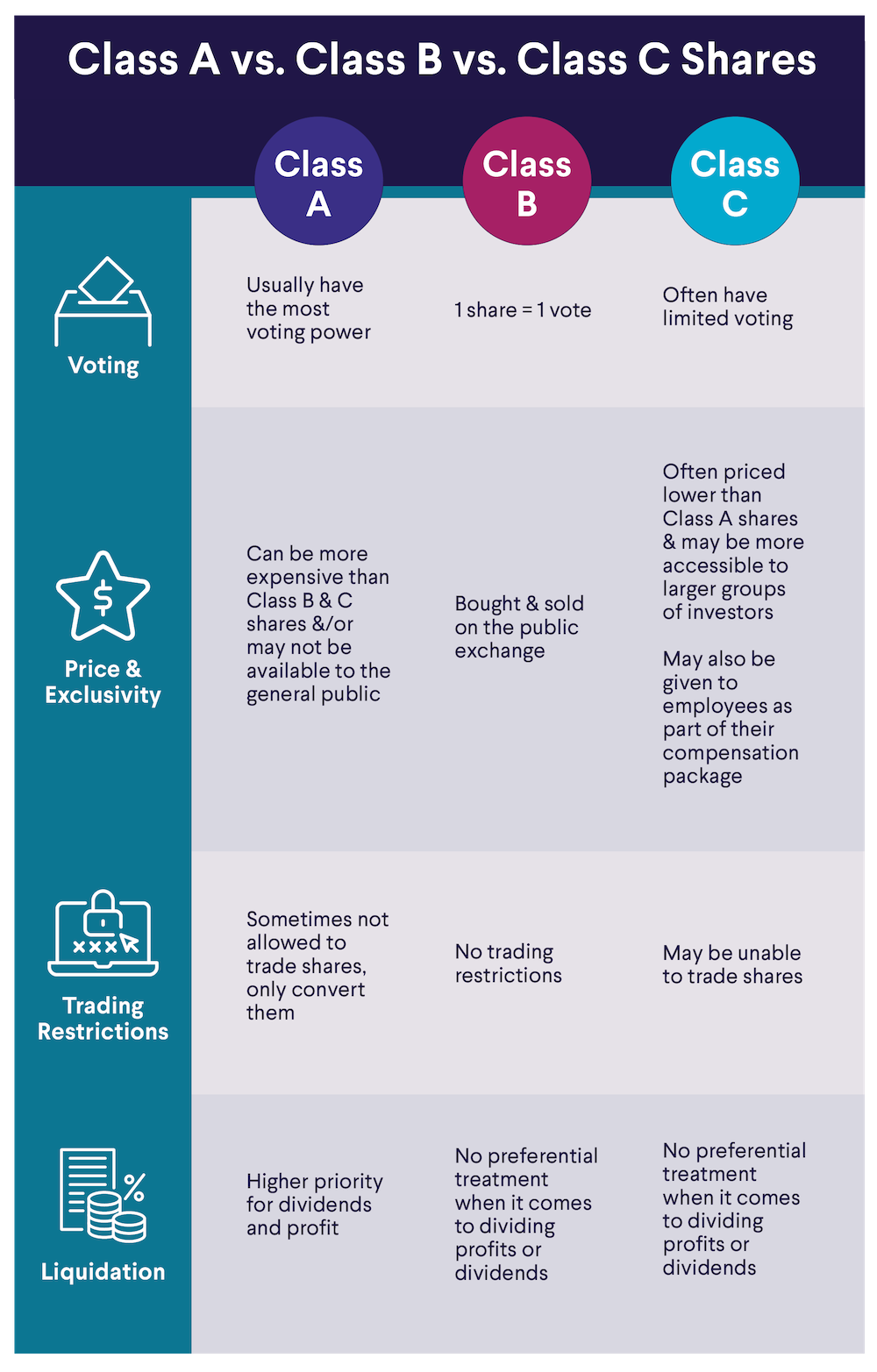
While the specific attributes of Class A shares depend on the company, they generally come with more voting power and a higher priority for dividends and profit in the event of liquidation. Class A shares may be more expensive than Class B shares, or may not be available to the general public.

Advantages and Disadvantages of Class A Shares

Class A shares have some advantages and disadvantages over other types of shares. But again, it all comes down to the specifics.

Many companies can have different stock tiers that trade at different prices. For instance, Company X may have Class A stock that regularly trades at hundreds of thousands of dollars while its Class B stock may trade for hundreds of dollars per share.

Class B stockholders may also only have a small percentage of the vote that a Class A stockholder has. And while Class A stockholders might be able to convert their shares into Class B shares, a Class B shareholder may not be able to convert their shares into Class A shares.

Many of the tech companies that have gone public in recent years have also used a dual-share class system.

In some cases, shareholders are not allowed to trade their Class A shares, so they have a conversion that allows the owner to convert them into Class B, which they can sell or trade. Executives may also be able to sell their shares in a secondary offering, following the IPO.


💡 Quick Tip: Distributing your money across a range of assets — also known as diversification — can be beneficial for long-term investors. When you put your eggs in many baskets, it may be beneficial if a single asset class goes down.

What Are Class B Shares?

Often companies refer to their Class B shares as “common shares” or “ordinary shares,” (But occasionally, companies flip the definition and have Class A shares designated as common shares and Class B shares as founder and executive shares).

Advantages and Disadvantages of Class B Shares

Class B shares are generally liquid, meaning that investors can buy and sell common shares on a public stock exchange, where, typically, one share equals one vote. However, Class B shares carry no preferential treatment when it comes to dividing profits or dividends.

What Are Class C Shares?

Some companies also offer Class C shares, which they may give to employees as part of their compensation package. The difference between Class C and common stock shares can be subtle.

It’s important to note that these stock classes vary depending on the company. So doing research and understanding exactly which type of shares you’re buying is key before you commit to purchasing a certain class of stock.

Advantages and Disadvantages of Class C Shares

Class C shares may have specific restrictions, such as an inability to trade the shares.

Class C shares also may also refer to alternate share classes available to public investors. Often priced lower than Class A shares and with restrictions on voting rights, these shares may be more accessible to larger groups of investors. But this is not always the case. For example, Alphabet has Class A and Class C shares. Both tend to trade at similar prices.

Note that the chart below represents common definitions of Class A, B, and C shares, but that companies may structure their own stock classes differently.

Class A vs Class B vs Class C Shares

What Are Dual Class Shares?

Companies that offer more than one class of shares have “dual class shares.” This is a fairly common practice, and some companies offer dual class shares that automatically convert to a common share with voting privilege at a set period of time.

Why Some Companies Use Dual Class Shares

Some companies may use dual class shares if they hope to IPO, and do not want public investors to have a say in the company’s decision-making. There has been controversy about companies offering two share classes of stock to the public, with detractors concerned that multiple share classes may lead to governance issues, such as reduced accountability. But others argue that multiple share classes can be an asset for a public company, leading to improved performance.

Examples of Companies With Dual Class Shares

There are numerous companies that use dual class share systems. Here are some examples of some of most recognizable:

•   Alphabet (Google)

•   Berkshire Hathaway

•   Meta

•   Ford

•   Nike

The Takeaway

Class A, Class B, and Class C shares have different voting rights and different levels of access to distributions and dividends. It can be difficult to determine which investment class is the best option for you if you’re deciding to invest in a public company that offers multiple share classes. Beyond market price, understanding how the stock will function in your overall portfolio as well as your personal investing philosophy can help guide you choose the best share class for you.

For example, investors who may be looking for shorter-term investments may choose a stock class without voting privileges. Other investors who want to be active in corporate governance may prefer share classes that come with voting rights. And some investors may be looking for stocks that provide guaranteed dividends, which may guide their decision toward one class of shares.

Invest in what matters most to you with SoFi Active Invest. In a self-directed account provided by SoFi Securities, you can trade stocks, exchange-traded funds (ETFs), mutual funds, alternative funds, options, and more — all while paying $0 commission on every trade. Other fees may apply. Whether you want to trade after-hours or manage your portfolio using real-time stock insights and analyst ratings, you can invest your way in SoFi's easy-to-use mobile app.

Opening and funding an Active Invest account gives you the opportunity to get up to $1,000 in the stock of your choice.¹

FAQ

Are there specific types of businesses that prefer Class A, Class B, or Class C shares?

Not necessarily, as how each share class is structured is typically done for different strategic reasons. As such, some companies in certain industries may operate in similar manners, but it doesn’t mean their share structures would necessarily follow suit.

Do Class B shares always have fewer voting rights than Class A shares?

Class B shares often, or commonly have fewer voting rights than Class A shares, but it’s not always the case. Some companies structure their shares such that Class B shares actually have more voting rights than Class A shares.

Can investors convert Class B or C shares into Class A shares?

Some investors are able to convert their Class B or C shares into Class A shares, depending on the specific stock.

Why do some companies prefer dual class share structures?

Some companies might use dual class share structures in order to concentrate voting power among a select group of investors, rather than leave it to the whims of public or retail investors.

How do different share classes impact dividend payments?

Broadly speaking, different share classes often have different dividend payments, and that can depend on numerous factors.


Photo credit: iStock/g-stockstudio

INVESTMENTS ARE NOT FDIC INSURED • ARE NOT BANK GUARANTEED • MAY LOSE VALUE

SoFi Invest is a trade name used by SoFi Wealth LLC and SoFi Securities LLC offering investment products and services. Robo investing and advisory services are provided by SoFi Wealth LLC, an SEC-registered investment adviser. Brokerage and self-directed investing products offered through SoFi Securities LLC, Member FINRA/SIPC.

For disclosures on SoFi Invest platforms visit SoFi.com/legal. For a full listing of the fees associated with Sofi Invest please view our fee schedule.

Financial Tips & Strategies: The tips provided on this website are of a general nature and do not take into account your specific objectives, financial situation, and needs. You should always consider their appropriateness given your own circumstances.


¹Probability of Member receiving $1,000 is a probability of 0.026%; If you don’t make a selection in 45 days, you’ll no longer qualify for the promo. Customer must fund their account with a minimum of $50.00 to qualify. Probability percentage is subject to decrease. See full terms and conditions.

Disclaimer: The projections or other information regarding the likelihood of various investment outcomes are hypothetical in nature, do not reflect actual investment results, and are not guarantees of future results.

Mutual Funds (MFs): Investors should carefully consider the information contained in the prospectus, which contains the Fund’s investment objectives, risks, charges, expenses, and other relevant information. You may obtain a prospectus from the Fund company’s website or clicking the prospectus link on the fund's respective page at sofi.com. You may also contact customer service at: 1.855.456.7634. Please read the prospectus carefully prior to investing.Mutual Funds must be bought and sold at NAV (Net Asset Value); unless otherwise noted in the prospectus, trades are only done once per day after the markets close. Investment returns are subject to risk, include the risk of loss. Shares may be worth more or less their original value when redeemed. The diversification of a mutual fund will not protect against loss. A mutual fund may not achieve its stated investment objective. Rebalancing and other activities within the fund may be subject to tax consequences.

Investment Risk: Diversification can help reduce some investment risk. It cannot guarantee profit, or fully protect in a down market.

Investing in an Initial Public Offering (IPO) involves substantial risk, including the risk of loss. Further, there are a variety of risk factors to consider when investing in an IPO, including but not limited to, unproven management, significant debt, and lack of operating history. For a comprehensive discussion of these risks please refer to SoFi Securities’ IPO Risk Disclosure Statement. This should not be considered a recommendation to participate in IPOs and investors should carefully read the offering prospectus to determine whether an offering is consistent with their investment objectives, risk tolerance, and financial situation. New offerings generally have high demand and there are a limited number of shares available for distribution to participants. Many customers may not be allocated shares and share allocations may be significantly smaller than the shares requested in the customer’s initial offer (Indication of Interest). For more information on the allocation process please visit IPO Allocation Procedures.

SOIN-Q225-154

Read more
couple home on laptop

Four Ways to Upgrade Your Home

Updating your home can be done without a full (and expensive) renovation. There are a number of light lift projects that can give your home a whole new look and feel, and even increase its resale value. Exterior upgrades, like fresh paint, a new front door, and better landscaping or outdoor lighting, can add to your home’s curb appeal. Indoor improvements, such as updated lighting fixtures, paint, or wallpaper, can give the interior of your home a more up-to-date, high-end look. Here are four ways you can upgrade your home without breaking the bank.

Key Points

•   Home upgrades, starting at $3,000, can enhance the look and value of a property.

•   Exterior upgrades, like a freshly painted front door, new porch lights, and modern landscaping with pollinator and edible gardens, can add curb appeal.

•   Indoor lighting trends favor bold and textured fixtures.

•   Popular paint colors are dusty pink, cinnamon brown, cool grays, and bright purples, while one wallpapered wall can create a mural effect.

•   Window treatments with natural hues, geometric prints, and layered rods add style and privacy.

Exterior Improvements

A home’s front door is the focal point of the exterior. To upgrade its appearance, you might replace the door, or paint it and add new hardware. Decorating the door with a seasonal wreath or another personalized touch can also add to its charm.

Besides a front door refresh or upgrade, other exterior improvements you might consider include a new mailbox, a new porch light fixture, and perhaps some window boxes with plants and fresh flowers that add a bright contrast to your home’s exterior color.

Front door styles that are currently trending include bold colors (from fire engine red to deep greens and bright blues), natural wood stains, and more glass (such as custom inserts and floor-to-ceiling sidelights).

How you landscape your front yard will depend upon where you live and the climate there. In general, though, modern trends include:

•   Natural landscaping using native plants, creating landscaping that’s eco-friendly and easy to maintain.

•   Pollinator gardens that attract butterflies, bees, and other insects that help pollinate.

•   Edible gardens, including lettuce, peppers, tomatoes, and more. Creativity is key!

Recommended: 15 Ways to Boost Your Curb Appeal for a Winter Open House

Lovely Lighting

Outdoor lighting doesn’t need to be white — filters can add a range of colors. These lights can spotlight key areas of landscaping, highlight where you like to entertain, or look attractive for even more curb appeal while providing illumination.

Size-wise, both tiny and boldly large lights are in vogue and, although lanterns aren’t a new trend, they’re still considered stylish. Updating recessed lighting is another popular home improvement project.

After a period of all-white being a hot trend for interior lighting, table lamps and hanging lighting fixtures are appearing more often as dark neutrals in brown, black, or gray. They can be used to update the white, cream, or gray choices in a home.

Paying attention to texture in lighting fixtures can add interest and variety. Materials can range from wood to wicker and rattan, and can be crafted in contemporary shapes to avoid an overly rustic look. Also still trending are geometrically designed lighting fixtures, from simple to more complex shapes.

Painting and Wallpapering

Painting rooms in a home can transform their appearance. What colors are trending? Currently, homeowners are favoring dusty pink, cinnamon brown, cool grays, and bright purples. However, unless you’re planning to sell some time soon, personal taste is what matters most when picking paint colors.

Wallpaper trends also run the gamut, including those with a texture and colors often inspired by landscapes. In this style of wallpaper, expect to see some blues, greens and neutral shades. Some people like to have one pictorial wallpaper wall, which looks like a mural in a room.

Wow Factor on Windows

In-style curtains often have hues found in nature, from green to ochre, and can also feature flowers, landscapes, and more. Geometric prints or two-tone materials may also appeal to some people. Velvet can be used to create a more intimate space.

Consider using double or triple curtain rods to add layers of window coverings. Then you can add a layer that filters light and enhances privacy, while also selecting curtains with the appearance you enjoy. Many designers recommend placing your curtain rod close to ceiling height vs. at the top of the window for a more dramatic and chic effect.

Recommended: How Much Does It Cost to Replace Windows?

Costs of a House Upgrade

The type of house upgrades listed here might be considered low-cost or low-end renovations, and can cost as little as $3,000 for a 1,250 to 1,600 square foot home. If, once momentum gets going, the low-end house upgrade turns into a middle-end one, the average cost could be closer to $5,200, according to the home improvement site Angi.

Another cost-related factor is where the home is located. Pricing in urban areas might be twice as high as in rural areas, depending on the area’s cost of living.

Plus, upgrades in older homes may take more time and attention to complete. If the home is officially considered to be historic, there may be guidelines about what changes can be made.

Recommended: Renovation vs. Remodel: What’s the Difference?

Financing a House Upgrade

Here are some options for financing a home upgrade.

•   Sometimes, homeowners are able to pay for these upgrades out of pocket. This can be true when the costs are relatively small or when money has been saved for the costs of the renovation. This can be the smart choice when possible: no debt, no interest to pay.

A downside to paying for home upgrades with cash may be that the homeowner empties a savings account or cuts corners on the renovations to avoid needing to borrow funds. Or, if, say, a big medical bill pops up and the emergency fund was used to renovate, then high-interest credit cards might need to be used to pay that debt.

•   You might consider a home equity line of credit (HELOC) to finance a house upgrade. This type of loan allows you to borrow against the equity in the home to pay for renovations. How much is available to borrow will depend upon how much equity is available and the loan-to-value ratio (LTV) that a lender permits. For example, if a lender has an 80% LTV ratio, that means the institution would:

◦   Appraise the home (e.g., $250,000).

◦   Calculate 80% of that ($200,000).

◦   Subtract current mortgage balances (e.g., $125,000).

◦   Consider what’s left over ($200,000-$125,000 = $75,000) to be equity in the home.

The lender would also consider the financial profile of the borrower when reviewing the loan application. HELOCs often have a low initial interest rate and, usually, the homeowner can choose to pay interest only during the draw period. However, there may be upfront fees and the rate is often variable with high lifetime caps.

•   Another option might be a home improvement loan, which is an unsecured personal loan and not attached to the home’s equity. Funding can usually be granted more quickly with fewer, or sometimes no, fees. This may be a good option for people who don’t have enough equity in their homes for their project or who don’t want to use their home as collateral.

Recommended: How to Apply for a Personal Loan

The Takeaway

There are a number of ways you can upgrade your home that don’t involve tearing down walls or putting on an $150,000 addition. Lower-cost upgrades, ranging from $3,000 to $50,000 or more, may still require spending more cash than you have just sitting in the bank, however. Plus, you may not want to deplete your savings in order to upgrade your home. A personal loan could be a good option.

Think twice before turning to high-interest credit cards. Consider a SoFi personal loan instead. SoFi offers competitive fixed rates and same-day funding. See your rate in minutes.


SoFi’s Personal Loan was named a NerdWallet 2026 winner for Best Personal Loan for Large Loan Amounts.

FAQ

How do you update your home?

A good plan for updating your home can be to start with changes that can shift the mood of a room. This includes paint and/or wallpaper, carpets and rugs, window treatments, and lighting, among other features.

How to update a home without renovation?

To update a home without a major renovation, make changes to surfaces, such as repainting in a different color, swapping in new curtains or blinds, and adding fresh rugs or refinishing the floors.

How much do home updates cost?

The price of home updates can range considerably depending on the cost of living in your area, how much you DIY vs. calling in professionals, and your taste level and the changes you actually make. A small update can start at $3,000, but prices in the five figures can be common.


SoFi Loan Products
SoFi loans are originated by SoFi Bank, N.A., NMLS #696891 (Member FDIC). For additional product-specific legal and licensing information, see SoFi.com/legal. Equal Housing Lender.


*Awards or rankings from NerdWallet are not indicative of future success or results. This award and its ratings are independently determined and awarded by their respective publications.

Disclaimer: Many factors affect your credit scores and the interest rates you may receive. SoFi is not a Credit Repair Organization as defined under federal or state law, including the Credit Repair Organizations Act. SoFi does not provide “credit repair” services or advice or assistance regarding “rebuilding” or “improving” your credit record, credit history, or credit rating. For details, see the FTC’s website .

Financial Tips & Strategies: The tips provided on this website are of a general nature and do not take into account your specific objectives, financial situation, and needs. You should always consider their appropriateness given your own circumstances.

Third-Party Brand Mentions: No brands, products, or companies mentioned are affiliated with SoFi, nor do they endorse or sponsor this article. Third-party trademarks referenced herein are property of their respective owners.

²SoFi Bank, N.A. NMLS #696891 (Member FDIC), offers loans directly or we may assist you in obtaining a loan from SpringEQ, a state licensed lender, NMLS #1464945.
All loan terms, fees, and rates may vary based upon your individual financial and personal circumstances and state.
You should consider and discuss with your loan officer whether a Cash Out Refinance, Home Equity Loan or a Home Equity Line of Credit is appropriate. Please note that the SoFi member discount does not apply to Home Equity Loans or Lines of Credit not originated by SoFi Bank. Terms and conditions will apply. Before you apply, please note that not all products are offered in all states, and all loans are subject to eligibility restrictions and limitations, including requirements related to loan applicant’s credit, income, property, and a minimum loan amount. Lowest rates are reserved for the most creditworthy borrowers. Products, rates, benefits, terms, and conditions are subject to change without notice. Learn more at SoFi.com/eligibility-criteria. Information current as of 06/27/24.
In the event SoFi serves as broker to Spring EQ for your loan, SoFi will be paid a fee.


Third Party Trademarks: Certified Financial Planner Board of Standards Center for Financial Planning, Inc. owns and licenses the certification marks CFP®, CERTIFIED FINANCIAL PLANNER®

SOPL-Q225-045

Read more
Lessons From the Dotcom Bubble_780x440-1

Lessons From the Dotcom Bubble

At the dawn of the millennium, the “dot-com bubble” burst, and many tech companies either went bankrupt, or saw their values plunge. Many recovered, others did not. But it was a classic case of a market bubble, and there are lessons to be drawn from it.

A bubble comprises numerous factors — such as rising stock valuations, an increase in initial public offerings (IPOs), and a focus on buzz over basics — and financial professionals are always on the lookout for the next one. Here are five lessons from the dot-com bubble and the financial crisis that followed.

Key Points

•   Asset bubbles may arise when investors’ extreme enthusiasm overshadows researching company fundamentals.

•   Diversification of assets may help to shield a portfolio against sharp market downturns.

•   Momentum trading demands discipline and paying close attention to market movements to avoid prolonged holding.

•   Historical events may provide insights but not necessarily forecasts — it’s important to view potential investments in context of the current market.

•   The Dot-com bubble burst during the middle of 2000.

What Caused the Dot-com Bubble, and Why Did It Burst?

Back in the mid-1990s, investors fell in love with all things internet-related. Dot-com and other tech stocks soared. The number of tech IPOs spiked. For example, one company, theGlobe.com Inc., rose 606% in its first day of trading in November 1998.

Venture capitalists poured money into tech and internet start-ups. And enthusiastic investors — often drawn by the hype instead of the fundamentals — kept buying shares in companies with significant challenges, trusting they’d make it big later.

But that didn’t happen. Many of those exciting new companies with optimistically valued stocks weren’t turning a profit. And as companies ran through their money, and fresh sources of capital dried up, the buzz turned to disillusionment. Insiders and more-informed investors started selling positions. And average investors, many of whom got in later than the smart money, suffered losses.

The tech-heavy Nasdaq index had climbed nearly 600% between 1995 to 2000. The gauge however slid from a peak of 5,048.62 on March 10, 2000, to 1,139.90 on Oct. 4, 2002. Many wildly popular dot-com companies (including Kozmo.com, eToys.com, and Excite) went bust. Equities entered a bear market. And the Nasdaq didn’t return to its peak until 2015.

What Can Investors Today Learn from the Past?

Every investment carries some risk, and volatility for stocks is generally known to be higher than for other asset classes, such as bonds or certificates of deposit (CDs). But there are strategies that can help investors manage that risk.

Here are some lessons:

1. Diversification Matters

One of the most established strategies for protecting a portfolio is to diversify into different market sectors and asset classes. In other words, don’t put all your eggs in one basket.

It may be tempting to go all-in on the latest hot stock, or to invest in a sector you’re intrigued by or think you know something about. But if that stock or sector tanks, as tech did in 2000, you could lose big.

Allocating across assets may reduce your vulnerability because your money is distributed across areas that aren’t likely to react in the same way to the same event.

Diversifying your portfolio won’t necessarily ensure a profit or guarantee against loss. And you might not be able to brag about your big score. Over time though, and with a steady influx of money into your account, you’ll likely have the opportunity to grow your portfolio while experiencing fewer gut-wrenching bumps along the way.

2. Ignoring Investing Basics Can Have Consequences

Even as the stock market began its meltdown in 2000, individual investors — caught up in the rush to riches — continued to dump money into equity funds. And many failed to do their homework and research the stocks they were buying.

Prices didn’t always reflect underlying business performance. Most of the new public companies weren’t profitable, but investors ignored poor fundamentals and increasing warnings about overvalued prices. In a December 1996 speech, then Federal Reserve Chairman Alan Greenspan warned that “irrational exuberance” could “unduly escalate asset values.” Still, the behavior continued for years.

When Greenspan eventually tightened up U.S. monetary policy in the spring of 2000, the reaction was swift. Without the capital they needed to continue to grow, companies began to fail. The bubble popped and a bear market followed.

From 1999 to 2000, shares of Priceline Inc., the name-your-own-price travel booking site, plunged 98%. Just a couple months after its IPO in 2000, the sassy sock puppet from Pets.com was silenced when the company folded and sold its assets. Even Amazon.com’s shares suffered, losing 90% of their value from 1999 to 2001.

And it wasn’t just day traders who were losing money. A Vanguard study showed that by the end of 2002, 70% of 401(k)s had lost at least one-fifth of their value, and 45% had lost more than one-fifth.

Valuing a Stock

There are many different ways to analyze a stock you’re interested in — with technical, quantitative, and qualitative analysis, and by asking questions about red flags. It can help in determining whether a company is undervalued or overvalued.

Even if you’re familiar with what a company does, and the products and services it offers, it can help to look deeper. If you don’t have the time to do your due diligence — to look at price-to-earnings ratios, business models, and industry trends — you may want to work with a professional who can help you understand the pros and cons of investing in certain businesses.

3. Momentum Is Tricky

Momentum trading when done correctly has the potential to be profitable in a relatively short amount of time, and successful momentum traders may turn out profits on a weekly or daily basis. But it can take discipline to get in, get your profit and get out.

Tech stocks rallied in the late 1990s because the internet was new and everybody wanted a piece of the next big thing. But when the reality set in that some of those dot-com darlings weren’t going to make it, and others would take years to turn a profit, the momentum faded. Investors who got in late or held on too long — out of greed or panic or stubbornness — came up empty-handed.

Identifying a potential bubble is tough enough, and it’s only the first step in avoiding the fallout should it eventually burst. Determining when that will happen can be far more challenging. If day-trading strategies and short-term investing are your thing, you may want to pay attention to the trends and your own gut, and get out when they tell you it’s time.

4. History May Repeat, But It Doesn’t Clone Itself

There are similarities between what’s happening in the more recent tech sector and the dot-com bubble that popped in 2000. But the situations are not exactly the same.

For one thing, investors today may have a better grip on what the Internet is, and how long it can take to develop a new idea or company. Some stock valuations today are, indeed, stretched but not as stretched as they were during the dot-com bubble.

Though it can be useful to look at past events for investing insight, it’s also important to look at stock prices in the context of the current economy.

5. You Can’t Always Predict a Downturn, But You Can Prepare

The dot-com stock-market crash hit some investors hard — so hard that many gave up on the stock market completely.

That’s not uncommon. Investors’ decisions are often driven by emotion over logic. But the result was that those angry and fearful investors lost out on an 11-year bull market. You don’t have to look at every asset bubble or market downturn as a signal to run for the hills. Also, if the market decline is followed by a rally, you could miss out.

One strategy — along with diversifying your portfolio — may be to keep a small percentage of cash in your investment or savings account. That way you’ll have protected at least a portion of your money, and you’ll be set up to take advantage of any new opportunities and bargains that might emerge if the stock market does go south.

Investors should also really look at a company’s fundamentals as well. Does a business make sense? Does it seem like they can grow their sales and keep costs low? Who are the competitors? Do you trust the CEO and management? After deep research into these topics, if the company is still attractive to you, then it could make sense to hang on to at least some of the shares.

If you’re a long-term investor who’s purchased shares in strong, healthy companies, those stocks could very well rebound. But this is an incredibly difficult process that even seasoned investors can get wrong.

The Takeaway

Asset bubbles like the dot-com bubble can have different causes, but the thing they tend to have in common is that investors’ extreme enthusiasm leads them to throw caution to the wind. In the late-‘90s and early-2000s, that “irrational exuberance” led investors to buy overpriced shares in internet companies with the expectation that they couldn’t lose. And when they did lose, the dot-com craze turned into a dot-com crash. Investors who thought they had a piece of the next big thing lost money instead.

Could it happen again? Unfortunately, there’s really no way to know when an asset bubble will burst or how severe the fallout might be. But a diversified portfolio can offer some protection. So can paying attention to investing basics and doing your homework before putting money into a certain stock. And it never hurts to ask for help.

Invest in what matters most to you with SoFi Active Invest. In a self-directed account provided by SoFi Securities, you can trade stocks, exchange-traded funds (ETFs), mutual funds, alternative funds, options, and more — all while paying $0 commission on every trade. Other fees may apply. Whether you want to trade after-hours or manage your portfolio using real-time stock insights and analyst ratings, you can invest your way in SoFi's easy-to-use mobile app.

Opening and funding an Active Invest account gives you the opportunity to get up to $1,000 in the stock of your choice.¹

FAQ

What was the dot-com bubble?

The dot-com bubble was a period marked by rising tech stocks and tech IPOs in the late 1990s, which eventually led to a bubble burst. Many companies went bankrupt or lost significant value after the burst.

What caused the dot-com bubble to burst?

Some reasons that the dot-com bubble burst include the fact that many companies weren’t profitable despite their lofty valuations, dried-up sources of capital, and fleeing insiders selling shares.

What are some lessons from the dot-com bubble?

Some lessons may include the fact that diversification is important, ignoring investment basics can have negative consequences, and that market bubbles are always possible, so investors should pay close attention.


INVESTMENTS ARE NOT FDIC INSURED • ARE NOT BANK GUARANTEED • MAY LOSE VALUE

SoFi Invest is a trade name used by SoFi Wealth LLC and SoFi Securities LLC offering investment products and services. Robo investing and advisory services are provided by SoFi Wealth LLC, an SEC-registered investment adviser. Brokerage and self-directed investing products offered through SoFi Securities LLC, Member FINRA/SIPC.

For disclosures on SoFi Invest platforms visit SoFi.com/legal. For a full listing of the fees associated with Sofi Invest please view our fee schedule.

Financial Tips & Strategies: The tips provided on this website are of a general nature and do not take into account your specific objectives, financial situation, and needs. You should always consider their appropriateness given your own circumstances.


¹Probability of Member receiving $1,000 is a probability of 0.026%; If you don’t make a selection in 45 days, you’ll no longer qualify for the promo. Customer must fund their account with a minimum of $50.00 to qualify. Probability percentage is subject to decrease. See full terms and conditions.

Investment Risk: Diversification can help reduce some investment risk. It cannot guarantee profit, or fully protect in a down market.

Investing in an Initial Public Offering (IPO) involves substantial risk, including the risk of loss. Further, there are a variety of risk factors to consider when investing in an IPO, including but not limited to, unproven management, significant debt, and lack of operating history. For a comprehensive discussion of these risks please refer to SoFi Securities’ IPO Risk Disclosure Statement. This should not be considered a recommendation to participate in IPOs and investors should carefully read the offering prospectus to determine whether an offering is consistent with their investment objectives, risk tolerance, and financial situation. New offerings generally have high demand and there are a limited number of shares available for distribution to participants. Many customers may not be allocated shares and share allocations may be significantly smaller than the shares requested in the customer’s initial offer (Indication of Interest). For more information on the allocation process please visit IPO Allocation Procedures.

Third Party Trademarks: Certified Financial Planner Board of Standards Center for Financial Planning, Inc. owns and licenses the certification marks CFP®, CERTIFIED FINANCIAL PLANNER®

SOIN-Q225-139

Read more
Investing in Chinese Stocks

Investing in Chinese Stocks

China represents a part of the global investor marketplace known as the “emerging markets,” or countries that are headed toward first-world status and undergoing a period of rapid growth. China has the second-largest economy in the world and is rapidly growing. Economists estimate that the country will overtake the United States to become the largest economy in the years to come.

Some prominent macro investors have expressed positive sentiments about emerging market opportunities. In spite of the potential opportunities, investing in foreign stocks can be confusing, scary, and in some cases impossible.

Key Points

•   China is the world’s second-largest economy, and investing in Chinese stocks may attract the interests of certain investors

•   Delisting of certain Chinese companies from U.S. stock exchanges introduces investment risks.

•   China’s long-term economic outlook may make Chinese stocks appealing to some, depending on their objectives.

•   Investing in Chinese stocks may provide an option for international diversification, spreading risk and potentially enhancing portfolio protection.

•   U.S. investors can access Chinese stocks through ETFs, mutual funds, or direct purchases via brokerage firms.

Can You Invest in Chinese Stocks?

The short answer is yes, investors located in the U.S. and elsewhere do generally have the capability of trading international stocks, including investing in Chinese stocks. The details aren’t always so simple, though.

The majority of Chinese stocks can only be traded on Chinese exchanges, including the Hong Kong Stock Exchange, the Shanghai Stock Exchange, and the Shenzhen Stock Exchange.

There are ways for foreign investors to participate in these markets, either directly or through various types of investment vehicles or intermediaries. For the most part, buying Chinese stocks is technically not unlike buying U.S. stocks. Investors may only need to search for specific securities or utilize a special intermediary firm in addition to their standard brokerage. Investors in the U.S. should also be aware that delisted Chinese stocks may or may not return to exchanges.

What Are the Best Chinese Stocks to Buy?

For investors in the U.S., choices may be limited. If there are a limited number of Chinese stocks that can be purchased directly on a stock exchange, then it’s just a matter of evaluating stocks on the list choosing whichever ones seem most attractive.

How Can Foreigners Invest in the Chinese Stock Market?

To buy and sell stocks on foreign exchanges, investors often have to contact their brokerage firms and ask if they allow participation in foreign markets. If the answer is yes, the firm could then consult with a market maker, known as an affiliate firm. Affiliate firms, which are located in the country where foreign investors want to buy stocks, help facilitate these types of transactions.

The easiest way for many investors to gain exposure to the Chinese stock market might be to purchase shares in an emerging markets mutual fund or exchange-traded funds (ETFs) that includes some stocks from publicly-traded companies based in China.

To do this, investors can look for funds that track a Chinese index. Some examples include:

•   Shenzhen Composite Index, which tracks the Shenzhen Stock Exchange

•   Shanghai Shenzhen CSI 300 Index, which tracks parts of the Shanghai and Shenzhen exchanges

•   Shanghai Stock Exchange Composite Index, which tracks the Shanghai Stock Exchange

As far as the actual process of buying Chinese stocks is concerned, doing so will look like buying any other stock. This holds especially true for those buying an ETF or mutual fund. Buying individual Chinese securities may involve an extra step with an affiliate firm, as mentioned earlier.

In either case, investors have to first open a brokerage account, decide which securities they would like to own, then create appropriate buy orders.

Pros & Cons of Buying Chinese Stocks

While the decision ultimately lies with an individual investor, there are both pros and cons of global investments, including Chinese stocks. Here, we will explore both perspectives.

Pros of Buying Chinese Stocks

Factors like a long-term outlook, China’s response to the recent health crisis, and international diversification can make Chinese stocks appealing to some investors.

Long-term Time Horizon

Some investors believe that Chinese investments have a positive long-term outlook— regardless of any short-term political concerns (more on that in Cons of Buying Chinese Stocks, below).

China’s Response to the COVID-19 Pandemic

After the COVID-19 pandemic shut down most major economies in the world for an extended period of time, many areas saw contracting economic growth and continued to struggle. China, on the other hand, responded quickly and was able to reopen its economy sooner than many others, marking the country as a champion of growth throughout the pandemic and beyond.

International Diversification

Some investors choose to invest in the stocks of different countries as a way to further diversify their portfolios. The rationale: An investor could be diversified within and across different industries, but if something were to negatively affect the economy of the country those industries are in, it might not matter.

Cons of Buying Chinese Stocks

There are a few reasons why some investors might choose to avoid Chinese stocks.

Delisting of Some Chinese Companies

In recent times, executive orders have removed some Chinese stocks from American stock exchanges, including a Chinese oil firm named Cnooc (CEO) and China Mobile (CHL).

Growth Limits

Though there’s been economic growth in China, some believe the nature of the Chinese government could stifle innovation going forward. Which industries survive and which ones don’t can sometimes be determined by a simple forced government decision. One perspective is that China’s best growth days are behind it.

Are Chinese Stocks Undervalued?

It is impossible to say for certain. From a long-term perspective, if someone assumes that China will keep growing at a similar pace as it has in the past, then Chinese stocks in general could be viewed as undervalued. But there could also be some sectors that are currently overvalued, some stocks more undervalued than others, and so on.

The Takeaway

China is considered to be one of the strongest emerging market economies, leading some investors to see potential for returns there. Foreign investors have several options if they want to invest in Chinese stocks. Doing so may not be any different than buying stocks in one’s home country. And because of its large economy, there may be other stocks affected by China as well, even if they aren’t Chinese stocks.

Invest in what matters most to you with SoFi Active Invest. In a self-directed account provided by SoFi Securities, you can trade stocks, exchange-traded funds (ETFs), mutual funds, alternative funds, options, and more — all while paying $0 commission on every trade. Other fees may apply. Whether you want to trade after-hours or manage your portfolio using real-time stock insights and analyst ratings, you can invest your way in SoFi's easy-to-use mobile app.

Opening and funding an Active Invest account gives you the opportunity to get up to $1,000 in the stock of your choice.¹

FAQ

Can American investors invest in Chinese stocks?

Yes, investors located in the U.S. and elsewhere do generally have the capability of trading international stocks, including investing in Chinese stocks. The details aren’t always so simple, though, and there may be additional considerations to make.

What are the risks of investing in Chinese stocks?

There is the possibility that Chinese stocks could be delisted off of stock exchanges, and there may also be concerns related to Chinese firms’ growth potential that investors should take into account.

Why might investors find Chinese stocks attractive?

China is the world’s second-largest economy, and many investors believe that there is a lot of room for growth and the generation of potential returns from Chinese stocks. They can also offer the potential for portfolio diversification.


INVESTMENTS ARE NOT FDIC INSURED • ARE NOT BANK GUARANTEED • MAY LOSE VALUE

SoFi Invest is a trade name used by SoFi Wealth LLC and SoFi Securities LLC offering investment products and services. Robo investing and advisory services are provided by SoFi Wealth LLC, an SEC-registered investment adviser. Brokerage and self-directed investing products offered through SoFi Securities LLC, Member FINRA/SIPC.

For disclosures on SoFi Invest platforms visit SoFi.com/legal. For a full listing of the fees associated with Sofi Invest please view our fee schedule.

Financial Tips & Strategies: The tips provided on this website are of a general nature and do not take into account your specific objectives, financial situation, and needs. You should always consider their appropriateness given your own circumstances.

Exchange Traded Funds (ETFs): Investors should carefully consider the information contained in the prospectus, which contains the Fund’s investment objectives, risks, charges, expenses, and other relevant information. You may obtain a prospectus from the Fund company’s website or by emailing customer service at [email protected]. Please read the prospectus carefully prior to investing.

Mutual Funds (MFs): Investors should carefully consider the information contained in the prospectus, which contains the Fund’s investment objectives, risks, charges, expenses, and other relevant information. You may obtain a prospectus from the Fund company’s website or clicking the prospectus link on the fund's respective page at sofi.com. You may also contact customer service at: 1.855.456.7634. Please read the prospectus carefully prior to investing.Mutual Funds must be bought and sold at NAV (Net Asset Value); unless otherwise noted in the prospectus, trades are only done once per day after the markets close. Investment returns are subject to risk, include the risk of loss. Shares may be worth more or less their original value when redeemed. The diversification of a mutual fund will not protect against loss. A mutual fund may not achieve its stated investment objective. Rebalancing and other activities within the fund may be subject to tax consequences.

Investment Risk: Diversification can help reduce some investment risk. It cannot guarantee profit, or fully protect in a down market.


¹Probability of Member receiving $1,000 is a probability of 0.026%; If you don’t make a selection in 45 days, you’ll no longer qualify for the promo. Customer must fund their account with a minimum of $50.00 to qualify. Probability percentage is subject to decrease. See full terms and conditions.

SOIN-Q225-138

Read more
TLS 1.2 Encrypted
Equal Housing Lender