How and When to Combine Federal Student Loans & Private Loans

One of the biggest student loan myths is that borrowers can’t combine federal student loans and private student loans into one refinanced loan.

It’s understandable why people may think that, since this wasn’t always an option. And consolidation through the Department of Education is only available for federal student loans.

But now you can choose to combine federal and private loans. So it’s important to learn whether combining them is right for you, and if it is, how to consolidate private and federal student loans.

Key Points

•   Borrowers can now combine federal and private student loans through refinancing, which simplifies payments and may result in lower interest rates.

•   Refinancing federal loans with a private lender results in the loss of federal benefits, such as forgiveness programs and income-driven repayment plans.

•   Interest rates for federal student loans are fixed and determined annually, while private loans may offer lower rates based on creditworthiness and income.

•   Federal student loans offer various benefits, including deferment and forbearance options, which are not available once loans are refinanced as private loans.

•   Evaluating financial goals and loan details is essential before deciding to refinance, as it can impact payment terms and overall debt costs.

Can I Consolidate Federal and Private Student Loans?

If you’ve ever wondered, can I consolidate federal and private student loans?, the answer is yes. You can combine private and federal student loans by refinancing them with a private lender.

Through this process, you apply for a new loan (which is used to pay off your original loans) and obtain one with a new — ideally lower — interest rate.

Although you are combining your loans, refinancing isn’t the same thing as federal student loan consolidation.

Key Differences Between Consolidation and Refinancing

Some people use the words “refinance” and “consolidate” interchangeably, but consolidating student loans is a different process than refinancing student loans.

Federal student loans can be consolidated into one loan by taking out a Direct Consolidation Loan from the government. To be eligible for a Direct Consolidation Loan you must have at least one Direct Loan or one Federal Family Education Loan (FFEL). Federal loan consolidation does not typically lower your interest rate. The new student loan consolidation rate is the weighted average of the interest rates of your prior loans, rounded up to the nearest ⅛ of a percent.

You can only consolidate federal student loans in this way. Private student loans are not eligible for federal loan consolidation.

When you refinance student loans, you exchange your old student loans for a new private loan. You can refinance private student loans, federal student loans, or a combination of both types. When you refinance, you may be able to get a lower interest rate, which could help you save money on interest over the life of the loan, or more favorable loan terms, if you qualify.

However, refinancing federal loans makes them ineligible for federal benefits such as deferment and income-driven-repayment plans.

Pros and Cons of Combining Federal and Private Loans

Before you combine federal and private student loans, there are a number of things to think about. Consider the following advantages and drawbacks.

Pros:

•   Combining federal and private loans may result in a lower interest rate if you qualify, which could help you save on interest over the life of the loan.

•   You may be able to lower your monthly payments through refinancing by extending the term of your loan.

•   Combining your loans can help you manage and streamline your payments since you’ll have just one loan rather than several.

Cons:

•   Combining federal and private loans through refinancing means you’ll lose federal protections like forgiveness and deferment.

•   In order to get lower interest rates, you’ll need a good credit score, a stable job, and a steady income.

•   If you extend the term of the loan to lower your monthly payments, you’ll pay more interest over the life of the loan.

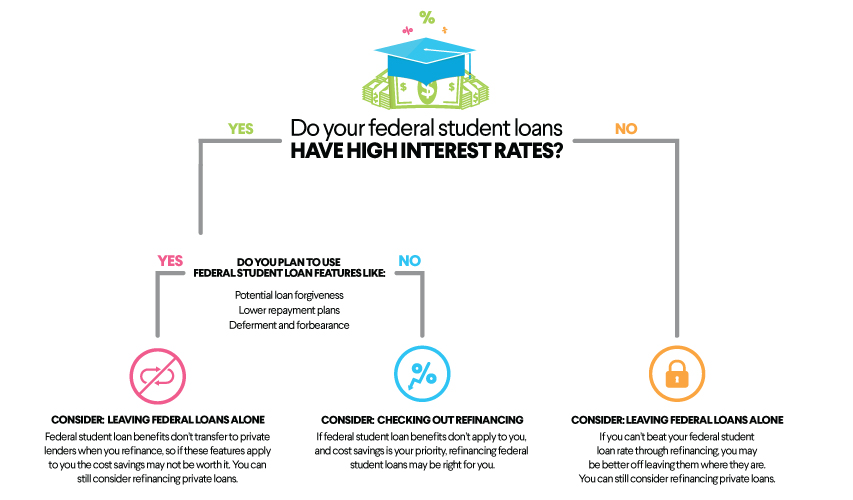
If you’re still debating what to do, here’s an easy decision tree to help you understand whether refinancing federal and private loans is the right option for you:

Federal-Loans-Decisions--Tree-853x500

Steps to Consolidating Private and Federal Loans

If you decide that loan consolidation makes sense, here’s how to consolidate private and federal student loans through refinancing:

1.    Decide which loans you want to consolidate. For instance, maybe you’d like to combine some of your federal loans with your private loans, but not all of them.

2.    Look into lenders. Private lenders that provide refinancing include banks, credit unions, and online lenders. Each one offers different rates and terms. Find out about any fees they might charge, what kind of customer service they have, and what their eligibility requirements are.

3.    Shop around. Each lender uses different criteria to determine if you’re eligible for a loan and the rates and terms you may get. To help find the best deal, you can prequalify with several lenders. Prequalifying involves a soft credit check, not a hard credit inquiry, so your credit score won’t be affected.

4.    Apply for refinancing. Once you’ve selected a lender, you can fill out a loan application. You can typically do this online. You’ll need to provide your personal, employment, and salary information, as well as details about your private and federal student loans. Be sure to have backup like pay stubs and loan paperwork readily available since you may need to provide it. The lender will do a hard credit check, which could temporarily cause your credit score to drop a few points.

5.    Find out if you’re approved. In general, you’ll learn whether you’re approved within several days. Keep an eye out for information from your new lender about the payments and due dates on the new loan.

Federal Student Loan Interest Rates

Depending on loan type and disbursement date, federal student loan interest rates are reassessed annually, every July. For the 2025-2026 school year, interest rates on new federal student loans range from 6.39% to 8.94%. Interest rates on federal student loans are determined by Congress and fixed for the life of the loan.

How Interest Rates Affect Consolidation and Refinancing Decisions

As noted earlier, when you apply to refinance, private lenders evaluate things like your credit history and credit score, as well as other personal financial factors, to determine the interest rate and terms you may qualify for.

If you’ve been able to build credit during your time as a student, or your income has significantly improved, you may be able to qualify for a more competitive interest rate than the rate on your current federal student loans — and perhaps any private student loans you have — when you consolidate your loans by refinancing with a private lender.

To get an idea of how much refinancing could potentially reduce the cost of interest on your loans, crunch the numbers with SoFi’s student loan refinancing calculator.

Federal Student Loan Benefits

Federal student loans come with a number of federal benefits and protections. If you refinance your federal loans — whether you’re consolidating them with private loans or not — the loans will no longer be eligible for federal benefits and protections.

Protections You May Lose When Combining Loans

Before you move ahead with refinancing, take a look at your loans to see if any of the following federal loan benefits and programs apply to you — and whether you might want to take advantage of them in the future. If you think you might need any of these protections, combining loans by refinancing them likely isn’t a good idea for you.

Student Loan Forgiveness

There are a few forgiveness programs available for borrowers with federal student loans. For example, under the Public Service Loan Forgiveness Program (PSLF), your Direct Loan balance may be eligible for forgiveness after 120 qualifying, on-time payments if you’ve worked in public service for an eligible nonprofit or government organization that entire time.

Pursuing PSLF can require close attention to detail to ensure your loan payments and employer qualify for the program. The qualification requirements are clearly stated on the PSLF section of the Federal Student Aid website.

Similarly, the Teacher Loan Forgiveness Program is available for teachers who work in eligible schools that serve low-income families full-time for five consecutive years. The total amount forgiven depends on factors like the eligible borrower’s role and the subject they teach.

Income-Driven Repayment Plans

Income-driven repayment plans can ease the burden for eligible borrowers who feel their loan payments are higher than they can afford. With income-driven repayment, monthly payments are calculated based on borrowers’ discretionary income and family size, which can lower how much you owe each month. That can make your student debt more manageable. The repayment period on these plans is 20 to 25 years.

Just be aware that when you lower your payments or extend your repayment term, you’ll pay more interest over time.

Deferment or Forbearance

Borrowers who are having difficulty making payments on their student loans may qualify for deferment or forbearance, two programs that allow borrowers to temporarily pause payments on their federal student loans.

The biggest difference between them is that with forbearance, the borrower is responsible for paying the interest that accrues on the loan. Forbearance can have a major financial impact on a borrower, as any unpaid interest will be added to the original loan balance. With deferment, the borrower may or may not be responsible for paying the interest that accrues. For instance, those with Direct Subsidized Loans are not responsible for paying the accruing interest.

Refinancing Your Student Loans

Looking to lower your monthly student loan payment? Refinancing may be one way to do it — by extending your loan term, getting a lower interest rate than what you currently have, or both. (Please note that refinancing federal loans makes them ineligible for federal forgiveness and protections. Also, lengthening your loan term may mean paying more in interest over the life of the loan.) SoFi student loan refinancing offers flexible terms that fit your budget.


With SoFi, refinancing is fast, easy, and all online. We offer competitive fixed and variable rates.

FAQ

How does refinancing affect my credit score?

Refinancing affects your credit score because when you submit a formal loan application, the lender will check your credit score and credit history, which is known as a hard credit inquiry. That may cause your credit score to drop a few points temporarily.

Can I keep federal loan protections if I refinance?

No. Refinancing federal student loans with a private lender means that you lose access to federal programs and protections like income-driven repayment and forgiveness.

What are the risks of refinancing student loans?

The risks of refinancing federal student loans is losing access to federal programs and protections. In addition, if you extend the term of the loan through refinancing to lower your monthly payments, you’ll end up paying more interest over the life of the loan.

Is it better to consolidate or refinance student loans?

Whether it’s better to consolidate or refinance your student loans depends on your situation. If you have federal loans and want to combine them all into one loan to streamline your payments and make them more manageable, consolidation may be the right option for you.

On the other hand, if you have private loans and your credit and financial background is strong, refinancing may help you get a lower interest rate, which could help you save money. Refinancing may also be worth considering if you have federal loans and won’t need to use any of the federal benefits they provide, and you can qualify for a lower interest rate.

What should I consider before combining federal and private student loans?

Before combining federal and private student loans through refinancing, make sure you won’t need to use any of the federal benefits that federal student loans provide, such as income-driven repayment and deferment. Remember, refinancing makes federal loans ineligible for these programs.

Also, consider whether your credit and financial history is strong enough to qualify for a lower interest rate than you have on your current loans before refinancing.


SoFi Student Loan Refinance
Terms and conditions apply. SoFi Refinance Student Loans are private loans. When you refinance federal loans with a SoFi loan, YOU FORFEIT YOUR ELIGIBILITY FOR ALL FEDERAL LOAN BENEFITS, including all flexible federal repayment and forgiveness options that are or may become available to federal student loan borrowers including, but not limited to: Public Service Loan Forgiveness (PSLF), Income-Based Repayment, Income-Contingent Repayment, extended repayment plans, PAYE or SAVE. Lowest rates reserved for the most creditworthy borrowers.
Learn more at SoFi.com/eligibility. SoFi Refinance Student Loans are originated by SoFi Bank, N.A. Member FDIC. NMLS #696891 (www.nmlsconsumeraccess.org).

SoFi Private Student Loans
Please borrow responsibly. SoFi Private Student loans are not a substitute for federal loans, grants, and work-study programs. We encourage you to evaluate all your federal student aid options before you consider any private loans, including ours. Read our FAQs.

Terms and conditions apply. SOFI RESERVES THE RIGHT TO MODIFY OR DISCONTINUE PRODUCTS AND BENEFITS AT ANY TIME WITHOUT NOTICE. SoFi Private Student loans are subject to program terms and restrictions, such as completion of a loan application and self-certification form, verification of application information, the student's at least half-time enrollment in a degree program at a SoFi-participating school, and, if applicable, a co-signer. In addition, borrowers must be U.S. citizens or other eligible status, be residing in the U.S., Puerto Rico, U.S. Virgin Islands, or American Samoa, and must meet SoFi’s underwriting requirements, including verification of sufficient income to support your ability to repay. Minimum loan amount is $1,000. See SoFi.com/eligibility for more information. Lowest rates reserved for the most creditworthy borrowers. SoFi reserves the right to modify eligibility criteria at any time. This information is subject to change. This information is current as of 4/22/2025 and is subject to change. SoFi Private Student loans are originated by SoFi Bank, N.A. Member FDIC. NMLS #696891 (www.nmlsconsumeraccess.org).

SoFi Loan Products
SoFi loans are originated by SoFi Bank, N.A., NMLS #696891 (Member FDIC). For additional product-specific legal and licensing information, see SoFi.com/legal. Equal Housing Lender.


Disclaimer: Many factors affect your credit scores and the interest rates you may receive. SoFi is not a Credit Repair Organization as defined under federal or state law, including the Credit Repair Organizations Act. SoFi does not provide “credit repair” services or advice or assistance regarding “rebuilding” or “improving” your credit record, credit history, or credit rating. For details, see the FTC’s website .

Third-Party Brand Mentions: No brands, products, or companies mentioned are affiliated with SoFi, nor do they endorse or sponsor this article. Third-party trademarks referenced herein are property of their respective owners.

Non affiliation: SoFi isn’t affiliated with any of the companies highlighted in this article.

Financial Tips & Strategies: The tips provided on this website are of a general nature and do not take into account your specific objectives, financial situation, and needs. You should always consider their appropriateness given your own circumstances.

External Websites: The information and analysis provided through hyperlinks to third-party websites, while believed to be accurate, cannot be guaranteed by SoFi. Links are provided for informational purposes and should not be viewed as an endorsement.

Third Party Trademarks: Certified Financial Planner Board of Standards Center for Financial Planning, Inc. owns and licenses the certification marks CFP®, CERTIFIED FINANCIAL PLANNER®

SOSLR-Q225-033

Read more
mother and daughter laughing

Can a Parent PLUS Loan Be Transferred to a Student?

If you took out a federal Parent PLUS loan to help your child through college, you may be wondering if it’s possible to transfer the loan into your child’s name now that they’ve graduated and have an income. While there are no federal loan programs that allow for this, there are other options that let your child take over the loan.

Read on to learn how to transfer a Parent PLUS loan to a student.

Key Points

•   Transferring a Parent PLUS loan to a student involves refinancing through a private lender.

•   The student must apply for a new loan to pay off the Parent PLUS loan.

•   Once refinanced, the student becomes responsible for the new loan’s repayments.

•   Refinancing can potentially lower the interest rate and monthly payments.

•   The process is irreversible, making the student solely responsible for the debt.

How to Transfer a Parent PLUS Loan to a Student

There are no specific programs in place to transfer a Parent PLUS loan to a student, but there is a way to do it. To make the transfer of the Parent PLUS loan to a student, the student can apply for student loan refinancing through a private lender. The student then uses the refinance loan to pay off the Parent PLUS loan, and they become responsible for making the monthly payments and paying off the new loan.

Here’s how to refinance Parent PLUS loans to a student.

Gather Your Loan Information

When filling out the refinancing application, the student will need to include information about the Parent Plus loan. Pull together documentation about the loan ahead of time, including statements with the loan payoff information, and the name of the loan servicer.

Compare Lenders

Look for lenders that refinance Parent PLUS loans (most but not all lenders do). Then shop around to find the best interest rate and terms. Many lenders allow applicants to prequalify, which doesn’t impact their credit score.

Fill Out an Application

Once the student has found the lender they’d like to work with, they will need to submit a formal application. They can list the Parent PLUS loan on the application and note that it is in their parent’s name, and include any supporting documentation the lender requires.

Eligibility Requirements for Refinancing a Parent PLUS Loan

To refinance a Parent PLUS loan to a student, the student should first make sure that they qualify for refinancing. Lenders look at a variety of factors when deciding whether to approve a refinance loan, including credit history and credit score, employment, and income. Specific eligibility requirements may vary by lender, but they typically include:

•   A credit score of at least 670 to qualify for refinancing and to get better interest rates

•   A stable job

•   A steady income

•   A history of repaying other debts

If approved for refinancing, the student can pay off the Parent PLUS loan with the refinance loan and begin making payments on the new loan.

Advantages of Refinancing a Parent PLUS Loan

The main advantage of refinancing a parent student loan like a Parent PLUS loan is to get the loan out of the parent’s name and into the student’s. However, there are other potential advantages to refinancing student loans, including:

•   Lowering the interest rate

•   Reducing the monthly payments

•   Paying off the loan faster

•   Helping the student to build a credit history

Disadvantages of Refinancing a Parent PLUS Loan

While it may be beneficial to refinance a Parent PLUS loan into a private loan, there are some disadvantages to Parent PLUS vs. private loans that should be considered. The drawbacks include:

•   Losing federal student loan benefits, including income-driven repayment, deferment options, and Public Service Loan Forgiveness

•   Possibly ending up with a higher interest rate, especially if the student has poor credit

•   The student is solely responsible for the monthly payment, which might become a hardship if their income is low

If you do choose to refinance your Parent PLUS loan, you should note that this process is not reversible. Once your child signs on the dotted line and pays off the Parent PLUS loan, the debt is theirs.

Parent PLUS Loan Overview

The Department of Education provides Parent PLUS loans that can be taken out by a parent to fund their child’s education. Before applying, the student and parent must fill out the Free Application for Federal Student Aid (FAFSA®).

Then the parent can apply directly for a Parent PLUS loan, also known as a Direct PLUS Loan.

The purpose of a Parent PLUS loan is to fund the education of the borrower’s child. The loan is made in the parent’s name, and the parent is ultimately responsible for repaying the loan. Parent PLUS loans come with higher interest rates than federal student loans made to students, plus a loan fee that is the percentage of the loan amount. These loans are not subsidized, which means interest accrues on the principal balance from day one of fund disbursement.

Parents are eligible to take out a maximum of the cost of attendance for their child’s school, minus any financial aid the student is receiving. Payments are due immediately from the time the loan is disbursed, unless you request a deferment to delay payment. You can also opt to make interest-only payments on the loan until your child has graduated.

Pros and Cons of Parent PLUS Loans

Parent PLUS loans allow you to help your child attend college without them accruing debt.

Pros of Parent PLUS loans include:

You can pay for college in its entirety. Parent PLUS loans can cover the full cost of attendance, including tuition, books, room and board, and other fees. Any money left over after expenses is paid to you, unless you request the funds be given directly to your child.

Multiple repayment plans available. As a parent borrower, you can choose from three types of repayment plans: standard, graduated, or extended. With all three, interest will start accruing immediately.

Interest rates are fixed. Interest rates on Parent PLUS loans are fixed for the life of the loan. This allows you to plan your budget and monthly expenses around this additional debt.

They are relatively easy to get. To qualify for a Parent PLUS loan, you must be the biological or adoptive parent of the child, meet the general requirements for receiving financial aid, and not have an adverse credit history. If you do have an adverse credit history, you may still be able to qualify by applying with an endorser or proving that you have extenuating circumstances, as well as undergoing credit counseling. Your debt-to-income ratio and credit score are not factored into approval.

Cons of Parent PLUS loans include:

Large borrowing amounts. Because there isn’t a limit on the amount that can be borrowed as long as it doesn’t exceed college attendance costs, it can be easy to take on significant amounts of debt.

Interest accrues immediately. You may be able to defer payments until after your child has graduated, but interest starts accruing from the moment you take out the loan. By comparison, federal subsidized loans, which are available to students with financial need, do not accrue interest until the first loan payment is due.

Loan fees. There is a loan fee on Parent PLUS loans. The fee is a percentage of the loan amount and it is currently (since October 2020) 4.228%.

Can a Child Make the Parent PLUS Loan Payments?

Yes, your child can make the monthly payments on your Parent PLUS loan. If you want to avoid having your child apply for student loan refinance, you can simply have them make the Parent PLUS loan payment each month instead.

However, it’s important to be aware that if you do this, the loan will still be in your name. If your child misses a payment, it will affect your credit score, not theirs. Your child also will not be building their own credit history since the debt is not in their name.

Parent PLUS Loan Refinancing

As a parent, you may also be interested in refinancing your Parent PLUS loan yourself. Refinancing results in the Parent PLUS loan being transferred to another lender — in this case, a private lender. With refinancing, you may be able to qualify for a lower interest rate. Securing a lower interest rate allows you to pay less interest over the life of the loan.

When you refinance federal Parent PLUS loans, you do lose borrower protections provided by the federal government. These include income-driven repayment plans, forbearance, deferment, and federal loan forgiveness programs. If you are currently taking advantage of one of these opportunities, it may not be in your best interest to refinance.

Parent Plus Loan Consolidation

Another option for parents with Parent PLUS loans is consolidation. By consolidating these loans into a Direct Consolidation Loan you become eligible for the income-contingent repayment (ICR) plan, which is an income-driven repayment (IDR) plan. (Parent PLUS loans are not eligible for IDR plans otherwise.)

On an ICR plan, your monthly payments are either what you would pay on a repayment plan with a fixed monthly payment over 12 years, adjusted based on your income; or 20% of your discretionary income divided by 12 — whichever is less.

One thing to consider if you consolidate a Parent PLUS loan is that you may pay more interest. In the consolidation process, the outstanding interest on the loans you consolidate becomes part of the principal balance on the consolidation loan. That means interest may accrue on a higher principal balance than you would have had without consolidation.

Alternatives to Transferring a Parent PLUS Loan

Instead of learning how to transfer Parent PLUS loans to a student, you could opt to keep the loan in your name and have your child make the monthly loan payments instead. But as noted previously, if you go this route and your child neglects to make any payments, it affects your credit not theirs. Also, when the loan remains in your name, the child is not building a credit history of their own.

You could also choose to consolidate Parent PLUS loans, as outlined above. Just weigh the pros and cons of doing so.

And finally, you could refinance the loan in your name to get a lower interest rate or more favorable terms, if you qualify.

Looking to lower your monthly student loan payment? Refinancing may be one way to do it — by extending your loan term, getting a lower interest rate than what you currently have, or both. (Please note that refinancing federal loans makes them ineligible for federal forgiveness and protections. Also, lengthening your loan term may mean paying more in interest over the life of the loan.) SoFi student loan refinancing offers flexible terms that fit your budget.


With SoFi, refinancing is fast, easy, and all online. We offer competitive fixed and variable rates.

FAQ

What if I can’t pay my Parent PLUS loans?

If you are struggling to pay your Parent PLUS loan, get in touch with your lender right away. One option they may offer is a deferment or forbearance to temporarily suspend your payments. Keep in mind that with forbearance, interest will continue to accrue on your loan even if payments are postponed.

You could also consider switching the repayment plan you are enrolled in to an extended repayment plan, or refinancing your loan in order to get a lower interest rate.

Can you refinance a Parent PLUS loan?

Yes, you can refinance a Parent PLUS loan through a private lender. Doing so will make the loan ineligible for any federal borrower protections, but it might allow you to secure a more competitive interest rate or more favorable terms. You could also opt to have the refinanced loan taken out in your child’s name instead of your own.

Is there loan forgiveness for Parent PLUS loans?

It is possible to pursue Public Service Loan Forgiveness (PSLF) with a Parent PLUS loan. To do so, the loan will first need to be consolidated into a Direct Consolidation loan and then enrolled in the income-contingent repayment (ICR) plan.

Then, you’ll have to meet the requirements for PSLF, including 120 qualifying payments while working for an eligible employer (such as a qualifying not-for-profit or government organization). Note that eligibility for PSLF depends on your job as the parent borrower, not your child’s job.

What happens if a Parent PLUS loan is not repaid?

If you can’t make the payments on a Parent PLUS loan, contact your loan servicer immediately to prevent the loan from going into default. The loan servicer can go over the options you have to keep your loan in good standing. For instance, you could change your repayment plan to lower your monthly payment. Or you could opt for a deferment or forbearance to temporarily stop the payments on your loan.

Can a Parent PLUS loan be consolidated with federal loans in the student’s name?

No, Parent PLUS loans cannot be consolidated with federal student loans in the student’s name. You can only consolidate Parent PLUS loans in your name.


SoFi Student Loan Refinance
Terms and conditions apply. SoFi Refinance Student Loans are private loans. When you refinance federal loans with a SoFi loan, YOU FORFEIT YOUR ELIGIBILITY FOR ALL FEDERAL LOAN BENEFITS, including all flexible federal repayment and forgiveness options that are or may become available to federal student loan borrowers including, but not limited to: Public Service Loan Forgiveness (PSLF), Income-Based Repayment, Income-Contingent Repayment, extended repayment plans, PAYE or SAVE. Lowest rates reserved for the most creditworthy borrowers.
Learn more at SoFi.com/eligibility. SoFi Refinance Student Loans are originated by SoFi Bank, N.A. Member FDIC. NMLS #696891 (www.nmlsconsumeraccess.org).

SoFi Loan Products
SoFi loans are originated by SoFi Bank, N.A., NMLS #696891 (Member FDIC). For additional product-specific legal and licensing information, see SoFi.com/legal. Equal Housing Lender.


Disclaimer: Many factors affect your credit scores and the interest rates you may receive. SoFi is not a Credit Repair Organization as defined under federal or state law, including the Credit Repair Organizations Act. SoFi does not provide “credit repair” services or advice or assistance regarding “rebuilding” or “improving” your credit record, credit history, or credit rating. For details, see the FTC’s website .

Third-Party Brand Mentions: No brands, products, or companies mentioned are affiliated with SoFi, nor do they endorse or sponsor this article. Third-party trademarks referenced herein are property of their respective owners.

Non affiliation: SoFi isn’t affiliated with any of the companies highlighted in this article.

Financial Tips & Strategies: The tips provided on this website are of a general nature and do not take into account your specific objectives, financial situation, and needs. You should always consider their appropriateness given your own circumstances.

External Websites: The information and analysis provided through hyperlinks to third-party websites, while believed to be accurate, cannot be guaranteed by SoFi. Links are provided for informational purposes and should not be viewed as an endorsement.

Third Party Trademarks: Certified Financial Planner Board of Standards Center for Financial Planning, Inc. owns and licenses the certification marks CFP®, CERTIFIED FINANCIAL PLANNER®

SOSLR-Q225-032

Read more

3 Ways to Pay for Your Kid’s Braces

Braces can help correct dental alignment issues (like crowded, gapped, or crooked teeth) and give your child a beautiful smile. But if an orthodontist visit is in your future, prepare for sticker shock: Depending on the type of appliances they recommend and severity of the dental problem, kids’ braces can run well into the thousands of dollars. If you haven’t been saving up for this developmental milestone, you may be wondering: How do I pay for braces?

Fortunately, you do have some options, including payment plans, flexible spending accounts, and loans. Here’s a look at ways to make covering the high cost of braces more manageable.

Key Points

•   Braces can enhance dental health and appearance.

•   Costs range from $3,000 to $10,000, depending on the case.

•   Insurance may cover 50% of the cost, often with a lifetime cap.

•   Paying up front can result in a discount.

•   Personal loans and FSAs/HSAs provide alternative payment options.

What’s the Average Cost of Braces?

The cost of getting braces varies depending on the area, dentist, and type of braces, but you can expect to shell out anywhere from $3,000 to $10,000.

Here is a look at typical costs for different types of orthodontic treatment:

•   Metal braces (traditional braces): $3,000 – $7,000

•   Ceramic braces (tooth-colored braces): $3,500 – $8,000

•   Lingual braces (braces that go on the back surfaces of your teeth): $5,000 – $13,000

•   Invisible braces (custom-made trays that straighten your teeth over time, such as Invisalign): $3,500 – $8,000

If you have dental insurance, it might partially cover a child’s orthodontic treatment. Policies vary but many dental plans will cover 50% of the cost of braces with a $1,500 or $2,500 lifetime maximum per child. While this still leaves you on the hook for the remainder, it can make a significant dent in your total out-of-pocket expenses.

Also keep in mind that many practices offer a discount (often 5%) on your braces cost if you choose to pay for the treatment up front.

Recommended: 8 Smart Tips To Finance Expensive Dental Work

Smart Options to Pay for Braces

Here’s a look at some ways to make orthodontic treatment costs more manageable.

1. Asking Your Orthodontic Office About Payment Plans

Many orthodontic offices offer flexible payment plans that allow you to stretch the cost of braces over a specified period. One common scenario is interest-free financing that spreads payments across two years. This can make the payments (typically debited monthly from your checking or saving account) more manageable.

For example, an interest-free, 24-month payment plan, with no required down payment, would make a $5,000 orthodontic treatment cost about $209 per month, assuming you don’t have any insurance coverage. If your dental plan covers some of your costs, your monthly, of course, will be less.

Payment policies will vary from office to office, so it’s a good idea to ask about payment plans, including any interest or financing charges associated with the plan, as well as the duration of the payment period. By understanding the terms up front, you can make an informed decision about which practice you want to use and how you will pay for the braces.

Recommended: Guide to Paying for Dental Care With a Credit Card

2. Using a Flexible Spending Account or a Health Savings Account

Flexible spending accounts (FSAs) and health saving accounts (HSAs) are offered as a part of healthcare plans by some employers. Both allow you to set aside pretax dollars to be used toward eligible expenses, which often include orthodontic treatment.

With an FSA, you determine how much you want your employer to set aside for the year (up to the FSA limit). You then need to use the funds for qualified medical expenses before the end of the year (though you may be able to roll over a certain amount to the following year.

To save to an HSA, you must enroll in a high-deductible health insurance plan, or HDHP (as defined by the government). Each year, you decide how much to contribute to your HSA, though you can’t exceed government-mandated maximums. If you have an HSA through your workplace, you can often set up automatic contributions directly from your paycheck. Typically, you get a debit card or checks linked to your HSA balance, and you can use the funds on eligible medical expenses.

Unlike an FSA, your HSA balance rolls over from year to year, so you never have to worry about losing your savings.

3. Taking out a Loan

If the above options aren’t available or sufficient to cover the cost of braces, you may want to consider getting a personal loan. These loans, available through banks, online lenders, and credit unions, are usually unsecured (meaning you don’t need to put up any collateral) and can be used for almost any type of expense, including your kid’s braces. In fact, healthcare costs are a common reason why people apply for a personal loan.

Financing braces this way, of course, comes with personal loan interest, which will add to the total cost of the treatment. However, personal loans generally have lower interest rates than credit cards. They also provide you with a lump sum up front, which might help you get a discount for paying in full (if your orthodontist offers that). Plus, you’ll get a set monthly payment you can budget for.

When getting a personal loan to pay for braces, it’s important to shop around and look for a loan that offers favorable rates and terms and fits within your budget.

Recommended: How to Apply for a Personal Loan

The Takeaway

The cost of a child’s braces, which can run more than $10,000 in some cases, can seem daunting. Fortunately, there are several options available to help you manage the expense. Whether you choose a payment plan offered by your orthodontist, utilize a flexible spending account or health savings account, or opt for a loan, careful planning and research can help you to find a solution that works for your family’s financial situation.

Think twice before turning to high-interest credit cards. Consider a SoFi personal loan instead. SoFi offers competitive fixed rates and same-day funding. See your rate in minutes.


SoFi’s Personal Loan was named NerdWallet’s 2024 winner for Best Personal Loan overall.

FAQ

How to get braces if I can’t afford them?

If you need braces for yourself or a child but can’t afford them, see if you can find an orthodontist with an affordable payment plan, look into dental insurance or Medicaid policies, research if funding is available through charitable organizations, or consider a personal loan.

Can you make payments on braces?

Yes, it is common for orthodontists to offer payment plans or work with financing companies to help patients pay for braces over time. Or you might consider a personal loan, which you pay off over a typical term of a couple to seven years.

How much do braces cost for a child?

Prices can vary for children’s braces depending on the patient’s specific case, the orthodontist’s fee scale, and where you live. Typically, expect prices in the $3,500 to $8,000 range as of mid-2025.


SoFi Loan Products
SoFi loans are originated by SoFi Bank, N.A., NMLS #696891 (Member FDIC). For additional product-specific legal and licensing information, see SoFi.com/legal. Equal Housing Lender.


*Awards or rankings from NerdWallet are not indicative of future success or results. This award and its ratings are independently determined and awarded by their respective publications.

Disclaimer: Many factors affect your credit scores and the interest rates you may receive. SoFi is not a Credit Repair Organization as defined under federal or state law, including the Credit Repair Organizations Act. SoFi does not provide “credit repair” services or advice or assistance regarding “rebuilding” or “improving” your credit record, credit history, or credit rating. For details, see the FTC’s website .

Financial Tips & Strategies: The tips provided on this website are of a general nature and do not take into account your specific objectives, financial situation, and needs. You should always consider their appropriateness given your own circumstances.

Third-Party Brand Mentions: No brands, products, or companies mentioned are affiliated with SoFi, nor do they endorse or sponsor this article. Third-party trademarks referenced herein are property of their respective owners.

SOPL-Q225-095

Read more
mother and daughter on laptop

Refinancing Student Debt With a Cosigner

If you’re interested in possibly refinancing your student loans, but you don’t think your credit history is strong enough, there are options that might help. One is to refinance student loans with a cosigner.

A cosigner could potentially help you qualify for a refinanced loan. But is taking out a new loan with a cosigner the right choice for you? There are pros and cons to carefully consider in order to decide if student loan refinance with a cosigner makes sense for your personal situation.

Key Points

•   A cosigner with strong credit can help you qualify for student loan refinancing and potentially secure a lower interest rate.

•   If you fail to make payments, your cosigner is legally responsible for repaying the loan, which can impact both of your credit scores.

•   Refinancing federal loans with a cosigner makes them ineligible for federal benefits like income-driven repayment plans and loan forgiveness.

•   Asking someone to cosign a loan is a big request—approach the conversation respectfully and demonstrate financial responsibility.

•   Cosigners should understand the risks, stay informed about payments, and be prepared for potential financial consequences.

What Is a Cosigner on a Loan?

A student loan cosigner is someone who legally agrees to pay your debt, such as your student loan debt, in the event that you can’t make the payments yourself. The exact terms will vary based on the loan type and lender, but in general, this person signs your loan with you and accepts responsibility for your loan if you are unable to pay your debt.

Responsibilities of a Cosigner

A cosigner on a student loan agrees to take on equal responsibility for repaying the loan. Any late or missed payments or student loan default by the borrower could harm the cosigner’s credit.

How Cosigners Affect Loan Approval

When a borrower adds a creditworthy cosigner to their loan application, it could help approve their chances of qualifying for the loan and securing a lower interest rate if the cosigner has a strong credit and financial history.

Can a Cosigner Help You Refinance a Student Loan?

If you’ve decided to refinance a student loan, a cosigner may help you qualify if your own credit is not strong enough.

Creditors review a variety of factors to determine whether or not they will give someone a loan. Things like a low credit score or a credit history that’s not robust enough can serve as an indicator to lenders that an individual could be a credit risk. Adding a creditworthy cosigner could make a potential borrower appear less risky, since there’s another person — one with a strong financial and credit background — to help guarantee repayment of the loan.

One important thing to note about student loan refinancing — either with or without a cosigner — is that if you are refinancing federal student loans, they will be ineligible for federal benefits like income-driven repayment and federal deferment.

Recommended: Applying for a Student Loan Without a Cosigner

Finding a Cosigner

If you can’t qualify for a loan based on your own credit history or current income, student loan refinancing with a cosigner who has a strong credit history may help improve your prospects.

Who Makes a Good Cosigner

When choosing a cosigner, you want someone with a good credit history who also has steady employment and a good income. In addition, you want an individual you can trust to repay the debt in the event you can’t. And finally, because cosigning a loan is a big commitment, it’s important to choose someone you will feel comfortable asking.

How to Ask Someone to Be Your Cosigner

Being a cosigner is a big responsibility, so how you ask someone to cosign is important. Treat the request with respect. Be open and honest about why you need to refinance student loans with a cosigner. Explain, for instance, that you are recently out of school and don’t yet have a strong credit history. By applying with a cosigner you are more likely to be approved for a refinance loan and get a lower interest rate. Also, detail your plans for repaying the loan so the other person knows you are serious about and committed to handling your debt.

Should a parent cosign a student loan, or should any relative or friend for that matter, it’s important to make them aware of the responsibilities and legal obligations involved. In addition, be sure they are prepared to pay for the loan if you are not able to do so. They should also understand that anything negative regarding the loan, such as late payments, can affect their credit.

Pros and Cons of Having a Cosigner

Taking out a loan with a cosigner is a significant commitment, so it’s worth considering the pros and cons. What’s right for you will depend on your personal and financial situation.

One of the most notable benefits of refinancing with a cosigner is the potential to qualify for a loan that may not have been an option otherwise. A cosigner could also possibly help you qualify for a lower student loan interest rate than what you could receive on your own. If you have little to no credit history or bad credit, it could help to refinance student loans with a cosigner by giving you an opportunity to begin strengthening your credit over time.

On the other hand, there can be some drawbacks to refinancing with a cosigner. If you fail to make payments on your loan, your cosigner will be responsible for repaying your debt. As a result, missed payments will likely reflect on both of your credit histories. This could also negatively impact your personal relationship with your cosigner.

💡 Recommended: Student Loan Calculator

Using a Cosigner when Refinancing Your Student Loans

When you’re refinancing your student loans, enlisting a friend or family member to cosign your refinanced loan could help strengthen your loan application.

Again, keep in mind that acting as a cosigner has risks — if you don’t pay back your loans, your cosigner is on the hook. It’s a big request, so take some time to think about how you’ll make it. Here are some additional tips that may help inform your conversation:

1.    Asking respectfully. You’ll want to broach the subject thoughtfully and respectfully. You’re asking the person for a serious commitment, so asking with tact to show you understand the gravity of your request is crucial.

2.    Showing your dedication. As noted, it’s also important to make it clear to your cosigner that you’re going to be making timely payments on the loan. One simple way to do so is by providing them with regular updates.

3.    Illustrating to your cosigner that you understand the intricacies of your loan. They’ll be responsible for the loan if you fail to make payments, so they’ll likely want to make sure you understand the responsibility you’re taking on — and asking them to take on.

Things to Consider if You’re Asked to Cosign a Loan

If you’ve been asked to cosign a loan, be aware that serving as a cosigner can come with consequences for your finances if the primary borrower fails to make payments. If you’re a family member or friend with excellent credit and a well-paying job, you could be a candidate as a cosigner. If you have some hesitation, here are a few steps you can take:

1.    Talking it out with the borrower. The borrower is going to use your name and credit history to take out a loan. It can be helpful to understand why they feel they need a cosigner while making sure they have the means to repay the loan.

2.    Following up often. Keeping the lines of communication open so you are aware of any issues can be helpful for both parties. If need be, you could discuss making payments on their behalf to avoid the impact of a late or missed payment on your own credit score.

3.    Accepting negative outcomes. Even if you’ve done everything you can to ensure the borrower is trustworthy, something might come up where they let you down. Your credit score might take a hit and you might be responsible for making payments yourself. Remember that this could happen, so accepting it as a possibility may be helpful.

Cosigning a loan is a big responsibility that can have implications on your financial future, so take some time to consider the idea.

If you decide not to cosign, you can let the requester down gently by trying to help them think of some alternative options to secure the loan or money they need.

How to Remove a Cosigner After Refinancing

Some lenders allow cosigners to be removed from a loan through a cosigner release. This allows the cosigner to be officially released from the loan and all the responsibilities that come with it. Typically, the primary borrower has to apply for a cosigner release with the lender.

Depending on the terms of the loan, the cosigner may be able to be released if the primary borrower has graduated from college and meets certain requirements as stipulated by the lender. Typically these requirements include such things as the primary borrower making one to two years of on time payments, having a good credit report and no loans in default, and being in a stable job with a steady income.

If your lender doesn’t offer a cosigner release, another way to take a cosigner off your loan is to refinance your student loans again. When you refinance, you replace your old loans with a new loan that has new terms. If you can qualify for the refinance on your own, you won’t need to include the cosigner on the new loan.

Refinancing Student Loans With SoFi

If you’re interested in refinancing student loans but your credit isn’t strong enough, enlisting a trusted person with a strong financial background as a cosigner may help you qualify for a loan and/or get a lower interest rate. Or, if your credit has strengthened over time, and you can qualify on your own, you can consider refinancing without a cosigner.

Looking to lower your monthly student loan payment? Refinancing may be one way to do it — by extending your loan term, getting a lower interest rate than what you currently have, or both. (Please note that refinancing federal loans makes them ineligible for federal forgiveness and protections. Also, lengthening your loan term may mean paying more in interest over the life of the loan.) SoFi student loan refinancing offers flexible terms that fit your budget.


With SoFi, refinancing is fast, easy, and all online. We offer competitive fixed and variable rates.

FAQ

How does adding a cosigner affect my interest rate?

A cosigner with strong credit and a solid financial background may help a borrower qualify for a lower interest rate when refinancing a student loan. Generally, the more creditworthy the cosigner is, the better a borrower’s chances of getting a lower rate.

What credit score does my cosigner need?

The credit score a cosigner needs for a student loan refinance depends on the lender’s specific criteria. Typically, many lenders look for a credit score of 670 or higher.

How long will my cosigner be responsible for my loan?

A cosigner is generally responsible for a loan until the loan is repaid in full. However, a cosigner may be able to be released from a loan through a cosigner release option — if a lender offers it and the primary borrower meets specific criteria set by the lender. Another option is for the primary borrower to refinance the loan again in their own name only, without the cosigner.

Do I need a cosigner for student loan refinance?

The specific requirements for refinancing a loan with a cosigner will depend on your credit history and income (among other factors) and the eligibility requirements of the lender. Borrowers who have a less than stellar credit history may find adding a cosigner to their application allows them to qualify for a student loan refinance and a more competitive interest rate.

Can I consolidate my student loans with a cosigner?

When you consolidate federal student loans through the Direct Consolidation Loan program, you combine all your current federal loans into a new loan with one payment. With Direct Loan Consolidation, you typically don’t need a cosigner.

Can a cosigner become the primary borrower?

In order for a cosigner to become the primary borrower of a student loan, the loan would generally need to be refinanced in the cosigner’s name.


SoFi Student Loan Refinance
Terms and conditions apply. SoFi Refinance Student Loans are private loans. When you refinance federal loans with a SoFi loan, YOU FORFEIT YOUR ELIGIBILITY FOR ALL FEDERAL LOAN BENEFITS, including all flexible federal repayment and forgiveness options that are or may become available to federal student loan borrowers including, but not limited to: Public Service Loan Forgiveness (PSLF), Income-Based Repayment, Income-Contingent Repayment, extended repayment plans, PAYE or SAVE. Lowest rates reserved for the most creditworthy borrowers.
Learn more at SoFi.com/eligibility. SoFi Refinance Student Loans are originated by SoFi Bank, N.A. Member FDIC. NMLS #696891 (www.nmlsconsumeraccess.org).

SoFi Loan Products
SoFi loans are originated by SoFi Bank, N.A., NMLS #696891 (Member FDIC). For additional product-specific legal and licensing information, see SoFi.com/legal. Equal Housing Lender.


Disclaimer: Many factors affect your credit scores and the interest rates you may receive. SoFi is not a Credit Repair Organization as defined under federal or state law, including the Credit Repair Organizations Act. SoFi does not provide “credit repair” services or advice or assistance regarding “rebuilding” or “improving” your credit record, credit history, or credit rating. For details, see the FTC’s website .

Third-Party Brand Mentions: No brands, products, or companies mentioned are affiliated with SoFi, nor do they endorse or sponsor this article. Third-party trademarks referenced herein are property of their respective owners.

Non affiliation: SoFi isn’t affiliated with any of the companies highlighted in this article.

Financial Tips & Strategies: The tips provided on this website are of a general nature and do not take into account your specific objectives, financial situation, and needs. You should always consider their appropriateness given your own circumstances.

Third Party Trademarks: Certified Financial Planner Board of Standards Center for Financial Planning, Inc. owns and licenses the certification marks CFP®, CERTIFIED FINANCIAL PLANNER®

SOSLR-Q225-025

Read more
woman writing on post it

Student Loan Consolidation Rates: What to Expect

It’s possible to consolidate or refinance your student loans into one loan with a single monthly payment. The major difference between these two options is that consolidation is offered through the federal government for federal student loans only. Refinancing is done with a private lender and can include both federal and private student loans.

Consolidating your student loans typically does not lower your interest rate. With refinancing, you get a new interest rate that could be lower, depending on your eligibility.

Understanding the differences between consolidation vs. refinancing — and the way student loan consolidation rates work compared to the way refinancing rates work — is critical before deciding to take the plunge.

Key Points

•   Student loan consolidation combines multiple federal loans into one federal loan through the Direct Loan Consolidation program.

•   The new interest rate from consolidation is the weighted average of previous loans, rounded up to the nearest one-eighth of a percent.

•   Refinancing student loans through private lenders can include both federal and private loans, potentially lowering the interest rate based on personal credit history.

•   Refinancing results in the loss of federal loan benefits, such as forgiveness programs and income-driven repayment plans.

•   It’s crucial to compare both consolidation and refinancing options to determine which option best suits individual financial situations and goals.

What Is Federal Student Loan Consolidation?

You can combine all your federal student loans into one loan by taking out a Direct Consolidation Loan from the government. In order to get a Direct Consolidation Loan, you must have at least one Direct Loan or one Federal Family Education Loan (FFEL).

How Federal Consolidation Affects Your Interest Rate

When you consolidate student loans with the federal government through the Direct Loan Consolidation program, it does not typically result in interest rate savings. That’s because the new student loan consolidation interest rate is the weighted average of your prior interest rates, rounded up to the nearest one-eighth of a percent.

Benefits of Federal Loan Consolidation

Consolidating your loans may simplify the repayment process if you have multiple loan servicers. With consolidation, you combine all your loans into one loan with one payment. This can make it easier to stay on top of your payments.

Consolidation may also help lower your monthly payments by giving you up to 30 years to repay the loan. Just be aware that with an extended loan term you’ll end up paying more in interest over the life of the loan.

Finally, consolidating your loans may give you access to federal loan forgiveness through an income-driven repayment (IDR) plan, or the Public Service Loan Forgiveness (PSLF) program.

What Is Student Loan Refinancing?

When you refinance student loans, it means you are borrowing a new loan which is then used to pay off the existing student loans you have. You can refinance both federal and private student loans. However, it’s important to note that when you refinance student loans with a private lender, you lose access to federal loan forgiveness programs and payment assistance programs, such as income-driven repayment plans and student loan deferment.

How Refinancing Can Lower Your Interest Rate

When you refinance with a private lender, the new loan will have a new interest rate and terms, which are based on factors such as an individual’s credit history, employment history, and debt-to-income ratio.
Borrowers may have the choice between a fixed or variable interest rate. In some cases, borrowers who refinance to a lower interest rate may be able to spend less in interest over the life of the loan.

To get an idea of what refinancing your student loans could look like with a lower rate, you can use this student loan refinancing calculator.

Who Qualifies for the Best Refinancing Rates

Borrowers with a strong credit history, a stable income, a history of steady employment, and a low debt-to-income ratio typically qualify for the best refinancing rates.

In order to get the lowest refinancing rates, borrowers generally need an “excellent” credit score, which FICO defines as 800 or higher.

Recommended: How to Build Credit

Comparing Student Loan Refinancing and Consolidation

As previously mentioned, consolidation can be completed for federal student loans through a Direct Consolidation Loan. Refinancing is completed with private lenders and can be done with either federal and/or private loans.

There are pros and cons of consolidating and also of refinancing. For example, Direct Loan Consolidation allows borrowers to retain the federal benefits and borrower protections that come with their federal loans, while refinancing does not.

Depending on how a borrower’s financial situation and credit profile has changed since they originally took out their student loans, refinancing could allow borrowers to secure a more competitive rate or preferable terms. Consolidating doesn’t typically result in a lower rate or save borrowers money.

When Consolidation Makes More Sense

Consolidation may be the better choice for you if you have federal Direct or FFEL loans and if any of these factors apply to your situation:

•   You need federal programs and protections like federal forgiveness or income-driven repayment plans.

•   You want to streamline your monthly loan payments.

•   You want to lower your monthly payments by extending your loan term for up to 30 years through a Direct Consolidation Loan. Just be aware that you’ll pay more interest over the life of the loan if you extend your loan term.

When Refinancing Is the Better Option

Refinancing may be the right option for you in the following situations:

•   You only have private student loans or you have federal loans but don’t need the federal benefits that come with them.

•   Your financial situation and credit profile have improved since you originally took out your student loans.

If you meet the criteria above, refinancing may allow you to secure a more competitive rate or preferable terms. An interest rate that’s even just a few percentage points lower than your current rate could save you thousands of dollars over the life of the loan.

Private Student Loan Refinancing Rates

It may be possible for borrowers to qualify for a more competitive interest rate by refinancing their student loans with a private lender. As noted previously, the rate you get typically depends on your total financial picture, including your credit history, income, and employment history.

Fixed vs. Variable Rate Options

Borrowers can choose between fixed rates and variable rates when refinancing. Fixed rate loans have a rate that remains the same over the life of the loan. Variable rate loans are tied to market conditions and may fluctuate up or down.

As of late May 2025, current student loan refinance rates with SoFi start at 4.49% APR with all discounts for fixed rate loans, and 5.99% APR with all discounts for variable rate loans.

Why Interest Rates Aren’t the Only Thing to Consider

Interest rates aren’t the only consideration when deciding whether to consolidate or refinance. It’s important to carefully weigh the other potential implications of both options.

Federal Benefits You Might Lose When Refinancing

If you refinance with a private lender, you’ll no longer be eligible for federal loan protections, including federal forgiveness, such as PSLF and Teacher Loan Forgiveness; access to income-driven repayment plans; and deferment and forbearance.

Term Length Considerations

With a Direct Consolidation Loan, you might pay more interest overall for your loans, since consolidation usually lengthens your repayment term.

With refinancing, you could choose to lengthen your loan term to reduce your monthly payments, but doing so will increase the amount of interest you pay over the life of the loan. A shorter loan term can help you repay your loan faster, but it typically increases your monthly payments.

With either option, think carefully about how the loan term could affect your payments in the near and long term.

Steps to Apply for Consolidation

If you’re interested in federal student aid consolidation, this is the process to apply:

1.    The Direct Consolidation Loan application form is available online. Fill out the online application and submit it — the entire process takes less than 30 minutes, on average.

2.    You can select which loans you do and do not want to consolidate on your loan application. For instance, if you have a loan that will be paid off in a short amount of time, you might consider leaving it out of the consolidation.

3.    After submitting your application, it’s natural to wonder, how long does student loan consolidation take? The process is approximately four to six weeks from the date of submission, according to the Federal Student Aid office.

4.    Remember to keep making payments on your loans during the application process until you are notified that they have been paid off by your new Direct Consolidation Loan. Your first new payment will be due within 60 days of when your Direct Consolidation Loan is paid out.

Steps to Apply for Refinancing

If you think student loan refinancing makes more sense for you, complete the following steps:

1.    Research lenders. Private lenders that provide refinancing include banks, credit unions, and online lenders. Each one offers different rates and terms. Look at any fees they might charge, what kind of customer service they offer, and what their qualification requirements are.

2.    Shop around for the most favorable rates and terms. Each lender uses different criteria to determine if you’re eligible for a refinance loan and what rates and terms you may get. To find the best deal, you can prequalify for refinancing with several lenders. Prequalifying does not involve a hard credit inquiry, so your credit score won’t be affected.

3.    Choose a lender and apply. Once you’ve selected a lender, fill out and submit a loan application. Many lenders allow you to do this online. You’ll need to provide your personal, employment, and salary information as well as details about your student loans. Be sure to have documentation like pay stubs and loan paperwork on hand since you may need to provide it. The lender will do a hard credit check, which could temporarily cause your credit score to drop a few points.

4.    Typically, you’ll learn whether you’re approved within several days — and in some cases, even on the same day. Keep an eye out for correspondence from the new lender about your new payments and due dates.

The Takeaway

Consolidating federal student loans can be done through the federal government with a Direct Consolidation Loan. The interest rate on this type of loan is the weighted average of the interest rates on the loans you’re consolidating, rounded up to the nearest one-eighth of a percent. When you consolidate, you keep your federal benefits and protections.

Refinancing student loans allows borrowers to combine both federal and private student loans into a single new loan with a new interest rate. The rate may be variable or fixed, and will be determined by the lender based on criteria like market rates and the borrower’s credit history. Again, refinancing will eliminate any federal loans from borrower protections, including income-driven repayment plans and federal forgiveness.

Depending on an individual’s personal circumstances, either consolidation or refinancing may make more sense. If refinancing seems like an option for you, consider SoFi.

With SoFi, refinancing is fast, easy, and all online. We offer competitive fixed and variable rates.

FAQ

Is it better to consolidate or refinance your student loans?

Whether it’s better to consolidate or refinance your student loans depends on your specific situation and goals. If you have federal loans and want to combine them all into one loan to streamline and manage your payments, consolidation may be an option for you.

If you have private loans and your credit and financial history are strong and you’re hoping to lower your interest rate, refinancing may make sense for you. Refinancing could also be an option to consider in this case if you have federal loans and won’t need to use any of the federal benefits they offer, such as income-driven repayment or federal forgiveness.

How much can refinancing save on student loan interest?

How much refinancing can save a borrower on interest depends on the interest rate they qualify for. Borrowers with a strong credit history, steady employment, and a stable income typically qualify for lower rates. In general, an interest rate that is even just a few percentage points lower than your current rate could save you thousands of dollars.

Can you consolidate private and federal student loans together?

Private loans are not eligible for federal student loan consolidation. The only way to combine private and federal student loans is through student loan refinancing with a private lender. However, refinancing your federal loans forfeits your ability to access federal programs and protections, such as income-driven repayment and federal deferment.

Does consolidating or refinancing student loans hurt your credit?

Consolidating student loans does not hurt your credit since no credit check is required. Refinancing student loans involves a hard credit inquiry when you submit a formal loan application. That may cause your credit score to drop a few points temporarily.

How often can you refinance student loans?

There is no limit on how often you can refinance student loans — generally, you can refinance them as often as long as you qualify for refinancing. That said, you’ll likely want to make sure that refinancing will save you money on interest and/or help you get better loan terms. Also, if you refinance multiple times within a certain period of time, the multiple credit checks involved could temporarily negatively impact your credit score.


SoFi Student Loan Refinance
Terms and conditions apply. SoFi Refinance Student Loans are private loans. When you refinance federal loans with a SoFi loan, YOU FORFEIT YOUR ELIGIBILITY FOR ALL FEDERAL LOAN BENEFITS, including all flexible federal repayment and forgiveness options that are or may become available to federal student loan borrowers including, but not limited to: Public Service Loan Forgiveness (PSLF), Income-Based Repayment, Income-Contingent Repayment, extended repayment plans, PAYE or SAVE. Lowest rates reserved for the most creditworthy borrowers.
Learn more at SoFi.com/eligibility. SoFi Refinance Student Loans are originated by SoFi Bank, N.A. Member FDIC. NMLS #696891 (www.nmlsconsumeraccess.org).

SoFi Loan Products
SoFi loans are originated by SoFi Bank, N.A., NMLS #696891 (Member FDIC). For additional product-specific legal and licensing information, see SoFi.com/legal. Equal Housing Lender.


Disclaimer: Many factors affect your credit scores and the interest rates you may receive. SoFi is not a Credit Repair Organization as defined under federal or state law, including the Credit Repair Organizations Act. SoFi does not provide “credit repair” services or advice or assistance regarding “rebuilding” or “improving” your credit record, credit history, or credit rating. For details, see the FTC’s website .

Third-Party Brand Mentions: No brands, products, or companies mentioned are affiliated with SoFi, nor do they endorse or sponsor this article. Third-party trademarks referenced herein are property of their respective owners.

Non affiliation: SoFi isn’t affiliated with any of the companies highlighted in this article.

Financial Tips & Strategies: The tips provided on this website are of a general nature and do not take into account your specific objectives, financial situation, and needs. You should always consider their appropriateness given your own circumstances.

External Websites: The information and analysis provided through hyperlinks to third-party websites, while believed to be accurate, cannot be guaranteed by SoFi. Links are provided for informational purposes and should not be viewed as an endorsement.

SOSLR-Q225-024

Read more
TLS 1.2 Encrypted
Equal Housing Lender