woman on smartphone

SEP IRA vs SIMPLE IRA: Differences & Pros and Cons

One of the most common retirement plans is an IRA, or individual retirement account, which allows individuals to contribute and save money for retirement over time. The money can be withdrawn during retirement to cover living expenses and other costs.

There are several different types of IRAs. Two of the most popular types are the Roth IRA and the Traditional IRA.

Perhaps less well-known are the SEP IRA and the SIMPLE IRA. These IRAs are designed for business owners, sole proprietors, and the self-employed.

For small business owners who would like to offer their employees — and themselves — a retirement savings plan, a SEP IRA and a Simple IRA can be options to explore. According to a 2023 study by Fidelity, only 34% of small business owners offer their employees a retirement plan. This is because they believe they can’t afford to do so (48%), are too busy running their company to do it (22%), or don’t know how to start (21%). SEP or Simple IRAs are generally easy to set up and manage and have lower fees than other types of accounts.

There are a number of similarities and differences between the SEP IRA vs. the SIMPLE IRA. Exploring the pros and cons of each and comparing the two plans can help self-employed people, small business owners, and also employees make informed decisions about retirement savings.

How SEP IRAs Work

A SEP IRA, or Simplified Employee Pension IRA, is a retirement plan set up by employers, sole proprietors, and the self-employed. Although SEP IRAs can be used by any size business, they are geared towards sole proprietors and small business owners. SEP IRAs are typically easy to set up and have lower management fees than other types of retirement accounts.

Employers make contributions to the plan for their employees. They are not required to contribute to a SEP every year. This flexibility can be beneficial for businesses with fluctuating income because the employer can decide when and how much to contribute to the account.

Employers can contribute up to 25% of an employee’s annual salary or $70,000 in 2025, whichever is less. In 2026, employers can contribute up to $72,000 or 25% of an employee’s salary, whichever is less. The employer and all employees must receive the same rate of contribution.

Employees cannot make contributions to their SEP accounts.

💡 Quick Tip: All investments come with some degree of risk — and some are riskier than others. Before investing online, decide on your investment goals and how much risk you want to take.

SEP IRA Pros and Cons

There are advantages to a SEP IRA, but there are disadvantages as well. Here are some of the main benefits and drawbacks to be aware of.

Pros

The pros of a SEP IRA include:

•   A SEP IRA is an easy way for a small business owner or self-employed individual to set up a retirement plan.

•   The contribution limit is higher than that for a SIMPLE IRA. In 2025, the contribution limit is $70,000 to a SEP IRA, and in 2026, the contribution limit is $72,000.

•   Employers can deduct contributions to the account from their taxes up to certain amounts, and employees don’t have to include the contributions in their gross income. The money in the account is tax-deferred, and employees don’t pay taxes on the money until it gets withdrawn.

•   For self-employed individuals, a SEP IRA may help reduce certain taxes, such as self-employment tax.

•   An employer isn’t required to make contributions to a SEP IRA every year. This can be helpful if their business has a bad year, for example.

•   For employees, the money in a SEP is immediately 100% vested, and each employee manages their own assets and investments.

•   Having a SEP IRA does not restrict an individual from having other types of IRAs.

Get a 1% IRA match on rollovers and contributions.

Double down on your retirement goals with a 1% match on every dollar you roll over and contribute to a SoFi IRA.1


1Terms and conditions apply. Roll over a minimum of $20K to receive the 1% match offer. Matches on contributions are made up to the annual limits.

Cons

There are some drawbacks to a SEP IRA for employees and employers. These include:

•   Employees are not able to make contributions to their own SEP accounts.

•   Individuals cannot choose to pay taxes on the contributions in their SEP now, even if they’d like to.

•   Employers must contribute the same percentage to all employees’ SEP accounts that they contribute to their own account.

•   There are no catch-up contributions for those 50 and older.

How SIMPLE IRAs Work

SIMPLE IRAs, or Savings Incentive Match Plan for Employees Individual Retirement Accounts, are set up for businesses with 100 or fewer employees. Unlike the SEP IRA, both the employer and the employees can contribute to a SIMPLE IRA.

Any employee who earns more than $5,000 per year (and has done so for any two- year period prior to the current year) is eligible to participate in a SIMPLE IRA plan. Employees contribute pre-tax dollars to their plan — and they may have the funds automatically deducted from their paychecks.

Employers are required to contribute to employee SIMPLE IRAs, and they may do so in one of two ways. They can either match employee contributions up to 3% of the employee’s annual salary, or they can make non-elective contributions whether the employee contributes or not. If they choose the second option, the employer must contribute a flat rate of 2% of the employee’s salary up to a limit of $350,000 in 2025, and up to a limit of $360,000 in 2026.

Both employer contributions and employee salary deferral contributions are tax-deductible.

As of 2025, the annual contribution limit to SIMPLE IRAs is $16,500. Workers age 50 and up can contribute an additional $3,500. In 2026, the annual contribution limit is $17,000, and workers age 50 and up can contribute an additional $4,000.

SIMPLE IRA Pros and Cons

There are benefits and drawbacks to a SIMPLE IRA.

Pros

These are some of the pros of a SIMPLE IRA:

•   A SIMPLE IRA is a way to save for retirement for yourself and your employees. And the plan is typically easy to set up.

•   Both employees and employers can make contributions.

•   Money contributed to a SIMPLE IRA may grow tax-deferred until an individual withdraws it in retirement.

•   For employees, SIMPLE IRA contributions can be deducted directly from their paychecks.

•   Employers can choose one of two ways to contribute to employees’ plans — by either matching employee contributions up to 3% of the employee’s annual salary, or making non-elective contributions of 2% of the employee’s salary up to an annual compensation limit.

•   Employees are immediately 100% vested in the SIMPLE IRA plan.

•   A SIMPLE IRA has higher contribution limits compared to a traditional or Roth IRA.

•   Catch-up contributions are allowed for those 50 and up.

Cons

SIMPLE IRAs also have some drawbacks, including:

•   A SIMPLE IRA is only for companies with 100 employees or fewer.

•   Employers are required to fund employees’ accounts.

•   The SIMPLE IRA contribution limit ($16,500 in 2025, and $17,000 in 2026) is much lower than the SEP IRA contribution limit ($70,000 in 2025, and $72,000 in 2026).

Main Differences Between SEP and Simple IRAs

While SEP IRAs and SIMPLE IRAs share many similarities, there are some important differences between them that both employers and employees should be aware of.

Eligibility

On the employer side, a business of any size is eligible for a SEP IRA. However, SIMPLE IRAs are for businesses with no more than 100 employees.

For employees to be eligible to participate in a SIMPLE IRA, they must earn $5,000 or more annually and have done so for at least two years previously. To be eligible for a SEP IRA, an employee must have worked for the employer for at least three of the last five years and earned at least $750.

Who Can Contribute

Only employers may contribute to a SEP IRA. Employees cannot contribute to this plan.

Both employers and employees can contribute to a SIMPLE IRA. Employers are required to contribute to their employees’ plans.

Contribution limits

Employers are required to contribute to employee SIMPLE IRAs either by matching employee contributions up to 3% of the employee’s annual salary, or making non-elective contributions of 2% of the employee’s salary up to a limit of $350,000 in 2025, and up to a limit of $360,000 in 2026.

With a SEP IRA, employers can contribute up to 25% of an employee’s annual salary or $70,000 in 2025, whichever is less. In 2026, an employer can contribute up to 25% of an employee’s annual salary or $72,000, whiever is less. A business owner and all employees must receive the same rate of contribution. Employers are not required to contribute to A SEP plan every year.

Taxes

For both SEP IRAS and SIMPLE IRAs, contributions are tax deductible. Individuals typically pay taxes on the money when they withdraw it from the plan.

Vesting

All participants in SIMPLE IRAs and SEP IRAS are immediately 100% vested in the plan.

Paycheck Deductions

Employees contributing to a SIMPLE IRA can have their contributions automatically deducted from their paychecks.

Employees cannot contribute to a SEP IRA, thus there are no paycheck deductions.

Withdrawals

For both SEP IRAs and SIMPLE IRAS, participants may withdraw the money penalty-free at age 59 ½ . Withdrawals are taxable in the year they are taken.

If an individual makes an early withdrawal from a SEP IRA or a SIMPLE IRA, they will generally be subject to a 10% penalty. For a SIMPLE IRA, if the withdrawal is taken within the first two years of participation in the plan, the penalty is raised to 25%.

SEP IRAs may be rolled over into other IRAs or certain other retirement plans without penalty. SIMPLE IRAs are eligible for rollovers into other IRAs without penalty after two years of participation in the plan. Before then, they may only be rolled over into another SIMPLE IRA.

Here’s an at-a-glance comparison of a SEP IRA vs. SIMPLE IRA:

SEP IRA

SIMPLE IRA

Eligibility Businesses of any size

Employee must have worked for the employer for at least three of the last five years and earn at least $750 annually

Business must have no more than than 100 employees

Employees must earn $5,000 or more per year and have done so for two years prior to the current year

Who can contribute Employers only Employers and employees (employers are required to contribute to their employees’ plans)
Contribution limits Employers can contribute up to 25% of an employee’s annual salary or $70,000 in 2025, and up to $72,000 in 2026, whichever is less

No catch-up contributions

$16,500 per year in 2025, and $17,000 in 2026

Catch-up contributions of $3,500 for those 50 and up in 2025 and $4,000 for those 50 and up in 2026

Taxes Contributions are tax deductible. Taxes are paid when the money is withdrawn Contributions are tax deductible. Taxes are paid when the money is withdrawn
Vesting 100% immediate vesting 100% immediate vesting
Paycheck deductions No (employees cannot contribute to the plan) Yes
Withdrawals Money can be withdrawn without penalty at age 59 ½. There is generally a 10% penalty if money is withdrawn early, before age 59 ½ Money can be withdrawn without penalty at age 59 ½. There is generally a 10% penalty if money is withdrawn early, before age 59 ½ (or 25% if the account has been open for less than 2 years)

The Takeaway

Both the SEP IRA and the SIMPLE IRA were created to help small business owners and their employees save for retirement. Each account may benefit employers and employees in different ways.

With the SEP IRA, the employer (including a self-employed person) contributes to the plan. They are not required to contribute every year. With the SIMPLE IRA, the employer is required to contribute, and the employee may contribute but can choose not to.

In addition to these plans, there are other ways to save for retirement. For instance, individuals can contribute to their own personal retirement plans, such as a traditional or Roth IRA, to help save money for their golden years. Just be sure to be aware of the contribution limits.

Ready to invest for your retirement? It’s easy to get started when you open a traditional or Roth IRA with SoFi. SoFi doesn’t charge commissions, but other fees apply (full fee disclosure here).

Easily manage your retirement savings with a SoFi IRA.


Third-Party Brand Mentions: No brands, products, or companies mentioned are affiliated with SoFi, nor do they endorse or sponsor this article. Third-party trademarks referenced herein are property of their respective owners.

Tax Information: This article provides general background information only and is not intended to serve as legal or tax advice or as a substitute for legal counsel. You should consult your own attorney and/or tax advisor if you have a question requiring legal or tax advice.

Financial Tips & Strategies: The tips provided on this website are of a general nature and do not take into account your specific objectives, financial situation, and needs. You should always consider their appropriateness given your own circumstances.

INVESTMENTS ARE NOT FDIC INSURED • ARE NOT BANK GUARANTEED • MAY LOSE VALUE

SoFi Invest is a trade name used by SoFi Wealth LLC and SoFi Securities LLC offering investment products and services. Robo investing and advisory services are provided by SoFi Wealth LLC, an SEC-registered investment adviser. Brokerage and self-directed investing products offered through SoFi Securities LLC, Member FINRA/SIPC.

For disclosures on SoFi Invest platforms visit SoFi.com/legal. For a full listing of the fees associated with Sofi Invest please view our fee schedule.

SOIN0124022
CN-Q425-3236452-26

Read more
What is Altcoin Season? Why Does It Happen?

Understanding Altcoin Season: Trends, Triggers, and Strategies

Altcoin season is a term used to describe a period in the cryptocurrency markets during which altcoins, or a significant percentage of them, rally and see their prices increase.

Altcoin itself is a sort of catch-all term that refers to cryptocurrencies aside from Bitcoin; they’re “alternate” coins, in other words. Since Bitcoin is the biggest and most popular crypto on the market, almost all other cryptos are seemingly in a classification of their own: Altcoins.

Key Points

•   Altcoin season is a market period when altcoins outperform Bitcoin.

•   The Altcoin Season Index measures top altcoins’ performance, with 75-100% outperformance signaling an altcoin season.

•   Bitcoin’s price stabilization after a major rally can precede an altcoin season.

•   New narratives and retail investor interest, reflected in social media, can trigger altcoin seasons.

•   Managing risk and avoiding FOMO are crucial strategies during altcoin seasons.

🛈 While SoFi members will soon be able to buy, sell, and hold a selection of cryptocurrencies, such as Bitcoin and Ethereum, other cryptocurrencies mentioned may not be offered by SoFi.

What Is Altcoin Season?

Altcoin season is a stretch in which altcoin appreciation outperforms Bitcoin, or a significant number of altcoins simultaneously see their prices increase. Or, put another way, altcoin season happens when there’s steady outperformance of tokens and coins that aren’t Bitcoin. They could last weeks, or even months.

How Altcoin Season Differs from Bitcoin Cycles

Cryptocurrencies tend to experience market cycles, similar to those seen in the broader economy and even in the stock market. That means that prices, productivity, or other metrics experience periods of expansion (value growth) or contraction (value decline). The same happens in the crypto markets.

Altcoin season, then, can happen when Bitcoin reaches the bottom of one of those cycles, effectively paving the way for altcoins to experience a period of expansion or growth.

However, there’s no guarantee that every runup in Bitcoin will turn into a downturn later, or that altcoins will start outperforming the original crypto. In fact, it’s not uncommon for all cryptos to rise together, as excitement about the sector grows. As such, there can be pros and cons to owning crypto.

The Role of Bitcoin Dominance in Market Trends

Bitcoin is the oldest and largest cryptocurrency. So, it tends to set the tone for the markets, and can move the currents and momentum within them, so to speak. When there is a big movement or change with Bitcoin, that is generally reflected in the markets, and that filters down to altcoins, which include different types of cryptocurrencies.

So, following a Bitcoin rally, it’s possible altcoins could also rally (though not guaranteed). They could both then see a staggered cooling period.

Why Do Altcoins Often Follow Bitcoin’s Price Movements?

There are a few different theories for why altcoin season happens, and why altcoins tend to follow Bitcoin’s price movements. Here are some of the most common.

Expectations of Future Growth

After a large runup of Bitcoin, crypto-holder’s projected growth in the price of other crypto assets might change.

Crypto is coming
back to SoFi.

The new crypto experience is coming soon— seamless, and easy to manage alongside the rest of your finances, right in the SoFi app. Sign up for the waitlist today.


The Altcoin Season Index: Your #1 Indicator

Remember this: You can’t determine altcoin season just by looking at the price of altcoins, Bitcoin, or any other cryptocurrency in isolation. Perhaps the best gauge is the Altcoin Season Index.

How This Key Indicator Works

The Altcoin Season Index is a crypto market indicator, similar to many other market-focused metrics out there, that helps market participants get a sense of whether or not altcoins are outperforming or seeing more appreciation than Bitcoin at any given time. It is, in other words, a tool to measure the prevailing winds of the crypto market.

The Index itself looks at the top altcoins on the market (with the exception of crypto’s stablecoins), measures their collective performance over a period of the previous 90 days, and produces an index score that reports the percentage of altcoins (altcoins tracked by the Index) that are or have performed better than Bitcoin during the tracking period.

How to Read the Index’s Signals

As noted, the Index produces a percentage that helps market participants gauge whether they’re witnessing an “altcoin season” play out. Depending on the percentage, or the signal, produced, the crypto market could be said to be either in a “Bitcoin season,” neutral, or in an “altcoin season.”

Specifically, here’s how those percentages break down:

•  0-25%: This means that less than a quarter of tracked altcoins are outperforming Bitcoin, putting the market in a “Bitcoin season.”

•  26-74%: A solid amount of altcoins are outperforming Bitcoin, but not an overwhelming amount. This is a “neutral” market.

•  75-100%: This indicates that the vast majority of altcoins are outperforming Bitcoin; the market is experiencing an “altcoin season.”

Where to Find the Live Index Data

Data related to the Altcoin Season Index can be found on a number of websites. A simple internet search should bring up plenty of places to access the live data.

3 Other Key Signs an Altcoin Season Might Be Starting

The Altcoin Season Index is a powerful tool to help crypto market participants gauge whether the market is, in fact, experiencing an Altcoin Season. But there are a few other key signs you can use to try and discern what’s happening.

Sign 1: Bitcoin’s Price Stabilizes After a Major Rally

One sign that may indicate an Altcoin Season is nigh is that Bitcoin starts to see a period of price stabilization, particularly after it rallies a bit. In the wake of the rally, Bitcoin prices may appreciate more slowly, or even fall or remain relatively stagnant. Altcoins, following the rally, could see a rally of their own, marking the beginning of an altcoin season.

Sign 2: New Narratives and Hype Cycles Emerge (e.g., DeFi, AI, GameFi)

Certain altcoins may see a period of appreciation that outperforms Bitcoin, too, if the market and news cycle is suddenly saturated with new, emerging narratives or hype cycles. These can take many forms, but may center around expanding or emerging AI or DeFI projects, among other things. Many of those projects may have their own related altcoins, which see value appreciation as a part of the hype cycle.

That enthusiasm may also spill over into other altcoins, sparking a rally.

Sign 3: Retail Interest and Social Media Buzz Explode

Similarly, there may be times when altcoin interest or hype takes flight among the general market or on social media. That can create hype cycles, and market participants may want to get in on the action as altcoins see price appreciation. Hype cycles can happen at any time, and seemingly for any reason, or sometimes no reason at all. And it can be difficult to tell if these will be brief hype bursts, or sustained, broad altcoin seasons.

What Happened in Past Altcoin Seasons?

There are examples of previous altcoin seasons, such as those that occurred during 2017, and again in 2021. Here’s a brief rundown of what happened.

2017

During 2017, there was a rapid and broad altcoin rally that was largely driven by speculative market participants, a slew of project launches, and piles of money entering the crypto markets.[1]

Specifically, regulatory changes in Japan helped fuel the frenzy, and Ethereum took off as what looked like the next Bitcoin, becoming the second-largest crypto on the market. There were also many ICOs, or initial coin offerings that year, and Bitcoin’s price also reached a high point (which it would eclipse in later years).

Ethereum, Ripple, Litecoin, and Bitcoin Cash were some of the top-performing altcoins that year, too.

2021

Similarly, 2021[2] saw another altcoin season and huge swell in interest in the crypto markets. There were several things happening, including a boom in NFTs and meme coins, much of which redirected capital and resources away from Bitcoin and into altcoins or other crypto-related projects.

This was all occurring during the pandemic, as well, which drove lots of speculative buying and selling all while the crypto ecosystem itself was becoming more sophisticated and entering the mainstream.

Some top performing altcoins in 2021 included Shiba Inu, Dogecoin, Solana, and Polygon.[3]

Lessons Learned from Historical Rallies

What sorts of takeaways are to be had from previous altcoin seasons? There can be a lot to digest, and the history of Bitcoin prices — which in of themselves have been volatile — play a role. But perhaps the overriding lessons are that the crypto markets can be and often are driven by hype and intense speculation. There can be outside events that also play a factor (such as global health emergencies and softening government stances toward crypto), but by and large, the markets can be difficult to predict and make sense of.

With all of this in mind, it can be good to keep risk in mind. Over short time periods, assets, be they crypto holdings, stocks, or precious metals, can lose value. The market is volatile, and things are always changing.

How to Approach Altcoin Season

With all of this in mind, how can crypto market participants best approach altcoin seasons, assuming they feel that one is waiting in the wings? Here are a few things to help keep you grounded.

Avoiding the FOMO (Fear of Missing Out) Trap

While altcoins may be used as a tool for transactions, or as a store of value, or even as a means of generating passive crypto income, it’s dangerous to get lured into the assumption that they could continue to appreciate. That can lead to making poor decisions due to FOMO, or the fear of missing out. Cryptocurrencies prices are historically highly volatile, and that should be taken into account during altcoin seasons, as well.

Perhaps the best thing to do in these cases is to keep your head on your shoulders, remember that you have a financial plan (or may want to create one), and that any altcoins you may be considering holding are merely one element of that.

Separating Market Hype From a Project’s Real Utility

Similarly, you may be hearing or seeing a lot of crypto hype about altcoin seasons or related to a specific crypto project. It may be helpful to try and understand where it’s coming from. You may want to ask whether there’s really a “there” there, and do some research before deciding to buy, sell, or hold altcoins whose potential promise could be unfounded or that could even turn out to be a crypto scam or rug-pull.

Volatility

The crypto market is volatile, and that volatility can occur during any “season,” not just “altcoin season.” It can be a good idea to try and keep that in mind when navigating the crypto space.

The Takeaway

Altcoin season describes a time period when altcoins steadily outperform Bitcoin. There are a few ways to try to determine altcoin season, but it remains impossible to predict. Basically, you’ll usually know it when you’re in it. And when an altcoin season does occur, it’s important to navigate it carefully. Always researching options carefully can help ensure they align with your financial goals and risk tolerance.

Soon, SoFi members will be able to buy, sell, and hold cryptocurrencies, such as Bitcoin, Ethereum, and more, and manage them all seamlessly alongside their other finances. This, however, is just the first of an expanding list of crypto services SoFi aims to provide, giving members more control and more ways to manage their money.

Join the waitlist now, and be the first to know when crypto is available.

FAQ

How can you tell if altcoin season has started?

There may not be a good or surefire way to determine if an altcoin season has started, at least not until some time has passed and there’s data to digest to help determine that. However, you can look for certain signs, such as a cooling Bitcoin rally, as a precursor or indicator that the altcoin market could rally.

How long do altcoin seasons usually last?

There’s really no telling for sure how long an altcoin season will last, but historically, they’ve lasted for one or two months, and perhaps a little longer.

Are all altcoins likely to rise during an altseason?

Depending on several factors, some altcoins are probably more likely to see value appreciation during an altcoin season than others.

What role does institutional investment play in altcoin seasons?

If institutional investors plow a project with a bunch of capital or make a huge investment in a particular altcoin, that could spark an altcoin season as interest rises in that altcoin, and also related ones. But there’s no guarantee that would necessarily happen.

Which indicators signal the end of an altcoin season?

One indicator that an altcoin season is near or at its end is a rally in Bitcoin prices, signalling Bitcoin may be returning to its dominant position.

Article Sources

Photo credit: iStock/Prostock-Studio

CRYPTOCURRENCY AND OTHER DIGITAL ASSETS ARE NOT FDIC INSURED • ARE NOT BANK GUARANTEED • MAY LOSE VALUE


Cryptocurrency and other digital assets are highly speculative, involve significant risk, and may result in the complete loss of value. Cryptocurrency and other digital assets are not deposits, are not insured by the FDIC or SIPC, are not bank guaranteed, and may lose value.

All cryptocurrency transactions, once submitted to the blockchain, are final and irreversible. SoFi is not responsible for any failure or delay in processing a transaction resulting from factors beyond its reasonable control, including blockchain network congestion, protocol or network operations, or incorrect address information. Availability of specific digital assets, features, and services is subject to change and may be limited by applicable law and regulation.

SoFi Crypto products and services are offered by SoFi Bank, N.A., a national bank regulated by the Office of the Comptroller of the Currency. SoFi Bank does not provide investment, tax, or legal advice. Please refer to the SoFi Crypto account agreement for additional terms and conditions.


Financial Tips & Strategies: The tips provided on this website are of a general nature and do not take into account your specific objectives, financial situation, and needs. You should always consider their appropriateness given your own circumstances.

Third-Party Brand Mentions: No brands, products, or companies mentioned are affiliated with SoFi, nor do they endorse or sponsor this article. Third-party trademarks referenced herein are property of their respective owners.

This article is not intended to be legal advice. Please consult an attorney for advice.

SOCRYP-Q325-088

Read more
The Black Scholes Model, Explained

The Black-Scholes Model, Explained


Editor's Note: Options are not suitable for all investors. Options involve risks, including substantial risk of loss and the possibility an investor may lose the entire amount invested in a short period of time. Please see the Characteristics and Risks of Standardized Options.

The Black-Scholes option pricing model is a mathematical formula used to calculate the theoretical price of an option. It’s a commonly-used formula for determining the price of contracts, and as such, can be useful for investors in the options market to know.

But there are some important things to know about it, such as the fact that the model only applies to European-style options.

Key Points

•   The Black-Scholes model is a mathematical formula used to calculate the theoretical price of an option.

•   It is commonly used for pricing options contracts and helps investors determine the value of options they’re considering trading.

•   The model takes into account factors like the option’s strike price, time until expiration, underlying stock price, interest rates, and volatility.

•   The Black-Scholes model was created by Myron Scholes and Fischer Black in 1973 and is also known as the Black-Scholes-Merton model.

•   While the model has some assumptions and limitations, it is considered an important tool for European options traders.

What Is the Black-Scholes Model?

As mentioned, the Black-Scholes model is one of the most commonly used formulas for pricing options contracts. The model, also known as the Black-Scholes formula, allows investors to estimate the value of options they’re considering trading.

The formula takes into account several important factors affecting options in an attempt to arrive at a theoretical price for the derivative. The Black-Scholes options pricing model only applies to European options.

Finally, user-friendly options trading is here.*

Trade options with SoFi Invest on an easy-to-use, intuitively designed online platform.


💡 Quick Tip: How do you decide if a certain trading platform or app is right for you? Ideally, the investment platform you choose offers the features that you need for your investment goals or strategy, e.g., an easy-to-use interface, data analysis, educational tools.

The History of the Black-Scholes Model

The Black-Scholes model gets its name from Myron Scholes and Fischer Black, who created the model in 1973. The model is sometimes called the Black-Scholes-Merton model, as Robert Merton also contributed to the model’s development. These three researchers were affiliated with the Massachusetts Institute of Technology (MIT) and University of Chicago.

The model functions as a differential equation that requires five inputs:

•  The option’s strike price

•  The amount of time until the option expires

•  The price of its underlying stock

•  Interest rates

•  Volatility

Modern computing power has made it easier to use this formula and made it more popular among those interested in stock options trading.

The model is designed for European options, since American options allow contract holders to exercise at any time between the time of purchase and the expiration date. By contrast, European options may be priced differently and only allow the owner to exercise the option on the expiration date. So, while European options only offer a single opportunity to exercise, American option traders may choose any of the days up until and on expiration to exercise the option.

Recommended: American vs European Options: What’s the Difference?

What Does the Black-Scholes Model Tell?

The main goal of the Black-Scholes model is to estimate the theoretical price of a European-style contract, giving options traders a benchmark to compare against market prices. To this end, the model goes deeper than simply looking at the fact that the price of a call option may increase when its underlying stock price rises and incorporates the impact of stock volatility.

The model looks at several variables, each of which may impact the value of that option. Greater volatility, for example, could increase the option’s theoretical value since it may have a higher chance of seeing larger price moves. Similarly, more time to expiration may increase the model’s estimate of the option ending in the money, and may lower the present value of the exercise price. Interest rates also influence the price of the option, as higher rates can make the option more expensive by decreasing the present value of the exercise price.

The Black-Scholes Formula

The Black-Scholes formula estimates the theoretical value of a call option or put option using inputs such as current stock price, time to expiration, volatility, and interest rates. It expresses the value of a call option by taking the current stock prices multiplied by a probability factor (d1) and subtracting the discounted exercise payment times a second probability factor (d2).

Explaining in exact detail what d1 and d2 represent can be complex. They are part of the mathematical process used to estimate option prices in the market, and are often debated.

💡 Quick Tip: If you’re an experienced investor and bullish about a stock, buying call options (rather than the stock itself) can allow you to take the same position, with less cash outlay. It is possible to lose money trading options, if the price moves against you.

Why Is the Black-Scholes Model Important?

The Black-Scholes option pricing model is so impactful that it once won the Nobel Prize in economics. Some consider it a foundational idea in financial history.

Some traders use the Black-Scholes model to estimate theoretical values of European options. Since its creation, many scholars have elaborated on and improved this formula. The model is widely recognized as a landmark in mathematical finance.

Some analysts argue that the model has contributed to greater pricing efficiency of options and stock markets. While designed for European options, the Black-Scholes model can still offer insights into how theoretical option values respond to changes in core pricing factors, which may help inform investors’ overall options trading strategies.

Some traders use the model hedge against portfolio risk, which they believe may improve overall market efficiency. However, others assert that the model has increased volatility in the markets, as more investors constantly try to fine tune their trades according to the formula.

How Accurate Is the Black-Scholes Model?

Some studies have shown the Black-Scholes model to be effective at estimating theoretical options prices. This doesn’t mean the formula has no flaws, however.

The model tends to underestimate the value of deep in-the-money calls and overestimate calls that are deeply out of the money.

That means the model might assign an artificially low value to options that are significantly in the money, while it may overvalue options that are significantly out of the money. Options tied to stocks yielding a high dividend may also get mispriced by the model.

Recommended: How Do Dividends Work?

Assumptions of the Black-Scholes Model

There are also a few assumptions made by the model that can limit its real-world accuracy. Some of these include:

•  The assumption that volatility and the risk-free rate remain constant over the option’s life

•  The assumption that stock prices move continuously and without sudden jumps

•  The assumption that a stock doesn’t pay dividends during the option’s life

Such assumptions are necessary to simplify the model, even though they may negatively impact results. Relying on assumptions makes the model mathematically tractable, as only so many variables can reasonably be calculated.

Over the years, quantitative researchers have expanded on the original models to address limitations introduced by its assumptions.

This leads to another flaw of the Black-Scholes model: unlike other inputs in the model, volatility must be an estimate rather than an objective fact. Interest rates and the amount of time left until the option expires are concrete numbers, while volatility has no fixed numerical value.

The best a financial analyst can do is estimate volatility using something like the formula for variance. Variance is a measurement of the variability of an asset, or how much its price changes from time to time. One common measurement of volatility is the standard deviation, which is calculated as the square root of variance.


Test your understanding of what you just read.


The Takeaway

The Black-Scholes option-pricing model is among the most influential mathematical formulas in modern financial history, and it may be one of the most accurate ways to determine the theoretical value of a European call option. It’s a complicated formula that has some drawbacks that traders should be aware of, but it’s a useful tool for European options traders.

Given the Black-Scholes model’s complexity, it’s likely that many investors may never apply it directly in their trading decisions. That doesn’t mean it isn’t important to know or understand, of course, but many investors may not get much practical use out of it unless they delve deeper into options trading.

SoFi’s options trading platform offers qualified investors the flexibility to pursue income generation, manage risk, and use advanced trading strategies. Investors may buy put and call options or sell covered calls and cash-secured puts to speculate on the price movements of stocks, all through a simple, intuitive interface.

With SoFi Invest® online options trading, there are no contract fees and no commissions. Plus, SoFi offers educational support — including in-app coaching resources, real-time pricing, and other tools to help you make informed decisions, based on your tolerance for risk.

Explore SoFi’s user-friendly options trading platform.

FAQ

What is an example of the Black-Scholes method?

An example would be using the Black-Scholes formula to estimate the theoretical value of a European call option on a stock trading at $100, with a $105 strike price, 30 days to expiration, 20% volatility, and a 5% risk-free rate. The model would help determine the option’s theoretical worth under these conditions.

What is the 5 step method of Black-Scholes?

The five steps typically include: identifying the input values (stock price, strike price, time to expiration, volatility, and risk-free rate), calculating d1 and d2 (which are probability factors), finding the cumulative normal distribution values of d1 and d2, plugging the values into the Black-Scholes formula, and interpreting the result as the option’s theoretical price.

Is Black-Scholes still used?

Yes, the Black-Scholes model remains widely used as a foundational pricing tool for European options. Many traders and financial institutions still use it, though modifications or alternative models may be applied in complex or non-standard scenarios.

Why are Black-Scholes so important?

The Black-Scholes model helped transform how options are priced by offering a standardized, mathematically grounded method. Some argue that it has helped to improve market efficiency and risk management and pave the way for the modern derivatives market.


Photo credit: iStock/akinbostanci

INVESTMENTS ARE NOT FDIC INSURED • ARE NOT BANK GUARANTEED • MAY LOSE VALUE

SoFi Invest is a trade name used by SoFi Wealth LLC and SoFi Securities LLC offering investment products and services. Robo investing and advisory services are provided by SoFi Wealth LLC, an SEC-registered investment adviser. Brokerage and self-directed investing products offered through SoFi Securities LLC, Member FINRA/SIPC.

For disclosures on SoFi Invest platforms visit SoFi.com/legal. For a full listing of the fees associated with Sofi Invest please view our fee schedule.

Options involve risks, including substantial risk of loss and the possibility an investor may lose the entire amount invested in a short period of time. Before an investor begins trading options they should familiarize themselves with the Characteristics and Risks of Standardized Options . Tax considerations with options transactions are unique, investors should consult with their tax advisor to understand the impact to their taxes.

Disclaimer: The projections or other information regarding the likelihood of various investment outcomes are hypothetical in nature, do not reflect actual investment results, and are not guarantees of future results.

Financial Tips & Strategies: The tips provided on this website are of a general nature and do not take into account your specific objectives, financial situation, and needs. You should always consider their appropriateness given your own circumstances.

SOIN-Q325-076

Read more
Crypto Wallets vs Crypto Exchanges: How They Compare

Crypto Exchange vs Crypto Wallet: Key Differences and How to Choose

If you’re getting started with cryptocurrency, one of the first things you’ll need to understand is the difference between a crypto exchange and a crypto wallet. At first they may seem similar since both let you handle your digital assets, but they actually serve different purposes.

A crypto exchange is an online platform where you can buy and sell cryptocurrencies. A crypto wallet is where you securely store and manage the keys needed to access your cryptocurrencies. Both exchanges and wallets are essential for navigating the crypto world, but knowing how they differ is key to keeping your assets safe. This guide explains how each works, what sets them apart, and how to choose the right platforms and tools for your needs.

Key Points

•  Exchanges enable buying and selling of cryptocurrencies, while wallets store and manage private keys.

•  Many exchanges provide wallet services as a convenience for customers.

•  Private wallets offer self-management of keys and greater control.

•  Offline wallets are generally more secure than online and custodial wallets.

•  Exchanges require identity verification, but wallets can be used anonymously, enhancing privacy.

Why Knowing the Difference Between Crypto Wallets and Exchanges Is Essential

While the terms “crypto wallet” and “crypto exchange” are sometimes used interchangeably, they aren’t the same thing. A crypto wallet is a piece of hardware or software that enables you to access your cryptocurrencies, which are technically stored on the blockchain. Crypto exchanges, on the other hand, are online marketplaces where users can buy and sell crypto.

The idea of a crypto wallet vs. exchange can be confusing for beginners, however, because many exchanges provide wallet services to account holders — these are known as custodial wallets.

Control, Security, and Risk Management

While you can use custodial wallets (which live on an exchange) to store your crypto keys and manage your assets, the wallet itself is technically owned and controlled by the exchange. A personal crypto wallet, by contrast, puts you in charge, allowing you to store and secure your private keys independently.

Dangers of Confusing Exchanges and Wallets

Leaving assets on an exchange for long-term storage (using a custodial wallet) comes with some risks. Unlike non-custodial wallets where you control your own keys, a custodial wallet requires you to trust the exchange with the security and management of your funds. If the provider encounters technical difficulties, goes bankrupt, or restricts withdrawals, users could lose access to their assets. If the exchange gets hacked, a user’s funds could potentially be lost.

Crypto is coming
back to SoFi.

The new crypto experience is coming soon— seamless, and easy to manage alongside the rest of your finances, right in the SoFi app. Sign up for the waitlist today.


What Is a Crypto Exchange?

A crypto exchange is a marketplace for cryptocurrencies. It primarily serves as a platform where crypto prices are listed and people can buy and sell crypto. Many exchanges also provide their users with wallet services, though that is not their main purpose. Some exchanges also offer other financial services such as credit and debit cards and crypto-backed loans.

Core Functions and Services

The core function of a crypto exchange is to act as a marketplace for buying and selling cryptocurrencies and other digital assets. It facilitates transactions between buyers and sellers, matching orders based on price and liquidity, and typically charges a fee for these services.

Many exchanges also provide a platform where users can convert fiat currency (government-backed currency) such as the U.S. dollar to digital assets and swap one cryptocurrency for another.

Types of Exchanges

There are two main types of cryptocurrency exchanges — centralized and decentralized. Here’s a closer look at how each one works.

Centralized (CEX)

A centralized crypto exchange (CEX) is an online platform operated by a single, for-profit company that acts as an intermediary, facilitating the buying and selling of cryptocurrencies. Different CEXs work in different ways, but generally customers deposit assets into a custodial wallet managed by the exchange and submit their trading instructions. An internal order book tracks and prioritizes these requests, which are then automatically executed to settle trades and credit users’ accounts.[1]

CEXs typically offer user-friendly interfaces, strong customer support, and fiat-to-crypto exchanges, making them appealing to beginners.

Decentralized (DEX)

A decentralized exchange (DEX) is a peer-to-peer crypto trading platform that operates without a central authority or intermediary. Instead of a company managing funds and transactions, DEXs use blockchain technology and smart contracts (self-executing, automated contracts) to enable direct transactions between users.

Unlike most centralized exchanges, DEX users make transactions directly from their wallets, keeping full control of their assets. Without an intermediary, however, DEXs offer little or no customer support, which means that user mistakes can result in permanent loss of funds. In addition, DEXs typically don’t support fiat-to-crypto trades and require users to know their way around wallets, private keys, and smart contracts. As a result, they generally aren’t ideal for beginners.

How Exchanges Enable Buying and Selling

Crypto exchanges match buyers and sellers of specific assets and facilitate swaps between the two. However, there’s a lot that happens in the background to enable these transactions.

Account Creation, KYC, and Regulatory Aspects

Centralized exchanges require users to complete Know Your Customer (KYC) verification, which entails submitting ID documents to comply with anti-money laundering (AML) laws. While this adds legitimacy, it reduces anonymity.

DEX users can usually remain more anonymous. These exchanges generally do not require identity verification (KYC) or personal account creation, allowing users to transact directly from their own crypto wallets.

Exchange Fee Structures and Hidden Costs

Crypto exchanges typically charge fees for their services. They are the main way these exchanges make money and can vary significantly depending on the platform and type of transaction. Common types of fees include:[2]

•  Trading fees: These are fees charged for buying or selling cryptocurrencies (sometimes referred to as maker and taker fees).

•  Deposit fees: This is the cost of transferring funds (fiat or crypto) into your exchange account.

•  Withdrawal fees: This is a fee for transferring funds out of the exchange.

•  Network fees: These are blockchain-related fees that are not controlled by the exchange.

Security Protocols and Risks on Exchanges

Reputable exchanges will employ a variety of security features. These may include:

•  Whitelisting withdrawal addresses (this means users can only withdraw to pre-approved wallet addresses)

•  Withdrawal time delays and approval requirements

•  AI-driven transaction monitoring to flag suspicious withdrawals

•  Daily or weekly withdrawal limits

•  End-to-end encryption and secure data handling

Still, crypto exchanges remain high-profile targets for hackers. If an exchange is compromised (or were to collapse or go bankrupt), you could lose your funds. Unlike bank deposits, cryptocurrency holdings in wallets are not covered by Federal Deposit Insurance Corporation (FDIC) insurance.

What Is a Crypto Wallet?

A crypto wallet is a tool — digital or physical — that stores your cryptocurrency keys and allows you to send and receive funds securely.

Main Purpose and How Crypto Wallets Work

The term “crypto wallet” is somewhat misleading because it doesn’t hold your digital assets. Instead, a wallet securely stores the private keys that prove your ownership of cryptocurrency on the blockchain. When you make a transaction, your wallet uses your private key to sign and authorize the transfer.

Types of Crypto Wallets

Crypto wallets generally fall into one of two categories: software wallets (or hot wallets) and hardware wallets (cold wallets). Software wallets can be further subdivided into custodial and non-custodial. Here’s a closer look at the different types of crypto wallets.

Hardware Wallets (Cold Storage)

Hardware wallets are small, physical devices (resembling USB sticks) that hold a user’s private keys offline or in “cold storage.” By keeping private keys separate from the cloud and connected computers, hardware wallets protect them from online threats like malware and hacking. However, hardware wallets have an upfront cost and are less convenient for making frequent transactions. They also carry physical risks like being lost, stolen, or damaged.

Software Wallets (Hot Wallets)

A software wallet, also known as a hot wallet, is a digital wallet that is constantly connected to the internet. These wallets are designed to store private keys on internet-connected devices like smartphones, desktop computers, or through web browser extensions. Hot wallets can be custodial (part of an exchange) or non-custodial, where you have control over your private keys.

Hot wallets allow for easy and quick access to your crypto, but are more vulnerable to cyberthreats, such as hacking and malware. Due to the higher security risk, they are generally best for holding small amounts of crypto.

Paper Wallets

A paper wallet is a physical document where a user writes or prints out their public and private keys. This method keeps keys away from online threats like hackers but carries risks of physical damage or loss. If you lose your keys, you may lose access to your holdings.

Custodial vs Non-Custodial Options

In a custodial wallet, a third party service holds and manages your private keys. This offers convenience and easy recovery but requires you to trust them with your assets. In contrast, a non-custodial wallet gives you complete control and ownership of your private keys. This offers more privacy and potentially higher security, but makes you fully responsible for their safekeeping and recovery.

Understanding Private Keys and Public Addresses

There are two main parts to a crypto wallet: the private key and the public key. The private key is a secret, unique code that gives you the ability to access and spend your cryptocurrency. If someone gets access to your private key, they have full control of your funds, so it must be kept highly secure.

The public key is mathematically linked to the private key but does not compromise your security when shared. The public key is used to generate a public cryptocurrency address, which is a shorter, more convenient version of the public key for sending and receiving funds. This public address is like a bank account number that anyone can use to send cryptocurrency to your wallet.

Security Features and Backup/Recovery Methods

Crypto wallets can have a number of security features, depending on the type of wallet. A software wallet will typically require two-factor authentication (2FA) for access. A hardware wallet might have biometric authentication features, so you can’t physically get into your wallet unless you can scan your fingerprints, for example.

Non-custodial wallets typically generate a seed phrase, which is also known as a recovery phrase. A seed phrase is a randomly generated list of words (typically 12 to 24) words that acts as a master key for your cryptocurrency wallet. It provides a backup mechanism that allows you to restore access to your private keys if you lose your device, forget your password, or need to restore your wallet on a new device.

Privacy and Anonymity Considerations

The type of crypto wallet you choose plays a major role in determining your level of privacy and anonymity.

Custodial wallets, such as those offered by exchanges, require users to complete identity verification (KYC), meaning your transactions are tied to your real identity and stored by a third party. Non-custodial wallets, on the other hand, give you full control over your private keys, allowing for greater privacy since no personal information is required to create or use them. However, even with non-custodial wallets, transactions on blockchains are publicly viewable, which means they generally don’t guarantee complete anonymity.

Wallet Fees and Transaction Costs

Hot wallets, which are software-based and connected to the internet, are typically free. Cold wallets, which are physical devices that store crypto offline, have an upfront cost.

Using your wallet to buy and sell cryptocurrencies will come with some transaction fees. Crypto exchanges charge fees whenever you buy or sell digital currencies on their platforms. In addition, you may be charged fees by the blockchain network to process transactions.

Crypto Exchange vs Crypto Wallet

While crypto wallets and exchanges are two different things, they do have some overlap. Here’s a closer look at how they compare.

Transaction vs Storage Functions

In simple terms, wallets are for storage, while exchanges are for buying and selling. Wallets may have some transaction features, and exchanges may have some storage features, but broadly speaking, those are the two main functions of each.

Who Controls Your Crypto? (Custody and Access)

As mentioned, custody is important to understand. If you own your wallet and your holdings are in that wallet, you are the sole custodian. If you’re using a hot wallet supplied by an exchange, a third party holds your private keys for you.

When using a custodian for your cryptocurrency, you are entrusting your assets to a third party’s honesty, competence, and financial health, rather than maintaining absolute control yourself.

Security Levels and Risk Exposure

Exchanges are online and connected to the internet. Many private wallets are, too, but not all. Cold storage or hardware wallets are the most secure, as they’re offline and untouchable by hackers or bad actors (unless, of course, someone steals the physical device). Overall, exchanges can be inherently less secure than private wallets, depending on the wallet type.

Private Key Access and Responsibility

If you store your crypto keys on an exchange (in a custodial wallet), you access your wallet and funds through an account, using credentials like a username and password.

If you’re using your own private wallet, you’re responsible for keeping it safe and keeping track of your private keys and seed phrases. If you lose those, you could lose access to your holdings — and there may be no way to get help regaining access.

Connectivity: Online (Hot) vs Offline (Cold) Storage

Crypto exchanges are always online (hot), whereas wallets can be hot (software) or cold (hardware/paper).

Regulatory Compliance and KYC Requirements

Exchanges (and custodial wallets) typically must comply with KYC/AML laws. Non-custodial wallets typically do not require submitting any personal data.

Exchange vs Wallet Comparison Table

Here’s a side-by-side comparison of crypto exchanges vs. wallets:

Crypto Exchange Crypto Wallet
Primary function Buying/selling crypto Storing crypto
Private key access No Yes
Security level Moderate High (especially hardware)
Connectivity Always online Online or offline
Ease of use Beginner-friendly Moderate to advanced
Recovery options Password reset Seed phrase backup
Custody Custodial Non-custodial
Best for Active crypto users Long-term holders

How to Move Crypto From an Exchange to a Wallet

If you want to move your crypto from an exchange (where it’s held in a custodial wallet) to a personal wallet, here’s a look at how the process works.

Setting Up and Securing Your Wallet

The process for setting up a wallet will depend on the type of wallet. Generally, you’ll need to:

•  Download or purchase a reputable wallet

•  Download the official wallet software or app (if applicable)

•  Create a “new wallet”

•  Set up a strong password to protect your wallet

•  Securely back up your recovery (or seed) phrase offline

Step-by-Step Guide to Transferring Cryptocurrency

The steps for transferring your cryptocurrency from an exchange to a personal wallet will vary depending on the exchange and type of wallet you’re using, but these are often the steps involved:

1.   Log into your exchange account

2.   Navigate to “Withdraw” or “Send”

3.   Copy your wallet’s public address for the specific crypto

4.   Paste it carefully in the withdrawal form

5.   Choose the correct blockchain network

6.   Confirm and send

Tips for Smooth Transfers

For safe and secure transfers, you’ll want to:

•  Avoid public Wi-Fi when transferring

•  Keep devices malware-free

•  Never share your private key or seed phrase

•  Bookmark official sites to avoid phishing

Common Mistakes to Avoid With Exchanges and Wallets

There are a number of common mistakes people make when using crypto exchanges and wallets. Here are some to be aware of and try to avoid.

Leaving Assets on Exchanges for Too Long

It can be easy to make a transaction on an exchange and then simply leave your holdings in the hot wallet supplied by that exchange — and in the exchange’s custody. While that’s not necessarily unsafe, it could mean that your holdings may be less secure than they would be in your own private wallet.

Failing to Back Up Seed Phrases

Failing to properly back up a seed phrase is a critical mistake in crypto that can lead to permanent loss of funds. A seed phrase is the master key to your wallet, and without it, there is no way to regain access to your assets if your device is lost, stolen, or damaged.

To backup your seed phrase, you’ll want to write it on durable, offline materials like paper or fireproof metal plates and store multiple copies in separate, secure locations.

Falling Victim to Phishing and Scams

Phishing and other crypto scams involve being tricked into revealing personal wallet information or sending cryptocurrency to fraudsters. To avoid this mistake, be wary of unsolicited offers of free tokens or guaranteed high returns; avoid clicking on links in questionable emails/texts; and always check the exact URL of any website to ensure it’s legitimate.

Recommended: How to Report Crypto Scams & Seek Recovery 2025

Overlooking Two-Factor Authentication (2FA)

Having to take extra extra steps to get into an account is a hassle, but neglecting to set up 2FA can be a costly mistake. This leaves your accounts vulnerable to unauthorized access and potential loss if your password is compromised.

Forgetting to Test Small Transfers First

Cryptocurrency transactions are irreversible. Once confirmed, funds sent to a wrong address or on an incompatible network are generally lost forever. Sending a trivial amount first can save you from a potentially expensive mistake. Once the test is confirmed, you can proceed with confidence and send the full amount of crypto.

The Takeaway

Crypto wallets and exchanges are different entities. Crypto wallets can be software or hardware based. And while you don’t technically hold actual crypto in a cryptocurrency wallet, these wallets are specially constructed so you can send and receive crypto via different blockchain platforms using private and public keys.

Crypto exchanges are like online marketplaces where people can buy, sell, and swap crypto. You can use a centralized exchange, which is a third-party platform that acts as an intermediary for cryptocurrency transactions, or a decentralized exchange, which allows users to buy and sell cryptocurrencies directly with each other without an intermediary.

Soon, SoFi members will be able to buy, sell, and hold cryptocurrencies, such as Bitcoin, Ethereum, and more, and manage them all seamlessly alongside their other finances. This, however, is just the first of an expanding list of crypto services SoFi aims to provide, giving members more control and more ways to manage their money.

Join the waitlist now, and be the first to know when crypto is available.

FAQ

Is it better to keep your crypto in a wallet or an exchange?

It is generally safer to store your crypto in a private wallet rather than on an exchange. A private wallet gives you full control of your private keys and complete autonomy over your assets. In contrast, exchanges use custodial wallets, where the exchange holds the private keys for your assets. This means you do not have full control, and your funds are vulnerable to exchange-specific risks, such as hacking, account freezes, or platform bankruptcy. For frequent traders, exchanges may be convenient, but for long-term storage, a hardware or software wallet may be the more secure option.

Should I move my crypto from an exchange to a wallet?

If you have crypto on an exchange, it’s technically in a custodial wallet, where the exchange holds your private keys on your behalf. You must trust the exchange to keep your keys secure, manage your funds, and grant access when you need to make a transaction.

It’s a good idea to move your crypto to a personal wallet, especially for long-term holdings. Exchanges can present risks like hacks and mismanagement, whereas a personal wallet gives you sole control over your private keys and, therefore, your assets.

What should I do if I lose access to my wallet or exchange account?

If you lose access to your private wallet, recovery depends on whether you saved your seed phrase — this is essential for regaining control. Without it, your funds may be unrecoverable. For exchange accounts, contact the exchange’s customer support immediately, verify your identity, and request an account recovery.

Should beginners use an exchange or a wallet?

Beginners often start with an exchange because they offer user-friendly interfaces, built-in wallets, and simple buying and selling options. However, exchanges control your private keys, acting as a custodial third party. Once you become familiar with crypto, you may want to transition to a personal wallet, which can offer greater security.

Do wallets charge transaction fees like exchanges?

Yes, both cryptocurrency wallets and exchanges charge transaction fees, but they are for different purposes. Wallets primarily charge network fees, which compensate the miners or validators who process and secure transactions on the blockchain. In contrast, exchanges typically charge fees for executing buy-and-sell orders. They may also charge withdrawal and deposit fees.


About the author

Julia Califano

Julia Califano

Julia Califano is an award-winning journalist who covers banking, small business, personal loans, student loans, and other money issues for SoFi. She has over 20 years of experience writing about personal finance and lifestyle topics. Read full bio.


Article Sources

Photo credit: iStock/AndreyPopov

CRYPTOCURRENCY AND OTHER DIGITAL ASSETS ARE NOT FDIC INSURED • ARE NOT BANK GUARANTEED • MAY LOSE VALUE


Cryptocurrency and other digital assets are highly speculative, involve significant risk, and may result in the complete loss of value. Cryptocurrency and other digital assets are not deposits, are not insured by the FDIC or SIPC, are not bank guaranteed, and may lose value.

All cryptocurrency transactions, once submitted to the blockchain, are final and irreversible. SoFi is not responsible for any failure or delay in processing a transaction resulting from factors beyond its reasonable control, including blockchain network congestion, protocol or network operations, or incorrect address information. Availability of specific digital assets, features, and services is subject to change and may be limited by applicable law and regulation.

SoFi Crypto products and services are offered by SoFi Bank, N.A., a national bank regulated by the Office of the Comptroller of the Currency. SoFi Bank does not provide investment, tax, or legal advice. Please refer to the SoFi Crypto account agreement for additional terms and conditions.


Financial Tips & Strategies: The tips provided on this website are of a general nature and do not take into account your specific objectives, financial situation, and needs. You should always consider their appropriateness given your own circumstances.

Third-Party Brand Mentions: No brands, products, or companies mentioned are affiliated with SoFi, nor do they endorse or sponsor this article. Third-party trademarks referenced herein are property of their respective owners.

SOCRYP-Q325-091

Read more
Cryptocurrencies on green background

The 7 Main Types of Cryptocurrency

When Bitcoin launched in 2009, it was the only digital currency of its kind. By 2011, though, new types of cryptocurrency began to emerge as competitors adopted the blockchain technology Bitcoin was built on to launch their own platforms and currencies. Suddenly, the race to create more crypto was on.

Read on to learn more about the seven main types of cryptocurrency, from proof-of-work to proof-of-stake cryptocurrencies, to utility tokens, stablecoins, and more.

Key Points

•   Proof-of-work (PoW) and proof-of-stake (PoS) are two main consensus mechanisms for validating transactions and adding new blocks to a blockchain.

•   Utility tokens grant holders access to specific functions, features, or services within a blockchain network.

•   Stablecoins are digital tokens whose value is pegged to another asset, such as the U.S. dollar, to help maintain price stability.

•   DeFi service providers offer decentralized financial services through blockchain-based frameworks, enabling direct peer-to-peer transactions.

•   Meme coins are cryptocurrencies whose popularity is driven by trends and memes, often exhibiting high volatility.

🛈 While SoFi members will soon be able to buy, sell, and hold a selection of cryptocurrencies, such as Bitcoin and Ethereum, other cryptocurrencies mentioned may not be offered by SoFi.

Understanding the Cryptocurrency Landscape: More Than Just Bitcoin

Bitcoin (BTC) may be the most recognized cryptocurrency, but it is one of thousands. It’s difficult to pin down an exact number for how many cryptocurrencies exist, since new coins continue to be developed while others become obsolete.

By some counts, close to 37 million unique cryptocurrencies have been created over time, with more on the way.1 While cryptocurrencies have been largely unregulated for much of their history, that’s been changing in recent years. A regulatory framework has begun to take shape as the Securities and Exchange Commission (SEC), U.S. Congress, and other agencies in the U.S. and abroad have passed crypto-related regulations and laws.

What Is Cryptocurrency and Why Do Different Types Exist?

Cryptocurrency is a type of digital asset that’s created, validated, and exchanged through the blockchain, without the need for any type of central clearing intermediary. What this means is that cryptocurrencies operate on decentralized networks that may be transmitted without having to go through a third party.

Transactions are publicly viewable on the blockchain, but the identities of those exchanging cryptocurrencies are not transparent (though not always untraceable), adding to its appeal for some.

Why are there so many different types of cryptocurrency? Innovation, a push towards decentralized finance, and increased market interest all play a part.

Developers have created different types of cryptocurrencies largely to support and expand the capabilities of blockchain networks. Cryptocurrencies such as Bitcoin and Litecoin were developed to support peer-to-peer payments, for example, while others, such as Ethereum and Solana, were designed to support blockchain-based decentralized apps (dApps).

Utility tokens were developed to provide access to services or functionalities on a blockchain network — governance tokens, for instance, allow users to vote on decisions being made by a certain network.

Blockchain technology is also being actively explored in areas outside of finance, such as health care, supply chain management, real estate, and art.

Crypto is coming
back to SoFi.

The new crypto experience is coming soon— seamless, and easy to manage alongside the rest of your finances, right in the SoFi app. Sign up for the waitlist today.


The Fundamental Difference: Coins vs Tokens

Although some people use the terms crypto, coins, and tokens interchangeably, they’re not the same. To gain a basic understanding of cryptocurrency, it’s important to understand how these terms differ from one another.

Cryptocurrency may broadly refer to coins or tokens, but the two have different meanings:

•   Coins: Crypto coins are native to their own blockchain network, and provide a means of exchange. They’re strings of computer code that can represent an asset, concept, or project — whether tangible, virtual, or digital — intended for various uses and with varying valuations. Examples include Bitcoin and Ethereum.

•   Tokens: Tokens are programmable assets that are created on an existing blockchain network, and allow users to access certain services or features. They’re usually created and distributed through an initial coin offering (ICO), much like an initial public offering (IPO) for stock.

While crypto coins operate on their own independent blockchain and offer a broader medium of exchange for that network, tokens are built on top of an existing blockchain and have any number of uses, such as representing an asset — a stake in a precious metal, for example — or facilitating a transaction on the blockchain. Both could potentially be bought or sold through a crypto exchange.

Crypto coins are created, tracked, and verified by their native blockchain network and essentially power the blockchain by serving as payment for the transactions that create and secure new blocks. While crypto coins are fundamentally different from fiat currencies, like the dollar, euro, or yen — fiat money is tangible, and it’s governed by central authorities — they also have some similarities, since both are designed to be a medium of exchange and a unit of value.

Tokens, meanwhile, can be used as part of a software application, such as granting access to an app, verifying identity, or tracking products moving through a supply chain. They can represent units of value, too, including for real-world items, like real estate, points, or commodities. They can also represent digital art — as with non-fungible tokens (NFTs). There have even been experiments using NFTs to represent physical assets, such as real-life art and real estate.

Numerous crypto coins and tokens have been introduced at a rapid pace since Bitcoin was launched in 2009, and while this can drive innovation, it’s important to remember that cryptocurrencies come with high risk, as well, such as from scammers counterfeiting tokens or from the high level of volatility these assets experience.

Type 1: Proof-of-Work (PoW) Cryptocurrencies – The Originals

Proof-of-work is the original framework Bitcoin was built upon, and it represents the mechanism by which new blocks are added to the blockchain. In a proof-of-work system, “miners” compete to solve complex mathematical puzzles and earn cryptocurrency.3

What Is Proof-of-Work?

Proof-of-work is a consensus mechanism, which is a standard that governs how cryptocurrency transactions are validated and information is added to a blockchain network. It allows crypto miners to compete for an opportunity to add a block to the blockchain, and receive a reward for their efforts.

With proof-of-work, crypto miners use powerful computer systems to race to solve an encryption puzzle. The winner creates a new block that contains transaction information, which is verified by the entire blockchain network as it’s added to the chain.

The rewards earned by winning miners are typically a certain number of newly minted coins, though that number varies between cryptocurrencies.

Examples of PoW Coins

Proof-of-work coins are represented by some of the most well-known types of cryptocurrency. Some of the most popular PoW coins by market cap include:

•   Bitcoin (BTC)

•   Dogecoin (DOGE)

•   Bitcoin Cash (BCH)

•   Litecoin (LTC)

•   Ethereum Classic (ETC)

Bitcoin is the largest PoW coin by market cap, with $2.34 trillion worth of coins in circulation. As of August 2025, there were just over 19 million Bitcoins being held or exchanged, out of a total distribution cap of 21 million. The last Bitcoin is expected to be mined sometime in 2140.5,6

Type 2: Proof-of-Stake (PoS) Cryptocurrencies – The Evolution

Proof-of-stake cryptocurrencies were developed as an alternative to proof-of-work coins, which are viewed as having scalability limitations given the vast amounts of power required to mine them. A proof-of-stake system relies on crypto staking, rather than mining, but it serves a similar function.

What Is Proof-of-Stake?

Proof-of-stake is a consensus mechanism that’s used to reward participants who validate transactions that are added to the blockchain.

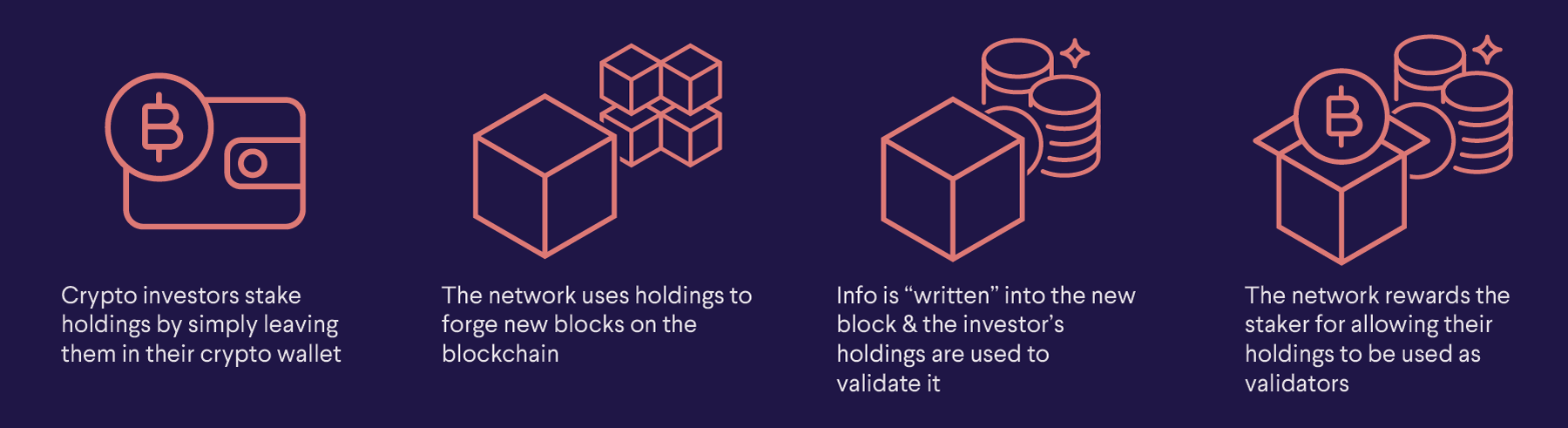
Here’s how it works:

•   Stakers agree to lock away some of their cryptocurrency on a blockchain network through a process called staking.

•   The blockchain network can use the holdings to create a new block and validate transactions.

•   The staker with the largest “stake” has a higher probability of being chosen to validate transactions.

•   Validated transactions earn the staker a reward; stakers who violate protocols, however, could face a penalty.

Proof-of-stake is considered by some to be an upgrade from proof-of-work. It requires much less computing power, reducing strain on the energy grid, and it also allows stakers an opportunity to potentially earn passive income while holding cryptocurrency. That said, stakers face the risk that their coins could lose value while they’re locked up for staking.

Examples of PoS Coins

Compared to Bitcoin, proof-of-stake coins claim a smaller share of the market. However, the numbers are growing, and these coins represent some of the biggest movers in terms of market cap:

•   Ethereum (ETH)

•   Solana (SOL)

•   Cardano (ADA)

•   Toncoin (TON)

•   Algorand (ALGO)

Ethereum has the largest market cap overall of these, at $430.88 billion, as of August 2025. This coin has seen a 911% increase in the last five years.

Type 3: Utility Tokens – The Keys to a Network

Utility tokens, or user tokens, are a type of cryptocurrency that serves a specific purpose inside a decentralized network. They’re built on an existing blockchain and grant their holders access to distinct functions, features, or services.

What Are Utility Tokens?

A utility token is a digital asset that grants holders access to a certain product or service for a given cryptocurrency. They’re typically developed using smart contracts and may be programmed for a range of uses, such as to access storage space or to bring external data onto a blockchain network. Or, as with a governance token, they may give holders the option to vote on changes to a blockchain network.

More broadly, utility tokens can help encourage participation in and support of the crypto ecosystem they were designed for. They may serve as a loyalty bonus, for example, provide access to exclusive features, or other incentives for interacting with the network, all of which may help foster the growth of that crypto community.

Unlike other types of tokens that may confer a stake in an asset or a physical entity, utility tokens serve primarily as a key to various features offered by a cryptocurrency.

Examples of Utility Tokens

Utility tokens are designed with specific use-cases in mind. Their value is typically measured more in terms of what they allow you to do, versus what value they represent.

Here are some examples of utility tokens:

•   Ether (ETH): Ether is the native token of Ethereum, which is the second-largest blockchain network. Ether is used to pay the Ethereum “gas fee” required to process transactions on the blockchain. Given its reach, however, it’s sometimes seen as a currency (having a store of value) in its own right.

•   Chainlink (LINK): Chainlink is a decentralized oracle network that acts as a bridge between smart contracts and real-world data. Tokens are used to pay for data services and incentivize the production of accurate data feeds.

•   Basic Attention Token (BAT): BAT is an Ethereum-based token that’s used within the Brave browser ecosystem. Browser users earn tokens by opting into ads; they can use their tokens to unlock premium content.

•   Golem (GLM): Golem is a decentralized supercomputer that lets users rent their computing power to others. Tokens are used to pay for services through the platform.
9,10

•   The Sandbox (SAND): SAND is the utility token for the community-driven blockchain gaming platform, The Sandbox. Players can earn SAND and use it to purchase virtual assets, access exclusive interactions, and take part in governance, among other things.

Type 4: Stablecoins – The Price Stability Anchor

Stablecoins are digital assets whose value is tied or “pegged” to another asset. Of the $250 billion in stablecoins currently in circulation, 99% of them are pegged to the U.S. dollar. Stablecoins are an alternative to Bitcoin and other cryptocurrencies whose value may fluctuate widely due to changes in supply and demand, or market sentiment.11

What Are Stablecoins?

Stablecoins are cryptocurrencies that are stored on the blockchain, but whose value is tied to an underlying currency or commodity. For example, stablecoins may be pegged to the U.S. dollar, the Euro, or gold. Because they’re tied to underlying assets, stablecoins can be redeemed for those assets.[1]

Stablecoins are designed with the goal of maintaining a stable price relative to the asset they’re pegged to, and in comparison to the high price volatility of cryptocurrencies in general. That said, stablecoin stability may depend on a number of factors, such as the stablecoin’s level of liquidity, market volatility, and transparency around reserves.

The regulatory landscape for stablecoins is quickly evolving, such as with the recent passing of the 2025 Genius Act, which provides oversight for issuers of payment stablecoins and rules focused on consumer protection.[2] The European Union’s Markets in Crypto-Assets (MiCA) regulation also went into effect in 2025. Under MiCA, stablecoins issuers are regulated like financial institutions and must meet certain EU reserve requirements. Some stablecoins are choosing not to seek EU compliance, however, such as Tether (USDT), which keeps much of its reserves in U.S. Treasurys.[3]

As the industry shifts, there are still risks to be aware of, such as a stablecoin losing its peg value, technology or operational risks, or the potential for scams or fraud.

Common uses for stablecoins include:

•   Paying for goods and services

•   Making cross-border payments

•   Offering potential protection against price instability in cryptocurrency markets

Crypto users may use stablecoins to buy other cryptocurrencies in lieu of cash, and more payment processors are allowing the use of these coins to pay for transactions online.

Examples of Stablecoins

Stablecoins represent a growing share of the total cryptocurrency market. Some of the most well-known stablecoins by market cap include:

•   Tether (USDT)

•   USDC (USDC)

•   USDS (USDS)

•   Dai (DAI)

•   PayPal USD (PYUSD)

The total market cap of stablecoins was $268.27 billion as of August 2025. With a few exceptions, stablecoins have a relatively low price point compared to other types of cryptocurrency.

Type 5: DeFi Service Providers – The Future of Finance

DeFi service providers represent a subset of the cryptocurrency landscape. They operate on decentralized, blockchain-based frameworks in order to offer services that allow individuals to conduct transactions directly. For example, a DeFi coin is similar to a physical coin in that it transfers value, but it does so without going through a central intermediary.

What Is Decentralized Finance (DeFi)?

Decentralized finance, or DeFi, describes financial services that are executed through the blockchain. By allowing for direct, peer-to-peer transactions, DeFi advocates note that it could help reduce barriers to entry for those who traditionally have a harder time accessing financial services, and allow for potentially faster, cheaper transactions.

Some of the top providers building out the decentralized finance landscape are developing decentralized peer-to-peer exchanges, borrowing and lending protocols, data services through decentralized oral networks (DONs), and stablecoins, which may help provide a bridge between blockchain systems and traditional assets.

Most, though not all, DeFi protocols and applications are built on Ethereum. DeFi tokens can be used to access services and goods through decentralized apps. Though DeFi tokens represent a smaller share of the cryptocurrency market, their popularity is growing.

DeFi, of course, is in its early stages, and while the blockchain technology itself helps to safeguard information, the other apps, systems, and entities that interact with the network could pose risks. It’s important to be cautious when considering options, especially as crypto regulations continue to develop.

Examples of DeFi Tokens

Here are some of the largest DeFi tokens by market cap:

•   Stellar (XLM)

•   Hyperliquid (HYPE)

•   Uniswap (UNI)

•   Polkadot (DOT)

•   Aave (AAVE)

The total DeFi token market was valued at $111.94 billion as of August 2025. It’s essential to distinguish between DeFi tokens and DeFi coins. The difference, again, between tokens and coins is how they relate to the blockchain.

Type 6: Privacy Coins – The Anonymous Transactions

Privacy coins offer anonymity by obscuring certain details about their users. These coins can be sent and received anonymously, without disclosing the location of the parties involved in the transaction.

What Are Privacy Coins?

Privacy coins enable the secure transfer of cryptocurrency without revealing either its origin or destination. This is a key departure from the more public nature of transactions conducted on the blockchain. Public blockchains were designed with the idea that information be transparent and immutable, allowing participants to view and validate the data. With Bitcoin, for example, Bitcoin users can access transaction data (though not identity information) through public Bitcoin addresses used to make payments.

A privacy coin blocks certain information from view through the use of different strategies, including:

•   Protocols that generate stealth addresses

•   Mixing of transactions to make the routing of coins more difficult to trace

•   Tools that allow for the validation of transactions without requiring the disclosure of any identifying information

Privacy coins aren’t accessible in every country or crypto market. Some countries have banned them outright, while others have taken steps to remove some of the secrecy surrounding them.15
For example, recent anti-money laundering regulations passed by the European Union will, starting in 2027, ban financial and credit institutions as well as crypto-asset service providers from managing cryptocurrencies that offer anonymous accounts.

Examples of Privacy Coins

The market for privacy coins is smaller than other types of cryptocurrencies, and your ability to buy them may depend on where you live. Examples of popular privacy coins include:

•   Monero (XMR)

•   Zcash (ZEC)

•   Beldex (BDX)

•   Decred (DCR)

•   Dash (DASH)

As of August 2025, the privacy coin market was valued at $7.16 billion. A glance at pricing charts shows that privacy coins have the potential to be exceptionally volatile.

Type 7: Meme Coins – The High Risk, High Reward Speculation

Meme coins are a type of cryptocurrency whose popularity is driven by memes or trends.

What Are Meme Coins?

Meme coins are coins that gain attention because they align with a trend or newsworthy event. Any coin can become a meme coin if someone or something pushes it into the spotlight. Some of the most popular meme coins can develop cult-like followings, which can help drive demand.

Compared to other types of cryptocurrency, meme coins tend to be more volatile because their value is often tied to their popularity. A coin that’s hot today may not be tomorrow, and its value could quickly fizzle if the trend dies down, or the meme that the coin is associated with loses popularity.

Examples of Meme Coins

Meme coins can sometimes be some of the most recognizable cryptocurrencies if they grab the attention of the broader population. Examples of popular meme coins include:

•   Dogecoin (DOGE)

•   Shiba Inu (SHIB)

•   Pepe (PEPE)

•   Pudgy Penguins (PENGU)

•   Bonk (BONK)

Meme coins often have lower prices than other cryptocurrencies. As of August 2025, meme coins had a market cap of $76.2 billion.

The Critical Impact of Tax Treatment

The IRS treats cryptocurrency and other digital assets as property, meaning that any gains you generate from them are taxable. If you have digital asset transactions during the year, you’re required to report them on your tax return.

The sale of digital assets, including cryptocurrency, can trigger capital gains if you sell at a profit, or capital losses if you sell for less than the original purchase price. Selling off crypto assets after seeing huge gains in value could significantly increase your tax liability for the year.

You can offset gains with losses through a process known as tax loss harvesting. That can reduce what you owe in federal taxes for the current year.

Income earned through cryptocurrency activities, such as from mining rewards, is considered ordinary income. Depending on your circumstances, the tax rules applying to your digital assets could get complicated. You may want to talk to a certified public accountant (CPA) or another tax professional about how crypto assets could affect your overall tax picture.[4]

The Takeaway

Cryptocurrencies are all digital assets built upon a distributed network and, likewise, upon the principle of decentralization. It’s important to remember, however, that there are several types of cryptocurrencies, and each one — be it proof-of-work, proof-of-stake, stablecoins, DeFi, or utility tokens — has myriad options within it.

Different cryptocurrencies have different goals, functionalities, markets, and prospects. By the same measure, cryptocurrencies are also not created equally in terms of risk, both in their own right, and in terms of how they may align with your financial goals. Understanding the different types of cryptocurrencies can help you better understand the role they may play in crypto markets and potentially in your portfolio.

Soon, SoFi members will be able to buy, sell, and hold cryptocurrencies, such as Bitcoin, Ethereum, and more, and manage them all seamlessly alongside their other finances. This, however, is just the first of an expanding list of crypto services SoFi aims to provide, giving members more control and more ways to manage their money.

Join the waitlist now, and be the first to know when crypto is available.

FAQ

How many types of cryptocurrencies are there?

Broadly speaking, cryptocurrencies can be grouped into coins and tokens. Beyond those two main types, there are millions of different types of crypto being exchanged, with new currencies entering the market regularly.

What is the most common type of cryptocurrency?

Bitcoin is likely the most common type of cryptocurrency, or at least the one people are most familiar with. It’s also the crypto asset that holds the lion’s share of market capitalization. As the first blockchain coin, Bitcoin opened the door for the introduction of other cryptocurrencies, including Ethereum and Litecoin.

What is the difference between a coin and a token?

The main difference between a coin and a token is their relationship to the blockchain. Coins are the native digital currency of their blockchain, while tokens sit on top of an existing blockchain. Tokens are often associated with digital currencies, but they can also represent other digital assets, like NFTs, or something intangible, like voting rights.

Are NFTs a type of cryptocurrency?

NFTs or non-fungible tokens are not a type of cryptocurrency, but they share space with crypto on the blockchain. An NFT represents ownership of a unique digital or physical asset, such as a drawing, image, or piece of artwork.


About the author

Rebecca Lake

Rebecca Lake

Rebecca Lake has been a finance writer for nearly a decade, specializing in personal finance, investing, and small business. She is a contributor at Forbes Advisor, SmartAsset, Investopedia, The Balance, MyBankTracker, MoneyRates and CreditCards.com. Read full bio.


Article Sources
  1. U.S. Securities and Exchange Commission. Statement on Stablecoins.
  2. Congress.gov. S.1582 – GENIUS Act.
  3. World Economic Forum. The GENIUS Act is designed to regulate stablecoins in the US, but how will it work?.
  4. Intuit Turbotax. Your Crypto Tax Guide.

CRYPTOCURRENCY AND OTHER DIGITAL ASSETS ARE NOT FDIC INSURED • ARE NOT BANK GUARANTEED • MAY LOSE VALUE


Cryptocurrency and other digital assets are highly speculative, involve significant risk, and may result in the complete loss of value. Cryptocurrency and other digital assets are not deposits, are not insured by the FDIC or SIPC, are not bank guaranteed, and may lose value.

All cryptocurrency transactions, once submitted to the blockchain, are final and irreversible. SoFi is not responsible for any failure or delay in processing a transaction resulting from factors beyond its reasonable control, including blockchain network congestion, protocol or network operations, or incorrect address information. Availability of specific digital assets, features, and services is subject to change and may be limited by applicable law and regulation.

SoFi Crypto products and services are offered by SoFi Bank, N.A., a national bank regulated by the Office of the Comptroller of the Currency. SoFi Bank does not provide investment, tax, or legal advice. Please refer to the SoFi Crypto account agreement for additional terms and conditions.


Financial Tips & Strategies: The tips provided on this website are of a general nature and do not take into account your specific objectives, financial situation, and needs. You should always consider their appropriateness given your own circumstances.

Tax Information: This article provides general background information only and is not intended to serve as legal or tax advice or as a substitute for legal counsel. You should consult your own attorney and/or tax advisor if you have a question requiring legal or tax advice.

Third-Party Brand Mentions: No brands, products, or companies mentioned are affiliated with SoFi, nor do they endorse or sponsor this article. Third-party trademarks referenced herein are property of their respective owners.

External Websites: The information and analysis provided through hyperlinks to third-party websites, while believed to be accurate, cannot be guaranteed by SoFi. Links are provided for informational purposes and should not be viewed as an endorsement.

This article is not intended to be legal advice. Please consult an attorney for advice.

SOCRYP-Q325-047

Read more
TLS 1.2 Encrypted
Equal Housing Lender