5 Tips For Getting the Lowest Rate When Refinancing Student Loans

One main reason for refinancing student loans with a private lender is to combine your loans into one new loan with a lower interest rate. If you get a lower interest rate, your monthly student loan payment will go down. You’ll also pay less interest over the life of the loan.

Here, learn more about steps to take to help get a lower interest rate on student loans.

Key Points

•   A student loan refinance may help borrowers get a lower interest rate if they qualify and reduce monthly loan payments.

•   A strong credit history and a low debt-to-income ratio can help refinancing applicants get a better rate.

•   Reducing living expenses and paying down other debt like credit card debt could be beneficial when applying for student loan refinance.

•   Providing lenders with a comprehensive employment history and proof of salary increases can be useful.

•   Those without a strong credit history may want to consider refinancing with a cosigner for better rates.

Reduce Your Interest on Student Loans

Consolidating multiple student loan balances into one new refinance loan with a low interest rate can be ideal for those looking to reduce the amount they owe in interest and also lower their monthly loan payment. It’s important to note, though, that if you refinance federal student loans, you lose access to federal benefits such as income-driven repayment plans.

Getting approved for student loan refinancing isn’t just a matter of submitting an application. You need a game plan — one that will help you become a strong loan candidate, who’ll qualify for a lower student loan interest rate. Here are five strategies that may help.

5-Point Plan for Getting a Low Interest Rate

1. Check your credit.

If you want to reduce your student loan interest rate through refinancing, the first thing you should do is check your credit score. The stronger your credit profile, the less risky you appear to lenders. If your credit profile is solid — meaning you have a good credit score and a low debt-to-income ratio — lenders should offer you better rates.

If, however, your credit profile isn’t quite where you want it to be, that’s OK. Take a few months to build your credit and reapply for student loan refinancing down the line to see if you qualify for a better rate.

Recommended: Why Your Debt to Income Ratio Matters

2. Take a hard look at your cost of living.

Some cities are more expensive to live in than others. Someone renting an apartment in a small Midwestern town, for example, has lower living expenses than someone who owns a row home in San Francisco. Cost of living ties directly into your debt-to-income ratio, and therefore it matters when you want to get a lower interest rate on student loans.

To some extent, this is out of your hands; your zip code helps lenders determine your cost of living. But anything you can do to pay down debt, especially high-interest credit card debt, and make choices that free up more money — such as renting a smaller place, taking on a roommate, or leasing a cheaper car — can help your case.

3. Give lenders a complete history.

Some student loan refinancing lenders consider things like where you went to school and your position at work when they weigh your application. Provide as much information as you can when it comes to your undergraduate and graduate degrees.

Be sure to also include all relevant work experience. Again, if you can show lenders that you have a solid work history and your income has steadily increased, you will appear less risky. The less riskier you are to lenders, the better your student loan interest rate is likely to be.

If there’s a job offer on the horizon, be sure to submit your offer letter with your application. And if you get a promotion while your application is under review, notify the lender immediately. Finally, if you’re in line for a promotion that will positively affect your paycheck, wait until it happens before you apply.

4. Show all your income.

When lenders ask for income information, they mean all of your income, not just job earnings. List dividends, interest earned, bonuses, and the extra money you make from your side hustle or Airbnb rental property. As long as you can prove these income sources, it will all count toward your debt-to-income ratio and help to lower it. And again, the lower this ratio, the better chances you have at qualifying for a lower student loan refinance rate.

Also, make sure your driver’s license is current and that your student loan statements are all correct. If you’re self-employed, you may want to wait until you’ve filed your taxes to apply for refinancing — it’s one of the easiest ways to prove the previous year’s income.

5. Be flexible.

If you have a number of student loans and you’re not offered the best rate when you apply for refinancing, consider refinancing only a couple of them. You may get a lower interest rate with a smaller refinance balance. You can always apply for the full balance down the road after you’ve received a raise or moved to a less expensive location.

Being flexible also means you might want to think about asking a friend or relative for help if your application isn’t as strong as you’d like. When you refinance your student loans with a cosigner who has a good credit profile and low debt-to-income ratio, you may be able to get a lower rate than if you refinanced on your own.

Refinance Student Loans With SoFi

The stronger you are as a student loan refinancing candidate, the better your chances are of getting a lower student loan refinance rate. To get the lowest rate when refinancing, check your credit, take a close look at your living expenses and debt-to-income ratio, give lenders a complete history of your education and employment, make sure to include all of your income sources in the application, and finally, be flexible, even if that means applying with a cosigner.

Keep in mind, though, that if you choose to refinance your federal student loans with a private lender, you lose access to federal benefits, such as student loan forgiveness and income-driven repayment plans. Make sure you don’t plan on using these benefits now or at any point in the future before deciding to refinance.

If you do think a student loan refinance may be right for you, consider SoFi. SoFi offers competitive rates and does not charge origination fees. It takes just a few minutes to see your rates, and your credit score will not be affected when you prequalify.

With SoFi, refinancing is fast, easy, and all online. We offer competitive fixed and variable rates.

FAQ

Can you negotiate your student loan interest rate?

Not necessarily. Interest rates are determined by both the market and your credit profile, leaving little room for negotiation. You could, however, present your lowest offer to another lender to see if they will match that.

How can I get a lower interest rate when refinancing my student loans?

Strategies to potentially get a lower interest rate when refinancing student loans include building your credit profile, having a reliable source of income, and making sure your debt-to-income ratio is low.

Is it possible to get lower rates when refinancing student loans?

Yes, it is possible to get a lower interest rate when refinancing student loans. Your student loan interest rate will generally depend on current market rates, your credit profile, and your debt-to-income ratio. A strong credit history and a lower debt-to-income ratio may help you get a lower rate.


SoFi Student Loan Refinance
Terms and conditions apply. SoFi Refinance Student Loans are private loans. When you refinance federal loans with a SoFi loan, YOU FORFEIT YOUR ELIGIBILITY FOR ALL FEDERAL LOAN BENEFITS, including all flexible federal repayment and forgiveness options that are or may become available to federal student loan borrowers including, but not limited to: Public Service Loan Forgiveness (PSLF), Income-Based Repayment, Income-Contingent Repayment, extended repayment plans, PAYE or SAVE. Lowest rates reserved for the most creditworthy borrowers.
Learn more at SoFi.com/eligibility. SoFi Refinance Student Loans are originated by SoFi Bank, N.A. Member FDIC. NMLS #696891 (www.nmlsconsumeraccess.org).

SoFi Loan Products
SoFi loans are originated by SoFi Bank, N.A., NMLS #696891 (Member FDIC). For additional product-specific legal and licensing information, see SoFi.com/legal. Equal Housing Lender.


Third-Party Brand Mentions: No brands, products, or companies mentioned are affiliated with SoFi, nor do they endorse or sponsor this article. Third-party trademarks referenced herein are property of their respective owners.

Non affiliation: SoFi isn’t affiliated with any of the companies highlighted in this article.

Disclaimer: Many factors affect your credit scores and the interest rates you may receive. SoFi is not a Credit Repair Organization as defined under federal or state law, including the Credit Repair Organizations Act. SoFi does not provide “credit repair” services or advice or assistance regarding “rebuilding” or “improving” your credit record, credit history, or credit rating. For details, see the FTC’s website .

Financial Tips & Strategies: The tips provided on this website are of a general nature and do not take into account your specific objectives, financial situation, and needs. You should always consider their appropriateness given your own circumstances.

SOSLR-Q225-007

Read more
woman typing on her computer

5 Alternatives to Emergency Student Loans

You thought you had your college costs covered. Then something unexpected happened — a sudden job loss, unplanned expense, family emergency — and now you’re short on funds and wondering how you’ll make ends meet.

Fortunately, some schools offer emergency student loans to help students rebound from a financial set-back and manage the unexpected. While these tend to be smaller amounts, an emergency loan can help you get through a rough financial patch, allowing you to stay in school and complete your degree.

However, not every college and university offers emergency student loans, and those that do may have limited funds for emergency student loans and varying eligibility requirements.

Here are key things to know about emergency or fast student loans, plus other ways to access quick funds when you hit a set-back or unexpected college expense.

Key Points

•   Emergency student loans are short-term loans (typically $500–$1,500, repaid in 30–90 days) that schools may offer for urgent expenses like food, housing, or medical costs.

•   Not all schools provide them, and strict eligibility plus fast repayment can make them difficult for some students to manage.

•   Alternatives include unused federal student loans, emergency university grants or scholarships, and private student loans for larger or longer-term needs.

•   Other options include tuition payment extensions or plans, and free resources like campus or community food pantries.

•   Alumni-funded programs and nonprofit emergency grants can also provide short-term financial relief without adding new debt.

The Basics of Emergency Student Loans

The term emergency student loan generally refers to a loan offered to actively enrolled students in dire financial situations, typically by colleges and universities. If you have experienced an unexpected financial hardship, whether due to a job loss, a death in the family, or any life circumstance that results in immediate financial need, you may be eligible to apply.

Emergency loans are generally disbursed and repaid on rapid schedules. Repayment terms may be as short as 30 to 90 days. The amount you can borrow varies by school but the cap is typically between $500 to $1,500. Some emergency student loans are interest-free, while others charge a low interest rate.

Typically, you cannot use an emergency student loan to cover your tuition for the semester. However, you can use it to cover other expenses, like food, housing, childcare, and medical expenses.


💡 Quick Tip: Get flexible terms and competitive rates when you refinance your student loan with SoFi.

How to Get Emergency Student Loans

If you need an emergency or instant student loan, a good first step is to contact your school’s financial aid office. If your school offers emergency loans, you will likely need to:

•   Find out if you are eligible. You’ll want to check your school’s eligibility requirements to make sure you qualify before you go through the application process.

•   Fill out the emergency student loan application. You may be able to do this online or you might need to do it in person at the financial aid office. You’ll likely need to have your student ID and enrollment information. Your school may also ask for documentation of your financial emergency before it will approve the loan.

•   Make a plan to repay your loan on time. You may need to repay the loan within just a few months, so you’ll want to determine how you will make those payments. If you miss a payment, the school might charge fees and/or hold your academic records.

Are Emergency Student Loans a Good Idea?

While emergency student loans can be helpful, they may not be the right solution for everyone. For one, the loan might not offer enough money to help you out. For another, schools typically have strict qualification criteria for emergency student loans. For example, you typically need to have experienced an unexpected event that triggered a dire and sudden financial need, such as:

•   Loss of a parent

•   Dismissal from a job or unexpected reduction in income

•   Natural disaster

•   Significant crime or theft

Also keep in mind that an emergency loan is still a loan, so you’ll want to make sure you can handle more debt before you tap a fast student loan. Also be sure you can manage the short repayment period. Having a loan go into default may jeopardize your education and your eligibility for future financial aid. In other words, it’s a good idea to establish a plan before you borrow money.

Emergency Student Loan Alternatives

Emergency student loans can be a great resource for some students. However, they aren’t right for everyone. You may not qualify for your school’s emergency student loan program. Or, you might need a larger sum of money or a longer repayment timeline. Also, not all schools offer emergency loans. Luckily, there are other options on the table to help you through a cash crunch during college. Here are five you may want to explore.

1. Unused Federal Student Loans

If you’ve already submitted your Free Application for Federal Student Aid (FAFSA) but turned down some or all of the federal student loans you were offered, there is good news: It’s possible to change your mind. Once you have filed a FAFSA, you are allowed to accept the funds at any time during the academic year.

For example, you might have been offered $5,000 in federal loans but only claimed $2,000 of that money. If you find yourself in financial hardship later in the academic year, you could still claim the unused portion of federal student aid. You can use federal student loans to cover tuition as well as living expenses. Your financial aid office can help you figure out if this is an option for you.

Since you’ve already been approved for the loan, funding time will likely be much faster compared to the regular waiting time for federal aid. It shouldn’t take more than 14 days to receive the funds.

If you’ve had a major change in your financial situation, such as a job loss or the passing of a parent, you may want to resubmit your FAFSA to reflect your new situation. Depending on the changes, you might qualify for more aid.

2. University Grants and Scholarships

Some colleges and universities offer emergency aid in other forms besides loans. Emergency grants and scholarships work in a similar way to emergency student loans in that they’re meant to help cover unexpected financial hardships. However, unlike loans, grants don’t have to be repaid.

For example, some schools offer completion scholarships or grants, which can forgive a portion or all of the outstanding balance that might otherwise keep a student from advancing or graduating. Other schools have voucher programs to help with specific on-campus costs like books and dining hall meals.

You’ll need to get in touch with your financial aid office to see if you qualify for any emergency assistance grants, scholarships, or vouchers under your circumstances. The school may require proof of hardship or emergency.

Recommended: Finding Free Money for College

3. Private Student Loans

If you’ve tapped all of your federal aid options, you might turn to private student loans to help cover emergency expenses. These are loans offered by banks, credit unions, and online lenders.

Private student loans typically come with higher interest rates than federal student loans and don’t offer the same borrower protections (like forbearance and forgiveness programs). However, you can often borrow up to your school’s cost of attendance with a private student loan, giving you more borrowing power than you can get with the federal government. Depending on the lender, you may be able to take advantage of quick student loan approval and disbursement and use the money to pay for your emergency expenses.

Some lenders send the money straight to the school and, once tuition is covered, the school will typically give you the remainder of the loan to cover living expenses. In other cases, lenders will send the funds to you to make the appropriate payments.

4. Tuition Payment Extension

If you’re not sure you can pay your tuition on time due to a sudden emergency, it’s worth asking your financial aid office if they provide temporary payment extensions or payment plans.

Some colleges may be willing to grant you an extension on paying your tuition. For example, they might offer an emergency deferment plan which allows enrolled students to postpone payments through a specific date, such as the 90th day of the term. This might give you a bit of extra breathing room in your budget.

You might also explore tuition payment plans. Many schools allow you to spread out your tuition into affordable monthly or bi-monthly payments. Typically, schools don’t charge interest on thes plans. However, when exploring this alternative, it’s a good idea to ask about any fees or interest charges that might apply.

5. Food Pantries

The cost of food is high these days, and this may be particularly burdensome during an emergency. Your school may have an on-campus food pantry that can help reduce your expenses until you’re back on your feet. Also keep in mind that local churches and other charitable organizations in your area may also offer food at no cost to those in need. Feeding America is a helpful resource to find food banks near you.These food pantries can provide basics like canned foods, pastas, dried breakfast items and more.


💡 Quick Tip: Refinancing could be a great choice for working graduates who have higher-interest graduate PLUS loans, Direct Unsubsidized Loans, and/or private loans.

Where Can You Look for Other Forms of Emergency Student Aid and Assistance?

Outside of emergency student loans and grants, colleges and universities often offer additional resources that can help with unplanned costs during an emergency. You might find on-campus support in the form of housing opportunities, bus passes, or food pantries. Even if your school doesn’t offer emergency assistance directly, a financial aid administrator may know of off-campus organizations that will offer support.

You might also explore assistance from alumni-funded foundations or other nonprofit scholarships or grants that can provide emergency assistance. For example, the UNCF offers a “Just-in-time” emergency grant of up to $1,000 for students at risk of dropping out of college due to a financial hardship (like medical bills, a car repair, or a trip home to help a sick parent). Students must complete an online application form and show proof of financial hardship.

After You Graduate

If you took out federal or private student loans during college to cover expenses (both planned and unplanned) and you’re now in the repayment stage, you might want to look into refinancing. When you refinance your student loans, a lender pays off your existing loans with a new one, ideally at a lower interest rate. That can potentially save you money in the long run — and from the first payment you make.

Just keep in mind that if you refinance federal student loans with a private lender you forfeit federal protections, such as income-driven repayment plans and forgiveness programs.

Looking to lower your monthly student loan payment? Refinancing may be one way to do it — by extending your loan term, getting a lower interest rate than what you currently have, or both. (Please note that refinancing federal loans makes them ineligible for federal forgiveness and protections. Also, lengthening your loan term may mean paying more in interest over the life of the loan.) SoFi student loan refinancing offers flexible terms that fit your budget.

Check out what kind of rates and terms you can get in just a few minutes.


We’ve Got You Covered

Need to pay
for school?

Learn more →

Already have
student loans?

Learn more →


About the author

Julia Califano

Julia Califano

Julia Califano is an award-winning journalist who covers banking, small business, personal loans, student loans, and other money issues for SoFi. She has over 20 years of experience writing about personal finance and lifestyle topics. Read full bio.


SoFi Student Loan Refinance
Terms and conditions apply. SoFi Refinance Student Loans are private loans. When you refinance federal loans with a SoFi loan, YOU FORFEIT YOUR ELIGIBILITY FOR ALL FEDERAL LOAN BENEFITS, including all flexible federal repayment and forgiveness options that are or may become available to federal student loan borrowers including, but not limited to: Public Service Loan Forgiveness (PSLF), Income-Based Repayment, Income-Contingent Repayment, extended repayment plans, PAYE or SAVE. Lowest rates reserved for the most creditworthy borrowers.
Learn more at SoFi.com/eligibility. SoFi Refinance Student Loans are originated by SoFi Bank, N.A. Member FDIC. NMLS #696891 (www.nmlsconsumeraccess.org).

SoFi Loan Products
SoFi loans are originated by SoFi Bank, N.A., NMLS #696891 (Member FDIC). For additional product-specific legal and licensing information, see SoFi.com/legal. Equal Housing Lender.


Non affiliation: SoFi isn’t affiliated with any of the companies highlighted in this article.

SoFi Private Student Loans
Please borrow responsibly. SoFi Private Student loans are not a substitute for federal loans, grants, and work-study programs. We encourage you to evaluate all your federal student aid options before you consider any private loans, including ours. Read our FAQs.

Terms and conditions apply. SOFI RESERVES THE RIGHT TO MODIFY OR DISCONTINUE PRODUCTS AND BENEFITS AT ANY TIME WITHOUT NOTICE. SoFi Private Student loans are subject to program terms and restrictions, such as completion of a loan application and self-certification form, verification of application information, the student's at least half-time enrollment in a degree program at a SoFi-participating school, and, if applicable, a co-signer. In addition, borrowers must be U.S. citizens or other eligible status, be residing in the U.S., Puerto Rico, U.S. Virgin Islands, or American Samoa, and must meet SoFi’s underwriting requirements, including verification of sufficient income to support your ability to repay. Minimum loan amount is $1,000. See SoFi.com/eligibility for more information. Lowest rates reserved for the most creditworthy borrowers. SoFi reserves the right to modify eligibility criteria at any time. This information is subject to change. This information is current as of 4/22/2025 and is subject to change. SoFi Private Student loans are originated by SoFi Bank, N.A. Member FDIC. NMLS #696891 (www.nmlsconsumeraccess.org).

Financial Tips & Strategies: The tips provided on this website are of a general nature and do not take into account your specific objectives, financial situation, and needs. You should always consider their appropriateness given your own circumstances.

External Websites: The information and analysis provided through hyperlinks to third-party websites, while believed to be accurate, cannot be guaranteed by SoFi. Links are provided for informational purposes and should not be viewed as an endorsement.

SOSL1123020

Read more
Books with sticky note markers

What’s the Average Student Loan Interest Rate?

Student loans, like any loans, have an interest rate. While interest rate accrual on existing federal student loans was paused for more than three years due to the Covid-19 forbearance, interest accrual resumed on September 1, 2023, and payments resumed in October 2023. And of course, any new student loans — federal or private — will have an interest rate that impacts the total cost of the loan.

So what is the average student loan interest rate? In this guide, we’ll look at the interest rates of new federal student loans, as well as the range of rates for private student loans.

Key Points

•   Federal student loan interest rates for 2024-25 are 6.53% for undergraduates, 8.08% for graduate students, and 9.08% for PLUS loans.

•   Private student loan interest rates range from 3.50% to 17.00% as of March 2025.

•   Federal interest rates are fixed rates that are set annually using formulas tied to the 10-year Treasury note and a statutory add-on percentage.

•   Lenders set their own rates for private student loans. The interest rate on these loans may be fixed or variable.

•   Interest rates for federal loans have increased from the previous year, while private loans have a wide range of rates influenced by market conditions.

What Is The Average Student Loan Interest Rate?

The interest rate on a student loan varies based on the type of student loan. Federal student loans issued after July 1, 2006, have a fixed interest rate. The rates on newly disbursed federal student loans are determined annually by formulas specified in the Higher Education Act of 1965 (HEA).

These are the federal student loan interest rates for the 2024–25 school year:

•   6.53% for Direct Subsidized or Unsubsidized loans for undergraduates

•   8.08% for Direct Unsubsidized loans for graduate and professional students

•   9.08% for Direct PLUS loans for graduate students, professional students, and parents

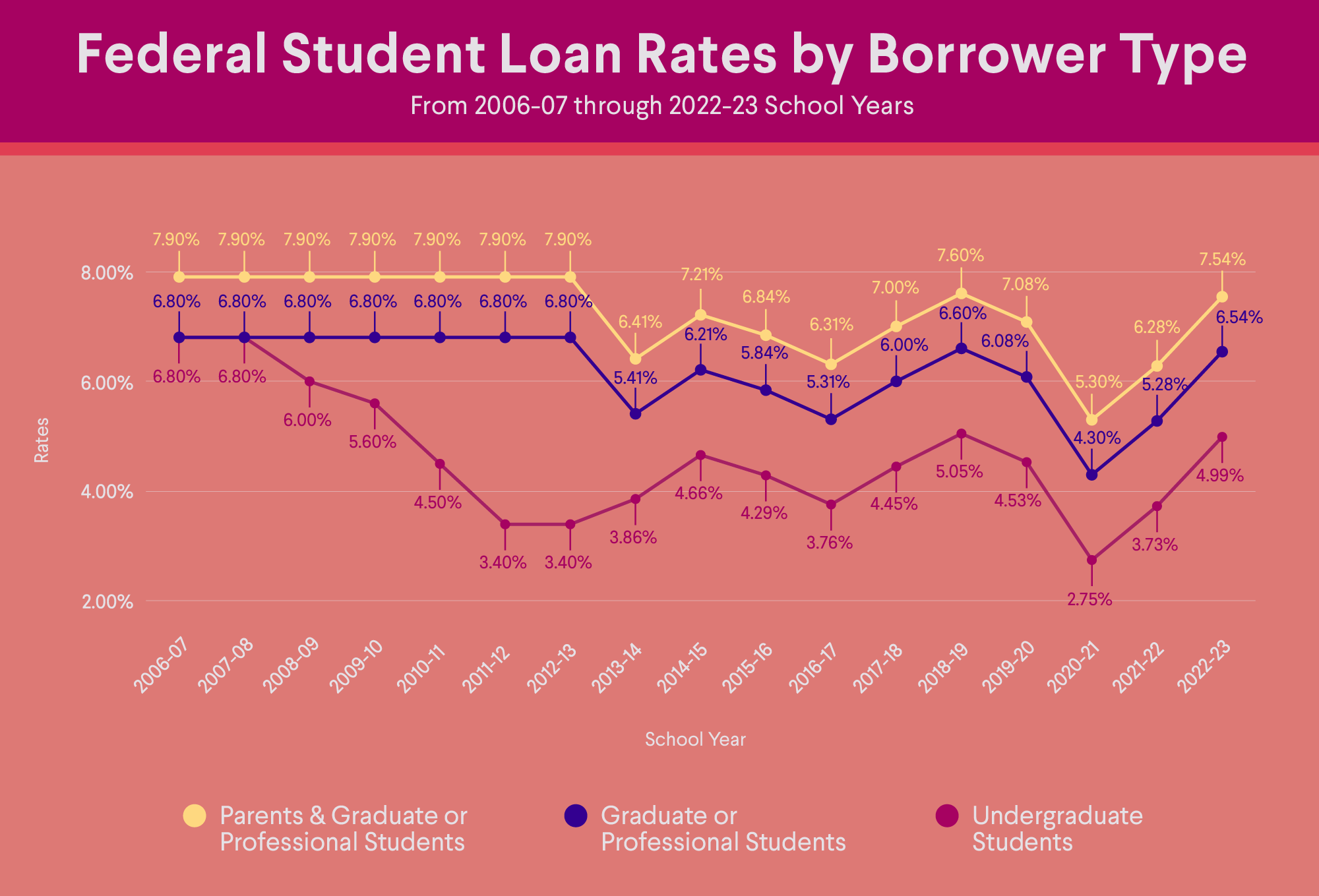
All three of those rates have risen from the 2023-2024 school year, and the undergraduate rate has more than doubled since the 2020-2021 school year.

Federal Student Loan Rates by Borrower Type
Source: Studentaid.gov

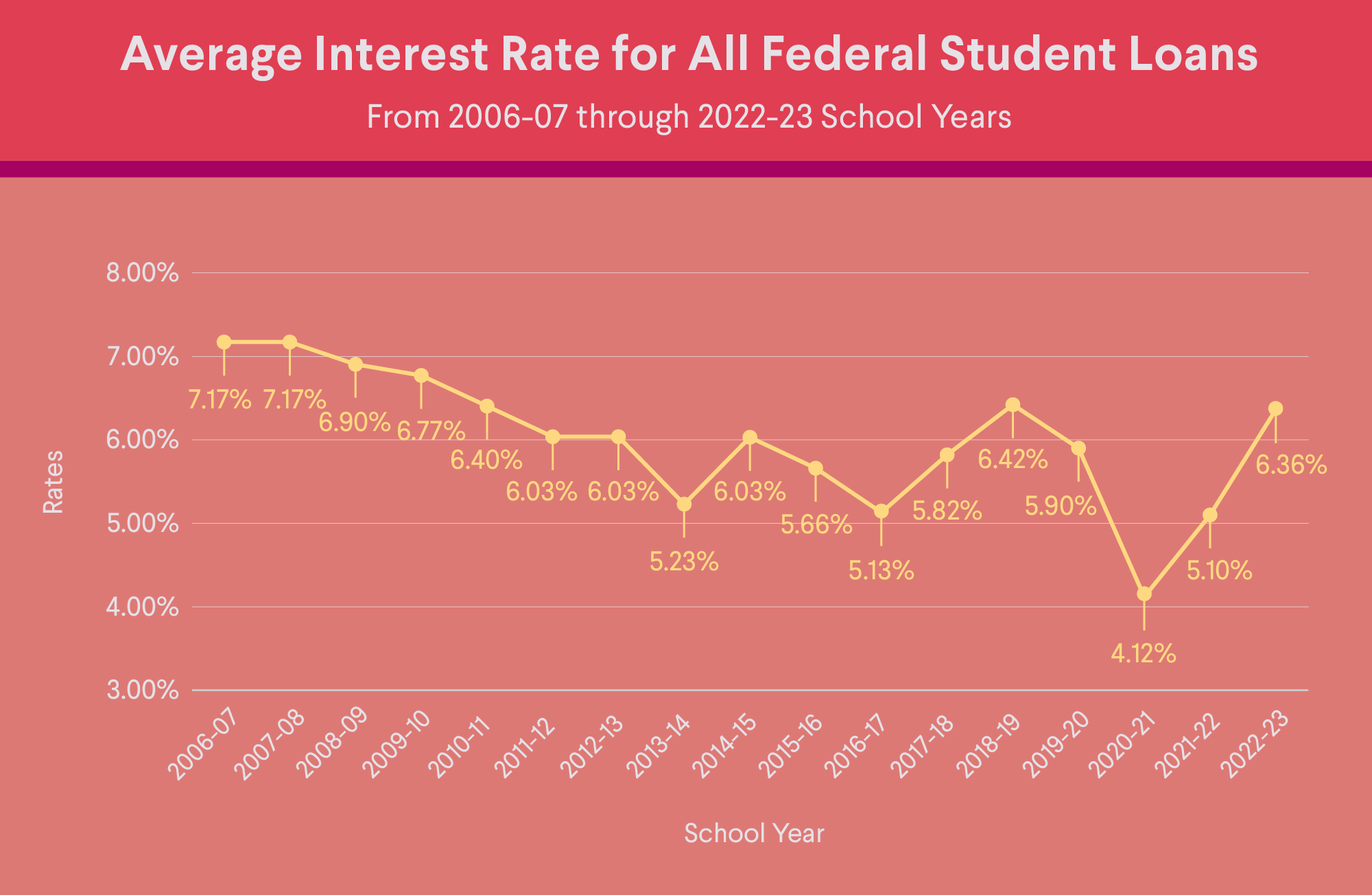
This means that the average student loan interest rate for the three main types of federal student loans is 7.89%.

Average Interest Rate for All Federal Student Loans
Source: Studentaid.gov

Private student loan interest rates vary by lender and each has its own criteria for which rates borrowers qualify for. Private student loans can have either fixed interest rates that remain the same over the life of the loan, or variable rates that may start lower than a fixed interest rate but then go up over time, based on market changes.

Private loans require a credit check, and lenders may offer different interest rates if you have strong credit or a cosigner on your student loan. The interest rates on private student loans can vary anywhere from 3.50% to 17.00% (as of March 2025), depending on the lender, the type of loan, and on individual financial factors including the borrower’s credit history.

Recommended: Do Student Loans Have Simple or Compound Interest?

How Are Interest Rates Determined?

As mentioned, the interest rates on federal student loans are set annually by formulas specified in the HEA. The rates are tied to the financial markets — federal law sets them based on the 10-year Treasury note and a statutory add-on percentage with a maximum rate cap.

Since July 2006, all federal student loans have fixed interest rates. Although federal student loans are serviced by private companies or nonprofits selected by the federal government, these loan servicers have no say in the federal interest rate offered.

For private student loans, the lenders set their own rates, though they often take cues from federal rates. The rates quoted for student loans vary based on each applicant’s individual situation — though generally the better a potential borrower’s credit history is, the better rate they may be able to qualify for.

To learn more about private and federal student loans, check out our student loan help center.

How Student Loan Interest is Calculated and Applied

Interest on federal student loans typically accrues daily. To calculate the interest as it accrues, the following formula can be used:

Interest amount = (outstanding student loan principal balance × interest rate factor) × days since last payment

In other words, you will multiply your outstanding loan balance by the interest rate factor, which is used to calculate the amount of interest that accrues on a student loan. Then, multiply that result by the days since you last made a payment.

To calculate the interest rate factor you can divide the interest rate by the number of days of the year (365). For example, let’s say you have an outstanding student loan balance of $10,000, an interest rate of 4.75%, and it’s been 30 days since your last payment. Here’s how to calculate your interest:

$10,000 x (4.75%/365) = $1.30 daily interest charge
$1.30 x 30 days = $39
Interest amount $39

Many private student loans will also accrue interest on a daily basis; however, the terms will ultimately be determined by the lender. Review the lending agreement to confirm.

Recommended: Do Student Loans Count as Income?

How to Evaluate Student Loan Interest Rates

When you take out a federal student loan, you’ll receive a fixed interest rate. This means that you’ll pay a set amount for the term of the student loan. In addition, all of the terms, conditions, and benefits are determined by the government. Federal student loans also provide some additional perks that you may not find with private lenders, like deferment.

Private student loans can have higher interest rates and potentially fewer perks than federal student loans. You may want to take advantage of all federal student loans you qualify for before comparing private loan options.

One thing to keep in mind is that interest you pay on student loans may allow you to take the student loan interest deduction on your taxes.

What Is a Good Fixed Interest Rate for Student Loans?

The lower the interest rate, the less a borrower will owe over the life of the loan, which could help individuals as they work on other financial goals. If you’re taking out federal loans, the student loan interest rate is set by federal law, so you don’t have a choice for what is and isn’t a reasonable interest rate.

When it comes to private student loans, it’s wise to shop around and compare your options to find the most suitable financing solution. Since every lender offers different terms, rates, and fees, getting quotes from multiple lenders may help you select the best option for your personal needs. Keep in mind that the rate you receive on a private student loan is largely dependent on your credit score and other factors, whereas federal student loan interest rates are based on HEA formulas.

Also keep in mind that private student loans do not have the same borrower protections as federal student loans, including deferment options, and should be considered only after all federal aid options have been exhausted.

Ways to Lower Your Student Loan Interest Rate

The interest rate on federal student loans, while fixed for the life of the loan, does fluctuate over time. For example, the rates for Direct Subsidized and Unsubsidized loans for undergraduates more than doubled from 2.75% in 2020–21 to 6.53% in 2024–25.

To adjust the rate on an existing student loan, borrowers generally have two options. They can refinance student loans or consolidate them with hopes of qualifying for a lower interest rate.

Refinancing a federal loan with a private lender eliminates them from federal borrower protections such as federal deferment or Public Service Loan Forgiveness. The federal government does offer a Direct Consolidation Loan, which allows borrowers to consolidate their federal loans into a single loan. This will maintain the federal borrower protections but won’t necessarily lower the interest rate. When federal loans are consolidated into a Direct Consolidation Loan, the new interest rate is a weighted average of your original federal student loans’ rates.

Refinancing student loans with a private lender may allow qualifying borrowers to secure a lower interest rate or preferable loan terms. Note that extending the repayment term will generally result in an increased cost over the life of the loan.

To see how refinancing could work for your student loans, try this student loan refinance calculator.

💡 Quick Tip: Refinancing comes with a lot of specific terms. If you want a quick refresher, the Student Loan Refinancing Glossary can help you understand the essentials.

Fixed vs. Variable Interest Rates: Which Is Better?

Whether fixed or variable interest rates are better depends on a borrower’s specific situation. For many borrowers, fixed rates are often a better option because they are stable and predictable. Your payments won’t change, and you won’t have to worry about rate hikes. Borrowers may want to consider a student loan with a fixed interest rate if interest rates are rising overall and they anticipate needing a number of years to repay their loan.

Because variable interest rates fluctuate with the market, they can be unpredictable. That means your payments can potentially change from one month to the next.

The Takeaway

The average student loan interest rate varies depending on the loan type. The interest rate for federal Direct Unsubsidized and Subsidized loans is set annually by federal law and fixed for the life of the loan.

The interest rate on private student loans is determined by a variety of factors including the borrower’s credit history and may range anywhere from 3.50% to to 17%.

Looking to lower your monthly student loan payment? Refinancing may be one way to do it — by extending your loan term, getting a lower interest rate than what you currently have, or both. (Please note that refinancing federal loans makes them ineligible for federal forgiveness and protections. Also, lengthening your loan term may mean paying more in interest over the life of the loan.) SoFi student loan refinancing offers flexible terms that fit your budget.


With SoFi, refinancing is fast, easy, and all online. We offer competitive fixed and variable rates.

FAQ

How often do student loan interest rates change?

The rates on federal student loans are determined and set annually by formulas specified in the Higher Education Act of 1965. Private student loan rates vary by lender, and they may be fixed or variable. Private loans with variable rates can change based on market changes.

How do federal student loan interest rates compare to private loans?

The interest rate on federal student loans is often lower than the rates for private student loans. The rate you may qualify for with a private loan depends on your circumstances. If you have strong credit or a loan cosigner who has strong credit, you may be able to get a loan with a lower interest rate.

Keep in mind that federal student loans have fixed interest rates, which means the interest and your monthly payment won’t change. Private student loans may have fixed or variable rates, and variable rates can go up or down with market changes.

Can I negotiate my student loan interest rate?

Federal student loans have fixed rates that are non-negotiable. With a private student loan, it’s possible that you may be able to negotiate the interest rate, especially if you are struggling to make payments or dealing with financial hardship. Call your private lender and explain the situation.

What factors determine my student loan interest rate?

Federal student loans have a fixed interest rate that is determined and set each year based on formulas specified in the Higher Education Act of 1965. With private student loans, each lender sets their own rates. Private loans require a credit check, and the interest rates vary based on an applicant’s credit and other factors. Generally speaking, the stronger a borrower’s credit is (or if they have a loan cosigner with strong credit), the lower the rate they may be able to qualify for.

Is it better to choose a fixed or variable interest rate for student loans?

For many borrowers, fixed rates may be a better option because they are stable and predictable, which means the monthly payments won’t change over the life of the loan. If you are planning to repay your loan over a period of years, you may want to consider a student loan with a fixed interest rate.

Variable interest rates fluctuate with the market, which makes them unpredictable. As a result, your payments can go up (or down), and may be harder to budget for.


About the author

Ashley Kilroy

Ashley Kilroy

Ashley Kilroy is a seasoned personal finance writer with 15 years of experience simplifying complex concepts for individuals seeking financial security. Her expertise has shined through in well-known publications like Rolling Stone, Forbes, SmartAsset, and Money Talks News. Read full bio.


SoFi Student Loan Refinance
Terms and conditions apply. SoFi Refinance Student Loans are private loans. When you refinance federal loans with a SoFi loan, YOU FORFEIT YOUR ELIGIBILITY FOR ALL FEDERAL LOAN BENEFITS, including all flexible federal repayment and forgiveness options that are or may become available to federal student loan borrowers including, but not limited to: Public Service Loan Forgiveness (PSLF), Income-Based Repayment, Income-Contingent Repayment, extended repayment plans, PAYE or SAVE. Lowest rates reserved for the most creditworthy borrowers.
Learn more at SoFi.com/eligibility. SoFi Refinance Student Loans are originated by SoFi Bank, N.A. Member FDIC. NMLS #696891 (www.nmlsconsumeraccess.org).

SoFi Loan Products
SoFi loans are originated by SoFi Bank, N.A., NMLS #696891 (Member FDIC). For additional product-specific legal and licensing information, see SoFi.com/legal. Equal Housing Lender.


Third-Party Brand Mentions: No brands, products, or companies mentioned are affiliated with SoFi, nor do they endorse or sponsor this article. Third-party trademarks referenced herein are property of their respective owners.

Non affiliation: SoFi isn’t affiliated with any of the companies highlighted in this article.

Tax Information: This article provides general background information only and is not intended to serve as legal or tax advice or as a substitute for legal counsel. You should consult your own attorney and/or tax advisor if you have a question requiring legal or tax advice.

Disclaimer: Many factors affect your credit scores and the interest rates you may receive. SoFi is not a Credit Repair Organization as defined under federal or state law, including the Credit Repair Organizations Act. SoFi does not provide “credit repair” services or advice or assistance regarding “rebuilding” or “improving” your credit record, credit history, or credit rating. For details, see the FTC’s website .

Financial Tips & Strategies: The tips provided on this website are of a general nature and do not take into account your specific objectives, financial situation, and needs. You should always consider their appropriateness given your own circumstances.

SOSLR-Q125-025

Read more
Woman behind laptop

Why Your Student Loan Balance Never Seems to Decrease

If you’ve been making your student loan payments, yet your balance isn’t budging — or even worse, it’s gone up — you may be asking yourself, why did my student loan balance increase? The likely reason is that your monthly payments are not covering all the interest that has accrued, which may be a result of the payment plan you’re on.

Understanding how and when student loans accrue interest, and the role your repayment plan may play, can help you make smart choices about paying off your balance.

Key Points

•   Accrued interest can cause student loan balances to remain stagnant or grow. Federal student loans accrue interest daily.

•   At the beginning of the loan repayment term, larger portions of payments primarily cover interest rather than the principal. Over time, the portion reducing the principal increases as the interest portion decreases.

•   Income-driven repayment plans can lower monthly student loan payments, but they may be too low to fully cover the interest, which can potentially cause the loan balance to grow.

•   During a period of forbearance or deferment, interest continues to accrue on student loans, and on certain types of loans, the interest may capitalize.

•   Potential methods to reduce student loan balance include changing repayment plans, making extra payments toward the loan principal, and student loan refinancing.

What Makes Up a Student Loan Balance?

To understand what increases your total loan balance, it’s important to know how student loans work. Your student loan balance is made up of two parts: the amount you borrowed plus any origination fees (the principal) and what the lender charges you to borrow it (interest).

Once you receive your loan, interest begins to accrue. If it’s a Direct Subsidized loan, the federal government typically pays the interest while you’re in school and for the first six months after you graduate. After that, you are responsible for paying the interest along with the principal.

If the loan is a Direct Unsubsidized loan or a private student loan, the borrower is solely responsible for accrued interest, even while they’re in school.

The Impact of Interest Accrual

The interest rate on your student loan is calculated as a percentage of your unpaid principal amount. Most federal student loans accrue interest daily. To determine the amount of interest that accrues each day, multiply your loan balance by the number of days since your last payment and then multiply that number by your interest rate.

In some cases, unpaid interest on federal student loans can capitalize — such as after a deferment for a Direct Unsubsidized loan. That means the interest is added to your principal balance. Interest then accrues on the new, larger balance moving forward, which increases how much you owe.

How Do Payments Affect My Student Loan Principal?

Many student loan borrowers pay a fixed monthly payment to their lender. That payment includes the principal and the interest. At the beginning of a loan term, a larger portion of your payment goes toward paying interest, and a smaller portion goes to the principal. But the ratio of interest to principal gradually changes so that by the end of the loan term, your payment is mostly going toward the principal.

💡 Recommended: Defaulting on Student Loans

How Does an Income-Based Repayment Plan Affect My Student Loan Balance?

The payment process is different if you’re making payments under an income-driven repayment (IDR) plan. Under these plans, your payments are tied to your family size and discretionary income. The interest, however, doesn’t change based on your income.

While an IDR plan can lower your monthly payments, the payment amount might be too low to fully cover the interest that accrues for that month, much less contribute to your principal. In fact, your student loan balance may actually grow over time, despite the payments you’re making, and you could end up repaying significantly more than you borrowed originally.

Refi now to pay off loans &
reach your goals faster with a shorter term.


Forbearance and Deferment Periods

Borrowers can temporarily pause their federal student loans payments with a forbearance or deferment.

A student loan forbearance allows you to pause your payments for up to 12 months at a time. However, interest continues to accrue on your federal loans while you’re in forbearance. To qualify for a forbearance, you need to apply for it and demonstrate that you meet specific requirements, such as experiencing financial difficulties or facing medical bills. Your loan servicer will determine if you are eligible.

With a student loan deferment, you can temporarily pause the payments on your federal loans, but you must apply for a specific type of deferment and meet certain requirements to be eligible. The types of deferment include cancer treatment deferment, economic hardship deferment, and unemployment deferment, among others.

Interest accrues on your loans during deferment, and you may be responsible for paying it, depending on the type of loan you hold. For example, borrowers with Direct Unsubsidized loans, Direct PLUS loans, and Federal Family Education Loans (FFEL) typically need to pay the interest that accrues on these loans while in deferment. You can pay the interest as it accrues or not. However, if you don’t pay it, the interest will capitalize at the end of the deferment period, which means the total amount you pay over the life of the loan might be higher.

Private student loans may or may not allow forbearance or deferment, and the rules typically differ from lender to lender.

How to Pay Down Your Loan Quicker

When it comes to repaying student loans, the key is to find an approach you’ll stick with. One way to tackle the debt is by making extra payments toward the principal. Even a little bit can help bring down the loan balance.

Another approach is to consider a student loan refinance to a lower interest rate, if you qualify, or you could refinance to a shorter loan term. You could also potentially do both. Your payments may be higher, particularly if you switch to a shorter loan term, but you will be finished paying off the debt sooner.

Note that if you refinance a federal student loan, you will lose access to federal protections and programs such as the Public Service Loan Forgiveness program, and income-driven repayment plans.

Other Strategies to Reduce Your Student Loan Balance

There are additional methods you can use to help pay off your student loans. They may take longer than the approaches listed above, but they can help shrink your balance.

•   Switch to a different repayment plan. If you’re on an income-driven plan, you could change to the standard repayment plan instead. Your monthly payments will likely be higher on this plan, but that will typically reduce the total amount of interest you’ll pay. Plus, you’ll repay your loan in up to 10 years, rather than the 20 or 25 years on an IDR plan.

•   Enroll in autopay. When you sign up for automatic payment, your loan servicer will deduct the amount you owe from your bank account each month. You won’t have to remember to make your payments, and even better, if you have federal Direct loans you’ll get a 0.25% interest rate deduction for participating. Some private student loan lenders also offer a similar interest rate deduction for autopay.

•   Search for student loan repayment assistance or forgiveness options. The federal government, many states, and various organizations offer programs that help qualifying individuals in certain professions pay off their loans. This includes teachers, health-care professionals, members of the military, and those who work in public service. Do some research to see what programs you might be eligible for.

The Takeaway

The way loan payment schedules are set up is likely one reason why your regular payments don’t seem to be making much of a dent to your balance or loan principal. Initially, more of your payment goes toward paying interest and less goes toward the principal. But gradually that changes so that by the end of the loan term, most of your payment is going toward the principal.

In addition, the type of student loan repayment plan you’re on can increase the amount you owe. With an income-driven plan, your monthly payment may be low enough that it doesn’t cover the interest you owe, which could cause your loan balance to grow.

Fortunately, you have options to help pay off your loan faster or pay less interest over the life of the loan. For instance, you could switch to a different repayment plan, make extra payments toward your loan principal, or refinance your student loans.

Looking to lower your monthly student loan payment? Refinancing may be one way to do it — by extending your loan term, getting a lower interest rate than what you currently have, or both. (Please note that refinancing federal loans makes them ineligible for federal forgiveness and protections. Also, lengthening your loan term may mean paying more in interest over the life of the loan.) SoFi student loan refinancing offers flexible terms that fit your budget.

With SoFi, refinancing is fast, easy, and all online. We offer competitive fixed and variable rates.


SoFi Student Loan Refinance
Terms and conditions apply. SoFi Refinance Student Loans are private loans. When you refinance federal loans with a SoFi loan, YOU FORFEIT YOUR ELIGIBILITY FOR ALL FEDERAL LOAN BENEFITS, including all flexible federal repayment and forgiveness options that are or may become available to federal student loan borrowers including, but not limited to: Public Service Loan Forgiveness (PSLF), Income-Based Repayment, Income-Contingent Repayment, extended repayment plans, PAYE or SAVE. Lowest rates reserved for the most creditworthy borrowers.
Learn more at SoFi.com/eligibility. SoFi Refinance Student Loans are originated by SoFi Bank, N.A. Member FDIC. NMLS #696891 (www.nmlsconsumeraccess.org).

SoFi Private Student Loans
Please borrow responsibly. SoFi Private Student loans are not a substitute for federal loans, grants, and work-study programs. We encourage you to evaluate all your federal student aid options before you consider any private loans, including ours. Read our FAQs.

Terms and conditions apply. SOFI RESERVES THE RIGHT TO MODIFY OR DISCONTINUE PRODUCTS AND BENEFITS AT ANY TIME WITHOUT NOTICE. SoFi Private Student loans are subject to program terms and restrictions, such as completion of a loan application and self-certification form, verification of application information, the student's at least half-time enrollment in a degree program at a SoFi-participating school, and, if applicable, a co-signer. In addition, borrowers must be U.S. citizens or other eligible status, be residing in the U.S., Puerto Rico, U.S. Virgin Islands, or American Samoa, and must meet SoFi’s underwriting requirements, including verification of sufficient income to support your ability to repay. Minimum loan amount is $1,000. See SoFi.com/eligibility for more information. Lowest rates reserved for the most creditworthy borrowers. SoFi reserves the right to modify eligibility criteria at any time. This information is subject to change. This information is current as of 4/22/2025 and is subject to change. SoFi Private Student loans are originated by SoFi Bank, N.A. Member FDIC. NMLS #696891 (www.nmlsconsumeraccess.org).

SoFi Loan Products
SoFi loans are originated by SoFi Bank, N.A., NMLS #696891 (Member FDIC). For additional product-specific legal and licensing information, see SoFi.com/legal. Equal Housing Lender.


Third-Party Brand Mentions: No brands, products, or companies mentioned are affiliated with SoFi, nor do they endorse or sponsor this article. Third-party trademarks referenced herein are property of their respective owners.

Non affiliation: SoFi isn’t affiliated with any of the companies highlighted in this article.

Financial Tips & Strategies: The tips provided on this website are of a general nature and do not take into account your specific objectives, financial situation, and needs. You should always consider their appropriateness given your own circumstances.

SOSLR-Q125-002

Read more
calendar with post-its

How Soon Can You Refinance Student Loans?

Typically, student loan borrowers cannot refinance their debt until they graduate or withdraw from school. At that point, federal student loans and the majority of private student loans have a grace period, so it can make sense to refinance right before the grace period ends.

Depending on your financial situation, the goal of refinancing may be to snag a lower interest rate and/or have lower monthly payments. Doing so can alleviate some of the stress you may feel when repaying your debt. In this guide, you’ll learn when you can refinance and what options are available, plus the potential benefits and downsides of each.

Key Points

•   Most borrowers can refinance after graduation or when they leave school; some lenders allow earlier refinancing with strong financials.

•   Refinancing federal loans with a private lender forfeits federal benefits like income-driven repayment and forgiveness.

•   It’s possible to refinance only select loans, such as those with high rates or variable interest.

•   You may refinance with a cosigner if you don’t meet a lender’s eligibility criteria.

•   Alternatives include federal loan consolidation, forbearance, or interest-only payments while still in school.

What Do Your Current Loans Look Like?

Before deciding whether or not to refinance your student loans, you need to know where your loans currently stand. Look at the loan servicers, loan amounts, interest rates, and terms for all loans before making a decision.

Contact Info for Most Federal Student Loans

The government assigns your loan to a loan servicer after it is paid out. To find your loan servicer, visit your account dashboard on studentaid.gov, find the “My Aid” section, and choose “View loan servicer details.” You can also call the Federal Student Aid Information Center at 800-433-3243.

Loans Not Owned by the Department of Education

Here’s how to get in touch:

•   If you have Federal Family Education Loan Program loans that are not held by the government, contact your servicer for details. Look for the most recent communication from the entity sending you bills.

•   If you have a Federal Perkins Loan that is not owned by the Education Department, contact the school where you received the loan for details. Your school may be the servicer for your loan.

•   If you have Health Education Assistance Loan Program loans and need to find your loan servicer, look for the most recent communication from the entity sending you bills.

Private Student Loans

Private student loans are not given by the government, but rather banks, credit unions, and online lenders. You’ll need to find your specific lender or servicer in order to find out your loan information.

Can You Refinance Student Loans While Still in School?

You may be able to refinance your student loans while still in school with certain lenders, but doing so may not make the most sense for your situation.

If you’re worried about interest accruing on your unsubsidized federal loans and/or private student loans while in school, you can most certainly make interest-only payments on them in order to keep the interest from capitalizing.

One important note: With federal student loans, any payments you make while still in school or during the grace period will not count as a qualifying payment toward loan forgiveness, if you plan on using that.


💡 Quick Tip: Ready to refinance your student loan? With SoFi’s no-fee loans, you could save thousands.

Which Loans Can Be Refinanced While Enrolled?

You can refinance any type of student loan while enrolled in school, assuming that the lender allows it. If you’re still in school and want to refinance, a lender will want to make sure you have a job or job offer on the table, are possibly in your last year of school, and have a solid credit profile. You could also consider refinancing your student loans with a cosigner if you do not meet the lender’s requirements on your own.

A couple of important points if you are considering refinancing federal student loans with a private lender:

•   Doing so means you will forfeit federal benefits and protections, such as forbearance and forgiveness, among others.

•   If you refinance for an extended term, you may have a lower monthly payment but pay more interest over the life of the loan. This may or may not suit your financial needs and goals, so consider your options carefully.

Which Loans Can’t Be Refinanced While Enrolled?

If you find a lender willing to refinance your student loans while still in school, they most likely won’t exclude a certain type of loan. However, it is best not to refinance federal student loans while enrolled. Federal Subsidized Loans, for example, do not start earning interest until after the grace period is over. Since you aren’t paying anything in interest, it doesn’t make sense to refinance and have to start paying interest on your loans immediately.

If you plan on using federal benefits, such as income-driven repayment plans or student loan forgiveness, refinancing student loans could be a bad idea. Refinancing gives you a new loan with a new private lender, thereby forfeiting your eligibility to federal benefits and protections, as noted above.

Is It Worth Refinancing Only Some of Your Loans?

Yes, it can be worth refinancing only some of your loans. The student loans you may want to focus on refinancing may include ones that have a variable rate (and you prefer a fixed rate), ones with a relatively high interest rate, or ones where you’ve had a less-than-ideal relationship with the servicer and are looking for a new experience.

When you might want to think twice about refinancing:

•   If you have federal loans and plan on using an income-based repayment plan, for example, it makes sense not to include those loans in the refinance.

•   If you have a low, fixed interest rate currently, you should probably keep those loans as is. The main reason to refinance is to secure a lower interest rate or a lower payment. Keep in mind, though, that by lowering your payment, you typically are extending your term. This can mean that you end up paying more in interest over the life of the loan.

Pros and Cons of Refinancing Student Loans

Pros Cons

•   Possibly lower your monthly payment

•   Possibly lower your interest rate

•   Shorten or lengthen the loan term

•   Switch from variable to fixed interest rate, or vice versa

•   Combine multiple loans into one

•   Lose access to federal benefits and protections

•   Lose access to remaining grace periods

•   May be difficult to qualify

•   May end up paying more in interest if you lengthen the term

Examples of Refinancing Before Earning a Degree

As stated above, there are some lenders that may allow you to refinance before you graduate or withdraw from school. These lenders may currently include Citizens Bank, Discover, RISLA, and Earnest.

Graduate students are also eligible to refinance their undergraduate student loans, assuming they meet the lender’s requirements or use a cosigner. Parents with Parent PLUS Loans are also typically allowed to refinance their loans prior to their child graduating. Rules will vary by lender, so make sure to do your research and choose a lender that will work with your unique situation.


💡 Quick Tip: Federal parent PLUS loans might be a good candidate for refinancing to a lower rate.

Alternatives to Refinancing

If refinancing your student loans isn’t the right option for you, there are alternatives to refinancing you can explore.

•   The main alternative is student loan consolidation, which combines your federal student loans into one loan with one monthly payment. The main difference between consolidation and refinancing is the interest rate on a federal loan consolidation is the weighted average of the rates of the loans you are consolidating, rounded up to the nearest one-eighth of a percentage.

•   You typically won’t save on interest, but you can lower your monthly payment by extending the loan term. Doing this, however, means you’ll probably pay more in interest over the life of the loan.

•   Student loan refinancing refers to paying off current loans with a new loan from a private lender, preferably with a lower rate. This rate is not the weighted average of the loans, but rather is based on current market rates, your credit profile, and your debt-to-income ratio.

•   Other alternatives to refinancing include making interest-only payments while still enrolled in school or requesting a student loan forbearance if you’re struggling to make your payments. Forbearance means you can reduce or pause payments for a designated period of time.

You’ll want to know all your student loan repayment options — and the pros and cons of consolidating or refinancing your loans, prior to making a decision.

A calculator tool for student loan refinancing can come in handy when estimating savings, both monthly and over the life of your loan.

Weighing Perks and Interest Rates

Before deciding whether refinancing is right for you, it’s important to again highlight this important point: If you refinance your federal student loans with a private lender, those loans will no longer be eligible for programs like income-driven repayment plans, federal forbearance, and Public Service Loan Forgiveness.

But if you can get a lower interest rate, refinancing may be a good fit. Most refinancing lenders offer loan terms of five to 20 years. Shortening or elongating your loan term can affect your monthly payment and the total cost over the life of your loan.

For some borrowers, lengthening the term and lowering the monthly payment will be a valuable option, even though it can mean paying more interest over the life of the loan. Only you can decide if this kind of refinancing makes sense for your personal finances.

The Takeaway

When can you refinance student loans? As soon as you establish a financial foundation or bring a solid cosigner aboard. Can you refinance your student loans while in school? Yes, however, not all lenders offer this and it may not make sense for your situation. It’s also important to understand the implications of refinancing federal student loans with a private lender. If you do not plan on using federal benefits and protections and are comfortable with the possibility of paying more interest over the loan’s term, it might be a move worth considering.

Looking to lower your monthly student loan payment? Refinancing may be one way to do it — by extending your loan term, getting a lower interest rate than what you currently have, or both. (Please note that refinancing federal loans makes them ineligible for federal forgiveness and protections. Also, lengthening your loan term may mean paying more in interest over the life of the loan.) SoFi student loan refinancing offers flexible terms that fit your budget.


With SoFi, refinancing is fast, easy, and all online. We offer competitive fixed and variable rates.


SoFi Student Loan Refinance
Terms and conditions apply. SoFi Refinance Student Loans are private loans. When you refinance federal loans with a SoFi loan, YOU FORFEIT YOUR ELIGIBILITY FOR ALL FEDERAL LOAN BENEFITS, including all flexible federal repayment and forgiveness options that are or may become available to federal student loan borrowers including, but not limited to: Public Service Loan Forgiveness (PSLF), Income-Based Repayment, Income-Contingent Repayment, extended repayment plans, PAYE or SAVE. Lowest rates reserved for the most creditworthy borrowers.
Learn more at SoFi.com/eligibility. SoFi Refinance Student Loans are originated by SoFi Bank, N.A. Member FDIC. NMLS #696891 (www.nmlsconsumeraccess.org).

SoFi Loan Products
SoFi loans are originated by SoFi Bank, N.A., NMLS #696891 (Member FDIC). For additional product-specific legal and licensing information, see SoFi.com/legal. Equal Housing Lender.


Non affiliation: SoFi isn’t affiliated with any of the companies highlighted in this article.

Financial Tips & Strategies: The tips provided on this website are of a general nature and do not take into account your specific objectives, financial situation, and needs. You should always consider their appropriateness given your own circumstances.

Third-Party Brand Mentions: No brands, products, or companies mentioned are affiliated with SoFi, nor do they endorse or sponsor this article. Third-party trademarks referenced herein are property of their respective owners.

SOSL0124014

Read more
TLS 1.2 Encrypted
Equal Housing Lender