Books with sticky note markers

What’s the Average Student Loan Interest Rate?

Student loans, like any loans, have an interest rate. While interest rate accrual on existing federal student loans was paused for more than three years due to the Covid-19 forbearance, interest accrual resumed on September 1, 2023, and payments resumed in October 2023. And of course, any new student loans — federal or private — will have an interest rate that impacts the total cost of the loan.

So what is the average student loan interest rate? In this guide, we’ll look at the interest rates of new federal student loans, as well as the range of rates for private student loans.

Key Points

•   Federal student loan interest rates for 2024-25 are 6.53% for undergraduates, 8.08% for graduate students, and 9.08% for PLUS loans.

•   Private student loan interest rates range from 3.50% to 17.00% as of March 2025.

•   Federal interest rates are fixed rates that are set annually using formulas tied to the 10-year Treasury note and a statutory add-on percentage.

•   Lenders set their own rates for private student loans. The interest rate on these loans may be fixed or variable.

•   Interest rates for federal loans have increased from the previous year, while private loans have a wide range of rates influenced by market conditions.

What Is The Average Student Loan Interest Rate?

The interest rate on a student loan varies based on the type of student loan. Federal student loans issued after July 1, 2006, have a fixed interest rate. The rates on newly disbursed federal student loans are determined annually by formulas specified in the Higher Education Act of 1965 (HEA).

These are the federal student loan interest rates for the 2024–25 school year:

•   6.53% for Direct Subsidized or Unsubsidized loans for undergraduates

•   8.08% for Direct Unsubsidized loans for graduate and professional students

•   9.08% for Direct PLUS loans for graduate students, professional students, and parents

All three of those rates have risen from the 2023-2024 school year, and the undergraduate rate has more than doubled since the 2020-2021 school year.
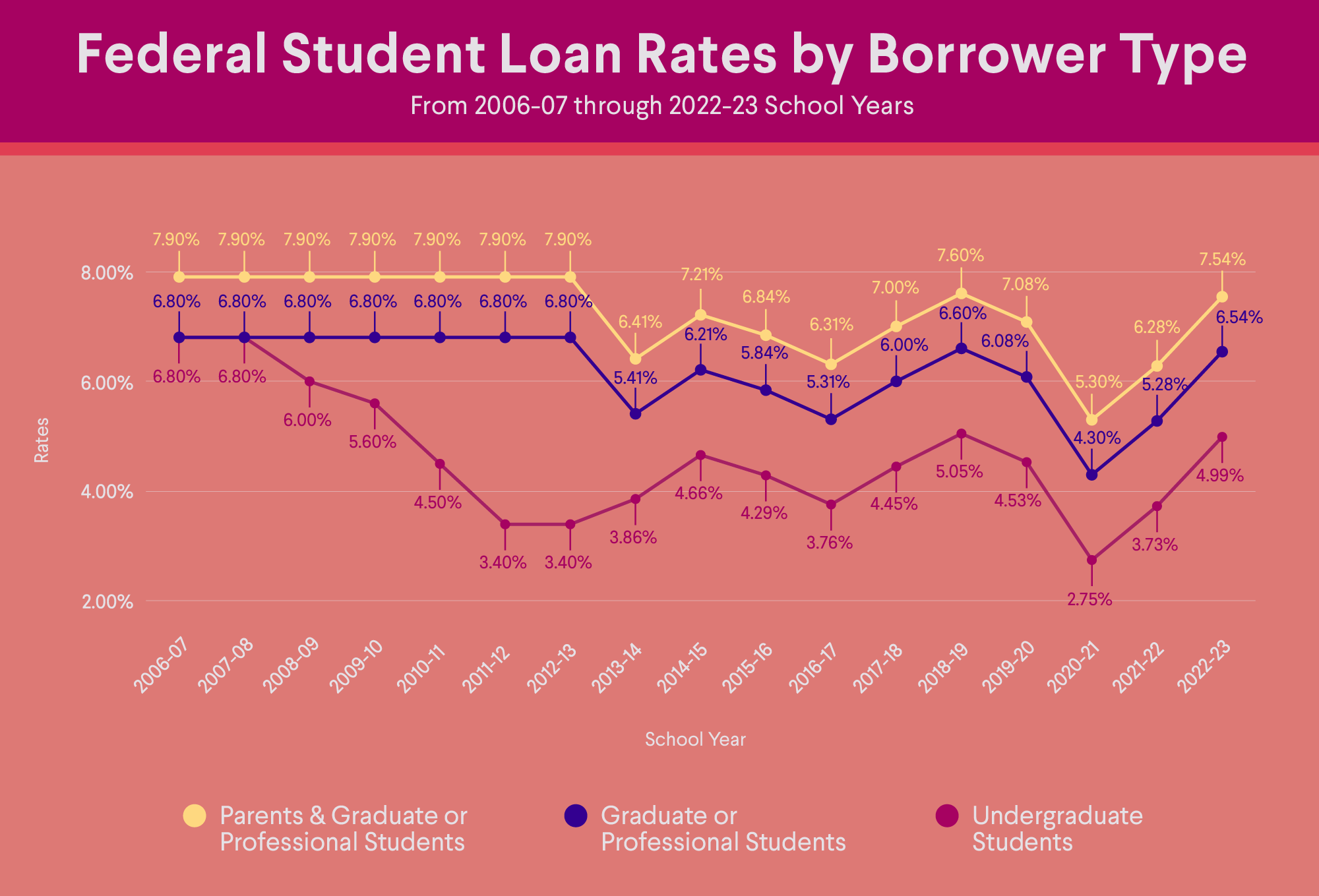
Federal Student Loan Rates by Borrower Type
Source: Studentaid.gov

This means that the average student loan interest rate for the three main types of federal student loans is 7.89%.
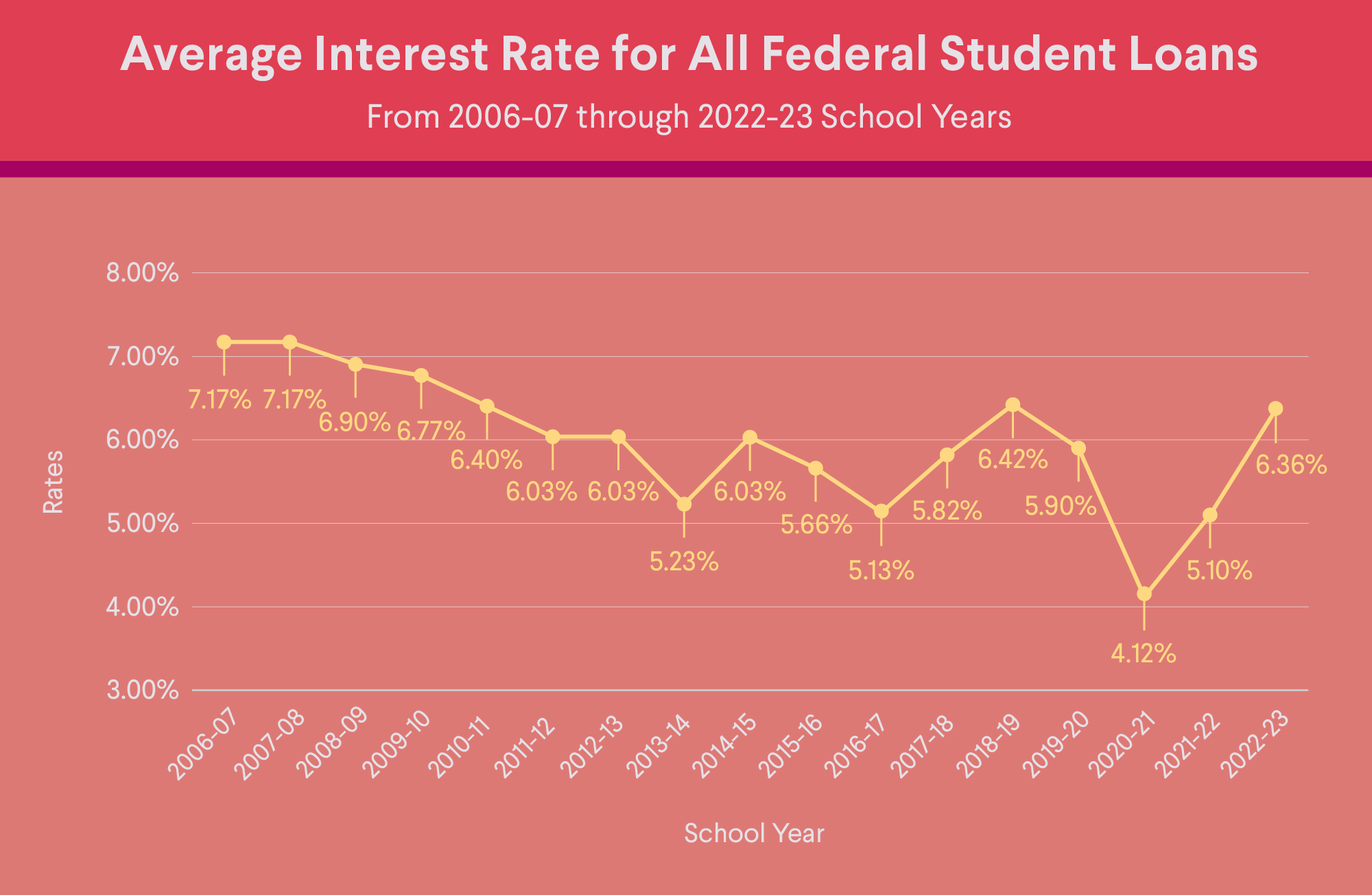
Average Interest Rate for All Federal Student Loans
Source: Studentaid.gov

Private student loan interest rates vary by lender and each has its own criteria for which rates borrowers qualify for. Private student loans can have either fixed interest rates that remain the same over the life of the loan, or variable rates that may start lower than a fixed interest rate but then go up over time, based on market changes.

Private loans require a credit check, and lenders may offer different interest rates if you have strong credit or a cosigner on your student loan. The interest rates on private student loans can vary anywhere from 3.50% to 17.00% (as of March 2025), depending on the lender, the type of loan, and on individual financial factors including the borrower’s credit history.

Recommended: Do Student Loans Have Simple or Compound Interest?

How Are Interest Rates Determined?

As mentioned, the interest rates on federal student loans are set annually by formulas specified in the HEA. The rates are tied to the financial markets — federal law sets them based on the 10-year Treasury note and a statutory add-on percentage with a maximum rate cap.

Since July 2006, all federal student loans have fixed interest rates. Although federal student loans are serviced by private companies or nonprofits selected by the federal government, these loan servicers have no say in the federal interest rate offered.

For private student loans, the lenders set their own rates, though they often take cues from federal rates. The rates quoted for student loans vary based on each applicant’s individual situation — though generally the better a potential borrower’s credit history is, the better rate they may be able to qualify for.

To learn more about private and federal student loans, check out our student loan help center.

How Student Loan Interest is Calculated and Applied

Interest on federal student loans typically accrues daily. To calculate the interest as it accrues, the following formula can be used:

Interest amount = (outstanding student loan principal balance × interest rate factor) × days since last payment

In other words, you will multiply your outstanding loan balance by the interest rate factor, which is used to calculate the amount of interest that accrues on a student loan. Then, multiply that result by the days since you last made a payment.

To calculate the interest rate factor you can divide the interest rate by the number of days of the year (365). For example, let’s say you have an outstanding student loan balance of $10,000, an interest rate of 4.75%, and it’s been 30 days since your last payment. Here’s how to calculate your interest:

$10,000 x (4.75%/365) = $1.30 daily interest charge
$1.30 x 30 days = $39
Interest amount $39

Many private student loans will also accrue interest on a daily basis; however, the terms will ultimately be determined by the lender. Review the lending agreement to confirm.

Recommended: Do Student Loans Count as Income?

How to Evaluate Student Loan Interest Rates

When you take out a federal student loan, you’ll receive a fixed interest rate. This means that you’ll pay a set amount for the term of the student loan. In addition, all of the terms, conditions, and benefits are determined by the government. Federal student loans also provide some additional perks that you may not find with private lenders, like deferment.

Private student loans can have higher interest rates and potentially fewer perks than federal student loans. You may want to take advantage of all federal student loans you qualify for before comparing private loan options.

One thing to keep in mind is that interest you pay on student loans may allow you to take the student loan interest deduction on your taxes.

What Is a Good Fixed Interest Rate for Student Loans?

The lower the interest rate, the less a borrower will owe over the life of the loan, which could help individuals as they work on other financial goals. If you’re taking out federal loans, the student loan interest rate is set by federal law, so you don’t have a choice for what is and isn’t a reasonable interest rate.

When it comes to private student loans, it’s wise to shop around and compare your options to find the most suitable financing solution. Since every lender offers different terms, rates, and fees, getting quotes from multiple lenders may help you select the best option for your personal needs. Keep in mind that the rate you receive on a private student loan is largely dependent on your credit score and other factors, whereas federal student loan interest rates are based on HEA formulas.

Also keep in mind that private student loans do not have the same borrower protections as federal student loans, including deferment options, and should be considered only after all federal aid options have been exhausted.

Ways to Lower Your Student Loan Interest Rate

The interest rate on federal student loans, while fixed for the life of the loan, does fluctuate over time. For example, the rates for Direct Subsidized and Unsubsidized loans for undergraduates more than doubled from 2.75% in 2020–21 to 6.53% in 2024–25.

To adjust the rate on an existing student loan, borrowers generally have two options. They can refinance student loans or consolidate them with hopes of qualifying for a lower interest rate.

Refinancing a federal loan with a private lender eliminates them from federal borrower protections such as federal deferment or Public Service Loan Forgiveness. The federal government does offer a Direct Consolidation Loan, which allows borrowers to consolidate their federal loans into a single loan. This will maintain the federal borrower protections but won’t necessarily lower the interest rate. When federal loans are consolidated into a Direct Consolidation Loan, the new interest rate is a weighted average of your original federal student loans’ rates.

Refinancing student loans with a private lender may allow qualifying borrowers to secure a lower interest rate or preferable loan terms. Note that extending the repayment term will generally result in an increased cost over the life of the loan.

To see how refinancing could work for your student loans, try this student loan refinance calculator.

💡 Quick Tip: Refinancing comes with a lot of specific terms. If you want a quick refresher, the Student Loan Refinancing Glossary can help you understand the essentials.

Fixed vs. Variable Interest Rates: Which Is Better?

Whether fixed or variable interest rates are better depends on a borrower’s specific situation. For many borrowers, fixed rates are often a better option because they are stable and predictable. Your payments won’t change, and you won’t have to worry about rate hikes. Borrowers may want to consider a student loan with a fixed interest rate if interest rates are rising overall and they anticipate needing a number of years to repay their loan.

Because variable interest rates fluctuate with the market, they can be unpredictable. That means your payments can potentially change from one month to the next.

The Takeaway

The average student loan interest rate varies depending on the loan type. The interest rate for federal Direct Unsubsidized and Subsidized loans is set annually by federal law and fixed for the life of the loan.

The interest rate on private student loans is determined by a variety of factors including the borrower’s credit history and may range anywhere from 3.50% to to 17%.

Looking to lower your monthly student loan payment? Refinancing may be one way to do it — by extending your loan term, getting a lower interest rate than what you currently have, or both. (Please note that refinancing federal loans makes them ineligible for federal forgiveness and protections. Also, lengthening your loan term may mean paying more in interest over the life of the loan.) SoFi student loan refinancing offers flexible terms that fit your budget.


With SoFi, refinancing is fast, easy, and all online. We offer competitive fixed and variable rates.

FAQ

How often do student loan interest rates change?

The rates on federal student loans are determined and set annually by formulas specified in the Higher Education Act of 1965. Private student loan rates vary by lender, and they may be fixed or variable. Private loans with variable rates can change based on market changes.

How do federal student loan interest rates compare to private loans?

The interest rate on federal student loans is often lower than the rates for private student loans. The rate you may qualify for with a private loan depends on your circumstances. If you have strong credit or a loan cosigner who has strong credit, you may be able to get a loan with a lower interest rate.

Keep in mind that federal student loans have fixed interest rates, which means the interest and your monthly payment won’t change. Private student loans may have fixed or variable rates, and variable rates can go up or down with market changes.

Can I negotiate my student loan interest rate?

Federal student loans have fixed rates that are non-negotiable. With a private student loan, it’s possible that you may be able to negotiate the interest rate, especially if you are struggling to make payments or dealing with financial hardship. Call your private lender and explain the situation.

What factors determine my student loan interest rate?

Federal student loans have a fixed interest rate that is determined and set each year based on formulas specified in the Higher Education Act of 1965. With private student loans, each lender sets their own rates. Private loans require a credit check, and the interest rates vary based on an applicant’s credit and other factors. Generally speaking, the stronger a borrower’s credit is (or if they have a loan cosigner with strong credit), the lower the rate they may be able to qualify for.

Is it better to choose a fixed or variable interest rate for student loans?

For many borrowers, fixed rates may be a better option because they are stable and predictable, which means the monthly payments won’t change over the life of the loan. If you are planning to repay your loan over a period of years, you may want to consider a student loan with a fixed interest rate.

Variable interest rates fluctuate with the market, which makes them unpredictable. As a result, your payments can go up (or down), and may be harder to budget for.


About the author

Ashley Kilroy

Ashley Kilroy

Ashley Kilroy is a seasoned personal finance writer with 15 years of experience simplifying complex concepts for individuals seeking financial security. Her expertise has shined through in well-known publications like Rolling Stone, Forbes, SmartAsset, and Money Talks News. Read full bio.


SoFi Student Loan Refinance
Terms and conditions apply. SoFi Refinance Student Loans are private loans. When you refinance federal loans with a SoFi loan, YOU FORFEIT YOUR ELIGIBILITY FOR ALL FEDERAL LOAN BENEFITS, including all flexible federal repayment and forgiveness options that are or may become available to federal student loan borrowers including, but not limited to: Public Service Loan Forgiveness (PSLF), Income-Based Repayment, Income-Contingent Repayment, extended repayment plans, PAYE or SAVE. Lowest rates reserved for the most creditworthy borrowers.
Learn more at SoFi.com/eligibility. SoFi Refinance Student Loans are originated by SoFi Bank, N.A. Member FDIC. NMLS #696891 (www.nmlsconsumeraccess.org).

SoFi Loan Products
SoFi loans are originated by SoFi Bank, N.A., NMLS #696891 (Member FDIC). For additional product-specific legal and licensing information, see SoFi.com/legal. Equal Housing Lender.


Third-Party Brand Mentions: No brands, products, or companies mentioned are affiliated with SoFi, nor do they endorse or sponsor this article. Third-party trademarks referenced herein are property of their respective owners.

Non affiliation: SoFi isn’t affiliated with any of the companies highlighted in this article.

Tax Information: This article provides general background information only and is not intended to serve as legal or tax advice or as a substitute for legal counsel. You should consult your own attorney and/or tax advisor if you have a question requiring legal or tax advice.

Disclaimer: Many factors affect your credit scores and the interest rates you may receive. SoFi is not a Credit Repair Organization as defined under federal or state law, including the Credit Repair Organizations Act. SoFi does not provide “credit repair” services or advice or assistance regarding “rebuilding” or “improving” your credit record, credit history, or credit rating. For details, see the FTC’s website .

Financial Tips & Strategies: The tips provided on this website are of a general nature and do not take into account your specific objectives, financial situation, and needs. You should always consider their appropriateness given your own circumstances.

External Websites: The information and analysis provided through hyperlinks to third-party websites, while believed to be accurate, cannot be guaranteed by SoFi. Links are provided for informational purposes and should not be viewed as an endorsement.

SOSLR-Q125-025

Read more
What Is a Protective Put? Definition, Graphs, & Example

Understanding Protective Puts: A Comprehensive Guide


Editor's Note: Options are not suitable for all investors. Options involve risks, including substantial risk of loss and the possibility an investor may lose the entire amount invested in a short period of time. Please see the Characteristics and Risks of Standardized Options.

A protective put is an investment strategy that uses options contracts to help reduce the risk that comes with owning a particular security or commodity. In it, an investor buys a put option on the security or commodity.

Typically, put options are used by investors who want to benefit from a price decline in a given investment. But in a protective put strategy, the investor owns the underlying asset, and is positioned to benefit if the price of the asset goes up.

The investor purchases the protective put, in this case, to help limit their potential losses if the price of the stock they own goes down.

An investor may use a protective put on various investments, including equities, ETFs, and commodities. But if the investment they own does go up, the investor will have to deduct the cost of the put-option premiums from their returns.

Recommended: How to Trade Options: A Beginner’s Guide

Key Points

•   A protective put strategy involves buying a put option on an asset that’s owned to limit potential losses.

•   The strike price of and premium paid for the put options can significantly affect the strategy’s effectiveness and cost.

•   Advantages include setting a loss limit and maintaining upside potential, while disadvantages involve premium costs.

•   In a real scenario, an investor buys a put option to hedge against a stock price decline.

•   Compared to other strategies, a protective put offers downside protection and upside participation.

What Is a Protective Put?

Investors typically purchase protective puts on assets that they already own as a way of limiting or capping any future potential losses.

The instrument that makes a protective put strategy work is the put option. A put option is a contract between two investors. The buyer of the put acquires the right to sell an agreed-upon number of a given asset security at a given price during a predetermined time period.

Definition and Basic Concepts

There is some key options trading lingo to know in order to fully understand a protective put.

•   The price at which the purchaser of the put option can sell the underlying asset is known as the “strike price.”

•   The amount of money the buyer pays to acquire this right is called the “premium.”

•   And the end of the time period specified in the options contract is the expiration date, or “expiry date.”

•   In a protective put strategy, the strike price represents the predetermined price at which an investor can sell the underlying asset if the put option is exercised. However, the true floor price, the minimum amount the investor would effectively receive, is the strike price minus the premium paid for the option. This also accounts for the cost of protection.

For complete coverage in a protective put strategy, an investor might buy put option contracts equal to their entire position. For large positions in a given stock, that can be expensive. And whether or not that protection comes in handy, the put options themselves regularly expire — which means the investor has to purchase new put options contracts on a regular basis.

Setting Up a Protective Put

To set up a protective put, an investor must first own the underlying asset they want to protect. The investor purchases a put option contract for the same asset. This put option allows the investor to sell the asset at a predetermined price, known as the strike price, within a specific time frame.

Setting up a protective put involves:

•   Determining the Level of Protection Needed: Investors should evaluate how much of their position they want to protect. A full protective put strategy involves buying put option contracts to cover the entire position. However, for cost-saving purposes, some investors may choose partial coverage.

•   Selecting the Strike Price: The strike price represents the minimum price at which the asset can be sold if the put option is exercised. Higher strike prices provide more protection but come with higher premiums. Lower strike prices reduce premium costs but offer less downside protection.

•   Choosing the Expiration Date: The expiration date of the put option determines the duration of the protection. Shorter-term options are generally less expensive but require frequent renewal if protection is still needed. Longer-term options, while more costly, may offer stability for investors seeking extended coverage.

•   Purchase the Put Option: Once the strike price and expiration date are chosen, the investor buys the put option from the market. The cost of this purchase is the premium, which varies based on market conditions, volatility, and the specific terms of the contract.

By following these steps, investors can effectively set up a protective put to help manage downside risk while maintaining the opportunity for upside gains if the asset increases in value.

Uses of Protective Puts

Protective puts are primarily used by investors to mitigate downside risk while maintaining the potential for upside gains. This strategy can be applied across a variety of scenarios to suit individual investment goals and market conditions.

•   Portfolio Protection: Investors holding significant positions in a stock, commodity, or index can use protective puts to safeguard their portfolio against sudden price declines. By setting a strike price near the current value, they establish a “floor” that limits losses in the event of a market downturn.

•   Market Volatility Management: Protective puts can help investors reduce uncertainty during periods of heightened market volatility. If a stock begins to trade below the strike price of the contract, they can choose to exercise their option to sell the stock at that higher strike price.

•   Strategic Planning: Protective puts can also be part of a larger investment strategy, allowing investors to take calculated risks in other areas of their portfolio. With downside risk managed, they can explore opportunities for higher returns elsewhere without jeopardizing their core holdings.

•   Hedging Concentrated Positions: Investors with concentrated positions in a single stock or sector can use protective puts to hedge against adverse price movements. This is particularly useful for individuals or institutions holding stock grants, company shares, or positions they are reluctant to sell.

Overall, protective puts provide a flexible means of managing risk, ensuring investors can participate in potential market gains while limiting their exposure to significant losses.

Recommended: How to Sell Options for Premiums

Calculating and Choosing Strike Prices and Premiums

When implementing a protective put strategy, selecting the right strike price and premium is critical. These choices directly affect the level of protection, the cost of the hedge, and the potential returns. Understanding how to calculate and balance these factors helps investors tailor their strategy to their goals and risk tolerance.

Calculating Strike Prices

Investors should consider the following factors when choosing a strike price:

•   Risk Tolerance: A strike price closer to the asset’s current market price offers maximum protection but comes at a higher cost. Conversely, a lower strike price provides less protection but reduces the premium paid.

•   Market Outlook: If an investor expects minor fluctuations, they may opt for a lower strike price to balance cost and protection. For significant downside risks, a strike price near the current price may be preferable.

•   Investment Goals: Whether the focus is on preserving capital or limiting minor losses, the strike price should align with the investor’s specific financial objectives.

Premium Considerations

The premium is the cost of purchasing the put option. It represents the upfront expense for securing downside protection and affects the overall profitability of the strategy. Key considerations include:

•   Cost vs. Protection: Higher premiums may provide greater protection but can erode potential returns. Investors should weigh the cost of the premium against the likelihood and impact of a price decline.

•   Option Moneyness: Options can be in the money (ITM), at the money (ATM), or out of the money (OTM). ITM options have higher premiums but provide immediate protection, while OTM options are cheaper but only activate under significant price drops.

•   Time Decay: The time until expiration impacts the premium. Longer-term options, which are typically more expensive, provide extended protection, whereas shorter-term options have lower premiums but require frequent renewal.

By carefully calculating strike prices and evaluating premium considerations, investors can design a protective put strategy that aligns with their risk profile and financial objectives. Striking the right balance between cost and protection is essential to maximize the benefits of this strategy.

Real-World Examples and Scenarios

Protective puts are widely used by investors to manage risk across various market conditions. Examining real-world examples provides a practical understanding of how this strategy works and its potential outcomes in different scenarios.

Scenario Analysis

A protective put strategy can help an investor manage risk by limiting potential losses while maintaining exposure to gains. For example, if an investor owns 100 shares of XYZ stock, currently trading at $100 per share, and buys a protective put option (also for 100 shares) with a $95 strike price for a premium of $2 per share, the position will perform differently depending on the stock’s movement.

Let’s say the stock price drops to $85 near the expiration date. The investor can exercise the put option, selling the shares at the $95 strike price instead of the lower market price. Let’s say the stock price drops from $100 to $85. Without a protective put, the investor would face a $15 per share loss ($1,500 total for 100 shares). However, with a put option at a $95 strike price, they can sell at $95 instead of $85, recovering $10 per share. After subtracting the $2 premium paid, the net gain from the put is $8 per share ($800 total). This offsets part of the stock’s decline, reducing the total loss to $700 instead of $1,500.

On the other hand, if the stock price rises to $110, the put option will expire worthless, and the investor will lose the premium paid, which amounts to $200 (100 shares × $2). The stock’s price increase results in a $1,000 unrealized gain, and after deducting the $200 premium, the investor still sees a net gain of $800.

If the stock price remains stable at $100 until the expiration date, the investor will hold onto the shares without any price changes, but the $200 premium will be a loss. In this case, the protective put serves as a precautionary measure, providing peace of mind during the holding period, but without any real financial benefit.

These examples show how a protective put works to limit losses while allowing participation in upside potential. Although the premium represents a cost, this strategy is useful in managing risk, particularly in uncertain or volatile markets.

The Impact of Time Decay and Volatility

Time decay and volatility play significant roles in the pricing and effectiveness of a protective put strategy, impacting both the cost of the put option and its potential for profit or loss.

Time decay refers to the gradual reduction in the value of an options contract as it approaches its expiration date. As with all options, the protective put’s premium tends to decrease over time due to time decay, even if the underlying asset’s price stays stable. As the expiration date nears, the value of the put option typically declines due to time decay. This can impact an investor who wants to sell the option before it expires. However, if the investor holds on through expiration, its final value will depend on whether the underlying asset’s price falls below the strike price.

Volatility impacts the value of options by affecting their premiums. Higher volatility increases the potential for large price movements in the underlying asset, which can raise the cost of the protective put. Conversely, during periods of low volatility, premiums tend to be lower, making puts more affordable, but also potentially reducing the need for protection if the asset’s price remains relatively stable.

Advantages and Disadvantages of Protective Puts

As with most investing strategies, there are both upsides and downsides to using protective puts.

Pros of Using Protective Puts

Protective puts allow investors to set a limit on how much they stand to lose in a given investment. Here’s why investors are drawn to them:

•   Protective puts offer protection against the possibility that an investment will lose money.

•   The protective put strategy allows an investor to participate in nearly all of an investment’s upside potential.

•   Investors can use at-the-money (ATM), out-of-the-money (OTM) options, in-the-money (ITM) options, or a mix of these to tailor their risks and costs.

Cons and Potential Risks

Buying protective put options comes at a cost. There is limited upside potential, expenses involved, and may come with other tradeoffs that can impact your investing goals.

•   An investor using protective puts will see lower returns if the underlying stock price rises, because of the premiums paid to buy the put options.

•   If a stock doesn’t experience much movement up or down, the investor will see diminished returns as they pay the option premiums.

•   Options with strike prices close to the asset’s current market price can be prohibitively expensive.

•   More affordable options that are further away from the stock’s current price offer only partial protection and may result in further losses.

Alternative Strategies to Protective Puts

In addition to protective puts, investors have several other strategies to manage risk, such as covered calls and collar strategies.

A covered call involves selling a call option against a stock you own, which generates income through the premium received. This can help offset potential losses, though it caps the upside potential.

A collar strategy combines buying a protective put and selling a covered call on the same asset, limiting both downside risk and upside potential. This can be a cost-effective way to manage risk while still participating in some upside potential.

Comparing with Other Options Strategies

Each alternative strategy comes with its own set of trade-offs. While a covered call generates income through premiums, it limits the upside, as the stock is “capped” if it rises above the strike price of the sold call.

The collar strategy offers protection like a protective put but may be more cost-effective due to the income from the sold call, though it also limits potential gains. Investors should choose the strategy that aligns with their risk tolerance, investment goals, and market outlook.

When to Choose Alternative Strategies

Investors might prefer alternative strategies when looking to reduce the cost of protection or when expecting limited movement in the underlying asset. A covered call can be useful in a flat or slightly bullish market, while a collar strategy may be ideal for those seeking cost-effective protection without the full expense of a protective put. These strategies can also be suitable for investors who are more focused on income generation than on maximizing returns from significant price movements.

The Takeaway

Protective put options are risk-management strategies that use options contracts to guard against losses. This options-based strategy allows investors to set a limit on how much they stand to lose in a given investment.

SoFi’s options trading platform offers qualified investors the flexibility to pursue income generation, manage risk, and use advanced trading strategies. Investors may buy put and call options or sell covered calls and cash-secured puts to speculate on the price movements of stocks, all through a simple, intuitive interface.

With SoFi Invest® online options trading, there are no contract fees and no commissions. Plus, SoFi offers educational support — including in-app coaching resources, real-time pricing, and other tools to help you make informed decisions, based on your tolerance for risk.

Explore SoFi’s user-friendly options trading platform.


Photo credit: iStock/igoriss

INVESTMENTS ARE NOT FDIC INSURED • ARE NOT BANK GUARANTEED • MAY LOSE VALUE

SoFi Invest is a trade name used by SoFi Wealth LLC and SoFi Securities LLC offering investment products and services. Robo investing and advisory services are provided by SoFi Wealth LLC, an SEC-registered investment adviser. Brokerage and self-directed investing products offered through SoFi Securities LLC, Member FINRA/SIPC.

For disclosures on SoFi Invest platforms visit SoFi.com/legal. For a full listing of the fees associated with Sofi Invest please view our fee schedule.

Options involve risks, including substantial risk of loss and the possibility an investor may lose the entire amount invested in a short period of time. Before an investor begins trading options they should familiarize themselves with the Characteristics and Risks of Standardized Options . Tax considerations with options transactions are unique, investors should consult with their tax advisor to understand the impact to their taxes.

Disclaimer: The projections or other information regarding the likelihood of various investment outcomes are hypothetical in nature, do not reflect actual investment results, and are not guarantees of future results.

Financial Tips & Strategies: The tips provided on this website are of a general nature and do not take into account your specific objectives, financial situation, and needs. You should always consider their appropriateness given your own circumstances.

SOIN-Q125-123

Read more
What Is a Manufactured Home? Features, Pros & Cons

What Is a Manufactured Home? Explaining the Pros & Cons

You may have grown up calling manufactured homes mobile homes — and the two terms are sometimes still used interchangeably — but these dwellings have evolved.

They’re more customizable and arguably fancier than previous iterations. Still, it’s a good idea to look beyond the sticker price.

Key Points

•   Manufactured homes are cost-effective, often 20% to 45% cheaper than site-built homes, excluding the cost of land.

•   Built to strict, newly updated HUD codes, manufactured homes must meet a high standard that ensures quality and energy efficiency, with customizable finishes and features.

•   Custom options may be limited by the builder, restricting certain design choices.

•   Lot rent increases in manufactured home communities have been substantial in recent years, so purchasing land for a hard-to-move manufactured home may be a better option than leasing.

•   Retirees and first-time homebuyers may benefit most from the cost-effective and customizable nature of manufactured homes.

Characteristics of a Manufactured Home

First, to clarify a popular point of confusion, modular homes and manufactured homes are different types of houses.

Both are built partially or entirely in a factory, but modular homes — aka kit homes — must adhere to the same codes that site-built homes do.

Manufactured homes are intended to be permanent dwelling units. Starting in 1976, they began to be built to a code developed by the Department of Housing and Urban Development (HUD) and moved past the name “mobile homes” and the notion of trailers placed atop blocks.

The manufactured home, built on a permanent chassis, is tested to ensure that it can be transported properly before being attached to a foundation, or the underlying chassis may be “skirted” by blocks or siding.

The home may be movable, depending on its age and condition, but few are moved. Moving a manufactured home, if it is new enough to be moved, can cost $20,000 or more.

Pros and Cons of a Manufactured Home

Before buying a manufactured home, the housing choice of about 20 million Americans, take a look at the following advantages and disadvantages to help you in your decision-making.

First-time homebuyers can
prequalify for a SoFi mortgage loan,
with as little as 3% down.

Questions? Call (888)-541-0398.


Pros

•   Cost effective: According to the Joint Center for Housing Studies of Harvard University, manufactured homes cost around 20% to 45% less than comparable site-built homes, excluding the price of land.

•   High quality: Manufactured homes must adhere to the HUD code, which applies to the home’s design, construction, durability, transportability, strength, and energy efficiency. Factories also need to adhere to standards and must inspect each step during construction.

•   Few delays: Because manufactured homes are built indoors in a controlled environment, the weather won’t interfere with the timeline to construct the home.

•   Home warranties: Most manufactured homes have some form of warranty to guarantee the quality of the home, usually for one to five years. The seller has its own warranties for transporting and installing the home.

•   Customizable: Most manufactured home makers allow homebuyers to customize some aspects of the home, such as certain finishes, porches, vaulted ceilings, and fireplaces.
Energy efficient: The HUD code ensures that manufactured homes have a high degree of energy efficiency.

•   Financing: The financing options include loans even if the buyer will not own the land the home will rest on.

•   Appreciation: Manufactured homes may not appreciate at the same rate as other types of homes and may even depreciate. The resale value depends on the location, and the age and condition of the home.

Cons

•   Limited customization: You can customize some parts of a manufactured home, but you may not have the options you want, depending on the builder.

•   Price increases: The average sales price of a manufactured home increased nearly 50% during the pandemic, driven by the demand for affordable housing.

•   Lot rent: Most residents own their homes but rent the land. Those who lease lots face uncertain increases in monthly costs. Park rents have been doubling and tripling.
Financing options may carry higher rates. Whether the home is considered real property or personal property makes a big difference.

A manufactured home built on or after June 15, 1976, and considered real property might qualify for a conventional or government-backed loan. To be considered real property, the home must be at least 400 square feet, permanently attached to a foundation, and on land that you own or plan to buy. The loans usually carry slightly higher interest rates than mortgages for traditional homes.

Financing options for manufactured homes classified as personal property include chattel loans, which come with a higher interest rate and a shorter term than most traditional mortgages. (A chattel mortgage also may be used for tiny house financing.)

FHA Title I loans and personal loans are other options for manufactured homes classified as personal property. Rates for unsecured personal loans will be higher than rates for secured loans like mortgages or chattel loans.

Finding a Manufactured Home

Most manufactured homes are sold through retailers instead of the builders. It’s also possible to purchase manufactured homes through real estate agents and online manufactured home marketplaces.

Think of buying a new manufactured home like going to a store where you can view model homes. You’ll be able to see your options, such as the number of bedrooms, layout, and customizable features. Depending on the retailer, you may even be able to apply for financing and arrange for delivery all in the same day.

Before signing on the dotted line, make sure you read the fine print, such as what warranties come with the home. You may be able to purchase both the land and home through a manufactured home community.

Who Should Get a Manufactured Home?

A manufactured home may be a good fit for a retiree or a first-time homebuyer who is looking for a more cost-effective housing solution than a condo or single-family home — especially if they own the land underneath them.

It also may be suited for those who want a new construction home and to be able to customize parts of the structure.

The Takeaway

A manufactured home may be a good choice for some buyers, and others may want to try to buy a condo, townhouse, or single-family home.

If you’re in the latter group or buying investment property, SoFi can help you get started by providing a rate quote with no obligation.

Looking for an affordable option for a home mortgage loan? SoFi can help: We offer low down payments (as little as 3% - 5%*) with our competitive and flexible home mortgage loans. Plus, applying is extra convenient: It's online, with access to one-on-one help.


SoFi Mortgages: simple, smart, and so affordable.

FAQ

What are the advantages of manufactured homes?

The main advantages of manufactured homes are the relatively low cost and the building standards they must meet.

Is a manufactured home considered real property?

A manufactured home is considered real property if you own both the land and the home, and the structure is permanently attached to a foundation.

Can I get a loan to buy a manufactured house?

Yes, though the type usually depends on whether the home is considered real or personal property. Classification as personal property is almost certain to preclude conventional financing. A borrower need not own the land for an FHA Title I loan from an approved lender. The loan may be used to buy a manufactured home, a lot on which to place the home, or a manufactured home and lot in combination. There are maximum loan amounts and terms.

Are manufactured homes safe?

Yes. Manufactured homes built after mid-1976 abide by HUD standards, and the agency significantly updated its manufacturing and safety standards in 2024. Most come with warranties.


Photo credit: iStock/clubfoto

SoFi Mortgages
Terms, conditions, and state restrictions apply. Not all products are available in all states. See SoFi.com/eligibility-criteria for more information.


SoFi Loan Products
SoFi loans are originated by SoFi Bank, N.A., NMLS #696891 (Member FDIC). For additional product-specific legal and licensing information, see SoFi.com/legal. Equal Housing Lender.


*SoFi requires Private Mortgage Insurance (PMI) for conforming home loans with a loan-to-value (LTV) ratio greater than 80%. As little as 3% down payments are for qualifying first-time homebuyers only. 5% minimum applies to other borrowers. Other loan types may require different fees or insurance (e.g., VA funding fee, FHA Mortgage Insurance Premiums, etc.). Loan requirements may vary depending on your down payment amount, and minimum down payment varies by loan type.

Third-Party Brand Mentions: No brands, products, or companies mentioned are affiliated with SoFi, nor do they endorse or sponsor this article. Third-party trademarks referenced herein are property of their respective owners.

Financial Tips & Strategies: The tips provided on this website are of a general nature and do not take into account your specific objectives, financial situation, and needs. You should always consider their appropriateness given your own circumstances.

SOHL-Q125-037

Read more
14 Budgeting Questions to Ask

14 Budgeting Questions to Ask

Making a budget is often the first step in building a solid financial foundation. It helps you get better acquainted with how much money you earn, spend, and save. What’s more, it provides guidance and guardrails to help you hit the financial goals you’re focused on, whether that means saving for a vacation in Tuscany or the down payment for your dream house.

But budgets are not “set it and forget it” tools. The process can involve plenty of trial and error, and you may benefit from refining your plans along the way. In fact, it’s a good idea to check in on your budget every month, quarter, and/or year to make sure it’s still serving you well.

That’s where budgeting questions come in. Whether you’re just starting to budget or have been doing it for years, the following list of budget-specific questions can help you fine-tune your financial plan and stay on track. When asked regularly, these questions can yield surprising insights and adjustments to enhance how you manage your money.

Key Points

•   Reviewing your budget every month, quarter, and/or year can help ensure your spending is on track and you’re making progress towards your goals.

•   Having a list of budgeting questions can help simplify the budget review process.

•   It’s a good idea to save 10% to 15% of income for retirement, adjusting based on retirement timing.

•   Aim to build and maintain an emergency fund that can cover three to six months of living expenses.

•   Apply debt repayment strategies, like the 50/30/20 rule, to balance debt reduction with savings.

How Questions Can Help You Budget Better

Asking questions about budgeting can be a wise move because everyone’s financial situation is different. The way that your parents or best friends budget may be entirely different from the way you approach managing your money. By checking in and assessing where you stand, you can help improve your financial outlook.

The right budget questions can give you insight into things like:

•   Why you should budget in the first place

•   What you hope to achieve from keeping a budget

•   Where your biggest budget pitfalls are

•   How you can improve your budget

To put it another way, asking budgeting questions can help you better understand where you are financially, where you’d like to be, and how a budget can help you to get there.

In terms of how often you should be asking questions about budgeting, there’s no set rule of thumb. You might check in monthly if you’re just getting started, then ease back to every few months. At the very least, it’s a good idea to do an annual budget review to see how your spending has evolved over the year. It’s also a good time to see what adjustments you might need to make as you set new financial goals for the year ahead.

14 Budgeting Questions That Can Help You

Not sure which budget questions to ask? The following checklist covers some of the most important things to consider as you make your monthly spending plan and keep tabs on it.

1. Am I Prepared for Unexpected Expenses?

Saving for financial emergencies is an important part of budgeting. When you don’t have money to cover an unexpected expense, you run the risk of having to use a high-interest credit card or loan to cover, say, a car repair or a major dental bill.

One of the first budget questions to consider is how much you have saved toward emergencies. If the answer is “0” in liquid funds you could quickly tap, you may want to think about how much you need to save for emergencies and how to fit that savings goal into your budget each month.

2. What is a Good Amount for an Emergency Fund?

A general rule of thumb is to keep three to six months’ worth of expenses in a separate savings account earmarked for emergencies. However, a good amount for an emergency fund for you can depend on your income, expenses, and how much money you need to have in the bank to feel comfortable.

If you’re single and have side-hustle income on top of your regular paychecks from a job, for instance, you might be okay with one to two months’ worth of expenses saved. On the other hand, if you’re married with two kids and are the primary breadwinner, it’s a much different situation. You might be more at ease with nine to 12 months’ worth of expenses saved instead.

When you’re starting from zero, aiming for $500 or $1,000 can be a good way to ease into a savings habit. You can then review your budget monthly to see where you might be able to find additional money. Every little bit counts ($20 here, $35 there) until your emergency savings hits a level that allows you to breathe a sigh of relief.

Recommended: Savings Account Calculator

3. How Much Debt Should I Pay Down Each Month?

Debt can make it difficult to reach your financial goals, especially if a big chunk of your income is going to credit cards, student loans, or other debts. With high-interest debt (like credit cards), it’s generally a good idea to pay as much as you can in excess of the minimum payment each month. This will help speed up repayment and save you a significant amount of money on interest. With other types of debt, however, you may want to strike a balance between debt repayment and saving. With the 50/30/20 rule of budgeting, 50% of your income goes to needs; 30% goes to wants; and 20% goes to debt payments beyond the minimum and savings.

4. Did I Overspend? If So, Where?

This is another great budgeting question to ask when reviewing your budget monthly if you’re trying to stop overspending. Going through each budget category and analyzing how much you spent can help you pinpoint the money leaks in your financial plan.

Once you find the leaks, you can take steps to plug them. For example, if you noticed that you’re spending more money on dining out, then planning meals at home and committing to that plan is a relatively simple fix. Or you might decide to audit your subscription services and cut out anything you’re paying for but not using. Those are simple ways to cut back on spending.

5. Do I Need to Adjust Spending Limits?

Reviewing your spending each month can help you figure out where you might be overdoing it. But it’s also an opportunity to see how inflation and rising prices might be affecting your expenses. If you notice that you’re spending more on groceries or gas, for instance, then you may need to adjust your budget and trim other areas of spending to compensate for those higher costs.
You might also decide to adjust spending limits down if you want to dedicate more of your budget to saving or debt repayment. So again, instead of eating out you might stick to having meals at home which can be more cost-effective. If that saves you $100 a month, you could add that sum to your emergency fund or make an extra payment to your student loans.

Recommended: Budgeting for Beginners: A Guide

6. What Are My Money Priorities?

Knowing your money priorities is important as they can influence the financial decisions you make. You could ask this budgeting question monthly. But if that feels like too much, aim to consider it at least once a year to see how life changes might affect your answers.

For example, your money priorities might include spending on travel or recreation in your 20s. But once you hit your 30s, your focus may shift to saving, paying down debt, and taking other steps to work toward financial stability and security.

Increase your savings
with a limited-time APY boost.*


*Earn up to 4.00% Annual Percentage Yield (APY) on SoFi Savings with a 0.70% APY Boost (added to the 3.30% APY as of 12/23/25) for up to 6 months. Open a new SoFi Checking and Savings account and pay the $10 SoFi Plus subscription every 30 days OR receive eligible direct deposits OR qualifying deposits of $5,000 every 31 days by 3/30/26. Rates variable, subject to change. Terms apply here. SoFi Bank, N.A. Member FDIC.

7. Am I Tracking Toward My Financial Goals?

Tracking your financial goals can give you motivation to stick with your money plan. It’s also an easy way to see how you’re progressing toward them.

Whether your goals include paying down debt, building an emergency fund, or saving for a vacation, you can ask this budget question monthly to gauge how you’re doing.

If you see that you’ve made little progress over the past few months, for instance, you can then ask yourself what you can do to change that and get closer to your goals.

8. Am I Happy About the Purchases I’ve Made?

Some things you have to spend money on, but others you buy because you want to. That’s the difference between needs vs. wants, and understanding that is an important part of budgeting.

If you find yourself spending money more often than you’d like on things that aren’t necessities, ask yourself what you’re getting from those purchases. Dropping $5,000 on a once-in-a-lifetime vacation might be justified if you get a chance to create lasting memories. Spending that same $5K on new clothes, on the other hand, might give you a temporary boost, but you may end up regretting that purchase later.

Considering what you’re getting from spending money can give you clarity on your financial priorities. It can also help you to identify bad money habits that might be hurting your financial situation.

9. What Would My Budget Look Like Without Debt?

Living debt-free might seem like a dream but it’s possible to make it a reality with the right plan. If you have debt that you’re paying down monthly, ask yourself what your budget might look like if you didn’t have to make those payments. That could give you a push to dedicate more money toward debt repayment so you can eliminate those obligations faster.

There are lots of debt reduction strategies you can use, including the debt snowball and debt avalanche techniques. If you’re tracking your debt repayment progress and aren’t getting ahead as fast as you’d like, you might review your budget to see if another method might be more effective.

When it comes to credit card debt, you might investigate balance transfer credit card offers, which give you, say, 18 months during which you pay no interest. This can help some people pay down the amount they own. You might also seek advice from a nonprofit credit counselor.

10. Is There a Way to Increase My Income?

Making more money can give your budget a boost. When income goes up, paying bills becomes less stressful. It may also be easier to knock out debt or grow your savings.

How often you ask yourself this budget question can depend on your situation, but it’s worth pondering it at least once a year. Some of the ways you might be able to increase income include getting a part-time job, taking on more hours at your current job, negotiating a raise, or starting a low-cost side hustle.

11. How Much Should I Budget for Investments?

Investing money and saving it are two different things. When you invest money, you’re putting it into the market where it has more opportunity to grow. There’s greater risk involved vs. saving, but the rewards can be greater as well.

The amount you should budget monthly for investing can depend on how much you have left after covering basic expenses, how much you’re saving for emergencies or other short-term goals, and how much you’re paying towards debts. (You also want to spend a little on those “wants” mentioned above; otherwise, you’ll end up feeling deprived.)

Depending on the details of your situation, aiming to invest 10% might be a good place to start and you can build on that amount year over year as you pay down debt or increase your income.

12. How Much Should I Save Each Month for Retirement?

Paying yourself first is a fundamental rule of personal finance and it’s a good way to build the wealth you need to retire. When reevaluating your budget each year, it’s a good idea to look at how much you’re saving for retirement.

The exact amount you’ll need to save monthly will depend on your retirement goals and age. Financial experts often recommend saving at least 10% to 15% of your annual take-home income for retirement (including any company match).
However, you might need to double or even triple that if you’d like to retire early or you’re getting a late start.

Look at what you’re putting into your 401(k) at work if you have one. If you’re not contributing enough to get the full company match, then consider bumping up your contribution rate to max out this benefit (which is essentially free money).

13. What Are My Goals This Month?

Financial goal-setting often involves looking well into the future. For instance, you might want to save $50,000 for a down payment on a home or $1 million for retirement. But you can also set goals that you hope to achieve month to month.

For example, you might set a goal of getting three car insurance quotes from different companies if you’re hoping to get a better rate. Or you might have a goal of not spending money for 15 days out of the month. These kinds of short-term goals can help you move ahead financially without losing sight of your bigger money picture.

What’s more, succeeding at small financial goals can build your confidence to tackle larger ones.

14. How Can I Stay Consistent In Keeping My Budget?

Making a budget is important, but sticking to it matters even more. Examining your income and expenses monthly is helpful, but asking the key question, “How can I stay consistent with my budget?” can also be vital. Doing so can help you figure out what might be tripping you up and what you can do to be more consistent with your spending plan.

You might decide to do weekly or biweekly budget check-ins versus reviewing your budget once a month. Or you might start using a budgeting app that tracks your daily and weekly spending. These tools often link to your checking account and credit cards and will automatically download transactions. This can help you catch — and correct — small cash flow problems before they become bigger and completely derail your budget.

The Takeaway

The great thing about making a budget is that there’s always room to tweak and improve things. Asking the right budget questions is a good way to figure out what’s working (and what’s not) so you can make the most of your money each month.

Interested in opening an online bank account? When you sign up for a SoFi Checking and Savings account with eligible direct deposit, you’ll get a competitive annual percentage yield (APY), pay zero account fees, and enjoy an array of rewards, such as access to the Allpoint Network of 55,000+ fee-free ATMs globally. Qualifying accounts can even access their paycheck up to two days early.


Better banking is here with SoFi, NerdWallet’s 2024 winner for Best Checking Account Overall.* Enjoy 3.30% APY on SoFi Checking and Savings with eligible direct deposit.

FAQ

How many budget categories should I have?

There’s no single right answer to how many budget categories someone should have. It’s possible to have 100 budget categories or more, depending on how much detail you go into when dividing up your income and expenses. At a minimum, you may want to have budget categories for fixed expenses, discretionary expenses, variable expenses, saving, and debt.

What does a realistic budget look like?

A realistic budget takes into account all of your income and divides it up to pay for your needs (including debt repayment) and some wants, as well as allowing room for saving. It should allow you to manage your money without feeling stressed or anxious.

How do you plan a budget?

Planning a budget starts with understanding your income and then diving into your expenses. As you make your budget, you can assign income to each expense you have, starting with the most important ones first. That usually means housing, utilities, food, transportation, and insurance. Paying down debt is also often a priority. From there, you can continue dividing up income to cover discretionary spending and savings.


About the author

Rebecca Lake

Rebecca Lake

Rebecca Lake has been a finance writer for nearly a decade, specializing in personal finance, investing, and small business. She is a contributor at Forbes Advisor, SmartAsset, Investopedia, The Balance, MyBankTracker, MoneyRates and CreditCards.com. Read full bio.


Photo credit: iStock/MicroStockHub

SoFi Checking and Savings is offered through SoFi Bank, N.A. Member FDIC. The SoFi® Bank Debit Mastercard® is issued by SoFi Bank, N.A., pursuant to license by Mastercard International Incorporated and can be used everywhere Mastercard is accepted. Mastercard is a registered trademark, and the circles design is a trademark of Mastercard International Incorporated.

Annual percentage yield (APY) is variable and subject to change at any time. Rates are current as of 12/23/25. There is no minimum balance requirement. Fees may reduce earnings. Additional rates and information can be found at https://www.sofi.com/legal/banking-rate-sheet

Eligible Direct Deposit means a recurring deposit of regular income to an account holder’s SoFi Checking or Savings account, including payroll, pension, or government benefit payments (e.g., Social Security), made by the account holder’s employer, payroll or benefits provider or government agency (“Eligible Direct Deposit”) via the Automated Clearing House (“ACH”) Network every 31 calendar days.

Although we do our best to recognize all Eligible Direct Deposits, a small number of employers, payroll providers, benefits providers, or government agencies do not designate payments as direct deposit. To ensure you're earning the APY for account holders with Eligible Direct Deposit, we encourage you to check your APY Details page the day after your Eligible Direct Deposit posts to your SoFi account. If your APY is not showing as the APY for account holders with Eligible Direct Deposit, contact us at 855-456-7634 with the details of your Eligible Direct Deposit. As long as SoFi Bank can validate those details, you will start earning the APY for account holders with Eligible Direct Deposit from the date you contact SoFi for the next 31 calendar days. You will also be eligible for the APY for account holders with Eligible Direct Deposit on future Eligible Direct Deposits, as long as SoFi Bank can validate them.

Deposits that are not from an employer, payroll, or benefits provider or government agency, including but not limited to check deposits, peer-to-peer transfers (e.g., transfers from PayPal, Venmo, Wise, etc.), merchant transactions (e.g., transactions from PayPal, Stripe, Square, etc.), and bank ACH funds transfers and wire transfers from external accounts, or are non-recurring in nature (e.g., IRS tax refunds), do not constitute Eligible Direct Deposit activity. There is no minimum Eligible Direct Deposit amount required to qualify for the stated interest rate. SoFi Bank shall, in its sole discretion, assess each account holder's Eligible Direct Deposit activity to determine the applicability of rates and may request additional documentation for verification of eligibility.

See additional details at https://www.sofi.com/legal/banking-rate-sheet.

*Awards or rankings from NerdWallet are not indicative of future success or results. This award and its ratings are independently determined and awarded by their respective publications.

Financial Tips & Strategies: The tips provided on this website are of a general nature and do not take into account your specific objectives, financial situation, and needs. You should always consider their appropriateness given your own circumstances.

We do not charge any account, service or maintenance fees for SoFi Checking and Savings. We do charge a transaction fee to process each outgoing wire transfer. SoFi does not charge a fee for incoming wire transfers, however the sending bank may charge a fee. Our fee policy is subject to change at any time. See the SoFi Bank Fee Sheet for details at sofi.com/legal/banking-fees/.

SOBNK-Q424-027

Read more

What Happens to a Direct Deposit if It Goes to a Closed Account?

If a direct deposit goes to a closed account, it won’t vanish into the ether. This kind of issue can usually be resolved, and the money can get to its intended destination or be reclaimed.

It’s a common enough hiccup when a direct deposit goes to a bank account that is closed. Maybe the account holder shut it or the financial institution did, but either way, the money can be tracked and re-directed.

Key Points

•   Direct deposits to closed accounts are usually returned to the sender.

•   The bank may hold onto the funds and give the account holder time to reopen the closed account.

•   Banks may issue a paper check to the individual who owns the closed account.

•   To avoid a misdirected deposit, it’s important to double-check account numbers and cancel direct deposits before closing a bank account.

What Is a Closed Account?

A closed account refers to a deactivated or terminated account; in other words, it’s no longer open and available for deposits and withdrawals. The account holder, a custodian or the account, or the banking institution can usually close an account.

Why might a bank close an account? This can be what happens when your bank account is negative and you fail to replenish it and/or pay overdraft fees. Or perhaps the bank has seen activity they don’t think is legitimate, among other reasons.

Once this happens, it’s generally not possible to deposit funds by direct deposit or otherwise into the account. Often the term “closed account” refers to a checking or savings account, but it can also refer to a derivative trading, auto loan, brokerage, or credit card account.

What Can Happen to a Direct Deposit if It Is Sent to a Closed Account?

Sometimes, you may have gone to the trouble of setting up direct deposit in the past, but then the account later winds up closed. You might wonder what happens if a direct deposit is sent to a closed account.

Most banks have a standard process they follow when misdirected money is received. Here are a few different situations that can play out.

Direct Deposit Will Be Returned to the Sender

In many cases when someone tries to send money to a closed bank account, the bank will simply return the funds to the sender or decline the transaction. It can take about five to 10 days for funds to be returned to the sender. This timeline can speed up if the account holder to whom the deposit was intended is in good standing with the bank.

Bank Can Possibly Hold Funds

If a deposit is issued to a closed account, the bank may choose to hold onto the funds and may give the account holder time to reopen a closed bank account. Reopening a closed account, however, is only possible in a couple of scenarios. It’s not a sure thing.

Sometimes, a situation arises with what is known as a dormant account. This means there hasn’t been any activity over a period of time except for interest accruing. You may be able to get the account fully up and running again by contacting your financial institution.

In other cases, you might be able to reopen an account that is frozen. In the case of a frozen account, you may not be able to withdraw funds due to the financial institution’s decision (perhaps there is activity that doesn’t seem legitimate) or a court order (that is, a judgment against you). In some of these scenarios, you may be able to fix a frozen account by talking with your bank, or you may need legal assistance.

Banks may be more willing to work with customers if this is the first time a situation like this (meaning a dormant or frozen account) has happened. If a deposit was intended for you and you are able to reopen your account, this issue can resolve quickly—possibly within 24 hours.

Bank May Issue a Paper Check

Some banks choose to issue a paper check to the individual who owns the closed account. Other times, the company or individual with whom you set up direct deposit may get their funds back from the bank and then may make the payment via a paper check.

Increase your savings
with a limited-time APY boost.*


*Earn up to 4.00% Annual Percentage Yield (APY) on SoFi Savings with a 0.70% APY Boost (added to the 3.30% APY as of 12/23/25) for up to 6 months. Open a new SoFi Checking and Savings account and pay the $10 SoFi Plus subscription every 30 days OR receive eligible direct deposits OR qualifying deposits of $5,000 every 31 days by 3/30/26. Rates variable, subject to change. Terms apply here. SoFi Bank, N.A. Member FDIC.

When Does a Bank Return a Direct Deposit to the Sender?

If a bank receives a direct deposit for a closed account or for a faulty account number, they may choose to return the direct deposit to the sender or to simply decline the transaction.

Can a Direct Deposit Reopen a Closed Account?

Occasionally, a direct deposit being sent to a closed account can trigger its reopening. A bank may choose to give a customer the chance to reopen their account. They might hold onto the funds until the account is reopened so they can complete the direct deposit.

This happens very much on a case-by-case, bank-by-bank decision. Communication with your financial institution can be very important in this situation.

Recommended: How Long Does a Direct Deposit Take to Go Through?

What Can I Do if My Direct Deposit Was Sent to a Closed Account?

If a direct deposit was sent into a closed account, the best thing to do is to contact the bank the funds were sent to. This can help you resolve the issue as quickly as possible. Every bank has its own processes for handling situations like this. Yours can help you understand what the best next steps may be.

The bank may or may not play a role in getting the funds to you. In some cases, you may need to deal directly with the payor. But in either case, your financial institution should be able to give you guidance.

Also, remember that while it can be stressful when a direct deposit goes to a closed account, the money won’t be lost. You should be able to get your funds back.

Avoiding a Misdirected Direct Deposit

To avoid having a direct deposit sent to a closed account, it’s best to get ahead of the issue. These are some steps you can take to help avoid a misdirected direct deposit.

•   Double-check account numbers on direct deposit forms. Whenever filling out a new direct deposit form, it’s a good idea to double (if not triple) check the account numbers on the form. Likewise, if you are expecting a recurring direct deposit to a closed bank account, it’s important to get it redirected to a current open account and carefully check that the digits are correct.

•   Cancel direct deposits before canceling a bank account. To help avoid any issues with direct deposits, it’s a good idea to cancel or alter any direct deposits before closing a bank account. Then, you can make sure payments are heading to a bank account that can receive the funds. That way, any issues can be resolved before the account closes so the money doesn’t get stuck in limbo.

Recommended: Are You Bad with Money? Here’s How to Get Better


Test your understanding of what you just read.


Banking With SoFi

Interested in opening an online bank account? When you sign up for a SoFi Checking and Savings account with eligible direct deposit, you’ll get a competitive annual percentage yield (APY), pay zero account fees, and enjoy an array of rewards, such as access to the Allpoint Network of 55,000+ fee-free ATMs globally. Qualifying accounts can even access their paycheck up to two days early.


Better banking is here with SoFi, NerdWallet’s 2024 winner for Best Checking Account Overall.* Enjoy 3.30% APY on SoFi Checking and Savings with eligible direct deposit.

FAQ

Can a direct deposit go into a closed account?

If a direct deposit goes to a closed account, there are several outcomes that vary bank to bank. In some cases, the financial institution may hold onto the funds and let the customer reopen their account to claim the money; it might send the funds back to the payer or decline the transaction; or it may choose to issue a paper check to the payee.

How long does it take for a payment to bounce back from a closed account?

If an individual or business issues a direct deposit to a closed account, the bank may choose to either decline the transaction or send the funds back to the payer. If they choose to send the funds back to the payer, it typically takes anywhere from five to 10 days for them to get their money back.

What happens to money refunded to a closed bank account?

A few different scenarios can happen if money is refunded to a closed bank account. The bank can simply decline the transaction or to send the funds back to the payer. Other options include issuing a paper check to the payee or possibly holding onto the funds and giving the payee the option to reopen their closed account.


Photo credit: iStock/MissTuni

SoFi Checking and Savings is offered through SoFi Bank, N.A. Member FDIC. The SoFi® Bank Debit Mastercard® is issued by SoFi Bank, N.A., pursuant to license by Mastercard International Incorporated and can be used everywhere Mastercard is accepted. Mastercard is a registered trademark, and the circles design is a trademark of Mastercard International Incorporated.

Annual percentage yield (APY) is variable and subject to change at any time. Rates are current as of 12/23/25. There is no minimum balance requirement. Fees may reduce earnings. Additional rates and information can be found at https://www.sofi.com/legal/banking-rate-sheet

Eligible Direct Deposit means a recurring deposit of regular income to an account holder’s SoFi Checking or Savings account, including payroll, pension, or government benefit payments (e.g., Social Security), made by the account holder’s employer, payroll or benefits provider or government agency (“Eligible Direct Deposit”) via the Automated Clearing House (“ACH”) Network every 31 calendar days.

Although we do our best to recognize all Eligible Direct Deposits, a small number of employers, payroll providers, benefits providers, or government agencies do not designate payments as direct deposit. To ensure you're earning the APY for account holders with Eligible Direct Deposit, we encourage you to check your APY Details page the day after your Eligible Direct Deposit posts to your SoFi account. If your APY is not showing as the APY for account holders with Eligible Direct Deposit, contact us at 855-456-7634 with the details of your Eligible Direct Deposit. As long as SoFi Bank can validate those details, you will start earning the APY for account holders with Eligible Direct Deposit from the date you contact SoFi for the next 31 calendar days. You will also be eligible for the APY for account holders with Eligible Direct Deposit on future Eligible Direct Deposits, as long as SoFi Bank can validate them.

Deposits that are not from an employer, payroll, or benefits provider or government agency, including but not limited to check deposits, peer-to-peer transfers (e.g., transfers from PayPal, Venmo, Wise, etc.), merchant transactions (e.g., transactions from PayPal, Stripe, Square, etc.), and bank ACH funds transfers and wire transfers from external accounts, or are non-recurring in nature (e.g., IRS tax refunds), do not constitute Eligible Direct Deposit activity. There is no minimum Eligible Direct Deposit amount required to qualify for the stated interest rate. SoFi Bank shall, in its sole discretion, assess each account holder's Eligible Direct Deposit activity to determine the applicability of rates and may request additional documentation for verification of eligibility.

See additional details at https://www.sofi.com/legal/banking-rate-sheet.

Financial Tips & Strategies: The tips provided on this website are of a general nature and do not take into account your specific objectives, financial situation, and needs. You should always consider their appropriateness given your own circumstances.

*Awards or rankings from NerdWallet are not indicative of future success or results. This award and its ratings are independently determined and awarded by their respective publications.

SOBNK-Q324-068

Read more
TLS 1.2 Encrypted
Equal Housing Lender