Checking Account Pros and Cons

A checking account can be a convenient place to store your cash and manage daily transactions. Among its benefits: You can usually make as many transfers in and out of the account as you like. Also, your funds are likely to be insured.
There are, however, some cons, too. You probably won’t earn much or any interest for parking your money in a checking account, and you may be hit with an array of fees that nibble away at your funds.

Here, take a closer look at checking account pros and cons so you can pick the right financial product to suit your needs.

Key Points

•   A checking account provides security and easy access to funds.

•   Checking accounts can support direct deposits and convenient bill payments.

•   A benefit of a checking account can be a small amount of interest, plus rewards and sign-up bonuses.

•   Potential drawbacks include low interest and fees.

•   Alternatives to checking accounts include prepaid cards and digital payment services.

What Is a Checking Account?

Simply put, a checking account is a safe place to stash funds and enable the flow of money in (what you earn and receive) and out (what you spend).

Whether held at a brick-and-mortar bank, an online bank, or a credit union, a checking account is often the hub of a person’s financial life. Your pay can be seamlessly direct-deposited, if you like.

For your everyday spending, you might schedule automatic payments for your mortgage and utilities, write a check when paying for a doctor’s appointment, and tap your debit card when treating yourself to a wine tasting with friends on the weekend.

Increase your savings
with a limited-time APY boost.*


*Earn up to 4.00% Annual Percentage Yield (APY) on SoFi Savings with a 0.70% APY Boost (added to the 3.30% APY as of 12/23/25) for up to 6 months. Open a new SoFi Checking and Savings account and pay the $10 SoFi Plus subscription every 30 days OR receive eligible direct deposits OR qualifying deposits of $5,000 every 31 days by 3/30/26. Rates variable, subject to change. Terms apply here. SoFi Bank, N.A. Member FDIC.

Benefits of Checking Accounts

Here’s a closer look at the pros and cons of a checking account, starting with the upsides.

Security

Yes, you could stuff your money under the proverbial mattress, but with a checking account, you have a secure spot for it, where it can’t get lost, stolen, or damaged.

If your bank is insured by the FDIC (Federal Deposit Insurance Corporation) or, in the case of a credit union, the NCUA (National Credit Union Administration), your account will typically be covered up to $250,000 per depositor, per insured institution, for each account ownership category.

Easy Access to Cash

Checking accounts allow you to access your money quickly and easily, whether you need to pay for a meal or something unexpected, like a school donation. Setting up direct deposit allows your paychecks to be transferred directly into your checking or savings account, with some banks offering access to cash up to two days early.

You can then tap your funds by using your checking account’s debit card, writing checks, snagging some cash from the ATM, or making a transfer.

Pay Bills Conveniently

Here’s another benefit of a checking account: Having a checking account means you can get your bills taken care of without much effort. You might set up recurring payments to a car loan, for instance, or use a digital payment app to send money to your roommate, a friend, or your yoga teacher. You can also typically move funds quickly via wire transfer, which can be especially useful for international transactions, and other methods as well.

Debit Card for Purchases

When you open a checking account, you’re usually provided with a debit card that’s linked to the account. Similar to a credit card, you can typically use your debit card to pay in person or online for anything from this week’s groceries to a cool new pair of shades to a matcha latte.

Unlike a credit card, however, debit cards pull funds directly from your checking account. They usually only let you dip into funds you actually have on deposit, which can help you keep spending in check and stay on budget, not to mention avoid credit card debt.

Rewards

Some checking accounts come with rewards that can be a nice perk. For example, when you open an account, you might get a sign-up bonus. Who doesn’t like free money? Or your debit card may carry rewards, similar to those of a credit card, such as cash back.

Direct Deposit Benefits

Direct deposit can be a seamless way to get paid; in fact, more than 95% of Americans get paid this way, according to National Payroll Week. Direct deposit sends cash, ready to spend, straight into your bank account, so you don’t have to deal with depositing a check or cash.

FDIC Insurance Protection

As noted above, most financial institutions (but not all) are insured by either the FDIC or NCUA. In the very rare event of a bank failure, you would be protected from loss up to those limits of $250,000 per depositor, per account ownership category, per insured institution. Note: Some institutions offer programs that provide even more than $250,000 in insurance.

Cons of Checking Accounts

As you might guess, there are advantages and disadvantages to checking accounts, as is the case with most financial products. Checking accounts are designed to serve customers’ everyday, short-term money needs and can have a few potential downsides to consider.

Low or No Interest Earned

While your money is sitting in your checking account, it is probably earning very low, if any, interest. For instance, as of June 2025, the average interest checking account rate was a meager 0.07% of one percent, according to the FDIC. Translated into dollars and cents, that means that if you kept $5,000 in your checking account for a year, you would only earn $3.50 in simple interest.

That said, there are high-yield and premium checking accounts available that pay heftier interest rates. These may come with minimum deposit and balance requirements. Online-only banks frequently offer these accounts without those barriers, however, and with interest rates that are several times higher than the national average.

Potential Overdraft and Other Fees

Sooner or later, many people will try to transfer more money out of their checking account than they actually have on deposit. It could be a simple math error, or they might have forgotten about that on-the-fly payment they made to contribute to, say, a friend’s baby shower gift.

Not having enough money in your checking account can lead to overdraft fees. The average charge currently stands at a steep $25 to $35, with an average (as of 2024) of $27.08. Also, even if you have overdraft protection — meaning you have linked accounts so that money can be pulled from savings into checking to cover payments, if needed — you may still be charged a fee. However, it’s likely to be lower than an overdraft charge.

Also, check the fine print when signing up for a new checking account: There can be other fees, such as account maintenance and out-of-network ATM fees (more on those below).

Security Risks

While banks are extremely safe overall, there is always a small possibility of a security risk (such as a hack). Losing or having your debit card stolen and used without your authorization is another concern— and it can be a common one. A card thief could potentially gain access to the funds in your checking account.

It’s vital to report the issue within two days of noticing the card is missing so that you’ll be liable for no more than $50 in unauthorized usage. Otherwise, you could be liable up to $500 or more depending on the circumstances.

Minimum Balance Requirements

Some checking accounts require the account holder to maintain a certain balance to avoid monthly account fees. Or they might want account holders to keep a certain sum on deposit in order to earn a premium interest rate. Depending on the institution, this minimum deposit could be several hundred or more than a thousand dollars. If your balance dips below this amount, you could be hit with fees and/or lose your interest rate.

Recommended: Ways to Manage Your Money

When a Checking Account Makes Sense

Quite simply, checking accounts make sense for the vast majority of Americans. It typically serves as the hub of one’s daily financial life.

Some people, though, are unbanked, meaning they have not (or are not able) to access the usual banking services. If you are seeking a checking account and haven’t been able to secure one, you can try a few other options:

•   It might be easier to get an account at a credit union, if you qualify for one based on where you live, your profession, or other factors.

•   Your banking history may reveal some issues, such as multiple overdrafts, as tracked by ChexSystems (a kind of reporting agency for the banking industry). In this situation, you might qualify for a second-chance account. This kind of account may have higher fees and/or minimum balance requirements, but it can be a good way to show that you can handle an account responsibly. In some cases, a second-chance account can be a stepping stone to a standard checking account.

When Other Accounts May Be Better

There are some situations in which another kind of account could be better than a checking account. A few scenarios to consider:

•   If you are hoping to park your money for a while and earn interest vs. spend it, a savings account can be a good bet. Some savings accounts have limits on how many transactions can occur per month (check the fine print). Whether or not that applies, you will likely earn a higher interest rate than you would with a checking account. For instance, the current average interest rate for a savings account is 0.38% vs. 0.07% for checking.

•   For those who want their money to earn still more money, a high-yield savings account can offer still more earning potential. At the time of publication, some online-only banks were offering rates in the range of 4.5%.

•   A CD (or certificate of deposit) can be another way to earn a higher return on money you keep in a bank. However, these don’t offer the accessibility of a checking account. You agree to keep your funds on deposit in return for the bank guaranteeing a certain interest rate and are usually penalized if you withdraw funds before the end of your time.

•   For those who want spending power without a checking account, prepaid debit cards can deliver. You load funds onto them and can then spend or pay bills with them. They are typically backed by a major network, like Visa or Mastercard.

•   One other option is to use digital payment services, such as Venmo and PayPal. These can allow you to move funds to shop and otherwise spend without a bank account.

Checking Account Features To Consider

If you are looking for a checking account, you may want to focus on these three considerations:

ATM Access and Fees

Since accessibility is a key selling point of checking accounts, you likely want your money to be within easy and affordable reach. Check out a financial institution’s network of ATMs and make sure they are near your usual haunts.

Also see what the charges are for using an out-of-network bank: Certain banks (especially online-only ones) may waive those usual out-of-network fees that can ding you; these currently average $4.77 a pop.

Online/Mobile Banking

Today, it’s par for the course for financial institutions to provide online banking features and mobile banking apps, but some provide more robust, user-friendly digital services and offer them for free.

As you consider your options, you might look for a bank that helps you save automatically. A round-up function that nudges purchases up to the next whole dollar amount and adds the extra money to your savings can be valuable.

Also helpful are dashboards that allow you to see your money (earnings, spending, and savings) and credit score at a glance, for no extra charge. This feature can help you budget better.

Overdraft Protection

As mentioned above, many people have those “oops” moments and overdraw their accounts. Some banks will give you free overdraft protection up to a certain sum. For instance, they might cover up to $50 of your overdraft without charging you the standard fees. This can be a valuable feature when you are deciding which financial partner is right for you.

Meet the new SoFi Plus!

Get access to higher APY, credit card cash back rewards, discounts, and more.

money management guide for beginners

Account Maintenance Fees

As noted above, some banks will charge monthly account maintenance fees for holding a checking account at their institution. It can be one of the ways that banks make money. These fees can range from, say, $5 to $12 a month or more, which can take a bite out of your budget.

You may find that some banks, especially online ones, offer no-fee checking accounts. Or a financial institution may waive fees if you keep a certain amount on deposit across your accounts or if you meet other requirements.

Customer Service and Support

Another factor to consider is the kind and quality of customer service and support a financial institution offers. Some people may gravitate toward online banks which typically have 24/7 online support by phone or text chat. Others may prefer banking with a traditional bank where they can meet in-person with team members. Consider what’s important to you to make the best decision for your news.

The Takeaway

For many people, a checking account can be a reliable hub for their personal finance needs. You can store your earnings securely and still easily access your money to pay bills and fund daily purchases.

Interested in opening an online bank account? When you sign up for a SoFi Checking and Savings account with eligible direct deposit, you’ll get a competitive annual percentage yield (APY), pay zero account fees, and enjoy an array of rewards, such as access to the Allpoint Network of 55,000+ fee-free ATMs globally. Qualifying accounts can even access their paycheck up to two days early.


Better banking is here with SoFi, NerdWallet’s 2024 winner for Best Checking Account Overall.* Enjoy 3.30% APY on SoFi Checking and Savings with eligible direct deposit.

FAQ

Are checking accounts free?

Some are. You can often find free checking accounts from traditional and online-only banks as well as credit unions. While these accounts may be billed as “free,” keep in mind that some fees may apply, say, if you overdraft your account.

What happens if my checking is overdrawn?

If your checking account is overdrawn, that means you have tried to withdraw more money than you have in your account. This can lead to payments not being processed (a check bouncing, for example) and charges piling up. By linking a checking and savings account, you may be able to have funds automatically transferred from savings into checking to cover the shortfall. Your bank may charge you a fee, whether they cover the shortfall through overdraft protection or not.

Can I have multiple checking accounts?

There is usually no limit on how many checking accounts you can have. It can be convenient to have one for, say, your salary and your living expenses and another for a side hustle and related expenses.

Are checking accounts FDIC insured?

Most but not all checking accounts are FDIC-insured. You can look for this feature before opening an account. With FDIC insurance, you are covered for up to $250,000 per depositor, per account ownership category, per insured institution in the very rare event of a bank failure. Some banks have programs that offer even higher amounts of insurance.

Do checking accounts offer fraud protection?

Most banks will refund you if your account is hacked or your debit card is used without permission, provided you report it in a timely fashion. Check with your financial institution about their policies, but note that if you willingly sent money to an individual or business that turned out to be a scam, refunds are less likely.


Photo credit: iStock/SDI Productions

SoFi Checking and Savings is offered through SoFi Bank, N.A. Member FDIC. The SoFi® Bank Debit Mastercard® is issued by SoFi Bank, N.A., pursuant to license by Mastercard International Incorporated and can be used everywhere Mastercard is accepted. Mastercard is a registered trademark, and the circles design is a trademark of Mastercard International Incorporated.

Annual percentage yield (APY) is variable and subject to change at any time. Rates are current as of 12/23/25. There is no minimum balance requirement. Fees may reduce earnings. Additional rates and information can be found at https://www.sofi.com/legal/banking-rate-sheet

Eligible Direct Deposit means a recurring deposit of regular income to an account holder’s SoFi Checking or Savings account, including payroll, pension, or government benefit payments (e.g., Social Security), made by the account holder’s employer, payroll or benefits provider or government agency (“Eligible Direct Deposit”) via the Automated Clearing House (“ACH”) Network every 31 calendar days.

Although we do our best to recognize all Eligible Direct Deposits, a small number of employers, payroll providers, benefits providers, or government agencies do not designate payments as direct deposit. To ensure you're earning the APY for account holders with Eligible Direct Deposit, we encourage you to check your APY Details page the day after your Eligible Direct Deposit posts to your SoFi account. If your APY is not showing as the APY for account holders with Eligible Direct Deposit, contact us at 855-456-7634 with the details of your Eligible Direct Deposit. As long as SoFi Bank can validate those details, you will start earning the APY for account holders with Eligible Direct Deposit from the date you contact SoFi for the next 31 calendar days. You will also be eligible for the APY for account holders with Eligible Direct Deposit on future Eligible Direct Deposits, as long as SoFi Bank can validate them.

Deposits that are not from an employer, payroll, or benefits provider or government agency, including but not limited to check deposits, peer-to-peer transfers (e.g., transfers from PayPal, Venmo, Wise, etc.), merchant transactions (e.g., transactions from PayPal, Stripe, Square, etc.), and bank ACH funds transfers and wire transfers from external accounts, or are non-recurring in nature (e.g., IRS tax refunds), do not constitute Eligible Direct Deposit activity. There is no minimum Eligible Direct Deposit amount required to qualify for the stated interest rate. SoFi Bank shall, in its sole discretion, assess each account holder's Eligible Direct Deposit activity to determine the applicability of rates and may request additional documentation for verification of eligibility.

See additional details at https://www.sofi.com/legal/banking-rate-sheet.

*Awards or rankings from NerdWallet are not indicative of future success or results. This award and its ratings are independently determined and awarded by their respective publications.

We do not charge any account, service or maintenance fees for SoFi Checking and Savings. We do charge a transaction fee to process each outgoing wire transfer. SoFi does not charge a fee for incoming wire transfers, however the sending bank may charge a fee. Our fee policy is subject to change at any time. See the SoFi Bank Fee Sheet for details at sofi.com/legal/banking-fees/.
^Early access to direct deposit funds is based on the timing in which we receive notice of impending payment from the Federal Reserve, which is typically up to two days before the scheduled payment date, but may vary.


1SoFi Bank is a member FDIC and does not provide more than $250,000 of FDIC insurance per depositor per legal category of account ownership, as described in the FDIC’s regulations. Any additional FDIC insurance is provided by the SoFi Insured Deposit Program. Deposits may be insured up to $3M through participation in the program. See full terms at SoFi.com/banking/fdic/sidpterms. See list of participating banks at SoFi.com/banking/fdic/participatingbanks.

Financial Tips & Strategies: The tips provided on this website are of a general nature and do not take into account your specific objectives, financial situation, and needs. You should always consider their appropriateness given your own circumstances.

Third-Party Brand Mentions: No brands, products, or companies mentioned are affiliated with SoFi, nor do they endorse or sponsor this article. Third-party trademarks referenced herein are property of their respective owners.

SOBNK-Q225-103

Read more

woman at desk

How Much Do I Owe in Student Loans?

If you already have a semester or two of college under your belt, you might be asking yourself, “How much do I owe in student loans?” It’s hard to keep track of your student loan balance, especially if you haven’t started repayment yet.

The amount might startle you. According to the Education Data Initiative, the average student loan balance, including federal and private student loans, is $41,618. The sooner you find out your student loan amounts, the sooner you can make a plan to pay them off.

The sooner you find out your student loan amounts, the sooner you could make a plan to pay them off. Here’s how to check your student loan balance.

Key Points

•   Check federal loan balances at StudentAid.gov using your FSA ID.

•   Private loan balances must be verified through each lender or by reviewing your credit report.

•   Knowing your total balance helps you create a payoff strategy, such as using income-driven repayment plans or Public Service Loan Forgiveness.

•   Making extra payments or using debt payoff methods like the debt avalanche can speed up repayment.

•   Refinancing may reduce interest or monthly payments, but eliminates federal loan benefits.

How to Find Out How Much You Owe in Federal Student Loans

Federal student loans typically come in two types: unsubsidized loans and subsidized loans. If you’re a graduate student, you might also have a Graduate PLUS federal student loan. So then, how to check a student loan balance? Fortunately, information on all your federal student loans can be found in one spot. You can look up your balance on the Federal Student Aid (FSA) website.

To check your student loan balance, simply log into your account at StudentAid.gov with your FSA ID and password. There, you’ll find your current student loan balance, the interest that has accrued on your account, payment status, and your loan servicer. If your loan servicer has changed, that information will be there as well.

How to Find Out How Much You Owe in Private Student Loans

There’s no one central website to check your balance for private student loans. One method to figure out how much you owe in private loans would be to contact each loan servicer individually.

If your loans have new servicers and you’re having trouble tracking them down, call your original lenders and ask who the new servicers are. Your school’s financial aid office should also have this information.

Another way to find your loan servicers is to check your credit report. You can get a free copy of your credit report from the three main credit bureaus (Equifax, Experian, and TransUnion) and also from AnnualCreditReport.com.

Your report will list your student loans, the loan servicers, and how much you borrowed. From there you can call each server to find out how much you currently owe. Keep in mind, private student loan providers set their own terms, including loan term length, interest rates, and repayment plans.

It might be a good idea to organize your private student loans and determine when the repayment phase kicks in for each, as it could be different from the federal student loan repayment plan.

Keeping Student Loan Debt Manageable

If this is your first time looking up how much you owe in student loans, you might be feeling major sticker shock. Take a deep breath. Keeping track of student loans can be a big undertaking, so don’t panic.

One way to help manage your student loan debt while you’re in college is to get a part-time job. You could look for opportunities to become a paid tutor, intern, or residence assistant. If working part-time during school isn’t possible, you could plan on getting a full-time job in the summer and live off the savings throughout the school year.

In addition to picking up paying jobs, you could also explore scholarships. These help pay for your education and you don’t have to pay them back. All it takes is some dedicated time looking for the right match. You could check with your university and any organizations you’re involved with to see if you can help fund your tuition this way.

Paying Off Your Student Loans

Once you’ve learned how to check your student loan balance and then determine how much you owe, it’s time to develop a master plan to pay your loans off. This is important, especially since the average monthly student loan payment is $536, according to EducationData.org, which is no small change.

These are some of the ways you could pay off what you owe.

Using a Government Repayment Plan

If you have federal student loans, you’ll likely repay your loans using a government repayment plan. This includes income-driven repayment plans where the minimum payment is based upon factors like your discretionary income and family size, and the repayment term can be stretched out to 25 years in some cases.

One downside of these options is that they typically increase the total amount you pay back when compared to the standard 10-year repayment plan.

You could also look into Public Service Loan Forgiveness (PSLF), as long as you meet the requirements. To qualify, you must work for a government agency or certain types of nonprofit organizations.

Making an Extra Payment Each Month

If you want to pay off your student loans more quickly, there are a few ways to go about it. First, you could make extra payments. You want to make sure the bulk of your extra payment goes toward your principal, not the interest, so it might make sense to contact your servicers or lenders to let them know if you want to do that.

It will be helpful to see all of your expenses and income together to determine how much extra cash you can put toward your loans. Drawing up a budget can help you determine how much extra money you can put toward your student loan balance.

DIY Student Loan Debt Payoff Ideas

You could organize your student loan debt by either the highest interest rate or by the lowest total outstanding balance. These methods are commonly referred to as the debt avalanche and debt snowball, respectively.

Paying off the debt with the highest interest rate could help save you money in the long run, whereas paying off the smallest loan balance could give you a quick win.

Once you select a method, you might want to make sure you’re actually making a dent in the balance. One way to do that is to regularly check your balances and see what kind of progress you’ve made. If that method isn’t decreasing your student loan debt as quickly as you’d like, you could switch to a different one.

Refinancing Your Student Loans

Alternatively, you may want to work on ways to reduce your student loan payments. In that case, you could explore student loan refinancing.

When you refinance with a private lender, you replace your old loans with a new private loan, ideally one with a lower interest rate and better terms. Using a student loan refinance calculator can help you figure out how much you might save by doing this.

Once you know the potential savings involved, consider this critical question: Should you refinance your student loans? If it could save you money, refinancing might be worth pursuing. However, it’s important to know that if you refinance federal student loans, they will no longer be eligible for federal deferment or forbearance, loan forgiveness programs, or income-driven repayment. If you’re certain you won’t need access to these programs, refinancing may make sense.

Still not sure? This student loan refinancing guide is full of useful information that could help you decide whether refinancing is the right choice.

SoFi Student Loan Refinancing

If you decide to move ahead, student loan refinancing with SoFi could help lower your monthly payments, shorten your student loan term, or save you money on interest. You can choose flexible terms, and there are no origination or prepayment fees. Plus, you can prequalify and get your rate in minutes.

With SoFi, refinancing is fast, easy, and all online. We offer competitive fixed and variable rates.

FAQ

How do I find out how much I owe in student loans?

To find out how much you owe in federal student loan debt, log into your account at StudentAid.gov. There, you’ll find your loan amount, the amount of interest that has accrued, and your loan servicer information, among other things. You can contact your loan servicer directly if you have additional questions about your loans.

Do student loans go away after seven years?

No, student loans don’t go away after seven years. There is no student loan forgiveness or cancellation program that is seven years. However, if you default on your federal student loans after 270 days of missed payments, the default goes on your credit report where it remains for approximately seven years. But even once the default status is removed from your credit report, it is still your responsibility to repay your loans in full.

Is $40,000 in student loans a lot?

While $40,000 is a lot of money, in terms of student loan debt, it’s about average. According to the Education Data Initiative, the average student loan borrower owes $41,618 in federal and private student loans.


SoFi Student Loan Refinance
Terms and conditions apply. SoFi Refinance Student Loans are private loans. When you refinance federal loans with a SoFi loan, YOU FORFEIT YOUR ELIGIBILITY FOR ALL FEDERAL LOAN BENEFITS, including all flexible federal repayment and forgiveness options that are or may become available to federal student loan borrowers including, but not limited to: Public Service Loan Forgiveness (PSLF), Income-Based Repayment, Income-Contingent Repayment, extended repayment plans, PAYE or SAVE. Lowest rates reserved for the most creditworthy borrowers.
Learn more at SoFi.com/eligibility. SoFi Refinance Student Loans are originated by SoFi Bank, N.A. Member FDIC. NMLS #696891 (www.nmlsconsumeraccess.org).

SoFi Private Student Loans
Please borrow responsibly. SoFi Private Student loans are not a substitute for federal loans, grants, and work-study programs. We encourage you to evaluate all your federal student aid options before you consider any private loans, including ours. Read our FAQs.

Terms and conditions apply. SOFI RESERVES THE RIGHT TO MODIFY OR DISCONTINUE PRODUCTS AND BENEFITS AT ANY TIME WITHOUT NOTICE. SoFi Private Student loans are subject to program terms and restrictions, such as completion of a loan application and self-certification form, verification of application information, the student's at least half-time enrollment in a degree program at a SoFi-participating school, and, if applicable, a co-signer. In addition, borrowers must be U.S. citizens or other eligible status, be residing in the U.S., Puerto Rico, U.S. Virgin Islands, or American Samoa, and must meet SoFi’s underwriting requirements, including verification of sufficient income to support your ability to repay. Minimum loan amount is $1,000. See SoFi.com/eligibility for more information. Lowest rates reserved for the most creditworthy borrowers. SoFi reserves the right to modify eligibility criteria at any time. This information is subject to change. This information is current as of 4/22/2025 and is subject to change. SoFi Private Student loans are originated by SoFi Bank, N.A. Member FDIC. NMLS #696891 (www.nmlsconsumeraccess.org).

SoFi Loan Products
SoFi loans are originated by SoFi Bank, N.A., NMLS #696891 (Member FDIC). For additional product-specific legal and licensing information, see SoFi.com/legal. Equal Housing Lender.


Third-Party Brand Mentions: No brands, products, or companies mentioned are affiliated with SoFi, nor do they endorse or sponsor this article. Third-party trademarks referenced herein are property of their respective owners.

Non affiliation: SoFi isn’t affiliated with any of the companies highlighted in this article.

Financial Tips & Strategies: The tips provided on this website are of a general nature and do not take into account your specific objectives, financial situation, and needs. You should always consider their appropriateness given your own circumstances.

Third Party Trademarks: Certified Financial Planner Board of Standards Center for Financial Planning, Inc. owns and licenses the certification marks CFP®, CERTIFIED FINANCIAL PLANNER®

External Websites: The information and analysis provided through hyperlinks to third-party websites, while believed to be accurate, cannot be guaranteed by SoFi. Links are provided for informational purposes and should not be viewed as an endorsement.

SOSLR-Q225-054

Read more
working top down laptop flowers

Your Parent PLUS Loan Was Denied. Now What?

If your application for a federal Parent PLUS Loan was denied, you and your child still have options to help pay for their college. Below, we’ll explain some reasons why a Parent PLUS loan application might be denied, what you can do if yours is rejected, and alternatives to consider.

Key Points

•   Parent PLUS Loans may be denied if borrowers have an adverse credit history, overdue payments, or recent bankruptcy.

•   Parents can appeal a Parent PLUS loan denial with the Department of Education by proving extenuating circumstances caused the credit issues.

•   An endorser without adverse credit can help secure a denied Parent PLUS Loan — the endorser assumes responsibility for repaying the loan if the parent cannot.

•   Additional financial aid options to explore include more federal aid, scholarships, and private loans.

•   Considering less expensive school options such as local or community colleges can also help manage college costs.

What Is the Parent PLUS Loan Program?

Parent PLUS Loans are federally funded Direct PLUS Loans taken out by parents to help their child pay for college. To apply, students or their parents must first fill out the Free Application for Federal Student Aid, or FAFSA®. Then a parent applies for a Parent PLUS Loan on the Federal Student Aid site. Most schools require this to be done online, though some have a different application process. Unlike other types of federal student loans, Parent PLUS loans require a credit check.

Why a Parent PLUS Loan Might Be Denied

If your Parent PLUS Loan was rejected, it may be because you don’t meet the credit requirements. PLUS borrowers can’t have an adverse credit history, such as being at least 90 days overdue in making a debt payment or in bankruptcy in the last five years.

Your application may also be denied if you or your child don’t meet other PLUS loan requirements. For instance, your child must be enrolled at least half-time at an eligible school, and you must meet the general eligibility criteria for federal student aid.

What Parents Can Do

In the event that your application for a Parent PLUS Loan is rejected, you may want to consider these options.

Appeal the Decision

If you had extenuating circumstances that led to an adverse credit event, you can ask the U.S. Department of Education (ED) to reconsider your application. You’ll need to provide documentation that proves that extenuating circumstances led to the adverse credit. The ED will decide whether to approve the appeal. Check the Federal Student Aid website for a list of potentially acceptable appeals and the supporting documentation needed.

If your appeal is approved, you’ll be required to complete PLUS Credit Counseling before your loan is disbursed. Counseling takes between 20 and 30 minutes and can be done online.

Find an Endorser

You may want to consider having someone else endorse the Parent PLUS loan. An endorser is essentially a cosigner without an adverse credit history. In the event that you are unable to repay the loan, the endorser would be responsible.

An endorser must complete an addendum online. They should be prepared to provide personal information such as their mailing address and phone number and their employer’s information, plus two references.

Your Child May Qualify for More Aid

If your Parent PLUS loan is rejected, there’s a chance your child may qualify for more federal student aid. They can contact their school’s financial aid office to see what can be done given that their parental contribution is now reduced.

It’s important to talk to your child about student loans so they understand how the loans work and how much they will cost upon graduation. It may be helpful to speak in terms of the expected monthly payment, so your student can compare that to their expected annual salary.

Scholarships

It’s likely not too late for your child to apply for scholarships. In fact, students should be searching for scholarships each and every year they’re in school.

While some types of scholarships may be limited to incoming freshmen, this is not always the case. In addition to looking at scholarships offered by your child’s school and the state, other local organizations may offer scholarships.

If your student is still in high school, their guidance counselor may be able to provide advice on ways to search for scholarships, including finding opportunities in your area.

Consider Other School Options

Depending on where you live, you may want to reconsider where your child goes to school. Switching to a state school or local community college could save thousands in tuition, room and board, and travel costs. Some community colleges even have transfer programs for getting students into four-year schools. Consider meeting with a counselor at the community college to see what the transfer process is like.

Named a Best Private Student Loans
Company by U.S. News & World Report.


Private Student Loans After a Parent PLUS Loan

Private student loans are another way to close the funding gap. Commercial banks, credit unions, online lenders, and other lending institutions offer these loans with varying terms and rates.

Private student loans and private parent student loans are not backed by the federal government and therefore not subject to its qualification rules. They may also lack the borrower protections available to federal loans, such as deferment. Private student loans are often considered once all federal aid options have been explored.

Rates on private student loans are generally determined by your credit score and personal financial situation. Borrowers who did not qualify for a Parent PLUS loan may also have trouble qualifying for a private loan at a competitive rate. Still, it’s worth shopping around. In addition to comparing rates between lenders, you’ll want to factor in the costs associated with taking out a loan, such as origination fees, prepayment penalties, and more.

Also, keep in mind that you can always choose to refinance student loans in the future if and when you may be able to qualify for a lower interest rate or more favorable loan terms. When you refinance, you replace your current loans with a new loan from a private lender. If you do get a lower interest rate, you could save money over the life of the loan.

You can refinance both private and federal student loans. However, refinancing federal loans makes them ineligible for such federal programs and protections as income-driven repayment and federal deferment. If you think you might need those benefits, think twice about refinancing federal loans.

The Takeaway

Parent PLUS Loans are federal loans available to parents of students. There are credit-related requirements in order to qualify for a PLUS loan, so in some cases, it is possible to be denied for a Parent PLUS Loan. If your application is rejected, you still have options, including appealing the decision, adding an endorser to the loan, exploring scholarships, or looking into alternate schools.

If you’ve exhausted all your options, private parent student loans are another alternative to consider. And if you can’t get a competitive rate, you can explore refinancing in the future.

Looking to lower your monthly student loan payment? Refinancing may be one way to do it — by extending your loan term, getting a lower interest rate than what you currently have, or both. (Please note that refinancing federal loans makes them ineligible for federal forgiveness and protections. Also, lengthening your loan term may mean paying more in interest over the life of the loan.) SoFi student loan refinancing offers flexible terms that fit your budget.

With SoFi, refinancing is fast, easy, and all online. We offer competitive fixed and variable rates.

FAQ

How often can I take out a Parent PLUS Loan?

You can apply each year you’d like to receive a Parent PLUS loan. To do so, you must fill out a Direct PLUS Loan Application.

When do Parent PLUS Loans need to be paid back?

Repayment begins 60 days after the final loan disbursement for that academic year. If you’re approved for deferments each year, you may not need to begin repaying the loan until six months after your child graduates.

If I’m approved for a Parent PLUS Loan, where will the funds go?

Funds from Parent PLUS Loans are sent directly to your child’s school. If there’s money left over, the school will send the remaining amount to you or, if you authorize it, to the student.


SoFi Student Loan Refinance
Terms and conditions apply. SoFi Refinance Student Loans are private loans. When you refinance federal loans with a SoFi loan, YOU FORFEIT YOUR ELIGIBILITY FOR ALL FEDERAL LOAN BENEFITS, including all flexible federal repayment and forgiveness options that are or may become available to federal student loan borrowers including, but not limited to: Public Service Loan Forgiveness (PSLF), Income-Based Repayment, Income-Contingent Repayment, extended repayment plans, PAYE or SAVE. Lowest rates reserved for the most creditworthy borrowers.
Learn more at SoFi.com/eligibility. SoFi Refinance Student Loans are originated by SoFi Bank, N.A. Member FDIC. NMLS #696891 (www.nmlsconsumeraccess.org).

SoFi Private Student Loans
Please borrow responsibly. SoFi Private Student loans are not a substitute for federal loans, grants, and work-study programs. We encourage you to evaluate all your federal student aid options before you consider any private loans, including ours. Read our FAQs.

Terms and conditions apply. SOFI RESERVES THE RIGHT TO MODIFY OR DISCONTINUE PRODUCTS AND BENEFITS AT ANY TIME WITHOUT NOTICE. SoFi Private Student loans are subject to program terms and restrictions, such as completion of a loan application and self-certification form, verification of application information, the student's at least half-time enrollment in a degree program at a SoFi-participating school, and, if applicable, a co-signer. In addition, borrowers must be U.S. citizens or other eligible status, be residing in the U.S., Puerto Rico, U.S. Virgin Islands, or American Samoa, and must meet SoFi’s underwriting requirements, including verification of sufficient income to support your ability to repay. Minimum loan amount is $1,000. See SoFi.com/eligibility for more information. Lowest rates reserved for the most creditworthy borrowers. SoFi reserves the right to modify eligibility criteria at any time. This information is subject to change. This information is current as of 4/22/2025 and is subject to change. SoFi Private Student loans are originated by SoFi Bank, N.A. Member FDIC. NMLS #696891 (www.nmlsconsumeraccess.org).

SoFi Loan Products
SoFi loans are originated by SoFi Bank, N.A., NMLS #696891 (Member FDIC). For additional product-specific legal and licensing information, see SoFi.com/legal. Equal Housing Lender.


Third-Party Brand Mentions: No brands, products, or companies mentioned are affiliated with SoFi, nor do they endorse or sponsor this article. Third-party trademarks referenced herein are property of their respective owners.

Non affiliation: SoFi isn’t affiliated with any of the companies highlighted in this article.

Financial Tips & Strategies: The tips provided on this website are of a general nature and do not take into account your specific objectives, financial situation, and needs. You should always consider their appropriateness given your own circumstances.

Third Party Trademarks: Certified Financial Planner Board of Standards Center for Financial Planning, Inc. owns and licenses the certification marks CFP®, CERTIFIED FINANCIAL PLANNER®

External Websites: The information and analysis provided through hyperlinks to third-party websites, while believed to be accurate, cannot be guaranteed by SoFi. Links are provided for informational purposes and should not be viewed as an endorsement.

SOSLR-Q225-052

Read more

3 Factors That Affect Student Loan Interest Rates

Student loan interest rates change on a regular basis and are determined by different factors. You may have student loans taken out in different years and/or from various lenders — each with a different interest rate. But why? Who makes these decisions and when were they made? Here’s an in-depth look at what goes into the determination of student loan interest rates.

Key Points

•   Federal student loan interest rates are set by Congress, tying rates to the 10-year Treasury bill plus a fixed margin, with new rates established each July 1 for the following year.

•   Direct Subsidized and Unsubsidized Loans, as well as PLUS Loans for parents and graduate students, each carry different fixed rates by law.

•   Qualifying for federal rates doesn’t require a credit check (aside from PLUS eligibility).

•   Private lenders set rates based on individual factors — credit score, income, debt-to-income ratio — and may require a cosigner.

•   Private loans often offer both fixed and variable rate options: variable rates may change over time, while fixed rates provide payment stability.

How Did We Get Here?

Federal student aid programs are enacted and authorized by Congress. There have been a few different programs over the years, aimed at students with various financial needs and educational goals:

•   GI Bill: The first such program was the GI Bill, implemented in 1944 to assist veterans who had served during wartime. The idea behind the GI Bill was that the veterans needed a chance to catch up to their peers who did not have their lives interrupted by military service and had been able to go to college.

•   National Defense Education Act: In 1958, spurred on by the Soviet launch of Sputnik, Congress enacted the National Defense Education Act (NDEA), which provided financial aid to students in certain fields of study. The NDEA provided low-cost loans for undergraduate students, with the opportunity for debt cancellation for students who became teachers after graduation. It also established graduate fellowships for students studying in fields with national security relevance, such as science, mathematics, and engineering. Scholarships or grants that were outright need-based were not included in the NDEA, however.

•   Higher Education Act: The first sweeping legislation to offer educational financial aid came in the form of the Higher Education Act (HEA) of 1965. Title IV of the HEA focused on the needs of students who did not have the financial means to afford a college education, with the introduction of Educational Opportunity Grants. This section of the act also introduced College Work-Study and the Guaranteed Student Loan (GSL) program.

Congress has enacted comprehensive reauthorization of the HEA eight times during successive presidential administrations. The HEA and student financial aid programs that today’s system is centered around came about with the 1972 reauthorization of the act. Changes included:

•   Financial support to students in programs other than four-year baccalaureate programs: career and vocational programs, community colleges, and trade schools, as well as to students in part-time programs.

•   Educational Opportunity Grants, College Work-Study, and the GSL program were replaced by Basic Grants (renamed Pell Grants in 1978).

•   State Student Incentive Grants, which provided federal matching funds to states that enacted or expanded their own need-based programs, were introduced.

•   Sallie Mae (“Student Loan Marketing Association”) was established to administer funds in the GSL program.

Later reauthorizations of the HEA saw further changes to student financial aid programs. Some of these changes included:

•   Expansion of student financial aid to the middle class.

•   Widening eligibility for Pell Grants.

•   Availability of subsidized guaranteed loans to students regardless of income or financial need.

•   Introduction of an unsubsidized federal student loan option that doesn’t take financial need into account at all.

•   Increasing the borrowing limits for federal student loans.

All of those various pieces of legislation introduced the concept of financial aid and programs that administered them. Some components of student financial aid, such as scholarships and grants, typically don’t have to be repaid, but student loans do have to be repaid — with interest.

3 Factors Affecting Your Student Loan Interest Rates

There are many moving pieces in the puzzle that is higher education funding, and affording a college education can be quite puzzling to students and parents. If you’re considering applying for a federal or private student loan, there are a few main factors to learn about that might help you make a decision:

1. How Legislation Affects Student Loan Interest Rates

One of the main factors affecting federal student loans and their interest rates is legislation. Rates set by private lenders are not governed by legislation.

Until 1979, banks’ rate of return for GSLs was capped by the rate set by a group of government officials. But that year, Congress passed an amendment to the HEA that assured banks a favorable rate of return on GSLs by tying their subsidies directly to changes in Treasury bill rates. Before this amendment, federal grants and work-study made up about 50% of student financial aid, and federal student loans made up about 25%.

During the 1980s and 1990s, student loan volume skyrocketed and those percentages essentially flip-flopped — loans made up about 60% of student aid, and grants and work-study made up only about 35%. But the low Treasury rates of the 1960s and early 1970s, which the banks’ subsidies had been based on, rose dramatically from the late 1970s though the mid-1980s, and didn’t return to the early-1970s rates until 1992, and they didn’t stay there for long.

The Student Loan Reform Act of 1993 was introduced to address the problems student loan borrowers were having repaying those debts. The Act implemented flexible repayment plans and began phasing in the Federal Direct Student Loan program, which still exists today, to replace previous loan programs.

Prior to 2006, federal student loan interest rates were variable, based on the 91-day Treasury bill rate plus varying percentage rates depending on the type of loan, and were capped at 8.25% for Stafford Subsidized and Unsubsidized Loans, and 9% for PLUS Loans.

From 2006 to 2012, rates were fixed at 6.8% for Stafford Subsidized and Unsubsidized Loans, and 7.9% for Direct PLUS Loans for graduate students and parents. During this time range, subsidized Stafford Loan interest rates were reduced incrementally based on the distribution date.

The 2013 passage of the Student Loan Certainty Act changed the way interest rates on federal student loans were calculated. This Act established the interest rate calculation as based on the 10-year Treasury bill rate. New rates are set every year on July 1, and are applied to loans disbursed from July 1 through June 30 of the following year. In other words, as prevailing interest rates change from year to year, rates on newly disbursed Direct Loans do, too.

How Does This Affect Your Rates?

If you are a federal student loan borrower, your loan’s interest rate was set according to the calculation used when it was disbursed. Student loan consolidation can be an option for some borrowers with multiple loans that have different interest rates. Any loans that have variable rates can be switched to a fixed interest rate through consolidation. There are pros and cons to consolidating loans, though, so it’s important to consider your financial situation before deciding if it’s the right option for you.

2. How the Type of Loan Affects Student Loan Interest Rates

The type of student loan you have dictates the interest rate you’ll be charged.

•   For current undergraduate borrowers, there are two types of federal student loans available:

◦   Direct Subsidized Loans for student borrowers with financial need.

◦   Direct Unsubsidized Loans, which don’t have a financial need requirement.

◦   The applicant’s credit history is not a consideration for either of these types of loans.

•   Current graduate and professional borrowers also have two federal student loan options:

◦   Direct Unsubsidized Loans, which don’t have a financial need requirement.

◦   Direct PLUS Loans, which are commonly referred to as Grad PLUS Loans when taken out by graduate students.

▪   Federal Direct PLUS Loans do require a credit check to determine eligibility, but this does not affect the interest rate, as it is fixed by federal law.

•   Parents of dependent, undergraduate students have the option of borrowing under the federal Direct PLUS Loan Program.

◦   Commonly referred to as Parent PLUS Loans when taken out by parents, a credit check is required for qualification, but since the interest rate is fixed by federal law, the applicant’s credit history does not affect the interest rate.

For the 2025-26 school year, the interest rate on Direct Subsidized or Unsubsidized loans for undergraduates is 6.39%, the rate on Direct Unsubsidized loans for graduate and professional students is 7.94%, and the rate on Direct PLUS Loans for graduate students, professional students, and parents is 8.94%. The interest rates on federal student loans are fixed and are set annually by Congress.

Private student loans may be another option for some borrowers. After exhausting all federal student loan options, seeking out scholarships and grants, and using as much accumulated savings as you feel comfortable using, a private student loan can help fill in any gaps in educational funding that might be left. Here are some details about private student loans that might help you as you consider financial options:

•   Private student loans are administered by the lender, not the federal government.

•   The borrower’s credit score and credit history will be used to determine the interest rate they might qualify for.

•   Recent high school graduates may not be able to qualify on their own, so might need a cosigner.

•   Interest rates can be higher with private student loans than federal student loans.

A borrower might end up with a combination of several types of loans to repay and want to make that repayment as simple and financially feasible as possible. Federal student loans come with consolidation options and repayment plans that aren’t generally offered by private lenders. If there is a need to reduce your monthly student loan payment on federal student loans, it’s best to try all federal options — forbearance, deferment, or income-driven repayment (IDR) — before looking at student loan refinancing options with a private lender.

How Does This Affect Your Rates?

Federal student loan interest rates are fixed by federal law, so your rate will only be affected by the date of disbursement. If you have more than one federal student loan, you will likely have different interest rates on each of them.

Private student loan interest rates are set by the lender. Some private lenders will offer the choice of a variable- or fixed-rate loan. With a variable-rate loan, the rate can fluctuate over time. This may make it a greater risk for the borrower. If interest rates go up, so do your interest payments. A fixed rate loan’s interest will be the same amount each month, which can make it easier to budget.

Recommended: Why Are Student Loan Interest Rates So High?

3. How You Can Affect Your Student Loan Interest Rates

The choices and decisions you feel comfortable making will affect how much you pay for a student loan.

Opting for a federal student loan means your interest rate will be fixed for the term of the loan. Your personal credit history does not have an effect on the interest rate.

Opting for a private loan means your credit history will be taken into account when determining eligibility and the interest rate offered. This means that financial decisions you’ve made in the past may determine how much you pay for your student loan in the future.

Auto-pay is an option that may reduce your student loan interest rate by a certain percentage. Federal loans offer this option, and some private lenders do, too. Check with your loan servicer to ask about auto-pay options.

If college graduation is but a fond memory, and your credit history is better established and more positive than it may have been in the past, you might consider negotiating your private student loan interest rate. There is no guarantee that the lender will agree to a lower rate, but it’s worth asking.

How Does This Impact Your Rates?

The bottom line with this factor is that you can choose the option that you think works best for your financial situation and personal comfort level. If you want the fixed-rate steadiness and other benefits that a federal student loan comes with, then choosing that may be right for you. If you’re comfortable with the potential of an interest rate increase with a variable-rate private student loan, then this is another option you may choose.

The Takeaway

For first-time borrowers, federal student loans can be the way to go — after all, most undergrads haven’t had time to build up a history of responsibly (or irresponsibly) using credit.

However, graduate and professional school borrowers, or nontraditional student borrowers with clear financial pictures, may have more options than the one-size-fits-all approach. Remember, private student loans may not have the same protections and benefits that come with federal student loans and usually are not considered until all other financial aid options have been exhausted.

Looking to lower your monthly student loan payment? Refinancing may be one way to do it — by extending your loan term, getting a lower interest rate than what you currently have, or both. (Please note that refinancing federal loans makes them ineligible for federal forgiveness and protections. Also, lengthening your loan term may mean paying more in interest over the life of the loan.) SoFi student loan refinancing offers flexible terms that fit your budget.


With SoFi, refinancing is fast, easy, and all online. We offer competitive fixed and variable rates.


We’ve Got You Covered

Need to pay
for school?

Learn more →

Already have
student loans?

Learn more →


FAQ

What is the student loan interest rate based on?

Student loan interest rates are based on factors such as the type of loan, the borrower’s credit score (for private loans), and the current federal benchmark rates (for federal loans). Federal rates are set annually and can vary depending on the loan program and the borrower’s level of education.

What can I do if my interest rate is high on my student loan?

If your student loan interest rate is high, consider refinancing with a private lender to secure a lower rate. Additionally, explore income-driven repayment plans for federal loans, make extra payments when possible, and check for any available loan forgiveness programs.

Why do private student loan rates vary by borrower?

Private student loan rates vary by borrower due to factors like credit score, credit history, income, and sometimes the borrower’s educational institution. Lenders assess these factors to determine the risk level, which influences the interest rate offered. Better credit generally leads to lower rates.


SoFi Student Loan Refinance
Terms and conditions apply. SoFi Refinance Student Loans are private loans. When you refinance federal loans with a SoFi loan, YOU FORFEIT YOUR ELIGIBILITY FOR ALL FEDERAL LOAN BENEFITS, including all flexible federal repayment and forgiveness options that are or may become available to federal student loan borrowers including, but not limited to: Public Service Loan Forgiveness (PSLF), Income-Based Repayment, Income-Contingent Repayment, extended repayment plans, PAYE or SAVE. Lowest rates reserved for the most creditworthy borrowers.
Learn more at SoFi.com/eligibility. SoFi Refinance Student Loans are originated by SoFi Bank, N.A. Member FDIC. NMLS #696891 (www.nmlsconsumeraccess.org).

SoFi Loan Products
SoFi loans are originated by SoFi Bank, N.A., NMLS #696891 (Member FDIC). For additional product-specific legal and licensing information, see SoFi.com/legal. Equal Housing Lender.


Financial Tips & Strategies: The tips provided on this website are of a general nature and do not take into account your specific objectives, financial situation, and needs. You should always consider their appropriateness given your own circumstances.

Third-Party Brand Mentions: No brands, products, or companies mentioned are affiliated with SoFi, nor do they endorse or sponsor this article. Third-party trademarks referenced herein are property of their respective owners.

Third Party Trademarks: Certified Financial Planner Board of Standards Center for Financial Planning, Inc. owns and licenses the certification marks CFP®, CERTIFIED FINANCIAL PLANNER®

External Websites: The information and analysis provided through hyperlinks to third-party websites, while believed to be accurate, cannot be guaranteed by SoFi. Links are provided for informational purposes and should not be viewed as an endorsement.

SOSLR-Q225-046

Read more
Are Student Loans Tax Deductible? What You Should Know About the Student Loan Interest Deduction

How the Student Loan Interest Deduction Works & Who Qualifies

If you paid interest on your qualified student loans in the previous tax year, you might be eligible for the student loan tax deduction, which allows borrowers to deduct up to $2,500 in interest paid.

Here are some important things to know about the student loan interest deduction and whether you qualify.

Key Points

•   Borrowers can deduct up to $2,500 in student loan interest annually.

•   Eligibility requires being legally obligated to pay interest on a qualified student loan and not filing as married separately.

•   Income limits for full deduction are based on a borrower’s modified adjusted gross income (MAGI), and MAGI limits are typically changed annually.

•   Form 1098-E reports student loan interest a borrower paid over the year and is required for claiming the student loan interest deduction.

•   Other education-related tax benefits include 529 Plans, the American Opportunity Tax Credit, and the Lifetime Learning Credit.

How the Student Loan Tax Deduction Works

With the student loan tax deduction, a borrower can deduct a certain amount of interest they paid on their student loans during the prior tax year.

The interest applies to qualified student loans that were used for tuition and fees; room and board; coursework-related fees like books, supplies, and equipment, and other necessary expenses such as transportation.

So how much student loan interest can you deduct? If you qualify for the full deduction, you can deduct student loan interest up to $2,500 or the total amount of interest you paid on your student loans, whichever is lower. (You don’t need to itemize in order to get the deduction.)

Who Qualifies for the Student Loan Interest Deduction?

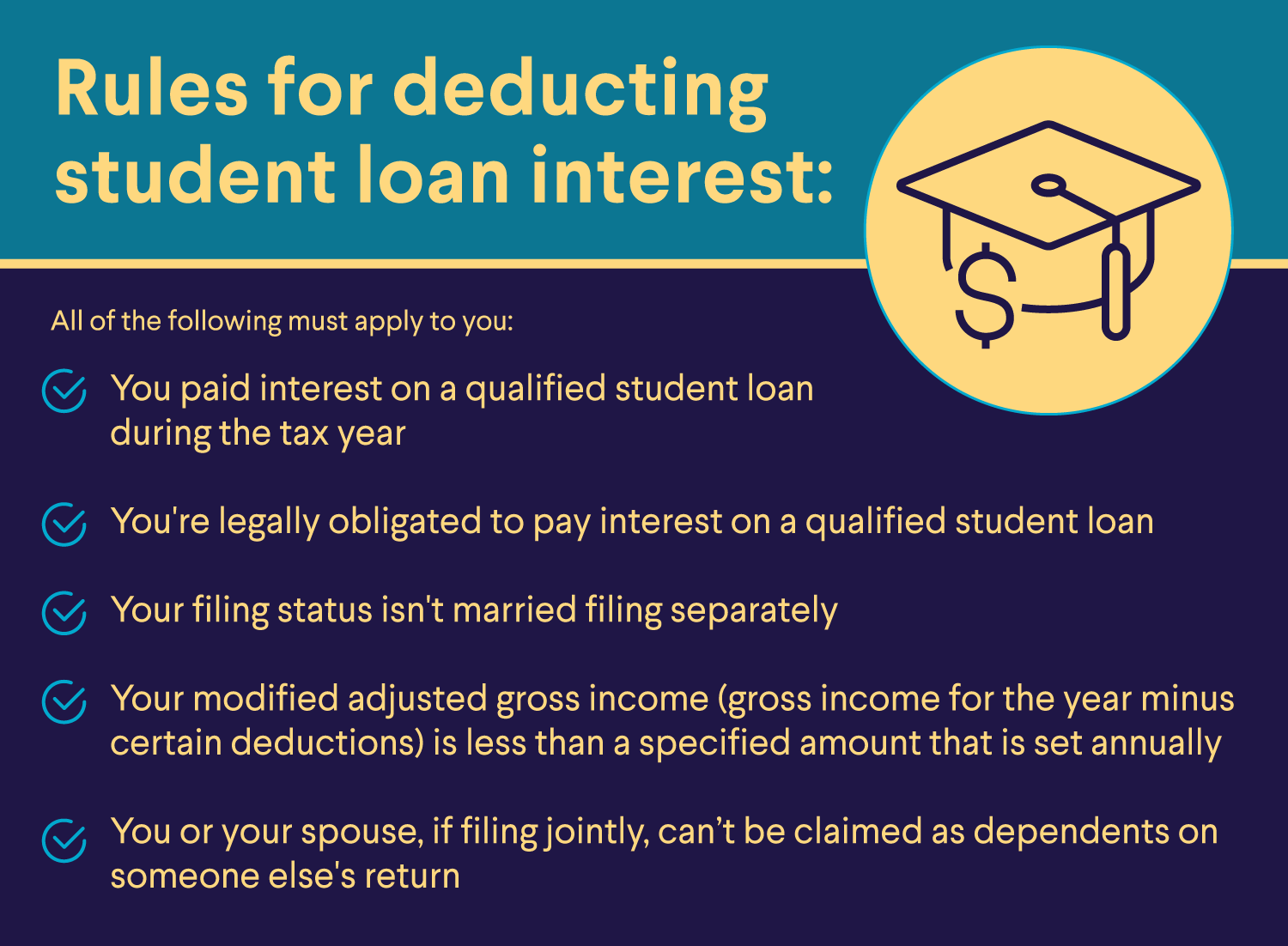
To be eligible to deduct student loan interest, individuals must meet the following requirements:

•   You paid interest on a qualified student loan (a loan for you, your spouse, or a dependent) during the tax year.

•   Your modified adjusted gross income (MAGI) is less than a specified amount that is set annually.

•   Your filing status is anything except married filing separately.

•   Neither you nor your spouse can be claimed as a dependent on someone else’s return.

•   You are legally required to pay the interest on a student loan.

The student loans in question can be federal or private student loans, as well as refinanced student loans.

What Are the Income Requirements for the Student Loan Tax Deduction?

The income requirements for the student loan tax deduction depend on your MAGI and your tax-filing status. The eligible MAGI ranges are typically recalculated annually.

For tax year 2024 (filing in 2025), the student loan interest deduction is worth up to $2,500 for a single filer, head of household, or qualifying widow/widower with a MAGI of $80,000 or less.

For those who exceed a MAGI of $80,000, the deduction begins to phase out. Once their MAGI reaches $95,000 or more, they are no longer able to claim the deduction.

For married couples filing jointly, the phaseout begins with a MAGI of more than $165,000, and eligibility ends at $195,000.

If you have questions about your eligibility, consider consulting a tax professional to make sure you can take advantage of the deduction.

When we say no required fees we mean it.
No late fees, & insufficient fund
fees when you take out a student loan with SoFi.


Other Tax Deductions for Students

In addition to the student loan interest rate deduction, there are other tax breaks that may be available to you if you’re a student, saving for college or paying for certain education expenses for yourself, a spouse, or a dependent. Here are three other tax benefits to consider:

529 Plans

A 529 college savings plan is a tax-advantaged plan that allows you to save for qualified education expenses — like tuition, lab fees, and textbooks — for yourself or your children. In 2025, you can contribute up to $19,000 per year without triggering gift taxes, and other family members can contribute to the fund, as well.

Savings can be invested and grow tax free inside the account. And while the federal government doesn’t offer any tax deductions, some states provide tax benefits like deductions from state income tax. Withdrawals must be used to cover qualified expenses; otherwise you will face income taxes and a 10% penalty.

American Opportunity Tax Credit

The American Opportunity Tax Credit (AOTC) helps offset $2,500 in qualified education expenses per student per year for the first four years of higher education. Unlike a tax deduction, tax credits reduce your tax bill on a dollar-for-dollar basis. And if the credit brings your taxes to zero, 40% of whatever remains of the credit amount can be refunded to you, up to $1,000.

To be eligible for the AOTC, you must be getting a degree or another form of recognized education credential. And at the beginning of the tax year, you must be enrolled in school at least half time for one academic period, and you cannot have finished your first four years of higher education at the beginning of the tax year.

Lifetime Learning Credit

The Lifetime Learning Credit (LLC) helps pick up where the AOTC leaves off. While the AOTC only lasts for four years, the LLC helps offset the expense of graduate school and other continuing educational opportunities. The credit can help pay for undergraduate and graduate programs, as well as professional degree courses that help you improve your job skills. The credit is worth $2,000 per tax return, and there is no limit to the number of years you can claim it. Unlike the AOTC, it is not a refundable tax credit.

To be eligible, you, a dependent, or someone else must pay qualified education expenses for higher education or pay for the expenses of an eligible student and an eligible educational institution. The eligible student must be yourself, your spouse or a dependent that you have listed on your tax return.

Look for Form 1098-E

If you’re wondering how to get the student loan interest deduction, keep an eye out for Form 1098-E, which you will need to file with your tax return. It will be sent out by your loan servicer or lender if you paid at least $600 in interest on your student loans for the tax year in question.

On Form 1098-E, your loan provider reports information on the interest you paid on your student loans throughout the year. The form goes out to student loan borrowers when the tax year ends, typically by mid-February. You can also check for the form on your loan servicer’s website and download a copy.

Note that you won’t receive this student loan tax form if you paid less than $600 in interest on your loan during the tax year.

Calculating Your Student Loan Interest Deduction

To figure out how much of a student loan interest deduction you can claim, start with your MAGI. If your MAGI is in the range to qualify for the full deduction, you’ll be eligible for $2,500 or the amount you paid in interest on your student loans during the tax year, whichever amount is less. (As you are calculating your MAGI, if you’re wondering, do student loans count as income, no, they do not.)

However, if your MAGI falls into the range where student interest deduction is reduced (which is more than $80,000 for single filers and $165,000 for joint filers in 2024), you can generally follow the instructions on the student loan interest deduction worksheet in Schedule 1 of Form 1040 to figure out the amount of your deduction when filing your federal income taxes. Then you can enter the calculated interest amount on Schedule 1 of the 1040 under “Adjustments to Income.”

One thing to note: For loans made before September 1, 2004, loan origination fees and/or capitalized interest may not be included in the amount of interest Form 1098-E says you paid. In this case, Box 2 on the form will be checked. If that applies to you, to calculate the full value of the interest deduction, start with the amount of interest the form says you paid, and then add any interest you paid on qualified origination fees and capitalized interest. Just make sure these amounts don’t add up to more than the total you paid on your student loan principal.

You can consult IRS Publication 970 for more information about how to do this, or consult a tax professional.

Common Mistakes to Avoid

Taking the student loan interest deduction can be somewhat complicated because there are a number of requirements involved. These are some common mistakes to watch out for.

•   Misreporting your income. Be sure to calculate your modified adjusted gross income (MAGI) correctly. It’s critical to use the right MAGI when determining if you are eligible for the student loan interest deduction and how much you can claim.

•   Deducting too much. The deduction is capped at $2,500 a year, no matter how much you paid in interest.

•   Deducting interest paid by someone else. If another person made some of your student loan payments for you — your parents, say — you cannot deduct the interest they paid. You can only deduct the interest you paid.

•   Failing to take the deduction. If you are eligible for the student loan interest deduction, be sure to take it. It can sometimes be easy to overlook this deduction in the hustle to get your tax information together.

Strategies to Reduce Student Loan Payments and Interest

Tax credits and deductions are one way to help cover some of the cost of school. Finding ways to lower your student loan payments is another cost-saving measure. Here are a few potential ways to do that.

•   Put money toward student loans by making additional payments to pay down your principal. Doing this may help reduce the amount of interest you owe over the life of the loan. Just make sure your loan does not have any prepayment penalties.

•   Make interest-only payments while you’re still in school on loans for which interest accrues, such as unsubsidized federal loans.

•   Find out if your loan provider offers discounts if you set up automatic payment. Federal Direct Loan holders may be eligible for a 0.25% discount when they sign up for automatic payments, for example.

•   Consider refinancing student loans. When you refinance, you replace your current student loan with a new loan that ideally has a lower interest rate or more favorable terms.

While there are advantages of refinancing student loans, such as possibly lowering your monthly payments, there are disadvantages as well. One major caveat: If you refinance federal loans, they are no longer eligible for federal benefits or protections. Also, you may pay more interest over the life of the loan if you refinance with an extended term. Weigh the options to decide if refinancing is right for you.

The Takeaway

Qualified student loan borrowers can take a student loan interest deduction of up to $2,500 annually. This applies to federal and private student loans as well as refinanced student loans.

You should get a form 1098-E from your loan servicer if you paid at least $600 in interest on your qualified student loans. Before you file for the deduction, make sure you qualify for it, and then figure out whether you are eligible for a full or partial deduction, based on your MAGI.

Whether you qualify for the student loan interest deduction or not, there are a number of ways to lower your monthly student loan payments, including putting additional payments toward your loan principal, signing up for automatic payments, and refinancing your student loans.

Looking to lower your monthly student loan payment? Refinancing may be one way to do it — by extending your loan term, getting a lower interest rate than what you currently have, or both. (Please note that refinancing federal loans makes them ineligible for federal forgiveness and protections. Also, lengthening your loan term may mean paying more in interest over the life of the loan.) SoFi student loan refinancing offers flexible terms that fit your budget.

With SoFi, refinancing is fast, easy, and all online. We offer competitive fixed and variable rates.

FAQ

How much student loan interest can I deduct?

The amount of student loan interest you can deduct is the lesser of up to $2,500 annually or the amount of interest you paid on your student loans. However, to qualify for the full deduction in 2024, you must have a MAGI of $80,000 or less if you are a single filer, or $165,000 or less if you are filing jointly. You will be eligible for a partial deduction if your MAGI is less than $95,000 for single filers and less than $195,000 for joint filers. Keep in mind that the MAGI limits typically change yearly.

Do I need to itemize my deductions to claim the student loan interest deduction?

No, you do not need to itemize your deduction to claim the student loan interest deduction. The deduction is considered an adjustment to your income, according to the IRS, so there is no need to itemize. You can simply report the amount on Form 1040 when you file your taxes, and include a copy of your Form 1098-E, which shows the student loan interest you paid for the tax year.

Can parents deduct student loan interest if they pay for their child’s loans?

Parents who pay for their child’s student loans can deduct student loan interest only if they are legally obligated to repay the loan — meaning that the loan is in their name or they are a cosigner of the loan. However, if the loan is in the child’s name only, parents cannot take the deduction, even if they paid for their child’s loans. The rules can be confusing, so parents may want to consult a tax professional.

What happens if I refinance my student loans?

Refinanced student loans are eligible for the student loan tax deduction as long as the refinanced loan was used for qualified education expenses and your MAGI falls within the set limits.

Are private student loans eligible for the student loan interest deduction?

Yes, private student loans are eligible for the student loan tax deduction, as are federal loans and refinanced loans. As long as you paid interest on a qualified student loan, your MAGI is less than the specified limit for the year, your filing status is anything except married and filing separately, and you (or your spouse if applicable) can’t be claimed as a dependent on someone else’s return, you are eligible for the deduction as a private student loan borrower.


SoFi Student Loan Refinance
Terms and conditions apply. SoFi Refinance Student Loans are private loans. When you refinance federal loans with a SoFi loan, YOU FORFEIT YOUR ELIGIBILITY FOR ALL FEDERAL LOAN BENEFITS, including all flexible federal repayment and forgiveness options that are or may become available to federal student loan borrowers including, but not limited to: Public Service Loan Forgiveness (PSLF), Income-Based Repayment, Income-Contingent Repayment, extended repayment plans, PAYE or SAVE. Lowest rates reserved for the most creditworthy borrowers.
Learn more at SoFi.com/eligibility. SoFi Refinance Student Loans are originated by SoFi Bank, N.A. Member FDIC. NMLS #696891 (www.nmlsconsumeraccess.org).

SoFi Loan Products
SoFi loans are originated by SoFi Bank, N.A., NMLS #696891 (Member FDIC). For additional product-specific legal and licensing information, see SoFi.com/legal. Equal Housing Lender.


Third-Party Brand Mentions: No brands, products, or companies mentioned are affiliated with SoFi, nor do they endorse or sponsor this article. Third-party trademarks referenced herein are property of their respective owners.

Non affiliation: SoFi isn’t affiliated with any of the companies highlighted in this article.

Tax Information: This article provides general background information only and is not intended to serve as legal or tax advice or as a substitute for legal counsel. You should consult your own attorney and/or tax advisor if you have a question requiring legal or tax advice.

Financial Tips & Strategies: The tips provided on this website are of a general nature and do not take into account your specific objectives, financial situation, and needs. You should always consider their appropriateness given your own circumstances.

Third Party Trademarks: Certified Financial Planner Board of Standards Center for Financial Planning, Inc. owns and licenses the certification marks CFP®, CERTIFIED FINANCIAL PLANNER®

External Websites: The information and analysis provided through hyperlinks to third-party websites, while believed to be accurate, cannot be guaranteed by SoFi. Links are provided for informational purposes and should not be viewed as an endorsement.

SOSLR-Q225-053

Read more
TLS 1.2 Encrypted
Equal Housing Lender