What Is a Gold IRA? How Do You Invest in One?

While it’s common for people to use their IRA to invest in stocks, bonds, and other securities, it’s also possible to set up a self-directed IRA to invest in physical gold bars, coins, or bullion.

Although the assets within a self-directed IRA are considered alternative investments, these accounts still follow the standard IRS rules regarding tax advantages, annual contribution limits, and so forth.

That said, not all brokers offer self-directed IRAs. And investing in gold within an IRA may be more expensive owing to the cost of storing a physical commodity like gold.

Establishing a Gold IRA Account

It’s important to understand that there isn’t a dedicated “gold IRA” that’s geared toward investing in gold alone (or any other type of precious metal). Rather, investors interested in investing in gold or other types of alternative investments can set up what’s known as a self-directed IRA (or SIDRA) in order to choose investments that aren’t normally available through a traditional IRA account.

While alternative investments can be illiquid, volatile, or subject to other risk factors, investors interested in alts may be curious about the potential for greater diversification since these assets typically don’t move in tandem with conventional markets. In the case of precious metals, they can be an inflation hedge.

Understanding Self-Directed IRAs

Typically, most IRA providers only allow you to invest in securities like stocks, bonds, ETFs or mutual funds. If you want to invest in gold by in an ETF focusing on gold, or by purchasing stock in a gold mining company, then a traditional IRA custodian is fine.

But if you want to hold physical gold in your IRA, you’ll need to find a broker that will allow you to set up a self-directed IRA.

Self-directed IRAs and self-directed Roth IRAs allow account holders to buy and sell a wider variety of investments than regular traditional IRAs and Roth IRAs.

While a custodian or a trustee administers the SDIRA, the account holder typically manages the portfolio of assets themselves. These accounts may also come with higher fees than regular IRAs owing to the higher cost of storing physical assets like gold.

That said, a self-directed IRA follows the same general rules as ordinary IRAs in terms of tax rules, withdrawal restrictions, income caps, and annual contribution limits (see details below). A self-directed IRA can be set up as a traditional, tax-deferred account, or a self-directed Roth IRA.

Setting Up a Gold IRA Account

Once you’ve found an IRA custodian or brokerage that allows you to open a self-directed IRA and purchase physical gold, you can fund your account. Be sure you’re working with a reputable, experienced precious metals IRA custodian, and that the company is registered with the SEC (Securities and Exchange Commission) and with FINRA (Financial Industry Regulatory Authority).

The two most common ways to fund a gold IRA are by contributing cash or transferring money from an existing IRA or 401(k) account.

After you’ve funded your account, your broker will purchase the physical gold and store it for you. These same steps will hold true if you want to invest in other precious metals, including silver or platinum.

Alternative investments,
now for the rest of us.

Explore trading funds that include commodities, private credit, real estate, venture capital, and more.


Gold Standards for IRAs

Just as with a silver IRA, there are restrictions on the physical gold you are allowed to hold in an IRA. Any gold that is held in an IRA must be at least 99.5% pure.

Some common types of gold coins that are allowed to be held in a gold IRA include American Eagle bullion or coins, Canadian Maple Leaf coins and Australian Koala bullion coins.

Managing a Gold IRA Portfolio

The process for managing an IRA invested in gold is similar to managing an IRA that holds any commodity or security.

When you open a gold IRA, you will issue instructions to your broker to buy and sell physical gold, just as you would if you were buying stocks in a more traditional IRA. The value of your gold IRA portfolio fluctuates with the value of the physical gold that you hold.

You are not allowed to hold the gold yourself while it is part of your IRA. If you want to take possession of the physical gold bullion in your gold IRA, you will need to make a withdrawal from your IRA — which is subject to standard IRS rules governing IRA withdrawals.

An early withdrawal before age 59 ½ may result in taxes and/or penalties, so make sure you understand the terms before you take a withdrawal from a self-directed IRA.

Recommended: Portfolio Diversification: What It Is and Why It’s Important

Tax Advantages and Drawbacks of Gold IRAs

Remember that an IRA invested in gold still follows the basic structure and tax rules of traditional and Roth IRAs. The annual contribution limit for a regular, Roth, or self-directed IRA is $7,000 for tax year 2025, or $8,000 for those 50 and older, and $7,500 for tax year 2026, or $8,600 for those 50 and older.

•   With a self-directed traditional IRA, you save money that’s considered pre-tax (just as in a traditional IRA account). The value of the assets within the account may grow over time, but taxes are deferred. This means you will owe tax on the money when you withdraw it, which you can do without penalty starting at age 59 ½.

•   With a self-directed Roth IRA you make after-tax contributions, just as you would with a regular Roth IRA. Here the money grows tax free over time. In the case of a Roth account, qualified withdrawals are tax free starting at age 59 ½, as long as you have had the account for at least five years, according to the five-year rule.

In addition, investors who want to set up a Roth SIDRA must meet certain income requirements (the same income caps as for a regular Roth IRA). For single and joint tax filers: in order to contribute the full amount to a Roth IRA in 2025, you must earn less than $150,000 (for single filers) or $236,000 (if you’re married, filing jointly), respectively.

In 2026, to contribute the full amount to a Roth IRA, you must earn less than $153,000 as a single filer and less than $242,000 if you’re married filing jointly. See IRS.gov for additional details, or consider consulting a tax professional.

One of the biggest drawbacks of a gold IRA is that the money in your IRA is generally intended for retirement. That means that if you withdraw the money in any IRA before you reach 59 ½, you may have to pay additional taxes and/or a 10% penalty. Another drawback is that you are limited by how much you can contribute to a gold IRA each year.

The Takeaway

There isn’t a specific type of IRA called a gold IRA — this is just a common way to refer to a self-directed IRA that is used to invest in physical gold. A gold IRA might be a traditional or a Roth IRA, which each come with certain tax advantages. Any gold that you hold in a self-directed IRA must be at least 99.5% pure. Additionally, not all brokers allow you to self-direct your investments and hold gold in your IRA.

Ready to expand your portfolio's growth potential? Alternative investments, traditionally available to high-net-worth individuals, are accessible to everyday investors on SoFi's easy-to-use platform. Investments in commodities, real estate, venture capital, and more are now within reach. Alternative investments can be high risk, so it's important to consider your portfolio goals and risk tolerance to determine if they're right for you.

Invest in alts to take your portfolio beyond stocks and bonds.

FAQ

What types of gold investments can be held in a gold IRA?

Like other commodities including silver or platinum, there are specific rules about what kinds of gold investments can be held in a gold IRA. Gold must be at least 99.5% pure to be eligible to be held in an IRA. This includes coins like the Australian Koala, Canadian Maple Leaf, or American Eagle.

How do you set up and fund a gold IRA account?

The most important step to setting up and funding a gold IRA is to find a custodian that will allow you to open a self-directed IRA and invest in precious metals. Once you have found a custodian that will, simply follow their account setup instructions. Then you can fund your gold IRA, by either making a new contribution, or transferring money from a 401(k) account or an existing IRA.

What are the tax benefits and restrictions associated with a gold IRA?

The tax benefits and restrictions of a self-directed gold IRA are the same as any other IRA. With a traditional gold IRA, you may be eligible for a tax deduction in the year that you make a contribution, but you’ll owe taxes on withdrawals. With a Roth gold IRA, you don’t get a tax deduction when you make your contribution — instead, your withdrawals are tax free. In most circumstances, you will have to pay taxes and/or penalties if you make a withdrawal before age 59 ½.


Photo credit: iStock/JohnnyGreig

INVESTMENTS ARE NOT FDIC INSURED • ARE NOT BANK GUARANTEED • MAY LOSE VALUE

SoFi Invest is a trade name used by SoFi Wealth LLC and SoFi Securities LLC offering investment products and services. Robo investing and advisory services are provided by SoFi Wealth LLC, an SEC-registered investment adviser. Brokerage and self-directed investing products offered through SoFi Securities LLC, Member FINRA/SIPC.

For disclosures on SoFi Invest platforms visit SoFi.com/legal. For a full listing of the fees associated with Sofi Invest please view our fee schedule.

Exchange Traded Funds (ETFs): Investors should carefully consider the information contained in the prospectus, which contains the Fund’s investment objectives, risks, charges, expenses, and other relevant information. You may obtain a prospectus from the Fund company’s website or by emailing customer service at [email protected]. Please read the prospectus carefully prior to investing.

Investment Risk: Diversification can help reduce some investment risk. It cannot guarantee profit, or fully protect in a down market.

Fund Fees
If you invest in Exchange Traded Funds (ETFs) through SoFi Invest (either by buying them yourself or via investing in SoFi Invest’s automated investments, formerly SoFi Wealth), these funds will have their own management fees. These fees are not paid directly by you, but rather by the fund itself. these fees do reduce the fund’s returns. Check out each fund’s prospectus for details. SoFi Invest does not receive sales commissions, 12b-1 fees, or other fees from ETFs for investing such funds on behalf of advisory clients, though if SoFi Invest creates its own funds, it could earn management fees there.
SoFi Invest may waive all, or part of any of these fees, permanently or for a period of time, at its sole discretion for any reason. Fees are subject to change at any time. The current fee schedule will always be available in your Account Documents section of SoFi Invest.


Tax Information: This article provides general background information only and is not intended to serve as legal or tax advice or as a substitute for legal counsel. You should consult your own attorney and/or tax advisor if you have a question requiring legal or tax advice.

Third-Party Brand Mentions: No brands, products, or companies mentioned are affiliated with SoFi, nor do they endorse or sponsor this article. Third-party trademarks referenced herein are property of their respective owners.

Disclaimer: The projections or other information regarding the likelihood of various investment outcomes are hypothetical in nature, do not reflect actual investment results, and are not guarantees of future results.

Financial Tips & Strategies: The tips provided on this website are of a general nature and do not take into account your specific objectives, financial situation, and needs. You should always consider their appropriateness given your own circumstances.

SOIN-Q224-1900719-V1
CN-Q425-3236452-51

Read more
Simple IRA vs. Traditional IRA

Is a SIMPLE IRA the Same as a Traditional IRA?

One of the most popular retirement accounts is an IRA, or Individual Retirement Account. IRAs allow individuals to put money aside over time to save up for retirement, with tax benefits similar to those of other retirement plans.

Two common IRAs are the SIMPLE IRA and the Traditional IRA, both of which have their own benefits, downsides, and rules around who can open an account. For investors trying to decide which IRA to open, it helps to know the differences between SIMPLE IRAs and Traditional IRAs.

SIMPLE IRA vs Traditional IRA: Side-by-Side Comparison

Although there are many similarities between the two accounts, there are some key differences. This chart details the key attributes of each plan:

SIMPLE IRA Traditional IRA
Offered by employers Yes No
Who it’s for Small-business owners and their employees Individuals
Eligibility Earn at least $5,000 per year No age limit; must have earned income in the past year
Tax deferred Yes Yes
Tax deductible contributions Yes, for employers and sole proprietors only Yes
Employer contribution Required No
Fee for early withdrawal 10% plus income tax, or 25% if money is withdrawn within two years of an employer making a deposit 10% plus income tax
Contribution limits $16,500 in 2025
$17,000 in 2026
$7,000 in 2025
$7,500 in 2026
Catch-up contribution $3,500 additional per year for people 50 and over in 2025
$4,000 additional per year for those 50 and older in 2026
$5,250 additional per year for those aged 60 to 63 in both 2025 and 2026, thanks to SECURE 2.0
$1,000 additional per year in 2025 for people 50 and over
$1,100 additional per year in 2026 for those 50 and older

SIMPLE IRAs Explained

The SIMPLE IRA, which stands for Savings Incentive Match Plan for Employees, is set up to help small-business owners help both themselves and their employees save for retirement. It’s a retirement plan that small businesses with fewer than 100 employees can offer employees who earn at least $5,000 per year.

A SIMPLE IRA is similar to a Traditional IRA, in that a plan participant can make tax-deferred contributions to their account, so that it grows over time with compound interest. When the individual retires and begins withdrawing money, then they must pay income taxes on the funds.

With a SIMPLE IRA, both the employer and the employee contribute to the employee’s account. Employers are required to contribute in one of two ways: either by matching employee contributions up to 3% of their salary, or by contributing a flat rate of 2% of the employee’s salary, even if the employee doesn’t contribute. With the matching option, the employee must contribute money first.

There are yearly employee contribution limits to a SIMPLE IRA: In 2025, the annual limit is $16,500, with an additional $3,500 in catch-up contributions permitted for people age 50 and older, and an additional $5,250 for those ages 60 to 63, thanks to SECURE 2.0.

In 2026 the annual limit is $17,000, with an additional $4,000 in catch-up contributions permitted for people age 50 and older, and an additional $5,250 for those ages 60 to 63.

Benefits and Drawbacks of SIMPLE IRAs

It’s important to understand both the benefits and downsides of the SIMPLE IRA to make an informed decision about retirement plans.

SIMPLE IRA Benefits

There are several benefits — for both employers and employees — to choosing a SIMPLE IRA:

•   For employers, it’s easy to set up and manage, with online set-up available through most banks.

•   For employers, management costs are low compared to other retirement plans.

•   For employees, taxes on contributions are deferred until the money is withdrawn.

•   Employers can take tax deductions on contributions. Sole proprietors can deduct both salary and matching contributions.

•   For employees, there is an allowable catch-up contribution for those over 50.

•   For employers, the IRA plan providers send tax information to the IRS, so there is no need to do any reporting.

•   Employers and employees can choose how the money in the account gets invested based on what the plan offers. Options may include mutual funds aimed toward growth or income, international mutual funds, or other assets.

SIMPLE IRA Drawbacks

Although there are multiple benefits to a SIMPLE IRA, there are some downsides as well:

•   Employers must follow strict rules set by the IRS.

•   Other employer-sponsored retirement accounts have higher limits, such as the 401(k), which allows for $23,500 per year in 2025 and $24,500 in 2026. (Check out our IRA calculator to see what you can contribute to each type of IRA.)

•   If account holders withdraw money before they reach age 59 ½, they must pay a 10% fee and income taxes on the withdrawal. That penalty jumps to 25% if money is withdrawn within two years of an employer making a deposit.

•   There is no option for a Roth contribution to a SIMPLE IRA, which would allow account holders to contribute post-tax money and avoid paying taxes later.

Get a 1% IRA match on rollovers and contributions.

Double down on your retirement goals with a 1% match on every dollar you roll over and contribute to a SoFi IRA.1


1Terms and conditions apply. Roll over a minimum of $20K to receive the 1% match offer. Matches on contributions are made up to the annual limits.

What Is a Traditional IRA?

The Traditional IRA is set up by an individual to contribute to their own retirement. Employers are not involved in Traditional IRAs in any way. The main requirements to open an IRA are that the account holder must have earned some income within the past year, and they must be younger than 70 ½ years old at the end of the year.

Pros and Cons of Traditional IRAs

When it comes to benefits and downsides, there’s not too much of a difference between Traditional vs. SIMPLE IRAs, given what an IRA is. That being said, there are a few that are unique to this type of plan.

Traditional IRA Pros

Some of the upsides of a Traditional IRA include:

•   It allows for catch-up contributions for those over age 50.

•   One can choose how the money in the account gets invested based on what the plan offers. Options may include mutual funds aimed toward growth or income, international mutual funds, or other assets.

•   Contributions are tax-deferred, so taxes aren’t paid until funds are withdrawn. If you’re hoping to pay taxes now instead of later, you might weigh a Traditional vs. Roth IRA.

Traditional IRA Cons

Meanwhile, downsides to a Traditional IRA include:

•   They have much lower contribution limits than a 401(k) or a SIMPLE IRA, at $ $7,000 in 2025, and $7,500 in 2026.

•   Penalties for early withdrawal are also the same: if you withdraw money before age 59 ½, you’ll pay a 10% fee plus income taxes on the withdrawal.

Is a SIMPLE IRA or Traditional IRA Right for You?

The SIMPLE IRA and Traditional IRA are both individual retirement accounts, but the SIMPLE is set up through one’s employer — typically a small business of 100 people or less. The Traditional IRA is set up by an individual. In other words, whether a SIMPLE IRA is an option for you will depend on if you have an employer that offers it.

There are many similarities in the attributes of the plans, if you’re choosing between a SIMPLE IRA vs. Traditional IRA. However, two major distinctions are that the SIMPLE IRA requires employer contributions (though not necessarily employee contributions) and allows for a higher amount of employee contributions per year.

Can I Have Both a SIMPLE IRA and a Traditional IRA?

Yes, it is possible for an individual to have both a SIMPLE IRA through their employer and also a Traditional IRA on their own — though they may not be able to deduct all of their Traditional IRA contributions. The IRS sets a cap on deductions per calendar year.

In 2025, single people covered by an employer-sponsored retirement plan at work who have a MAGI (modified adjusted gross income) of more than $79,000 are restricted to a partial deduction; those with a MAGI of $89,000 or more may not take a deduction at all. Those with an employer-sponsored plan at work who are married filing jointly with an MAGI of more than $126,000 but less than $146,000 may take a partial deduction; those with a MAGI of $146,000 or more may not take a deduction at all.

In 2026, single people covered by an employer-sponsored retirement plan at work who have a MAGI of more than $81,000 and less than $91,000 are restricted to a partial deduction; those with a MAGI of $91,000 or more may not take a deduction at all. Those who are covered by an employer-sponsored retirement plan at work and are married filing jointly with a MAGI of more than $129,000 and less than $149,000 may take a partial deduction; those with a MAGI of $149,000 or more may not take a deduction at all.

Can You Convert a SIMPLE IRA to a Traditional IRA?

If you’re hoping to convert a SIMPLE IRA to a Traditional IRA, you’re in luck — you can roll over a SIMPLE IRA into a Traditional IRA. However, you can’t roll over the funds from a SIMPLE IRA to a Traditional IRA within the first two years of opening a SIMPLE IRA. Otherwise, you’ll get hit with a 25% penalty in addition to the regular income tax you must pay on your withdrawal.

Once that two-year period is up, however, you can roll over the money from your SIMPLE IRA — even if you’re still working for that employer. Just note that you can only roll over money from a SIMPLE IRA one time within a 12-month period.

Can You Max Out a Traditional and SIMPLE IRA the Same Year?

While you cannot max out a SIMPLE IRA and another employer-sponsored retirement plan like a 401(k), you can max out both a Traditional IRA and a SIMPLE IRA.

The maximum contribution for a SIMPLE IRA in 2025 is $16,500 (plus $3,500 in catch-up contributions), while the maximum for a Traditional IRA is $7,000 (plus $1,000 in catch-up contributions). This means that you could contribute a total of $23,500 across both plans in a year — or $28,000 if you’re 50 or older.

The maximum contribution for a SIMPLE IRA in 2026 is $17,000 (plus $4,000 in catch-up contributions), while the maximum for a Traditional IRA is $7,500 (plus $1,100 in catch-up contributions). This means that you could contribute a total of $24,500 across both plans for the year — or $29,600 if you’re 50 or older.

Are SIMPLE IRAs Most Similar to 401(k) Plans?

There are a lot of similarities between SIMPLE IRAs and 401(k) plans given that they are both employer-sponsored retirement plans. However, while any employer with one or more employees can offer a 401(k), SIMPLE IRAs are reserved for employers with 100 or fewer employees. Additionally, contribution limits are lower with SIMPLE IRAs than with 401(k) plans.

Another key difference between the two is that while employers can opt whether or not to make contributions to employee 401(k), employer contributions are mandatory with SIMPLE IRAs. On the employer side, SIMPLE IRAs generally have fewer account fees and annual tax filing requirements.

Opening an IRA With SoFi

Understanding the differences between retirement accounts like the SIMPLE and Traditional IRA is one more step in creating a personalized retirement plan that works for you and your goals. While a SIMPLE IRA is only an option if your employer offers it, you’ll want to weigh the pros and cons of a SIMPLE IRA vs. Traditional IRA if both are on the table for you. As we’ve covered, the two types of IRAs share many similarities, but a SIMPLE IRA is not the same as a Traditional IRA.

If you’re looking to start saving for retirement now, or add to your investments for the future, SoFi Invest® online retirement accounts offer both Traditional and Roth IRAs that are simple to set up and manage. By opening an IRA with SoFi, you’ll gain access to a broad range of investment options, member services, and a robust suite of planning and investment tools.

Find out how to further your retirement savings goals with SoFi Invest.

FAQ

Do you pay taxes on SIMPLE IRA?

Yes, you will pay taxes on a SIMPLE IRA, but not until you withdraw your funds in retirement. You’ll generally have to pay income tax on any amount you withdraw from your SIMPLE IRA in retirement. However, if you make a withdrawal prior to age 59 ½, or if money is withdrawn within two years of an employer making a deposit, you’ll have to pay income taxes then, alongside an additional tax penalty.

Is a SIMPLE IRA better than a Traditional IRA?

When comparing a SIMPLE IRA vs. traditional IRA, it’s important to understand that each has its pros and cons. If your employer offers a SIMPLE IRA, they require employer contributions, and they have higher contributions. At the end of the day, though, both allow you to save for retirement through tax-deferred contributions.


INVESTMENTS ARE NOT FDIC INSURED • ARE NOT BANK GUARANTEED • MAY LOSE VALUE

SoFi Invest is a trade name used by SoFi Wealth LLC and SoFi Securities LLC offering investment products and services. Robo investing and advisory services are provided by SoFi Wealth LLC, an SEC-registered investment adviser. Brokerage and self-directed investing products offered through SoFi Securities LLC, Member FINRA/SIPC.

For disclosures on SoFi Invest platforms visit SoFi.com/legal. For a full listing of the fees associated with Sofi Invest please view our fee schedule.

Financial Tips & Strategies: The tips provided on this website are of a general nature and do not take into account your specific objectives, financial situation, and needs. You should always consider their appropriateness given your own circumstances.

Tax Information: This article provides general background information only and is not intended to serve as legal or tax advice or as a substitute for legal counsel. You should consult your own attorney and/or tax advisor if you have a question requiring legal or tax advice.

SOIN0323009
CN-Q425-3236452-27

Read more

Guide to the Average Savings in America by Age

How much does the average American have in savings? Age tends to have a lot to do with it. Generally, as people get older, they are likely to have more savings.

But what the average person has in a savings account also depends on their financial goals and personal circumstances.

If you’re looking for a benchmark of just how much you should save by a specific age, or how much you should start contributing right now, read on for average savings by age and some tips that could help.

Key Points

•   The average savings for individuals under 35 is $20,540.

•   Individuals between the ages of 35 and 44 have an average savings of $41,540.

•   Those aged 45 to 54 have an average savings of $71,130.

•   The average savings for individuals between 55 and 64 is $72,520.

•   Individuals aged 65 and older have an average savings of $100,2500.

The Importance of Saving for the Future

Life can happen fast. For example, the average cost of having a new baby is almost $19,000, including approximately $3,000 in out-of-pocket expenses for pregnancy and delivery. And then there’s the cost of caring for a child, which some estimates put at more than $310,605 for raising them through age 17.

And, if that baby wants to get a college degree, you’re looking at a whole new realm of savings. The cost of a four-year public college education can range from about $108,584 to $182,832, according to the Education Data Initiative.

There’s one other big reason to save for the future: People are living longer. According to a 2025 survey by the Employee Benefit Research Institute, only 28% of American workers are “very confident they will be able to retire comfortably.” Thirty-two percent of workers say their lack of confidence is because they have less than $25,000 in savings and investments.

Fortunately, the concept of saving for the future seems to be resonating with people at younger ages. According to the SoFi 2024 Retirement Survey, more than half (51%) of respondents started saving for retirement before age 35, with many of that group starting by age 25.
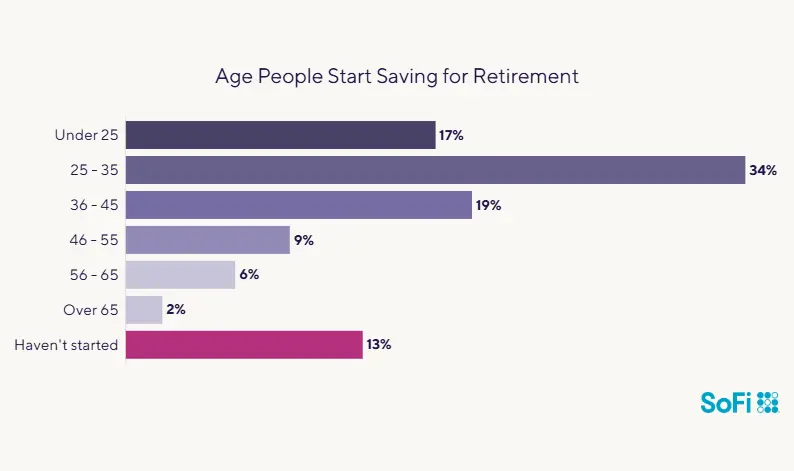
Age-People-Start-Saving-for-Retirement
Source: SoFi 2024 Retirement Survey

A Savings Shortfall

Still, Americans’ savings strategy has a way to go. More than half of Americans can’t cover an unexpected $1,000 expense, according to Bankrate’s 2025 emergency savings report. Only 41% say they could cover it.

And 37% of all Americans don’t have enough cash in savings to cover even a $400 emergency, the Federal Reserve found in its “Economic Well-Being of U.S. Households in 2024” report.

Get a 1% IRA match on rollovers and contributions.

Double down on your retirement goals with a 1% match on every dollar you roll over and contribute to a SoFi IRA.1


1Terms and conditions apply. Roll over a minimum of $20K to receive the 1% match offer. Matches on contributions are made up to the annual limits.

Average Savings by Age in the USA

The Federal Reserve’s latest (2022) Survey of Consumer Finances shows that the typical American household has an average savings balance of $62,410.

But average savings varies greatly by age and number of people in a household. Here’s what savings by age looks like.

Average Savings for Those 35 and Younger

Americans under the age of 35 had an average savings account balance of $20,540, according to the Fed’s survey.

This is a large age bracket that can range from those just graduating high school to recent college grads to young professionals well into a decade’s worth of work.

It’s wise to have three to six months of expenses in an emergency fund. At the very least, aiming to have $1,000 handy in a savings account for unexpected expenses is recommended.

Use our emergency fund calculator to see how much you should ideally have stashed away.

For those who have started their careers, employer-sponsored retirement funds such as a 401(k) plan can be good options to start saving for long-term retirement goals.

It makes sense to contribute at least enough to get matching funds from an employer, if that’s an option with your company’s plan. For reference, the average 401(k) savings for those ages 25 to 34 is $42,640, according to Vanguard’s “How America Saves 2025” report.

Recommended: Why You Should Start Retirement Planning in Your 20s

Average Savings by Age: 35 to 44

Americans ages 35 to 44 had an average savings account balance of $41,540, according to the Federal Reserve survey. Those in this age bracket are now well into adulthood. At this stage of life, it’s prudent to have that three-to six-months’ worth of savings in an emergency fund, to cover the cost of everything from an accident to a lost job.

This may also be the time to think about diversifying a financial portfolio and possibly investing in the stock or bond market.

And, of course, keep contributing to your 401(k). For reference, the average 401(k) savings for those ages 35 to 44 is $103,552, according to the Vanguard report.

Average Savings by Age: 45 to 54

People ages 45 to 54 had an average savings account balance of $71,130, according to the Fed’s survey.

At this point, general financial advice dictates that a 50-year-old should have at least six times their annual salary if their intention is to retire at 67.

Those in this age group have an average 401(k) savings of $188,643.

Average Savings by Age: 55 to 64

The Fed survey found that Americans ages 55 to 64 had an average savings account balance of $72,520.

Since this is the time when most Americans are staring down retirement in a few years, it’s generally a good idea to boost retirement savings into high gear.

That’s because while younger people in 2025 are capped at contributing $23,500 a year to a 401(k) account, those age 50 and up are allowed to contribute an additional $7,500.This is known as a catch-up contribution. Also for 2026, those under age 50 can contribute up to $24,500, and those 50 and up can contribute an additional $8,000. And those aged 60 to 63 may again contribute an additional $11,250 instead of $8,000.

The average retirement savings account for a person aged 55 to 64 is $271,230. It’s important to note that taking a withdrawal from such a plan before the age of 59 ½ could mean paying taxes and penalties.

Average Savings by Age: 65 and Older

This is when savings really peaks for the average American. The latest Federal Reserve Survey of Consumer Finances found that Americans ages 65 to 74 had an average savings account balance of $100,250.

However, that savings number does drop over time. According to the survey, Americans ages 75 and up had an average savings account balance of $82,800.

This underscores the importance of creating a retirement budget and sticking to it in order to have enough savings for as long as needed.

But before retirement, try to hit the average retirement savings amount for those ages 65 and up, which is $299,442.

This chart offers an at-a-glance comparison of the average American savings by age.

Age

Average savings

Under 35 $20,540
35-44 $41,540
45-54 $71,130
55-64 $72,520
65+ $100,250

Median Savings by Age

Median savings is different from average savings. The median is the number in the middle of all the other numbers, meaning half the numbers are higher and half are lower. So with median savings, half the people in an age category will have saved more and half will have saved less.

These are the median savings by age, according to the latest Federal Reserve Survey of Consumer Finances:

•   Under 35: $5,400

•   35-44: $7,500

•   45-54: $8,700

•   55-64: $8,000

•   65-74: $13,400

Savings vs Retirement Savings

What Americans have saved for emergencies, expenses, and other near-future goals is different from what they have in their retirement savings accounts, as you can see from all the information above. It’s critical to have both types of savings at the same time.

And keep this in mind: As you get older, and closer to retirement, it’s important that your retirement savings grow even more. It’s a good idea to contribute the maximum amount allowed to your retirement accounts at this time, if you can. This is one of the ways to save for retirement.

Saving a Little Bit More

Reaching specific savings goals doesn’t have to be complicated. It just means doing a bit of homework, strategizing, and staying diligent about personal finances.

The first step in saving more is to analyze current expenses to see what can be cut back on or cut out altogether to make more room for saving. This means creating a personal budget and tracking current spending.

To track spending, a person could create an excel spreadsheet and list all expenditures by categories like groceries, phone bill, car expenses, housing, medical, entertainment and others over the course of a month, filling it in with every single dollar spent to see where the money is going. Or you can use an online tracker like SoFi’s tracker, which allows users to connect all their accounts to one dashboard and track spending habits in real time.

After the month is up, the next step is to look back on the expenditures list. Was there anything that surprised you? Do you need all those streaming subscriptions? How about that gym membership — did it actually get used? This is the time to get a little ruthless.

After figuring out what’s left, try implementing a general budget outline like the 50/30/20 rule. This means that approximately 50% of your after-tax income goes toward essential expenses like food and rent, while 30% goes toward discretionary expenses like nights out at the movies or concerts. The last 20% belongs to savings and retirement account goals.

Next, it’s time to get creative about saving even more for the future. This can be done by putting more cash into a high-yield savings account via direct deposit right from a paycheck.

Those looking to save a few more bucks every month could also do so by getting rid of unnecessary expenses. But, instead of pocketing that cash, consider using mobile banking to direct that cash right to savings.

Still feeling the pinch and don’t really have room to save more from a budget? Working part-time for, say, a ride-sharing company could allow you to set your own hours and earn extra income based on how much time you can dedicate to it. Other options might include freelance work in photography, writing, or other creative arts.

The Takeaway

Saving for goals in the near term — such as a house or a car — along with putting away money for an emergency savings fund to cover unexpected expenses, is important at every age. And so is investing in your future, including for retirement. The earlier you start saving for all your goals, the better.

Interested in opening an online bank account? When you sign up for a SoFi Checking and Savings account with direct deposit, you’ll get a competitive annual percentage yield (APY), pay zero account fees, and enjoy an array of rewards, such as access to the Allpoint Network of 55,000+ fee-free ATMs globally. Qualifying accounts can even access their paycheck up to two days early.


Better banking is here with SoFi, NerdWallet’s 2024 winner for Best Checking Account Overall.* Enjoy up to 3.60% APY on SoFi Checking and Savings.

FAQ

How much should a 30 year old have in savings?

By age 30, you should have the equivalent of your annual salary saved. So if you make $60,000 a year, you should have $60,000 in savings.

How much money does an average person have in savings?

The average American has a savings balance of $62,410, according to the 2022 Federal Reserve Survey of Consumer Finances, which is the latest data available.

How many Americans have $100,000 in savings?

According to one 2023 survey, only 14% of Americans have at least $100,000 in savings.


SoFi Checking and Savings is offered through SoFi Bank, N.A. Member FDIC. The SoFi® Bank Debit Mastercard® is issued by SoFi Bank, N.A., pursuant to license by Mastercard International Incorporated and can be used everywhere Mastercard is accepted. Mastercard is a registered trademark, and the circles design is a trademark of Mastercard International Incorporated.

Annual percentage yield (APY) is variable and subject to change at any time. Rates are current as of 11/12/25. There is no minimum balance requirement. Fees may reduce earnings. Additional rates and information can be found at https://www.sofi.com/legal/banking-rate-sheet

Eligible Direct Deposit means a recurring deposit of regular income to an account holder’s SoFi Checking or Savings account, including payroll, pension, or government benefit payments (e.g., Social Security), made by the account holder’s employer, payroll or benefits provider or government agency (“Eligible Direct Deposit”) via the Automated Clearing House (“ACH”) Network every 31 calendar days.

Although we do our best to recognize all Eligible Direct Deposits, a small number of employers, payroll providers, benefits providers, or government agencies do not designate payments as direct deposit. To ensure you're earning the APY for account holders with Eligible Direct Deposit, we encourage you to check your APY Details page the day after your Eligible Direct Deposit posts to your SoFi account. If your APY is not showing as the APY for account holders with Eligible Direct Deposit, contact us at 855-456-7634 with the details of your Eligible Direct Deposit. As long as SoFi Bank can validate those details, you will start earning the APY for account holders with Eligible Direct Deposit from the date you contact SoFi for the next 31 calendar days. You will also be eligible for the APY for account holders with Eligible Direct Deposit on future Eligible Direct Deposits, as long as SoFi Bank can validate them.

Deposits that are not from an employer, payroll, or benefits provider or government agency, including but not limited to check deposits, peer-to-peer transfers (e.g., transfers from PayPal, Venmo, Wise, etc.), merchant transactions (e.g., transactions from PayPal, Stripe, Square, etc.), and bank ACH funds transfers and wire transfers from external accounts, or are non-recurring in nature (e.g., IRS tax refunds), do not constitute Eligible Direct Deposit activity. There is no minimum Eligible Direct Deposit amount required to qualify for the stated interest rate. SoFi Bank shall, in its sole discretion, assess each account holder's Eligible Direct Deposit activity to determine the applicability of rates and may request additional documentation for verification of eligibility.

See additional details at https://www.sofi.com/legal/banking-rate-sheet.

We do not charge any account, service or maintenance fees for SoFi Checking and Savings. We do charge a transaction fee to process each outgoing wire transfer. SoFi does not charge a fee for incoming wire transfers, however the sending bank may charge a fee. Our fee policy is subject to change at any time. See the SoFi Bank Fee Sheet for details at sofi.com/legal/banking-fees/.
*Awards or rankings from NerdWallet are not indicative of future success or results. This award and its ratings are independently determined and awarded by their respective publications.

Financial Tips & Strategies: The tips provided on this website are of a general nature and do not take into account your specific objectives, financial situation, and needs. You should always consider their appropriateness given your own circumstances.

Third-Party Brand Mentions: No brands, products, or companies mentioned are affiliated with SoFi, nor do they endorse or sponsor this article. Third-party trademarks referenced herein are property of their respective owners.

Disclaimer: The projections or other information regarding the likelihood of various investment outcomes are hypothetical in nature, do not reflect actual investment results, and are not guarantees of future results.

Investment Risk: Diversification can help reduce some investment risk. It cannot guarantee profit, or fully protect in a down market.

Third Party Trademarks: Certified Financial Planner Board of Standards Center for Financial Planning, Inc. owns and licenses the certification marks CFP®, CERTIFIED FINANCIAL PLANNER®

External Websites: The information and analysis provided through hyperlinks to third-party websites, while believed to be accurate, cannot be guaranteed by SoFi. Links are provided for informational purposes and should not be viewed as an endorsement.

SOBNK-Q325-095
CN-Q425-3236452-35

Read more
woman using tablet in living room

4 Places To Put Your Retirement Money

There is no shortage of options when deciding where to put your retirement money. Strategies and tools are available to all investors, no matter where you may be in your retirement planning journey.

These options range from DIY to completely hands-off. Investors can break down their choices into three main decisions: the account, the investments, and finally the bank or platform.

Here are your options for your retirement investing strategy—and how to choose between them.

Where To Invest Retirement Money: First, Choose an Account

A typical first choice for an account to save and invest for the long-term is a designated retirement account. There are many different types of retirement plans, including Roth IRAs and employee-sponsored 401(k)s, most of which provide tax incentives to invest for the long haul.

It is important to remember, though, that retirement accounts are just that—accounts. For example, a 401(k) and a Roth IRA are not investments but instead, accounts that hold investments. Said another way, they provide a place where you can invest, but are not themselves an investment. This can be confusing, as many workplace retirement plans also automatically invest contributions made to the account.

Therefore, the decision on which retirement account to use will largely depend on what makes the most sense for your personal tax situation, and which you have access to. Here are some common options.

1. Workplace Retirement Plan

For individuals with access to one, a workplace retirement plan can be a convenient option that offers the benefit of automatic paycheck deduction. Many workplace plans, such as 401(k), 403(b), and SIMPLE (Savings Incentive Match Plan for Employees) IRA accounts, provide an easy place where retirement saving and investing can happen automatically.

As a bonus, many workplace plans offer a company match: when you contribute to your account, they do too. Many investors think of a company match as additional salary or “free money” that will help them reach their goals.

2. Tax-deferred Retirement Account

Tax-deferred retirement accounts, which include traditional IRAs, 401(k)s, and solo 401(k)s and SEP IRAs, offer tax deferral—meaning that you contribute with pre-tax dollars. When you open an IRA (or other similar account), income taxes on all contributions are deferred until you withdraw money, usually in retirement.

One benefit of tax deferral is that an individual might be more likely to have a lower (effective) income tax rate as a retired person, so there may be an advantage to delay taxes.

Get a 1% IRA match on rollovers and contributions.

Double down on your retirement goals with a 1% match on every dollar you roll over and contribute to a SoFi IRA.1


1Terms and conditions apply. Roll over a minimum of $20K to receive the 1% match offer. Matches on contributions are made up to the annual limits.

3. Roth IRA

Neither a Roth IRA or a Roth 401(k) offer tax deferral, so money entering into the account will be subject to income taxes. But that means that the money can be withdrawn tax-free, upon retirement or at other qualified times.

A Roth IRA could be a compelling option for someone looking to supplement their existing workplace plan, or someone who may not have access to an account through work. That said, Roth IRA accounts have income limitations, meaning that a high salary may disqualify you from using one.

There is one universal benefit to using a retirement account—as opposed to a non-retirement investment account—whether it’s tax-deferred or not: Tax-free investment growth. In a non-retirement account, money earned through investing will be subject to an additional tax on investment earnings. Within a retirement account, there is no such tax on any money earned through investing.

4. Non-retirement investment account

Non-retirement investment accounts, such as brokerage accounts or general investing accounts, offer more flexibility in accessing your money than retirement accounts typically do. Typically, an individual can incur penalties if money is removed from their retirement account before age 59 ½. If an investor is planning to retire before this age or would like the flexibility to do so, a non-retirement investment account might be appealing.

Additionally, a non-retirement investment account isn’t subject to the annual contribution limits of a retirement plan like a 401(k) or a Roth IRA (the latter of which is $7,000 for 2025 and $7,500 for 2026 for those under age 50). Some investors may choose to max out retirement accounts and open up a taxable investment account in order to fully fund their retirement goals.

Choose an Investment Strategy

Once an investor has decided where to put retirement money, it is time for the next step, which is how to invest that money. While many workplace retirement plans automatically invest money, it should be viewed as a separate step in the process.

Typically, investors choose (at minimum) a mix of stocks and bonds within their long-term investment portfolios. When contemplating bonds vs. stocks, it’s helpful to think of the differences in this way: Stocks tend to be higher growth, but that growth comes with more risk. On the other hand, bonds have historically lower rates of growth, but are considered to be less risky. An individual may want to determine their personal mix of stocks and bonds by assessing their goals, investing timeline, and risk tolerance.

Once an investor has determined their preferred mix of stocks, bonds, and any other major asset classes (called asset allocation), it is time to determine how to fulfill these allocations. There are several options, ranging from the completely DIY (buying individual stocks, for example) to the completely uninvolved (such as having a professional manage your portfolio).

Individual Stocks

Those who have an inherent interest in picking individual stocks could certainly do so, though it is not a requisite to building an investment portfolio. As you consider if and how to choose your first stock, it also makes sense to look into whether you’re more interested in a concentrated vs. diversified investment portfolio.

Index Funds and ETFs

A common way to invest for retirement is by using mutual funds or exchange-traded funds (ETFs). These funds are, essentially, baskets that hold lots of investments. That basket could hold stocks, bonds, something else entirely, or some combination of different investment types.

Some investors may find buying big baskets of investments easier than attempting to choose individual investments, like stocks. Individuals whose retirement plan automatically invests may already have a combination of funds.

Both mutual funds and ETFs can be either actively managed or “index.” Index funds—whether mutual funds or ETFs—are a popular choice because they are low-cost and often represent a broad swath of the market. For example, it’s possible to buy a low-cost index fund that invests in the entire US stock market. With just a handful of index funds, it may be possible to build a fully diversified portfolio.

Recommended: Are Mutual Funds Good for Retirement?

Target-date Funds

Similarly, there are options that utilize a passive, index fund strategy but that build a portfolio on your behalf. First, retirement target-date funds (also called lifecycle funds) are funds that typically hold other funds (as opposed to individual stocks and bonds) in amounts that are appropriate for your investing timeline—that’s why you pick one that corresponds to your approximate retirement date.

Target-date funds are popular within workplace retirement plans, but it also may be possible to buy into one at the brokerage bank of your choosing. Be sure to check and see whether the fund consists of index funds, which are typically lower cost, or holds managed funds, which generally have higher fees.

Robo-advisor Service

Another hands-off option is to use a digital “robo-advisor” service that manages a portfolio of index funds on your behalf. This option might appeal to those who want a bit more assistance in maintaining a retirement investing strategy. Most of these services encourage a passive, long-term investment strategy.

Generally, you’ll answer questions about your goals, investing timeline, and risk tolerance, which indicates to the service your most suitable investment mix. Then, this strategy is built and maintained for you. Typically, this service comes with an additional cost on top of the cost of the funds used.

The Takeaway

For investors deciding where to put retirement money, choosing a preferred account type and an investment strategy are two ways to get started. With tax-deferred options like 401(k)s and other choices like traditional and Roth IRAs, an investor is likely to find at least one retirement plan account that suits their lifestyle and goals.

In considering possible investment strategies, it’s useful to think about how hands-on one wants to be. Putting together a stock portfolio requires more direct involvement, whereas utilizing robo-advisor services might require less.

Deciding where to invest and with what strategy will help guide an investor’s third and final decision regarding the bank or investing platform.

No matter where and how an individual decides to invest their retirement money, they’re not likely to welcome unnecessary fees. Service fees and other costs embedded in accounts can seriously erode any potential profit earned on an investment.

For investors interested in a DIY approach for retirement investments, a low-cost brokerage bank or trading platform, like SoFi Invest®, may be appealing. With SoFi Invest, members can build out a diversified investment strategy—including stocks and ETFs—without high costs.

For individuals who favor a hands-off approach, a robo-advisor could be the right fit. SoFi Automated Investing builds and maintains a diversified portfolio for investors guided by their personal money goals and smart digital algorithms. Portfolios are built using low-cost ETFs.

Find out how SoFi Invest can help you meet your retirement goals.


SoFi Invest®
The information provided is not meant to provide investment or financial advice. Investment decisions should be based on an individual’s specific financial needs, goals and risk profile. SoFi can’t guarantee future financial performance. Advisory services offered through SoFi Wealth, LLC. SoFi Securities, LLC, member FINRA / SIPC . The umbrella term “SoFi Invest” refers to the three investment and trading platforms operated by Social Finance, LLC and its affiliates (described below). Individual customer accounts may be subject to the terms applicable to one or more of the platforms below.

Investment Risk: Diversification can help reduce some investment risk. It cannot guarantee profit, or fully protect in a down market.

Tax Information: This article provides general background information only and is not intended to serve as legal or tax advice or as a substitute for legal counsel. You should consult your own attorney and/or tax advisor if you have a question requiring legal or tax advice.

Automated Investing—The Automated Investing platform is owned by SoFi Wealth LLC, an SEC Registered Investment Advisor (“Sofi Wealth“). Brokerage services are provided to SoFi Wealth LLC by SoFi Securities LLC, an affiliated SEC registered broker dealer and member FINRA/SIPC, (“SoFi Securities”).
Active Investing—The Active Investing platform is owned by SoFi Securities LLC. Clearing and custody of all securities are provided by APEX Clearing Corporation.
For additional disclosures related to the SoFi Invest platforms described above, please visit https://www.sofi.com/legal/.
Fund Fees
If you invest in Exchange Traded Funds (ETFs) through SoFi Invest (either by buying them yourself or via investing in SoFi Invest’s automated investments, formerly SoFi Wealth), these funds will have their own management fees. These fees are not paid directly by you, but rather by the fund itself. these fees do reduce the fund’s returns. Check out each fund’s prospectus for details. SoFi Invest does not receive sales commissions, 12b-1 fees, or other fees from ETFs for investing such funds on behalf of advisory clients, though if SoFi Invest creates its own funds, it could earn management fees there.
SoFi Invest may waive all, or part of any of these fees, permanently or for a period of time, at its sole discretion for any reason. Fees are subject to change at any time. The current fee schedule will always be available in your Account Documents section of SoFi Invest.


Financial Tips & Strategies: The tips provided on this website are of a general nature and do not take into account your specific objectives, financial situation, and needs. You should always consider their appropriateness given your own circumstances.

SOIN0423027
CN-Q425-3236452-55

Read more

What Is a Silver IRA? How Do They Work?

A silver IRA follows the basic rules of an ordinary IRA account, but it has a special designation as a self-directed IRA that allows you to invest in precious metals like silver.

It’s important to note that you don’t need to open a specific silver IRA. Instead, you set up a self-directed account with a qualified broker that specializes in precious metals or other types of alternative investments (e.g. real estate, commodities, private placements, and others).

That said, not all brokers offer self-directed IRAs. And investing in silver within an IRA may be more expensive owing to the cost of storing a physical commodity like silver.

Introduction to IRAs Invested in Precious Metals

An IRA invested in silver assets is one way to invest in precious metals. There are a few kinds of precious metal IRAs you can invest in, including a platinum IRA, a gold IRA, or a palladium IRA.

While alternative investments can be illiquid, volatile, or subject to other risk factors, investors interested in alts may be curious about the potential for greater diversification since these assets typically don’t move in tandem with conventional markets. In the case of precious metals, they can be an inflation hedge.

How a Self-Directed IRA Works

Again, it is important to note that these are not separate types of IRAs. Rather, investors interested in investing in silver or other types of alternative investments can set up what’s known as a self-directed IRA (or SIDRA) in order to choose investments that aren’t normally available through a traditional IRA account.

While the brokerage administers the SDIRA, the investor typically manages the portfolio of assets themselves. These accounts may also come with higher fees than regular IRAs owing to the higher cost of storing physical assets like silver.

That said, these accounts follow the same rules as ordinary IRAs in terms of withdrawal restrictions, income caps, taxes, and annual contribution limits (see details below). A self-directed IRA can be set up as a traditional, tax-deferred account, or a self-directed Roth IRA.

Recommended: Alternative Investments: Definition, Examples, Benefits and Risks

Get a 1% IRA match on rollovers and contributions.

Double down on your retirement goals with a 1% match on every dollar you roll over and contribute to a SoFi IRA.1


1Terms and conditions apply. Roll over a minimum of $20K to receive the 1% match offer. Matches on contributions are made up to the annual limits.

Establishing a Silver IRA

If you’re ready to start investing in precious metals and you’ve found a broker or IRA custodian that will allow you to open a SDIRA and purchase silver in your account, you must fund it, either by depositing cash or by transferring money from an existing 401(k) or IRA account. Then your custodian will purchase the physical silver bullion and store it for you.

Requirements for Silver Investments

When comparing a commodity vs. a security, the IRS has specific rules for investing in commodities like silver in an IRA.

One of the most important is that any physical silver bullion held in your IRA must be at least 99.9% pure. This includes coins such as the Australian Silver Kangaroo, American Silver Eagle or Canadian Maple Leaf. Make sure that you work with a reputable precious metals IRA custodian that can ensure you are only investing in approved investments.

Be sure to check that the company is registered both with FINRA (Financial Industry Regulatory Authority) as well as the SEC (Securities and Exchange Commission).

Recommended: Portfolio Diversification: What It Is and Why It’s Important

Managing a Silver IRA Portfolio

The guidelines for managing a silver IRA portfolio are similar to the rules for any other type of IRA.

When you open a silver IRA, you will issue instructions to your broker to buy and sell physical silver, just as you would if you were buying stocks in a regular IRA. The value of your silver IRA portfolio will vary according to the price of silver in the market.

You don’t hold onto or store the silver yourself while it’s an asset in your IRA. If you want to take possession of the physical assets in your silver IRA, you would need to make a withdrawal from your IRA — which is subject to standard rules governing IRA withdrawals.

An early withdrawal before age 59 ½ may result in taxes and/or penalties, so make sure you understand the terms of investing in any IRA before you take a withdrawal from a self-directed IRA.

Tax Advantages and Drawbacks of Silver IRAs

Remember that a silver IRA still follows the basic structure and tax rules of traditional and Roth IRAs. The annual contribution limit for a regular, Roth, or self-directed IRA is $7,000 for tax year 2025, or $8,000 for those 50 and older, and $7,500 for tax year 2026, or $8,600 for those 50 and older.

•   With a self-directed traditional IRA, you save pre-tax money for your retirement, similar to a traditional IRA. The assets grow tax deferred over time. You pay taxes on the money when you withdraw it, which you can do without a penalty starting at age 59 ½.

•   With a self-directed Roth IRA, similar to a regular Roth IRA, you make after-tax contributions. Your assets also grow tax free over time. And in the case of a Roth account, qualified withdrawals are tax free starting at age 59 ½, as long as you have had the account for at least five years, according to the five-year rule.

In addition, investors who want to set up a Roth SIDRA must meet certain income requirements. These are the same as the income caps on an ordinary Roth account. In 2025, in order to contribute the full amount to a Roth IRA you must earn less than $150,000 (for single filers) or $236,000 (if you’re married, filing jointly), respectively. In 2026, you must earn less than $153,000 as a single filer or $242,000 if you’re married and filing jointly. See IRS.gov for more information, or consult a tax professional.

One of the drawbacks of a silver IRA is that the assets in your IRA are intended for retirement. That means that if you withdraw the money in any IRA before you reach 59 ½, you may have to pay additional taxes and/or a 10% penalty.

The Takeaway

A silver IRA is a common name for a self-directed IRA that invests in and holds physical silver bullion. You can open either a traditional silver IRA or a Roth silver IRA, each of which comes with its own tax advantages.

Only certain brokerages support investing in silver in a self-directed IRA, so make sure that you have found a reputable company that offers this option. It’s also important to know that the IRS has certain regulations about investing in a silver IRA, such as a requirement that any silver be at last 99.9% pure.

Ready to expand your portfolio's growth potential? Alternative investments, traditionally available to high-net-worth individuals, are accessible to everyday investors on SoFi's easy-to-use platform. Investments in commodities, real estate, venture capital, and more are now within reach. Alternative investments can be high risk, so it's important to consider your portfolio goals and risk tolerance to determine if they're right for you.

Invest in alts to take your portfolio beyond stocks and bonds.

FAQ

What types of silver investments are eligible for a silver IRA?

If you are looking to invest in gold, silver or other precious metals, it’s important to understand that there are certain IRS requirements and regulations for the types of silver you can hold in an IRA. Only silver that is 99.9% pure is allowed to be held in a Silver IRA. This includes popular coins such as the Canadian Maple Leaf, Australian Silver Kangaroo, or American Silver Eagle.

How does the process of establishing and funding a silver IRA work?

The first step in opening up a silver IRA is to find an IRA custodian that allows you to self-direct (or manage) your investments. Once you’ve opened a self-directed IRA at a brokerage that supports it, you can deposit money or transfer it from an existing 401(k) account or IRA. Your custodian will then purchase the silver bullion based on your instructions.

What are the potential tax advantages and drawbacks of a silver IRA?

The tax advantages of a silver IRA depend on whether it is structured as a traditional or Roth self-directed IRA. With a traditional IRA, you may be eligible for a tax deduction in the year that you make your contributions. With a Roth IRA, you pay tax on your contributions in the year you make them, but you don’t pay capital gains on withdrawals; qualified withdrawals are tax free.

One potential drawback is that, in most circumstances, you will have to pay additional taxes and/or penalties if you withdraw money from your IRA before you reach retirement age.


Photo credit: iStock/Pekic

INVESTMENTS ARE NOT FDIC INSURED • ARE NOT BANK GUARANTEED • MAY LOSE VALUE

SoFi Invest is a trade name used by SoFi Wealth LLC and SoFi Securities LLC offering investment products and services. Robo investing and advisory services are provided by SoFi Wealth LLC, an SEC-registered investment adviser. Brokerage and self-directed investing products offered through SoFi Securities LLC, Member FINRA/SIPC.

For disclosures on SoFi Invest platforms visit SoFi.com/legal. For a full listing of the fees associated with Sofi Invest please view our fee schedule.

Exchange Traded Funds (ETFs): Investors should carefully consider the information contained in the prospectus, which contains the Fund’s investment objectives, risks, charges, expenses, and other relevant information. You may obtain a prospectus from the Fund company’s website or by emailing customer service at [email protected]. Please read the prospectus carefully prior to investing.

Investment Risk: Diversification can help reduce some investment risk. It cannot guarantee profit, or fully protect in a down market.

Fund Fees
If you invest in Exchange Traded Funds (ETFs) through SoFi Invest (either by buying them yourself or via investing in SoFi Invest’s automated investments, formerly SoFi Wealth), these funds will have their own management fees. These fees are not paid directly by you, but rather by the fund itself. these fees do reduce the fund’s returns. Check out each fund’s prospectus for details. SoFi Invest does not receive sales commissions, 12b-1 fees, or other fees from ETFs for investing such funds on behalf of advisory clients, though if SoFi Invest creates its own funds, it could earn management fees there.
SoFi Invest may waive all, or part of any of these fees, permanently or for a period of time, at its sole discretion for any reason. Fees are subject to change at any time. The current fee schedule will always be available in your Account Documents section of SoFi Invest.


Tax Information: This article provides general background information only and is not intended to serve as legal or tax advice or as a substitute for legal counsel. You should consult your own attorney and/or tax advisor if you have a question requiring legal or tax advice.

Third-Party Brand Mentions: No brands, products, or companies mentioned are affiliated with SoFi, nor do they endorse or sponsor this article. Third-party trademarks referenced herein are property of their respective owners.

Disclaimer: The projections or other information regarding the likelihood of various investment outcomes are hypothetical in nature, do not reflect actual investment results, and are not guarantees of future results.

Financial Tips & Strategies: The tips provided on this website are of a general nature and do not take into account your specific objectives, financial situation, and needs. You should always consider their appropriateness given your own circumstances.

SOIN-Q224-1900646-V1
CN-Q425-3236452-52

Read more
TLS 1.2 Encrypted
Equal Housing Lender