Guide to the Average Savings in America by Age

How much does the average American have in savings? Age tends to have a lot to do with it. Generally, as people get older, they are likely to have more savings.

But what the average person has in a savings account also depends on their financial goals and personal circumstances.

If you’re looking for a benchmark of just how much you should save by a specific age, or how much you should start contributing right now, read on for average savings by age and some tips that could help.

Key Points

•   The average savings for individuals under 35 is $20,540.

•   Individuals between the ages of 35 and 44 have an average savings of $41,540.

•   Those aged 45 to 54 have an average savings of $71,130.

•   The average savings for individuals between 55 and 64 is $72,520.

•   Individuals aged 65 and older have an average savings of $100,2500.

The Importance of Saving for the Future

Life can happen fast. For example, the average cost of having a new baby is almost $19,000, including approximately $3,000 in out-of-pocket expenses for pregnancy and delivery. And then there’s the cost of caring for a child, which some estimates put at more than $310,605 for raising them through age 17.

And, if that baby wants to get a college degree, you’re looking at a whole new realm of savings. The cost of a four-year public college education can range from about $108,584 to $182,832, according to the Education Data Initiative.

There’s one other big reason to save for the future: People are living longer. According to a 2025 survey by the Employee Benefit Research Institute, only 28% of American workers are “very confident they will be able to retire comfortably.” Thirty-two percent of workers say their lack of confidence is because they have less than $25,000 in savings and investments.

Fortunately, the concept of saving for the future seems to be resonating with people at younger ages. According to the SoFi 2024 Retirement Survey, more than half (51%) of respondents started saving for retirement before age 35, with many of that group starting by age 25.
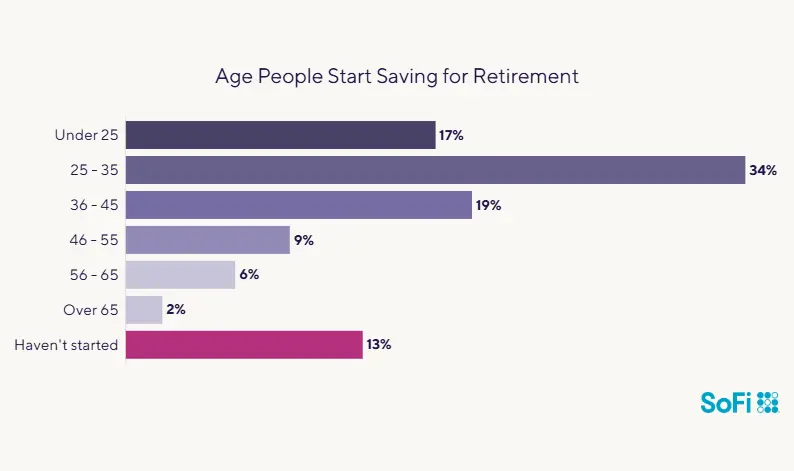
Age-People-Start-Saving-for-Retirement
Source: SoFi 2024 Retirement Survey

A Savings Shortfall

Still, Americans’ savings strategy has a way to go. More than half of Americans can’t cover an unexpected $1,000 expense, according to Bankrate’s 2025 emergency savings report. Only 41% say they could cover it.

And 37% of all Americans don’t have enough cash in savings to cover even a $400 emergency, the Federal Reserve found in its “Economic Well-Being of U.S. Households in 2024” report.

Get a 1% IRA match on rollovers and contributions.

Double down on your retirement goals with a 1% match on every dollar you roll over and contribute to a SoFi IRA.1


1Terms and conditions apply. Roll over a minimum of $20K to receive the 1% match offer. Matches on contributions are made up to the annual limits.

Average Savings by Age in the USA

The Federal Reserve’s latest (2022) Survey of Consumer Finances shows that the typical American household has an average savings balance of $62,410.

But average savings varies greatly by age and number of people in a household. Here’s what savings by age looks like.

Average Savings for Those 35 and Younger

Americans under the age of 35 had an average savings account balance of $20,540, according to the Fed’s survey.

This is a large age bracket that can range from those just graduating high school to recent college grads to young professionals well into a decade’s worth of work.

It’s wise to have three to six months of expenses in an emergency fund. At the very least, aiming to have $1,000 handy in a savings account for unexpected expenses is recommended.

Use our emergency fund calculator to see how much you should ideally have stashed away.

For those who have started their careers, employer-sponsored retirement funds such as a 401(k) plan can be good options to start saving for long-term retirement goals.

It makes sense to contribute at least enough to get matching funds from an employer, if that’s an option with your company’s plan. For reference, the average 401(k) savings for those ages 25 to 34 is $42,640, according to Vanguard’s “How America Saves 2025” report.

Recommended: Why You Should Start Retirement Planning in Your 20s

Average Savings by Age: 35 to 44

Americans ages 35 to 44 had an average savings account balance of $41,540, according to the Federal Reserve survey. Those in this age bracket are now well into adulthood. At this stage of life, it’s prudent to have that three-to six-months’ worth of savings in an emergency fund, to cover the cost of everything from an accident to a lost job.

This may also be the time to think about diversifying a financial portfolio and possibly investing in the stock or bond market.

And, of course, keep contributing to your 401(k). For reference, the average 401(k) savings for those ages 35 to 44 is $103,552, according to the Vanguard report.

Average Savings by Age: 45 to 54

People ages 45 to 54 had an average savings account balance of $71,130, according to the Fed’s survey.

At this point, general financial advice dictates that a 50-year-old should have at least six times their annual salary if their intention is to retire at 67.

Those in this age group have an average 401(k) savings of $188,643.

Average Savings by Age: 55 to 64

The Fed survey found that Americans ages 55 to 64 had an average savings account balance of $72,520.

Since this is the time when most Americans are staring down retirement in a few years, it’s generally a good idea to boost retirement savings into high gear.

That’s because while younger people in 2025 are capped at contributing $23,500 a year to a 401(k) account, those age 50 and up are allowed to contribute an additional $7,500.This is known as a catch-up contribution. Also for 2026, those under age 50 can contribute up to $24,500, and those 50 and up can contribute an additional $8,000. And those aged 60 to 63 may again contribute an additional $11,250 instead of $8,000.

The average retirement savings account for a person aged 55 to 64 is $271,230. It’s important to note that taking a withdrawal from such a plan before the age of 59 ½ could mean paying taxes and penalties.

Average Savings by Age: 65 and Older

This is when savings really peaks for the average American. The latest Federal Reserve Survey of Consumer Finances found that Americans ages 65 to 74 had an average savings account balance of $100,250.

However, that savings number does drop over time. According to the survey, Americans ages 75 and up had an average savings account balance of $82,800.

This underscores the importance of creating a retirement budget and sticking to it in order to have enough savings for as long as needed.

But before retirement, try to hit the average retirement savings amount for those ages 65 and up, which is $299,442.

This chart offers an at-a-glance comparison of the average American savings by age.

Age

Average savings

Under 35 $20,540
35-44 $41,540
45-54 $71,130
55-64 $72,520
65+ $100,250

Median Savings by Age

Median savings is different from average savings. The median is the number in the middle of all the other numbers, meaning half the numbers are higher and half are lower. So with median savings, half the people in an age category will have saved more and half will have saved less.

These are the median savings by age, according to the latest Federal Reserve Survey of Consumer Finances:

•   Under 35: $5,400

•   35-44: $7,500

•   45-54: $8,700

•   55-64: $8,000

•   65-74: $13,400

Savings vs Retirement Savings

What Americans have saved for emergencies, expenses, and other near-future goals is different from what they have in their retirement savings accounts, as you can see from all the information above. It’s critical to have both types of savings at the same time.

And keep this in mind: As you get older, and closer to retirement, it’s important that your retirement savings grow even more. It’s a good idea to contribute the maximum amount allowed to your retirement accounts at this time, if you can. This is one of the ways to save for retirement.

Saving a Little Bit More

Reaching specific savings goals doesn’t have to be complicated. It just means doing a bit of homework, strategizing, and staying diligent about personal finances.

The first step in saving more is to analyze current expenses to see what can be cut back on or cut out altogether to make more room for saving. This means creating a personal budget and tracking current spending.

To track spending, a person could create an excel spreadsheet and list all expenditures by categories like groceries, phone bill, car expenses, housing, medical, entertainment and others over the course of a month, filling it in with every single dollar spent to see where the money is going. Or you can use an online tracker like SoFi’s tracker, which allows users to connect all their accounts to one dashboard and track spending habits in real time.

After the month is up, the next step is to look back on the expenditures list. Was there anything that surprised you? Do you need all those streaming subscriptions? How about that gym membership — did it actually get used? This is the time to get a little ruthless.

After figuring out what’s left, try implementing a general budget outline like the 50/30/20 rule. This means that approximately 50% of your after-tax income goes toward essential expenses like food and rent, while 30% goes toward discretionary expenses like nights out at the movies or concerts. The last 20% belongs to savings and retirement account goals.

Next, it’s time to get creative about saving even more for the future. This can be done by putting more cash into a high-yield savings account via direct deposit right from a paycheck.

Those looking to save a few more bucks every month could also do so by getting rid of unnecessary expenses. But, instead of pocketing that cash, consider using mobile banking to direct that cash right to savings.

Still feeling the pinch and don’t really have room to save more from a budget? Working part-time for, say, a ride-sharing company could allow you to set your own hours and earn extra income based on how much time you can dedicate to it. Other options might include freelance work in photography, writing, or other creative arts.

The Takeaway

Saving for goals in the near term — such as a house or a car — along with putting away money for an emergency savings fund to cover unexpected expenses, is important at every age. And so is investing in your future, including for retirement. The earlier you start saving for all your goals, the better.

Interested in opening an online bank account? When you sign up for a SoFi Checking and Savings account with direct deposit, you’ll get a competitive annual percentage yield (APY), pay zero account fees, and enjoy an array of rewards, such as access to the Allpoint Network of 55,000+ fee-free ATMs globally. Qualifying accounts can even access their paycheck up to two days early.


Better banking is here with SoFi, NerdWallet’s 2024 winner for Best Checking Account Overall.* Enjoy up to 3.60% APY on SoFi Checking and Savings.

FAQ

How much should a 30 year old have in savings?

By age 30, you should have the equivalent of your annual salary saved. So if you make $60,000 a year, you should have $60,000 in savings.

How much money does an average person have in savings?

The average American has a savings balance of $62,410, according to the 2022 Federal Reserve Survey of Consumer Finances, which is the latest data available.

How many Americans have $100,000 in savings?

According to one 2023 survey, only 14% of Americans have at least $100,000 in savings.


SoFi Checking and Savings is offered through SoFi Bank, N.A. Member FDIC. The SoFi® Bank Debit Mastercard® is issued by SoFi Bank, N.A., pursuant to license by Mastercard International Incorporated and can be used everywhere Mastercard is accepted. Mastercard is a registered trademark, and the circles design is a trademark of Mastercard International Incorporated.

Annual percentage yield (APY) is variable and subject to change at any time. Rates are current as of 11/12/25. There is no minimum balance requirement. Fees may reduce earnings. Additional rates and information can be found at https://www.sofi.com/legal/banking-rate-sheet

Eligible Direct Deposit means a recurring deposit of regular income to an account holder’s SoFi Checking or Savings account, including payroll, pension, or government benefit payments (e.g., Social Security), made by the account holder’s employer, payroll or benefits provider or government agency (“Eligible Direct Deposit”) via the Automated Clearing House (“ACH”) Network every 31 calendar days.

Although we do our best to recognize all Eligible Direct Deposits, a small number of employers, payroll providers, benefits providers, or government agencies do not designate payments as direct deposit. To ensure you're earning the APY for account holders with Eligible Direct Deposit, we encourage you to check your APY Details page the day after your Eligible Direct Deposit posts to your SoFi account. If your APY is not showing as the APY for account holders with Eligible Direct Deposit, contact us at 855-456-7634 with the details of your Eligible Direct Deposit. As long as SoFi Bank can validate those details, you will start earning the APY for account holders with Eligible Direct Deposit from the date you contact SoFi for the next 31 calendar days. You will also be eligible for the APY for account holders with Eligible Direct Deposit on future Eligible Direct Deposits, as long as SoFi Bank can validate them.

Deposits that are not from an employer, payroll, or benefits provider or government agency, including but not limited to check deposits, peer-to-peer transfers (e.g., transfers from PayPal, Venmo, Wise, etc.), merchant transactions (e.g., transactions from PayPal, Stripe, Square, etc.), and bank ACH funds transfers and wire transfers from external accounts, or are non-recurring in nature (e.g., IRS tax refunds), do not constitute Eligible Direct Deposit activity. There is no minimum Eligible Direct Deposit amount required to qualify for the stated interest rate. SoFi Bank shall, in its sole discretion, assess each account holder's Eligible Direct Deposit activity to determine the applicability of rates and may request additional documentation for verification of eligibility.

See additional details at https://www.sofi.com/legal/banking-rate-sheet.

We do not charge any account, service or maintenance fees for SoFi Checking and Savings. We do charge a transaction fee to process each outgoing wire transfer. SoFi does not charge a fee for incoming wire transfers, however the sending bank may charge a fee. Our fee policy is subject to change at any time. See the SoFi Bank Fee Sheet for details at sofi.com/legal/banking-fees/.
*Awards or rankings from NerdWallet are not indicative of future success or results. This award and its ratings are independently determined and awarded by their respective publications.

Financial Tips & Strategies: The tips provided on this website are of a general nature and do not take into account your specific objectives, financial situation, and needs. You should always consider their appropriateness given your own circumstances.

Third-Party Brand Mentions: No brands, products, or companies mentioned are affiliated with SoFi, nor do they endorse or sponsor this article. Third-party trademarks referenced herein are property of their respective owners.

Disclaimer: The projections or other information regarding the likelihood of various investment outcomes are hypothetical in nature, do not reflect actual investment results, and are not guarantees of future results.

Investment Risk: Diversification can help reduce some investment risk. It cannot guarantee profit, or fully protect in a down market.

Third Party Trademarks: Certified Financial Planner Board of Standards Center for Financial Planning, Inc. owns and licenses the certification marks CFP®, CERTIFIED FINANCIAL PLANNER®

External Websites: The information and analysis provided through hyperlinks to third-party websites, while believed to be accurate, cannot be guaranteed by SoFi. Links are provided for informational purposes and should not be viewed as an endorsement.

SOBNK-Q325-095
CN-Q425-3236452-35

Read more
dollar sign made of trees

Capital Gains Tax Rates and Rules for 2025 and 2026

What Is Capital Gains Tax?

Capital gains are the profits investors may see from selling investments and other assets, like stocks, bonds, properties, vehicles, and so on. Capital gains tax doesn’t apply when you own these assets — it only applies when you profit from selling them, and the gain has to be reported to the IRS.

Short-term capital gains (from assets you’ve held for a year or less) are taxed at a higher marginal income tax rate. Long-term capital gains, which apply to assets you’ve held for more than a year, are taxed at the lower capital gains rate.

Other factors can affect an investor’s tax rate on gains, including: which asset you’re selling, your annual income, as well as your filing status. Capital gains tax rates typically change every year. Here, we’ll cover 2025 capital gains tax rates (for returns filed in 2026), and 2026 rates (for returns filed in 2027). Investment gains may also be subject to state and local taxes, as well.

▶️
Video: What Are Unrealized Gains?
Learn the basics in under 2 minutes.
Watch Now

Key Points

•   Capital gains tax is levied on the profit (capital gains) you make from selling investments or assets like stocks and properties.

•   Gains are classified as either short-term (from assets held for one year or less) or long-term (from assets held for more than a year).

•   Short-term gains are taxed at a higher marginal income tax rate compared to the lower long-term capital gains rate.

•   Investments held within tax-advantaged retirement accounts, such as an IRA or 401(k), are generally not subject to capital gains tax as the money grows, though withdrawals may be subject to income tax.

•   Holding an investment for more than a year to qualify for the long-term rate, and utilizing strategies like tax-loss harvesting (selling investments at a loss to offset capital gains) can help lower your overall capital gains tax liability.

Capital Gains Tax Rates Today

Capital gains and losses result from selling assets. Capital gains occur when the asset is sold for more than its purchase price. A capital loss is when an investor sells an asset for less than its original value.

How long you hold an investment before selling it can make a big difference in how much you pay in taxes.

When you profit from an asset after owning it for a year or less, it’s considered a short-term capital gain. If you profit from it after owning it for at least a year, it’s a long-term capital gain.

Capital gains tax applies to investments that are sold when you’re investing online or through a traditional taxable brokerage; again, appreciated assets are not taxed until they’re sold. Gains may also be subject to state and local tax.

With a tax-deferred retirement account, such as an IRA or 401(k), you don’t pay any capital gains; you do owe income tax on withdrawals, however.

Other Capital Gains Tax Rules

Certain investments are subject to capital gains even if you don’t sell those securities. For example, a dividend-paying stock can produce a taxable gain because dividends are a type of income.

Taxes on qualified dividends are paid at long-term capital gains rates. Taxes on ordinary dividends are taxed at the marginal income tax rate, the same as short-term gains. Because the long-term capital gains tax rate is lower than the marginal income tax rate, qualified dividends are generally preferred vs. ordinary dividends.

Again, if divided-paying investments are held in a tax-advantaged account, those dividends are also tax deferred.

Capital Gains Tax Rates for Tax Year 2025

Long-term capital gains taxes for an individual are simpler and lower than for married couples. These rates apply to gains from an asset sold after one year, and fall into three brackets: 0%, 15%, and 20%.

Long-Term Capital Gains Rates, 2025

The following table shows the long-term capital-gains tax rates, by income bracket and filing status, for the 2025 tax year, according to the IRS.

Capital Gains Tax Rate Single Married, Filing Jointly Married, Filing Separately Head of Household
0% Up to $48,350 Up to $96,700 Up to $48,350 Up to $64,750
15% $48,351 to $533,400 $96,701 to $600,050 $48,351 to $300,000 $64,751 – $566,700
20% Over $533,401 Over $600,051 Over $300,001 Over $566,701

Long-Term Capital Gains Tax Rates, 2026

The following table shows the long-term capital gains tax rates for the 2026 tax year by income and filing status, according to the IRS.

Capital Gains Tax Rate Single Married, Filing Jointly Married, Filing Separately Head of Household
0% Up to $49,450 Up to $98,900 Up to $49,450 Up to $66,200
15% $49,451 to $545,500 $98,901 to $613,700 $49,451 to $306,850 $66,201 to $579,600
20% Over $545,500 Over $613,700 Over $306,850 Over $579,600

Recommended: Stock Market Basics

Short-Term Capital Gains Tax Rates for Tax Year 2025

The short-term capital gains are taxed as regular income at the “marginal rate,” so the rates are based on the federal income tax bracket you’re in.

The Internal Revenue Service (IRS) changes these numbers every year to adjust for inflation. You may learn your tax bracket by going to the IRS website, or asking your accountant.

2025 Short-Term Capital Gains Tax Rates

Here’s a table that shows the federal income tax brackets for the 2025 tax year, which are used for short-term gains, for tax returns that are usually filed in 2026, according to the IRS.

Marginal Rate Single filers Married, filing jointly Head of household Married, filing separately
10% $0 to $11,925 $0 to $23,850 Up to $17,000 $0 to $11,925
12% $11,926 to $48,475 $23,851 to $96,950 $17,001 to $64,850 $11,926 to $48,475
22% $48,476 to $103,350 $96,951 to $206,700 $64,851 to $103,350 $48,476 to $103,350
24% $103,351 to $197,300 $206,701 to $394,600 $103,351 to $197,300 $103,351 to $197,300
32% $197,301 to $250,525 $394,601 to $501,050 $197,301 to $250,500 $197,301 to $250,525
35% $250,526 to $626,350 $501,051 to $751,600 $250,501 to $626,350 $250,526 to $375,800
37% Over $626,350 Over $751,600 Over $626,350 Over $375,800

Short-Term Capital Gains Tax Rates for Tax Year 2026

This table shows the federal marginal income tax rates for tax year 2026, which apply to short-term capital gains (for tax returns that are usually filed in 2027).

Marginal Rate Single filers Income Married, filing jointly Head of household Married, filing separately
10% $0 to $12,400 $0 to $24,800 $0 to $17,700 $0 to $12,400
12% $12,401 to $50,400 $24,801 to $100,800 $17,701 to $67,450 $12,401 to $50,400
22% $50,401 to $105,700 $100,801 to $211,400 $67,451 to $105,700 $50,401 to $105,700
24% $105,701 to $201,775 $211,401 to $403,550 $105,701 to $201,750 $105,701 to $201,775
32% $201,776 to $256,225 $403,551 to $512,450 $201,751 to $256,200 $201,776 to $256,225
35% $256,226 to $640,600 $512,451 to $768,700 $256,201 to $640,600 $256,226 to $384,350
37% Over $640,600 Over $768,700 Over $640,600 Over $384,350

Tips for Lowering Capital Gains Taxes

Hanging onto an investment for more than a year can lower your capital gains taxes significantly.

Capital gains taxes also don’t apply to tax-advantaged accounts like 401(k) plans, 529 college savings accounts, or when you open an IRA. So selling investments within these accounts won’t generate capital gains taxes.

Instead, traditional 401(k)s and IRAs are taxed when you take distributions, while qualified distributions for Roth IRAs and 529 plans are tax-free.

Single homeowners also get a tax exclusion on the first $250,000 in profit they make from the sale of their primary residence, which they need to have lived in for at least two of the past five years. The limit is $500,000 for a married couple filing jointly.

Tax-Loss Harvesting

Tax-loss harvesting is another way to potentially save money on capital gains. Tax-loss harvesting is the strategy of selling some investments at a loss to offset the tax on profits from another investment.

Using short-term losses to offset short-term gains is a way to take advantage of tax-loss harvesting — because, as discussed above, short-term gains are taxed at higher rates. IRS rules also dictate that short-term or long-term losses must be used to offset gains of the same type, unless the losses exceed the gains from the same type.

Investors can also apply losses from investments of as much as $3,000 to offset ordinary income. And because tax losses don’t expire, if only a portion of losses was used to offset income in one year, the investor can “save” those losses to offset taxes in another year. This is known as a tax-loss carryforward.

Understanding the Wash-Sale Rule

While it may be useful in some cases to sell securities in order to harvest losses, it’s important to know about something called the wash-sale rule.

Per the IRS, the wash-sale rule states that if an investor sells an investment for a loss, then buys the same or a “substantially identical” asset within 30 days before or after the sale, they cannot use the original loss to offset capital gains or ordinary income and claim the tax benefit.

The wash-sale rule sounds straightforward, but the details are complicated. If you plan to sell securities at a loss in order to claim the tax benefit, you may want to consult a professional.

Recommended: Is Automated Tax-Loss Harvesting a Good Idea?

How US Capital Gains Taxes Compare

Generally, capital gains tax rates affect the wealthiest taxpayers, who typically make a bigger chunk of their income from profitable investments.

Here’s a closer look at how capital gains taxes compare with other taxes, including those in other countries.

Compared to Other Taxes

The highest long-term capital gains taxes rate of 20% is lower than the highest marginal rate of 37%.

Proponents of the lower long-term capital gains tax rate say the discrepancy exists to encourage investments.

Comparison to Capital Gains Taxes in Other Countries

In 2025, the Tax Foundation listed the capital gains taxes of the 35 different European Organization for Economic Cooperation and Development (OECD) countries. The U.S. maximum rate of 20% is roughly midway on the spectrum of comparable capital gains taxes.

In comparison, Denmark had the highest top capital gains tax at a rate of 42%. Norway was second-highest at 37.8%. The Netherlands were third on the list, at 36%. In addition, the following European countries all levied higher capital gains taxes than the U.S. (listed in order from the highest to lowest rate): Finland, France, Ireland, Sweden, Spain, Latvia, Austria, Germany, Italy, Czech Republic, and Iceland.

Comparing Historical Capital Gains Tax Rates

Because short-term capital gains tax rates are the same as those for wages and salaries, they adjust when ordinary income tax rates change. As for long-term capital gains tax, Americans today are paying rates that are relatively low historically. Today’s maximum long-term capital gains tax rate of 20% started in 2013.

For comparison, the high point for long-term capital gains tax was in the 1970s, when the maximum rate was at 35%.

Going back in time, in the 1920s the maximum rate was around 12%. From the early 1940s to the late 1960s, the rate was around 25%. Maximum rates were also pretty high, at around 28%, in the late 1980s and 1990s. Then, between 2004 and 2012, they dropped to 15%.

The Takeaway

Capital gains taxes are the levies you pay from making money on investments. The IRS updates the tax rates every year to adjust for inflation.

It’s important for investors to know that capital gains tax rates can differ significantly based on whether they’ve held an investment for a year or less (for short-term gains), or more than a year (for long-term gains). An investor’s income level also determines how much they pay in capital gains taxes.

An accountant or financial advisor can suggest ways to lower your capital gains taxes as well as help you set financial goals.

Ready to invest in your goals? It’s easy to get started when you open an investment account with SoFi Invest. You can invest in stocks, exchange-traded funds (ETFs), mutual funds, alternative funds, and more. SoFi doesn’t charge commissions, but other fees apply (full fee disclosure here).


Invest with as little as $5 with a SoFi Active Investing account.

FAQ

Why is capital gains tax important?

When investors decide how long to hold investments, it’s a complex decision. Given that long-term capital gains rates are more favorable, some investors may want to hold onto their profitable investments for at least a year to get the lower rate.

Can you pay zero capital gains tax?

If you meet certain income criteria, yes. The lowest capital gains rate of 0% applies if your taxable income for tax year 2025 is equal to or less than $94,050 (married filing jointly); $47,025 (single, married filing separately, qualifying surviving spouse); and $63,000 for head of household. For tax year 2026, the 0% rate applies if your taxable income is equal to or less than $98,900 (married, filing jointly); $49,450 (single, married filing separately, qualifying surviving spouse); $66,200 (head of household).

Can capital losses reduce personal income tax?

In some cases yes: If your capital losses for a given year exceed your capital gains, you can deduct up to $3,000 in losses from your ordinary income (married, filing jointly; $1,500 if you’re married, filing separately). Losses can be applied to future capital gains or to income, in what’s known as a tax-loss carryforward.


INVESTMENTS ARE NOT FDIC INSURED • ARE NOT BANK GUARANTEED • MAY LOSE VALUE

SoFi Invest is a trade name used by SoFi Wealth LLC and SoFi Securities LLC offering investment products and services. Robo investing and advisory services are provided by SoFi Wealth LLC, an SEC-registered investment adviser. Brokerage and self-directed investing products offered through SoFi Securities LLC, Member FINRA/SIPC.

For disclosures on SoFi Invest platforms visit SoFi.com/legal. For a full listing of the fees associated with Sofi Invest please view our fee schedule.

Tax Information: This article provides general background information only and is not intended to serve as legal or tax advice or as a substitute for legal counsel. You should consult your own attorney and/or tax advisor if you have a question requiring legal or tax advice.

Third Party Trademarks: Certified Financial Planner Board of Standards Center for Financial Planning, Inc. owns and licenses the certification marks CFP®, CERTIFIED FINANCIAL PLANNER®

Financial Tips & Strategies: The tips provided on this website are of a general nature and do not take into account your specific objectives, financial situation, and needs. You should always consider their appropriateness given your own circumstances.

This article is not intended to be legal advice. Please consult an attorney for advice.

SOIN-Q425-056

Read more
A model of a one-room blue house is shown against a red background.

How to Get Tiny House Financing

Many Americans are finding tiny houses, or those that measure several hundred square feet in size, are a great way to live. They can be both economical and eco-friendly, and some people say they simplify life, which can bring many benefits.

If you’re curious about tiny houses or are currently contemplating one, it’s important to know that financing these dwellings may be different than securing a traditional mortgage. Here’s a guide to tiny houses and how to secure funds to buy or build one.

Key Points

•   Tiny homes, typically 100-400 square feet, cost around $82,500.

•   Traditional mortgages are often not available due to the non-traditional nature and lack of foundation.

•   Alternative financing includes home equity loans, HELOCs, personal loans, RV loans, and chattel mortgages.

•   Consider land costs, utility connections, and property taxes when financing.

•   Higher resale risk can lead to less favorable loan terms, impacting financing options.

What Is a Tiny House?

A tiny house is often defined as a home that is between 100 and 400 square feet. In contrast, the median size of a single-family American home is currently 1,834 square feet as of October 2025, according to the Federal Reserve Bank of St. Louis data. That’s almost five times bigger than the biggest tiny home. Here are some other facts to know about this kind of dwelling.

•   Owners live in their tiny homes themselves, rent them out, use them as a small vacation home or even build them as an accessory dwelling unit (ADU) on the same lot as their primary residence. Tiny homes may be on wheels, or they may sit on a fixed foundation.

•   Prefab homes can be delivered complete to the site, or there are modular homes that require some assembly on site. Those who would rather build their own house can hire an architect or draw up plans to their own specifications. There are small homes in all kinds of styles, from a classic Colonial or Victorian to a ranch style or A-frame or ultra-modern design.

•   Local zoning rules will determine whether or not a person can build or move into a tiny home. And building codes will determine things like ceiling height.

•   Tiny houses may not have good resale value since they are such a specific type of home and are often highly customized. Before buying a tiny house as an investment property, it might be wise to consult a real estate investment professional.

Tiny House Pricing

In 2025, the average sales price for a single-family home was about $534,100, according to U.S. Census Bureau data. Tiny homes cost quite a bit less, with an average of $82,500. That price can vary up and down depending on the size of the home, materials used, and amenities (yes, some tiny homes have luxe, spa-style bathrooms, for example). The price of the building is not the only thing to consider.

Buyers of tiny homes must factor in the price of buying or leasing land on which to place the home if they don’t already own it, as well as the cost of hooking it up to utilities.

If the tiny home is on a foundation, there may be state and local property taxes to pay. If the tiny house is on wheels, though, there likely won’t be property tax assessed.

Recommended: Is Buying a House a Good Investment?

Financing the Land

If property needs to be purchased to have a place to put a tiny home, an option for financing is a land loan. There are three types of land loans: raw land loans, unimproved land loans, and improved loans.

•   Raw land loans are for land that’s completely undeveloped with no electricity, roads, or sewer access.

•   Unimproved land loans are for properties that have more access to amenities like utilities, but lack utility meters.

•   Improved land loans are for land with access to roads, water, and electricity.

The size of the down payment and the interest rate of the loan will depend on what type of loan is needed. For example, lenders may consider raw land to be a riskier option than improved land and require a bigger down payment and higher interest rates.

Mortgages for Tiny Homes

Qualifying for a home loan for a tiny home may be tricky. Some lenders may not be willing to offer first or second mortgages for tiny home financing. However, if a tiny home has a foundation and complies with local building codes, it may qualify for certain mortgages.

Tiny homes may also qualify for what is known as a “chattel mortgage,” a mortgage for moveable personal property. The tiny home acts as security for the loan, and the lender effectively becomes the owner of the tiny home until the loan is paid off and ownership is transferred back to the borrower.

This differs from traditional mortgages that are secured by a lien on the property. Because the size of the loans are typically small, chattel mortgages may have relatively short terms, though interest rates may be relatively high.

Personal Loans

A personal loan can allow individuals access to money that they can use for any personal, family, or household purpose, from paying off credit cards to an effective tiny house loan. Depending on the lender, loan amounts can range from a few thousand dollars to $100,000. When the applicant is approved for a personal loan, they’ll receive the loan amount in a lump sum and pay it back in installments with interest.

Personal loans may be secured or unsecured. Unsecured loans are not backed with any collateral, and the interest rates currently range from about 6% to 36%, depending largely on the borrower’s credit score.

Secured loans are backed by collateral, such as personal savings, a car, or another home owned by the same borrower. They typically come with a lower interest rate than their unsecured counterparts. However, it’s important to note that if a personal loan is defaulted on, the borrower’s assets could be seized by the lender to repay the debt.

Home Equity Loans

The equity someone may have built up in a home they already own can be tapped to finance a tiny home for use as a vacation home, rental property, or ADU. A home equity loan is a fixed amount of money secured by a borrower’s home.

Usually, up to 85% of the equity accumulated in a home can be borrowed, though actual loan amounts will also depend on the applicant’s income and credit history. The home equity loan is repaid with monthly payments over a fixed term. And if the borrower fails to repay, the lender can foreclose on the house.

A home equity line of credit (HELOC) may be another option to finance a tiny home. HELOCs differ from home equity loans in that the borrower doesn’t receive a single lump-sum payment from the lender.

Rather, a HELOC gives the borrower access to a line of credit that can be drawn down, paid back, and drawn down again, if need be, within a certain time period. The HELOC is secured by the borrower’s home, so as with a home equity loan if the debt is not paid, the lender can use the home as collateral.

Loans From Tiny House Builders

A tiny house builder or contractor may be able to help secure financing through unsecured loans based on an applicant’s credit score, or secured loans backed by the value of the tiny home. These tiny-house loans may have longer terms and lower starting interest rates than personal loans, but they may require a downpayment.

RV Loans

If the tiny house has wheels and is certified as an RV by the Recreational Vehicle Industry Association, an RV loan may be another option for financing. Online lenders, banks, and credit unions may all offer RV loans. In many cases, the tiny house will serve as collateral for the loan, the same way a car would serve as collateral in an automobile loan.

Recommended: Guide to Buying, Selling, and Updating Your Home

The Takeaway

If you’re in the market for a tiny house, you may need to think beyond traditional mortgages. Home equity, HELOC, and personal loans, among other options, may be available forms of financing that can set you on your way to owning the tiny house of your dreams.

Think twice before turning to high-interest credit cards. Consider a SoFi personal loan instead. SoFi offers competitive fixed rates and same-day funding. See your rate in minutes.


SoFi’s Personal Loan was named NerdWallet’s 2024 winner for Best Personal Loan overall.

FAQ

How big is a tiny home?

Tiny homes are typically between 100 and 400 square feet.

How much does a tiny home cost?

Currently, the average cost of a tiny home is about $82,500, but there’s considerable variation depending on location, size, style, and other factors.

How to afford a tiny home?

There can be several ways to finance a tiny home, including possibly a mortgage loan, home equity loan, HELOC, builder loan, RV loan, or personal loan.


SoFi Loan Products
SoFi loans are originated by SoFi Bank, N.A., NMLS #696891 (Member FDIC). For additional product-specific legal and licensing information, see SoFi.com/legal. Equal Housing Lender.


*Awards or rankings from NerdWallet are not indicative of future success or results. This award and its ratings are independently determined and awarded by their respective publications.

SoFi Mortgages
Terms, conditions, and state restrictions apply. Not all products are available in all states. See SoFi.com/eligibility-criteria for more information.


²SoFi Bank, N.A. NMLS #696891 (Member FDIC), offers loans directly or we may assist you in obtaining a loan from SpringEQ, a state licensed lender, NMLS #1464945.
All loan terms, fees, and rates may vary based upon your individual financial and personal circumstances and state.
You should consider and discuss with your loan officer whether a Cash Out Refinance, Home Equity Loan or a Home Equity Line of Credit is appropriate. Please note that the SoFi member discount does not apply to Home Equity Loans or Lines of Credit not originated by SoFi Bank. Terms and conditions will apply. Before you apply, please note that not all products are offered in all states, and all loans are subject to eligibility restrictions and limitations, including requirements related to loan applicant’s credit, income, property, and a minimum loan amount. Lowest rates are reserved for the most creditworthy borrowers. Products, rates, benefits, terms, and conditions are subject to change without notice. Learn more at SoFi.com/eligibility-criteria. Information current as of 06/27/24.
In the event SoFi serves as broker to Spring EQ for your loan, SoFi will be paid a fee.


Disclaimer: Many factors affect your credit scores and the interest rates you may receive. SoFi is not a Credit Repair Organization as defined under federal or state law, including the Credit Repair Organizations Act. SoFi does not provide “credit repair” services or advice or assistance regarding “rebuilding” or “improving” your credit record, credit history, or credit rating. For details, see the FTC’s website .

Financial Tips & Strategies: The tips provided on this website are of a general nature and do not take into account your specific objectives, financial situation, and needs. You should always consider their appropriateness given your own circumstances.

SOPL-Q425-029

Read more
A real estate agent shows a man and a woman a room that has a sliding door leading to a small backyard. The woman looks around, smiling.

Zero- and Low-Down-Payment Mortgage Options

The housing market is rising in some areas of America and falling in others. If you find yourself in a hot seller’s market, it can be challenging to buy a house, but doing so, even with a low down payment, is possible.

Lenders are willing to approve mortgages with lower down payment requirements if you qualify and are comfortable with paying mortgage insurance.

Read on for advice on navigating the real estate market if you have a small down payment but a fair amount of competition from other prospective buyers.

Key Points

•   Low-down-payment mortgages, including 0% down options, are available for qualified buyers.

•   While 20% is a common down payment goal, the average down payment for first-time homebuyers averages 10%.

•   Buying with a small down payment is challenging in a seller’s market due to longer closing times, seller preference for higher down payments, and competition from all-cash offers.

•   Popular low-down-payment options include FHA loans, Fannie Mae HomeReady, and Conventional 97.

•   Zero-down mortgages offer the benefit of buying a home sooner and preserving cash, but they may result in higher monthly payments, additional fees, and greater risk of owing more than the home is worth (being “underwater”).

First-time homebuyers can
prequalify for a SoFi mortgage loan,
with as little as 3% down.

Questions? Call (888)-541-0398.

What Is Considered a Low Down Payment?

While many people believe you need at least a 20% down payment to buy a house, the average down payment by a first time homebuyer at the end of 2025 was 10%. And low-down-payment mortgage loans — even home loans with zero down payment — do exist.

Given the wide range above, what’s actually considered a low down payment? Popular mortgage programs out there may require as little as 3% down, and a couple of more specific home loan programs allow 0% down.

The reason why that 20% down payment figure keeps popping up is that any amount less than that will likely entail some form of mortgage insurance, an ongoing fee charged by most lenders.

💡 Quick Tip: You deserve a more zen mortgage. Look for a mortgage lender who’s dedicated to closing your loan on time.

Challenges of Buying in a Seller’s Market With a Small Down Payment

If you’re wondering how to buy a house with a low down payment, it’s important to acknowledge a painful truth in today’s housing market: There’s truth to the saying “cash is king,” and that continues to be evident in a seller’s market, where real estate investors who pay all cash frequently outbid prospective first-time homebuyers. All-cash sales have risen to a historic high of 26% in 2025, according to the National Association of Realtors. Be ready for these potential challenges if you intend to buy a house with a small down payment.

Longer Closing Time

Closing on a home with a mortgage-contingent offer to buy takes longer than closing with a cash offer. There’s often more paperwork, and underwriters will require time to ensure that your financials are in order before green-lighting your mortgage.

Lenders May Disagree With Mortgage Minimums

Just because a mortgage loan program allows for low-down-payment mortgage loans for qualified buyers doesn’t mean a lender will accept a down payment of 3%. Lenders have wide latitude to dictate their own terms, and it’s fairly common for them to set their own minimum down payment requirement somewhere above what the stated minimum for the program is.

Home Sellers May Be Nervous About Your Ability to Close

While it’s true that all funds from your down payment and mortgage transfer to the seller at closing, many sellers still buy into the old “bird in hand” adage when it comes to accepting offers. A higher down payment signals a buyer’s financial capacity and is, therefore, more attractive in the eyes of the homeowner.

If sellers accept a bid with a low down payment, they may run an increased risk of the buyer being rejected at the last minute by the mortgage lender.

In a deal involving a mortgage backed by the Federal Housing Administration (FHA), if the home is appraised for less than the agreed-upon price, the sellers must match the appraised price or the deal will fall through. FHA guidelines require home appraisers to look for certain defects. If any are found, the sellers may have to repair them before the sale.

Struggles With Competitive Offers and Bidding Wars

When your down payment is limited, you may find it difficult to compete in a bidding war. To help your case, if you are obtaining a conventional loan, seek out mortgage preapproval before beginning your home search in earnest. And consider writing a “love note” to the seller in your offer letter. Compliment something you especially like about the house and try to find some common ground with the seller that will appeal to their emotions. Thank the seller for considering your offer.

Recommended: Private Mortgage Insurance (PMI) vs. Mortgage Insurance Premium (MIP)

Types of Low-Down-Payment Mortgages

If you’re trying to score a home with a small down payment, there are some ways you can approach it to increase your odds. Some of the most popular low-down-payment mortgage programs are:

FHA Loans

FHA loans backed by the Federal Housing Administration, allow for a down payment as low as 3% to 5%. The government guarantee makes these loans more palatable for mortgage lenders and easier for a homebuyer to afford.

Fannie Mae HomeReady

Buyers who are within 80% of area median income for the census tract where a home is located can put down just 3% with this program. You don’t need to be a first-time buyer to take advantage of this program, however if all buyers are first-timers, you may be required to take a homebuyer education class.

Conventional 97 Loan

This loan allows first-time homebuyers of any income level to put only 3% down and finance the other 97% of their purchase with a fixed-rate mortgage with a term of up to 30 years. A credit score of 620 is required, although it will take a score of 680 to take full advantage of the features of this loan. At least one buyer must be a first-timer, and if all buyers are first-time homebuyers, a homeowner education course is usually required.

Conventional Mortgage

If you don’t qualify as a first-time homebuyer you can still obtain a low-down-payment home loan with a down payment as low as 5%. Conventional mortgage loans can be either fixed or adjustable rate, and you could take anywhere from 10 to 30 years to repay what you owe, depending on the mortgage term you choose. You’ll need a credit score of 620, and the higher your score, the better the interest rate you will likely be offered. If you put down less than 20%, you’ll need to pay for private mortgage insurance (PMI) with your monthly payment until you have 20% equity in your home.

Recommended: Home Affordability Calculator

Types of No-Down-Payment Mortgages

It is also possible to buy a house with no money down at all. Here are two common no-down-payment mortgages you may want to explore:

VA Loan

A VA loan backed by the U.S. Department of Veterans Affairs, allows eligible active-duty military members, veterans, reserve members, National Guard members, and certain surviving spouses to purchase a home with a zero-down-payment mortgage. If you think you might be eligible for a VA loan, your first step is to obtain a Certificate of Eligibility from the VA. Then you’ll obtain the loan from a lender (most will require a 620 credit score or better). While there is no mortgage insurance required, there is usually a VA funding fee.

USDA Loan

USDA loans are for low- and moderate-income buyers living in rural areas. The fixed-rate loan allows for the purchase of a new home but also allows borrowers to wrap some renovation costs into a home purchase. The loan can be used for modular or manufactured housing. There is no down payment or minimum credit score required for this loan.

💡 Quick Tip: Not to be confused with prequalification, preapproval involves a longer application, documentation, and hard credit pulls. Ideally, you want to keep your applications for preapproval to within the same 14- to 45-day period, since many hard credit pulls outside the given time period can adversely affect your credit score, which in turn affects the mortgage terms you’ll be offered.

Pros and Cons of Zero-Down-Payment Mortgage Loans

There are both benefits and disadvantages to going into homeownership with no down payment. Here are a few points to think about.

thumb_up

Pros:

•   Gets you in a home faster than if you had waited to save up for a down payment.

•   Start building equity versus spending money on rent.

•   Preserve cash for other investments, opportunities, and emergencies.

•   If current mortgage rates are low, a zero-down-payment loan allows you to buy at a favorable rate.

thumb_down

Cons:

•   Some loans may require upfront and annual fees that are similar to mortgage insurance fees on other loans.

•   Your monthly mortgage payment will likely be larger than it would be if you had made a down payment on your home.

•   Some lenders may have higher mortgage rates for no-down-payment loans.

•   You run a greater risk of your home loan being underwater, should home values drop, because you begin ownership without equity.

Recommended: Home-Buying Process Checklist

How Down Payment Assistance Can Help

If you’re struggling to come up with a down payment and a zero-down-payment loan isn’t an option, you may be able to get help. Consider exploring both of these options:

Down Payment Assistance (DPA) Programs

Many governments and nonprofits offer down payment assistance programs for first-time homebuyers — those who have not owned a principal residence in the past three years. The funds may come in the form of a loan or a grant. Some lenders can even assist you in qualifying for these programs to help offset the upfront costs of homebuying.

Cash Gift for Down Payment

Finally, you can also ask a family member, or sometimes a domestic partner, close friend, or employer, to help with the down payment by contributing gift money. The money can’t come with any strings attached, and a gift letter will likely be required by the lender. This is a popular option for parents and in-laws who want to help their children buy a first home.

Low- or No-Down-Payment Considerations

Mortgage Insurance

Buyers who put down less than 20% on a home purchased with a conventional mortgage can expect to have to pay for private mortgage insurance until they reach 20% equity in their home. Those who finance their home with an FHA loan will need to pay an upfront and annual mortgage insurance premium for the life of the loan. Some other government-backed loans also have similar fees.

Higher Cost Overall

Home loans cost money, in the form of interest. And because more of the home’s price must be financed when you put down a low down payment (or none at all), the total cost of the home will be greater than if some or all of the home purchase was covered by cash.

Less Equity Initially

The larger the down payment on a home, the more equity the buyer has on move-in day. Of course, you will build equity with your monthly mortgage payments, but in a process called mortgage amortization, a greater proportion of your monthly payment goes toward interest in the early years of a home loan, with less going to pay down the principal. The balance shifts gradually over the years of your loan, but you build equity slowly at the outset of a home loan.

The Takeaway

Buying a home with a small down payment is possible, even in a seller’s market. With preparation and the right mortgage lender, you may be able to land a place to call your own even with a low down payment — or no down payment at all.

Looking for an affordable option for a home mortgage loan? SoFi can help: We offer low down payments (as little as 3% - 5%*) with our competitive and flexible home mortgage loans. Plus, applying is extra convenient: It's online, with access to one-on-one help.

SoFi Mortgages: simple, smart, and so affordable.

FAQ

What mortgage has the lowest down payment?

Homebuyers who qualify can get a VA mortgage (backed by the U.S. Department of Veterans Affairs) or a USDA loan (from the U.S. Department of Agriculture) with no down payment at all. For other loan types, the lowest down payment amount is 3%.

Are zero-down mortgages a good idea?

Zero-down-payment home loans can help you get settled into a home sooner, but there are a few things to consider: You will not have any equity in your home at the outset, and equity builds slowly in the earliest years of a home loan. Your zero-down-payment loan will also be larger than the loan you would have if you made a down payment, so over the long haul, you will pay more for the home. However, if buying with no down payment allows you to take advantage of low interest rates, it might be worthwhile.

Is it harder to get your offer accepted with a small down payment?

If a seller is considering similar offers, the buyer with the larger down payment might have an edge. Being preapproved for a home loan can give you an advantage, however. If you can’t make a large down payment, consider obtaining preapproval.

Can a low down payment affect your mortgage rate?

Lenders may perceive buyers with lower down payments to be a greater risk, so a low down payment can sometimes result in a higher interest rate.

Are there programs to help first-time buyers compete in a seller’s market?

There are both national and local programs to help first-time homebuyers, including first-time homebuyer loan programs and down payment assistance programs. While these programs are not designed specifically to help buyers in a seller’s market, they certainly can’t hurt.

Should I wait for a buyer’s market if I only have a small down payment?

Whether or not to wait for a buyer’s market will depend on how soon you wish to buy a home and which local market you’re searching in. If waiting will allow you to build money for a larger down payment or improve your credit score, it might be worthwhile. The same is true if you foresee any reason the market might cool in the future. But if you need to settle down now, consider exploring nearby housing markets that might be a little less heated. And line up your mortgage preapproval to position yourself for success.


Photo credit: iStock/sturti

SoFi Loan Products
SoFi loans are originated by SoFi Bank, N.A., NMLS #696891 (Member FDIC). For additional product-specific legal and licensing information, see SoFi.com/legal. Equal Housing Lender.

SoFi Mortgages
Terms, conditions, and state restrictions apply. Not all products are available in all states. See SoFi.com/eligibility-criteria for more information.


*SoFi requires Private Mortgage Insurance (PMI) for conforming home loans with a loan-to-value (LTV) ratio greater than 80%. As little as 3% down payments are for qualifying first-time homebuyers only. 5% minimum applies to other borrowers. Other loan types may require different fees or insurance (e.g., VA funding fee, FHA Mortgage Insurance Premiums, etc.). Loan requirements may vary depending on your down payment amount, and minimum down payment varies by loan type.
Financial Tips & Strategies: The tips provided on this website are of a general nature and do not take into account your specific objectives, financial situation, and needs. You should always consider their appropriateness given your own circumstances.
Tax Information: This article provides general background information only and is not intended to serve as legal or tax advice or as a substitute for legal counsel. You should consult your own attorney and/or tax advisor if you have a question requiring legal or tax advice.
¹FHA loans are subject to unique terms and conditions established by FHA and SoFi. Ask your SoFi loan officer for details about eligibility, documentation, and other requirements. FHA loans require an Upfront Mortgage Insurance Premium (UFMIP), which may be financed or paid at closing, in addition to monthly Mortgage Insurance Premiums (MIP). Maximum loan amounts vary by county. The minimum FHA mortgage down payment is 3.5% for those who qualify financially for a primary purchase. SoFi is not affiliated with any government agency. Veterans, Service members, and members of the National Guard or Reserve may be eligible for a loan guaranteed by the U.S. Department of Veterans Affairs. VA loans are subject to unique terms and conditions established by VA and SoFi. Ask your SoFi loan officer for details about eligibility, documentation, and other requirements. VA loans typically require a one-time funding fee except as may be exempted by VA guidelines. The fee may be financed or paid at closing. The amount of the fee depends on the type of loan, the total amount of the loan, and, depending on loan type, prior use of VA eligibility and down payment amount. The VA funding fee is typically non-refundable. SoFi is not affiliated with any government agency. Third Party Trademarks: Certified Financial Planner Board of Standards Center for Financial Planning, Inc. owns and licenses the certification marks CFP®, CERTIFIED FINANCIAL PLANNER®

SOHL-Q425-198

Read more
A woman holding her credit card in one hand and her cell phone in the other as she makes a purchase with her phone.

Can You Consolidate Student Loans and Credit Card Debt Together?

After attending college, you might have a hefty student loan you need to pay off, and you might also have some credit card debt you’re ready to eliminate.

Having two (or more) separate payments each month can get messy, and could negatively impact your credit if you don’t make all the minimum payments required. You may be wondering if it’s possible to consolidate student loans and credit card debt together to make things easier.

In this guide, we’ll look at the differences between debt consolidation and student loan consolidation, plus explore the options to lower your interest rates and possibly get one single payment for all your student loan and credit card debts.

Key Points

•   Debt consolidation and refinancing serve different purposes in managing multiple debts like student loans and credit cards.

•   Direct Consolidation Loans are available only for federal student loans.

•   Personal loans can consolidate various debts, but borrowers with federal student loans will forfeit federal benefits.

•   Balance transfer credit cards offer a 0% interest rate for a limited time, but may be difficult to pay off in the short time frame if you have a large amount of debt.

•   The Avalanche and Snowball methods provide alternative debt repayment strategies.

What Is Debt Consolidation?

There are two different ways you can change what your debt looks like: debt consolidation and debt refinancing.

It’s important to understand that when it comes to student loans, consolidating is different from refinancing. Refinancing refers to changing the financial terms of a debt. Maybe when you took out your student loan, for example, interest rates were higher than they are now. You might be able to refinance your loan with lower rates or you could refinance to extend the loan term.

Debt consolidation, on the other hand, refers to combining more than one debt into a new loan with a single payment. Say you have three different credit card balances and you take out a new loan to pay them off. Now, those three credit cards have a zero balance and you’re left with a single monthly payment and a new interest rate and terms with the new loan.

Consolidating Student Loans

The U.S. Education Department offers what’s called a Direct Consolidation Loan, which consolidates all your federal education loans that qualify into one new loan with a single interest rate, typically the weighted average of the loans you’re consolidating. When you consolidate federal student loans, you keep federal benefits, such as income-driven repayment plans and student loan forgiveness.

Student loan consolidation may be useful if you have federal loans from different lenders and are making more than one payment per month. However, your interest rate won’t necessarily be lowered, nor will you be allowed to also consolidate private student loans or credit card debt.

Consolidating Credit Cards

Just like with student loans, you may have multiple credit cards each with their own balance, interest rate, and minimum payment due each month. This can make paying off all the debt next to impossible — and make you feel like you’re treading water as you pay the minimum amount due on each card.

With credit card consolidation, you take out a new personal loan and pay off all outstanding credit card debt. You then have one payment and one interest rate (which may often be significantly lower than some very high rates for credit cards). You’re now making one monthly payment for all your credit card debt.

How to Consolidate Student Loans and Credit Card Debts

As discussed, with a Direct Consolidation Loan, you can’t add credit card debt to the loan. Direct Consolidation Loans are reserved for federal student loans only.

However, if you’re wanting to consolidate both student loans and credit card debts, there are options you can consider.

Personal Loan

One way to pay off different types of debt is with a personal loan. However, be aware that personal loans typically have higher interest rates than student loans. The rates for personal loans may be lower than credit card interest rates if your credit is good.

By taking out a personal loan, you may be able to pay off all of your student loans and credit card debt. Your debt is then rolled up into one monthly payment with one interest rate.

The higher your credit score, the lower the interest rate you may qualify for with a personal loan. If you don’t get a good rate, you could extend the loan term to make your payments more manageable. But that will result in paying more in interest over the life of the loan. You can usually pay off a personal loan early without penalty, which can cut down on what you’d otherwise pay in interest.

Finally, it’s important to note that if you use a personal loan to pay off your federal student loans, you’ll lose federal benefits such as student loan forgiveness and deferment.

Balance Transfer

If a personal loan isn’t for you, you could check to see if you have a credit card with a balance transfer offer. Often, credit cards will offer a promotion of 0% on any balances from other credit cards or loans transferred. Take note though: Often these promotions end after a year, and then you’re stuck with the interest payment on the remaining balance.

A balance transfer may make sense if you know you can pay off your debts within a year. If you have a large amount of credit card debt or a high student loan amount, this may not be the best solution if you can’t pay it off quickly. Instead, you might consider transferring only the amount of your debts that you know you can pay off within the timeframe, or consider an alternative method.

Alternatives to Consolidation

If you’re hoping to consolidate student loans and credit card debt together, taking out a personal loan or using a balance transfer are two options to explore.

You might also look at a debt reduction strategy, such as the Avalanche Method or the Snowball Method.

The Avalanche Method

The Avalanche Method focuses on paying off your debts with the highest interest rates first. Once those are paid off, you put your money toward the debts with the next highest interest rates, and so on and so forth, until they are all paid off.

The Snowball Method

With the Snowball Method, you focus on the debt with the largest balance first. Put extra money toward paying that off, then when it’s paid off, you move to the debt with the next largest balance.

Continue Payments

Whatever strategy you choose, the key is to keep making payments on your other debts too. And if possible, pay more than the minimum amount due. Even paying an additional $25 a month on a debt will help you pay it off faster and reduce the total amount of interest you pay overall.

Student Loan Refinance Tips from SoFi

Because student loans are often the largest debts people carry, you may want to have a separate strategy for paying off student loans.

When you refinance student loans, you exchange your old loans for a new private loan, ideally one with a lower interest rate, which could lower your payments. Or you could opt for a loan that offers a longer time period if you want a smaller monthly payment. However, keep in mind that with a longer loan term, you’re likely to pay more in interest over the life of the loan.

Using a student loan refinancing calculator could help you see what you might save by refinancing.

Also, if you plan on using federal benefits like forgiveness or income-driven repayment plans, it’s not recommended to refinance federal student loans with a private lender. Instead, look into a Direct Consolidation Loan or refinance your student loans once you’re no longer using federal benefits.

The Takeaway

While it can be challenging to consolidate student loans and credit card debt together, it may be possible to do so with a personal loan or a credit card balance transfer. Using one of these methods allows you to transfer these debts into a single loan with a single payment and interest rate. However, there are drawbacks to consider, including losing federal protections on federal student loans.

If a personal loan or balance transfer credit card isn’t an option, you could consider refinancing your student loans to possibly lower your interest rate and save money each month. The money you save could then be put toward paying off your credit card debt.

Looking to lower your monthly student loan payment? Refinancing may be one way to do it — by extending your loan term, getting a lower interest rate than what you currently have, or both. (Please note that refinancing federal loans makes them ineligible for federal forgiveness and protections. Also, lengthening your loan term may mean paying more in interest over the life of the loan.) SoFi student loan refinancing offers flexible terms that fit your budget.


With SoFi, refinancing is fast, easy, and all online. We offer competitive fixed and variable rates.

FAQ

Do I lose my credit cards if I consolidate?

Consolidating credit card debt does not cause you to lose your credit cards. It merely wipes out the debt on each card you include in the consolidation (though you will have a new loan to pay off for all the debt on the consolidated credit cards).

Will consolidating my student loans lower my credit score?

If you use the Direct Consolidation Loan, this will not impact your credit score. However, if you consolidate your student loans with a personal loan or through student loan refinancing, it may impact your credit.

Can my student loans be forgiven if I consolidate?

If you consolidate your loans with a Direct Consolidation Loan, you’re still eligible for student loan forgiveness. However, if you refinance your student loans with a private lender, you are no longer eligible for federal benefits, including loan forgiveness.


Photo credit: iStock/PeopleImages

SoFi Student Loan Refinance
Terms and conditions apply. SoFi Refinance Student Loans are private loans. When you refinance federal loans with a SoFi loan, YOU FORFEIT YOUR ELIGIBILITY FOR ALL FEDERAL LOAN BENEFITS, including all flexible federal repayment and forgiveness options that are or may become available to federal student loan borrowers including, but not limited to: Public Service Loan Forgiveness (PSLF), Income-Based Repayment, Income-Contingent Repayment, extended repayment plans, PAYE or SAVE. Lowest rates reserved for the most creditworthy borrowers.
Learn more at SoFi.com/eligibility. SoFi Refinance Student Loans are originated by SoFi Bank, N.A. Member FDIC. NMLS #696891 (www.nmlsconsumeraccess.org).

SoFi Loan Products
SoFi loans are originated by SoFi Bank, N.A., NMLS #696891 (Member FDIC). For additional product-specific legal and licensing information, see SoFi.com/legal. Equal Housing Lender.


Non affiliation: SoFi isn’t affiliated with any of the companies highlighted in this article.

Financial Tips & Strategies: The tips provided on this website are of a general nature and do not take into account your specific objectives, financial situation, and needs. You should always consider their appropriateness given your own circumstances.

Disclaimer: Many factors affect your credit scores and the interest rates you may receive. SoFi is not a Credit Repair Organization as defined under federal or state law, including the Credit Repair Organizations Act. SoFi does not provide “credit repair” services or advice or assistance regarding “rebuilding” or “improving” your credit record, credit history, or credit rating. For details, see the FTC’s website .

SoFi Credit Cards are issued by SoFi Bank, N.A. pursuant to license by Mastercard® International Incorporated and can be used everywhere Mastercard is accepted. Mastercard is a registered trademark, and the circles design is a trademark of Mastercard International Incorporated.

SOSLR-Q425-025

Read more
TLS 1.2 Encrypted
Equal Housing Lender