25+ Potential Ways to Invest in a Carbon-free Future

27 Potential Ways to Invest in a Carbon-Free Future

Investing in a carbon-free future may be a powerful way for individuals to help make an impact on the climate. Studies have shown that investing in climate mitigation efforts and adaptation now may prevent trillions of dollars in potential future losses from disaster relief, GDP decreases, and property losses, and it may cost far less to act now than to deal with future damages.

Investors with environmental priorities might consider investing in green stocks as a way to help build a strong long-term portfolio. As with all investing, it’s essential to carefully consider the risks involved in your chosen investment strategies. Some, all, or none of the strategies below may be appropriate for you.

Key Points

•   Investing in carbon offsets and credits provides an option to support renewable energy and sustainable agriculture, though effectiveness is debated.

•   ESG and climate-focused ETFs may help drive market growth and innovation in climate-friendly industries.

•   Sustainable agriculture and forestry can help improve soil quality, enhance food production, and increase CO2 removal.

•   Individual investments in green sectors can help support efforts vital for mitigating climate change and building a resilient, low-carbon economy.

•   Green bonds, blue bonds, and investments in electric vehicles, green shipping, and waste management provide options for scaling climate solutions.

How Carbon Impacts Our Planet

Current carbon dioxide (CO2) levels in the atmosphere are higher than they have been for a long time, and likely higher than they have been in the past 3 million years.

Human activities ranging from automobile use and building construction to agriculture results in greenhouse gas emissions. Over millions of years prior to the Industrial Revolution, carbon was removed from the atmosphere naturally through plant photosynthesis and other processes — but by burning fossil fuels like coal and oil, humans have put that carbon back into the atmosphere in just a few hundred years. Once emitted, that CO2 stays in the air for centuries.

Changing the concentration of greenhouse gases in the atmosphere changes the Earth’s carbon cycles and results in global climate change. Some effects of climate change are already visible: rising sea levels, more intense hurricanes and fires, disappearing glaciers, and more. Around half of the CO2 emitted since 1850 is still in the atmosphere, and the rest of it is in the oceans causing ocean acidification, which interferes with the ability of marine life to grow skeletons and shells.

Currently, CO2 emissions continue to increase yearly, so it’s just as important for us to scale up the removal of CO2 from the atmosphere as it is to continue working on reducing emissions.

There are ways companies can do construction, agriculture, and all other industrial activity without emitting greenhouse gases into the atmosphere, but scaling up these solutions will require a massive amount of investment. That’s where individual investors can make a difference: By putting money behind companies that are working to create a carbon-free planet.

Climate-Friendly Industries and Companies to Invest In

Ready to make a difference by supporting climate visionaries? Here are 25+ ways to invest in efforts supporting carbon reduction.

1. Carbon Offsets

Individuals and companies can purchase carbon offsets to zero out their carbon emissions. How they work: You can calculate your estimated emissions from air or car travel or other activities, and invest in local or international projects that contribute to the reduction of emissions. For instance, an individual could invest in a solar energy project in Africa to offset their annual emissions.

Although carbon offsets are controversial because they don’t directly work to reduce one’s emissions, they do help to build out renewable energy infrastructure, regenerative agriculture, and other important initiatives. They are also helpful for offsetting certain activities that are often unavoidable and have no carbon neutral option, such as flying in a plane.

2. Carbon Credits

Carbon credits give a company the right to emit only a certain amount of carbon dioxide or other greenhouse gases.

They create a cap on the amount of emissions that can occur, and then the right to those emissions can be bought and sold in the market. Caps may be placed on nations, states, companies, or industries.

Carbon credits are controversial because larger companies can afford more credits which they can either use or sell for a profit, and some believe the program may lower the incentive for companies to reduce their emissions.

However, companies may be incentivized to reduce emissions in two different ways:

1.    They can sell any extra credits they don’t use, thus making money.

2.    Generally, limits are lowered over time, and companies that exceed their limits are fined — therefore, transitioning to lower emissions practices is in their best interest.

Although carbon credits are used by companies, individuals can invest in carbon credits through ETFs, or consider carbon emissions alternative investments.

3. ESG Indices and Impact Investing ETFs

Individuals can invest in ESG (environmental, social, governance) and impact investing ETFs, which are funds made up of companies focused on socially and environmentally responsible practices. Companies included in these funds may be working on renewable energy, sustainable agriculture, plastics alternatives, or other important areas, such as human rights standards and board policies.

4. Climate and Low-Carbon ETFs

Within the impact investing and ESG investing space, there are ETFs specifically focused on climate change and carbon reduction. These exclude companies that rely on fossil fuels, focusing exclusively on companies deemed as climate-friendly.

5. Carbon Capture, Sequestration, and Storage

There are many ways that carbon can be removed from the atmosphere, including through trees and other plants, or by machinery. CO2 can also be captured at the source of emission before it is released into the atmosphere. Once captured, the carbon needs to be stored in the ground or in long-lasting products, so it doesn’t get leaked into the air. Interested investors might want to consider buying stocks in companies that sequester millions of tons of CO2 each year.

6. Products and Materials Made from Captured Carbon

Once removed from the atmosphere, carbon can be used to make many products and materials, including carbon fiber, graphene, and cement. The construction industry is one of the biggest emitters of carbon dioxide, so replacing standard materials with ones made from sequestered CO2 could have a huge impact. All of these materials industries are poised to see huge growth in the coming years, and investing in them helps promote market growth, which may lower the cost of materials and help make them more accessible to customers.

7. Tree-Planting Companies and Sustainable Forestry

The business of planting trees has been growing. Newer tree planting companies may currently be private, but investors have the option to buy stocks, REITs (Real Estate Investment Trusts) and ETFs in companies that practice sustainable forestry and land management, as well as companies that allow investors to purchase a tree.

8. Regenerative Agriculture

The way the majority of agriculture is currently practiced worldwide depletes the soil and land over time. This not only makes it harder to grow food, it also decreases the amount of CO2 that gets removed from the atmosphere and stored in the soil. But with regenerative agricultural practices, the quality of soil improves over time. Spreading the knowledge and use of regenerative farming can be extremely important to both food security and greenhouse gas management. Individuals have the option to invest in regenerative agriculture through REITs, or even by investing in individual farms.

9. Green Bonds and Climate Bonds

Green bonds function the same way as other types of bonds, but they are specifically used to raise money to finance projects that have environmental benefits. Projects could include biodiversity, rewilding, renewable energy, clean transportation, and many other areas in the realm of sustainable development. In addition to buying individual bonds, investors can consider buying into bond funds.

10. Blue Bonds

Blue bonds focus on protecting the oceans by addressing plastic pollution, marine conservation, and more.

11. Refrigerant Management and Alternatives

Refrigerants used for cooling are a top emitter, and there are several ways to invest in improvements in the refrigerant industry:

•   Invest in alternative refrigerants such as ammonia and captured carbon dioxide.

•   Invest in companies making new types of cooling devices.

•   Invest in refrigerant management companies that reclaim refrigerants.

Other companies are working to retrofit old buildings and provide new buildings with more efficient HVAC systems.

12. Plant-based Foods

Raising livestock for food has a huge environmental footprint: It leads to huge amounts of deforestation, and cows emit methane when they burp, which is a much stronger greenhouse gas than CO2. Raising cows also uses a lot of water, transportation, chemicals, and energy. Replacing meat and materials with plant-based options can significantly reduce emissions and resource use.

13. Food Waste Solutions

Food waste in landfills does not biodegrade naturally — instead it gets buried under more layers of refuse and biodegrades anaerobically, emitting greenhouse gases into the atmosphere for centuries. Landfills are one of the biggest contributors to global emissions, with food waste contributing 8% of greenhouse gas emissions worldwide.

Some companies are heavily investing in waste-to-energy and landfill gas-to-energy facilities, which turn landfill waste into a useful energy source — essentially making products out of food ingredients and byproducts that would otherwise have gone to waste. One has developed a promising food waste recycling unit that could help reduce the amount of waste that sits in landfills as well.

14. Biodiversity and Conservation

Protecting biodiversity is key to creating a carbon-free future. Biodiversity includes crucial forest and ocean ecosystems that sequester and store carbon while also maintaining a planetary balance of nutrient and food cycles.

Interest in biodiversity investments has been growing, and there is even an ETF focused on habitat preservation.

15. Sustainable Aquaculture

The demand for fish rises every year, in part because eating fish is better for the planet and emissions than eating livestock. But a lot of work goes into making sure fishing is done sustainably to avoid overfishing and species depletion, and prevent widespread disease and wasted seafood. Investors may choose to support sustainable aquaculture by seeking out new and established businesses in the industry, or by investing in ETFs that include companies involved in responsible use and protection of ocean resources.

16. Green Building Materials

Creating construction materials such as steel and concrete results in a significant amount of CO2 emissions. There is currently a race in the materials industry to develop new materials and improve the processes of making existing ones. Both new and established businesses are part of this race. Besides steel and concrete, other key building materials that can help contribute to a carbon-free future include bamboo and hemp.

17. Water

Clean water systems are essential to the health of the planet and human life. As the population grows, there will be more demand for water, which requires increased infrastructure and management. Proper water management can have a huge impact on emissions as well.

There are three main ways for individuals to invest in the future of water. One is to invest in public water stocks such as water utilities, equipment, metering, and services companies. Another is to invest in water ETFs or in ESG funds that focus on water.

18. Green Shipping

The transportation of goods around the globe is a huge contributor to greenhouse gas emissions. In order to improve shipping practices, a massive shift is underway. The future of green shipping includes battery-operated vessels, carbon-neutral shipping, and wind-powered ships. Other technologies that play into green shipping including self-driving vehicle technology and AI. Investing in any of these areas can help the shift towards a carbon-free future.

19. Electric cars and bicycles

The use of electric cars and bicycles can significantly reduce the amount of CO2 emissions that go into the atmosphere. Interested investors might want to research stocks in the electric vehicle, charging, and battery space.

20. Telepresence

As proven during the pandemic in 2020, the reduction of work-related travel can significantly reduce global CO2 emissions. Video conferencing and telepresence tools continue to improve over time, which reduces the need for people to fly and drive to different locations for business meetings. Investing in companies working on these technologies may help solidify and continue the trend of remote work.

21. Bioplastics

Bioplastics include plastics that are completely biodegradable as well as plastics that are made partially or entirely out of biological matter. Currently bioplastics make up a very small portion of global plastic use, but increasing their use can greatly help to reduce waste and emissions.

22. Energy Storage

One of the biggest hurdles to scaling up renewable energy is creating the technology and infrastructure to store the energy, as well as reducing the costs of energy storage to make it more accessible. Investing in energy storage can help develop and improve the industry to help hasten the transition away from fossil fuels.

23. Green Building

Making the construction industry carbon-free goes beyond the creation and use of green building materials to include LED lighting, smart thermostats, smart glass, and more. These technologies can drastically reduce the energy used in buildings. There are many companies to invest in in the green building industry, as well as ETFs that include green building stocks.

24. Recycling and Waste Management

As the world’s population grows and becomes more urbanized, waste management and recycling will become even more important. Preventing waste from going to landfills is key to reducing emissions, as is the reuse of materials. For interested investors, there are many companies to invest in within waste management.

25. Sustainable Food

Food production is heavily resource-intensive, with many moving parts. In addition to companies working to improve soil health, refrigeration, plant-based foods, and food waste, there are also companies working on sustainable fertilizers, pesticides, irrigation, seeds, and other areas. One way to invest in sustainable food is through an ETF.

26. Sustainable Fashion

The fashion industry is one of the world’s worst polluters. In fact, the fashion industry produces about 10% of global carbon emissions, in addition to its huge water use and polluting the ocean with plastics. Several of the world’s most well-known sustainable fashion brands are privately held, but increasingly, public companies are also making big strides in sustainability. Individuals can also help support sustainable fashion by investing in material companies and agricultural producers that make bioplastics, bamboo, hemp, and sustainable leather alternatives.

27. Renewable and Alternative Energy

Energy is another important area to invest to help support a carbon-free future. Within the renewable and alternative energy space, individuals can invest in companies working on wind, solar, biomass, hydrogen, geothermal, nuclear, or hydropower. There are many companies and ETFs to invest in within renewable energy.

Recommended: How to Invest in Wind Energy for Beginners

The Takeaway

Every industry around the world needs to make big shifts in the coming years in order to reduce emissions and help and build a carbon-free future. As an individual, investors can make their voices and their choices heard with their dollars, by investing in companies leading the way in sustainability.

Invest in what matters most to you with SoFi Active Invest. In a self-directed account provided by SoFi Securities, you can trade stocks, exchange-traded funds (ETFs), mutual funds, alternative funds, options, and more — all while paying $0 commission on every trade. Other fees may apply. Whether you want to trade after-hours or manage your portfolio using real-time stock insights and analyst ratings, you can invest your way in SoFi's easy-to-use mobile app.

Opening and funding an Active Invest account gives you the opportunity to get up to $1,000 in the stock of your choice.¹

FAQ

What are green stocks?

Green stocks are shares of companies that are focused on sustainability, or that are working on technologies or in industries that are looking to help decarbonize the planet.

What does ESG stand for?

ESG stands for “environmental, social, governance,” and is a broad qualifier for certain investments that qualify for certain activities. That may include, for example, sustainable agriculture, renewable energy, fair executive pay ratios, and labor rights.

What is green building?

Green building refers to construction projects that utilize low-carbon or carbon-free resources, such as LED lighting, smart thermostats, smart glass, and more. These can also reduce energy usage in buildings.


INVESTMENTS ARE NOT FDIC INSURED • ARE NOT BANK GUARANTEED • MAY LOSE VALUE

SoFi Invest is a trade name used by SoFi Wealth LLC and SoFi Securities LLC offering investment products and services. Robo investing and advisory services are provided by SoFi Wealth LLC, an SEC-registered investment adviser. Brokerage and self-directed investing products offered through SoFi Securities LLC, Member FINRA/SIPC.

For disclosures on SoFi Invest platforms visit SoFi.com/legal. For a full listing of the fees associated with Sofi Invest please view our fee schedule.

Financial Tips & Strategies: The tips provided on this website are of a general nature and do not take into account your specific objectives, financial situation, and needs. You should always consider their appropriateness given your own circumstances.

Disclaimer: The projections or other information regarding the likelihood of various investment outcomes are hypothetical in nature, do not reflect actual investment results, and are not guarantees of future results.

An investor should consider the investment objectives, risks, charges, and expenses of the Fund carefully before investing. This and other important information are contained in the Fund’s prospectus. For a current prospectus, please click the Prospectus link on the Fund’s respective page. The prospectus should be read carefully prior to investing.
Alternative investments, including funds that invest in alternative investments, are risky and may not be suitable for all investors. Alternative investments often employ leveraging and other speculative practices that increase an investor's risk of loss to include complete loss of investment, often charge high fees, and can be highly illiquid and volatile. Alternative investments may lack diversification, involve complex tax structures and have delays in reporting important tax information. Registered and unregistered alternative investments are not subject to the same regulatory requirements as mutual funds.
Please note that Interval Funds are illiquid instruments, hence the ability to trade on your timeline may be restricted. Investors should review the fee schedule for Interval Funds via the prospectus.


Exchange Traded Funds (ETFs): Investors should carefully consider the information contained in the prospectus, which contains the Fund’s investment objectives, risks, charges, expenses, and other relevant information. You may obtain a prospectus from the Fund company’s website or by emailing customer service at [email protected]. Please read the prospectus carefully prior to investing.


¹Probability of Member receiving $1,000 is a probability of 0.026%; If you don’t make a selection in 45 days, you’ll no longer qualify for the promo. Customer must fund their account with a minimum of $50.00 to qualify. Probability percentage is subject to decrease. See full terms and conditions.

SOIN-Q225-141

Read more
4 Student Loan Repayment Options—and How to Choose the Right One for You

4 Student Loan Repayment Options — and How to Choose the Right One for You

It’s never too early to think about student loan repayment. Whether you’re still in college, or you recently graduated and are in the grace period before repayment begins, strategizing now can help you weigh the options.

If you’ve graduated and are already working and making payments, it can be a good idea to re-evaluate your repayment plan over time. As your financial circumstances change, the way you’d like to manage your student loans may also shift.

Before considering your options, take inventory of all your student loans. Be sure to list the principal, the interest rate, the repayment period, and the servicer for each loan.

All federal student loans issued in recent years have fixed interest rates, but private student loans or older federal student loans may have variable rates. If the rate is variable, be sure to note that as well.

Key Points

•   The Standard Repayment Plan is the default option for federal student loans, offering fixed payments over 10 years, but it may not be the most cost-effective for everyone.

•   Income-Driven Repayment Plans adjust payments based on discretionary income and can lead to loan forgiveness after 20-25 years, though they may increase total interest paid.

•   Student Loan Forgiveness Programs are available for certain borrowers, such as those in public service or teaching, but require meeting eligibility criteria like 120 qualifying payments.

•   Student Loan Consolidation allows federal borrowers to combine multiple loans into one with a single payment, but it does not lower interest rates.

•   Student Loan Refinancing can reduce interest rates and lower payments, but refinancing federal loans with a private lender eliminates federal protections and repayment options.

Different Student Loan Repayment Options

Once you understand the details of your student loans, it’s time to think about your repayment options. The simple choice if you have federal student loans is the Standard Repayment Plan. It’s the “default” repayment plan, so unless you sign up for another option, this is the plan you’ll have. Under the Standard plan, you typically pay a fixed amount every month for up to 10 years.

There is no “standard repayment plan” for private student loans; the interest rate may vary based on market factors, and your repayment term might be shorter or longer.

The federal government also offers graduated and extended repayment plans for borrowers. With the Graduated Repayment Plan, payments start smaller and grow over time, while the Extended Repayment Plan stretches repayment over a period of up to 25 years and payments may be either fixed or graduated.

Opting for the Standard Repayment Plan may work for you, but for some borrowers, it’s not the most cost-effective choice. These borrowers may be eligible for special federal programs that can reduce the amount they owe monthly based on financial circumstances, and in some cases, forgive balances if they meet certain requirements.

Or some borrowers might be able to find a more competitive interest rate by refinancing their loans through private lenders.

💡 Quick Tip: Often, the main goal of refinancing is to lower the interest rate on your student loans — federal and/or private — by taking out one loan with a new rate to replace your existing loans. Refinancing may make sense if you qualify for a lower rate and you don’t plan to use federal repayment programs or protections, since refinancing federal loans makes them ineligible for federal benefits.

Here’s an overview of some student loan repayment options that may help if you are choosing a repayment plan:

1. Student Loan Consolidation

Federal student loan consolidation allows you to combine multiple federal student loans into a single new loan. You can’t consolidate private student loans using this federal program.

When you consolidate your federal student loans into a Direct Consolidation Loan, your new loan’s interest rate will be the weighted average of all your old student loans’ interest rates, rounded up to the nearest one-eighth of a percent. This means your interest rate won’t necessarily be lower than the rate you were paying before consolidation on some of your student loans — in fact, it could be slightly higher.

When you consolidate, you’ll also have the option to select a new repayment plan. The standard plan would still be available, but consolidation can also be a first step toward other plans of action, like student loan forgiveness or income-driven repayment.

2. Student Loan Forgiveness

Federal student loans are eligible for student loan forgiveness programs, and private student loans may qualify for some loan repayment assistance programs. For instance, some federal student loans and Direct Consolidation Loans are eligible for modified payment plans that forgive outstanding student loan balances.

Health care professionals, teachers, military service members, and those employed full-time by qualifying nonprofit or public service organizations may be eligible for certain federal student loan forgiveness programs. Some states and employers offer loan repayment assistance toward both federal and private loans for eligible workers.

Under the Public Service Loan Forgiveness (PSLF) program, those who have worked for qualified employers, such as the government or some nonprofit agencies, and have made 10 years of payments on a qualified income-driven repayment plan, can apply for forgiveness of all of their remaining federal student loan balances. That forgiveness is not considered taxable income.

The Federal Student Aid website has additional information on which federal student loans qualify for which types of forgiveness, cancellation, and/or discharge.

3. Income-Based Repayment

If the payments under the Standard Repayment Plan seem too high, federal student loans offer income-driven repayment plans, which tie the amount you pay to your discretionary income. The currently available options are Income-Based Repayment, Income-Contingent Repayment, and Pay As You Earn.

Income-driven repayment plans may help lower your monthly payments. In some cases, however, you might end up paying more over the life of the loan than you would have on the Standard Repayment Plan. That’s because with low monthly payments that stretch out over more years, you could be paying more in interest over time.

Additionally, with income-driven repayment plans, you may be eligible for student loan forgiveness if the remainder of your student loans aren’t paid off after 20 to 25 years of consistent, on-time payments.

4. Student Loan Refinancing

Refinancing student loans through a private lender offers the opportunity to consolidate multiple student loans into a single payment and potentially decrease your interest rate or lower your monthly payment.

Loan repayment terms vary based on the lender, and borrowers with better credit and earning potential (among other financial factors that vary by lender) may qualify for better terms and interest rates.

One important thing to know about refinancing, however, is that once you refinance a federal student loan into a private loan, you can’t undo that transaction and later consolidate back into a federal Direct Consolidation Loan.

This can be relevant for professionals in health care or education where federal student loan forgiveness plans are offered, or for those considering long-term employment in the public sector.

In addition, refinancing federal student loans with a private lender renders them ineligible for important borrower benefits and protections, like income-driven repayment and deferment.

💡 Quick Tip: When refinancing a student loan, you may shorten or extend the loan term. Shortening your loan term may result in higher monthly payments but significantly less total interest paid. A longer loan term typically results in lower monthly payments but more total interest paid.

Can You Change Your Student Loan Repayment Plan?

If you have federal student loans, it is possible to change your repayment plan at any time, without any fees. You’ll have the option to choose from any of the federal repayment plan options, including income-driven repayment plans.

There is less flexibility to change the terms of a private student loan. Some private lenders may offer alternative payment plans for borrowers. Check with your lender directly to see what options may be available to you.

Recommended: Student Loan Calculator

SoFi Student Loan Refinancing

Refinancing is another avenue that can result in a new repayment plan. An important consideration, however, is that refinancing federal student loans will remove them from any federal programs or protections, so this won’t be the right choice for everyone.

The Takeaway

Federal student loan borrowers have the ability to change their repayment plan at any time, without being charged any fees. There are different plans to choose from, and you can look for one that suits your situation and needs.

Changing your repayment plan is a bit more challenging for private student loans, though some private lenders may offer alternative options for borrowers. Refinancing is another option that could allow some borrowers to adjust their repayment terms.

Looking to lower your monthly student loan payment? Refinancing may be one way to do it — by extending your loan term, getting a lower interest rate than what you currently have, or both. (Please note that refinancing federal loans makes them ineligible for federal forgiveness and protections. Also, lengthening your loan term may mean paying more in interest over the life of the loan.) SoFi student loan refinancing offers flexible terms that fit your budget.


With SoFi, refinancing is fast, easy, and all online. We offer competitive fixed and variable rates.

FAQ

What student loan repayment options are available to me?

Borrowers with federal student loans can choose from various federal repayment plans, including the standard 10-year repayment plan and income-driven repayment options. The SAVE plan, which was introduced by the Biden Administration at the end of June 2023, is no longer available. For private student loans, repayment options will be determined by the lender.

What is a standard repayment plan for student loans?

The Standard Repayment Plan for federal student loans involves fixed monthly payments over a period of 10 years. For consolidation loans, repayment may extend up to 30 years, depending on the loan amount.

How long is a typical student loan repayment?

The typical student loan repayment period may vary from individual to individual. The Standard Repayment Plan for federal loans is 10 years, but income-driven repayment plans or Direct Consolidation loans may have a term of up to 25 to 30 years. The repayment terms for private student loans vary by lender.


SoFi Student Loan Refinance
Terms and conditions apply. SoFi Refinance Student Loans are private loans. When you refinance federal loans with a SoFi loan, YOU FORFEIT YOUR ELIGIBILITY FOR ALL FEDERAL LOAN BENEFITS, including all flexible federal repayment and forgiveness options that are or may become available to federal student loan borrowers including, but not limited to: Public Service Loan Forgiveness (PSLF), Income-Based Repayment, Income-Contingent Repayment, extended repayment plans, PAYE or SAVE. Lowest rates reserved for the most creditworthy borrowers.
Learn more at SoFi.com/eligibility. SoFi Refinance Student Loans are originated by SoFi Bank, N.A. Member FDIC. NMLS #696891 (www.nmlsconsumeraccess.org).

SoFi Loan Products
SoFi loans are originated by SoFi Bank, N.A., NMLS #696891 (Member FDIC). For additional product-specific legal and licensing information, see SoFi.com/legal. Equal Housing Lender.


Third-Party Brand Mentions: No brands, products, or companies mentioned are affiliated with SoFi, nor do they endorse or sponsor this article. Third-party trademarks referenced herein are property of their respective owners.

External Websites: The information and analysis provided through hyperlinks to third-party websites, while believed to be accurate, cannot be guaranteed by SoFi. Links are provided for informational purposes and should not be viewed as an endorsement.
Financial Tips & Strategies: The tips provided on this website are of a general nature and do not take into account your specific objectives, financial situation, and needs. You should always consider their appropriateness given your own circumstances.

SOSLR-Q225-044

Read more

How Much of Your Paycheck Should Go to Savings?

Financial experts typically advise people to save at least 10% to 20% of their salary, but recent GOBankingRates research reveals that 34% of Americans aren’t putting a cent of their paycheck into savings. Almost the same percentage saves less than 10% of their earnings.

Whether you are on track with your savings plans or struggling to get started, this guide can help. You’ll learn more about how much of your paycheck you should stash away and toward which goals, plus tactics for prioritizing savings.

Key Points

•   Financial experts recommend saving at least between 10% and 20% of your salary, with 20% being a common figure.

•   The 50/30/20 rule suggests allocating 20% of your take-home income to savings, including retirement, short-term savings, and other goals, such as debt repayment beyond the minimum due.

•   The amount to save from each paycheck depends on factors like goals, current income, and living expenses.

•   Saving for an emergency fund, retirement, and other goals are important savings objectives.

•   Cutting spending, automating savings, and choosing the right savings account can help increase savings.

What Percentage of Your Paycheck Should You Save?

When it comes to what percentage of income to save for future expenses, financial advice can vary depending on where you look. Some experts suggest saving as little as 10% of each paycheck, while others might suggest 30% or more.

For some people who are living paycheck to paycheck, the amount may be lower still. It may be wiser to simply come up with a set amount (say, $25 to $50) to deposit into savings in your bank account.

Rules of Thumb

According to the popular 50/30/20 rule of budgeting, 50% of your take-home income should go to essentials (or needs), 30% to nonessentials (or wants), and 20% to saving for future goals (including debt repayment beyond the minimum).

The right amount for you to save from each paycheck will depend on your income, your fixed expenses, as well as your short- and long-term financial goals.

If, for instance, you are a recent grad living at home for a while and your living expenses are very low, you may be able to save a much higher percentage for the time being.

Or, if you have a sizable credit card balance, you might pump money toward paying that off. In this situation, you might minimize or even pause the amount saved while getting that debt eliminated.

Calculating Percentages From Your Paycheck

To figure out how much to save from each paycheck, you’ll need to consider a few factors. The right amount will depend on your income, your fixed expenses, as well as your short- and long-term financial goals.

•   For example, if the cost of living is high in your state or local area, you may need to spend more than half of your take-home pay on living expenses, making it hard to put 20% of each paycheck into savings.

•   On the other hand, if your goal is to buy a home in two years, you may need to put more than 20% percent of your paycheck into savings in order to have your down payment in that timeline. (Keep reading for tips on how to save more.)

•   If you want to retire early, you may need to put more of your income toward retirement every month than the average worker.

Recommended: 50/30/20 budget calculator

Increase your savings
with a limited-time APY boost.*


*Earn up to 4.00% Annual Percentage Yield (APY) on SoFi Savings with a 0.70% APY Boost (added to the 3.30% APY as of 12/23/25) for up to 6 months. Open a new SoFi Checking and Savings account and pay the $10 SoFi Plus subscription every 30 days OR receive eligible direct deposits OR qualifying deposits of $5,000 every 31 days by 3/30/26. Rates variable, subject to change. Terms apply here. SoFi Bank, N.A. Member FDIC.

4 Important Savings Goals to Work Toward

Having a few specific goals in mind can help you determine how much to save from each paycheck as well as motivate you.

Here are some common savings goals that can help you build financial wellness.

1. Emergency Fund

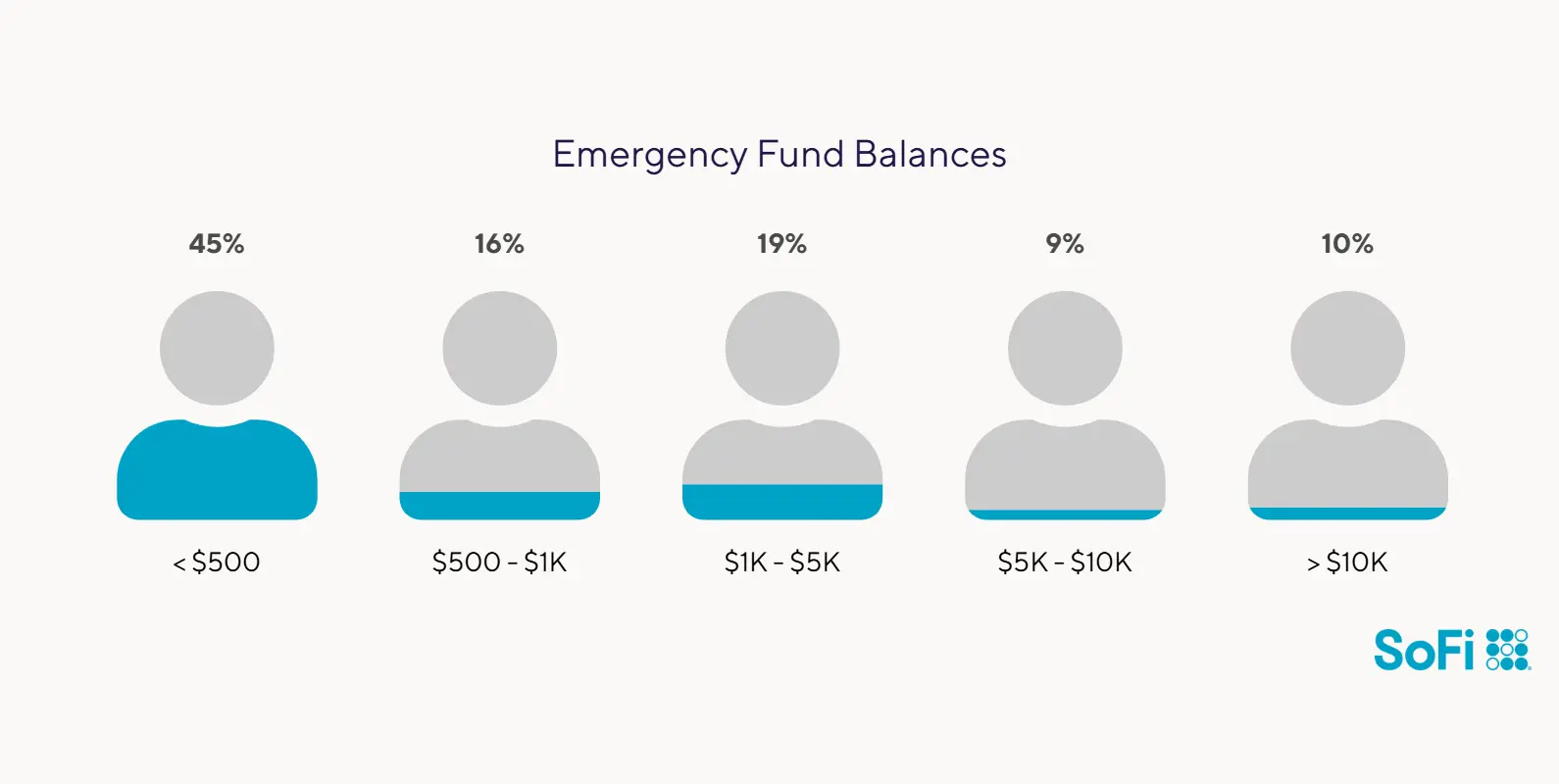
Yes, it can be hard to save money, but one of the most important priorities is to sock away money (even if just a little) regularly into an emergency fund. In SoFi’s April 2024 Banking Survey of 500 U.S. adults, 77% of respondents with a savings account said they use the account to save for emergencies.

Emergency Fund Balances
Source: SoFi’s April 2024 Banking Survey

An emergency fund is a bundle of easily accessible cash that could help you handle a financial curveball, such as a job loss, medical emergency, or big ticket car or home repair. Ideally, an emergency fund will contain enough money to cover your living expenses for three to six months, so you don’t wind up with credit card debt.

•   If you are married with an employed spouse and with no children, for example, you may only need to cover three months’ worth of expenses.

•   If you have kids or you’re single, you may want to have an emergency fund that could cover more than six months’ worth of expenses.

Recommended: Emergency Fund Calculator

2. Paying Off High-Interest Debt

Another important thing you could consider doing with your savings is paying off any high-interest debt (or “bad” debt) you may have. Typically, this is credit card debt, which currently has an average rate of well over 20%.

•   One debt payoff strategy is the debt snowball method. You start by paying off the debt with the smallest balance and put all your extra payments toward that until it’s paid off (while continuing to pay the minimum on your other debts).

You then put extra payments toward the debt with the next highest balance, and so on. This can give you a sense of accomplishment which can help motivate you to continue your aggressive repayment.

•   Another approach is the debt avalanche method, putting all your extra payments toward the debt with the highest interest rate, while paying the minimum on the others.

When that debt is paid off, you then focus on the debt with the next-highest interest rate. This strategy can be the most cost-effective method.

3. Saving for Retirement

Another reason why saving money is important: It can secure your future by providing for your retirement. Exactly how much of your paycheck should go to retirement savings will depend on your age and when you want to retire. Some pointers:

•   If your company offers a 401(k) with matching contributions, it can make sense to put aside at least as much of your paycheck as your company will match (since this is essentially free money).

•   If you don’t have access to a 401(k) or want to contribute beyond that fund, you may want to open a Roth or Traditional IRA. Both types of IRAs have different tax benefits.

•   When you invest in a Roth IRA, the money is taxed at the time of contribution but then in retirement, you can withdraw it tax-free. Contributions made to a traditional IRA might not be taxed at the time they are made but are taxed when they are withdrawn in retirement.

When choosing how much of your paycheck to put into retirement savings, you may want to keep in mind that the IRS sets restrictions on how much you can contribute to your retirement funds each year. IRS retirement guidelines are published and updated regularly.

4. Saving for Other Goals

After establishing plans for debt repayment, an emergency fund, and retirement savings, you may also want to consider working toward your other financial goals, like buying a house, saving for your kids’ future education, or affording a great vacation.

When you’re saving for a big purchase, you can start by determining how much money you’ll need and when you want to have the money. You can then break that dollar amount down into the amount you need to save each year and each month.

Strategies for Increasing Your Savings Rate

If you want to ramp up your savings, here are a couple of strategies that can pay off.

Automating Your Savings

Also known as paying yourself first, automating your savings involves setting up recurring payments or transfers into an account where the money won’t be spent and can earn interest. You might have a portion of your direct-deposit paycheck go straight into savings, or you could have a set amount whisked from checking into savings every pay day.

Read on for ideas about which kind of account is best for your savings.

Adjusting Your Budget

If you need to save more, take a closer look at your budget. Checking in with your budget is an important way to stay in control of your money. You may see patterns that you can address to maximize your savings. For example, did your wifi provider raise costs or have your property taxes increased year over year?

Once you size up your situation, you can take the right next steps, such as reducing costs (see below), finding a budget that works better for you, or using tech tools, such as money trackers, to manage your money more effectively.

Recommended: How to Make Money From Home

Reducing Your Costs to Save More

You can help ramp up your savings by cutting your spending. Here are some ideas:

•   Review your monthly bills and see if there’s anything you can cut. You might have signed up for a couple of subscriptions and then forgotten about them, or you might see that your restaurant spending is surging lately.

•   Learn how to save on food. You might try planning your meals weekly, so nothing goes to waste; joining a warehouse or wholesale club to lower your grocery bill; and using coupons and discount codes to downsize your food costs.

•   Bundle up: If you get your auto and home (or renters) insurance from one provider, you may save on your premiums.

•   Fight off FOMO spending (fear of missing out). Just because your friends are upgrading to a luxury car or a social media influencer is frolicking on the French Riviera, that doesn’t mean you have to too.

•   Pause, for a day or a month, before making pricey impulse buys to make sure you really and truly want or need them. Try a 30-day spending rule to eliminate impulse buys. It involves waiting 30 days to make an unplanned purchase; the urge to buy may vanish in that time period.

•   Pay in cash. Plastic, whether a credit or debit card, can make it easy to overspend. If you take out the cash you need for the week ahead and use only that to pay for purchases, you may be able to rein in your purchasing.

•   Use budgeting tools to help stay on track. Twenty-three percent of people in SoFi’s survey use budgeting tools offered by their bank, and 20% have knowingly used AI to manage their budget or finances.

Where to Put Your Savings

Once you’ve committed to saving money, you’ll have some options about where to keep it.

High-Yield Savings Account

A high-yield savings account pays a significantly higher interest rate than a standard account. As of mid-2025, the average savings account earned 0.38% interest while some high-yield savings accounts were paying 4.00% or more.

These accounts are often found at online banks vs. traditional ones. Just be sure to read the fine print and make sure you are aware of and comfortable with any account fees or minimums that might be involved. These accounts allow for easy access to your money when needed.

Certificate of Deposit (CD)

A certificate of deposit (CD) is an account in which you commit to keeping your money at the bank for a specific term and you know what rate you will earn. Typically, there is a penalty for early withdrawal. The terms for CDs can range from a few months to several years, so you can pick what works best for you. Longer terms will often have higher interest rates.

Investment Options for Long-Term Savings

Longer-term savings goals, meaning five or 10 years or longer (such as your retirement savings) can involve investing, since you’ll likely have more time to ride out the ups and downs of the markets.

For college savings, you may want to consider opening a 529 savings plan.


Test your understanding of what you just read.


The Takeaway

Many financial experts and budgeting methods recommend putting 20% or more of your salary into savings, but that may not fit your needs. Consider your savings goals, your financial situation, and other factors to find the right figure and the right tactics to help you stash the right amount of cash. Also consider where to keep your savings: A higher rate of interest can help your money grow and work harder for you over time.

Interested in opening an online bank account? When you sign up for a SoFi Checking and Savings account with eligible direct deposit, you’ll get a competitive annual percentage yield (APY), pay zero account fees, and enjoy an array of rewards, such as access to the Allpoint Network of 55,000+ fee-free ATMs globally. Qualifying accounts can even access their paycheck up to two days early.


Better banking is here with SoFi, NerdWallet’s 2024 winner for Best Checking Account Overall.* Enjoy 3.30% APY on SoFi Checking and Savings with eligible direct deposit.

FAQ

Is saving 10% of my paycheck enough?

Most financial experts advise saving between 10% and 30% of your salary, with 20% being a common figure. Based on this, 10% is an adequate amount for some, but if you can ramp that up in the future, so much the better.

Is 20% of your salary enough to save?

According to the 50/30/20 budget rule, saving 20% of your salary is a good goal to have; that’s the 20 in the name of the guideline. This amount can then be divided to address different needs, such as saving for the down payment on a house, for your child’s college education, and for retirement. However, for some people, 20% won’t be enough if, say, you have a large family to support.

How much of a $1,000 paycheck should I save?

Typically, financial experts recommend saving between 10% and 30% of your paycheck, with 20% being a good figure to aim for. For $1,000, that would mean between $100 and $300, with $200 being the 20% figure. However, if you are earning a lower salary and money is tight, it would be understandable if you save less until your salary increases.

How much should you save if you don’t have a regular paycheck?

If you don’t have a regular paycheck, it can be especially important during high-earning periods to save at least 20% of your pay. Also aim for at least six to 12 months’ worth of living expenses in your emergency fund. This can be a good cushion during the off-season (if you have a seasonal business) or you lose a steady gig.

How can I save money if I live paycheck to paycheck?

If you’re living paycheck to paycheck, saving is still important. Review your fixed expenses and see what cuts you can make to free up funds for your emergency savings account and other goals. Put in the time to find a budget that works for you, and stash any money windfalls (such as a tax refund or unexpected gift of cash) into your savings. You might also sell your unwanted but still useful items to raise some cash for your savings.


Annual percentage yield (APY) is variable and subject to change at any time. Rates are current as of 12/23/25. There is no minimum balance requirement. Fees may reduce earnings. Additional rates and information can be found at https://www.sofi.com/legal/banking-rate-sheet

Eligible Direct Deposit means a recurring deposit of regular income to an account holder’s SoFi Checking or Savings account, including payroll, pension, or government benefit payments (e.g., Social Security), made by the account holder’s employer, payroll or benefits provider or government agency (“Eligible Direct Deposit”) via the Automated Clearing House (“ACH”) Network every 31 calendar days.

Although we do our best to recognize all Eligible Direct Deposits, a small number of employers, payroll providers, benefits providers, or government agencies do not designate payments as direct deposit. To ensure you're earning the APY for account holders with Eligible Direct Deposit, we encourage you to check your APY Details page the day after your Eligible Direct Deposit posts to your SoFi account. If your APY is not showing as the APY for account holders with Eligible Direct Deposit, contact us at 855-456-7634 with the details of your Eligible Direct Deposit. As long as SoFi Bank can validate those details, you will start earning the APY for account holders with Eligible Direct Deposit from the date you contact SoFi for the next 31 calendar days. You will also be eligible for the APY for account holders with Eligible Direct Deposit on future Eligible Direct Deposits, as long as SoFi Bank can validate them.

Deposits that are not from an employer, payroll, or benefits provider or government agency, including but not limited to check deposits, peer-to-peer transfers (e.g., transfers from PayPal, Venmo, Wise, etc.), merchant transactions (e.g., transactions from PayPal, Stripe, Square, etc.), and bank ACH funds transfers and wire transfers from external accounts, or are non-recurring in nature (e.g., IRS tax refunds), do not constitute Eligible Direct Deposit activity. There is no minimum Eligible Direct Deposit amount required to qualify for the stated interest rate. SoFi Bank shall, in its sole discretion, assess each account holder's Eligible Direct Deposit activity to determine the applicability of rates and may request additional documentation for verification of eligibility.

See additional details at https://www.sofi.com/legal/banking-rate-sheet.

*Awards or rankings from NerdWallet are not indicative of future success or results. This award and its ratings are independently determined and awarded by their respective publications.

We do not charge any account, service or maintenance fees for SoFi Checking and Savings. We do charge a transaction fee to process each outgoing wire transfer. SoFi does not charge a fee for incoming wire transfers, however the sending bank may charge a fee. Our fee policy is subject to change at any time. See the SoFi Bank Fee Sheet for details at sofi.com/legal/banking-fees/.

INVESTMENTS ARE NOT FDIC INSURED • ARE NOT BANK GUARANTEED • MAY LOSE VALUE

SoFi Invest is a trade name used by SoFi Wealth LLC and SoFi Securities LLC offering investment products and services. Robo investing and advisory services are provided by SoFi Wealth LLC, an SEC-registered investment adviser. Brokerage and self-directed investing products offered through SoFi Securities LLC, Member FINRA/SIPC.

For disclosures on SoFi Invest platforms visit SoFi.com/legal. For a full listing of the fees associated with Sofi Invest please view our fee schedule.

Financial Tips & Strategies: The tips provided on this website are of a general nature and do not take into account your specific objectives, financial situation, and needs. You should always consider their appropriateness given your own circumstances.

Third-Party Brand Mentions: No brands, products, or companies mentioned are affiliated with SoFi, nor do they endorse or sponsor this article. Third-party trademarks referenced herein are property of their respective owners.

Tax Information: This article provides general background information only and is not intended to serve as legal or tax advice or as a substitute for legal counsel. You should consult your own attorney and/or tax advisor if you have a question requiring legal or tax advice.

External Websites: The information and analysis provided through hyperlinks to third-party websites, while believed to be accurate, cannot be guaranteed by SoFi. Links are provided for informational purposes and should not be viewed as an endorsement.
Third Party Trademarks: Certified Financial Planner Board of Standards Center for Financial Planning, Inc. owns and licenses the certification marks CFP®, CERTIFIED FINANCIAL PLANNER®

SOBNK-Q225-107

Read more
woman on laptop

10 Top Career Training Programs

When it comes to getting a secure, well-paying job, it’s not always necessary to get a college degree first.

Some students may choose a career training program to learn skills for a specific job, often more quickly and for less money than a four-year college degree. These programs may also be referred to as career certificate programs, usually certifying the students to work in a particular role once the course is completed.

Recent high school graduates or those who have attained their GED can often attend career training programs and get started on their careers after receiving their certificate.

Key Points

•   Career training programs can offer a faster, more cost-effective route to employment than traditional college degrees.

•   On average, career certificate programs cost about $100 per credit hour, and some programs can be completed in less than a year.

•   Accreditation guarantees that training programs meet quality standards and are recognized by employers.

•   High-demand roles like web designers, paralegals, and solar photovoltaic installers earn competitive median salaries.

•   Multiple financing options, such as federal financial aid, scholarships, and private loans, are available for career training.

Why Do People Choose Career Training Programs?

Two big factors in choosing to go through a career training program before or instead of going to college are time and money.

Career training programs typically can be completed in less time than it generally takes to complete an undergraduate degree. Some programs can be finished in as little as four months.

They’re also less expensive, which may mean that students have less student loan debt. On average, a career certificate program may cost around $100 per credit. By comparison, the average annual cost of in-state tuition at a public two-year institution is $4,050, and at a public four-year college, the in-state tuition averages $11,610 a year.

For instance, at Minnesota State University, certificate programs consist of nine to 30 credits, which can be completed in one year or less of full-time study. If these programs cost the average $100 per credit, they would cost between $900 and $3,000. This is fairly affordable compared to the cost of tuition at either a two-year or a four-year institution.

Another reason some people choose a career training program is that they need to, or would like to, start earning money relatively soon after graduating high school. And that way, if they borrowed money to help pay for their certificate program, they can put more money toward student loans to pay them off.

A career training program could be a more direct route to employment than getting an associate or bachelor’s degree for people who are sure about their career path. This could also be a beneficial route for students who want to save money to attend college later in life.

Choosing a Program

The most important thing to look for when choosing a career training program, whether it’s in-person or an online career training program, is accreditation. Accreditation verifies that an institution is meeting a certain level of quality. Usually, a certificate will need to come from an accredited institution for it to be considered legitimate.

Accreditation is done by private agencies, and most programs or institutions will list accreditations on their website.

The most up-to-date accreditation information can be found in the database of postsecondary institutions and programs compiled by the U.S. Department of Education or with the specific accrediting agency’s website.

Once it’s clear that the potential programs are accredited, students can begin to narrow down which one will be best for them. This will be a highly personal choice, but there are a few factors worthy of attention, including cost, course length, and type of instruction (online vs. in-person).

Job search assistance—which might include resume writing workshops, job fairs, or interview prep—is another element that may help set students up for success.

Top-Paying Jobs For Certificate Holders

In addition to career training programs having the potential to save students time and money, people want to know that they’ll be able to make a good living with those jobs. They also want jobs that can help pay off any money borrowed for school.

These are some of the highest paying jobs for those opting to go through a career training program:

1. Web Designer

According to the U.S. Bureau of Labor Statistics, the average annual income for a web developer and digital designer is $95,380, with the educational requirements ranging from a high school diploma to a bachelor’s degree. This job is growing faster than average, so it has a promising future.

2. Paralegals and Legal Assistants

Paralegals and legal assistants make, on average, $61,010 per year. The required education for an entry-level job as a paralegal is a certificate or an associate degree. This job’s growth rate has slowed in the past couple of years, but an average of 37,300 openings are projected each year.

3. Solar Photovoltaic Installer

Solar panel installation is a growing field with decent pay and a lot of projected growth for the future. The median annual pay is $51,860, with only a high school degree or a certificate required to begin working.

4. Licensed Practical and Licensed Vocational Nurses

Training to become a licensed practical or licensed vocational nurse typically takes only one year of full-time study, and the median annual salary is $62,340. This job is growing as fast as average and is in a field that will almost certainly always exist. This could be a good choice for someone who wants to be in the medical field without the time and financial commitment it takes to become a doctor.

5. Medical Records Specialist

Working as a medical records specialist usually only requires a certificate, and sometimes an associate degree. This job has a median annual pay of $50,250 and the potential to work from home.

6. Pharmacy Technician

The median pay for a pharmacy technician is $43,460 per year. This job is growing faster than the average rate and typically requires on-the-job training or a formal training program, most of which last one year. Some longer pharmacy tech training programs culminate in an associate degree.

7. Computer Support Specialist

The role of a computer support specialist can vary widely, which means the educational requirements may also vary. Some jobs in this field may require a bachelor’s degree, but others only require an associate degree or a certificate. The median annual pay for a computer support specialist is $61,550, and the field is growing faster than average.

8. Phlebotomists

Phlebotomists draw blood and may work in hospitals, labs, or doctors’ offices. Professional certification, which can be gained after completing a phlebotomy training program, is the credential generally preferred by employers. This job has a median annual pay of $43,660, and it’s growing faster than average.

9. Medical Assistants

Medical assistants have a median annual pay of $44,200, and the job only requires a certificate or on-the-job training. This job is growing much faster than average.

10. Wind Turbine Technician

The median pay for this job is $62,580 per year, and the only education required is a training certificate through a technical program. This job is growing at a rate much faster than average, which could make it a great choice for students who are ready to start their career shortly after graduating high school.

Paying for a Career Training Program

Just because career training programs are typically less expensive than college doesn’t mean they’ll be easy to pay for. Some programs last longer than others and could end up costing a fair chunk of money. Here are some ways to help cover the costs.

Pay for it. One way to pay for a career training program is to save up the amount of money needed before starting it, especially if the program is short or has a lower cost. Paying in full with cash means no debt to worry about.

Financial aid. Another potential way to pay for a career training program is to apply for federal student financial aid, which may be available to students enrolled in eligible degree or certificate programs and who meet other eligibility requirements. Completing the Free Application for Free Application for Federal Student Aid (FAFSA®) is the first step. After submitting the FAFSA, students will find out if they’re eligible for federal student aid, which could include federal student loans and/or work-study.

Scholarships. Students who aren’t eligible for financial aid or those who can’t cover tuition costs may want to look for scholarships or grants. There may be fewer scholarships available for certificate programs than there are for degree programs, but they’re out there.

The best place to start looking for scholarships is with the school the student is attending. Some schools set up their own scholarships. Alternatively, students can search for scholarships offered by professional organizations in their related fields.

Private student loans. A private student loan may be another option to cover the cost of a career training program.

One of the basics of student loans is that loan terms will vary from lender to lender, and applicants are encouraged to shop around. It also makes sense for students to exhaust all federal student aid options before considering private student loans.

Learn more about how private student loans work with this private student loans guide.

Student loan refinancing. If you took out student loans and the payments are difficult to manage, or you’d like to get a lower interest rate if you qualify, you can look into refinancing student loans.

One of the ways that student loan refinancing works is that you may be able to qualify for more favorable terms or a lower rate, which could help you save money.

Just be aware that when you refinance federal student loans, you lose access to federal protections and programs like income-driven repayment plans and deferment. Be sure you won’t need those benefits if you choose to refinance.

The Takeaway

Students can be under a lot of pressure to go right into a four-year college or university after graduating high school, but career training programs provide an alternative that can also set them up for success, typically in less time and for less money.

There are a number of options to help pay for a certificate training program, including saving up for it, applying for federal student financial aid, looking for scholarships, and taking out a private student loan.

And if you have student loans and you’d like to get a more favorable rate or better terms, consider student loan refinancing. SoFi offers loans with flexible terms and no origination and prepayment fees.

With SoFi, refinancing is fast, easy, and all online. We offer competitive fixed and variable rates.

FAQ

What is the best type of career training program?

The best type of career training program depends on your personal interests and goals. Some career training programs to consider are those for web designer, paralegal, licensed practical nurse, and wind turbine technician. Each job generally pays well and is typically easy to get certified for.

What is the easiest career certification to get that pays well?

Becoming a solar photovoltaic installer requires only a high school degree or a certificate to begin working. The median annual pay for the job is $51,860, and the field is projected to grow.

How much do career training programs cost?

On average, a career certificate program may cost around $100 per credit. Some programs can be completed in one year or less, which can help keep costs down.


SoFi Student Loan Refinance
Terms and conditions apply. SoFi Refinance Student Loans are private loans. When you refinance federal loans with a SoFi loan, YOU FORFEIT YOUR ELIGIBILITY FOR ALL FEDERAL LOAN BENEFITS, including all flexible federal repayment and forgiveness options that are or may become available to federal student loan borrowers including, but not limited to: Public Service Loan Forgiveness (PSLF), Income-Based Repayment, Income-Contingent Repayment, extended repayment plans, PAYE or SAVE. Lowest rates reserved for the most creditworthy borrowers.
Learn more at SoFi.com/eligibility. SoFi Refinance Student Loans are originated by SoFi Bank, N.A. Member FDIC. NMLS #696891 (www.nmlsconsumeraccess.org).

SoFi Loan Products
SoFi loans are originated by SoFi Bank, N.A., NMLS #696891 (Member FDIC). For additional product-specific legal and licensing information, see SoFi.com/legal. Equal Housing Lender.


Third-Party Brand Mentions: No brands, products, or companies mentioned are affiliated with SoFi, nor do they endorse or sponsor this article. Third-party trademarks referenced herein are property of their respective owners.

Non affiliation: SoFi isn’t affiliated with any of the companies highlighted in this article.

Financial Tips & Strategies: The tips provided on this website are of a general nature and do not take into account your specific objectives, financial situation, and needs. You should always consider their appropriateness given your own circumstances.

Third Party Trademarks: Certified Financial Planner Board of Standards Center for Financial Planning, Inc. owns and licenses the certification marks CFP®, CERTIFIED FINANCIAL PLANNER®

External Websites: The information and analysis provided through hyperlinks to third-party websites, while believed to be accurate, cannot be guaranteed by SoFi. Links are provided for informational purposes and should not be viewed as an endorsement.

SOSLR-Q225-040

Read more
couple home on laptop

Four Ways to Upgrade Your Home

Updating your home can be done without a full (and expensive) renovation. There are a number of light lift projects that can give your home a whole new look and feel, and even increase its resale value. Exterior upgrades, like fresh paint, a new front door, and better landscaping or outdoor lighting, can add to your home’s curb appeal. Indoor improvements, such as updated lighting fixtures, paint, or wallpaper, can give the interior of your home a more up-to-date, high-end look. Here are four ways you can upgrade your home without breaking the bank.

Key Points

•   Home upgrades, starting at $3,000, can enhance the look and value of a property.

•   Exterior upgrades, like a freshly painted front door, new porch lights, and modern landscaping with pollinator and edible gardens, can add curb appeal.

•   Indoor lighting trends favor bold and textured fixtures.

•   Popular paint colors are dusty pink, cinnamon brown, cool grays, and bright purples, while one wallpapered wall can create a mural effect.

•   Window treatments with natural hues, geometric prints, and layered rods add style and privacy.

Exterior Improvements

A home’s front door is the focal point of the exterior. To upgrade its appearance, you might replace the door, or paint it and add new hardware. Decorating the door with a seasonal wreath or another personalized touch can also add to its charm.

Besides a front door refresh or upgrade, other exterior improvements you might consider include a new mailbox, a new porch light fixture, and perhaps some window boxes with plants and fresh flowers that add a bright contrast to your home’s exterior color.

Front door styles that are currently trending include bold colors (from fire engine red to deep greens and bright blues), natural wood stains, and more glass (such as custom inserts and floor-to-ceiling sidelights).

How you landscape your front yard will depend upon where you live and the climate there. In general, though, modern trends include:

•   Natural landscaping using native plants, creating landscaping that’s eco-friendly and easy to maintain.

•   Pollinator gardens that attract butterflies, bees, and other insects that help pollinate.

•   Edible gardens, including lettuce, peppers, tomatoes, and more. Creativity is key!

Recommended: 15 Ways to Boost Your Curb Appeal for a Winter Open House

Lovely Lighting

Outdoor lighting doesn’t need to be white — filters can add a range of colors. These lights can spotlight key areas of landscaping, highlight where you like to entertain, or look attractive for even more curb appeal while providing illumination.

Size-wise, both tiny and boldly large lights are in vogue and, although lanterns aren’t a new trend, they’re still considered stylish. Updating recessed lighting is another popular home improvement project.

After a period of all-white being a hot trend for interior lighting, table lamps and hanging lighting fixtures are appearing more often as dark neutrals in brown, black, or gray. They can be used to update the white, cream, or gray choices in a home.

Paying attention to texture in lighting fixtures can add interest and variety. Materials can range from wood to wicker and rattan, and can be crafted in contemporary shapes to avoid an overly rustic look. Also still trending are geometrically designed lighting fixtures, from simple to more complex shapes.

Painting and Wallpapering

Painting rooms in a home can transform their appearance. What colors are trending? Currently, homeowners are favoring dusty pink, cinnamon brown, cool grays, and bright purples. However, unless you’re planning to sell some time soon, personal taste is what matters most when picking paint colors.

Wallpaper trends also run the gamut, including those with a texture and colors often inspired by landscapes. In this style of wallpaper, expect to see some blues, greens and neutral shades. Some people like to have one pictorial wallpaper wall, which looks like a mural in a room.

Wow Factor on Windows

In-style curtains often have hues found in nature, from green to ochre, and can also feature flowers, landscapes, and more. Geometric prints or two-tone materials may also appeal to some people. Velvet can be used to create a more intimate space.

Consider using double or triple curtain rods to add layers of window coverings. Then you can add a layer that filters light and enhances privacy, while also selecting curtains with the appearance you enjoy. Many designers recommend placing your curtain rod close to ceiling height vs. at the top of the window for a more dramatic and chic effect.

Recommended: How Much Does It Cost to Replace Windows?

Costs of a House Upgrade

The type of house upgrades listed here might be considered low-cost or low-end renovations, and can cost as little as $3,000 for a 1,250 to 1,600 square foot home. If, once momentum gets going, the low-end house upgrade turns into a middle-end one, the average cost could be closer to $5,200, according to the home improvement site Angi.

Another cost-related factor is where the home is located. Pricing in urban areas might be twice as high as in rural areas, depending on the area’s cost of living.

Plus, upgrades in older homes may take more time and attention to complete. If the home is officially considered to be historic, there may be guidelines about what changes can be made.

Recommended: Renovation vs. Remodel: What’s the Difference?

Financing a House Upgrade

Here are some options for financing a home upgrade.

•   Sometimes, homeowners are able to pay for these upgrades out of pocket. This can be true when the costs are relatively small or when money has been saved for the costs of the renovation. This can be the smart choice when possible: no debt, no interest to pay.

A downside to paying for home upgrades with cash may be that the homeowner empties a savings account or cuts corners on the renovations to avoid needing to borrow funds. Or, if, say, a big medical bill pops up and the emergency fund was used to renovate, then high-interest credit cards might need to be used to pay that debt.

•   You might consider a home equity line of credit (HELOC) to finance a house upgrade. This type of loan allows you to borrow against the equity in the home to pay for renovations. How much is available to borrow will depend upon how much equity is available and the loan-to-value ratio (LTV) that a lender permits. For example, if a lender has an 80% LTV ratio, that means the institution would:

◦   Appraise the home (e.g., $250,000).

◦   Calculate 80% of that ($200,000).

◦   Subtract current mortgage balances (e.g., $125,000).

◦   Consider what’s left over ($200,000-$125,000 = $75,000) to be equity in the home.

The lender would also consider the financial profile of the borrower when reviewing the loan application. HELOCs often have a low initial interest rate and, usually, the homeowner can choose to pay interest only during the draw period. However, there may be upfront fees and the rate is often variable with high lifetime caps.

•   Another option might be a home improvement loan, which is an unsecured personal loan and not attached to the home’s equity. Funding can usually be granted more quickly with fewer, or sometimes no, fees. This may be a good option for people who don’t have enough equity in their homes for their project or who don’t want to use their home as collateral.

Recommended: How to Apply for a Personal Loan

The Takeaway

There are a number of ways you can upgrade your home that don’t involve tearing down walls or putting on an $150,000 addition. Lower-cost upgrades, ranging from $3,000 to $50,000 or more, may still require spending more cash than you have just sitting in the bank, however. Plus, you may not want to deplete your savings in order to upgrade your home. A personal loan could be a good option.

Think twice before turning to high-interest credit cards. Consider a SoFi personal loan instead. SoFi offers competitive fixed rates and same-day funding. See your rate in minutes.


SoFi’s Personal Loan was named a NerdWallet 2026 winner for Best Personal Loan for Large Loan Amounts.

FAQ

How do you update your home?

A good plan for updating your home can be to start with changes that can shift the mood of a room. This includes paint and/or wallpaper, carpets and rugs, window treatments, and lighting, among other features.

How to update a home without renovation?

To update a home without a major renovation, make changes to surfaces, such as repainting in a different color, swapping in new curtains or blinds, and adding fresh rugs or refinishing the floors.

How much do home updates cost?

The price of home updates can range considerably depending on the cost of living in your area, how much you DIY vs. calling in professionals, and your taste level and the changes you actually make. A small update can start at $3,000, but prices in the five figures can be common.


SoFi Loan Products
SoFi loans are originated by SoFi Bank, N.A., NMLS #696891 (Member FDIC). For additional product-specific legal and licensing information, see SoFi.com/legal. Equal Housing Lender.


*Awards or rankings from NerdWallet are not indicative of future success or results. This award and its ratings are independently determined and awarded by their respective publications.

Disclaimer: Many factors affect your credit scores and the interest rates you may receive. SoFi is not a Credit Repair Organization as defined under federal or state law, including the Credit Repair Organizations Act. SoFi does not provide “credit repair” services or advice or assistance regarding “rebuilding” or “improving” your credit record, credit history, or credit rating. For details, see the FTC’s website .

Financial Tips & Strategies: The tips provided on this website are of a general nature and do not take into account your specific objectives, financial situation, and needs. You should always consider their appropriateness given your own circumstances.

Third-Party Brand Mentions: No brands, products, or companies mentioned are affiliated with SoFi, nor do they endorse or sponsor this article. Third-party trademarks referenced herein are property of their respective owners.

²SoFi Bank, N.A. NMLS #696891 (Member FDIC), offers loans directly or we may assist you in obtaining a loan from SpringEQ, a state licensed lender, NMLS #1464945.
All loan terms, fees, and rates may vary based upon your individual financial and personal circumstances and state.
You should consider and discuss with your loan officer whether a Cash Out Refinance, Home Equity Loan or a Home Equity Line of Credit is appropriate. Please note that the SoFi member discount does not apply to Home Equity Loans or Lines of Credit not originated by SoFi Bank. Terms and conditions will apply. Before you apply, please note that not all products are offered in all states, and all loans are subject to eligibility restrictions and limitations, including requirements related to loan applicant’s credit, income, property, and a minimum loan amount. Lowest rates are reserved for the most creditworthy borrowers. Products, rates, benefits, terms, and conditions are subject to change without notice. Learn more at SoFi.com/eligibility-criteria. Information current as of 06/27/24.
In the event SoFi serves as broker to Spring EQ for your loan, SoFi will be paid a fee.


Third Party Trademarks: Certified Financial Planner Board of Standards Center for Financial Planning, Inc. owns and licenses the certification marks CFP®, CERTIFIED FINANCIAL PLANNER®

SOPL-Q225-045

Read more
TLS 1.2 Encrypted
Equal Housing Lender