Woman smiling in front of car

Can You Get a Personal Loan for a Car?

Buying a car is often a major purchase, whether you opt for new ($48,000 on average) or used (typically about $26,000). If you’re in the market, you may well be exploring your financing options, which could include a loan. In fact, you may be deciding between a car loan and a personal loan.

If that’s your situation, it’s worth taking a closer look at your options and the pros and cons of each. Here, you’ll learn more about this topic, so you can make the best decision for your situation and needs.

Key Points

•   Personal loans offer flexibility in funding, allowing for the purchase of a car and covering other related expenses.

•   Secured personal loans do not require collateral, unlike auto loans that use the car as security.

•   Interest rates for personal loans may be higher due to their unsecured nature.

•   Personal loans can be either secured or unsecured, with fixed or variable interest rates.

•   Approval for a personal loan before car shopping can empower buyers to negotiate effectively at dealerships.

Types of Loans That Can Be Used to Buy a Car

Can you use a personal loan to buy a car? Yes. But is it the right option? There are a few things to take into consideration when thinking about buying a car with a personal loan or a car loan.

•   Are you buying a new car or a used car?

•   Are you buying a car from a private individual or a dealership?

💡 Quick Tip: Before choosing a personal loan, ask about the lender’s fees: origination, prepayment, late fees, etc. One question can save you many dollars. While SoFi does not offer auto loans at this time, we do offer personal loan options with other use cases.

Are You Buying a New or a Used Car?

If you’re buying a new car from a dealership, the benefits of using dealer financing might outweigh the drawbacks. Automakers offer financing on cars purchased through their dealerships, with low or sometimes even 0% annual percentage rates (APRs) for well-qualified buyers in an effort to compete with banks and other financial institutions.

Is the Seller an Individual or a Car Dealer?

An individual who is selling a used car is not likely to offer financing, so a car buyer in that situation would likely need to find their own source of funds. As the name implies, a personal loan can be taken out for a variety of personal expenses — including to pay for a car. In this way, personal loans to buy a car can work well if you’re shopping from friends, neighbors, or other individuals.


💡 Quick Tip: Before choosing a personal loan, ask about the lender’s fees: origination, prepayment, late fees, etc. One question can save you many dollars. While SoFi does not offer auto loans at this time, we do offer personal loan options with other use cases.

Getting a Personal Loan for a Car

Funds from a personal loan can be more flexible than funds from an auto loan — they can be used not just for purchasing a car but for the other costs of owning a car as well.

Personal loans can be secured or unsecured, with either fixed or variable interest rates. If you choose to purchase a car with an unsecured personal loan, collateral is not needed. There is no asset for a lender to seize in the case of default, as with a secured personal loan, although lenders can pursue you in court.

Car buyers who have a personal loan approval in hand before they go to the dealership can negotiate, knowing exactly how much they can spend. If you don’t think your income would qualify you for an auto loan from a dealership, you could consider looking for personal loans based on income.

Refinancing a car loan with a personal loan might be an option in some cases. Perhaps your credit score was bad when you purchased your car, but you’ve built it since taking out your car loan and you can now qualify for a lower interest rate. Or you’d rather have a shorter-term loan than you currently have, and refinancing with a personal loan might accomplish that.

Recommended: How Does Collateral Work with a Personal Loan?

Determining the Value of a Car

Whether the car you’re considering is new or just new to you, there are a number of well-respected pricing guides to consult for an appropriate price range once you narrow down your car choices. Having an idea of the car you’re considering buying may give you more confidence while negotiating a price.

•   Edmunds offers a True Market Value guide.

•   Kelley Blue Book has suggested price ranges for various cars (particularly useful for used cars).

•   J.D. Power offers information about new and used cars, including classic cars.

•   Consumer Reports provides detailed reviews and reports about specific makes and models.

These resources simply provide a price range for the car you want. Calling car dealers for price quotes or estimates and looking for any purchase incentives or dealer financing offers are good ways to be prepared as you consider your financing options.

Discover real-time vehicle values with Auto Tracker.¹

Now you can instantly monitor vehicle prices in this unprecedented market—to help you make smart money moves.


Pros and Cons of Using a Personal Loan for a Car

Once you know which car you want and what you can afford, how do you pay for it? If you’re considering different ways to get a car loan — and a personal loan is one option — there are some pros and cons to weigh. Here, details that can help when you know that you can use a personal loan to buy a car but wonder if it’s the right move.

Pros of Using a Personal Loan for a Car

Cons of Using a Personal Loan for a Car

Prequalification for a personal loan means you know exactly how much you can spend. Capping your spending at the amount of your personal loan will limit the pool of cars you can afford.
You don’t need a downpayment. Interest rate may be higher than for an auto loan.
Funds can be used for other expenses, not just the car purchase. May be more difficult to qualify for than an auto loan.


💡 Quick Tip: Just as there are no free lunches, there are no guaranteed loans. So beware lenders who advertise them. If they are legitimate, they need to know your creditworthiness before offering you a loan.

Pros and Cons of Using an Auto Loan To Buy a Car

In essence, a car loan works much like a mortgage. It’s a secured loan paid for in monthly installments, and the asset isn’t fully yours until the final payment is made. The car is the asset that secures the loan, which means if you default on payments, the lender could seize your car. The car’s title typically remains with the lender until the loan is paid in full.

Pros of Using an Auto Loan To Buy a Car

Cons of Using an Auto Loan To Buy a Car

May be easier to qualify because it’s a secured loan. If you default on the loan, the lender can repossess your car.
Auto loans are structured specifically for vehicle purchases. Lenders may restrict purchase to a newer car.
May be easier to qualify for an auto loan than a personal loan. May need a good or excellent credit score to qualify for favorable interest rates.

Things to Consider When Using a Personal Loan to Buy a Car

After comparing the general factors of using a personal loan vs. using an auto loan to buy a car, you might want to look at some more specific things. “Can you get a personal loan for a car?” is a question that can be answered differently depending on your financial situation and other factors. Learn more about the ins and outs of personal loans for cars here.

Credit Score

Since a personal loan for a car is an unsecured loan, you typically need a higher credit score to qualify for a favorable interest rate. Unsecured loans are generally riskier for lenders than secured loans because there is no collateral to back the loan.

Bank Account

Having a bank account may make it easier to get a personal loan. Lenders tend to see a bank account as evidence that an applicant has sufficient cash flow to make payments. Getting a personal loan with no bank account may mean having a higher interest rate or less favorable terms — or both.

Interest Rate

Generally speaking, personal loan applicants who are approved for lower interest rates have higher credit scores. Personal loan interest rates tend to be higher than auto loan interest rates because there is no collateral to secure the loan.

Other Fees

Personal loan fees that potentially can be charged are usually higher than auto loan fees. Origination fees are one example — they’re commonly included in personal loans and can range from 1% to 10% of the loan amount. Some auto loans may include an origination fee, but the range is typically lower than the personal loan range, at 1% to 2% of the loan amount.

Loan Term

The term of a loan is the length of time the lender allows for repayment of the loan. Personal loan terms tend to be shorter than auto loan terms. One reason for this is due to the unsecured nature of a personal loan. If a lender doesn’t have an asset to secure a loan, they may want to make sure they get their money back as soon as possible. Personal loan terms typically range from two to seven years.

Collateral

Personal loans are usually unsecured, which means no collateral is required. As mentioned before, however, that tends to equate to higher interest rates and shorter terms than secured loans offer. Collateral gives a lender more confidence that the borrower is serious about repaying the loan.

Ease of Application and Approval

Online applications for personal loans are fairly common. Completing an online application is usually quick and easy, especially at the pre-qualification stage. After that, a lender will likely ask for more detailed information to move forward in the process.

At this point, the lender will likely run a hard credit check on your credit report, which will affect your credit score (in contrast to a soft credit check, which doesn’t affect your credit score). You may be asked what the purpose of the loan is, and you’ll need to fill out a complete loan application. Lenders will also ask you to provide proof of identity, Social Security number, and current address, and will verify your employer and income.

Down Payment

Typically, a down payment is not required when using a personal loan to purchase a car. This factor can be the deciding one for some people looking for auto financing. If you’re getting a personal loan for part of the cost of the car and paying for the remainder with your own funds, you could think of the latter as your unofficial down payment.

The Takeaway

Choosing what type of loan — auto loan or personal loan — generally corresponds to what type of car you’re buying, what interest rate and terms you might qualify for, and what works best for your specific financial situation. Getting prequalified for a personal loan before you begin shopping for a car may help direct your car search toward vehicles that are affordable and fit your lifestyle.

Think twice before turning to high-interest credit cards. Consider a SoFi personal loan instead. SoFi offers competitive fixed rates and same-day funding. See your rate in minutes.


SoFi’s Personal Loan was named a NerdWallet 2026 winner for Best Personal Loan for Large Loan Amounts.


SoFi Loan Products
SoFi loans are originated by SoFi Bank, N.A., NMLS #696891 (Member FDIC). For additional product-specific legal and licensing information, see SoFi.com/legal. Equal Housing Lender.


Financial Tips & Strategies: The tips provided on this website are of a general nature and do not take into account your specific objectives, financial situation, and needs. You should always consider their appropriateness given your own circumstances.

Disclaimer: Many factors affect your credit scores and the interest rates you may receive. SoFi is not a Credit Repair Organization as defined under federal or state law, including the Credit Repair Organizations Act. SoFi does not provide “credit repair” services or advice or assistance regarding “rebuilding” or “improving” your credit record, credit history, or credit rating. For details, see the FTC’s website .

Third-Party Brand Mentions: No brands, products, or companies mentioned are affiliated with SoFi, nor do they endorse or sponsor this article. Third-party trademarks referenced herein are property of their respective owners.

SoFi Relay offers users the ability to connect both SoFi accounts and external accounts using Plaid, Inc’s service. Vehicle Identification Number is confirmed by LexisNexis and car values are provided by J.D. Power. Auto Tracker is provided on an “as-is, as-available” basis with all faults and defects, with no warranty, express or implied. The values shown on this page are a rough estimate based on your car’s year, make, and model, but don’t take into account things such as your mileage, accident history, or car condition.

SOPL1023026

Read more

Your 12-Month Master Savings Plan to Buying Your First Home — While Paying Down Student Loans

Home prices are on the rise again, especially in large metro areas, after a lull leading into 2023. Seven cities, including Atlanta, Charlotte, Detroit, and Miami are at all-time highs as measured by the Case-Shiller U.S. National Home Price NSA Index. So saving for a down payment for your first house can be tough. This is especially true if you’re trying to buy that first home while you also have student loans to pay off. And if you’d like to purchase that home super fast before prices soar higher, it can feel impossible.

But here’s the good news: It’s definitely doable, even within just 12 months, if you accelerate your savings and prepare wisely. Follow our strategy below to take that big step into home ownership fast.


💡 Quick Tip: When house hunting, don’t forget to lock in your home mortgage loan rate so there are no surprises if your offer is accepted.

Months 1–3: Save Like You’ve Never Saved Before

Do the Math

The median home price in the U.S. in late 2023 was $431,000. Saving 10% for a down payment on a home at that price is far more manageable than following the old 20%-down school of thought, especially when you have student loans to pay off. To succeed at saving $43,100 in a year’s time, you’ll need to save $3,592 a month, which seems slightly more plausible if you take a breath and break it down into 52 weeks, at $829 a week. Of course, you’ll want to crunch the numbers for the type of home you’re looking to purchase. If you can find a well-priced property and put even less than 10% down, you may need significantly less cash on hand.

But don’t put your calculator away yet.

In addition to saving for the down payment, you’ll need to factor in closing costs, which typically amount to about 3% of the home price. So for a home that costs $431,000, you would need to add $249 to your weekly savings goal.

Yeah, that’s a big chunk of change. But don’t panic; the first step is always the hardest. Just imagine yourself landing your first job or hosting your first big party. You managed that and you’ll manage this too. And remember to consider student loan refinancing, which can help lower your interest rate, monthly payments, and ultimately save you money.

Revise Your Budget

Hunker down and take a hard look at your budget. If you’ve decided to refinance your student loans, don’t forget to adjust your monthly fixed expenses to account for your lower payments. Compare your income and expenses to get a clear view of your spending habits, and then make the necessary changes to meet your weekly savings goals.

Look closely at your expenses to see what you can give up to increase your savings, and what costs you can cut back on. Can you join a rideshare group to save on gas? Part with a streaming subscription or two? Also, consider setting limits on eating out and buying clothing or gadgets you don’t really need.

Recommended: Home Affordability Calculator

Flex your Negotiation Muscles

Put your savvy bargaining skills to use to get lower interest rates on existing credit cards and auto loans, or discounted rates on subscription services.

Start a Home Fund

Open a savings account just for your down payment, and avoid dipping into it. This will help you keep careful tabs on your progress.

Reach out to Your Family and Friends

Within your 12 months of saving, you’ll have a birthday and celebrate gift-giving holidays. Let your friends and family in on your major goal of buying a house, and ask that they contribute money toward a down payment in lieu of material presents.

Just remember that if you receive unusually large sums or a large number of deposits in the months leading to your home purchase, you may need gift letters from the generous people in your life, indicating that there is no expectation of repayment. Depending on the mortgage loan, rules vary when it comes to how much of your down payment can come from gifts.

Months 3–6: Keep Saving. And Focus on Earning More

Ramp up Your Income

Think of creative ways to use your expertise and skills to boost your income. You did invest a substantial amount of time and money in your education, after all, so maximize the ROI to rake in some extra cash to put toward your home fund.

Perhaps you can roll out an e-course or teach a professional seminar at your local community college. Or look for a way to make extra money from home. And, if the time is right, ask for a raise.

Months 7–9: Build Your Credit (and Keep Saving)

Review Your Credit Report

Check your credit report to make sure it is error-free and that your credit score is as high as it can be. And mind the cardinal rule of credit scores: Pay your credit cards, student loans, and bills on time.

Check your credit utilization ratio (the amount of your credit card balances against their limits), too; you want that number to be low.

Now is also the time to be wary of applying for new lines of credit, as that will result in lenders doing a “hard pull” on your credit. Too many of these within a 6-month time frame could ding your credit score.

Recommended: First-Time Homebuyer Guide

Keep an Eye on Your DTI

Make sure your debt-to-income ratio (DTI) is as low as possible. Your DTI is a key part of securing a home mortgage loan, and while the lower the better, it should fall below 36% — although for certain types of mortgage the DTI can be as high as 43%.


💡 Quick Tip: Don’t have a lot of cash on hand for a down payment? The minimum down payment for an FHA mortgage loan is as low as 3.5%.

Months 10–12: Learn About the Mortgage Process (While You Keep Saving)

Do Your Mortgage Application Prep

Your mortgage company will require quite a bit of paperwork to get your loan approved. Familiarize yourself with the mortgage loan application process. Also check your credit score once more to make sure it’s still solid.

Explore Homebuyer Assistance Programs

There are many different programs designed to help first-time homebuyers gain access to home ownership. A loan from the Federal Housing Administration, for example, may help you purchase a home even if you haven’t saved a heap of cash for a down payment or if your credit score isn’t at the highest level.

If a fixer-upper is your goal, a HUD loan may be worth exploring. And depending on where you’re looking to buy, you might find city- or state-specific homebuyers assistance programs.

The Takeaway

Saving for a down payment and the associated costs of buying a home is a big endeavor, but with persistence and discipline, both in terms of your spending and your home-search process, you can find a home and have the down payment necessary to purchase it. The same careful planning that got you to college and helped you secure a student loan will help you achieve your dream of becoming a homeowner.

Looking for an affordable option for a home mortgage loan? SoFi can help: We offer low down payments (as little as 3% - 5%*) with our competitive and flexible home mortgage loans. Plus, applying is extra convenient: It's online, with access to one-on-one help.


SoFi Mortgages: simple, smart, and so affordable.


SoFi Loan Products
SoFi loans are originated by SoFi Bank, N.A., NMLS #696891 (Member FDIC). For additional product-specific legal and licensing information, see SoFi.com/legal. Equal Housing Lender.


SoFi Mortgages
Terms, conditions, and state restrictions apply. Not all products are available in all states. See SoFi.com/eligibility-criteria for more information.


*SoFi requires Private Mortgage Insurance (PMI) for conforming home loans with a loan-to-value (LTV) ratio greater than 80%. As little as 3% down payments are for qualifying first-time homebuyers only. 5% minimum applies to other borrowers. Other loan types may require different fees or insurance (e.g., VA funding fee, FHA Mortgage Insurance Premiums, etc.). Loan requirements may vary depending on your down payment amount, and minimum down payment varies by loan type.

¹FHA loans are subject to unique terms and conditions established by FHA and SoFi. Ask your SoFi loan officer for details about eligibility, documentation, and other requirements. FHA loans require an Upfront Mortgage Insurance Premium (UFMIP), which may be financed or paid at closing, in addition to monthly Mortgage Insurance Premiums (MIP). Maximum loan amounts vary by county. The minimum FHA mortgage down payment is 3.5% for those who qualify financially for a primary purchase. SoFi is not affiliated with any government agency.


SOHL1023250

Read more

The Ideal Wedding Budget May Be Smaller Than You Think

Popular wedding sites claim the average wedding costs $29,000. Countless media reports have repeated that number while leaving out an important caveat: Averages can be misleading. Even one extravagant wedding may skew the average to be significantly higher than what most people actually paid.

SoFi wanted to know: How much does a wedding really cost? We surveyed 1,000 men and women across the country and then crunched the numbers. Read on to find out what we discovered.

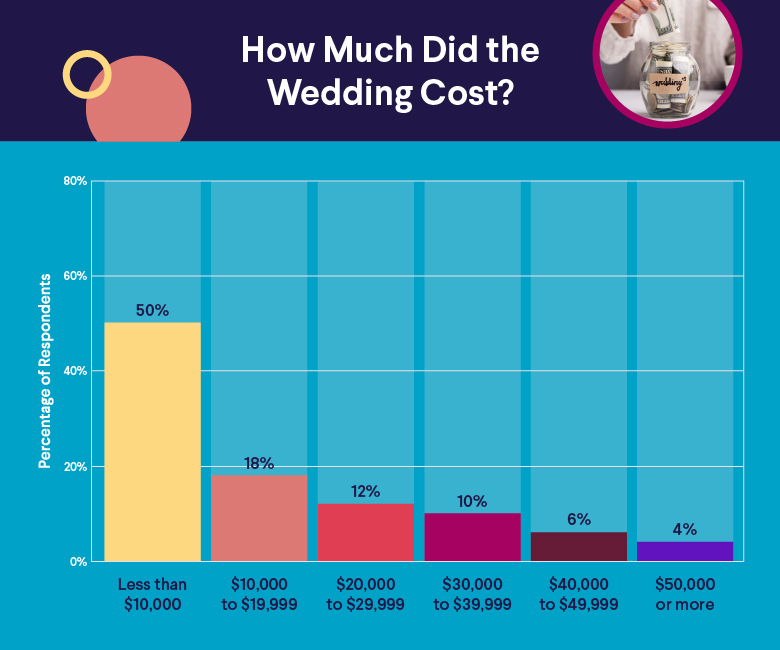
How Much Did the Wedding Cost?

50% of respondents’ weddings cost less than $10,000

Total wedding budget breakdown:

•   Less than $10,000: 50%

•   $10,000 to 19,999: 18%

•   $20,000 to 29,999: 12%

•   $30,000 to $39,999: 10%

•   $40,000 to $49,999: 6%

•   $50,000 or more: 4%

Half of respondents to our wedding survey spent less than $10K on their ceremony and reception. That’s considerably less than the $29K figure that’s been popularized as “average.”

We’re not saying that the $29K budget is inaccurate — after all, half of respondents paid more than that. However, averages in general are notoriously confusing. Only 22% of couples in our survey spent about $29K (between $20K and $39K). And just 10% paid more than that.

But why does this matter?

There’s a concept in behavioral economics called anchoring. It describes how numbers can influence consumer decisions by unconsciously becoming our reference point for what’s standard or “normal.”

Let’s say you’re in the early stages of wedding planning. If you stumble across an authoritative $29K estimate, from then on you may view anything less than that as a “low-budget” wedding. And when figuring out your own wedding budget, you may make decisions that bring you closer to that total — even if a $10K wedding is more aligned with your savings and taste.

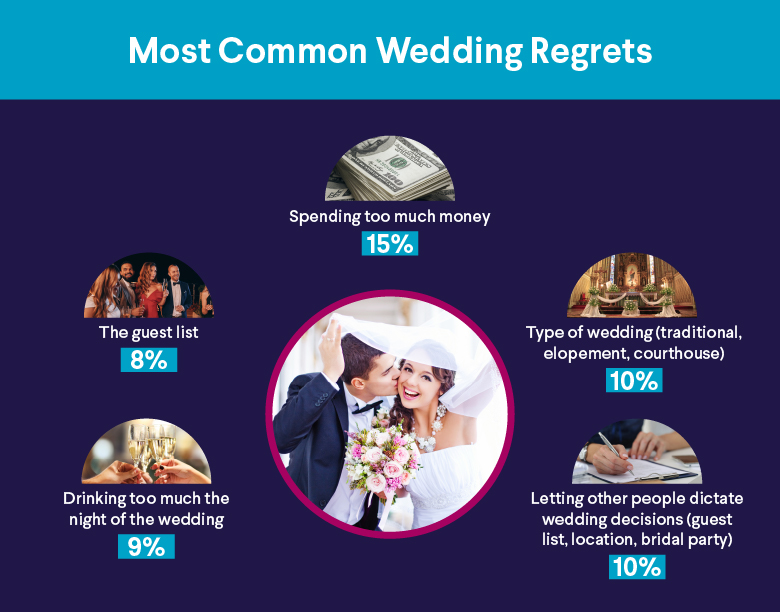
Most Common Wedding Regrets

The most common wedding regret? Spending too much money.

15% of respondents said their biggest wedding regret was spending too much money. Other common wedding regrets:

•   Type of wedding (traditional, elopement, courthouse): 10%

•   Letting other people dictate wedding decisions (guest list, location, bridal party): 10%

•   Drinking too much the night of the wedding: 9%

•   The guest list: 8%

You may have heard of a phenomenon called the “vacation mindset,” which drives travelers to splurge on special purchases they wouldn’t consider on their home turf. Well, a similar wedding mindset can push couples to indulge an uncharacteristic desire for luxury. “It’s a once-in-a-lifetime event! Your wedding should be as big as your love for each other!”

After the wedding, as the bills roll in, so does buyer’s remorse. And now, other big-ticket goals that took a backseat to the wedding — buying a home, having kids, expanding a business, or saving for the long term — now feel more urgent.

Nearly half (46%) of respondents who got married in 2020 or later had a nontraditional wedding (they eloped or got married in a courthouse).

Traditional or Not?

•   9% of people eloped. Of those, 6% had a reception with friends and family later.

•   25% of respondents got married in a courthouse. Of those, 18% had a reception with friends and family later.

The pandemic likely drove many couples to forgo big group events in favor of smaller celebrations. But there are other reasons behind the popularity of nontraditional weddings, according to several wedding vendors we spoke to:

3 Reasons to Have a Nontraditional Wedding

Financial goals:
“It’s no surprise that couples might want to scale back their wedding,” says Jim Campbell, founder of Honeymoon Goals. “They don’t want to spend years saving for an elaborate event when they could be saving for other things instead, like traveling together.”

Time:
“The last few years have shown people how much they value their free time,” observes Maddie Ward, of Sonnet Weddings. “Elopements and courthouse weddings are definitely lower-cost, but there’s also much less of a time investment in planning. The prospect of spending a year or more involved in a time-intensive endeavor with your partner has many people looking at alternatives.”

Stress:
“The No. 1 reason to scale back to a micro wedding or elopement is stress!” insists Lee Ramsay, of Lee Ramsay Events. “More guests means more money, and more money means more problems. Save your dollars, and avoid the headache of attempting to make everyone happy.”

The venue (23%) was among the biggest wedding expenses.

Of those who said the venue was the most expensive, the most commonly reported cost was $10,000 (11% of respondents). The most expensive venue cost reported? $500,000.

It’s safe to say that those who spent $10K on their venue had higher overall budgets. Those with smaller wedding budgets often got creative about the venue, choosing a park, beach, or private home or yard.

How Couples Save on Wedding Costs

Other common ways people saved money on their wedding venue were:

•   Limiting the number of guests: 31%

•   Using buffet or family-style food service: 29%

•   Booking a venue that didn’t require additional rentals (chairs, tables, tents): 26%

Nearly two-thirds (62%) of respondents had expenses pop up that they weren’t prepared for.

Sneaky Weddings Costs That Surprise Couples

The most common fee that snuck up on people? Marriage license and officiant fees: 23%.

Other common surprise costs reported by respondents:

•   Taxes and service charges: 17%

•   Pre-wedding events like the rehearsal dinner or welcome party: 15%

•   Meals for vendors: 13%

•   Overtime charges for vendors: 13%

•   Gratuities for vendors: 12%

•   Postage for stationery (invitations, RSVPs, thank you cards): 12%

82% of respondents who had a wedding planner said their planner helped them save money.

“Wedding planning is a lot like cooking. The more you do it, the better you get at it,” explains Jim Campbell. “The more weddings you plan, the better you get at saving money.”

According to The Knot, the average cost of a wedding planner is about $1,900. But a planner’s fee can vary widely widely depending on a number of factors:

•   Location: A destination wedding requires more coordination than a hometown ceremony.

•   Services required: A full-service planner costs more than someone hired to manage certain elements, such as the seating chart or budget.

•   Fee structure: Planners may charge a flat fee, hourly rate, or a percentage of your overall budget.

Only 25% of our respondents hired a wedding planner. (Another 13% said a planner was included with their venue.)

Ryan Mayiras, of Candid Studios wedding photography, thinks many couples don’t need a wedding planner. “Believe it or not, we recommend that most of our customers skip the wedding planner step. Good vendors will go out of their way to help couples plan their wedding,” he says. “We have a collection of timeline templates that we send to our customers for reference. They can skip the planner and go with a day-of coordinator instead. A coordinator is more affordable and will keep the event on schedule, so the couple doesn’t need to worry during the wedding itself.”

Who Paid for the Wedding?

Who paid for the wedding?

39% of respondents said the couple paid for the total cost of the wedding on their own. Of this group:

•   70% said their wedding cost less than $10,000.

•   88% said it cost less than $30,000.

45% of respondents said their parents helped pay for the wedding. 27% said their partner’s parents helped pay.

Aside from the venue, the biggest wedding expenses

Of those who said the food and drinks were the most expensive, the most commonly reported cost was $10,000 (10% of respondents). The next most commonly reported cost for food and drink was $1,000 (8% of respondents).

Those who said the rings were the most expensive reported a wide range of dollars spent. Regardless of the total wedding budget, many couples (35%) splurged on their rings. Here were some of the most commonly reported costs:

•   $300: 5%

•   $500: 7%

•   $1,000: 8%

•   $2,000: 7%

•   $2,500: 5%

•   $3,000: 6%

•   $5,000: 7%

Popular money-saving tactics

The most common ways people saved money on their wedding attire:

•   Shopped around for deals: 33%

•   Bought a dress off the rack: 26%

•   Rented suits: 23%

18% of people said they didn’t try to save money on attire.

The most common ways people saved money on their wedding vendors:

•   Did their own hair and makeup: 38%

•   Hired a friend to do photography/videography: 32%

•   Didn’t provide transportation for wedding party or guests: 30%

The most common ways people saved money on their wedding decor, stationery, and gifts:

•   DIYed decor: 26%

•   Didn’t give gifts to parents: 25%

•   Didn’t give gifts to out of town guests: 24%

Money-Saving Tip

Ashley Meyer of Meyer Photo Video offered other money-saving tips:

•   “Skip traditional paper invitations and stamps, and opt for email invitations.

•   “Save a few hundred dollars by asking a close friend or family member to get ordained online to officiate your wedding.

•   “Join local bridal Facebook groups to buy discounted wedding items from couples who already tied the knot. Couples sell everything from their wedding dress and veil to candles and signage.”

What couples splurged on

The most common splurge was the rings (35%). Other wedding items that respondents splurged on:

•   The food: 32%

•   The dress: 27%

•   The drinks: 23%

•   The venue: 20%

Many wedding planners we spoke with recommended splurging on photos. Yet only 17% of respondents said they splurged on photography/videography.

The real takeaway? Couples don’t have to splurge on anything. You may feel better after your big day if you save your splurging for a new home or fat retirement account.

Financing a Wedding

Should you need a bit of financial assistance to put your wedding savings over the top, a personal loan is a better option than high-interest credit cards. With low rates and no fees required, SoFi can put those final funds at your fingertips the same day as your approval. That way, rather than anticipating how you’ll pay the bills, you can relax and enjoy your wedding.

Learn how SoFi can help you finance your big day.


SoFi Loan Products
SoFi loans are originated by SoFi Bank, N.A., NMLS #696891 (Member FDIC). For additional product-specific legal and licensing information, see SoFi.com/legal. Equal Housing Lender.


Third-Party Brand Mentions: No brands, products, or companies mentioned are affiliated with SoFi, nor do they endorse or sponsor this article. Third-party trademarks referenced herein are property of their respective owners.

Non affiliation: SoFi isn’t affiliated with any of the companies highlighted in this article.

Financial Tips & Strategies: The tips provided on this website are of a general nature and do not take into account your specific objectives, financial situation, and needs. You should always consider their appropriateness given your own circumstances.

SOPL1023028

Read more
What Is a Margin Loan? Definition & Examples

Margin Loans: Definition, Examples, Pros & Cons

Margin loans are a type of loan that an investor takes out from a brokerage to buy investments. An investor typically borrows from a brokerage if they don’t have the cash balance in their trading account to cover the cost of a trade or investment – so, they use credit from their brokerage to cover the costs.

While there are risks associated with using margin and margin loans, they can also increase an investor’s purchasing power and bolster potential returns.

What Is a Margin Loan?

A margin loan is a loan from your brokerage to pay for securities that you can’t cover with cash. Similar to any other loan, you must apply for the account and be approved before you can borrow funds; and your brokerage will charge interest on any funds you borrow.

Having a margin account by definition enables you to take out a margin loan (the two are synonymous in many ways). Having the flexibility to buy securities on margin gives many traders the ability to take positions they might not have been able to afford otherwise. In fact, margin loans are a cornerstone to putting together effective day trading strategies, for advanced investors.


💡 Quick Tip: How to manage potential risk factors in a self-directed investment account? Doing your research and employing strategies like dollar-cost averaging and diversification may help mitigate financial risk when trading stocks.

Understanding Margin Loans

Understanding margin trading can be tricky, but for the average investor, all you really need to know is that a margin loan is essentially a short-term financing solution. If you want to buy securities, but don’t have the cash in your account, your brokerage may allow you to buy those securities using credit. It’s similar to a line of credit, in that way.

So, that’s what margin debt is: The result of a margin loan, in which a trader borrows money to buy securities.

How Margin Loans Work

While we’ve mostly been discussing margin loans in terms of trading and investing, they could be used for any purpose. But almost always, a margin loan is used to buy securities.

As for the process of how they actually work: A margin loan is more or less like any other loan. To get one, you’ll need to apply and qualify for margin on your brokerage account (typically called a “margin account”).

Margin Accounts and How They Work

Like other forms of lending, margin loans have strict criteria. In addition, these accounts are governed by industry regulations as well as the policies of individual institutions, so be sure to understand how your desired margin account works. Each brokerage has different rules and eligibility requirements, and FINRA, for example, also requires you to deposit a minimum of $2,000 or 100% of the security’s purchase price, whichever is less. This is the “minimum margin.” Some firms may require you to deposit more than $2,000.

If you’re approved for a margin account, you’re able to trade using a margin loan — up to a certain amount. According to Regulation T of the Federal Reserve Board, you may borrow up to 50% of the purchase price of securities that can be purchased on margin.

This is known as the “initial margin.” Some firms require you to deposit more than 50 percent of the purchase price. (Also be aware that not all securities can be purchased on margin. Only those deemed “marginable” can be traded on margin.)

If you have $5,000 in your brokerage account, and you want to buy stock X, which is valued at $50 per share, with a 50% margin you could buy 50% more than your cash balance: 200 shares instead of 100. But half of those (100 shares) would’ve been purchased on margin — so, you’d need to settle up your account at some point, if or when you decide to sell your shares (hopefully for a profit).

Increase your buying power with a margin loan from SoFi.

Borrow against your current investments at just 4.75% to 9.50%* and start margin trading.


*For full margin details, see terms.

How Margin Interest Works

The other important thing to remember about margin loans is that they are, like pretty much all loans, subject to interest charges. Your brokerage is going to charge you for the money you borrow.

Margin interest is a big topic unto itself, but the key takeaway is to know that you’ll be on the hook for paying your brokerage back for the money you borrow, plus interest charges.

You’re probably thinking: “Can I avoid paying margin interest?” The answer is that it depends on how fast you can pay your margin balance back. Most brokerages will charge interest by the day and add the charges to your account monthly. So, if you have cash or can sell securities and pay your balance off before interest accrues, it’s possible.


💡 Quick Tip: How do you decide if a certain trading platform or app is right for you? Ideally, the investment platform you choose offers the features that you need for your investment goals or strategy, e.g., an easy-to-use interface, data analysis, educational tools.

Margin Loan Pros and Cons

Marginal loans can be highly useful for traders and investors. But like almost any financial instrument, margin loans have their pros and cons.

The biggest upside of margin is that it can open up a new swath of investing choices for traders. That means increasing their buying power, and allowing them to buy securities that may have otherwise been too expensive. This can increase potential profitability, too.

Conversely, traders who aren’t careful can’t quickly find themselves in debt if one of their trades backfires.

There are also interest charges to consider, as discussed. And if things really go sideways, some traders may experience a “margin call,” which is when your brokerage sells your assets without warning to settle up or get your account balance back within its requirements.

Here’s a quick rundown:

Margin Loans: Pros & Cons

Pros

Cons

Increased trading capacity Traders can accumulate debt
Traders can buy pricier securities Interest charges
Increased potential gains Potential margin calls

Typical Margin Loan Rates

Margin loan rates, or, the interest rate charged by a brokerage for using margin, vary. Brokerages make the information available to traders and investors, so finding what types of margin loan rates you’re subjected to usually just requires a little research (or a call to your broker).

As mentioned, a brokerage will probably charge different interest rates depending on your overall margin balance, and how much you’ve borrowed. Lower balances are typically charged higher interest rates.

Here are some hypothetical examples: Let’s say Brokerage ABC’s margin interest rates vary between 4% and 8%, depending on the trader’s balance. Traders using up to $24,999 in margin will be subject to the highest interest rate (8%), whereas traders with more than $1 million in margin debit are subject to the 4% rate.

Brokerage B, however, has a different scale, with traders in margin debt up to $24,999 subject to 8.5% interest, and those with balances between $500,000 and $999,999 subject to 6.5%.

So, while brokerages do vary in what they charge for margin loan rates, they tend to be similar. To know your exact rate, contact your brokerage, or look up the current rate schedule on the company’s website.

The Takeaway

Margin loans are similar to any other type of loan, but are typically used for the purpose of buying stocks or other securities. Once you’ve applied for and been approved for a margin account, which is akin to adding a line of credit to your existing brokerage account, you’ll have the flexibility to buy more investments than if you were relying only on cash.

That said, you’re on the hook for repaying the money you’ve borrowed, with interest. If you’ve made a profitable investment, this shouldn’t be a problem. But if you invest in stock X on margin, say, and the price drops, you would still owe the full amount you’d borrowed to buy the stock, plus interest.

Invest in what matters most to you with SoFi Active Invest. In a self-directed account provided by SoFi Securities, you can trade stocks, exchange-traded funds (ETFs), mutual funds, alternative funds, options, and more — all while paying $0 commission on every trade. Other fees may apply. Whether you want to trade after-hours or manage your portfolio using real-time stock insights and analyst ratings, you can invest your way in SoFi's easy-to-use mobile app.

Opening and funding an Active Invest account gives you the opportunity to get up to $1,000 in the stock of your choice.¹

FAQ

Can you withdraw a margin loan?

Yes, it’s possible to withdraw a margin loan, although the specifics will depend on an individual brokerage, as will any applicable interest charges.

Are margin loans a good idea?

Margin loans can be useful for many investors and traders, and whether or not they’re a good idea will depend on the specific individual considering taking one out. They do have risks, but upsides, too.

How do I pay back my margin loan?

The simplest ways to pay back margin loans are to either deposit cash into your brokerage account to get the balance back to zero, or to sell holdings that will result in a positive or neutral balance.

How much collateral is required for a margin loan?

The collateral required to take out a margin loan depends on a specific brokerage, but it’s not uncommon for brokerages to require somewhere between 30%, 40%, or 50%.

What happens if you can’t pay back a margin loan?

If you can’t pay back a margin loan, the brokerage will likely reach out to see what can be done, or lock you out of your account. Further, it could end up liquidating securities in your portfolio in order to cover the debt.

Photo credit: iStock/Sergey Nazarov


INVESTMENTS ARE NOT FDIC INSURED • ARE NOT BANK GUARANTEED • MAY LOSE VALUE

SoFi Invest is a trade name used by SoFi Wealth LLC and SoFi Securities LLC offering investment products and services. Robo investing and advisory services are provided by SoFi Wealth LLC, an SEC-registered investment adviser. Brokerage and self-directed investing products offered through SoFi Securities LLC, Member FINRA/SIPC.

For disclosures on SoFi Invest platforms visit SoFi.com/legal. For a full listing of the fees associated with Sofi Invest please view our fee schedule.

Financial Tips & Strategies: The tips provided on this website are of a general nature and do not take into account your specific objectives, financial situation, and needs. You should always consider their appropriateness given your own circumstances.


¹Probability of Member receiving $1,000 is a probability of 0.026%; If you don’t make a selection in 45 days, you’ll no longer qualify for the promo. Customer must fund their account with a minimum of $50.00 to qualify. Probability percentage is subject to decrease. See full terms and conditions.

SOIN1023012

Read more

Best Types of Loans for Home Improvement

A higher resale value of your home is one of the many rewards for carrying out home improvements and renovations. But remodeling projects cost money, and financing them can be expensive, depending on the amount you borrow and the type of loan you use.

Options for home improvement financing include home equity loans (HELOCs), home equity lines of credit, and cash-out refinancing. These types of financing allow homeowners to borrow against the equity they have built up in their home. Other financing options are personal loans, credit card financing, and government programs. Any of these could be the best option depending on the circumstances.

Here’s what homeowners need to know about the different types of home improvement loans and what factors they should consider before settling on a lender.

1. Home Equity Loans

If you have built up equity in your home, which means you have paid off a portion of your mortgage, a home equity loan could be the right choice to finance home improvements. To find out how much equity you have, subtract the balance due on your mortgage from the assessed value of your home. For example, if your home is worth $400,000 and you owe $200,000 on your mortgage, you have $200,000 in equity. A bank will let you borrow up to a certain percentage of that amount — up to 100% in some cases.

A home equity loan acts like an additional mortgage, where the homeowner pays back the loan in monthly payments. The payments are in addition to the original mortgage payments. Home equity loans often have low fixed interest rates because the home is used as collateral for the loan. However, there are closing costs to consider that could be between 2% to 5% of the loan amount.

On the plus side, home equity loans usually qualify for the mortgage interest tax deduction as long as the funds are used to substantially improve the home.

If you have plenty of equity and need a sizable amount to finance a big project, a home equity loan could make sense. You will receive a lump sum payment, and the improvements you make may increase the value of your home.

Advantages of a Home Equity Loan

Disadvantages of a Home Equity Loan

Low interest and terms from five to 30 years There are origination fees and closing costs
You can borrow up to 100% of your home’s equity Funds are disbursed as one lump sum, so borrowers need to budget carefully
The interest is tax deductible The monthly payments add to existing mortgage payments


💡 Quick Tip: Before choosing a personal loan, ask about the lender’s fees: origination, prepayment, late fees, etc. One question can save you many dollars.

2. Home Equity Line of Credit (HELOC)

A home equity line of credit also borrows against the equity you have built up in your home. But the funding works more like a credit card and is not distributed as a lump sum payment. A bank will allow a qualified homeowner to borrow up to a preapproved limit and then pay it back. HELOC loan terms are typically between five and 20 years.

Interest rates differ for HELOCs because they are adjustable and rise and fall over the life of the loan. However, interest is only due on the outstanding balance — the amount borrowed — not the full credit limit.

The amount you can borrow through a HELOC depends on your credit score, income, and the value of your home. Your lender can change the loan terms, too. For example, if your credit score drops during the loan term, your lender may reduce the amount you can borrow.

One advantage of a HELOC is that you can use funds from the line of credit, make payments, and then borrow again. A HELOC is a better option if you have smaller projects to do over a longer term. You can borrow as you go, only pay interest on how much you use, and avoid paying closing costs.

Advantages of a HELOC

Disadvantages of a HELOC

No closing costs Interest rates may go up and down
Interest payments are tax deductible Interest rates are typically higher than those for a home equity loan
You only pay interest on the amount you use Your lender can change the amount you can borrow and the repayment terms

3. Cash-Out Refinancing

Another option to fund home improvements is cash-out refinancing. In the case of cash-out refinancing, a homeowner takes out a new mortgage that is higher than their original mortgage. The borrower then pays off the original mortgage and uses the leftover cash to fund home improvements. The amount of cash they can access depends on the equity they have in the home.

For example, let’s say the homeowner currently owes $100,000 on a $300,000 mortgage. They take out a new mortgage for $350,000, pay off the old mortgage ($300,000), and now have $50,000 left to spend on home improvements. The catch is that their new monthly mortgage payments will be higher because they have increased the size of the loan, and they will have to pay origination fees and closing costs.

Money from refinancing does not have to be used to improve a home; it can be used to consolidate debt, pay for school, or anything else the borrower wants to use it for. Also, the cash is not considered income from the IRS and is not taxable.

Cash-out refinancing may be a good option if interest rates have dropped since you took out your original mortgage. You can take out cash and pay a lower interest rate on the new loan. You might also be able to reduce the term length of your original mortgage and pay off your home loan sooner. This will be the case if the total cost of your new loan including closing costs is less than the total cost of your original mortgage.

Advantages of Cash-Out Refinancing

Disadvantages of Cash-Out Refinancing

You will still have one monthly mortgage payment Your new mortgage will have a higher balance
You might be able to lower your interest rate and loan term Your loan term will start from the beginning, so you will be paying off your mortgage for longer
You can use the cash for anything If interest rates have gone up, your monthly payments may be higher

4. FHA 203(k) Rehab Loan

An FHA 203(k) rehab loan is a loan taken out at the time of the home’s purchase. These loans are typically used for a fixer-upper, when the owners need funding right away for improvements. This could be the best type of loan for home improvements for big projects. The advantages of this type of loan for the borrower are that they have funds available for improvements from the outset, and they only have to pay back one loan with one set of closing costs.

These loans are also backed by the government and come with benefits. Borrowers can qualify with a less-than-stellar credit score (typically, a minimum of 620), and the down payment expected is lower than it would be for a traditional mortgage loan (as low as 3.5%).

Two things to remember are that the renovation costs must exceed $5,000 for the borrower to qualify for this type of loan, and the closing process can take a long time. Lastly, work covered under an FHA 203(k) loan must start within 30 days of closing, and projects must be completed within six months.

This type of loan may be worth considering if you are buying a fixer-upper that requires significant work, and your credit score qualifies you for this type of loan.

Advantages of a FHA 203(k) Rehab Loan

Disadvantages of a FHA 203(k) Rehab Loan

One loan and one set of closing costs Only old homes or homes in bad repair may qualify
Federally-backed with low interest rates and low closing costs You are likely to be charged costly monthly mortgage insurance
You can qualify with a lower credit score Cash must be used for specific home improvements

5. Personal Loans

If you don’t have sufficient equity in your home to take out a home equity loan or a HELOC, a personal loan is an option. A personal loan will come with a higher interest rate, adjustable or fixed, because this type of personal loan is unsecured. Your home is not used as collateral. These loans are processed much quicker than home equity loans or HELOCs, sometimes the same day.

Personal loan terms are shorter, from two to five years, which will mean higher monthly payments, and you’ll have to pay closing costs.

These loans may work if you lack equity or if you have an emergency, such as a broken water heater or HVAC system. That said, they are probably one of the most expensive borrowing options.

Advantages of a Personal Loan

Disadvantages of a Personal Loan

Fast financing Higher interest rate than mortgage loans
You can qualify for a good interest rate even with an average credit score Shorter terms, which increases monthly payments
Your home is not used as collateral and is not at risk Fees and possible prepayment penalties

6. Credit Cards

A credit card can be used for financing, and it’s a fast, simple way to access funds. The amount you can spend on improvements will depend on your credit limit (although you could use multiple cards), and the interest charges are likely to be much higher than other financing options.

A credit card can be a good option if you think you can finish your renovations quickly and pay off the balance on the card. Look for cards with an introductory 0% annual percentage rate (APR). Some cards allow you up to 18 months to pay back the balance at that introductory rate. If you can pay off the balance by the deadline, that’s interest-free financing. However, check for fees and other hidden costs.

The danger here is that if you don’t pay off the balance by the end of the interest-free rate, the interest charges can skyrocket. That’s why credit cards should not be used for long-term financing.

A credit card can be a great option for home improvement financing if you can find one with a low introductory rate, low fees, and you are confident you can pay off the balance within the introductory rate period.

Advantages of Credit Card Financing

Disadvantages of Credit Card Financing

Fast financing High interest rates, particularly after a low introductory interest rate period has expired
Some cards offer 0% introductory rates Possibly low credit limits
Less paperwork High fees

7. Government Assistance Programs

The federal government has grants and programs that can help homeowners pay for renovations. Two home renovation loan options are Title I loans and Energy Efficient Mortgages. Lenders for Title I property improvement loans for your state are listed on the U.S. Department of Housing and Urban Development’s website.

Title I Loans

An FHA Title 1 loan is a fixed-rate loan used for home improvements and rehabilitation. Loans under $7,500 are usually unsecured, but bigger loans may use your home as collateral. These loans may be used in conjunction with a 203(k) rehabilitation mortgage.

The maximum loan terms are between 12 and 20 years, and loan amounts are $7,500 to $60,000, depending on the home’s size and type.

The loan must be used for property improvements, and an FHA mortgage insurance premium of 1% of the loan amount will be added to your interest rate. There is no minimum credit score required, but your debt-to-income ratio may factor into your loan terms.

Energy Efficient Mortgage

FHA’s Energy Efficient Mortgage program (EEM) finances energy-efficient improvements with their FHA-insured mortgage. The borrower must qualify for the loan amount used to purchase or refinance a home. However, they’re not required to be qualified on the total loan amount that includes the amount used to finance energy-efficient improvements. The FHA insures the loan to protect the lender against loss in the event of payment default.

Starting in 2023, homeowners can also get tax credits for some energy-efficient updates, including windows, insulation, new doors, heat pumps, and air conditioners.

These types of programs will reduce the cost of financing for home improvements and are great options if you meet the criteria.

Advantages of Government-Assisted Financing

Disadvantages of Government-Assisted Financing

Low interest rates Financing must be used for property improvements.
Broad range of loan terms Strict qualification standards
Tax credits Larger loans may require your home as collateral.

How to Decide the Best Type of Home Improvement Loan for You

If you’re trying to decide what home improvement loan is best for you, consider the following factors:

Are You Purchasing a Fixer-Upper?

If you are buying a fixer-upper, check if you qualify for either an FHA 203(k) rehab loan or a government-assisted program. You may get cheaper financing this way.

Do You Need Funds Right Away?

If you need funds quickly — for example, you have a broken heat pump or HVAC system — a personal loan or credit card financing are options to explore.

Do You Have Equity Available?

If you have built up equity, a home equity loan or line of credit will provide cheaper financing than a personal loan and over a longer term, so that your monthly payments will be lower. A cash-out refinancing loan might also mean that you could lower your payments and reduce your term if interest rates have dropped significantly since you took out your original mortgage.

How to Get a Home Equity Loan

The first step in getting a home equity loan is to decide which loan is best for your situation. Next, find a lender with the best terms and fill out an application to see if you qualify.

1. Check Your Financial Health

The better your credit score, the better the loan terms will be. If you can boost your credit score before you apply for financing, you’ll boost your chances of getting a better deal. Lenders will also look at your debt-to-income ratio when setting the interest rate and term, so lowering your debt before you apply for a home improvement loan can help lower the cost of your financing.

2. Compare Lenders

You should contact a few different lenders to compare their rates and loan terms. Look for benefits, such as rate discounts for enrolling in autopay, and watchouts, such as late payment fees and minimum loan amounts.

3. Gather Documentation

You will need to submit a few basic pieces of information when you apply for a loan. As a general guide, you will need:

•  Proof of income, such as W-2s or 1099s, bank statements, pay stubs, or tax returns.

•  Proof of residence, such as your Social Security number and utility bills.

Your current debts, housing payment, and total income will also play a role. Be sure to have all the information your lender may need on hand when you apply to speed up the application process.


💡 Quick Tip: With home renovations, surprises are inevitable. Look for a home improvement loan with no fees required — and no surprises.

4. Apply for Prequalification

Some lenders will prequalify you, which will tell you your interest rate and how much your monthly payments will be. Prequalification should not affect your credit score, whereas a formal loan application could. Applying for too many loans in a short space of time could lower your credit score.

5. Complete the Loan Application Process

Your loan application might be fully online, via phone and email, or in person at a local branch. In cases where you are borrowing against equity, your lender may require a home appraisal. Provided your finances are in good shape, the lender should approve your application, and you’ll receive funding.

How Your Credit Affects Your Home Improvement Loans

Your credit score will affect the total cost of a home improvement loan. The higher your score, the less of a risk you pose to a lender, so the better the loan terms will likely be for a mortgage or long-term loan. The same goes for credit cards and personal loans. Also, if you have good credit, you’ll probably have an easier time securing a home improvement loan.

Can You Use Home Equity Loans for Non-Home Expenses?

Home equity loans and HELOCs are flexible and can be used for anything, not just home expenses or renovations. However, these loans are best suited for long-term, ongoing expenses like home renovations, medical bills, or college tuition.

The Takeaway

The types of loans for home improvements include loans based on the equity you have built up in your home, such as a home equity loan, a HELOC, or cash-out refinancing. You can also use personal loans, credit card financing, and government programs. Loans based on equity tend to cost less over the loan’s lifetime, but they also tend to have longer loan terms. Equity-based loans also tend to be best when you need to borrow a larger amount, because you can spread out the cost over a longer period.

A personal loan will have a higher interest rate and a shorter term, but the higher your credit rating, the better the interest rate tends to be. Alternatively, credit card financing is favorable if you need funds quickly, the amount you need is not too high, and you can take advantage of a 0% introductory rate and pay off the balance before the rate expires.

Think twice before turning to high-interest credit cards. Consider a SoFi personal loan instead. SoFi offers competitive fixed rates and same-day funding. See your rate in minutes.


SoFi’s Personal Loan was named a NerdWallet 2026 winner for Best Personal Loan for Large Loan Amounts.

FAQ

What type of loan is best for home improvements?

The type of loan that is best for home improvements depends on your finances and how much you need to spend. If you hold a fair amount of equity and need a sizable amount of cash, a home equity loan, HELOC, or cash-out refinancing may be good options. Cash-out refinancing might be particularly appealing if interest rates have dropped, and you can refinance with better loan terms.

If, on the other hand, you have a smaller project that you expect to complete in a short timeframe, using a credit card that gives a 0% interest rate for a period could be the way to go.

What is the best renovation loan?

If you’re taking on a big project, buying a fixer-upper or planning to renovate an older home, you may want to consider the FHA 203(k) mortgage. The 203(k) rehab loan lets you consolidate the home and renovation costs into a single remodel home loan and avoid paying double closing costs and interest rates.

If your home is newer or higher-value and you have equity, cash-out refinancing can be a good option, particularly if interest rates have dropped.

Should I use a personal loan for home improvements?

Personal loans are a more expensive option for home improvements, especially if your credit score is average. However, using a personal loan for home improvements might be the best option if you don’t have a lot of equity to borrow from.

Are home improvements tax deductible?

Home improvement loans are generally not tax deductible. However, if you use a refinance or home equity loan, some of the costs might be tax deductible. Check with a CPA or tax specialist.

What credit score is needed to get a home improvement loan?

Credit score requirements for a home equity loan depend on the lender. A credit score in the mid-600s might be enough to be approved by some lenders, while others might not approve you with a score above 700. Lenders consider many factors, including your debt-to-income ratio and equity in the home, when considering you for a home equity loan.


Photo credit: iStock/Hero Images

SoFi Loan Products
SoFi loans are originated by SoFi Bank, N.A., NMLS #696891 (Member FDIC). For additional product-specific legal and licensing information, see SoFi.com/legal. Equal Housing Lender.


Non affiliation: SoFi isn’t affiliated with any of the companies highlighted in this article.

External Websites: The information and analysis provided through hyperlinks to third-party websites, while believed to be accurate, cannot be guaranteed by SoFi. Links are provided for informational purposes and should not be viewed as an endorsement.
Financial Tips & Strategies: The tips provided on this website are of a general nature and do not take into account your specific objectives, financial situation, and needs. You should always consider their appropriateness given your own circumstances.

SOPL0423002

Read more
TLS 1.2 Encrypted
Equal Housing Lender