A preferred provider organization (PPO) is a type of health care plan that offers lower out-of-pocket costs to members who use doctors and other providers who are part of the plan’s network.
These preferred providers have signed onto the network at a lower negotiated rate than they might charge outside of the network.
PPOs also offer members the flexibility to see providers outside of the plan’s network, although they will most likely pay more in out-of-pocket costs to do so.
To learn more about PPOs, and how this type of plan compares to other health insurance options, read on.
Key Points
• PPO plans offer flexibility to see any healthcare provider, with lower costs for in-network services.
• PPOs provide access to a large, geographically diverse network of providers.
• No referrals are needed to see specialists, enhancing convenience.
• Monthly premiums for PPOs are typically higher than for HMOs and HDHPs.
• Out-of-network care incurs significantly higher out-of-pocket expenses.
How Does PPO Insurance Work?
When you join a PPO health plan, you’re joining a managed care network that includes primary care doctors, specialists, hospitals, labs, and other healthcare professionals. PPO networks tend to be large and geographically diverse.
If you see a preferred provider, you will likely pay a copay, or you might be responsible for a coinsurance payment (after you meet the health care plan’s deductible).
While you are free to see any health care provider whether or not they are in the PPO network, if you see a provider outside of the network, you may pay significantly more in out-of-pocket costs. In return for flexibility, large networks, and low in-network cost sharing, PPO plans typically charge higher premiums than many other types of plans.
PPOs are a common, and often a popular, choice for employer-sponsored health insurance.
What Are the Costs of Going Out of the PPO’s Network?
If you see a provider who is not part of the plan’s network, you will likely be expected to bear more of the cost. PPOs typically use what’s called a “usual, customary, and reasonable” (UCR) fee schedule for out-of-network services.
Insurers calculate UCR fees based on what doctors in the area are charging for the same service you were provided.
If your doctor charges more than what your insurance company determines to be usual, customary, and reasonable, you most likely will be charged for the difference between the amount charged for the service and the amount covered by your insurer.
Depending on where you live and the service you received, this difference could be significant. It may also come as a surprise to policyholders who assume their medical costs will be covered and don’t fully understand the distinction between in-network and out-of-network providers.
A good way to avoid surprise charges with a PPO (or any health plan) is to talk to your provider and your insurer before you receive treatment about the total cost and what will be covered.
How PPOs Compare to Other Types of Health Care Plans
HMOs typically offer lower premiums and out-of-pocket costs than PPOs in exchange for less flexibility.
Unlike a PPO, HMO members typically must choose a primary care physician from the plan’s network of providers. Care from providers out of the HMO network is generally not covered, except in the case of an emergency.
Also unlike a PPO, an HMO’s network of providers is usually confined to a specific local geographic area.
Another key difference between these two types of plans: HMO members typically must first see their primary care doctor to get a referral to a specialist. With PPOs, referrals are not usually required.
PPOs are also often compared to point of service (POS) plans.
POS plans are generally a cross between an HMO and a PPO. As with a PPO, POS members typically pay less for care from network providers, but may also go out of network if they desire (and potentially pay more).
Like an HMO, POS plans require a referral from your primary care doctor to see a specialist.
PPOs (as well as HMOs and POS plans) are very different from high deductible health plans, or HDHPs.
HDHPs charge a high deductible (what you would have to pay for health care costs before insurance coverage kicks in).
This means that you would need to pay for all of your doctor visits and other medical services out of pocket until you meet this high deductible. In return for higher deductibles, these plans usually charge lower premiums than other insurance plans.
You can combine a HDHP with a tax-advantaged health savings account (HSA). Money saved in an HSA can be used to pay for qualified medical expenses.
HDHPs are generally best for relatively healthy people who don’t see doctors frequently or anticipate high medical costs for the coming year.
As with all health insurance options, PPOs have both advantages and disadvantages. Here are a few to consider.
Advantages of PPOs
• Flexibility. PPO members typically do not have to see a primary care physician for referrals to other health care providers, and they may see any doctor they choose (though they may pay more for out-of-network providers).
• Lower costs for in-network care. Out-of-pocket costs, such as copays and coinsurance, for care from in-network providers can be lower than some other types of plans.
• Large provider networks. PPOs usually include a large number of doctors, specialists, hospitals, labs, and other providers in their networks, spanning across cities and states. As a result, network coverage while traveling or for college student dependents can be easier to access than with more restricted plans.
Disadvantages of PPOs
• High premiums. In return for flexibility, PPO members can expect to pay higher monthly premiums than they may find with other types of plans.
• High out-of-pocket costs for out-of-network care. Depending on where you live, the treatment you receive, and how your insurer calculates “usual, customary, and reasonable” fees, you may find you are responsible for a large portion of the bill when you receive care outside of the PPOs network.
• Might be more insurance than you need. If you rarely see doctors and wouldn’t mind potentially switching doctors, you may be able to save money by going with an HMO or a HDHP.
The Takeaway
PPOs are a popular type of health plan because of the flexibility, ease of use, and wide range of provider choices they offer. PPO networks tend to be large and varied enough to include a patient’s existing doctors. If not, members still have the option of going out-of-network and receiving at least some coverage from a PPO. PPO members pay for this flexibility, however.
PPOs typically come with higher premiums, along with extra costs associated with out-of-network care. That can be prohibitive for many consumers.
Your employer’s benefits department or an experienced insurance agent or broker can help you compare PPOs to other types of health care plans and determine which choice is right for your health care needs and your budget.
Take control of your finances with SoFi. With our financial insights and credit score monitoring tools, you can view all of your accounts in one convenient dashboard. From there, you can see your various balances, spending breakdowns, and credit score. Plus you can easily set up budgets and discover valuable financial insights — all at no cost.
Find affordable auto, life, homeowners, and renters insurance with SoFi Protect.
FAQ
What is a disadvantage of having an HMO?
One drawback of PPO plans is that they’re often more expensive than HMO plans. Monthly premiums are usually higher, and you’ll likely have to pay more out of pocket if you see doctors who are out of the plan’s network.
What does PPO mean?
PPO stands for preferred provider organization. It’s a type of health care plan that offers lower out-of-pocket costs to members who see health care providers who are part of the PPO plan’s network.
Is having a PPO worth it?
It depends. PPOs tend to have large networks, which can make them a good choice for someone who travels frequently within the U.S. or lives in two different states.
Auto Insurance: Must have a valid driver’s license. Not available in all states.
Home and Renters Insurance: Insurance not available in all states.
Experian is a registered trademark of Experian.
SoFi Insurance Agency, LLC. (“”SoFi””) is compensated by Experian for each customer who purchases a policy through the SoFi-Experian partnership.
Financial Tips & Strategies: The tips provided on this website are of a general nature and do not take into account your specific objectives, financial situation, and needs. You should always consider their appropriateness given your own circumstances.
If you’ve ever wondered about the difference between an available balance vs. current balance for your bank account, know that a current balance reflects the amount of money in a checking or savings account at any given moment. The available balance, on the other hand, shows you the current balance, plus or minus any transactions that are pending but have not yet been processed fully. The available figure is what you can actually spend at that moment.
Financial institutions share these two balances with their customers to give as detailed a picture of funds on deposit as possible. While it may be confusing at first glance, once you understand the difference, it can actually help you stay in better control of your cash.
Read on to learn more about current vs. available balances on your bank accounts.
Key Points
• Current balance reflects the amount of money in an account at any given moment.
• Available balance shows the current balance minus any pending transactions that have not been fully processed.
• Current balance includes both credits and debits, while available balance represents the amount available for spending.
• The time it takes for a current balance to become an available balance depends on the processing time of pending transactions.
What Is a Current Balance?
The current balance of an account is a reflection of the amount of funds that are moving throughout a checking account or savings account at any given time.
This is a compilation of both credits and debits — incoming and outgoing funds — within an account. It includes transactions that have been completely processed on both ends and posted to an account.
Pending transfers or payments that have been authorized but have not been fully processed yet may be listed in your transaction history but are not included in the tally. So any debit card payments, mobile deposits, or automatic bill payments that haven’t been fully processed will not be calculated into the current balance.
As an example, say Brian’s checking account balance is $200.
• On Monday, his employer deposits an $800 payment into his account that clears and posts on the same day, raising Brian’s current balance to $1,000.
• On Wednesday, Brian uses his debit card to pay $100 for dinner, and the restaurant places a hold on his account for the amount. Because the payment is pending and awaiting processing, Brian’s current balance is still $1,000.
• However, if on Friday the restaurant charge is fully processed and posted onto his account, his current balance would drop to $900.
What Is an Available Balance?
An available balance is the current balance of a checking account or whatever type of savings account you may have, minus any pending payments and deposits. In essence, it takes the total amount of all fully processed and posted credits and debits and subtracts the total amount of any pending payments that have yet to be fully processed. This provides a more accurate reflection of the money in your account that remains available to be spent.
For example, Danielle’s checking account balance is $500. She uses her debit card to pay a $100 internet bill, and her landlord cashes her $300 check for her rent — both payments appear on her account as pending.
Despite her current balance being $500, her available balance is only $100 due to the pending payments. If she were to make other payments totaling more than $100, she will risk an overdraft fee and having a negative bank balance.
What Is the Difference Between Current Balance and Available Balance?
If an account goes a week or two without any activity, its available balance and current balance will likely be in sync. However, once purchases and payments are made with a debit card linked to your checking account, that is when the available balance is likely to fluctuate.
The key difference between a current balance and an available balance is “promised payments.” A current balance is the total amount of money in an account including money that has been promised to other people or businesses. An available balance, on the other hand, is the specific amount of money available that has not been promised to any person or business. While spending the full amount of a current balance with pending payments could result in overdraft or NSF fees, spending the full amount of an available balance should not.
Generally, when a current balance and available balance differ, here’s the likely situation:
• The available balance is the lower of the two, and it’s nearly always due to a pending payment.
• In some less common cases, an available balance may appear larger than the current balance. This could be due to receiving a refund from a purchase or the reflection of a bank overdraft protection buffer on an account. Either way, in this case, it would be wise to contact your bank for a better understanding of your current account standing.
How Long Does It Take for a Current Balance to Become an Available Balance?
The amount of time it takes for an available balance to sync back up with a current balance depends on the specific amount of processing time needed to complete each pending transaction.
Those times can vary depending on the type of transaction and how quickly the establishment processes it. The account holder’s ability to refrain from spending with their debit card and adding more pending payments to the account is also a major factor.
As a general rule of thumb, individual pending payments can take as little as 24 hours or as long as five days to be completely processed and posted to an account. The process requires communication and confirmation between the banks of the account owner and the establishment they purchased from. Some transactions, especially international ones, can take longer than others to be completed.
If a transaction remains pending for up to a week, it would be wise to contact the merchant or your bank for clarity.
Which Balance Should I Rely On?
The current balance and available balance each serve their own purpose, and both can be relied upon as an accurate representation of a checking or saving account. However, there are specific instances when it would be better to reference one over the other.
• If you’re planning on making a purchase or withdrawal, that is an instance where it would be more beneficial to reference the available balance on your account. It’s the best way to know exactly how much money is available to be spent without disrupting any other pending payments.
Checking the available balance will give the most exact account of what is freely available to be spent and will also help you avoid incurring any overdraft fees.
• If you’re more interested in your account balance as a whole and how much money you have flowing through your account at any given time, that is when you’ll want to reference your current balance. It accounts for every dollar entering and exiting your account at the very moment you check it.
Do keep in mind, however, that the available balance total may change quickly due to pending transactions, therefore it would be wise to check it daily for the most up-to-date tally.
Your available balance shows how much money is available in your account at a given moment, while the current balance also includes pending transactions that are still being processed. Knowing what your account balances mean and how to interpret them is a basic but important financial skill that can help you manage your money better.
Interested in opening an online bank account? When you sign up for a SoFi Checking and Savings account with eligible direct deposit, you’ll get a competitive annual percentage yield (APY), pay zero account fees, and enjoy an array of rewards, such as access to the Allpoint Network of 55,000+ fee-free ATMs globally. Qualifying accounts can even access their paycheck up to two days early.
Better banking is here with SoFi, NerdWallet’s 2024 winner for Best Checking Account Overall.* Enjoy 3.30% APY on SoFi Checking and Savings with eligible direct deposit.
FAQ
Why are my current and available balance different?
Your available balance shows how much is currently in your account for spending or paying others. The current balance reflects transactions that are still processing, such as a deposit that hasn’t fully cleared yet.
How long does it take for a current balance to become an available balance?
The amount of time it takes for bank transactions to clear can take a matter of hours to several days, depending on the details. For instance, if you are waiting for an international check to clear, it could take around five days.
Can I spend my available balance or my current balance?
Your available balance is what is available for spending, while your current balance shows you the amount that will be in your account once the transactions that are processing are fully cleared.
Photo credit: iStock/fizkes
SoFi Checking and Savings is offered through SoFi Bank, N.A. Member FDIC. The SoFi® Bank Debit Mastercard® is issued by SoFi Bank, N.A., pursuant to license by Mastercard International Incorporated and can be used everywhere Mastercard is accepted. Mastercard is a registered trademark, and the circles design is a trademark of Mastercard International Incorporated.
Annual percentage yield (APY) is variable and subject to change at any time. Rates are current as of 12/23/25. There is no minimum balance requirement. Fees may reduce earnings. Additional rates and information can be found at https://www.sofi.com/legal/banking-rate-sheet
Eligible Direct Deposit means a recurring deposit of regular income to an account holder’s SoFi Checking or Savings account, including payroll, pension, or government benefit payments (e.g., Social Security), made by the account holder’s employer, payroll or benefits provider or government agency (“Eligible Direct Deposit”) via the Automated Clearing House (“ACH”) Network every 31 calendar days.
Although we do our best to recognize all Eligible Direct Deposits, a small number of employers, payroll providers, benefits providers, or government agencies do not designate payments as direct deposit. To ensure you're earning the APY for account holders with Eligible Direct Deposit, we encourage you to check your APY Details page the day after your Eligible Direct Deposit posts to your SoFi account. If your APY is not showing as the APY for account holders with Eligible Direct Deposit, contact us at 855-456-7634 with the details of your Eligible Direct Deposit. As long as SoFi Bank can validate those details, you will start earning the APY for account holders with Eligible Direct Deposit from the date you contact SoFi for the next 31 calendar days. You will also be eligible for the APY for account holders with Eligible Direct Deposit on future Eligible Direct Deposits, as long as SoFi Bank can validate them.
Deposits that are not from an employer, payroll, or benefits provider or government agency, including but not limited to check deposits, peer-to-peer transfers (e.g., transfers from PayPal, Venmo, Wise, etc.), merchant transactions (e.g., transactions from PayPal, Stripe, Square, etc.), and bank ACH funds transfers and wire transfers from external accounts, or are non-recurring in nature (e.g., IRS tax refunds), do not constitute Eligible Direct Deposit activity. There is no minimum Eligible Direct Deposit amount required to qualify for the stated interest rate. SoFi Bank shall, in its sole discretion, assess each account holder's Eligible Direct Deposit activity to determine the applicability of rates and may request additional documentation for verification of eligibility.
See additional details at https://www.sofi.com/legal/banking-rate-sheet.
*Awards or rankings from NerdWallet are not indicative of future success or results. This award and its ratings are independently determined and awarded by their respective publications.
Financial Tips & Strategies: The tips provided on this website are of a general nature and do not take into account your specific objectives, financial situation, and needs. You should always consider their appropriateness given your own circumstances.
Third Party Trademarks: Certified Financial Planner Board of Standards Center for Financial Planning, Inc. owns and licenses the certification marks CFP®, CERTIFIED FINANCIAL PLANNER®
Editor's Note: Options are not suitable for all investors. Options involve risks, including substantial risk of loss and the possibility an investor may lose the entire amount invested in a short period of time. Please see the Characteristics and Risks of Standardized Options.
Interest rate options are derivatives that let traders speculate on or hedge against interest rate fluctuations. These contracts are tied to benchmarks like U.S. Treasuries or Eurodollars, and are primarily used by institutions that manage rate exposure. These options are structured as calls and puts, and can be used to express a view on how yields might change over time.
This guide breaks down how interest rate options work, including key terms, common use cases, and the potential risks involved.
Key Points
• Interest rate options are financial instruments for speculating on or hedging against interest rate movements.
• These options are structured as calls and puts, linked to benchmarks such as U.S. Treasuries.
• Buyers of calls may potentially profit when interest rates rise, while the buyers of puts may benefit from falling rates.
• Interest rate options are settled in cash, with the maximum loss for the buyer limited to the premium paid.
• Trading these options involves significant market and interest rate risks, especially if the buyer misjudges rate direction, timing, or volatility.
What Are Interest Rate Options?
Interest rate options enable investors to hedge, speculate on, or otherwise help manage their exposure to interest rates. These financial derivatives are available as both puts and calls, and are traded on major options exchanges. They can also be used to secure exposure to a specific interest rate level over a set time frame. Interest rate options offer buyers the right to profit from a known rate level at expiration, often as a hedge against rising or falling yields. This cap may help secure more predictable outcomes in a volatile rate environment.
Interest rates in the U.S. fluctuate continuously, with the Federal Reserve being a key driver, among other factors. To mitigate the risk that interest rate fluctuations could erode portfolio value, and to potentially benefit from rate changes, professional money managers turn to interest rate options as a source for managing exposure.
Interest rate options are sold on major options exchanges as standardized puts and calls — the two primary types of option contracts. Similar to puts and calls on equity securities, interest rate options represent directional bets on the value of an underlying asset.
The value of interest rate options is tied to yields on interest-rate-linked assets, typically Eurodollars and U.S. Treasuries of various maturities. These options are cash-settled and typically do not involve the delivery of a bond. Instead, buyers receive a payout if the reference rate moves in their favor.
Buyers of interest rate options can gain exposure to a specific interest rate over a defined term. Treasury maturities are standardized terms commonly sold on the CME Group exchanges. These products are used primarily by institutional investors and sophisticated traders managing large portfolios or interest rate exposure. Professional money managers may use puts or calls at any given maturity to express their views on future rate movements or the volatility of borrowing costs over time.
For example, a fund manager concerned about rising borrowing costs could purchase a call option tied to the 5-year Treasury as a hedge. If rates rise, the option gains value. This could potentially offset higher financing expenses or losses elsewhere in the manager’s portfolio.
How Interest Rate Options Work
Interest rate options afford the buyer the right to receive payment based on the spread between the yield of the underlying security on the expiration date and the original strike rate of the option, net of fees.
Interest rate options in the United States feature “European-style” options exercise terms, which means they can only be exercised on the expiration date.
This contrasts with equity options, which more often contain “American-style” exercise terms. That means they can be exercised at any time before and on the expiration date.
Buyers of interest rate options pay a premium — the price of the options contract — to acquire the right to receive a cash settlement if interest rates move in their favor. Options pricing can be complex, and to profit on a trade, the buyer needs interest rates to move in their favor enough to cover the cost of the option’s premium.
In the event that interest rates don’t move in the option holder’s favor enough to overcome the strike rate, the option will expire worthless, and the option holder incurs the total loss of their premium.
We’ll cover how this dynamic plays out with respect to both interest rate calls and puts.
How Do Interest Rate Call Options Work
Buyers of interest rate call options seek to benefit from rising interest rates. Should the yield on the underlying security close above its strike rate on the expiration date, the owner of an interest rate call option will receive a cash payout. This payout will be the difference between the option value at maturity and its strike.
Note that interest rate options are cash-settled. Unlike equity options, no exercise is required. If the rate is higher than the strike rate, the holder is paid the difference.
Interest rate call options, much like equity call options, give the buyer potential upside exposure to rising yields. They can also offer a way to effectively “lock in” an interest rate level for potential payout calculation, which benefits the buyer if rates rise above the strike.
Holders of interest rate call options bear the risk that the option might expire out-of-the-money should interest rates remain beneath the strike by the expiration date. In this case, the maximum loss the owner of an interest rate call option can expect is limited to the premium paid.
How Do Interest Rate Put Options Work
In contrast, buyers of interest rate put options seek to benefit from falling interest rates. Interest rate puts give the put holder the right to receive payment based on the difference between the strike rate and the yield on the underlying security at expiration. Since the payout depends on the yield falling below the strike rate, the buyer effectively locks in the right to receive a higher interest rate (rather than pay a lower one) for a fixed period, compared to market rates at expiration. In this case, the strike rate is typically the maximum gain that a put holder may receive.
Holders of interest rate put options bear the risk that the put option might expire worthless (out-of-the-money) if interest rates rise above the strike by the expiration date. In this case, the maximum loss the buyer of an interest rate put option will incur is limited to the premium paid.
What Are the Risks of Trading Interest Rate Options?
Trading interest rate options may involve significant risk, particularly for any trader who either, 1) lacks understanding of the basic drivers of options valuation and interest rates, or 2) doesn’t know how to structure their options trade properly to manage risk exposure. The leverage associated with options trades can result in significant losses if not managed carefully. Since these contracts define a rate level at the outset, traders risk loss if actual market rates move unexpectedly in the opposite direction.
Traders must manage a range of key risks and may want to consider different strategies for trading options, when it comes to buying interest rate puts and calls. Risks related to interest rate options include “market risk,” or the risk of price movements driven by macroeconomic factors that affect financial markets. It also includes “interest rate risk,” or the possibility that changes in interest rates could erode the value of fixed-income holdings, especially when those shifts are abrupt or unexpected. Traders may also face losses if they misjudge rate direction, timing, volatility, or fail to anticipate how quickly investors might adjust their outlook based on new interest rate information.
Interest Rate Option Example
For example, an investor seeking to hedge their portfolio against rising interest rates may choose to buy an interest rate call option on a 10-year Treasury bond, expiring in two months at a strike of $50.00.
Strikes on interest rate options reflect a rate that’s multiplied by 10 and expressed in dollar terms to standardize pricing. Therefore a 5.0% rate converts to a strike price of $50.
If the option’s premium is quoted at $0.50, then buying a single interest rate call option would cost the buyer a $50 total premium, as each interest rate option affords the buyer exposure to 100 shares of the underlying interest rate.
If yields rise for the next 2 months until the option expires, the underlying might be worth $55 by the time it’s exercised.
In this instance, you can calculate your net profit using the following equation:
(Reference Rate at Expiry – Strike Rate) x 100 – Premium Paid = Profit
($55 – $50) X 100 ) – $50 = Profit
$5 X 100 – $50 = Profit
$500 – $50 = $450 Net Profit
Remember that each option contract grants exposure to 100 units of the underlying interest rate, while options premiums are quoted for a single unit of the underlying. Remember also to use the full contract premium and apply a multiplier of 100 when calculating net profit.
The Takeaway
Interest rate options may appeal to investors who understand the underlying drivers of these securities. They provide direct exposure to interest rates, on a leveraged basis, at a relatively competitive cost.
When employed strategically, interest rate options may allow investors to profit from changes in interest rates or help mitigate their downside in a volatile rate environment.
SoFi’s options trading platform offers qualified investors the flexibility to pursue income generation, manage risk, and use advanced trading strategies. Investors may buy put and call options or sell covered calls and cash-secured puts to speculate on the price movements of stocks, all through a simple, intuitive interface.
With SoFi Invest® online options trading, there are no contract fees and no commissions. Plus, SoFi offers educational support — including in-app coaching resources, real-time pricing, and other tools to help you make informed decisions, based on your tolerance for risk.
🛈 SoFi does not offer interest rate options trading at this time.
FAQ
What are interest rate future options?
Interest rate future options are futures contracts tied to an underlying interest-bearing security. The buyer purchases the right to receive the interest rate payment in the contract, while the seller agrees to pay it.
These options allow both parties to lock in the price on an interest-bearing security, for future delivery, which offers both parties some level of price certainty within a specific timeframe.
What is an interest rate swaption?
Interest rate swaptions represent the right, but not the obligation, to enter into an interest rate swap on an agreed-upon date.
In exchange for the contract premium, the buyer of an interest rate swaption can choose whether to be a fixed-rate payer (payer swaption), or fixed-rate receiver (receiver swaption) on the underlying swap, with the counterparty taking the variable rate side of the transaction.
Unlike standard interest rate options, swaptions are over-the-counter products, allowing for more customized terms across expiration, exercise style, and notional amount.
What is interest rate risk?
Interest rate risk is the exposure of an investment to fluctuations in prevailing rates. Rates can change daily, based on economic growth, monetary policies set by central banks, or investor sentiment.
If interest rates rise, that shift may reduce the value of bonds and other fixed-income assets. Conversely, if rates fall, the value of outstanding fixed-income securities often rises. This kind of exposure defines interest rate risk.
Photo credit: iStock/LaylaBird
INVESTMENTS ARE NOT FDIC INSURED • ARE NOT BANK GUARANTEED • MAY LOSE VALUE
SoFi Invest is a trade name used by SoFi Wealth LLC and SoFi Securities LLC offering investment products and services. Robo investing and advisory services are provided by SoFi Wealth LLC, an SEC-registered investment adviser. Brokerage and self-directed investing products offered through SoFi Securities LLC, Member FINRA/SIPC.
For disclosures on SoFi Invest platforms visit SoFi.com/legal. For a full listing of the fees associated with Sofi Invest please view our fee schedule.
Options involve risks, including substantial risk of loss and the possibility an investor may lose the entire amount invested in a short period of time. Before an investor begins trading options they should familiarize themselves with the Characteristics and Risks of Standardized Options . Tax considerations with options transactions are unique, investors should consult with their tax advisor to understand the impact to their taxes.
Disclaimer: The projections or other information regarding the likelihood of various investment outcomes are hypothetical in nature, do not reflect actual investment results, and are not guarantees of future results.
Financial Tips & Strategies: The tips provided on this website are of a general nature and do not take into account your specific objectives, financial situation, and needs. You should always consider their appropriateness given your own circumstances.
Simply defined, disposable income is the amount of money you have available to spend or save after your income taxes have been deducted. You may also hear this sum of money called disposable earnings or disposable personal income (or DPI).
Disposable income is carefully watched by economists because it is a valuable indicator of the economy’s health. It’s also the basis of your own personal budget, since it represents the money you can use for spending, saving, or investing as you see fit.
Key Points
• Disposable income refers to the money available for spending or saving after income taxes have been deducted.
• It is an important indicator of an individual’s financial status and is used to determine how to allocate funds.
• Disposable income is different from discretionary income, which takes into account essential expenses.
• Calculating disposable income involves subtracting taxes and other mandatory deductions from gross earnings.
• Budgeting disposable income involves tracking spending, setting goals, and allocating funds for basic living expenses, discretionary spending, and saving/investing.
What Is Disposable Income?
Disposable income is money you have left over from your earnings after taxes and any other mandatory charges are deducted.
This money (which may also be referred to as expendable income) can then be spent or saved as you wish. You will likely use it for your basic living expenses, or the needs in your daily life, such as housing, utilities, food, transportation, healthcare, and minimum debt payments.
You may also spend that money on the wants in life, such as dining out, entertainment, travel, and non-vital purchases, such as a cool new watch or mountain bike.
Your disposable income can also be allocated towards your goals, such as saving for your child’s college education, the down payment on a house, and/or retirement.
💡 Quick Tip: Typically, checking accounts don’t earn interest. However, some accounts do, and online banks are more likely than brick-and-mortar banks to offer you the best rates.
Why Disposable Income Is Important
There are different types of income, and disposable income is usually defined as the amount of money you keep after federal, state, and local taxes and other mandatory deductions are subtracted from gross earnings. Consider these details:
• Mandatory deductions include Social Security, state income tax, federal income tax, and state disability insurance.
• Voluntary deductions, such as health benefit deductions, 401(k) contributions, deductions for other employer-sponsored benefits, as well as any assignments of support (such as child support) are excluded from the calculation. These costs are considered part of your disposable earnings.
• Disposable income is an important number not just for consumers, but also the nation as a whole. The average disposable income of the country is used by analysts to measure consumer spending, payment ability, probable future savings, and the overall health of a nation’s economy.
• International economists use national measures of disposable income to compare economies of different countries.
On an individual level, your disposable income is also a key economic indicator because this is the actual amount of money you have to spend or save.
For example, if your salary is $60,000, you don’t actually have $60,000 to spend over the course of the year. Federal, state, and possibly other local taxes will be deducted, as will Social Security and Medicare taxes.
What is left over is what you would have to spend on everything else in your life, such as housing, transportation, food, health insurance, other necessities, as well as nonessentials.
Although they’re often confused with one another, disposable income is completely different from discretionary income.
While disposable income is your income minus only taxes, discretionary income takes into account the costs of both taxes and other essential expenses. Essential expenses include rent or mortgage payments, utilities, groceries, insurance, clothing, and other “musts.”
Discretionary income is what you can have leftover after the essentials are subtracted. This is what you can spend on nonessential, or discretionary, items.
Some costs that fall under the discretionary category are dining out, vacations, recreation, and luxury items like jewelry. Although internet service and your cell phone may seem like necessities, these expenses are considered discretionary expenses.
Similarities
Both disposable and discretionary income are a way of looking at income after taxes.
However, discretionary income goes a step further and deducts essential expenses, such as housing and healthcare.
Differences
As you might expect, discretionary income is always less than disposable income. When you subtract your basic living expenses from disposable income, the amount that remains is your discretionary income — what you have left to spend on wants or save for the future.
Increase your savings with a limited-time APY boost.*
*Earn up to 4.00% Annual Percentage Yield (APY) on SoFi Savings with a 0.70% APY Boost (added to the 3.30% APY as of 12/23/25) for up to 6 months. Open a new SoFi Checking and Savings account and pay the $10 SoFi Plus subscription every 30 days OR receive eligible direct deposits OR qualifying deposits of $5,000 every 31 days by 3/30/26. Rates variable, subject to change. Terms apply here. SoFi Bank, N.A. Member FDIC.
Calculating Disposable Income
Disposable income refers to the amount of earnings left over after mandatory federal, state, and local deductions. But disposable income is not necessarily the same as your take-home pay.
Deductions from your paycheck may include additional items such as health insurance, retirement plan contributions, and health savings accounts. These deductions are voluntary, not mandatory.
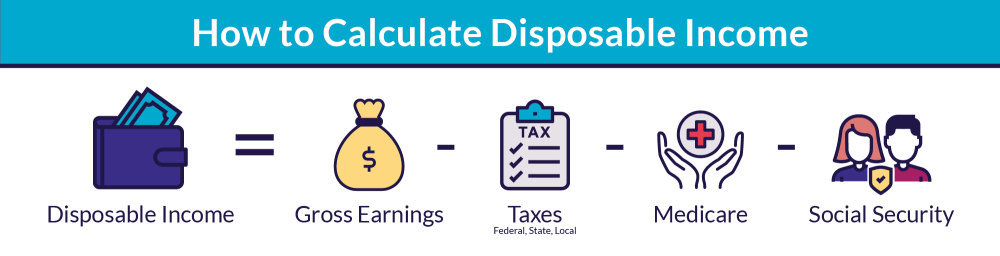
To calculate your disposable earnings, you can simply subtract federal, state and local taxes; Medicare; and Social Security from your gross earnings. Be sure to include any passive income streams, such as rental income, or side hustle earnings (more on that in a moment), when doing the math for your gross income. The resulting amount is your disposable income.
Some of the finer points to note:
• Keep in mind that taxes deducted from your paycheck are an estimate. If you have a history of getting a large refund or having a large amount of taxes due, it may be worth reviewing your withholdings through your employer.
This could help you adjust the withholdings so it is closer to the actual expected tax that will be calculated when you file. You can then plan accordingly.
• Even if you’re a contractor or freelancer, or if you made additional income from side gigs along with your salary, you can still calculate your disposable income.
This requires subtracting your quarterly tax payments and any additional taxes you will owe from your overall income. You can then determine your monthly after-tax income.
Setting aside money to pay taxes can also help you budget with your disposable income.
💡 Quick Tip: Most savings accounts only earn a fraction of a percentage in interest. Not at SoFi. Our high-yield savings account can help you make meaningful progress towards your financial goals.
Disposable Income Budgeting
Calculating your disposable income is a key first step in preparing a budget. You need to know how much you have to spend in order to plan your monthly spending and saving.
A personal budget puts you in control of your disposable income and helps you make financial decisions. It forces you to take a closer look at how you’re spending your money.
Here are a few ideas that could be helpful when developing a budget based on disposable income.
Tracking Spending
Disposable income is what’s coming into your account every month. It’s a good idea to also determine what is going out each month.
To do this, you can gather up bank and credit card statements, as well as receipts, from the past three months or so, and then list all of your monthly spending (both essential and discretionary/nonessential).
To make this list more accurate, you may want to actually track your spending for a month. You can do this with a phone app (your bank’s app may include this function), by carrying a small notebook and jotting down everything you buy, or by saving all of your receipts and logging it later.
This can be an eye-opening exercise. Many of us have no idea how much we’re spending on the little things, like morning coffees, and how much they can add up to at the end of the month.
Once you see your spending laid out in black and white, you may find some easy ways to cut back, such as getting rid of subscriptions and streaming services that you rarely use, brewing coffee at home, cooking more and getting less take-out, or getting rid of a pricey gym membership and working out at home.
Setting Goals And Spending Targets
Tracking income and spending can provide a great starting point for setting financial goals and spending targets.
• Goals are things that a person aims for in the short- or long-term — like paying off student loans or buying a new car.
• Spending targets are how much you want to spend each month in general categories in order to have money left over to put towards your savings goals.
Since essential spending often can’t be adjusted, spending targets are typically for discretionary income.
One option for budgeting disposable income is the 50/30/20 plan. This suggests spending about 50% on necessities, 30% on discretionary items, and then putting aside 20% for savings and other long-term goals.
These percentages are general guidelines, however, and can be adjusted as needed based on individual circumstances. For example, if you live in a competitive housing area, rent may take up a large portion of your expenses, and you may have to bump up necessity spending to 60% and decrease fun money to 20% instead.
Or, if you are saving for something in the near term, like a car or a wedding, you may want to temporarily bump up the savings category, and pull back unnecessary spending for a few months.
3 Uses for Your Disposable Income
Once you have calculated your disposable income, you can consider the ways you might divide it up:
Basic Living Expenses
Some of your disposable income will go towards necessities, such as:
• Housing
• Utilities
• Food
• Healthcare
• Transportation
• Insurance
• Minimum debt payments
Discretionary Spending
Next, there are the wants in life. These are things that are not vital for survival but can certainly make things more enjoyable:
• Eating out
• Entertainment, such as streaming platforms, movies, concerts, and books
• Clothing that isn’t essential
• Electronics, like the latest mobile phone
• Travel
• Gifts
Saving and Investing
In addition to the spending outlined above, you will likely want to save money or invest it for your short-term and/or long-term goals. These may include:
Get access to higher APY, credit card cash back rewards, discounts, and more.
Test your understanding of what you just read.
The Takeaway
Disposable income is a key concept in budgeting, as it refers to the income that’s left over after you pay taxes. Knowing how much disposable income you have is the foundation for putting together a simple budget that allows for necessary expenses, having fun, while also saving for the future. Finding the right banking partner is another important element of planning for tomorrow.
Interested in opening an online bank account? When you sign up for a SoFi Checking and Savings account with eligible direct deposit, you’ll get a competitive annual percentage yield (APY), pay zero account fees, and enjoy an array of rewards, such as access to the Allpoint Network of 55,000+ fee-free ATMs globally. Qualifying accounts can even access their paycheck up to two days early.
Better banking is here with SoFi, NerdWallet’s 2024 winner for Best Checking Account Overall.* Enjoy 3.30% APY on SoFi Checking and Savings with eligible direct deposit.
FAQ
What does disposable income mean?
Disposable income (also known as disposable earnings) is the money you have left after taxes and other mandatory deductions are taken out of your income. Essentially, it’s the money you have at your disposal to spend, save, or invest.
What is an example of disposable income?
Disposable income is the amount of money you have left after taxes and other mandatory deductions are taken out. As an example, let’s say Sarah earns $4,000 a month in gross income. After $1,000 is deducted in federal, state, and payroll taxes (including Social Security and Medicare), Sarah is left with $3,000.
This $3,000 is Sarah’s disposable income — the amount she has available to spend on essential and discretionary expenses, as well as put towards savings.
What is the difference between disposable income and discretionary income?
Disposable income refers to earnings minus taxes and mandatory deductions, such as Social Security and Medicare. Discretionary income is a subset of disposable income. It is the money left once you have paid for essentials, such as housing, utilities, food, and healthcare. The money that is left can be used for nonessential spending and for saving.
SoFi Checking and Savings is offered through SoFi Bank, N.A. Member FDIC. The SoFi® Bank Debit Mastercard® is issued by SoFi Bank, N.A., pursuant to license by Mastercard International Incorporated and can be used everywhere Mastercard is accepted. Mastercard is a registered trademark, and the circles design is a trademark of Mastercard International Incorporated.
Annual percentage yield (APY) is variable and subject to change at any time. Rates are current as of 12/23/25. There is no minimum balance requirement. Fees may reduce earnings. Additional rates and information can be found at https://www.sofi.com/legal/banking-rate-sheet
Eligible Direct Deposit means a recurring deposit of regular income to an account holder’s SoFi Checking or Savings account, including payroll, pension, or government benefit payments (e.g., Social Security), made by the account holder’s employer, payroll or benefits provider or government agency (“Eligible Direct Deposit”) via the Automated Clearing House (“ACH”) Network every 31 calendar days.
Although we do our best to recognize all Eligible Direct Deposits, a small number of employers, payroll providers, benefits providers, or government agencies do not designate payments as direct deposit. To ensure you're earning the APY for account holders with Eligible Direct Deposit, we encourage you to check your APY Details page the day after your Eligible Direct Deposit posts to your SoFi account. If your APY is not showing as the APY for account holders with Eligible Direct Deposit, contact us at 855-456-7634 with the details of your Eligible Direct Deposit. As long as SoFi Bank can validate those details, you will start earning the APY for account holders with Eligible Direct Deposit from the date you contact SoFi for the next 31 calendar days. You will also be eligible for the APY for account holders with Eligible Direct Deposit on future Eligible Direct Deposits, as long as SoFi Bank can validate them.
Deposits that are not from an employer, payroll, or benefits provider or government agency, including but not limited to check deposits, peer-to-peer transfers (e.g., transfers from PayPal, Venmo, Wise, etc.), merchant transactions (e.g., transactions from PayPal, Stripe, Square, etc.), and bank ACH funds transfers and wire transfers from external accounts, or are non-recurring in nature (e.g., IRS tax refunds), do not constitute Eligible Direct Deposit activity. There is no minimum Eligible Direct Deposit amount required to qualify for the stated interest rate. SoFi Bank shall, in its sole discretion, assess each account holder's Eligible Direct Deposit activity to determine the applicability of rates and may request additional documentation for verification of eligibility.
See additional details at https://www.sofi.com/legal/banking-rate-sheet.
*Awards or rankings from NerdWallet are not indicative of future success or results. This award and its ratings are independently determined and awarded by their respective publications.
Financial Tips & Strategies: The tips provided on this website are of a general nature and do not take into account your specific objectives, financial situation, and needs. You should always consider their appropriateness given your own circumstances.
We do not charge any account, service or maintenance fees for SoFi Checking and Savings. We do charge a transaction fee to process each outgoing wire transfer. SoFi does not charge a fee for incoming wire transfers, however the sending bank may charge a fee. Our fee policy is subject to change at any time. See the SoFi Bank Fee Sheet for details at sofi.com/legal/banking-fees/.
Tax Information: This article provides general background information only and is not intended to serve as legal or tax advice or as a substitute for legal counsel. You should consult your own attorney and/or tax advisor if you have a question requiring legal or tax advice.
Third Party Trademarks: Certified Financial Planner Board of Standards Center for Financial Planning, Inc. owns and licenses the certification marks CFP®, CERTIFIED FINANCIAL PLANNER®
A spot market is a market where buyers meet sellers and make an immediate exchange. In other words, delivery takes place at the same time payment is made. That can include stock exchanges, currency markets, or commodity markets.
But often when discussing spot markets, we’re talking about commodities. Commodity markets are somewhat different from the markets for stocks, bonds, mutual funds, and ETFs, all of which trade exclusively through brokerages. Because they represent a physical good, commodities have an additional market — the spot market. This market represents a place where the actual commodity gets bought and sold right away.
Key Points
Spot markets involve instant trades and immediate delivery.
Spot prices reflect real-time supply and demand.
Spot markets are less susceptible to manipulation.
OTC and centralized exchanges facilitate spot trades.
Futures markets are speculative, while spot markets are organic.
Spot Markets Definition
If you’re trying to define the spot markets, it may be helpful to think of it as a public financial market, and one on which assets or commodities are bought and sold. They’re also bought and sold for immediate, or quick, delivery. That is, the asset being traded changes hands on the spot.
Prices quoted on spot markets are called the spot price, accordingly.
One example of a spot market is a coin shop where an individual investor goes to buy a gold or silver coin. The prices would be determined by supply and demand. The goods would be delivered upon receipt of payment.
Understanding Spot Markets
Spot markets aren’t all that difficult to understand from a theoretical standpoint. There can be a spot market for just about anything, though they’re often discussed in relation to commodities (perhaps coffee, corn, or construction materials), and specific things like precious metals.
But again, an important part of spot market transactions is that trades take place on the spot — immediately.
Which Types of Assets Can Be Found on Spot Markets?
As noted, all sorts of assets can be found on spot markets. That ranges from food items or other consumables, construction materials, precious metals, and more. If you were, for instance, interested in investing in agriculture from the sense you wanted to trade contracts for oranges or bananas, you could likely do so on the spot market.
Some financial instruments may also be traded on spot markets, such as Treasuries or bonds.
How Spot Market Trades Are Made
In a broad sense, spot market trades occur like trades in any other market. Buyers and sellers come together, a price is determined by supply and demand, and trades are executed — usually digitally, like most things these days. In fact, a spot market may and often does operate like the stock market.
As noted, stock markets are also, in fact, spot markets, with financial securities trading hands instantly (in most cases).
What Does the Spot Price Mean?
As mentioned, the spot price simply refers to the price at which a commodity can be bought or sold in real time, or “on the spot.” This is the price an individual investor will pay for something if they want it right now without having to wait until some future date.
Because of this dynamic, spot markets are thought to reflect genuine supply and demand to a high degree.
The interplay of real supply and demand leads to constantly fluctuating spot prices. When supply tightens or demand rises, prices tend to go up, and when supply increases or demand falls, prices tend to go down.
The Significance of a Spot Market
The spot market of any asset holds special significance in terms of price discovery. It’s thought to be a more honest assessment of economic reality.
The reason is that spot markets tend to be more reliant on real buyers and sellers, and therefore should more accurately reflect current supply and demand than futures markets (which are based on speculation and can be manipulated, as recent legal cases have shown. More on this later.)
Types of Spot Markets
There’s only one type of spot market — the type where delivery of an asset takes place right away. There are two ways this can happen, however. The delivery can take place through a centralized exchange, or the trade can happen over the counter.
Over-the-counter
Over-the counter, or OTC trades, are negotiated between two parties, like the example of buying coins at a coin shop.
Market Exchanges
There are different spot markets for different commodities, and some of them work slightly differently than others.
The spot market for oil, for example, also has buyers and sellers, but a barrel of oil can’t be bought at a local shop. The same goes for some industrial metals like steel and aluminum, which are bought and sold in much higher quantities than silver and gold.
Agricultural commodities like soy, wheat, and corn also have spot markets as well as futures markets.
Spot Market vs Futures Market
One instance that makes clear the difference between a spot market and a futures market is the price of precious metals.
Gold, silver, platinum, and palladium all have their own spot markets and futures markets. When investors check the price of gold on a mainstream financial news network, they are likely going to see the COMEX futures price.
COMEX is short for the Commodity Exchange Inc., a division of the New York Mercantile Exchange. As the largest metals futures market in the world, COMEX handles most related futures contracts.
These contracts are speculatory in nature — traders are making bets on what the price of a commodity will be at some point. Contracts can be bought and sold for specific prices on specific dates.
Most of the contracts are never delivered upon, meaning they don’t involve delivery of the actual underlying commodity, such as gold or silver. Instead, what gets exchanged is a contract or agreement allowing for the potential delivery of a certain amount of metal for a certain price on a certain date.
For the most part, futures trading only has two purposes: hedging bets and speculating for profits. Sophisticated traders sometimes use futures to hedge their bets, meaning they purchase futures that will wind up minimizing their losses in another bet if it doesn’t go their way. And investors of all experience levels can use futures to try to profit from future price action of an asset. Predicting the exact price of something in the future can be difficult and carries high risk.
The spot market works in a different manner entirely. There are no contracts to buy or sell and no future prices to consider. The market is simply determined by what one party is willing to purchase something for.
Spot Market vs Futures Market
Spot Market
Futures Market
No contracts to buy or sell
Contracts are bought and sold outlining future prices
Trades occur instantly
Trades may never actually occur at all
Non-speculative
Speculative by nature
Another important concept to understand is contango and backwardation, which are ways to characterize the state of futures markets based on the relationship between spot and future prices. Some background knowledge on those concepts can help guide your investing strategy.
Note, too, that some investors may be confused by the concepts of margin trading and futures contracts. Margin and futures are two different concepts, and don’t necessarily overlap.
💡 Quick Tip: Distributing your money across a range of assets — also known as diversification — can be beneficial for long-term investors. When you put your eggs in many baskets, it may be beneficial if a single asset class goes down.
Example of a Spot Market
Consider the spot and futures markets for precious metals.
Precious-metal prices that investors see on financial news networks will most often be the current futures price as determined by COMEX. This market price is easy to quote. It’s the sum of all futures trading happening on one central exchange or just a few central exchanges.
The spot market is more difficult to pin down. In this case, the spot market could be generally referred to as the average price that a person would be willing to pay for a single ounce of gold or silver, not including any premiums charged by sellers.
Sometimes there is a difference between prices in the futures market and spot market. The difference is referred to as the “spread.” Under ordinary circumstances, the difference will be modest. During times of uncertainty, though, the spread can become extreme.
Futures Market Manipulation
As for trying to define what spot price means, it’s important to include one final note on futures markets. This will illustrate a key difference between the two markets.
Recent high-profile cases brought by government enforcement agencies like the Securities and Exchange Commission and Commodities and Futures Trading Commission highlight the susceptibility of futures markets to manipulation.
Some large financial institutions have been convicted of engaging in practices that artificially influence the price of futures contracts. Again, we can turn to the precious-metals markets for an example.
During the third quarter of 2020, JP Morgan was fined $920 million for “spoofing” trades and market manipulation in the precious metals and U.S. Treasury futures markets. Spoofing involves creating large numbers of buy or sell orders with no intention of fulfilling the orders.[1]
Because order book information is publicly available, traders can see these orders, and may act on the perception that big buying or selling pressure is coming down the pike. If many sell orders are on the books, traders may sell, hoping to get ahead of the trade before prices fall. If many buy orders are on the books, traders may buy, thinking the price is going to rise soon.
Cases like this show that futures markets can be heavily influenced by market participants with the means to do so.
Spot markets, on the other hand, are much more organic and more difficult to manipulate.
3 Tips for Spot Market Investing
For those interested in trying their hand in the spot market, here are a few things to keep in mind.
1. Know What’s Going On
Often, prices in the spot market can change or be volatile in relation to the news or other current events. For that reason, it’s important that investors know what’s happening in the world, and use that to assess what’s happening with prices for a given asset or commodity.
2. Keep Your Emotions in Check
Emotional investing or trading is a good way to get yourself into financial trouble, be it in the spot market, or any other type of trading or investing. You’d likely do well to keep your emotions in check when trading or investing on the spot market, as a result.
3. Understand the Market
It’s also a good idea to do some homework and make a solid attempt at trying to understand the market you’re trading in. There may be jargon to learn, terms to understand, price discovery mechanisms that could otherwise be foreign to even a seasoned investor — do your best to do your due diligence.
The Takeaway
Spot markets are where commodities are traded, instantly. There are numerous types of spot markets, and there are numerous types of commodities that might be traded on them. Investors would be wise to know the basics of how they work, and come armed with a bit of background knowledge about the given commodity they’re trading, in order to reach their goals.
Spot market trading can be a part of an overall trading strategy, but again, investors should know the ropes a bit before getting in over their heads. It may be a good idea to speak with a financial professional before investing.
Invest in what matters most to you with SoFi Active Invest. In a self-directed account provided by SoFi Securities, you can trade stocks, exchange-traded funds (ETFs), mutual funds, alternative funds, options, and more — all while paying $0 commission on every trade. Other fees may apply. Whether you want to trade after-hours or manage your portfolio using real-time stock insights and analyst ratings, you can invest your way in SoFi's easy-to-use mobile app.
Opening and funding an Active Invest account gives you the opportunity to get up to $1,000 in the stock of your choice.¹
FAQ
What is spot market vs a futures market?
Trades on a spot market occur instantly, on the spot. Trades in the futures market involve contracts for commodities with prices outlined for some time in the future — if they occur at all.
What does spot market mean?
The term spot market refers to a financial market where assets or commodities are bought and sold by traders. The trades occur on the spot, or instantly, for immediate delivery.
What is the difference between spot market and forward market?
Forward markets involve trading of futures contracts, or transactions that take place at some point in the future, whereas spot market trades occur instantly, often for cash.
INVESTMENTS ARE NOT FDIC INSURED • ARE NOT BANK GUARANTEED • MAY LOSE VALUE
SoFi Invest is a trade name used by SoFi Wealth LLC and SoFi Securities LLC offering investment products and services. Robo investing and advisory services are provided by SoFi Wealth LLC, an SEC-registered investment adviser. Brokerage and self-directed investing products offered through SoFi Securities LLC, Member FINRA/SIPC.
For disclosures on SoFi Invest platforms visit SoFi.com/legal. For a full listing of the fees associated with Sofi Invest please view our fee schedule.
Financial Tips & Strategies: The tips provided on this website are of a general nature and do not take into account your specific objectives, financial situation, and needs. You should always consider their appropriateness given your own circumstances.
Third-Party Brand Mentions: No brands, products, or companies mentioned are affiliated with SoFi, nor do they endorse or sponsor this article. Third-party trademarks referenced herein are property of their respective owners.
Disclaimer: The projections or other information regarding the likelihood of various investment outcomes are hypothetical in nature, do not reflect actual investment results, and are not guarantees of future results.
An investor should consider the investment objectives, risks, charges, and expenses of the Fund carefully before investing. This and other important information are contained in the Fund’s prospectus. For a current prospectus, please click the Prospectus link on the Fund’s respective page. The prospectus should be read carefully prior to investing.
Alternative investments, including funds that invest in alternative investments, are risky and may not be suitable for all investors. Alternative investments often employ leveraging and other speculative practices that increase an investor's risk of loss to include complete loss of investment, often charge high fees, and can be highly illiquid and volatile. Alternative investments may lack diversification, involve complex tax structures and have delays in reporting important tax information. Registered and unregistered alternative investments are not subject to the same regulatory requirements as mutual funds.
Please note that Interval Funds are illiquid instruments, hence the ability to trade on your timeline may be restricted. Investors should review the fee schedule for Interval Funds via the prospectus.
Exchange Traded Funds (ETFs): Investors should carefully consider the information contained in the prospectus, which contains the Fund’s investment objectives, risks, charges, expenses, and other relevant information. You may obtain a prospectus from the Fund company’s website or by emailing customer service at [email protected]. Please read the prospectus carefully prior to investing.
Mutual Funds (MFs): Investors should carefully consider the information contained in the prospectus, which contains the Fund’s investment objectives, risks, charges, expenses, and other relevant information. You may obtain a prospectus from the Fund company’s website or clicking the prospectus link on the fund's respective page at sofi.com. You may also contact customer service at: 1.855.456.7634. Please read the prospectus carefully prior to investing.Mutual Funds must be bought and sold at NAV (Net Asset Value); unless otherwise noted in the prospectus, trades are only done once per day after the markets close. Investment returns are subject to risk, include the risk of loss. Shares may be worth more or less their original value when redeemed. The diversification of a mutual fund will not protect against loss. A mutual fund may not achieve its stated investment objective. Rebalancing and other activities within the fund may be subject to tax consequences.
Investment Risk: Diversification can help reduce some investment risk. It cannot guarantee profit, or fully protect in a down market.
Utilizing a margin loan is generally considered more appropriate for experienced investors as there are additional costs and risks associated. It is possible to lose more than your initial investment when using margin. Please see SoFi.com/wealth/assets/documents/brokerage-margin-disclosure-statement.pdf for detailed disclosure information.
Third Party Trademarks: Certified Financial Planner Board of Standards Center for Financial Planning, Inc. owns and licenses the certification marks CFP®, CERTIFIED FINANCIAL PLANNER®
¹Probability of Member receiving $1,000 is a probability of 0.026%; If you don’t make a selection in 45 days, you’ll no longer qualify for the promo. Customer must fund their account with a minimum of $50.00 to qualify. Probability percentage is subject to decrease. See full terms and conditions.