piggy bank with band-aids

Emergency Fund: What It Is and Why It’s Important

An emergency savings fund is a lump sum of cash set aside to cover any unanticipated expenses or financial emergencies that may come your way.

Besides offering peace of mind, an emergency fund can help save you from having to rely on high-interest debt options. These include credit cards or unsecured loans which can snowball. Not having rainy-day savings can also threaten to undermine your future security if you wind up tapping into retirement funds to get by.

Key Points

•   An emergency fund is a financial safety net that can be used for unexpected expenses, for financial emergencies, or in the event of income loss.

•   Financial professionals generally advise having three to six months’ worth of living expenses in your savings account.

•   An emergency fund may prevent you from going into debt, provide funds during unemployment, give you the space needed to make better financial decisions, and provide peace of mind.

•   To begin building an emergency fund, it can help to start with a smaller goal, such as $1,000.

•   Using a high-yield savings account and automating contributions to the account can help you gradually build up your emergency fund to the amount that’s best for your circumstances.

What Is an Emergency Fund?

An emergency fund is essentially a savings fund earmarked for emergency expenses—aka unplanned expenses or financial emergencies. A major home repair, like a leaking roof, is an example of an unplanned expense that needs to be dealt with right away. Losing a job is an example of a financial emergency that can cause a lot of stress if you don’t have an emergency fund to dip into to pay for necessities and bills.

If someone doesn’t have an emergency fund and experiences financial difficulties, they may turn to high-interest debt. For instance, they may use credit cards or personal loans to cover expenses, which can lead to struggling to pay down the debt that’s left in its wake.

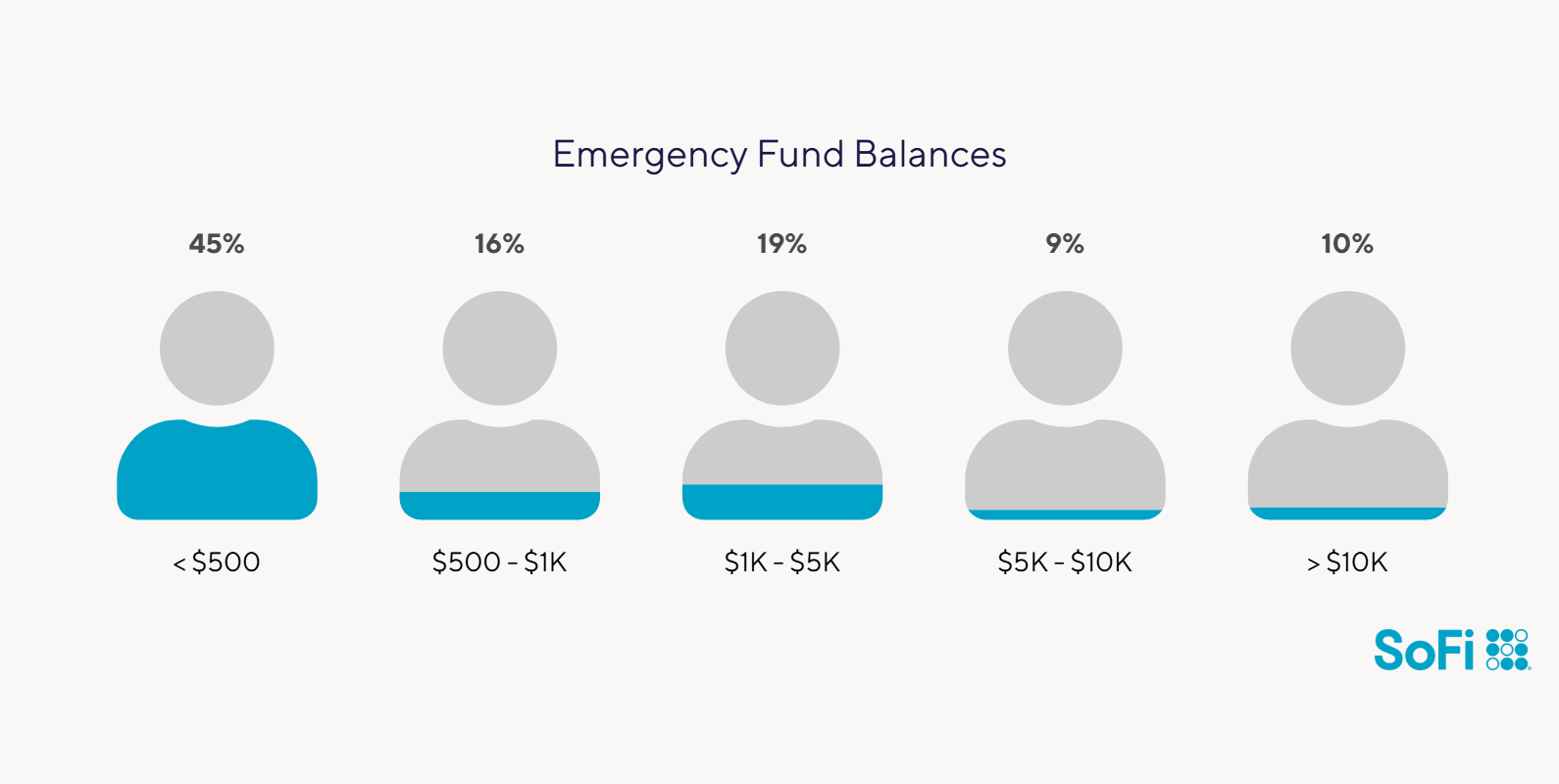
You may be wondering just how much to keep in an emergency fund. Financial experts often recommend having at least three to six months’ worth of basic living expenses set aside in an emergency fund. That can be a lofty goal considering that one recent study showed that about half of all Americans would struggle to come up with $400 in an emergency scenario. And in SoFi’s April 2024 Banking Survey of 500 U.S. adults, 45% of respondents said they have less than $500 set aside in an emergency fund. It’s wise not to be caught short and to prioritize saving an emergency fund.

Emergency Fund Balances - SoFi How People Bank Today Survey
Source: SoFi’s 2024 Banking Survey

Why Do You Need an Emergency Fund?

With all of the bills that a person typically has to pay, you may wonder, “Why should creating an emergency fund be a top priority?” Here’s why: An emergency fund can be a kind of self-funded insurance policy. Instead of paying an insurance company to back you up if something goes wrong, you’re paying yourself by setting aside these funds for the future. Building this cushion into your budget can be a vital step in better money management.

How you invest emergency funds is of course up to you, but keeping the money in a high-yield savings account typically gives you the liquidity you need while earning some interest.

Having this kind of financial safety net comes with a range of benefits. Below are some of the key perks of having an ample emergency fund.

Preventing You From Going into Debt

Yes, there may be other ways to quickly access cash to cover the cost of an emergency, such as credit cards, unsecured loans, home equity lines of credit, or pulling from other sayings, like retirement funds.

Preventing debt is one of the most important reasons to have an emergency fund.

But these options typically come with high interest fees or penalties. Though there are many reasons for having an emergency fund, preventing debt is among the most important and enticing.

Providing Peace of Mind

Here’s another reason why it is important to have an emergency fund: Living without a safety net and simply hoping to get by can cause you to stress. Thoughts about what would happen if you got hit with a large, unanticipated expense could keep you up at night.

Being prepared with an emergency fund, on the other hand, can give you a sense of confidence that you can tackle any of life’s unexpected events without experiencing financial hardship.

Increase your savings
with a limited-time APY boost.*


*Earn up to 4.30% Annual Percentage Yield (APY) on SoFi Savings with a 0.70% APY Boost (added to the 3.60% APY as of 11/12/25) for up to 6 months. Open a new SoFi Checking & Savings account and enroll in SoFi Plus by 1/31/26. Rates variable, subject to change. Terms apply here. SoFi Bank, N.A. Member FDIC.

Providing Finances During Unemployment

Applying for unemployment benefits, if you are entitled to them, can help you afford some of your daily expenses. Unfortunately, these payments are generally not enough to cover your entire cost of living.

If you have an emergency fund, you can tap into it to cover the cost of everyday expenses — like utility bills, groceries, and insurance payments — while you’re unemployed.

Starting an emergency fund also gives you the freedom to leave a job you dislike, without having to secure a new job first. Sometimes this can be the best move if you are stuck in a toxic situation.

Making Better Financial Decisions

Having extra cash set aside in an emergency fund helps keep that money out of sight and out of mind. Having money out of your immediate reach can make you less likely to spend it on a whim, no matter how much you’d like to.

Also by having a separate emergency account, you’ll know exactly how much you have — and how much you may still need to save. This can be preferable to keeping a cash cushion in your checking account and hoping it will be enough. In fact, 77% of the SoFi survey respondents who have a savings account said they used it specifically for emergencies.

Recommended: Guide to Practicing Financial Self-Care

Emergency Fund Statistics

Curious about how much other people have in their emergency funds? Or what percentage of Americans actually have a rainy-day account? Here are some recent research numbers to know:

•   About 75% of people report having emergency savings.

•   46% have enough money to cover three months’ worth of expenses.

•   Just 19% of people in SoFi’s report said they have between $1,000 and $5,000 in emergency savings.

•   24% of people overall have no emergency savings at all.

•   37% of Americans said they couldn’t cover a $400 emergency expense, according to Empower data.

•   59% of U.S. survey respondents said they couldn’t cover a $1,000 emergency bill.

How Do You Build an Emergency Fund?

One of the basic steps of how to start a financial plan is saving for emergencies. Stashing money aside for a rainy day is a vital part of financial health.

The good news is that starting an emergency fund doesn’t have to be complicated. These tips can help you get your emergency fund off to a good start.

•   Set your savings target. The first step in building an emergency fund is deciding how much to save. The easiest way to do that is to add up your monthly expenses, then multiply that by the number of months you’d like to save (typically, at least three to six months). If the amount seems overwhelming, you can start smaller and aim to save $1,000 first, then build up your emergency fund from there.

•   Decide where to keep it. The next step is deciding where to hold your emergency savings. Opening a bank account online could be a good fit, since you can earn a competitive APY (annual percentage yield) on balances while maintaining convenient access to your money. You could also choose to open a traditional bank account and use its online banking features. Forty-eight percent of people say they use online banking daily, according to SoFi’s data.

•   Automate contributions. Once you set up an online bank account for your emergency fund, you can schedule automatic transfers from checking. This way, you can easily grow your emergency fund without having to worry about accidentally spending down that money.

One of the most frequently asked emergency fund questions is whether a savings account is really the best place to keep your savings. After all, you could put the money into a certificate of deposit (CD) account instead or invest it in the market. But there are issues with those options.

A CD is a time deposit, meaning you agree to leave your savings in the account for a set maturity period. If you need to withdraw money from a CD in an emergency before maturity, your bank may charge you an early withdrawal penalty.

So, should emergency funds be invested instead? Not so fast. Investing your emergency fund money in the stock market could help you to earn a higher rate of return compared to a savings account. But you’re also taking more risk with that money, since a downturn could reduce your investment’s value. Proceed with caution before taking this step.

How Long Does It Take to Grow an Emergency Fund?

Emergency funds don’t necessarily come together overnight. Saving after-tax dollars to equal six months’ worth of typical living expenses can take some work and time. Here’s an example to consider: If your monthly costs are $3,000, you would want to have between $9,000 and $18,000 set aside for an emergency, such as being laid-off.

•   If your goal is $9,000 and you can set aside $200 per month, that would take you 45 months, or almost four years, to accumulate the funds.

•   If you can put aside $300 a month, you’d hit your goal in 30 months, or two and a half years.

•   If you can stash $500 a month, you’d have $9,000 saved in one and a half years.

A terrific way to grow your emergency fund is to set up automatic transfers from your checking account into your rainy-day savings. That way, you won’t see the money sitting in your checking and feel as if it’s available to be spent.

Recommended: Online Emergency Fund Calculator

How Can You Grow It Faster?

You’ve just seen how gradually saving can build a cash cushion should an emergency hit. Here are some ways to save even faster:

•   Put a windfall into your emergency fund. This could be a tax refund, a bonus at work, or gift money from a relative perhaps.

•   Sell items you don’t need or use. If you have gently used clothing, electronics, jewelry, or furniture, you might sell it on a local site, such a Facebook group or Craigslist, or, if small in size, on eBay or Etsy.

•   Start a side hustle. One of the benefits of a side hustle is bringing in extra cash; it can also be a fun way to explore new directions, build your skills, and fill free time.

These techniques can help you ramp up your savings even faster and be prepared for an emergency that much sooner.

Prioritizing Your Emergency Fund When You Have Other Financial Obligations

Most of us have competing financial goals: paying down student debt or a credit card balance; accumulating enough money for a down payment on a house; saving for college for kids; and socking away money for retirement. In many cases, you’ll see variability in financial goals by age, but there are often several needs vying for your dollars at any given time.

Here’s advice on how to allocate funds:

•   Definitely start or continue saving towards your emergency fund. Even if you can only spare $25 per month right now, do it! It will get you on the road to hitting your goal and earning you compound interest. Otherwise, if an emergency were to strike, you’ll likely have to resort to credit cards or tapping any retirement savings, which probably involves a penalty.

•   Continue to pay down high-interest debt, like credit card debt. You want to get this kind of debt out of your life, given the interest rates can currently top 20%. You might explore balance transfer offers that let you pay no or very low interest for a period of time (say, 18 months) which can help you pay down your debt. Just make sure you understand the fees that are typically involved.

•   Steadily stick to your schedule for low-interest debt, which typically includes student loans and mortgages.

•   Fund your retirement savings as much as you can. As with an emergency fund, even a small amount will be worthwhile, especially with the benefit of compound interest. Make sure to contribute enough to take advantage of the company match if your employer offers that as part of a 401(k) plan; that is akin to free money.


Test your understanding of what you just read.


The Takeaway

An emergency fund is an important financial goal. Once you’ve accrued at least three to six months’ worth of basic living expenses, you can feel more secure if a major unexpected expense pops up or job loss happens. It can be wise to store emergency funds in a high-yield savings account to deliver both liquidity and interest.

Interested in opening an online bank account? When you sign up for a SoFi Checking and Savings account with direct deposit, you’ll get a competitive annual percentage yield (APY), pay zero account fees, and enjoy an array of rewards, such as access to the Allpoint Network of 55,000+ fee-free ATMs globally. Qualifying accounts can even access their paycheck up to two days early.


Better banking is here with SoFi, NerdWallet’s 2024 winner for Best Checking Account Overall.* Enjoy up to 3.60% APY on SoFi Checking and Savings.

FAQ

What is the purpose of an emergency fund?

An emergency fund is a financial safety net. It’s money set aside that you can use if you are hit with a big, urgent, unexpected bill (like a medical expense or car repair) or endure a loss of income. In these situations, an emergency fund can help you avoid using your credit cards and taking on high-interest debt or hurting your credit score by paying bills late. How to invest an emergency fund is up to you, but a high-interest savings account is one good, liquid option.

Can I use an emergency fund for a non-emergency expense?

Technically, you can use an emergency fund for a non-emergency expense. After all, it’s your money. But it’s not wise to do so and defeats the whole purpose of saving this cash. If you use your emergency funds to pay for a vacation or new clothes, then if a true emergency arises, you won’t be prepared.

How difficult is it to rebuild an emergency fund?

It can be difficult to rebuild an emergency fund, just as it was to accumulate the money in the first place. But even if it takes years to achieve your goal, it is worth it. Putting away money gradually for an emergency is an important step towards being financially fit.

More from the emergency fund series:


SoFi Checking and Savings is offered through SoFi Bank, N.A. Member FDIC. The SoFi® Bank Debit Mastercard® is issued by SoFi Bank, N.A., pursuant to license by Mastercard International Incorporated and can be used everywhere Mastercard is accepted. Mastercard is a registered trademark, and the circles design is a trademark of Mastercard International Incorporated.

Annual percentage yield (APY) is variable and subject to change at any time. Rates are current as of 11/12/25. There is no minimum balance requirement. Fees may reduce earnings. Additional rates and information can be found at https://www.sofi.com/legal/banking-rate-sheet

Eligible Direct Deposit means a recurring deposit of regular income to an account holder’s SoFi Checking or Savings account, including payroll, pension, or government benefit payments (e.g., Social Security), made by the account holder’s employer, payroll or benefits provider or government agency (“Eligible Direct Deposit”) via the Automated Clearing House (“ACH”) Network every 31 calendar days.

Although we do our best to recognize all Eligible Direct Deposits, a small number of employers, payroll providers, benefits providers, or government agencies do not designate payments as direct deposit. To ensure you're earning the APY for account holders with Eligible Direct Deposit, we encourage you to check your APY Details page the day after your Eligible Direct Deposit posts to your SoFi account. If your APY is not showing as the APY for account holders with Eligible Direct Deposit, contact us at 855-456-7634 with the details of your Eligible Direct Deposit. As long as SoFi Bank can validate those details, you will start earning the APY for account holders with Eligible Direct Deposit from the date you contact SoFi for the next 31 calendar days. You will also be eligible for the APY for account holders with Eligible Direct Deposit on future Eligible Direct Deposits, as long as SoFi Bank can validate them.

Deposits that are not from an employer, payroll, or benefits provider or government agency, including but not limited to check deposits, peer-to-peer transfers (e.g., transfers from PayPal, Venmo, Wise, etc.), merchant transactions (e.g., transactions from PayPal, Stripe, Square, etc.), and bank ACH funds transfers and wire transfers from external accounts, or are non-recurring in nature (e.g., IRS tax refunds), do not constitute Eligible Direct Deposit activity. There is no minimum Eligible Direct Deposit amount required to qualify for the stated interest rate. SoFi Bank shall, in its sole discretion, assess each account holder's Eligible Direct Deposit activity to determine the applicability of rates and may request additional documentation for verification of eligibility.

See additional details at https://www.sofi.com/legal/banking-rate-sheet.

*Awards or rankings from NerdWallet are not indicative of future success or results. This award and its ratings are independently determined and awarded by their respective publications.

Financial Tips & Strategies: The tips provided on this website are of a general nature and do not take into account your specific objectives, financial situation, and needs. You should always consider their appropriateness given your own circumstances.

Disclaimer: Many factors affect your credit scores and the interest rates you may receive. SoFi is not a Credit Repair Organization as defined under federal or state law, including the Credit Repair Organizations Act. SoFi does not provide “credit repair” services or advice or assistance regarding “rebuilding” or “improving” your credit record, credit history, or credit rating. For details, see the FTC’s website .

Third-Party Brand Mentions: No brands, products, or companies mentioned are affiliated with SoFi, nor do they endorse or sponsor this article. Third-party trademarks referenced herein are property of their respective owners.

Third Party Trademarks: Certified Financial Planner Board of Standards Center for Financial Planning, Inc. owns and licenses the certification marks CFP®, CERTIFIED FINANCIAL PLANNER®

SOBNK-Q325-116

Read more

How to Build an Emergency Fund in 6 Steps

Setting up an emergency fund is an important step for financial security, but finding the cash can be tricky. Much as you might want to have a bundle of money waiting if you had a major medical bill due or endured a job loss, actually accruing an emergency fund may sometimes seem almost impossible. Monthly bills and expenses can siphon off your income, making it tough to save.

While it can be challenging, building an emergency fund can be done. It may take some time, but what’s important is to start saving and then keep it up, even in small amounts, to help protect your financial future.

Key Points

•  Set a clear and achievable goal for an emergency savings fund, typically three to six months’ worth of expenses.

•  When choosing an account for an emergency fund, a high-yield savings account may be an option to consider to help maximize growth.

•  Cutting unnecessary expenses from a monthly budget can free up funds to put in an emergency account, as can windfall money like a tax refund or rebate.

•  Automating savings with direct deposits can ensure consistent contributions.

•  Use an emergency fund money only on real emergencies and work to replenish the account afterward.

What Is an Emergency Fund and Why Is It Important?

An emergency fund is a savings fund earmarked specifically for unanticipated expenses or financial emergencies that might crop up — such as job loss, major home repairs, or a medical procedure that results in a hefty bill. Financial professionals typically suggest having three to six month’s worth of income in an emergency fund.

An emergency fund is important because without this financial safety net, an individual might have to use high-interest credit cards or take out a loan to cover the emergency expense, which could result in having to pay down a significant amount of debt.

6 Steps to Building an Emergency Fund

Step 1. Set a Clear and Achievable Savings Goal

When it comes to the emergency fund amount you should have, most financial professionals recommend that you save three to six months’ worth of living expenses. Some people, however, may want to aim higher. If you are the sole provider for a family, have significant medical expenses, or are self-employed, you may want to allocate a higher amount, for example.

You can use an emergency fund calculator to help determine your savings target. Once you calculate that sum, you can divide it by 12 or 24 to get a one- or two-year savings plan for meeting the target.

The goal amount of your emergency fund may seem intimidating, but don’t let that discourage you. Even if you can only take a small amount ($25, say) from each paycheck as you save money from your salary, it will help make a difference.

Having some money in your bank account for emergencies is what matters.

Step 2. Choose the Right Account for Your Emergency Fund

The next important step is to get your emergency fund account set up. When choosing an account type, these are some considerations to keep in mind:

•  Because an emergency fund is like a rainy day fund — you spend it only when a specific unexpected event warrants it, such as a costly medical procedure — putting it in a separate dedicated account can be helpful. Otherwise, if you leave the funds in your regular savings account, you might be tempted to spend the money.

•  A savings account that could help your money make more money, such as a high-yield savings account, is one option to explore.These accounts can offer interest rates that are higher than those of standard savings accounts. And thanks to the power of compounding interest, your money may grow faster.

•  Consider using savings vaults. These are essentially extensions of your savings account that let you organize your money into “buckets” and earmark it for specific goals, without having to set up a new account. That way, if you have a high-yield account, you can still earn the same competitive interest rate on your money and save for multiple goals at once, including an emergency fund.

Step 3. Find Room in Your Budget to Start Saving

If even a two-year timeframe for building your emergency fund amount feels intimidating, don’t worry. The important thing in terms of how to build an emergency fund is to begin saving and stick with it. If you only have a little bit of money to add per month, save that much. Good start!

Also, consider growing your savings by depositing windfall money in your emergency fund. Perhaps you’ll receive a tax refund, a bonus at work, a rebate, or other unexpected source of funds. Put that into your emergency account to help it grow.

Increase your savings
with a limited-time APY boost.*


*Earn up to 4.30% Annual Percentage Yield (APY) on SoFi Savings with a 0.70% APY Boost (added to the 3.60% APY as of 11/12/25) for up to 6 months. Open a new SoFi Checking & Savings account and enroll in SoFi Plus by 1/31/26. Rates variable, subject to change. Terms apply here. SoFi Bank, N.A. Member FDIC.

Step 4. Automate Your Savings With Direct Deposit

Depositing money into your emergency savings consistently can help your fund grow. And letting technology do the work for you can make it practically effortless. You could set up automatic savings transfers into your emergency fund just after you get paid, for instance. Or, if you have a side hustle, you might decide to automatically deposit 10% or 20% of those earnings into your emergency fund.

Not only will you reap the satisfaction of saving, if the money isn’t sitting in your checking account, you won’t be tempted to spend it.

Step 5. Start Tracking Your Expenses and Spending

If it feels like you just don’t have any cash available to put toward an emergency fund, consider ways to manage your money better and cut your budget a bit.

Perhaps you could eat out a bit less often, save on streaming services, shop for basics at warehouse clubs, or find other ways to trim back. Once you lower or eliminate some costs, you can put that extra money toward your emergency fund.

One thing to be alert for is “lifestyle creep.” This happens when, as you begin to earn more, you also spend more. In other words, as your income grows, so do your expenses, meaning you don’t build wealth. If you get a raise at work and then lease an expensive car, you may struggle to increase your savings.

However, if your spending stays in check, you can put a portion of your increased earnings toward your emergency savings account.

Step 6. Know When to Use Your Fund and How to Replenish It

Of course, you only want to tap your emergency savings account for a necessary and urgent expense.

An example of a financial emergency is a major home repair such as a roof that suddenly starts leaking. It could also be a car repair, like a blown tire that needs to be fixed so you can drive to work, a medical emergency that results in a hefty bill, or a job loss.

After you use your savings to help pay for an emergency, remember to replenish your emergency fund. That can ensure that you are prepared for the next unexpected expense that might pop up, which could help you achieve financial security. Otherwise, you could wind up drawing down your savings and have nothing left when needed.

To replenish your account, determine your new savings goal and start setting aside funds to help you reach it. Deposit any windfalls into your account, cut back on whatever expenses you can and put the resulting savings into your fund, or take on a weekend job to earn some extra income to replenish your emergency stash.

How Long Does It Take to Grow an Emergency Fund?

Emergency funds don’t necessarily come together overnight. Saving after-tax dollars to equal six months’ worth of typical living expenses can take some work and time. Here’s an example to consider: If your monthly costs are $3,000, you would want to have between $9,000 and $18,000 set aside for an emergency, such as being laid-off.

•   If your goal is $9,000 and you can set aside $200 per month, that would take you 45 months, or almost four years, to accumulate the funds.

•   If you can put aside $300 a month, you’d hit your goal in 30 months, or two and a half years.

•   If you can stash $500 a month, you’d have $9,000 saved in one and a half years.

A terrific way to grow your emergency fund is to set up automatic transfers from your checking account into your rainy-day savings. That way, you won’t see the money sitting in your checking and feel as if it’s available to be spent.

Next, we’ll take a look at how to accelerate saving for an emergency fund.

How Can You Grow It Faster?

You’ve just seen how gradually saving can build a cash cushion should an emergency hit. Here are some ways to save even faster:

•   Put a windfall into your emergency fund. This could be a tax refund, a bonus at work, or gift money from a relative perhaps.

•   Sell items you don’t need or use. If you have gently used clothing, electronics, jewelry, or furniture, you might sell it on a local site, such a Facebook group or Craigslist, or, if small in size, on eBay or Etsy.

•   Start a side hustle. One of the benefits of a side hustle is bringing in extra cash; it can also be a fun way to explore new directions, build your skills, and fill free time.

These techniques can help you ramp up your savings even faster and be prepared for an emergency that much sooner.

How to Start an Emergency Fund on a Low Income

Even when money is tight, you can still build an emergency fund. It may require some extra time and dedication, but every small step you take to grow your emergency fund amount can make a difference. Consider these tips to help reach your goal:

•   Go over your budget carefully. Look for any expenses you could reduce and direct that money toward your emergency fund instead. For example, pack lunch for work and bring it with you every day. Then use your “lunch money” to help bolster your emergency savings.

•   Get on a regular saving schedule. For example, you could automate the transfer of a small amount of money (say, $20) every payday into your emergency fund.

•   Take advantage of “found” money. Use any windfall, such as a tax refund, a rebate, or a birthday gift, to help build your account.

How to Build an Emergency Fund in College

Creating an emergency fund as a college student gives you a cushion to deal with unexpected expenses you might face while in school, such as your laptop dying or your car breaking down. Methods to build up your emergency savings as a student can include:

•  Use student discounts. Taking advantage of the deals you get as a student can help you maximize your savings at stores, restaurants, and other retailers. Put the money you save into your emergency account.

•  Start a side hustle. You could get a weekend gig walking dogs, for instance. Or if you knit or make ceramics, try selling your creations on Etsy. There is no limit to what you can try. The benefit of a side hustle is that you’ll make some extra cash that you can put towards your emergency fund.

•  Gamify your savings. You can give yourself fun challenges that help you save cash. For example, you might challenge yourself not to buy any fancy takeout coffee for a month and put the amount saved in your emergency fund account. The next month, you might skip yoga classes and instead practice at home. Again, deposit the extra cash into your emergency account.

How to Stay Motivated While Saving

Now that you know how to start an emergency fund, the next step is to stick with your savings goals. These tips for staying motivated could help.

•  Find a buddy. Pair up with a friend or relative who is also trying to save, and support one another through the ups and downs of the process.

•  Give yourself a pat on the back. Recognize that saving can be hard and that you may not hit your goal every month. But every time you put money in your emergency fund, you are doing something positive for your financial health. Be proud of yourself, and give yourself a little treat now and then to celebrate your accomplishment.

•  Use available tools. Many financial institutions, as well as other companies, offer ways to automate, track, and build your savings. See what is offered that could help you save more easily.

The Takeaway

Starting and keeping an emergency fund can be an important step in achieving financial security. By keeping at least three to six months’ worth of living expenses in an interest-bearing account, you will have a cash cushion if you should hit one of life’s unexpected speedbumps. Automating the process, directing any windfalls to the account, and replenishing it after withdrawing funds are all important steps in the process.

Interested in opening an online bank account? When you sign up for a SoFi Checking and Savings account with direct deposit, you’ll get a competitive annual percentage yield (APY), pay zero account fees, and enjoy an array of rewards, such as access to the Allpoint Network of 55,000+ fee-free ATMs globally. Qualifying accounts can even access their paycheck up to two days early.


Better banking is here with SoFi, NerdWallet’s 2024 winner for Best Checking Account Overall.* Enjoy up to 3.60% APY on SoFi Checking and Savings.

FAQ

What expenses qualify as an actual emergency?

Expenses that qualify as actual emergencies that you could use your emergency fund savings to pay for include a major home repair, such as a damaged or leaking roof; a large medical bill as the result of a sudden medical procedure; car repairs necessary for your vehicle to operate properly; and daily living expenses you have to cover after a job loss, such as rent, utility bills, insurance, groceries, and so on.

Where is the best place to keep my emergency fund money?

Where you choose to keep your emergency fund money is up to you, but one option is a high-yield savings account that offers rates higher than the rate of a standard savings account. This could potentially help your money earn more money. Plus keeping your emergency fund in a bank account keeps it liquid so that it’s easier to access when you need it.

Should I invest my emergency fund in the stock market?

Where you decide to put your emergency fund is a personal decision, however, many financial professionals advise against investing it in the stock market. That’s because the market can be volatile and there is the risk of losing money. Also, when an emergency strikes, you often need money quickly. Money that’s invested in the stock market is typically not liquid and may take time to access. For instance, you might need to sell stocks in order to get your cash.

How is an emergency fund different from regular savings?

An emergency fund is different from regular savings because the money is earmarked specifically for an emergency that might arise, such as an unexpected medical bill. Ideally, emergency fund savings aren’t used for anything other than emergencies, while regular savings may be used for a variety of other purposes, such as a down payment on a house, purchasing a car, or taking a vacation.

You may want to keep your emergency fund in a separate savings account so that you aren’t tempted to spend it on non-emergencies.

More from the emergency fund series:


Photo credit: iStock/SergeyChayko

SoFi Checking and Savings is offered through SoFi Bank, N.A. Member FDIC. The SoFi® Bank Debit Mastercard® is issued by SoFi Bank, N.A., pursuant to license by Mastercard International Incorporated and can be used everywhere Mastercard is accepted. Mastercard is a registered trademark, and the circles design is a trademark of Mastercard International Incorporated.

Annual percentage yield (APY) is variable and subject to change at any time. Rates are current as of 11/12/25. There is no minimum balance requirement. Fees may reduce earnings. Additional rates and information can be found at https://www.sofi.com/legal/banking-rate-sheet

Eligible Direct Deposit means a recurring deposit of regular income to an account holder’s SoFi Checking or Savings account, including payroll, pension, or government benefit payments (e.g., Social Security), made by the account holder’s employer, payroll or benefits provider or government agency (“Eligible Direct Deposit”) via the Automated Clearing House (“ACH”) Network every 31 calendar days.

Although we do our best to recognize all Eligible Direct Deposits, a small number of employers, payroll providers, benefits providers, or government agencies do not designate payments as direct deposit. To ensure you're earning the APY for account holders with Eligible Direct Deposit, we encourage you to check your APY Details page the day after your Eligible Direct Deposit posts to your SoFi account. If your APY is not showing as the APY for account holders with Eligible Direct Deposit, contact us at 855-456-7634 with the details of your Eligible Direct Deposit. As long as SoFi Bank can validate those details, you will start earning the APY for account holders with Eligible Direct Deposit from the date you contact SoFi for the next 31 calendar days. You will also be eligible for the APY for account holders with Eligible Direct Deposit on future Eligible Direct Deposits, as long as SoFi Bank can validate them.

Deposits that are not from an employer, payroll, or benefits provider or government agency, including but not limited to check deposits, peer-to-peer transfers (e.g., transfers from PayPal, Venmo, Wise, etc.), merchant transactions (e.g., transactions from PayPal, Stripe, Square, etc.), and bank ACH funds transfers and wire transfers from external accounts, or are non-recurring in nature (e.g., IRS tax refunds), do not constitute Eligible Direct Deposit activity. There is no minimum Eligible Direct Deposit amount required to qualify for the stated interest rate. SoFi Bank shall, in its sole discretion, assess each account holder's Eligible Direct Deposit activity to determine the applicability of rates and may request additional documentation for verification of eligibility.

See additional details at https://www.sofi.com/legal/banking-rate-sheet.

We do not charge any account, service or maintenance fees for SoFi Checking and Savings. We do charge a transaction fee to process each outgoing wire transfer. SoFi does not charge a fee for incoming wire transfers, however the sending bank may charge a fee. Our fee policy is subject to change at any time. See the SoFi Bank Fee Sheet for details at sofi.com/legal/banking-fees/.
*Awards or rankings from NerdWallet are not indicative of future success or results. This award and its ratings are independently determined and awarded by their respective publications.

Financial Tips & Strategies: The tips provided on this website are of a general nature and do not take into account your specific objectives, financial situation, and needs. You should always consider their appropriateness given your own circumstances.

Third Party Trademarks: Certified Financial Planner Board of Standards Center for Financial Planning, Inc. owns and licenses the certification marks CFP®, CERTIFIED FINANCIAL PLANNER®

Tax Information: This article provides general background information only and is not intended to serve as legal or tax advice or as a substitute for legal counsel. You should consult your own attorney and/or tax advisor if you have a question requiring legal or tax advice.

SOBNK-Q325-097

Read more
20 dollar bills rolled up

Should You Ever Invest Your Emergency Fund?

Life is unpredictable, and an emergency fund acts as your financial safety net. Whether it’s covering unexpected medical expenses or getting through a sudden job loss, an emergency fund gives you peace of mind and prevents you from relying on high-interest credit cards or loans during a crisis.

Experts generally recommend saving at least three to six months’ worth of living expenses for emergencies, which can add up to a sizable sum. With this much money sitting in an account, it’s natural to wonder: Should you invest your emergency fund to help it grow faster?

The answer is generally, no. Emergency funds should be readily available and liquid — meaning you can access them quickly without losing value. Riskier investments like stocks, mutual funds, or real estate, typically do not fit that profile. However, there are safe places where you can store your emergency fund while still earning a modest return.

Key Points

•   Emergency funds should not be invested in volatile assets to avoid potential losses.

•   Market fluctuations and withdrawal restrictions can pose significant risks to emergency funds.

•   Liquidity ensures quick access to funds during emergencies.

•   High-yield savings, money market accounts, and certain CDs are often recommended for emergency funds.

Should You Invest Your Emergency Fund?

It can be tempting to put your emergency fund to work. After all, if you’ve saved $10,000 or more, why not grow it in the stock market or tuck it into your retirement account? On the surface, it feels like a smart financial move.

However, your emergency fund serves a very different purpose from your investment accounts. Investments are meant to build wealth over time, while an emergency fund exists to protect you in the short term. That means safety and accessibility may matter more than potential growth.

Think of it this way: If you put $10,000 into a savings account, you’ll have that $10,000 several months from now. If you put that $10,000 in a brokerage account and invest in stocks, it might grow to $12,000 in a few months, but it could just as easily drop to $8,000 (or possibly even less) right when you need it most.

On top of that, certain investment accounts come with restrictions, taxes, and/or penalties that make it harder — and more expensive — to access your money quickly.

This doesn’t mean your emergency fund has to sit in a checking account earning little to no interest. The key is to find a balance: a place where your money remains safe, liquid, and accessible, while earning at least some return.

Recommended: Emergency Fund Calculator

The Risks of Investing an Emergency Fund

While investing can build wealth in other areas of your financial plan, it can undermine the purpose of your emergency fund. Here are the biggest risks you face when putting those savings into investments.

It Might Take You Longer to Get Your Money

Emergencies, by definition, require quick action. If your car breaks down or a pipe in your home bursts, you’ll likely need funds immediately. Some investments, however, are not designed for instant access. Stocks and mutual funds, for example, must be sold before you can access cash, and it can take a couple of business days for the transaction to settle. The longer it takes to access your money, the less effective your emergency fund becomes.

You Could Risk Losing Money

The stock market can be volatile. If you need to access your emergency fund during a market downturn, you could be forced to sell your investments at a loss. Even relatively stable assets like bonds or certain mutual funds can lose value when interest rates rise or market conditions shift. This makes them unreliable for something as crucial as an emergency fund.

You could also face taxes and penalties. Withdrawals from taxable accounts may trigger capital gains taxes, and pulling money early from retirement accounts often comes with penalties. What’s supposed to be a cushion could quickly turn into a financial headache.

Considerations for Storing an Emergency Fund

Instead of chasing returns, you’re usually better off putting your emergency fund in an account that is safe, yet not stagnant. The best places to keep an emergency fund allow you to:

Access Your Funds Easily

The most important feature of an emergency fund is liquidity. You need to be able to access the money quickly, ideally within minutes or hours, not two to three business days, or more. This means avoiding accounts where you might face delay, fees, or penalties for withdrawals.

Earn Potentials Returns on Your Money

While safety comes first, that doesn’t mean your emergency fund has to sit idle. Traditional savings accounts often earn a relatively low interest rate, but newer options such as high-yield savings accounts and money market accounts generally offer much better returns without sacrificing accessibility.

Even if the interest rate seems small compared to investment returns, earning 3.00% to 4.50% APY (Annual Percentage Yield) on your emergency fund can help combat inflation and ensure your money grows slowly over time instead of losing purchasing power.

3 Options for Keeping an Emergency Fund

If you want your emergency fund to be both safe and productive, here are three common options worth considering.

High-Yield Savings Account

A high-yield savings account (HYSA) can be a good choice for an emergency fund. Many HYSAs are offered by online banks, which generally have lower overhead costs and can pass those savings on to customers through higher interest rates and fewer (or no) fees.

HYSAs generally pay interest rates far above traditional savings accounts — often several times the national average. In addition, funds are typically FDIC-insured and accessible anytime.

Money Market Account

A money market account (MMA) blends features of savings and checking accounts. They typically offer higher interest rates than standard savings accounts while providing some of the conveniences of a checking account, such as checks or a debit card. Just keep in mind that some MMAs require high minimum balances and may charge monthly fees if balance requirements aren’t met.

Certificates of Deposit

Certificates of Deposit (CDs) offer a guaranteed return without risking your money, and rates are typically higher than traditional savings accounts. The tradeoff is that your funds are locked up for a specific term (which can range from a few months to several years), and early withdrawals typically trigger a penalty. However, there are two ways to make CDs work for your emergency fund:

•   CD ladders: With this strategy, you spread your emergency fund across multiple CDs with staggered maturity dates (e.g., 3 months, 6 months, 12 months). This way, a portion of your funds becomes available regularly while still earning higher interest.

•   No-penalty CDs: Some banks offer CDs that allow you to withdraw funds early without penalties. These can be a good compromise between higher interest and accessibility. Just keep in mind that no-penalty CD rates tend to be lower than traditional CDs with similar term lengths.

While CDs generally shouldn’t hold your entire emergency fund, they can work for a portion of it if you want to maximize returns without significant risk.

The Takeaway

An emergency fund isn’t meant to be an investment but, rather, a safety net. Putting your emergency savings in volatile investments like stocks or real estate can leave you vulnerable just when you need money the most.

That said, you don’t have to leave your emergency fund in a traditional savings account that may earn lower rates. High-yield savings accounts, money market accounts, and certain CDs can offer the perfect balance of safety, accessibility, and growth.

Interested in opening an online bank account? When you sign up for a SoFi Checking and Savings account with direct deposit, you’ll get a competitive annual percentage yield (APY), pay zero account fees, and enjoy an array of rewards, such as access to the Allpoint Network of 55,000+ fee-free ATMs globally. Qualifying accounts can even access their paycheck up to two days early.


Better banking is here with SoFi, NerdWallet’s 2024 winner for Best Checking Account Overall.* Enjoy up to 3.60% APY on SoFi Checking and Savings.

FAQ

Is it wise to invest your emergency fund?

Generally, it’s not wise to invest your emergency fund in risky assets like stocks, mutual funds, or real estate. The purpose of this fund is immediate accessibility and preservation of capital, not growth. Investments can fluctuate, and if you need cash during a downturn, you might be forced to sell at a loss. A safer option is keeping your fund in a high-yield savings account or money market account, where it earns more modest interest but remains secure and easily accessible.

How much of my emergency fund should be liquid?

Ideally, your entire emergency fund should be liquid, or at least the majority of it. Emergencies often require immediate cash access, so keeping funds in a savings account, checking account, or money market account is generally best.

If you have a larger emergency fund — say, more than six months’ living expenses — you might keep a small portion in short-term certificates of deposit (CDs). However, it’s generally a good idea to keep at least three to six months of essential expenses fully liquid and easily accessible without penalties.

What should an emergency fund not be used for?

An emergency fund should not be used for planned expenses, vacations, shopping, or investments. It exists specifically for unexpected, urgent financial needs such as medical bills, car repairs, or a sudden job loss. Using it for non-emergencies undermines its purpose and can leave you vulnerable when a real crisis comes up.

More from the emergency fund series:


SoFi Checking and Savings is offered through SoFi Bank, N.A. Member FDIC. The SoFi® Bank Debit Mastercard® is issued by SoFi Bank, N.A., pursuant to license by Mastercard International Incorporated and can be used everywhere Mastercard is accepted. Mastercard is a registered trademark, and the circles design is a trademark of Mastercard International Incorporated.

Annual percentage yield (APY) is variable and subject to change at any time. Rates are current as of 11/12/25. There is no minimum balance requirement. Fees may reduce earnings. Additional rates and information can be found at https://www.sofi.com/legal/banking-rate-sheet

Eligible Direct Deposit means a recurring deposit of regular income to an account holder’s SoFi Checking or Savings account, including payroll, pension, or government benefit payments (e.g., Social Security), made by the account holder’s employer, payroll or benefits provider or government agency (“Eligible Direct Deposit”) via the Automated Clearing House (“ACH”) Network every 31 calendar days.

Although we do our best to recognize all Eligible Direct Deposits, a small number of employers, payroll providers, benefits providers, or government agencies do not designate payments as direct deposit. To ensure you're earning the APY for account holders with Eligible Direct Deposit, we encourage you to check your APY Details page the day after your Eligible Direct Deposit posts to your SoFi account. If your APY is not showing as the APY for account holders with Eligible Direct Deposit, contact us at 855-456-7634 with the details of your Eligible Direct Deposit. As long as SoFi Bank can validate those details, you will start earning the APY for account holders with Eligible Direct Deposit from the date you contact SoFi for the next 31 calendar days. You will also be eligible for the APY for account holders with Eligible Direct Deposit on future Eligible Direct Deposits, as long as SoFi Bank can validate them.

Deposits that are not from an employer, payroll, or benefits provider or government agency, including but not limited to check deposits, peer-to-peer transfers (e.g., transfers from PayPal, Venmo, Wise, etc.), merchant transactions (e.g., transactions from PayPal, Stripe, Square, etc.), and bank ACH funds transfers and wire transfers from external accounts, or are non-recurring in nature (e.g., IRS tax refunds), do not constitute Eligible Direct Deposit activity. There is no minimum Eligible Direct Deposit amount required to qualify for the stated interest rate. SoFi Bank shall, in its sole discretion, assess each account holder's Eligible Direct Deposit activity to determine the applicability of rates and may request additional documentation for verification of eligibility.

See additional details at https://www.sofi.com/legal/banking-rate-sheet.

*Awards or rankings from NerdWallet are not indicative of future success or results. This award and its ratings are independently determined and awarded by their respective publications.

Financial Tips & Strategies: The tips provided on this website are of a general nature and do not take into account your specific objectives, financial situation, and needs. You should always consider their appropriateness given your own circumstances.

We do not charge any account, service or maintenance fees for SoFi Checking and Savings. We do charge a transaction fee to process each outgoing wire transfer. SoFi does not charge a fee for incoming wire transfers, however the sending bank may charge a fee. Our fee policy is subject to change at any time. See the SoFi Bank Fee Sheet for details at sofi.com/legal/banking-fees/.
Third Party Trademarks: Certified Financial Planner Board of Standards Center for Financial Planning, Inc. owns and licenses the certification marks CFP®, CERTIFIED FINANCIAL PLANNER®

SOBNK-Q325-112

Read more

15 Easy Ways to Save Money

Saving money is a common goal. Who doesn’t want more cash available to cushion their budget, pay off debt, or save for a future dream like a trip to Italy or an early retirement?

Saving money is important for many reasons. It can allow you to pay for things outright rather than running up high-interest credit card debt. It can offer peace of mind, when you know you have enough put away to navigate rough times. And having more money can give you more options.

Saving money doesn’t have to mean living so frugally that there’s never a fancy coffee or weekend getaway in your foreseeable future. In truth, saving money can be fairly painless if you’re smart about it.

Read on to learn some clever, simple strategies for how to save money each month.

Key Points

•   Tracking weekly spending provides insight, can make individuals think twice before buying non-essentials, and may make them become more intentional with money.

•   Creating a budget sets spending limits and can help ensure savings.

•   Automating transfers to savings accounts simplifies the saving process.

•   Planning meals and shopping lists reduces grocery expenses.

•   Negotiating bills and canceling unused subscriptions can lower monthly costs.

1. Tracking Your Weekly Spending

Looking at your spending on a weekly basis can feel more manageable than trying to keep track of a month’s worth of spending at a time.

That’s not to say that you shouldn’t budget on a monthly basis, but breaking your timeline into smaller segments can simplify the process.

You can track spending (including every cash/debit/credit card transaction and every bill you pay) by using an app, jotting down every purchase, or collecting all of your receipts and writing it all down later.

You might then set a certain day to look over the week’s spending. This can be an enlightening exercise. Because spending can be so frictionless these days, many of us don’t have a real sense of how much we are actually shelling out on a day-to-day basis.

Just seeing it all laid out in black and white can immediately make you think twice before you buy something nonessential and inspire you to become more intentional with every dollar.

💡 Quick Tip: Tired of paying pointless bank fees? When you open a bank account online you often avoid excess charges.

2. Creating a Simple Budget

Once you’ve mastered tracking your cash flow, and have a good idea as to your spending habits, you may want to take it one step further and set up a simple budget.

A budget is nothing more than setting limits for spending in different categories. To get started, you’ll want to list all of your monthly expenses, grouping them into categories, such as groceries, rent, utilities, clothing, etc.

If your goal is to save some money every month, you’re going to want to set a budget for yourself that includes an allocation to saving.

Next, tally up all of the income you’re taking home each month (after taxes), and see how your monthly spending and monthly income compare.

If spending (including putting some money towards savings) exceeds income, the next step is to look at all your expenses, find places where you can cut back on spending, and then give yourself some spending parameters to stick to each week.

3. Automating Savings

If you do nothing else to get yourself on the savings path, consider doing this.

Automating savings is a great way to remove a huge barrier to saving — forgetting to put that money aside, then ultimately spending it.

The reality is, we all live busy lives, and while we may have every intention of stashing away cash, there are many reasons why it’s hard to save money. Saving often doesn’t happen without a plan.

Automating is an easy way to save money without ever having to think about it.

The idea is to have money moved from a checking account and into a savings account on the same day each month, perhaps soon after your paycheck is deposited.

This way, the money is whisked from the checking account before it can be spent elsewhere.

If you are new to automating or have an irregular income, it’s okay to start with smaller dollar amounts. Likely, you won’t even notice that the money is gone from your account, and you’ll be able to increase the amount of money over time.

You can set up automatic transfers to your savings, retirement, and other investing accounts.

Increase your savings
with a limited-time APY boost.*


*Earn up to 4.30% Annual Percentage Yield (APY) on SoFi Savings with a 0.70% APY Boost (added to the 3.60% APY as of 11/12/25) for up to 6 months. Open a new SoFi Checking & Savings account and enroll in SoFi Plus by 1/31/26. Rates variable, subject to change. Terms apply here. SoFi Bank, N.A. Member FDIC.

4. Planning Your Groceries

Here’s another easy way to save money: Spend less on groceries by making a meal plan and a shopping list before you go to the store.

Without a list, you may be tempted to buy things that look good but that you don’t need or can’t use. Plus, you may end up having to go back to the store later, where you may be tempted to buy more things.

You don’t have to be a pro at meal-planning. It can be as simple as picking a few recipes that you want to make throughout the week (making large enough portions to provide for leftovers is another way to save).

You can then write a list of the ingredients that you’ll need, making sure to check your cabinets and use what you have first. Doing so is a life skill that can save you money.

You may also want to list exactly what snacks and/or desserts you plan to buy, so you’re not overly tempted once you get to the chips or cookies aisle.

Another way to save money on groceries is to cut back on pricier items, such as meat and alcohol, and to go with store or generic brands whenever possible. With tactics like these, you could be saving money daily.

5. Negotiating Your Bills

Some of those recurring bills (such as cable, car insurance, and cell phone) aren’t carved in stone.

Sometimes you can get a lower rate just by calling up and asking, particularly if the provider is in a competitive market.

Before calling, you may want to do a little research and know exactly what you are getting, how much you are paying, and what the competition is charging. You may also want to get competing quotes.

Even a small reduction in a monthly bill can save significant cash by the end of the year.

If you are experiencing hardship, you may also be able to negotiate down your electric and/or other utility bills by calling and explaining your circumstances. It never hurts to ask. The same holds true with doctor’s charges: You may be able to negotiate medical bills as well.

6. Actively Paying Down Credit Cards

This might sound more like spending than saving, but if you’re currently only paying the minimum on your credit cards, a big chunk of your payment is likely going towards interest. Chipping away at the principal can feel like a tall mountain to climb.

If possible, consider putting more than the minimum payment towards your bill each month. The faster those credit cards are paid off, the faster you can reallocate money that was going to interest into savings.

Can’t seem to make a dent in your credit card debt? You might want to look into a zero-interest balance transfer offer, using a lower-interest personal loan to pay off the debt, or finding a debt reduction plan.

7. Canceling Subscriptions

It can be all-too easy for money to leak out of your account due to sneaky subscriptions.

From unused gym memberships to shopping subscription programs, subscription bills (even small ones) can rack up quickly because they come every single month without fail.

The first step is to cancel any subscriptions that no longer serve you. Try to be honest with yourself: Are you likely to start going to the gym? Could you work out at home instead?

If you’re looking to save money faster, you might consider making a sacrifice on a subscription that you do enjoy. For example, maybe you pay for Netflix, Hulu, and Disney+. Is it possible to use just one or two, instead of three? That could be a good way to save on streaming services.

8. Renewing Your Library Card

If you’re a reader and love books, one creative way to save money is to dig out your library card, or if you don’t have one, stop in to apply for a card.

The library can be a great resource for more than books. For example, you can often access magazines, newspapers, DVDs, music, as well as free passes to local museums.

These days, you can typically get many of the benefits of being a cardholder without ever actually going to a branch. You can often get audio books and e-books, as well as access to online publications and online entertainment all from your computer or phone. Cost: Zero.

9. Shopping for Quality

Buying well-made, durable items instead of cheap, trendy, or single-use items may mean spending a little more up front.

But this can be a shrewd money move that can save you a bundle over the long run because you won’t have to repeatedly make the same purchases.

Buying a few classic, well-made pieces of clothing you will wear for a few years, for example, can end up costing less than picking up eight or 10 cheaper, trendier items that you’ll end up replacing next year.

It may also pay off to spend a little more for appliances that are known for being reliable and lasting a long time and have great customer reviews, than buying the cheapest option.

Shopping for quality takes some education and practice, but it can be a worthwhile skill that your wallet will appreciate.

10. Pressing Pause on Big Purchases

Making impulse purchases can wreck a budget. That’s why if you’re tempted to buy an expensive item that is more of a “want” than a “need,” you may want to give yourself some breathing room, and allow the initial rush to wear off.

For example, you might tell yourself that you’ll wait 30 days and if, after the waiting period is over, you still want the item, you can get it then.

During that time you may lose interest in the item. If, however, you still want it in a month, that’s a good sign that this purchase will add substantial value to your life, and isn’t just a fleeting desire. If you can make room for purchase in your budget, then go for it.

This helps you make spending decisions from a slower, more thoughtful place, and can be a huge help in learning to budget and save money.

11. Round up Purchases

A painless and fun way to save money can be by rounding up purchases. You can do this in one of two ways.

•   The old-fashioned way is to pay for things with cash and keep the change in a jar. Then, at the end of a week or a month, deposit that change into your savings account.

•   Today, there are a variety of apps that allow you to round up purchases. That extra money can then be put into savings or invested. Check with your bank; they may offer a program like this making for a seamless experience.

12. Look into Refinancing Your Loans

Interest rates go up and down, and there may be an advantage to refinancing your loans if you can find a lower rate and/or a shorter term. Doing so could save you considerable money in interest over the life of the loan, whether that’s a mortgage, car payment, or student loan.

13. Bundle Your Insurance Policies

You may be able to whittle down your bills by combining your insurance policies (typically home and auto) with one company. Generally, when you do so, you can reap a solid amount of savings.

14. Gamify Savings

Many people find it helpful to give themselves monthly challenges to save money. It can make the pursuit of spending less more fun and can get your competitive spirit going.

For example, one month, you could vow not to get any takeout coffee and put the savings in the bank. The next month, you could vow to not use any rideshares and instead walk or take public transportation. Again, you’d put the cash saved in the bank.

15. Go Fee-Free

It can be wise to take a look at your financial institution and see how much you are paying in bank fees. There can be everything from overdraft charges to out-of-network fees to foreign transaction costs. In addition, your account might be hit with monthly maintenance or minimum balance fees. All of that can add up.

You might want to shop around for a new banking partner if you’re getting assessed a number of these charges.

Why Saving Money Is Important

Why go to the trouble of pinching pennies like this? Saving money is important for several reasons.

•   It can help you build wealth.

•   It can give you security.

•   It can reduce money stress.

•   It can help you achieve short- and long-term financial goals.

•   It can allow you to navigate bumpy times (such as job loss).

•   It can give you breathing room to splurge at times on the fun stuff of life.

Finding a Good Place to Grow Your Savings

Even if you’re only putting a small amount of money into savings each month, over time, that account will grow.
One way to help it grow faster is to park the money in a place where you won’t accidentally spend it and where it can earn more interest than a typical savings account.

You might consider opening up a high-yield savings account, money market account, online savings account, or a cash management account.

You may find that separating your savings, and watching it grow, keeps you motivated to save.
In some cases, you may be able to create “buckets” within your account, and even give them fun names, such as “Sushi Tour in Japan” or “My Dream House” that can help keep you motivated.

The Takeaway

Saving may not seem nearly as fun as spending, but it can give you the things you ultimately want, whether that’s a posh vacation, a down payment on a new home, or a comfortable retirement.

And, there are plenty of ways to save money that don’t require sacrifice. You can use a mix of short-term strategies (like spending less every time you go to the supermarket) and long-term moves (like paying down debt and buying higher quality goods) to achieve your goals.

Interested in opening an online bank account? When you sign up for a SoFi Checking and Savings account with direct deposit, you’ll get a competitive annual percentage yield (APY), pay zero account fees, and enjoy an array of rewards, such as access to the Allpoint Network of 55,000+ fee-free ATMs globally. Qualifying accounts can even access their paycheck up to two days early.


Better banking is here with SoFi, NerdWallet’s 2024 winner for Best Checking Account Overall.* Enjoy up to 3.60% APY on SoFi Checking and Savings.

FAQ

What is the 50/30/20 rule?

The 50/30/20 budget rule says that, of your take-home pay, 50% should be allocated to needs, or basic living expenses and minimum debt payment; 30% should be for wants, or discretionary spending; and 20% should go into savings.

What is the 30 day rule?

The 30-day rule is a way of avoiding impulse purchases and helping you take control of your money. If you find yourself about to make a significant impulse purchase, agree to wait 30 days. Write down the item, its cost, and where you saw it in your calendar for 30 days in the future. If that date rolls around and you still feel you must have it, you can reevaluate buying it, but there is a good chance the sense of “gotta have it” will have passed.

How much should you save a month?

Many financial professionals advise saving 20% of your take-home pay, but of course the exact amount will vary depending on such factors as your income, your debt, your household (how many dependents, for instance), and your cost of living.


SoFi Checking and Savings is offered through SoFi Bank, N.A. Member FDIC. The SoFi® Bank Debit Mastercard® is issued by SoFi Bank, N.A., pursuant to license by Mastercard International Incorporated and can be used everywhere Mastercard is accepted. Mastercard is a registered trademark, and the circles design is a trademark of Mastercard International Incorporated.

Annual percentage yield (APY) is variable and subject to change at any time. Rates are current as of 11/12/25. There is no minimum balance requirement. Fees may reduce earnings. Additional rates and information can be found at https://www.sofi.com/legal/banking-rate-sheet

Eligible Direct Deposit means a recurring deposit of regular income to an account holder’s SoFi Checking or Savings account, including payroll, pension, or government benefit payments (e.g., Social Security), made by the account holder’s employer, payroll or benefits provider or government agency (“Eligible Direct Deposit”) via the Automated Clearing House (“ACH”) Network every 31 calendar days.

Although we do our best to recognize all Eligible Direct Deposits, a small number of employers, payroll providers, benefits providers, or government agencies do not designate payments as direct deposit. To ensure you're earning the APY for account holders with Eligible Direct Deposit, we encourage you to check your APY Details page the day after your Eligible Direct Deposit posts to your SoFi account. If your APY is not showing as the APY for account holders with Eligible Direct Deposit, contact us at 855-456-7634 with the details of your Eligible Direct Deposit. As long as SoFi Bank can validate those details, you will start earning the APY for account holders with Eligible Direct Deposit from the date you contact SoFi for the next 31 calendar days. You will also be eligible for the APY for account holders with Eligible Direct Deposit on future Eligible Direct Deposits, as long as SoFi Bank can validate them.

Deposits that are not from an employer, payroll, or benefits provider or government agency, including but not limited to check deposits, peer-to-peer transfers (e.g., transfers from PayPal, Venmo, Wise, etc.), merchant transactions (e.g., transactions from PayPal, Stripe, Square, etc.), and bank ACH funds transfers and wire transfers from external accounts, or are non-recurring in nature (e.g., IRS tax refunds), do not constitute Eligible Direct Deposit activity. There is no minimum Eligible Direct Deposit amount required to qualify for the stated interest rate. SoFi Bank shall, in its sole discretion, assess each account holder's Eligible Direct Deposit activity to determine the applicability of rates and may request additional documentation for verification of eligibility.

See additional details at https://www.sofi.com/legal/banking-rate-sheet.

We do not charge any account, service or maintenance fees for SoFi Checking and Savings. We do charge a transaction fee to process each outgoing wire transfer. SoFi does not charge a fee for incoming wire transfers, however the sending bank may charge a fee. Our fee policy is subject to change at any time. See the SoFi Bank Fee Sheet for details at sofi.com/legal/banking-fees/.

1SoFi Bank is a member FDIC and does not provide more than $250,000 of FDIC insurance per depositor per legal category of account ownership, as described in the FDIC’s regulations. Any additional FDIC insurance is provided by the SoFi Insured Deposit Program. Deposits may be insured up to $3M through participation in the program. See full terms at SoFi.com/banking/fdic/sidpterms. See list of participating banks at SoFi.com/banking/fdic/participatingbanks.

^Early access to direct deposit funds is based on the timing in which we receive notice of impending payment from the Federal Reserve, which is typically up to two days before the scheduled payment date, but may vary.

Third-Party Brand Mentions: No brands, products, or companies mentioned are affiliated with SoFi, nor do they endorse or sponsor this article. Third-party trademarks referenced herein are property of their respective owners.

Financial Tips & Strategies: The tips provided on this website are of a general nature and do not take into account your specific objectives, financial situation, and needs. You should always consider their appropriateness given your own circumstances.

*Awards or rankings from NerdWallet are not indicative of future success or results. This award and its ratings are independently determined and awarded by their respective publications.

Third Party Trademarks: Certified Financial Planner Board of Standards Center for Financial Planning, Inc. owns and licenses the certification marks CFP®, CERTIFIED FINANCIAL PLANNER®

SOBNK-Q325-052

Read more
blue piggy banks

10 Ways To Save Money Fast

There are moments in life when you may need a bundle of cash and fast. Maybe you have been hit with a major car repair bill, you want to attend a destination wedding, or you’re motivated to pay off your student loans ASAP.

Whatever the situation, there are smart strategies that can help you accumulate that money as quickly as possible. Tactics like trimming your expenses, selling your unwanted stuff, and bundling your insurance can help you meet a savings goal at top speed.

In this guide, you’ll learn techniques to help you finance whatever is most urgent on your financial to-do list.

Key Points

•   To save money fast, review and cancel unused subscriptions to save money.

•   Setting up autopay for bills to avoid late fees can help save cash.

•   Delaying big purchases can help prevent impulse buying.

•   Use high-interest savings accounts to grow your money faster.

•   Annually review insurance policies to reduce costs.

How to Save Money Fast 10 Ways

One person’s goal for saving money quickly might be, “I need $500 by the end of the week.” For another, it could be, “I’m going to stash away $10,000 within the next year.” Wherever you may fall in terms of your short-term financial goals, these 10 tactics will help you save money and achieve your aspiration.

1. Getting Rid of Unnecessary Expenses

In an age of automated billings and subscriptions, it is easy to lose track of what exactly you’re paying for each month. It is entirely possible that you’re paying for something you’re not even using.

In order to pinpoint any potentially unwanted expenses, review a month’s worth of auto debits from your bank account. You may find that you’re paying $5 a month for a digital magazine you no longer read or that you could save on streaming services by dropping one or two you don’t watch but are paying $15 a month for.

Once you’ve canceled, you could reroute the money you would have spent directly into a high-yield savings account. While $20 or $30 a month saved on subscriptions might not seem like much, even small amounts can quickly add up over time. In combination with other savings techniques, this might help you build your savings fast.

Increase your savings
with a limited-time APY boost.*


*Earn up to 4.30% Annual Percentage Yield (APY) on SoFi Savings with a 0.70% APY Boost (added to the 3.60% APY as of 11/12/25) for up to 6 months. Open a new SoFi Checking & Savings account and enroll in SoFi Plus by 1/31/26. Rates variable, subject to change. Terms apply here. SoFi Bank, N.A. Member FDIC.

2. Negotiating and Automating Your Bill Payments

Did you know that some companies offer discounts when you set up automatic bill payments, or autopay? This means connecting a bill directly to your bank account and allowing the company to automatically withdraw the amount of the bill on the due date.

Some companies offer a discount in these situations because automatically debiting your account gives the company assurance that the bill will be paid on time. That’s a nice bonus along with not having to remember to manually pay the bill each month.

Autopay might also help you avoid unexpected late fees, which in turn could help you build up savings faster. There might be some downsides to autopay, however. If you don’t have enough money in your account to cover the charge, you might end up with a canceled subscription or overdraft or NSF fees from your bank.

3. Carefully Considering Big Decisions

Yes, it’s hard to save money, but learning to be mindful about your purchases can help. Instead of buying something as soon as you want it, you might want to sleep on it overnight and see if you still want it the next morning. Giving yourself more time before pulling out your credit card could help you determine if you really need the item or if you were just caught up in the excitement of shopping.

For example, if you fall in love with a sectional sofa, waiting overnight might give you a chance to read reviews and see if there are similar styles available online that might cost less.

Some people wait longer still. They use the 30-day rule, which involves writing a note in your calendar for 30 days after you see the item you want. If you still are determined to buy it when the calendar alert pops up, then you can probably feel confident that it isn’t an impulse buy and go for it.

By delaying purchases this way, you may be able to avoid impulse shopping and save funds, which can go towards your savings goal.

4. Considering a Spending “Fast”

Another way to save money quickly is to plan a spending fast, meaning a day or two every week where you eliminate all unnecessary spending.

For example, if you decide to do a two-day spending fast, you might only spend money on what it costs to commute to work. On those days, you might choose to forgo your daily pitstop at the coffee shop, a lunch from the salad place (you’d bring food from home), or ordering the brand new book you’ve been waiting to read.

Planning to not spend could help you reign in unintentional spending. Chances are that you barely think about that $4 you spend at the coffee shop, but if you give it up twice a week, that’s $8 that could be going into your savings.

If you save an average of $40 a week with a two-day fast, that could add more than $2,000 to your savings in a year.

5. Putting Your Accounts to Work

Choosing the right account for your money can be a great way to save funds fast. Some checking accounts charge monthly or annual account maintenance fees, with little to no interest.

Savings accounts might offer higher interest rates than a checking account, but the reality is that the average interest rates on a standard savings account can still be very low. Instead, you might shop around for a no-fee, high-interest savings account to make your money work harder for you. These kinds of accounts are often found at online vs. traditional banks.

If you currently have, say, $5,000 sitting in a checking account, earning no interest, if you were to put it in a savings account at 4.50% interest compounded daily, you’d have an extra $230.12 a year later, with no effort on your part.

6. Bundling Your Insurance

Insurance can be one of those “set it and forget it” expenses. You might buy a policy and then never really focus on the cost of the premium again.

Many insurers, however, will reduce your rate if you give them more of your business. Typically, this means having your auto and home insurance with the same company. You might be able to save a chunk of change and put it towards your savings goal.

It can also be wise to review your insurance annually. You might be paying for coverage you don’t really need.

7. Starting a Side Hustle

Sure, cutting back on your spending is one way to save money fast. But so is bringing in more cash. Many people find starting a side hustle is a good way to bring in more income. This could mean anything from selling your nature photography on Etsy or providing social media services to a local business or two.

While one of the key benefits of a side hustle is the money it can bring in, you also might find it personally rewarding and even an entry to a new full-time career.

8. Saving on Essentials

Looking for another idea for how to save money fast? There’s no doubt that many things you spend money on are necessities. Food, personal-care items, and gas for your car. But there are plenty of ways you can trim those costs.

•   To save on food, you could do some meal-planning so you can more efficiently manage your grocery budget. Using up what you buy vs. wasting food can help you save a bundle towards your goals.

•   You could get a gas card to save at the pump. There are also plenty of apps that point you towards the cheapest gas stations in your area.

•   Joining a warehouse or wholesale club can help you save on your typical purchases. If you find the quantities too large (say, a 12-pack of shampoo), partner up with a friend of two to share the wealth.

Recommended: 50/30/20 Budget Calculator

9. Selling Your Stuff

If you’re trying to save money fast, you might be able to “find” a pile of cash by selling your used items that you no longer need. This could mean anything from selling gently worn clothes online (say, on Poshmark or thredUP) or IRL (at Buffalo Exchange perhaps); putting functional electronics up for sale on eBay; or offering items on places like Nextdoor or Facebook Marketplace.

Just be cautious as there are scammers who try to prey on direct sellers.

10. Checking Your Tax Withholding

Here’s another idea for accumulating money quickly: Double-check your tax withholding. If you get a sizable tax refund every year, you may feel as if you are getting “free money.” Not at all! That’s actually your hard-earned money that you overpaid to the government and are now getting back. It could have been earning interest in the bank rather than being whisked out of your paycheck.

If you typically receive a refund, tweak your withholding, and then put the additional money that stays in your paycheck into your savings.

Is Saving Money Fast Realistic?

Saving money fast can be realistic, as long as you keep in mind your income and the fact that most financial experts say to save 20% of that figure. That’s one of the principals of the popular 50/30/20 budget rule. Fifty percent of your money goes towards essential spending, 30% goes to discretionary expenses, and 20% gets socked away as savings.

So, if you earn $100,000 a year and have an important goal in mind, such as the down payment for a house, you might be able to stash $20K in a single year. That might involve pausing your retirement savings for a year as you go all-in on accumulating as much cash as possible for a home purchase.

Also, if you are able to bring in more income (whether by selling your stuff, starting a side hustle, or via passive income ideas), that can accelerate your savings as well.

The Takeaway

If you need to save money fast, you have an array of options, such as cutting your spending, going on a buying fast, selling things you no longer need, and starting a side hustle. It can also be wise to find the right banking partner which offers a favorable interest rate and low or no fees.

Interested in opening an online bank account? When you sign up for a SoFi Checking and Savings account with direct deposit, you’ll get a competitive annual percentage yield (APY), pay zero account fees, and enjoy an array of rewards, such as access to the Allpoint Network of 55,000+ fee-free ATMs globally. Qualifying accounts can even access their paycheck up to two days early.


Better banking is here with SoFi, NerdWallet’s 2024 winner for Best Checking Account Overall.* Enjoy up to 3.60% APY on SoFi Checking and Savings.

FAQ

How can I save $1,000 fast?

To save $1,000 fast, you can try a combination of such techniques as trimming subscriptions, essential, and discretionary spending; bundling insurance to cut costs; selling your unwanted items; and/or using the 30-day rule.

How to save up $10,000 in 3 months?

To save $10,000 in three months, you need to save $3,333 after-tax dollars per month. Your income and expenses will influence how doable this is. Some ways to save this amount include going on a spending fast (meaning you eliminate all possible discretionary spending) and starting a side hustle to bring in more money.

How to save $5,000 ASAP?

To save $5,000 ASAP, you can try cutting your expenses, avoiding big purchases, making sure your money is earning a good interest rate, and bringing in more cash via a side hustle.


SoFi Checking and Savings is offered through SoFi Bank, N.A. Member FDIC. The SoFi® Bank Debit Mastercard® is issued by SoFi Bank, N.A., pursuant to license by Mastercard International Incorporated and can be used everywhere Mastercard is accepted. Mastercard is a registered trademark, and the circles design is a trademark of Mastercard International Incorporated.

Annual percentage yield (APY) is variable and subject to change at any time. Rates are current as of 11/12/25. There is no minimum balance requirement. Fees may reduce earnings. Additional rates and information can be found at https://www.sofi.com/legal/banking-rate-sheet

Eligible Direct Deposit means a recurring deposit of regular income to an account holder’s SoFi Checking or Savings account, including payroll, pension, or government benefit payments (e.g., Social Security), made by the account holder’s employer, payroll or benefits provider or government agency (“Eligible Direct Deposit”) via the Automated Clearing House (“ACH”) Network every 31 calendar days.

Although we do our best to recognize all Eligible Direct Deposits, a small number of employers, payroll providers, benefits providers, or government agencies do not designate payments as direct deposit. To ensure you're earning the APY for account holders with Eligible Direct Deposit, we encourage you to check your APY Details page the day after your Eligible Direct Deposit posts to your SoFi account. If your APY is not showing as the APY for account holders with Eligible Direct Deposit, contact us at 855-456-7634 with the details of your Eligible Direct Deposit. As long as SoFi Bank can validate those details, you will start earning the APY for account holders with Eligible Direct Deposit from the date you contact SoFi for the next 31 calendar days. You will also be eligible for the APY for account holders with Eligible Direct Deposit on future Eligible Direct Deposits, as long as SoFi Bank can validate them.

Deposits that are not from an employer, payroll, or benefits provider or government agency, including but not limited to check deposits, peer-to-peer transfers (e.g., transfers from PayPal, Venmo, Wise, etc.), merchant transactions (e.g., transactions from PayPal, Stripe, Square, etc.), and bank ACH funds transfers and wire transfers from external accounts, or are non-recurring in nature (e.g., IRS tax refunds), do not constitute Eligible Direct Deposit activity. There is no minimum Eligible Direct Deposit amount required to qualify for the stated interest rate. SoFi Bank shall, in its sole discretion, assess each account holder's Eligible Direct Deposit activity to determine the applicability of rates and may request additional documentation for verification of eligibility.

See additional details at https://www.sofi.com/legal/banking-rate-sheet.

*Awards or rankings from NerdWallet are not indicative of future success or results. This award and its ratings are independently determined and awarded by their respective publications.

Financial Tips & Strategies: The tips provided on this website are of a general nature and do not take into account your specific objectives, financial situation, and needs. You should always consider their appropriateness given your own circumstances.

Tax Information: This article provides general background information only and is not intended to serve as legal or tax advice or as a substitute for legal counsel. You should consult your own attorney and/or tax advisor if you have a question requiring legal or tax advice.

Third-Party Brand Mentions: No brands, products, or companies mentioned are affiliated with SoFi, nor do they endorse or sponsor this article. Third-party trademarks referenced herein are property of their respective owners.

Third Party Trademarks: Certified Financial Planner Board of Standards Center for Financial Planning, Inc. owns and licenses the certification marks CFP®, CERTIFIED FINANCIAL PLANNER®

SOBNK-Q325-086

Read more
TLS 1.2 Encrypted
Equal Housing Lender