Man holding books at library

What Is the Maximum Student Loan Amount for a Lifetime?

When taking out student loans, it’s important to know that both federal and private student loans have borrowing caps. Federal loans have two different limits: annual and lifetime borrowing limits.

The lifetime aggregate federal student loan limit for dependent undergraduate students is $31,000, and no more than $23,000 can be in subsidized loans. For graduate students, the lifetime borrowing limit is $138,500, of which no more than $65,500 can be in subsidized loans.

Private lenders may also have lifetime and annual borrowing limits, though those limits are set by the lender.

It’s possible to hit the maximum amount of loans allowed before finishing school, so it’s helpful to understand how much you may be eligible to borrow.

Key Points

•   The lifetime aggregate limit for dependent undergraduate students for federal student loans is $31,000, with no more than $23,000 in subsidized loans.

•   Graduate students face a lifetime borrowing cap of $138,500, which includes undergraduate loans, with a maximum of $65,500 in subsidized loans.

•   Private lenders also set annual and lifetime borrowing limits, which generally do not exceed the cost of attendance minus any financial aid received.

•   The total cost of attendance includes tuition, fees, room and board, books, supplies, and transportation.

•   Students nearing their federal loan limits may need to seek additional funding through private loans or other financial resources.

What Is the Lifetime Limit for Student Loans?

Students have the option to borrow both federal and private student loans. There are annual and lifetime limits for borrowing.

Federal Student Loan Lifetime Limits

Federal student loans have annual and lifetime limits. The limits can vary by student, depending on three criteria:

•   Year in school

•   Type of loan you are eligible to borrow choose (subsidized vs. unsubsidized)

•   Dependency status

Independent students, who the U.S. Department of Education considers to be on their own financially, can borrow more than dependent students who can typically get help from their parents.

Even if you’re financially independent of your parents, the definition of an independent student is fairly strict, and if you are under the age of 24, you’ll need to confirm you qualify as an independent student. If you’re not sure if you’re a dependent or independent student, see your guidance counselor or an admissions counselor who may be able to help.

Here are the federal loan limits, depending on your status and year in school, according to the U.S. Department of Education:

Year In School

Dependent Students*

Independent Students**

First-year undergraduate $5,500 — no more than $3,500 can be subsidized $9,500 — no more than $3,500 can be subsidized
Second-year undergraduate $6,500 — no more than $4,500 can be subsidized $10,500 — no more than $4,500 can be subsidized
Third-year and beyond undergraduate $7,500 — no more than $5,500 can be subsidized $12,500 — no more than $5,500 can be subsidized
Graduate and professional student annual limit N/A (all graduate and professional degree students are considered independent) $20,500 — none can be subsidized
Lifetime limit $31,000 — no more than $23,000 can be subsidized $57,000 for undergraduates — no more than $23,000 can be subsidized

$138,500 for graduate students through June 30, 2026; $100,000 after that (not including undergrad debt)— no more than $65,500 can be subsidized

$200,000 for professional students, starting July 1, 2026

*Except students whose parents are unable to obtain PLUS Loans.

**Also includes dependent undergraduate students whose parents are unable to obtain PLUS Loans.

Note that the lifetime limit for graduate and professional students includes the amount in federal loans borrowed during a student’s undergraduate studies.

Private Student Loan Lifetime Limits

If you choose to borrow private student loans, the annual and lifetime limit may vary by lender. That said, the annual limits typically cannot exceed the cost of attendance at your school, less any financial aid you have already received.

The total cost of attendance is a number determined by your school and typically includes tuition and fees, on-campus room and board, books, supplies, and transportation.

As for lifetime limits, it may depend on whether you’re an undergraduate student or a graduate student. Some private lenders may offer higher limits if you’re doing an MBA or going to law or medical school, for example.

Some lenders have just one limit for all loans. But in some cases, you may even see two lifetime limits: one for loans through the private lender and one for total federal and private loans.

If you’re considering borrowing from a private lender, ask about their loan limits before applying to make sure you get the funding you need.

How Loan Limits Vary by Degree Level

Student loan limits can vary significantly depending on the degree level you are pursuing:

•  Undergraduate degrees: Undergraduate student loans include Federal Direct Subsidized and Unsubsidized Loans. They have annual limits ranging from $5,500 to $12,500, and aggregate limits of $31,000 to $57,500, depending on your year in school and dependency status.

•  Graduate degrees: Graduate student loans include Federal Direct Unsubsidized Loans and have higher annual limits, typically up to $20,500, with an aggregate limit of $138,500, including any undergraduate debt.

•  Professional degrees (e.g., law, medical): Federal Direct Unsubsidized Loans for professional students have an annual limit of $40,500 and an aggregate limit of $224,000, including any undergraduate debt.

•  Parent PLUS Loans: Parents can borrow up to the cost of attendance minus other financial aid received, with no set annual or aggregate limits.

•  Private student loans: Private lenders set their own limits, which can vary widely but are often based on the cost of attendance and the borrower’s creditworthiness.

Aggregate Loan Limits vs. Annual Limits

When borrowing federal student loans, it’s important to understand the difference between annual limits and aggregate (lifetime) limits.

Annual limits refer to the maximum amount a student can borrow in a single academic year. These limits vary by year in school and dependency status — for example, dependent undergraduate students can typically borrow between $5,500 and $7,500 per year, while independent undergrads may be eligible for up to $12,500 annually.

Aggregate loan limits, on the other hand, represent the total amount a student can borrow over the course of their education. For dependent undergraduate students, the aggregate cap is $31,000, while independent undergraduates can borrow up to $57,500. Graduate and professional students have a higher lifetime limit of $138,500 (which includes any undergraduate loans already borrowed). Once you reach the aggregate limit, you must repay some of your balance before becoming eligible for additional federal loans.

Recommended: How Do Student Loans Work?

What to Do If You’ve Hit the Maximum Federal Student Loan Amount

If you’ve reached your lifetime limit for federal student loans or you’re close to it, it’s probably time to start thinking about how you’re going to repay your student loans. Here are some options if you’ve maxed out your options for federal loans.

Consider Student Loan Refinancing

One way to make progress toward paying off your student loans and potentially save money along the way is to refinance them with a private lender. With student loan refinancing, you replace your current loans with a new one.

In some cases, you may qualify for a lower interest rate than what you’re currently paying. You could also adjust your repayment schedule to pay off your student loans faster or take some more time to fit your budget better.

With a lower interest rate, you could reduce the amount of money you spend on interest over the life of the loan. If you lengthen the term of your loan, you’d decrease your monthly payments but pay more in interest over the life of the loan.

In other words, if you refinance your student loans, you may get more flexibility with your payments as you eliminate your debt. However, it is important to note that if you refinance your federal student loans with a private lender, you forfeit eligibility for federal benefits, such as student loan forgiveness and deferment.

Recommended: Student Loan Consolidation Rates

Check Out Federal Assistance Programs

If you’ve maxed out your federal student loans because your income isn’t where you’d like it to be, you may want to take a look at federal programs like income-driven repayment plans, which base your monthly payments on your discretionary income and family size.

If you’re facing financial difficulties, you might want to consider deferment or forbearance instead, which allow you to temporarily pause your payments for a certain amount of time. However, the two programs have some important differences between them.

For example, with deferment, a borrower doesn’t need to make payments on the interest that accrues on certain loans, including Direct Subsidized Loans. With forbearance, borrowers must pay the interest that accrues no matter what type of federal loan they have.

Consider a Private Student Loan

If you’ve reached your limit on federal student loans but still need some assistance paying for your tuition, you might consider taking out a private student loan. There are options for fixed or variable rate private student loans, and some lenders like SoFi offer flexible repayment options.

Explore Employer Tuition Assistance or Loan Repayment Programs

Another effective strategy if you’ve reached your student loan limit is to explore employer tuition assistance or loan repayment programs. Many employers offer financial support to help employees further their education, either by covering tuition costs directly or by providing funds to repay existing student loans.

These benefits can significantly reduce your financial burden and help you continue your education without incurring additional debt. Additionally, some companies may offer flexible payment options or matching contributions, making it easier to manage your educational expenses.

Return to School for Eligibility Reset

If you’ve reached your federal loan aggregate limit, returning to school does not reset your borrowing eligibility — you’re still bound by both annual and aggregate limits regardless of breaks or changing institutions.

However, if you are considering furthering your education, returning to school can allow you access to new loan limits. For example, if you have maxed out your undergraduate loan limits, enrolling in a master’s or doctoral program can provide you with new annual and aggregate loan limits specific to graduate studies.

Recommended: Applying for Grad School: Tips for Success

The Takeaway

There are both annual and lifetime borrowing limits for federal student loans. The lifetime limit for dependent undergraduate students is $31,000, of which no more than $23,000 can be in subsidized loans. For independent undergraduate students, the lifetime limit is $57,550, of which no more than $23,000 can be in subsidized loans.

Private lenders may also have borrowing limits, but they are set by the lender. Generally speaking, private student loans are limited to the cost of attendance.

If you’ve reached your lifetime limit on student loans and you’re ready to start repaying them — and hoping to save some money in the process — options to consider include student loan refinancing and, for federal loans, income-driven repayment plans.

Looking to lower your monthly student loan payment? Refinancing may be one way to do it — by extending your loan term, getting a lower interest rate than what you currently have, or both. (Please note that refinancing federal loans makes them ineligible for federal forgiveness and protections. Also, lengthening your loan term may mean paying more in interest over the life of the loan.) SoFi student loan refinancing offers flexible terms that fit your budget.


With SoFi, refinancing is fast, easy, and all online. We offer competitive fixed and variable rates.

FAQ

What is the maximum student loan limit?

The maximum lifetime aggregate federal student loan limit for dependent undergraduates is $31,000, and no more than $23,000 of that can be in subsidized loans. For financially independent undergraduate students, the maximum lifetime aggregate limit is $57,500, of which no more than $23,000 can be in subsidized loans.
For graduate students, the lifetime aggregate loan limit is $138,500, of which no more than $65,500 can be in subsidized loans. With private student loans, lenders typically set their own lifetime limits.

What is the maximum student loan you can take out per year?

First-year undergraduate dependent students can take out no more than $5,500 annually, and no more than $3,500 of that amount can be in subsidized loans. For dependent undergrads in their second year, the annual borrowing limit is $6,500, with no more than $4,500 in subsidized loans. Dependent undergraduates in their third and fourth years can take out up to $7,500, with no more than $5,500 in subsidized loans.

Graduate students can take up to $20,500 annually, but only in unsubsidized loans.

Do student loans have a term limit?

Yes. The maximum repayment term for federal student loans being repaid under an income-driven repayment plan is 20 years for borrowers with undergraduate loans and 25 years for those with graduate student loans.

Borrowers with federal consolidation loans have up to 30 years to repay them.

Are there different limits for graduate and undergraduate loans?

Yes, there are different limits for graduate and undergraduate loans. Undergraduate loans typically have lower annual and aggregate limits, ranging from $5,500 to $12,500 annually and $31,000 to $57,500 in total. Graduate loans have higher limits, up to $20,500 annually and $138,500 in total, including undergraduate debt.

What happens if I need more than the maximum loan amount?

If you need more than the maximum loan amount, consider alternative funding options such as private loans, scholarships, grants, or employer tuition assistance. You can also explore part-time work, internships, or reducing your course load to manage costs.


SoFi Private Student Loans
Please borrow responsibly. SoFi Private Student loans are not a substitute for federal loans, grants, and work-study programs. We encourage you to evaluate all your federal student aid options before you consider any private loans, including ours. Read our FAQs.

Terms and conditions apply. SOFI RESERVES THE RIGHT TO MODIFY OR DISCONTINUE PRODUCTS AND BENEFITS AT ANY TIME WITHOUT NOTICE. SoFi Private Student loans are subject to program terms and restrictions, such as completion of a loan application and self-certification form, verification of application information, the student's at least half-time enrollment in a degree program at a SoFi-participating school, and, if applicable, a co-signer. In addition, borrowers must be U.S. citizens or other eligible status, be residing in the U.S., Puerto Rico, U.S. Virgin Islands, or American Samoa, and must meet SoFi’s underwriting requirements, including verification of sufficient income to support your ability to repay. Minimum loan amount is $1,000. See SoFi.com/eligibility for more information. Lowest rates reserved for the most creditworthy borrowers. SoFi reserves the right to modify eligibility criteria at any time. This information is subject to change. This information is current as of 4/22/2025 and is subject to change. SoFi Private Student loans are originated by SoFi Bank, N.A. Member FDIC. NMLS #696891 (www.nmlsconsumeraccess.org).

SoFi Loan Products
SoFi loans are originated by SoFi Bank, N.A., NMLS #696891 (Member FDIC). For additional product-specific legal and licensing information, see SoFi.com/legal. Equal Housing Lender.


Non affiliation: SoFi isn’t affiliated with any of the companies highlighted in this article.

Financial Tips & Strategies: The tips provided on this website are of a general nature and do not take into account your specific objectives, financial situation, and needs. You should always consider their appropriateness given your own circumstances.

Third-Party Brand Mentions: No brands, products, or companies mentioned are affiliated with SoFi, nor do they endorse or sponsor this article. Third-party trademarks referenced herein are property of their respective owners.

Third Party Trademarks: Certified Financial Planner Board of Standards Center for Financial Planning, Inc. owns and licenses the certification marks CFP®, CERTIFIED FINANCIAL PLANNER®

External Websites: The information and analysis provided through hyperlinks to third-party websites, while believed to be accurate, cannot be guaranteed by SoFi. Links are provided for informational purposes and should not be viewed as an endorsement.

SOISL-Q325-022

Read more
Pros & Cons of a Weekly Budget

Guide to Weekly Budgets

A budget can be a great and necessary way to take control of your finances. It helps you track money coming in and going out, which could mean your spending on necessities, fun experiences, and saving for the future.

While many people prefer a monthly budget, a weekly budget can be a better option for others. It gives added control and flexibility in wrangling your finances. For instance, if you see that you’ve hit your restaurant spending limit by Thursday, you can commit to eating at home for the rest of the week to avoid overspending and coming up short by the end of the month.

Here’s a closer look at how a weekly budget works, the benefits of budgeting this way, along with some potential pitfalls to look out for.

Key Points

•   A weekly budget divides take-home pay and expenses into weekly amounts, offering close financial tracking.

•   Flexibility in weekly budgeting allows for quick adjustments to unexpected costs.

•   Aligning a weekly budget with paydays can simplify savings.

•   A potential downside of weekly budgeting includes the temptation to overspend.

•   Weekly check-ins for budgeting may feel overwhelming for some.

What Is a Weekly Budget

A weekly budget is a way to organize your finances and manage your money on a weekly cycle. It outlines your expected income and expenses for a one-week period and can help you stay on top of your finances and avoid overspending.

To make a weekly budget, you determine your weekly income, how much you need to spend on essentials/fixed expenses for the week, along with how much you will allot for nonessential spending and savings/goals.

For many people, a weekly guardrail like this helps them ensure their cash is tracking properly.

How Weekly Budgets Work

Here are the basis of how a weekly budget works:

•   Figure out your take-home pay per week. This likely requires a bit of basic division since many people are paid bi-weekly or at another cadence.

•   Next, look at your spending on necessities, such as housing, utilities, basic food (but not dining out or those vanilla lattes), minimum debt payments, healthcare, and insurance.

•   Subtract those expenses from your income. See how much is left.

•   From this remaining amount, allocate how much you can spend on “fun” items, such as dining out or takeout, clothing that isn’t vital, entertainment, travel, and the like.

•   Also remember to allocate funds for savings. Many experts recommend a figure of 20% but that may vary depending on your cost of living, debt, and other factors.

•   Now that you see how much money is coming in and how much remains for spending after the needs of life are paid for, you can track and manage your spending and saving weekly to make sure you are hitting your marks.

Benefits of a Weekly Budget

If you think tracking your money with a monthly household budget is a pain, the idea of putting even more effort into the process — and breaking it down by the week — may feel like overkill. But there could be some benefits to be had from the effort.

Here are a few pros and cons to consider:

Pro: More Flexibility

Life doesn’t always follow a schedule. A monthly budget can be a good fit for fixed expenses that are paid once a month (rent and car payments, student loan payments, etc.), or even quarterly or annual bills (insurance payments, subscriptions, and memberships). But other costs, such as dining out with friends, unexpected car repairs, clothing purchases, gifts, or an occasional massage or pedicure splurge, fluctuate from week to week.

With a weekly budget, you can quickly adjust to any changes or overages. For example, if your car suddenly needs a repair, you can rejigger your spending in other categories for the rest of the month to make up for the added cost. Or, if you see you spent more than what you allotted for grocery spending for the week, you may decide to adjust your budget moving forward to reflect your actual spending.

Pro: Planning Around Paychecks

If, like many Americans, you’re paid every week or every other week — or your spouse is — a weekly or biweekly budget could offer more flexibility for saving and spending.

People who are paid weekly have some months with four paychecks and some months with five. Those who are paid every other week have some months with two paychecks and some months with three.

A weekly budget could help pinpoint those extra paydays so you can take advantage of the opportunity to work on a short- or long-term goal. You might stockpile a few grocery-store staples that could help tide you over during leaner months, for example. Or you may want to set aside the money to start an emergency fund. Or you could use it to save for a wedding, honeymoon, or vacation.

Pro: Simplifying Savings

Switching to a budget that aligns with weekly or biweekly paydays also could make saving more manageable.

If you’re enrolled in a 401(k) or similar investment savings plan at work, you may already be making contributions each payday. You could do the same thing with your savings account by setting up automatic transfers and moving money from your checking account to your savings account each week. Ideally, you’ll want this to happen on the same day you get paid.

Or, if your employer offers split direct deposit, you might opt to have some of each paycheck go directly into savings and the rest go into checking. This approach to saving, called “paying yourself first,” removes the temptation to spend money you had allocated for saving in your budget.

Increase your savings
with a limited-time APY boost.*


*Earn up to 4.00% Annual Percentage Yield (APY) on SoFi Savings with a 0.70% APY Boost (added to the 3.30% APY as of 12/23/25) for up to 6 months. Open a new SoFi Checking and Savings account and pay the $10 SoFi Plus subscription every 30 days OR receive eligible direct deposits OR qualifying deposits of $5,000 every 31 days by 3/30/26. Rates variable, subject to change. Terms apply here. SoFi Bank, N.A. Member FDIC.

Downsides of a Weekly Budget

As you might expect, there are also some cons of a weekly budget. Consider the following:

Con: Too Much Temptation

The added flexibility that can make a weekly budget appealing also could make it easier for some individuals and households to be tempted off course — especially when it comes to discretionary spending. Telling yourself that you’ll spend less “next week” to justify getting what you want right now could become a habit. An important part of successful budgeting is sticking to the budget.

With that in mind, you might want to tuck each week’s discretionary money into an envelope …and when it’s gone, it’s gone. Using a budgeting app to keep track of your expenses on your phone or tablet also could help.

Recommended: Envelope Budgeting Method

Con: Weekly Check-ins Could Become Overwhelming

Taking the time each week to review your purchases and update your budget may not be realistic for some people. If finding time to check in with your budget each week feels too overwhelming you may want to try a bi-weekly or monthly approach.

💡 Quick Tip: Want a simple way to save more each month? Grow your personal savings by opening an online savings account. SoFi offers high-interest savings accounts with no account fees. Open your savings account today!

4 Steps To Create a Weekly Budget

Making a budget — whether it’s set up to be weekly, biweekly, monthly, or a bit of a combo — can be a good way to get control of your finances. Here’s are more detailed steps to setting up a weekly budget template:

1. Pull Together Your Paperwork

If you want your budget to be useful, it should be as accurate as possible. So you’ll probably want to pull together some paperwork to help get it right, including your most recent pay stubs and bank statements, along with utility bills, insurance bills, credit card bills, loan statements, and any other recurring bills you can think of. You may also find it helps to have tracked your spending (on paper or with an app) for a while before you sit down to create your budget. Or you may want to collect recent grocery store, drug store, and restaurant receipts to help you estimate those costs.

2. Calculate Your Weekly Income

Write down all of the income you receive each month. (If you’re married, include your spouse’s income sources. If you’re a freelancer or your income is unpredictable, you may want to calculate the average over the past three or four months.) Find your monthly take-home amount (what you get after taxes and other payroll deductions) and divide it by four.

3. Make a Realistic List of Your Expenses

Using a budgeting program or app, a spreadsheet like Excel, or maybe just a notebook, write down all your expenses for the month. It can help to break down those costs by categories, such as:

•   Housing costs (e.g., rent or mortgage, utilities, and other expenses)

•   Transportation (like car payments, insurance, gas, and maintenance)

•   Food and groceries

•   Costs associated with your children (like child care, tuition, activities), if applicable

•   Financial expenses, such as bank fees or taxes

•   Savings and investing, such as contributions to a 401(k) or IRA or emergency fund

•   Health Care (e.g., prescriptions, dental care, co-pays)

•   Personal spending (like clothes, shoes, gym membership)

•   Entertainment (such as movies, special events, streaming services, books)

Keep in mind that the categories you include in your budget will be influenced by your wants, needs, and spending habits.

You may decide you want to use a monthly budget for some expenses (utility bills and other fixed expenses) and a weekly budget for others (such as discretionary expenses, debt payments, and savings). But if you want to go weekly with everything, the math isn’t all that complicated. To convert monthly amounts into weekly spend amounts, multiply the monthly figure by 12 and then divide by 52.

4. Deduct Expenses from Income

Add up your weekly expenses and subtract that number from your weekly income. If you come out ahead, you could add more to your savings and investments, pay down debt even faster, or add more of a cushion to another category on your list. If you come out even, you may want to adjust your discretionary spending a bit, so an unexpected cost doesn’t throw you off track.

If you come out with a negative number, you may have to make some decisions about what costs you can cut or even get rid of.

Especially when you’re starting out, it may help to use a budget framework similar to the 50/30/20 budget rule, which suggests keeping essential costs to 50% or less, discretionary costs to 30% or less, and setting at least 20% aside for savings if you can. If your percentages aren’t where you want them, you may need to make some adjustments in your spending.

Recommended: 50/30/20 Budget Rule Calculator.

Test the Budget and Adjust

Once you have a budget you feel comfortable with, it’s time to test your new spending and savings strategy. You might decide to use a tracking app to see how you’re doing, but you also may benefit from actually sitting down to go over the numbers once a week. (This could be particularly helpful for married couples who are sharing a couples budget.)

If you spot any problem areas or realize you forgot something, you can always make adjustments. If something happens to change your income or expenses (a raise, a new job, a job loss, a big purchase, or a baby), you can adjust again.

Don’t be discouraged if the budget you built doesn’t work out the first time you use it. You may have to develop new habits. Or you may need to get some help with ditching your debt or determining your financial goals.

The Takeaway

Setting up a weekly budget could make it easier to stay on top of your spending by streamlining the number of transactions you have to track and helping you spotlight any areas you may be overspending in. However, for some, checking in and tracking your spending and transactions each week could become overwhelming. An app, possibly provided by your bank, could help.

Interested in opening an online bank account? When you sign up for a SoFi Checking and Savings account with eligible direct deposit, you’ll get a competitive annual percentage yield (APY), pay zero account fees, and enjoy an array of rewards, such as access to the Allpoint Network of 55,000+ fee-free ATMs globally. Qualifying accounts can even access their paycheck up to two days early.


Better banking is here with SoFi, NerdWallet’s 2024 winner for Best Checking Account Overall.* Enjoy 3.30% APY on SoFi Checking and Savings with eligible direct deposit.

FAQ

What should a weekly budget include?

A weekly budget should include your income, your necessary expenses (housing, utilities, food, healthcare, and more), your discretionary expenses (eating out, travel, entertainment), and your savings.

How do you budget weekly money?

To budget money weekly, you will need to divide your take-home pay into weekly amounts and then do the same with your spending on needs and wants, as well as savings. You want to be sure your weekly income can cover those expenditures.

What does having a weekly budget mean?

Having a weekly budget means you are balancing your income, spending, and saving on a weekly basis. This can be a good way to stay in close touch with your money, though for some people it might feel like overkill vs. monthly budgeting.


Photo credit: iStock/Prostock-Studio

SoFi Checking and Savings is offered through SoFi Bank, N.A. Member FDIC. The SoFi® Bank Debit Mastercard® is issued by SoFi Bank, N.A., pursuant to license by Mastercard International Incorporated and can be used everywhere Mastercard is accepted. Mastercard is a registered trademark, and the circles design is a trademark of Mastercard International Incorporated.

Annual percentage yield (APY) is variable and subject to change at any time. Rates are current as of 12/23/25. There is no minimum balance requirement. Fees may reduce earnings. Additional rates and information can be found at https://www.sofi.com/legal/banking-rate-sheet

Eligible Direct Deposit means a recurring deposit of regular income to an account holder’s SoFi Checking or Savings account, including payroll, pension, or government benefit payments (e.g., Social Security), made by the account holder’s employer, payroll or benefits provider or government agency (“Eligible Direct Deposit”) via the Automated Clearing House (“ACH”) Network every 31 calendar days.

Although we do our best to recognize all Eligible Direct Deposits, a small number of employers, payroll providers, benefits providers, or government agencies do not designate payments as direct deposit. To ensure you're earning the APY for account holders with Eligible Direct Deposit, we encourage you to check your APY Details page the day after your Eligible Direct Deposit posts to your SoFi account. If your APY is not showing as the APY for account holders with Eligible Direct Deposit, contact us at 855-456-7634 with the details of your Eligible Direct Deposit. As long as SoFi Bank can validate those details, you will start earning the APY for account holders with Eligible Direct Deposit from the date you contact SoFi for the next 31 calendar days. You will also be eligible for the APY for account holders with Eligible Direct Deposit on future Eligible Direct Deposits, as long as SoFi Bank can validate them.

Deposits that are not from an employer, payroll, or benefits provider or government agency, including but not limited to check deposits, peer-to-peer transfers (e.g., transfers from PayPal, Venmo, Wise, etc.), merchant transactions (e.g., transactions from PayPal, Stripe, Square, etc.), and bank ACH funds transfers and wire transfers from external accounts, or are non-recurring in nature (e.g., IRS tax refunds), do not constitute Eligible Direct Deposit activity. There is no minimum Eligible Direct Deposit amount required to qualify for the stated interest rate. SoFi Bank shall, in its sole discretion, assess each account holder's Eligible Direct Deposit activity to determine the applicability of rates and may request additional documentation for verification of eligibility.

See additional details at https://www.sofi.com/legal/banking-rate-sheet.

*Awards or rankings from NerdWallet are not indicative of future success or results. This award and its ratings are independently determined and awarded by their respective publications.

Financial Tips & Strategies: The tips provided on this website are of a general nature and do not take into account your specific objectives, financial situation, and needs. You should always consider their appropriateness given your own circumstances.

We do not charge any account, service or maintenance fees for SoFi Checking and Savings. We do charge a transaction fee to process each outgoing wire transfer. SoFi does not charge a fee for incoming wire transfers, however the sending bank may charge a fee. Our fee policy is subject to change at any time. See the SoFi Bank Fee Sheet for details at sofi.com/legal/banking-fees/.
Third-Party Brand Mentions: No brands, products, or companies mentioned are affiliated with SoFi, nor do they endorse or sponsor this article. Third-party trademarks referenced herein are property of their respective owners.

Third Party Trademarks: Certified Financial Planner Board of Standards Center for Financial Planning, Inc. owns and licenses the certification marks CFP®, CERTIFIED FINANCIAL PLANNER®

SOBNK-Q325-059

Read more
couple having coffee

What Is a Joint Bank Account?

If you’re married or in a committed relationship, you may be wondering whether combining your finances with a joint bank account is the right choice, or if it’s better to keep things separate.

Opening a joint checking account can simplify budgeting and spending, especially if you’re sharing household expenses. In SoFi’s 2024 Love & Money survey (which included 450 adults who live with their partners and plan to marry in the next few years), nearly 30% said they already had a joint account with their significant other, and 39% said they were planning to open one.

But joint accounts also have some drawbacks, including loss of financial privacy and independence. If you are mulling over this decision, read on to learn the pros and the cons of opening a joint bank account, as well as what’s required to open this type of account.

Key Points

•   A joint bank account allows shared access to funds, simplifying bill payments and budgeting.

•   Both account holders are equally responsible for the account’s activities.

•   A joint account can help promote transparency and trust between account holders.

•   Some potential downsides include financial disputes and loss of privacy.

•   To open a joint account, you’ll generally need to provide identification and personal information for all account holders.


🛈 At this time, SoFi only offers joint accounts for members 18 years old and above.

What Is a Joint Bank Account?

A joint bank account is an account that is shared between two or more people. It allows all account holders to deposit, withdraw, and manage funds, and is often used by couples, family members, or business partners.

Sharing a checking account comes with a number of benefits, including the convenience of managing household expenses and promoting transparency between couples. However, joint accounts also have some potential downsides, such as increased risk for financial disputes and potential strain on the relationship.

One of the biggest decisions a couple will make is whether they decide to treat their money as a shared asset or as separate entities. As with any discussion about money, every individual or couple will have different goals and experiences, so it’s helpful to take a look at both sides. Considering the pros and cons of joint vs separate accounts may help you decide if this kind of account suits you.

How Does a Joint Account Work?

A joint account functions just like an individual bank account, except that more than one person has access to it.

Everyone named on a joint account has the power to manage it, which includes everything from deposits to withdrawals. Any account holder can also close the account at any time. In addition, all owners of a joint account are jointly liable for any debts incurred in relation to the account.

You can open a joint account with a spouse or partner you live with, but you don’t have to be a married couple or even live at the same address to open a joint checking or savings account. For example, you can open a joint account with an aging parent who needs assistance with paying bills and managing their money. You can also open a joint account with a friend, roommate, sibling, business partner, or (if your bank allows it) a teenage child.

What Are Some Pros of a Joint Bank Account?

Here are some of the benefits of opening a joint account:

•  Ease of paying bills. When you’re sharing expenses, such as rent/mortgage payments, utilities, insurance, and streaming services, it can be a lot simpler to write one check (or make one online payment), rather than splitting bills between two bank accounts. A shared account can simplify and streamline your financial life.

•  Transparency. With a joint checking account, there can’t be any secrets about what’s coming in and in and what’s going out, since you both have access to your online account. This can help a newly married couple understand each other’s spending habits and talk more openly about finances.

•  A sense of togetherness. Opening a joint bank account signals trust and a sense of being on the same team. Instead of “your money” and “my money,” it’s “our money.”

•  Easier budgeting. When all household and entertainment expenses are coming out of the same account, it can be much easier to keep track of spending and stick to a monthly budget. A joint account can help give a couple a clear financial picture.

•  Banking perks. Your combined resources might allow you to open an account where a certain minimum balance is required to keep it free from fees. Or, you might get a higher interest rate or other rewards by pooling your funds. Also, in a joint bank account, each account holder is typically insured by the FDIC (Federal Deposit Insurance Corporation), which means the total insurance on the account is higher than it is in an individual account.

•  Fewer legal hoops. Equal access to the account can come in handy during illness or another type of crisis. If one account holder gets sick, for example, the other can access funds and pay medical and other bills. If one partner passes away, the other partner will retain access to the funds in a joint account without having to deal with a complicated legal process.

Recommended: Money Management Guide

Increase your savings
with a limited-time APY boost.*


*Earn up to 4.00% Annual Percentage Yield (APY) on SoFi Savings with a 0.70% APY Boost (added to the 3.30% APY as of 12/23/25) for up to 6 months. Open a new SoFi Checking and Savings account and pay the $10 SoFi Plus subscription every 30 days OR receive eligible direct deposits OR qualifying deposits of $5,000 every 31 days by 3/30/26. Rates variable, subject to change. Terms apply here. SoFi Bank, N.A. Member FDIC.

🛈 At this time, SoFi only offers joint accounts for members 18 years old and above.

What Are Some Cons of a Joint Bank Account?

Despite the myriad advantages of opening a joint account, there are some potential downsides to a shared account, which include:

•  Lack of privacy. Since both account holders can see everything that goes in and comes out of the account, your partner will know exactly what you’re earning and how much you are spending each month.

•  Potential for arguments. While a joint account can prevent arguments by making it easier to keep track of bills and spending, there is also the potential for it to lead to disagreements if one partner has a very different spending style than the other.

•  No individual protection. As joint owners of the account, you are both responsible for everything that happens in the account. So if your partner overdraws the account, you will both be on the hook for paying back that debt and covering any fees that are charged as a result. If one account holder lets debts go unpaid, creditors can, in some cases, go after money in the joint account.

•  It can complicate a break-up. If you and your partner end up parting ways, you’ll have the added stress of deciding how to divide up the bank account. Each account owner has the right to withdraw money and close the account without the consent of the other.

•  Reduced benefits eligibility. If you open a joint account with a teenage child who is going to, or is already in, college, the joint funds will count towards their assets, possibly reducing their eligibility for financial aid. The same goes for an elderly co-owner who may rely on Medicaid long-term care.

How to Open a Joint Bank Account

If you decide opening a joint account makes sense for your situation, the process is similar to opening an individual account. You can check your bank’s website to find out if you need to go in person, call, or just fill out forms online to start your joint account.

Typically, you have the option to open any kind of bank account as a joint account, except you’ll select “joint account” when you fill out your application or, after you fill in one person’s information, you can choose to add a co-applicant.

Whether you open your joint account online or in person, you’ll likely both need to provide the bank with personal information, including address, date of birth, and social security numbers, and also provide photo identification. You may also need information for the accounts you plan to use to fund your new account.

Another way to open a joint account is to add one partner to the other partner’s existing account. In this case, you’ll only need personal information for the partner being added.

Before signing on the dotted line, it can be a good idea to make sure you and the co-owner know the terms of the joint account. You will also need to make decisions together about how you want to manage and monitor the account, such as which account alerts you want to set up.

Should I Open a Joint Bank Account or Keep Separate Accounts?

As you consider your options, know that it doesn’t have to be all or nothing. You might find that the best solution is to pool some funds in a joint account for specific purposes, from paying for basic living expenses to saving for the down payment on a house or building an emergency fund.

You might keep your own separate accounts as well, where you can spend on what you like without anyone watching (or judging). In SoFi’s Love & Money newlywed survey (which included 600 adults who have been married less than one year), the most popular banking set-up, chosen by 42% of couples, was a hybrid approach — having both joint and individual accounts.

types of bank accounts held by newlyweds

Recommended: Emergency Fund Calculator.

The Takeaway

Opening a joint bank account offers convenience by allowing shared access to funds for bills, savings, or everyday expenses. Joint accounts also promote transparency and can simplify money management for couples who share financial responsibilities.

But joint accounts also come with some downsides and potential risks. All transactions on the joint account are visible to both account holders, which can lead to a lack of privacy regarding personal spending habits and potential conflict. Plus, either holder can withdraw money without the other’s consent. If one person mismanages funds, both may be affected.

Some couples choose to maintain separate accounts alongside a joint one for shared expenses to achieve a balance of independence and collaboration.

Interested in opening an online bank account? When you sign up for a SoFi Checking and Savings account with eligible direct deposit, you’ll get a competitive annual percentage yield (APY), pay zero account fees, and enjoy an array of rewards, such as access to the Allpoint Network of 55,000+ fee-free ATMs globally. Qualifying accounts can even access their paycheck up to two days early.


Better banking is here with SoFi, NerdWallet’s 2024 winner for Best Checking Account Overall.* Enjoy 3.30% APY on SoFi Checking and Savings with eligible direct deposit.

🛈 At this time, SoFi only offers joint accounts for members 18 years old and above.

FAQ

What are the disadvantages of a joint account?

A joint bank account can create financial complications if one account holder mismanages money or racks up overdraft fees, as both parties are equally responsible. Disagreements over spending habits may also come up, which could strain a relationship. Also, in the event of a breakup or divorce, separating funds can become more complicated.

Are joint bank accounts a good idea?

Joint accounts can be a good idea for couples, family members, and business partners who share financial goals and trust each other fully. They simplify bill payments, budgeting, and managing shared expenses. However, they also require communication and mutual agreement on spending. If that trust breaks down or if one person is less financially responsible, problems can arise. Whether it’s a good idea depends on the relationship and financial compatibility.

Is it better to have joint or separate bank accounts?

Whether to have joint or separate bank accounts depends on the relationship and financial habits of the individuals involved. Joint accounts offer transparency and make shared expenses easier to manage, which can work well for couples or family with aligned goals. Separate accounts allow more financial independence and privacy. Some people prefer a hybrid approach — maintain both joint and individual accounts. The best setup depends on trust, communication, and lifestyle needs

Who owns the money in a joint bank account?

In a joint bank account, both account holders have equal legal ownership of the funds, regardless of who deposits the money. This means either person can withdraw or use all the money at any time without the other’s permission.


About the author

Julia Califano

Julia Califano

Julia Califano is an award-winning journalist who covers banking, small business, personal loans, student loans, and other money issues for SoFi. She has over 20 years of experience writing about personal finance and lifestyle topics. Read full bio.


SoFi Checking and Savings is offered through SoFi Bank, N.A. Member FDIC. The SoFi® Bank Debit Mastercard® is issued by SoFi Bank, N.A., pursuant to license by Mastercard International Incorporated and can be used everywhere Mastercard is accepted. Mastercard is a registered trademark, and the circles design is a trademark of Mastercard International Incorporated.

Annual percentage yield (APY) is variable and subject to change at any time. Rates are current as of 12/23/25. There is no minimum balance requirement. Fees may reduce earnings. Additional rates and information can be found at https://www.sofi.com/legal/banking-rate-sheet

Eligible Direct Deposit means a recurring deposit of regular income to an account holder’s SoFi Checking or Savings account, including payroll, pension, or government benefit payments (e.g., Social Security), made by the account holder’s employer, payroll or benefits provider or government agency (“Eligible Direct Deposit”) via the Automated Clearing House (“ACH”) Network every 31 calendar days.

Although we do our best to recognize all Eligible Direct Deposits, a small number of employers, payroll providers, benefits providers, or government agencies do not designate payments as direct deposit. To ensure you're earning the APY for account holders with Eligible Direct Deposit, we encourage you to check your APY Details page the day after your Eligible Direct Deposit posts to your SoFi account. If your APY is not showing as the APY for account holders with Eligible Direct Deposit, contact us at 855-456-7634 with the details of your Eligible Direct Deposit. As long as SoFi Bank can validate those details, you will start earning the APY for account holders with Eligible Direct Deposit from the date you contact SoFi for the next 31 calendar days. You will also be eligible for the APY for account holders with Eligible Direct Deposit on future Eligible Direct Deposits, as long as SoFi Bank can validate them.

Deposits that are not from an employer, payroll, or benefits provider or government agency, including but not limited to check deposits, peer-to-peer transfers (e.g., transfers from PayPal, Venmo, Wise, etc.), merchant transactions (e.g., transactions from PayPal, Stripe, Square, etc.), and bank ACH funds transfers and wire transfers from external accounts, or are non-recurring in nature (e.g., IRS tax refunds), do not constitute Eligible Direct Deposit activity. There is no minimum Eligible Direct Deposit amount required to qualify for the stated interest rate. SoFi Bank shall, in its sole discretion, assess each account holder's Eligible Direct Deposit activity to determine the applicability of rates and may request additional documentation for verification of eligibility.

See additional details at https://www.sofi.com/legal/banking-rate-sheet.

*Awards or rankings from NerdWallet are not indicative of future success or results. This award and its ratings are independently determined and awarded by their respective publications.

Financial Tips & Strategies: The tips provided on this website are of a general nature and do not take into account your specific objectives, financial situation, and needs. You should always consider their appropriateness given your own circumstances.

We do not charge any account, service or maintenance fees for SoFi Checking and Savings. We do charge a transaction fee to process each outgoing wire transfer. SoFi does not charge a fee for incoming wire transfers, however the sending bank may charge a fee. Our fee policy is subject to change at any time. See the SoFi Bank Fee Sheet for details at sofi.com/legal/banking-fees/.

1SoFi Bank is a member FDIC and does not provide more than $250,000 of FDIC insurance per depositor per legal category of account ownership, as described in the FDIC’s regulations. Any additional FDIC insurance is provided by the SoFi Insured Deposit Program. Deposits may be insured up to $3M through participation in the program. See full terms at SoFi.com/banking/fdic/sidpterms. See list of participating banks at SoFi.com/banking/fdic/participatingbanks.

SOBNK-Q325-035

Read more
How To Calculate Marginal Propensity to Save

Guide to Marginal Propensity to Save (MPS)

The marginal propensity to save (MPS) is an important concept in economics that describes how much of each additional dollar of income a person (or economy) chooses to save rather than spend. It plays a central role in Keynesian economic theory and helps economists understand how changes in income affect savings, spending, and overall economic activity.

But beyond theory — does MPS matter to you as an individual saver? Absolutely. Understanding MPS can help you become more mindful of how you handle income increases, whether from a raise, bonus, or side gig. What follows is a more in-depth look at marginal propensity to save, including what it means, why it matters, and how it applies to your personal financial life.

Key Points

•   Marginal propensity to save (MPS) measures the proportion of additional income consumers save rather than spend.

•   MPS is calculated as the change in savings divided by the change in income.

•   Lower MPS generally boosts the economy through increased spending.

•   Tips for increasing personal savings including setting goals, budgeting, and using high-yield accounts.

•   Understanding MPS can help you manage lifestyle inflation and align your spending and saving with your goals.

The Keynesian Economic Theory, Explained

British economist John Maynard Keynes revolutionized economic thinking with his 1936 book, The General Theory of Employment, Interest, and Money. His core idea was that economic downturns result from insufficient demand for goods and services, and that government spending can help stabilize the economy.

Keynes advocated for an increase in government spending during recessions and depressions, which would boost the production of goods and services to minimize unemployment rates and enhance economic activity. This theory went against the prevailing and long-held view that markets are self-regulating and any interference by the government could be harmful.

There are three main elements of this theory:

•   Aggregate demand: This is the total demand for goods and services in an economy. If demand drops too low (in other words, there is a lull in spending), a recession may follow.

•   Sticky prices and wages: Prices and wages are often slow to respond to changes in supply and demand, which can prolong unemployment or inflation.

•   Government intervention: Keynes advocated for government interventions like increased spending and lowering taxes to stimulate demand and pull the economy out of a downturn.

The Keynesian Multiplier describes the effect of increased government spending/investment as an economic stimulus. According to the multiplier, an increase in government spending leads to a greater-than-proportional increase in total economic output. In other words, the overall gain of government intervention is greater than the dollar amount spent.

The multiplier effect is directly influenced by the marginal propensity to save (MPS) and its counterpart, the marginal propensity to consume (MPC).

💡 Quick Tip: Tired of paying pointless bank fees? When you open a bank account online you often avoid excess charges.

Calculating Marginal Propensity to Save

MPS measures how savings behavior changes in response to a change in disposable income. The lower the MPS, the higher the multiplier effect of government spending or investment on total output, or gross domestic product (GDP). A low MPS supports Keynes’s premise that government spending can have a powerful effect on increasing aggregate demand and reducing unemployment during recessions.

Knowing the MPS helps policymakers estimate how effective spending or tax changes will be in stimulating the economy. A lower MPS (meaning people spend more and save less of their additional income) amplifies the effects of fiscal policy, which is central to Keynes’s approach to managing economic downturns.

Recommended: 7 Tips to Managing Your Money Better

Marginal Propensity to Save Formula

MPS is calculated with a specific formula:

MPS = Change in Savings / Change in Income.

Marginal Propensity to Save Example

Let’s say you receive a $1,000 bonus at the end of the year. Of that $1,000 increase in income, you decide to spend $300 on new clothes, $200 on a fancy dinner out, and save the remaining $500.

•   Change in income = $1,000

•   Change in savings = $500

•   MPS = $500 ÷ $1,000 = 0.5

This means you saved 50% of your additional income.

Marginal Propensity to Consume

Conversely, the marginal propensity to consume (MPC) is the change in the spending, or consuming amount. If someone’s income increases, the MPC measures the amount of income they choose to spend on goods and services instead of putting into different forms of savings.

The MPC formula is:

MPC = Change in Consumption / Change in Income.

By using the example above, the MPC would be 500 ÷1000 = 0.5.

Since income must be either saved or spent, the following must always be true:

MPS + MPC = 1

What MPS Means for You as a Consumer

While MPS is a tool economists use to measure national saving behavior, it also has implications on your personal finances. Understanding your own MPS can help you evaluate your spending vs. savings habits and take better control of your finances.

For example, if you find that you increase spending in line with any increases in income (meaning your MPS is at or near zero), it’s a sign you may be succumbing to lifestyle inflation, also known as lifestyle creep, which is the tendency to increase spending as income increases. It also indicates that you may want to consider increasing your savings rate — especially for emergencies, retirement, or other financial goals.

💡 Quick Tip: If you’re saving for a short-term goal — whether it’s a vacation, a wedding, or the down payment on a house — consider opening a high-yield savings account. The higher APY that you’ll earn will help your money grow faster, but the funds stay liquid, so they are easy to access when you reach your goal.

Other Factors That Influence Saving

While MPS looks at changes in savings that result from changes in income, consumer savings behavior is influenced by other factors. Here’s a look at some other things that can affect saving and spending that are unrelated to income.

1. Wealth

Wealth (assets and investments) is separate from income. If your wealth increases — say through an inheritance, stock gains, or home appreciation — you may feel more comfortable saving less and spending more, even if your income hasn’t changed.

Alternatively, a decline in wealth might lead to reduced consumption and increased saving as a precaution.

2. Expectations

Future income expectations are also known to influence consumer spending and saving habits. For example, if you expect to get a raise or bonus, you may spend more now. If you fear a job loss or recession is looming, you might decide to tighten your budget. These shifts affect your saving behavior even without actual changes in income.

Debt

People also tend to adjust their consumption and savings if they’re in debt. For example, if you’re carrying high levels of credit card debt, you might be inclined to cut spending and increase savings to pay it down, even if your income hasn’t changed. Conversely, when debt levels are low and borrowing is easy, you may feel more free to spend.

Recommended: What is the Average Savings by Age?

Why Marginal Propensity to Save Matters

Using the data from MPS and MPC helps businesses and governments determine how funds are allocated. For example, economists can assess this data to determine whether increases in government spending, or investment spending, is having an influence on consumer saving and spending.

But understanding MPS isn’t just for economists and policymakers. Here’s why it may matter to you:

•   It helps you analyze how you use extra income.

•   It shows if your current spending habits align with your savings goals.

•   It can help you adjust behavior to avoid lifestyle inflation.

If you receive a raise or a financial windfall (like a bonus, inheritance, or cash gift), recognizing your personal MPS can help you make more strategic decisions, rather than impulsively spending the entire amount.

How to Start Saving Money

Whether you’ve recently experienced a boost in income, expect a raise or bonus in the future, or simply want to amp up your savings rate, these strategies can help.

Identifying Your Savings Goals

Consider what you’re saving for in the near-, mid- and long-term. For example:

•   Short-term goals: These might include building an emergency fund or saving for a small vacation.

•   Medium-term goals: This could include buying a car, a home improvement project, or a wedding.

•   Long-term: These are goals that are many years, even decades, away, such as retirement, sending a child to college, or achieving financial independence.

Once you’ve set some goals and timelines, you’ll want to figure out how much you need to set aside each month to reach those goals. If your goal is short-term, you might consider keeping your funds in a high-yield savings account. Online banks and credit unions tend to offer the highest rates.

“For money you’ll use in three to seven years, you may be prepared to take slightly more risk than a savings account,” says Brian Walsh, CFP® and Head of Advice & Planning at SoFi. “You might choose to use a brokerage account where you can invest that money in stocks, bonds, cash, or other asset classes. Just be sure to keep your comfort with risk in mind.”

For retirement saving, you’ll want to utilize retirement accounts, such as an employer-sponsored 401(k) or an individual retirement account (IRA).

Recommended: Emergency Fund Calculator

Creating a Budget

To free up funds for saving, it’s important to make a basic budget. You can do this by gathering up the last several months of financial statements and using them to determine your average monthly income and average monthly spending.

If you find that your average monthly cash outflow is the same or close to your average monthly cash inflow (meaning you’re not saving much or anything each month), you’ll want to comb through your expenses and look for places where you can cut back. Any money you free up can be siphoned into savings.

Alternatively, you might look for ways to increase your income, such as asking for a raise, freelancing, or starting a side hustle, then funnel those extra earnings right into savings.

The Takeaway

The marginal propensity to save, or MPS, is more than just an economic formula — it’s a practical tool that can help you reflect on how you manage your money. Whether you’re building an emergency fund, saving for home, or hope to retire some day, consider increasing your savings rate any time you get a raise, bonus, or any other increase in income.

Interested in opening an online bank account? When you sign up for a SoFi Checking and Savings account with eligible direct deposit, you’ll get a competitive annual percentage yield (APY), pay zero account fees, and enjoy an array of rewards, such as access to the Allpoint Network of 55,000+ fee-free ATMs globally. Qualifying accounts can even access their paycheck up to two days early.


Better banking is here with SoFi, NerdWallet’s 2024 winner for Best Checking Account Overall.* Enjoy 3.30% APY on SoFi Checking and Savings with eligible direct deposit.

FAQ

Can MPS be greater than 1?

No, the marginal propensity to save (MPS) cannot be greater than one. This is because MPS represents the proportion of an additional dollar of income that is saved, and it’s impossible to save more than the total amount of additional income received. MPS always ranges between 0 and 1.

How do you calculate the marginal propensity to save?

The marginal propensity to save (MPS) shows how much of an increase in income is saved rather than spent. You calculate it by dividing the change in savings by the change in income. The formula is: MPS = Change in Savings / Change in Income.

What is the difference between average and marginal propensity to save?

The average propensity to save (APS) is the proportion of total income that is saved. It’s calculated by dividing total savings by total income. The marginal propensity to save (MPS), on the other hand, indicates how much of an increase in income is saved. It’s calculated by dividing the change in savings by the change in disposable income.


Photo credit: iStock/MarsBars
SoFi Checking and Savings is offered through SoFi Bank, N.A. Member FDIC. The SoFi® Bank Debit Mastercard® is issued by SoFi Bank, N.A., pursuant to license by Mastercard International Incorporated and can be used everywhere Mastercard is accepted. Mastercard is a registered trademark, and the circles design is a trademark of Mastercard International Incorporated.

Annual percentage yield (APY) is variable and subject to change at any time. Rates are current as of 12/23/25. There is no minimum balance requirement. Fees may reduce earnings. Additional rates and information can be found at https://www.sofi.com/legal/banking-rate-sheet

Eligible Direct Deposit means a recurring deposit of regular income to an account holder’s SoFi Checking or Savings account, including payroll, pension, or government benefit payments (e.g., Social Security), made by the account holder’s employer, payroll or benefits provider or government agency (“Eligible Direct Deposit”) via the Automated Clearing House (“ACH”) Network every 31 calendar days.

Although we do our best to recognize all Eligible Direct Deposits, a small number of employers, payroll providers, benefits providers, or government agencies do not designate payments as direct deposit. To ensure you're earning the APY for account holders with Eligible Direct Deposit, we encourage you to check your APY Details page the day after your Eligible Direct Deposit posts to your SoFi account. If your APY is not showing as the APY for account holders with Eligible Direct Deposit, contact us at 855-456-7634 with the details of your Eligible Direct Deposit. As long as SoFi Bank can validate those details, you will start earning the APY for account holders with Eligible Direct Deposit from the date you contact SoFi for the next 31 calendar days. You will also be eligible for the APY for account holders with Eligible Direct Deposit on future Eligible Direct Deposits, as long as SoFi Bank can validate them.

Deposits that are not from an employer, payroll, or benefits provider or government agency, including but not limited to check deposits, peer-to-peer transfers (e.g., transfers from PayPal, Venmo, Wise, etc.), merchant transactions (e.g., transactions from PayPal, Stripe, Square, etc.), and bank ACH funds transfers and wire transfers from external accounts, or are non-recurring in nature (e.g., IRS tax refunds), do not constitute Eligible Direct Deposit activity. There is no minimum Eligible Direct Deposit amount required to qualify for the stated interest rate. SoFi Bank shall, in its sole discretion, assess each account holder's Eligible Direct Deposit activity to determine the applicability of rates and may request additional documentation for verification of eligibility.

See additional details at https://www.sofi.com/legal/banking-rate-sheet.

*Awards or rankings from NerdWallet are not indicative of future success or results. This award and its ratings are independently determined and awarded by their respective publications.

Financial Tips & Strategies: The tips provided on this website are of a general nature and do not take into account your specific objectives, financial situation, and needs. You should always consider their appropriateness given your own circumstances.

We do not charge any account, service or maintenance fees for SoFi Checking and Savings. We do charge a transaction fee to process each outgoing wire transfer. SoFi does not charge a fee for incoming wire transfers, however the sending bank may charge a fee. Our fee policy is subject to change at any time. See the SoFi Bank Fee Sheet for details at sofi.com/legal/banking-fees/.
Third Party Trademarks: Certified Financial Planner Board of Standards Center for Financial Planning, Inc. owns and licenses the certification marks CFP®, CERTIFIED FINANCIAL PLANNER®

SOBNK-Q325-057

Read more

A Guide to Delta-Neutral Trading Strategies


Editor's Note: Options are not suitable for all investors. Options involve risks, including substantial risk of loss and the possibility an investor may lose the entire amount invested in a short period of time. Please see the Characteristics and Risks of Standardized Options.

The typical options buyer generally seeks to profit from directional price moves in an underlying asset. However, there are some traders who aim to profit from other characteristics of options, such as volatility or time decay, by using strategies like delta-neutral positioning.

To pursue these trading strategies, investors may seek to minimize the effect of price changes and create portfolios that are more sensitive to other factors. A delta-neutral strategy does this by combining positions with offsetting deltas in order to create a net delta of zero overall.

Key Points

•   Delta-neutral strategies aim to balance positive and negative deltas, achieving a net delta of zero.

•   These strategies can generate profits from changes in implied volatility and time decay.

•   Delta-neutral positions require regular adjustments to maintain neutrality.

•   A delta-neutral straddle involves purchasing both at-the-money calls and puts.

•   Delta-neutral trading minimizes exposure to short-term price fluctuations while holding longer-term positions.

What Is Delta?

Delta is one of the Option Greeks and measures how much an option will change in price, given a $1 change in the price of the underlying asset. By convention, the delta of a long position in the underlying asset is always 1, while a short position has a delta of -1.

What Does Delta Neutral Mean?

Delta neutral means that a position’s value is intended to remain stable when there are small market price changes. By holding a combination of assets and options, or combinations of various call and put options, a trader can create a portfolio with an overall delta of approximately zero.

Traders use delta-neutral strategies to reduce sensitivity to price changes while aiming to benefit from shifts in implied volatility, the time decay of options, or to hedge against existing positions.

How Does Delta Neutral Function?

A portfolio’s overall delta is determined by the sum of the deltas of its individual positions. Let’s take a closer look at delta in options and securities.

Basic Mechanics

An options trader holding shares (“going long”) benefits one-for-one from increases in the stock price. The delta for long shares is typically 1.

Investors short a stock will experience losses one-for-one as the share price rises, but they will benefit in the same amount when it falls. The delta for short shares is -1.

In the options trading world, a long call option has a delta of 0 to 1, while a long put option has a delta of –1 to 0.

Deep in-the-money long call options tend to have a delta near 1. Deep out-of-the-money long call options will have a delta near 0. At-the-money long call options typically have a delta near 0.5.

Deep in-the-money long put options typically have deltas near -1. Deep out-of-the-money long puts have deltas near 0 and at-the-money long puts have deltas near -0.5.

Delta’s values are for each individual security held and need to be adjusted based on your actual holdings. If you own 200 shares of stock, the delta for this position is 200. If you own an at-the-money call options contract, the delta for this position would be 100 x 0.5, or 50, due to options representing 100 shares of the underlying asset.

If you are writing (“going short”) options, the deltas values are reversed. If you write a call option with a delta of 0.75, then the delta for the position would be -75. Similarly, the delta for shares sold short is -1 per share.

The investor must also be aware that any delta-neutral portfolio will only retain its neutrality for a short period of time and over a narrow range of asset prices. Therefore, a portfolio must be constantly adjusted to maintain delta neutrality.

An Example of Delta-Neutral in Use

A trader might employ a delta-neutral trading strategy when they are long shares of stock but are concerned about a near-term pullback in its price. Assume the trader owns 100 shares of XYZ stock at $100 per share. A long stock position has a delta of 1. Multiplied by 100 shares, the position has a total delta of approximately 100.

The goal of a delta-neutral strategy is to use a combination of calls and puts to bring the portfolio’s net delta close to 0. One possibility is to purchase at-the-money put options that have a delta of -0.5. Two of these put option contracts (each with a delta of -0.5 a share) have a total delta of approximately -100 (-0.5 multiplied x 100 shares x 2 contracts). Recall that an options contract represents 100 shares of stock.

Here, the $100 strike acts as a temporary balance point for delta neutrality. As the underlying price moves away from $100, the delta of the portfolio will shift, and may require rebalancing to maintain neutrality. This shift happens because delta itself changes as the underlying asset changes — a second-order effect known as gamma.

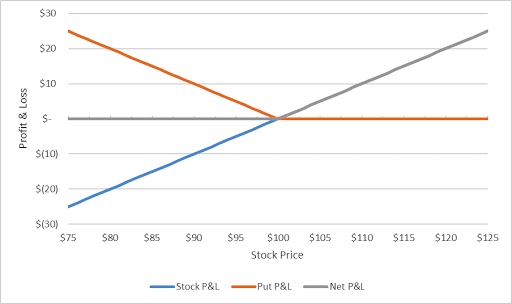
Combining the deltas of 100 shares together with 2 long put option contracts with a -0.5 delta yields a delta-neutral portfolio.

Stock position delta = 100 shares x delta of 1 = 100

Long put position delta = 2 contracts x 100 shares/option x delta of -0.5 = -100

Portfolio delta = stock position delta + long put position delta

Portfolio delta = 100 + (-100) = 0 or delta neutral

The net position may offer downside risk reduction by being long put options while still having exposure to upside from the long stock position. Of course, using protective puts involves premium costs that may reduce overall returns.

A diagram might help illustrate how delta-neutral positioning works.

Profit & Loss Diagram Using the Above Example (Not Including the Put Option Cost)

Profit & Loss Diagram Using the Above Example (Not Including the Put Option Cost)

Profiting From Delta-Neutral Trading

It is possible to profit from changes other than price movements in the underlying stock. For example, an options trader can use delta-neutral strategies to seek gains from declining or rising volatility. Vega is the Options Greek that measures the sensitivity of an option’s price to changes in volatility.

Delta-neutral strategies can also be used to capture potential value from time decay or — as in the earlier example — to hedge an existing long stock position. Writing options may allow you to benefit from the effect of time decay, but there is a risk of assignment. If the underlying stock price moves significantly, the contracts could be assigned to you.

Shorting Vega

Shorting vega is a more advanced options trading strategy, used to express a bearish view on implied volatility.

You might consider shorting volatility after a period of extreme movement in the market or a single stock. The key is to short vega when implied volatility is still high and there is an expectation it may decline.

When implied volatility is high, you pay a significant premium to be long options. You may seek to capitalize on elevated premiums by selling options while still being delta neutral. The risk is that implied volatility levels continue to increase further, which can lead to losses on a short vega play. Note: delta neutrality degrades due to gamma as prices move.

Waiting for Collapse in Volatility

A short vega position relies on the implied volatility on the underlying security to drop in order to turn a profit. It might take patience for implied volatility to revert toward historical averages. To remain delta neutral, other positions might need to be added to mitigate the risk of a change in the underlying stock price.

Pros and Cons of Delta Neutral Positions

Some of the pros of crafting a delta-neutral portfolio have been highlighted, but there are potential tradeoffs and risks as well. Having to closely monitor your portfolio can be a burden, while trading costs mount as you constantly layer on or reduce hedges to keep near delta neutral.

thumb_up

Pros:

•   Potential to profit from variables other than the price movement of the underlying asset

•   Traders hold stock for the long run while seeking to limit the impact of near-term declines

thumb_down

Cons:

•   Requires frequent trades, which may increase costs, to maintain a delta near 0

•   Deltas are constantly changing, which can result in over- or under-hedging

Delta-Neutral Straddle

A delta-neutral straddle strategy uses a combination of puts and calls to keep the position’s delta near zero while having exposure to volatility changes.

For example, if XYZ stock trades at $100, and it’s at-the-money call has a delta of 0.5 and it’s at-the-money put has a delta of -0.5, a trader might buy both options to establish a neutral position and then sell them if implied volatility increases. With this delta-neutral long straddle strategy, your delta is effectively 0 but you are long volatility.

A delta-neutral short straddle is an options trade that aims to benefit from limited price movement and a decline in implied volatility. The short straddle, as the inverse of the long straddle, may be used when implied volatility is expected to decrease.

Other options trading strategies that may benefit from volatility and time decay include calendar spreads, diagonal spreads, iron butterflies, and iron condors, among others.

The Takeaway

Building and maintaining a delta-neutral portfolio can be a challenging task, but the potential to benefit from time decay and volatility shifts may make it worthwhile.

Delta-neutral trading can also help reduce exposure to short-term declines while allowing investors to hold stock for the long-term.

SoFi’s options trading platform offers qualified investors the flexibility to pursue income generation, manage risk, and use advanced trading strategies. Investors may buy put and call options or sell covered calls and cash-secured puts to speculate on the price movements of stocks, all through a simple, intuitive interface.

With SoFi Invest® online options trading, there are no contract fees and no commissions. Plus, SoFi offers educational support — including in-app coaching resources, real-time pricing, and other tools to help you make informed decisions, based on your tolerance for risk.

Explore SoFi’s user-friendly options trading platform.

FAQ

How do you make money with a delta-neutral strategy?

You may profit from a delta-neutral option strategy when there are changes in a stock’s variables beyond its share price. Changes in implied volatility can present opportunities to go long or short volatility while being agnostic to the stock price’s change. You can also benefit from time decay by selling options while being delta neutral.

What is a delta-neutral strike?

A delta-neutral strike refers to the price at which a portfolio is precisely balanced. In practice, this is an approximation rather than an exact level. As the underlying asset price moves, delta may shift away from zero; it will take additional hedging trades to get back to delta neutral.

How can you calculate the value of your delta-neutral position?

To calculate your position’s delta, multiply each security’s delta by your position size. For example, one call option contract with a delta of 0.75 has a delta of 75 (0.75 x 100 options per contract). Being long 100 shares of stock with a delta of 1 has a delta of 100 (1 x 100 shares).

You combine the deltas of all positions in your portfolio to determine your overall delta. At that point, you may trade options to make your portfolio delta neutral.


Photo credit: iStock/Delmaine Donson

INVESTMENTS ARE NOT FDIC INSURED • ARE NOT BANK GUARANTEED • MAY LOSE VALUE

SoFi Invest is a trade name used by SoFi Wealth LLC and SoFi Securities LLC offering investment products and services. Robo investing and advisory services are provided by SoFi Wealth LLC, an SEC-registered investment adviser. Brokerage and self-directed investing products offered through SoFi Securities LLC, Member FINRA/SIPC.

For disclosures on SoFi Invest platforms visit SoFi.com/legal. For a full listing of the fees associated with Sofi Invest please view our fee schedule.

Options involve risks, including substantial risk of loss and the possibility an investor may lose the entire amount invested in a short period of time. Before an investor begins trading options they should familiarize themselves with the Characteristics and Risks of Standardized Options . Tax considerations with options transactions are unique, investors should consult with their tax advisor to understand the impact to their taxes.

Disclaimer: The projections or other information regarding the likelihood of various investment outcomes are hypothetical in nature, do not reflect actual investment results, and are not guarantees of future results.

Financial Tips & Strategies: The tips provided on this website are of a general nature and do not take into account your specific objectives, financial situation, and needs. You should always consider their appropriateness given your own circumstances.

SOIN-Q225-074

Read more
TLS 1.2 Encrypted
Equal Housing Lender