Should You Refinance Your Student Loans?

If refinancing your student loans could save you money or make your monthly loan payments more manageable, it may be time to consider a refinance. When you refinance student loans, you replace your existing loans with a new loan from a private lender. Ideally, the new loan would have better rates and terms, if you can qualify for them.

Refinancing isn’t always the right choice, however. There are times when it may not be in your favor. If you’re wondering, should I refinance my student loans?, here’s what you need to know.

Key Points

•   Refinancing student loans can potentially save borrowers money through lower interest rates and reduced monthly payments.

•   A good credit score is needed to qualify for the best refinancing offers and terms.

•   Borrowers who want to switch from variable to fixed interest rates (or vice versa) can do so by refinancing.

•   Refinancing federal loans results in losing eligibility for federal forgiveness and income-driven repayment programs.

•   Weighing pros and cons is crucial, especially for those with federal student loans, to determine if refinancing is beneficial.

When to Refinance Student Loans

There are several situations in which refinancing student loans makes sense, including these instances:

You Have Private Student Loans With High Interest Rates

If you took out private student loans to help cover the cost of school and the interest you’re paying is high, refinancing may help you get a lower rate. This is especially true at times when interest rates are lower overall and/or when your financial history is solid.

If you qualify for an interest rate that’s even just a few points lower than your current rate, you could potentially save thousands of dollars. This could be one of the times when to refinance student loans. A student loan refinancing calculator can help you crunch the numbers to see what your specific savings might be.

Or perhaps you need to lower your monthly payment to help save money. One way to do this is to refinance your student loans with a longer loan term. This will reduce your payments, however, you will end up paying more in interest over the life of the loan. You could also lower your payment by getting a lower student loan refinancing rate, if possible, and keeping the term the same.

Your Credit Score is Good

Your eligibility to refinance student loans depends in part on your credit score. If you’ve spent time building your credit and you have a stable job, you may qualify for lower student loan refinancing rates.

You can also consider applying for a student loan refinance with a cosigner. If your cosigner has a stronger credit profile than you, you may be able to land a better rate on your refinance.

You can usually refinance student loans right after graduating, and as often as you want after that. Most lenders charge no fees to refinance.

You Have Multiple Loans

If you have several different student loans, refinancing allows you to combine them all into one loan. Basically, when you refinance, you take out a new loan, and that loan is used to pay off your existing loans. You then make payments on the new loan. It streamlines the repayment process since you have just one loan payment to make each month.

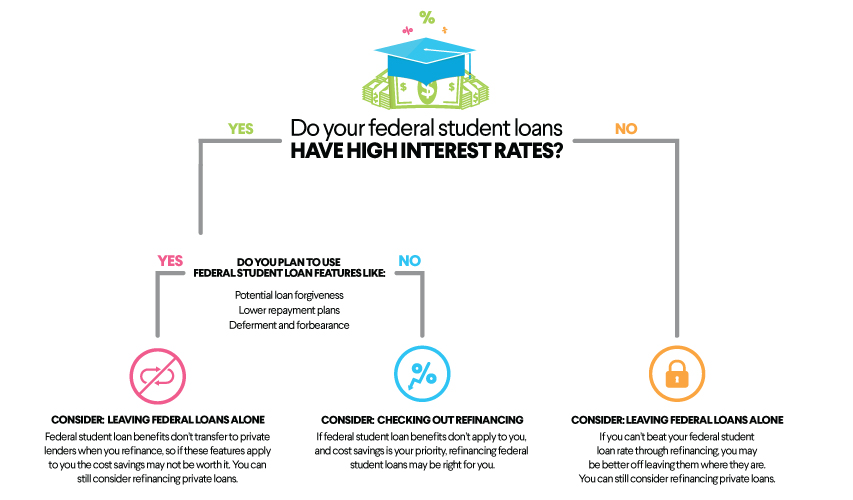
You can refinance both federal and private student loans, or a combination of both types, but be aware that refinancing federal loans with a private lender will forfeit your eligibility for federal benefits and protections.

You Qualify for Refinancing

Whether you qualify to refinance student loans depends in part on your credit score, as noted, along with your financial history, employment, and debt-to-income ratio (your monthly income vs. expenses). If you qualify, and ideally, if you can get a lower interest rate, you can save money by refinancing.

You Want to Remove a Cosigner

If you have a cosigner on your student loans and you’d like to remove them, refinancing is one way to do that — as long as you have the credit and financial history to qualify to refinance on your own. To remove the cosigner, take out the refinance loan in your own name only. The cosigner will not have any responsibility for the new loan.

You Want to Switch to Fixed Interest

If you have student loans with variable rates, and you’re concerned that interest rates will rise, you may want to consider refinancing to lock in a fixed rate on the new loan.

You Are Willing to Give Up Federal Benefits

Borrowers with federal student loans need to understand that refinancing these loans into a private student loan will eliminate the ability to participate in income-driven repayment plans, Public Service Loan Forgiveness, and federal deferment and forbearance.

If you are using these benefits or you plan to, it’s not recommended to refinance your student loans. Instead, you could consider student loan consolidation vs. refinancing. A federal student loan consolidation combines multiple loans into one, with the interest rate being the weighted average of the loans you are consolidating rounded up to the nearest one-eighth of a percent.

IMPORTANT: The projections or other information generated by this quiz regarding the likelihood of various outcomes are hypothetical in nature, do not reflect actual results, and are not guarantees of offers.

When Not to Refinance Student Loans

Just like there are times when refinancing may be a wise choice, there are also times when it’s best not to refinance your student loans. You’ll generally want to rule out refinancing in the following situations.

You Want to Use a Federal Loan Forgiveness Program

If you have federal student loans and you’re planning on taking advantage of federal loan forgiveness programs that cancel some of your debt after you meet certain qualifications, refinancing is not the right option for you. Refinancing federal loans into a new private loan makes them ineligible for federal benefits and programs.

You Work in Public Service or Education

Borrowers working in a public service job or as a teacher or educator should think twice about refinancing. If you keep your federal student loans, you may be able to qualify for Public Service Loan Forgiveness (PSLF) or Teacher Loan Forgiveness. With PSLF, eligible borrowers who work in public service for a qualifying nonprofit organization or government agency may qualify for forgiveness from their remaining loan balance after making 120 qualifying payments.

With Teacher Loan Forgiveness, if you teach for five consecutive years in a low-income school or educational service agency and meet certain other qualifications, you may be eligible for forgiveness for up to $17,500 on certain federal student loans, including Direct Subsidized and Unsubsidized Loans.

Refinancing federal student loans means you lose access to these forgiveness programs.

You Need Flexible Repayment Options

If you need a payment plan that could make it easier to repay your federal student loans, income-driven repayment (IDR) is an option to consider. IDR plans base your payments on your discretionary income and family size. The repayment period ranges from 20 to 25 years on these plans.

There are three IDR plans borrowers can currently enroll in via an online application: the income- based repayment (IBR) plan, the income-contingent repayment (ICR) plan, and the Pay As You Earn (PAYE) repayment plan. On one of these plans, the IBR plan, the remainder of your student loan debt may be forgiven at the end of the repayment term.

If you refinance student loans, you will not be eligible for IDR plans.

You Have Poor Credit

Borrowers need good credit to qualify for refinancing, and they need good or excellent credit to be eligible for lower interest rates. If your credit is poor, it may be wise to hold off on refinancing and work on building your credit instead. You could always refinance later, when your financial situation improves and your credit is stronger.

The Takeaway

Knowing when and when not to refinance student loans is important. Refinancing your loans can make sense if it saves you money or helps you get more favorable loan terms. But if your credit isn’t strong enough to get a lower interest rate, or you have federal student loans and want to pursue federal programs like loan forgiveness, refinancing isn’t recommended.

Looking to lower your monthly student loan payment? Refinancing may be one way to do it — by extending your loan term, getting a lower interest rate than what you currently have, or both. (Please note that refinancing federal loans makes them ineligible for federal forgiveness and protections. Also, lengthening your loan term may mean paying more in interest over the life of the loan.) SoFi student loan refinancing offers flexible terms that fit your budget.


With SoFi, refinancing is fast, easy, and all online. We offer competitive fixed and variable rates.

FAQ

Can refinancing student loans reduce the cost of your total debt?

Yes, refinancing your student loans may reduce the total cost of your debt by reducing the amount of interest you pay over the life of the loan. You can do this by getting a lower interest rate (and keeping your loan term the same) and/or shortening your loan term.

What credit score do you need to refinance student loans?

The minimum credit score needed to refinance student loans varies from lender to lender, but according to FICO, a “good” credit score is 670 or higher. To get the best student loan refinance rates, you’ll want to have a good credit score and low debt-to-income ratio. If you don’t meet those requirements, you may want to consider refinancing with a cosigner or waiting until you build your credit.

How do I qualify for student loan refinancing?

To qualify for student loan refinancing, you need strong credit, a low debt-to-income ratio, and stable employment and a steady income. Some lenders may also require you to have your degree in order to refinance. If you don’t meet the refinancing qualifications, you could add a creditworthy cosigner to your loan application or wait to refinance when your financial situation improves.

What are the benefits of refinancing student loans?

The benefits of refinancing student loans include saving money if you can qualify for a lower interest rate, lower monthly payments if you extend your loan term, switching from a variable rate loan to a loan with a fixed rate, and removing a cosigner from your loan if that is something you are looking to do. Just be aware that refinancing federal student loans makes them ineligible for federal programs and protections.

Can student loans be forgiven if you refinance?

No, student loans cannot be forgiven if you refinance. Refinancing federal loans into private loans makes them ineligible for forgiveness. If you have federal student loans and you would like to pursue federal loan forgiveness, refinancing is not the recommended option for you.


SoFi Student Loan Refinance
Terms and conditions apply. SoFi Refinance Student Loans are private loans. When you refinance federal loans with a SoFi loan, YOU FORFEIT YOUR ELIGIBILITY FOR ALL FEDERAL LOAN BENEFITS, including all flexible federal repayment and forgiveness options that are or may become available to federal student loan borrowers including, but not limited to: Public Service Loan Forgiveness (PSLF), Income-Based Repayment, Income-Contingent Repayment, extended repayment plans, PAYE or SAVE. Lowest rates reserved for the most creditworthy borrowers.
Learn more at SoFi.com/eligibility. SoFi Refinance Student Loans are originated by SoFi Bank, N.A. Member FDIC. NMLS #696891 (www.nmlsconsumeraccess.org).

SoFi Loan Products
SoFi loans are originated by SoFi Bank, N.A., NMLS #696891 (Member FDIC). For additional product-specific legal and licensing information, see SoFi.com/legal. Equal Housing Lender.


Disclaimer: Many factors affect your credit scores and the interest rates you may receive. SoFi is not a Credit Repair Organization as defined under federal or state law, including the Credit Repair Organizations Act. SoFi does not provide “credit repair” services or advice or assistance regarding “rebuilding” or “improving” your credit record, credit history, or credit rating. For details, see the FTC’s website .

Third-Party Brand Mentions: No brands, products, or companies mentioned are affiliated with SoFi, nor do they endorse or sponsor this article. Third-party trademarks referenced herein are property of their respective owners.

Non affiliation: SoFi isn’t affiliated with any of the companies highlighted in this article.

Financial Tips & Strategies: The tips provided on this website are of a general nature and do not take into account your specific objectives, financial situation, and needs. You should always consider their appropriateness given your own circumstances.

Third Party Trademarks: Certified Financial Planner Board of Standards Center for Financial Planning, Inc. owns and licenses the certification marks CFP®, CERTIFIED FINANCIAL PLANNER®

SOSLR-Q225-029

Read more
woman sitting at a desk working

Can You Refinance Student Loans More Than Once?

Refinancing your student debt can have many benefits, including saving money on interest, lowering your monthly payments, or changing your repayment terms. But can you do it more than once? And, if so, should you?

Yes. And maybe.

There is no limit on how many times you can refinance your student loans. If your finances and credit have improved since you last refinanced and/or market interest rates have gone down, it may be worthwhile to refinance your loans, even if you’ve refinanced before.

That said, refinancing multiple times isn’t always worthwhile. Here are key things to consider before you refinance your student loans more than once.

Key Points

•   There is no limit to how many times you can refinance student loans, as long as you qualify each time.

•   Refinancing again can be beneficial if your credit has improved, interest rates have dropped, or you need different repayment terms.

•   Lower interest rates can reduce overall costs, and some lenders offer better repayment options or promotional discounts.

•   Frequent refinancing can impact your credit score, extend repayment (increasing total interest paid), and require time and effort.

•   Before refinancing again, compare interest rates, loan terms, lender reputation, and fees to ensure it’s the right decision.

How Many Times Can You Refinance Student Loans?

Technically, there is no limit to the number of times you can refinance your student loans with a private lender. In fact, as long as you qualify, you can refinance your student loans as many times and as often as you’d like. And given that lenders often don’t charge prepayment penalties or origination fees, there may be no extra cost involved with refinancing your student loans again.

Refinancing student loans again generally makes the most sense when your finances or credit score improves or interest rates decline. In these cases, it may be possible to save thousands of dollars in interest by reducing your interest rate by a couple percentage points.

If you’re not able to get a lower rate, however, refinancing may not make sense, especially if it extends your repayment term, leading to higher costs.

Also keep in mind that if you only have federal student loans, refinancing with a private lender may not be your best option, since it means giving up government protections like income-driven repayment plans and Public Service Loan Forgiveness.

If you have federal loans, you may want to carefully explore your options, including whether to consolidate or refinance student loans.

When Should You Consider Refinancing Your Student Loans Again?

If you’ve already refinanced your loans with a private lender, here are some key reasons why you might consider refinancing again.

Your Financial Situation Has Changed

If you have experienced a significant improvement in your overall financial health since your last refinance, you may be eligible for a better loan rate and terms. In fact, some borrowers with limited or poor credit might refinance their loans multiple times as they build credit.

Interest Rates Have Come Down

Student loan rates are not only tied to your creditworthiness, but also current economic conditions. If market interest rates have dropped since your last refinance, you might be able to secure a lower rate student loan refinancing rate, reducing your overall interest payments. Even a small reduction in interest rates can lead to substantial savings over the life of the loan.

It’s a good idea to keep an eye on market trends and compare current rates to what you’re paying to determine if refinancing again makes financial sense.

You’re Looking for Different Loan Terms

Changing loan terms can also be a reason to refinance again. Perhaps your initial refinance resulted in a longer loan term to lower your monthly payments, but now you’re in a better financial position and can afford higher payments to pay off your loan faster.

Conversely, you might need to extend your loan term to lower monthly payments due to a change in financial circumstances. Just be aware that extending your repayment term can cost you more money in interest over time.

You Want to Remove or Add a Cosigner

If you originally refinanced with a cosigner and your financial situation has changed so that you no longer need them to qualify for favorable loan terms — or if the cosigner wants to be removed from the loan — refinancing allows you to take them off the loan. You’ll refinance in your own name only and the cosigner will not be included on the new loan.

On the other hand, if you want to add a cosigner with strong credit in order to qualify for a lower refinancing rate, you can do that as well. The new refinanced loan will be in both your names, and you will both be responsible for the loan. The cosigner legally agrees to repay your debt in the event that you can’t make the payments.

Recommended: Can You Refinance Student Loans With No Degree?

What Are Some Advantages of Refinancing Multiple Times?

Before you decide to refinance your student loan again, it’s important to know the advantages and disadvantages of this strategy. Here’s a look at some of the pros of refinancing student loans multiple times.

•   Save money: Refinancing multiple times can help you take advantage of lower interest rates as your financial situation improves or as market rates decrease. Each reduction in interest rates can save you money over the life of your loan. You can also shorten your loan term to pay off your debt faster, which can also reduce what you pay in interest

•   Better lender benefits: Refinancing with a different lender can potentially provide access to better benefits, such as more flexible repayment options and hardship programs if you are struggling to make your payments. Choosing a lender that offers these benefits can provide additional financial security.

•   Promotional offers: Some lenders will offer special promotions or discounts for refinancing with them.

What Are Some Disadvantages of Refinancing Multiple Times?

Refinancing multiple times also has potential drawbacks. Here are some to consider.

•   Credit impact: When you formally apply for a refinance, the lender runs a hard credit inquiry, which can negatively affect your credit score. While a single inquiry typically has a minimal impact, multiple inquiries in a short period can lower your credit score.

•   You could end up paying more: If you refinance to a longer repayment term, or even the same term every few years, you’re extending the amount of interest payments you make. This can keep you in debt longer and increase the total amount of interest you pay. If you refinance to a variable-rate student loan, the rate could also go up during the life of the loan.

•   Time and effort: The process of refinancing can be time-consuming, involving research and making comparisons between lenders, as well as paperwork and credit checks. Doing this multiple times may require a significant investment of time and effort. It might not always be worth it if you won’t save much money with your new loan.

Things to Look for When Refinancing

If you’re considering another refinance, it’s important to look at the following factors to ensure you’re making a smart financial decision.

•   Interest rates: Compare the offered interest rates with your current rate to ensure you’re getting a better deal. And make sure you have a credit score required to refinance to help you get those better rates.

•   Fixed vs. variable rates: Variable-rate loans have interest rates that can fluctuate based on market rates. The rate could climb if the rate or index it’s tied to goes up (and vice versa).

•   Loan terms: Evaluate the terms of the new loan, including the length of the loan and monthly payment amounts. Keep in mind that a longer term can lead to lower payments but increase the total cost of your loan in the end.

•   Fees and costs: Be aware of any fees associated with the refinance and calculate whether the savings outweigh these costs.

•   Lender reputation: Research the lender’s reputation and customer service to ensure you’re working with a reliable and supportive institution.

•   Borrower benefits: Consider the benefits offered by the lender, such as flexible repayment options and hardship programs.

Recommended: How Soon Can You Refinance Student Loans?

How to Decide If Refinancing Again is Right for You

To determine whether refinancing again is a wise option for your situation, consider whether it will save you money. If your financial situation has improved, and/or interest rates have dropped, refinancing may help you secure a lower rate and potentially save thousands of dollars in interest.

If you need to change the terms of your loan, refinancing could help you do that as well. Just be aware that if you’re extending your loan term to reduce your monthly payments, you’ll pay more overall over the life of the loan. And if you shorten the loan term, your monthly payments will be higher.

Finally, if adding a cosigner might help you get more favorable rates and terms for a loan, refinancing to add that person may be worthwhile.

Refinancing Your Student Loans With SoFi

Refinancing student loans multiple times can be a strategic move to save money and better manage your debt. While there’s no limit to how many times you can refinance, it’s important to carefully consider the costs, benefits, and your financial goals each time.

Looking to lower your monthly student loan payment? Refinancing may be one way to do it — by extending your loan term, getting a lower interest rate than what you currently have, or both. (Please note that refinancing federal loans makes them ineligible for federal forgiveness and protections. Also, lengthening your loan term may mean paying more in interest over the life of the loan.) SoFi student loan refinancing offers flexible terms that fit your budget.


With SoFi, refinancing is fast, easy, and all online. We offer competitive fixed and variable rates.

FAQ

Can I consolidate student loans more than once?

Typically, you can’t consolidate federal student loans into a Direct Consolidation Loan more than once. However, you may be able to do this if you have federal loans that were not included in a previous consolidation. Just keep in mind that federal consolidation does not lower your interest rate. With private student loans, refinancing is the way to consolidate your loans, and there is no limit on the number of times it can be done. Each refinance creates a new loan with new terms, so you’ll want to evaluate the benefits, interest rates, and any potential fees before deciding to refinance again.

How many times can you refinance a loan?

There is typically no set limit on how many times you can refinance a loan, including student loans. As long as you qualify, you can refinance your student loans as many times and as often as you’d like. Each refinance involves taking out a new loan to pay off the existing one, so it’s important to consider factors like interest rates, loan term, and any associated fees.

How many times can you take out student loans?

There’s no set limit on how many student loans you can take out, but the federal government and private lenders do impose lending limits based on dollar amount.

For federal student loans, there are annual and aggregate (lifetime) limits based on your degree level and dependency status. For private student loans, lenders set their own annual and aggregate student limits. Often, they will cover up to the annual cost of attendance minus other financial aid each year.

What happens if I refinance my student loans multiple times?

You can refinance your student loans as often as you like, as long as you qualify. There are pros and cons to refinancing multiple times. On the plus side, if your financial situation has improved, you may be able to get a lower interest rate through refinancing again and save money. You could also change the terms of your loan or remove or add a cosigner.

The main drawbacks of refinancing again include a negative impact to your credit, since multiple credit inquiries in a short period of time could temporarily lower your score, and paying more in interest if you refinance to a longer loan term.

Does refinancing student loans multiple times hurt my credit?

Refinancing student loans multiple times in a short period of time could temporarily lower your credit score by several points. This is because when you apply for refinancing, lenders typically do a hard credit check to see your credit report and debt repayment history. A hard credit check temporarily drops your score.


About the author

Julia Califano

Julia Califano

Julia Califano is an award-winning journalist who covers banking, small business, personal loans, student loans, and other money issues for SoFi. She has over 20 years of experience writing about personal finance and lifestyle topics. Read full bio.


SoFi Student Loan Refinance
Terms and conditions apply. SoFi Refinance Student Loans are private loans. When you refinance federal loans with a SoFi loan, YOU FORFEIT YOUR ELIGIBILITY FOR ALL FEDERAL LOAN BENEFITS, including all flexible federal repayment and forgiveness options that are or may become available to federal student loan borrowers including, but not limited to: Public Service Loan Forgiveness (PSLF), Income-Based Repayment, Income-Contingent Repayment, extended repayment plans, PAYE or SAVE. Lowest rates reserved for the most creditworthy borrowers.
Learn more at SoFi.com/eligibility. SoFi Refinance Student Loans are originated by SoFi Bank, N.A. Member FDIC. NMLS #696891 (www.nmlsconsumeraccess.org).

SoFi Loan Products
SoFi loans are originated by SoFi Bank, N.A., NMLS #696891 (Member FDIC). For additional product-specific legal and licensing information, see SoFi.com/legal. Equal Housing Lender.


Disclaimer: Many factors affect your credit scores and the interest rates you may receive. SoFi is not a Credit Repair Organization as defined under federal or state law, including the Credit Repair Organizations Act. SoFi does not provide “credit repair” services or advice or assistance regarding “rebuilding” or “improving” your credit record, credit history, or credit rating. For details, see the FTC’s website .

Third-Party Brand Mentions: No brands, products, or companies mentioned are affiliated with SoFi, nor do they endorse or sponsor this article. Third-party trademarks referenced herein are property of their respective owners.

Non affiliation: SoFi isn’t affiliated with any of the companies highlighted in this article.

Financial Tips & Strategies: The tips provided on this website are of a general nature and do not take into account your specific objectives, financial situation, and needs. You should always consider their appropriateness given your own circumstances.

Third Party Trademarks: Certified Financial Planner Board of Standards Center for Financial Planning, Inc. owns and licenses the certification marks CFP®, CERTIFIED FINANCIAL PLANNER®

SOSLR-Q225-027

Read more
Close-up of a person's hands researching auto insurance on a white smartphone, wearing a striped shirt and rings

7 Ways To Simplify Your Finances

It may feel like there’s nothing easy about money. The older you get, the more obligations you may have. Between checking, savings, 401(k)s, bills, loans, mortgages, and more — it can be a lot to keep track of and manage.

If thinking about your finances causes you to feel stressed and/or you find yourself putting off important financial decisions, it may be time to simplify. While streamlining your personal finances can take a little bit of time and effort in the short term, it can end up saving you time, effort, as well as money, over the long haul.

Here are seven simple moves that can help you manage your money more efficiently — and more effectively.

Key Points

•   Automate bill payments to save time and avoid late fees.

•   Opt for paperless statements to reduce clutter and easily access documents.

•   Consolidate multiple accounts to minimize fees and simplify management.

•   Focus on one or two financial goals at a time for better progress.

•   Use the debt snowball or avalanche method to pay off debts efficiently.

1. Automating Your Bills

One of the easiest ways to simplify your finances is to set up auto payment whenever possible. Putting all of your bills — including credit cards, utilities, insurance, loans, mortgage, and even rent — on autopilot can save you significant time and hassle each month. Plus, you won’t have to worry about late payments — or late fees.

You can often set up automatic payments for your bills by going to the website of the service provider and inputting your bank account information.

If a business doesn’t offer an automatic payment program, you may be able to set up a recurring payment through your bank by logging in to your online bank account or using your bank’s mobile app.

2. Going Paperless

A major culprit of personal finance-related headaches is paperwork. Keeping track of the many documents — all those receipts, investment reports, bank statements, tax returns — can be a struggle.

Many services allow you to opt-in to a paperless experience instead. You’ll typically have access to all of the documents when you log into your account. And, with everything just a click away, you won’t have to worry about finding misplaced paper documents.

If you’re interested in next-level financial organization, you could even set up a digitized archive of your important information and files on your computer or an external hard drive, so you never have to spend hours searching through file cabinets and miscellaneous envelopes.

You can also reduce physical — and mental — clutter by taking advantage of the many retailers and service providers that offer email, rather than paper, receipts. Or, you may want to consider getting an app that scans, organizes, and stores receipts.

Increase your savings
with a limited-time APY boost.*


*Earn up to 4.30% Annual Percentage Yield (APY) on SoFi Savings with a 0.70% APY Boost (added to the 3.60% APY as of 11/12/25) for up to 6 months. Open a new SoFi Checking & Savings account and enroll in SoFi Plus by 1/31/26. Rates variable, subject to change. Terms apply here. SoFi Bank, N.A. Member FDIC.

3. Consolidating Accounts

Whether you’re married with three kids or single with two Labradoodles, there’s a good chance that you have more financial accounts than you need. Consolidating multiple bank accounts into just a few can help simplify your financial life. In some cases, it can also help you save you money.

If you’ve done a lot of job hopping in your career, for example, you could have multiple 401(k)s floating around. When you leave a company but don’t roll over your 401(k), you’re often subject to fees that your employer may have been covering while you were employed.

By rolling your 401(k) into an Individual Retirement Account (IRA), you may be able to minimize fees. Another plus is that you may be able to merge your IRAs and have all of your funds in one spot. And, you may be able to select from a wider selection of funds and investments than the ones selected by your previous employer.

If you have more than one checking or savings account, you may want to see if you can pare it down to one of each. They don’t necessarily have to be under the same roof. You can typically link your accounts even if they are at two different banks, such as a checking account at a traditional bank and a high-yield savings account at an online bank.

You may also want to look at bundling your insurance policies. Many companies offer substantial discounts if they write both your auto and homeowner’s policies.

4. Using One Credit Card

If you signed up for a variety of credit cards, chasing the promised rewards they offered, you may have racked up more than a few credit accounts.

To make it easier to keep track of your spending, you may want to pick the card that offers you the most in return, whether that’s cash back, travel rewards, or other perks, and focus on using only that credit card.

By putting everything on one card, you’ll only have one credit card bill to pay each month, a single statement to monitor for errors and fraud, and one rewards program to track. Plus, you won’t have to think about which card to pull out whenever you’re making a purchase.

Rather than canceling your other cards (which could negatively impact your credit), you may want to just store them away in a secure place.

5. Knocking Down Debt

One of the most effective ways to reduce financial stress is to get rid of high-interest debts.

Paying off even one sizable credit card or loan can not only ease worry, but can also reduce the number of financial obligations you have to deal with each month. It can also free up money that you can then put towards something else, whether that’s getting rid of other debts or something fun like a vacation.

Two common strategies for paying off debt are the debt snowball and debt avalanche method.

With the debt snowball method, you list your debts in order of size, then put any extra money you have towards the debt with the smallest balance, while paying the minimum on the others. When that debt is paid off, you tackle the next-smallest debt, and so on. Paying off debts in full can help you feel accomplished, simplify your life, and inspire you to continue crushing your debt.

With the debt avalanche method of paying off debt, you list your debts in order of interest rate, then focus on putting extra money towards the debt with the highest interest rate first, while paying the minimum on the rest. When that debt is paid off, you put extra money towards the debt with the next-highest interest rate. While it may take you longer to see progress on your loans, you’ll likely pay less money in interest over time using this method.

6. Putting Saving on Autopilot

The set-it-and-forget-it approach can be highly effective when it comes to saving money. For one reason, you don’t have to remember to transfer money from your checking to your savings each month. For another, the money will get whisked out of your checking account before you ever have a chance to spend it.

You can automate savings in just a few minutes by setting up a recurring transfer from your checking to your savings account for a set amount of money on the same day each month (perhaps the day after your paycheck clears).

Even if you can only afford to transfer a small amount each month, it can be worth automating this task. Since the savings will happen every month no matter what, your savings will gradually build over time.

Recommended: Savings Calculator

7. Focusing on Fewer Goals

It can be great to have financial goals. Many of us have plans to buy a home, put kids through college, and pay for our retirement. But if you set too many goals at one time, you can end up losing focus, and not making any progress on any of them.

A better approach can be to set just one or two goals to fully focus on at one time. Ideally, one should be saving for retirement, since the earlier you start saving for retirement, generally the easier it is to reach your goal.

The other goal might be paying off your credit card debt or student loans, saving for a down payment on a home, or putting money aside to help pay for your kids’ college education.

By focusing your energy on just one or two specific goals, you may be able to make real headway. Once you start seeing progress — or actually achieve the goal — you’ll likely be inspired to set, and accomplish, other goals.

The Takeaway

Simplifying your financial life may take a bit of legwork up front but, in the long run, it can help alleviate stress and also help you better plan for your financial future.

Strategies that can help you simplify your finances include paring down the number of accounts you have, crossing off debts, automating monthly tasks like paying bills and transferring money to savings, and focusing your efforts on just one or two financial goals at a time.

Interested in opening an online bank account? When you sign up for a SoFi Checking and Savings account with direct deposit, you’ll get a competitive annual percentage yield (APY), pay zero account fees, and enjoy an array of rewards, such as access to the Allpoint Network of 55,000+ fee-free ATMs globally. Qualifying accounts can even access their paycheck up to two days early.


Better banking is here with SoFi, NerdWallet’s 2024 winner for Best Checking Account Overall.* Enjoy up to 3.60% APY on SoFi Checking and Savings with eligible direct deposit.

FAQ

How do I simplify my finances?

You can simplify your finances by consolidating accounts, automating payments, and using budgeting apps. Other ways to simplify your financial life include: setting up a budget with clear spending categories and limits, paying off high-interest debts to reduce monthly obligations, and getting rid of subscriptions and memberships you don’t use regularly.

What is the 50/30/20 rule in your financial plan?

The 50/30/20 rule is a budgeting guideline that splits your income into three parts: 50% for essential expenses (like rent and groceries), 30% for discretionary spending (like entertainment, dining out, and hobbies), and 20% for savings and debt repayment. This rule helps ensure a balanced way to manage money, ensuring both responsible financial habits and room for enjoyment and future planning.

What is the 7% rule in finance?

The 7% rule in finance suggests that a safe and sustainable withdrawal rate from a retirement portfolio is 7% per year. This means you can withdraw 7% of your total retirement savings annually without significantly depleting your funds. However, this rule is a general guideline and may vary based on market conditions, portfolio size, and individual financial circumstances. Always consult a financial advisor for personalized advice.


SoFi Checking and Savings is offered through SoFi Bank, N.A. Member FDIC. The SoFi® Bank Debit Mastercard® is issued by SoFi Bank, N.A., pursuant to license by Mastercard International Incorporated and can be used everywhere Mastercard is accepted. Mastercard is a registered trademark, and the circles design is a trademark of Mastercard International Incorporated.

Annual percentage yield (APY) is variable and subject to change at any time. Rates are current as of 11/12/25. There is no minimum balance requirement. Fees may reduce earnings. Additional rates and information can be found at https://www.sofi.com/legal/banking-rate-sheet

Eligible Direct Deposit means a recurring deposit of regular income to an account holder’s SoFi Checking or Savings account, including payroll, pension, or government benefit payments (e.g., Social Security), made by the account holder’s employer, payroll or benefits provider or government agency (“Eligible Direct Deposit”) via the Automated Clearing House (“ACH”) Network every 31 calendar days.

Although we do our best to recognize all Eligible Direct Deposits, a small number of employers, payroll providers, benefits providers, or government agencies do not designate payments as direct deposit. To ensure you're earning the APY for account holders with Eligible Direct Deposit, we encourage you to check your APY Details page the day after your Eligible Direct Deposit posts to your SoFi account. If your APY is not showing as the APY for account holders with Eligible Direct Deposit, contact us at 855-456-7634 with the details of your Eligible Direct Deposit. As long as SoFi Bank can validate those details, you will start earning the APY for account holders with Eligible Direct Deposit from the date you contact SoFi for the next 31 calendar days. You will also be eligible for the APY for account holders with Eligible Direct Deposit on future Eligible Direct Deposits, as long as SoFi Bank can validate them.

Deposits that are not from an employer, payroll, or benefits provider or government agency, including but not limited to check deposits, peer-to-peer transfers (e.g., transfers from PayPal, Venmo, Wise, etc.), merchant transactions (e.g., transactions from PayPal, Stripe, Square, etc.), and bank ACH funds transfers and wire transfers from external accounts, or are non-recurring in nature (e.g., IRS tax refunds), do not constitute Eligible Direct Deposit activity. There is no minimum Eligible Direct Deposit amount required to qualify for the stated interest rate. SoFi Bank shall, in its sole discretion, assess each account holder's Eligible Direct Deposit activity to determine the applicability of rates and may request additional documentation for verification of eligibility.

See additional details at https://www.sofi.com/legal/banking-rate-sheet.

*Awards or rankings from NerdWallet are not indicative of future success or results. This award and its ratings are independently determined and awarded by their respective publications.

Financial Tips & Strategies: The tips provided on this website are of a general nature and do not take into account your specific objectives, financial situation, and needs. You should always consider their appropriateness given your own circumstances.

We do not charge any account, service or maintenance fees for SoFi Checking and Savings. We do charge a transaction fee to process each outgoing wire transfer. SoFi does not charge a fee for incoming wire transfers, however the sending bank may charge a fee. Our fee policy is subject to change at any time. See the SoFi Bank Fee Sheet for details at sofi.com/legal/banking-fees/.
Third Party Trademarks: Certified Financial Planner Board of Standards Center for Financial Planning, Inc. owns and licenses the certification marks CFP®, CERTIFIED FINANCIAL PLANNER®

SOBNK-Q225-086

Read more
woman at desk on laptop

Ways to Avoid Student Loan Fees

Many students rely on student loans to help them pay for college. In addition to charging interest, student loans may also have other fees associated with them. Fees charged may include origination fees — a fee charged by the lender for processing the loan — or late payment fees.

When students sign up for loans or are in the midst of repayment, they may not even be aware of fees that accompany many private and federal student loans. But by learning about these fees, they can better prepare themselves financially and avoid headaches.

Keep reading to learn more on student loan fees and how you may be able to avoid them.

Key Points

•   Both federal and private student loans may come with fees, including origination fees and late payment fees.

•   Federal student loans come with origination fees: approximately 1.057% for Direct Subsidized and Unsubsidized Loans, and about 4.228% for Direct PLUS Loans.

•   Private lenders may charge various fees, including late payment fees, returned check fees, and forbearance fees.

•   Late payments on student loans can incur fees up to 6% of the missed payment amount.

•   If you’re facing financial difficulties, proactively contact your loan servicer to discuss options like deferment or forbearance.

What Are Student Loan Fees?

Student loan fees are additional charges that may be applied when borrowing or repaying student loans. They may include:

Student loan fees may include:

•   Origination fees

•   Late payment fees

•   Returned-check fees (aka insufficient-funds or non-sufficient-funds fees)

•   Loan collection fees

•   Forbearance and deferment fees

Can a Student Loan Fee Be Waived?

For the most part, student loan fees cannot be waived. In some instances, lenders may be willing to waive late payment fees for borrowers who have not previously made a late payment. Fees and policies may vary by loan type and lender, so contact your lender with specific questions. Continue reading for an explanation of different types of fees that may be associated with a student loan.

Origination Fees

Origination fees cover the cost of processing the loan. They are typically a small percentage of the loan amount.

How Are Student Loan Origination Fees Assessed?

Student loan origination fees are charged as a percentage of the loan amount. Federal student loans have an origination fee, and the information will be included in the Master Promissory Note. The origination fee is deducted from the amount borrowed, so when you receive the loan, it will actually be for less than the amount you borrowed.

Private student loans may or may not charge an origination fee; the policy will depend on the lender.

How Much Are Student Loan Origination Fee?

For federal student loans, the origination fee (also known as disbursement fee) is dependent on the loan type. Direct Subsidized and Unsubsidized Loans disbursed between October 1, 2020 and October 1, 2025 have a 1.057% origination fee. During the same timeframe, Direct PLUS Loans have a ​​4.228% origination fee.

The origination fee on private student loans will vary based on the lender, and not all private lenders charge an origination fee. Review the terms and conditions closely and contact your lender with any questions.

Recommended: Avoiding Loan Origination Fees

Late Payment Fees

Making a loan payment past the due date for a federal student loan can result in a late fee. After 30 days, the late fee may be up to 6% of the loan amount due. Review your Master Promissory Note or contact your loan servicer with questions.

The late fee for a private student loan depends on the lender and loan program. Some private student loan lenders do not charge late fees.

Returned-Check Fees

If a borrower pays using a check that bounces, the student loan servicer could charge a returned-check fee.

Loan Collection Fees

If a borrower defaults on a loan by not making payments for a certain amount of time (270 days for most federal student loans), the loan may be placed with a collection agency and be subject to loan collection fees. Any fees incurred will be in addition to the outstanding principal balance, interest, and fees.

Private student loan companies may charge even higher loan collection fees. Generally, private student loans also enter default sooner than federal student loans. The default period is described in the loan contract.

Forbearance and Deferment Fees

Borrowers who cannot make payments temporarily can request student loan forbearance or deferment. Typically, loan holders can avoid a fee, but they will need to contact their loan provider.

Forbearance and deferment are available for most federal student loans. Private lenders are not obligated to offer either program, but may offer some forms of deferment. If you are struggling to make payments on a private student loan, contact your lender to evaluate the options available to you.

Federal Student Loan Fees

When students want to apply for a loan, they can do it through the federal government or a private company, depending on their circumstances. The loan providers charge different types of fees.

Students will pay an origination fee for a federal student loan. As mentioned previously, for Direct Subsidized and Unsubsidized Loans, the fee is 1.057% of the loan amount. For Direct PLUS Loans (including Grad PLUS and Parent PLUS Loans), the fee is about 4.228% of the loan amount.

A late payment fee will typically be charged within 30 days after the payment is due. The late fee could be up to 6%. At that rate, if your monthly minimum payment is $250, your fee would be $15.

Private Student Loan Fees

Private lenders may not charge origination fees, though there may be an origination fee for a specialty loan, like a loan for medical school.

Some lenders charge late fees — generally a percentage of the late payment amount or a flat fee. They also typically charge for returned checks.

Additionally, most private student loan companies charge a fee for forbearance, a flat fee determined by the lender.

Collection fees will vary from lender to lender. If there is a collection fee on a private student loan, it will typically be included in your loan agreement.

How to Avoid Student Loan Fees

If students need to take out private or federal student loans, they may be able to avoid some of the fees (with the exception of origination fees for federal student loans). Ways to avoid student loan fees include:

Paying on Time

Paying on time is always recommended, not only to avoid late fees but to keep a credit report healthy. To avoid late fees, returned-check fees, and collection fees, borrowers can set up automated payments from a bank account. Otherwise, they can set up reminders on their phones and calendars that go off when their payments are about to come due.

Communicating with Your Lender

In terms of deferment fees, borrowers having trouble making payments on time can call their student loan servicer and ask for extensions or other options so that they don’t go into default.

Students shouldn’t be afraid to reach out to their loan servicer as soon as they can’t make a payment.

Choosing No-Fee Lenders

Some private lenders offer student loans with no origination, application, or late payment fees. Comparing lenders and reading the fine print can help you steer clear of unnecessary charges.

Paying for College

Paying for college may require a combination of resources. One of the first places for students to start their financial aid journey is by filling out the Free Application for Federal Student Aid (FAFSA®) every year. This application allows students to find out if they are eligible for federal financial aid, including federal student loans, grants, scholarships, and work-study. Additional ways to pay for college include private student loans and personal savings.

Private Student Loans

Private student loans are offered by private lenders such as banks, credit unions, and other financial institutions. To apply, potential borrowers will need to file applications with individual lenders. The interest rate and loan terms are generally determined based on the applicant’s personal information, such as their income and credit score. It’s generally worth shopping around to find the best rate and loan terms for your personal situation.

Private student loans can be helpful tools to pay for college. However, when comparing private student loans vs. federal student loans, it’s important to note that private student loans lack the borrower protections afforded to federal student loans — things like income-driven repayment plans or deferment options. For this reason, they are generally considered an option after all other financial resources have been depleted.

Personal Savings

Some students may have the money saved to go to college, or someone in their family might be able to finance their education. For instance, perhaps their parents or grandparents opened a 529 savings plan for them when they were younger and funded it with money to put toward college.

Grants

Grants are a type of funding that typically don’t need to be repaid. Grants are generally awarded based on financial need and can be found from sources such as the federal or local government, college, or even nonprofit organizations.

Each grant application may have different application and eligibility requirements so be sure to read the instructions closely.

Scholarships

Scholarships are another type of aid that recipients are not required to repay. Often, they are awarded based on merit, though they can be awarded based on other criteria, as well.

Students can look for scholarships in schools, nonprofit and community organizations, companies, and more.

Take a look at your school’s financial aid website to see what scholarships are available. There are also online databases that aggregate information on available scholarships, as well.

The Takeaway

Student loan fees, like an origination fee or late payment fees, can increase the total cost of the loan. The types of fees on student loans will vary based on the loan type. Federal student loans, for example, charge an origination fee which varies based on the type of federal loan, and there are late payment fees associated with payments that are 30 days late or more.

Private loans may or may not have an origination fee or late payment penalties. The policies will vary by lender.

If you’ve exhausted all federal student aid options, no-fee private student loans from SoFi can help you pay for school. The online application process is easy, and you can see rates and terms in just minutes. Repayment plans are flexible, so you can find an option that works for your financial plan and budget.


Cover up to 100% of school-certified costs including tuition, books, supplies, room and board, and transportation with a private student loan from SoFi.

FAQ

How much is the origination fee for student loans?

The origination fee on a student loan will likely vary depending on the loan type and lender. For federal student loans, the origination fee from October 1, 2020 through October 1, 2025 is 1.057% for Direct Subsidized and Unsubsidized Loans and ​​4.228% for Direct PLUS Loans.

The origination fee on a private student loan will vary by lender.

Do unsubsidized student loans have an origination fee?

Yes, unsubsidized loans through the federal government’s Direct Loan Program do have an origination fee of 1.057% for loans disbursed between October 1, 2020 and October 1, 2025.

Can a student loan origination fee be waived?

Federal student loans have an origination fee and it’s unlikely to have this fee waived. Some private student loans may not charge an origination fee and lenders that do may be willing to negotiate with borrowers.


SoFi Private Student Loans
Please borrow responsibly. SoFi Private Student loans are not a substitute for federal loans, grants, and work-study programs. We encourage you to evaluate all your federal student aid options before you consider any private loans, including ours. Read our FAQs.

Terms and conditions apply. SOFI RESERVES THE RIGHT TO MODIFY OR DISCONTINUE PRODUCTS AND BENEFITS AT ANY TIME WITHOUT NOTICE. SoFi Private Student loans are subject to program terms and restrictions, such as completion of a loan application and self-certification form, verification of application information, the student's at least half-time enrollment in a degree program at a SoFi-participating school, and, if applicable, a co-signer. In addition, borrowers must be U.S. citizens or other eligible status, be residing in the U.S., Puerto Rico, U.S. Virgin Islands, or American Samoa, and must meet SoFi’s underwriting requirements, including verification of sufficient income to support your ability to repay. Minimum loan amount is $1,000. See SoFi.com/eligibility for more information. Lowest rates reserved for the most creditworthy borrowers. SoFi reserves the right to modify eligibility criteria at any time. This information is subject to change. This information is current as of 4/22/2025 and is subject to change. SoFi Private Student loans are originated by SoFi Bank, N.A. Member FDIC. NMLS #696891 (www.nmlsconsumeraccess.org).

SoFi Loan Products
SoFi loans are originated by SoFi Bank, N.A., NMLS #696891 (Member FDIC). For additional product-specific legal and licensing information, see SoFi.com/legal. Equal Housing Lender.


Financial Tips & Strategies: The tips provided on this website are of a general nature and do not take into account your specific objectives, financial situation, and needs. You should always consider their appropriateness given your own circumstances.

Third-Party Brand Mentions: No brands, products, or companies mentioned are affiliated with SoFi, nor do they endorse or sponsor this article. Third-party trademarks referenced herein are property of their respective owners.

Third Party Trademarks: Certified Financial Planner Board of Standards Center for Financial Planning, Inc. owns and licenses the certification marks CFP®, CERTIFIED FINANCIAL PLANNER®

SOISL-Q225-041

Read more
How to Pay for Medical School

How to Pay for Medical School

Paying for medical school can be a significant financial challenge, with tuition, fees, and living expenses adding up quickly. Fortunately, there are several options available to help future doctors finance their education.

Keep reading for more insight into how to pay for medical school.

Key Points

•   Ways to pay for medical school include cash savings, grants, scholarships, federal student loans, and private student loans.

•   You can apply for scholarships and grants through medical schools, associations like the AMA and AMWA, and external nonprofits to reduce loan reliance.

•   Use federal student loans first, such as Direct Unsubsidized Loans and Graduate PLUS Loans, which offer fixed interest and potential income-driven repayment options.

•   Check eligibility for HRSA Primary Care Loans if pursuing a primary care specialty and attending a participating school.

•   Turn to private student loans only after federal aid, and be aware that they lack benefits like PSLF and deferment; compare rates and terms carefully.

What Is Medical School?

Medical school is typically a four-year educational program that leads to graduating students receiving an M.D., D.O., or N.D. degree. After medical school, graduates will generally continue onto a medical residency in the specialty of their choice.

Different Types of Medical School

There are three main types of medical school: allopathic, osteopathic, and naturopathic. All of these programs prepare students for careers as doctors, but they have different academic credentials. Let’s take a closer look at each of these programs.

Allopathic Medical School

Allopathic medicine is also known as conventional or traditional medicine. Allopathic medical schools provide students with a traditional curriculum and approach to medicine. Allopathic doctors rely on traditional methods such as x-rays, prescription medications, and surgery to treat and diagnose an illness or medical issue. If a student graduates from an allopathic program, they’ll receive a Doctor of Medicine (M.D.) degree.

Osteopathic Medical School

Osteopathic schools also cover standard medical sciences and practices but supplement those lessons with training on providing touch-based diagnosis and treatment of different health problems. Osteopathic doctors often take a more holistic approach to patient wellness and treatment. Students who attend an osteopathic medical school will end up with a Doctor of Osteopathic Medicine (D.O.) degree.

Naturopathic Medicine School

Naturopathic medicine school is a graduate-level program that trains students to become naturopathic doctors (NDs). These schools focus on natural and holistic approaches to health and healing, combining traditional medical sciences with therapies such as herbal medicine, nutrition, acupuncture, homeopathy, and lifestyle counseling. The curriculum typically includes both classroom instruction and clinical training, and it usually takes four years to complete after earning a bachelor’s degree.

Recommended: Average Cost of Medical School

Financing Medical School

The cost of medical school is on the rise and finding a way to finance medical school can be a daunting task. There are quite a few options for medical students to get help doing so. From taking out student loans for medical school to gift aid, students have options.

Scholarships & Grants

Scholarships and grants are considered a form of gift aid because they typically do not need to be repaid. Students can apply for need-based grants and merit scholarships through their medical school or outside sources. Their school’s financial aid office can walk them through their options.

Medical associations and nonprofit organizations also tend to have financial aid, grants, and scholarships that medical students can apply for. Again, a school’s financial aid office can help point medical students in the right direction, but they won’t know of every gift aid opportunity available outside of their school, so students may want to do their own research.

The following associations generally offer scholarships and grants for medical students.

•   American Medical Association. This professional group provides financial support through scholarship opportunities, as well as general support for medical students looking to learn more about how to pay for medical school and to prepare for residency.

•   American Medical Women’s Association. Medical students can peruse this association’s list of more than a dozen different scholarships, awards, and grants that they may be eligible to apply to.

•   American Podiatric Medical Association. Every year, the American Podiatric Medical Association gives out more than $200,000 worth of grants and scholarships.

Federal Student Loans

Medical students can apply for federal financial aid, including federal student loans, by completing the Free Application for Federal Student Aid (FAFSA®). Medical students may qualify for three types of federal loans after they complete the FAFSA. The FAFSA may also qualify students for financial aid such as scholarships and grants from their state or school (if available).

•   Federal Direct Unsubsidized Loans. Also known as Stafford Loans, Federal Direct Unsubsidized Loans allow students to borrow money unsubsidized. When a loan is unsubsidized, this means that the borrower is responsible for paying all of the interest on the loan.

•   Federal Direct Graduate PLUS Loans. If a student still needs help financing medical school after taking out a Federal Direct Unsubsidized Loan, they can take out a Federal Direct Graduate PLUS Loan, which is also unsubsidized. These loans tend to have a higher interest rate than Federal Direct Unsubsidized Loans do and are credit-based.

•   Health Resources and Services Administration (HRSA) Primary Care Loan. Medical students with financial need, and who can demonstrate it, may qualify for this school-based program that offers a few different types of loans for medical students. Not all medical schools participate in this program, but students can check with their school’s financial aid office to see if their school does take part in it.

Recommended: Types of Federal Student Loans

Private Student Loans

After applying for federal student loans, students may be interested in supplementing their federal support with private medical school loans. Generally, private student loans for medical school are available through banks or credit unions. How much a student will pay in interest for a private student loan will depend on what their credit history is, amongst other factors. There are private student loans available at fixed and variable interest rates.

While private student loans can be a helpful option for borrowers, they don’t always offer the same borrower protections as federal student loans — such as income-driven repayment plans or the opportunity to pursue Public Service Loan Forgiveness. Because of this, students generally resort to private student loans only after depleting all other financing resources.

Recommended: Private Students Loans vs Federal Student Loans 

The Takeaway

Between scholarships, grants, and medical school student loans, medical students have some decent options at their disposal for financing medical school. While there’s no denying that medical school can be a stressful time in a person’s life, hopefully all of the hard work and sacrifices will lead to a fulfilling and rewarding career.

If you’ve exhausted all federal student aid options, no-fee private student loans from SoFi can help you pay for school. The online application process is easy, and you can see rates and terms in just minutes. Repayment plans are flexible, so you can find an option that works for your financial plan and budget.


Cover up to 100% of school-certified costs including tuition, books, supplies, room and board, and transportation with a private student loan from SoFi.

FAQ

What is the best way to pay for medical school?

If a student can secure scholarships and grants, that’s the best way to pay for medical school. Unlike student loans which must be paid back, gift aid is free money that medical students won’t have to pay back after graduation.

How do you get medical school paid for?

Medical students can apply for scholarships and grants to help cover the cost of medical school. After applying gift aid, students can take out federal or private student loans to cover the remaining costs of attending medical school. Paying in cash is also an option, but one that is understandably not within reach for many people.

Is it hard to get loans for medical school?

There are both federal and private student loans available to medical students, so they generally have plenty of options that make it possible to get a loan for medical school.


About the author

Jacqueline DeMarco

Jacqueline DeMarco

Jacqueline DeMarco is a freelance writer who specializes in financial topics. Her first job out of college was in the financial industry, and it was there she gained a passion for helping others understand tricky financial topics. Read full bio.


Photo credit: iStock/FatCamera

SoFi Private Student Loans
Please borrow responsibly. SoFi Private Student loans are not a substitute for federal loans, grants, and work-study programs. We encourage you to evaluate all your federal student aid options before you consider any private loans, including ours. Read our FAQs.

Terms and conditions apply. SOFI RESERVES THE RIGHT TO MODIFY OR DISCONTINUE PRODUCTS AND BENEFITS AT ANY TIME WITHOUT NOTICE. SoFi Private Student loans are subject to program terms and restrictions, such as completion of a loan application and self-certification form, verification of application information, the student's at least half-time enrollment in a degree program at a SoFi-participating school, and, if applicable, a co-signer. In addition, borrowers must be U.S. citizens or other eligible status, be residing in the U.S., Puerto Rico, U.S. Virgin Islands, or American Samoa, and must meet SoFi’s underwriting requirements, including verification of sufficient income to support your ability to repay. Minimum loan amount is $1,000. See SoFi.com/eligibility for more information. Lowest rates reserved for the most creditworthy borrowers. SoFi reserves the right to modify eligibility criteria at any time. This information is subject to change. This information is current as of 4/22/2025 and is subject to change. SoFi Private Student loans are originated by SoFi Bank, N.A. Member FDIC. NMLS #696891 (www.nmlsconsumeraccess.org).

SoFi Loan Products
SoFi loans are originated by SoFi Bank, N.A., NMLS #696891 (Member FDIC). For additional product-specific legal and licensing information, see SoFi.com/legal. Equal Housing Lender.


Financial Tips & Strategies: The tips provided on this website are of a general nature and do not take into account your specific objectives, financial situation, and needs. You should always consider their appropriateness given your own circumstances.

Third-Party Brand Mentions: No brands, products, or companies mentioned are affiliated with SoFi, nor do they endorse or sponsor this article. Third-party trademarks referenced herein are property of their respective owners.

Third Party Trademarks: Certified Financial Planner Board of Standards Center for Financial Planning, Inc. owns and licenses the certification marks CFP®, CERTIFIED FINANCIAL PLANNER®

SOISL-Q225-039

Read more
TLS 1.2 Encrypted
Equal Housing Lender