Beginners Guide to KYC

What Is Know Your Customer (KYC) for Financial Institutions?

There are banking regulations in place that are known as KYC. The definition of KYC is “know your customer,” and these rules provide guidelines for financial institutions to know more about their customers.

This isn’t just a matter of curiosity but of national security and crime prevention. Banks need to protect themselves from unwittingly participating in illicit activities.

For example, if a criminal uses a bank for illicit purposes, such as money laundering, the financial institution could be held accountable. It’s the bank’s responsibility to always know who their customers are. That way, they can help avoid being involved in criminal activity.

KYC plays an important role in financial institutions maintaining accurate information about their clients. KYC procedures and anti-money laundering (AML) laws can work together to minimize risk. Read on to learn more about know your customer regulations.

Key Points

•   Know Your Customer (KYC) law requires financial institutions to verify customer identities.

•   The purpose of KYC is to help prevent money laundering, terrorism financing, and fraud.

•   The KYC process includes the Customer Identification Program, Customer Due Diligence, and Enhanced Due Diligence.

•   Under KYC, there is monitoring and annual reviews of customer activities.

•   Compliance with KYC generally enhances a financial institution’s reputation and integrity.

3 Components of KYC

There are three main parts of a KYC compliance framework, which were instituted under the USA Patriot Act in 2001: customer identification, customer due diligence, and enhanced due diligence. Each phase of the process of this kind of financial regulation gets more intensive according to the estimated risk that the potential client might pose.

Customer Identification Program (CIP)

The first of the three main KYC requirements is to identify a customer. (Incidentally, some people refer to KYC as know your client vs. know your customer.)

Organizations must verify that a potential customer’s ID is valid and doesn’t contain any inconsistencies. The person must also not be on any Office of Foreign Assets Control (OFAC) sanctions lists.

An organization also needs to know if their prospective customer is “politically exposed.” A politically exposed person (PEP), such as a public figure, is thought to be more susceptible to corruption than the average individual, and is therefore considered high-risk, requiring special attention.

As part of their AML/KYC compliance program, all financial institutions are required to keep records of their Customer Identification Program (CIP) as mandated by the Financial Crimes Enforcement Network (FinCEN).

FinCEN works under the guidance of the department of Treasury and is charged with guarding the financial system against illicit activity and money laundering.

The following information will satisfy the minimum KYC requirements for a Customer Identification Program:

•   Customer name (or name of business)

•   Address

•   Date of birth (not required for businesses)

•   Identification number

For individuals, the customer’s residential address must be validated. US Postal Office boxes are not accepted. Individuals with no physical residential address can use an Army Post Office box (APO), Fleet Post Office Box (FPO), or the residential or business street address of their next of kin.

For business banking customers, the address provided for know your customer laws can be the principal place of business, a local office, or another physical location utilized by the business.

The ID number for most individuals will be their social security number or Taxpayer Identification Number (TIN).

For business entities, the number will usually be their Employer Identification number (EIN). Foreign businesses without ID numbers can be verified by alternative government-issued documents.

Recommended: Opening a Bank Account While Living in a Foreign Country

Customer Due Diligence (CDD)

Due diligence includes:

•   Collecting all relevant information on a customer from trusted sources

•   Determining what the customer will be using financial services for

•   Maintaining ongoing surveillance of the situation to further verify that customer activity remains in line with recorded customer information.

The goal of this phase of the know your customer process is to assess the risks a potential customer might pose and assign them to one of three categories — low-, medium-, or high-risk.

Several variables — including the customer’s expected cash transactions, the type of business, source of income, and location — will help determine the customer’s risk level.

Other categories for assessing risk include the customer’s business industry, whether they use a foreign or domestic account, and their past financial history. The customer is also screened against politically exposed persons (PEP) and the Office of Foreign Assets Control’s (OFAC) sanctions lists.

Enhanced Due Diligence (EDD)

Enhanced due diligence (EDD) involves increased monitoring of customers deemed to be high-risk. This may include customers from high-risk third countries, those with political exposure, or those that have existing relationships with financial competitors.

Conducting enhanced due diligence on high-risk business entities requires identifying all beneficiaries of those entities when they open an account. Customers that are legal entities are those that have had legal documentation filed with a Secretary of State or other state office, and include:

•   Limited liability companies (LLC)

•   Corporations

•   Business trusts

•   General partnerships

•   Limited partnerships

•   Any other entity created via filing with a state office or formed under the laws of a jurisdiction outside of the US

On May 11, 2018, a new AML/KYC requirement came into effect. This change to KYC laws states that all banking and non-banking firms subject to the Bank Secrecy Act (BSA) must verify the identity of beneficiaries of legal entity customers when they open an account.

Firms must also develop risk profiles and continually monitor these customers. This must be done regardless of what risk category the customer falls into.

Due diligence is an ongoing process and requires financial institutions to constantly update customer profiles and monitor account activity.

💡 Quick Tip: Don’t think too hard about your money. Automate your budgeting, saving, and spending with SoFi’s seamless and secure mobile banking app.

5 Key Steps Involved in Know Your Customer?

There are five main steps of complying with the know your customer rule, which is part of how banks are regulated. These include:

1. Customer Identification Program (CIP)

As mentioned above, the first step is to ensure that a prospective client’s ID is valid, real, and consistent. The address and other details must be checked. The applicant must be screened to be sure they are not on any OFAC sanctions list and their PEP status must be investigated.

2. Customer Due Diligence (CDD)

The next step of due diligence involves researching and vetting the customer’s intentions regarding the financial services they are seeking.

3. Enhanced Due Diligence (EDD)

Further scrutiny may determine that some applicants are considered risky. If the customer is deemed high-risk, additional ongoing screening is required to make sure activity doesn’t cross any lines.

4. Account Opening

If verification is successful and a client is eligible, the customer can open a bank account, with some clients requiring closer monitoring than others.

5. Annual Review

Once an account is opened, the institution will conduct an annual review of their activity. The higher the risk category a customer falls into, the more often their activities will be reviewed.

💡 Quick Tip: Want a new checking account that offers more access to your money? With 55,000+ ATMs in the Allpoint network, you can get cash when and where you choose.

4 Key Elements of a KYC Policy?

KYC compliance involves four key elements. When gathering KYC information, organizations must:

1. Identify Their Customers

In this step, the financial institution will gather information about the customer’s identity.

2. Verify That the Customer’s ID Is True and Valid

The identification documents will be checked against independent sources to make sure identity theft isn’t occurring

3. Understand Their Customer’s Source of Funding and Activities

In this step, a review of the customer’s activities and background can shed light on how likely it is that the client would do reputational damage or could commit crimes that involve money laundering or the financing of terrorism.

4. Monitor the Activities of Their Customers

Monitoring of customer activities is an ongoing process, particularly for high-risk clients. Most firms review clients based on their level of risk.

Low-risk clients might only be reviewed once every two or three years, moderate-risk clients every one to two years, while high-risk clients tend to be reviewed once a year or even once every six months.

Recommended: Guide to Keeping Your Bank Account Safe Online

Why Does KYC Matter?

KYC procedures matter because they are an important screening step. Their implementation can help verify customers and assess and minimize risk.

The KYC process provides guardrails and can help protect against such crimes as money laundering, terrorism funding, and other illegal activities.

Is KYC Successful?

KYC programs are seen as improving a financial institution’s reputation and integrity, though it can add a layer to a prospective client’s application process and banking life.

As the banking landscape evolves quickly with technological advances, banks are finding new ways to track customers and comply with protective KYC and other guidelines. For instance, the use of artificial intelligence (AI) in banking may be able to perform some of these functions.

AML vs KYC

KYC and AML are both ways that financial institutions comply with regulations designed to inhibit terrorism financing and money laundering.

•   AML is the more general practice of an institution seeking to identify and stop such activity.

•   KYC is one aspect of AML, focusing on customer identification and verification.

AML and KYC Similarities AML and KYC Differences
Designed to inhibit money laundering, including terrorism financing FKYC focuses on customer identification, while AML has a wider scope
Both are implemented by financial institutions to comply with government guidelines KYC represents one aspect of larger AML procedures

The Takeaway

KYC, or know your customer, is a regulation that helps financial institutions prevent fraud by their customers. KYC involves constant check-ups and ongoing measures to ensure customer information and account profiles are kept up-to-date.

Wherever you decide to bank, know that teams are likely to be at work, ensuring compliance with KYC regulations.

Interested in opening an online bank account? When you sign up for a SoFi Checking and Savings account with eligible direct deposit, you’ll get a competitive annual percentage yield (APY), pay zero account fees, and enjoy an array of rewards, such as access to the Allpoint Network of 55,000+ fee-free ATMs globally. Qualifying accounts can even access their paycheck up to two days early.

Better banking is here with SoFi, NerdWallet’s 2024 winner for Best Checking Account Overall.* Enjoy 3.60% APY on SoFi Checking and Savings with eligible direct deposit.

FAQ

What is a KYC procedure in banking?

KYC procedures in banking are regulations that involve a financial institution verifying potential clients’ identities and backgrounds and monitoring their activity if they become customers. This can be one of the ways a bank ensures that it’s not being used in criminal activity such as money laundering.

Do all banks require KYC?

Yes. FinCen, or the US Financial Crimes Enforcement Network, requires financial institutions and their customers to adhere to KYC regulations.

Why is KYC mandatory in banks?

KYC is an important measure as banks work to know their customers and make sure accounts are not being used for illegal purposes. KYC regulations are one way that the government seeks to prevent money laundering and terrorism financing.

Photo credit: iStock/Andrii Yalanskyi


SoFi Checking and Savings is offered through SoFi Bank, N.A. Member FDIC. The SoFi® Bank Debit Mastercard® is issued by SoFi Bank, N.A., pursuant to license by Mastercard International Incorporated and can be used everywhere Mastercard is accepted. Mastercard is a registered trademark, and the circles design is a trademark of Mastercard International Incorporated.

Annual percentage yield (APY) is variable and subject to change at any time. Rates are current as of 11/12/25. There is no minimum balance requirement. Fees may reduce earnings. Additional rates and information can be found at https://www.sofi.com/legal/banking-rate-sheet

Eligible Direct Deposit means a recurring deposit of regular income to an account holder’s SoFi Checking or Savings account, including payroll, pension, or government benefit payments (e.g., Social Security), made by the account holder’s employer, payroll or benefits provider or government agency (“Eligible Direct Deposit”) via the Automated Clearing House (“ACH”) Network every 31 calendar days.

Although we do our best to recognize all Eligible Direct Deposits, a small number of employers, payroll providers, benefits providers, or government agencies do not designate payments as direct deposit. To ensure you're earning the APY for account holders with Eligible Direct Deposit, we encourage you to check your APY Details page the day after your Eligible Direct Deposit posts to your SoFi account. If your APY is not showing as the APY for account holders with Eligible Direct Deposit, contact us at 855-456-7634 with the details of your Eligible Direct Deposit. As long as SoFi Bank can validate those details, you will start earning the APY for account holders with Eligible Direct Deposit from the date you contact SoFi for the next 31 calendar days. You will also be eligible for the APY for account holders with Eligible Direct Deposit on future Eligible Direct Deposits, as long as SoFi Bank can validate them.

Deposits that are not from an employer, payroll, or benefits provider or government agency, including but not limited to check deposits, peer-to-peer transfers (e.g., transfers from PayPal, Venmo, Wise, etc.), merchant transactions (e.g., transactions from PayPal, Stripe, Square, etc.), and bank ACH funds transfers and wire transfers from external accounts, or are non-recurring in nature (e.g., IRS tax refunds), do not constitute Eligible Direct Deposit activity. There is no minimum Eligible Direct Deposit amount required to qualify for the stated interest rate. SoFi Bank shall, in its sole discretion, assess each account holder's Eligible Direct Deposit activity to determine the applicability of rates and may request additional documentation for verification of eligibility.

See additional details at https://www.sofi.com/legal/banking-rate-sheet.

Financial Tips & Strategies: The tips provided on this website are of a general nature and do not take into account your specific objectives, financial situation, and needs. You should always consider their appropriateness given your own circumstances.

Third-Party Brand Mentions: No brands, products, or companies mentioned are affiliated with SoFi, nor do they endorse or sponsor this article. Third-party trademarks referenced herein are property of their respective owners.

*Awards or rankings from NerdWallet are not indicative of future success or results. This award and its ratings are independently determined and awarded by their respective publications.

Third Party Trademarks: Certified Financial Planner Board of Standards Center for Financial Planning, Inc. owns and licenses the certification marks CFP®, CERTIFIED FINANCIAL PLANNER®

SOBNK-Q325-001

Read more

How Much of Your Paycheck Should Go to Savings?

Financial experts typically advise people to save at least 10% to 20% of their salary, but recent GOBankingRates research reveals that 34% of Americans aren’t putting a cent of their paycheck into savings. Almost the same percentage saves less than 10% of their earnings.

Whether you are on track with your savings plans or struggling to get started, this guide can help. You’ll learn more about how much of your paycheck you should stash away and toward which goals, plus tactics for prioritizing savings.

Key Points

•   Financial experts recommend saving at least between 10% and 20% of your salary, with 20% being a common figure.

•   The 50/30/20 rule suggests allocating 20% of your take-home income to savings, including retirement, short-term savings, and other goals, such as debt repayment beyond the minimum due.

•   The amount to save from each paycheck depends on factors like goals, current income, and living expenses.

•   Saving for an emergency fund, retirement, and other goals are important savings objectives.

•   Cutting spending, automating savings, and choosing the right savings account can help increase savings.

What Percentage of Your Paycheck Should You Save?

When it comes to what percentage of income to save for future expenses, financial advice can vary depending on where you look. Some experts suggest saving as little as 10% of each paycheck, while others might suggest 30% or more.

For some people who are living paycheck to paycheck, the amount may be lower still. It may be wiser to simply come up with a set amount (say, $25 to $50) to deposit into savings in your bank account.

Rules of Thumb

According to the popular 50/30/20 rule of budgeting, 50% of your take-home income should go to essentials (or needs), 30% to nonessentials (or wants), and 20% to saving for future goals (including debt repayment beyond the minimum).

The right amount for you to save from each paycheck will depend on your income, your fixed expenses, as well as your short- and long-term financial goals.

If, for instance, you are a recent grad living at home for a while and your living expenses are very low, you may be able to save a much higher percentage for the time being.

Or, if you have a sizable credit card balance, you might pump money toward paying that off. In this situation, you might minimize or even pause the amount saved while getting that debt eliminated.

Calculating Percentages From Your Paycheck

To figure out how much to save from each paycheck, you’ll need to consider a few factors. The right amount will depend on your income, your fixed expenses, as well as your short- and long-term financial goals.

•   For example, if the cost of living is high in your state or local area, you may need to spend more than half of your take-home pay on living expenses, making it hard to put 20% of each paycheck into savings.

•   On the other hand, if your goal is to buy a home in two years, you may need to put more than 20% percent of your paycheck into savings in order to have your down payment in that timeline. (Keep reading for tips on how to save more.)

•   If you want to retire early, you may need to put more of your income toward retirement every month than the average worker.

Recommended: 50/30/20 budget calculator

Increase your savings
with a limited-time APY boost.*


*Earn up to 4.30% Annual Percentage Yield (APY) on SoFi Savings with a 0.70% APY Boost (added to the 3.60% APY as of 11/12/25) for up to 6 months. Open a new SoFi Checking & Savings account and enroll in SoFi Plus by 1/31/26. Rates variable, subject to change. Terms apply here. SoFi Bank, N.A. Member FDIC.

4 Important Savings Goals to Work Toward

Having a few specific goals in mind can help you determine how much to save from each paycheck as well as motivate you.

Here are some common savings goals that can help you build financial wellness.

1. Emergency Fund

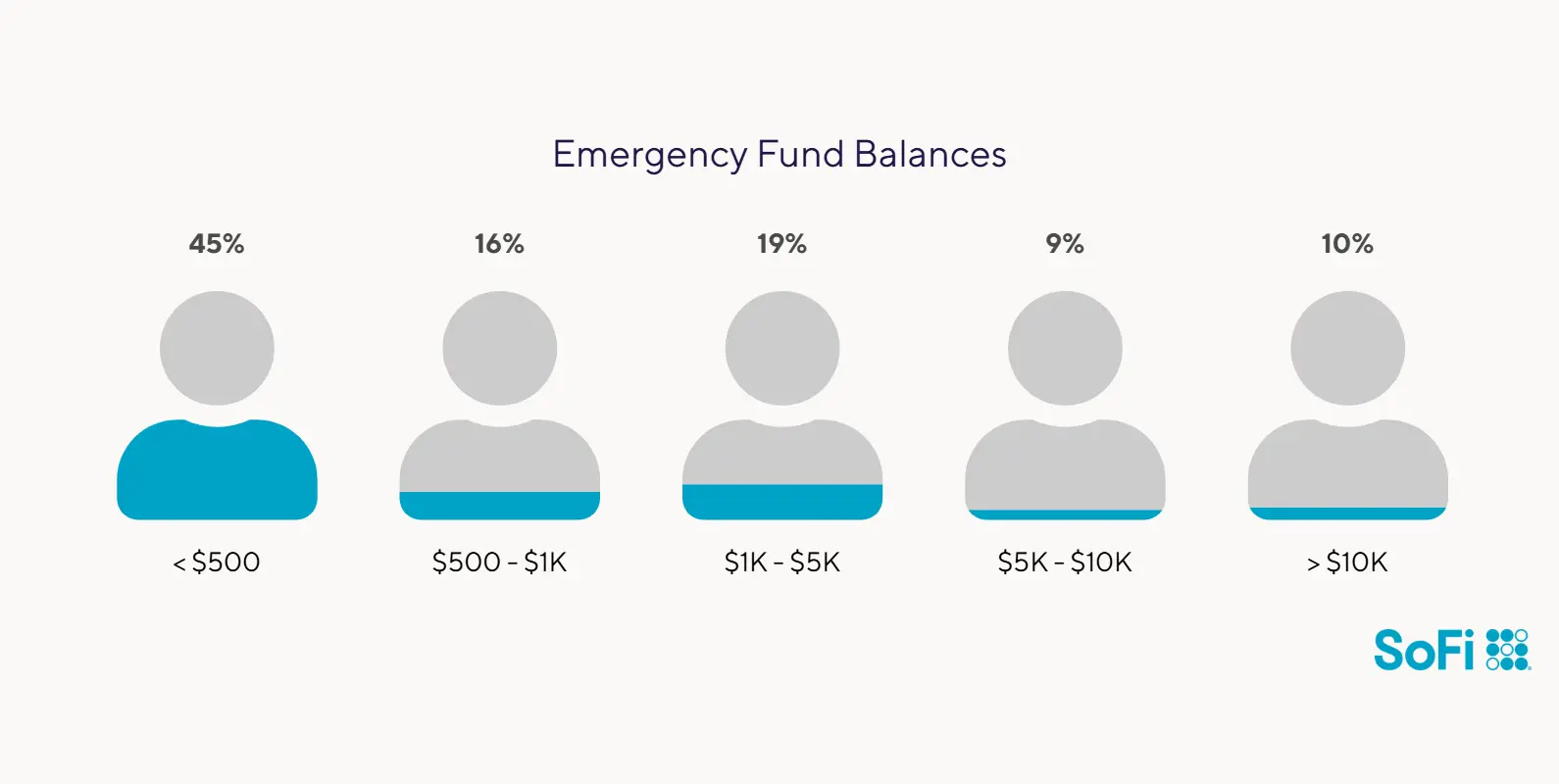
Yes, it can be hard to save money, but one of the most important priorities is to sock away money (even if just a little) regularly into an emergency fund. In SoFi’s April 2024 Banking Survey of 500 U.S. adults, 77% of respondents with a savings account said they use the account to save for emergencies.

Emergency Fund Balances
Source: SoFi’s April 2024 Banking Survey

An emergency fund is a bundle of easily accessible cash that could help you handle a financial curveball, such as a job loss, medical emergency, or big ticket car or home repair. Ideally, an emergency fund will contain enough money to cover your living expenses for three to six months, so you don’t wind up with credit card debt.

•   If you are married with an employed spouse and with no children, for example, you may only need to cover three months’ worth of expenses.

•   If you have kids or you’re single, you may want to have an emergency fund that could cover more than six months’ worth of expenses.

Recommended: Emergency Fund Calculator

2. Paying Off High-Interest Debt

Another important thing you could consider doing with your savings is paying off any high-interest debt (or “bad” debt) you may have. Typically, this is credit card debt, which currently has an average rate of well over 20%.

•   One debt payoff strategy is the debt snowball method. You start by paying off the debt with the smallest balance and put all your extra payments toward that until it’s paid off (while continuing to pay the minimum on your other debts).

You then put extra payments toward the debt with the next highest balance, and so on. This can give you a sense of accomplishment which can help motivate you to continue your aggressive repayment.

•   Another approach is the debt avalanche method, putting all your extra payments toward the debt with the highest interest rate, while paying the minimum on the others.

When that debt is paid off, you then focus on the debt with the next-highest interest rate. This strategy can be the most cost-effective method.

3. Saving for Retirement

Another reason why saving money is important: It can secure your future by providing for your retirement. Exactly how much of your paycheck should go to retirement savings will depend on your age and when you want to retire. Some pointers:

•   If your company offers a 401(k) with matching contributions, it can make sense to put aside at least as much of your paycheck as your company will match (since this is essentially free money).

•   If you don’t have access to a 401(k) or want to contribute beyond that fund, you may want to open a Roth or Traditional IRA. Both types of IRAs have different tax benefits.

•   When you invest in a Roth IRA, the money is taxed at the time of contribution but then in retirement, you can withdraw it tax-free. Contributions made to a traditional IRA might not be taxed at the time they are made but are taxed when they are withdrawn in retirement.

When choosing how much of your paycheck to put into retirement savings, you may want to keep in mind that the IRS sets restrictions on how much you can contribute to your retirement funds each year. IRS retirement guidelines are published and updated regularly.

4. Saving for Other Goals

After establishing plans for debt repayment, an emergency fund, and retirement savings, you may also want to consider working toward your other financial goals, like buying a house, saving for your kids’ future education, or affording a great vacation.

When you’re saving for a big purchase, you can start by determining how much money you’ll need and when you want to have the money. You can then break that dollar amount down into the amount you need to save each year and each month.

Strategies for Increasing Your Savings Rate

If you want to ramp up your savings, here are a couple of strategies that can pay off.

Automating Your Savings

Also known as paying yourself first, automating your savings involves setting up recurring payments or transfers into an account where the money won’t be spent and can earn interest. You might have a portion of your direct-deposit paycheck go straight into savings, or you could have a set amount whisked from checking into savings every pay day.

Read on for ideas about which kind of account is best for your savings.

Adjusting Your Budget

If you need to save more, take a closer look at your budget. Checking in with your budget is an important way to stay in control of your money. You may see patterns that you can address to maximize your savings. For example, did your wifi provider raise costs or have your property taxes increased year over year?

Once you size up your situation, you can take the right next steps, such as reducing costs (see below), finding a budget that works better for you, or using tech tools, such as money trackers, to manage your money more effectively.

Recommended: How to Make Money From Home

Reducing Your Costs to Save More

You can help ramp up your savings by cutting your spending. Here are some ideas:

•   Review your monthly bills and see if there’s anything you can cut. You might have signed up for a couple of subscriptions and then forgotten about them, or you might see that your restaurant spending is surging lately.

•   Learn how to save on food. You might try planning your meals weekly, so nothing goes to waste; joining a warehouse or wholesale club to lower your grocery bill; and using coupons and discount codes to downsize your food costs.

•   Bundle up: If you get your auto and home (or renters) insurance from one provider, you may save on your premiums.

•   Fight off FOMO spending (fear of missing out). Just because your friends are upgrading to a luxury car or a social media influencer is frolicking on the French Riviera, that doesn’t mean you have to too.

•   Pause, for a day or a month, before making pricey impulse buys to make sure you really and truly want or need them. Try a 30-day spending rule to eliminate impulse buys. It involves waiting 30 days to make an unplanned purchase; the urge to buy may vanish in that time period.

•   Pay in cash. Plastic, whether a credit or debit card, can make it easy to overspend. If you take out the cash you need for the week ahead and use only that to pay for purchases, you may be able to rein in your purchasing.

•   Use budgeting tools to help stay on track. Twenty-three percent of people in SoFi’s survey use budgeting tools offered by their bank, and 20% have knowingly used AI to manage their budget or finances.

Where to Put Your Savings

Once you’ve committed to saving money, you’ll have some options about where to keep it.

High-Yield Savings Account

A high-yield savings account pays a significantly higher interest rate than a standard account. As of mid-2025, the average savings account earned 0.38% interest while some high-yield savings accounts were paying 4.00% or more.

These accounts are often found at online banks vs. traditional ones. Just be sure to read the fine print and make sure you are aware of and comfortable with any account fees or minimums that might be involved. These accounts allow for easy access to your money when needed.

Certificate of Deposit (CD)

A certificate of deposit (CD) is an account in which you commit to keeping your money at the bank for a specific term and you know what rate you will earn. Typically, there is a penalty for early withdrawal. The terms for CDs can range from a few months to several years, so you can pick what works best for you. Longer terms will often have higher interest rates.

Investment Options for Long-Term Savings

Longer-term savings goals, meaning five or 10 years or longer (such as your retirement savings) can involve investing, since you’ll likely have more time to ride out the ups and downs of the markets.

For college savings, you may want to consider opening a 529 savings plan.


Test your understanding of what you just read.


The Takeaway

Many financial experts and budgeting methods recommend putting 20% or more of your salary into savings, but that may not fit your needs. Consider your savings goals, your financial situation, and other factors to find the right figure and the right tactics to help you stash the right amount of cash. Also consider where to keep your savings: A higher rate of interest can help your money grow and work harder for you over time.

Interested in opening an online bank account? When you sign up for a SoFi Checking and Savings account with eligible direct deposit, you’ll get a competitive annual percentage yield (APY), pay zero account fees, and enjoy an array of rewards, such as access to the Allpoint Network of 55,000+ fee-free ATMs globally. Qualifying accounts can even access their paycheck up to two days early.


Better banking is here with SoFi, NerdWallet’s 2024 winner for Best Checking Account Overall.* Enjoy 3.60% APY on SoFi Checking and Savings with eligible direct deposit.

FAQ

Is saving 10% of my paycheck enough?

Most financial experts advise saving between 10% and 30% of your salary, with 20% being a common figure. Based on this, 10% is an adequate amount for some, but if you can ramp that up in the future, so much the better.

Is 20% of your salary enough to save?

According to the 50/30/20 budget rule, saving 20% of your salary is a good goal to have; that’s the 20 in the name of the guideline. This amount can then be divided to address different needs, such as saving for the down payment on a house, for your child’s college education, and for retirement. However, for some people, 20% won’t be enough if, say, you have a large family to support.

How much of a $1,000 paycheck should I save?

Typically, financial experts recommend saving between 10% and 30% of your paycheck, with 20% being a good figure to aim for. For $1,000, that would mean between $100 and $300, with $200 being the 20% figure. However, if you are earning a lower salary and money is tight, it would be understandable if you save less until your salary increases.

How much should you save if you don’t have a regular paycheck?

If you don’t have a regular paycheck, it can be especially important during high-earning periods to save at least 20% of your pay. Also aim for at least six to 12 months’ worth of living expenses in your emergency fund. This can be a good cushion during the off-season (if you have a seasonal business) or you lose a steady gig.

How can I save money if I live paycheck to paycheck?

If you’re living paycheck to paycheck, saving is still important. Review your fixed expenses and see what cuts you can make to free up funds for your emergency savings account and other goals. Put in the time to find a budget that works for you, and stash any money windfalls (such as a tax refund or unexpected gift of cash) into your savings. You might also sell your unwanted but still useful items to raise some cash for your savings.


Annual percentage yield (APY) is variable and subject to change at any time. Rates are current as of 11/12/25. There is no minimum balance requirement. Fees may reduce earnings. Additional rates and information can be found at https://www.sofi.com/legal/banking-rate-sheet

Eligible Direct Deposit means a recurring deposit of regular income to an account holder’s SoFi Checking or Savings account, including payroll, pension, or government benefit payments (e.g., Social Security), made by the account holder’s employer, payroll or benefits provider or government agency (“Eligible Direct Deposit”) via the Automated Clearing House (“ACH”) Network every 31 calendar days.

Although we do our best to recognize all Eligible Direct Deposits, a small number of employers, payroll providers, benefits providers, or government agencies do not designate payments as direct deposit. To ensure you're earning the APY for account holders with Eligible Direct Deposit, we encourage you to check your APY Details page the day after your Eligible Direct Deposit posts to your SoFi account. If your APY is not showing as the APY for account holders with Eligible Direct Deposit, contact us at 855-456-7634 with the details of your Eligible Direct Deposit. As long as SoFi Bank can validate those details, you will start earning the APY for account holders with Eligible Direct Deposit from the date you contact SoFi for the next 31 calendar days. You will also be eligible for the APY for account holders with Eligible Direct Deposit on future Eligible Direct Deposits, as long as SoFi Bank can validate them.

Deposits that are not from an employer, payroll, or benefits provider or government agency, including but not limited to check deposits, peer-to-peer transfers (e.g., transfers from PayPal, Venmo, Wise, etc.), merchant transactions (e.g., transactions from PayPal, Stripe, Square, etc.), and bank ACH funds transfers and wire transfers from external accounts, or are non-recurring in nature (e.g., IRS tax refunds), do not constitute Eligible Direct Deposit activity. There is no minimum Eligible Direct Deposit amount required to qualify for the stated interest rate. SoFi Bank shall, in its sole discretion, assess each account holder's Eligible Direct Deposit activity to determine the applicability of rates and may request additional documentation for verification of eligibility.

See additional details at https://www.sofi.com/legal/banking-rate-sheet.

*Awards or rankings from NerdWallet are not indicative of future success or results. This award and its ratings are independently determined and awarded by their respective publications.

We do not charge any account, service or maintenance fees for SoFi Checking and Savings. We do charge a transaction fee to process each outgoing wire transfer. SoFi does not charge a fee for incoming wire transfers, however the sending bank may charge a fee. Our fee policy is subject to change at any time. See the SoFi Bank Fee Sheet for details at sofi.com/legal/banking-fees/.

INVESTMENTS ARE NOT FDIC INSURED • ARE NOT BANK GUARANTEED • MAY LOSE VALUE

SoFi Invest is a trade name used by SoFi Wealth LLC and SoFi Securities LLC offering investment products and services. Robo investing and advisory services are provided by SoFi Wealth LLC, an SEC-registered investment adviser. Brokerage and self-directed investing products offered through SoFi Securities LLC, Member FINRA/SIPC.

For disclosures on SoFi Invest platforms visit SoFi.com/legal. For a full listing of the fees associated with Sofi Invest please view our fee schedule.

Financial Tips & Strategies: The tips provided on this website are of a general nature and do not take into account your specific objectives, financial situation, and needs. You should always consider their appropriateness given your own circumstances.

Third-Party Brand Mentions: No brands, products, or companies mentioned are affiliated with SoFi, nor do they endorse or sponsor this article. Third-party trademarks referenced herein are property of their respective owners.

Tax Information: This article provides general background information only and is not intended to serve as legal or tax advice or as a substitute for legal counsel. You should consult your own attorney and/or tax advisor if you have a question requiring legal or tax advice.

External Websites: The information and analysis provided through hyperlinks to third-party websites, while believed to be accurate, cannot be guaranteed by SoFi. Links are provided for informational purposes and should not be viewed as an endorsement.

Third Party Trademarks: Certified Financial Planner Board of Standards Center for Financial Planning, Inc. owns and licenses the certification marks CFP®, CERTIFIED FINANCIAL PLANNER®

SOBNK-Q225-107

Read more
couple doing taxes

How to Pay Less Taxes: 9 Simple Steps

Taxes are part of life, but many people would like to know if there are any ways to lower their tax bill.

While paying no taxes isn’t likely, there are ways you can use the tax code to reduce your taxable income and tax liability. These range from knowing the right filing status to maxing out your retirement contributions to understanding which deductions and credits you may qualify for.

Read on to learn some smart strategies for lowering your tax bill without running afoul of the IRS.

Key Points

•   Selecting the most appropriate filing status for your situation can lower tax bills.

•   Maximizing contributions to retirement accounts can reduce taxable income.

•   Withdrawals from a 529 savings plan are tax-free when used for qualifying educational expenses.

•   Contributions to a Health Savings Account are tax-deductible, and distributions used for qualifying medical expenses are tax-free.

•   With investments, tax-loss harvesting may help reduce the taxes owed on capital gains.

1. Choosing the Right Filing Status

If you’re married, you have a choice to file jointly or separately. In many cases, a married couple will come out ahead by filing taxes jointly.

Typically, this will give them a lower tax rate, and also may help make them eligible for certain tax breaks, such as the Earned Income Tax Credit (EITC), the American Opportunity Tax Credit (AOTC), and the Lifetime Learning Credit (LLC) for education expenses. But there are certain circumstances where couples may be better off filing separately.

Some examples include: when both spouses are high-income earners and earn the same, when one spouse has high medical bills, and if your income determines your student loan payments.

Seeking advice from a tax professional or preparing returns both ways can help you assess the pros and cons of filing jointly or separately.

2. Maxing Out Your Retirement Account

Generally, the lower your income, the lower your taxes. However, you don’t have to actually earn less money to lower your tax bill.

Instead, you can reduce your gross income (which is your income before taxes are taken out) by making contributions to a 401(k) retirement plan, a 403(b) retirement plan, a 457 plan, or an IRA.

The more you contribute to a pre-tax retirement account, the more you can reduce your adjusted gross income (AGI), which is the baseline for calculating your taxable income. A lower taxable income may also put you into different tax brackets. It’s important to keep in mind, however, that there are annual limitations to how much you can put aside into retirement, which depend on your income and your age.

Even if you don’t have access to a retirement plan at work, you may still be able to open and contribute to an IRA. And, you can do this even after the end of the year.

While the tax year ends on December 31st, you may still be able to contribute to your IRA or open up a Roth IRA or traditional IRA (if you meet the eligibility requirements) up until the tax deadline in mid-April.

Increase your savings
with a limited-time APY boost.*


*Earn up to 4.30% Annual Percentage Yield (APY) on SoFi Savings with a 0.70% APY Boost (added to the 3.60% APY as of 11/12/25) for up to 6 months. Open a new SoFi Checking & Savings account and enroll in SoFi Plus by 1/31/26. Rates variable, subject to change. Terms apply here. SoFi Bank, N.A. Member FDIC.

3. Adding Up Your Health Care Costs

Health care expenses are typically only deductible once they exceed 7.5% of your AGI (and only for those who itemize their deductions). But with today’s high cost of medical care and, in some cases, insurance companies passing more costs onto consumers, you might be surprised how much you’re actually spending on health care.

In addition to the obvious expenses, like copays and coinsurance, it’s key to also consider things like dental care, prescription medications, prescription eyeglasses, and even the mileage to and from all medical appointments.

4. Saving for Private School and College

If you have children who may attend college in the future, or who attend or will attend private school, it can pay off to open a 529 savings plan.

Even if your children are young, it’s never too early to start setting aside money for their education. In fact, because of the power compounding returns with long-term investing, starting early could help make college a lot more affordable.

A 529 savings plan is a type of investment account designed to help parents save for educational expenses (such as for private schools or colleges) in a tax-advantaged way. While you won’t typically get a federal tax deduction for the money you put into a 529, many states offer a state tax deduction for these contributions.

The big tax advantage is that no matter how much your investments grow between now and when you need the money, you won’t pay taxes on those gains, and any withdrawals you take out to pay for qualified education expenses will be tax-free.

Recommended: Compound vs. Simple Interest

5. Putting Estimated Tax Payments on Your Calendar

While this move won’t technically lower your taxes, it could help you avoid a higher-than-necessary tax bill at the end of the year.

That’s because income tax in the United States works on a pay-as-you-go system. If you are a salaried employee, the federal government typically collects income taxes throughout the year via payroll taxes.

If you’re self-employed or a freelancer, however, it’s up to you to pay as you go. You can do this by paying the IRS taxes in quarterly installments throughout the year.

If you don’t pay enough, or if you miss a quarterly payment due date, you may have to pay a penalty to the IRS. The penalty amount depends on how late you paid and how much you underpaid.

The deadlines for quarterly estimated tax payments are typically in mid-April, mid-June, mid-September, and mid-January.

For help calculating your estimated payments, individuals can use the Estimated Tax Worksheet from the IRS .

6. Saving Your Donation Receipts

You may be able to claim a deduction for donating to charities that are recognized by the IRS. So it’s a good idea to always get a receipt whenever you give, whether it’s cash, clothing and household items, or your old car.

If your total charitable contributions and other itemized deductions, including unreimbursed medical expenses, mortgage interest, and state and local taxes, are greater than your available standard deduction, you may wind up with a lower tax bill.

Note: For any contribution of $250 or more, you must obtain and keep a record.

7. Adding to Your HSA

If you have a high deductible health plan, you may be eligible for or already have a health savings account (HSA), where you can set aside funds for medical expenses.

HSA contributions are made with pre-tax dollars, so any money you put into an HSA is income the IRS will not be able to tax. And, you can typically add money until mid-April to deduct those contributions on the prior year’s taxes.

Distributions from your HSA are tax-free as long as they’re used for yourself, your spouse, and your dependents for qualifying medical expenses. If you don’t end up needing the money to pay for health care, you can simply leave it in your HSA until you reach age 65, at which point you can withdraw money from an HSA for any reason.

HSAs typically allow you to invest your funds, and in that case, the interest, dividends, and capital gains from an HSA are also nontaxable for qualified distributions.

Recommended: How to Switch Banks

8. Making Student Loan Payments

You may be able to lower your tax bill by deducting up to $2,500 of student loan interest paid per year, even if you don’t itemize your deductions.

There are certain income requirements that must be met, however. The deduction is phased out when an individual’s income reaches certain thresholds.

Even so, it’s worth plugging in the numbers to see if you qualify.

9. Selling Off Poorly Performing Investments

If you have investments in your portfolio that have been down for quite some time and aren’t likely to recover, selling them at a loss might benefit you tax-wise.

The reason: You can use these losses to offset capital gains, which are profits earned from selling an investment for more than you purchased it for. If you profited from an investment that you held for one year or less, those gains can be highly taxed by the IRS.

This strategy, known as tax-loss harvesting, needs to be done within the tax year that you owe, and may be used to reduce capital gains on both short-term and long-term investments (short-term gains are taxed at a higher rate than long-term gains). Tax-loss harvesting can help a taxpayer who has made money from investments avoid a large, unexpected tax bill.

The Takeaway

The key to saving on taxes is to get to know the tax code and make sure you’re taking advantage of all the deductions and credits you’re entitled to.

It can also be helpful to look at tax planning as a year-round activity. If you gradually make tax-friendly financial decisions like saving for retirement, college, and health care throughout the year, you could easily reduce your tax burden and potentially score a refund at the end of the year. If you do score a tax refund, you can put it to good use, paying down debt or earning interest in a bank account.

Interested in opening an online bank account? When you sign up for a SoFi Checking and Savings account with eligible direct deposit, you’ll get a competitive annual percentage yield (APY), pay zero account fees, and enjoy an array of rewards, such as access to the Allpoint Network of 55,000+ fee-free ATMs globally. Qualifying accounts can even access their paycheck up to two days early.


Better banking is here with SoFi, NerdWallet’s 2024 winner for Best Checking Account Overall.* Enjoy 3.60% APY on SoFi Checking and Savings with eligible direct deposit.

FAQ

How can I lower my tax payments?

Filing jointly, when applicable, can often get you a lower tax rate and a higher standard deduction. Other common ways to reduce taxes include contributing the maximum amount to retirement accounts, such as 401(k)s and IRAs, making tax-deductible contributions to an HSA account, deducting charitable contributions, and deducting up to $2,500 in student loan interest payments.

With investments, tax-loss harvesting may also help reduce the amount of taxes owed on capital gains.

How can saving for retirement help me lower my taxes?

Contributing to traditional, pre-tax retirement accounts like 401(k)s, 403(b)s, 457 plans, or IRAs can lower your taxable income for the year. These pre-tax contributions reduce the income you report to the IRS, which can result in a smaller tax bill now, while also allowing your retirement investments to grow tax-deferred until retirement.

Are there tax advantages to saving for health care expenses?

Yes, if you have a high-deductible health plan, you may be eligible for a Health Savings Account (HSA). HSAs offer a few different tax advantages: your contributions are tax-deductible, the money, if invested, may grow tax-free, and withdrawals for qualified medical expenses are also tax-free. In addition, non-medical withdrawals made after turning 65 are also tax-free.


SoFi Checking and Savings is offered through SoFi Bank, N.A. Member FDIC. The SoFi® Bank Debit Mastercard® is issued by SoFi Bank, N.A., pursuant to license by Mastercard International Incorporated and can be used everywhere Mastercard is accepted. Mastercard is a registered trademark, and the circles design is a trademark of Mastercard International Incorporated.

Financial Tips & Strategies: The tips provided on this website are of a general nature and do not take into account your specific objectives, financial situation, and needs. You should always consider their appropriateness given your own circumstances.

Annual percentage yield (APY) is variable and subject to change at any time. Rates are current as of 11/12/25. There is no minimum balance requirement. Fees may reduce earnings. Additional rates and information can be found at https://www.sofi.com/legal/banking-rate-sheet

Eligible Direct Deposit means a recurring deposit of regular income to an account holder’s SoFi Checking or Savings account, including payroll, pension, or government benefit payments (e.g., Social Security), made by the account holder’s employer, payroll or benefits provider or government agency (“Eligible Direct Deposit”) via the Automated Clearing House (“ACH”) Network every 31 calendar days.

Although we do our best to recognize all Eligible Direct Deposits, a small number of employers, payroll providers, benefits providers, or government agencies do not designate payments as direct deposit. To ensure you're earning the APY for account holders with Eligible Direct Deposit, we encourage you to check your APY Details page the day after your Eligible Direct Deposit posts to your SoFi account. If your APY is not showing as the APY for account holders with Eligible Direct Deposit, contact us at 855-456-7634 with the details of your Eligible Direct Deposit. As long as SoFi Bank can validate those details, you will start earning the APY for account holders with Eligible Direct Deposit from the date you contact SoFi for the next 31 calendar days. You will also be eligible for the APY for account holders with Eligible Direct Deposit on future Eligible Direct Deposits, as long as SoFi Bank can validate them.

Deposits that are not from an employer, payroll, or benefits provider or government agency, including but not limited to check deposits, peer-to-peer transfers (e.g., transfers from PayPal, Venmo, Wise, etc.), merchant transactions (e.g., transactions from PayPal, Stripe, Square, etc.), and bank ACH funds transfers and wire transfers from external accounts, or are non-recurring in nature (e.g., IRS tax refunds), do not constitute Eligible Direct Deposit activity. There is no minimum Eligible Direct Deposit amount required to qualify for the stated interest rate. SoFi Bank shall, in its sole discretion, assess each account holder's Eligible Direct Deposit activity to determine the applicability of rates and may request additional documentation for verification of eligibility.

See additional details at https://www.sofi.com/legal/banking-rate-sheet.

Tax Information: This article provides general background information only and is not intended to serve as legal or tax advice or as a substitute for legal counsel. You should consult your own attorney and/or tax advisor if you have a question requiring legal or tax advice.

External Websites: The information and analysis provided through hyperlinks to third-party websites, while believed to be accurate, cannot be guaranteed by SoFi. Links are provided for informational purposes and should not be viewed as an endorsement.

Third Party Trademarks: Certified Financial Planner Board of Standards Center for Financial Planning, Inc. owns and licenses the certification marks CFP®, CERTIFIED FINANCIAL PLANNER®

*Awards or rankings from NerdWallet are not indicative of future success or results. This award and its ratings are independently determined and awarded by their respective publications.

SOBNK-Q225-099

Read more
What Is UCITS?

What Are UCITS Funds?

UCITS, or Undertakings for Collective Investment in Transferable Securities, refers to a set of guidelines that allow pooled securities, similar to mutual funds, to be traded across borders within the European Union.

As such, UCITS is essentially a framework or directive that governs the composition and trading of UCITS funds.

UCITS funds are registered in individual EU countries and must comply with European Commission rules. Investors in the U.S. may also access these funds via authorized brokers. UCITS may be available in other regions, like Asia, as well.

Key Points

•   UCITS refers to a set of guidelines that allows a certain type of mutual fund to be traded freely across country borders within the EU.

•   UCITS funds are a type of mutual fund that complies with European Union regulations and holds securities from throughout the region.

•   The rules for UCITS funds are periodically updated, with each new version noted by a Roman numeral.

•   Although these are considered EU securities, U.S. investors can purchase these funds through an authorized broker.

•   UCITS funds are highly regulated, and investors outside the EU may face tax events when trading these funds.

What Is a UCITS Fund?

UCITS funds are a type of mutual fund that complies with European Union regulations. These securities can be traded across the borders of EU member states.

The EU launched UCITS for two primary reasons:

1.    To structure a type of security under the EU umbrella that allowed for the cross-border sale of mutual funds throughout the EU, and across other markets.

2.    To better regulate investment asset transactions among all EU member countries, giving investors inside and outside of the EU access to more tightly regulated investment funds.

Fundamentally, UCITS rules give EU regulators a powerful tool to centralize key financial services issues like types of investments allowed, asset liquidity, investment disclosures, and investor safeguards. By rolling the new rules and regulations into UCITS, EU regulators sought to make efficient and secure investment funds available to a broad swath of investors.

For investors, UCITS funds offer flexibility and security. Not only are the funds widely viewed as safe and secure owing to the level of regulation, but UCITS funds offer a diversified fund option to investors who might otherwise have to depend on single public companies for the bulk of their investment portfolios.

A Brief History of UCITS

The genesis of UCITS funds dates back to the mid-1980’s, with the rollout of the European Directive legislation, which set a new blueprint for financial markets across the continent. The new law introduced UCITS funds on an incremental basis and has been used as a way to regulate financial markets with regular updates and revisions over the past three decades.

In 2002, the EU issued a pair of new directives related to mutual fund sales — Directives 2001/107/EC and 2001/108/EC, which expanded the market for UCITS across the EU and loosened regulations on the sale of index funds in the region.

The fund initiative accelerated in 2009 and 2010, when the Directive 2009/65/EC of the European Parliament and of the Council of 13 July 2009 clarified the use of UCITS in European investment markets, especially in coordination of all laws, regulations, and administrative oversight. The next year, the European Union reclassified UCITS w as investment funds regulated under Part 1 of the Law of 17 December 2010.

In recent years, “Alt UCITS” or alternative UCITS funds have grown in popularity, along with other types of alternative investments.

How Does a UCIT Fund Work?

Structurally, UCITS are built like mutual funds, with many of the same features, regulatory requirements, and marketing models.

Individual and institutional investors, who form a collective group of unit holders, put their money into a UCIT, which, in turn, owns investment securities (mostly stocks and bonds) and cash. For investors, the primary goal is to invest their money into the fund to capitalize on specific market conditions that favor the stocks or bonds that form the UCITS.

UCITS funds may provide one way for American investors to get more international diversification within their portfolios.

A professional money manager, or group of managers, run the fund, and they are singularly responsible for choosing the securities that make up the fund. The UCITS investor understands this agreement before investing in the fund, thus allowing the fund managers to choose investments on their behalf.

An investor may leave the fund at any point in time, and do so by liquidating their shares of the fund on the open market. American investors should know that the Internal Revenue Service may classify UCITS as passive foreign investment companies, which could trigger more onerous tax treatments, especially when compared to domestic mutual funds.


💡 Quick Tip: How to manage potential risk factors in a self-directed investment account? Doing your research and employing strategies like dollar-cost averaging and diversification may help mitigate financial risk when trading stocks.

UCITS Rules and Regulations

UCITS do have some firm regulatory and operational requirements to abide by in the European Union, as follows:

•   The fund and its management team are usually based on a tax-neutral EU country (Ireland would be a good example).

•   A UCITS fund operates under the laws mandated by the member state of its headquarters. After the fund is licensed in the EU state of origin, it can then be marketed to other EU states, and to investors around the world. The fund must provide proper legal notification to the state or nation where it wants to do business before being allowed to market the fund to investors.

•   A UCITS fund must provide proper notice to investors in the form of a Key Investor Information Document, usually located on the fund’s website. The fund must also be approved.

•   A UCITS fund must also provide a fund prospectus to investors (also normally found on the fund’s web site) and must file both annual and semiannual reports.

•   Any time a UCITS company issues, sells, or redeems fund shares, it must make pricing notification available to investors.

The Takeaway

Undertakings for Collective Investment in Transferable Securities (UCITS) is a category of investment funds primarily available in the EU, but investors in the U.S. may access these funds through authorized brokers.

UCITS may be an interesting type of investment for U.S. investors looking to diversify their portfolios. As with any investment, investors must conduct thorough due diligence on a UCITS security, which should include a review of fund holdings, past performance, management stability, fees, and tax consequences.

FAQ

What is UCITS in simple terms?

UCITS is a set of guidelines governing a type of mutual fund in the EU. It stands for: “undertaking for collective investment in transferable securities.” This means it’s a type of pooled investment, similar to a U.S. mutual fund, that invests in securities like stocks, bonds, short-term government bonds, and cash.

What is a non-UCITS fund?

A non-UCITS fund does not comply with UCITS guidelines. For example, a non-UCITS fund might not be open-ended or it might be illiquid — two primary UCITS requirements.

What are the disadvantages of UCITS?

UCITS funds may have higher costs, owing to the regulatory requirements governing securities in the EU. Also, because the UCITS standards can be restrictive, these funds may not be able to take advantage of certain market conditions. UCITS funds can also have higher tax consequences for U.S. investors.


Photo credit: iStock/kupicoo

INVESTMENTS ARE NOT FDIC INSURED • ARE NOT BANK GUARANTEED • MAY LOSE VALUE

SoFi Invest is a trade name used by SoFi Wealth LLC and SoFi Securities LLC offering investment products and services. Robo investing and advisory services are provided by SoFi Wealth LLC, an SEC-registered investment adviser. Brokerage and self-directed investing products offered through SoFi Securities LLC, Member FINRA/SIPC.

For disclosures on SoFi Invest platforms visit SoFi.com/legal. For a full listing of the fees associated with Sofi Invest please view our fee schedule.

Mutual Funds (MFs): Investors should carefully consider the information contained in the prospectus, which contains the Fund’s investment objectives, risks, charges, expenses, and other relevant information. You may obtain a prospectus from the Fund company’s website or clicking the prospectus link on the fund's respective page at sofi.com. You may also contact customer service at: 1.855.456.7634. Please read the prospectus carefully prior to investing.Mutual Funds must be bought and sold at NAV (Net Asset Value); unless otherwise noted in the prospectus, trades are only done once per day after the markets close. Investment returns are subject to risk, include the risk of loss. Shares may be worth more or less their original value when redeemed. The diversification of a mutual fund will not protect against loss. A mutual fund may not achieve its stated investment objective. Rebalancing and other activities within the fund may be subject to tax consequences.

Fund Fees
If you invest in Exchange Traded Funds (ETFs) through SoFi Invest (either by buying them yourself or via investing in SoFi Invest’s automated investments, formerly SoFi Wealth), these funds will have their own management fees. These fees are not paid directly by you, but rather by the fund itself. these fees do reduce the fund’s returns. Check out each fund’s prospectus for details. SoFi Invest does not receive sales commissions, 12b-1 fees, or other fees from ETFs for investing such funds on behalf of advisory clients, though if SoFi Invest creates its own funds, it could earn management fees there.
SoFi Invest may waive all, or part of any of these fees, permanently or for a period of time, at its sole discretion for any reason. Fees are subject to change at any time. The current fee schedule will always be available in your Account Documents section of SoFi Invest.


Tax Information: This article provides general background information only and is not intended to serve as legal or tax advice or as a substitute for legal counsel. You should consult your own attorney and/or tax advisor if you have a question requiring legal or tax advice.

Investment Risk: Diversification can help reduce some investment risk. It cannot guarantee profit, or fully protect in a down market.

Disclaimer: The projections or other information regarding the likelihood of various investment outcomes are hypothetical in nature, do not reflect actual investment results, and are not guarantees of future results.

Financial Tips & Strategies: The tips provided on this website are of a general nature and do not take into account your specific objectives, financial situation, and needs. You should always consider their appropriateness given your own circumstances.

SOIN-Q225-098

Read more
overhead view of businessman working, looking at business charts and graphs

How to Find the Right Fixed Index Annuity Rate for Your Needs

Annuities are a type of insurance contract that investors can use to fund their retirement or help meet other financial goals. When someone purchases an annuity, they pay premiums to the annuity issuer. The annuity company then makes regular payments back to the annuitant as agreed in the annuity contract.

Annuities can provide a steady stream of income in retirement, which may help support people’s investment goals. What’s important to keep in mind, however, is that rates of return generated can vary from one annuity to the next. It’s helpful to understand how to compare index annuity rates side by side to find the best one for your needs.

Key Points

•   Fixed index annuities offer a guaranteed minimum return and potential for higher returns linked to a market index.

•   Key factors affecting rates are cap rate, participation rate, and fees.

•   These annuities may help balance safety with market growth opportunities.

•   A good rate considers minimum return, cap, participation, fees, and the company’s financial health.

•   Evaluate companies by financial ratings and compare rates, fees, and terms to direct market investments.

What Is an Indexed Annuity?

An indexed annuity, or fixed index annuity, is a specific type of annuity product that can yield a minimum guaranteed rate of return along with a rate of return that’s linked to a stock market index.

For example, the annuity’s performance may be based on the performance of the S&P 500 Composite Price Index. This is a market capitalization-weighted index that represents 500 of the largest publicly traded U.S. companies.

Generally, annuities are indexed, fixed, or variable. With a fixed annuity, you’re guaranteed to earn a minimum rate of return, making them relatively safe investments. Variable annuity returns hinge on how underlying annuity investments, such as mutual funds, perform which can make them riskier. Indexed annuities strike a middle ground in terms of their risk/reward profile.

This type of annuity may be suitable to investors who seek upside potential with built-in downside protection, while enjoying the benefits of tax-deferred growth. Indexed annuities may also be favorable among investors who lean toward a passive versus active investing strategy.

What Are Fixed Index Annuity Rates?

Fixed index annuity rates are the guaranteed minimum rate of return on an annuity. Rather than tracking interest rates, the fixed index annuity rate is benchmarked against a particular index.

How Fixed Index Annuities Work

Fixed index annuities have two phases: the accumulation phase and the income phase.

Once you purchase a fixed indexed annuity, the accumulation phase begins. This is the period during which your annuity earns interest on a tax-deferred basis. The amount of money you have in the annuity, also referred to as the contract value, can fluctuate over time based on how the underlying index that the annuity tracks is performing.

Annuity returns are typically recalculated every 12 months, though the annuity contract should spell out how and when return calculations occur. It’s important to keep in mind that the contract may specify a cap rate, which represents the maximum positive rate of return an indexed annuity can earn.

The income or annuity phase is when payments are made back to you from the contract. These payments can be made periodically or be delivered in a single lump sum. Additionally, they can last for a specified time frame or for the duration of your natural life. If you’re married, indexed annuity payments can also continue to be paid to your spouse after you pass away. The annuity contract will detail the payment schedule.

For example, in the accumulation phase, an annuity might pay out a minimum of 3% with a 7% rate cap (even if the index is tracking at 11%). In the income phase, the fixed index annuity might be paid monthly starting at a predetermined date, and pay out across the lifetime of you and/or your spouse.

How Are Fixed Index Annuity Rates Set?

Broadly speaking, index annuity rates are tied to the index they track. So again, this could be an index like the S&P 500 Composite Price Index or the Nasdaq 100.

With a fixed index annuity, the annuity company guarantees a minimum interest rate alongside the interest rate generated by the underlying index.

When setting fixed index annuity rates, annuity contract providers typically use several factors to determine how much of a return is credited to the contract owner. The actual rate of return realized from an indexed annuity can depend on:

•  Cap rate

•  Participation rate

•  Margin/spread fees

•  Riders

Here’s more on how each one affects fixed index annuity rates.

Cap Rate

Cap rate represents the upper limit on returns that an annuity can earn over time. For instance, an indexed annuity that has a 3.5% cap rate would limit the returns credited to the annuity owner to that amount — even when the underlying index produces a higher rate of return. Generally, cap rates fall somewhere between 3 and 7% per year.

Participation Rate

If the index an annuity tracks goes up, the participation rate determines how much of that gain is credited to an annuity owner. For instance, if the index increases by 10% and the participation rate is 80%, an 8% return would be credited.

Margin/Spread Fees

Also referred to as an administrative fee, this fee can deduct a set percentage from index gains. An indexed annuity that realizes a 10% gain and has a 3% spread fee, for example, would yield a net credited return of 7%.

Riders

Riders can be used to enhance fixed indexed annuity benefits. For instance, you might choose to add a rider that would guarantee lifetime income payments to your spouse if you’re married. Expanding the annuity’s coverage can result in added premium costs, which may reduce credited returns.

What Is a Good Fixed Index Annuity Rate?

A “good” fixed index annuity rate is one that results in a rate of return that aligns with your objectives and needs. Index annuity rates can also vary based on the length of the contract term. Cost is also an important consideration, as indexed annuities can charge a variety of fees, including administrative fees and surrender charges, which may apply if you decide to cancel an annuity contract.

The top index annuities are the ones that offer the best combination of high rates and low fees. It’s also important to consider an annuity company’s ratings before purchasing an indexed annuity.

Is an Indexed Annuity Right for You?

Fixed index annuities can offer the potential to earn higher rates of return compared to traditional fixed annuities. At the same time, they may be less risky than a variable annuity product since they track an index rather than investing in the market directly.

Investment risk management is an important part of any strategy for growing wealth, even when you’re starting from scratch with building an investment portfolio. Indexed annuities aim to help with balancing that risk while creating an ongoing stream of income to rely on in retirement.

That said, it’s also important to consider how fixed index annuity rates compare to the rate of return one could earn by investing in the market directly. For example, you may see better returns by investing in individual stocks. That does involve taking more risk but individuals with a longer timeline until retirement generally have a broader window to recover from market downturns.

The Takeaway

A fixed index annuity offers investors a minimum guaranteed rate of return along with a rate of return that’s linked to a stock market index. While fixed indexed annuities do offer some advantages, they may not suit every investor and it’s important to research index annuity rates to find the right one.

FAQ

What is a fixed annuity?

Fixed annuities are a type of insurance contract that investors can use to fund their retirement or meet other financial goals. When someone purchases an annuity, they pay premiums to the annuity issuer, and the annuity company then makes regular payments back to the annuitant as agreed in the annuity contract.

What is an indexed annuity?

An indexed annuity, or fixed index annuity, is a specific type of annuity product that can yield a minimum guaranteed rate of return along with a rate of return that’s linked to a stock market index.

What determines fixed index annuity rates?

Annuity contract providers typically use several factors to determine how much of a return is credited to the contract owner. The actual rate of return realized from an indexed annuity can depend on the cap rate, participation rate, margin and spread fees, and riders.


About the author

Rebecca Lake

Rebecca Lake

Rebecca Lake has been a finance writer for nearly a decade, specializing in personal finance, investing, and small business. She is a contributor at Forbes Advisor, SmartAsset, Investopedia, The Balance, MyBankTracker, MoneyRates and CreditCards.com. Read full bio.


INVESTMENTS ARE NOT FDIC INSURED • ARE NOT BANK GUARANTEED • MAY LOSE VALUE

SoFi Invest is a trade name used by SoFi Wealth LLC and SoFi Securities LLC offering investment products and services. Robo investing and advisory services are provided by SoFi Wealth LLC, an SEC-registered investment adviser. Brokerage and self-directed investing products offered through SoFi Securities LLC, Member FINRA/SIPC.

For disclosures on SoFi Invest platforms visit SoFi.com/legal. For a full listing of the fees associated with Sofi Invest please view our fee schedule.

Financial Tips & Strategies: The tips provided on this website are of a general nature and do not take into account your specific objectives, financial situation, and needs. You should always consider their appropriateness given your own circumstances.

¹Claw Promotion: Probability of Member receiving $1,000 is a probability of 0.026%; If you don’t make a selection in 45 days, you’ll no longer qualify for the promo. Customer must fund their account with a minimum of $50.00 to qualify. Probability percentage is subject to decrease. See full terms and conditions.

Disclaimer: The projections or other information regarding the likelihood of various investment outcomes are hypothetical in nature, do not reflect actual investment results, and are not guarantees of future results.

S&P 500 Index: The S&P 500 Index is a market-capitalization-weighted index of 500 leading publicly traded companies in the U.S. It is not an investment product, but a measure of U.S. equity performance. Historical performance of the S&P 500 Index does not guarantee similar results in the future. The historical return of the S&P 500 Index shown does not include the reinvestment of dividends or account for investment fees, expenses, or taxes, which would reduce actual returns.
Mutual Funds (MFs): Investors should carefully consider the information contained in the prospectus, which contains the Fund’s investment objectives, risks, charges, expenses, and other relevant information. You may obtain a prospectus from the Fund company’s website or clicking the prospectus link on the fund's respective page at sofi.com. You may also contact customer service at: 1.855.456.7634. Please read the prospectus carefully prior to investing.Mutual Funds must be bought and sold at NAV (Net Asset Value); unless otherwise noted in the prospectus, trades are only done once per day after the markets close. Investment returns are subject to risk, include the risk of loss. Shares may be worth more or less their original value when redeemed. The diversification of a mutual fund will not protect against loss. A mutual fund may not achieve its stated investment objective. Rebalancing and other activities within the fund may be subject to tax consequences.

Tax Information: This article provides general background information only and is not intended to serve as legal or tax advice or as a substitute for legal counsel. You should consult your own attorney and/or tax advisor if you have a question requiring legal or tax advice.

SOIN-Q225-135

Read more
TLS 1.2 Encrypted
Equal Housing Lender