Ways to Build Wealth at Any Age

There are many time-honored ways to build wealth — at any age — and most of these methods include a few important steps: learning to set goals, save and invest, and avoid high-interest debt.

In other words, it’s possible to build wealth at any age, because almost anyone can learn the fundamental tenets of wealth-building. Embracing smart money-management habits may improve your long-term financial security, whether you use those funds for the purchase of a home, long-term goals such as retirement, or estate planning for after you’re gone.

The key, however, is to start as soon as possible, rather than wait until the right time (which may never come).

Key Points

•   Building wealth can be accomplished at almost any age, because it’s the result of mastering smart money management skills.

•   The common elements of wealth building include learning skills like saving, investing, setting goals, and avoiding certain types of debt.

•   Wealth building also requires learning how to put your money into assets that have the potential to gain value.

•   Being proactive about wealth building means saving and investing for the future, while finding ways to enjoy the present, too.

•   Understanding wealth building at different ages also requires understanding specific challenges that can arise at various times of life.

Set Short- and Long-Term Goals

The first step in building wealth is to set short- and long-term goals that you can revisit and revise at any time, as needed.

Short-term goals focus on achieving near-term results, such as funding next summer’s trip or buying a new car.

In contrast, long-term goals might require several years or more of preparation. For example, you may want to collect enough to pay off your mortgage or send your kid to college . Creating realistic goals gives you direction, so make them as specific as possible.

Create a Budget

Once you know your goals, drafting a monthly budget is the next step.

Document up to three months’ worth of expenses by using a spending-tracker app, or a basic notebook. Then, break the list down into fixed costs, variable costs, necessary costs, and discretionary costs. It’s essential to know where your money is going, in order to make smart decisions about your priorities.

You probably can’t stop paying your utilities, but you will likely find places to save in your discretionary category (think restaurant meals, or entertainment expenses). Making cuts in some areas can help you channel money into your goals.

There are a number of effective budgeting methods and systems. Some rely on an app, others use hands-on strategies such as dividing your spending into separate envelopes. It’s important to try different budgets and find one you can stick with.

Pay Off Debt

To dedicate more money toward building wealth and saving for your goals, you’ll likely need to pay off some debt first. You can use your discretionary income as a tool for minimizing your debt load.

If you have multiple debts, consider using a debt reduction method, such as the avalanche method or the snowball method, to accelerate the process.

The Avalanche Method

The avalanche method prioritizes high-interest debts by ranking the interest rates from highest to lowest. Then, regularly pay the minimum on each of your debts, and put any leftover funds towards the one with the highest interest rate.

Once you pay that off, continue on to the second-highest debt. Follow that pattern to minimize the interest you’re paying as you become debt-free.

Snowball Method

Alternatively, the snowball method is another debt repayment strategy. It’s essentially the opposite of the avalanche approach. List your debts from the smallest balance to largest, ignoring the interest rates. Then, regularly dedicate enough funds to each to avoid penalties, and put any extra money toward the smallest debt.

After the smallest debt is paid, redirect your attention to the next largest debt, and so on. As the number of individual debts shrink, you’ll have more money to apply towards the larger debts. You may still have interests to worry about but picking off the debts one by one can impart a sense of forward movement and accomplishment.

Start Investing

Investing is an important way to build wealth at any age. Generally speaking, there are two ways to invest when building wealth. The first step is to max out your retirement savings. The second is to invest on your own.

Investing for Retirement

If you haven’t already, find out what if any employer-sponsored retirement savings plans are available to you, such as a 401(k) plan. These qualified retirement plans offer tax advantages, and typically allow you to direct a portion of your paycheck to your account, thus putting your savings on autopilot.

If your workplace does not offer any retirement accounts, consider whether you want to open an IRA — or a brokerage account to build an investment portfolio.

Generally, investing for retirement when you’re young means you can take on more risks. While a diversified portfolio is a standard strategy, younger investors might have a portfolio that’s heavier on equities , since they may help generate long-term growth.

As you get older and closer to retirement, your risk profile may change and your portfolio will need a rebalancing to incorporate more fixed-income investments, such as bonds, which are considered lower risk than stocks. Understanding stock market basics can help you become a more savvy investor.

Investing on Your Own

While investing for retirement should be a key part of your long-term wealth-building strategy, it’s also possible to open a taxable brokerage or online brokerage account for additional growth potential.

Investing always comes with the risk of loss, but many investors find ways to put their money to work by investing in low-cost mutual funds or exchange-traded funds (ETFs), as well as other types of securities.

One important aspect of active investing is knowing what the costs are. You may have to pay brokerage fees, expense ratios, trading commissions, and other charges. While these may seem small, or may be couched as a tiny percentage, investment fees can add up over time and reduce your returns.

How to Increase Your Income and Save More

You might be getting by on your current income, but there may be ways to boost what you bring home. With an extra-positive cash flow, you could pay down debt and save more, and achieve your goals sooner. Here are a few ways to make that happen.

Ask for a Raise

Asking for a salary increase is one solution for improving your cash flow. All it takes is a few good conversations, a positive work record — and a bit of courage and confidence. Speak to your peers and read up on how to conduct yourself when asking for a raise. Going in with a plan will save you anxiety and help you get your points across clearly.

Start a Side Gig

Additional work is also great to bulk up your resume and create new connections. It seems like everyone is starting up a side hustle these days. From online shops to freelancing, the opportunities are endless. All you have to do is determine your marketable skills and how to advertise them. There might be local opportunities, or you can create a profile online on side hustle-oriented websites.

Cut Expenses

Sometimes it’s not about finding new sources of money, but about creating a larger pool with the money already coming in. Take a second pass at your list of discretionary expenses to pinpoint a few more areas you could cut back on without feeling the impact in your day-to-day life.

One good example: Automatically renewed subscriptions for streaming services and local businesses, like gyms, are convenient. But think about how frequently you use the service. If the answer is “not often,” you’re not getting your money’s worth — and you may want to negotiate a lower fee, or cut the subscription altogether.

How to Build Wealth at Every Stage of Life

While it’s good to have a general strategy in place for building wealth and increasing cash flow, different stages in your life may require you to focus on different things. Taking advantage of the opportunities each decade brings you will help you financially adjust and build a stable lifestyle.

In Your 20s

You may be right out of school and trying to navigate the job market, but don’t wait to start working towards your long-term financial goals. The sooner you start, the sooner you’re likely to reach your goals.

Create an Emergency Fund

Generally, an emergency fund should include about three to six months’ worth of living expenses. Although that sounds like a lot, start small and save what you can. You’ll be grateful for the cushion if you should lose your job, need a car repair, or have a medical emergency.

Unexpected things happen all the time, and an emergency fund will protect you while you get things back up and running. It will also keep you from having to tap your savings accounts.

Eliminate High-Interest Debt

Your student loans aren’t going anywhere, so pay off student debt as soon as possible. The same goes for any other high-interest debt you might have incurred, such as with a credit card. Paying high interest rates will limit your ability to save.

However, don’t be afraid to use your credit cards responsibly. Your 20s are the perfect time to build good credit, which will be vital to certain goals, like purchasing a house. Use them strategically and pay them off immediately to build an upstanding credit history.

In Your 30s

Your 30s may bring some stability into your life, whether it’s a steady career, a partner, and/or kids. However, the costs you’re facing are likely growing with you. Focus on money moves that will benefit you long-term.

Plan for College Expenses

If you have children, saving for their education is a big step. Use opportunities like a 529 account to help provide the funding. A 529 plan is a tax-advantaged savings plan you can use to pay for future tuition and related costs. While saving for college is important, it’s essential to balance this with funding your retirement — which is an even bigger priority.

Pad the Nest Egg

By some popular estimates, by age 30 you should have at least one year’s worth of your annual salary saved for your retirement — and twice that by 35. Incrementally increasing the amount you put towards your savings will help boost that number as well. While these targets may seem big, the more important thing is to save steadily over time — that’s how real wealth-building happens.

In Your 40s, 50s and Beyond

By 40, conventional wisdom holds that you should be well on your way to a growing nest egg with three times your annual salary saved up. Again, this is just a target — but it can help you stay on track.

At this stage, you may also have other assets to your name, such as a home. If you have kids, they might be nearing college age, and retirement might not seem quite as far away as it once did. This will motivate you to save for your goals.

Protect Your Self and Your Wealth

It’s always smart to protect your assets — and yourself. Make sure you have insurance covering both you and your estate (through health and life insurance). Insurance can take a burden off of your family’s shoulders in case anything happens to you.

Capitalize on Make-Up Contributions

Maximizing your retirement savings is a key part of wealth-building at every age.

A make-up, or catch-up, contribution, is an additional payment that anyone over age 50 can make to their 401(k) or IRA account. If you’re in a financial position to contribute these extra funds, it can help bulk up those savings to help prepare for retirement.

For 2025, you can contribute up to $23,500 per year, and if you’re 50 or older, the maximum allowable catch-up contribution to 401(k) plans per year is $7,500, for a total of $31,000. In 2026, you can contribute up to $24,500 per year, and if you’re 50 or older, you can make a catch-up contribution of up to $8,000, for a total of $32,500.

However, there’s also something called a super catch-up contribution, which allows employees aged 60 to 63 to contribute an extra $11,250 in both 2025 and 2026 (instead of $7,500 and $8,000).

The annual IRA contribution limit for 2025 is $7,000, with those 50 and above allowed to contribute another $1,000 per year. In 2026, the limit if $7,500, with those 50 and older allowed to contribute an extra $1,100 per year. In total, anyone 50 or older can put $8,000 into their traditional or Roth IRA annually in 2025, and $8,600 in their IRA annually in 2026.

There are other types of retirement accounts for self-employed people that allow you to save more than in ordinary IRAs. Choosing the type of plan that matches your needs and helps you save and invest more is key to building wealth long term.

Wait to Take Social Security

Did you know you could receive a higher Social Security benefit if you wait to claim your benefits? Those who hold off collecting Social Security until age 67 — the full retirement age for people born in 1960 or afterward — get 108% of their benefits, and those who wait until the age of 70 can receive 132% of their monthly benefit.

On the other hand, if you begin taking benefits early, at age 62, you’ll receive 25% less in monthly benefits.

Shift Your Asset Allocation

Investors should periodically revisit their portfolio and reassess their investments and risk level. As you get closer to retirement, you may decide to allocate a larger part of your portfolio to safer choices like bonds and other fixed-income assets. This may not increase your nest egg, but it can help prevent losses.

The Takeaway

Building wealth at any age starts with a close look at your current income and expenditures, a detailed list of short-term and long-range goals — and a little follow-through based on where you are in life.

Some ways to start building wealth are to take on a side gig or side hustle, find ways to cut expenses and increase savings rates, and to start investing. There are numerous ways to do any of these, and it may take some experimenting to see what works for you.

Ready to invest in your goals? It’s easy to get started when you open an investment account with SoFi Invest. You can invest in stocks, exchange-traded funds (ETFs), mutual funds, alternative funds, and more. SoFi doesn’t charge commissions, but other fees apply (full fee disclosure here).

Invest with as little as $5 with a SoFi Active Investing account.

FAQ

What are the key principles for building wealth?

The basic tenets of building wealth may seem simple, but they require discipline. Spending less than you make, setting goals and saving toward those goals, learning to invest, and avoiding high-interest debt are generally good places to start.

Is 40 too late to start building wealth?

Even if you start at age 40, you should have enough runway to build wealth that can help support you later in life.

Does investing build wealth?

Investing involves risk, and there are no guarantees that investing your money will help it grow. That said, learning the ropes of how to invest and manage your money may help build wealth over time.


About the author

Ashley Kilroy

Ashley Kilroy

Ashley Kilroy is a seasoned personal finance writer with 15 years of experience simplifying complex concepts for individuals seeking financial security. Her expertise has shined through in well-known publications like Rolling Stone, Forbes, SmartAsset, and Money Talks News. Read full bio.


INVESTMENTS ARE NOT FDIC INSURED • ARE NOT BANK GUARANTEED • MAY LOSE VALUE

SoFi Invest is a trade name used by SoFi Wealth LLC and SoFi Securities LLC offering investment products and services. Robo investing and advisory services are provided by SoFi Wealth LLC, an SEC-registered investment adviser. Brokerage and self-directed investing products offered through SoFi Securities LLC, Member FINRA/SIPC.

For disclosures on SoFi Invest platforms visit SoFi.com/legal. For a full listing of the fees associated with Sofi Invest please view our fee schedule.

Tax Information: This article provides general background information only and is not intended to serve as legal or tax advice or as a substitute for legal counsel. You should consult your own attorney and/or tax advisor if you have a question requiring legal or tax advice.

Third Party Trademarks: Certified Financial Planner Board of Standards Center for Financial Planning, Inc. owns and licenses the certification marks CFP®, CERTIFIED FINANCIAL PLANNER®

Exchange Traded Funds (ETFs): Investors should carefully consider the information contained in the prospectus, which contains the Fund’s investment objectives, risks, charges, expenses, and other relevant information. You may obtain a prospectus from the Fund company’s website or by emailing customer service at [email protected]. Please read the prospectus carefully prior to investing.

Mutual Funds (MFs): Investors should carefully consider the information contained in the prospectus, which contains the Fund’s investment objectives, risks, charges, expenses, and other relevant information. You may obtain a prospectus from the Fund company’s website or clicking the prospectus link on the fund's respective page at sofi.com. You may also contact customer service at: 1.855.456.7634. Please read the prospectus carefully prior to investing.Mutual Funds must be bought and sold at NAV (Net Asset Value); unless otherwise noted in the prospectus, trades are only done once per day after the markets close. Investment returns are subject to risk, include the risk of loss. Shares may be worth more or less their original value when redeemed. The diversification of a mutual fund will not protect against loss. A mutual fund may not achieve its stated investment objective. Rebalancing and other activities within the fund may be subject to tax consequences.

Disclaimer: The projections or other information regarding the likelihood of various investment outcomes are hypothetical in nature, do not reflect actual investment results, and are not guarantees of future results.

Financial Tips & Strategies: The tips provided on this website are of a general nature and do not take into account your specific objectives, financial situation, and needs. You should always consider their appropriateness given your own circumstances.

SOIN-Q225-056

Read more
piggy bank on orange background

How Much Money Should I Have Saved by 30?

As you near 30, you probably have lots of different financial goals. Maybe you’re planning to buy a house. Or perhaps you’re considering starting a family. And while retirement may seem a long way off, it’s never too early to start saving and planning for your future.

You might know you want to save money for all these different things, but you don’t know exactly how much you should be saving. Chances are, you may have been wondering, how much money should I have saved by 30?

The good news is, money you save now can add up. And if you invest that money in a retirement account or an investment portfolio, you can get longer-term growth on your money.

First, though, it helps to know how much you should be saving by age 30 to see if you’re on track. Learn how much you should have saved — plus tips to help you reach your savings goals.

Average/Median Savings by Age 30

The average savings for individuals by age 30 is approximately $20,540, and their median savings is $5,400, according to the Federal Reserve’s most recent Survey of Consumer Finances. It’s important to note that the Fed’s survey doesn’t look specifically at people who are age 30. Instead, it divides them into groups, including 25 to 34 year olds.

These savings amounts are in what the Fed calls “Transaction Accounts.” This includes checking and savings accounts and money market accounts.

How Much Should a 30-Year-Old Have in Savings?

If you’re still asking yourself, how much money should I have saved by 30?, know this: By age 30, you should have the equivalent of your annual salary in savings, according to one rule of thumb. That means if you’re earning $54,000 a year, you should have $54,000 saved.

This number — $54,000 — is based on the average annual salary for those 25 to 34 years old, which is $54,080, according to 2023 data from the Bureau of Labor Statistics.

Strategies to Help You Reach Your Savings Goals by 30

If you don’t have $54,000 saved by age 30, you can still catch up and reach your financial goals.

Here are some techniques that can help you get there.

Set Up an Emergency Fund

Having an emergency savings fund to pay for sudden expenses is vital. That way you’ll have money to pay for emergencies like unexpected medical bills or to help cover your expenses if you lose your job, rather than having to resort to using a credit card or taking out a loan. Put three to six months’ worth of expenses in your emergency fund and keep the money in a savings account where you can quickly and easily access it if you need it.

Pay Down Debt

Debt, especially high-interest debt like credit card debt, can drain your income so that you don’t have much, if anything, left to put in savings. Make a plan to pay it off.

For example, you might want to try the debt avalanche method. List your debts in order of those with the highest interest to those with the lowest interest. Then, make extra payments on your debt with the highest interest, while paying at least the minimum payments on all your other debts. Once you pay the highest interest debt off, move on to the debt with the second highest interest rate and continue the pattern.

With the debt avalanche technique, you eliminate your most expensive debts first, which can help you save money. You may also get debt-free sooner because, as you pay the debt off, less interest accumulates each month.

If the avalanche method isn’t right for you, you could try the debt snowball method, in which you pay off the smallest debts first and work your way up to the largest, or the fireball method, which is a combination of the avalanche and snowball methods.

Start Investing

Retirement probably feels like a long way off for you. But the sooner you can start saving for retirement, the better, since it will give your savings time to grow.

If you have access to a 401(k) plan at work, take advantage of it. Once you open an account, the money will be automatically deducted from your paycheck each pay period, which can make it easier to save since you don’t have to think about it.

If your employer doesn’t offer a 401(k), or even if they do and you want to save even more for retirement, consider opening an IRA account. There are two types of IRAs to choose from: a traditional IRA and a Roth IRA. At this point in your life, when you’re likely to be earning less than you will be later on, a Roth IRA might be a good choice because you pay the taxes on it now, when your income is lower. And in retirement, you withdraw your money tax-free.

However, if you expect that your income will be less in retirement than it is now, a traditional IRA is typically your best choice. You’ll get the tax break now, in the year you open the account, and pay taxes on the money you withdraw in retirement, when you expect to be in a lower tax bracket.

Contribute the full amount to your IRA if you can. In tax year 2025, those under age 50 can contribute up to $7,000 a year, and in tax year 2026, they can contribute up to $7,500 a year.

Take Advantage of 401(k) Matching

When choosing how much to contribute to your 401(k), be sure to contribute at least enough to get your employer’s matching funds if such a benefit is offered by your company.

An employer match is, essentially, free money that can help you grow your retirement savings even more. With an employer match, an employer contributes a certain amount to their employees’ 401(k) plans. The match may be based on a percentage of an employee’s contribution up to a certain portion of their total salary, or it may be a set dollar amount, depending on the plan.

Save More as Your Salary Increases

When you get a raise, instead of using that extra money to buy more things, put it into savings instead. That will help you reach your financial goals faster and avoid the kind of lifestyle creep in which your spending outpaces your earnings.

Though it’s tempting to celebrate a pay raise by buying a fancier car or taking an expensive vacation, consider the fact that you’ll have a bigger car payment to make every month moving forward, which can result in even more spending, or that you may be paying off high interest credit card debt that you used to finance your vacation fun.

Instead, make your celebration a little smaller, like dinner with a few best friends, and put the rest of the money into a savings or investment account for your future.

The Takeaway

By age 30, you should have saved the equivalent of your annual salary, according to a popular rule of thumb. For the average 30 year old, that works out to about $54,000.

But don’t fret if you haven’t saved that much. It’s not too late to start. By taking such steps as paying down high-interest debt, creating an emergency fund, saving more from your salary, and saving for retirement with a 401(k), IRA, or other investment account, you still have time to reach your financial goals.

Ready to invest in your goals? It’s easy to get started when you open an investment account with SoFi Invest. You can invest in stocks, exchange-traded funds (ETFs), mutual funds, alternative funds, and more. SoFi doesn’t charge commissions, but other fees apply (full fee disclosure here).

Invest with as little as $5 with a SoFi Active Investing account.

FAQ

Is $50k saved at 30 good?

Yes, saving $50,000 by age 30 is quite good. According to one rule of thumb, you should save the equivalent of your annual salary by age 30. The latest data from the Bureau of Labor Statistics shows that the annual average salary of a 30 year-old is approximately $54,080. So you are basically on target with your savings.

Plus, when you consider the fact that the average individual’s savings by age 30 is approximately $20,540, according to the Federal Reserve’s most recent Survey of Consumer Finances, you are ahead of many of your peers.

Is $100k savings good for a 30 year old?

Yes, $100,000 in savings for a 30 year old is good. It’s almost double the amount recommended by a popular rule of thumb, which is to save about $54,000, or the equivalent of the average annual salary of a 30 year old, based on data from the Bureau of Labor Statistics.

Where should I be financially at 35?

By age 35, you should save more than three times your annual salary, according to conventional wisdom. The average salary of those ages 35 to 44 is $65,676, according to the Bureau of Labor Statistics. That means by 35 you should have saved approximately $197,000.


Third-Party Brand Mentions: No brands, products, or companies mentioned are affiliated with SoFi, nor do they endorse or sponsor this article. Third-party trademarks referenced herein are property of their respective owners.

Tax Information: This article provides general background information only and is not intended to serve as legal or tax advice or as a substitute for legal counsel. You should consult your own attorney and/or tax advisor if you have a question requiring legal or tax advice.

Financial Tips & Strategies: The tips provided on this website are of a general nature and do not take into account your specific objectives, financial situation, and needs. You should always consider their appropriateness given your own circumstances.

INVESTMENTS ARE NOT FDIC INSURED • ARE NOT BANK GUARANTEED • MAY LOSE VALUE

SoFi Invest is a trade name used by SoFi Wealth LLC and SoFi Securities LLC offering investment products and services. Robo investing and advisory services are provided by SoFi Wealth LLC, an SEC-registered investment adviser. Brokerage and self-directed investing products offered through SoFi Securities LLC, Member FINRA/SIPC.

For disclosures on SoFi Invest platforms visit SoFi.com/legal. For a full listing of the fees associated with Sofi Invest please view our fee schedule.

SOIN0124003
CN-Q425-3236452-37

Read more
woman in cafe on laptop

How Much Money Should I Have Saved by 40?

By the time you reach 40, your retirement savings should ideally be on track to support a comfortable lifestyle once you stop working. But how do you know if you’re saving enough? Exactly how much should you have for retirement by age 40?

The answer depends on various factors, including your income, current expenses, and long-term financial goals. Below, we’ll walk you through key retirement savings benchmarks, simple ways to calculate your retirement savings target, and how to play catch-up if you’re behind.

Key Points

•   Aim to have three times your annual income saved for retirement by age 40.

•   Prioritize paying off high-interest debt over saving for retirement in your 40s.

•   Maximize contributions to 401(k) and IRA accounts to boost savings.

•   Consider Roth accounts for tax-free withdrawals in retirement.

•   Protect your retirement savings by building an emergency fund with at least six months’ worth of living expenses.

Understanding Your Retirement Savings at 40

Whether you have a full-time job or you’re self-employed, a smart way to save for retirement is in a retirement savings account, such as 401(k) or an individual retirement account (IRA). Unlike regular investment accounts, these accounts give you a tax break on your savings, either upfront or down the line when you withdraw the funds.

In the meantime, your money grows without being taxed.

A general rule of thumb is to save at least 15% to 20% of your income into your retirement fund. However, you may need to adjust this percentage based on your income and current monthly expenses.

💡 Quick Tip: Want to save more, spend smarter? Let your bank manage the basics. It’s surprisingly easy, and secure, when you open an online bank account.

Retirement Savings Benchmarks for 40-Year-Olds

Financial experts provide benchmarks to help gauge whether you’re on track with retirement saving. A common guideline suggests having two to three times your annual salary saved in a 401(l) or IRA by 40. For example, if you earn $80,000 per year, you should aim for $160,000 to $240,000 in retirement savings.

If you haven’t reached this benchmark, however, don’t get discouraged. There are ways to boost retirement savings in your 40s, plus ways to play catch-up later (more on that below).

Analyzing Personal Financial Circumstances

As you enter your 40s, it’s likely that your income is increasing. However, your expenses and financial obligations may also be on the rise. You may be managing mortgage payments, still paying off student loans, and also trying to save for a child’s future college education. Here’s a look at how to balance it all.

Income and Earning Potential

Your income level directly affects how much you can save for retirement. If your income is modest and your expenses are high, it may be difficult to put 10%, let alone 15%, of each paycheck into retirement. The key is to save a consistent percentage of each paycheck, even if it’s small. As your income grows, so will your contributions. As you earn more, you can also gradually bump up the percent you put into retirement savings.

Current Debt and Financial Obligations

In your 40s, you may have debts, which can hinder your ability to save for retirement. Which is wiser — saving for retirement or paying off your debts?

A general rule of thumb is to prioritize paying off high-interest debts, like credit cards, over saving for retirement. This is because your investment returns likely won’t exceed the interest you’re paying on your balances. With other debts, like student loans and a mortgage, however, it’s generally a good idea to balance paying them off while consistently contributing to retirement savings.

Recommended: Money Management Guide

Calculating Your Retirement Savings Target

So how much 401(k) should you have at 40? There are two guidelines financial planners often use to help people determine how much they should have in retirement savings. Here’s a closer look at each.

Salary Multiplier Method

This approach recommends saving a multiple of your salary at different life stages. While this method doesn’t account for any unique lifestyle choices or financial needs, it provides a quick and easy way to assess your savings progress at various ages.

Retirement Savings By:

•  Age 30: 1x your annual income

•  Age 40: 3x your annual income

•  Age 50: 6x your annual income

•  Age 60: 8x your annual income

•  Age 67: 10x your annual income

Income Replacement Ratio Approach

This method focuses on saving enough to replace 75% of your pre-retirement income annually once you stop working. So if you think you’ll be making $100,000 in the last few years before retirement, you would plan on needing $75,000 a year to live on once you stop working.

There are a few reasons you’ll likely need less than your full income after retirement:

•   Your everyday expenses will likely be lower.

•   You’re no longer a portion of your earnings into retirement savings.

•   Your taxes may be lower.

How to Maximize Your Retirement Savings in Your 40s

Maximizing contributions to tax-advantaged accounts such as 401(k)s and IRAs can accelerate your retirement savings in your 40s.

Contribute to Retirement Accounts

If you have access to a 401(k) at work, you ideally want to contribute up to the max allowed by the Internal Revenue Service (IRS). For tax year 2025, the most you can contribute to a 401(k) is $23,500 if you’re under age 50. For 2026, the maximum rises to $24,500.

If you don’t have access to an employer-sponsored retirement plan, you can open an IRA and set-up automatic transfers from your checking account into the IRA each month — ideally up to max allowed for an IRA. For tax year 2025, you can contribute up to $7,000 if you’re under age 50, and for tax year 2026, you can contribute up to $7,500 if you’re under age 50.

You can make 2025 IRA contributions until the unextended federal tax deadline.

Take Advantage of 401(k) Matching

Employer-sponsored 401(k) plans often come with matching contributions. If your employer offers this benefit, consider adjusting your contributions to get the full match, since this is essentially free money. Over time, compound returns (which are the returns you earn on your returns) on these extra contributions can lead to substantial growth.

Leverage Catch-Up Contributions

Once you reach age 50, you can make catch-up contributions to your 401(k), which could help you save even more for retirement.

For tax year 2025, the 401(k) catch-up contribution is an extra $7,500 on top of the regular $23,500 limit (for a total limit of $31,000), and for tax year 2026, the catch-up contribution is an extra $8,000 on top of the regular $24,500 limit (for a total limit of $32,500). In both 2025 and 2026, those aged 60 to 63 can contribute up to an additional $11,250 (in place of the $7,500 in 2025 and the $8,000 in 2026), if their plan allows it.

The IRA catch-up contribution is $1,000 for 2025, for a total contribution limit of $8,000 for those age 50 or older. In 2026, the IRA catch-up contribution is $1,100 for a total contribution limit of $8,600 for those age 50 or older.

Expert Strategies to Increase Retirement Savings

There are a number of smart ways to maximize your savings and stay on track for retirement. Here are a few strategies experts advise.

Salary Negotiations and Their Long-Term Impact on Savings

If it’s been a while since you’ve received a raise, this may be a good time to ask for one. By age 40, you’ve probably developed skills that make you valuable to your employer. To increase your chances of success, it can be helpful to research industry standards, highlight your achievements, and demonstrate your value to the company.

Even small salary increases can have a compounding effect on long-term savings. If you need some incentive for negotiating for a higher salary, consider this: Increasing your retirement contributions by just $25 a month for the next 20 years can add an extra $13,023.17 to your retirement fund, assuming a growth rate of 7.00% and monthly compounding.

Building a Solid Financial Foundation With a Six-Month Emergency Fund

Having an emergency fund that contains at least six months’ worth of living expenses is also critical to your retirement plan.

Why? While retirement is still a long way off if you’re 40, an emergency could happen at any time. For instance, you may get hit with an unexpected medical bill or your heating system might break in the middle of winter and need to be replaced. If you don’t have the emergency funds to cover these things, you might be forced to dip into your retirement fund early (and pay penalties) or run up debt that could limit your ability to save for retirement.

You might open a high-yield savings account for your emergency fund to help it grow. Consider automating your savings to make sure you’re contributing to your emergency fund regularly. Once it’s fully funded, you can allocate the money you had been contributing to the emergency fund to your retirement savings.

Recommended: Emergency Fund Calculator

Why Prioritizing Roth Retirement Accounts Can Pay Off

A Roth IRA or Roth 401(k) is a retirement account that taxes your contributions up front, but your withdrawals in retirement are tax-free, including all your growth. This differs from a traditional IRA, which involves tax-deferred contributions, meaning you’ll pay taxes every time you withdraw money, including on your growth. A Roth IRA or 401 (k) can be especially beneficial if you anticipate being in a higher tax bracket later in life.

Even if you have a 401(k) at work, you can add a Roth IRA to boost your retirement earnings. However, there are contribution and income limits with Roth IRAs that you’ll need to keep in mind.

The Role of Expenses in Retirement Planning

Figuring out how much your retirement living expenses will be is important for calculating how money you’ll need to save. These are some of the things you may want to consider and budget for when figuring out how much to save for retirement.

Planning for Health Care Expenses in Retirement

As people grow older, their health care needs and costs typically increase. For many, health care can be one of the biggest retirement expenses. Fidelity estimates that the average person may need $165,000 to cover health care costs in retirement.

If you have a high-deductible health insurance plan, you might want to set up a health savings account (HSA). An HSA is a tax-advantaged account that can be used to pay for medical expenses. You can invest the money in an HSA, and if you leave it untouched, it will grow and earn interest. When you make withdrawals in retirement, you won’t pay any taxes if you spend the money on qualified health care expenses.

Long-term care insurance is another option to consider for covering health care costs later in life. Researching Medicare options and potential out-of-pocket expenses ahead of time can help you prepare for future medical needs.

Incorporating Home Costs Into Retirement Savings

Housing costs are another major retirement expense. You may have mortgage payments, homeowner’s insurance, and home maintenance and repairs to pay for. If you rent, you’ll have to cover your monthly rental fee plus renters’ insurance.

If you’re planning on a move after you retire, where you choose to live can have a major impact on how much you pay for housing. In general, living on the coasts can be more expensive. You may want to take the cost of living into consideration when you’re thinking about where you want to live in retirement.

Family and Retirement: Balancing the Present and Future

Along with planning for retirement, you may be saving for important family milestones, such as college and a child’s wedding. Fortunately, with proper budgeting and planning, it is possible to help cover these expenses and save for retirement at the same time.

Budgeting for College Savings While Prioritizing Retirement

To help your children with the cost of college, consider opening a 529 plan. You fund this account with after-tax dollars, but your money grows tax-free and withdrawals for qualified education expenses are also tax-free.

Just keep in mind: Financial experts generally recommend that people in their 40s prioritize retirement savings over college savings. The reason? Financial aid can help fill a college funding gap, but there’s no financial aid for retirement, so you’ll want to ensure your retirement contributions remain consistent.

You might funnel extra funds toward college saving. You can also let family members know they can contribute to a child’s 529. For instance, instead of birthday gifts, you might ask loved ones to contribute to your child’s 529 instead.

Weddings and Other Major Family Expenses

If you’d like to help pay for your child’s wedding or first home purchase it’s a good idea to save for those goals separately, so they don’t disrupt your retirement savings progress.

If the wedding or home purchase is coming up in the next few years, you might open a high-yield savings account earmarked for that goal. If these family expenses are well off in the future, you might want to invest in mutual funds or a stock index fund, which could deliver more growth (though returns are not guaranteed).

The Takeaway

While there are several rules of thumb as to how much money you should have saved by 40, the truth is everyone’s path to a comfortable retirement looks different. One piece of advice is universal, however: The sooner you start saving for retirement, the better your chances of being in a financially desirable position later in life.

Interested in opening an online bank account? When you sign up for a SoFi Checking and Savings account with direct deposit, you’ll get a competitive annual percentage yield (APY), pay zero account fees, and enjoy an array of rewards, such as access to the Allpoint Network of 55,000+ fee-free ATMs globally. Qualifying accounts can even access their paycheck up to two days early.


Better banking is here with SoFi, NerdWallet’s 2024 winner for Best Checking Account Overall.* Enjoy up to 3.60% APY on SoFi Checking and Savings.


SoFi Checking and Savings is offered through SoFi Bank, N.A. Member FDIC. The SoFi® Bank Debit Mastercard® is issued by SoFi Bank, N.A., pursuant to license by Mastercard International Incorporated and can be used everywhere Mastercard is accepted. Mastercard is a registered trademark, and the circles design is a trademark of Mastercard International Incorporated.

Annual percentage yield (APY) is variable and subject to change at any time. Rates are current as of 11/12/25. There is no minimum balance requirement. Fees may reduce earnings. Additional rates and information can be found at https://www.sofi.com/legal/banking-rate-sheet

Eligible Direct Deposit means a recurring deposit of regular income to an account holder’s SoFi Checking or Savings account, including payroll, pension, or government benefit payments (e.g., Social Security), made by the account holder’s employer, payroll or benefits provider or government agency (“Eligible Direct Deposit”) via the Automated Clearing House (“ACH”) Network every 31 calendar days.

Although we do our best to recognize all Eligible Direct Deposits, a small number of employers, payroll providers, benefits providers, or government agencies do not designate payments as direct deposit. To ensure you're earning the APY for account holders with Eligible Direct Deposit, we encourage you to check your APY Details page the day after your Eligible Direct Deposit posts to your SoFi account. If your APY is not showing as the APY for account holders with Eligible Direct Deposit, contact us at 855-456-7634 with the details of your Eligible Direct Deposit. As long as SoFi Bank can validate those details, you will start earning the APY for account holders with Eligible Direct Deposit from the date you contact SoFi for the next 31 calendar days. You will also be eligible for the APY for account holders with Eligible Direct Deposit on future Eligible Direct Deposits, as long as SoFi Bank can validate them.

Deposits that are not from an employer, payroll, or benefits provider or government agency, including but not limited to check deposits, peer-to-peer transfers (e.g., transfers from PayPal, Venmo, Wise, etc.), merchant transactions (e.g., transactions from PayPal, Stripe, Square, etc.), and bank ACH funds transfers and wire transfers from external accounts, or are non-recurring in nature (e.g., IRS tax refunds), do not constitute Eligible Direct Deposit activity. There is no minimum Eligible Direct Deposit amount required to qualify for the stated interest rate. SoFi Bank shall, in its sole discretion, assess each account holder's Eligible Direct Deposit activity to determine the applicability of rates and may request additional documentation for verification of eligibility.

See additional details at https://www.sofi.com/legal/banking-rate-sheet.

*Awards or rankings from NerdWallet are not indicative of future success or results. This award and its ratings are independently determined and awarded by their respective publications.

Financial Tips & Strategies: The tips provided on this website are of a general nature and do not take into account your specific objectives, financial situation, and needs. You should always consider their appropriateness given your own circumstances.

We do not charge any account, service or maintenance fees for SoFi Checking and Savings. We do charge a transaction fee to process each outgoing wire transfer. SoFi does not charge a fee for incoming wire transfers, however the sending bank may charge a fee. Our fee policy is subject to change at any time. See the SoFi Bank Fee Sheet for details at sofi.com/legal/banking-fees/.
Tax Information: This article provides general background information only and is not intended to serve as legal or tax advice or as a substitute for legal counsel. You should consult your own attorney and/or tax advisor if you have a question requiring legal or tax advice.

Third Party Trademarks: Certified Financial Planner Board of Standards Center for Financial Planning, Inc. owns and licenses the certification marks CFP®, CERTIFIED FINANCIAL PLANNER®

SOBNK-Q125-061
CN-Q425-3236452-38

Read more
A hand is holding a piggybank upside down, emptying out the money that was inside it.

How to Automate Savings

It can be challenging to save money for your financial goals, which is why automating your savings — meaning the endeavor is taken off your plate and happens like clockwork — can be a very helpful tactic.

Saving money is important on so many levels, from building up a healthy emergency fund to having a retirement nest egg. And it seems as if Americans could use some help in this pursuit. The personal savings rate in the U.S. was 4.60% as of September 2025, according to the Bureau of Economic Analysis, which is less than half what it was in 2021.

Learn more about automating your savings here.

Key Points

•   Automating savings can simplify financial management and ensure consistent savings.

•   Direct deposit into savings or separate accounts for different goals can enhance savings efficiency.

•   High-interest accounts boost savings growth.

•   Employer programs, like 401(k) matches, can increase retirement savings.

•   Monitoring financial insights with apps can help track and optimize savings.

Why Automating Savings Makes Sense

When people say one thing and then do another, it’s called the value-action gap or intentional-behavior gap. Psychologists have lots of theories about why this disconnect exists.

When it comes to saving money, lots of things can get in the way: routine bills, an unexpected big night out with friends, a shopping splurge, or simply forgetting to move money into savings. But by taking some of the human element out of saving money and using an automatic savings technique, it may be possible to overcome some of the obstacles that make it hard for people to save. It can help you build your savings rate and manage your money better,

Increase your savings
with a limited-time APY boost.*


*Earn up to 4.30% Annual Percentage Yield (APY) on SoFi Savings with a 0.70% APY Boost (added to the 3.60% APY as of 11/12/25) for up to 6 months. Open a new SoFi Checking & Savings account and enroll in SoFi Plus by 1/31/26. Rates variable, subject to change. Terms apply here. SoFi Bank, N.A. Member FDIC.

9 Ways to Automate Savings

If you’re wondering how to automate savings, you can start by deciding which actions to automate and set them up with a lender (if they offer automated services).

Here are some good ways to get started.

1. Set Up Direct Deposit

A good first step to automating savings is setting up direct deposit for paychecks. This means that on payday, your paycheck goes directly into the bank account. People often plunk their full paycheck into their checking account, but a smart move can be to send some of those funds into a savings vehicle.

•   Whether you fund a dedicated savings account or investment fund, this process will ensure a regular, ongoing flow of money to help you build a nest egg.

•   If your employer doesn’t have a way for you to divide your automatic deposit, there’s a simple workaround: Have your paycheck go into your checking account and then have a sum automatically transferred to savings the following day on a recurring basis.

2. Earmark Money for Each Goal

There are a lot of things people can choose to do with their money. Most people have more than one savings goal, from accumulating cash for a vacation, a new car, or the down payment on a home.

If all of your money goes into a single savings account, it can be difficult to determine how effectively they are tracking for each individual goal. You can gain financial clarity by setting up separate savings accounts for each goal and then making regular automated deposits into each.

How much should go into each savings account? That depends on your goals and the immediacy of each. If you’re saving for a vacation a year from now, figure out the price tag for your trip, divide by 12, and that’s how much to stash away each month.

Recommended: High-Yield Savings Account Calculator

3. Choose a High-Interest Account

Saving can be hard work. But without the right savings account, those hard-earned dollars may not go as far as they potentially could. Instead of putting money in just any account, look for a high-interest savings account to increase the returns of your automated savings.

There are different ways to earn more interest on your money.

•   Some lenders may reward automatic savers, helping them to reach their goals faster. For example, a recurring automated deposit of $100 may earn interest at a lower starting rate, but increasing that deposit to $500 each month may trigger a higher rate.

•   Or look for an online bank which, since they don’t have to pay for brick-and-mortar locations and in-person staff, typically pay higher rates than traditional banks.

4. Take Advantage of Employer Programs

For those who have savings for retirement among their financial goals, employers can be a great savings partner. Those with a 401(k) may want to arrange automatic paycheck deductions, so the contribution comes out of your pay before it even lands in their bank account.

Some companies will also match 401(k) contributions up to a certain level each year. Aim to earmark at least enough to get that match; otherwise, it’s akin to leaving money on the table. It’s an easy way to increase retirement savings.

Recommended: 15 Creative Ways to Save Money

5. Pay Bills Automatically

The late fees associated with missing a bill payment needlessly take a bite out of savings. So if you’re trying to save money, ensuring that all payments go out on time is an easy way to reduce losses that can derail a savings plan. A few pointers:

•   Organizing your bills is important, but you don’t need a great memory to stay on top of rent, car, and utility payments — these can usually be done automatically. It makes sense to automate predictable billings that don’t fluctuate each month. Set them up in the payment system, and rest assured they’ll be paid by the due date as long as adequate funds are available.

•   For credit card bills, it’s good to ensure that spending habits don’t exceed the amount flowing into the account from paychecks and other sources.

•   If you spend more in a particular month, it’s wise to check in advance of the payment date that there are sufficient funds to cover the automatic payment.

•   Setting up a calendar alert each month several days before the credit card payment date is a good reminder to make sure there’s enough money to cover the amount owed, particularly if your credit card spending habits are irregular.

6. Monitor Financial Insights

Setting — and sticking to — a budget is an important part of successful financial management. But it can be a lot of work to monitor spending in each category and to stay on the right side of all targets.

Here’s where technology can definitely give you a boost. Instead of crunching the numbers week after week and month after month, apps and other digital tools can improve the ease of fulfilling this important, but arguably boring, mathematical task.

Your bank may well offer an automated tool or dashboard that shows in real-time your spending and saving. This means you can see account balances and itemized spending category breakdowns to have a clear picture of where your money goes and where you might cut back.

Some banks also allow account holders to set up personal financial goals — such as monthly savings targets — and then automatically track their transactions against them. This can be helpful when you are trying to boost savings and your sense of financial security.

7. Increase Deposits Over Time

While learning how to automate savings can take the headache out of managing finances, it’s wise to revisit the amounts periodically. Cash flows change from time to time (you get a raise, you pay off a car loan, you have a baby), and there may be new opportunities to save.

Even if nothing of note has changed, some individuals may find that they have more room to contribute to savings than they estimated at the outset. Even increasing automated savings by 1% per paycheck can help savings grow faster.

Setting a periodic automatic calendar reminder to closely review finances (perhaps every quarter) can be a wise move.

8. Use a Cash-Back Card

If you have a cash-back credit card, you may typically use that 1% to 5% back on purchases to… purchase more. Instead, direct your cash-back rewards into a savings account. Whether you get $10, $100, or more in cash back per month, it will help your savings account grow.

9. Funnel Your Windfalls Wisely

If you get a tax refund or a bonus at work, send that money into savings (or at least some of it) versus checking. Sure, it’s fun to get an infusion of cash and go shopping or dining out, but you can hit those financial goals more quickly if you send the money straight to savings, where it can earn compound interest and grow.

The Takeaway

Automating your savings can help ease your path to reaching your financial goals, from saving for a wedding to nurturing a retirement nest egg. This process is quick and convenient, and doesn’t require you to remember regular money transfers nor break out the calculator to see where you stand financially. Finding a savings account with a competitive interest rate and low or no fees can help your savings grow even faster.

Interested in opening an online bank account? When you sign up for a SoFi Checking and Savings account with direct deposit, you’ll get a competitive annual percentage yield (APY), pay zero account fees, and enjoy an array of rewards, such as access to the Allpoint Network of 55,000+ fee-free ATMs globally. Qualifying accounts can even access their paycheck up to two days early.


Better banking is here with SoFi, NerdWallet’s 2024 winner for Best Checking Account Overall.* Enjoy up to 3.60% APY on SoFi Checking and Savings.

FAQ

What is the $27.40 rule?

The “$27.40 rule” is a method for saving about $10,000 a year. It advises that you save $27.40 a day to meet that goal. The idea is that a large savings goal can be a lot more manageable when you break it down into smaller, daily increments.

Why is automating savings a good idea?

Automating your savings can be a very good idea because it doesn’t require any effort on your part. Once you set up a recurring savings strategy, you don’t have to remember to save or find time to move money around. You don’t have the opportunity to think about using the money for, say, a concert ticket vs. for a future goal. It happens seamlessly.

What are ways to automate savings?

There are several ways to automate savings. You might send some of your direct-deposited paycheck into savings, or you might set up a recurring transfer from your checking account to savings. Another idea is to automatically contribute to retirement savings, such as having your employer deduct funds from your pay and have them go into a 401(k) plan.


SoFi Checking and Savings is offered through SoFi Bank, N.A. Member FDIC. The SoFi® Bank Debit Mastercard® is issued by SoFi Bank, N.A., pursuant to license by Mastercard International Incorporated and can be used everywhere Mastercard is accepted. Mastercard is a registered trademark, and the circles design is a trademark of Mastercard International Incorporated.

Annual percentage yield (APY) is variable and subject to change at any time. Rates are current as of 11/12/25. There is no minimum balance requirement. Fees may reduce earnings. Additional rates and information can be found at https://www.sofi.com/legal/banking-rate-sheet

Eligible Direct Deposit means a recurring deposit of regular income to an account holder’s SoFi Checking or Savings account, including payroll, pension, or government benefit payments (e.g., Social Security), made by the account holder’s employer, payroll or benefits provider or government agency (“Eligible Direct Deposit”) via the Automated Clearing House (“ACH”) Network every 31 calendar days.

Although we do our best to recognize all Eligible Direct Deposits, a small number of employers, payroll providers, benefits providers, or government agencies do not designate payments as direct deposit. To ensure you're earning the APY for account holders with Eligible Direct Deposit, we encourage you to check your APY Details page the day after your Eligible Direct Deposit posts to your SoFi account. If your APY is not showing as the APY for account holders with Eligible Direct Deposit, contact us at 855-456-7634 with the details of your Eligible Direct Deposit. As long as SoFi Bank can validate those details, you will start earning the APY for account holders with Eligible Direct Deposit from the date you contact SoFi for the next 31 calendar days. You will also be eligible for the APY for account holders with Eligible Direct Deposit on future Eligible Direct Deposits, as long as SoFi Bank can validate them.

Deposits that are not from an employer, payroll, or benefits provider or government agency, including but not limited to check deposits, peer-to-peer transfers (e.g., transfers from PayPal, Venmo, Wise, etc.), merchant transactions (e.g., transactions from PayPal, Stripe, Square, etc.), and bank ACH funds transfers and wire transfers from external accounts, or are non-recurring in nature (e.g., IRS tax refunds), do not constitute Eligible Direct Deposit activity. There is no minimum Eligible Direct Deposit amount required to qualify for the stated interest rate. SoFi Bank shall, in its sole discretion, assess each account holder's Eligible Direct Deposit activity to determine the applicability of rates and may request additional documentation for verification of eligibility.

See additional details at https://www.sofi.com/legal/banking-rate-sheet.

*Awards or rankings from NerdWallet are not indicative of future success or results. This award and its ratings are independently determined and awarded by their respective publications.

We do not charge any account, service or maintenance fees for SoFi Checking and Savings. We do charge a transaction fee to process each outgoing wire transfer. SoFi does not charge a fee for incoming wire transfers, however the sending bank may charge a fee. Our fee policy is subject to change at any time. See the SoFi Bank Fee Sheet for details at sofi.com/legal/banking-fees/.
^Early access to direct deposit funds is based on the timing in which we receive notice of impending payment from the Federal Reserve, which is typically up to two days before the scheduled payment date, but may vary.

Financial Tips & Strategies: The tips provided on this website are of a general nature and do not take into account your specific objectives, financial situation, and needs. You should always consider their appropriateness given your own circumstances.

Third Party Trademarks: Certified Financial Planner Board of Standards Center for Financial Planning, Inc. owns and licenses the certification marks CFP®, CERTIFIED FINANCIAL PLANNER®

SOBNK-Q425-014

Read more

Guide to Maxing Out Your 401(k)

Maxing out your 401(k) involves contributing the maximum allowable amount to your workplace retirement account to increase the benefit of compounding and appreciating assets over time.

All retirement plans come with contribution caps, and when you hit that limit it means you’ve maxed out that particular account.

There are a lot of things to consider when figuring out how to max out your 401(k) account, including whether maxing out your account is a good idea in the first place. Read on to learn about the pros and cons of maxing out your 401(k).

Key Points

•   Maxing out your 401(k) contributions can help you save more for retirement and take advantage of tax benefits.

•   If you want to max out your 401(k), strategies include contributing enough to get the full employer match, increasing contributions over time, utilizing catch-up contributions if eligible, automating contributions, and adjusting your budget to help free up funds for additional 401(k) contributions.

•   Diversifying your investments within your 401(k) and regularly reviewing and rebalancing your portfolio can optimize your returns.

•   Seeking professional advice and staying informed about changes in contribution limits and regulations can help you make the most of your 401(k).

What Exactly Does It Mean to ‘Max Out Your 401(k)?’

Maxing out your 401(k) means that you contribute the maximum amount allowed in a given year, as specified by the established 401(k) contribution limits. But it can also mean that you’re maxing out your contributions up to an employer’s percentage match.

If you want to max out your 401(k) in 2025, you’ll need to contribute $23,500. If you’re 50 or older, you can contribute an additional $7,500, for an annual total of $31,000. In addition, in 2025, those aged 60 to 63 may contribute an additional $11,250 instead of $7,500, thanks to SECURE 2.0, for an annual total of $34,750.

Should You Max Out Your 401(k)?

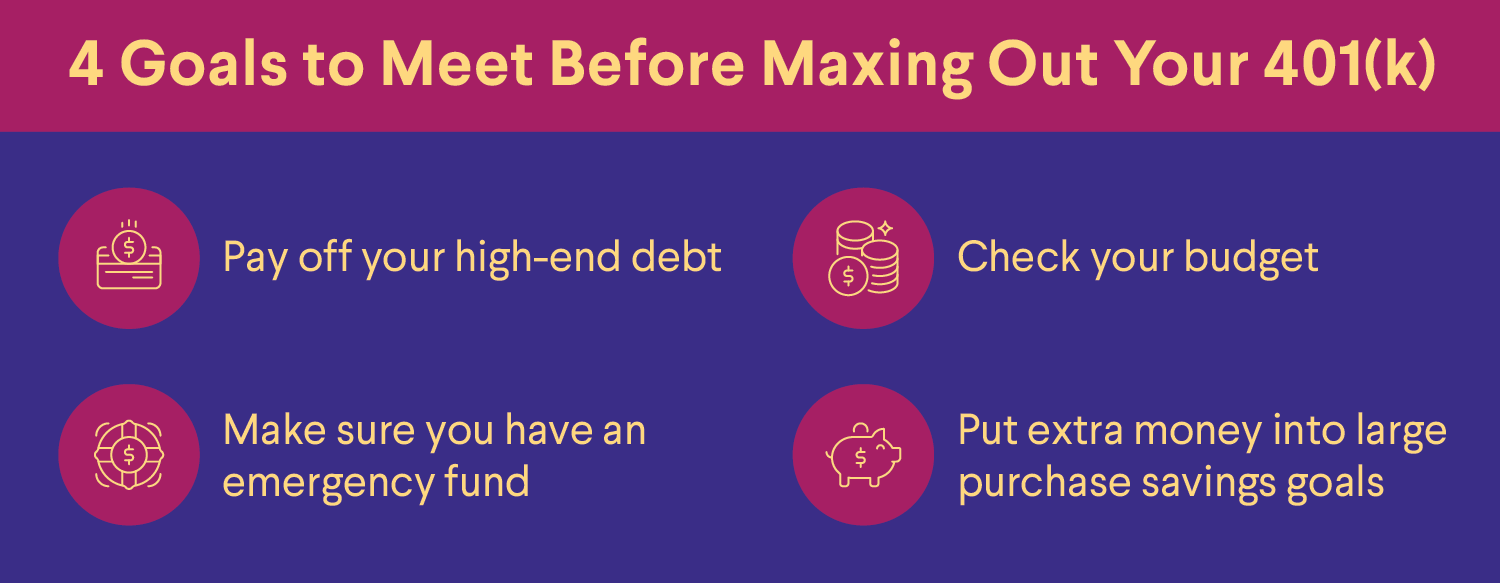
4 Goals to Meet Before Maxing Out Your 401(k)

Generally speaking, yes, it’s a good thing to max out your 401(k) so long as you’re not sacrificing your overall financial stability to do it. Saving for retirement is important, which is why many financial experts would likely suggest maxing out any employer match contributions first.

But while you may want to take full advantage of any tax and employer benefits that come with your 401(k), you also want to consider any other financial goals and obligations you have before maxing out your 401(k).

That doesn’t mean you should put other goals first, and not contribute to your retirement plan at all. That’s not wise. Maintaining a baseline contribution rate for your future is crucial, even as you continue to save for shorter-term aims or put money toward debt repayment.

Other goals might include:

•   Is all high-interest debt paid off? High-interest debt like credit card debt should be paid off first, so it doesn’t accrue additional interest and fees.

•   Do you have an emergency fund? Life can throw curveballs — it’s smart to be prepared for job loss or other emergency expenses.

•   Is there enough money in your budget for other expenses? You should have plenty of funds to ensure you can pay for additional bills, like student loans, health insurance, and rent.

•   Are there other big-ticket expenses to save for? If you’re saving for a large purchase, such as a home or going back to school, you may want to put extra money toward this saving goal rather than completely maxing out your 401(k), at least for the time being.

Once you can comfortably say that you’re meeting your spending and savings goals, it might be time to explore maxing out your 401(k). There are many reasons to do so — it’s a way to take advantage of tax-deferred savings, employer matching (often referred to as “free money”), and it’s a relatively easy and automatic way to invest and save, since the money gets deducted from your paycheck once you’ve set up your contribution amount.

How to Max Out Your 401(k)

Only a relatively small percentage of people max out their 401(k)s, but that doesn’t mean you can’t be one of them. Here are some strategies for how to max out your 401(k).

1. Max Out 401(k) Employer Contributions

Your employer may offer matching contributions, and if so, there are typically rules you will need to follow to take advantage of their match.

An employer may require a minimum contribution from you before they’ll match it, or they might match only up to a certain amount. They might even stipulate a combination of those two requirements. Each company will have its own rules for matching contributions, so review your company’s policy for specifics.

For example, suppose your employer will match your contribution up to 3%. So, if you contribute 3% to your 401(k), your employer will contribute 3% as well. Therefore, instead of only saving 3% of your salary, you’re now saving 6%. With the employer match, your contribution just doubled. Note that employer contributions can range from nothing at all up to a certain limit. It depends on the employer and the plan.

Since saving for retirement is one of the best investments you can make, it’s wise to take advantage of your employer’s match. Every penny helps when saving for retirement, and you don’t want to miss out on this “free money” from your employer.

If you’re not already maxing out the matching contribution and wish to, you can speak with your employer (or HR department, or plan administrator) to increase your contribution amount, you may be able to do it yourself online.

2. Max Out Salary-Deferred Contributions

While it’s smart to make sure you’re not leaving free money on the table, maxing out your employer match on a 401(k) is only part of the equation.

In order to make sure you’re setting aside an adequate amount for retirement, consider contributing as much as your budget will allow. As noted earlier, individuals younger than age 50 can contribute up to $23,500 in 2025, while those 50 and over can contribute $7,500 more in catch-up contributions. And those aged 60 to 63 may contribute an additional $11,250 instead of $7,500, thanks to SECURE 2.0.

Those contributions aren’t just an investment in your future lifestyle in retirement. Because they are made with pre-tax dollars, they lower your taxable income for the year in which you contribute. For some, the immediate tax benefit is as appealing as the future savings benefit.

3. Take Advantage of Catch-Up Contributions

As mentioned, 401(k) catch-up contributions allow investors aged 50 and over to increase their retirement savings — which is especially helpful if they’re behind in reaching their retirement goals.

Individuals 50 and over can contribute an additional $7,500 for a total of $31,000 in 2025. And again, in 2025, those aged 60 to 63 can contribute an additional $11,250, instead of $7,500, for a total of $34,750. Putting all of that money toward retirement savings can help you truly max out your 401(k).

As you draw closer to retirement, catch-up contributions can make a difference, especially as you start to calculate when you can retire. Whether you have been saving your entire career or just started, this benefit is available to everyone who qualifies.

And of course, this extra contribution will lower taxable income even more than regular contributions. Although using catch-up contributions may not push everyone to a lower tax bracket, it will certainly minimize the tax burden during the next filing season.

4. Reset Your Automatic 401(k) Contributions

When was the last time you reviewed your 401(k)? It may be time to check in and make sure your retirement savings goals are still on track. Is the amount you originally set to contribute each paycheck still the correct amount to help you reach those goals?

With the increase in contribution limits most years, it may be worth reviewing your budget to see if you can up your contribution amount to max out your 401(k). If you don’t have automatic payroll contributions set up, you could set them up.

It’s generally easier to save money when it’s automatically deducted; a person is less likely to spend the cash (or miss it) when it never hits their checking account in the first place.

If you’re able to max out the full 401(k) limit, but fear the sting of a large decrease in take-home pay, consider a gradual, annual increase such as 1% — how often you increase it will depend on your plan rules as well as your budget.

5. Put Bonus Money Toward Retirement

Unless your employer allows you to make a change, your 401(k) contribution may be deducted from any bonus you might receive at work. Some employers allow you to determine a certain percentage of your bonus check to contribute to your 401(k).

Consider possibly redirecting a large portion of a bonus to 401k contributions, or into another retirement account, for example, if you open an IRA. Because this money might not have been expected, you won’t miss it if you contribute most of it toward your retirement.

You could also do the same thing with a raise. If your employer gives you a raise, consider putting it directly toward your 401(k). Putting this money directly toward your retirement can help you inch closer to maxing out your 401(k) contributions.

6. Maximize Your 401(k) Returns and Fees

Many people may not know what they’re paying in investment fees or management fees for their 401(k) plans. By some estimates, the average fees for 401(k) plans are between 0.5% and 2%, but some plans may have higher fees.

Fees add up — even if your employer is paying the fees now, you’ll have to pay them if you leave the job and keep the 401(k).

Essentially, if an investor has $100,000 in a 401(k) and pays $1,000 or 1% (or more) in fees per year, the fees could add up to thousands of dollars over time. Any fees you have to pay can chip away at your retirement savings and reduce your returns.

It’s important to ensure you’re getting the most for your money in order to maximize your retirement savings. If you are currently working for the company, you could discuss high fees with your HR team.

One way to potentially lower your costs is to find more affordable investment options. Generally speaking, index funds often charge lower fees than other investments. If your employer’s plan offers an assortment of low-cost index funds, you may want to consider investing in these funds to save some money and help build a diversified portfolio.

If you have a 401(k) account from a previous employer, you might consider moving your old 401(k) into a lower-fee plan. It’s also worth examining what kind of funds you’re invested in and if the plan is meeting your financial goals and risk tolerance.

What Happens If You Contribute Too Much to Your 401(k)?

After you’ve maxed out your 401(k) for the year — meaning you’ve hit the contribution limit corresponding to your age range — then you’ll need to stop making contributions or risk paying additional taxes on your overcontributions.

In the event that you do make an overcontribution, you’ll need to take some additional steps such as letting your plan manager or administrator know, and withdrawing the excess amount. If you leave the excess in the account, it’ll be taxed twice — once when it was contributed initially, and again when you take it out.

Get a 1% IRA match on rollovers and contributions.

Double down on your retirement goals with a 1% match on every dollar you roll over and contribute to a SoFi IRA.1


1Terms and conditions apply. Roll over a minimum of $20K to receive the 1% match offer. Matches on contributions are made up to the annual limits.

What to Do After Maxing Out a 401(k)?

If you max out your 401(k) this year, pat yourself on the back. Maxing out your 401(k) is a financial accomplishment. But now you might be wondering, what’s next? Here are some additional retirement savings options to consider if you have already maxed out your 401(k).

Open an IRA

An individual retirement account (IRA) can be a good complement to your employer’s retirement plans. With a traditional IRA, you can contribute pre-tax dollars up to the annual limit, which is $7,000 in 2025. If you’re 50 or older, you can contribute an extra $1,000, for an annual total of $8,000 in 2025.

You may also choose to consider a Roth IRA. As with a traditional IRA, the annual contribution limit for a Roth IRA in 2025 is $7,000, and $8,000 for those 50 or older. Roth IRA accounts have income limits, but if you’re eligible, you can contribute with after-tax dollars, which means you won’t have to pay taxes on earnings withdrawals in retirement as you do with traditional IRAs.

You can open an IRA at a brokerage, mutual fund company, or other financial institution. If you ever leave your job, you can typically roll your employer’s 401(k) into your IRA without facing tax consequences as long as both accounts are similarly taxed, such as rolling funds from a traditional 401(k) to a traditional IRA, and funds are transferred directly from one plan to the other. Doing a 401(k) to IRA rollover may allow you to invest in a broader range of investments with lower fees.

Boost an Emergency Fund

Experts often advise establishing an emergency fund with at least three to six months of living expenses before contributing to a retirement savings plan. Perhaps you’ve already done that — but haven’t updated that account in a while. As your living expenses increase, it’s a good idea to make sure your emergency fund grows, too. This will cover you financially in case of life’s little curveballs: new brake pads, a new roof, or unforeseen medical expenses.

The money in an emergency fund should be accessible at a moment’s notice, which means it needs to comprise liquid assets such as cash. You’ll also want to make sure the account is FDIC insured, so that your money is protected if something happens to the bank or financial institution.

Save for Health Care Costs

Contributing to a health savings account (HSA) can reduce out-of-pocket costs for expected and unexpected health care expenses, though you can only open and contribute to an HSA if you are enrolled in a high-deductible health plan (HDHP).

For tax year 2025, those eligible can contribute up to $4,300 pre-tax dollars for an individual plan or up to $8,550 for a family plan. Those 55 or older can make an additional catch-up contribution of $1,000 per year.

The money in this account can be used for qualified out-of-pocket medical expenses such as copays for doctor visits and prescriptions. Another option is to leave the money in the account and let it grow for retirement. Once you reach age 65, you can take out money from your HSA without a penalty for any purpose. However, to be exempt from taxes, the money must be used for a qualified medical expense. Any other reasons for withdrawing the funds will be subject to regular income taxes.

Increase College Savings

If you’re feeling good about maxing out your 401(k), consider increasing contributions to your child’s 529 college savings plan (a tax-advantaged account meant specifically for education costs, sponsored by states and educational institutions).

College costs continue to creep up every year. Helping your children pay for college helps minimize the burden of college expenses, so they hopefully don’t have to take on many student loans.

Open a Brokerage Account

After you max out your 401(k), you may also consider opening an online brokerage account. Brokerage firms offer various types of investment accounts, each with different services and fees. A full-service brokerage firm may provide different financial services, which include allowing you to trade securities.

Many brokerage firms require you to have a certain amount of cash to open accounts and have enough funds for trading fees and commissions. While there are no limits on how much you can contribute to the account, earned dividends are taxable in the year they are received. Therefore, if you earn a profit or sell an asset, you must pay a capital gains tax. On the other hand, if you sell a stock at a loss, that becomes a capital loss. This means that the transaction may yield a tax break by lowering your taxable income.

Pros and Cons of Maxing Out Your 401(k)

thumb_up

Pros:

•   Increased Savings: Your retirement savings account will be bigger, which could lead to more growth over time.

•   Simplified Saving and Investing: Maxing out your 401(k) can also make your saving and investing relatively easy, as long as you’re taking a no-lift approach to setting your money aside thanks to automatic contributions.

thumb_down

Cons:

•   Affordability: Maxing out a 401(k) may not be financially feasible for everyone. It may be challenging due to existing debt or other savings goals.

•   Opportunity Costs: Money invested in retirement plans could be used for other purposes. During strong stock market years, non-retirement investments may offer more immediate access to funds.


Test your understanding of what you just read.


The Takeaway

Maxing out your 401(k) involves matching your employer’s maximum contribution match, and also, contributing as much as legally allowed to your retirement plan in a given year. If you have the flexibility in your budget to do so, maxing out a 401(k) can be an effective way to build retirement savings.

And once you max out your 401(k)? There are other smart ways to direct your money. You can open an IRA, contribute more to an HSA, or to a child’s 529 plan.

Ready to invest in your goals? It’s easy to get started when you open an investment account with SoFi Invest. You can invest in stocks, exchange-traded funds (ETFs), mutual funds, alternative funds, and more. SoFi doesn’t charge commissions, but other fees apply (full fee disclosure here).


Invest with as little as $5 with a SoFi Active Investing account.

FAQ

What happens if I max out my 401(k) every year?

Assuming you don’t overcontribute, you may see your retirement savings increase if you max out your 401(k) every year, and hopefully, be able to reach your retirement and savings goals sooner.

Will you have enough to retire after maxing out a 401(k)?

There are many factors that need to be considered to determine if you’ll have enough money to retire if you max out your 401(k). Start by getting a sense of how much you’ll need to retire by using a retirement expense calculator. Then you can decide whether maxing out your 401(k) for many years will be enough to get you there, assuming an average stock market return and compounding built in.

First and foremost, you’ll need to consider your lifestyle and where you plan on living after retirement. If you want to spend a lot in your later years, you’ll need more money. As such, a 401(k) may not be enough to get you through retirement all on its own, and you may need additional savings and investments to make sure you’ll have enough.

What is the best way to max out a 401(k)?

Some effective ways to max out a 401(k) include contributing up to the allowable amount for the year (for 2025, that’s $23,500 for those under age 50); using catch-up contributions if you’re aged 50 or older ($7,500 in 2025, or $11,250 if you’re ages 60 to 63); contributing enough to get your employer’s matching contributions if offered; automating your contributions and increasing them yearly, if possible; and directing a percentage of any bonus you receive into your 401(k).


About the author

Ashley Kilroy

Ashley Kilroy

Ashley Kilroy is a seasoned personal finance writer with 15 years of experience simplifying complex concepts for individuals seeking financial security. Her expertise has shined through in well-known publications like Rolling Stone, Forbes, SmartAsset, and Money Talks News. Read full bio.


INVESTMENTS ARE NOT FDIC INSURED • ARE NOT BANK GUARANTEED • MAY LOSE VALUE

SoFi Invest is a trade name used by SoFi Wealth LLC and SoFi Securities LLC offering investment products and services. Robo investing and advisory services are provided by SoFi Wealth LLC, an SEC-registered investment adviser. Brokerage and self-directed investing products offered through SoFi Securities LLC, Member FINRA/SIPC.

For disclosures on SoFi Invest platforms visit SoFi.com/legal. For a full listing of the fees associated with Sofi Invest please view our fee schedule.

Fund Fees
If you invest in Exchange Traded Funds (ETFs) through SoFi Invest (either by buying them yourself or via investing in SoFi Invest’s automated investments, formerly SoFi Wealth), these funds will have their own management fees. These fees are not paid directly by you, but rather by the fund itself. these fees do reduce the fund’s returns. Check out each fund’s prospectus for details. SoFi Invest does not receive sales commissions, 12b-1 fees, or other fees from ETFs for investing such funds on behalf of advisory clients, though if SoFi Invest creates its own funds, it could earn management fees there.
SoFi Invest may waive all, or part of any of these fees, permanently or for a period of time, at its sole discretion for any reason. Fees are subject to change at any time. The current fee schedule will always be available in your Account Documents section of SoFi Invest.


Disclaimer: The projections or other information regarding the likelihood of various investment outcomes are hypothetical in nature, do not reflect actual investment results, and are not guarantees of future results.

Mutual Funds (MFs): Investors should carefully consider the information contained in the prospectus, which contains the Fund’s investment objectives, risks, charges, expenses, and other relevant information. You may obtain a prospectus from the Fund company’s website or clicking the prospectus link on the fund's respective page at sofi.com. You may also contact customer service at: 1.855.456.7634. Please read the prospectus carefully prior to investing.Mutual Funds must be bought and sold at NAV (Net Asset Value); unless otherwise noted in the prospectus, trades are only done once per day after the markets close. Investment returns are subject to risk, include the risk of loss. Shares may be worth more or less their original value when redeemed. The diversification of a mutual fund will not protect against loss. A mutual fund may not achieve its stated investment objective. Rebalancing and other activities within the fund may be subject to tax consequences.

Investment Risk: Diversification can help reduce some investment risk. It cannot guarantee profit, or fully protect in a down market.

Financial Tips & Strategies: The tips provided on this website are of a general nature and do not take into account your specific objectives, financial situation, and needs. You should always consider their appropriateness given your own circumstances.

Third-Party Brand Mentions: No brands, products, or companies mentioned are affiliated with SoFi, nor do they endorse or sponsor this article. Third-party trademarks referenced herein are property of their respective owners.

Tax Information: This article provides general background information only and is not intended to serve as legal or tax advice or as a substitute for legal counsel. You should consult your own attorney and/or tax advisor if you have a question requiring legal or tax advice.

Third Party Trademarks: Certified Financial Planner Board of Standards Center for Financial Planning, Inc. owns and licenses the certification marks CFP®, CERTIFIED FINANCIAL PLANNER®

External Websites: The information and analysis provided through hyperlinks to third-party websites, while believed to be accurate, cannot be guaranteed by SoFi. Links are provided for informational purposes and should not be viewed as an endorsement.

SOIN-Q325-039

Read more
TLS 1.2 Encrypted
Equal Housing Lender