chef cooking in kitchen

Why College May Not Be for Everyone

While college is a good option for many people, it isn’t for everyone — and not going to a four-year college doesn’t mean you can’t have a meaningful career.

More people than ever before have a college degree, but a four-year program isn’t the only way to be successful. Even employers are realizing that there are many skills that can’t be captured in a degree program. In fact, some major tech companies, including Google and Apple, no longer require applicants to have a four-year degree for some of their positions.

There are certain jobs for which you need a college degree, like an electrical engineer, marketing manager, or teacher, but there are plenty of careers out there that don’t require additional degrees.

Keep reading for more on the pros and cons of going to college, alternatives to a college degree, and more.

Key Points

•   College may not suit everyone, and skipping it doesn’t preclude a successful career.

•   Major tech companies are increasingly open to hiring individuals without a four-year degree.

•   Specific careers require a college degree, but many do not.

•   Alternatives like trade schools, apprenticeships, and certificate programs offer viable career paths.

•   Taking a gap year or starting a business are potential options for those opting out of college.

Reasons Not to Go to College

There are a number of valid reasons to delay college — or put it off entirely. Here are some to consider:

•   You’re not excited about your options. Maybe you didn’t get into the schools you expected to or you’re having second thoughts when you try to imagine yourself attending the schools you did get into. If the thought of college fills you with dread or doubt rather than excitement, taking a year off to reassess your options can be a good strategy.

•   You’re unsure what career you are interested in pursuing. You may want to explore different options by being exposed to college-level courses at a community college, or spend time volunteering, working, or traveling.

•   You’re already working. If you already have a job, you may be wanting to lean into your current job or save money to go to school in a few years.

•   You’re exploring non-degree avenues. There are many high-paying trades that don’t require a degree, but may require on-the-job experience or an apprenticeship.

•   You have a plan for a gap year. Some people like to take a year to travel, work, or otherwise take a break in between high school and college to further explore their identity and what they want to do in the future.

•   You feel you’re going to college only to please your family. If you feel pressured to go to college, it may be a sign that college isn’t the right option for you, at least right now.

•   You have essential family obligations. Some students need to help their families and may not be able to take time off to go to school. These students may consider community college or a part-time degree program. Speaking with your current high school counselor may help you find ways to juggle multiple responsibilities.

•   You want to take time to pursue a talent. From sports to the performing arts to a creative path, some people choose to explore a talent more seriously, focusing time, energy, and resources prior to going to college. This can be a decision you make with the help of your family and any coaches or teachers.

Refi now to pay off loans &
reach your goals faster with a shorter term.


Reasons to Go to College

College can be a great time to grow and learn and, for some, it’s a natural step. Here are some other reasons why college may make sense:

•   You’re excited and realistic about college. You recognize college may have ups and downs, but feel confident that college feels “right” as your next step — not just something your family or teachers expect from you.

•   A college degree will help you achieve your career goals. You’ve done your research and/or talked with alums and people working in your targeted field and feel confident that college makes sense for your career goals.

•   College fits into your overall financial plan. You have a sense of how much college will cost and a plan for how you will pay for it, which might include a combination of financial aid, savings, and federal or private student loans. You also want to make sure you will be able to manage any student loan payments after you graduate.

•   You have a ‘Plan B’ in case you realize that college isn’t the right fit. Sometimes people realize one semester into school that college may not be what they need at that moment in their lives. It can be helpful to talk about what this may be, so that you don’t feel trapped if school doesn’t feel like it’s a good fit.
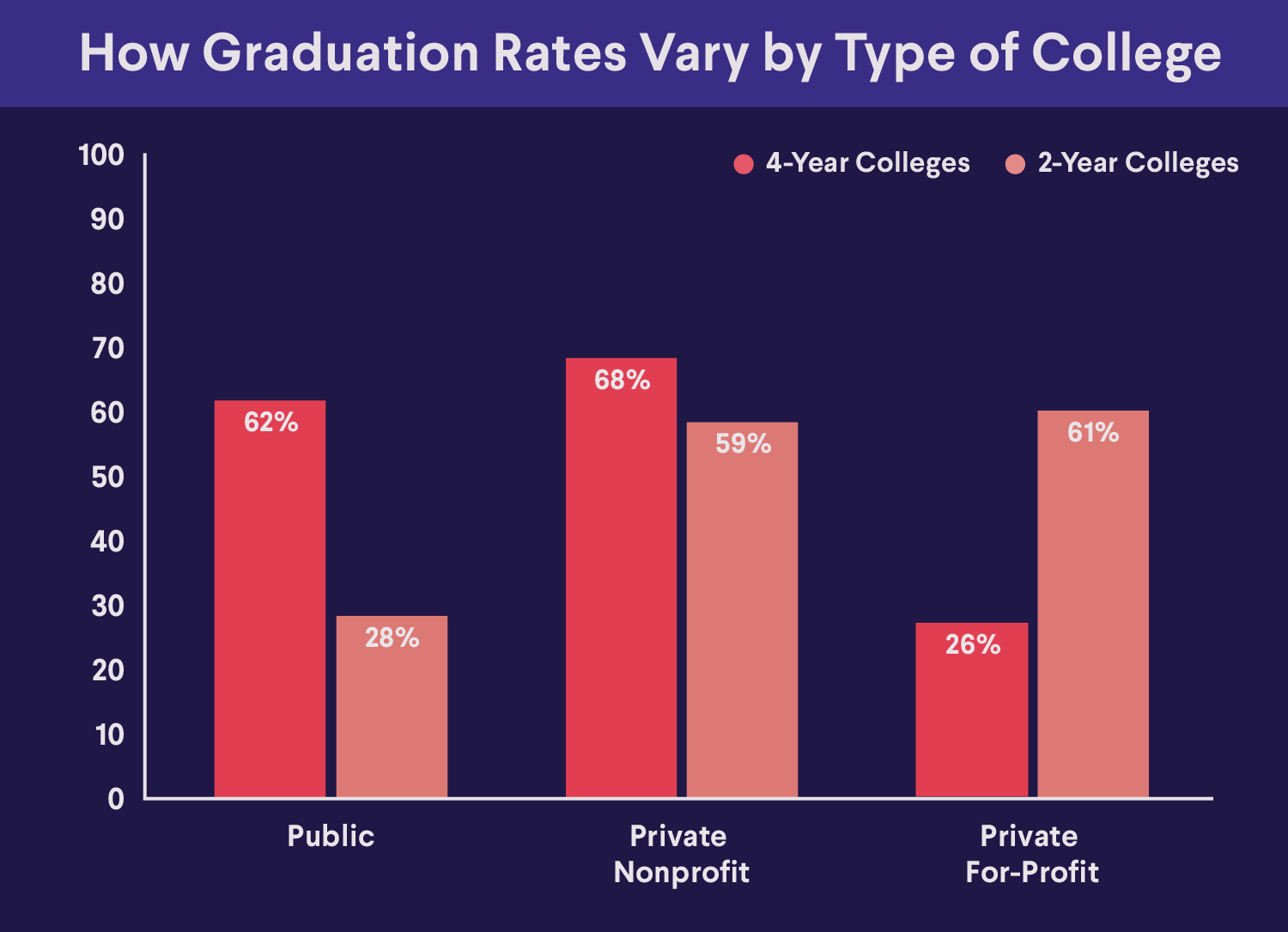
How Graduation Rates Vary by Type of College
Source: National Center for Education Statistics

Recommended: Full-time vs Part-time Student

Alternatives to a College Degree

Just because you aren’t interested in a four-year degree doesn’t mean you need to forgo higher education entirely. Alternative educational models, like trade schools and community colleges, offer many practical certification and two-year associate degree programs that can help you get ahead.

It is important to know that even if you’re not planning to pursue a four-year degree, you still have options when it comes to creating a career that is right for you.


💡 Quick Tip: You’ll make no payments on some private student loans for six months after graduation.

Trade School

Sometimes known as technical or vocational schools, trade schools can prepare you for a specific job, such as a dental hygienist, electrician, cosmetologist, or web developer. These programs are normally much shorter than four years, and certain programs may allow you to finish in only a few months. There are both public and private trade schools.

Trade schools don’t award bachelor’s degrees. Instead, when you graduate from a trade school, you typically receive a diploma or certificate indicating that you are trained and certified to perform a specific job. Some trade school programs do offer associate degrees, which are the same type of degrees offered by many community colleges.

Community College

As mentioned above, community colleges usually offer two-year degrees called associate degrees. These degrees can either stand alone or be a stepping stone to obtaining a bachelor’s degree at a four-year school.

Many community colleges also offer career preparation programs that are designed to help students jump into the workforce without the need for a bachelor’s degree.

Community college could also be a great way to test out college life and see if you want to continue pursuing higher education. They tend to be much less expensive than four-year universities, which means it won’t cost you an arm and a leg before you decide if higher education is right for you.

Apprenticeships

Apprenticeships are paid positions designed to teach the apprentice about a specific job or industry. They can help you learn how to use industry-specific tools and technologies and help you develop your skills over a period of time. This may be in fields as diverse as plumbing to transportation engineering to baking.

Apprenticeships can be a win-win for employers and employees because they allow those starting out to begin working (and earning a paycheck) immediately, and they help employers fill vacant jobs.

Certificate Programs

Similar and sometimes overlapping with trade schools, certificate programs offer specialized training in a specific area. This may include coding, cybersecurity, yoga, fitness, getting a commercial driver’s license (CDL), or other areas where specialized knowledge may be a prerequisite. These certificates may also be helpful in making job seekers eligible for positions with higher starting salaries.

Recommended: Are Coding Bootcamps Worth the Money?

Taking a Gap Year

A gap year is when a student takes a year off between high school and college. Some colleges allow accepted students to defer for a year, holding a place for them in the next year’s incoming class. Some people create a travel itinerary; others may work or volunteer for the year. There are some gap year programs that create opportunities for students, but keep in mind that some programs may be costly.

Starting a Business

If you are already passionate about — and have a lot of knowledge about — a specific field or industry, you might consider skipping college altogether and jumping into that business.

Starting your own business takes a lot of hard work, but it could mean that you get to be your own boss and work in an industry you love. And because you could quickly become an expert on the products or services you provide, you aren’t necessarily at a disadvantage because you lack a degree.

Recommended: 9 High Paying Jobs That Don’t Require a Degree

If You Do Go the College Route

There are plenty of options if you choose not to attend a four-year college. However, there are also options within the world of college, including the type of college you choose, the major you decide to pursue, and how you pay for college.

There’s no denying that college can be expensive. In the 2024-25 school year, the average cost for tuition and fees at an in-state college was $11,610, while the average sticker price for a private college was $43,350. And, these numbers don’t include room and board. This can be a big financial commitment, especially if you are on the fence about pursuing higher education.

That’s why it can be a good idea to begin creating a payment strategy early. A great first step is to fill out the Free Application for Federal Student Aid (FAFSA®) to see how much federal aid — including scholarships, grants, work-study, and federal student loans — you qualify for.

Federal student loans do have limits on how much a student can borrow each year they are enrolled in school. Some students may need additional funds to bridge the gap. In that case, some may consider borrowing a student loan from a private lender to help cover college costs.

In general, it can be a smart idea to tap all your federal loan and grant options before you consider private student loans. That’s because federal loans offer some protections, such as deferment options, that private loans may not. However, private loans can cover up to 100% of the cost of attendance, including money to pay for books, room and board, and personal expenses.


💡 Quick Tip: Parents and sponsors with strong credit and income may find much lower rates on no-fee private parent student loans than federal Parent PLUS Loans. Federal PLUS loans also come with an origination fee.

The Takeaway

College can lead students on a new career path, but depending on your goals and other factors, may not be necessary. Some students may choose to pursue a trade or vocational program instead of a four-year degree, while others may simply want to wait a year or so to earn and save more money to cover the cost of going to college.

If you do decide to go to college, you’ll have to figure out a way to pay for it. Most students rely on a combination of cash savings, scholarships, grants, federal student loans, and private student loans.

If you’ve exhausted all federal student aid options, no-fee private student loans from SoFi can help you pay for school. The online application process is easy, and you can see rates and terms in just minutes. Repayment plans are flexible, so you can find an option that works for your financial plan and budget.


Cover up to 100% of school-certified costs including tuition, books, supplies, room and board, and transportation with a private student loan from SoFi.

FAQ

Why do some people not like college?

Some people dislike college due to high costs, irrelevant coursework, lack of practical skills, social pressures, and the rigid structure that doesn’t suit everyone’s learning style.

What are some alternatives to college?

Alternatives to college include trade schools, apprenticeships, online courses, bootcamps, and self-directed learning. These options often offer practical skills, lower costs, and more flexible schedules.

What are the pros of not attending college?

Pros of not attending college include saving money, allowing for early career entry, providing hands-on experience, and offering more flexibility for personal or family responsibilities.


SoFi Private Student Loans
Please borrow responsibly. SoFi Private Student loans are not a substitute for federal loans, grants, and work-study programs. We encourage you to evaluate all your federal student aid options before you consider any private loans, including ours. Read our FAQs.

Terms and conditions apply. SOFI RESERVES THE RIGHT TO MODIFY OR DISCONTINUE PRODUCTS AND BENEFITS AT ANY TIME WITHOUT NOTICE. SoFi Private Student loans are subject to program terms and restrictions, such as completion of a loan application and self-certification form, verification of application information, the student's at least half-time enrollment in a degree program at a SoFi-participating school, and, if applicable, a co-signer. In addition, borrowers must be U.S. citizens or other eligible status, be residing in the U.S., Puerto Rico, U.S. Virgin Islands, or American Samoa, and must meet SoFi’s underwriting requirements, including verification of sufficient income to support your ability to repay. Minimum loan amount is $1,000. See SoFi.com/eligibility for more information. Lowest rates reserved for the most creditworthy borrowers. SoFi reserves the right to modify eligibility criteria at any time. This information is subject to change. This information is current as of 4/22/2025 and is subject to change. SoFi Private Student loans are originated by SoFi Bank, N.A. Member FDIC. NMLS #696891 (www.nmlsconsumeraccess.org).

SoFi Loan Products
SoFi loans are originated by SoFi Bank, N.A., NMLS #696891 (Member FDIC). For additional product-specific legal and licensing information, see SoFi.com/legal. Equal Housing Lender.


Financial Tips & Strategies: The tips provided on this website are of a general nature and do not take into account your specific objectives, financial situation, and needs. You should always consider their appropriateness given your own circumstances.

Third-Party Brand Mentions: No brands, products, or companies mentioned are affiliated with SoFi, nor do they endorse or sponsor this article. Third-party trademarks referenced herein are property of their respective owners.

External Websites: The information and analysis provided through hyperlinks to third-party websites, while believed to be accurate, cannot be guaranteed by SoFi. Links are provided for informational purposes and should not be viewed as an endorsement.

SOISL-Q325-009

Read more

Is Getting A Degree In Marketing Worth It_780x440

Is Getting a Degree in Marketing Worth It?

When you’re in college, you likely want to choose a major that will lead to a successful and enjoyable career. If you’re a business marketing major, you may wonder whether the education you’re getting now will pay off in terms of the type of job you’ll qualify for after you graduate, and what you can earn.

Here’s a look at what you can expect as a marketing major — both during college and after you graduate.

Key Points

•   The job market for marketing professionals is robust, with a growing need for specialists in digital marketing, social media, and data analytics.

•   A marketing degree offers diverse career opportunities, including roles in advertising, brand management, market research, and public relations.

•   Marketing professionals often enjoy competitive salaries, especially as they gain experience and move into senior positions.

•   The degree equips students with essential skills in communication, critical thinking, and data analysis, which are valuable in many industries.

•   The marketing field is constantly evolving, and a degree helps graduates stay adaptable and relevant, preparing them for future trends and technologies.

What Does a Marketing Major Learn?

As a marketing major, you will learn various aspects and strategies for promoting a company or product, creating brand awareness, and building relationships with customers.

You may study marketing tools like social media, content marketing, and advertising, as well as public relations, sales, marketing strategy, and consumer behavior.

Once you complete your degree, you should have a thorough understanding of how to employ these tools and tactics in the real world on behalf of your employer.


💡 Quick Tip: You can fund your education with a low-rate, no-fee private student loan that covers all school-certified costs.

Who Is It Good For?

If you’re still trying to determine the best college major and are considering marketing, here’s some insight into the type of person who might thrive in a marketing career.

If you’re curious about how brands connect with customers and find yourself analyzing ads in magazines and on television, you might be a natural marketer. Marketers are typically creative and good communicators; you’ll need that ingenuity to come up with innovative marketing campaigns to compete with others in a given industry.

Depending on the job you get after college, you may work with a team on campaigns, or you may be solely in charge of doing multiple different tasks on your own. Ideally, you’ll be excited and confident about sharing your ideas for projects.

If you’ve got an analytical mind, so much the better. You’ll be able to analyze data to better understand what types of marketing efforts are working to reach your audience and which aren’t.

Recommended: 20 of the Most Popular College Majors

Why Consider Marketing?

Marketing isn’t a trendy or even industry-specific career; it’s one that every brand on earth needs. As a result, there will likely always be careers in marketing. Because marketing is what propels a company to sell products or services, it has a return on investment, and that means that companies are willing to also invest in smart marketing professionals.

Everywhere you look, there’s marketing, from the product placement in your favorite television show to the daily Instagram posts from influencers that offer “sponsored content.” Being a part of this exciting field gives you the opportunity to shape how consumers connect with brands.

What Jobs Can a Marketing Major Get?

So you’ve majored in marketing and now you want to know your career options. What does a marketing major do after graduating? And what professional goals can you set down the road, once you’ve had more experience?

Entry-Level Marketing Jobs

Depending on your specific interest in marketing, there are several paths you could take after graduation.

If you enjoy working with advertising, you could get work as a media buyer, who is in charge of purchasing ads, both digital and print, to achieve marketing goals. Median salary for a media buyer is $69,077.

If you enjoy dabbling in different aspects of marketing, you could be a marketing coordinator. You might be a part of planning and launching marketing campaigns and events, managing email marketing, and writing content for different platforms. The median annual salary is $55,463.

If you lit up in your public relations coursework, a public relations assistant might be a good first job. You’ll be tasked with creating press releases and pitch letters, and connecting with the media to get interviews and media coverage for your brand. Salaries vary, but the median is around $52,266 a year.

Recommended: 25 Highest Paying Jobs in the US

Marketing Jobs for More Experienced Professionals

Once you have a bit of experience in your entry-level marketing job, you may be eligible for a promotion or could qualify for a more advanced role with a different company like the following ones.

A public relations manager has approximately six to eight years of experience working in PR. In addition to building relationships with journalists and influencers and securing media coverage for a brand, this role may also hire and manage other PR roles as well as writers and designers. The median salary for this role is around $75,042.

A marketing director could be a good goal after you build experience as a marketing coordinator and have five to 10 years of marketing experience. This role is involved in the planning of marketing activities, building a budget, and forecasting sales. You may oversee a marketing team, including internal staff and freelancers. The median salary for this position is approximately $112,676, but can vary widely.

Another option once you have one to five years of experience, specifically in sales, is as a sales manager. This role analyzes sales data to shape sales and pricing strategy and may train or manage sales staff. The median salary for a sales manager is $138,060.

Launching Your Own Marketing Business

You’re not limited to working for someone else in your marketing career; many professionals get experience under their belt by working for companies of all sizes, then decide to open their own business. That could be a one-person content marketing business run out of your home or a PR firm with office space and staff.

Starting your own business gives you the flexibility of working when you want, and to choose exactly the marketing, advertising, or PR services you want to specialize in. It does, however, require plenty of hard work and dedication, and without the stability of a regular paycheck, you aren’t guaranteed to make a certain amount of money.

What Can a Marketing Major Earn?

Understandably, you want some reassurance that what you’ll make in your career after graduating will help you quickly pay off any student debt and help you become financially successful.

Generally, students can expect to make the least right after graduating, since they’ll have little to no work experience. Salary expectations for entry-level marketing positions can vary based on factors like where you live and the industry you want to work in. Some companies may offer hiring bonuses or commission on top of that salary.

As you build experience, your salary will generally increase. Again, this will depend on your specific experience and accomplishments as well as the industry and company you work for.


💡 Quick Tip: Even if you don’t think you qualify for financial aid, you should fill out the FAFSA form. Many schools require it for merit-based scholarships, too. You can submit it as early as Oct. 1.

The Takeaway

Only you can determine whether marketing is a field where you’ll thrive and enjoy working. However, if you’re willing to put in the effort, the industry offers opportunities to learn a wide range of skills and advance your career.

Of course, as a student, you’re still a long way from earning a sizable salary, and coming up with enough funds to cover the high cost of college can be challenging. Fortunately, no matter what you’re thinking about majoring in, you have a range of funding options, including grants, scholarships, federal work-study programs, and both federal and private student loans.

If you’ve exhausted all federal student aid options, no-fee private student loans from SoFi can help you pay for school. The online application process is easy, and you can see rates and terms in just minutes. Repayment plans are flexible, so you can find an option that works for your financial plan and budget.


Cover up to 100% of school-certified costs including tuition, books, supplies, room and board, and transportation with a private student loan from SoFi.

FAQ

Can you be successful with a marketing degree?

Absolutely, a marketing degree can lead to successful careers in advertising, brand management, market research, and digital marketing, providing valuable skills in communication, analytics, and strategy.

Is a marketing degree difficult?

A marketing degree can be challenging, requiring strong skills in communication, analytics, and creativity. It involves rigorous coursework and practical projects, but it’s manageable with dedication and effort.

Will a marketing degree get you a job?

A marketing degree can significantly enhance your job prospects, opening doors to various roles in advertising, brand management, market research, and digital marketing. It provides valuable skills that are in high demand.


SoFi Private Student Loans
Please borrow responsibly. SoFi Private Student loans are not a substitute for federal loans, grants, and work-study programs. We encourage you to evaluate all your federal student aid options before you consider any private loans, including ours. Read our FAQs.

Terms and conditions apply. SOFI RESERVES THE RIGHT TO MODIFY OR DISCONTINUE PRODUCTS AND BENEFITS AT ANY TIME WITHOUT NOTICE. SoFi Private Student loans are subject to program terms and restrictions, such as completion of a loan application and self-certification form, verification of application information, the student's at least half-time enrollment in a degree program at a SoFi-participating school, and, if applicable, a co-signer. In addition, borrowers must be U.S. citizens or other eligible status, be residing in the U.S., Puerto Rico, U.S. Virgin Islands, or American Samoa, and must meet SoFi’s underwriting requirements, including verification of sufficient income to support your ability to repay. Minimum loan amount is $1,000. See SoFi.com/eligibility for more information. Lowest rates reserved for the most creditworthy borrowers. SoFi reserves the right to modify eligibility criteria at any time. This information is subject to change. This information is current as of 4/22/2025 and is subject to change. SoFi Private Student loans are originated by SoFi Bank, N.A. Member FDIC. NMLS #696891 (www.nmlsconsumeraccess.org).

SoFi Loan Products
SoFi loans are originated by SoFi Bank, N.A., NMLS #696891 (Member FDIC). For additional product-specific legal and licensing information, see SoFi.com/legal. Equal Housing Lender.


Financial Tips & Strategies: The tips provided on this website are of a general nature and do not take into account your specific objectives, financial situation, and needs. You should always consider their appropriateness given your own circumstances.

Third-Party Brand Mentions: No brands, products, or companies mentioned are affiliated with SoFi, nor do they endorse or sponsor this article. Third-party trademarks referenced herein are property of their respective owners.

SOISL-Q325-010

Read more
A couple sit at a table with financial papers on it staring intently at a laptop screen.

What Is Disposable Income?

Simply defined, disposable income is the amount of money you have available to spend or save after your income taxes have been deducted. You may also hear this sum of money called disposable earnings or disposable personal income (or DPI).

Disposable income is carefully watched by economists because it is a valuable indicator of the economy’s health. It’s also the basis of your own personal budget, since it represents the money you can use for spending, saving, or investing as you see fit.

Key Points

•   Disposable income refers to the money available for spending or saving after income taxes have been deducted.

•   It is an important indicator of an individual’s financial status and is used to determine how to allocate funds.

•   Disposable income is different from discretionary income, which takes into account essential expenses.

•   Calculating disposable income involves subtracting taxes and other mandatory deductions from gross earnings.

•   Budgeting disposable income involves tracking spending, setting goals, and allocating funds for basic living expenses, discretionary spending, and saving/investing.

What Is Disposable Income?

Disposable income is money you have left over from your earnings after taxes and any other mandatory charges are deducted.

This money (which may also be referred to as expendable income) can then be spent or saved as you wish. You will likely use it for your basic living expenses, or the needs in your daily life, such as housing, utilities, food, transportation, healthcare, and minimum debt payments.

You may also spend that money on the wants in life, such as dining out, entertainment, travel, and non-vital purchases, such as a cool new watch or mountain bike.

Your disposable income can also be allocated towards your goals, such as saving for your child’s college education, the down payment on a house, and/or retirement.

💡 Quick Tip: Typically, checking accounts don’t earn interest. However, some accounts do, and online banks are more likely than brick-and-mortar banks to offer you the best rates.

Why Disposable Income Is Important

There are different types of income, and disposable income is usually defined as the amount of money you keep after federal, state, and local taxes and other mandatory deductions are subtracted from gross earnings. Consider these details:

•  Mandatory deductions include Social Security, state income tax, federal income tax, and state disability insurance.

•  Voluntary deductions, such as health benefit deductions, 401(k) contributions, deductions for other employer-sponsored benefits, as well as any assignments of support (such as child support) are excluded from the calculation. These costs are considered part of your disposable earnings.

•  Disposable income is an important number not just for consumers, but also the nation as a whole. The average disposable income of the country is used by analysts to measure consumer spending, payment ability, probable future savings, and the overall health of a nation’s economy.

•  International economists use national measures of disposable income to compare economies of different countries.

On an individual level, your disposable income is also a key economic indicator because this is the actual amount of money you have to spend or save.

For example, if your salary is $60,000, you don’t actually have $60,000 to spend over the course of the year. Federal, state, and possibly other local taxes will be deducted, as will Social Security and Medicare taxes.

What is left over is what you would have to spend on everything else in your life, such as housing, transportation, food, health insurance, other necessities, as well as nonessentials.

Recommended: Money Management Guide

Disposable Income vs. Discretionary Income

Although they’re often confused with one another, disposable income is completely different from discretionary income.

While disposable income is your income minus only taxes, discretionary income takes into account the costs of both taxes and other essential expenses. Essential expenses include rent or mortgage payments, utilities, groceries, insurance, clothing, and other “musts.”

Discretionary income is what you can have leftover after the essentials are subtracted. This is what you can spend on nonessential, or discretionary, items.

Some costs that fall under the discretionary category are dining out, vacations, recreation, and luxury items like jewelry. Although internet service and your cell phone may seem like necessities, these expenses are considered discretionary expenses.

Similarities

Both disposable and discretionary income are a way of looking at income after taxes.

However, discretionary income goes a step further and deducts essential expenses, such as housing and healthcare.

Differences

As you might expect, discretionary income is always less than disposable income. When you subtract your basic living expenses from disposable income, the amount that remains is your discretionary income — what you have left to spend on wants or save for the future.

Increase your savings
with a limited-time APY boost.*


*Earn up to 4.00% Annual Percentage Yield (APY) on SoFi Savings with a 0.70% APY Boost (added to the 3.30% APY as of 12/23/25) for up to 6 months. Open a new SoFi Checking and Savings account and pay the $10 SoFi Plus subscription every 30 days OR receive eligible direct deposits OR qualifying deposits of $5,000 every 31 days by 3/30/26. Rates variable, subject to change. Terms apply here. SoFi Bank, N.A. Member FDIC.

Calculating Disposable Income

Disposable income refers to the amount of earnings left over after mandatory federal, state, and local deductions. But disposable income is not necessarily the same as your take-home pay.

Deductions from your paycheck may include additional items such as health insurance, retirement plan contributions, and health savings accounts. These deductions are voluntary, not mandatory.

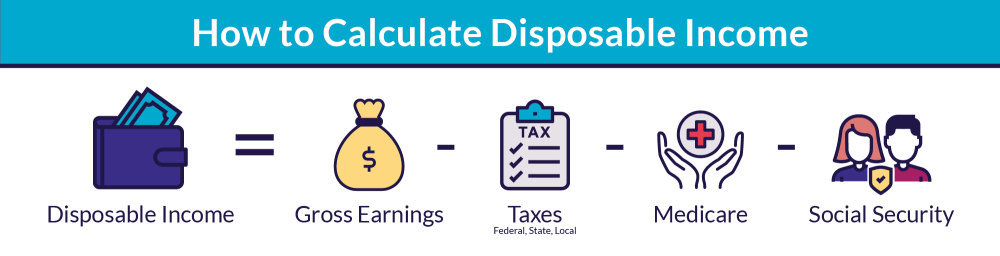
To calculate your disposable earnings, you can simply subtract federal, state and local taxes; Medicare; and Social Security from your gross earnings. Be sure to include any passive income streams, such as rental income, or side hustle earnings (more on that in a moment), when doing the math for your gross income. The resulting amount is your disposable income.

How to calculate disposable income

Some of the finer points to note:

•   Keep in mind that taxes deducted from your paycheck are an estimate. If you have a history of getting a large refund or having a large amount of taxes due, it may be worth reviewing your withholdings through your employer.

This could help you adjust the withholdings so it is closer to the actual expected tax that will be calculated when you file. You can then plan accordingly.

•   Even if you’re a contractor or freelancer, or if you made additional income from side gigs along with your salary, you can still calculate your disposable income.

This requires subtracting your quarterly tax payments and any additional taxes you will owe from your overall income. You can then determine your monthly after-tax income.

Setting aside money to pay taxes can also help you budget with your disposable income.

💡 Quick Tip: Most savings accounts only earn a fraction of a percentage in interest. Not at SoFi. Our high-yield savings account can help you make meaningful progress towards your financial goals.

Disposable Income Budgeting

Calculating your disposable income is a key first step in preparing a budget. You need to know how much you have to spend in order to plan your monthly spending and saving.

A personal budget puts you in control of your disposable income and helps you make financial decisions. It forces you to take a closer look at how you’re spending your money.

Here are a few ideas that could be helpful when developing a budget based on disposable income.

Tracking Spending

Disposable income is what’s coming into your account every month. It’s a good idea to also determine what is going out each month.

To do this, you can gather up bank and credit card statements, as well as receipts, from the past three months or so, and then list all of your monthly spending (both essential and discretionary/nonessential).

To make this list more accurate, you may want to actually track your spending for a month. You can do this with a phone app (your bank’s app may include this function), by carrying a small notebook and jotting down everything you buy, or by saving all of your receipts and logging it later.

This can be an eye-opening exercise. Many of us have no idea how much we’re spending on the little things, like morning coffees, and how much they can add up to at the end of the month.

Once you see your spending laid out in black and white, you may find some easy ways to cut back, such as getting rid of subscriptions and streaming services that you rarely use, brewing coffee at home, cooking more and getting less take-out, or getting rid of a pricey gym membership and working out at home.

Setting Goals And Spending Targets

Tracking income and spending can provide a great starting point for setting financial goals and spending targets.

•  Goals are things that a person aims for in the short- or long-term — like paying off student loans or buying a new car.

•  Spending targets are how much you want to spend each month in general categories in order to have money left over to put towards your savings goals.

Since essential spending often can’t be adjusted, spending targets are typically for discretionary income.

One option for budgeting disposable income is the 50/30/20 plan. This suggests spending about 50% on necessities, 30% on discretionary items, and then putting aside 20% for savings and other long-term goals.

Use the 50/30/20 budget calculator below to see how your budget would fall into those three categories.


These percentages are general guidelines, however, and can be adjusted as needed based on individual circumstances. For example, if you live in a competitive housing area, rent may take up a large portion of your expenses, and you may have to bump up necessity spending to 60% and decrease fun money to 20% instead.

Or, if you are saving for something in the near term, like a car or a wedding, you may want to temporarily bump up the savings category, and pull back unnecessary spending for a few months.

3 Uses for Your Disposable Income

Once you have calculated your disposable income, you can consider the ways you might divide it up:

Basic Living Expenses

Some of your disposable income will go towards necessities, such as:

•  Housing

•  Utilities

•  Food

•  Healthcare

•  Transportation

•  Insurance

•  Minimum debt payments

Discretionary Spending

Next, there are the wants in life. These are things that are not vital for survival but can certainly make things more enjoyable:

•  Eating out

•  Entertainment, such as streaming platforms, movies, concerts, and books

•  Clothing that isn’t essential

•  Electronics, like the latest mobile phone

•  Travel

•  Gifts

Saving and Investing

In addition to the spending outlined above, you will likely want to save money or invest it for your short-term and/or long-term goals. These may include:

•  Your emergency fund

•  The down payment for a house

•  A college fund for children

•  Money to start your own business

•  A new car

•  Retirement

Recommended: Emergency Fund Calculator

Meet the new SoFi Plus!

Get access to higher APY, credit card cash back rewards, discounts, and more.

money management guide for beginners

Test your understanding of what you just read.


The Takeaway

Disposable income is a key concept in budgeting, as it refers to the income that’s left over after you pay taxes. Knowing how much disposable income you have is the foundation for putting together a simple budget that allows for necessary expenses, having fun, while also saving for the future. Finding the right banking partner is another important element of planning for tomorrow.

Interested in opening an online bank account? When you sign up for a SoFi Checking and Savings account with eligible direct deposit, you’ll get a competitive annual percentage yield (APY), pay zero account fees, and enjoy an array of rewards, such as access to the Allpoint Network of 55,000+ fee-free ATMs globally. Qualifying accounts can even access their paycheck up to two days early.


Better banking is here with SoFi, NerdWallet’s 2024 winner for Best Checking Account Overall.* Enjoy 3.30% APY on SoFi Checking and Savings with eligible direct deposit.

FAQ

What does disposable income mean?

Disposable income (also known as disposable earnings) is the money you have left after taxes and other mandatory deductions are taken out of your income. Essentially, it’s the money you have at your disposal to spend, save, or invest.

What is an example of disposable income?

Disposable income is the amount of money you have left after taxes and other mandatory deductions are taken out. As an example, let’s say Sarah earns $4,000 a month in gross income. After $1,000 is deducted in federal, state, and payroll taxes (including Social Security and Medicare), Sarah is left with $3,000.

This $3,000 is Sarah’s disposable income — the amount she has available to spend on essential and discretionary expenses, as well as put towards savings.

What is the difference between disposable income and discretionary income?

Disposable income refers to earnings minus taxes and mandatory deductions, such as Social Security and Medicare. Discretionary income is a subset of disposable income. It is the money left once you have paid for essentials, such as housing, utilities, food, and healthcare. The money that is left can be used for nonessential spending and for saving.


SoFi Checking and Savings is offered through SoFi Bank, N.A. Member FDIC. The SoFi® Bank Debit Mastercard® is issued by SoFi Bank, N.A., pursuant to license by Mastercard International Incorporated and can be used everywhere Mastercard is accepted. Mastercard is a registered trademark, and the circles design is a trademark of Mastercard International Incorporated.

Annual percentage yield (APY) is variable and subject to change at any time. Rates are current as of 12/23/25. There is no minimum balance requirement. Fees may reduce earnings. Additional rates and information can be found at https://www.sofi.com/legal/banking-rate-sheet

Eligible Direct Deposit means a recurring deposit of regular income to an account holder’s SoFi Checking or Savings account, including payroll, pension, or government benefit payments (e.g., Social Security), made by the account holder’s employer, payroll or benefits provider or government agency (“Eligible Direct Deposit”) via the Automated Clearing House (“ACH”) Network every 31 calendar days.

Although we do our best to recognize all Eligible Direct Deposits, a small number of employers, payroll providers, benefits providers, or government agencies do not designate payments as direct deposit. To ensure you're earning the APY for account holders with Eligible Direct Deposit, we encourage you to check your APY Details page the day after your Eligible Direct Deposit posts to your SoFi account. If your APY is not showing as the APY for account holders with Eligible Direct Deposit, contact us at 855-456-7634 with the details of your Eligible Direct Deposit. As long as SoFi Bank can validate those details, you will start earning the APY for account holders with Eligible Direct Deposit from the date you contact SoFi for the next 31 calendar days. You will also be eligible for the APY for account holders with Eligible Direct Deposit on future Eligible Direct Deposits, as long as SoFi Bank can validate them.

Deposits that are not from an employer, payroll, or benefits provider or government agency, including but not limited to check deposits, peer-to-peer transfers (e.g., transfers from PayPal, Venmo, Wise, etc.), merchant transactions (e.g., transactions from PayPal, Stripe, Square, etc.), and bank ACH funds transfers and wire transfers from external accounts, or are non-recurring in nature (e.g., IRS tax refunds), do not constitute Eligible Direct Deposit activity. There is no minimum Eligible Direct Deposit amount required to qualify for the stated interest rate. SoFi Bank shall, in its sole discretion, assess each account holder's Eligible Direct Deposit activity to determine the applicability of rates and may request additional documentation for verification of eligibility.

See additional details at https://www.sofi.com/legal/banking-rate-sheet.

*Awards or rankings from NerdWallet are not indicative of future success or results. This award and its ratings are independently determined and awarded by their respective publications.

Financial Tips & Strategies: The tips provided on this website are of a general nature and do not take into account your specific objectives, financial situation, and needs. You should always consider their appropriateness given your own circumstances.

We do not charge any account, service or maintenance fees for SoFi Checking and Savings. We do charge a transaction fee to process each outgoing wire transfer. SoFi does not charge a fee for incoming wire transfers, however the sending bank may charge a fee. Our fee policy is subject to change at any time. See the SoFi Bank Fee Sheet for details at sofi.com/legal/banking-fees/.
Tax Information: This article provides general background information only and is not intended to serve as legal or tax advice or as a substitute for legal counsel. You should consult your own attorney and/or tax advisor if you have a question requiring legal or tax advice.

Third Party Trademarks: Certified Financial Planner Board of Standards Center for Financial Planning, Inc. owns and licenses the certification marks CFP®, CERTIFIED FINANCIAL PLANNER®

SOBNK-Q325-060

Read more
IRA Withdrawal Rules: All You Need to Know

Traditional and Roth IRA Withdrawal Rules & Penalties

The purpose of an Individual Retirement Account (IRA) is to save for retirement. Ideally, you sock away money consistently in an IRA and your investment grows over time.

However, IRAs have strict withdrawal rules both before and after retirement. It’s very important to understand the IRA rules for withdrawals to avoid incurring penalties.

Here’s what you need to know about IRA withdrawal rules.

Key Points

  • Traditional and Roth IRAs have specific withdrawal rules and penalties.
  • Roth IRA withdrawal rules include the five-year rule for penalty-free withdrawals of earnings, and required minimum distributions (RMDs) for inherited IRAs. You can always withdraw your Roth IRA contributions tax-free and penalty-free.
  • Traditional IRA withdrawals before age 59 ½ incur regular income taxes and a 10% penalty on the taxable portion.
  • There are exceptions to the penalty, such as using funds for unreimbursed medical expenses (exceeding 7.5% of AGI), health insurance premiums during unemployment, total and permanent disability, qualified higher education expenses, and first-time home purchases (up to $10,000 lifetime limit).
  • Generally speaking, early IRA withdrawals might be thought of as a last resort due to the potential impact on retirement savings and tax implications, including lost opportunity for growth.

Roth IRA Withdrawal Rules

So when can you withdraw from a Roth IRA? The IRA withdrawal rules are different for Roth IRAs vs traditional IRAs. For instance, qualified withdrawals from a Roth IRA are tax-free, since you make contributions to the account with after-tax funds.

There are some other Roth IRA withdrawal rules to keep in mind as well.[1]

The Five-year Rule

The date you open a Roth IRA and how long the account has been open is a factor in taking your withdrawals.

According to the five-year rule, you can generally withdraw your earnings tax- and penalty-free if you’re at least 59 ½ years old and it’s been at least five years since you opened the Roth IRA. You can withdraw contributions to a Roth IRA anytime without taxes or penalties. (The annual IRA contribution limits for 2024 and 2025 are $7,000, or $8,000 for those age 50 and up.)

Even if you’re 59 ½ or older, you may face a Roth IRA early withdrawal penalty if the retirement account has been open for less than five years when you withdraw earnings from it.

These Roth IRA withdrawal rules also apply to the earnings in a Roth that was a rollover IRA. If you roll over money from a traditional IRA to a Roth and you then make a withdrawal of earnings from the Roth IRA before you’ve owned it for at least five years, you’ll owe a 10% penalty on the earnings.

For inherited Roth IRAs, the five-year rule applies to the age of the account. If your benefactor opened the account more than five years ago, you can withdraw earnings penalty-free. If you tap into the money before that, though, you’ll owe taxes on the earnings.

Required Minimum Distributions (RMDs) on Inherited Roth IRAs

In most cases, you do not have to pay required minimum distributions (RMDs) on money in a Roth IRA account.

However, according to the SECURE Act, if your loved one passed away in 2020 or later, you don’t have to take RMDs, but you do need to withdraw the entire amount in the Roth IRA within 10 years.[2]

There are two ways to do that without penalty:

  • Withdraw funds by December 31 of the fifth year after the original holder died. You can do this in either partial distributions or a lump sum. If the account is not emptied by that date, you could owe a 50% penalty on whatever is left.
  • Take withdrawals each year, based on your life expectancy.

Tax Implications of Roth IRA Withdrawals

Contributions to a Roth IRA can be withdrawn any time without taxes or penalties. However, let’s say an individual did active investing through their account, which generated earnings. Any earnings withdrawn from a Roth before age 59 ½ are subject to a 10% penalty and income taxes.

Recommended: Retirement Planning Guide

Traditional IRA Withdrawal Rules

If you take funds out of a traditional IRA before you turn 59 ½, you’ll owe regular income taxes on the contributions and the earnings, per IRA tax deduction rules, plus a 10% penalty. Brian Walsh, CFP® at SoFi specifies, “When you make contributions to a traditional retirement account, that money is going to grow without paying any taxes. But when you take that money out — say 30 or 40 years from now — you’re going to pay taxes on all of the money you take out.”

RMDs on a Traditional IRA

The rules for withdrawing from an IRA mean that required minimum distributions kick in the year you turn 73 (as long as you turned 72 after December 31, 2022). After that, you have to take distributions each year, based on your life expectancy. If you don’t take the RMD, you’ll owe a 25% penalty on the amount that you did not withdraw. The penalty may be lowered to 10% if you correct the mistake and take the RMD within two years.[3]

Early Withdrawal Penalties for Traditional IRAs

In general, an early withdrawal from a traditional IRA before the account holder is at least age 59 ½ is subject to a 10% penalty and ordinary income taxes.[4] However, there are some exceptions to this rule.

Recommended: What Is a SEP IRA?

When Can You Withdraw from an IRA Without Penalties?

As noted, you can make withdrawals from an IRA once you reach age 59 ½ without penalties.

In addition, there are other situations in which you may be able to make withdrawals without having to pay a penalty. These include having medical expenses that aren’t covered by health insurance (as long as you meet certain qualifications), having a permanent disability that means you can no longer work, and paying for qualified education expenses for a child, spouse, or yourself.

Read more about these and other penalty-free exceptions below.

9 Exceptions to the 10% Early-Withdrawal Penalty on IRAs

Whether you’re withdrawing from a Roth within the first five years or you want to take money out of an IRA before you turn 59 ½, there are some exceptions to the 10% penalty on IRA withdrawals.

1. Medical Expenses

You can avoid the early withdrawal penalty if you use the funds to pay for unreimbursed medical expenses that total more than 7.5% of your adjusted gross income (AGI).

2. Health Insurance

If you’re unemployed for at least 12 weeks, IRA withdrawal rules allow you to use funds from an IRA penalty-free to pay health insurance premiums for yourself, your spouse, or your dependents.

3. Disability

If you’re totally and permanently disabled, you can withdraw IRA funds without penalty. In this case, your plan administrator may require you to provide proof of the disability before signing off on a penalty-free withdrawal.

4. Higher Education

IRA withdrawal rules allow you to use IRA funds to pay for qualified education expenses, such as tuition and books for yourself, your spouse, or your child without penalty.

5. Inherited IRAs

IRA withdrawal rules for inherited IRAs state that you don’t have to pay the 10% penalty on withdrawals from an IRA, unless you’re the sole beneficiary of a spouse’s account and roll it into your own, non-inherited IRA. In that case, the IRS treats the IRA as if it were yours from the start, meaning that early withdrawal penalties apply.

6. IRS Levy

If you owe taxes to the IRS, and the IRS levies your account for the money, you will typically not be assessed the 10% penalty.

7. Active Duty

If you’re a qualified reservist, you can take distributions without owing the 10% penalty. This goes for a military reservist or National Guard member called to active duty for at least 180 days.[5]

8. Buying a House

While you can’t take out IRA loans, you can use up to $10,000 from your traditional IRA toward the purchase of your first home — and if you’re purchasing with a spouse, that’s up to $10,000 for each of you. The IRS defines first-time homebuyers as someone who hasn’t owned a principal residence in the last two years. You can also withdraw money to help with a first home purchase for a child or your spouse’s child, grandchild, or parent.

In order to qualify for the penalty-free withdrawals, you’ll need to use the money within 120 days of the distribution.

9. Substantially Equal Periodic Payments

Another way to avoid penalties under IRA withdrawal rules is by starting a series of distributions from your IRA spread equally over your life expectancy. To make this work, you must take at least one distribution each year and you can’t alter the distribution schedule until five years have passed or you’ve reached age 59 ½, whichever is later.

The amount of the distributions must use an IRS-approved calculation that involves your life expectancy, your account balance, and interest rates.

Understanding How Exceptions Are Applied

If you believe that any of the exceptions to early IRA withdrawal penalties apply to your situation, you may need to file IRS form 5329 to claim them.[6] However, it’s wise to consult a tax professional about your specific circumstances.


💡 Quick Tip: For investors who want a diversified portfolio without having to manage it themselves, automated investing could be a solution (although robo advisors typically have more limited options and higher costs). The algorithmic design helps minimize human errors, to keep your investments allocated correctly.

Is Early IRA Withdrawal Worth It?

While there may be cases where it makes sense to take an early withdrawal, many financial professionals agree that it should be a last resort. These are disadvantages and advantages to consider.

Pros of IRA Early Withdrawal

  • If you have a major expense and there are no other options, taking an early withdrawal from an IRA could help you cover the cost.
  • An early withdrawal may help you avoid taking out a loan you would then have to repay with interest.

Cons of IRA Early Withdrawal

  • By taking money out of an IRA account early, you’re robbing your own nest egg not only of the current value of the money but also the chance for future years of compound growth.
  • Money taken out of a retirement account now can have a big impact on your financial security in the future when you retire.
  • You may owe taxes and penalties, depending on the specific situation.

Alternatives to Early IRA Withdrawal

Rather than taking an early IRA withdrawal and incurring taxes and possible penalties, as well as impacting your long-term financial goals, you may want to explore other options first, such as:

  • Using emergency savings: Building an emergency fund that you can draw from is one way to cover unplanned expenses, whether it’s car repairs or a medical bill, or to tide you over if you lose your job. Financial professionals often recommend having at least three to six months’ worth of expenses in your emergency fund.

    To create your fund, start contributing to it weekly or bi-weekly, or set up automatic transfers for a certain amount to go from your checking account into the fund every time your paycheck is direct-deposited.

  • Taking out a loan: You could consider asking a family member or friend for a loan, or even taking out a personal loan, if you can get a good interest rate and/or favorable loan terms. While you’ll need to repay a loan, you won’t be taking funds from your retirement savings. Instead, they can remain in your IRA where they can potentially continue to earn compound returns.

Opening an IRA With SoFi

IRAs are tax-advantaged accounts you can use to save for retirement. However, it is possible to take money out of an IRA if you need it before retirement age. Just remember, even if you’re able to do so without paying a penalty, the withdrawals could leave you with less money for retirement later.

Prepare for your retirement with an individual retirement account (IRA). It’s easy to get started when you open a traditional or Roth IRA with SoFi. Whether you prefer a hands-on self-directed IRA through SoFi Securities or an automated robo IRA with SoFi Wealth, you can build a portfolio to help support your long-term goals while gaining access to tax-advantaged savings strategies.

Help build your nest egg with a SoFi IRA.

FAQ

Can you withdraw money from a Roth IRA without penalty?

You can withdraw your contributions to a Roth IRA without penalty no matter what your age. However, you generally cannot withdraw the earnings on your contributions before age 59 ½, or before the account has been open for at least five years, without incurring a penalty.

What are the rules for withdrawing from a Roth IRA?

You can withdraw your own contributions to a Roth IRA at any time penalty-free. But to avoid taxes and penalties on your earnings, withdrawals from a Roth IRA must be taken after age 59 ½ and once the account has been open for at least five years.

However, there are a number of exceptions in which you typically don’t have to pay a penalty for an early withdrawal, including some medical expenses that aren’t covered by health insurance, being permanently disabled and unable to work, or if you’re on qualified active military duty.

What are the 5 year rules for Roth IRA withdrawal?

Under the 5-year rule, if you make a withdrawal from a Roth IRA that’s been open for less than five years, you’ll owe a 10% penalty on the account’s earnings. If your Roth IRA was inherited, the 5-year rule applies to the age of the account. So if you inherited the Roth IRA from a parent, for instance, and they opened the account more than five years ago, you can withdraw the funds penalty-free. If the account has been opened for less than five years, however, you’ll owe taxes on the gains.

How do inherited IRA withdrawal rules differ?

According to inherited IRA withdrawal rules, you don’t have to pay the 10% penalty on withdrawals from an IRA unless you’re the sole beneficiary of a spouse’s account and roll it into your own, non-inherited IRA. In that case, the IRS treats the IRA as if it were yours from the start, meaning that early withdrawal penalties apply.

In addition, for inherited IRAs, the five-year rule applies to the age of the account. If the person you inherited the IRA from opened the account more than five years ago, you can withdraw earnings penalty-free.

Are there penalties for missing RMDs?

Yes, there are penalties for missing RMDs. You are required to start taking RMDs when you turn 73, and then each year after that. If you miss or don’t take RMDs, you’ll typically owe a 25% penalty on the amount that you failed to withdraw. The penalty could be lowered to 10% if you correct the mistake and take the RMD within two years.

Article Sources

Photo credit: iStock/Fly View Productions

INVESTMENTS ARE NOT FDIC INSURED • ARE NOT BANK GUARANTEED • MAY LOSE VALUE

SoFi Invest is a trade name used by SoFi Wealth LLC and SoFi Securities LLC offering investment products and services. Robo investing and advisory services are provided by SoFi Wealth LLC, an SEC-registered investment adviser. Brokerage and self-directed investing products offered through SoFi Securities LLC, Member FINRA/SIPC.

For disclosures on SoFi Invest platforms visit SoFi.com/legal. For a full listing of the fees associated with Sofi Invest please view our fee schedule.

Brokerage and Active investing products offered through SoFi Securities LLC, member FINRA(www.finra.org)/SIPC(www.sipc.org). For all full listing of the fees associated with Sofi Invest, please view our fee schedule.
Financial Tips & Strategies: The tips provided on this website are of a general nature and do not take into account your specific objectives, financial situation, and needs. You should always consider their appropriateness given your own circumstances.

Tax Information: This article provides general background information only and is not intended to serve as legal or tax advice or as a substitute for legal counsel. You should consult your own attorney and/or tax advisor if you have a question requiring legal or tax advice.

Third-Party Brand Mentions: No brands, products, or companies mentioned are affiliated with SoFi, nor do they endorse or sponsor this article. Third-party trademarks referenced herein are property of their respective owners.

SOIN-Q125-060

Read more

The 14 Best Jobs for MBA Graduates

When you make the decision to continue your higher education beyond an undergraduate degree, you likely think about the payoff: Will the education, such as a Master’s degree in Business Administration (MBA), help you secure a well-paying job? Will you be able to quickly pay off your graduate loan?

If you’re wondering what you can do with an MBA, you’re not alone. While there are many different jobs for MBA graduates, the important thing is identifying which you’re interested in so you know you’ve got a promising career ahead of you on the other side of that MBA program.

Keep reading to learn more on what an MBA prepares you for and the best jobs for MBA graduates.

Key Points

•   Jobs like management consultants, financial analysts, and marketing managers are in high demand for MBA graduates, offering numerous opportunities.

•   Specializations in finance, investment banking, and management consulting often command the highest starting salaries.

•   Roles such as corporate strategy managers and business development managers provide significant growth potential.

•   MBA graduates can find opportunities in various sectors, including tech, healthcare, and finance.

•   These jobs offer valuable experience in leadership, strategic thinking, and problem-solving, enhancing career prospects.

What an MBA Prepares You For

An MBA exposes you to many different aspects of business, from finance to marketing to economics, and can help you qualify for a wide range of business-related MBA careers. Because you aren’t focused in a single niche, you can apply the leadership, accounting, and communication skills you have learned in your MBA program to your future career, no matter what industry it’s in.

Some prestigious MBA programs (that also come with a hefty price tag) may have an alumni network that can help you find a good job right after graduation. But even if you’ve opted for a more affordable MBA program, the simple fact of you possessing an MBA may be appealing to employers and could help you command a higher salary than you could have earned with just an undergraduate degree.


💡 Quick Tip: Private student loans offer fixed or variable interest rates. So you can get a loan that fits your budget.

The Current Job Market

Despite recent layoffs in a variety of industries, particularly in technology, there are still many industries that are growing and even the ones doing the layoffs are still hiring MBAs.

Finding a great job, however, may require using your networks to your best advantage. Human resource experts also advise MBA grads to highlight skills that are especially marketable today, including training in artificial intelligence, project management, business analytics, and supply chain management.

Recommended: Is Getting A Degree In Marketing Worth It?

The Best Jobs for MBA Grads

This leads us back to that question: What jobs can I get with an MBA?

The good news is, no matter what the economic climate and your particular skill set, there are typically many jobs for MBA graduates.

Jobs in Finance

If you aced your finance, statistics, and accounting courses, your future may lie in finance. For someone with an MBA, you’ve got several possibilities.

A financial advisor provides financial planning and advice for clients, and may specialize in certain niches, like estate planning or high net worth clients. Financial advisors may continue to pursue additional certifications or licenses. The median salary for financial advisors is approximately $102,140.

A financial analyst is attuned to the stock market and may make forecasts about the behavior of stocks and bonds for clients. The median salary for a financial analyst is around $101,910.

If you enjoy managing a business’ finances, becoming an accountant may be a good fit. You may be in charge of accounts receivable and payable, as well as filing taxes for a business. The median salary for an accountant is around $81,680.

If you have a little technical skill, a budget analyst might be a good fit. You’ll prepare financial reports, evaluate budgets, and help the business manage its finances. Median salary for a budget analyst falls around $87,930.

Recommended: 9 Top Online MBA Programs

Jobs in Marketing

If numbers aren’t your thing, but you love the idea of promoting a brand and connecting with its customers, a career in marketing could be up your alley.

A marketing manager is involved in overseeing marketing campaigns for a company. You may be involved in the strategy and/or actual execution of tools like social media, content, and advertising. Median salary for marketing managers is around $159,660.

If you want to get more hands-on with digital marketing, consider applying to become a digital media strategist. This role taps into analytics and data to build marketing and ad campaigns to build relationships with customers. The average salary for a digital media strategist is approximately $70,897.

If you’re a born salesperson, being a sales manager may come naturally to you. They develop sales and promotions and oversee sales teams for a company. The median salary for sales managers is about $138,060.

Jobs in Management

If you’re highly organized and have leadership skills, a career in management might be a good fit, particularly if you also have technical skills.

Management consultants often work in technology fields and help companies solve problems or facilitate transitions. The average salary for management consultants is around $101,190.

Or you could become an operations manager, who is in charge of making sure a company runs smoothly. This role could be involved in finance, supply chain, hiring, and overall strategy, and the median salary is roughly $101,280.

HR managers are also involved in the company’s operations, though from the human resources perspective. This role recruits, interviews, and hires employees, as well as onboards them and trains them. The average HR manager salary is around $136,350.

If you like keeping projects running smoothly, you might make a great project manager. You’ll be involved in assigning tasks to team members, communicating with company leaders, and facilitating the success of a project. Average salaries fall around $100,750.

Another option is a product manager, who is involved in creating and marketing new products. The average salary for this role is $123,175.

Jobs in Technology

If your skill set lies in IT, there are several jobs to consider once you’ve graduated.

As IT manager, your role would be to manage and upkeep a business’ IT hardware and software, as well as build strategies and protocols for IT security. The median salary is around $171,200.

Business intelligence analysts assess business data and trends to find ways that a business can become more efficient and profitable. The average salary for a business intelligence analyst is around $100,709.

Recommended: Tips on How to Pay for MBA School

How to Stand Out from Other MBAs

Now that you have a sense of your career options post-graduation, the question is how to get hired.

Network

Start by networking. There likely are organizations in your community that cater to a general business audience, or even a specific niche, like IT professionals. Your university may have an organization to connect students with employers.

As you build relationships with people through these groups, you can put feelers out for potential jobs. Remember, networking isn’t about what you can get out of it but rather what you can give. So contribute what you can and connect people when appropriate, and the favor may be returned.

Update Social Profiles

Update your LinkedIn profile and other social media profiles to reflect your education as well as any internships or organizations you have been involved with. It’s also a great place to search for jobs and connect with people who work at companies you’re interested in.

Have Patience

Finding a job will take time, so start early and have patience. Have a few versions of your cover letter that you can modify, and customize the letter you send specific to the job and company you’re applying with.

Send Thank You Notes

If you make it to the interview phase, send a handwritten thank you note to the person who interviewed you. This is not only polite, but might help you stand out, since few people send physical mail anymore.

After all your hard work, you will likely be rewarded with a career that allows you to utilize the knowledge you gleaned in your MBA program, and ideally offers a competitive salary that can help you repay any MBA loans you took out to finance your education.


💡 Quick Tip: Would-be borrowers will want to understand the different types of student loans that are available: private student loans, Federal Direct Subsidized and Unsubsidized Loans, Direct PLUS Loans, and more.

The Takeaway

Getting your MBA can open doors for your career. MBA programs aim to teach students a broad range of skills that can help them thrive in a wide range of roles and industries, including tech, HR, marketing, and more.

MBA programs can be pricey. If federal aid, scholarships, and savings aren’t enough to fill the funding gap, private school loans could be one option to consider.

Keep in mind, though, that private loans may not offer the borrower protections — like income-based repayment plans and deferment or forbearance — that automatically come with federal student loans.

If you’ve exhausted all federal student aid options, no-fee private student loans from SoFi can help you pay for school. The online application process is easy, and you can see rates and terms in just minutes. Repayment plans are flexible, so you can find an option that works for your financial plan and budget.


Cover up to 100% of school-certified costs including tuition, books, supplies, room and board, and transportation with a private student loan from SoFi.

FAQ

Which job is best after an MBA?

The best job after an MBA depends on your interests and skills, but popular choices include management consultant, financial analyst, marketing manager, and business development manager. These roles often offer high salaries and growth opportunities.

Which MBA job has the highest salary?

MBA jobs with the highest salaries often include roles like investment banking analyst, management consultant, and corporate strategy manager. These positions can command six-figure salaries, especially in top-tier firms.

What are the highest-paying MBA specializations?

The highest-paying MBA specializations typically include finance, investment banking, management consulting, and technology management. These fields often offer starting salaries well over $100,000, with significant growth potential.


SoFi Private Student Loans
Please borrow responsibly. SoFi Private Student loans are not a substitute for federal loans, grants, and work-study programs. We encourage you to evaluate all your federal student aid options before you consider any private loans, including ours. Read our FAQs.

Terms and conditions apply. SOFI RESERVES THE RIGHT TO MODIFY OR DISCONTINUE PRODUCTS AND BENEFITS AT ANY TIME WITHOUT NOTICE. SoFi Private Student loans are subject to program terms and restrictions, such as completion of a loan application and self-certification form, verification of application information, the student's at least half-time enrollment in a degree program at a SoFi-participating school, and, if applicable, a co-signer. In addition, borrowers must be U.S. citizens or other eligible status, be residing in the U.S., Puerto Rico, U.S. Virgin Islands, or American Samoa, and must meet SoFi’s underwriting requirements, including verification of sufficient income to support your ability to repay. Minimum loan amount is $1,000. See SoFi.com/eligibility for more information. Lowest rates reserved for the most creditworthy borrowers. SoFi reserves the right to modify eligibility criteria at any time. This information is subject to change. This information is current as of 4/22/2025 and is subject to change. SoFi Private Student loans are originated by SoFi Bank, N.A. Member FDIC. NMLS #696891 (www.nmlsconsumeraccess.org).

SoFi Loan Products
SoFi loans are originated by SoFi Bank, N.A., NMLS #696891 (Member FDIC). For additional product-specific legal and licensing information, see SoFi.com/legal. Equal Housing Lender.


Financial Tips & Strategies: The tips provided on this website are of a general nature and do not take into account your specific objectives, financial situation, and needs. You should always consider their appropriateness given your own circumstances.

Third-Party Brand Mentions: No brands, products, or companies mentioned are affiliated with SoFi, nor do they endorse or sponsor this article. Third-party trademarks referenced herein are property of their respective owners.

SOISL-Q325-008

Read more
TLS 1.2 Encrypted
Equal Housing Lender