A History of Credit (and How to Manage Yours Better)

It’s hard to believe that Americans ever got by without plastic, but the credit card is less than 75 years old. There’s a good chance your grandparents could tell you about life in the days of nothing but cash or checks.

Today, about 84% of Americans have at least one credit card, which allows them to quickly and conveniently tap or swipe their way towards purchases. Unfortunately, those rectangles of plastic may make spending a little too easy: The average household has almost $8,000 in this kind of debt.

Here, you’ll learn just how the credit card came into being, as well as smart ways to manage your credit card usage more effectively.

The Origins of Credit

Here’s how the story of the first credit card goes: Businessman Frank McNamara was having dinner at a New York City restaurant in 1949 when he realized he forgot his wallet. Rather than dine and dash, he came clean and asked if he could sign for the meal and pay later.

Though some say this legendary dinner never happened, everyone agrees McNamara founded Diners Club, the world’s first multipurpose charge card, in 1950. McNamara sold Diners Club memberships to friends and acquaintances willing to pay $3 for the “sign now, pay later” privilege at participating restaurants and hotels.

Until that point, only individual stores extended credit to customers. If you couldn’t pay for, say, a dress or a new suit at the general store — and the owner knew you were good for the money — you could run up a tab and pay cash later. But the Diners Club card provided the benefit of credit at multiple locations instead of just one establishment.


💡 Quick Tip: Before choosing a personal loan, ask about the lender’s fees: origination, prepayment, late fees, etc. One question can save you many dollars.

Next Came the “Big Four” of Credit Cards

Of course, future entrepreneurs and banks wouldn’t let Diners Club monopolize the charge and credit market for long. Eventually, other cards came on the scene—most notably Visa, Mastercard, American Express, and Discover.

•   Visa: In 1958, Bank of America issued the BankAmericard — the first true credit card — to customers in California. While the original Diners Club card required payment in full at the end of each month, BankAmericard users could pay off purchases over time. In 1976, BankAmericard became Visa.

•   Mastercard: BankAmericard got a run for its money when a group of banks joined forces in 1966 to create the Interbank Card Association (ICA). In 1969, ICA created Master Charge: The Interbank Card, which became Mastercard in 1979.

•   American Express: The American Express Company has been around since 1850, but it didn’t issue its first charge card until 1958. Like Diners Club, the American Express card had to be paid in full each month. That changed in 1987 with the introduction of the Optima card, the first true credit card by American Express. (Fun fact: Elvis Presley was one of the earliest American Express card members.)

•   Discover: Discover is the newest major credit card network on the scene. Sears launched the Discover card in 1986, distinguishing it from the pack by charging no annual fees and offering higher credit limits than other cards at the time.

Discover was also the innovator of cash rewards on credit card purchases—back in 1986. At that time, Discover cardholders could earn rewards of up to 1% cash back on all purchases. Incidentally, Discover Financial Services purchased Diners Club International in 2008.

How Credit Cards Have Changed Over Time

A lot has changed since McNamara’s legendary dinner. Take a look at some of the biggest shifts in the credit industry:

The Ubiquity of Credit

In the early decades, credit was curbed by restrictive interstate banking laws. But credit’s big breakthrough came in 1978, when the Supreme Court ruled to allow nationally chartered banks to charge out-of-state customers the interest rate set in the bank’s home state.

Credit expanded as a result, and today, the average American credit card holder has nearly four cards.

The Evolution of Fees

When Diners Club began, it made money by charging stores a 7% fee on all transactions. Today, credit card companies charge interest on debt, too, so they make money when you don’t pay your bill in full. This is what’s typically known as high-interest debt. How high? At the end of 2023, the average credit card interest rate was reported as 24.59%.

Also, Diners Club used to charge nominal membership fees, but by the 1980s, many credit card companies eliminated annual fees to stay competitive.

The Advent of Rewards

The ’80s also brought tangible rewards for using credit cards instead of cash. Discover pioneered cash rewards, allowing cardholders to get a percentage back on purchases charged. And in 1987, Citibank made a deal with American Airlines to give consumers reward points to use for future flights.

Today, consumers continue to use credit card rewards programs to earn cash or points for future purchases, including travel. In fact, more than 87% of credit card users have rewards programs associated with their cards.

How to Control Your Credit

Credit can be convenient and a real asset when you want to buy something you don’t have enough cash to pay for outright. It’s a powerful tool, and one that must be managed wisely. In the summer of 2023, credit card balances in America hit a new milestone, topping a total of $1 trillion. That likely means many people are carrying a significant amount of debt. To avoid having your balances soar too high, consider these ways to take control of your credit.

Build Your Credit History Wisely

It might sound enticing to pay for everything in cash (and thus stay out of debt), but most of us don’t have the cash flow to pay for college, buy a car, and purchase a home outright. Besides, even if you do have the cash to buy everything you need right now, when the day comes to apply for a loan, you’ll need a solid credit history to qualify.

If you’ve never had a single credit card or loan, your credit history is minimal, which means you pose a higher risk to lenders. In that way it pays to borrow, as long as you do so responsibly. That means spending less than you earn and paying your bills on time, every time. Whenever possible, pay off your credit card in full every month.

Consider Prefinancing

Of course, credit cards aren’t the only way to pay for purchases and build a strong debt payment history. Prefinancing (getting access to a sum of money in advance of a purchase), such as taking out a personal loan, is another option. When you apply for a loan, you’re requesting a specific amount of money from a lender and agreeing to repay that loan over a predetermined period of time.

How credit cards work is a different process. When you pay on credit, the credit card network (e.g., Visa) pays the merchant (e.g., Home Depot) for your purchases, and you pay the network back for your purchases each month. If you don’t pay your balance in full, you’ll be charged interest on future payments.

Between the two options, prefinancing may offer the benefit of lower interest rates and shorter loan terms, helping you get out of debt quicker. After all, if you don’t have a system in place to pay off purchases in a reasonable time frame, credit card debt can haunt you for a long time.

Think about it: If you’ve racked up $15,000 in credit card debt at an interest rate of 20%, and make a payment of $300 each month, it will take you 109 months (9+ years) to pay off your debt, including $17,635.48 in interest, by the way. (You can use a credit card interest calculator to see how your own debt stacks up.)

Understand Your Credit Score

Whenever you borrow money via a personal loan or use your credit card, your lenders and creditors send details of those transactions to three major national credit bureaus (Equifax®, Experian®, and TransUnion®). That information is then used to assess your creditworthiness, which is expressed as a three-digit credit score that represents the risk you pose to lenders.

The higher your credit score, the less risky you are in their eyes. FICO® scores are the ones used most often in lending decisions in the United States, with scores typically ranging from 300 (poor) to 850 (exceptional).

Your credit score comprises five categories, and each one has an impact:

•   Payment history: Late or missed payments drag down your score.

•   Amounts owed: High balances can hurt you; maxing out your credit cards is even more damaging.

•   Length of credit history: A long history can increase your score.

•   Credit mix in use: A healthy mix of credit cards, student loans, a mortgage loan, etc., can boost your score.

•   New credit: Opening several credit accounts in a short period of time can damage your score.


💡 Quick Tip: Swap high-interest debt for a lower-interest loan, and save money on your monthly payments. Find out why SoFi credit card consolidation loans are so popular.

Build Your Credit Score

If your credit score isn’t where you want it to be, there’s good news: Scores aren’t set in stone. Try these tips to build yours:

Do's and Don'ts of Credit Cards

Getting out of Credit Card Debt With a Personal Loan

Sometimes the problem is bigger than a low credit score. Unfortunately, some people get so deep into debt that it’s hard to find a way out on their own. One option: A personal loan to pay off credit card debt. This kind of loan usually allows you to consolidate high-interest credit card debt into one lower-interest loan with a fixed monthly payment.

Balance-transfer credit cards are another potential avenue to get out from under debt. Keep in mind, though, that these likely charge balance transfer fees, and your interest rate will be considerable after the promotional period. On the other hand, if you shop around, you may be able to find a personal loan that doesn’t charge origination or other fees.

You might also benefit from free or low-cost financial counseling from a nonprofit organization, such as the National Foundation for Credit Counseling (NFCC).

The Takeaway

Clearly, Americans have become accustomed to and perhaps even reliant on credit cards since they were developed almost 75 years ago. When managed effectively, credit cards are valuable tools to help you pay for the things you need and to sustain the lifestyle you want.

If, however, you feel weighed down by credit card debt, start taking steps to control your credit, rather than letting it control you. Consider your options, such as balance transfer credit cards or using a personal loan, to help you pay off your balance.

Looking to lower your monthly student loan payment? Refinancing may be one way to do it — by extending your loan term, getting a lower interest rate than what you currently have, or both. (Please note that refinancing federal loans makes them ineligible for federal forgiveness and protections. Also, lengthening your loan term may mean paying more in interest over the life of the loan.) SoFi student loan refinancing offers flexible terms that fit your budget.


With SoFi, refinancing is fast, easy, and all online. We offer competitive fixed and variable rates.


SoFi Student Loan Refinance
Terms and conditions apply. SoFi Refinance Student Loans are private loans. When you refinance federal loans with a SoFi loan, YOU FORFEIT YOUR ELIGIBILITY FOR ALL FEDERAL LOAN BENEFITS, including all flexible federal repayment and forgiveness options that are or may become available to federal student loan borrowers including, but not limited to: Public Service Loan Forgiveness (PSLF), Income-Based Repayment, Income-Contingent Repayment, extended repayment plans, PAYE or SAVE. Lowest rates reserved for the most creditworthy borrowers.
Learn more at SoFi.com/eligibility. SoFi Refinance Student Loans are originated by SoFi Bank, N.A. Member FDIC. NMLS #696891 (www.nmlsconsumeraccess.org).

SoFi Loan Products
SoFi loans are originated by SoFi Bank, N.A., NMLS #696891 (Member FDIC). For additional product-specific legal and licensing information, see SoFi.com/legal. Equal Housing Lender.


Non affiliation: SoFi isn’t affiliated with any of the companies highlighted in this article.

Financial Tips & Strategies: The tips provided on this website are of a general nature and do not take into account your specific objectives, financial situation, and needs. You should always consider their appropriateness given your own circumstances.

Third-Party Brand Mentions: No brands, products, or companies mentioned are affiliated with SoFi, nor do they endorse or sponsor this article. Third-party trademarks referenced herein are property of their respective owners.

Disclaimer: Many factors affect your credit scores and the interest rates you may receive. SoFi is not a Credit Repair Organization as defined under federal or state law, including the Credit Repair Organizations Act. SoFi does not provide “credit repair” services or advice or assistance regarding “rebuilding” or “improving” your credit record, credit history, or credit rating. For details, see the FTC’s website .

SOPL1223001

Read more

A Guide to Keeping Your Data Safe: Top 11 Cyber Security Tips

Of course, there’s a risk in handing over sensitive data. Identity theft is on the rise — the Federal Trade Commission received more than 1.1 million reports of it in 2022 alone. And the total number of data breaches has more than tripled, according to a 2022 report from Verizon.

The good news is, there are steps you can take to help protect your personal information. Some of these you’ll only need to do once, others are a habit that you’ll get the hang of with time.

Let’s take a closer look.

1. Use Strong Passwords

One of the most basic ways to protect yourself online is to use a unique password for each of your accounts — email, social media, mobile banking, you name it. Aim for passwords that are simple for you to remember but difficult for others to guess.

To create a strong password, keep the following tips in mind:

•   Use a combination of upper- and lower-case letters, symbols, and numbers.

•   Longer is usually better — aim for a password that’s at least six characters long.

•   Never use personal information like your name, birthday, or email address.

•   Random passwords are usually difficult for hackers to crack. Use a password generator if you need help.

2. Turn On Two-Factor Authentication

Take advantage of two-factor authentication (2FA) when possible. 2FA involves using one authentication method plus your username and password. Examples of 2FA include sending a numerical code to your phone or email, using fingerprint ID, or identifying you via facial recognition.

Certain accounts add an extra layer of protection by using authenticator apps like Google Authenticator, Authy, or Microsoft Authenticator. Typically, these apps generate a verification passcode, which you’ll need to enter when you log in.

3. Always Use a Secure Connection

There were concerns in the not-so-distant past about using a public wifi network to get online, as it could make your information vulnerable to hackers. But today, connecting through a public network is usually considered safe. That’s because most websites protect data through encryption, a process that involves scrambling information so it can only be deciphered using a unique encryption key.

To make sure your connection is encrypted, look for either a lock symbol or “https” to the left of the URL in a browser.

4. Know the Signs of a Phishing Scam

Phishing is the oldest trick in the book. Unfortunately, it also happens to be fairly successful.

Phishing emails and text messages can take many different forms: a link to confirm financial information, an alert about suspicious activity or log-in attempts on one of your accounts, an invoice you don’t recognize, a coupon for a free prize.

One effective way to help prevent falling for these scams? Be cautious about emails that have an attachment or embedded link, and don’t click or download anything from a source you don’t recognize. Keep in mind that legitimate companies usually won’t send you a link to change or update your payment information. If you’re not sure whether a message is authentic, you can call the company directly to confirm.

5. Check Your Credit Report

Checking your credit report regularly is a simple way to help protect your identity and financial security. You can request a free credit report from each of the three major credit reporting agencies, Equifax, Experian, and Transunion, by visiting AnnualCreditReport.com . It will detail all the information about your financial history, including credit card debt, student loans, missed payments and more.

When you receive your credit report, make sure all of the information is accurate. If you notice anything that is incorrect, report it to the credit bureaus and dispute any inaccurate information.

💡 Quick Tip: Check your credit report at least once a year to ensure there are no errors that can damage your credit score.

6. Monitor Your Credit Card and Bank Accounts

Keeping tabs on your credit card and bank accounts doesn’t just help with tracking your spending. It’s also a good way to spot mysterious charges.

Sometimes, a scammer will start with a small, unassuming charge and then quickly escalate their spending when they feel that a person isn’t paying attention. Look for strange names and keep tabs on every purchase, no matter how small.

7. Make Social Media Profiles Private

At first glance, this might seem like an unnecessary step. After all, if someone has your social security and your address, what more do they need? But strengthening your privacy settings on your social media accounts can go a long way to protecting your data in the future. Hackers can use photos, comments, and more to learn about you, which could make it easier for them to break into your accounts.

8. Tap Into Online Tools for Help

As data security becomes more important, the government is getting involved. If you think, or know, that your identity has been stolen, you can visit Identity Theft , the Federal Trade Commission’s website dedicated to cyber security protection. There are resources to help you troubleshoot ongoing issues, create a plan to protect your identity, report identity theft, and more.

9. Update Software

Yes, updating apps, web browsers, and operating systems takes time and may temporarily disrupt your work. But the reward — protecting your data — is worth the few extra minutes. Many times, software updates include new features or improved security.

Set updates to happen automatically so you always have the latest and greatest version.

10. If Your Identity Has Been Stolen, Consider Placing a Credit Freeze on Your Files

By placing a credit freeze or security freeze on your files, you can prevent a potential hacker from opening a new account in your name. The freeze restricts access to your credit report, which makes it difficult for a cyber criminal to open up any accounts.

Freezing your credit does not affect your credit score. However, as long as the freeze is in place, you won’t be able to open any new accounts in your name. If you’re planning to rent an apartment, apply for a job, or buy insurance, you’ll likely need to temporarily lift the freeze for a certain amount of time or for a specific party.

Check with the credit reporting company in advance to find out the costs and lead times. The process is daily involved, as you’ll have to request a credit freeze with all three agencies.

Also, it’s worth mentioning that a credit freeze doesn’t prevent a hacker from adding charges to your existing accounts

11. Consider Placing a Fraud Alert on Your File If You Suspect Identity Theft

This is a much easier option than placing a full credit freeze, as it only requires creditors to confirm your identity instead of freezing all your credit in the future. It may be a good step to take if you are concerned that someone might have been able to access your personal data but lack proof

The Takeaway

Data breaches and identity theft happen, but by taking some simple precautions, you can help keep your personal information from falling into the wrong hands.

Cybercrime isn’t just disruptive, it can also be expensive. That’s why SoFi has partnered with Blink by Chubb to help protect your finances with cyber insurance. Apply in just minutes and get your quote.

SoFi helps you safeguard your digital life.


Photo credit: iStock/ozgurcankaya

Third-Party Brand Mentions: No brands, products, or companies mentioned are affiliated with SoFi, nor do they endorse or sponsor this article. Third-party trademarks referenced herein are property of their respective owners.

External Websites: The information and analysis provided through hyperlinks to third-party websites, while believed to be accurate, cannot be guaranteed by SoFi. Links are provided for informational purposes and should not be viewed as an endorsement.

Financial Tips & Strategies: The tips provided on this website are of a general nature and do not take into account your specific objectives, financial situation, and needs. You should always consider their appropriateness given your own circumstances.

SOPT1023003

Read more

Consumers Fear Credit Card Fraud, Still Get Lazy About Security

Think for a moment about all the personal information floating around online: We chronicle our activities on Insta and TikTok, send payments to keep the lights and WiFi on, and order up a storm of gifts, groceries, and impulse buys with a few quick clicks.

Sure, our digital lives are fast and fun, but there’s a downside — you might say a dark side. Many of us have online habits that can leave us wide open to the growing ranks of hackers and scammers. Cybersecurity is becoming an increasingly common concern, and getting hacked — or just the fear of it — can be one more stressor in an already anxious world.

SoFi took on the topic with a survey of 1,000 U.S. adults who self-identified as credit card holders, conducted online in February 2023. It revealed some surprising statistics about who’s been hacked, how worried people are, and what steps they are (and aren’t) taking to avoid becoming a victim.

SoFi's survey result

Over Half of People Believe They’re Doomed to Be Hacked

With the average person spending more than 6.5 hours per day online, there’s a lot of sharing going on of ideas, feelings, funny memes… And highly personal data.

Perhaps you’ve made a flurry of purchases on social media or discussed embarrassing symptoms via text and then thought, Uh-oh, I hope that was secure.

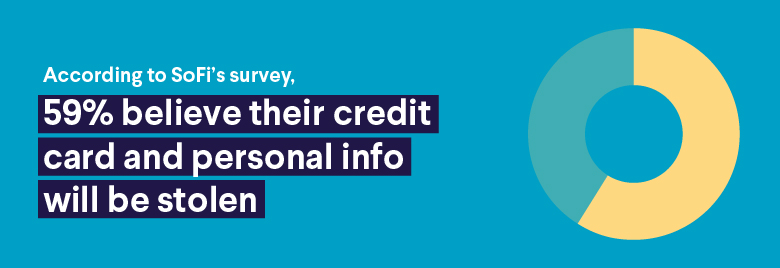
You aren’t alone. According to SoFi’s survey, 59% of people believe their credit card information or personally identifiable information will be stolen at some point, if it hasn’t been already.

That means the majority of people who participated in our survey expect to be hacked or already have been. When you consider how the number of data breaches is rising, it makes sense. Cybercrime is projected to almost triple between 2022 and 2027. No wonder we’re worried!

Less Than Half of Respondents Say They Know How to Outsmart Hackers

Frankly, most of us don’t have a clue as to what is really involved when you fall victim to cyber crime. Less than half of respondents in SoFi’s study believe they understand the risks of credit card fraud and different types of identity theft very well. In fact, only 45% of respondents said they understand very well how to protect themselves from online crime.

Most Respondents Are Working Hard to Defend Their Data and Assets

No one wants their most personal info kicking around on the dark web. Nor does anyone relish checking their credit card bill and seeing that someone charged $600 worth of baby clothes to their account when they are most definitely not a parent.

Most popular online security measures

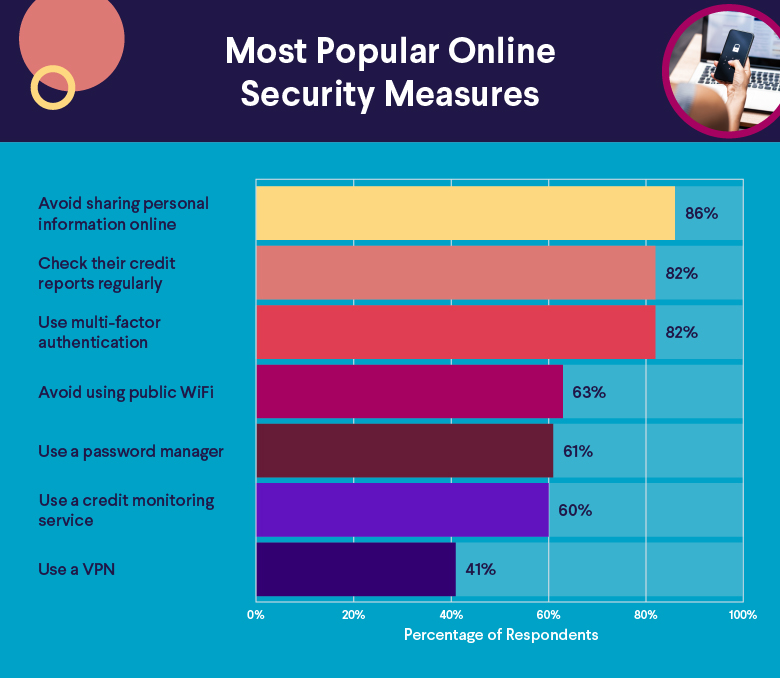
Here’s what SoFi’s research found about how people are playing defense. Check out how many people use these protective tactics to avoid becoming an identity theft or credit card fraud statistic:

•   82% of people check their credit reports regularly.

•   82% use multi-factor authentication, or MFA. (A good sign: Only 3% of people don’t have a clue what MFA is.)

•   63% avoid using public WiFi.

•   41% use a VPN, or virtual private network. That said, 8% don’t know what a VPN is.

•   61% use a password manager.

•   86% avoid sharing personal information online.

•   60% use a credit monitoring service.

More of Us Should Be Monitoring Our Credit

That last move, using a credit monitoring service, is an important one. It can make mobile banking safer and help protect other aspects of a person’s digital life.

Steve Tcherchian quote

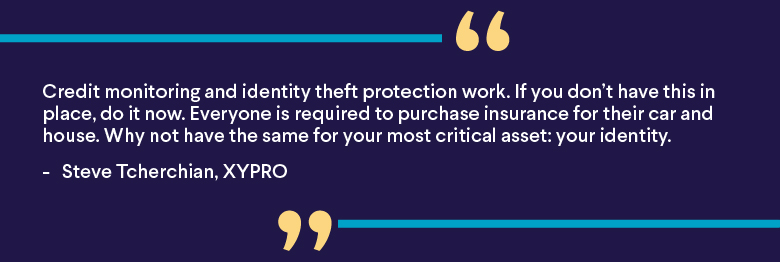
“Credit monitoring and identity theft protection work. If you don’t have this in place, do it now. With the size of the last few mega breaches and the companies they have affected, assume your data is exposed and you’re at risk. Everyone is required to purchase insurance for their car and house. Why not have the same for your most critical asset: your identity?” —Steve Tcherchian, CISO and Chief Product Officer at XYPRO, a cybersecurity solutions company

In addition to using the tactics above, the SoFi survey respondents have also deployed these moves to protect themselves from credit card fraud and other cybercrimes:

•   Using strong passwords

•   Clearing browser cookies and cache frequently

•   Not sharing their location in browsers or apps

•   Checking their account activity frequently

Most people (90%) check their credit card statements at least once per month. 44% of people check their statements at least once a week.

More Than Half of Respondents Admit to Recycling Passwords

Most people have good intentions when it comes to protecting themselves from the bad guys trying to swipe their financial or personal data. But hello, we’re all human. And that can mean sometimes recycling passwords because it’s just too complicated to come up with a new one. Or logging onto WiFi at a cafe or in a hotel because those Taylor Swift tickets are about to go on sale and you cannot, cannot live without them.

Risky online behaviors

More Than 1/3 of Respondents Use Public WiFi Without a VPN

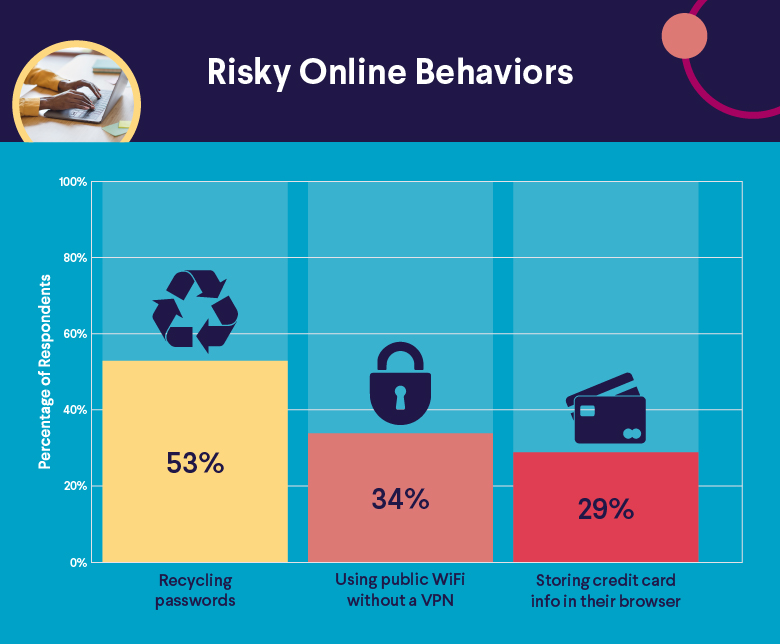
Here, the SoFi survey respondents admit to risky online behavior:

•   53% have used the same passwords for multiple accounts.

•   34% have used public WiFi without a VPN.

•   29% have stored credit card information in their browser.

•   27% have provided credit card info over the phone.

•   26% have stored confidential information on a cloud server, such as Google Drive or Dropbox.

•   20% have shared credit card information with others (either in person or not secured online).

•   18% have downloaded software from unsecure websites.

•   13% have left their phone or computer unattended in a public space.

•   11% have responded to emails from unknown senders that asked for personal information.

“When logging onto public WiFi that doesn’t require a password for access, know that hackers can track your internet activity and intercept passwords and other sensitive data that is exchanged. If you must use an unprotected public WiFi network, avoid entering your social media, email, or bank credentials while connected.” —Brandon King, founder of Home Security Heroes, an identity-security advisory service

Not everyone realizes the very real risks of playing fast and loose with their personal data. More warnings about the consequences of getting hacked or scammed could be a huge help.

“Education and awareness campaigns need to be implemented at all levels, including schools, workplaces, and public forums. Financial institutions can play a significant role in providing customer education on safeguarding personal information. And social media platforms can spread awareness and provide tips on preventing fraud and identity theft.” —Andrew Lokenauth, founder of Fluent in Finance, a financial education platform

With the right information, many people might avoid becoming an identity theft statistic.

14% of Respondents Are Using Their Birthday or Their Pet’s Name as Their Password

You don’t need to confess, but many people are guilty of using shockingly simple passwords. One like your first name plus the digits of your birthday. Or your phone number. Or even the dreaded password1234.

And, making matters even worse, lots of busy people reuse their passwords with abandon. It’s easy to understand why: You might be prompted to create an account when shopping online so you can unlock a discount or free shipping, so you fall back on your old favorite. Or perhaps you need to create a password to access info on your vet’s website, so of course your doggo’s name is an easy to remember password, right?

Dumb password moves

Whatever the reason, there’s no doubt that there are plenty of people who aren’t following password security best practices. Here are some of the missteps the SoFi survey revealed:

•   14% use passwords that include their pets’ names or birthdays

•   13% use passwords that include their childrens’ names or birthdays

•   11% use passwords that include their significant other’s name or birthday

•   10% use use passwords that relate to a band or song they like

•   7% use something easy to remember like “12345” or “password”

•   7% use something easy to type like “QWERTY”

On the flip side, 16% use auto-generated, secure passwords provided by a password manager. High-five to those folks!

No More Lame Passwords: Pro Advice

Brandon King quote

Some advice from experts on this super-important subject:

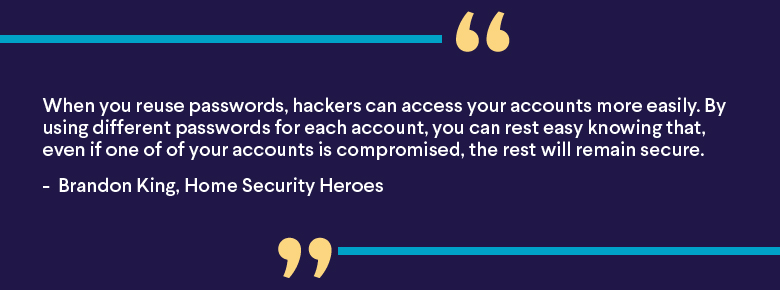
•   Buckle down and “use different passwords for each login or account. If you reuse passwords, hackers can access your accounts more easily” in the event of a security breach. “By using separate passwords for each account, you can rest easy knowing that even if one of your accounts is compromised, the rest will remain secure.” —Brandon King, Home Security Heroes

•   “Keep a close eye on credit card balances, and immediately report any discrepancies to the bank or credit card company” to minimize your liability. —Andrew Lokenauth, Fluent in Finance

•   “Don’t write down passwords!” —Monica Eaton, founder of Chargebacks911, a chargeback management company

And need we mention that writing your PIN on the back of your debit card is a real no-no?

44% experienced fraudulent

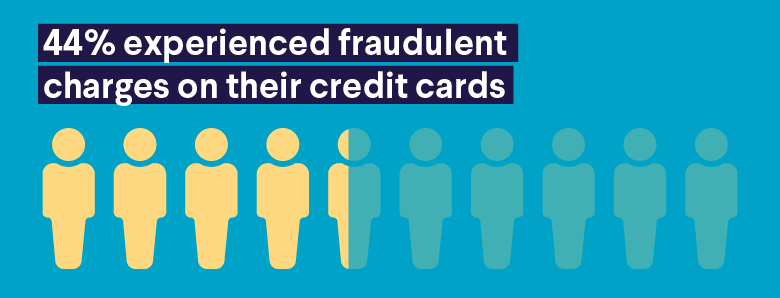
44% of Respondents Have Had Bogus Credit Card Charges

Sometimes, you get lucky, and your bank or credit card company pings you asking whether that’s really you trying to pay for a lavish dinner in SoHo, NYC, when you are actually sitting on your couch in Santa Cruz. Fraud protection can be a wonderful thing, but it doesn’t catch every scammer. Learn more about threats to credit card security:

Older Respondents Are More Than 2x As Likely to Endure Credit-Card Fraud

Here’s what SoFi survey participants told us about experiencing examples of credit card fraud in the form of unauthorized charges:

•   44% of people have experienced fraudulent charges on their credit cards.

◦   Nearly two-thirds of this group (63%) have experienced fraudulent charges more than once.

◦   For most people (84%), the unauthorized charges were less than $500.

◦   6% of people said their most recent fraudulent charge was $1,000 or more.

•   4% of respondents have experienced fraudulent charges five or more times.

•   53% of respondents ages 55 and older have experienced fraudulent charges on their credit cards, showing that older age seems to correlate with being scammed more often.

◦   Perhaps that’s why confidence in one’s credit card security seems to wane with age: 26% of those aged 55 or older said they had been or expected to be hacked, versus 10% of those aged 18 to 24.

•   Almost three-quarters (74%) of those who experienced fraudulent charges said their credit card company notified them of suspicious activity.

Who Knew? Where Scammers Shop

Curious about where credit card scammers go shopping? People who experienced fraudulent charges and knew where their stolen credit card numbers were used said the purchases were made in these types of environments:

•   Big box retailers and grocery stores like Walmart, Target, Sam’s Club, Costco, Whole

•   Foods

•   Online retailers like Amazon and eBay

•   Smaller ecommerce sites

•   Gas stations and convenience stores

Monica Eaton quote

How can you better protect yourself?

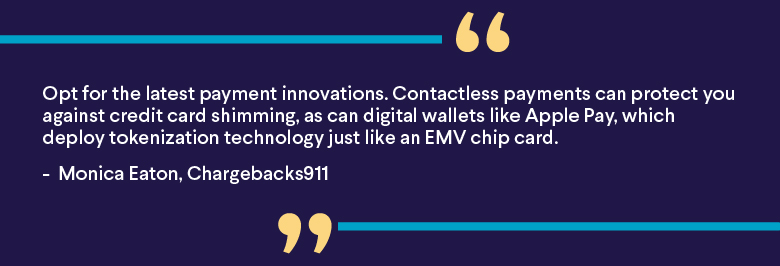
“Opt for the latest payment innovations. Contactless payments, for example, can protect you against credit card ‘shimming’ [in which scammers insert a thin device into the slot of card readers to steal your data], as can digital wallets like Apple Pay, which deploy tokenization technology just like an EMV [which stands for Europay, Mastercard, and Visa] chip card does.” —Monica Eaton, Chargebacks911

Ouch: 15% of Respondents Have Been Victims of Identity Theft

It’s a scary fact that identity theft is on the rise. It can be deeply upsetting to have someone steal your personal information and credentials and use them for nefarious purposes, opening accounts and making purchases that you would never dream of. It can be similarly troubling to have to unravel the damage done and reclaim what is rightfully yours.

34% of Victims Lost Money Due to Identity Theft

Personal impact of identity theft

Unfortunately, the SoFi survey revealed the following identify theft statistics:

•   15% of respondents have been victims of identity theft.

•   Most often, this group found out about identity theft because they noticed fraudulent charges on their bank statements (21%).

•   Other common ways people found out:

◦   12% said they were getting suspicious emails, calls, and text messages.

◦   12% said their tax return was incorrect or filed by someone else.

◦   12% said there were inaccuracies on their credit report.

◦   10% said they were unexpectedly denied credit.

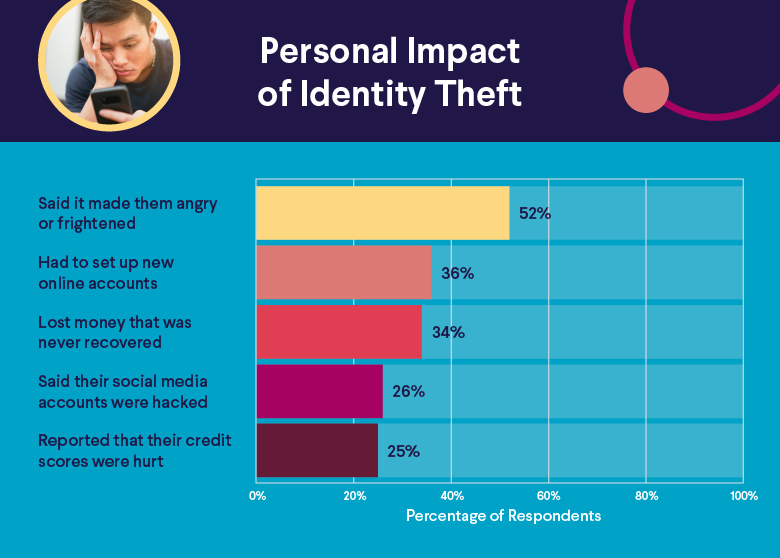
•   The most common impacts that people described as a result of identity theft were:

◦   52% said it made them angry or frightened.

◦   36% had to set up new online accounts.

◦   34% lost money that was never recovered.

◦   26% said their social media accounts were hacked.

◦   25% reported that their credit scores were hurt.

•   More than half of all respondents (51%) said they know someone who has been a victim of identity theft.

Those who are concerned about the possibility of identity theft can subscribe to services designed to help protect one’s information and send alerts about any evidence of this kind of activity. It can help provide peace of mind as this kind of crime increases.

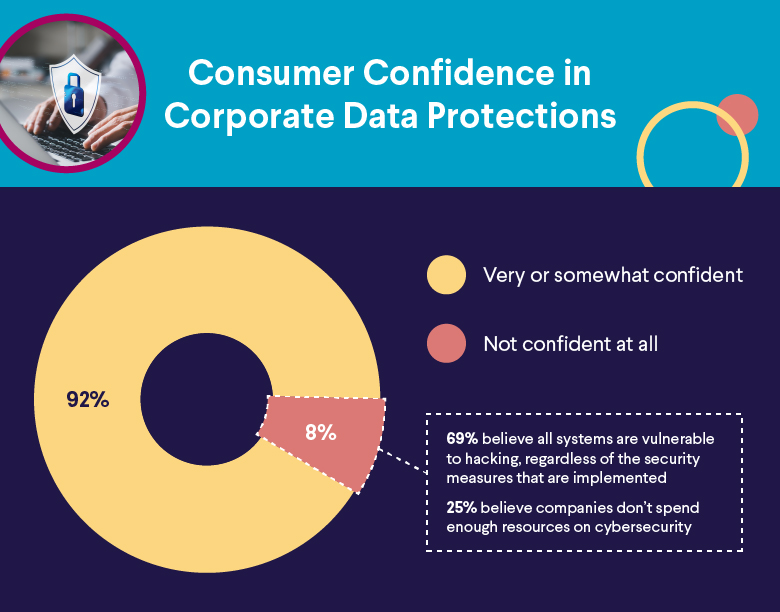
92% of Respondents Are Confident Companies Can Protect Their Data

Learning about all the risks of credit card and identity theft out there can be troubling and make a person feel as if they have a big bullseye on their back, tempting hackers to target them.

But of course, that’s not the case. Steps are being taken to protect consumers from identity and money scams and new techniques are emerging. Most people recognize that it’s not all doom and gloom out there.

Consumer confidence in corporate data protections

In general, people are cautiously optimistic about how well their information is and can be safeguarded.

•   92% of people are somewhat confident or very confident in companies’ abilities to protect their personal information.

•   8% of respondents said they’re not confident at all in companies’ abilities to protect their information

◦   However, people realize there is only so much that can be done to protect information. 69% of this group believe all systems are vulnerable to hacking, regardless of the security measures that are implemented.

◦   On the flip side, 25% of this group believe companies don’t spend enough resources on cybersecurity.

Yes, we all may be at risk, but by adopting smart strategies and partnering with top-notch, security-focused financial institutions and other businesses, we can minimize the odds of falling prey to cybercriminals.

The Takeaway

As SoFi’s survey reveals, credit card fraud and identity theft are growing concerns for Americans. But there are proven and emerging ways to stay ahead of the scammers. By doubling down on smart tactics and taking steps to safeguard your personal information, you can protect yourself from serious damage.

To learn more about options for protecting your credit cards and tips for managing your accounts, explore our credit card guide.


Third-Party Brand Mentions: No brands, products, or companies mentioned are affiliated with SoFi, nor do they endorse or sponsor this article. Third-party trademarks referenced herein are property of their respective owners.

Financial Tips & Strategies: The tips provided on this website are of a general nature and do not take into account your specific objectives, financial situation, and needs. You should always consider their appropriateness given your own circumstances.

Read more

Top 10 Fun Things to Do When Visiting Nashville

If you’re looking for an action-packed family vacation, look no further than the birthplace of country music, Nashville, Tennessee. Not only is Nashville a major center for music events and performances, the city is increasingly known as a cultural hub with tons of restaurants, architecture, and museums.

We rounded up our favorite things to do in Nashville at every price point.

Best Times to Go to Nashville

Nashville has plenty going on year round. But if you want to enjoy that famous sunny Southern weather, plan your trip between April and October. Just know that the summer months can see temperatures in the 90s.

If you’re looking to save money on your trip, go off-season between November and March. Because there are fewer tourists, many hotels and attractions offer discount rates.

Here are a few seasonal highlights to help you schedule your visit:

•  March/April: Tin Pan South, a songwriter’s festival

•  April: Cherry Blossom Festival

•  May: Iroquois Steeplechase horse racing

•  August: Tennessee State Fair

•  October: Southern Festival of Books

•  December: Gaylord Opryland’s A Country Christmas

Hotels can fill up for these events, so plan your trip as far out as possible.

Recommended: The Best Time to Book Fall Travel

Bad Times to Go to Nashville


So are there any bad times for your Nashville trip? It depends on what you’re looking for in a vacation. If you hate crowds or heat, stay clear in the summer. And if you want to visit when everything is green and beautiful, winter might not be the ideal time. Nashville winters are mild but still chilly enough to make walking around the city uncomfortable for some.

Consider planning your visit for a week when “nothing” is going on. You’ll still find plenty of live music (of all genres, not just country), and nationally renowned restaurants.

10 Fun Must-Dos in Nashville


You’ve got almost endless options for things to do, see, hear, and eat in Nashville, and narrowing them all down can be tricky. But here’s one frequent visitor’s highly personal take on the best of the best.

1. Nashville Zoo

This zoological garden and historic plantation farmhouse is one of the top attractions in the state. Located 6 miles from downtown, the zoo houses more than 6,000 animals of several hundred species, including Andean bears, Madagascar fanalokas, and red pandas. Kids will enjoy the 20 animatronic dinosaurs that hiss and spit. Advance tickets required. Adults & teens $23, children 2-12 $19. NashvilleZoo.org/

2. Tennessee State Museum

The Tennessee State Museum aims to educate visitors about the social, political, economic, and cultural history of Tennessee through permanent and changing exhibits, events, and tours. While the museum has plenty for kids of all ages (and is free to all visitors), its Children’s Gallery is designed for ages three to eight to learn about Tennessee history in a hands-on environment. Tue-Sat 10am-5pm, Sun 1-5pm. Free. TNMuseum.org

3. Opry House Tour

For the traveler who loves country music, there’s no better place to visit than the Grand Ole Opry House. There are several themed tours — including Backstage and Women of Country — that explore the history of this iconic venue and the singers who have graced its stage. Tours every 15 mins 9:30am-4pm. Adults from $30. Opry.com/tours

4. Hop On Hop Off Nashville Tours

A great way to see the city with teens is a Hop On, Hop Off bus ride. Live guides give running commentary about the sights and history of Nashville, and you can jump off the bus to explore, then rejoin the next tour, as you like. Helpful maps direct passengers to the various sites at each stop. The Old Town tour has 13 stops and the most frequent service, while the Soul of Music tour includes stories about the music scene, original songs from diverse genres, and recommendations on the latest hot spots. 9:30am-4pm daily. From $43. TrolleyTours.com/nashville/hop-on-hop-off

5. Andrew Jackson’s Hermitage

The Hermitage is the former home of President Andrew Jackson and his family. On your visit, you can explore his home, garden, and historic buildings, as well as learn the history of the property, Jackson, and the era he lived there. There is also the Natchez Hills Winery at Andrew Jackson’s Hermitage onsite if you fancy an after-tour adult beverage. 9am-6pm daily. Adults $27, kids (5-12) $17. TheHermitage.com

6. Belle Meade History Site & Winery

Belle Meade is a beautiful example of plantation life in Tennessee. Take a tour of the gorgeous grounds or attend a food and wine pairing at the winery. You can also uncover stories of the slaves who were brought to or born at the plantation from 1807 through the years following Emancipation. 9am-5pm daily. Admission $28+ VisitBelleMeade.com/

7. Country Music Hall of Fame

Patsy Cline. Brooks & Dunn. Reba McEntire. Every country musician you know and love can be found in the Country Music Hall of Fame. Learn the stories behind the music, see iconic costumes worn by musicians, and view historical exhibits in the museum. The “Experience It All” tour (adults $72) includes tours of the Hall of Fame admission, an 1800s letterpress print shop, and RCA Studio B, where Elvis, Dolly, and Waylon recorded their hits. 9am-5pm daily. Adults $28+, kids (5-12) $18+. CountryMusicHallofFame.org/

8. Johnny Cash Museum

From goth teens to grandpas, everyone loves the Man in Black. And the Johnny Cash Museum is not your average tourist spot — USA Today named it the nation’s best music museum in 2023. Here you’ll find the largest collection of Johnny Cash memorabilia. If you’re hungry after your visit, stop by Johnny Cash’s Bar & BBQ for food and music. 9am-7pm daily. Adults $26, kids (6-15) $22. JohnnyCashMuseum.com

9. Nashville Food Scene

In-the-know visitors believe Nashville has surpassed New York City as the country’s foodie capitol. The site Eater lists not 10, but 38 essential Nashville restaurants, covering everything from southern barbecue to vegan cuisine, Parisian-style riverside cafes to recreations of an Appalachian grandmother’s home and meals. You’ll also find fabulous cooking classes, pop-ups, and speakeasies serving craft cocktails. Nashville.Eater.com

10. Explore Nashville Neighborhoods

Nashville has several distinctive neighborhoods that are worth a stroll. The Music Row / Demonbreun / Edgehill neighborhood is the heart of music culture in the city. You can also explore 12South, where you’ll find coffee shops, bakeries, and vintage stores. Or dive into the honky tonk scene downtown, where great restaurants, historic buildings, and galleries abound.

The Takeaway

Your trip to Nashville is going to be action-packed and fun for everyone. Get your bearings with a hop on, hop off trolley tour. Hit the Grand Ole Opry, Johnny Cash Museum (named the best music museum in the country by USA Today), and the historical tours at the Country Music Hall of Fame. And leave room for incredible meals at a few of the countless world-class restaurants.

SoFi Travel is a new service offered exclusively to SoFi members. Earn 2x rewards when booking with your SoFi Mastercard or debit card. Then apply those rewards to your next trip when you book through our travel portal. SoFi makes planning a getaway fast, easy, and convenient — perfect for people on the move.


SoFi, your one-stop shop for travel.

FAQ

What are things to do in Nashville for music lovers?

In addition to attractions like the Grand Ole Opry, the Country Music Hall of Fame Museum, and the Johnny Cash Museum, there are loads of live music events every week in Nashville.

How long should I stay in Nashville?

With so much to see in Nashville, you could stay up to five days. Allow at least a minimum of three days to enjoy the city.

What are things to do for kids in Nashville?

There’s plenty for kids of all ages to enjoy in Nashville, including the Nashville Zoo, Grand Ole Opry, and Hop On, Hop Off tours.


Photo credit: iStock/Sean Pavone

**Terms, and conditions apply: This SoFi member benefit is provided by Expedia, not by SoFi or its affiliates. SoFi may be compensated by the benefit provider. Offers are subject to change and may have restrictions, please review the benefit provider's terms: Travel Services Terms & Conditions.
The SoFi Travel Portal is operated by Expedia. To learn more about Expedia, click https://www.expediagroup.com/home/default.aspx.

When you use your SoFi Credit Card to make a purchase on the SoFi Travel Portal, you will earn a number of SoFi Member Rewards points equal to 3% of the total amount you spend on the SoFi Travel Portal. Members can save up to 10% or more on eligible bookings.


Eligibility: You must be a SoFi registered user.
You must agree to SoFi’s privacy consent agreement.
You must book the travel on SoFi’s Travel Portal reached directly through a link on the SoFi website or mobile application. Travel booked directly on Expedia's website or app, or any other site operated or powered by Expedia is not eligible.
You must pay using your SoFi Credit Card.

SoFi Member Rewards: All terms applicable to the use of SoFi Member Rewards apply. To learn more please see: https://www.sofi.com/rewards/ and Terms applicable to Member Rewards.


Additional Terms: Changes to your bookings will affect the Rewards balance for the purchase. Any canceled bookings or fraud will cause Rewards to be rescinded. Rewards can be delayed by up to 7 business days after a transaction posts on Members’ SoFi Credit Card ledger. SoFi reserves the right to withhold Rewards points for suspected fraud, misuse, or suspicious activities.
©2024 SoFi Bank, N.A. All rights reserved. Member FDIC. Equal Housing Lender. NMLS #696891 (Member FDIC), (www.nmlsconsumeraccess.org).


Non affiliation: SoFi isn’t affiliated with any of the companies highlighted in this article.

Third-Party Brand Mentions: No brands, products, or companies mentioned are affiliated with SoFi, nor do they endorse or sponsor this article. Third-party trademarks referenced herein are property of their respective owners.

SOCC0223013

Read more

Top 10 Fun Things to Do When Visiting New Orleans

Considering a trip to the Crescent City? Many say visiting New Orleans is like traveling to another country. There’s so much to explore in terms of culture, food, music, and fun.

Let’s look at things to do in New Orleans, as well as the best time to visit.

Best Times to Go to New Orleans

New Orleans is temperate year-round, with winter rarely dipping below the 60s during the day, and summers topping out in the 90s. That means even the winter offers a great opportunity to explore the many fun things to do in New Orleans without freezing on your vacation.

If you’re looking for action, consider going during Mardi Gras season. Mardi Gras is a different date every year, but usually falls in February or March, and the celebrations start weeks before. You’ll find both parades and events for tourists in the French Quarter, as well as smaller family-friendly parades outside the tourist area.

Here are just a few of the events hosted each year in NOLA (New Orleans + LA, for Louisiana):

•  March: New Orleans Book Festival

•  April: French Quarter Festival

•  April/May: Jazz Fest

•  June: Creole Tomato Festival

•  June/July: Essence Festival

•  October: Oktoberfest

•  November: Bayou Bacchanal

•  December: Christmas Eve Bonfires on the Levee

Learn how to find travel deals before your trip.

Bad Times to Go to New Orleans

While New Orleans parties all year round, beware the humidity. From May to September, the city can be muggy — which isn’t ideal if you’re planning many outdoor activities.

Hate crowds? You may prefer not to visit during major events like Mardi Gras or Jazz Fest. Prices tend to be higher during these peak seasons, too.

One tip for family travel is to go off-season: You may find more deals from September to April. Hot tip: Halloween brings many costumed revelers, but doesn’t get too crazy.

10 Fun Must-Dos in New Orleans

This roundup of the best things to do is based on this writer’s 20 years of visiting the Big Easy.

1. The French Quarter

If you haven’t been to the French Quarter, have you really been to New Orleans? This historic district, founded in 1718, is a great place to walk, explore, dine, and enjoy local music and culture. Many find the Quarter reminiscent of France, with its quaint buildings adorned with elaborate wrought iron railings. In fact, New Orleans is sometimes known as the Paris of the South. NewOrleans.com/plan/neighborhoods/french-quarter/

Recommended: 6 Souvenirs You Won’t Regret Buying (and 5 You Might)

2. Cafe du Monde

While you’re in the French Quarter, stop at the iconic Cafe du Monde, famous since 1862 for its beignets, fried squares of dough covered in powdered sugar. Just don’t wear white, because getting the sugar all over you is half of the fun! Adults can partake of its equally renowned chicory coffee, while kids enjoy chocolate milk. Open 24/7. Shop.cafedumonde.com/

3. Music on Frenchmen Street

If you’re looking for fun things to do in New Orleans for couples, an evening on Frenchmen Street is a must. This neighborhood on the edge of the French Quarter is home to jazz clubs like The Spotted Cat and Snug Harbor. You’ll also find great options for drinks and dinner. NewOrleans.com/plan/streets/frenchmen-street/

Recommended: What to Do if You Lose Your Wallet While Traveling

4. The French Market

The historic French Market has been around since 1791, and now houses restaurants, shops offering local flavors and gifts, and open-air markets. It’s also home to many annual events, like the Creole Tomato Festival. 10am-6pm daily. FrenchMarket.org

5. Music at Preservation Hall

One of the top things to do in New Orleans for jazz lovers is to hear music at Preservation Hall. The Hall, which has been the backdrop to some of the biggest names in jazz, offers music 350 days a year. Arrive early; the space is small, and seating is limited. Tickets from $25 standing, $40 seated. Preservationhall.com

6. Mardi Gras World

Curious about what goes into building the world-famous Mardi Gras floats of New Orleans? Mardi Gras World provides a behind-the-scenes look at how these floats are made. You can see actual artists busy at work on float features for next year’s parades. Tours every 30 mins 9:30am-4pm. Adults $22. Kids $14. MardiGrasWorld.com

Recommended: Responsible Tourism: 8 Ways Travelers Can Support the Local Community

7. Mulate’s Cajun Restaurant

If you want a taste of local cuisine and the chance to attend a fais-do-do (Cajun dance party), Mulate’s Cajun Restaurant is the place to go. The restaurant features Creole and Cajun classics like grilled oysters, jambalaya, and gumbo. Most nights, a zydeco band plays, and locals and visitors alike get the chance to cut a rug on the spacious dance floor. Mulates.com/

8. Steamboat Natchez

See New Orleans from a different perspective by taking a trip on the Steamboat Natchez. You can take a daytime or dinner jazz cruise on this last authentic steamboat on the Mississippi River. Tickets from $39. SteamboatNatchez.com

9. New Orleans Museum of Art

Art lovers will enjoy a few hours in the New Orleans Museum of Art, where you’ll find permanent and rotating exhibits of modern and historic art, as well as a beautiful sculpture garden. Tue–Sun 10am–5pm; Wed 12pm–7pm. Adults $15; kids and teens free. NOMA.org

10. New Orleans Historic Voodoo Museum

New Orleans is known for its darker side. If that appeals, you won’t want to miss a trip to the Voodoo Museum. Here you’ll discover the secrets, rituals, and traditions of voodoo practitioners, past and present. There is also an optional walking tour that includes Congo Square and Marie Laveau’s house. 11am-7pm daily. VoodooMuseum.com

The Takeaway

With so much to see, do, and eat in New Orleans, the challenge will be fitting it all in during your vacation! Music is a big part of city culture, so don’t miss a live performance at Preservation Hall or one of the many jazz clubs on Frenchmen Street. If you’re feeling daring, check out the Voodoo Museum. Or just relax with beignets and chicory coffee at Cafe du Monde and watch the crowds go by.

SoFi Travel is a new service exclusively for SoFi members. Through a partnership with Expedia, we make it easy to find the lowest rates and book your reservations — for flights, hotel rooms, car rentals, and more — all in one place. Earn 2x rewards when booking with your SoFi Mastercard or debit card. And when you redeem your SoFi rewards for travel, you get a 25% bonus: $100 of reward points are worth $125.


Wherever you’re going, get there with SoFi Travel.

FAQ

What is the most popular thing to do in New Orleans?

The historic French Quarter is by far the most popular area of the city for visitors. There, you can find museums, music events, and restaurants offering Creole and Cajun cuisine.

What are popular events in New Orleans?

Mardi Gras and Jazz Fest are two of the largest annual events held in New Orleans, drawing thousands of visitors from around the globe.

How many days should I spend in New Orleans?

While you could easily spend five to seven days in the Crescent City, plan for at least three to four to see as much as possible.


Photo credit: iStock/Kruck20


**Terms, and conditions apply: This SoFi member benefit is provided by Expedia, not by SoFi or its affiliates. SoFi may be compensated by the benefit provider. Offers are subject to change and may have restrictions, please review the benefit provider's terms: Travel Services Terms & Conditions.
The SoFi Travel Portal is operated by Expedia. To learn more about Expedia, click https://www.expediagroup.com/home/default.aspx.

When you use your SoFi Credit Card to make a purchase on the SoFi Travel Portal, you will earn a number of SoFi Member Rewards points equal to 3% of the total amount you spend on the SoFi Travel Portal. Members can save up to 10% or more on eligible bookings.


Eligibility: You must be a SoFi registered user.
You must agree to SoFi’s privacy consent agreement.
You must book the travel on SoFi’s Travel Portal reached directly through a link on the SoFi website or mobile application. Travel booked directly on Expedia's website or app, or any other site operated or powered by Expedia is not eligible.
You must pay using your SoFi Credit Card.

SoFi Member Rewards: All terms applicable to the use of SoFi Member Rewards apply. To learn more please see: https://www.sofi.com/rewards/ and Terms applicable to Member Rewards.


Additional Terms: Changes to your bookings will affect the Rewards balance for the purchase. Any canceled bookings or fraud will cause Rewards to be rescinded. Rewards can be delayed by up to 7 business days after a transaction posts on Members’ SoFi Credit Card ledger. SoFi reserves the right to withhold Rewards points for suspected fraud, misuse, or suspicious activities.
©2024 SoFi Bank, N.A. All rights reserved. Member FDIC. Equal Housing Lender. NMLS #696891 (Member FDIC), (www.nmlsconsumeraccess.org).


Non affiliation: SoFi isn’t affiliated with any of the companies highlighted in this article.

Third-Party Brand Mentions: No brands, products, or companies mentioned are affiliated with SoFi, nor do they endorse or sponsor this article. Third-party trademarks referenced herein are property of their respective owners.

SOCC0223016

Read more
TLS 1.2 Encrypted
Equal Housing Lender