Yes, you can get scholarships for graduate school. Many universities, private organizations, professional associations, and foundations offer merit-based, need-based, and field-specific awards. You can apply before or during your program, and using scholarship databases or your school’s financial aid office can help you find opportunities that match your background and goals.

How to Pay for Grad School

Students who graduate with a master’s degree carry an average debt of $69,140, according to the Education Data Initiative. Fortunately, there are many ways to pay for grad school, including options that don’t require borrowing.

Keep reading to learn more on how to pay for grad school in 2025, including how to take out graduate student loans, how to qualify for scholarships and grants, and other ways to reduce your total tuition.

Key Points

•   When it comes to financing grad school, filling out the Free Application for Federal Student Aid (FAFSA) is required to determine eligibility for federal financial assistance, including grants and loans.

•   Investigate grants, scholarships, and fellowships offered by your chosen university’s financial aid office, as these can significantly reduce tuition costs.

•   Some employers provide tuition reimbursement programs to support employees pursuing further education. Review your company’s policies to see if this benefit is available.

•   Seek out scholarships and grants from private organizations, nonprofits, and government agencies, which can provide additional funding without the need for repayment.

•   After exhausting grants and scholarships, explore federal student loans, which often have favorable terms. If additional funding is needed, private student loans are also an option, though they may come with higher interest rates.

Ways to Pay for Grad School Without Taking on Debt

You can pay for grad school without taking on debt by filling out the FAFSA, applying for scholarships and grants, or working for an employer who offers tuition reimbursement. Continue reading for even more strategies to pay for grad school without taking on debt.

1. Fill Out the FAFSA

The first step to seeing if you qualify for financial aid is to fill out the Free Application for Federal Student Aid, or FAFSA®.

Your FAFSA will determine your eligibility for federal student loans, federal work-study, and federal grants. In addition, your college may use your FAFSA to determine your eligibility for aid from the school itself. Here’s a closer look at federal grants and federal work-study programs.

Federal Grants

Unlike student loans, federal grants do not need to be repaid. Grants for college for grad students include TEACH Grants and Fulbright Grants.

The TEACH Grant, or Teacher Education Assistance for College and Higher Education Grant, has relatively stringent requirements and is available for students pursuing a teaching career who are willing to fulfill a service obligation after graduating.

The Fulbright Grant offers funding for international educational exchanges. Sponsored by the U.S. government, it supports students, scholars, teachers, and professionals to study, research, or teach abroad.

Federal Work-Study Program

Federal work-study for grad students provides part-time jobs to help cover educational expenses. These positions are often related to a student’s field of study or serve the community. Eligibility is based on financial need, and earnings are exempt from being counted as income on the FAFSA, maximizing financial aid opportunities.

2. Figure Out What Your University Can Offer You

After narrowing down your federal options, make sure to consider what university-specific funding might be available. Many schools offer their own grants, scholarships, and fellowships. Your school’s financial aid office likely has a specific program or contact person for graduate students who are applying for institutional assistance.

Many schools will use the FAFSA to determine what, if anything, the school can offer you, but some schools use their own applications.

Although another deadline is the last thing you need, seeking out and applying for school-specific aid can be one of the most successful ways to pay for grad school. Awards can range from a small grant to full tuition remission.

3. Employer Tuition Reimbursement

It might sound too good to be true, but some employers are happy to reimburse employees for a portion of their grad school costs. Employers that have tuition reimbursement plans set their own requirements and application processes.

Make sure to consider any constraints your employer puts on their tuition reimbursement program, including things like staying at the company for a certain number of years after graduation or only funding certain types of degree programs.

4. Become an In-State Resident

If you’re applying for graduate school after taking a few years off to work, you might be surprised to find how costs have changed since your undergraduate days. Graduate students interested in a public university can save tens of thousands of dollars by considering a university in the state they already live in.

Each state has different requirements for determining residency. If you are planning on relocating to attend grad school, be sure to look into the requirements for the state of the school you are planning to attend.

Certain states require only one year of full-time residency before you can qualify for in-state tuition, while others require three years. During that time, you could work as much as possible to save money for graduate school. More savings could mean fewer loans.

Recommended: 6 Ways to Save Money for Grad School

Serious savings. Save thousands of dollars
thanks to flexible terms and low fixed or variable rates.


5. Become a Resident Advisor (RA)

Resident Advisors (RAs) help you get settled into your dorm room, show you how to get to the nearest dining hall, and yell at you for breaking quiet hours.

RAs may be underappreciated, but they’re often compensated handsomely for their duties. Students are typically compensated for a portion or all of their room and board, and some schools may even include a meal plan, reduced tuition, or a stipend. The compensation you receive will depend on the school you are attending, so check with your residential life office to see what the current RA salary is at your school.

Serious savings. Save thousands of dollars

thanks to flexible terms and low fixed or variable rates.

6. Find a Teaching Assistant Position

If you’re a graduate student, you can often find a position as a Teaching Assistant (TA) or Research Assistant (RA) for a professor. The position will be related to your undergrad or graduate studies and often requires grading papers, conducting research, organizing labs, or prepping for class.

TAs can be paid with a stipend or through reduced tuition, depending on which school you attend. Not only can the job help you to potentially avoid student loans, but it also gives you networking experience with people in your field.

The professor you work with can recommend you for a job, bring you to conferences, and serve as a reference. Being a TA may help boost your resume, especially if you apply for a Ph.D. program or want to be a professor someday. According to ZipRecruiter, the average TA earns $15.66 an hour, as of November 2025.

Recommended: How to Become a Graduate Assistant

7. Apply for Grants and Scholarships

Applying for grants and graduate scholarships is a smart way to fund graduate school without accumulating debt. Start by researching opportunities specific to your field, school, or demographics. Many scholarships focus on academic achievements, leadership, or community involvement, while grants often emphasize financial need.

An easy way to search for scholarships is through one of the many websites that gather and tag scholarships by criteria. Keeping all your grad school and FAFSA materials handy means that you’ll have easy access to the information you’ll need for scholarship applications.

8. Utilize Military Education Benefits (If Eligible)

Military education benefits can significantly reduce or even eliminate the cost of graduate school for qualifying service members, veterans, and sometimes their families. Programs like the GI Bill® and the Yellow Ribbon Program can cover tuition, fees, and even housing costs at many institutions. Additionally, some branches offer tuition assistance while on active duty, enabling students to pursue advanced degrees with little to no out-of-pocket expenses.

How to Pay for Grad School With Student Loans

Grad students may rely on a combination of financing to pay for their education. Student loans are often a part of this plan. Like undergraduate loans, graduate students have both federal and private student loan options available to them.

Federal Loans for Graduate School

There are different types of federal student loans, and each type has varying eligibility requirements and maximum borrowing amounts. Graduate students may be eligible for the following types of federal student loans:

•   Direct Unsubsidized Loans. Eligibility for this loan type is not based on financial need.

•   Direct PLUS Loans. Eligibility for this loan type is not based on financial need; however, a credit check is required to qualify for this type of loan. As of July 1, 2026, Grad PLUS Loans will no longer be available (Parent PLUS Loans will still be available, however).

•   Direct Consolidation Loans. This is a type of loan that allows you to combine your existing federal loans into a single federal loan.

Federal Student Loan Forgiveness Programs

Federal student loan forgiveness programs either assist with monthly loan payments or can discharge a remaining federal student loan balance after a certain number of qualifying payments.

One such program is the Public Service Loan Forgiveness (or PSLF) program. The PSLF program allows qualifying federal student loan borrowers who work in certain public interest fields to discharge their loans after 120 monthly, on-time, qualifying payments.

Additionally, some employers offer loan repayment assistance to help with high monthly payments. While loan forgiveness programs don’t help with the upfront cost of paying for grad school, they may offer a meaningful solution for federal student loan repayment. (Unfortunately, private student loans don’t qualify for these federal programs.)

Private Loans for Graduate School

If you’re not eligible for scholarships or grants, or you’ve maxed out how much you can borrow using federal student loans, you can apply for a private graduate student loan to help cover the cost of grad school.

Private loan interest rates and terms will vary by lender, and some private loans have variable interest rates, which means they can fluctuate over time. Doing your research with any private lender you’re considering is worth it to ensure you know exactly what a loan with them would look like.

Also, keep in mind that private student loans do not offer the same benefits and protections as federal student loans. It’s best to use all federal funding first before relying on private funding.

Comparing Federal vs. Private Loan Options

Understanding the differences between federal vs private student loans is important when considering grad school loans. Each option offers unique benefits, eligibility rules, and repayment features that can impact long-term costs.

•   Federal loans: These loans are funded by the government and typically offer more borrower protections, such as fixed interest rates, income-driven repayment plans, and potential for deferment, forbearance, or loan forgiveness programs. They usually don’t require a cosigner and are often based on financial need.

•   Private loans: Offered by banks, credit unions, and other private lenders, these loans often have variable interest rates that can be higher than federal loans. They usually require a strong credit history or a cosigner, and their repayment terms and borrower benefits are generally less flexible than federal options.

Recommended: Private Medical School Loans

Steps to Take Before Applying to Graduate School

Before applying to graduate school, it’s important to consider the earning potential offered by the degree in comparison to the cost. At the end of the day, only you can decide if pursuing a specific graduate degree is worth it. Here are a few steps to take before applying to grad school.

1. Research Potential Earnings by Degree

Perhaps you are already committed to one degree path, like getting your JD to become a lawyer. In that case, you should have a good idea of what the earning potential could be post-graduation.

If you’re considering a few different graduate degrees, weigh the cost of the degree in contrast to the earning potential for that career path. This could help you weigh which program offers the best return.

2. Complete the FAFSA

Regardless of the educational path you choose, filling out the FAFSA is a smart move. It’s completely free to fill out and you may qualify for aid including grants, work-study, or federal student loans. Federal loans have benefits and protections not offered to private loans, so they are generally prioritized first.

3. Estimate Your Cost of Attendance

Estimating your cost of attendance will help you understand the full financial commitment beyond just tuition. This estimate should include fees, textbooks, housing, transportation, and personal expenses, as well as potential increases in tuition over time. By creating a detailed budget upfront, you can compare programs more accurately, anticipate funding needs, and avoid surprises once you enroll.

4. Explore Financing Options

As mentioned, you may need to rely on a combination of financing options to pay for grad school. When scholarships, grants, and federal student loans aren’t enough, private loans can help you fill in the gaps.

When comparing private lenders, be sure to review the loan terms closely — including factors like the interest rate, whether the loan is fixed or variable, and any other fees. Review a lender’s customer service reputation and any other benefits they may offer, too.

The Takeaway

Grad school is a big investment in your education, but the good news is there are grants and scholarships that you won’t have to pay back. Some employers may also offer tuition reimbursement benefits, or you could find work as a Resident Advisor to supplement your tuition costs. If you need more funding to finance grad school, there are federal and private student loans.

If you’ve exhausted all federal student aid options, no-fee private student loans from SoFi can help you pay for school. The online application process is easy, and you can see rates and terms in just minutes. Repayment plans are flexible, so you can find an option that works for your financial plan and budget.


Cover up to 100% of school-certified costs including tuition, books, supplies, room and board, and transportation with a private student loan from SoFi.

FAQ

Does FAFSA give money for grad school?

FAFSA provides access to federal financial aid for graduate school, including Direct Unsubsidized Loans and Grad PLUS Loans (through July 1, 2026). Graduate students may not qualify for federal grants but can explore assistantships, scholarships, and work-study opportunities through FAFSA to help cover their educational expenses.

Does Pell Grant cover a master’s degree?

No, the Pell Grant does not cover master’s degree programs. It is a federal grant specifically designed for undergraduate students with financial need. Graduate students must explore other funding options like scholarships, assistantships, and federal loans to finance their education.

Is it worth paying for grad school?

Paying for grad school can be worth it if the degree significantly boosts your career prospects, earning potential, or personal goals. Consider the return on investment, including salary increases and opportunities. Research funding options and weigh potential debt against long-term benefits to determine if grad school aligns with your financial future.

What are the best student loans for graduate school?

The best student loans for graduate school often start with federal options, like Direct Unsubsidized Loans, because they offer fixed rates, borrower protections, and forgiveness eligibility. Private student loans can be a good alternative for borrowers with strong credit who may qualify for lower interest rates and flexible terms.

Can I get scholarships for graduate school?

Yes, you can get scholarships for graduate school. Many universities, private organizations, professional associations, and foundations offer merit-based, need-based, and field-specific awards. You can apply before or during your program, and using scholarship databases or your school’s financial aid office can help you find opportunities that match your background and goals.


SoFi Private Student Loans
Please borrow responsibly. SoFi Private Student loans are not a substitute for federal loans, grants, and work-study programs. We encourage you to evaluate all your federal student aid options before you consider any private loans, including ours. Read our FAQs.

Terms and conditions apply. SOFI RESERVES THE RIGHT TO MODIFY OR DISCONTINUE PRODUCTS AND BENEFITS AT ANY TIME WITHOUT NOTICE. SoFi Private Student loans are subject to program terms and restrictions, such as completion of a loan application and self-certification form, verification of application information, the student's at least half-time enrollment in a degree program at a SoFi-participating school, and, if applicable, a co-signer. In addition, borrowers must be U.S. citizens or other eligible status, be residing in the U.S., Puerto Rico, U.S. Virgin Islands, or American Samoa, and must meet SoFi’s underwriting requirements, including verification of sufficient income to support your ability to repay. Minimum loan amount is $1,000. See SoFi.com/eligibility for more information. Lowest rates reserved for the most creditworthy borrowers. SoFi reserves the right to modify eligibility criteria at any time. This information is subject to change. This information is current as of 4/22/2025 and is subject to change. SoFi Private Student loans are originated by SoFi Bank, N.A. Member FDIC. NMLS #696891 (www.nmlsconsumeraccess.org).

SoFi Loan Products
SoFi loans are originated by SoFi Bank, N.A., NMLS #696891 (Member FDIC). For additional product-specific legal and licensing information, see SoFi.com/legal. Equal Housing Lender.


Non affiliation: SoFi isn’t affiliated with any of the companies highlighted in this article.

Financial Tips & Strategies: The tips provided on this website are of a general nature and do not take into account your specific objectives, financial situation, and needs. You should always consider their appropriateness given your own circumstances.

Third-Party Brand Mentions: No brands, products, or companies mentioned are affiliated with SoFi, nor do they endorse or sponsor this article. Third-party trademarks referenced herein are property of their respective owners.

Third Party Trademarks: Certified Financial Planner Board of Standards Center for Financial Planning, Inc. owns and licenses the certification marks CFP®, CERTIFIED FINANCIAL PLANNER®

External Websites: The information and analysis provided through hyperlinks to third-party websites, while believed to be accurate, cannot be guaranteed by SoFi. Links are provided for informational purposes and should not be viewed as an endorsement.

SOISL-Q425-047

Read more
A jubilant young woman with curly hair and glasses holds a phone, pumping her fist in front of a laptop.

52 Companies that Offer Student Discounts in 2026

College comes with a lot of expenses. On top of tuition, fees, books, and housing, you might also want to occasionally go out and have fun. Maybe you want to go shopping, see a movie, or meet friends for lunch or dinner. That’s not always easy on a student budget. Fortunately, there are widely available deals and discounts designed just for college students. Here’s where you can find them.

Key Points

•  Major retailers like Amazon and Sam’s Club offer special pricing and membership benefits to college students.

•  Technology companies such as Apple, Microsoft, and Dell provide discounts on products and software for students.

•  Clothing stores like J.Crew, Aeropostale, and Levi’s offer a percentage off purchases upon showing a valid student ID.

•  Restaurants including Burger King, Chick-fil-A, and Buffalo Wild Wings provide various discounts and deals for students.

•  Travel and transportation services like Zipcar, Amtrak, and United Airlines offer reduced rates for students traveling domestically.

Major Retailers

1. Amazon

Amazon Prime for Young Adults gives college students a six-month free trial, followed by a discounted Prime subscription ($7.49/month). You also get access to student-exclusive offers, including free Grubhub+ and 5% cash back on a wide variety of purchases.

2. Sam’s Club

Sam’s Club offers qualified college students 60% off a Club membership or $50 off a Plus membership (which comes with free curbside pickup and free delivery on orders of $50-plus). Students need to apply online to qualify.

💡 Quick Tip: You’ll make no payments on some private student loans for six months after graduation.

3. Target

Target Circle’s College Student Appreciation program offers exclusive perks and discounts to students, which could come in handy when you’re shopping for your dorm room. To access deals, including 50% off Circle 360, you need to verify your student status (by uploading a student ID, class schedule, or tuition receipt) and join Target Circle for free.

4. Costco

A Costco membership can also help make college more affordable. College students who join Costco as a new Gold Star Member through UNiDAYS (a site that verifies student status and offers exclusive student deals) can get a $40 Digital Costco Shop Card.

Technology

5. Apple

Keep this in mind when you’re preparing for college: Apple offers special pricing for current and recently accepted college students (along with their parents). For example, you can get a 13” Macbook Air starting at $899 or an iPad air from $549.

6. Microsoft

Students (as well as parents and teachers) can save up to 10% off eligible computers and accessories with Microsoft’s student discount.

7. Dell

Dell offers 10% off when you register for Dell Rewards and verify your student status.

8. Lenovo

College students get an extra 5% off their tech purchases at Lenovo. Incoming students can also access the deal by providing a letter of acceptance. You simply need to verify your student status through ID.me during checkout.

9. Adobe

Adobe allows students to get Creative Cloud Pro for $24.99/month for the first year and $39.99/month after that (it’s normally $66.99/month). To get the deal, you need to provide a school-issued email address during purchase so you can be instantly verified.

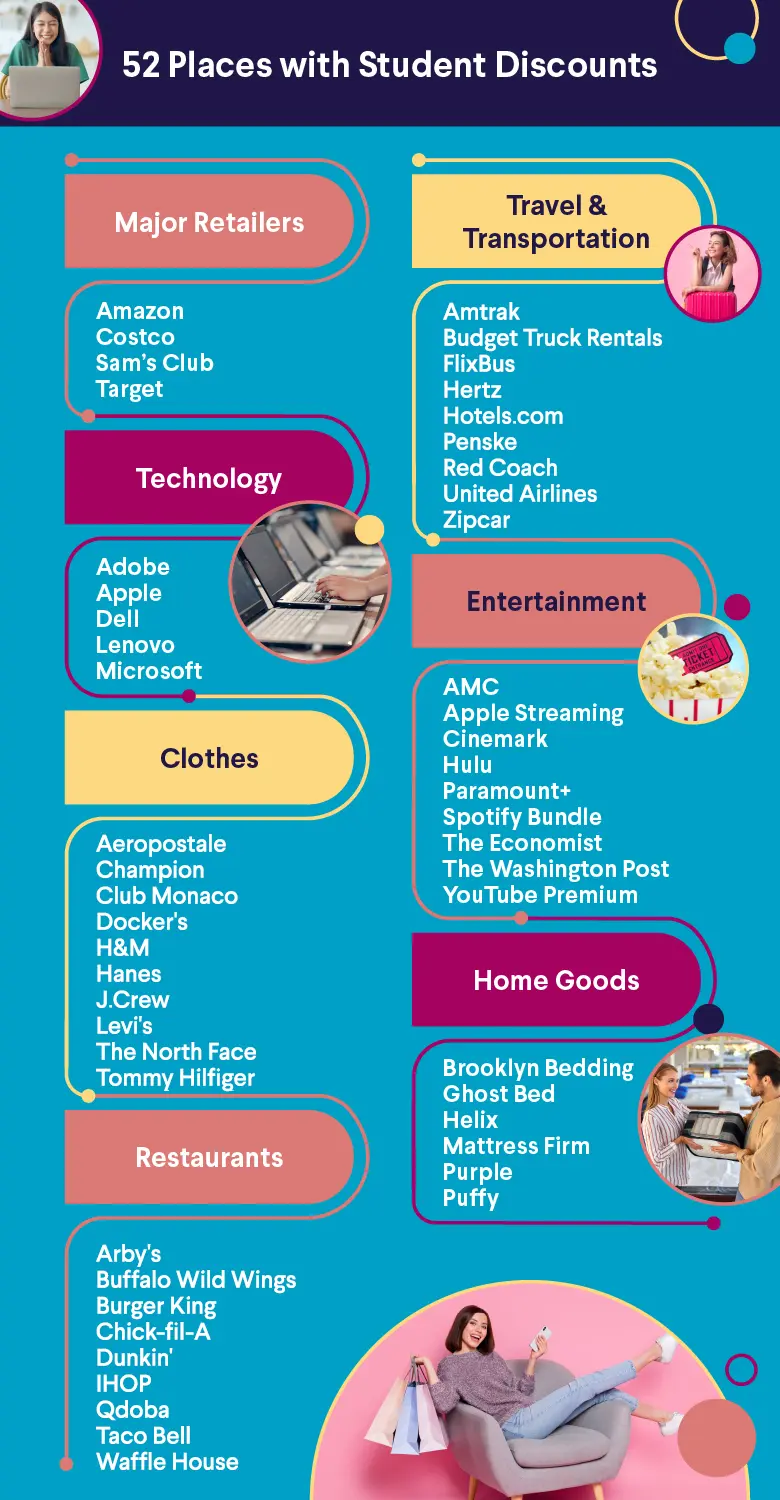
52 Places with Student Discounts

Clothes

10. Aeropostale

Students can benefit from an extra 15% off at Aeropostale. To take advantage of the deal, you’ll simply need to register and verify your student status with UNiDAYS.

11. J.Crew

J.Crew gives students with a valid student ID 15% off purchases both in store and online. The discount can be used up to four times a month.

12. Hanes

Need some basics, like tees or undergarments? Hanes offers students 10% off online purchases. To score your discount, you need to verify your student status through ID.me and get a promo code.

13. The North Face

The North Face gives students a 10% discount when shopping in store or online. To get the discount in person, simply show your ID at the register. For online purchases, you’ll need to verify your student status on the site.

14. Tommy Hilfiger

Tommy Hilfiger offers students 15% off online or in-store. First, you have to create or log in to your ID.me account.

15. Levi’s

Levi’s offers students 15% off online purchases after you verify your student status on the site.

16. Club Monaco

Students who are Club Monaco fans can get 15% off both online and in-store through Student Beans, a money-saving website and app for college students.

17. Docker’s

Docker’s offers students a generous 25% off all purchases made online. You simply need to verify your student status through the site.

18. H&M

H&M gives students 10% off online orders through UniDAYS.

19. Champion

Champion offers college students 15% off full-price items and 5% off sale items through UniDAYS when shopping online.

Recommended: Guide to Saving Money in College

Restaurants

20. Burger King

You can typically get Burger King deals through Student Beans, such as free any size fries, when you order online and pick up in store.

21. Chick-fil-A

Student discounts vary by location, but many Chick-fil-As offer students deals, such as a free drink with any purchase.

22. Dunkin’

Dunkin’ offers a 10% off student discount at participating locations. To claim the deal, simply show your student ID to your cashier.

23. Arby’s

You can save 10% on your Arby’s meal when you show your student ID at participating locations.

24. Buffalo Wild Wings

Want to catch the game and eat some wings with friends? Students can score 10% off at many Buffalo Wild Wings locations.

25. Waffle House

Looking for a late-night meal? Students can enjoy a 10% discount at participating Waffle Houses.

26. IHOP

If you don’t have a Waffle House nearby, many IHOP locations also offer 10% off for students.

27. Qdoba

Qdoba offers a 10% student discount when you show a valid student ID at participating locations.

28. Taco Bell

Craving a Crunchwrap Supreme? You can get a 10% student discount at participating Taco Bells.

💡 Quick Tip: Need a private student loan to cover your school bills? Because approval for a private student loan is based on creditworthiness, a cosigner may help a student get loan approval and a more competitive rate.

Travel & Transportation

29. Zipcar

New Zipcar University members get their first year free. The student membership allows you to reserve cars by the hour or day, and includes gas, secondary insurance, and up to 180 miles per day. (Other fees, such as a young driver fee, may apply.) 

30. Amtrak

Students between the ages of 17 and 24 can travel by Amtrak train for 15% off when booking at least one day in advance.

31. United Airlines

United Airlines offers a 5% flight discount to MileagePlus® members who are 18 to 23 years old. To get the deal, you need to book through the United app.

32. Hotels.com

Through Student Beans, you can get a 10% student discount at Hotels.com. You’ll get a discount code that you can use at checkout. Better yet, it can be applied on top of on-site promotions.

33. FlixBus

You can get 10% off Flixbus tickets with Student Beans. Simply use your FlixBus student discount code at checkout.

34. Hertz

Hertz offers up to 25% off, and up to 2.0% cash back, for students through ID.me.

35. Budget Truck Rentals

Budget Truck Rentals offers students 20% off local moves and 15% off one-way moves any day of the week. Use the discount code TRUKU.

36. Penske

Penske offers college students a 10% discount on all truck rentals and unlimited miles on one-way moving truck rentals. Simply use the discount code STUDENT at checkout. You’ll need to provide a college ID or proof of enrollment status at pickup to receive the discount.

37. Red Coach

RedCoach offers high school, college, and graduate students 10% off tickets. To get the discount, check the student option at checkout then show your student ID card to the driver along with your ticket.

Recommended: College Move-In Day Tips for Parents

Entertainment

38. AMC

Students get a lower ticket price at select AMC theaters every day. Just bring your photo student ID (and maybe some extra money for popcorn).

39. Cinemark

Student discounts at Cinemark vary by location and time of day, so check with the local box office to see what kind of deal you can snag.

40. Apple Streaming

Apple’s student music subscription is $5.99 per month for up to 48 months (normally $10.99 per month). You also get Apple TV at no extra cost.

41. Hulu

Hulu offers students its ad-supported plan for just $1.99 a month (an 83% discount). If you’re interested in a bundle, check out the deal below.

42. Spotify Bundle

As a student, you can get Spotify Premium Student with Hulu (with ads) free for one month and $5.99/month after that. You can cancel anytime.

43. The Washington Post

The Washington Post has a digital all-access student subscription plan for just $1 every four weeks for one year, then $7 every four weeks after that.

44. Paramount+

As a student, you can get 50% off any Paramount+ Plan. You just need to verify your student status on their website.

45. YouTube Premium

YouTube Premium (which allows you to enjoy YouTube and YouTube Music ad⁠-⁠free) is available to students at a discounted rate of $7.99 a month, after a free one-month trial. You can cancel at any time.

46. The Economist

The Economist offers students an Espresso subscription (which offers quick daily updates on important issues) for free and an annual digital subscription for $62.25, a steep 75% off.

💡 Quick Tip: Even if you don’t think you qualify for financial aid, you should fill out the FAFSA form. Many schools require it for merit-based scholarships, too.

Home Goods

47. Ghost Bed

As a student or teacher, you can get 27% off your entire order at GhostBed. To take advantage of the deal, just click on the ID.me button and then “Student ID” to sign up and get verified.

48. Mattress Firm

After verifying your student status through ID.me, Mattress Firm will give you a single-use coupon code that can be used in-store or online. You get an extra 20% off select purchases or an extra 10% off Purple with the code.

49. Purple

You can also get a 10% discount directly from Purple. Once you verify your eligibility, you’ll be emailed a coupon for 10% off your order.

50. Helix

After verifying your student status at Helix, you’ll receive a one-time 25% discount code to apply during checkout.

51. Puffy

Puffy offers a generous student and educator discount — $1,425 off any Puffy mattress.

52. Brooklyn Bedding

Brooklyn Bedding offers a 5% discount and free shipping to students. You simply need to verify your eligibility through ID.me.

The Takeaway

Student discounts can help you save on everything from food and clothing to electronics and entertainment. Even with these deals, however, you may still need help covering your college expenses.

If you completed the FAFSA and didn’t get enough financial aid to pay all of your school bills, keep in mind that you may be able to get a private student loan to help fill in any gaps. Unlike federal student loans, which have strict application deadlines, you can apply for private student loans at any time — including mid-semester.

Private student loans also allow you to borrow up to 100% of the school-certified cost of attendance. Just keep in mind that private student loans don’t offer the borrower protections — like income-driven repayment plans and deferment or forbearance — that come with federal student loans.

If you’ve exhausted all federal student aid options, no-fee private student loans from SoFi can help you pay for school. The online application process is easy, and you can see rates and terms in just minutes. Repayment plans are flexible, so you can find an option that works for your financial plan and budget.


Cover up to 100% of school-certified costs including tuition, books, supplies, room and board, and transportation with a private student loan from SoFi.

FAQ

How many times can you use a student discount?

It depends on the company. Some retailers and restaurants allow you to use your student discount once per visit or purchase; others limit you to a certain number of times per month or year.

How much is the average student discount?

Student deals typically give you 10% to 15% off, though you may find some discounts for 50% off or even higher. In some cases, a student discount may come with restrictions, such as only being able to use it on full-price merchandise. So it’s always a good idea to compare your student discount to any other available deals and sales.

Do student discounts only apply to college students?

Typically, student discounts only apply to college and graduate students. In some cases, high school students can get deals if they have an email that ends in .edu. The colleges and programs that retailers recognize can vary, but you can expect most major colleges and universities to be eligible.


SoFi Private Student Loans
Please borrow responsibly. SoFi Private Student loans are not a substitute for federal loans, grants, and work-study programs. We encourage you to evaluate all your federal student aid options before you consider any private loans, including ours. Read our FAQs.

Terms and conditions apply. SOFI RESERVES THE RIGHT TO MODIFY OR DISCONTINUE PRODUCTS AND BENEFITS AT ANY TIME WITHOUT NOTICE. SoFi Private Student loans are subject to program terms and restrictions, such as completion of a loan application and self-certification form, verification of application information, the student's at least half-time enrollment in a degree program at a SoFi-participating school, and, if applicable, a co-signer. In addition, borrowers must be U.S. citizens or other eligible status, be residing in the U.S., Puerto Rico, U.S. Virgin Islands, or American Samoa, and must meet SoFi’s underwriting requirements, including verification of sufficient income to support your ability to repay. Minimum loan amount is $1,000. See SoFi.com/eligibility for more information. Lowest rates reserved for the most creditworthy borrowers. SoFi reserves the right to modify eligibility criteria at any time. This information is subject to change. This information is current as of 4/22/2025 and is subject to change. SoFi Private Student loans are originated by SoFi Bank, N.A. Member FDIC. NMLS #696891 (www.nmlsconsumeraccess.org).

SoFi Bank, N.A. and its lending products are not endorsed by or directly affiliated with any college or university unless otherwise disclosed.

SoFi Loan Products
SoFi loans are originated by SoFi Bank, N.A., NMLS #696891 (Member FDIC). For additional product-specific legal and licensing information, see SoFi.com/legal. Equal Housing Lender.


Non affiliation: SoFi isn’t affiliated with any of the companies highlighted in this article.

Third-Party Brand Mentions: No brands, products, or companies mentioned are affiliated with SoFi, nor do they endorse or sponsor this article. Third-party trademarks referenced herein are property of their respective owners.

External Websites: The information and analysis provided through hyperlinks to third-party websites, while believed to be accurate, cannot be guaranteed by SoFi. Links are provided for informational purposes and should not be viewed as an endorsement.

SOISL-Q425-020

Read more
What is Debt Consolidation and How Does it Work_780x440

How Does Debt Consolidation Work?

If you’re repaying a variety of different debts to different lenders, keeping track of them and making payments on time each month can be time consuming. It isn’t just tough to keep track of these various debts, it’s also difficult to know which debts to prioritize in order to fast track your debt repayment. After all, each of your cards or loans likely have different interest rates, minimum payments, payment due dates, and loan terms.

Consolidating — or combining — your debts into a new, single loan may give your brain and your budget some breathing room. We’ll take a look at what it means to consolidate debt and how it works.

Key Points

•   Debt consolidation involves combining multiple debts into a single loan with a potentially lower interest rate, simplifying monthly payments.

•   Common methods include balance transfers to low or zero-interest credit cards and home equity loans.

•   Personal loans are an increasingly popular alternative to high-interest credit card debt. These unsecured loans are cheaper, safer, and more transparent than credit cards.

•   Consolidation can be beneficial if it reduces the number of payments and potentially lowers the interest rate.

•   It may not be suitable for everyone, especially if it leads to longer payment terms or higher overall costs due to fees.

What Is Debt Consolidation?

Debt consolidation involves taking out one loan or line of credit (ideally with a lower interest rate) and using it to pay off other debts — whether that’s car loans, credit card debt, or another type of debt. After consolidating those existing loans into one loan, you have just one monthly payment and one interest rate.


💡 Quick Tip: Credit card interest rates average 20%-25%, versus 12% for a personal loan. And with loan repayment terms of 2 to 7 years, you’ll pay down your debt faster. With a SoFi personal loan for credit card debt, who needs credit card rate caps?

Common Ways to Consolidate Debt

Your options to consolidate debt depend on your overall financial situation and what type of debt you wish to consolidate. Here are some common approaches.

Balance Transfer

If you are able to qualify for a credit card that has a lower annual percentage rate (APR) than your current cards, a balance transfer credit card may be one option to consider and can be a smart financial strategy to consolidate debt if you use it responsibly.

Some credit cards have zero- or low-interest promotional rates specifically for balance transfers. Promotional rates are typically for a limited time, so if you pay the transferred balance in full before it ends, you’ll reap the benefit of paying less — or possibly zero — interest.

However, there are some caveats to keep in mind. Credit card issuers generally charge a balance transfer fee, sometimes 3% to 5% of the amount transferred. If you use the credit card for new purchases, the card’s purchase APR, not the promotional rate, will apply to those purchases.

At the end of the promotional period, the card’s APR will revert to its regular rate. If a balance remains at that time, it will be subject to the new, regular rate.

Making late payments or missing payments entirely will typically trigger a penalty rate, which will apply to both the balance transfer amount and regular purchases made with the credit card.

Home Equity Loan

If you own a home and have equity in it, you might consider a home equity loan for consolidating debt. Home equity is the home’s value minus the amount remaining on your mortgage. If your home is worth $300,000 and you owe $125,000 on the mortgage, you have $175,000 worth of equity in your home.

Another key term lenders use in home equity loan determinations is loan-to-value (LTV) ratio. Typically expressed as a percentage, the LTV is similar to equity, but on the other side of the scale: Instead of how much you own, it’s how much you owe. The percentage is calculated by dividing the home’s appraised value by the remaining mortgage balance.

Lenders typically like to see applicants whose LTV is no more than 80%. In the above example, the LTV would be 42%.

$125,000 / $300,000 = 0.42
(To express this as a percentage, multiply 0.42 x 100 to get 42%.)

If you qualify for a home equity loan, you’ll typically be able to tap into 75% to 80% of your equity.

After the home equity loan closes, you’ll receive the loan proceeds in one lump sum, which you can use to pay your other debts.

A home equity loan is essentially a second mortgage, a secured loan using your home as collateral. Since there is a risk of losing your home if you default on the loan, this option should be considered carefully.

Personal Loan

If you don’t have home equity to tap into or you prefer not to put your home up as collateral, a personal loan may be another option to consider.

There are many types of personal loans, but they are typically unsecured loans, which means no collateral is required to secure the loan. They can have fixed or variable interest rates, but it’s fairly easy to find a lender that offers fixed-rate personal loans.

Generally, personal loans offer lower interest rates than credit cards. So consolidating credit card debt with a fixed-rate personal loan may result in savings over the life of the loan. Also, since personal loans are installment loans, there is a payment end date, unlike the revolving nature of credit cards.

There are many online personal loan lenders and the application process tends to be fairly simple. You may be able to use a loan comparison site to see what types of interest rates and loan terms you may be able to qualify for.

When you apply for a personal loan, the lender will do a hard credit inquiry into your credit report, which may temporarily lower your credit score. The lower credit score may drop off your credit report in a few months.

If you’re approved, the lender will send you the loan proceeds in one lump sum, which you can use to pay off your other debts. You’ll then be responsible for paying the monthly personal loan payment.

A drawback to using a personal loan for debt consolidation is that some lenders may charge origination fees, which can add to the total balance you’ll have to repay. Other fees may also be charged, such as late fees or prepayment penalties. It’s important to make sure you’re aware of any fees or penalties before signing the loan agreement.


💡 Quick Tip: Swap high-interest debt for a lower-interest loan, and save money on your monthly payments. Find out why SoFi credit card consolidation loans are so popular.

Awarded Best Personal Loan by NerdWallet.
Apply Online, Same Day Funding


Is Debt Consolidation Right For You?

Your financial situation is unique to you, but there are several things you’ll want to keep in mind when trying to decide if debt consolidation is right for you.

Debt Consolidation Might Be a Good Idea If …

•   You want to have only one monthly debt payment. It can be a challenge to manage multiple lenders, interest rates, and due dates.

•   You want to have a payment end date. Using a home equity loan or a personal loan for debt consolidation will be useful for this reason because they are forms of installment debt.

•   You can qualify for a zero interest or low-interest rate balance transfer credit card. This may allow you to consolidate multiple debts on one new credit card and save interest by paying off the balance before the promotional rate ends.

Debt Consolidation Might Not Be For You If …

•   You think you’ll be tempted to continue using the credit cards you paid off in the debt consolidation process. This can leave you further in debt.

•   You’ll incur fees (e.g., balance transfer fee or origination fee). If the fees are high, it might not make sense financially to consolidate the debts.

•   Consolidating your debts may actually cost you more in the long run. If your goal is to have smaller monthly payments, that generally means you’ll be making payments for a longer period of time and incurring more interest over the life of the loan.

Recommended: Getting Out of Debt with No Money Saved

Credit Card Debt Relief: How to Get It

Some people seek assistance with getting relief from debt burdens. Reputable credit counselors do exist, but there are also many programs that scam people who may already be overwhelmed and are vulnerable.

Disreputable debt settlement companies may charge fees before ever settling your debt and often make bogus claims, such as guaranteeing that they will be able to make your debt go away or that there is a government program to bail out those in credit card debt.

Even if a debt settlement company can eventually settle your debt, there may be negative consequences to your credit along the way. What’s more, a debt settlement program may require that you stop making payments to your creditors. But your debts may continue to accrue interest and fees, putting you further in debt. The lack of payments may also take a negative toll on your payment history, which is an important factor in the calculation of your credit score.

Recommended: Debt Settlement vs Credit Counseling: What’s the Difference?

Debt Relief: Is it a Good Idea?

What’s a good idea for some people may be a bad idea for others. Whether debt relief is a good idea for you and your financial situation will depend on factors that are unique to you. Working with a reputable credit counselor may be a good way to get some assistance that will help you get out of debt for good and create a solid financial plan for the future.

The Takeaway

Debt consolidation allows borrowers to combine a variety of debts, like credit cards, into a new loan. Ideally, this new loan has a lower interest rate or more favorable terms to help streamline the repayment process.

Whether or not you agree that credit card interest rates should be capped, one thing is undeniable: Credit cards are keeping people in debt because the math is stacked against you. If you’re carrying a balance of $5,000 or more on a high-interest credit card, consider a SoFi Personal Loan instead. SoFi offers lower fixed rates and same-day funding for qualified applicants. See your rate in minutes.


SoFi’s Personal Loan was named a NerdWallet 2026 winner for Best Personal Loan for Large Loan Amounts.


SoFi Loan Products
SoFi loans are originated by SoFi Bank, N.A., NMLS #696891 (Member FDIC). For additional product-specific legal and licensing information, see SoFi.com/legal. Equal Housing Lender.


Non affiliation: SoFi isn’t affiliated with any of the companies highlighted in this article.

Checking Your Rates: To check the rates and terms you may qualify for, SoFi conducts a soft credit pull that will not affect your credit score. However, if you choose a product and continue your application, we will request your full credit report from one or more consumer reporting agencies, which is considered a hard credit pull and may affect your credit.

Financial Tips & Strategies: The tips provided on this website are of a general nature and do not take into account your specific objectives, financial situation, and needs. You should always consider their appropriateness given your own circumstances.

External Websites: The information and analysis provided through hyperlinks to third-party websites, while believed to be accurate, cannot be guaranteed by SoFi. Links are provided for informational purposes and should not be viewed as an endorsement.

SOPL0324008

Read more
What Is a Good Interest Rate for a Savings Account?

What Is a Good Interest Rate for a Savings Account?

Interest rates on savings accounts determine how quickly your money grows while it sits in the bank. If you research the average rate for savings accounts, however, you might be surprised to find that the interest rates across banks can vary significantly.

At the time of publication, the national average savings account rate is 0.39% annual percentage yield (APY). By contrast, the APY for high-yield savings accounts may be close to 3.00% to 4.00% or sometimes higher.

The gap is significant, and can mean earning just a few dollars versus hundreds over the course of a year. Rather than settling for the national average, it can be worth seeking out a savings account that pays a meaningfully higher rate.

Key Points

•   The national average savings account rate is 0.39% APY as of late 2025, per the FDIC.

•   The FDIC’s national average tends to be much lower than the best available rates.

•   Interest rates at large, traditional banks tend to be lower than the national average.

•   High-yield savings accounts, typically offered by online banks, often pay many times the national average.

•   The difference between a top-tier APY and the national average can amount to hundreds of dollars per year.

What Is the National Average Savings Rate in 2026?

As of December 15, 2025, the APY for a U.S. savings account stood at 0.39%, according to the Federal Deposit Insurance Corporation (FDIC). For comparison, money market accounts averaged 0.58%, while the average six-month certificate of deposit (CD) paid 1.58% APY.

Those headline averages hide a dramatic divide. Large, legacy banks frequently pay very little — some branches still advertise 0.01% APY for basic savings accounts. Meanwhile, many online banks and smaller institutions may offer an APY of 3.00% or higher.

For savers, this means the “average” tells you approximately what many banks may pay, not what’s available if you’re willing to shop around.

How the National Average Savings Rate Is Calculated

The FDIC calculates the national average savings account rate by collecting interest rate data from FDIC-insured banks for savings deposit products.

To avoid skewing the data towards smaller institutions offering niche rates, the FDIC uses a weighted average based on each bank’s share of total deposits. Because many of the biggest banks offer low savings rates, the national average ends up being pulled down — even below what some large banks themselves pay.

Recommended: How to Calculate Interest in a Savings Account

How Do Average Rates at Traditional Banks Compare?

If you keep your savings at a large national bank, you may see very low interest rates on standard savings accounts. As of late 2025, many of the largest banks were still offering near-zero yields.

Here’s a look at the APYs for basic savings accounts as of December 16, 2025 at the five largest banks in the U.S.

Bank APY
Chase 0.01%
Bank of America 0.01%
Citibank 0.03%
Wells Fargo 0.01%
U.S. Bank 0.05%

This doesn’t mean that big banks never offer competitive products. Some provide promotional or tiered-rate accounts that offer higher yields. But for everyday savings held in standard brick-and-mortar accounts, the numbers tend to remain low.

Why Are Online Savings Account Rates Typically Higher?

Online savings account rates are typically higher because these institutions typically have lower overhead costs compared to traditional banks. Without a vast network of physical branches to maintain, online banks can avoid major expenses such as rent/mortgage, utilities, maintenance, and a large on-site staff. These savings can then be passed on to customers in the form of higher APYs and lower (or no) fees.

For customers, this difference can be substantial. While a traditional savings account might offer an APY of around 0.01%, online high-yield savings accounts often provide rates of 3.00% or more. All FDIC-insured online banks help ensure your money is safe (up to insured limits), just like traditional banks.

How Can You Find the Best Interest Rate for Your Savings?

You don’t have to accept the national average savings interest rate. Here are some of the most effective ways to earn a higher APY:

Focus on High-Yield Savings Accounts (HYSAs)

High-yield savings accounts (HYSAs) typically pay rates many times higher than the national average, allowing your money to grow faster while remaining safe and accessible. HYSAs are often provided by online banks, which can offer better rates due to lower operating expenses. Some credit unions, which operate as not-for-profit institutions, also offer competitive rates, though they may require specific membership criteria.

Compare APY, Not Just the Interest Rate

When looking for a competitive rate for a savings account, it’s important to focus on annual percentage yield (APY), not just the interest rate. The interest rate is the basic rate at which your money earns interest, but the APY offers a more accurate picture of how much your account will grow because it includes the effect of compounding, which is the process of earning interest on both your initial principal and the accumulated interest.

The frequency of compounding can vary between financial institutions (e.g., daily, monthly, quarterly, or annually), so an account with a slightly lower stated interest rate might actually yield more if it compounds more frequently.

By standardizing returns to one year with compounding included, APY allows you to compare savings accounts apples to apples and choose the best return.

Recommended: High-Yield Savings Account Calculator

What to Look for When Comparing Savings Accounts

In addition to APYs, here are several other factors to consider when choosing a savings account:

•   Minimal balance requirements: Some savings accounts require a sizable opening deposit or a minimum ongoing balance to qualify for the highest APY. You’ll want to make sure your balance meets these thresholds so you don’t miss out on the top rate.

•   Bank fees: Monthly maintenance fees can quickly eat into your interest earnings. To avoid them, you can either choose a savings account with no account fees (common with online banks and credit unions) or meet requirements set by banks that charge fees, such as maintaining a certain minimum balance or linking a checking account.

•   Accessibility: Consider how you’ll be able to access and manage your money. Ideally, you want to choose a bank that offers a wide network of free-free ATMs, plus a robust mobile app with features like mobile check deposit, automatic transfers, and account alerts.

How Will the Federal Reserve Affect Savings Rates in 2026?

Savings account interest rates are typically variable, not fixed, and tend to move in response to changes in the Federal Reserve’s benchmark federal funds rate, though the timing and magnitude can vary by bank.

When the Fed raises interest rates, savings account yields generally increase. When the Fed cuts rates, APYs usually fall. In 2025, the Fed lowered the federal funds rate three times. While competitive rates are still available, they have begun trending downward.

Banks also adjust rates based on supply and demand. If a bank needs more deposits to support lending, it may raise savings rates to attract funds. If deposits are plentiful and loan demand is weak, rates may decline. Competition among banks and broader economic conditions further impact this constantly shifting landscape.

The Takeaway

The national average savings interest rate, at approximately 0.39% APY as of late 2025, significantly understates the potential for savings growth. Rates at large traditional banks are often near-zero, but high-yield savings accounts (HYSAs) from online institutions often pay 3.00% APY or more, offering a substantial difference in earnings.

By comparing APYs, looking for accounts with low fees, and prioritizing FDIC-insured HYSAs, you can maximize the return on your savings and ensure your money works harder for you.

Interested in opening an online bank account? When you sign up for a SoFi Checking and Savings account with eligible direct deposit, you’ll get a competitive annual percentage yield (APY), pay zero account fees, and enjoy an array of rewards, such as access to the Allpoint Network of 55,000+ fee-free ATMs globally. Qualifying accounts can even access their paycheck up to two days early.


Better banking is here with SoFi, NerdWallet’s 2024 winner for Best Checking Account Overall.* Enjoy 3.30% APY on SoFi Checking and Savings with eligible direct deposit.

FAQ

What is a typical interest rate for a savings account at a large national bank?

Traditional savings accounts, particularly those offered by large, brick-and-mortar banks, generally offer a low interest rate. As of late 2025, the national average annual percentage yield (APY) for a savings account is 0.39%, according to the FDIC. However, some large banks offer rates significantly below this average, sometimes as low as 0.01% APY on their standard savings products.

What is considered a high-interest savings account?

A high-interest savings account, often referred to as a high-yield savings account, is one that offers an annual percentage yield (APY) significantly above the national average. Given that the national average APY for savings accounts is around 0.39% as of late 2025, an account offering an APY of significantly higher than that number may be considered “high-interest.” Some online banks and credit unions offer high-yield accounts that may be upwards of 3.00% to 4.00% APY, making them a popular choice for savers looking to maximize their returns.

How much more interest can you earn with a high-yield savings account?

The amount of extra interest you can earn with a high-yield savings account (HYSA) is often substantial, especially when compared to the national average or the rates offered by large traditional banks. For example, if you have a $10,000 balance and earn 0.01% APY, you would earn $1 in interest over one year. If you move that same $10,000 to a top-tier HYSA offering 3.00% APY, you would earn $300 in interest over one year, a difference of $299. The larger your savings balance and the greater the rate difference, the more pronounced this gap in earnings becomes over time.

How is APY calculated?

The annual percentage yield (APY) is calculated by taking the interest rate and factoring in the effect of compounding over the course of one year. This means it shows you the total return on your savings, including both the base interest earned and the interest earned on that interest. The formula for APY is: APY = [1 + (i / n)]n − 1, where:

•   “i” is the interest rate

•   “r” is the stated annual interest rate (as a decimal)

•   “n” is the number of compounding periods per year.

Are high-yield savings accounts safe?

Yes, high-yield savings accounts (HYSAs) are generally safe, provided they are offered by institutions that are insured by the Federal Deposit Insurance Corporation (FDIC) for banks, or the National Credit Union Administration (NCUA) for credit unions.

FDIC or NCUA insurance protects your deposits up to $250,000 per depositor, per account ownership category (such as single, joint, or trust account), per insured institution, in the event the bank or credit union fails. When choosing an HYSA, always confirm the institution’s insurance status, regardless of whether it is a traditional or an online bank.

Do I have to pay taxes on the interest I earn in a savings account?

You are generally required to pay taxes on the interest you earn from a savings account. The interest is considered ordinary income by the IRS, and it is taxable at your regular federal income tax rate. If you earn $10 or more in interest in a given year, your bank will issue you a Form 1099-INT detailing the amount of interest earned. You must report this amount when filing your annual tax return.

Can a savings account interest rate change?

Yes, a savings account interest rates can change at any time. Banks often adjust rates based on market conditions, such as changes in the federal funds rate or overall economic trends. Unlike fixed-rated products like certificates of deposit (CDs), savings accounts usually have variable interest rates, so your earnings may increase or decrease over time.


Photo credit: iStock/MicroStockHub

SoFi Checking and Savings is offered through SoFi Bank, N.A. Member FDIC. The SoFi® Bank Debit Mastercard® is issued by SoFi Bank, N.A., pursuant to license by Mastercard International Incorporated and can be used everywhere Mastercard is accepted. Mastercard is a registered trademark, and the circles design is a trademark of Mastercard International Incorporated.

Annual percentage yield (APY) is variable and subject to change at any time. Rates are current as of 12/23/25. There is no minimum balance requirement. Fees may reduce earnings. Additional rates and information can be found at https://www.sofi.com/legal/banking-rate-sheet

Eligible Direct Deposit means a recurring deposit of regular income to an account holder’s SoFi Checking or Savings account, including payroll, pension, or government benefit payments (e.g., Social Security), made by the account holder’s employer, payroll or benefits provider or government agency (“Eligible Direct Deposit”) via the Automated Clearing House (“ACH”) Network every 31 calendar days.

Although we do our best to recognize all Eligible Direct Deposits, a small number of employers, payroll providers, benefits providers, or government agencies do not designate payments as direct deposit. To ensure you're earning the APY for account holders with Eligible Direct Deposit, we encourage you to check your APY Details page the day after your Eligible Direct Deposit posts to your SoFi account. If your APY is not showing as the APY for account holders with Eligible Direct Deposit, contact us at 855-456-7634 with the details of your Eligible Direct Deposit. As long as SoFi Bank can validate those details, you will start earning the APY for account holders with Eligible Direct Deposit from the date you contact SoFi for the next 31 calendar days. You will also be eligible for the APY for account holders with Eligible Direct Deposit on future Eligible Direct Deposits, as long as SoFi Bank can validate them.

Deposits that are not from an employer, payroll, or benefits provider or government agency, including but not limited to check deposits, peer-to-peer transfers (e.g., transfers from PayPal, Venmo, Wise, etc.), merchant transactions (e.g., transactions from PayPal, Stripe, Square, etc.), and bank ACH funds transfers and wire transfers from external accounts, or are non-recurring in nature (e.g., IRS tax refunds), do not constitute Eligible Direct Deposit activity. There is no minimum Eligible Direct Deposit amount required to qualify for the stated interest rate. SoFi Bank shall, in its sole discretion, assess each account holder's Eligible Direct Deposit activity to determine the applicability of rates and may request additional documentation for verification of eligibility.

See additional details at https://www.sofi.com/legal/banking-rate-sheet.

*Awards or rankings from NerdWallet are not indicative of future success or results. This award and its ratings are independently determined and awarded by their respective publications.

Financial Tips & Strategies: The tips provided on this website are of a general nature and do not take into account your specific objectives, financial situation, and needs. You should always consider their appropriateness given your own circumstances.

We do not charge any account, service or maintenance fees for SoFi Checking and Savings. We do charge a transaction fee to process each outgoing wire transfer. SoFi does not charge a fee for incoming wire transfers, however the sending bank may charge a fee. Our fee policy is subject to change at any time. See the SoFi Bank Fee Sheet for details at sofi.com/legal/banking-fees/.
^Early access to direct deposit funds is based on the timing in which we receive notice of impending payment from the Federal Reserve, which is typically up to two days before the scheduled payment date, but may vary.

Tax Information: This article provides general background information only and is not intended to serve as legal or tax advice or as a substitute for legal counsel. You should consult your own attorney and/or tax advisor if you have a question requiring legal or tax advice.

Third-Party Brand Mentions: No brands, products, or companies mentioned are affiliated with SoFi, nor do they endorse or sponsor this article. Third-party trademarks referenced herein are property of their respective owners.

SSOBNK-Q425-037

Read more
Where Is My Tax Refund?

Where Is My Tax Refund?

The IRS says that if you file your return electronically and enroll in direct deposit, you can probably receive any refund you qualify for within three weeks. That speed can be a real upside of getting organized and filing early, especially if you have plans for the funds coming back to you (such as paying for summer vacation plane tickets).

Those who file a paper return, however, will likely have a longer wait. Read on to learn more and manage your expectations, including:

•   How long does it take to get my federal tax refund?

•   When will I get my tax refund?

•   What affects the time it takes to get a tax refund?

•   How can you check on where your tax refund is?

IRS Refund Schedule for Tax Year 2025

For those who are curious about when exactly a refund should arrive for the tax year 2025 (filed in 2026) or for tax year 2026 (filed in 2027), consider this information:

Federal Tax Refunds

In terms of when you will get your federal tax refund, here is a typical timeline of when refunds are issued after filing:

•   Up to 21 days for an e-filed return

•   4 weeks or more for amended returns and returns sent by mail

•   Longer if your return needs corrections or extra review

State Tax Refunds

When it comes to issuing refunds, each state handles things in their own way, on their own timeline, so it can be difficult to generalize.

Typically, a state tax refund can take anywhere from a few days to a few months for processing. If you filed a paper copy vs. electronically, that may lengthen the usual time for refund processing and the arrival of your funds.

Tax Return Extension

Sometimes, a taxpayer will not be able to file their return by the Tax Day deadline. Perhaps they are missing important tax documents, are experiencing a family or personal emergency, or maybe they just procrastinated. Whatever the case, there is a mechanism in place that allows for an extension.

The IRS allows people to file for a six-month tax extension for submitting their return. However, the extension request, plus any taxes owed, are still due on that April deadline (the 15th or slightly later if it falls on a weekend or holiday).

If you are due a refund, it will be delayed if you submit your tax return late. The volume of tax returns filed late can impact how soon you get your refund.

Form 4868

To request an extension, an individual should file IRS Form 4868. The form captures basic information about the taxpayer, such as name, address, Social Security number (SSN), and how much you believe you owe.

Anyone, regardless of income, can submit this form electronically as part of the IRS’ Free File program.

Recommended: What If I Miss the Tax Filing Deadline?

How Long Does the IRS Take to Process Your Taxes?

The IRS says that it issues more than nine out of 10 refunds in less than 21 days. That said, sometimes the processing of a return can take longer, even if a return was filed electronically.

If a return needs to be reviewed manually, it will likely take longer as well. Factors that can lead to a manual review include incorrect or missing information or identity theft situations. More detail is provided below.

Recommended: Steps to Prepare for Tax Season

Common Tax Refund Delays

If you’re wondering how long does it take to get a tax refund, know that there is not a single, specific timeframe for all taxpayers, and that delays can and do happen.

The IRS cautions visitors to its website not to expect their refund by a certain date. Though most taxpayers typically receive their refund within three weeks, and possibly in even less time if they e-file and choose direct deposit, there are several reasons why a payment might be delayed.

Here are some issues that could cause a holdup:

Filing a Paper Return

Under normal circumstances, the IRS says, it can take several weeks to process a paper Form 1040. Unlike returns that are filed electronically, paper returns must be manually entered into the IRS system.

•   Tax returns are opened in the order they’re received, so if your refund is taking longer than expected, the date you sent your return could be a factor as well.

•   The delivery option you choose for your refund also can affect how quickly you receive your funds. According to the IRS, the fastest way to receive your refund is to combine the direct deposit method with an electronically filed tax return. But taxpayers who prefer a paper return also may be able to speed things up a bit by choosing direct deposit for their refund instead of a paper check.

•   Note: If you e-file, direct deposit is again your fastest path to any refund that’s due (typically one to three weeks), as noted above. If you e-file but request a paper check, that will take a bit longer, often closer to one month.

Providing Incorrect or Incomplete Information

Did you or your spouse forget to sign your return, or did you type in the wrong Social Security number? Returns with missing information or errors can cause extra work for the IRS, which could hold up a refund.

What’s more, the IRS is strengthening its screening process to help fight identity theft, so even the smallest mistake — such as using a different name than what’s on your Social Security card or misreporting what is W-2 income — could slow things down. If the information you provide is wrong or something is missing, you can expect the IRS to contact you for additional documentation or to correct the error.

Claiming Certain Tax Credits

If you’re claiming the additional child tax credit (ACTC) or the earned income tax credit (EITC), the IRS won’t issue your refund before mid-February. A federal law that took effect in 2017 gives the IRS extra time to review those returns, check employers and other information, and detect any possible fraud.

Filing an Amended Return

You may have to amend your return if you find you made an error or there’s a change that affects your income, your income tax bracket, and/or your deductions — and that could delay your refund by several weeks. According to the IRS, it can take up to 20 weeks to process an amended return — even if it was filed electronically.

You can check your return and refund status daily with the IRS’s Where’s My Amended Return tracking tool .

Tax Fraud

A missing refund could be a sign that someone used your personal information to file a fraudulent tax return in your name. If you suspect you may be the victim of tax fraud, the IRS lists several recommendations for what to do next on its Taxpayer Guide to Identity Theft web page, and the agency advises potential victims to report their concerns to the Federal Trade Commission.

Existing Government Debt

If you have certain kinds of delinquent debt owed to the federal government, what is known as tax refund offset may occur. This means that an individual’s refund may be partially or completely withheld to satisfy the debt.

You will generally be notified if your refund is being reduced or withheld in this way, and you can dispute the payment with the agency that received it. And if there’s any money left after the offset, you’ll receive it by direct deposit or in a check, depending on what you requested on your tax return.

To ask questions about delinquent debt, you can contact the Treasury Department at 800-304-3107.

Your Refund Went Missing

If you e-filed with third-party tax software or the IRS’s Free File system, you likely received confirmation that your return was received and accepted. If you don’t remember getting a confirmation notice or if you’re concerned because you haven’t heard anything since then, you can check your status with the agency’s Where’s My Refund tool. Some next steps:

•   If the IRS’s Where’s My Refund tool says your refund check was mailed but 28 days or more have passed and you haven’t seen it, you can file a claim online to receive a replacement. (The Where’s My Refund site will show you how.)

•   Even if you opted for direct deposit, it still could take a few days for the money to show up in your account.

•   If you think your refund has gone missing, you may want to call your bank about tracking the deposit, then move on to contacting your tax preparer or the IRS for help.

•   The IRS won’t accept responsibility if it sent a refund but you or your tax preparer wrote the wrong account number on your return. If the IRS notices an error or if your bank rejects the deposit and returns the money to the IRS, the IRS still may end up sending you a check (instead of using a direct deposit).

•   If you entered an account or routing number that belongs to someone else and the financial institution accepted the deposit, you’ll probably have to work with a bank representative to recover the money. The IRS cannot compel the bank to return the refund.

Tracking Your Tax Refund Process

If you are eagerly awaiting your income tax refund, a wise move can be to track its status on the IRS website or through the IRS2GO app.

You can begin checking your refund’s progress as soon as 24 hours after the IRS receives your e-filed return or four weeks after mailing a paper return. And, if everything goes smoothly, you can use the Where’s My Refund tracking tool daily to watch your tax return make progress.

•   To use the Where’s My Refund tracking tool, all you need is your Social Security number, your filing status (single, married filing jointly, etc.), and the exact dollar amount of your expected refund.

•   You may not get all the information you wanted about your refund, but it’s a start. If you can’t get enough intel there, your local IRS office may be able to help.

Tax Refund Mistakes

What about the scenario in which a tax refund arrives but it’s for less than you expected? Consider a couple of possibilities:

•   Your tax return could have contained an error, leading you to think you were due more money than you actually are.

•   You might have had your refund lowered by the Treasury’s Offset Program mentioned above.

In the situation of your refund being less than anticipated, there is likely an explanation provided from the IRS as to why. If you are not satisfied, you can use the methods outlined above to contact the IRS and gain more insight.

Tips for Getting Your Tax Refund Faster

If you’re hoping to get your next refund faster, here are a few steps that might help:

Filing Electronically

As mentioned above, filing electronically vs. filing a paper return can speed up your refund. It can typically shave a week or two off of getting your money back via direct deposit and a month off the time for a refund check to be issued.

Choosing Direct Deposit

The IRS says refunds will generally be received by taxpayers sooner if they have e-filed and selected direct deposit. Even if you prefer mailing in a paper return, you can choose to have your refund deposited into your account.

Providing Accurate Information

Pay attention to every detail as you prepare your taxes. Don’t let a little mistake or an omission of data cause a long delay.

Filing Early

By filing as soon as possible during tax season, you’ll be able to position your return at the front of the line for processing. And by starting early, you’ll give yourself plenty of time to research any tax help you may need along with tips that might apply to you, your business, and your family.

Just remember the point above about returns claiming the ACTC or EITC not being processed until mid-February at the earliest.

The Takeaway

Most tax refunds are issued within one to three weeks if you file electronically and opt for direct deposit of your refund. If you file a paper return or opt for a refund check to be mailed to you, it can lengthen the timeline. In any scenario, the IRS provides tools that can help you track your refund and know where your return is in terms of processing.

If you are due a refund and need a great place to deposit it, you may want to make sure your account offers minimal or zero account fees and a competitive annual percentage rate (APR).

Interested in opening an online bank account? When you sign up for a SoFi Checking and Savings account with eligible direct deposit, you’ll get a competitive annual percentage yield (APY), pay zero account fees, and enjoy an array of rewards, such as access to the Allpoint Network of 55,000+ fee-free ATMs globally. Qualifying accounts can even access their paycheck up to two days early.

Better banking is here with SoFi, NerdWallet’s 2024 winner for Best Checking Account Overall.* Enjoy 3.30% APY on SoFi Checking and Savings with eligible direct deposit.

FAQ

When will I get my tax refund for 2025?

Your tax refund arrival will depend on when you filed your return, how you filed it, and how you indicated you’d receive your tax refund. Typically, filing electronically with direct deposit is quickest, with the refund arriving within three weeks. If you file electronically with a paper check as the refund, that could take longer since the check has to be mailed. Paper returns can take several weeks, with those requesting refunds via paper check requiring still longer.

What is the 2025 IRS tax refund schedule?

Filing for the 2025 tax year begins around January 26, 2026, and the deadline is April 15, 2026. Tax refunds are issued at varying speeds, depending on whether you file electronically or with a paper return, and whether you request your refund be direct-deposited or sent as a check. The fastest option is to file electronically and have the refund direct-deposited. This typically takes three weeks or less.

How long does it take to get your tax refund through direct deposit?

How long it takes to get your refund through direct deposit will vary depending on whether you filed an electronic or paper return. The majority of electronic returns are processed in three weeks or less, with direct deposit happening very soon thereafter. Paper returns, however, can take several weeks or longer, with refunds taking at least that long to hit a taxpayer’s bank account.


SoFi Checking and Savings is offered through SoFi Bank, N.A. Member FDIC. The SoFi® Bank Debit Mastercard® is issued by SoFi Bank, N.A., pursuant to license by Mastercard International Incorporated and can be used everywhere Mastercard is accepted. Mastercard is a registered trademark, and the circles design is a trademark of Mastercard International Incorporated.

Annual percentage yield (APY) is variable and subject to change at any time. Rates are current as of 12/23/25. There is no minimum balance requirement. Fees may reduce earnings. Additional rates and information can be found at https://www.sofi.com/legal/banking-rate-sheet

Eligible Direct Deposit means a recurring deposit of regular income to an account holder’s SoFi Checking or Savings account, including payroll, pension, or government benefit payments (e.g., Social Security), made by the account holder’s employer, payroll or benefits provider or government agency (“Eligible Direct Deposit”) via the Automated Clearing House (“ACH”) Network every 31 calendar days.

Although we do our best to recognize all Eligible Direct Deposits, a small number of employers, payroll providers, benefits providers, or government agencies do not designate payments as direct deposit. To ensure you're earning the APY for account holders with Eligible Direct Deposit, we encourage you to check your APY Details page the day after your Eligible Direct Deposit posts to your SoFi account. If your APY is not showing as the APY for account holders with Eligible Direct Deposit, contact us at 855-456-7634 with the details of your Eligible Direct Deposit. As long as SoFi Bank can validate those details, you will start earning the APY for account holders with Eligible Direct Deposit from the date you contact SoFi for the next 31 calendar days. You will also be eligible for the APY for account holders with Eligible Direct Deposit on future Eligible Direct Deposits, as long as SoFi Bank can validate them.

Deposits that are not from an employer, payroll, or benefits provider or government agency, including but not limited to check deposits, peer-to-peer transfers (e.g., transfers from PayPal, Venmo, Wise, etc.), merchant transactions (e.g., transactions from PayPal, Stripe, Square, etc.), and bank ACH funds transfers and wire transfers from external accounts, or are non-recurring in nature (e.g., IRS tax refunds), do not constitute Eligible Direct Deposit activity. There is no minimum Eligible Direct Deposit amount required to qualify for the stated interest rate. SoFi Bank shall, in its sole discretion, assess each account holder's Eligible Direct Deposit activity to determine the applicability of rates and may request additional documentation for verification of eligibility.

See additional details at https://www.sofi.com/legal/banking-rate-sheet.

Financial Tips & Strategies: The tips provided on this website are of a general nature and do not take into account your specific objectives, financial situation, and needs. You should always consider their appropriateness given your own circumstances.

Tax Information: This article provides general background information only and is not intended to serve as legal or tax advice or as a substitute for legal counsel. You should consult your own attorney and/or tax advisor if you have a question requiring legal or tax advice.

External Websites: The information and analysis provided through hyperlinks to third-party websites, while believed to be accurate, cannot be guaranteed by SoFi. Links are provided for informational purposes and should not be viewed as an endorsement.
SOBK0224001
CN-Q425-3236452-146

Read more
TLS 1.2 Encrypted
Equal Housing Lender