house next to a condo

House or Condo: Which is Right For You? Take The Quiz

If you’re thinking about buying a home in the not-too-distant future, you may be wondering what kind of property to purchase. Would a single-family house be better, or perhaps a condo unit?

Some important factors: Do you prefer being in a city, perhaps in an apartment or townhome, or are you all about a house with a picket fence? Do you like handling your own gardening and picking your own front-door paint colors, or would you like to delegate that? Do you like neighbors close by or prefer privacy? Does your household include furbabies?

These are some of the considerations that may impact whether a house or a condo is right for you. Each option has its pros and cons, and of course, finances will play a role too.

Key Points

•   Houses typically cost more but are considered better long-term investments.

•   Condos reduce maintenance and utility costs, but fees apply.

•   Houses offer more privacy and living space.

•   Condos often include shared amenities, and many offer urban perks.

•   Condo values appreciate more slowly than those of houses.

To decide which might suit you best, take this house vs. condo quiz, and then learn more about some key factors.

House or Condo Quiz

Next, you might want to take these pros and cons into consideration as well.

Pros and Cons of Buying a House

A top-of-mind question for many people is, “Isn’t a house more expensive than a condo?” Cost is a factor, especially when buying in a hot market, and there can typically be a significant difference between a house and a condo when you are home shopping.

The median sales price of existing single-family homes was $404,400 in the fourth quarter of 2024, according to St. Louis Fed data, compared with a median existing condo price of $359,000 in December 2024, according to the National Association of Realtors®.

Now that you know that price info, look at these pros and cons when buying a house vs. a condo.

Pros of Buying a House

Among the benefits of buying a house are the following:

•   More privacy and space, including storage

•   A yard

•   Ability to customize your home as you see fit

•   Room to garden and create an outdoor space, just as you want it to be

•   Control of your property

•   Pet ownership unlikely to be an issue

•   Sometimes no homeowners association (HOA) or dues

•   Generally considered a better investment

Cons of Buying a House

However, you may have to contend with these downsides:

•   Potentially higher initial and ongoing costs

•   More maintenance inside and out

•   Typically higher utility bills

•   Potentially higher property taxes and homeowners insurance

•   Possibly fewer amenities (such as common areas, a gym, etc.)

If, after taking the quiz and weighing the pros and cons, buying a house feels like the right choice, you can start brainstorming about size, style, location, and price; attending open houses; and looking online.

Learning how to win a bidding war might also come in handy, depending on the temperature of the market.

First-time homebuyers can
prequalify for a SoFi mortgage loan,
with as little as 3% down.

Questions? Call (888)-541-0398.


Pros and Cons of Buying a Condo

A quick look at how condos work before diving in: Condominium owners share an interest in common areas, like the grounds and parking structures, and hold title to their individual units. They are members of an HOA that enforces community rules. Being a member of a community in this way is a key difference between a condo and a house.

Pros of Buying a Condo

Here are some of the upsides of purchasing a condo:

•   More affordable

•   Amenities included (this might include common rooms, a fitness center, and other features)

•   Potentially less expensive homeowners insurance and property taxes

•   Repairs and upkeep of the property typically taken care of

•   Typically lower utility bills

•   Security, if the community is gated or patrolled

•   Access to urban perks

Cons of Buying a Condo

Next, consider the drawbacks of condo living:

•   Less privacy

•   Typically no private yard

•   Rules and restrictions (about noise levels, outside wall colors, pets, and more)

•   Typically less overall space

•   HOA fees

•   Limited parking

•   Slower appreciation in value

Plus, the mortgage interest rate and down payment are often higher on a condo vs. a house of the same value, though that isn’t always the case, especially for a first-time buyer of an owner-occupied condo.

Conventional home loan mortgage lenders sometimes charge more for loans on condo units; they take into consideration the strength of the condo association financials and vacancy rate when weighing risk.

Mortgages backed by the Federal Housing Administration (FHA) are available for condos, even if they are not part of an FHA-approved condominium project, with a process called the Single Unit Approval Program.

An FHA loan is easier to qualify for and requires as little as 3.5% down, but you’ll pay upfront and ongoing mortgage insurance premiums.
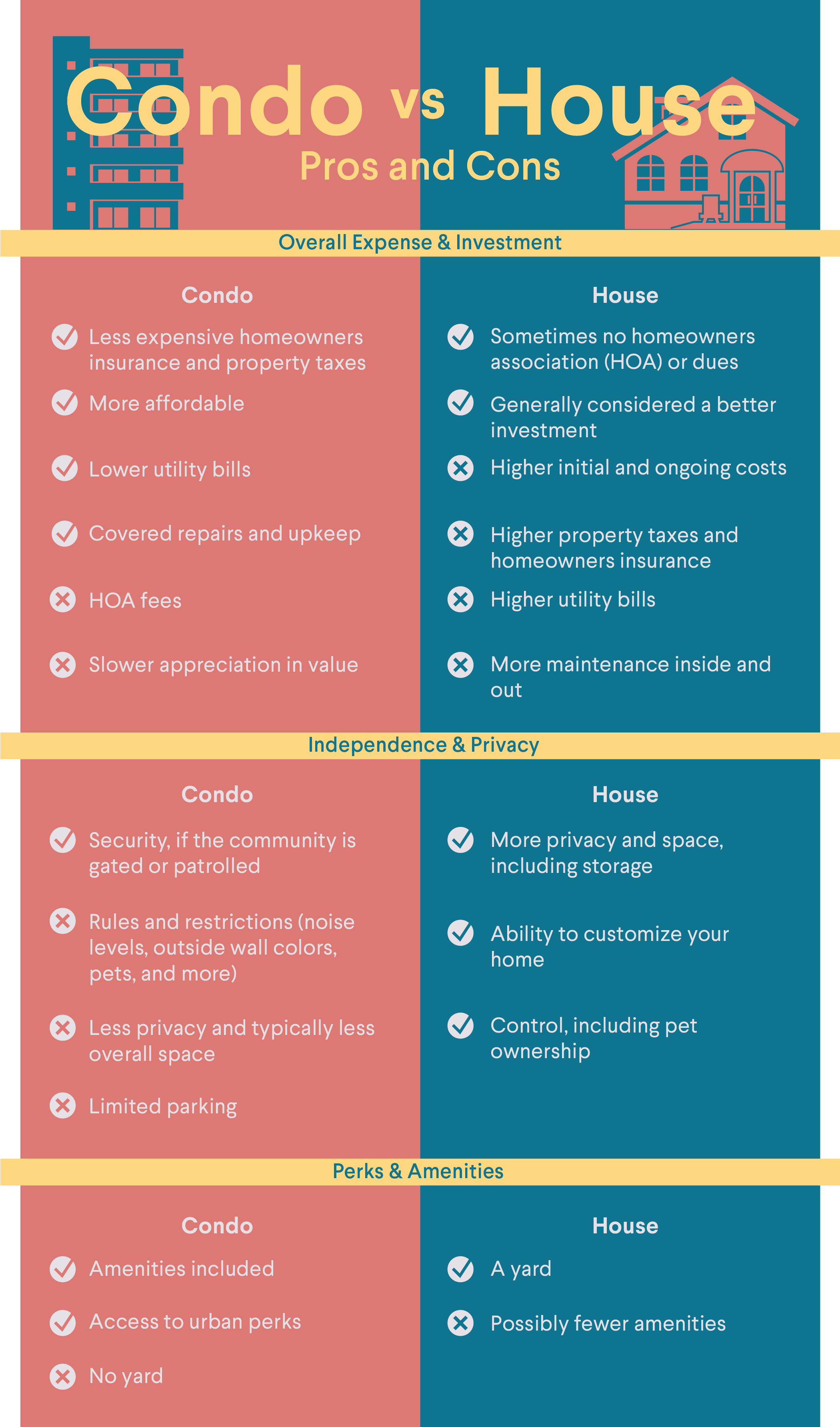
Condo vs House Pros and Cons

What Are the Costs of a House or Condo?

As mentioned above, houses tend to cost more than condos. But here are a few other ways to look at the financials when comparing a condo vs. a house:

•   Condos tend to have lower list prices than houses which may mean a smaller mortgage. However, you also need to factor in monthly maintenance fees and HOAs so you get the full picture.

•   Condos may have assessments from time to time. These are additional charges to fund projects for the unexpected expenses, such as a capital improvement to the entire dwelling.

•   Homeowner fees are growing along with inflation, so when you make your purchase, understand that these charges are not static.

•   Before buying into an HOA community, it’s imperative to vet the board’s finances, including its reserve fund, how often it has raised rates in recent years, whether it has collected any special assessments or plans, and whether it’s facing any lawsuits.

•   If you are buying a house, keep in mind that maintenance and upkeep are your responsibility. This can mean everything from replacing a hot-water heater that’s reaching the end of its lifespan to dealing with roof repairs.

•   Down payments will vary due to several factors. For a condo, a down payment is typically around 10% but can vary considerably from, say, 3% to 20%.

•   With a house, a down payment could be from 3.5% with an FHA loan to the conventional 20% needed to avoid private mortgage insurance, or PMI. Those who qualify for VA loans may be able to buy a house without a down payment.

•   If you are buying a house, make sure to scrutinize property taxes and factor those into your budget. Those are not fixed and can rise over time.

Another smart move: Check out this home affordability calculator to get a better feel for the bottom line.

When Is a Good Time to Buy?

You may know what you’d like to buy (condo vs. a house) and where (in what neighborhood), but do you feel as though now is the right time? If so, fantastic.

You might decide, though, that you want to rent for a while longer under certain circumstances, which can include:

•   Hoping to wait out an overheated market and looking at price-to-rent ratios

•   Wanting to save more money for the down payment and closing costs (the bigger your down payment, the lower your monthlies will likely be)

•   Needing to boost your credit score first

•   Wanting to pay down credit card debt or other debt, which improves your debt-to-income ratio or DTI

•   Needing more time to look at houses and condos before deciding which path to take


Get matched with a local
real estate agent and earn up to
$9,500 cash back when you close.

The Takeaway

The condo vs. house decision depends on a multitude of factors. Reviewing the pros and cons of buying a condo vs. a house can at least give you a direction to start your search. And so can such givens as knowing that you want to be in a certain location (downtown in a condo instead of in a house on a couple of acres), or that you have lots of dogs and therefore want your own yard, and so forth.

Looking for an affordable option for a home mortgage loan? SoFi can help: We offer low down payments (as little as 3% - 5%*) with our competitive and flexible home mortgage loans. Plus, applying is extra convenient: It's online, with access to one-on-one help.

SoFi Mortgages: simple, smart, and so affordable.


Financial Tips & Strategies: The tips provided on this website are of a general nature and do not take into account your specific objectives, financial situation, and needs. You should always consider their appropriateness given your own circumstances.

SoFi Mortgages
Terms, conditions, and state restrictions apply. Not all products are available in all states. See SoFi.com/eligibility-criteria for more information.


SoFi Loan Products
SoFi loans are originated by SoFi Bank, N.A., NMLS #696891 (Member FDIC). For additional product-specific legal and licensing information, see SoFi.com/legal. Equal Housing Lender.


External Websites: The information and analysis provided through hyperlinks to third-party websites, while believed to be accurate, cannot be guaranteed by SoFi. Links are provided for informational purposes and should not be viewed as an endorsement.
‡Up to $9,500 cash back: HomeStory Rewards is offered by HomeStory Real Estate Services, a licensed real estate broker. HomeStory Real Estate Services is not affiliated with SoFi Bank, N.A. (SoFi). SoFi is not responsible for the program provided by HomeStory Real Estate Services. Obtaining a mortgage from SoFi is optional and not required to participate in the program offered by HomeStory Real Estate Services. The borrower may arrange for financing with any lender. Rebate amount based on home sale price, see table for details.

Qualifying for the reward requires using a real estate agent that participates in HomeStory’s broker to broker agreement to complete the real estate buy and/or sell transaction. You retain the right to negotiate buyer and or seller representation agreements. Upon successful close of the transaction, the Real Estate Agent pays a fee to HomeStory Real Estate Services. All Agents have been independently vetted by HomeStory to meet performance expectations required to participate in the program. If you are currently working with a REALTOR®, please disregard this notice. It is not our intention to solicit the offerings of other REALTORS®. A reward is not available where prohibited by state law, including Alaska, Iowa, Louisiana and Missouri. A reduced agent commission may be available for sellers in lieu of the reward in Mississippi, New Jersey, Oklahoma, and Oregon and should be discussed with the agent upon enrollment. No reward will be available for buyers in Mississippi, Oklahoma, and Oregon. A commission credit may be available for buyers in lieu of the reward in New Jersey and must be discussed with the agent upon enrollment and included in a Buyer Agency Agreement with Rebate Provision. Rewards in Kansas and Tennessee are required to be delivered by gift card.

HomeStory will issue the reward using the payment option you select and will be sent to the client enrolled in the program within 45 days of HomeStory Real Estate Services receipt of settlement statements and any other documentation reasonably required to calculate the applicable reward amount. Real estate agent fees and commissions still apply. Short sale transactions do not qualify for the reward. Depending on state regulations highlighted above, reward amount is based on sale price of the home purchased and/or sold and cannot exceed $9,500 per buy or sell transaction. Employer-sponsored relocations may preclude participation in the reward program offering. SoFi is not responsible for the reward.

SoFi Bank, N.A. (NMLS #696891) does not perform any activity that is or could be construed as unlicensed real estate activity, and SoFi is not licensed as a real estate broker. Agents of SoFi are not authorized to perform real estate activity.

If your property is currently listed with a REALTOR®, please disregard this notice. It is not our intention to solicit the offerings of other REALTORS®.

Reward is valid for 18 months from date of enrollment. After 18 months, you must re-enroll to be eligible for a reward.

SoFi loans subject to credit approval. Offer subject to change or cancellation without notice.

The trademarks, logos and names of other companies, products and services are the property of their respective owners.


SOHL-Q125-045

Read more

When Do I Get My Escrow Refund?

If you, as a mortgage holder, have money in an escrow account, you may see an escrow refund after an escrow analysis at the end of the year. It may not happen often, but an escrow refund check comes if there’s an excess amount in your escrow account. Regulations set by the Consumer Financial Protection Bureau (CFPB) allow the mortgage servicer to retain two months’ worth of your escrow payment as a cushion. Amounts greater than $50 above the cushion should be refunded to you. Escrow balances less than this amount can be retained in the escrow account for the next year or refunded to the borrower.

Escrow refunds generally come when there’s an expense that’s smaller than expected, such as a lower insurance bill or fewer taxes. Your mortgage servicer pays the lower amount and then, when the servicer conducts an escrow analysis, the difference will be refunded to you, typically by check. The funds can also come when an escrow account is closed, such as when the mortgage is paid off or refinanced.

Key Points

•   An escrow refund occurs when there is an overpayment in an escrow account.

•   It typically happens when property taxes or insurance premiums decrease.

•   The lender or servicer will issue a refund check to the homeowner.

•   Homeowners can use the refund to reduce their mortgage balance or for other purposes.

•   It’s important to review escrow statements and communicate with the lender to ensure accurate refunds.

The Escrow Process 101

You might have heard the term “escrow” in a couple of different settings when you’re buying a home. First, an escrow account is like a savings account that is set up for holding earnest money after you make an offer on a house.

And second, a different escrow account is set up by your mortgage servicer after you close on the loan. It can manage your taxes, private mortgage insurance (PMI), and/or homeowner’s insurance. This second type of escrow account is the one most likely to trigger a refund.

In its simplest form, the escrow process looks like this:

1.    The mortgage servicer sets up an escrow account.

2.    The borrower makes monthly payments to the mortgage servicer.

3.    The mortgage servicer deposits the portion of the monthly payment for the homeowners insurance, taxes, and mortgage insurance into an escrow account.

4.    The taxing entity, homeowners insurance provider, and/or mortgage insurance company send the mortgage servicer a bill.

5.    The mortgage servicer pays the bill on the borrower’s behalf.

6.    The mortgage servicer audits accounts every year to determine if there is an overage or a shortage.

7.    If there is an overage above $50, the borrower can be refunded that money. The servicer will alter the monthly payment lower for the next year.

8.    If there is a shortage, the mortgage servicer will modify your monthly payment to account for both the shortage in the last year and the increased cost for the upcoming year.

Recommended: What Is an Escrow Holdback?

What Is an Escrow Refund?

An escrow refund occurs when you, as a mortgage holder, receive a check at the end of the year for the extra money you paid into your escrow account. This is a requirement of mortgage servicing.

When you start making monthly payments to your mortgage servicer, you’ll pay the same amount each month. This amount typically includes your principal, interest, property taxes, homeowners insurance, and PMI (if you have it). The portion designated for taxes, PMI, and homeowner’s insurance will go into your escrow account. This amount is saved until your bill is due. The mortgage servicer pays the bill and deducts the amount from your escrow account.

Every year, the mortgage servicer is required to conduct an escrow analysis. This is a process where the servicer looks at the deposits made by you as well as the bills for insurance and taxes. Adjustments are made, and if you overpaid, you get a refund.

Escrow Refunds at Closing

You also might be wondering, “Do you get escrow money back at closing?” The process for escrow refunds at closing is a little different.

•   Your lender typically uses the money from your existing escrow account to apply toward your down payment or closing costs.

•   Then, for the new escrow account opened by your mortgage servicer, you will contribute what are called “prepaid closing costs” to the account to fund your escrow account. If you end up paying too much, you’ll see an escrow refund check from your servicer after an escrow analysis has been performed.

Mortgage servicers like escrow accounts because it helps protect their investment in your home. When the homeowner’s insurance is paid, the lender can be assured there is protection for the home should anything happen to it. Likewise, when the taxes are paid, the lender doesn’t have to worry about the taxing entity placing a lien on the home.

When Might You Expect An Escrow Refund?

Mortgage servicers are required to complete an escrow analysis at the end of the escrow account computation year, according to Regulation X of the Real Estate Settlement Procedures Act. (The clock starts ticking on the “computational year” when you make your first mortgage payment.) After the yearly escrow analysis, you will receive an escrow account statement. This statement will show you the deposits and expenses for the year, as well as show you a projection of anticipated expenses for the upcoming year.

It will also notify you of changes to your monthly payment that need to be made. These steps help ensure that your mortgage servicer is able to pay your taxes and insurance in full from your monthly payment. It’s common for the amount to change a bit from year to year.

If the escrow analysis uncovers a surplus above the allowable cushion in your escrow account, you can expect a mortgage escrow refund within 30 days.

Here are some common scenarios where you might expect to see a refund from your escrow account.

Mortgage Payoff

When you pay off your mortgage or refinance with a new mortgage loan, your mortgage servicer is no longer required to hold an escrow account for you. You may receive a refund from your escrow account for any unused funds.

Lower Tax Bill

If your tax bill decreases, that means the amount collected from your monthly mortgage payment over the year will be more than what is actually due. The excess amount in your escrow account could be refunded to you after escrow analysis.

Better Insurance Rate

If you change your homeowners insurance to a company that offers a better rate, you may be due a refund. If this happens, you’ll likely pay the higher premium that you had locked into your monthly payment for the year. However, once the escrow analysis is completed, the savings will be apparent and you should receive your refund.

Private Mortgage Insurance No Longer Required

On many conventional mortgages, there may come a time when you don’t need to pay for mortgage insurance. Let’s say you were a first-time homeowner who put less than 10% on your house. When your home equity reaches 20%, you may be able to have the private mortgage insurance premium removed (depending on the type of mortgage you have).

This may happen in the middle of the year before your servicer expects it. Your monthly payment may not be adjusted until an escrow analysis is completed at the end of the year. After an analysis has been completed, you’ll likely receive a refund because you’ve been overpaying for that mortgage insurance you no longer need.

Recommended: What Is a Mortgage Contingency?

Purchase Overpay

If you overpaid for an escrow item when you closed on your home, the surplus can be refunded to you after an escrow analysis.

When You Won’t See an Escrow Refund

The part of your monthly mortgage payment that goes toward your escrow account is set at the beginning of the year. However, tax rates and insurance rates often increase during the year. When your tax or insurance bill is due, your escrow servicer will pay the larger bill even though there isn’t enough money in the escrow account to cover it. This may result in a negative escrow balance.

In the case of a negative escrow balance, the servicer uses their own money to cover the shortfall. To make up for the shortage, the servicer will make adjustments after completing escrow analysis and take steps to collect the shortfall. The adjustment will also account for the new increased amounts due monthly during the upcoming year.

How Soon Can You Expect a Refund?

For ongoing mortgage payments: Your escrow servicer is required to issue a refund within 30 days of discovering a surplus of $50 or more. (This surplus is above a two-month allowable cushion of escrow payments that your mortgage lender may hold.). Borrowers must be current on their mortgage payment, however, to be able to receive this refund.

If you pay off your mortgage: Your escrow servicer may refund the balance of your escrow account within 20 days. Or, if you get a new mortgage with the same servicer, the servicer can apply the balance of the escrow account to a new escrow account with your permission.

The Takeaway

You may see an escrow refund coming your way if you’ve negotiated a better deal for your homeowners insurance, expect to pay less in taxes, or no longer need to pay PMI. It will happen automatically because your mortgage servicer is required to perform yearly escrow analysis. You’ll also receive a refund if you pay off your mortgage and possibly when you refinance. Once that happens, the servicer has 30 days or less to refund the money you’re owed from your escrow account.

Looking for an affordable option for a home mortgage loan? SoFi can help: We offer low down payments (as little as 3% - 5%*) with our competitive and flexible home mortgage loans. Plus, applying is extra convenient: It's online, with access to one-on-one help.

SoFi Mortgages: simple, smart, and so affordable.

FAQ

How long does it take to get escrow money back?

If you’ve paid off your mortgage in full, the balance in your escrow account should be returned to you within 20 days. If you are still paying into escrow but an escrow analysis (a process conducted every 12 months) has found you’re due money back, you should receive it within 30 days.

Do you get an escrow refund every year?

There is no rule that says you’ll get an escrow refund every year. In fact, in some years you may find that you need to pay more into escrow the following year (or make a lump-sum payment) to make up for a shortfall.


Photo credit: iStock/MaslovMax

SoFi Loan Products
SoFi loans are originated by SoFi Bank, N.A., NMLS #696891 (Member FDIC). For additional product-specific legal and licensing information, see SoFi.com/legal. Equal Housing Lender.


SoFi Mortgages
Terms, conditions, and state restrictions apply. Not all products are available in all states. See SoFi.com/eligibility-criteria for more information.


*SoFi requires Private Mortgage Insurance (PMI) for conforming home loans with a loan-to-value (LTV) ratio greater than 80%. As little as 3% down payments are for qualifying first-time homebuyers only. 5% minimum applies to other borrowers. Other loan types may require different fees or insurance (e.g., VA funding fee, FHA Mortgage Insurance Premiums, etc.). Loan requirements may vary depending on your down payment amount, and minimum down payment varies by loan type.

Financial Tips & Strategies: The tips provided on this website are of a general nature and do not take into account your specific objectives, financial situation, and needs. You should always consider their appropriateness given your own circumstances.

Third-Party Brand Mentions: No brands, products, or companies mentioned are affiliated with SoFi, nor do they endorse or sponsor this article. Third-party trademarks referenced herein are property of their respective owners.

Tax Information: This article provides general background information only and is not intended to serve as legal or tax advice or as a substitute for legal counsel. You should consult your own attorney and/or tax advisor if you have a question requiring legal or tax advice.

SOHL-Q125-050

Read more
What Is a Bank Statement Mortgage? Who Is It For?

What Is a Bank Statement Mortgage? Who Is It for?

When you apply for a mortgage, lenders typically require proof of income via pay stubs, W-2s, and tax returns. But with a bank statement mortgage, borrowers can use their bank statements instead of tax documents to verify income.

For self-employed workers, who currently number more than 9 million and sole proprietors (another 20-plus million), using bank statements can demonstrate their real income instead of the lower figure that might be reported on a tax return after deductions.

Read on to learn how you can leverage your bank statements to qualify for a mortgage.

Key Points

•   Bank statement mortgages use bank statements to verify income, suitable for self-employed individuals.

•   Lenders require 12 to 24 months of bank statements to assess net income.

•   Pros include no need for W-2s or tax returns, and eligibility for second homes.

•   Cons involve higher down payments and interest rates, and limited lender availability.

•   Lenders apply an expense ratio to business bank statements and use 100% of personal deposits for income.

What Is a Bank Statement Mortgage?

A homebuyer who is self-employed, by any name — sole proprietor, independent contractor, a member of a business partnership, freelancer, or gig worker — or anyone else may qualify for a bank statement mortgage loan, also known as a self-employed mortgage, by submitting personal or business bank statements.

A bank statement lists all transactions made in an account during a set period of time, usually a month. The sum of the transactions — deposits, charges, and withdrawals — is used to calculate the beginning and ending balances for that period. In place of tax returns, this account information is used to verify you have enough income and cash flow to cover a down payment and monthly loan payments.

Lenders offering bank statement mortgages may ask for 12 to 24 months of statements to determine the borrower’s net income — how much they earned after taxes and business write-offs. Typically, the bank statements cover the time period immediately preceding the loan application.

First-time homebuyers can
prequalify for a SoFi mortgage loan,
with as little as 3% down.


How Does a Bank Statement Mortgage Work?

So, what is a bank statement mortgage in practice? As with any mortgages, lenders can consider your credit score, work history, and proof of liquid assets as part of the loan application. But a bank statement mortgage differs in at least one way.

Whether you deposit income from your business directly into a personal bank account or into a separate business account affects how your income is calculated.

Lenders may apply an expense ratio to business bank statements with the understanding that part of the deposits go toward business expenses. This means that only a percentage — usually 50% to 85% — of qualifying deposits is used to calculate income. (However, it’s possible to obtain a lower expense factor with a statement from a certified public accountant or tax preparer.)

If you deposit income to your personal account from your business account, 100% of deposits can count toward calculating the bank statement mortgage you can afford. Without a separate business account, though, deposits to a personal account also receive an expense ratio.

Note that lenders can also factor in your ownership percentage in a business when calculating gross monthly income from business bank statements.

Here’s an example of how these two scenarios would work for the same self-employed person applying for a 12-month bank statement mortgage.

Business bank statement: ($84,000 in deposits / 12 months) x 50% expense ratio = $3,500 gross monthly income

Personal bank statement: $84,000 in deposits / 12 months = $7,000 gross monthly income

With this monthly gross income figure, the lender will assess monthly debt payments to calculate the debt-to-income ratio and determine the loan amount you qualify for.

Recommended: Understanding Mortgage Basics

Who Should Get a Bank Statement Mortgage?

Prospective homebuyers who don’t have consistent cash flow or who lack proof of income from an employer like W-2s and pay stubs could benefit from a bank statement mortgage.

Self-employed workers often claim tax deductions for business expenses to lower their tax liability, which makes their income appear lower on tax forms. Therefore, without using bank statements, many sole proprietors, contract workers, and freelancers will qualify for a smaller mortgage amount than they can actually afford.

Bank statement mortgage loans could also be advantageous for seasonal workers. Since gross monthly income is calculated as an average during the full time period covered by the bank statements, when the deposits occur within that time frame is less important. (Incidentally, if you’re seeking a personal loan there are similar considerations to getting a personal loan when self-employed.)

Recommended: Understanding the Different Types of Mortgage Loans

Pros and Cons of a Bank Statement Mortgage

Bank statement mortgages represent an alternative to conventional mortgage loans that lends itself to self-employed and seasonal workers. But it’s important to consider the pros and cons when shopping for a mortgage.

Pros of Bank Statement Mortgage Cons of Bank Statement Mortgage
Can qualify without W-2s, pay stubs, or tax returns May require a higher down payment than other types of home loans
Often eligible for second homes and investment properties Generally carries higher interest rates
Private mortgage insurance is not required if buyer puts 20% down Not all lenders offer this loan product
May offer higher loan limits Can require being in business for years to qualify

How to Find a Bank Statement Mortgage

Bank statement mortgages are considered non-qualified mortgages (non-QM), which means they may lack certain features and protections, so not every lender uses them. Though less common than traditional mortgages, many lenders, including banks and credit unions, offer bank statement mortgage loans.

Since bank statement loans are non-QMs, it’s natural to have questions about mortgage terms and requirements.

For instance, it’s worth asking about mortgage points — fees paid to a lender for a lower interest rate — since the limits on points and fees for a qualified mortgage do not apply.

Recommended: Mortgage Calculator

Alternatives to a Bank Statement Mortgage

Prospective homebuyers have a range of financing options to choose from, even if they’re self-employed.

Getting prequalified and preapproved can give you an idea of how much home you can afford, and a specific amount, respectively.

A mortgage loan originator will convey the loan terms you might qualify for and available financing options.

•   Conventional home loan: Conventional loans tend to come with competitive interest rates and are originated, backed, and serviced by private mortgage lenders.

•   FHA loan: Insured by the Federal Housing Administration but administered by approved private lenders, an FHA loan allows for down payments as low as 3.5% and lower credit scores than conventional loans.

•   USDA loan: A USDA loan, backed by the U.S. Department of Agriculture, is designed to make homeownership affordable for low-income buyers in designated rural areas.

•   VA loan: Eligible service members, veterans, and eligible surviving spouses can obtain VA loans, guaranteed by the Department of Veterans Affairs, with competitive interest rates, no down payment, and minimal closing costs.

If you’ve been self-employed for two years, or one year self-employed plus two years in a similar role with comparable income, you may still qualify for one of the above loans.

Recommended: Help Center for Home Loans

The Takeaway

Being self-employed does not prevent borrowers from getting financing for a home purchase or refinance. A bank statement loan could be a solution if your tax returns don’t fully capture what you can afford. But you may also qualify for a conventional loan or other type of financing.

Looking for an affordable option for a home mortgage loan? SoFi can help: We offer low down payments (as little as 3% - 5%*) with our competitive and flexible home mortgage loans. Plus, applying is extra convenient: It's online, with access to one-on-one help.

SoFi Mortgages: simple, smart, and so affordable.

FAQ

Are bank statement mortgages good?

Bank statement mortgages can be advantageous for self-employed homebuyers or refinancers, but they can have higher interest rates and down payment requirements. It’s worth checking to see if you’re eligible for conventional or government-backed loans first.

How much of a down payment is required for a bank statement mortgage?

Typically, bank statement loan lenders require a 20% down payment, or 10% if purchasing mortgage insurance.

Can I use a bank statement loan on a second home?

Yes, bank statement loans can be used for a second home, as well as vacation homes and investment properties.

Do bank statement mortgages work for refinancing?

Yes, homeowners can refinance with a bank statement mortgage, including applying for a cash-out refinance if they have enough home equity.


Photo credit: iStock/PeopleImages

SoFi Loan Products
SoFi loans are originated by SoFi Bank, N.A., NMLS #696891 (Member FDIC). For additional product-specific legal and licensing information, see SoFi.com/legal. Equal Housing Lender.


SoFi Mortgages
Terms, conditions, and state restrictions apply. Not all products are available in all states. See SoFi.com/eligibility-criteria for more information.


*SoFi requires Private Mortgage Insurance (PMI) for conforming home loans with a loan-to-value (LTV) ratio greater than 80%. As little as 3% down payments are for qualifying first-time homebuyers only. 5% minimum applies to other borrowers. Other loan types may require different fees or insurance (e.g., VA funding fee, FHA Mortgage Insurance Premiums, etc.). Loan requirements may vary depending on your down payment amount, and minimum down payment varies by loan type.
Financial Tips & Strategies: The tips provided on this website are of a general nature and do not take into account your specific objectives, financial situation, and needs. You should always consider their appropriateness given your own circumstances.
Third-Party Brand Mentions: No brands, products, or companies mentioned are affiliated with SoFi, nor do they endorse or sponsor this article. Third-party trademarks referenced herein are property of their respective owners.
Tax Information: This article provides general background information only and is not intended to serve as legal or tax advice or as a substitute for legal counsel. You should consult your own attorney and/or tax advisor if you have a question requiring legal or tax advice.
¹FHA loans are subject to unique terms and conditions established by FHA and SoFi. Ask your SoFi loan officer for details about eligibility, documentation, and other requirements. FHA loans require an Upfront Mortgage Insurance Premium (UFMIP), which may be financed or paid at closing, in addition to monthly Mortgage Insurance Premiums (MIP). Maximum loan amounts vary by county. The minimum FHA mortgage down payment is 3.5% for those who qualify financially for a primary purchase. SoFi is not affiliated with any government agency. Veterans, Service members, and members of the National Guard or Reserve may be eligible for a loan guaranteed by the U.S. Department of Veterans Affairs. VA loans are subject to unique terms and conditions established by VA and SoFi. Ask your SoFi loan officer for details about eligibility, documentation, and other requirements. VA loans typically require a one-time funding fee except as may be exempted by VA guidelines. The fee may be financed or paid at closing. The amount of the fee depends on the type of loan, the total amount of the loan, and, depending on loan type, prior use of VA eligibility and down payment amount. The VA funding fee is typically non-refundable. SoFi is not affiliated with any government agency.

SOHL-Q125-035

Read more

Subordinate Mortgages: Everything You Need to Know

Hierarchies are everywhere, including in the mortgage world. Many people have a subordinate mortgage in the form of a home equity line of credit (HELOC) or home equity loan.

A subordinate mortgage is secured by your property but sits in second position, if you have a primary mortgage. In the event that an owner defaults and the property moves to foreclosure, the primary mortgage would be paid from the proceeds of the foreclosure sale before the subordinate mortgage. Note: SoFi does not offer piggy-back loans, which are a type of subordinate mortgage. It does, however, offer a HELOC and a home equity loan.

Here’s what you need to know about subordination and why it matters.

Key Points

•   A subordinate mortgage is secured by property and ranks below a primary mortgage in priority for repayment upon default.

•   Mortgage subordination ensures order of payment in foreclosure, with primary mortgages paid first.

•   Subordinate mortgages include home equity lines of credit and home equity loans, which are riskier for lenders.

•   Subordination clauses in mortgage agreements confirm the priority of the primary mortgage over subsequent liens.

•   Refinancing a primary mortgage may require a subordination agreement from the second mortgage lender to maintain order.

What Is Mortgage Subordination?

Mortgage subordination is the process of ranking debts tied to your home in the order that they need to be paid in the event of a foreclosure. Whichever mortgage lien is recorded first usually has higher priority than those that are recorded later, but depending on state law, property tax liens, homeowners association (HOA) “super liens,” and mechanic’s liens may have priority over previously recorded liens.

In the event of a foreclosure, a second mortgage is only paid if there are funds left over after paying the primary mortgage.

Lenders that make second mortgages — also called junior mortgages, second liens, or junior liens — typically allow borrowers to tap only a portion of their home equity to help ensure that they will get paid in the event of a foreclosure.

And a subordinate mortgage represents a higher risk to the lender, so borrowers will likely see higher rates than they would be offered on a primary home mortgage loan.

First-time homebuyers can
prequalify for a SoFi mortgage loan,
with as little as 3% down.

Questions? Call (888)-541-0398.


Recommended: Understanding Mortgage Basics

What Are Mortgage Subordination Clauses?

A mortgage subordination clause is typically included in the legal documents of the primary mortgage holder.

The subordination mortgage clause states that all other loans made using the property as collateral are subordinate to the primary mortgage, now and in the future.

What Is a Subordinate Lien?

A lien is a claim against your property. Generally, there are voluntary mortgage liens, such as mortgages you take out, and involuntary liens, like judgment, tax, HOA, and mechanic’s liens.

A subordinate lien is a claim against your property that usually can only be paid after the primary lien has been paid.

How Does a Mortgage Become Subordinate?

When a mortgage is subordinate to another, it simply means that the lender of the subordinate mortgage will get paid only after the senior lienholder is paid.

Again, mortgages are typically ranked in the order they are originated and recorded in county land records. The primary mortgage is first, and a second mortgage is subordinate because it came after.

If a property is refinanced, the situation changes.

Subordinate Mortgages and Refinancing

If a homeowner has two mortgage loans and wants to refinance the first mortgage, most refinancing lenders will ask the second mortgage lender to sign a subordination agreement to stay in second position after the refinance.

If the second lienholder balks at subordinating that loan, you may have enough equity to apply for a cash-out refinance and use the extra money to pay off the second mortgage. Or you could pay off the second mortgage with cash on hand.

This mortgage calculator can help you run the numbers to see if refinancing is right for you.

Recommended: What Are the Different Types of Mortgage Loans?

Subordinate Mortgage Loan Modification

Loan modification is a mortgage relief program in which the terms of the loan are changed so that the homeowner can better meet the monthly payment requirement.

Homeowners who anticipate a permanent change in finances, or are exiting mortgage forbearance but don’t qualify for refinancing, can ask for mortgage modification.

If you have a HELOC or home equity loan and you’re struggling to make the payments, the lender may be willing to modify the credit line or loan: lowering the rate, extending your repayment term, or reducing your principal balance.

The Takeaway

Though lenders are more concerned about subordinate mortgages than you may be, you may want to know how second mortgages and other liens may affect refinancing your primary mortgage.

Looking for an affordable option for a home mortgage loan? SoFi can help: We offer low down payments (as little as 3% - 5%*) with our competitive and flexible home mortgage loans. Plus, applying is extra convenient: It's online, with access to one-on-one help.

SoFi Mortgages: simple, smart, and so affordable.

FAQ

What type of mortgage is subordinate?


If a homeowner has a first mortgage, home equity lines of credit and home equity loans are examples of subordinate loans. They will be paid second in the event of a foreclosure or cash sale.

Is a subordinate mortgage a second mortgage?


Yes. A second mortgage is a subordinate mortgage because it came after the primary mortgage.

What is subordinate financing?


Subordinate financing is a junior loan secured by an asset that can be sold if the loan is unpaid for a specified amount of time. Interest rates and terms can be more favorable than those of unsecured loans but not as favorable as those for a first mortgage.

How long does it take to subordinate a loan?


On primary loans, subordination is included in the contract. On a subsequent refinance when there is a junior (or subordinate) mortgage, the amount of time it will take to reach a subordination agreement will depend on the lenders involved, but it can often be done in 25 business days.


Photo credit: iStock/wutwhanfoto

SoFi Loan Products
SoFi loans are originated by SoFi Bank, N.A., NMLS #696891 (Member FDIC). For additional product-specific legal and licensing information, see SoFi.com/legal. Equal Housing Lender.


SoFi Mortgages
Terms, conditions, and state restrictions apply. Not all products are available in all states. See SoFi.com/eligibility-criteria for more information.


*SoFi requires Private Mortgage Insurance (PMI) for conforming home loans with a loan-to-value (LTV) ratio greater than 80%. As little as 3% down payments are for qualifying first-time homebuyers only. 5% minimum applies to other borrowers. Other loan types may require different fees or insurance (e.g., VA funding fee, FHA Mortgage Insurance Premiums, etc.). Loan requirements may vary depending on your down payment amount, and minimum down payment varies by loan type.

Financial Tips & Strategies: The tips provided on this website are of a general nature and do not take into account your specific objectives, financial situation, and needs. You should always consider their appropriateness given your own circumstances.

²SoFi Bank, N.A. NMLS #696891 (Member FDIC), offers loans directly or we may assist you in obtaining a loan from SpringEQ, a state licensed lender, NMLS #1464945.
All loan terms, fees, and rates may vary based upon your individual financial and personal circumstances and state.
You should consider and discuss with your loan officer whether a Cash Out Refinance, Home Equity Loan or a Home Equity Line of Credit is appropriate. Please note that the SoFi member discount does not apply to Home Equity Loans or Lines of Credit not originated by SoFi Bank. Terms and conditions will apply. Before you apply, please note that not all products are offered in all states, and all loans are subject to eligibility restrictions and limitations, including requirements related to loan applicant’s credit, income, property, and a minimum loan amount. Lowest rates are reserved for the most creditworthy borrowers. Products, rates, benefits, terms, and conditions are subject to change without notice. Learn more at SoFi.com/eligibility-criteria. Information current as of 06/27/24.
In the event SoFi serves as broker to Spring EQ for your loan, SoFi will be paid a fee.

SOHL-Q125-030

Read more

What Is Mortgage Foreclosure? Here’s What You Need to Know

You may know someone who lost a home to foreclosure, but you might not know all the ins and outs of the process.

When the lender takes back a property after the mortgage has gone unpaid for a specified period of time, that’s a mortgage foreclosure. The process varies by state and by lender, but there are things you can do to avoid it.

Here’s what you need to know about foreclosure and moves you can make if you’re facing it.

Key Points

•   Mortgage foreclosure occurs when homeowners miss payments, leading to lenders reclaiming the property.

•   Reinstatement involves paying all overdue amounts to prevent foreclosure.

•   Forbearance agreements allow temporary reduction or pause in payments.

•   Loan modification changes terms to make payments more manageable.

•   Exploring these options helps avoid foreclosure and maintains financial stability.

What Does Foreclosure Mean?

When a buyer finances a home, the home mortgage loan is secured with the property, meaning the property is used as collateral on the loan. If the homeowner fails to make the agreed-upon payments on the due dates, the lender can take the property back. This is why it’s so important to think about what ifs as you go through the mortgage prequalification and mortgage preapproval process. How would you keep up payments in the event of a job loss? Do you have an emergency fund in place?

Each state has its own laws regarding foreclosure and its own state foreclosure rate. Where you live will determine how properties are foreclosed. There are two main types of mortgage foreclosure.

First-time homebuyers can
prequalify for a SoFi mortgage loan,
with as little as 3% down.

Questions? Call (888)-541-0398.


Recommended: Help Center for Mortgages

Types of Mortgage Foreclosure

In some states, the lender is required to go through the court system to foreclose on a property. This is known as judicial foreclosure. In other states, the lender does not have to go through the court process.

Judicial

With a judicial foreclosure, a lender must get a court order to foreclose on a property. The lender must file a complaint with the court, which is also sent to the homeowner and any other lienholders. Generally, the mortgage note must also be filed with the court.

Some states require loss mitigation efforts before a suit can be filed, meaning the mortgage servicer must work with the borrower to help them avoid foreclosure. Most of these foreclosures are not contested, resulting in a default judgment against the homeowner.

After this, the property may be scheduled for sale (usually a foreclosure sale or sheriff’s auction). The homeowner may appeal the foreclosure judgment.

Nonjudicial

In a nonjudicial foreclosure, deeds of trust can be foreclosed without going through the court system. Lenders must give special notice to the property owner and wait a specified amount of time before auctioning the property off.

Some states allow both judicial and nonjudicial foreclosure, while others may only allow one or the other. Below is a summary of states and what process they follow for mortgage foreclosure.

State Foreclosure process
Alabama Primarily nonjudicial
Alaska Primarily nonjudicial
Arizona Primarily nonjudicial
Arkansas Primarily nonjudicial
California Primarily nonjudicial
Colorado Primarily nonjudicial
Connecticut Primarily judicial
Delaware Primarily judicial
District of Columbia Primarily nonjudicial
Florida Primarily judicial
Georgia Primarily nonjudicial
Hawaii Primarily judicial
Idaho Primarily nonjudicial
Illinois Primarily judicial
Indiana Primarily judicial
Iowa Primarily judicial
Kansas Primarily judicial
Kentucky Primarily judicial
Louisiana Primarily judicial
Maine Primarily judicial
Maryland Primarily nonjudicial
Massachusetts Primarily nonjudicial
Michigan Primarily nonjudicial
Minnesota Primarily nonjudicial
Mississippi Primarily nonjudicial
Missouri Primarily nonjudicial
Montana Primarily nonjudicial
Nebraska Primarily nonjudicial
Nevada Primarily nonjudicial
New Hampshire Primarily nonjudicial
New Jersey Primarily judicial
New Mexico Primarily judicial
New York Primarily judicial
North Carolina Primarily nonjudicial
North Dakota Primarily judicial
Ohio Primarily judicial
Oklahoma Primarily nonjudicial
Oregon Primarily nonjudicial
Pennsylvania Primarily judicial
Puerto Rico Primarily judicial
Rhode Island Primarily nonjudicial
South Carolina Primarily judicial
South Dakota Primarily nonjudicial
Tennessee Primarily nonjudicial
Texas Primarily nonjudicial
Utah Primarily nonjudicial
Vermont Primarily judicial
Virginia Primarily nonjudicial
Washington Primarily nonjudicial
West Virginia Primarily nonjudicial
Wisconsin Primarily judicial
Wyoming Primarily nonjudicial

When Does Mortgage Foreclosure Begin?

Mortgage foreclosure begins with the first missed payment, though a lender’s actions will escalate the more payments a homeowner misses. With the first missed payment, the mortgage lender won’t take the property back, or even issue a notice of default, but will reach out to the borrower to help them get payments back on track.

The lender will also report a nonpayment or late payment to the credit bureaus and issue a late fee.

Typically, lenders won’t issue a notice of default until the borrower defaults on three missed payments, or 90 days past due (this is standard practice, but lenders can issue a notice of default sooner than 90 days). Default is the precursor to foreclosure.

Recommended: Home Loan Help Center

Foreclosure Timeline: How Long Does Mortgage Foreclosure Take?

Once the notice of default arrives after 90 days past due, the time it takes to complete the foreclosure will vary by state. In some states, it can be a matter of months. In others, much longer. In the last quarter of 2024, the average time a property took to complete foreclosure was 762 days.

In jurisdictions where each step of the process requires court approval (judicial foreclosures), court backlogs can delay the foreclosure processes for years.

Why Do Foreclosures Happen?

Foreclosure occurs in a number of situations. Some of the most common:

•   Being underwater. When a homeowner has negative equity in the home, the property is more likely to be foreclosed on. Having an underwater mortgage is the most common reason for foreclosure.

•   Rising interest rates. When a borrower’s loan has an adjustable interest rate, a sudden rise in the amount owed each month can lead down the path to foreclosure. With the 5/1 ARM, for example, the interest rate is fixed for the first five years and then adjusts once a year.

•   Mortgage types. Sometimes even the different kinds of mortgages can contribute to default. With an interest-only mortgage, for instance, after five or 10 years of interest payments, principal and interest kick in, resulting in higher payments.

•   Personal situations. When the payment on a mortgage loan becomes too much or when a life event (hospitalization, death, divorce, layoff) prevents homeowners from making monthly payments, they can slip into default and eventually foreclosure.

If the homeowner doesn’t work with the lender to make a plan for repayment of the missed payments, the mortgage servicer can seek foreclosure.

Can You Avoid Foreclosure?

Homeowners have options if they’re facing foreclosure, and the sooner they contact their mortgage lender or servicer, the more they will have. Some of these include:

•   Reinstatement. If you’re able to pay off the past due amounts and any penalty fees, the lender will stop the foreclosure process.

•   Repayment plan. A repayment plan allows you to tack on a portion of your past-due payments to your regular payment each month. This makes sense if you’ve only missed a small number of payments and will no longer have trouble making a monthly mortgage payment.

•   Forbearance. If you qualify for mortgage forbearance, your lender might pause or lower monthly mortgage payments for a short amount of time. When you start making payments again, you’ll add portions of your missed payments to your regular payment to catch up.

•   Loan modification. With a loan modification, the lender permanently alters the terms of the mortgage contract, so the payment is more manageable. This can include a reduced interest rate, adding missed payments to the loan balance, extending the term of the mortgage, or even canceling part of the mortgage debt.

•   Filing for bankruptcy. Filing for Chapter 13 bankruptcy may allow you to keep certain assets like a house or car. A court must approve your repayment plan. It stays on your credit report for seven years. You might want to consult with a bankruptcy attorney if you’re thinking about going this route.

•   Selling your home. If you have enough equity in your home to pay off the mortgage and pay for the cost of selling your home, you may be able to sell your home to avoid foreclosure.

•   Deed in lieu of foreclosure. A deed in lieu of foreclosure is essentially when you hand over the title of your home to the lender instead of going through a foreclosure. It is less damaging to your credit than a foreclosure. (Note: SoFi does not offer a Deed in Lieu at this time.)

•   Short sale. If the lender agrees to a short sale, it is agreeing to allow the home to be sold for less than what is owed. The deficit is taxable if the mortgage terms hold the borrower liable for the full amount of the loan.

Recommended: A Guide to Mortgage Relief Programs

Consequences of Foreclosure

Foreclosure has a huge impact on your credit. It will stay on your credit report for seven years after the first missed payment, and the multiple delinquent payments are a further knock against your credit scores, making it hard to go shopping for another mortgage and other loans.

After a foreclosure, it could take two to seven years to get a new conventional or government-backed mortgage.

But there are ways to deal with financial hardship. And a key first step where foreclosure is concerned is to reach out to your mortgage servicer and discuss a plan.

The Takeaway

Facing mortgage foreclosure is one of the toughest things a homeowner can go through. As the financial landscape shifts, knowledge is power. Foreclosure can be avoided if you work with your mortgage servicer and get help managing your debts. With time and a disciplined strategy in place, you can get on a solid financial footing again.

Looking for an affordable option for a home mortgage loan? SoFi can help: We offer low down payments (as little as 3% - 5%*) with our competitive and flexible home mortgage loans. Plus, applying is extra convenient: It's online, with access to one-on-one help.

SoFi Mortgages: simple, smart, and so affordable.

FAQ

Can I stop the foreclosure process?

Possibly. The sooner you contact your mortgage servicer, the more options you will have.

How will foreclosure hurt my credit score?

The lender reports each missed payment, and the further behind a borrower gets, the more delinquent they become. The credit score lowers with each report. A foreclosure stays on a credit report for seven years, which makes it harder to apply for other credit lines and loans.

Am I supposed to pay property taxes when my house is in foreclosure?

It’s true that a missed tax payment can also lead to foreclosure proceedings, but it depends on where you are in the process. If you’re working with your lender to get your missed payments back on track to avoid foreclosure, then your escrow account will be replenished and the mortgage servicer will pay your taxes. If you’re in foreclosure and not able to get your payments back on track, paying your taxes won’t help you get your house back. You’re better off working with your lender to put that money toward missed mortgage payments.

Do I have to move out of my house when it is in foreclosure?

The Federal Trade Commission advises staying in the house as long as possible if you’re facing foreclosure. You may not qualify for certain types of assistance if you move out.


Photo credit: iStock/jhorrocks

SoFi Loan Products
SoFi loans are originated by SoFi Bank, N.A., NMLS #696891 (Member FDIC). For additional product-specific legal and licensing information, see SoFi.com/legal. Equal Housing Lender.


SoFi Mortgages
Terms, conditions, and state restrictions apply. Not all products are available in all states. See SoFi.com/eligibility-criteria for more information.


*SoFi requires Private Mortgage Insurance (PMI) for conforming home loans with a loan-to-value (LTV) ratio greater than 80%. As little as 3% down payments are for qualifying first-time homebuyers only. 5% minimum applies to other borrowers. Other loan types may require different fees or insurance (e.g., VA funding fee, FHA Mortgage Insurance Premiums, etc.). Loan requirements may vary depending on your down payment amount, and minimum down payment varies by loan type.

Financial Tips & Strategies: The tips provided on this website are of a general nature and do not take into account your specific objectives, financial situation, and needs. You should always consider their appropriateness given your own circumstances.

Tax Information: This article provides general background information only and is not intended to serve as legal or tax advice or as a substitute for legal counsel. You should consult your own attorney and/or tax advisor if you have a question requiring legal or tax advice.

This article is not intended to be legal advice. Please consult an attorney for advice.

Disclaimer: Many factors affect your credit scores and the interest rates you may receive. SoFi is not a Credit Repair Organization as defined under federal or state law, including the Credit Repair Organizations Act. SoFi does not provide “credit repair” services or advice or assistance regarding “rebuilding” or “improving” your credit record, credit history, or credit rating. For details, see the FTC’s website .

SOHL-Q125-032

Read more
TLS 1.2 Encrypted
Equal Housing Lender