
When Can I Retire This Formula Will Help You Know_780x440

When Can I Retire Calculator

When it comes to figuring out when you can retire, there are a number of factors to consider, including Social Security, other sources of income like a pension, and expenses such as health care costs.

Thankfully, there’s retirement calculators for figuring out these costs, which might help you plan for the future. But first, to decide when you can retire, determine at what age you want to retire and then see how that decision affects your finances.

Key Points

•   Factors to consider when deciding when to retire include Social Security benefits, other sources of income, and expenses like health care costs.

•   The full retirement age for Social Security benefits varies based on birth year.

•   Early retirement can result in reduced Social Security benefits, while delaying retirement can increase monthly benefits.

•   Different retirement accounts, such as Roth IRAs and traditional IRAs, have specific rules for withdrawals.

•   Other sources of retirement income to consider include part-time work, pensions, inheritance, and rental income.

When Can You Get Full Social Security Benefits?

As you consider when to apply for Social Security, you’ll want to understand at what age the government allows people to retire with full Social Security benefits. Not only that, at what age can people start withdrawing from their retirement accounts without facing penalties? For Social Security, the rules are based on your birth year.

The Social Security Administration (SSA) has a retirement age calculator. For example, people born between 1943 and 1954 could retire with full Social Security benefits at age 66.

Meanwhile, those born in 1955 could retire at age 66 and two months, and those born in 1956 could retire at age 66 and four months. Those born in or after 1960 can retire at age 67 to receive full benefits. This can help with your retirement planning.

When you plan to retire is important as you consider your Social Security benefits. What you can collect at full retirement age is different from what you can collect if you retire early or late.

In a 2024 SoFi Retirement Survey, two out of three respondents say they are somewhat or very confident they can retire on time: 70% are hoping to leave the workforce at age 60 or older. Others hope to retire early —17% would like to retire between the ages of 50 and 59.
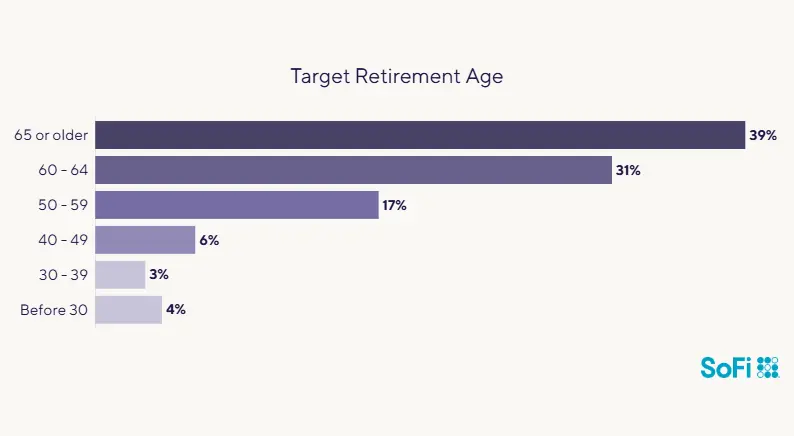
Target Retirement Age
Source: SoFi’s 2024 Retirement Survey

Social Security Early Retirement

A recipient’s benefits will be permanently reduced if they retire before full retirement age. That’s because the earlier a person retires, the less they’ll receive in Social Security.

Let’s use Jane Doe as an example and say she was born in 1960, so full retirement age is 67. If she retires at age 66, she’ll receive 93.3% of Social Security benefits; at age 65 will get Jane 86.7%. If she retires on her 62nd birthday — the earliest she can receive Social Security — she’ll only receive 70% of earnings.

Here’s a retirement planner table for those born in 1960, which shows how one’s benefits will be reduced with early retirement.

How Early Retirement Affects Your Social Security Benefits
Source: Social Security Administration

Social Security Late Retirement

If a person wants to keep working until after full retirement age, they could earn greater monthly benefits. This is helpful to know when choosing your retirement date.

For example, if the magic retirement number is 66 years but retirement is pushed back to 66 and one month, then Social Security benefits rise to 100.7% per month. So if your monthly benefit was supposed to be $1,000, but you wait until 66 years and one month, then your monthly allotment would increase to $1,007.

If retirement is pushed back to age 70, earnings go up to 132% of monthly benefits. But no need to calculate further: Social Security benefits stop increasing once a person reaches age 70. Here is a SSA table on delayed retirement .

Get a 1% IRA match on rollovers and contributions.

Double down on your retirement goals with a 1% match on every dollar you roll over and contribute to a SoFi IRA.1


1Terms and conditions apply. Roll over a minimum of $20K to receive the 1% match offer. Matches on contributions are made up to the annual limits.

Other Retirement Income to Consider

In retirement, you may have other income sources that can help you support your lifestyle and pay the bills. These might include:

Part-Time Work

Working after retirement by getting a part-time job, especially if it’s one you enjoy, could help cover your retirement expenses. And as long as you have reached your full retirement age (which is based on your year of birth, as noted above), your Social Security benefits will not be reduced, no matter what your earnings are.

However, if you retire early, you need to earn under an annual limit, which is $23,400 in 2025, to keep your full benefits. If you earn more than that, you’ll lose $1 in Social Security benefits for every $2 you earn over the limit. (Note that if some of your retirement benefits are withheld because of your earnings, your monthly benefit will increase once you reach full retirement age, taking into account the withheld benefits.)

Pension

A pension plan, also sometimes known as a defined benefits plan, from your employer is usually based on how long you worked at your company, how much you earned, and when you stopped working. You’ll need to be fully vested, which typically means working at the company for five years, to collect the entire pension. Check with the HR rep at your company to get the full details about your pension.

A pension generally gives you a set monthly sum for life or a lump sum payment when you retire.

Inheritance

If you inherit money from a relative, these funds could also help you pay for your retirement. And fortunately, receiving an inheritance won’t affect your Social Security benefits, because Social Security is based on money you earn.

Rental Income

Another potential money-earning idea: You could rent out a home you own, or rent out just the upper floors of the house you live in, for some extra income in retirement. Like an inheritance, rental income will generally not affect your Social Security benefits.

Major Expenses in Retirement

It’s important to draw up a budget for retirement to help determine how much money you might need. The amount may be higher than you realize — which is one of the reasons it’s beneficial to start saving early. In SoFi’s retirement survey, more than half of respondents (51%) say they started saving before age 35.
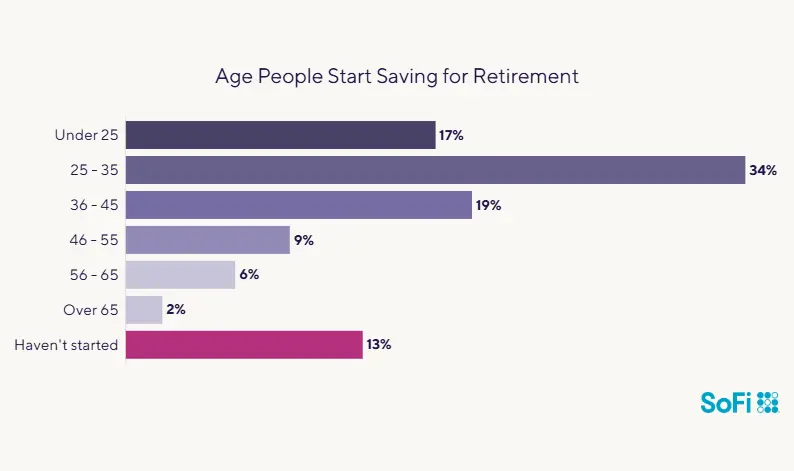
Age People Start Saving for Retirement
Source: SoFi’s 2024 Retirement Survey

As you put together your retirement budget, these are some of the major expenses retirees commonly face.

Healthcare

For most people, health care costs increase as they get older, as medical problems can become more serious or pervasive. According to Fidelity, based on 2024 numbers, the average amount that a couple who are both age 65 will spend on health care during their first year of retirement is $12,800.

Housing

Your mortgage, home insurance, and the costs of maintaining your house can be a significant monthly and yearly expense. In fact, according to the Bureau of Labor Statistics’ 2023 Consumer Expenditures report, Americans aged 65 and older spent an average of $21,445 on housing in 2023.

Travel

If you’re planning to take trips in retirement, or even just drive to visit family, transportation costs can quickly add up. The Bureau of Labor Statistics Consumer Expenditures report found that in 2023, people over age 65 averaged about $9,033 in transportation costs a year, including vehicles, maintenance, gas, and insurance.


💡 Quick Tip: You can’t just sit on the money you save in a traditional IRA account forever. The government requires withdrawals each year, starting at age 73 (for those born in 1950 or later). These are called required minimum distributions or RMDs.

When Can You Withdraw From Retirement Accounts?

Now that you have a sense of your expenses in retirement, let’s look at retirement accounts. Each type of account has different rules about when money can be taken out.

If a Roth IRA account has existed for at least five years, withdrawals can generally be taken from the account after age 59 ½ without consequences. These are known as qualified withdrawals. Taking out money earlier or withdrawing money from a Roth IRA that’s been open for fewer than five years could result in paying penalties and taxes.

There is a little wiggle room. Contributions (but not earnings) can be withdrawn at any time without penalty, no matter the age of the account holder or the age of the account.

Roth IRA withdrawal rules also have some exceptions. Qualified withdrawals may be made from an account that’s been open at least five years for the purchase of a first home (up to a $10,000 lifetime limit), due to a disability, or after the account holder’s death to be paid to their estate or a beneficiary.

People with a traditional IRA can make withdrawals after age 59 ½ without being penalized. The government will charge a 10% penalty on withdrawals before age 59 ½. There are some exceptions, such as the purchase of a first home (up to a $10,000 lifetime limit), some medical and educational expenses, disability, and death.

People with 401(k)s can make withdrawals after age 59 ½ without paying a 10% penalty. Again, there are some exceptions. For example, an individual can generally retire at age 55 and make withdrawals without penalty. There are also exceptions for those under age 59 ½ for hardship withdrawals, disability, and death, among others.

It’s important to be aware that with a traditional IRA and a 401(k), individuals must start making required minimum distributions (RMDs) by age 73 or face a penalty.


Test your understanding of what you just read.


The Takeaway

Deciding at what age to retire is a personal choice. However, by planning ahead for some common expenses, and understanding the age at which you can get full Social Security benefits, you can use a retirement calculator formula to estimate how much money you’ll need each year to live on. And you can supplement your Social Security benefits with other forms of income and by making smart decisions about savings and investments.

Ready to invest for your retirement? It’s easy to get started when you open a traditional or Roth IRA with SoFi. SoFi doesn’t charge commissions, but other fees apply (full fee disclosure here).

Easily manage your retirement savings with a SoFi IRA.

FAQ

How do I calculate my retirement age?

To calculate your full retirement age, which is the age you can receive your full retirement benefits, you can use the Social Security administration’s retirement age calculator . Essentially, if you were born in 1960 or later, your full retirement age is 67. For those born between 1954 and 1959, the full retirement age is between 66 and 67, depending exactly how old they are when they retire (such as age 66 and two months). And for those born between 1943 and 1954, full retirement age is 66.

The earlier you retire before your full retirement age, the less you’ll receive in benefits. Conversely, the longer you keep working, up to age 70, the more you can receive.

Can you legally retire before 55?

Yes, you can legally retire before age 55. However, your Social Security benefits typically won’t kick in until age 62. And even then, because you’ll be tapping into those benefits before your full retirement age of 66 or 67, you’ll get a reduced amount.

The rule of 55 generally allows you to withdraw funds from a 401(k) or 403(b) at age 55 without paying a penalty. That may be something to look into if you’re planning to retire early.

Can you retire after 20 years of work?

In some lines of work, you can retire after 20 years on the job and likely get a pension. This includes those in the military, firefighters, police officers, and certain government employees.

That said, anyone in any industry can retire at any time. However, Social Security benefits don’t typically begin until age 62.


INVESTMENTS ARE NOT FDIC INSURED • ARE NOT BANK GUARANTEED • MAY LOSE VALUE

SoFi Invest is a trade name used by SoFi Wealth LLC and SoFi Securities LLC offering investment products and services. Robo investing and advisory services are provided by SoFi Wealth LLC, an SEC-registered investment adviser. Brokerage and self-directed investing products offered through SoFi Securities LLC, Member FINRA/SIPC.

For disclosures on SoFi Invest platforms visit SoFi.com/legal. For a full listing of the fees associated with Sofi Invest please view our fee schedule.

Financial Tips & Strategies: The tips provided on this website are of a general nature and do not take into account your specific objectives, financial situation, and needs. You should always consider their appropriateness given your own circumstances.

Disclaimer: The projections or other information regarding the likelihood of various investment outcomes are hypothetical in nature, do not reflect actual investment results, and are not guarantees of future results.

Third-Party Brand Mentions: No brands, products, or companies mentioned are affiliated with SoFi, nor do they endorse or sponsor this article. Third-party trademarks referenced herein are property of their respective owners.

Third Party Trademarks: Certified Financial Planner Board of Standards Center for Financial Planning, Inc. owns and licenses the certification marks CFP®, CERTIFIED FINANCIAL PLANNER®

External Websites: The information and analysis provided through hyperlinks to third-party websites, while believed to be accurate, cannot be guaranteed by SoFi. Links are provided for informational purposes and should not be viewed as an endorsement.

SOIN-Q325-038

Read more
woman holding laptop

Retirement Plan Options for the Self-Employed

If you’re an entrepreneur, consultant, or small business owner, you might be surprised to learn that the retirement plan options when you’re self-employed — like a SEP-IRA or solo 401(k) — are very robust.

Not only do you have more options in terms of self-employed retirement plans than you might think, some of these plans come with higher contribution limits and greater tax benefits than traditional plans. That’s especially true since the passage of the SECURE 2.0 Act, which has favorably adjusted the rules of many retirement plans.

Key Points

•   Self-employed individuals have many retirement plan options, including SEP-IRAs and solo 401(k)s.

•   These plans are similar to traditional ones, allowing long-term contributions and a range of investment selections, and may offer higher contribution limits and tax benefits.

•   SEP-IRAs are ideal for business owners with employees, offering simplified contributions that are tax-deductible.

•   Solo 401(k) plans suit owner-only businesses, allowing substantial contributions when you’re both employer and employee.

•   SIMPLE IRAs are designed for small businesses with fewer than 100 employees, enabling both employer and employee contributions.

•   Thanks to SECURE 2.0, in 2025 there are additional “super catch-up” contributions allowed for those aged 60 to 63 for some accounts, as well as other new provisions.

What Are Self-Employed Retirement Plans?

In some ways, self-employed retirement plans aren’t so different from regular retirement plans. You can set aside money now, select investments within the account, and continue to contribute and invest for the long term.

Similar to traditional retirement plans, there are two main categories most self-employed plans fall into:

•   Tax-deferred retirement accounts (e.g traditional, SEP, or SIMPLE IRAs and solo 401(k) plans). The amount you can save varies by the type of account. The money you set aside is deductible, and you don’t pay tax on that portion of your income. You do pay taxes on the funds you withdraw in retirement.

•   After-tax retirement accounts (typically designated as Roth IRAs or Roth 401(k) accounts). Here you can also save up to the prescribed annual limit, but the money you save is after-tax income and cannot be deducted. That said, withdrawals in retirement are tax free.

A note about Roth eligibility: Roth IRAs come with income limits. If your income is higher than the prescribed limit, you may not be eligible. Roth 401(k) plans do not come with income restrictions. Details below.

Understanding Beneficiary Rules for Self-Employed Plans

The rules that apply to inherited retirement accounts are extremely complicated. If you’re the beneficiary of an IRA, solo 401(k) or other retirement account, you may want to consult a professional as terms vary widely, and penalties can apply.

Administrative Factors to Consider

When selecting a self-employed retirement plan, it’s important to weigh the set up, administrative, and IRS filing rules. Some plans are easier to establish and maintain than others.

Given that running a plan can add to your overall time and personnel costs, it’s important to do a cost-benefit analysis when choosing a retirement plan when you’re a freelancer, consultant, or small business owner.

💡 Quick Tip: Want to lower your taxable income? Start saving for retirement with a traditional IRA. The money you save each year is tax deductible (and you don’t owe any taxes until you withdraw the funds, usually in retirement).

5 Types of Self-Employed Retirement Plans

The IRS outlines a number of retirement plans for those who are freelance, self-employed, or who run their own businesses. Here are the basics.

1. Traditional and Roth IRAs

What they are: One of the most popular types of retirement plans is an IRA — or Individual Retirement Arrangement.

As noted above, there are traditional IRAs, which are tax deferred, as well as Roth IRAs, which are after-tax accounts.

Suited for: While anyone with earned income can open a traditional or Roth IRA, these accounts can also be used specifically as self-employed retirement plans. They are simple to set up; and most financial institutions offer IRAs.

That said, IRAs have the lowest contribution limits of any self-employed plans, and may be better suited to those who are starting out, or who have a side hustle, and can’t contribute large amounts to a retirement account.

Contribution limits. There is no age limit for contributing to a traditional or Roth IRA, but there are contribution limits (and for Roth IRAs there are income limits; see below).

For tax years 2024 and 2025, the annual contribution limit for traditional and Roth IRAs is $7,000. These IRAs allow for a catch-up contribution of up to $1,000 per year if you’re 50 or older, for a total annual limit of $8,000.

Note that your total annual combined contributions across all your IRA accounts cannot exceed those limits. So if you’re 35 and contribute $3,000 to a Roth IRA for 2024, you cannot contribute more than $4,000 to a traditional IRA in the same year, for a maximum total annual contribution of $7,000.

Remember: You have until tax day in April of the following year to contribute to an IRA.For example, you can contribute to a traditional or a Roth IRA for tax year 2024 up until April 15, 2025.

Income limits: There are no income limits for contributing to a traditional IRA, but Roth IRAs do come with income restrictions. In 2024, that limit is $146,000 for single people (people earning more than $146,000 but less than $161,000 can contribute a reduced amount). For those individuals who are married and file taxes jointly, the limit is $230,000 to make a full contribution, and between $230,000 to $240,000 for a reduced amount.

•   In 2024 for single filers, those limits are: up to $146,000; those earning more than $146,000 but less than $161,000 can contribute a reduced amount. If your income is $161,000 or higher, you cannot contribute to a Roth IRA.

•   For 2025, the income limit for single filers is up to $150,000 to make a full contribution. Those with incomes between $150,000 and $165,000 can contribute a reduced amount. If you’re single and your income is $165,000 or higher, you cannot contribute to a Roth IRA.

•   For 2024, individuals who are married and file taxes jointly have an income limit up to $230,000 to make a full contribution to a Roth, and from $230,000 to $240,000 to contribute a reduced amount.

•   For 2025, the income limit if you’re married, filing jointly, is up to $236,000 to make a full contribution. Those with incomes between $236,000 and $246,000 can contribute a reduced amount. If your income is $246,000 or higher, you cannot contribute to Roth.

Tax benefits: The main difference between a traditional vs. Roth IRA is the tax treatment of the money you save.

•   With a traditional IRA, the contributions you make are tax-deductible when you make them (unless you’re covered by a retirement plan at work, in which case conditions apply). Withdrawals are taxed at ordinary income rates.

•   With a Roth IRA, there are no tax breaks for your contributions, but qualified withdrawals are tax free.

Withdrawal rules: You owe ordinary income tax on withdrawals from a traditional IRA after age 59 ½. You may owe a 10% penalty on early withdrawals, i.e. before age 59 ½. There are exceptions to this rule for medical and educational expenses, as well as other conditions, so be sure to check with a professional or on IRS.gov.

The rules and restrictions for taking withdrawals from a Roth are more complex. Although your contributions to a Roth IRA (i.e. your principal) can be withdrawn at any time, investment earnings on those contributions can only be withdrawn tax-free and without penalty once the investor reaches the age of 59½ — and as long as the account has been open for at least five years (a.k.a. the 5-year rule).

Required Minimum Distributions (RMDs): You are required to take RMDs from a traditional IRA starting at age 73. You are not required to take minimum distributions from a Roth IRA account. RMD rules can be complicated, so you may want to consult a professional to avoid making a mistake and potentially owing a penalty.

2. Solo 401(k)

What it is: A solo 401(k) is a self-employed retirement plan that the IRS also refers to as a one-participant 401(k) plan. It works a bit like a regular employer-backed 401(k), except that in this instance you’re the employer and the employee. There are contribution rules for each role, but this dual structure enables freelancers and solo business owners to save more than a standard 401(k) would allow.

Suited for: A solo 401(k) covers a business owner who has no employees, or employs only their spouse.

Contribution limits:

•   As the employee: For 2024, you can contribute up to $23,000 or 100% of compensation (whichever is less), with an additional $7,500 in catch-up contributions allowed if you’re over 50, for a total of $30,500.

   For 2025, you can contribute up to $23,500, or 100% of compensation (whichever is less), with an additional $7,500 in catch-up contributions allowed if you’re over 50, for a total of $31,000.

•   As the employer: You can contribute up to 25% of your net earnings, with separate rules for single-member LLCs or sole proprietors.

For 2024, total contributions cannot exceed a total of $69,000, or $76,500 if you’re 50 and over. For 2025, it’s $70,000 or $77,500 with the $7,500 catch-up provision.

•   Super catch-up contribution rules: For tax year 2025, those aged 60 to 63 only can contribute an additional $11,250, instead of the standard $7,500, or $81,250 total.

You cannot use a solo 401(k) if you have any employees, though you can hire your spouse so they can also contribute to the plan (and you can match their contributions as the employer), further reducing your taxable income.

Note that 401(k) contribution limits are per person, not per plan (similar to IRA rules), so if either you or your spouse are enrolled in another 401(k) plan, then the $69,000 employer + employee limit per person for 2024 ($70,000 for 2025) must take into account any contributions to that other 401(k) plan.

Income limits: There is a limit on the amount of compensation that’s allowed for use in determining your contributions. For tax year 2024 it’s $345,000; for 2025 it’s $350,000.

Tax benefits: A solo 401(k) has a similar tax setup as a traditional 401(k). Contributions can be deducted, thus reducing your taxable income and potentially the amount of tax you owe for the year you contribute. But you owe ordinary income tax on any withdrawals.

Withdrawal rules: You can take withdrawals from a solo 401(k) without penalty at age 59 ½ or older. Distributions may be allowed before that time in the case of certain “triggering events,” such as a disability (you can find a list of exceptions at IRS.gov), but you may owe a 10% penalty as well as income tax on the withdrawal.

Required Minimum Distributions (RMDs): You are required to take minimum distributions from a solo 401(k) starting at age 73. RMD rules can be complicated, so you may want to consult a professional to avoid making a mistake and potentially owing a penalty.

3. Simplified Employee Pension (or a SEP-IRA)

What it is: A SEP-IRA, or Simplified Employee Pension plan, is similar to a traditional IRA with a streamlined way for an employer (in this case, you) to make contributions to their own and their employees’ retirement savings. Note that when using a SEP-IRA, the employer makes all contributions; employees do not contribute to the SEP.

Suited for: A key difference in a SEP-IRA vs. other self-employment retirement plans is that it’s designed for those who run a business with employees. Employers have to contribute an equal percentage of salary for every employee (and you are counted as an employee). Again, employees may not contribute to the SEP-IRA.

That means, as the employer, you can not contribute more to your retirement account than to your employees’ accounts (as a percentage, not in absolute dollars). On the plus side, it’s slightly simpler than a solo 401(k) to manage in terms of paperwork and annual reporting.

Contribution limits: For 2024, the SEP-IRA rules and limits are as follows: you can contribute up to $69,000 ($70,000 for 2025) or 25% of an employee’s total compensation, whichever is less. Be sure to understand employee eligibility rules.

As the employer you can contribute up to 20% of your net compensation.

Note that SEP-IRAs are flexible: Contribution amounts can vary each year, and you can skip a year.

Compensation limits: For tax year 2024 there is a $345,000 limit on the amount of compensation used to determine contributions; it’s $350,000 for 2025.

Tax benefits: Employers and employees can deduct contributions from their earnings, and withdrawals in retirement are taxed as income.

Withdrawal rules: You can take withdrawals from a SEP-IRA without penalty at age 59 ½ or older. Distributions may be allowed before that time in the case of certain “triggering events,” such as a disability (you can find a list of exceptions at IRS.gov), but you may owe a 10% penalty as well as income tax on the withdrawal.

Required Minimum Distributions (RMDs): You are required to take minimum distributions from a SEP-IRA starting at age 73. RMD rules can be complicated, so you may want to consult a professional to avoid making a mistake and potentially owing a penalty.

New rules under SECURE 2.0: Starting in 2024, SEP-IRA plans can now include a designated Roth option. But not all plan providers offer the Roth option at this time.

💡 Quick Tip: All investments come with some degree of risk — and some are riskier than others. Before investing online, decide on your investment goals and how much risk you want to take.

4. SIMPLE IRA

What it is: A SIMPLE IRA (which stands for Savings Incentive Match Plan for Employees) is similar to a SEP-IRA except it’s designed for larger businesses. Unlike a SEP plan, individual employees can also contribute to their own retirement as salary deferrals out of their paycheck.

Suited for: Small businesses that typically employ 100 people or less.

Contribution limits for employers: A small business owner who sets up a SIMPLE plan has two options.

•   Matching contributions. The employer can match employee contributions dollar for dollar, up to 3%.

•   Fixed contributions. The employer can contribute a fixed 2% of compensation for each employee.

Employer contributions are required every year (unlike a SEP-IRA plan), and similar to a SEP, contributions are based on a maximum compensation amount of $350,000 for 2025.

Contribution limits for employees: Employees can contribute up to $16,000 to a SIMPLE plan for 2023, an additional $3,500 for those 50 and up; $16,500 for tax year 2025, and the same $3,500 standard catch-up contribution.

2025 Super catch-up contributions: For savers age 60 to 63 only, a SECURE 2.0 provision allows an extra contribution amount of $5,250 instead of the standard $3,500 catch-up contribution starting in 2025.

Tax benefits: Employer and employees can deduct contributions from their earnings, and withdrawals in retirement are taxed as income.

Withdrawal rules: Withdrawals are taxed as income. If you make an early withdrawal before the age of 59 ½ , you’ll likely incur a 10% penalty much like a regular 401(k); do so within the first two years of setting up the SIMPLE account and the penalty jumps to 25%.

Required Minimum Distributions (RMDs): You are required to take minimum distributions from a SEP-IRA starting at age 73. RMD rules can be complicated, so you may want to consult a professional to avoid making a mistake and potentially owing a penalty.

New rules under SECURE 2.0: Starting in 2024, the federal law permits employers that provide a SIMPLE plan to make additional contributions on behalf of employees, as long as the amount doesn’t exceed 10% of compensation or $5,000, whichever is less. This amount will be indexed for inflation.

Also under these new rules, student loan payments that employees make can be treated as elective deferrals (contributions) for the purpose of the employer’s matching contributions.

In addition, SIMPLE plans can now include a designated Roth option, but not all plan providers offer the Roth option at this time.

5. Defined-Benefit Retirement Plan

Another retirement option you’ve probably heard about is the defined-benefit plan, or pension plan. Typically, a defined benefit plan pays out set annual benefits upon retirement, usually based on salary and years of service.

Typically pension plans have been set up and run by very large entities, such as corporations and federal and local governments. But it is possible for a self-employed individual to set up a DB plan.

These plans do allow for very high contributions, but the downside of trying to set up and run your own pension plan is the cost and hassle. Because a pension provides fixed income payments in retirement (i.e. the defined benefit), actuarial oversight is required annually.

The Takeaway

When you’re an entrepreneur, freelance, or otherwise self-employed, it may feel as if you’re out on your own, and your options are limited in terms of retirement plans. But in fact there are a number of options to consider, including various types of IRAs and a solo 401(k).

In some cases, these plans can be just as robust as employer-provided plans in terms of contribution limits and tax benefits, or even more so. Also, be aware that some plans now offer additional contribution amounts, thanks to SECURE 2.0.

Ready to invest for your retirement? It’s easy to get started when you open a traditional or Roth IRA with SoFi. SoFi doesn’t charge commissions, but other fees apply (full fee disclosure here).

Easily manage your retirement savings with a SoFi IRA.


INVESTMENTS ARE NOT FDIC INSURED • ARE NOT BANK GUARANTEED • MAY LOSE VALUE

SoFi Invest is a trade name used by SoFi Wealth LLC and SoFi Securities LLC offering investment products and services. Robo investing and advisory services are provided by SoFi Wealth LLC, an SEC-registered investment adviser. Brokerage and self-directed investing products offered through SoFi Securities LLC, Member FINRA/SIPC.

For disclosures on SoFi Invest platforms visit SoFi.com/legal. For a full listing of the fees associated with Sofi Invest please view our fee schedule.

Tax Information: This article provides general background information only and is not intended to serve as legal or tax advice or as a substitute for legal counsel. You should consult your own attorney and/or tax advisor if you have a question requiring legal or tax advice.

Financial Tips & Strategies: The tips provided on this website are of a general nature and do not take into account your specific objectives, financial situation, and needs. You should always consider their appropriateness given your own circumstances.

SOIN-Q424-110

Read more
Businessman on cell phone

How to Roll Over Your 401(k): Knowing Your Options

It’s pretty easy to rollover your old 401(k) retirement savings to an individual retirement account (IRA), a new 401(k), or another option — yet millions of workers either forget to rollover their hard-won retirement savings, or they lose track of the accounts. Given that a 401(k) rollover typically takes minimal time and, these days, minimal paperwork, it makes sense to know the basics so you can rescue your 401(k), roll it over to a new account, and add to your future financial security.

Whether you’re starting a new job and need to roll over your 401(k), or are looking at what other options are available to you, here’s a rundown of what you need to know.

Key Points

•   Rolling over a 401(k) to an IRA or new 401(k) is typically straightforward and your retirement funds will continue to have the opportunity to grow.

•   Moving 401(k) funds to another 401(k) is often the simplest option and allows you to continue to have a higher contribution limit.

•   Moving 401(k) funds to an IRA may provide more investment choices and control over those investments.

•   Leaving a 401(k) with a former employer is an option but may involve additional fees and complications.

•   Direct transfers are simpler and generally preferred over indirect transfers, which run the risk of incurring tax liabilities and penalties.

401(k) Rollover Options

For workers who have a 401(k) and are considering next steps for those retirement funds — such as rolling them to an IRA or another 401(k), here are some potential avenues.

1. Roll Over Money to a New 401(k) Plan

If your new job offers a 401(k) or similar plan, rolling your old 401(k) funds into your new 401(k) account may be both the simplest and best option — and the one least likely to lead to a tax headache.

That said, how you go about the rollover has a pretty major impact on how much effort and paperwork is involved, which is why it’s important to understand the difference between direct and indirect transfers.

Here are the two main options you’ll have if you’re moving your 401(k) funds from one company-sponsored retirement account to another.

Direct Rollover

A direct transfer, or direct rollover, is exactly what it sounds like: The money moves directly from your old account to the new one. In other words, you never have access to the money, which means you don’t have to worry about any tax withholdings or other liabilities.

Depending on your account custodian(s), this transfer may all be done digitally via ACH transfer, or you may receive a paper check made payable to the new account. Either way, this is considered the simplest option, and one that keeps your retirement fund intact and growing with the least possible interruption.

Indirect Rollover

Another viable, but more complex, option, is to do an indirect transfer or rollover, in which you cash out the account with the expressed intent of immediately reinvesting it into another retirement fund, whether that’s your new company’s 401(k) or an IRA (see above).

But here’s the tricky part: Since you’ll actually have the cash in hand, the government requires your account custodian to withhold a mandatory 20% tax. And although you’ll get that 20% back in the form of a tax exemption later, you do have to make up the 20% out of pocket and deposit the full amount into your new retirement account within 60 days.

For example, say you have $50,000 in your old 401(k). If you elected to do an indirect transfer, your custodian would cut you a check for only $40,000, thanks to the mandatory 20% tax withholding.

But in order to avoid fees and penalties, you’d still need to deposit the full $50,000 into your new retirement account, including $10,000 out of your own pocket. In addition, if you retain any funds from the rollover, they may be subject to an additional 10% penalty for early withdrawal.

Pros and Cons of Rolling Over to a New 401(k)

With all of that in mind, rolling over your money into a new 401(k) has some pros and cons:

thumb_up

Pros:

•   Often the simplest, easiest rollover option when available.

•   Should not typically result in any tax liabilities or withholdings.

•   Allows your investments to continue to grow (hopefully!), uninterrupted.

thumb_down

Cons:

•   New employer may change certain aspects of your 401(k) plan.

•   There may be higher associated fees or costs with your new plan.

•   Indirect transfers may tie up some of your funds for tax purposes.

Get a 1% IRA match on rollovers and contributions.

Double down on your retirement goals with a 1% match on every dollar you roll over and contribute to a SoFi IRA.1


1Terms and conditions apply. Roll over a minimum of $20K to receive the 1% match offer. Matches on contributions are made up to the annual limits.

2. Roll Over Your 401(k) to an IRA

If your new job doesn’t offer a 401(k) or other company-sponsored account like a 403(b), you still have options that’ll keep you from bearing a heavy tax burden. Namely, you can roll your 401(k) into an IRA.

The entire procedure essentially boils down to three steps:

1. Open a new IRA that will accept rollover funds.

2. Contact the company that currently holds your 401(k) funds and fill out their transfer forms using the account information of your newly opened IRA. You should receive essential information about your benefits when you leave your current position. If you’ve lost track of that information, you can contact the plan sponsor or the company HR department.

3. Once your money is transferred, you can reinvest the money as you see fit. Or you can hire an advisor to help you set up your new portfolio. It also may be possible to resume making deposits/contributions to your rollover IRA.

Pros and Cons of Rolling Over to an IRA

This option also has its pros and cons, however.

thumb_up

Pros:

•   IRAs may have more investment options available.

•   You’ll have more control over how you allocate your investments.

•   You could potentially reduce related expenses, depending on your specifications.

thumb_down

Cons:

•   May require you to liquidate your holdings and reinvest them.

•   Lower contribution limit compared to 401(k).

•   May involve different or higher fees and additional costs.

•   IRAs may provide less protection from creditor judgments.

•   You’ll be subject to new distribution rules – namely, you’ll need to be 59 1/2 before withdrawing funds to avoid incurring penalties.

3. Leave Your 401(k) With Your Former Employer

Leaving your 401(k) be – or, with your former employer – is also an option.

If you’re happy with your portfolio mix and you have a substantial amount of cash stashed in there already, it might behoove you to leave your 401(k) where it is.

You’ll also want to dig into the details and determine how much control you’ll have over the account, and how much your former employer might.

You might also consider any additional fees you might end up paying if you leave your 401(k) where it is. Plus, racking up multiple 401(k)s as you change jobs could lead to a more complicated withdrawal schedule at retirement.

Pros and Cons of Leaving Your 401(k) Alone

thumb_up

Pros:

•   It’s convenient – you don’t do anything at all, and your investments will remain where they are.

•   You’ll have the same protections and fees that you previously had, and won’t need to get up to speed on the ins and outs of a new 401(k) plan.

thumb_down

Cons:

•   If you have a new 401(k) at a new employer, you could end up with multiple accounts to juggle.

•   You’ll no longer be able to contribute to the 401(k), and may not get regular updates about it.

4. Cash Out Your Old 401(k)

Cashing out, or liquidating your old 401(k) is another option. But there are some stipulations investors should be aware of.

Because a 401(k) is an investment account designed specifically for retirement, and comes with certain tax benefits — e.g. you don’t pay any tax on the money you contribute to your 401(k), depending on the specific type — the account is also subject to strict rules regarding when you can actually access the money, and the tax you’d owe when you did.

Specifically, if you take out or borrow money from your 401(k) before age 59 ½, you’ll likely be subject to an additional 10% tax penalty on the full amount of your withdrawal — and that’s on top of the regular income taxes you’ll also be obligated to pay on the money.

Depending on your income tax bracket, that means an early withdrawal from your 401(k) could really cost you, not to mention possibly leaving you without a nest egg to help secure your future.

This is why most financial professionals generally recommend one of the next two options: rolling your account over into a new 401(k), or an IRA if your new job doesn’t offer a 401(k) plan.

Pros and Cons of Cashing Out Your 401(k)

thumb_up

Pros:

•   You’ll have immediate access to your funds to use as you like.

thumb_down

Cons:

•   Early withdrawal penalties may apply, and there will likely be income tax liabilities.

•   Liquidating your retirement account may hurt your chances of reaching your financial goals.

When Is a Good Time to Roll Over a 401(k)?

If there’s a good time to roll over your 401(k), it’s when you change jobs and have the chance to enroll in your new employer’s plan. But you can generally do a rollover any time.

That said, if you have a low balance in your 401(k) account — for example, less than $5,000 — your employer might require you to do a rollover. And if you have a balance lower than $1,000, your employer may have the right to cash it out without your approval. Be sure to check the exact terms with your employer.

When you receive funds from a 401(k) or IRA account, such as with an indirect transfer, you’ll only have 60 days from the date you receive them to then roll them over into a new qualified plan. If you wait longer than 60 days to deposit the money, it will trigger tax consequences, and possibly a penalty. In addition, only one rollover to or from the same IRA plan is allowed per year.

The Takeaway

Rolling over your 401(k) — to a new employer’s plan, or to an IRA — gives you more control over your retirement funds, and could also give you more investment choices. It’s not difficult to rollover your 401(k), and doing so can offer you a number of advantages. First of all, when you leave a job you may lose certain benefits and terms that applied to your 401(k) while you were an employee. Once you move on, you may pay more in account fees for that account, and you will likely lose the ability to keep contributing to your account.

There are some instances where you may not want to do a rollover, for instance when you own a lot of your old company’s stock, so be sure to think through your options.

Ready to invest for your retirement? It’s easy to get started when you open a traditional or Roth IRA with SoFi. SoFi doesn’t charge commissions, but other fees apply (full fee disclosure here).

Help grow your nest egg with a SoFi IRA.

FAQ

How can you roll over a 401(k)?

It’s fairly easy to roll over a 401(k). First decide where you want to open your rollover account, then contact your old plan’s administrator, or your former HR department. They typically send funds to the new institution directly via an ACH transfer or a check.

What options are available for rolling over a 401(k)?

There are several options for rolling over a 401(k), including transferring your savings to a traditional IRA, or to the 401(k) at your new job. You can also leave the account where it is, although this may incur additional fees. It’s generally not advisable to cash out a 401(k), as replacing that retirement money could be challenging.


INVESTMENTS ARE NOT FDIC INSURED • ARE NOT BANK GUARANTEED • MAY LOSE VALUE

SoFi Invest is a trade name used by SoFi Wealth LLC and SoFi Securities LLC offering investment products and services. Robo investing and advisory services are provided by SoFi Wealth LLC, an SEC-registered investment adviser. Brokerage and self-directed investing products offered through SoFi Securities LLC, Member FINRA/SIPC.

For disclosures on SoFi Invest platforms visit SoFi.com/legal. For a full listing of the fees associated with Sofi Invest please view our fee schedule.

Financial Tips & Strategies: The tips provided on this website are of a general nature and do not take into account your specific objectives, financial situation, and needs. You should always consider their appropriateness given your own circumstances.

Tax Information: This article provides general background information only and is not intended to serve as legal or tax advice or as a substitute for legal counsel. You should consult your own attorney and/or tax advisor if you have a question requiring legal or tax advice.

¹Claw Promotion: Probability of Member receiving $1,000 is a probability of 0.026%; If you don’t make a selection in 45 days, you’ll no longer qualify for the promo. Customer must fund their account with a minimum of $50.00 to qualify. Probability percentage is subject to decrease. See full terms and conditions.

SOIN-Q324-044

Read more
TLS 1.2 Encrypted
Equal Housing Lender