A woman with short, dark hair, wearing wire-rimmed glasses and a blue blouse, sits in an office smiling down at her computer screen.

Getting a $3,000 Personal Loan

The funds from a personal loan can be used for anything from paying off high-interest credit card debt to setting up a new home gym. But how hard is it to qualify for a $3,000 personal loan? And what if you have bad credit? Lenders may charge higher interest rates and financing fees because a borrower with bad credit is considered higher risk. Should you turn to a non-bank lender in this situation?

Read on to find out how to get a personal loan, what credit score you need for a personal loan, and where to go to get a loan if you have bad credit.

Key Points

•   Personal loans offer flexibility in usage, allowing borrowers to cover various expenses like debt consolidation or personal purchases without needing collateral.

•   Qualification for a $3,000 personal loan often requires a decent credit score, with many lenders preferring scores of 670 or higher for better terms.

•   Monthly payments on personal loans are fixed, making budgeting easier, but borrowers should be cautious of potential origination fees and penalties.

•   For those with lower credit scores, higher interest rates are common, so it’s important to compare multiple offers to find the best available rate and terms.

•   Applying for a personal loan involves checking credit reports, comparing lender terms, and gathering necessary documentation, which can streamline the approval process.

Can I Get a $3,000 Personal Loan with Bad Credit?

A personal loan is money borrowed from a bank, credit union, or online lender. (Banks and credit unions can do business online, of course, and some do business entirely online.) Personal loan amounts range from $1,000 to $100,000, and the principal is paid back with interest in fixed monthly payments, typically over several months to seven years. Personal loans are flexible, meaning they can be used for virtually any purpose, from a cross-country move to home improvements. There are even vacation loans and wedding loans in the personal loan category.

Getting approved for a personal loan that is $3,000 with bad credit may mean you have to jump through a few hoops to qualify. What is bad credit? According to FICO®, someone with a score of 580 or below is considered to have “poor” credit (the lowest rating tier) and poses a high risk to a lender.

When calculating an individual’s credit score, FICO and other rating agencies will look at a variety of factors, including whether you pay bills on time, how long you have held credit lines or loans, how much of your available credit you are currently using, how often lenders have pulled your credit report, and your history of bankruptcy or foreclosure.

A low credit score indicates that you could be at a higher risk of defaulting on a loan. To compensate for that risk, a lender may charge you a higher interest rate for a loan or credit card, or you may have to put down a deposit or provide collateral.

Factors Lenders Consider Beyond Credit Score

When lenders evaluate your application for a personal loan, they might consider other factors in addition to your credit score. Your debt-to-income (DTI) ratio — the amount of your monthly debts divided by your monthly pretax income — will be important. Lenders prefer a DTI ratio below 35% or 40%.

Lenders may also consider your income history. Having a steady source of income and showing gradually increasing income will help your case.

What Is the Typical Credit Score Required for a $3,000 Personal Loan?

While some personal loan lenders allow you to apply with a very low credit score, many require a minimum credit score of 620 to be considered for a $3K loan. Generally, the higher your credit score, the lower the interest rate you will pay when compared to other borrowers seeking the same size loan. A score of 670 to 720 or higher is preferred for the best available rates.

Benefits of a $3,000 Personal Loan

The benefits of a $3,000 personal loan include flexibility and predictability. The loan can be used for pretty much anything you need, and the payments will be the same each month until the loan is paid off.

Interest Rates and Flexible Terms

The interest rate for a personal loan will typically be fixed for the term of the loan, and the repayment terms are flexible, ranging between a few months to seven (or more) years. Personal loans typically have a lower interest rate than a credit card, and the rates can be much better if you have excellent credit. You might also be able to borrow more using a personal loan versus a credit card.

Fixed Monthly Payments

A personal loan will have fixed monthly payments for the life of the loan, which makes budgeting for bills easier.

No Collateral Required

Using collateral for personal loans typically is not necessary. These are called “unsecured” loans. Unsecured personal loans are also sometimes called “signature loans.”

Some loans require the borrower to use their car or home as an asset to guarantee the loan. The interest rate may be a little higher for an unsecured loan than it would be for a secured loan because the lender assumes more risk, but you won’t risk your car or home if you default. There are also hard money personal loans, often used by those investing in real estate. These use the home as collateral. But most personal loans don’t involve collateral.

Recommended: Secured vs. Unsecured Personal Loans

Cons of a $3,000 Personal Loan

A personal loan might not be the best option depending on your situation and the loan’s purpose. Here are some of the downsides to a personal loan.

Debt Accumulation

Many people use personal loans to pay off credit card debt because the interest paid on a credit card is generally more than the interest paid on a personal loan. However, this can be a double-edged sword if clearing your credit card balances tempts you to use those cards again and rack up even more debt.

Origination Fees and Penalties

Personal loans may come with significant fees and penalties that can drive up the cost of borrowing. Though some lenders don’t charge origination fees, these fees are common and can run as high as 10% of the loan amount. If you decide to pay off the balance before the term ends, you may have to pay a penalty.

Interest Rates May Be Higher Than Other Options

This is particularly true for people who have a low credit score. In that case, a credit card might charge a lower rate than a personal loan.

If you have equity in your home, another option is a home equity line of credit (HELOC) or a home equity loan. Alternatively, a balance transfer credit card might charge a lower interest rate than you’re currently paying on your credit card balance.

Risk of Relying on Personal Loans for Ongoing Expenses

Whatever method of borrowing you choose, it’s a red flag if you are seeking a loan or piling up credit card debt to cover routine costs like your rent, groceries, or heating bills. If this is the case, take a hard look at how you are spending money throughout your life to determine whether you have opportunities to redistribute funds so you don’t need a loan for everyday expenses. Credit counseling might be helpful to you.

Where Can I Get a $3,000 Personal Loan?

You can obtain a personal loan from many different sources, each with its own distinctive qualities.

Banks and Credit Unions

A bank will typically require good credit to qualify for a personal loan. You may also need an account with the bank. Account holders are likely to qualify for the lowest interest rates and bigger loans. Some banks will require you to visit a branch and complete the application in person, but not all banks and credit unions have branches and some do business only online.

Credit unions may offer lower interest rates and more flexible terms for members. Having a history with a credit union might boost your eligibility. Through March 10, 2026, federally chartered credit unions cap annual percentage rates (APRs) at 18%, so borrowers with imperfect credit may receive lower rates than they would elsewhere. This cap may or may not be extended in future months.

Online Lenders

Online lenders do business entirely online. Some (but not all) are technically banks, in that they are regulated at the federal or state level. Online lenders offer a streamlined application process, and loans are often funded within two days. Some users choose online lenders for reasons of speed. Others might opt for an online lender because some online lenders have more lenient credit score requirements for personal loans than brick-and-mortar banks.

When using an online lender, you can typically get prequalified and see your potential loan terms before you apply. An online lender might do a soft credit check to prequalify you for a loan, but your credit rating will not be affected. If the idea of applying entirely online and tracking every step of your loan process from your phone appeals to you, an online lender could be a good fit. Check interest rates and loan terms as you would with any lender.

Peer-to-Peer Lending Platforms

Peer-to-peer lending has grown in popularity in recent years. It allows those who wish to borrow money to connect through an app with investors (individuals or companies) willing to lend. Loans can be approved and funded in as little as one day. Some peer-to-peer platforms have lower credit score requirements or higher loan limits than banks, credit unions, or online lenders. This type of lending has become especially popular among entrepreneurs starting small businesses. The time allotted for borrowers to repay the loan may be shorter than it would be with a bank, while the fees may be higher.

How to Apply for a $3,000 Personal Loan

1.    Check your credit reports. You may find errors on your reports that you can fix to boost your eligibility for lower-rate loans.

2.    Compare the terms and conditions offered by lenders. A personal loan calculator can help you determine what your payments will be.

3.    Prequalify if you can, because it won’t affect your credit score and will help you with your comparison.

4.    Consider using your car or other collateral to get a better rate with a secured loan.

5.    Use a cosigner (with good credit) to get a better rate. The cosigner’s credit rating is considered along with your own, but they must agree to pay the loan if you cannot.

6.    Gather the documents you need and apply to the best lender. Examples of documents you may be asked to provide are W-2s, paystubs, and financial statements.

What Happens After Approval and Funding

Once you’ve filed your application, you’ll await word as to whether your loan request has been approved. If your application is approved, the lender will deposit the funds into the bank account or your choice. If you are using the loan to pay down credit card debt, some lenders will pay the credit card lender for you. The whole process could take anywhere from a day to two weeks. You’ll then begin making monthly payments covering a portion of the principal (what you have borrowed) and the interest.

💡 Quick Tip: To find the lowest personal loan rate with SoFi, compare different term lengths and select the option that best fits your budget and financial goals.

Choosing Between $5,000 and $10,000 Personal Loans

When you’re thinking about applying for a personal loan, it’s important to understand the different factors that can affect your borrowing costs: the loan amount, the APR, and the repayment term. As a reminder, the APR, or annual percentage rate, is the interest rate plus any fees — in other words, the total cost of borrowing. Let’s examine how the APR might affect costs by looking first at the costs of a $5,000 loan:

$5,000 Personal Loan

Here’s an example of what your costs would be if you took out a $5,000 loan with a three-year term at various APRs:

APR Monthly Payment Total Interest Cost
8% $157 $640.55
12% $166 $978.58
16% $176 $1,328.27

Now let’s see what happens to costs if you increase the loan amount to $10,000.

$10,000 Personal Loan

If you’re wondering how much of a personal loan can I get and consider a larger loan amount, it helps to compare the costs of smaller and larger loan amounts. The monthly payment on a personal loan of $10,000 with a 12.00% APR and a three-year term would be $332.13. The loan’s total interest cost by the end of the term would be $1,957.15.

A Shorter Repayment Term

The shorter the repayment term, the higher your monthly payments will typically be. If you were to opt for the same $10,000 loan and got the same 12.00% APR rate but had a five-year term rather than a three-year one, the monthly payment would be $222.44 and total interest cost would be $3,346.67.

The Takeaway

A personal loan is a way to get flexible financing quickly. A personal loan can be used for nearly any purpose, and the term of the loan can range from a few months to seven or more years. Banks, credit unions, online lenders, and peer-to-peer lenders offer these loans at varying interest rates.

Personal loans are popular for people who want to consolidate their debt or pay off credit cards that charge a higher interest rate. The requirements for a $3K loan depend on the lender, but a good credit score will typically get you a better rate. It’s important to check rates and examine fees at various lenders before diving into the application process.

Think twice before turning to high-interest credit cards. Consider a SoFi personal loan instead. SoFi offers competitive fixed rates and same-day funding. See your rate in minutes.


SoFi’s Personal Loan was named a NerdWallet 2026 winner for Best Personal Loan for Large Loan Amounts.

FAQ

What credit score is needed for a $3,000 personal loan?

A score of at least 620 is typically required to qualify for an unsecured personal loan, though some online lenders and peer-to-peer lenders will accept lower scores. To qualify for a lender’s lowest interest rate, however, borrowers generally need a score of at least 670 to 720 or higher.

Is it possible to get a $3,000 loan with bad credit?

Some lenders, primarily online or peer-to-peer lenders, will extend personal loans to people with bad credit. In fact, some online lenders will specifically advertise personal loans for borrowers with bad credit. However, the terms may include high interest rates and fees.

What’s the monthly payment on a $3,000 personal loan?

The monthly payment on a $3,000 personal loan will depend on the loan term and the interest rate. For example, the monthly payment on a two-year $3,000 loan with an annual percentage rate (APR) of 12.00% would be $141.22. The monthly payment on a $3,000 loan with a six-year term and an APR of 12.00% would be $58.65.

How long does it take to get approved and funded for a $3,000 personal loan?

Depending on the lender and your financial credentials, it is possible to be approved in as little as a day, although the entire process — from application to receiving funds — can sometimes take up to two weeks.

Can I use a $3,000 personal loan for any purpose?

Borrowers can use funds from a personal loan for practically anything. Debt consolidation (paying off credit card debt) is a common use, but some borrowers use personal loans to pay for travel, medical bills, or a wedding, among other things. The important thing when taking out a personal loan is that you have a strategy in place to repay what you have borrowed.


Photo credit: iStock/nortonrsx

SoFi Loan Products
SoFi loans are originated by SoFi Bank, N.A., NMLS #696891 (Member FDIC). For additional product-specific legal and licensing information, see SoFi.com/legal. Equal Housing Lender.


²SoFi Bank, N.A. NMLS #696891 (Member FDIC), offers loans directly or we may assist you in obtaining a loan from SpringEQ, a state licensed lender, NMLS #1464945.
All loan terms, fees, and rates may vary based upon your individual financial and personal circumstances and state.
You should consider and discuss with your loan officer whether a Cash Out Refinance, Home Equity Loan or a Home Equity Line of Credit is appropriate. Please note that the SoFi member discount does not apply to Home Equity Loans or Lines of Credit not originated by SoFi Bank. Terms and conditions will apply. Before you apply, please note that not all products are offered in all states, and all loans are subject to eligibility restrictions and limitations, including requirements related to loan applicant’s credit, income, property, and a minimum loan amount. Lowest rates are reserved for the most creditworthy borrowers. Products, rates, benefits, terms, and conditions are subject to change without notice. Learn more at SoFi.com/eligibility-criteria. Information current as of 06/27/24.
In the event SoFi serves as broker to Spring EQ for your loan, SoFi will be paid a fee.


Disclaimer: Many factors affect your credit scores and the interest rates you may receive. SoFi is not a Credit Repair Organization as defined under federal or state law, including the Credit Repair Organizations Act. SoFi does not provide “credit repair” services or advice or assistance regarding “rebuilding” or “improving” your credit record, credit history, or credit rating. For details, see the FTC’s website .

Non affiliation: SoFi isn’t affiliated with any of the companies highlighted in this article.

Third Party Trademarks: Certified Financial Planner Board of Standards Center for Financial Planning, Inc. owns and licenses the certification marks CFP®, CERTIFIED FINANCIAL PLANNER®

SOPL-Q126-005

Read more
An adhesive bandage covers a crack in a pink tile on a bathroom wall.

What Are the Most Common Home Repair Costs?

Thanks to high demand and inflation, the cost of home repairs has been on the rise. In 2025, the average household spent $2,041 on maintenance and $1,143 on emergency repairs, according to Angi’s State of Home Spending Report. The report also found Millennials led all generations in spending, with an average total home spend of $14,199, including the highest maintenance ($2,601) and emergency ($1,519) expenditures.

The most common home repairs include the usual suspects: electrical, plumbing, HVAC, water damage, and termite damage. Keep reading to learn more about these issues and the cost of repair or replacement, so you can pick up tips on maintaining the value of your home and be prepared for repairs when reality bites.

Key Points

•   Common home repairs include foundation issues, electrical problems, roof repairs, water heater replacements, water damage, plumbing, septic system repairs, HVAC issues, mold removal, and termite damage, with costs ranging from a few hundred to tens of thousands of dollars.

•   The average household spending on home repairs in 2025 was $2,041 on maintenance and $1,143 on emergency repairs.

•   High-cost repairs include foundation repair (up to $8,129), roof replacement (up to $13,223), and septic system replacement (up to $12,000), highlighting the need for a strong emergency fund.

•   Budgeting for home repairs can be guided by rules of thumb, such as setting aside 1% of your home’s value annually, $1 per square foot of living space, or 10% of main monthly expenses.

Estimated Cost of the Most Common Home Repairs

Low-cost preventive measures — like cleaning your gutters or getting your heating and cooling systems serviced annually — can help keep common home repair costs down. But even with the best preparation, surprises (like a busted pipe or roof leak) happen, and when they do, you can be on the hook for thousands of dollars. Whether you’re a new or longtime homeowner, it’s a good idea to plan for — and budget for — home repairs.

Below is a roundup of the most common home repairs and average costs.

Foundation Repair

A number of different issues can occur with foundations, some of which are more serious (aka, costly) than others. Among the most common problems are foundation cracks, which can be caused by house settling or changes in soil pressure around the home. Cracks can lead to water damage or cause the walls in your foundation or home to bow. Foundations can also begin to sink, due to changing weather patterns, nearby tree roots, or erosion.

Since the foundation is the footprint of your home, repairs can be complicated and expensive. According to Angi, foundation repair costs can range anywhere from $2,224 to $8,129.

Average cost of foundation repair: $5,172

Electrical Issues

While there are many home repairs you can safely DIY, electrical issues and wiring are generally best left to professional electricians. Working with live wires can be dangerous and faulty electrical work can be a significant fire hazard. Some signs you may need to call an electrician include:

•   Burning smell coming from an outlet

•   Buzzing or sizzling noises coming from an outlet

•   Flickering lights

•   Outlets feel hot to the touch

•   You have 2- rather than 3-prong outlets

•   Circuit breaker continually trips

•   Appliances spark when plugged in

Depending on the length and complexity of the job, the cost of hiring an electrician ranges between $163 and $536. Installing a new outlet can run $100 to $450, while replacing a breaker panel can cost anywhere from $519 to $2,187.

Average cost of electrical repairs: $348

Recommended: What Is the Cost to Rewire a House?

Roof Repair

Your roof protects your home from the elements, so it’s important to keep it in top condition. If you notice any damage or signs of wear and tear, you’ll want to address them sooner rather than later. This can help prevent small problems from becoming serious and expensive. Signs that your roof may be compromised include broken, cracked, curling, or missing shingles, and any interior signs of water damage (such as dark spots or discoloration on walls or ceiling and/or mold or rotting wood in the attic).

The cost of a roof repair will depend on your home’s location, roofing material, size of your home, and the type of roof. On average, costs run between $393 and $1,939. By contrast, a full roof replacement can run between $5,870 to $13,223. Due to the significant price difference, you would generally only invest in a new roof if the damage to your existing roof is extensive or the roof is near the end of its life.

Average cost of roof repairs: $1,158

Repair or Replace a Water Heater

Due to mineral buildup and the routine breakdown of components, water heaters do not last forever. Depending on how extensive the repairs your water heater requires, you can be on the hook for a new unit entirely. And if you’ve ever taken a cold shower in the middle of winter, you know this is one repair that is essential to your quality of life.

On average, homeowners spend anywhere from $222 to $990 on water heater repairs. Your actual bill will depend on the cost of the part needed for the fix, how much your local water heater professional charges for labor, and the length of the job. Where you live and where the water heater is located in your home can also impact costs.

Average cost of water heater repairs: $606

Water Damage

Water damage is fairly common. It can result from a crack in an old pipe, a leaky roof, an unusually strong storm, or sewage backup. To prevent mold growth and further damage, it’s best to fix the issue and clear out moisture as soon as you spot it.

Water damage restoration can involve replacing wallboard, flooring, and/or ceilings, as well as ensuring that no mold spores are left behind to spread once the repairs are complete. Two important factors influencing price are the square footage affected and the type of water (i.e., whether it’s clean or has been contaminated with potentially harmful substances). The cost of water damage restoration generally ranges between $1,384 and $6,387.

Average cost to fix water damage: $3,867


Replacing Pipes

Replacing older pipes is a common home repair often needed after a home inspection. Common problems include dated construction materials with a known problem in their manufacturing, signs of corrosion, clogs, and leaks. And because pipes run behind walls and underground, repair costs often include patching up interior holes and dug-up yards.

The good news is that not all leaks, burst pipes, and signs of corrosion require replacing large amounts of plumbing. Often, a plumber can replace a small section of the pipe affected by the damage. The cost to install pipes for a repair ranges from $372 to $2,131, though it can run higher if the damaged pipes are difficult to access.

Average cost to install pipes: $1,251

Recommended: Renovation vs Remodel: What’s the Difference?

Septic System Repair

A septic tank contains and filters household wastewater. If it is damaged or not functioning properly, it’s important to deal with the problem quickly — otherwise, you could be dealing with a smelly and costly mess. Sewage backups can occur when the septic tank becomes clogged or full, there’s a problem with devices within the tank, or there’s a blockage in the home’s main drain line leading to the tank.

Depending on the type of repair, tank size, permits, and other factors, the cost of a septic tank repair runs, on average, between $628 and $3,039. A small fix like repairing a septic tank lid could cost less ($150 to $500); but if you need to replace the tank, you could be looking at a bill as high as $12,000.

Average cost to repair a septic system: $1,830

Heating or Air Conditioning Repair

Your home’s HVAC (which stands for heating, ventilation, and air conditioning) system plays a key role in keeping your home comfortable to live in. Though there are many different types of HVAC systems, they generally all work by using energy to heat or cool the air to a desired temperature. The system may also add/remove moisture and filter your home’s indoor air.

An HVAC system typically has two main components: a heater (which could be a furnace, boiler, or heat pump) and an air conditioning (AC) unit. The type of system you have and the component that’s broken will significantly influence the cost of repairs. For example, an AC system repair can run anywhere from $130 to $2,000, while a furnace repair tends to run between $132 and $503. On average, homeowners spend between $130 and $2,000 on HVAC repairs.

Average cost to fix a heating or air conditioning system: $350

Mold Removal

Mold develops inside homes as a result of moisture and can lead to health problems. Signs that you may have a mold problem include:

•   Musty odor in a specific area

•   Discoloration on the walls

•   Peeling, cracking, or warping of floors or walls

•   Leaks or water damage

•   Darkening around tile grout

•   Worsening of allergy symptoms

While you may be able to remove small amounts of mold yourself (provided you’re certain the mold isn’t toxic), often the best option is to hire a mold remediation professional.

The cost for mold removal will vary widely depending on where it is located in your home. Mold growth in hard-to-reach areas, like drywall or your HVAC system, generally costs more to remediate since it can require more time, materials, and labor. The size of the infestation and the type of mold that is growing also influence costs. On average, mold removal runs between $1,223 and $3,753.

Average cost of mold removal: $2,367

Termite Damage

The problem with termites is that they literally eat away at your house. They can also eat through your budget: The cost to repair termite damage can range anywhere from $1,000 to $10,000 or even more.

Generally, the longer termites chew on the wooden structure of your home, the more costly the repair will be, so it’s key to recognize — and deal with — any signs of a termite infestation early. If you catch a termite problem early, for example, you may only need to replace a few damaged boards or joists, which can run from $250 to $1,000. If the problem goes on for a while, however, you may need to replace damaged walls, framing, or floors — at a cost of $1,000 to $3,000. Worst-case scenario: Termites do enough damage to your home’s infrastructure (like beams or load-bearing walls) that it becomes structurally unsound. A major termite repair job can run you more than $37,000.

Average cost to repair termite damage: $3,000

Factors That Affect Home Repair Costs

Home repair costs can vary widely based on geographic location and other cost drivers. These are the things that might influence your bill:

Age of the Home

Not surprisingly, older homes will typically have higher repair costs. Sometimes the repair itself isn’t the driver of the increase, but rather the costs associated with postrepair restoration, such as repairing plaster walls or replacing intricate woodwork. The higher cost of buying a fixer upper can stick with you even after an initial renovation if the renovation is cosmetic and doesn’t address underlying mechanical issues such as dated wiring or plumbing.

Location and Labor Costs

The cost of living in the area where your home is located will help determine your repair costs. In higher-cost areas, labor costs also tend to be higher.

Materials and Permit Fees

Constructions materials costs have increased alongside labor costs and even outstripped them in some cases. Copper (used in wiring) and other electrical components have seen especially intense cost increases. Building permit costs vary widely by geography but high-cost areas often tend to have high permit costs. Moreover, this is one cost that is entirely out of the control of the homeowner or the contractor.

Average Cost of Home Repairs

Trying to predict — and budget for — home repairs can be challenging. However, there are several rules of thumb that can help homeowners. Being prepared for home repair costs is one of those personal finance basics you’ll want to have a handle on as a homeowner.

•   The 1% Rule. One common guideline is to set aside approximately 1% of your home’s value annually for home maintenance.

•   The Square Foot Rule. Another formula is to set aside $1 for every square foot of livable space.

•   The 10% Rule. Put aside 10% of all your main monthly expenses.

If you don’t have enough savings to cover the cost of a necessary home repair, there are financing options, including a home equity line of credit (HELOC), a home equity loan, or a credit card (though this can be an expensive choice).

You can also use a personal loan to cover the cost of home repairs or improvements.

How to Budget for Home Repairs

One way to ensure you have cash on hand when home repair needs arise is to plan ahead and start budgeting and saving in advance.

Creating a Home Maintenance Fund

You can help ensure you’ve saved a cushion for repairs by creating a home maintenance fund.

Emergency vs. Planned Repairs

It’s one thing to create a maintenance fund and periodically do some preventive maintenance.

Home Warranty Considerations

Some homeowners choose to pay for a home warranty in order to ensure that repair costs are covered when the time comes.

Quick Tip: Check out SoFi’s home improvement loan rates to find competitive options for financing your next repair or renovation project.

The Takeaway

It’s tough to predict the cost of home repairs.

Think twice before turning to high-interest credit cards. Consider a SoFi personal loan instead. SoFi offers competitive fixed rates and same-day funding. See your rate in minutes.


SoFi’s Personal Loan was named a NerdWallet 2026 winner for Best Personal Loan for Large Loan Amounts.

FAQ

How do I estimate home repair costs?

As a general rule, experts estimate that your annual home repair costs will average either $1 per square foot or 10% of your housing costs.

What repairs are usually not covered by homeowners insurance?

Every homeowners insurance policy is slightly different.

When should I hire a professional instead of doing it myself?

Assuming you aren’t a licensed tradesperson, it’s best to hire a professional.

How much should I budget annually for home repairs?

There are several guidelines for budgeting for home repair.

What is the most expensive home repair?

The most expensive home repairs tend to be foundation repairs, full roof or septic tank replacements, or repairs due to extensive termite damage.


SoFi Loan Products
SoFi loans are originated by SoFi Bank, N.A., NMLS #696891 (Member FDIC). For additional product-specific legal and licensing information, see SoFi.com/legal. Equal Housing Lender.


²SoFi Bank, N.A. NMLS #696891 (Member FDIC), offers loans directly or we may assist you in obtaining a loan from SpringEQ, a state licensed lender, NMLS #1464945.
All loan terms, fees, and rates may vary based upon your individual financial and personal circumstances and state.
You should consider and discuss with your loan officer whether a Cash Out Refinance, Home Equity Loan or a Home Equity Line of Credit is appropriate. Please note that the SoFi member discount does not apply to Home Equity Loans or Lines of Credit not originated by SoFi Bank. Terms and conditions will apply. Before you apply, please note that not all products are offered in all states, and all loans are subject to eligibility restrictions and limitations, including requirements related to loan applicant’s credit, income, property, and a minimum loan amount. Lowest rates are reserved for the most creditworthy borrowers. Products, rates, benefits, terms, and conditions are subject to change without notice. Learn more at SoFi.com/eligibility-criteria. Information current as of 06/27/24.
In the event SoFi serves as broker to Spring EQ for your loan, SoFi will be paid a fee.


Disclaimer: Many factors affect your credit scores and the interest rates you may receive. SoFi is not a Credit Repair Organization as defined under federal or state law, including the Credit Repair Organizations Act. SoFi does not provide “credit repair” services or advice or assistance regarding “rebuilding” or “improving” your credit record, credit history, or credit rating. For details, see the FTC’s website .

Non affiliation: SoFi isn’t affiliated with any of the companies highlighted in this article.

Third Party Trademarks: Certified Financial Planner Board of Standards Center for Financial Planning, Inc. owns and licenses the certification marks CFP®, CERTIFIED FINANCIAL PLANNER®

Tax Information: This article provides general background information only and is not intended to serve as legal or tax advice or as a substitute for legal counsel. You should consult your own attorney and/or tax advisor if you have a question requiring legal or tax advice.

Third-Party Brand Mentions: No brands, products, or companies mentioned are affiliated with SoFi, nor do they endorse or sponsor this article. Third-party trademarks referenced herein are property of their respective owners.

Financial Tips & Strategies: The tips provided on this website are of a general nature and do not take into account your specific objectives, financial situation, and needs. You should always consider their appropriateness given your own circumstances.

SOPL-Q126-008

Read more
Wire cutters cutting through exposed electrical cable, symbolizing home electrical repair or rewiring work.

What Is the Cost to Rewire a House?

Updating the wiring in a house could cost between $6 and $10 per square foot, but keeping old wiring could have disastrous consequences. Electrical issues are the third most common cause of house fires in the United States. Modern technology also may demand rewiring a house. Powering multiple electronic devices, having adequate interior and exterior lighting, and heating and cooling a home to today’s standards are difficult if a home’s electrical system is not up to the task. Given all this, rewiring is a common way to upgrade your home. Let’s explore what’s involved and how much is it to rewire a house.

Key Points

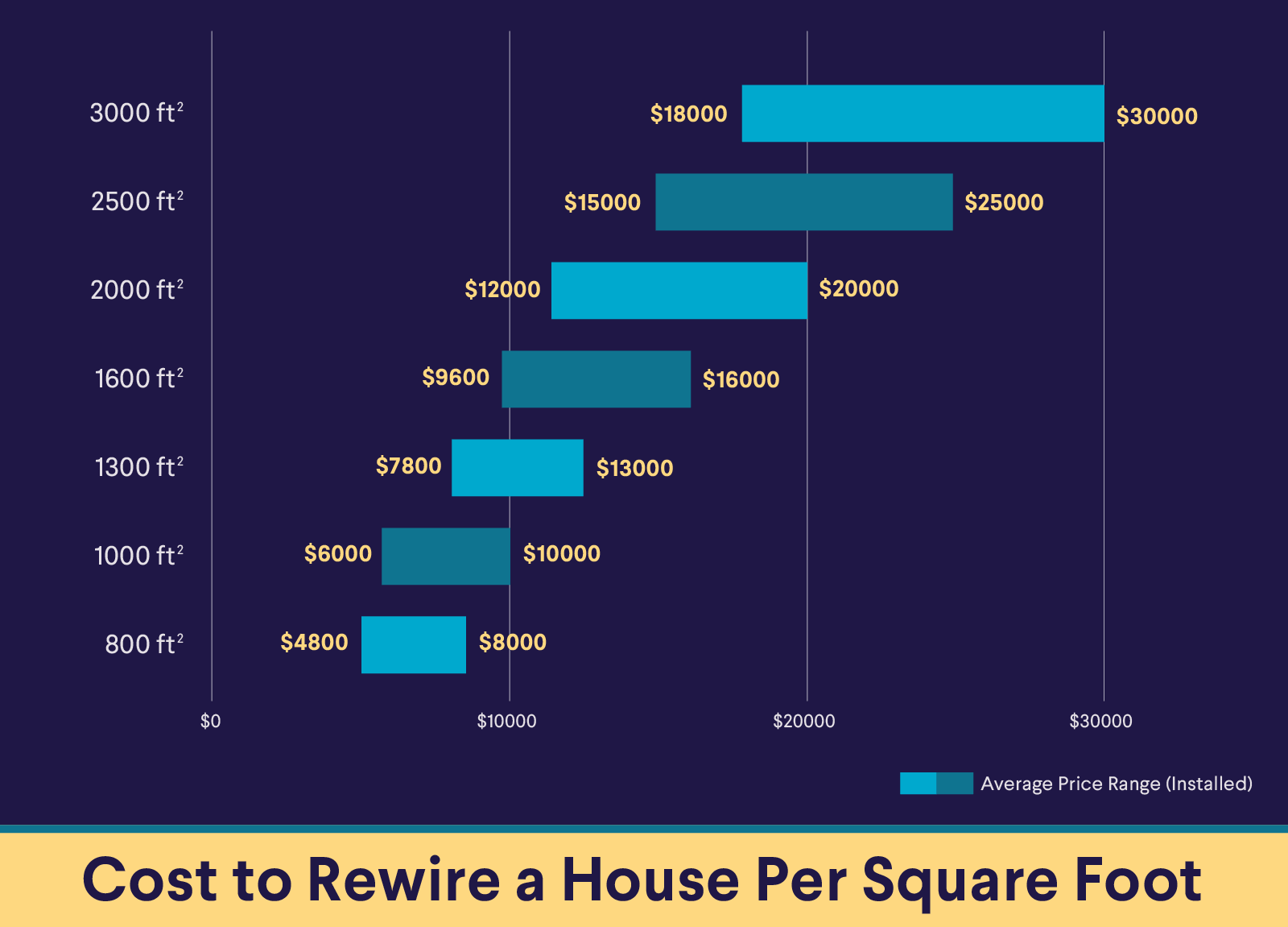
•   Rewiring costs for a house typically range from $6 to $10 per square foot.

•   A 1,300-square-foot house may cost between $7,800 and $13,000 to rewire.

•   Rewiring a 2,500-square-foot home could range from $15,000 to $25,000.

•   Factors influencing rewiring costs include house size, age, work extent, materials used, and wiring access.

•   Older and larger homes often require more extensive rewiring, increasing the overall cost.

Factors That Affect the Cost to Rewire a House

Rewiring a home involves removing the outdated wiring inside a home’s walls and installing new, modern wiring that can safely meet today’s electrical needs.

Rewiring is typically done by a licensed electrician who strips out the old wiring and runs new wiring throughout the entire house, installs a new circuit breaker panel to handle the load of the new wiring system, and ensures that building codes are met.

It can be a big job — and an expensive one, too. Let’s look at some common factors that can impact the total cost.

Size of the House

The bigger the home, the more materials and labor the job will likely require. And that can drive up the price. Rewiring a 1,300-square-foot house, for instance, runs around $7,800 to $13,000. For a 2,500-square-foot home, you can expect to pay between $15,000 to $25,000.

House’s Age

Older homes weren’t constructed with 21st century living in mind, so a rewiring project will likely cost more. Common necessities like opening a wall to reach out-of-the-way wiring ($4-$8 per square foot), upgrading outdated wiring ($200-$2,300), and replacing an electrical outlet ($125-$200) can all add to the price tag.

Extent of Work Needed

Small-scale projects are typically cheaper than larger, more complex ones. If you’re planning to set up a new alarm system, run wiring to a backyard shed, or upgrade the electric panel, you’ll likely need to adjust your budget accordingly.

Type of Wiring and Materials Used

The average cost to rewire a house is just that: average. And your own house rewire costs will vary based on the materials used in the job. Below we’ll get into the details of how different materials can affect your job costs.

Local Labor Rates and Permit Requirements

If you’re in a high cost of living area, you can expect hourly rates for electricians, drywall repair, and painting to be above national averages. This, too, will affect the cost of your job.

Recommended: How to Find a Contractor for Home Remodeling

Signs You Need to Rewire a Home

Flickering lights, outlets making a popping sound, or tripped breakers indicate that a home might need to be rewired. When buying an older home, a home inspection typically reveals if rewiring is recommended or necessary.

Even before a professional inspection, prospective homebuyers may be able to get a good idea of how the home is wired by peeking into the attic, basement, or crawl space.

Vintage charm does not extend to knob and tube wiring, which was common through the mid-1900s. The lack of a ground wire is seen as a significant fire hazard, and most carriers will deny homeowners insurance for a home that has knob and tube electrical wiring.

Another way to check for outdated wiring is to find the electrical panel and see if it has modern breaker switches or round fuses. The fuses indicate that the system is outdated, and rewiring the house might be recommended.

In almost every state, home sellers must disclose defects, but cautious buyers may still want to include the inspection contingency in the purchase contract.

If you’re living in a home with older wiring and notice that your circuit breakers trip often, lights flicker, the light switches feel warm to the touch, or there is a burning smell coming from an outlet, it’s time to schedule an appointment with an electrician and explore house rewire costs. Get ready to encounter one of the more common home repair costs

Cost to Rewire a House Per Square Foot

What’s Involved in the Rewiring Process?

Rewiring a house can be a costly endeavor in part because it is a complex process. After all, most of those wires are inside your walls. Depending on the extent of the job, rewiring could involve any or all of the following: Replacing or adding circuits; running new wire through walls, ceiling, and floors; replacing (and potentially adding) outlets and switches; installing ground fault circuit interrupters, which are often required by building codes in areas with potential exposure to moisture such as kitchens and bathrooms. After the work is done, the electrical contractor will test the system.

Filing for building permits before the work and managing an inspection once it is done will also likely be necessary. And in some jobs, an electrical service upgrade will be needed to bring more power to the home. This adds to cost and complexity.

Now let’s look more closely at how much does it cost to rewire a home based on the type of materials being used.

Cost to Rewire a House Per Material

The cost of rewiring a house depends on square footage and how easy or difficult it is to access the space. But the wiring and cable materials can also have an impact. Let’s take a look:

•   Used in most homes, nonmetallic (NM) cables are easy to install, flexible, and cost-effective. If you’re rewiring these cables, expect to pay between $0.40 and $0.80 per linear foot, according to Angi.

•   Underground feeder (UF) cables are similar to NM cables, except that they’re designed to go underground or in damp areas. Rewiring UF cables costs around $0.50 to $0.75 per linear foot.

•   Durable and able to handle high temperatures, THHN and THWN wires are often used in an unfinished space, like a basement, or for hot water heaters and garbage disposals. They cost $0.80 to $1.60 per linear foot to rewire.

•   Coaxial cables have high bandwidth support and are easy to install, which once made them a go-to choice for televisions and video equipment. Today, they’re more commonly used to connect cable or satellite TV signals or for internet connectivity. These cables cost around $0.25 to $0.35 per linear foot to rewire.

Updating a doorbell or thermostat? You’ll likely be working with low-voltage wires, which are used for circuits less than 50 volts. Rewiring typically costs between $0.25 and $0.35.

Copper vs. Aluminum Wiring

As you explore rewiring the house, you may find references to both aluminum and copper wire. If your home dates to the 1970s, it may have aluminum wiring, which was used often in that era because it was light and cheap. Unfortunately, it was also more prone than copper to oxidizing and expanding, which created hazards. Copper is the preferred material and what you will likely be upgrading to. Copper’s conductivity makes it highly efficient and a lower fire risk than aluminum.

Cost of Upgrading the Electrical Panel

If the wiring in your home is outdated, it is possible that your electrical panel will also need an update to provide the level of service necessary for the needs of a modern home. A basic panel upgrade can cost $2,000 to $4,000, with additional costs for a service upgrade requiring underground wiring, for example.

Additional Costs for Smart Home or Energy-Efficient Upgrades

These days, there are abundant add-ons for any wiring project. The universe of smart-home devices seems to be expanding exponentially. A basic smart-home upgrade for your home, often done alongside a rewiring job, might run you between $2,000 and $7,000. This would include installing a hub with a smart speaker and automated door locks, thermostat, and smart lighting in several rooms. If you go all in on a smart refrigerator and other gadgets, the price could climb as high as $16,000.

Recommended: How Much Is My House Worth?

Awarded Best Online Personal Loan by NerdWallet.
Apply Online, Same Day Funding


How to Cover Your House Rewiring Costs

Rewiring a home is not a small expense. Fortunately, there are several ways to pay for it. Here’s a look at some options.

Home Equity Loans

If you’ve built up equity in your home and are facing a major rewiring project, one possible solution is a home equity loan. There are three main types of home equity borrowing to consider: a fixed-rate home equity loan, a home equity line of credit (HELOC), and cash-out refinancing. All of these use your home as collateral, meaning that if you miss payments you could face foreclosure.

Each has its pros and cons. For instance, with a fixed-rate home equity loan, you receive a lump sum payment, which you’ll pay back over a period of time with a set interest rate.

A HELOC, on the other hand, is revolving debt. As the balance borrowed is paid down, it can be borrowed again during the draw period, which typically lasts 10 years. HELOCs tend to have a variable interest rate, so payments are less predictable.

With a cash-out refinance, you can refinance your mortgage for more than what you currently owe, and then take the difference in cash that you can use to cover your renovation.

Home Improvement Loans

A home improvement loan is a type of personal loan used to fund renovations and upgrades, including rewiring a house. Once your loan application is approved, you’ll receive a lump sum of cash, which you can use to pay for home improvements. You’ll repay the loan, with interest, in regular installments over the life of the loan — typically five to seven years.

These loans are unsecured, which means your home isn’t used as collateral. As a result, they often come with a higher interest rate than a home equity loan or HELOC.

💡 Quick Tip: Check out SoFi’s home improvement loan rates to explore competitive terms and find the right financing for your renovation needs.

Credit Cards

A credit card is a fast, easy way to fund a rewiring project, and it can be a good option if you’re able to pay off the balance on the card that month. Or look for a card with an introductory 0% annual percentage rate (APR), as this allows you anywhere from six to 18 months to pay back the balance with zero interest. But keep in mind that any balance left after the promotional period ends will start accruing the card’s regular APR.

Also watch for surcharges on credit card transactions. Many tradespeople charge fees for clients using credit cards, and these can quickly add a considerable sum to a larger project.

Government Assistance or Energy Efficiency Incentives

The U.S. Department of Energy provides tax credits and rebates for certain home energy projects, so it’s a good idea to check the DOE site to see what might be available when planning your project. Local governments and utility companies may also offer incentives if your project is considered energy efficient. The U.S. Department of Agriculture also provides grants and loans to qualified low-income households looking to make home improvements. And if you are purchasing a home that needs rewiring, you may be able to finance the purchase and renovation with an FHA 203(k) loan.

Cash

Depending on the scope of the project and your budget, you may decide to dip into your savings account or withdraw money from your emergency fund, if you have one, to cover the cost of rewiring a home.

As you create a budget and weigh your financing options, look for opportunities to save money. Research how much rewiring a house costs in your area, and include a cushion in your budget for unexpected expenses. If you’re not planning to tackle the job yourself, gather quotes from reputable licensed electricians in your area and see which one can offer you the best deal.

Finally, factor in the long-term costs and benefits. Although rewiring might seem cost-prohibitive when buying a single-family home, owners may find that the cost of rewiring a house — and the peace of mind the upgrade provides — can be money well spent.

Regardless of how you choose to pay for your rewiring job, it’s a good idea to track your home improvement costs, as these records may come in handy for tax purposes if you tackle home improvement projects to increase your home’s value before selling the property.

The Takeaway

At $6 to $10 per square foot, the cost of rewiring a house may seem high. But adequate electrical panels and modern wiring can amp up your home value and prevent fires. Wondering how you’re going to pay for it all? Home equity loans, savings, credit cards, and home improvement loans are all ways to pay for the average cost to rewire a house.

Think twice before turning to high-interest credit cards. Consider a SoFi personal loan instead. SoFi offers competitive fixed rates and same-day funding. See your rate in minutes.

SoFi’s Personal Loan was named a NerdWallet 2026 winner for Best Personal Loan for Large Loan Amounts.

FAQ

Is it worth rewiring an old house?

It’s not only worth rewiring an old house, it’s an important safety measure and a way of protecting your investment. Replacing outdated wiring can help prevent a house fire and add value to the property. Plus, updated, energy-efficient fixtures are sometimes included in a remodeling job of this scope, which can potentially lower utility costs.

How much does it cost to replace all the electrical wiring in a house?

According to the home services website Angi, home owners can expect to pay anywhere from $601 to $2,590 to rewire a house. However, if you have an older, larger home, you’ll likely pay closer to $6,000.

Can a house be rewired without removing drywall?

In many cases, at least some drywall or plaster will need to be removed during a rewiring project. But talk to your electrician to see if the work can be done without disrupting your walls.

What permits or inspections are needed to rewire a house?

All but the most minor electrical work typically requires a permit, although regulations are set locally so you’ll want to explore exactly what is required in your area. Rewiring a house is quite a big job and so any costs associated with permitting should be part of the electrician’s bid.

How long does it typically take to rewire a house?

Rewiring a house can take anywhere from a few days to a few weeks, depending on the size of the job. Angi reports an average time of three to 10 days, with longer times for older and larger houses. If rewiring is happening in the context of other renovations, such as an HVAC installation or plumbing work, you can expect it to take longer. Add additional time for replacing sheetrock or plaster that has been removed and repainting the affected area.


Photo credit: iStock/Dmitriev

SoFi Loan Products
SoFi loans are originated by SoFi Bank, N.A., NMLS #696891 (Member FDIC). For additional product-specific legal and licensing information, see SoFi.com/legal. Equal Housing Lender.


¹FHA loans are subject to unique terms and conditions established by FHA and SoFi. Ask your SoFi loan officer for details about eligibility, documentation, and other requirements. FHA loans require an Upfront Mortgage Insurance Premium (UFMIP), which may be financed or paid at closing, in addition to monthly Mortgage Insurance Premiums (MIP). Maximum loan amounts vary by county. The minimum FHA mortgage down payment is 3.5% for those who qualify financially for a primary purchase. SoFi is not affiliated with any government agency.
²SoFi Bank, N.A. NMLS #696891 (Member FDIC), offers loans directly or we may assist you in obtaining a loan from SpringEQ, a state licensed lender, NMLS #1464945.
All loan terms, fees, and rates may vary based upon your individual financial and personal circumstances and state.
You should consider and discuss with your loan officer whether a Cash Out Refinance, Home Equity Loan or a Home Equity Line of Credit is appropriate. Please note that the SoFi member discount does not apply to Home Equity Loans or Lines of Credit not originated by SoFi Bank. Terms and conditions will apply. Before you apply, please note that not all products are offered in all states, and all loans are subject to eligibility restrictions and limitations, including requirements related to loan applicant’s credit, income, property, and a minimum loan amount. Lowest rates are reserved for the most creditworthy borrowers. Products, rates, benefits, terms, and conditions are subject to change without notice. Learn more at SoFi.com/eligibility-criteria. Information current as of 06/27/24.
In the event SoFi serves as broker to Spring EQ for your loan, SoFi will be paid a fee.


Tax Information: This article provides general background information only and is not intended to serve as legal or tax advice or as a substitute for legal counsel. You should consult your own attorney and/or tax advisor if you have a question requiring legal or tax advice.

Disclaimer: Many factors affect your credit scores and the interest rates you may receive. SoFi is not a Credit Repair Organization as defined under federal or state law, including the Credit Repair Organizations Act. SoFi does not provide “credit repair” services or advice or assistance regarding “rebuilding” or “improving” your credit record, credit history, or credit rating. For details, see the FTC’s website .

Third Party Trademarks: Certified Financial Planner Board of Standards Center for Financial Planning, Inc. owns and licenses the certification marks CFP®, CERTIFIED FINANCIAL PLANNER®

This article is not intended to be legal advice. Please consult an attorney for advice.

External Websites: The information and analysis provided through hyperlinks to third-party websites, while believed to be accurate, cannot be guaranteed by SoFi. Links are provided for informational purposes and should not be viewed as an endorsement.
Third-Party Brand Mentions: No brands, products, or companies mentioned are affiliated with SoFi, nor do they endorse or sponsor this article. Third-party trademarks referenced herein are property of their respective owners.

SOPL-Q126-001

Read more
A man in glasses sits in front of a laptop with papers spread around him, peering intently at the screen.

What Happens If Your Bank Account Goes Negative?

A negative account balance can happen all too easily: An automatic bill payment might hit when your account doesn’t have enough to cover it. Or maybe you lost track of purchases made with your debit card and overextended yourself.

The resulting negative bank balance can have a serious impact, leading to overdraft fees, declined transactions, and even account closure. Read on to learn more about a negative bank account balance, including ways to avoid the problem, and what to do if you wind up with a negative balance.

Key Points

•   Having a negative bank balance can result in costly fees, declined transactions, and (potentially) account closure.

•   A negative balance occurs when you make payments that exceed the funds in your account.

•   Miscalculating how much is in the account, automatic payment delays, and pending transactions are some reasons a bank account might go negative.

•   Overdraft protection can help cover the difference, but it comes with fees.

•   To avoid a negative bank balance, monitor your account, set up alerts, and consider linking accounts.

What Does a Negative Balance Mean?

A negative account balance, also known as an overdraft, occurs when you spend more money than you have in your bank account, causing the account to dip below zero. This happens when a bank allows a transaction to go through even though there are insufficient funds. The bank is effectively lending you money to cover the difference, often at the cost of an overdraft fee. The bank may also charge other fees until the balance is restored to zero or positive.

To help you visualize this, here’s an example:

•   Imagine you have $500 in your account, and you write a check for $515, because you thought you had a balance of $600.

•   If the bank pays the $515, you end up with an account balance of minus $15. That’s the difference between how much money you had in the account and how much the bank paid the person that cashed your check. The bank made up the difference.

Increase your savings
with a limited-time APY boost.*


*Earn up to 4.00% Annual Percentage Yield (APY) on SoFi Savings with a 0.70% APY Boost (added to the 3.30% APY as of 12/23/25) for up to 6 months. Open a new SoFi Checking and Savings account and pay the $10 SoFi Plus subscription every 30 days OR receive eligible direct deposits OR qualifying deposits of $5,000 every 31 days by 3/30/26. Rates variable, subject to change. Terms apply here. SoFi Bank, N.A. Member FDIC.

Common Causes of Negative Balances

Your balance goes negative when you have withdrawn more than you have in your account. This can happen if you make a transaction — such as ATM withdrawal, or debit card purchase — for an amount that exceeds the balance in your checking account.

This is when overdraft protection, if you have it, kicks in. Instead of rejecting the transaction, the bank will cover the overage, allowing your account to go negative. Typically, you repay a negative balance with the next deposit of funds.

Here’s a closer look at how a negative bank balance can occur.

Miscalculation/Mistakes

Overdrafts can happen with miscalculations and mistakes. For instance, you might overestimate how much is in your account and spend more than you actually have. Or you may forget to record a bill you paid, which could take your balance down into negative territory.

Pending Transactions and Auto-Pay Delays

It’s possible you’re not exactly sure what checks you’ve written have been cashed and what incoming checks are still pending and haven’t yet cleared. You may unwittingly make a payment or ATM withdrawal thinking you’re good, but discover you’re not.

Or perhaps you experience an auto-pay delay, when your automatic bill payment doesn’t process on the exact date it should because the due date is on a weekend or a holiday, or the transaction is taking longer than usual. If sufficient funds aren’t sitting in your account the date the payment finally processes, that could result in a negative bank account balance.

Overdraft Fees Compounding the Balance

Your bank can charge you an overdraft fee whenever you don’t have enough in your account to cover a transaction. The amount varies by bank, but the fee may be as much as $35 per transaction. Since overdraft fees may be charged per transaction, they can multiply quickly, adding even more charges to the negative balance in your account.

The Risks of Ignoring a Negative Balance

Ignoring a negative bank account balance could lead to serious consequences that could cost you money and potentially damage your financial profile. Here are some of the issues ignoring a negative bank account can trigger.

Accumulating Daily Fees

If your bank covers a transaction that puts your account in negative territory, as noted above, it will typically charge an overdraft fee — and it might continue to do so daily or every time you make a transaction. If you make multiple transactions, and/or a number of days go by before you realize you have a negative balance, these fees can add up to a significant sum.

Involuntary Account Closure

If you don’t fix your negative balance by depositing money into your account, or if you overdraw your account too often, your days as a bank customer may come to a close. The bank can opt to shutter the account, and it can be difficult to reopen a closed bank account.

ChexSystems and Credit Score Impact

If the bank closes your account due to an ongoing negative bank account balance, it will likely report the closure to ChexSystems, a consumer reporting company banks use to screen customer accounts. A negative report by this agency will stay on your record for up to five years, which could make it difficult for you to open a new bank account.

Also, a bank that closed your account due to unpaid overdrafts might sell your debt to a collection company. That, in turn, could negatively impact your credit profile and your credit score.

How Long Can a Bank Account Stay Negative? (The Timeline)

How long a bank account can stay negative depends on the specific bank and its policies. Some banks offer a 24-hour grace period for you to bring your balance back up before they charge an overdraft fee; other banks may allow you to be overdrawn for one or two days up to a certain amount (like $50.)

The 30 to 60-Day Risk Window

If you have a negative bank balance for five to seven days, some banks charge extended overdraft fees, which add even more to what you owe. After about 30 to 60 days, many banks will close down the account. At this point, they may send your account to a debt collection agency.

When Does it Get Reported to ChexSystems?

When a bank closes an overdrawn account for a negative unpaid balance, they also typically report the closed account, and the reason it was closed down, to ChexSystems. A negative report by this company can stay on your record for up to five years making it difficult to open a new bank account. In that case, your only option might be a second chance checking account.

Overdraft vs NSF: What’s the Difference?

An overdraft fee is not the same thing as a non-sufficient funds (NSF) fee. Here’s a look at the difference when it comes to overdraft vs NSF fees:

•   An overdraft fee is what a bank or credit union charges you when they have to cover your transaction when you don’t have enough funds available in your account. This fee is around $35.

•   When a financial institution returns a check or electronic transaction without paying it, they may charge a non-sufficient funds fee. It’s usually about $18. The difference is, with a non-sufficient funds fee, the bank is not covering the shortfall; they are essentially rejecting the transaction and charging you for doing so.

How to Clear a Negative Bank Balance

If you have a negative bank balance, it’s important to take action as soon as you can. The following steps can help you get back on track.

Step 1. Audit Your Transaction History

Determine what went wrong and triggered the overdraft. Check your bank account online or via your bank’s app and also see what charges haven’t been paid or received. Then, do the math. This will give you an idea of where you stand and how soon you may be back in the positive zone for your balance.

Step 2. Stop All Automatic Payments Immediately

Automating your finances can be a convenient tool, but if you are in overdraft, automatic payments could keep popping up and derailing your efforts. Stop these payments right away for all your bills so they don’t keep adding to your negative balance.

Bring the Balance to Zero

Once you understand your situation, take action. Deposit enough money to bring your account balance to zero — and even better, deposit funds to put your balance firmly in the positive zone again. Ideally, put in enough to give yourself some cushion to help protect from future overdrafts.

Recommended: Savings Goal Calculator

Ask for Fee Forgiveness

Make a request to your bank to have your fees waived. They may be feeling generous, particularly if this is your first offense.

If your bank won’t waive the fees, go ahead and pay what you owe. If you don’t, you’ll just make your situation worse, meaning the bank could close your account and turn the matter over to debt collection. Taking action sooner rather than later to protect your bank account is usually best.

How to Prevent Future Negative Balances

There are ways to avoid a negative bank account balance. Try these strategies:

Set Up Low-Balance Alerts

Set up account alerts to let you know when your account balance reaches a certain number. If you know your account is getting low, you can take steps to avoid going into the negative balance zone. In addition, consider setting alerts to notify you before automatic deductions are made (many banks offer this option). That way, you can monitor your bank account and its balance to make sure you can cover the debit.

And be sure to check your balance regularly. “Waiting until the end of the month to check in on accounts leaves you at risk of excess spending and potentially overdrawing your checking account, “ says Brian Walsh, CFP® and Head of Advice & Planning at SoFi. “Checking in once a week leaves time to self correct and adjust your budget to help balance the numbers.”

Link a Backup Savings Account

Explore what overdraft protection your bank offers. And then carefully consider: Do you need overdraft protection? It can keep a transaction from being declined if you don’t have enough money in your account, but the overdraft fees —as much as $35 per transaction — can add up.

Instead, you may be able to link a savings account to your checking which can be tapped to cover overdrafts. It may cost you a fee for that transfer, but it’s likely not as steep as an overdraft fee. While you don’t want overdrafts to be a regular occurrence, you do want to be protected in case they crop up.

Switch to a No-Fee Bank

Another option is to look for a no-fee bank, which may not charge overdraft fees, and set up a no-fee checking and savings accounts. A growing number of banks are offering no-fee accounts, especially no-fee checking accounts, so shop around and see which one offers the best option for your needs.

The Takeaway

Having a negative bank balance means you overdrafted your account. This often triggers pricey overdraft fees, and it can lead to other financial issues such as having your account closed down if the situation isn’t remedied. To help prevent a negative balance, keep tabs on your bank account balance, set up low-balance alerts, link a savings account to your checking account for extra coverage, or consider switching to a no-fee bank.

Interested in opening an online bank account? When you sign up for a SoFi Checking and Savings account with eligible direct deposit, you’ll get a competitive annual percentage yield (APY), pay zero account fees, and enjoy an array of rewards, such as access to the Allpoint Network of 55,000+ fee-free ATMs globally. Qualifying accounts can even access their paycheck up to two days early.


Better banking is here with SoFi, NerdWallet’s 2024 winner for Best Checking Account Overall.* Enjoy 3.30% APY on SoFi Checking and Savings with eligible direct deposit.

FAQ

Does a negative bank balance affect my credit score?

A negative bank balance could potentially affect your credit score if the negative balance isn’t resolved. For example, your bank might close your account due to an unpaid negative bank account balance and sell your debt to a collection company which could negatively impact your credit score.

Can a bank take my whole paycheck to fix a negative balance?

If you don’t remedy an overdrawn account, it’s possible that a bank could eventually choose to sue you and take legal action to garnish your wages. They would typically need a court order to do this, and it’s probable that they could only take a portion of your wages rather than your entire paycheck. But it’s wise to consult a legal professional about your specific situation.

How much does it cost to have a negative balance?

Having a negative balance typically costs about $35 per transaction in overdraft fees, though the exact amount can vary by bank. The costs can add up quickly, especially if you have a negative balance for several days.

Can I open a new bank account if I have a negative balance?

You may be able to open a new bank account if you have a negative balance, but it might be challenging, depending how long you’ve had the negative balance. If it’s been more than 30 to 60 days, your current bank may close your account and report it to ChexSystems, a banking reporting agency. A negative report can stay on your record for up to five years, making it difficult to open a new account. An option to consider in this case is a second chance bank account, a type of checking account for people with a negative banking history.

What is a “forced closure” of a bank account?

A forced closure means a bank shuts down a bank account without the account owner’s consent, usually for a policy violation such as repeated overdrafts, unpaid fees, or suspicious activity. If this happens to you, contact the bank to find out the reason for the closure. Ask what can be done to remedy the situation. For example, in the case of repeated overdrafts, find out how much you owe and how to go about repaying it to avoid having the account sent to collections, which could impact your credit.


Photo credit: iStock/kupicoo

^Early access to direct deposit funds is based on the timing in which we receive notice of impending payment from the Federal Reserve, which is typically up to two days before the scheduled payment date, but may vary.

Annual percentage yield (APY) is variable and subject to change at any time. Rates are current as of 12/23/25. There is no minimum balance requirement. Fees may reduce earnings. Additional rates and information can be found at https://www.sofi.com/legal/banking-rate-sheet

Eligible Direct Deposit means a recurring deposit of regular income to an account holder’s SoFi Checking or Savings account, including payroll, pension, or government benefit payments (e.g., Social Security), made by the account holder’s employer, payroll or benefits provider or government agency (“Eligible Direct Deposit”) via the Automated Clearing House (“ACH”) Network every 31 calendar days.

Although we do our best to recognize all Eligible Direct Deposits, a small number of employers, payroll providers, benefits providers, or government agencies do not designate payments as direct deposit. To ensure you're earning the APY for account holders with Eligible Direct Deposit, we encourage you to check your APY Details page the day after your Eligible Direct Deposit posts to your SoFi account. If your APY is not showing as the APY for account holders with Eligible Direct Deposit, contact us at 855-456-7634 with the details of your Eligible Direct Deposit. As long as SoFi Bank can validate those details, you will start earning the APY for account holders with Eligible Direct Deposit from the date you contact SoFi for the next 31 calendar days. You will also be eligible for the APY for account holders with Eligible Direct Deposit on future Eligible Direct Deposits, as long as SoFi Bank can validate them.

Deposits that are not from an employer, payroll, or benefits provider or government agency, including but not limited to check deposits, peer-to-peer transfers (e.g., transfers from PayPal, Venmo, Wise, etc.), merchant transactions (e.g., transactions from PayPal, Stripe, Square, etc.), and bank ACH funds transfers and wire transfers from external accounts, or are non-recurring in nature (e.g., IRS tax refunds), do not constitute Eligible Direct Deposit activity. There is no minimum Eligible Direct Deposit amount required to qualify for the stated interest rate. SoFi Bank shall, in its sole discretion, assess each account holder's Eligible Direct Deposit activity to determine the applicability of rates and may request additional documentation for verification of eligibility.

See additional details at https://www.sofi.com/legal/banking-rate-sheet.

We do not charge any account, service or maintenance fees for SoFi Checking and Savings. We do charge a transaction fee to process each outgoing wire transfer. SoFi does not charge a fee for incoming wire transfers, however the sending bank may charge a fee. Our fee policy is subject to change at any time. See the SoFi Bank Fee Sheet for details at sofi.com/legal/banking-fees/.
*Awards or rankings from NerdWallet are not indicative of future success or results. This award and its ratings are independently determined and awarded by their respective publications.

Financial Tips & Strategies: The tips provided on this website are of a general nature and do not take into account your specific objectives, financial situation, and needs. You should always consider their appropriateness given your own circumstances.

Disclaimer: Many factors affect your credit scores and the interest rates you may receive. SoFi is not a Credit Repair Organization as defined under federal or state law, including the Credit Repair Organizations Act. SoFi does not provide “credit repair” services or advice or assistance regarding “rebuilding” or “improving” your credit record, credit history, or credit rating. For details, see the FTC’s website .

Third-Party Brand Mentions: No brands, products, or companies mentioned are affiliated with SoFi, nor do they endorse or sponsor this article. Third-party trademarks referenced herein are property of their respective owners.

Third Party Trademarks: Certified Financial Planner Board of Standards Center for Financial Planning, Inc. owns and licenses the certification marks CFP®, CERTIFIED FINANCIAL PLANNER®

SOBNK-Q126-004

Read more
Two women smile as they pick out fresh eggs at a market, perhaps discussing the average cost of a dozen eggs.

Average Cost of a Dozen Eggs by State

As of January 2026, the average cost of a dozen eggs in the U.S. is $3.59, according to data from the U.S. Bureau of Labor Statistics (BLS). This is lower than in previous years, including the $4.71 consumers paid on average in 2025, when concerns about egg shortages sent the cost of eggs skyrocketing.

Why does knowing the cost of a dozen eggs today matter? If you’re trying to manage your household budget, then keeping food costs as low as possible might be a priority. Where you live can play a part in determining how much you’ll pay for a dozen eggs.

Key Points

•   Egg prices in the U.S. average $3.59 per dozen as of January 2026.

•   Avian flu, severe winter weather, and inflation drove egg prices up in 2025, but they’re slowly starting to return to normal pricing.

•   Hawaii and California have some of the highest egg prices in the country.

•   The USDA predicts egg prices will decrease to $2.16 per dozen as 2026 progresses.

•   Shopping at farmer’s markets and buying in bulk can help consumers find cheaper eggs.

What Is the Average Cost of a Dozen Eggs Today?

On average, Americans are paying $3.59 for a dozen Grade A large eggs, based on the BLS data. That price reflects the most recent Consumer Price Index (CPI) data available as of January 2026. The CPI Consumer Price Index tracks prices for a basket of consumer goods and services over time.

In tracking egg price data, the CPI looks at average numbers by city, rather than state. Prices are based on the cost of a dozen eggs only and don’t take into account pricing for smaller or larger quantities of eggs sold, or pricing for different sizes of eggs. The CPI’s egg price data offers a snapshot of how egg prices have moved up or down over time. The average cost of a dozen eggs increased sharply in the beginning of 2023, declined for a while, and then began going back up in July 2024. Whether you live alone or are supporting a family, these types of fluctuations can impact your grocery budget.

If you’re trying to manage a higher-than-normal grocery bill, tracking your spending can help.

Check your credit score for free. Sign up and get $10

in rewards points on us.*


RL24-1993217-B

Where the Cost of Eggs Is Highest

As evidenced by the price data, some states are more expensive than others when it comes to what you’ll pay for a dozen eggs on average. In descending order, here are the 10 states that had the highest cost overall for a dozen eggs:

•   Hawaii

•   Florida

•   Alabama

•   Nevada

•   California

•   Arizona

•   Georgia

•   Maine

•   Wyoming

•   Colorado

Where the Cost of Eggs Is Lowest

Where is the average cost of a dozen eggs the cheapest? Shoppers paid the least for a dozen eggs in these states:

•   Missouri

•   Nebraska

•   Indiana

•   Ohio

•   Kansas

•   Iowa

•   Kentucky

•   Pennsylvania

•   Alaska

•   West Virginia

As you can see, most of these states are located in the central, southern, and eastern U.S., though Alaska is the outlier. Assuming food costs are lower overall in these states, the average grocery budget for a family of five is likely to be less compared to the states where eggs are more expensive.

Why Did the Cost of Eggs Increase in 2025?

The spike in egg prices in early 2025 was largely fueled by scarcity. An outbreak of avian flu sent egg production into decline as more than 20 million laying hens were lost to the disease or depopulation efforts just in the last quarter of 2024. With fewer eggs in supply but demand not easing, egg prices began to climb. Severe winter weather events across the country didn’t help matters.

But inflation can also be pointed to as a contributing factor to rising egg prices. In simple terms, inflation is a rise in prices for things consumers buy, like eggs and other household items. Knowing how to find the inflation rate and what’s considered to be a normal range matters for making the most of your money.

You don’t need a money tracker to know that when inflation is higher, everything costs more and your money doesn’t go as far. A difference of a few cents in the price of a dozen eggs might not seem like much. But when everything else is going up in price too, and inflation doesn’t appear to be easing any time soon, it can take a serious toll on your wallet.

When Will the Cost of Eggs Go Down?

Egg prices spiked in early 2025 but have since gone down to normal levels, averaging $3.59 per dozen as of 2026.

Monitoring prices for different goods and services can help you stay on top of your budget. Making and sticking to a spending and savings plan is one of the most basic steps for building wealth and increasing your net worth. Being able to measure your liquid net worth can give you an idea of how well you’re doing financially when it comes to accumulating assets and paying down debt.

Tips on How to Shop for Cheap Eggs

Shopping for eggs on the cheap can save you money and make it easier to live below your means. Living below your means benefits you in a few ways. For one thing, you may be less reliant on credit cards to cover expenses if you always have extra cash in your budget. And for another, it can make it easier to adapt to economic changes that can affect your budget and spending.

With that in mind, here are a few quick tips to help you pay less for eggs.

•   Shop the farmer’s market. Buying eggs locally from a farmer’s market vs. a supermarket could save you money if you’re able to find lower prices. You may even be able to work out a barter or trade with a local farmer or neighbor who has a backyard flock, which could allow you to get eggs for free.

•   Choose store brands. Store-brand products, including eggs, typically cost less than name-brand ones. If you’re not partial to any one egg brand, you may save a little money by choosing your local store’s brand.

•   Buy eggs in bulk. Buying in bulk could save you money if you’re paying a lower unit price per egg. But the catch is that you have to be sure you’re actually going to use them all; otherwise, you could be wasting money.

•   Use fewer eggs. A simple way to save money on eggs is to not consume as many. For instance, you might opt to get your daily protein from other sources or swap out your favorite baking recipes for ones that don’t incorporate eggs.

•   Shop with coupons and cash back apps. Couponing may seem tedious but supermarkets make it easier by allowing you to load digital coupons to your store loyalty card. You can pair coupons with a cash back app that pays you a percentage back when you shop at partner grocery stores, which can add to your savings.

The Takeaway

The average cost of a dozen eggs might not be something you think about on a day-to-day basis. But knowing how much you’ll pay for eggs matters when it’s time to go to the grocery store and do your weekly shopping. Keeping an eye on egg prices and implementing some different hacks for finding cheap eggs can help you keep your food budget in check.

Take control of your finances with SoFi. With our financial insights and credit score monitoring tools, you can view all of your accounts in one convenient dashboard. From there, you can see your various balances, spending breakdowns, and credit score. Plus you can easily set up budgets and discover valuable financial insights — all at no cost.

See exactly how your money comes and goes at a glance.

FAQ

How much did a dozen eggs cost in 2023?

As of July 2023, the average cost of a dozen eggs was $2.09, according to Consumer Price Index data. Overall, egg prices were on the decline by mid-2023 after peaking at $4.82 on average per dozen at the beginning of the year.

What state has the most expensive eggs?

Hawaii residents pay the most for a dozen eggs. On average, a dozen eggs there costs just under $10.

Do eggs last longer than sell by date?

Eggs can stay fresh past the sell by date, but there are limits on how long you’ll be able to use them. A simple way to tell if an egg is fresh is to place it in a glass or bowl of water. Eggs that float to the surface are no longer fresh, while ones that lie flat on their side are the freshest.


Photo credit: iStock/nd3000

SoFi Relay offers users the ability to connect both SoFi accounts and external accounts using Plaid, Inc.’s service. When you use the service to connect an account, you authorize SoFi to obtain account information from any external accounts as set forth in SoFi’s Terms of Use. Based on your consent SoFi will also automatically provide some financial data received from the credit bureau for your visibility, without the need of you connecting additional accounts. SoFi assumes no responsibility for the timeliness, accuracy, deletion, non-delivery or failure to store any user data, loss of user data, communications, or personalization settings. You shall confirm the accuracy of Plaid data through sources independent of SoFi. The credit score is a VantageScore® based on TransUnion® (the “Processing Agent”) data.

Financial Tips & Strategies: The tips provided on this website are of a general nature and do not take into account your specific objectives, financial situation, and needs. You should always consider their appropriateness given your own circumstances.

Third-Party Brand Mentions: No brands, products, or companies mentioned are affiliated with SoFi, nor do they endorse or sponsor this article. Third-party trademarks referenced herein are property of their respective owners.

Third Party Trademarks: Certified Financial Planner Board of Standards Center for Financial Planning, Inc. owns and licenses the certification marks CFP®, CERTIFIED FINANCIAL PLANNER®

SORL-Q126-005

Read more
TLS 1.2 Encrypted
Equal Housing Lender